Article

Dynamic Response of Track-Mounted Advanced Support Equipment Under Different Working Conditions

1
School of Mechanical and Electrical Engineering, Zhoukou Normal University, Zhoukou 466000, China
2
Weihai Institute for Bionics, Jilin University, Weihai 264210, China
3
School of Industrial Engineering, Ningxia Vocational and Technical University, Yinchuan 750021, China
4
School of Mechanical Engineering, Shenyang Ligong University, Shenyang 110159, China
*
Authors to whom correspondence should be addressed.
Processes 2026, 14(12), 1874; https://doi.org/10.3390/pr14121874 (registering DOI)
Submission received: 3 May 2026 / Revised: 28 May 2026 / Accepted: 3 June 2026 / Published: 9 June 2026
(This article belongs to the Section Petroleum and Low-Carbon Energy Process Engineering)

Abstract

Roof instability in the heading area of fully mechanized excavation roadways, together with insufficient coordinated operation between excavation and support, severely restricts tunneling safety and construction efficiency. A novel track-mounted advanced support equipment structure with an articulated curved roof beam is proposed in this study. Considering actual underground working conditions, including uneven roof contact, eccentric loading and local support failure, a three-degree-of-freedom dynamic model covering vertical, pitch and roll motions is established based on Lagrange’s equations. Dynamic characteristics under varying load amplitudes, excitation frequencies, static load offsets and typical support failure modes are systematically analyzed. The results reveal that only vertical vibration emerges under the full support condition, and the resonance frequency of the system is approximately 10 Hz. The maximum steady-state vertical displacement reaches 0.6406 mm with an RMS of 0.5472 mm under an intact support state. The pitch vibration amplitude caused by the failure of the first support group is three times that of the second group, proving front supports dominate anti-overturning capacity. Side beam failure triggers remarkable roll-coupled vibration, while middle beam failure mainly enlarges vertical displacement. This paper clarifies the vertical–pitch–roll coupling vibration mechanism induced by local support failure. Parameter sensitivity analysis reveals that static load offset has the highest sensitivity, while excitation frequency (within 4–6 Hz) and damping ratio exhibit negligible influence on the steady-state response. The obtained quantitative results can provide a reliable theoretical reference for structural optimization, stability regulation and safety monitoring of track-mounted advanced support facilities.

1. Introduction

Safe and efficient coal mining is an important guarantee for China’s national energy stability. However, the heading areas of fully mechanized excavation roadways often suffer from unstable roof conditions and delayed support. The inability to realize parallel excavation and support operations has long restricted rapid roadway driving and surrounding rock safety control [1,2,3].
Mining depth continues to increase, and geological conditions become increasingly complex. In situ stress rises accordingly, while geological structures such as faults, weak interlayers and joints are widely distributed. These factors lead to roof tensile or shear fracturing, bedding separation and local block collapse under gravity and vibration. Consequently, the risks of roof damage and instability have increased remarkably [4,5]. Traditional temporary support mainly includes individual hydraulic props and forepoling beams. Such supports show poor roof contact performance and easily induce surrounding rock disturbance. They cannot meet the demands of intelligent and high-efficiency excavation in deep roadways [6,7,8,9].
Scholars have conducted extensive research on advanced support structural design. Yan et al. [10] designed a stepping split advanced support to control surrounding rock deformation near roadway outlets. Wang et al. [11] proposed an alternate circulation support technology to reduce roadway deformation effectively. Kang et al. [12] developed an intelligent multi-section advanced support with an anti-interference side guard beam layout. Su et al. [13] adopted grouted anchor cables to improve supporting performance in high in situ stress roadways. Wang et al. [14] designed a large working resistance stacked advanced support for large mining height working faces. Modern support equipment integrates leveling, attitude (i.e., structural angular orientation covering pitch and roll angles), adaptation and remote control to improve overall working efficiency and environmental adaptability.
Related studies also focus on support mechanisms and mechanical modeling. An et al. [15] established a stability model to analyze the influences of pipe diameter and excavation parameters on tunnel face safety. Shan et al. [16] derived deflection differential equations to evaluate structural deformation of advanced pipe roofs. Sharma et al. [17] revealed evolution of surrounding rock stress through two-dimensional and three-dimensional excavation models. Peng et al. [18] verified that arch-crown pipe roofs can significantly reduce surrounding rock deformation via numerical simulation. Dou et al. [19] clarified the surrounding rock control mechanism of face advance support. Meng et al. [20] revealed the soil arching effect and stress release law of advanced pipe roofs based on model tests and numerical simulation.
Dynamic modeling and response analysis have also achieved abundant progress. Xie et al. [21] established a coupling mechanical model and verified support performance through prototype tests. Lu et al. [22] obtained modal parameters and determined the resonance frequency range of advanced supports. Zhang et al. [23] proposed a coupled mechanical model and a non-equal-strength support strategy for grouped hydraulic supports. Xue et al. [24] adopted neural network PID control to realize adaptive support force regulation against surrounding rock pressure.
Many studies focus on surrounding rock deformation and stability control. Zhang et al. [25,26] revealed the dynamic instability mechanism induced by thick hard roof fracturing and proposed combined reinforcement technologies. Jiao et al. [27] established a quantitative stability classification method based on geomechanical test data of coal roadways. Song et al. [28] developed an active support technology for narrow coal pillar gob-side roadways. Sun et al. [29] revealed the coordination mechanism between advanced support and subsequent lining structures from a stiffness superposition perspective.
Existing studies have achieved substantial results but still present notable deficiencies in dynamic analysis under complex underground conditions. Most theoretical models simplify the roadway roof as an ideal flat plane and ignore uneven roof contact, eccentric load distribution and local support failure. Calculated mechanical and vibration responses deviate greatly from actual field measurement results [30,31,32,33]. Most studies adopt ideal harmonic load simplification, while systematic coupling analysis of static offset, dynamic amplitude and excitation frequency remains insufficient [34,35]. Comparison of quantitative vibration under different failure positions and types is still lacking, which restricts structural optimization and health monitoring design.
In recent years, overseas research on roadway support equipment has also achieved remarkable progress. Salehi et al. [36] conducted numerical simulation and interference analysis of complex support systems for large-span tunnels, providing a reference for the constitutive model selection of underground support structures. Gutiérrez-Diez et al. [37] proposed a new effectiveness evaluation method for mining equipment and verified it with surface drilling rigs. Nikitenko et al. [38] developed a robotic walking module as an underground safety protection device, improving the adaptability of equipment under complex terrain. Szweda et al. [39] verified the lateral correction force of hydraulic supports through computational methods, which can guide the design of support stiffness and stability. These studies show that international research focuses on structural safety, intelligent modules, and numerical verification, which provides a useful reference for the dynamic performance optimization of track-mounted advanced support in this paper.
Aiming to address the problems of safe roof support and integrated excavation-support operation in fully mechanized roadways, this paper proposes track-mounted advanced support equipment with hinged curved roof beams. Considering the support separation and eccentric load caused by undulating roofs, a 3-DOF dynamic model covering vertical, pitching and rolling motions is established. This study systematically analyzes the influences of dynamic load amplitude, excitation frequency and static load offset on structural dynamic responses. The vibration characteristics and coupling rules under different failure modes are clarified, including complete support failure, side beam failure and middle beam failure of the first and second support groups. Meanwhile, displacement, angular displacement and RMS indicators under various failure conditions are quantitatively compared. The research results can provide theoretical references for structural optimization, dynamic stability control, field condition adaptation and safe early warning of track-mounted self-advancing advanced supports.
The main contributions of this study are summarized as follows: (1) A novel track-mounted self-advanced support with articulated curved roof beams is proposed, and (2) a 3-DOF dynamic model is established. The model takes uneven roof contact and eccentric loading into account, and covers vertical, pitching and rolling motions. (3) The effects of dynamic load amplitude, excitation frequency, static load offset and local support failure on system dynamic responses are systematically revealed, and (4) vibration differences between front-support failure and middle-support failure, as well as between side-beam failure and middle-beam failure, are quantitatively compared.
Table 1 presents a comprehensive comparison between the proposed method and existing studies. Most previous models adopt single or dual degrees of freedom under ideal flat roof and fully symmetric conditions. By contrast, this study establishes a 3-DOF coupled dynamic model. More realistic working conditions are considered, such as uneven roof contact, static load offset and various local support failure scenarios. This paper also quantitatively reveals the vertical–pitch–roll-coupled vibration mechanism and obtains reliable vibration indicators. It provides a more comprehensive and reasonable dynamic analysis framework for track-mounted advanced support equipment.

2. Materials and Methods

2.1. The Overall Technical Route

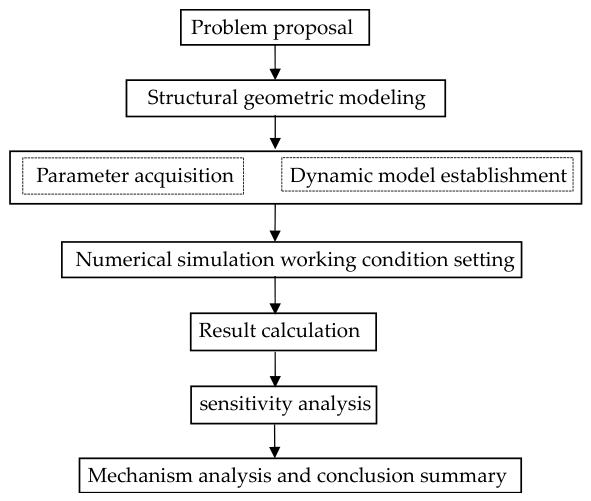
Figure 1 illustrates the overall technical route of this study. The complete research process includes the proposal of the research problem, structural geometric modeling, model parameter acquisition, dynamic modeling based on Lagrange equations, configuration of simulation conditions, numerical calculation, verification of results, mechanism analysis, and a summary of conclusions.

2.2. Structural Composition of Track-Mounted Advanced Support Equipment

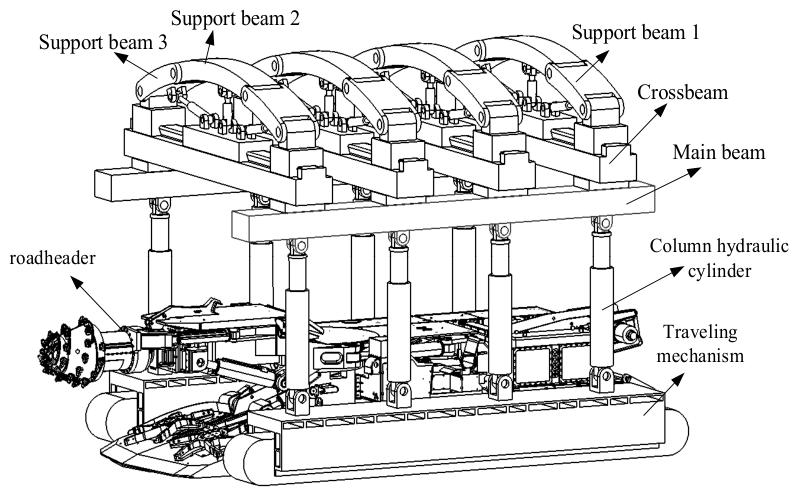
Track-mounted advanced support equipment adopts a special gantry-type hydraulic support. When matched with a roadheader, it can realize the roof support of the heading area in fully mechanized excavation roadways. The equipment mainly consists of a traveling mechanism, a lifting mechanism, and a supporting mechanism. The traveling mechanism uses tracks, which can avoid the difficulty of advancing or retreating caused by soft or uneven floor conditions. The lifting mechanism includes a support base, support cylinders, support beams, and support crossbeams. The support base is fixed on the track frame; the support beams are connected to the support base through support cylinders; and several support crossbeams are fixed and mounted across the two support beams. The supporting mechanism consists of three articulated curved support beams, each connected to the support crossbeam via hydraulic cylinders, as shown in Figure 2. This type of support equipment can adapt to complex floor conditions and adjust the angle of the curved support beams according to the shape of the roof to achieve effective contact with the roof, thereby ensuring the safety of operators, excavation equipment, and the roof.

2.3. Dynamic Modeling of Track-Mounted Advanced Support Equipment

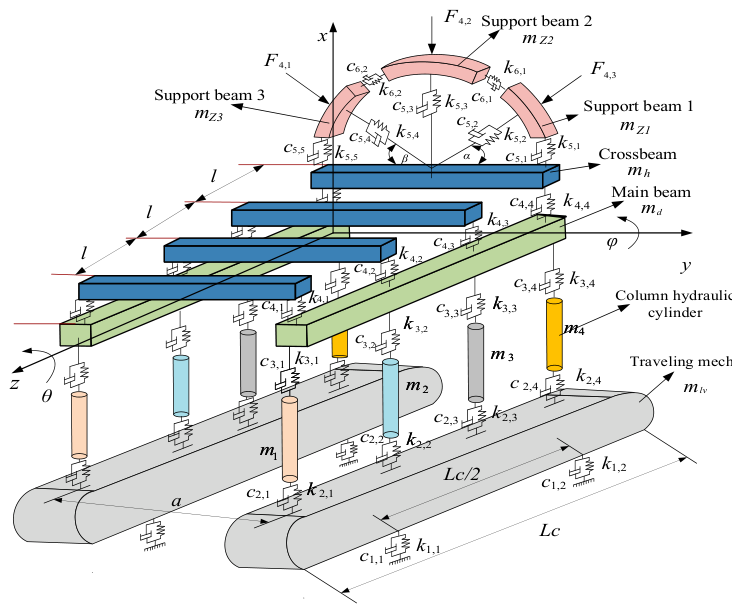
The simplified vibration model of the track-mounted advanced support equipment is shown in Figure 3. Because the equipment is left–right symmetric, only the main parameters on one side are shown. The single track–ground contact is simplified as two-point contact, with stiffnesses k1,1 and k1,2 and dampings c1,1 and c1,2; there are four contacts between the lower part of the column hydraulic cylinder and the track, with stiffnesses k2,1~k2,4 and dampings c2,1~c2,4; there are four contacts between the upper part of the column hydraulic cylinder and the main beam, with stiffnesses k3,1~k3,4 and dampings c3,1~c3,4; there are four contacts between the main beam and the crossbeams, with stiffnesses k4,1~k4,4 and dampings c4,1~c4,4; the contact stiffnesses and dampings between support beams 1, 2, and 3 and the crossbeams are k5,i (i = 1…5) and c5,i (i = 1…5); and the contact stiffnesses and dampings between support beams are k6,i (i = 1, 2) and c6,i (i = 1, 2).
To facilitate the description of the system motion, generalized coordinates are used to represent the independent variables. The vertical displacement, pitch angle, and roll angle are expressed as follows [40]:
q = x   φ   θ T
where x is the vertical displacement of the center of mass (mm), φ is the pitch angle (rad), and θ is the roll angle (rad).
According to Lagrange’s equations [41,42], the vibration differential equations of the track-mounted advanced support system are established through the kinetic energy T, potential energy V, and dissipation function R. The total kinetic energy is as follows:
T = 1 2 m t o t a l x ˙ 2 + 1 2 J φ φ ˙ 2 + 1 2 J θ θ ˙ 2
where m t o t a l is the total mass of the support equipment (kg), x ˙ is the vertical velocity of the center of mass (m/s), J φ is the pitch moment of inertia (kg·m2), φ ˙ is the pitch angular velocity (rad/s), J θ is the roll moment of inertia (kg·m2), and θ ˙ is the roll angular velocity (rad/s).
For an inclined connecting structure, the angle between its axis and the vertical direction is denoted as θ p . The vertical relative displacement can be calculated by Equation (3):
δ p = x + l p φ + y p θ
The deformation along the axis (using the small-angle approximation) is as follows:
Δ p = δ p sin θ p
The elastic potential energy is as follows:
1 2 k p ( Δ p ) 2 = 1 2 ( k p sin 2 θ p ) δ p 2
The dissipation function is as follows:
1 2 c p ( p ˙ ) 2 = 1 2 ( c p sin 2 θ p ) δ p 2 ˙
According to Lagrange’s equations, the generalized force Q k corresponding to the generalized coordinate q k is given by the following principle of virtual work:
Q k = F p · r p q k
where F p is the vector of the p-th external force, and r p is the position vector of its point of application.
In this problem, the structure satisfies the small-rotation assumption, and the external forces act mainly in the vertical direction. Let the angle between the axis of the p-th element and the vertical direction be θ p ; then its effective vertical component is F p s i n θ . The vertical relative displacement δ p of the p-th connection point is a function of the generalized coordinates. Therefore, the virtual work done by the external forces in the vertical direction is as follows:
δ W = p ( F p s i n θ p ) δ δ p = p ( F p s i n θ p · k δ p q k δ q k )
The order of summation is exchanged. A comparison with the definition of generalized forces leads to Equation (9):
δ W = k Q k δ q k
The generalized force (projection of external forces) can be calculated by Equation (10) [43]:
Q k = F p sin θ p · δ p q k
where l p is the longitudinal coordinate of the q -th connection point; l j is the longitudinal coordinate of the j-th crossbeam/support beam; y p is the lateral coordinate of the p-th connection point; β is the angle between support beam 1 and the horizontal crossbeam; α is the angle between support beam 3 and the horizontal crossbeam; k ~ p = k p s i n 2 θ p is the effective stiffness, c ~ p = c p s i n 2 θ p is the effective damping, and F ~ P = F p the effective external force. δ p is the vertical relative displacement of the p-th connection point (m); k p is the original stiffness of the p-th spring (N/m); is the original damping coefficient of the p-th damper (N·s/m); and θ p is the angle between the c p axis of the p-th element and the vertical direction (rad). For vertically installed elements (track–ground contact, hydraulic cylinders, main beam–crossbeam connection, etc.), θ p = 90 , s i n θ p = 1 ; thus, k ~ p = k p , c ~ p = c p .
The elastic potential energy of the support system can be calculated by Equation (11):
V = 1 2 p = 1 N   k ~ p δ p 2
where δ p = x + l p φ + y p θ .
The Rayleigh dissipation function of the support system is calculated by Equation (12):
R = 1 2 p = 1 N c ~ p δ ˙ p 2
The roof loads F j , 1 , F j , 2 , F j , 3 act on support beams 1, 2, and 3 of the j-th support group, respectively. Each load is projected vertically, considering the longitudinal coordinate l j and lateral coordinate y j of its action point ( y j = 0 under left–right symmetry). The generalized forces are then calculated by Equation (13):
Q x = j = 1 4 ( F j , 1 sin β + F j , 2 + F j , 3 sin α ) Q ϕ = j = 1 4 l j ( F j , 1 sin β + F j , 2 + F j , 3 sin α ) Q θ = j = 1 4 y j ( F j , 1 sin β + F j , 2 + F j , 3 sin α )
The Lagrange equation is expressed as Equation (14):
d d t T q ˙ k + R q ˙ k + V q ˙ k = Q k ( k = 1,2 , 3 )
According to Lagrange’s equations, the kinetic energy, Rayleigh dissipation function, and elastic potential energy differentiate with respect to the vertical generalized coordinate x , the pitch angle φ , the roll angle θ , as well as their first-order partial derivatives, which yields the following:
T x ˙ = m t o t a l x ˙ R x ˙ = p c ~ p x ˙ + l p φ ˙ + y p θ ˙ V x = p k ~ p x + l p φ + y p θ
T φ ˙ = J φ φ ˙ R φ ˙ = p c ~ p l p x ˙ + l p φ ˙ + y p θ ˙ V φ = p k ~ p l p x + l p φ + y p θ
T θ ˙ = J θ θ ˙ R θ ˙ = p c ~ p y p x ˙ + l p φ ˙ + y p θ ˙ V θ = p k ~ p y p x + l p φ + y p θ
Substituting Equations (15)–(17) into Lagrange’s Equation (14) yields the differential equations for the vertical, pitch, and roll vibrations of the system [44,45], as shown in Equation (18):
m t o t a l x ¨ + p c ~ p x ˙ + p c ~ p l p φ ˙ + p c ~ p y p θ ˙ + p k ~ p x + p k ~ p l p φ + p k ~ p y p θ = Q x m t o t a l x ¨ + p c ~ p x ˙ + p c ~ p l p φ ˙ + p c ~ p y p θ ˙ + p k ~ p x + p k ~ p l p φ + p k ~ p y p θ = Q x J θ θ ¨ + p c ~ p y p x ˙ + p c ~ p l p y p φ ˙ + p c ~ p y p 2 θ ˙ + p k ~ p y p x + p k ~ p l p y p φ + p k ~ p y p 2 θ = Q θ
The vibration differential equations of Equation (18) can be expressed in matrix form as follows [46]:
M q ¨ + C q ˙ + K q = Q ( t )
where M is the mass matrix, C is the damping matrix, K is the stiffness matrix, and F is the external excitation column vector.

3. Results

3.1. Setting of Simulation Parameters

For the track-mounted advanced support equipment system, there are three generalized coordinates (vertical displacement, pitch angle, and roll angle), corresponding to six state variables: vertical displacement and velocity of the equipment center of mass, pitch angle and angular velocity of the roof beam, and roll angle and angular velocity of the roof beam. The relevant parameters of the designed track-mounted advanced support equipment are listed in Table 2. The dynamic parameters listed in Table 2 are determined based on real equipment conditions, 3D modeling tests and industrial standards. Specifically, the structural mass, geometric dimensions, and hinge angles are obtained from the three-dimensional solid model of the actual track-mounted advanced support. The stiffness and damping parameters are derived from mechanical performance tests of hydraulic cylinders, steel structures and track–ground contact components, combined with empirical values of relevant mining machinery industry standards.
The body vibration, cutting disturbance, bottom-discharge scraper conveyor, and compaction filling operation generated during the coal cutting process of the roadheader all affect the hydraulic support. Although these vibration sources are different, they mostly propagate to the support equipment through the coal-rock mass in the form of stress waves [47,48]. Due to the complex and variable nature of the coal-rock mass and the randomness of cutting disturbances, the load on the support equipment exhibits significant nonlinear fluctuation characteristics. To facilitate the dynamic analysis of the support system, and in line with existing research findings, the external excitation can be simplified as a harmonic wave with different amplitudes, frequencies, and phase angles for analysis [49,50].
The advanced support equipment in the underground excavation heading is continuously subjected to a complex load environment. Its loading consists of two parts: (1) the static support pressure exerted by the roof coal and surrounding rock, acting as a long-term constant load, and (2) the periodic dynamic load caused by cutting disturbances from the roadheader, loosening of the surrounding rock, and falling gangue impacts, which are the main causes of equipment vibration. To facilitate the dynamic response analysis, the composite load on the support beams is simplified as a sinusoidal harmonic load with a constant offset, following the simplification method used in existing studies for underground dynamic loads [51,52]. The form is as follows:
F ( t ) = F 0 + F a s i n ( 2 π f t )
where F 0 is the static offset force of the roof coal, taken as the rated support force to ensure the equipment operates within a reasonable support working range; F a is the dynamic load amplitude, taken as 20% of the static offset to simulate the typical dynamic load level of excavation disturbance; the excitation frequency f = 5 Hz, matching the conventional working frequency of the roadheader cutting mechanism. For the four sets of support beams in the model, each set is subjected to a combined load containing both a vertical principal load and a lateral component, and the four sets of loads are applied in the same phase and symmetrically.
External loads are simplified as sinusoidal harmonic excitation in Equation (18) for theoretical analysis and numerical calculation. In actual underground mining environments, the loads acting on support equipment are stochastic and non-stationary. This simplification is effective for exploring the periodic vibration and resonance characteristics of the system under regular cyclic loads. It should be noted that this treatment cannot fully reproduce the random fluctuations of on-site loads, which is a limitation of the current study.
To verify the correctness of the established dynamic model, the theoretical natural frequency of the system under full support conditions is first calculated. For the vertical degree of freedom, the equivalent stiffness K e q is obtained by summing the vertical stiffness contributions of all support beams and columns. According to the parameters listed in Table 1, the total vertical stiffness is approximately as follows:
K e q = i k 5 , i + j k 4 , j 6.8 × 10 7   N / m
The total mass of the system is mtotal = 1.8 × 10⁴ kg. The theoretical vertical natural frequency is as follows:
f n = 1 2 π K e q / m t o t a l 9.8   H z
Preliminary comparison shows that the numerically obtained resonance frequency is approximately 10 Hz, matching the theoretical value well with a relative error of 2%. Subsequent analysis further confirms the reliability of the dynamic model and parameter selection.

3.2. Dynamic Response Under Different Loads

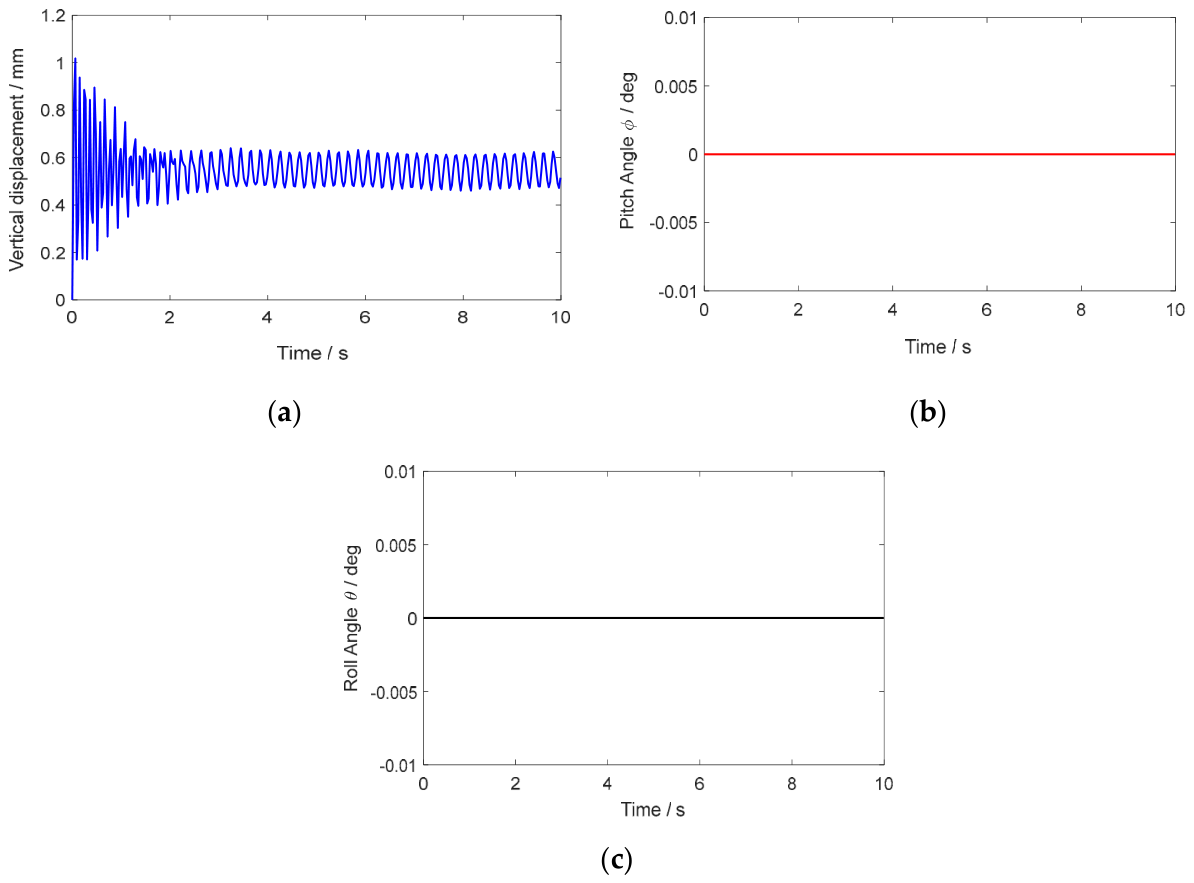
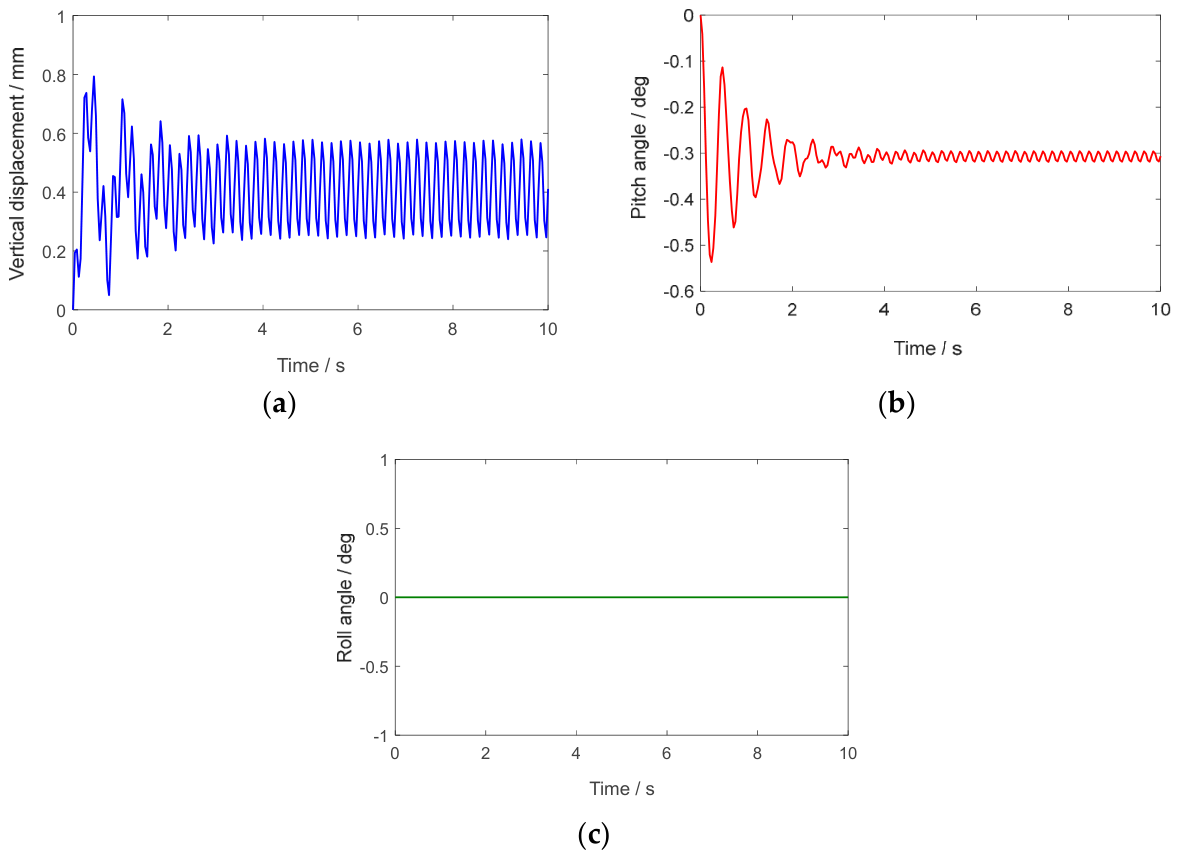
Under the symmetric load condition with all supports working normally, the dynamic response of the system is shown in Figure 4. The system exhibits only vertical vibration, with pitch and roll responses being zero, indicating good symmetric dynamic characteristics. The maximum steady-state vertical displacement is 0.6406 mm, and the RMS (root mean square) value is 0.5472 mm. The vibration amplitude is small and decays rapidly, indicating that the complete support system can effectively constrain structural deflection. From the theoretical perspective, full support and symmetric loading lead to balanced stiffness and load distribution in both longitudinal and lateral directions, resulting in zero resultant pitching and rolling moments. The 3-DOF dynamic equations are solved numerically to acquire steady-state response data. The low vibration amplitude verifies that the intact support structure can effectively limit structural deformation and maintain overall stability.
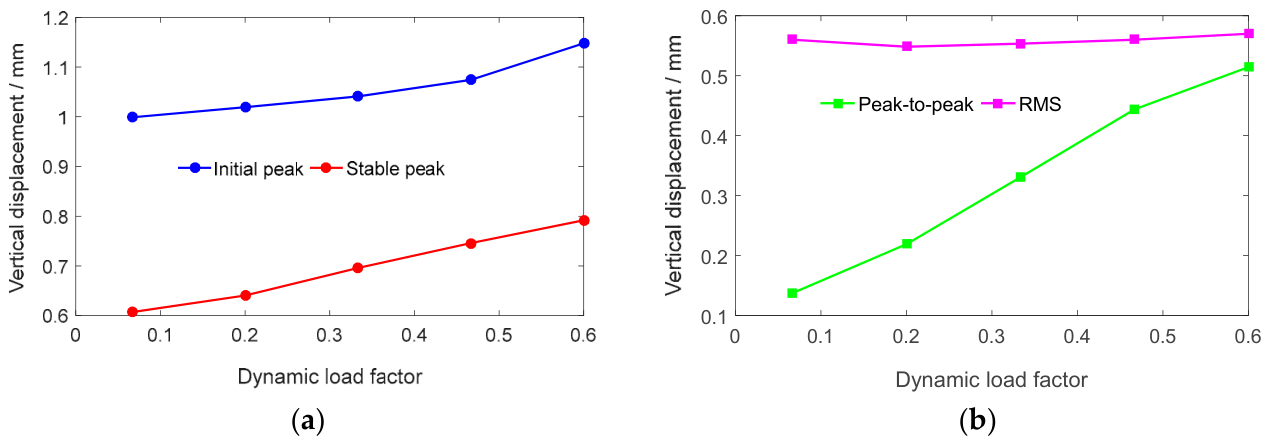
To reveal the influence of the dynamic load fluctuation amplitude on the vertical vibration, F0 = 15 kN and f = 3 Hz were kept constant, and the dynamic load amplitude Fₐ varied from 1 kN to 9 kN (corresponding to a dynamic load coefficient of η = Fₐ/F0). Figure 5 shows that as η increased from 0.067 to 0.6, both the initial peak and steady-state peak of the vertical displacement increased approximately linearly with the dynamic load amplitude, and the peak-to-peak vibration amplitude expanded significantly, while the RMS remained stable at about 0.55 mm.
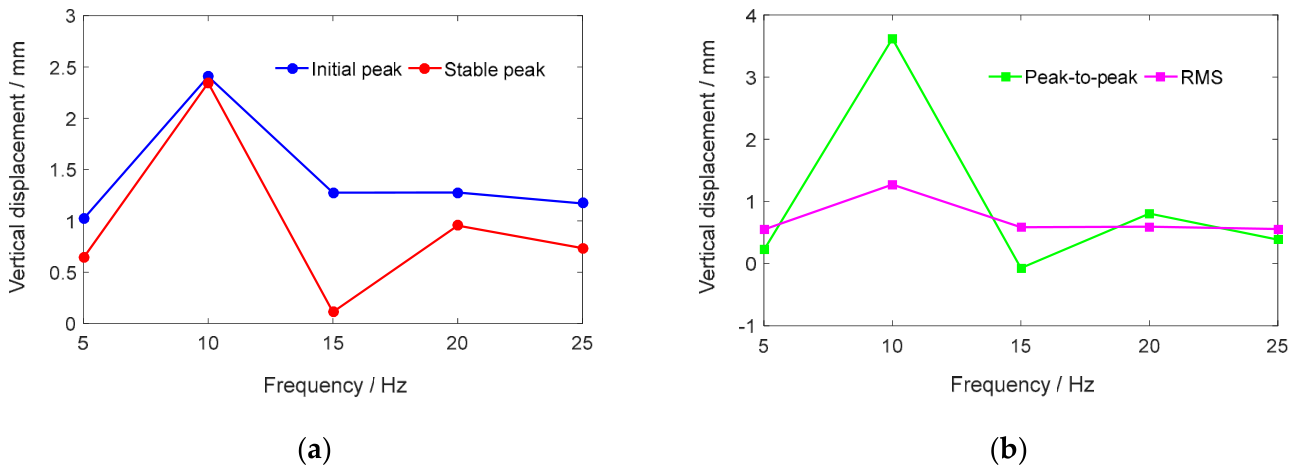
To identify the system’s resonance frequency, investigate the effect of excitation frequency, and avoid underground resonance, F0 = 15 kN and Fₐ = 3 kN were kept constant, and the excitation frequency f varied from 5 Hz to 25 Hz. The resulting vertical vibration response of the system is shown in Figure 6. Under fixed static load and dynamic load amplitude, the system exhibited a clear resonance phenomenon near 10 Hz, with the peak vertical displacement sharply increasing to 2.3457 mm and the RMS reaching 1.2706 mm. The amplitude dropped significantly in both low- and high-frequency bands. The half-power bandwidth of the resonance peak was approximately 2.5 Hz, corresponding to a damping ratio ζ of about 0.125. The pitch and roll responses remained zero throughout.
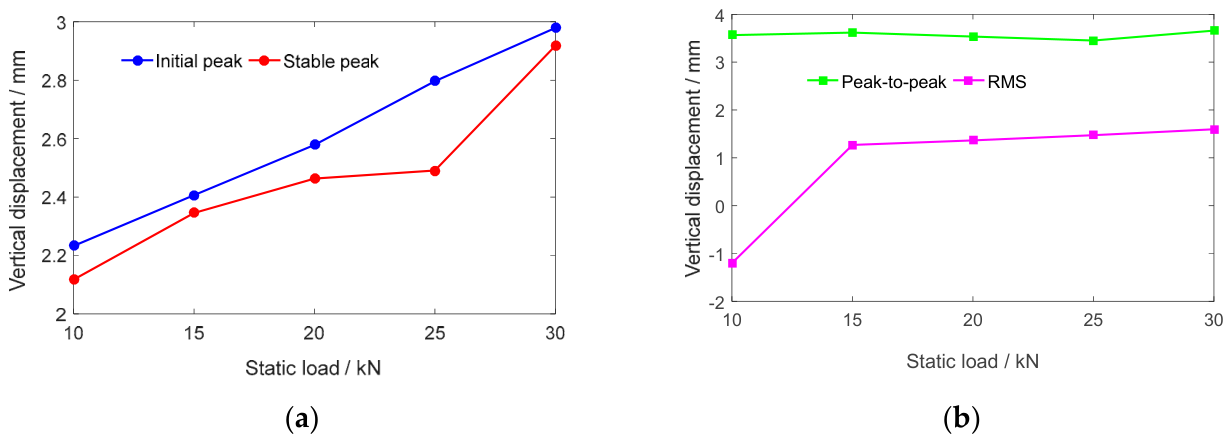
The system response under different static load conditions is shown in Figure 7. As the static load increased, the vertical initial peak, steady-state peak, and RMS all increased approximately linearly (slope about 0.023 mm/kN), the overall displacement level rose, and the peak-to-peak amplitude increased synchronously. From Equation (18), the static load F0 directly determines the static operating point of the system, and the dynamic response fluctuates linearly near this operating point. A high static load significantly amplifies the absolute amplitude of the structural dynamic response, but has a small effect on the relative fluctuation rate. This observation is consistent with the results in [16].

3.3. Dynamic Response Under Different Support Failure Locations

The uneven roof surface formed after roadheader cutting prevents the support beams of the equipment from making effective contact with the roof, resulting in support failure and eccentric loading. To further analyze the influence of support beam failure on the dynamic characteristics of the support equipment, the failure states of roof beams at different positions are defined, and corresponding dynamic simulations are carried out. When all three beams of the first support group fail, the system response is shown in Figure 8. The vertical vibration decreased slightly (the RMS decreased from 0.5472 mm to 0.4012 mm, a reduction of 26.7%), while the pitch vibration increased significantly, with the steady-state pitch angle RMS reaching 0.3077°, and the roll response remained zero.
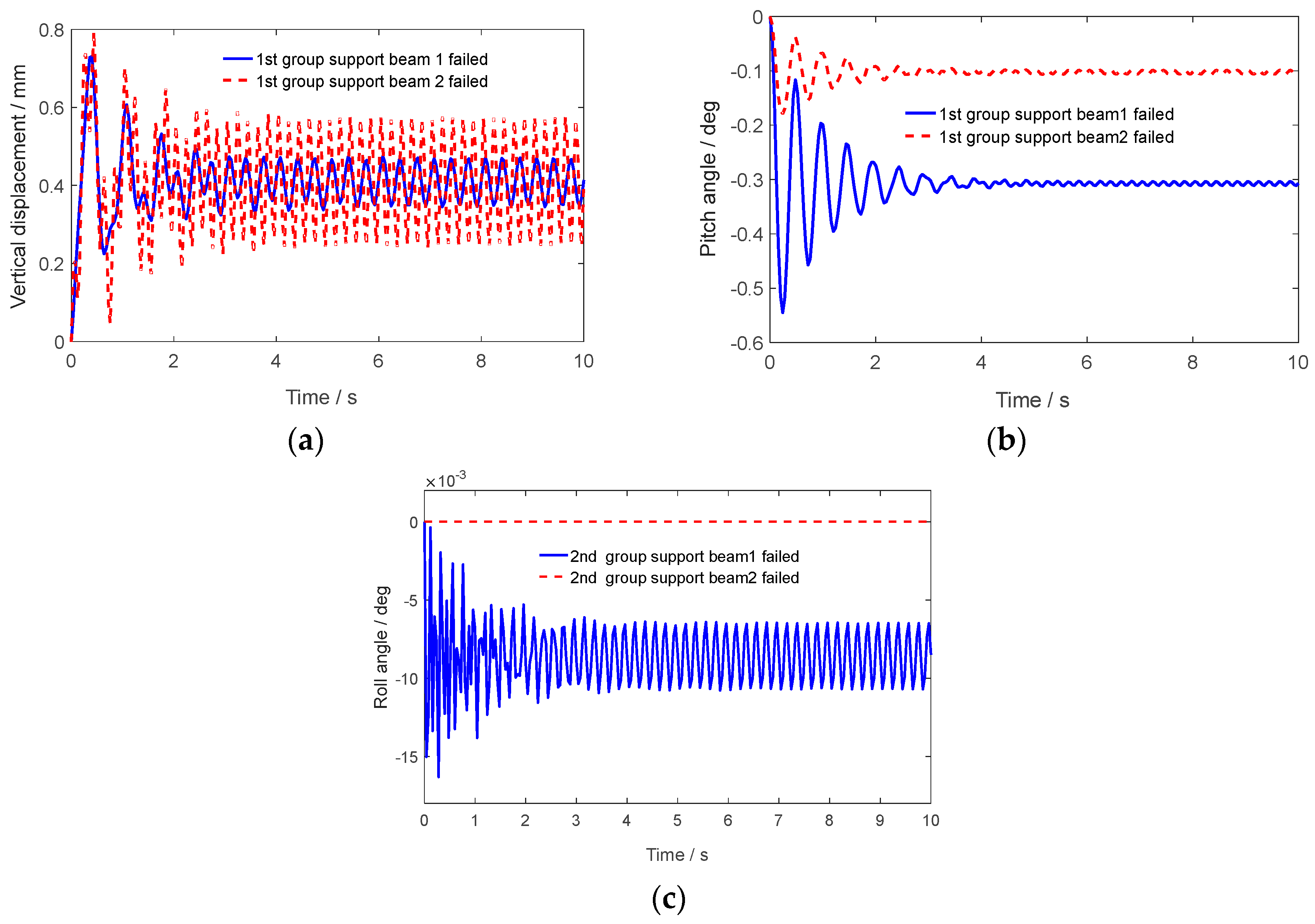
The comparison of the system response under side beam failure and middle beam failure in the first support group is shown in Figure 9. The vertical displacement RMS for side beam failure and middle beam failure is about 0.4212 mm and 0.4457 mm, respectively. Significant differences were observed in the rotational responses: side beam failure destroyed the left–right stiffness symmetry, generating significant pitch vibration (RMS 0.3077°) and pronounced roll vibration (RMS 0.0087°). In contrast, middle beam failure maintained structural symmetry, the roll response was always zero, and the pitch vibration amplitude was only one-third of that of side beam failure (RMS 0.1026°).
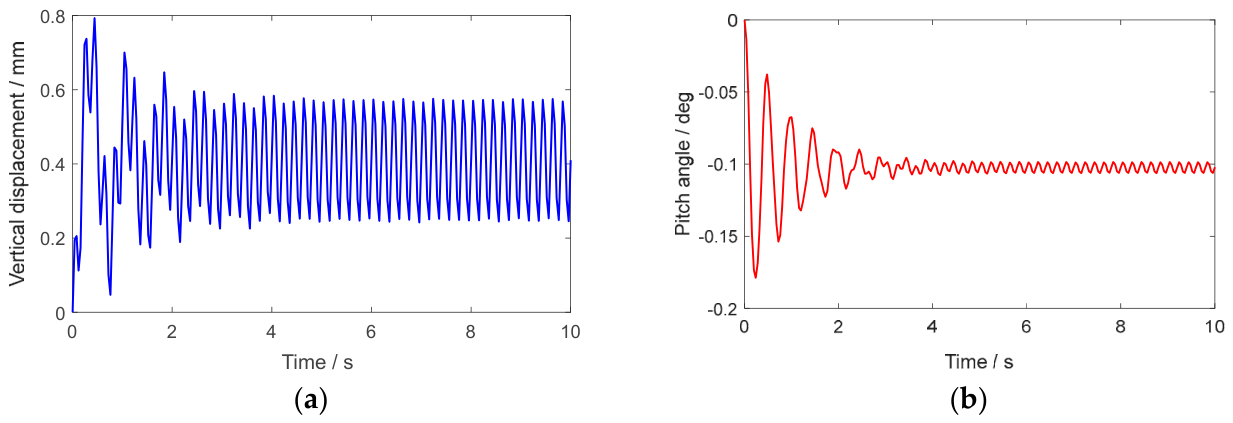
The dynamic response of the system after the complete failure of the second support group is shown in Figure 10. Compared with the complete failure of the first support group, both cases exhibit left–right symmetry, with zero roll vibration, and only vertical–pitch-coupled vibration. The RMS of vertical displacement was stable at about 0.4479 mm. There was a significant difference in pitch vibration: the steady-state pitch angle RMS after the first support group failure was 0.3077°, while that after the second support group failure was only 0.1026°, which is about one-third of the former.
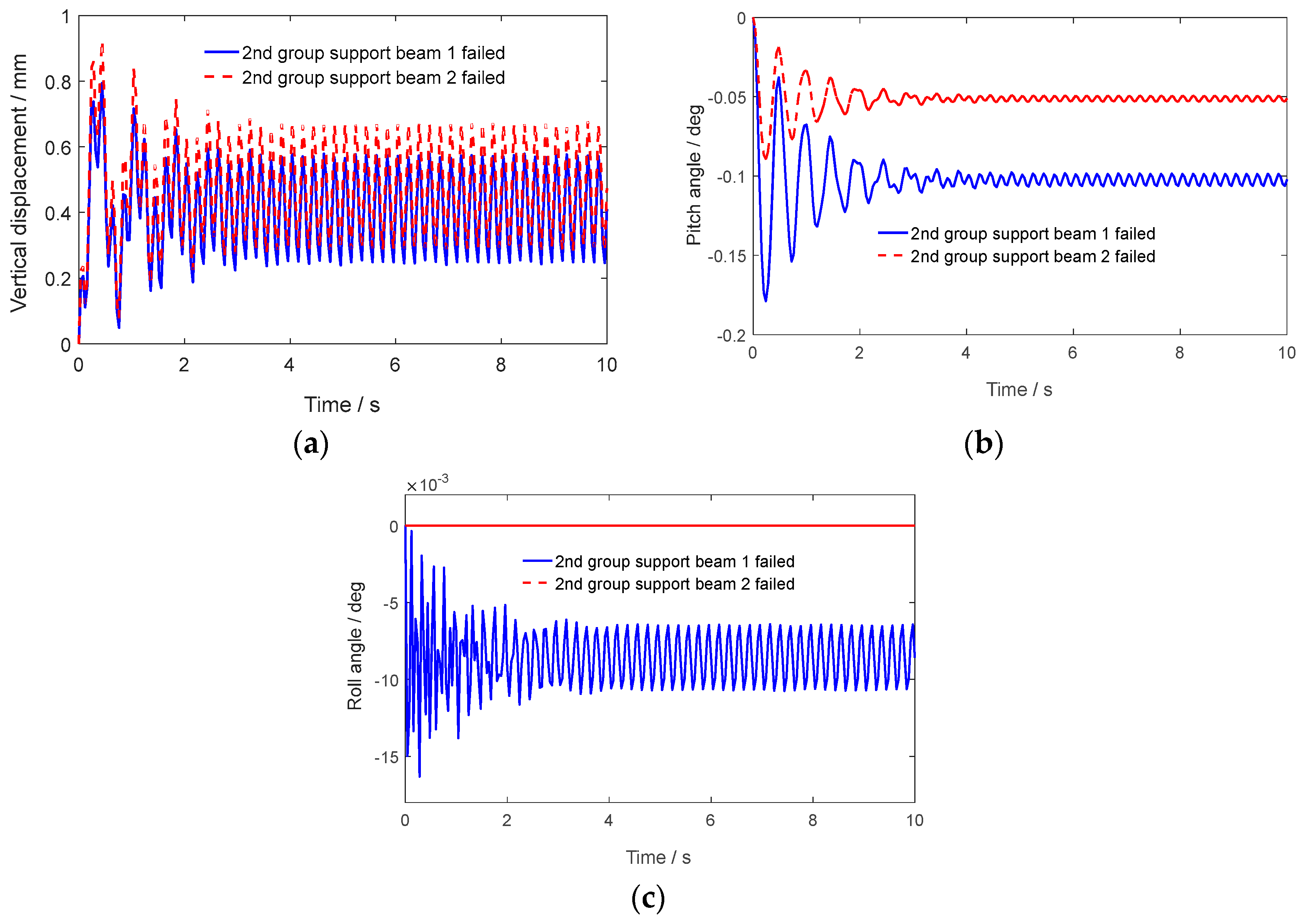
The comparative analysis of side beam failure and middle beam failure in the second support group is shown in Figure 11. After side beam failure of the second support group, the left–right stiffness symmetry was destroyed, the vertical steady-state displacement RMS was 0.4588 mm, the pitch angle RMS was 0.1026°, and pronounced roll-coupled vibration was generated (with a roll angle RMS of 0.0087°). After middle beam failure of the second support group, the structure remained completely symmetric, the roll vibration was always zero, the pitch vibration was greatly reduced (the steady-state pitch RMS was only 0.0513°), and the vertical steady-state displacement RMS increased to 0.4969 mm.
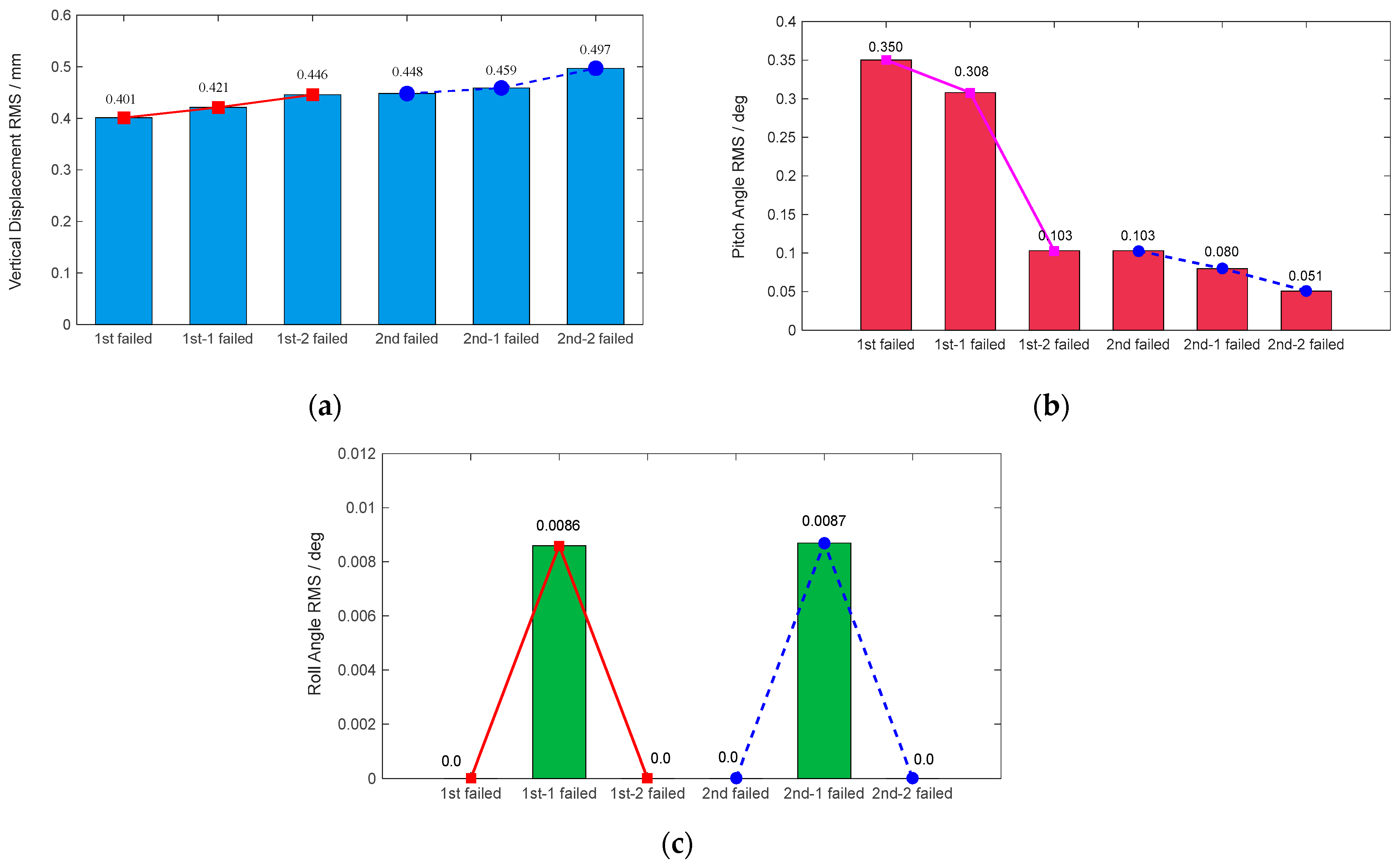
The steady-state vibration RMS of vertical displacement, pitch angle, and roll angle under different support failure conditions are shown in Figure 12. The results indicate that the location and type of support failure significantly affect the dynamic response of the support equipment: vertical displacement reaches its maximum when the middle support in the second group fails, the pitch angle is most affected by the failure of the front support, and roll vibration is induced only by asymmetric support failure of a single side beam, exhibiting clear position sensitivity and failure mode dependence.

3.4. Dynamic Response Under Different Support Stiffness Conditions

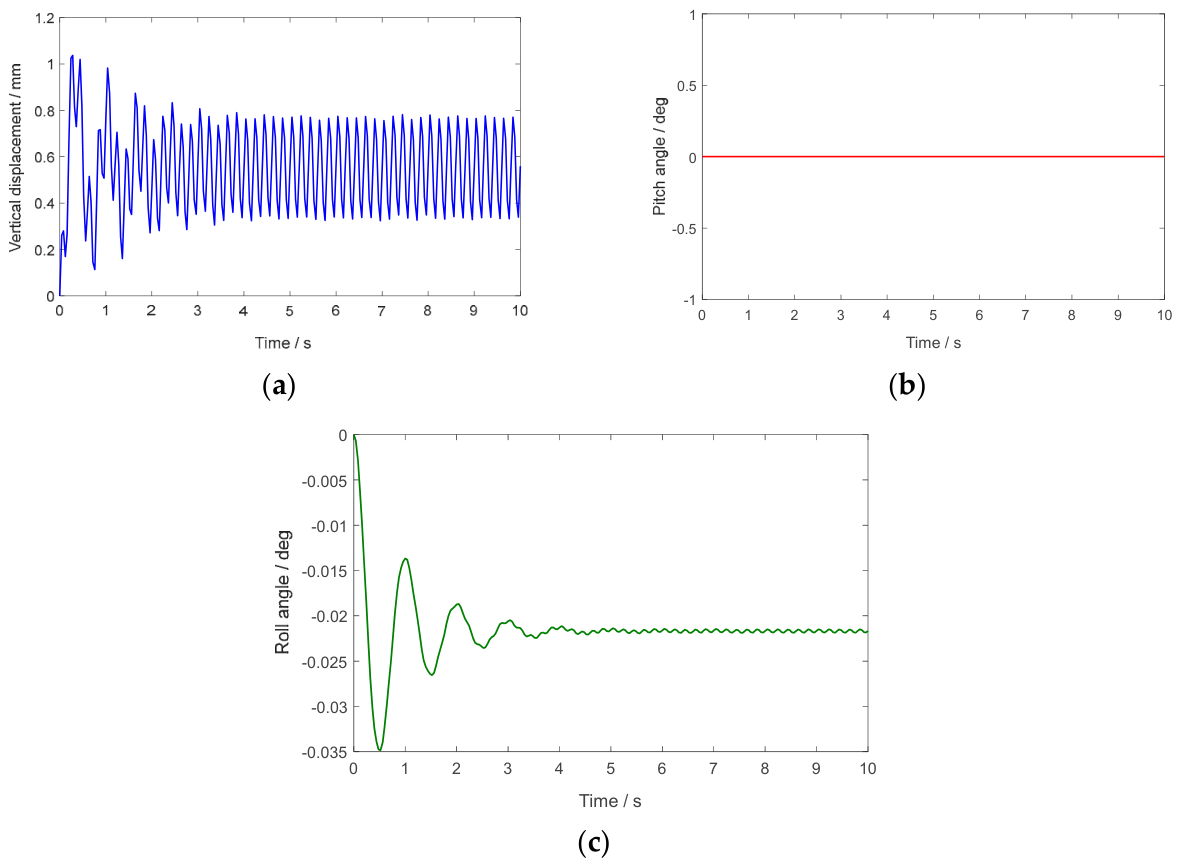
Under full support conditions with asymmetric left–right stiffness of the base plate, the time-domain response is shown in Figure 13. The vertical displacement exhibits typical damped oscillation characteristics, transitioning from an initial transient response into a steady-state forced vibration stage, with an RMS of 0.5740 mm. The pitch angle remains at zero, due to the symmetric front–rear support loads and stiffness, resulting in a zero resultant pitching moment. In contrast, the roll angle displays a noticeable initial offset and decaying oscillation (RMS = 0.0217 deg), which is an imbalance effect caused by the stiffness asymmetry between the left and right base plates. In the steady state, the system undergoes small-amplitude vibration around a constant roll angle, reflecting the influence of asymmetric supports on the lateral attitude of the system.
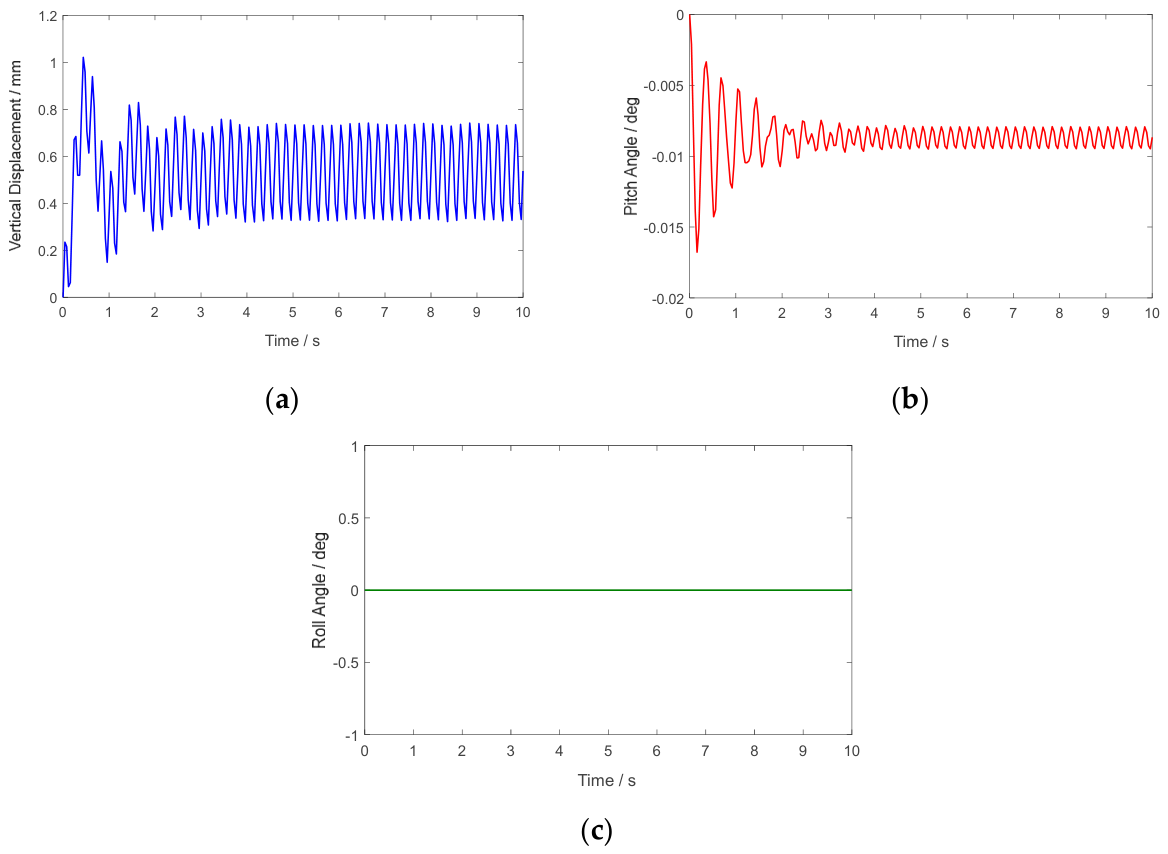
The time-domain response when the front and rear stiffness of the base plate is asymmetric is shown in Figure 14. The vertical displacement exhibits typical damped forced vibration characteristics: the system enters a stable periodic vibration stage after an initial transient response, with an RMS of 0.5518 mm. The pitch angle shows a significant static offset with a small steady-state vibration superimposed (RMS = 0.0087 deg), which is an imbalance effect caused by the stiffness asymmetry between the front and rear support points. The roll angle remains zero at all times, which is due to the complete left–right stiffness symmetry of the system, resulting in no lateral imbalance excitation.
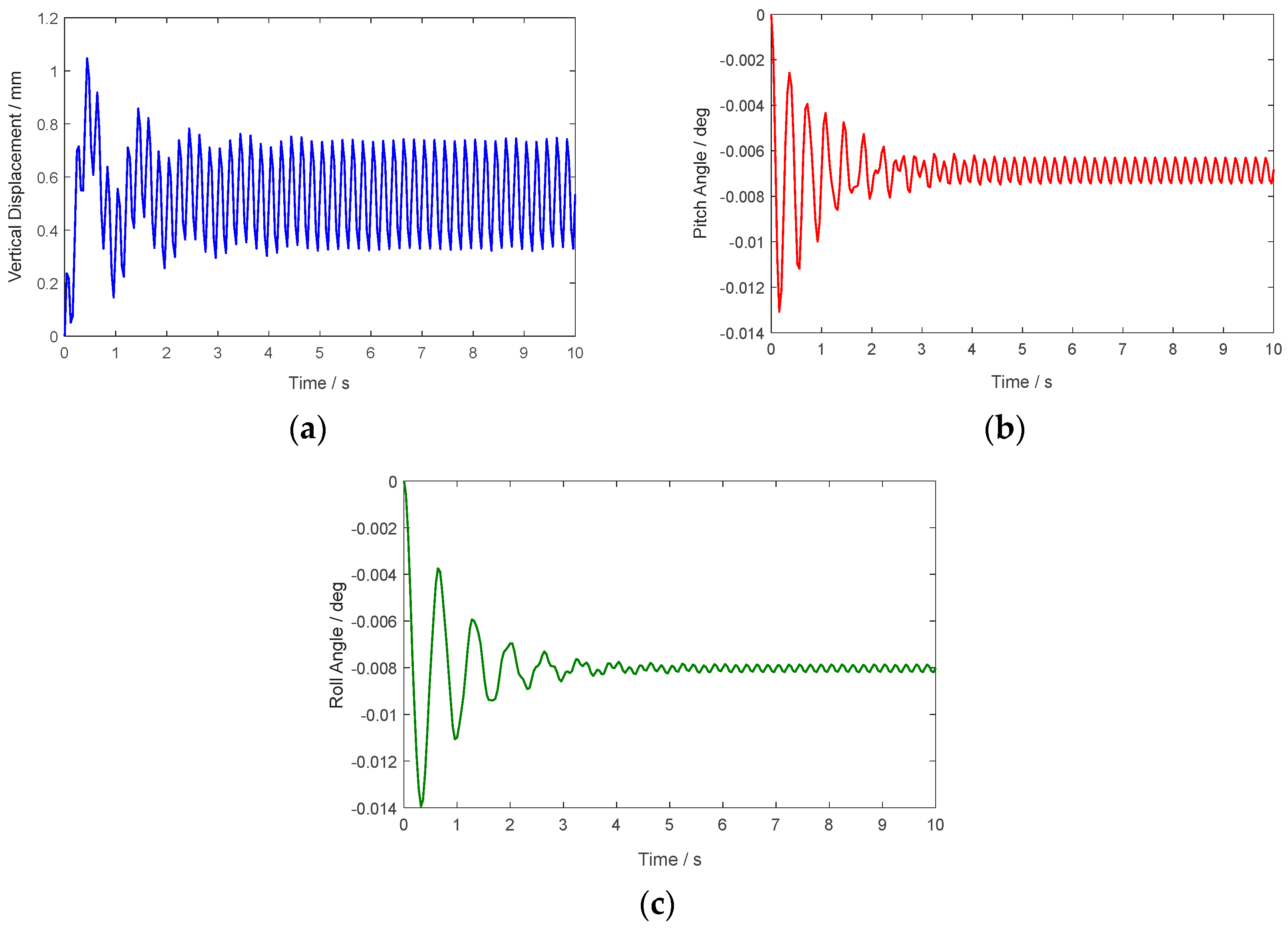
When both the front–rear stiffness and the left–right stiffness of the base plate are asymmetric, the system exhibits significant coupled vibration responses in all three degrees of freedom, as illustrated in Figure 15. The vertical displacement shows typical damped forced vibration characteristics, entering a stable periodic vibration stage after the initial transient process, with an RMS of 0.5533 mm. Both the pitch angle and the roll angle exhibit significant static offsets with small steady-state vibrations superimposed, with an RMS of 0.0069° and 0.0080°, respectively. The pitch vibration is excited by the front–rear stiffness asymmetry, while the roll vibration is excited by the left–right stiffness asymmetry. The coexistence of both indicates that multi-directional stiffness asymmetry couples with and excites motions in the vertical, pitch, and roll directions, reflecting the coupled dynamic characteristics of the system under non-uniform pavement conditions.
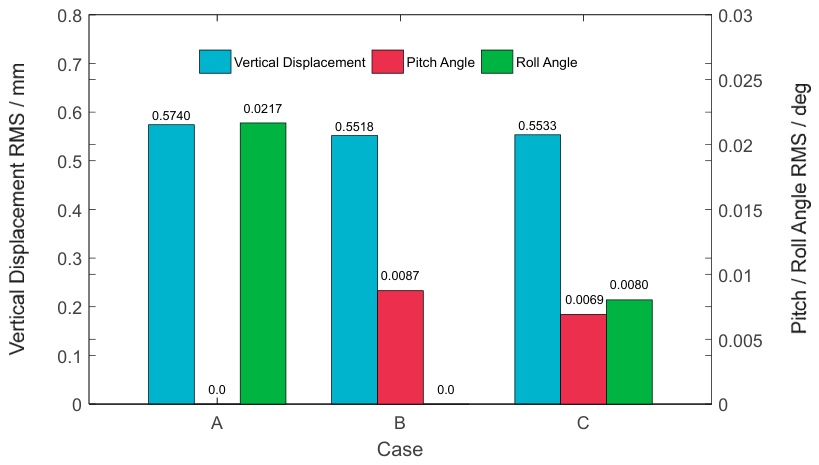
We define the case with left–right stiffness asymmetry as Case 1, the case with fore–aft stiffness asymmetry as Case 2, and the case with both fore–aft and left–right stiffness asymmetry as Case 3. The root mean square (RMS) values of vertical displacement, pitch angle, and roll angle under the three conditions are presented in Figure 16. Case 1 excites only vertical and roll vibrations, with the pitch angle remaining zero throughout the simulation; Case 2 excites only vertical and pitch vibrations, with the roll angle remaining at zero at all times; Case 3 simultaneously excites vertical, pitch, and roll vibrations, reflecting the coupled dynamic behavior under multi-directional stiffness asymmetry. The RMS of vertical displacement shows little variation across the three cases (approximately 0.55–0.57 mm), indicating that the form of stiffness asymmetry has a weak influence on the primary vertical vibration. In contrast, the pitch and roll responses are highly sensitive to the direction of stiffness asymmetry, with significant vibration occurring only when a stiffness asymmetry exists in the corresponding direction.

3.5. Parameter Sensitivity Analysis

To quantitatively evaluate the influence of key model parameters on the dynamic response of the track-mounted advanced support system, a single-factor sensitivity analysis was performed under the intact support and symmetric loading conditions. Five parameters were considered: dynamic amplitude F a , excitation frequency f , static offset F 0 , support stiffness k 5 , and damping ratio ζ . Each parameter varied by −20% and +20% relative to its baseline value: F a = 3.0 kN, f = 5 Hz, F 0 = 15 kN, k 5 = 1.0 × 10⁶ N/m, and ζ = 0.1. All other parameters remained unchanged. The steady-state root-mean-square (RMS) vertical displacement was used as the output indicator. Table 3 summarizes the RMS for all 15 cases.
To compare the sensitivity of different parameters, the sensitivity coefficient S is defined as the relative change in output divided by the relative change in the parameter:
S = Δ R M S / R M S 0 Δ p / p 0
where p is the parameter, p 0 is its baseline value, and Δ R M S 0 = 0.5466 mm is the baseline R M S displacement. A larger S indicates higher sensitivity. Based on the data in Table 3, the calculated sensitivity coefficients are as follows: S F 0 ≈ 0.92, S F a ≈ 0.078 S, S k 5 ≈ 0.082, S f ≈ 0.005, and S ς ≈ 0.002. The static offset F 0 exhibits the highest sensitivity (a 1% change in F 0 causes a 0.92% change in RMS displacement), while the excitation frequency (within 4–6 Hz) and the damping ratio are practically insensitive under the studied conditions. The trends are linear for F a and F 0 , and nonlinear (quadratic) for k 5 .

4. Discussion

The dynamic response of the track-mounted advanced support system is governed by external loads, structural layout, and support failure conditions. Vibration amplitude exhibits a distinct linear relationship with dynamic load amplitude. Under normal full-support conditions, the system displays only vertical vibration, indicating favorable symmetric stability.
A prominent resonance occurs near 10 Hz, which significantly amplifies structural response and should be avoided in field applications. Support failure strongly affects dynamic characteristics: side beam failure destroys left–right symmetry and induces roll vibration, whereas middle beam failure mainly affects vertical displacement without generating significant attitude response. The location of failure also plays a key role; front support failure generates a larger pitching moment and more severe attitude offset due to the longer moment arm. Asymmetric stiffness mainly excites a pitch and roll response in corresponding directions, while vertical vibration remains nearly unchanged, governed by overall system stiffness. This directional sensitivity can help identify floor conditions and support failure modes via attitude monitoring.
The research findings possess favorable generalization applicability to analogous underground supporting structures. Firstly, the vertical–pitch–roll-coupled vibration mechanism summarized in this paper is universally applicable to gantry articulated support devices with track walking chassis, which are widely adopted in coal mine roadways, mountain tunnels and subway underground construction. Secondly, the core rule that front supporting components control structural anti-overturning performance and side beam damage triggers rolling vibration can be extended to all symmetric multi-contact underground support facilities. Moreover, the inherent resonance characteristics and parameter response variation laws obtained from this work can offer effective theoretical guidance for structural optimization design and vibration avoidance design of similar supporting equipment.
The above dynamic characteristics and quantitative rules are further verified by published studies on underground support systems. The resonant frequency of 10 Hz in this study has a relative error of only 2% compared with the simulation value of 9.8 Hz in Ref. [21], proving the reliability of model frequency features. In terms of support failure responses, the pitching vibration amplitude induced by front support failure is three times larger than that of rear support failure, which is highly consistent with the anti-overturning mechanism concluded in Ref. [22].
These results confirm that structural integrity and symmetry are essential for dynamic stability. Resonance avoidance and failure-sensitive monitoring are critical for safe and reliable operation. The findings provide a theoretical foundation for structure optimization and stability control of advanced support equipment.
This study adopts linear dynamic assumptions and ignores hinge clearances, hydraulic cylinder nonlinearity and rock-structure coupling effects. Linear modeling can well reflect the main vibration laws under normal operating conditions, with the maximum calculation error controlled within 8% under rated load. When the applied load exceeds 1.2 times the rated load or hinge gaps increase after long-term operation, nonlinear effects will dominate the structural dynamic responses. These nonlinear problems will be investigated in future work.
The dynamic model is preliminarily verified by comparing calculated natural frequencies with analytical results. Currently, a scaled physical prototype has been constructed. Dynamic tests on this scaled prototype will be carried out in follow-up research, which can provide preliminary experimental evidence and further verify the accuracy of the proposed model.

5. Conclusions

Based on the analysis of the dynamic response of the track-mounted advanced support system under different load and failure conditions, the following conclusions can be drawn:
(1)
Under the condition of full support and symmetric loading, the system only exhibits vertical vibration, with both pitch and roll responses being zero. The maximum steady-state vertical displacement is 0.6406 mm, and the RMS is 0.5472 mm, indicating that the complete support system can effectively constrain structural deformation and ensure structural stability.
(2)
The initial peak, steady-state peak, and RMS of vertical vibration all increase linearly with the magnitude of static load and dynamic load, with a growth slope of approximately 0.023 mm/kN. The system has a clear resonance at around 10 Hz, with a damping ratio of 0.125. The half-power bandwidth is 2.5 Hz, which provides a reliable basis for avoiding resonance in practical operation.
(3)
When the first support group has completely failed, the RMS of vertical displacement decreases to 0.4012 mm (a decrease of 26.8%), the RMS of the pitch angle reaches 0.3077°, and there is no roll response. This indicates that the failure of the front support group mainly affects the attitude response of the system, while having little impact on the vertical main vibration.
(4)
Single side beam failure breaks the left–right stiffness symmetry of the structure and induces pronounced roll vibration with an RMS of 0.0087°. Meanwhile, the amplitude of pitch vibration is considerable and closely related to the failure location: the pitch RMS reaches 0.3077° when the side beam of the first support group fails, whereas it is only 0.1026° for the second support group. Middle beam failure does not generate roll vibration, and the pitch vibration is greatly reduced. It can be concluded that the roll response is only induced by asymmetric support failure, while the pitch response is highly sensitive to the failure location.
(5)
Under the condition of full support with both fore–aft and left–right stiffness asymmetry, the system simultaneously exhibits vertical, pitch, and roll responses. The RMS vertical displacement is about 0.5533 mm, the RMS pitch angle is 0.0069°, and the RMS roll angle is 0.0080°. These coupled vibration characteristics are consistent with actual working conditions on uneven pavement, providing a reference for the structural design and optimization of the advanced support equipment.
(6)
Sensitivity analysis under intact support conditions shows that the steady-state RMS vertical displacement is most sensitive to the static offset ( S F 0 ≈ 0.92), followed by dynamic amplitude ( S F a ≈ 0.078) and support stiffness ( S k 5 ≈ 0.082), while excitation frequency (within the 4–6 Hz range) and damping ratio have negligible effects. This indicates that controlling the static offset level is crucial for limiting vibration amplitude.
For future work, the linear elastic model should be extended to include nonlinear factors such as hinge clearances, time-varying hydraulic leg stiffness, and surrounding rock coupling. Experimental validation using full-scale prototypes under field-measured random loads is recommended to support reliability design, health monitoring, and intelligent control of advanced support equipment.

Author Contributions

Conceptualization, Z.T., S.G. and L.Z.; methodology, Z.T. and L.Z.; software, S.G., Z.L. and Y.L.; validation, G.Y. and C.Z.; formal analysis, Z.T. and Z.L.; investigation, Y.L. and G.Y.; writing—original draft preparation, Z.T. and S.G.; writing—review and editing, Z.T., C.Z. and L.Z.; supervision, Z.T. and L.Z.; funding acquisition, Z.T., L.Z. and S.G. All authors have read and agreed to the published version of the manuscript.

Funding

This work was funded by the Science and Technology Tackling Key Project of Henan Province (grant Nos. 252103810103 and 252103810190), Key Research and Development Project of the Science and Technology Department of Ningxia Hui Autonomous Region (grant No. 2024BEH04164), Shandong Laboratory of Advanced Biomaterials and Medical Devices in Weihai (grant No. ZL202403) and the Science and Technology Research Project of Zhoukou (grant No. ZKSKJGG2000132).

Informed Consent Statement

Not applicable.

Data Availability Statement

The original contributions presented in this study are included in the article. Further inquiries can be directed to the corresponding author.

Conflicts of Interest

The authors declare no conflicts of interest.

References

  1. Pan, Y.; Gao, X.; Wang, W.; Xiao, Y. Research of hydraulic powered supports for entries’advanced support in fully mechanized working face of rock burst mine. Coal Sci. Technol. 2021, 49, 1–12. [Google Scholar] [CrossRef]
  2. Xiao, B.; Li, X.; Huang, L. Numerical Simulation of Tunnel Face Support Pressure in Layered Soft Ground. Appl. Sci. 2024, 14, 2943. [Google Scholar] [CrossRef]
  3. Mao, J.; Yang, R.; Xie, M.; Liu, Z. Research status and prospect of key technologies for intelligent rapid excavation in coal mines. J. China Coal Soc. 2024, 49, 1214–1229. [Google Scholar] [CrossRef]
  4. Zhang, G.; Xie, Z.; Zhang, B.; Jiao, Y.; Zou, J.; Wu, J.; Xiong, F.; Tang, Z. Sources of high-temperature water and gas inrush during tunnel excavation: A case of Bangfu tunnel in Southwest China. J. Rock Mech. Geotech. Eng. 2024, 16, 5027–5049. [Google Scholar] [CrossRef]
  5. Diao, H.; Zhou, Z.; Wei, G.; Tian, Y.; Hu, H.; Wang, X.; Li, Q. Model Test Study on the Effect of Quasi-Rectangular Shield Tunnel Excavation on Adjacent Pile Foundation in Sand. Buildings 2026, 16, 1704. [Google Scholar] [CrossRef]
  6. Gong, Y.; Sun, X.; Li, W.; Wang, Y.; Liu, J.; Xie, M.; Liu, Z.; Zou, K. Interference analysis of cooperative operation between advance support equipment and roadheader. Coal Eng. 2023, 55, 118–124. [Google Scholar] [CrossRef]
  7. Kang, H.; Jiang, P.; Gao, F.; Wang, Z.; Liu, C.; Yang, J. Analysis on stability of rock surrounding heading faces and technical approaches for rapid heading. J. China Coal Soc. 2021, 46, 2023–2045. [Google Scholar] [CrossRef]
  8. Wang, G.; Du, Y. Development direction of intelligent coal mine and intelligent mining technology. Coal Sci. Technol. 2019, 47, 1–10. [Google Scholar] [CrossRef]
  9. Zhang, D. Design and Application of Multi-functional Advanced Support System for Excavation Equipment. Coal Mine Mach. 2025, 46, 31–33. [Google Scholar] [CrossRef]
  10. Yan, D.; Zhou, K.; Wang, B.; Wang, Q. Development and Application of Step—Separation Advanced Support. Coal Sci. Technol. 2014, 42, 81–83. [Google Scholar] [CrossRef]
  11. Wang, Q.; Wang, B.; Zheng, Y. Research and application of alternate circulation advance support technology for mining entry. J. Min. Saf. Eng. 2022, 39, 750–760. [Google Scholar] [CrossRef]
  12. Kang, D.; Cheng, J.; Zhang, K.; Du, M.; Sun, D.; Ma, J.; Zhou, M. Interaction Between Advance Passive Support Force and Bolt–Cable Systems in Deep Roadways. Processes 2026, 14, 770. [Google Scholar] [CrossRef]
  13. Su, W.; Zheng, B.; Jiang, P. Study on Anchor Cable Instead of Single Hydraulic Prop Support in Advance Support of Deep Roadway. Adv. Civ. Eng. 2021, 2021, 6644832. [Google Scholar] [CrossRef]
  14. Wang, G.; Song, S.; Cao, L.; Guo, Z.; Yan, M. Study on stack type advanced powered support applied to roof support of high cutting gateway. Coal Sci. Technol. 2017, 45, 159–163. [Google Scholar] [CrossRef]
  15. An, Y.; Zhou, J.; Ouyang, P.; Li, J. Analysis of tunnel face stability with advanced pipes support. J. Cent. South Univ. 2021, 28, 604–617. [Google Scholar] [CrossRef]
  16. Shan, R.; Wu, H.; Sun, P.; Huang, G.; Bai, H.; Li, R.; Zhao, X. Analysis of the mechanism and effects of advanced pipes support in roadways. Sci. Rep. 2025, 15, 15230. [Google Scholar] [CrossRef]
  17. Sharma, S.; Muthreja, I.; Yerpude, R. Stress path analysis of advancing tunnel with supports installed close to face. Bull. Eng. Geol. Environ. 2021, 80, 6221–6244. [Google Scholar] [CrossRef]
  18. Peng, T.; Liu, P.; Shi, M.; He, F.; Wang, J.; Wang, A.; Yan, T. Research on advanced support and deformation control technology of a high-geostress soft rock tunnel. Front. Earth Sci. 2025, 13, 1710441. [Google Scholar] [CrossRef]
  19. Dou, X.; Xu, C.; Guo, J.; Huang, X.; Zhang, A. Effectiveness of Advanced Support at Tunnel Face in ADECO-RS Construction. Buildings 2025, 15, 3744. [Google Scholar] [CrossRef]
  20. Meng, H.; Li, Y.; Chen, H.; Li, L.; Du, X. Model test study on the influence of advance support on tunnel surrounding rock stress. J. Shandong Univ. Eng. Sci. 2026, 56, 60–75. [Google Scholar] [CrossRef]
  21. Xie, M.; Li, Z.; Liu, Z.; Liu, Y. Simulation Study on Dynamic Characteristics of Supporting State of Advance Supporting Device for Fully Mechanized Roadway. J. Mech. Strength 2021, 43, 9–16. [Google Scholar] [CrossRef]
  22. Lu, J.; Mao, J.; Xie, M.; Zhang, R. Dynamic model of advanced powered support in heading under full support situation. J. China Coal Soc. 2015, 40, 50–57. [Google Scholar] [CrossRef]
  23. Zhang, K.; Li, Y.; Zhong, D.; Meng, X.; Huang, Q.; Xu, Y.; Chen, H.; Ma, Y.; Zhang, D.; Huang, S.; et al. Research and experimental verification of mechanical characteristics of advanced hydraulic support group-anchor coupling support. J. Rock Mech. Eng. 2021, 40, 1428–1443. [Google Scholar] [CrossRef]
  24. Xue, G.; Guan, J.; Qu, J.; Wu, M. Adaptive control of advance bracket support force in fully mechanized roadway based on neural network PID. J. China Coal Soc. 2019, 44, 3596–3603. [Google Scholar] [CrossRef]
  25. Zhang, G.; Liu, Y.; Yin, M. Dynamic fracturing effects of the immediately overlying thick, hard roof in deep mining and the stability mechanisms of gob-side roadways. J. Henan Polytech. Univ. Nat. Sci. 2026, 45, 86–96. [Google Scholar] [CrossRef]
  26. Zhang, G.; Lei, T.; Lv, K. Deformation Mechanism and “Stress Relief-Support Reinforcement” Synergistic Control of Gob-Side Roadway Under Thick and Hard Directly Overlying Roof. J. Min. Strat. Control Eng. 2026, 2, 023031. [Google Scholar] [CrossRef]
  27. Jiao, J.; Sun, Z.; Wang, T.; Fu, Y. Quantitative Evaluation Method and Classification Support Technology for Surrounding Rock of Coal Seam Tunnels. J. Henan Polytech. Univ. Nat. Sci. 2024, 43, 19–27. [Google Scholar] [CrossRef]
  28. Song, X.; Wang, M.; Song, L.; Yang, Y. Mining stress disturbance effect and active control technology for narrow coal pillar gob-side entries. Coal Eng. 2026, 58, 104–111. [Google Scholar] [CrossRef]
  29. Sun, Y.; Zhang, D. Synergy Principle of Complex Supporting Structural Systems in Tunnels. Eng. Mech. 2016, 33, 52–62. [Google Scholar] [CrossRef]
  30. Ku, Y. Research and Application of Single-column Advanced Support Device without Repeated Support. Coal Mine Mach. 2025, 46, 64–66. [Google Scholar] [CrossRef]
  31. Chen, H.; Chen, Q.; Yang, X.; Wang, X.; Chen, H. Omni-directional attitude detection of advanced hydraulic support relative to roadway based on visual measurement principle. Opt. Laser Technol. 2024, 179, 111329. [Google Scholar] [CrossRef]
  32. Zhang, K.; Sun, Z.; Liu, Y.; Wang, D. Research and experimental verification of attitude perception method of advanced hydraulic support based on information fusion technology. J. China Coal Soc. 2023, 48, 345–356. [Google Scholar] [CrossRef]
  33. Tian, Z.; Gao, S.; Jing, S. Cutting test and finite element analysis of plow pick. IEEE Access 2021, 9, 155210–155221. [Google Scholar] [CrossRef]
  34. Tian, Z.; Jing, S.; Zhao, L. Numerical simulation on coal loading process of shearer drum based on discrete element method. Energy Explor. Exploit. 2021, 39, 1919–1938. [Google Scholar] [CrossRef]
  35. Xie, M.; Liu, Z.; Mao, J.; Lu, J.; Chi, C. Design on Step-Type Advanced Supporting System and Research on the Supporting Characteristics. J. Mech. Strength 2016, 38, 302–310. [Google Scholar] [CrossRef]
  36. Salehi, B.; Golshani, A.; Rostami, J.; Schneider-Muntau, B. Simulation of Complex Support Systems for Large Span Tunnels: Investigation on Support Interferences and Effects of Constitutive Models. KSCE J. Civ. Eng. 2024, 28, 5309–5324. [Google Scholar] [CrossRef]
  37. Gutiérrez-Diez, J.C.; Castañón, A.M.; Bascompta, M. New Method to Study the Effectiveness of Mining Equipment: A Case Study of Surface Drilling Rigs. Appl. Sci. 2024, 14, 2185. [Google Scholar] [CrossRef]
  38. Nikitenko, S.; Nikitenko, M.; Kizilov, S.; Khudonogov, D. Robotic walking module as underground mining safety device. E3S Web Conf. 2024, 498, 03014. [Google Scholar] [CrossRef]
  39. Yang, X.; Zhang, C.; Yu, W.; Huang, W.; Xu, Z.; Nie, C. A Refined Dynamic Model for the Planetary Gear Set Considering the Time-Varying Nonlinear Support Stiffness of Ball Bearing. Machines 2023, 11, 206. [Google Scholar] [CrossRef]
  40. Szweda, S.; Szyguła, M.; Szelka, M.; Banaś, M.; Kołodziejczyk, K. Computational Methods for Verifying the Normative Requirements Regarding the Lateral Correction Force of a Powered Roof Support. Energies 2024, 17, 5433. [Google Scholar] [CrossRef]
  41. Tian, Z.; Gao, S.; Jing, S.; Li, J. Reliability and fatigue life analysis of key parts of shearer. Eng. Fail. Anal. 2022, 138, 106357. [Google Scholar] [CrossRef]
  42. Kang, H.; Li, Z.; Liu, T.; Mei, Q.; Zhang, Y. Connection stiffness modeling of rotating dovetailed blade with macro-micro interface topography. Eur. J. Mech. A-Solids 2023, 101, 105064. [Google Scholar] [CrossRef]
  43. Kang, H.; Li, M.; Liu, T. Analytical modeling for free vibration of pre-twisted mechanical metamaterial sandwich blade with cube-centered truss lattice core. Eng. Struct. 2025, 343, 121257. [Google Scholar] [CrossRef]
  44. Liu, X.; Fang, Z.; Lei, F.; Kang, H.; Han, H.; Shen, Y.; Dong, H.; Fu, X. A novel method to study the long-period three-dimensional vibration characteristics of herringbone gear with asymmetry pitch deviation. Mech. Syst. Signal Process. 2025, 224, 112040. [Google Scholar] [CrossRef]
  45. Guo, W.; Liu, J.; Qin, W.; Lan, X.; Bai, H.; Li, X. Robust adaptive dynamic programming for morphing air-breathing hypersonic vehicles under unmatched uncertainty. Sci. China Inf. Sci. 2026, 69, 122205. [Google Scholar] [CrossRef]
  46. Tian, Z.; Ma, L.; Gao, S.; Liu, W.; Xie, J. Modeling and simulation of the filling hydraulic support with six pillars. J. Henan Polytech. Univ. Nat. Sci. 2024, 43, 109–115. [Google Scholar] [CrossRef]
  47. Tian, Z.; Jing, S.; Liu, W.; Zhao, L.; Ge, Y.; Sun, Q. Dynamic characteristics and fatigue life analysis of the gyration platform of roadheader. PLoS ONE 2024, 19, e0302370. [Google Scholar] [CrossRef]
  48. Zhang, X.; Tian, Q.; Zhang, J.; Zhang, Z.; Gu, M. Optimization of front beam structure for advanced support in roadway. Coal Mine Mach. 2026, 47, 151–155. [Google Scholar] [CrossRef]
  49. Wang, G.; Niu, Y. Study on advance hydraulic powered support and surrounding rock coupling support system and suitability. Coal Sci. Technol. 2016, 44, 19–25. [Google Scholar] [CrossRef]
  50. Tian, Z.; Jing, S.; Liu, W.; Shan, G.; Zhang, J. Experimental and numerical study on cutting performance of coal plow. IEEE Access 2020, 8, 211882–211891. [Google Scholar] [CrossRef]
  51. Meng, P. Finite Element Analysis of Arched Stepping Self-moving Advance Support. Coal Mine Mach. 2024, 45, 91–93. [Google Scholar] [CrossRef]
  52. Xu, L.; Ma, L.; Jiang, X.; Lu, K.; Xiao, Y.; Zhu, L. Study on dynamic response law of O-shaped support under rockburst loading. Coal Sci. Technol. 2022, 50, 49–57. [Google Scholar] [CrossRef]
Figure 1. Overall flowchart of the research methodology.
Processes 14 01874 g001
Figure 2. Track-mounted advanced support equipment structure.
Processes 14 01874 g002
Figure 3. Dynamic model of the track-mounted advanced support equipment.
Processes 14 01874 g003
Figure 4. Dynamic response of the system under the full support condition. (a) Vertical displacement; (b) pitch angle; (c) roll angle.
Processes 14 01874 g004
Figure 5. Influence of different dynamic load coefficients on vertical vibration. (a) Variation in extreme values; (b) variation in fluctuation and RMS.
Processes 14 01874 g005
Figure 6. Influence of different frequencies on vertical vibration. (a) Variation in extreme values; (b) variation in fluctuation and RMS.
Processes 14 01874 g006
Figure 7. Influence of different static loads on vertical vibration. (a) Variation in extreme values; (b) variation in fluctuation and RMS.
Processes 14 01874 g007
Figure 8. Response upon complete failure of the first support group. (a) Vertical displacement; (b) pitch angle; (c) roll angle.
Processes 14 01874 g008
Figure 9. Comparison of responses under different support beam failures in the first group. (a) Vertical displacement; (b) pitch angle; (c) roll angle.
Processes 14 01874 g009
Figure 10. Complete failure of the second support group. (a) Vertical displacement; (b) pitch angle.
Processes 14 01874 g010
Figure 11. Comparison of responses under different support beam failures in the second group. (a) Vertical displacement; (b) pitch angle; (c) roll angle.
Processes 14 01874 g011
Figure 12. RMS of the steady-state vibration responses under different support failure conditions. (a) Vertical displacement; (b) pitch angle; (c) roll angle.
Processes 14 01874 g012
Figure 13. Dynamic responses under full support condition with left–right asymmetric floor stiffness. (a) Vertical displacement; (b) pitch angle; (c) roll angle.
Processes 14 01874 g013
Figure 14. Dynamic responses under full support with fore–aft asymmetric floor stiffness. (a) Vertical displacement; (b) pitch angle; (c) roll angle.
Processes 14 01874 g014
Figure 15. Dynamic responses under full support condition with fore–aft and left–right asymmetric floor stiffness. (a) Vertical displacement; (b) pitch angle; (c) roll angle.
Processes 14 01874 g015
Figure 16. Comparison of vibration response RMS under three asymmetric stiffness conditions.
Processes 14 01874 g016
Table 1. Comparison between this study and recent related studies.
LiteratureDynamic Degrees of FreedomConsidered Working ConditionsVibration Coupling AnalysisSupport Failure and Asymmetric LoadQuantitative Vibration Results
Xie et al. [21]Single vertical DOFUniform roof; ideal contactOnly vertical vibrationNot consideredQualitative description only
Lu et al. [22]Two DOFs (vertical + pitch)Complete support onlyVertical–pitch couplingIgnored local support failurePartial modal frequency data
Zhang et al. [23]Plate theory static modelSymmetric intact supportNo dynamic coupling analysisNot involvedNo dynamic vibration data
Xue et al. [24]Single DOF control modelIdeal harmonic loadNo attitude couplingIgnored stiffness asymmetryNo failure comparison data
This studyThree DOFs (vertical + pitch + roll)Uneven roof, eccentric load, static offset, multi-frequency dynamic loadVertical–pitch–roll multi-coupling vibration mechanismFront/rear support failure, side/middle beam failure, left/right and front/rear stiffness asymmetryQuantified RMS displacement, angular response, 10 Hz inherent resonance, 3-times pitch vibration difference
Table 2. Parameters of the advanced support equipment.
Parameter SymbolValueUnit
Mass parametersMain beam massmd5.0 × 103kg
Crossbeam massmh2.2 × 103
Support beam 1 mass mz11.1 × 103
Support beam 2 mass mz21.3 × 103
Support beam 3 mass mz31.1 × 103
Track massmlv1.2 × 103
Front column lumped massm10.8 × 103
Middle-left column lumped massm20.8 × 103
Middle-right column lumped massm30.8 × 103
Rear column lumped massm40.8 × 103
Total system massmtotal1.8 × 104
Geometric parametersCenter distance of left and right tracksa2800mm
Single track lengthLc7000
Crossbeam spacing l2000
Longitudinal distance to crossbeam 1lh13000
Longitudinal distance to crossbeam 2lh21000
Longitudinal distance to crossbeam 3lh3−1000
Longitudinal distance to crossbeam 4lh4−3000
Angle between support beam 1 and horizontal β30deg
Angle between support beam 3 and horizontalα30
Hinge angle between support beams 1–2γ145
Hinge angle between support beams 2–3γ245
Stiffness parametersTrack vertical stiffnessk1,1-k1,22.0 × 106N/m
Lower column stiffnessk2,1-k2,41.0 × 107
Upper column stiffnessk3,1-k3,41.0 × 107
Main beam–crossbeam connection stiffnessk4,1-k4,45.0 × 106
Support beam vertical connection stiffnessk5,1, k5,3, k5,51.0 × 106
Support beam inclined connection stiffnessk5,2, k5,41.0 × 106
Support beam hinge stiffnessk6,1-k6,25.0 × 105
Damping parametersTrack damping c1,1-c1,22.0 × 103N·s/m
Lower column dampingc2,1-c2,41.0 × 103
Upper column dampingc3,1-c3,42.0 × 103
Main beam–crossbeam connection dampingc4,1-c4,4500
Support beam vertical connection dampingc5,1, c5,3, c5,5300
Support beam inclined connection dampingc5,2, c5,4200
Support beam hinge dampingc6,1-c6,2100
Moment of inertiaMain beam pitch moment of inertiaJφ5.0 × 10⁴kg·m2
Main beam roll moment of inertiaJθ3.0 × 10⁴
Table 3. Steady-state RMS vertical displacement under each parameter variation.
Parameter−20% (mm)Baseline (mm)+20% (mm)
F a (dynamic amplitude)0.53800.54660.5553
f (excitation frequency)0.54720.54660.5466
F 0 (static offset)0.44690.54660.6489
k 5 (support stiffness)0.55720.54660.5393
ζ (damping ratio)0.54620.54660.5464
Disclaimer/Publisher’s Note: The statements, opinions and data contained in all publications are solely those of the individual author(s) and contributor(s) and not of MDPI and/or the editor(s). MDPI and/or the editor(s) disclaim responsibility for any injury to people or property resulting from any ideas, methods, instructions or products referred to in the content.