Article

Robust Substrate Control for a Microbial Electrolysis Cell System

by
René Alejandro Flores-Estrella
1,*,
José de Jesús Colin Robles
2,
Ixbalank Torres-Zúñiga
3,
Fernando López-Caamal
4 and
Victor Alcaraz-Gonzalez
5
1
Departamento Ciencias de la Sustentabilidad, El Colegio de la Frontera Sur, Tapachula 30700, Mexico
2
Tecnológico Nacional de México/ITS de Purísima del Rincón, Blvd. del Valle 2301, Purísima del Rincón 36425, Mexico
3
Departamento de Ingeniería Electrónica, Universidad de Guanajuato, Carr. Salamanca-Valle de Santiago Km. 3.5+1.8, Comunidad de Palo Blanco, Salamanca 36885, Mexico
4
Departamento de Ingeniería Química, Universidad de Guanajuato, Noria Alta, Guanajuato 36050, Mexico
5
Departamento de Ingeniería Química, Universidad de Guadalajara, Blvd. Marcelino García Barragán 1421, Guadalajara 44430, Mexico
*
Author to whom correspondence should be addressed.
Processes 2026, 14(12), 1876; https://doi.org/10.3390/pr14121876 (registering DOI)
Submission received: 13 May 2026 / Revised: 30 May 2026 / Accepted: 3 June 2026 / Published: 9 June 2026
(This article belongs to the Section Process Control, Modeling and Optimization)

Abstract

This paper presents a control design framework that systematically translates nonlinear equilibrium operability analysis into frequency-domain robust synthesis for continuous microbial electrolysis cells (MEC). Since MEC operation is threatened by washout and highly variable influent conditions, analytical local conditions for the existence and local stability of normal operating conditions (NOC) and washout equilibria are first established. Departing from these nonlinear properties, the model is linearized within the locally validated NOC region, and a parametric sensitivity screening is used to identify dominant uncertainty sources ( α , μ m a x , K d ). These are embedded into an unstructured multiplicative uncertainty weight, enabling the synthesis of nominal and robust H controllers that explicitly account for actuator effort, disturbance rejection, and measurement noise. Controller order reduction via balanced truncation is performed while preserving closed-loop local robustness properties. As a benchmark, an internal model control proportional–integral (IMC-PI) controller is derived, and its single tuning parameter is selected by solving a univariate multi-objective optimization that balances integral absolute error and maximum control effort, yielding a Pareto-optimal compromise. Numerical simulations under simultaneous inlet disturbances, parametric variations, measurement noise, and actuator saturation show that the reduced-order robust H controller outperforms the optimized IMC-PI in the tracking–effort trade-off, while the nominal H controller satisfies an a posteriori robust stability test for the linearized dynamics. The proposed framework provides a systematic path from nonlinear operability analysis to implementable robust control, demonstrating that high-order H designs can be reduced to low-order transfer functions suitable for standard industrial control hardware while preserving local stability properties against realistic process perturbations.

1. Introduction

The tightening of carbon-neutral mandates and the rising energy demand of wastewater treatment plants have renewed interest in technologies that couple pollutant removal with net-positive energy output. Rather than treating wastewater as a pure disposal liability, recent process intensification strategies aim to recover the chemical energy embedded in organic effluents before discharge [1].
Bio-electrochemical systems (BES) exploit the extracellular electron transfer capability of electroactive biofilms to drive electrochemical reactions without precious metal catalysts [2]. Bioelectrochemical systems (BES) are specialized biological platforms that convert chemical energy from organic materials into usable energy or valuable chemicals [3]. While many types of BES have received attention, microbial fuel cells (MFCs) and microbial electrolysis cells (MECs) stand out because they are effective in cleaning wastewater while also producing electricity and hydrogen, respectively [2].
Among these, hydrogen stands out as one of the most promising fuels due to its high energy content (120–142 MJ/kg) and environmentally friendly byproducts, producing only water upon combustion. Hydrogen generation via biological pathways (BioH2) is categorized within renewable energy platforms, distinguished by its negligible carbon footprint and net-zero greenhouse gas emission profile during production. MEC systems are particularly attractive because of their capability to convert a variety of organic waste materials into hydrogen with high efficiency [4].
Building on this potential, extensive experimental research into BES technologies has proliferated, with particular emphasis on the development of technologies for simultaneous energy generation and wastewater treatment. This experimental progress has been accompanied by advances in the understanding of system dynamics, microbial behavior, and reactor design and operation [5,6].
Despite substantial progress under controlled experimental conditions, the practical large-scale deployment of MFCs and MECs still faces many technical and operational barriers [7,8,9], with reactor instability being among the most pressing [5]. To overcome these challenges, control and optimization strategies are being investigated as essential tools for maintaining system performance under variable influent conditions. Rapid changes in the physical and chemical characteristics of wastewater can cause system performance deterioration, making real-time control a priority.
For MECs in particular, dynamic models provide the only practical route to anticipate washout, size actuators, and evaluate control structures before committing to pilot-scale investment [10,11,12]. While the inventory of experimentally validated MFC models has grown steadily, comparable first-principles descriptions of continuous MECs remain sparse, and the control-oriented literature is even thinner [5,13,14,15].
Several literature reviews have shown that MFCs have received much more research attention on modeling and control methods than MECs [5,11,13,14,15,16].
The handful of control studies that do exist, ranging from extremum-seeking to PID and LSTM-based designs, are surveyed below to expose the specific methodological gap addressed here [17,18,19,20,21,22,23,24,25].
The earliest continuous MEC regulation attempt used applied voltage as the manipulated variable, adjusting it to minimize apparent internal resistance while bounding the excursion below the 1.2 V water electrolysis threshold [17]. In this approach, the applied voltage was adjusted to minimize the apparent resistance of the MEC system. The current served as the measured variable, and the resistance was then computed as a function of the applied voltage and current. A criterion based on the direction of voltage change was included via the internal resistance gradient, along with upper and lower voltage bounds to prevent over-voltage (i.e., above 1.2 V related to water electrolysis). This approach demonstrated robustness against perturbations, such as changes in the influent concentration and hydraulic retention time [17].
Subsequently, a schema based on an extremum-seeking controller was proposed for continuous MFC and MEC systems [18]. In this approach the controller adjusted the applied voltage to optimize the objective function of productivity based on the current of the MEC system. The controller, combined with a multi-unit optimization method, achieved robust convergence even in the presence of variations in internal resistance [18].
Other contributions have explored the use of proportional–integral–derivative (PID) controllers to regulate the current by manipulating the applied voltage in a fed-batch MEC process [19]. Two variants were tested: a PID tuned using the classical Ziegler–Nichols method (PID-ZN) and an adaptive gain PID (PID-adaptive). Both controllers performed satisfactorily in the face of set-point changes and inlet disturbances, although the adaptive approach offered better robustness and lower sensitivity to current noise [19].
Further developments proposed control laws targeting specific biological and biochemical states. For instance, in [20] two control laws were proposed for regulating the anodophilic bacteria and mediator molar mass concentration for a continuous MEC process [20]. These key variables are strongly linked with the electrical current and Bio-H2 production. In such a work, the dilution rate (related to the inlet flow) was manipulated to regulate the concentration of acidophilic bacteria, while the applied potential was used to regulate the concentration of mediator oxidative molar mass. Both proposed control schemas showed robustness against process inlet perturbations during set-point changes [20].
In related work, researchers implemented a golden-section search approach paired with a super-twisting control algorithm on an FPGA platform, aiming to optimize hydrogen productivity rate (HPR) performance under continuous MEC operation [21]. The gaseous hydrogen flow rate was used as a reference signal, and the dilution rate was manipulated to maximize the HPR. The FPGA-embedded optimization algorithm showed robustness against inlet disturbances and parametric uncertainties [21].
Similarly, an extremum-seeking control strategy was proposed to maximize the HPR in a continuous MEC process [22]. The optimization strategy employed a gradient-based optimization algorithm in conjunction with a gradient estimation algorithm to calculate the optimal dilution rate that was used as the control input. The controller demonstrated good performance in terms of settlement time, the amplitude of the control input, and rapid convergence to the optimum value [22].
Other contributions have introduced nominal H and PID control strategies for MECs in both a continuous [23] and fed-batch [24] configurations. The PID controllers were tuned using Skogestad’s internal model control (IMC) rules, genetic algorithms, and non-smooth H optimization. Dilution rate and current were used as the manipulated and measured variables, respectively. All tested controllers showed good performance. The PID tuning via a non-smooth H optimization algorithm demonstrated robustness against noise measurement and parametric uncertainties [23,24]. However, for a fed-batch MEC process, the controller required anti-windup mechanisms to prevent instability caused by large control efforts [24].
In parallel with conventional control strategies, long short-term memory (LSTM) and Bi-directional LSTM (Bi-LSTM) network controllers have been proposed to control the fed-batch MEC process [25]. These controllers were compared with two PI controllers tuned via particle swarm optimization and IMC rules. In all cases, voltage and current served as the control input and the measured variable, respectively. The LSTM controllers showed good performance against inlet disturbance as well as robustness in terms of set-point changes, the amplitude of the control input (applied voltage), and parametric uncertainties related to counter-electromotive force ( E C E F ) [25]. However, it is interesting to note that, actually, there is no “resulting model” in terms of increased dynamical complexity beyond the neural network architecture itself, which consists of standard LSTM layers (e.g., input, hidden, and output) tuned via particle swarm optimization.
Although H synthesis has been exercised on activated-sludge and anaerobic digester models [26,27,28,29,30,31,32,33], its application to MEC substrate regulation lacks a formal treatment of parametric uncertainty derived from the nonlinear equilibrium structure. Although a few nominal H control approaches have been reported for a continuous [23] and semi-batch [24] MEC process, these do not include a formal synthesis procedure. Furthermore, the lack of rigorous analysis regarding normal operation conditions and washout conditions raises concerns regarding system stability.
A third-order model was reported for a continuous MEC system [34]. It has been applied for control and optimization purposes [21,22,23]. Parameterized using literature data, this model exhibits similar open-loop behavior and steady-state values to an experimentally validated model [18]. Compared numerically, both models predict similar open-loop dynamical behavior and steady-state values. This numerical agreement supports the suitability of the model [34] for controller design and analysis.
The MEC models mentioned above differ in scope and detail, ranging from complex experimentally validated representations to reduced-order approximations. The control approaches used on such models also differ in various ways and have been key in understanding and addressing the control of these systems. To date, no formal investigation has been conducted into the implementation of robust H control in scenarios where parametric uncertainties coexist with disturbances with frequency-domain characteristics.
Here, we close that gap by anchoring the linear robust synthesis to the nonlinear NOC/washout bifurcation diagram: The equilibrium analysis dictates where linearization is safe, while a sensitivity screening step dictates which parameters must be treated as uncertain. In this paper, a rigorous local analysis of a non-linear model is presented in the context of normal operating conditions and undesirable washout conditions for a continuous double-chamber MEC system. A H approach is proposed, and the controller synthesis takes into account signal restrictions (i.e., error, dilution rate, noise) during the synthesis. An IMC-PI is proposed, and a simple tuning approach is solved via a univariable optimization problem.
The next sections of this paper are arranged as follows. First, a brief description of the mathematical model is presented, along with an assessment of its dynamical behavior regarding unity and stability. Next, the control problem is formally established. Controller synthesis using H theory is then resolved for both nominal and robust schemes, based on dynamical properties within the NOC context. Afterward, the IMC-PI synthesis and tuning procedure is described. Numerical simulations follow to illustrate the realistic implementation of the control laws in the MEC process. The manuscript concludes with final observations and remarks.

2. Model Description

The present section delineates a dynamical model adapted from the microbial electrolysis cell formulation formerly established in [34].
This resultant formulation incorporates two nonlinear ordinary differential equations (ODEs) that capture the dynamic evolution of a continuous isothermal MEC system with a two-chamber configuration separated by a cathode membrane. The model focuses on describing the bioelectrochemical decomposition of the substrate by a single microbial population attached to the anode.
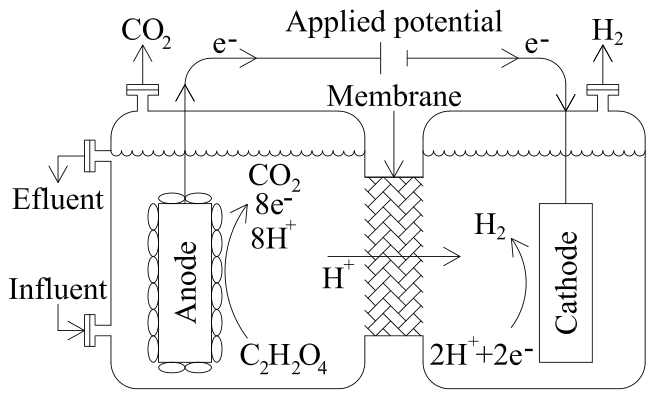
Although the original representation in [34] is third-order, the present reduced-order version preserves the key dynamic characteristics required for control design. Numerical comparisons demonstrate that this simplified model predicts open-loop dynamical behavior and steady-state values that are in close agreement with the experimentally validated model reported by Pinto et al. [18]. Consequently, the equilibrium structure, including the normal operating condition (NOC) and washout boundaries, remains qualitatively and quantitatively valid despite the reduction, and the resulting two-state representation is sufficient for the subsequent robust control synthesis. Figure 1 shows a schematic diagram of a MEC system.
The two-state representation rests on several simplifying hypotheses that retain the dominant dynamics while suppressing fast electrochemical transients: A single anodophilic guild is assumed; this population is idealized as a spatially uniform biofilm on the anode surface [35]; substrate uptake follows multiplicative Nernst–Monod kinetics [36]; the bulk liquid is perfectly mixed; intra-biofilm substrate gradients are ignored [37]; the catholyte is free of biomass and substrate; membrane gas crossover is negligible; and temperature, pressure, and pH are held constant.
That a single electroactive guild dominates the anode is not unconditional: Competitive exclusion of methanogens and other fermenters (a prerequisite for the present two-state model) has been demonstrated both biologically [38,39,40,41,42,43] and operationally [18,19,40], as detailed in [34]. Two practical routes to enforce this mono-culture state are available. The first operates on differential washout: Due to the fact that methanogens grow markedly slower than anodophiles, a sufficiently high dilution rate can strip the former while retaining the latter [42]. The second removes the carbon source that sustains competitors, for example by feeding dark-fermentation effluent that is depleted in carbohydrates [43,44,45]. First-principles MEC simulations that resolve substrate competition and anode overpotential consistently show that anodophiles dominate whenever the applied voltage exceeds the 0.45 V threshold [18,19,46]. As the third-order MEC model [34] predicts non-coexistence, the present model considers a single microbial population.
Acetate is adopted as the representative carbon source because it is the central fermentation end-product fed to most continuous MEC anodes [18,20]. In the anode, the following reactions are carried out by the electrogenic microorganisms:
C 2 H 4 O 2 + 2 H 2 O + 4 M o x 4 M r e d + 2 C O 2 4 M r e d 4 M o x + 8 e + 8 H +
where M o x and M r e d identify the oxidized and reduced redox couples of the intracellular mediator, respectively. Under an applied external potential, electrons released at the anode are shuttled to the cathode via an external electrical circuit, whereas the H + migrates through the cathodic membrane from the anode to the cathode. Then, the following reaction is carried on in the cathode:
8 e + 8 H + 4 H 2
The overall reaction of acetic acid in the MEC system is described as follows:
C 2 H 4 O 2 + 2 H 2 O 2 C O 2 + 4 H 2

2.1. Mass Balances

With the above hypotheses, mass conservation over the anodic compartment yields the following coupled ODEs for substrate and biomass:
S ˙ = ( S i n S ) D k μ X X ˙ = μ X K d X α D X .
where S [mg/L] denotes the substrate concentration; S i n [mg/L] corresponds to the influent substrate concentration; and X [mg/L] represents the biomass concentration. The dilution rate is defined as D = F i n / V r e a c [d−1], where F i n [L/d] is the input flow, and V r a c [L] is the reactor volume. k  [ mg S / mg X ] is the yield coefficient for substrate consumption; μ [d−1] is the growth rates for anodophilic microorganisms; K d [d−1] is the microbial decay rate; and α is the dimensionless biofilm retention constant [47] for anodophilic microorganisms. The microbial growth rate μ is defined by the multiplicative Nernst–Monod kinetics [35]:
μ = μ m a x S K S + S φ ,
where μ m a x [d−1] is the maximum growth rate; K S [mg S L−1] is the half-rate Monod constant; and φ is a dimensionless factor calculated as
φ = 1 1 + e x p F R T η .
Here, F [C/mol e ] is the Faraday constant; R [J/(mol K)] is the gas ideal constant; T is the temperature; and η = E a n o d e E K a is the local potential, where E a n o d e [V] is the anode potential and E K a [V] is the half-cell potential of the anode reaction. The current density generated by the MEC is given by [36]:
I M E C = γ S k μ X L f ( 1 f S 0 ) + γ X b X L f ,
where I M E C [A m−2] is the current density produced; γ S and γ X [ mF / MW S or mF / MW X ] are yield coefficients; k is the yield coefficient [mg S/mg X]; L f is the biofilm thickness; f S 0 is the fraction of electrons used for cell synthesis; and b [d−1] is the endogenous decay coefficient. The hydrogen flow rate is [37]
Q H 2 = Y H 2 I M E C m F R T P ,
where Q H 2 [L H 2 d−1 m−2)] corresponds to the rate of hydrogen evolution, Y H 2 signifies the cathode efficiency (dimensionless), m represents the molar electron ratio [mol e/mol M], and P denotes the pressure [atm]. Consequently, the nonlinear model admits the following compact representation:
Φ ˙ = f ( Φ , Π ) , Φ ( t 0 ) = Φ 0 ,
where the state vector is Φ = [ S , X ] T ; the parameter set is π = [ α , K d , k, μ m a x , K S , Y H 2 , γ S , γ X ] ; operational conditions are [ D , T, P, S i n , η ] ; and physical constants are [ R , m, F ] . Parameter values used in simulations are listed in Table 1, Table 2 and Table 3.

2.2. Equilibrium Points

In previous work [34], a third-order non-linear model was proposed to describe a continuous MEC process. In the present study, a reduced version of this model is adopted. Since the reduced model retains the same equilibrium structure and steady-state locus as the experimentally validated representation in Pinto et al. [18], the equilibrium and stability results derived below remain fully applicable to the physically relevant operating regime. In this section, the corresponding results are summarized. The steady state solution of the mathematical model results in two equilibrium coordinates ϕ i , where i = 1, 2. The equilibrium coordinate ϕ 1 is related to the trivial solution as follows:
S = S i n X = 0 .
This steady-state coordinate ϕ 1 corresponds to an actual operational regime known as washout, characterized by a negligible or vanishing biomass concentration and the absence of substrate reduction or removal from the wastewater stream.
The second equilibrium coordinates ϕ 2 correspond to
S = ( K d + α D ) K S ( μ m a x φ K d α D ) X = ( S i n S ) D k μ ,
where D is the dilution rate at this equilibrium point.
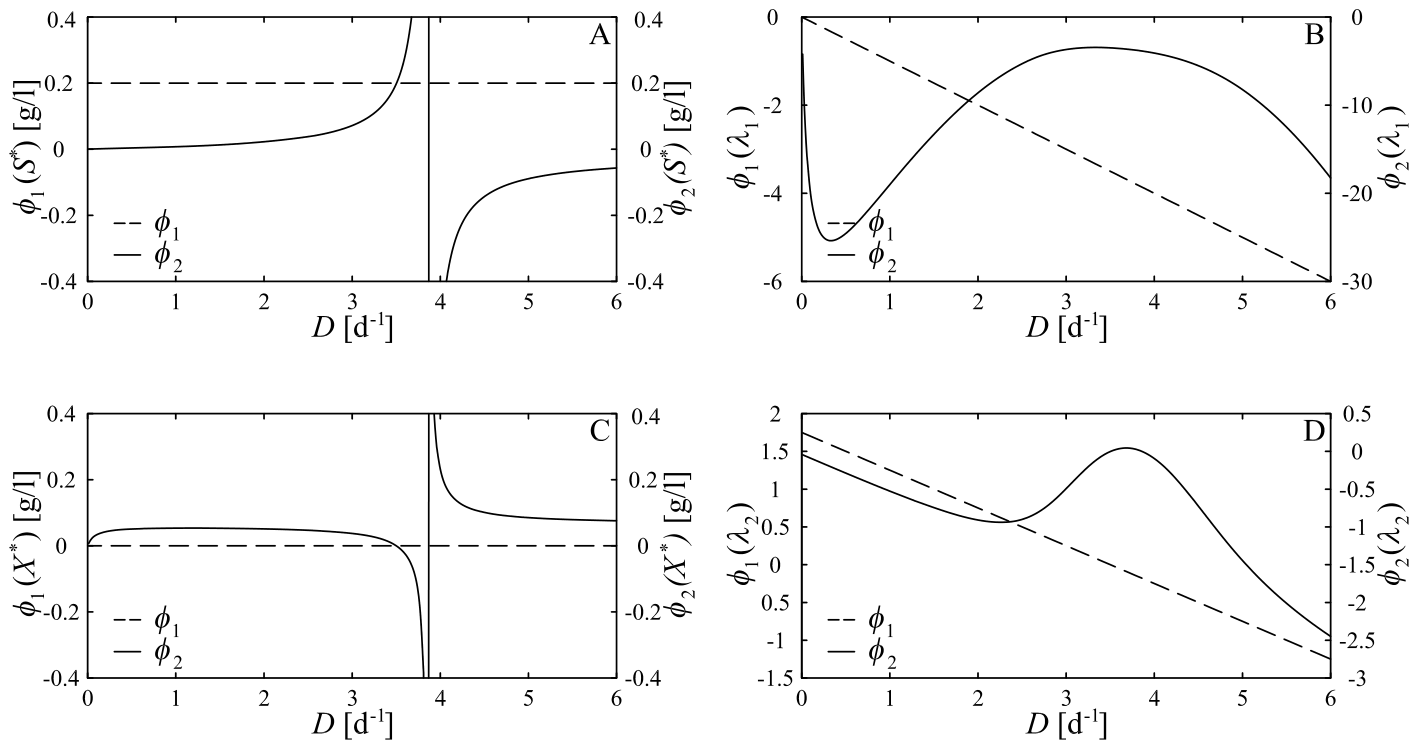
A numerical analysis of the ϕ i coordinates and λ i eigenvalues of the Jacobian matrix J ( Φ ) derived from the MEC model (1) was conducted over the range D = ( 0 , 6 ] [ d 1 ] ( i = 1 , 2 ) in order to ascertain the singularity of the equilibrium points. Figure 2 shows these numerical evaluations. It should be noted that negative values of S and X have no physical meaning (NPM). Since α , K d , K S , and D are positive constants, the conditions μ m a x φ > K d + α D and S < S i n must hold to obtain physical meaning (PM) values. Indeed, PM values for ϕ 2 are a desirable operation condition, in which the biomass remains active and a portion of the substrate is degraded or consumed by the microbial population. However, if ( K d + α D ) μ m a x φ , which means that D increase, the values of S increases. At high D values, ( S i n S ) 0 , and consequently X 0 . This scenario defines the operational boundary of the washout conditions, where further increases in D could lead to the maximum permissible value such that X 0 and S S i n . Thus, a stable desirable equilibrium ϕ 2 with PM values exists for D = ( 0 , 3.8612 ) , whereas a stable undesirable equilibrium ϕ 1 with PM values exists for D > 3.8612 , where ( μ m a x φ - K S ) / α =3.8612. Then, regarding uniqueness of the equilibrium, the following propositions are acknowledged:
Proposition 1. 
Under the assumption that the influent substrate concentration  S i n  of the system (1) remains piecewise constant, the system admits a unique equilibrium ϕ for every dilution rate  D  under normal operating conditions (i.e., S,  X 0 ,  D [ D ̲ , D ¯ ] R +  and  S i n > S ), where  ϕ Ω = { ( S , X ) R + 2 }  containing all normal operating conditions.
Proof. 
From (8) S and X are unique for a any given D . From (8), the condition ( μ m a x φ K d ) / α > D must be satisfied to obtain X with PM values (i.e., X > 0 ). Under NOC, S i n > S must also hold. Then, ( S , X ) Ω ; which completes the proof. □
Proposition 2. 
Consider the equilibrium point  ( S , X ) Ω  of the MEC system (1). For any  D [ D ̲ , D ¯ ] , this equilibrium is locally stable under normal operating conditions (NOC).
Proof. 
The Jacobian matrix of system (1), linearized about ( S , X ) , is given by:
J = J 11 J 12 J 21 J 22 ,
where J i , j = and stand for
J 11 = ( D K S 2 + 2 D K S S + φ X k μ m a x K S + D S 2 ) ( K S + S ) 2 J 12 = φ S k μ m a x K S + S J 21 = φ K S X μ m a x ( K S + S ) 2 J 22 = φ S μ m a x K S + S K d α D .
At the equilibrium ϕ 2 , the biomass steady-state condition implies μ = K d + α D . Substituting this into J 22 yields
J 22 = φ S μ m a x K S + S ( K d + α D ) = μ ( K d + α D ) = 0 .
The determinant of the Jacobian is therefore
det ( J ) = J 11 J 22 J 12 J 21 = J 12 J 21 .
Since J 12 < 0 and J 21 > 0 for all physically meaningful NOC values, it follows that det ( J ) > 0 . The trace is
tr ( J ) = J 11 + J 22 = J 11 .
From the expression for J 11 , every term in the numerator is positive, while the denominator is positive; hence J 11 < 0 and consequently tr ( J ) < 0 for all D [ D ̲ , D ¯ ] . By the standard stability criterion for planar systems ( tr ( J ) < 0 and det ( J ) > 0 ), the equilibrium ϕ 2 is locally asymptotically stable, which completes the proof. □
Propositions 1 and 2 establish the existence, uniqueness, and local asymptotic stability of the equilibrium point under NOC for all D [ D ̲ , D ¯ ] . However, the following proposition applies to the undesirable washout conditions for D > D ¯ . For stability criteria for planar systems details see Appendix A.
Proposition 3. 
Assuming that the inlet substrate concentration  S i n  of the system (1) is piecewise constant, system (1) has a unique equilibrium ϕ for any dilution rate   D > D ¯  which contains all washout conditions (i.e.,  S = S i n ,  X = 0 ).
Proof. 
From (7) S and X are unique for any given D . From (7), the condition ( μ m a x φ K d ) / α < D must be satisfied to obtain X with physically meaningful values (i.e., X = 0 ). Under WSC, S = S i n must also hold. Then, ( S , X ) Ξ ; which completes the proof. □
Proposition 4. 
Let us consider the equilibrium point  ( S , X ) Ξ  of the MEC system (1). For any   D > D ¯ , under washout conditions such an equilibrium point is locally asymptotically stable.
Proof. 
For the washout equilibrium ϕ 1 , we have S = S i n and X = 0 . Evaluating the Jacobian entries at this point gives
J 11 = D J 12 = φ S i n k μ m a x K S + S i n J 21 = 0 J 22 = φ S i n μ m a x K S + S i n K d α D .
Given that D > D ¯ = ( μ m a x φ K d ) / α and μ ( S i n ) = φ μ m a x S i n / ( K S + S i n ) μ m a x φ , it follows that
J 22 = μ ( S i n ) K d α D < μ m a x φ K d α D ¯ = 0 ,
so J 22 < 0 for all D > D ¯ . The trace and determinant are therefore
tr ( J ) = J 11 + J 22 = D + J 22 < 0 ,
det ( J ) = J 11 J 22 J 12 J 21 = ( D ) ( J 22 ) > 0 ,
since D < < 0 and J 22 < 0 . By the planar-system stability criterion ( tr ( J ) < 0 and det ( J ) > 0 ), the washout equilibrium ϕ 1 is locally asymptotically stable for all D > D ¯ , which completes the proof. □
All parameter values listed in Table 1, Table 2 and Table 3 are taken from the cited literature [19,37,47] and were not calibrated against experimental or pilot-scale data from the present authors. Consequently, the uncertainty bounds and performance weights are derived from numerical sensitivity screening rather than physical measurements. The structural simplifications are prerequisites of the two-state reduced model. If any of these assumptions are relaxed, the analysis must revert to the third-order formulation reported in [34] or higher-dimensional extensions that explicitly resolve mediator redox dynamics, proton mass balance, and competitive population interactions [19,37].

3. Organic Matter Regulation

The MEC system is designed to fulfill two primary functions: (i) the degradation of organic substrates present in agro-industrial wastewater, and (ii) the biological synthesis of hydrogen (BioH2). The substrate is considered to be composed of organic pollutants, which are usually measured in terms of total organic carbon or soluble chemical oxygen demand. In this context, regulating organic matter through feedback control becomes one of the key challenges in real-world applications of wastewater treatment processes.
Consequently, the substrate concentration S represents a logical choice for the control variable within the MEC formulation (1), with its control strategy being elaborated upon in the sections that follow.

3.1. Problem Formulation

Based on the above discussion, the formal statement of the substrate regulation problem is presented. The MEC model (1) admits a unique locally stable equilibrium under normal operating conditions. The control challenge is to adjust the dilution rate D to regulate the system and achieve a desired substrate set-point S for a parameter set π and specific operating conditions. The objective is to determine a control input D , using the available measured variable S, such that S S r e f , which in turn ensures stable bio-H2 production despite uncertainties in the parameter set π .
To obtain a control law, the following assumptions are made: (i) The inlet substrate composition S i n is a piecewise constant, bounded and uncertain function (load disturbances); (ii) the continuous MEC output is given by the substrate concentration S, which is available for on-line measurement; (iii) the parameter set π of the MEC model (1) is known but uncertain.

3.2. Preliminaries in Classical H Control

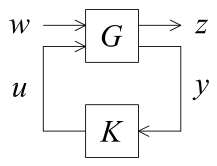
Grounded in the standard H synthesis approach [48], the feedback architecture depicted in Figure 3 is expressed in linear fractional transformation (LFT) form. The transfer functions G and K are assumed rational and proper. Accordingly, the generalized plant G is considered to possess the following realization:
G ( s ) = A B 1 B 2 C 1 C 2 D 11 D 12 D 21 D 22 .
The above representation is dimensionally consistent with z ( t ) p , y ( t ) p , u ( t ) q and w ( t ) d , as illustrated in Figure 3. The synthesis of a suboptimal H controller can be posed as follows: For a given performance level γ > 0 , determine an internally stabilizing controller K ( s ) —provided one exists—such that the closed-loop transfer function satisfies T z w > γ , where T z w = F l ( G , K ) = G 11 + G 12 K ( I G 22 K ) 1 G 21 . In order to find the controller, if it exists, G ( s ) should satisfy the following conditions:
  • ( A , B 2 ) is stabilizable, and ( C 2 , A ) is detectable.
  • [ A j ω I , B 2 ; C 1 , D 12 ] has full column rank for all ω .
  • [ A j ω I , B 1 ; C 2 , D 21 ] has full row rank for all ω .
In the standard Algebraic Riccati Equation (ARE) methodology, controller synthesis is accomplished through the resolution of the Riccati equations yielding the solutions X and Y , within the established state-space H approach (refer to [48] for specifics).

3.3. H Control Design

The control design proceeds in two stages. First, the nonlinear MEC model (1) is linearized around the NOC equilibrium (8) to obtain a nominal plant. Second, a family of perturbed linear plants is generated by varying the biologically dominant parameters identified in the sensitivity screening, and an unstructured multiplicative uncertainty is fitted to cover their collective frequency response. This yields two controllers: a nominal H controller that guarantees internal stability and performance for the nominal plant, and a robust H controller that does the same for the entire uncertain family.
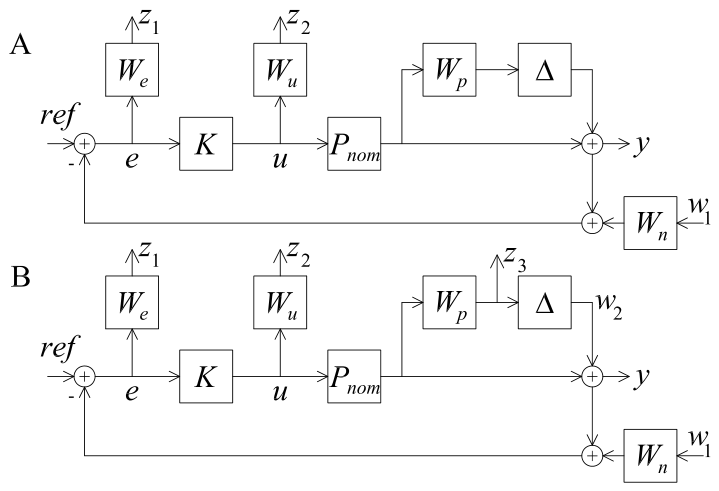
The closed-loop system for the nominal control synthesis is shown in Figure 4A, where the nominal plant P n o m is obtained via linearization of the nonlinear model (1) at (8). W p Δ stands for an unstructured multiplicative uncertainty ( Δ 1 ) . Additional weighting functions W e , W u and W n are used. The generalized plant G is derived from the relationships between inputs and outputs, such that z n o m = G n o m w n o m , where the output vector is z n o m = [ z 1 z 2 | e ] T , and the input vector is w n o m = [ w 1 | u ] T . Then, G n o m is given by the following equation:
G n o m ( s ) = W e W n 0 W e P n o m W u W n P n o m .
The nominal design algorithm consists of the following: (i) linearization of the MEC model (1) under NOC; (ii) derivation of weighting functions from specified performance requirements; (iii) obtainment of a nominal controller K n o m which internally stabilizes the nominal model P n o m ; (iv) given the description of an uncertainty model and nominal controller K n o m , verification of whether the robust stability test is satisfied.
The closed-loop system for the robust control synthesis is showed in Figure 4B. From the input/output relation z r o b = G r o b w r o b , where z r o b = [ z 1 z 2 z 3 | e ] T and w r o b = [ w 1 w 2 | u ] T . Then, G r o b is given by the following equation:
G r o b ( s ) = W e W n W e 0 0 0 0 W e P n o m W u W p P n o m W n I P n o m .
The nominal and robust control problem can be addressed via classical H approach [48]. Thus, if one solution exists, K can be parameterized such that T z w = F l ( G , K ) is minimized. For a more detailed description of the procedure derivation, interested readers are referred to the standard literature in [49].

3.3.1. Nominal and Uncertain Plants

The existence and uniqueness of equilibrium point under NOC allows us to derive P n o m at ϕ 2 . Let us consider the input variable u = D D and the substrate concentration as the output variable, i.e., ( y = S ). Then, the following linear representation of the model (1) is obtained:
x ˙ = A x + B u ; x t 0 = x 0 y = C x ,
where A = f i / x k | x , B = f i / u | D , for i , k = 1 , 2 , and C = [ 1 , 0 ] . The nominal state-space realization is
P n o m ( s ) = A B C 0 .
To include parametric uncertainty in the control design, the following procedure is proposed: (i) Identify the parameter subset that significantly influences the dynamical behavior of the MEC model (1) through parametric sensitivity analysis. (ii) Obtain the frequency response of a family of linear plants across a range of values for selected parameters. (iii) Derive a weighting function W p .
The parametric sensitivity function is approximately determined through the concurrent solution of the MEC model (1) together with the equation presented below [50]:
S ˙ f = f ( Φ , Π ) Φ π 0 S f + f ( Φ , Π ) Π π 0 ; S f ( t 0 ) = S f , 0 .
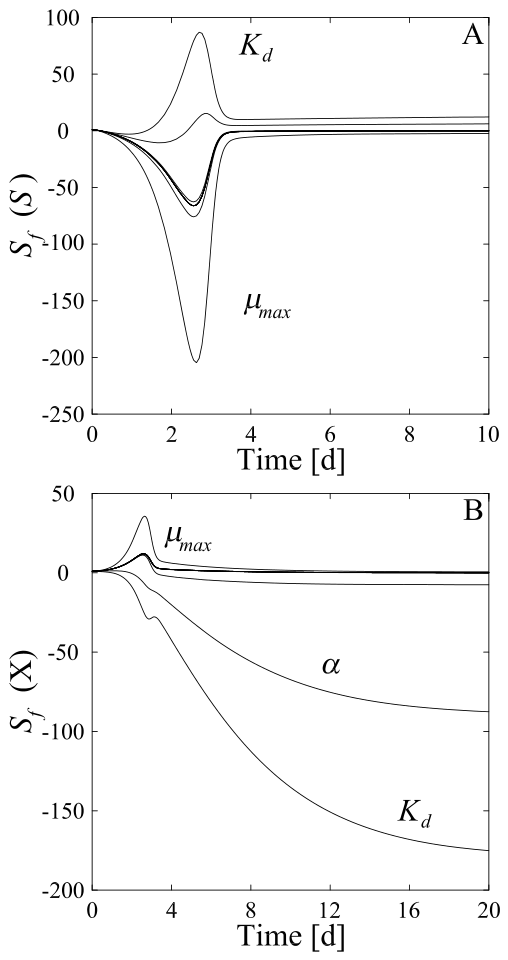
The numerical solution of (14) is depicted in Figure 5. The subset of parameters exerting a pronounced influence on the dynamical response of the MEC model (1) comprises { α , μ max , K d } . This subset is in good agreement with the study reported in [34].
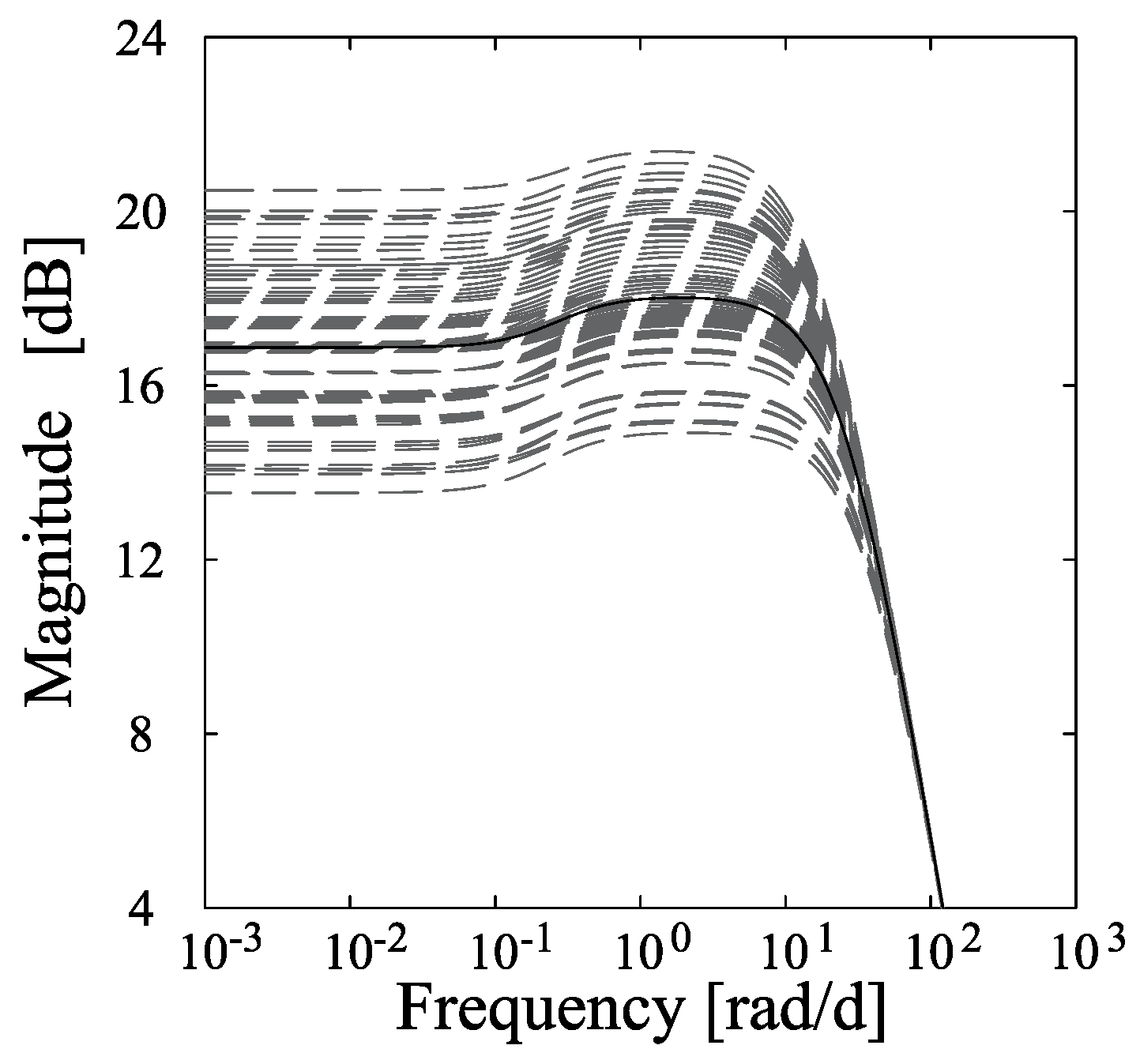
A sensitivity screening via parametric differential Equation (14) identified α , μ m a x and K d as the dominant parameters. A ±15% variation band was selected to cover the uncertainty range where the linearized family remains within the NOC stability region derived in Propositions 1 and 2. The percentage values distribution within the ±15% interval for the three parameters is [ 15 , 10 , 5 , 0 , 5 , 10 , 15 ] % with respect to the nominal value for each parameter. Then, the total number of linear plants P ( s ) is 342. Then, a frequency response of each linear plant P ( s ) derived from changes in parameter values (Figure 6) is compared with those values obtained from the nominal plant P n o m :
P n o m ( s ) = 196.6 s + 49.19 s 2 + 24.84 s + 7.04 ,
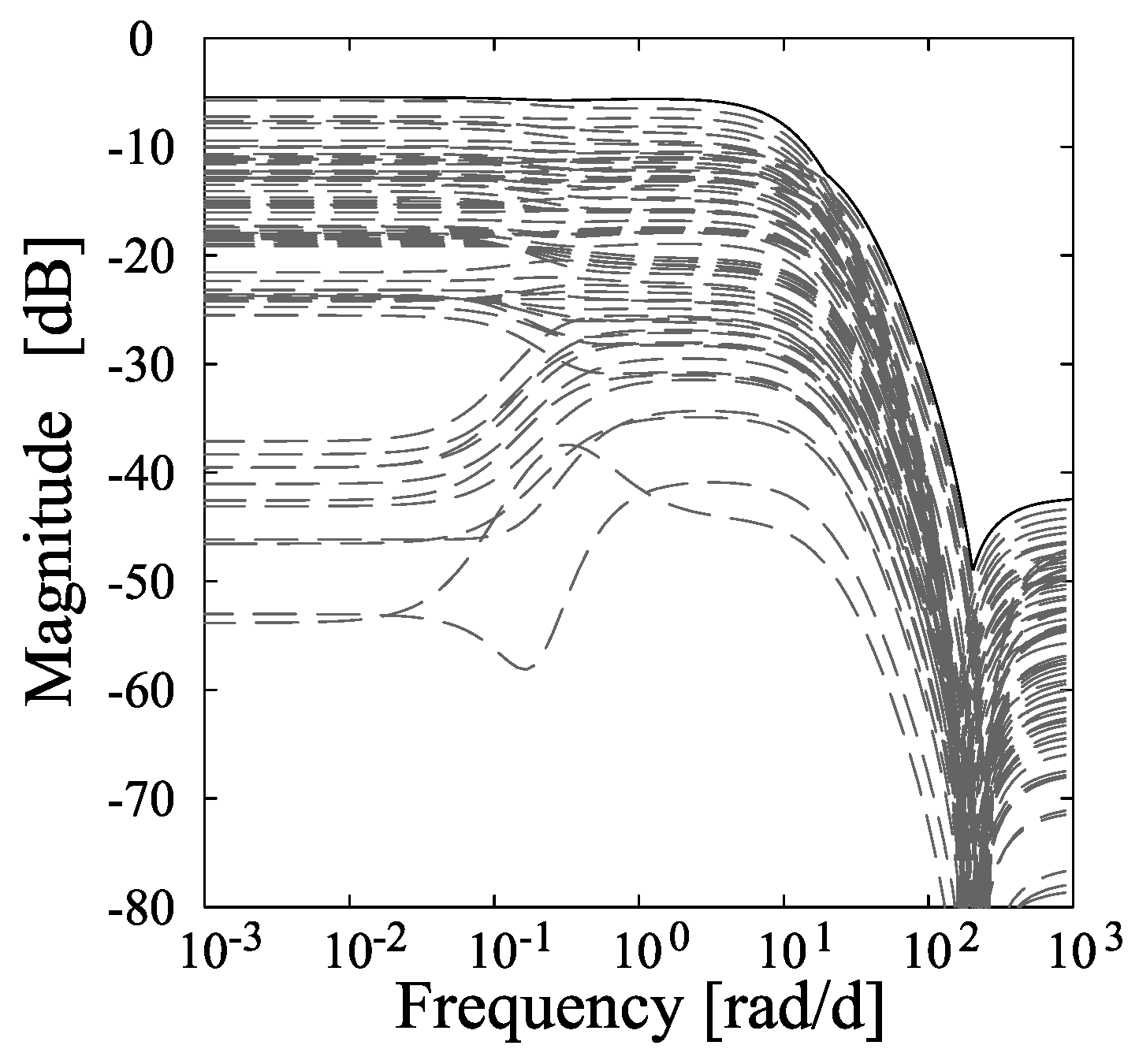
on ω [ ω ̲ , ω ¯ ] = 1 × 10 3 , 1 × 10 3 [rad/d], where ω is the angular frequency, under a relative uncertainty [49] as follows (Figure 7):
U r e l ω = P ω P n o m ω P n o m ω .
Then, an upper bound of the relative uncertainty U r e l is obtained as follows [49]:
max ω [ ω ̲ , ω ¯ ] { U r e l } = max ω P ω P n o m ω P n o m ω .
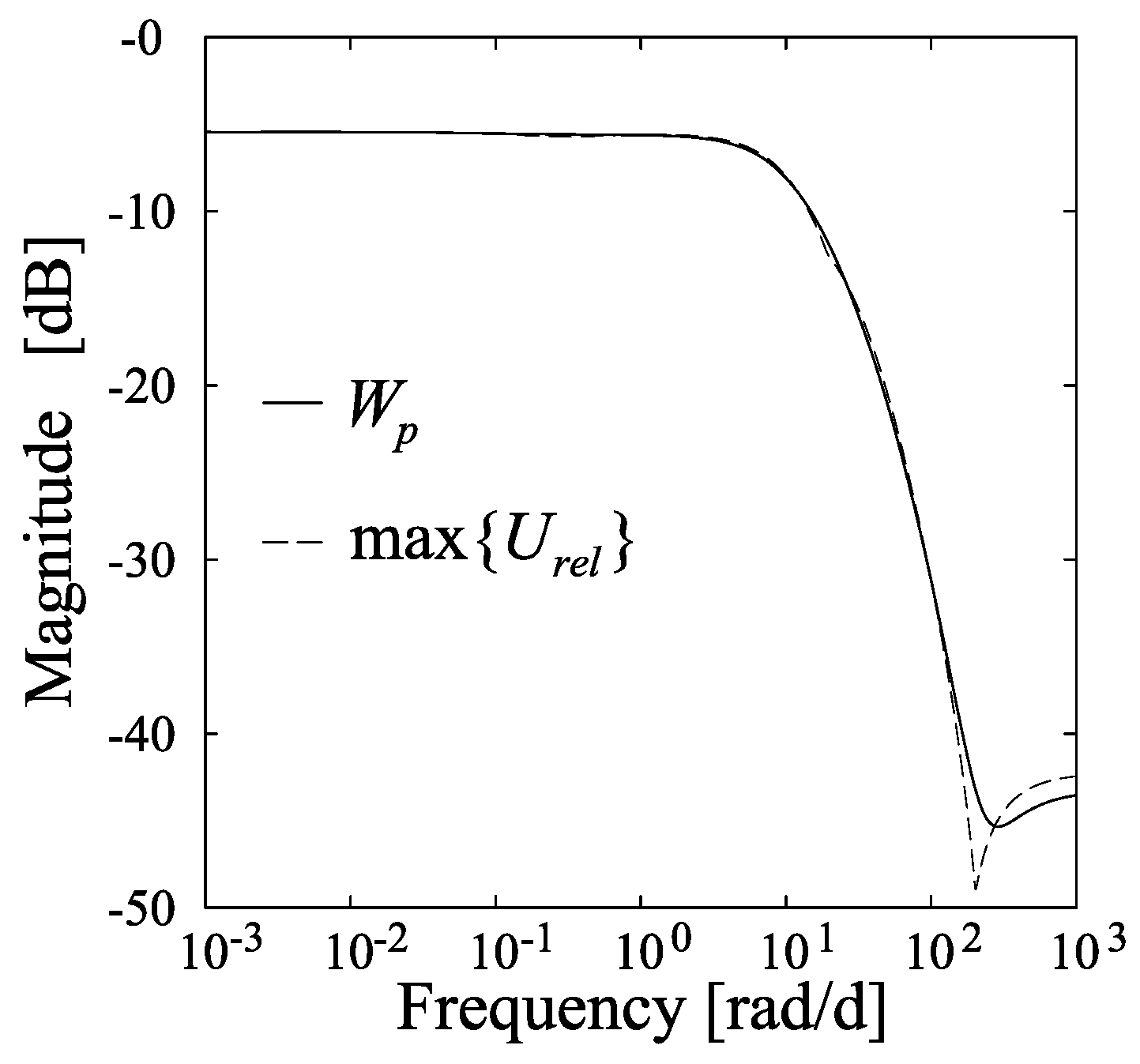
A weighting function W p ( ω ) can approximate [49] the previous expression (17). The numerical solution was obtained using the function fitting (Matlab®) [49], and the following transfer function was obtained (Figure 8):
W p ( s ) = 0.006872 s 3 + 1.405 s 2 + 355.6 s + 30.08 s 3 + 69.22 s 2 + 682.4 s + 56.34 .
It should be noted that MEC systems exhibit intrinsic time-scale separation: Electrochemical processes occur on timescales of milliseconds to seconds, while biological processes, such as microbial growth and substrate utilization, occur on timescales of hours to days. The macroscopic MEC model (1) and its linearization (12) and (13) focus on the slow biological dynamics affecting substrate concentration. Assuming fast electrochemical quasi-steady-state enables the use of a low-order plant P n o m for control synthesis. This quasi-steady-state electrochemical approximation is justified by time-scale separation; abrupt changes in the applied anode potential or the bulk temperature could transiently invalidate it. This necessitates retaining additional fast electrochemical states in the control-oriented model.

3.3.2. Weighted Transfer Functions

Classical H control synthesis can include performance weighting constraints. In this work, weighted transfer functions have been considered, accounting for restriction on the input W u , error W e , and noise W n signals as follows [49]:
W e ( s ) = s / 1.05 + 50 s + ( 50 ) ( 0.005 ) W u ( s ) = s + 1000 / 1.1 0.05 s + 1000 W n ( s ) = s + ( 1000 ) ( 0.01 ) s / 0.02 + 1000 .
The weights encode the physical limits of the MEC loop. W e shapes the sensitivity to guarantee tight substrate regulation despite load disturbances; its low-frequency gain enforces zero steady-state offset, while its roll-off avoids excessive bandwidth. W u penalizes the manipulated dilution rate so that the peristaltic pump or valve never saturates during transients. W n models the high-frequency content of the substrate sensor noise, ensuring the controller does not amplify spurious fluctuations.
The crossover frequencies of (19) are chosen as follows. The sensitivity function ( 1 + P n o m K ) 1 must be small at low frequency to suppress inlet-substrate disturbances and guarantee set-point tracking; hence, W e has an integrator-like gain below 50 [rad/d]. The complementary bound on the control sensitivity, | K ( 1 + P n o m K ) 1 | | W u | 1 , forces the controller to roll off before the actuator bandwidth, preventing the dilution rate from chattering or saturating. Finally, W n caps the loop gain above the sensor noise corner frequency (1000 [rad/d]), so that high-frequency measurement artifacts are not propagated into the control signal.

3.3.3. H Control Synthesis

The suboptimal control problem, which minimizes the norm γ of the transfer function (10) and (11) in the H sense, was solved using a standard Riccati solution, i.e., the algebraic Riccati equations associated with the H problem [49]. The numerical solution was obtained using the function hinfsyn (Synthesis Toolbox Matlab R2025a®) [49]. The resulting complete order controllers for nominal and robust cases, denoted as K n o m and K r o b , respectively, are expressed as
K n o m ( s ) = 61.34 s 4 + 1.229 × 10 6 s 3 + 4.561 × 10 7 s 2 + 3.841 × 10 8 s + 1.065 × 10 8 s 5 + 5205 s 4 + 5.878 × 10 6 s 3 + 1.185 × 10 8 s 2 + 5.813 × 10 7 s + 7.218 × 10 6 , K r o b ( s ) = 185.9 s 7 + 3.739 × 10 6 s 6 + 4.249 × 10 8 s 5 + 1.596 × 10 10 s 4 + 2.442 × 10 11 s 3 + 1.324 × 10 12 s 2 + 4.63 × 10 12 s + 2.951 × 10 10 s 8 + 1.146 × 10 4 s 7 + 1.493 × 10 7 s 6 + 1.252 × 10 9 s 5 + 2.79 × 10 10 s 4 + 1.795 × 10 11 s 3 + 9.799 × 10 10 s 2 + 1.708 × 10 10 s + 8.427 × 10 8 .
The suboptimal controller K n o m guarantees internal stability for the linearized plant with γ = 0.0193 . As mentioned before, it is assumed that the parametric variation of the model (1) is described by a multiplicative unstructured uncertainty Λ = { ( I + W p Δ ) P n o m : Δ R H } . Then, the condition for robust stability is accomplished by satisfying W p P n o m K n o m ( I + P n o m K ) 1 = 0.5287 1 (for details, see Theorem 8.5 [49]), which guarantees that K n o m internally stabilizes the entire family of linear plants described by Λ . Similarly, the suboptimal controller K r o b guarantees robust stability against the same uncertainty set, i.e., Λ with γ = 0.9822 .
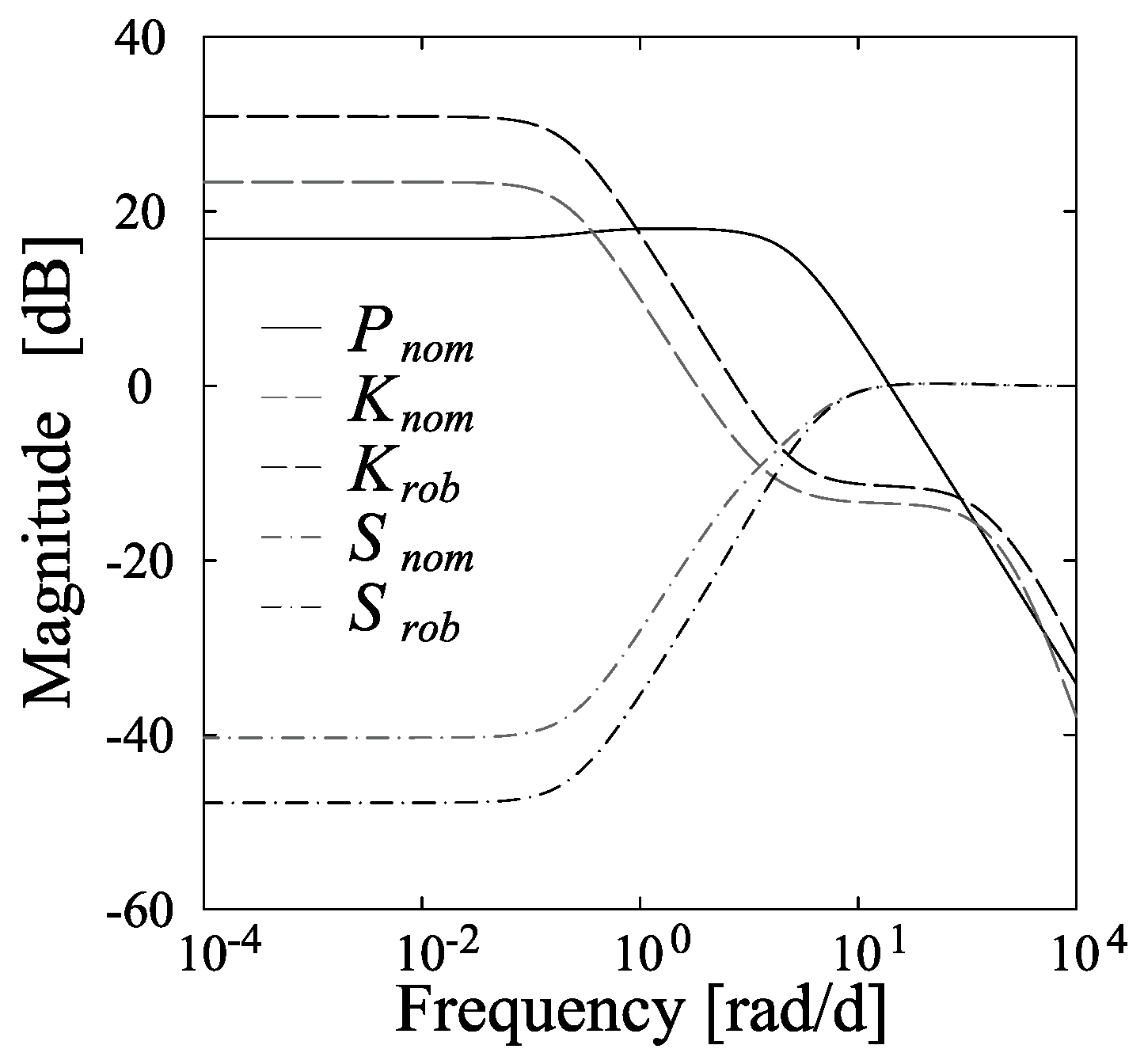
Figure 9 shows the frequency response for the nominal plant P n o m , the controller K n o m and K r o b -based closed-loop system, and the sensitivity function S n o m = ( 1 + P n o m K n o m ) 1 and S r o b = ( 1 + P n o m K r o b ) 1 . In this Figure, it is worth noting the frequency responses of the linear transfer functions S n o m , S r o b , and P n o m around magnitude zero [dB]. Notice that the frequency at which the sensitivity transfer function magnitude values are higher than unity corresponds to the frequency at which the nominal plant P n o m transfer function magnitude values are less than unity.
It is important to emphasize that the internal and robust stability criteria derived above apply to the dynamics linearized around the NOC equilibrium. The synthesis follows the standard indirect Lyapunov method: Local stability of the nonlinear open-loop equilibrium (Propositions 1 and 2) justifies the linearization step, and the resulting H guarantees are valid in a neighborhood of that equilibrium.
The robust stability criteria above rely on an unstructured multiplicative uncertainty W p Δ , with Δ 1 , which bounds the deviation of the three dominant biological parameters { α , μ max , K d } identified in sensitivity screening. This is standard in process-control practice [49] and gives a computationally tractable path to H synthesis. However, this method is conservative, treating parametric perturbations as a single, frequency-dependent complex block rather than as physically independent real uncertainties. As a result, this approach does not capture (i) the independence between α , μ max , and K d ; (ii) worst-case combinations from their distinct biological mechanisms; or (iii) the potentially lower conservatism from structured robustness tools. Finally, the weighting functions W e , W u , W n and the unstructured uncertainty bound W p were constructed numerically from design specifications and the parametric sensitivity screening of Figure 5; they were not fitted to experimental frequency–response or noise data from a physical pilot plant.

3.4. Preliminaries in Classical IMC-PI Control

In the context of proportional–integral (PI) control, the standard controller structure is expressed as
K P I ( s ) = K c τ I s + 1 τ I s ,
where K c denotes the controller gain, and τ I the integral time constant. To derive suitable tuning parameters, an approximate first-order model for the nominal plant P n o m is employed. For simplicity, this approximation excludes time delay effects and is given by
G 1 o ( s ) = k g τ 1 s + 1 ,
where k g represents the process gain and τ 1 the dominant lag time. Then, within the framework of internal model control (IMC) design for PI controllers [51], the tuning rules are defined as
K c = 1 k g τ 1 τ c τ I = min τ 1 , 4 τ c ,
where τ c is the IMC tuning parameter controlling the trade-off between performance and robustness; this relationship provides a direct link between the process dynamics and the PI parameters, ensuring a systematic tuning procedure.

3.5. Imc-Pi Control Design

Departing from P n o m (15), as s 0 , the plant gain can be approximated as k g = 49.19/7.04 = 6.9749. Considering the denominator of P n o m (15) in the form ( τ 1 s + 1) ( τ 2 s + 1), where τ 1 is the dominant lag time constant, then τ 1 is obtained as τ 1 = 0.2869. As previously mentioned, τ c is the tuning parameter. For example, for τ c = 1 the K c = τ 1 / k g = 0.2869/6.9749 = 0.0411 and τ I = min τ 1 , 4 τ c = 0.2869.

4. Numerical Implementation

4.1. H Control Implementation

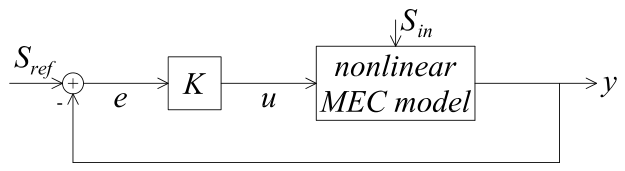
The controllers (20) were implemented on the nonlinear MEC model (1) according to the feedback structure in Figure 10. Two scenarios are examined: Case 1 evaluates tracking and disturbance rejection under the nominal parameter set, while case 2 introduces simultaneous parametric drift, measurement noise, and inlet load changes.
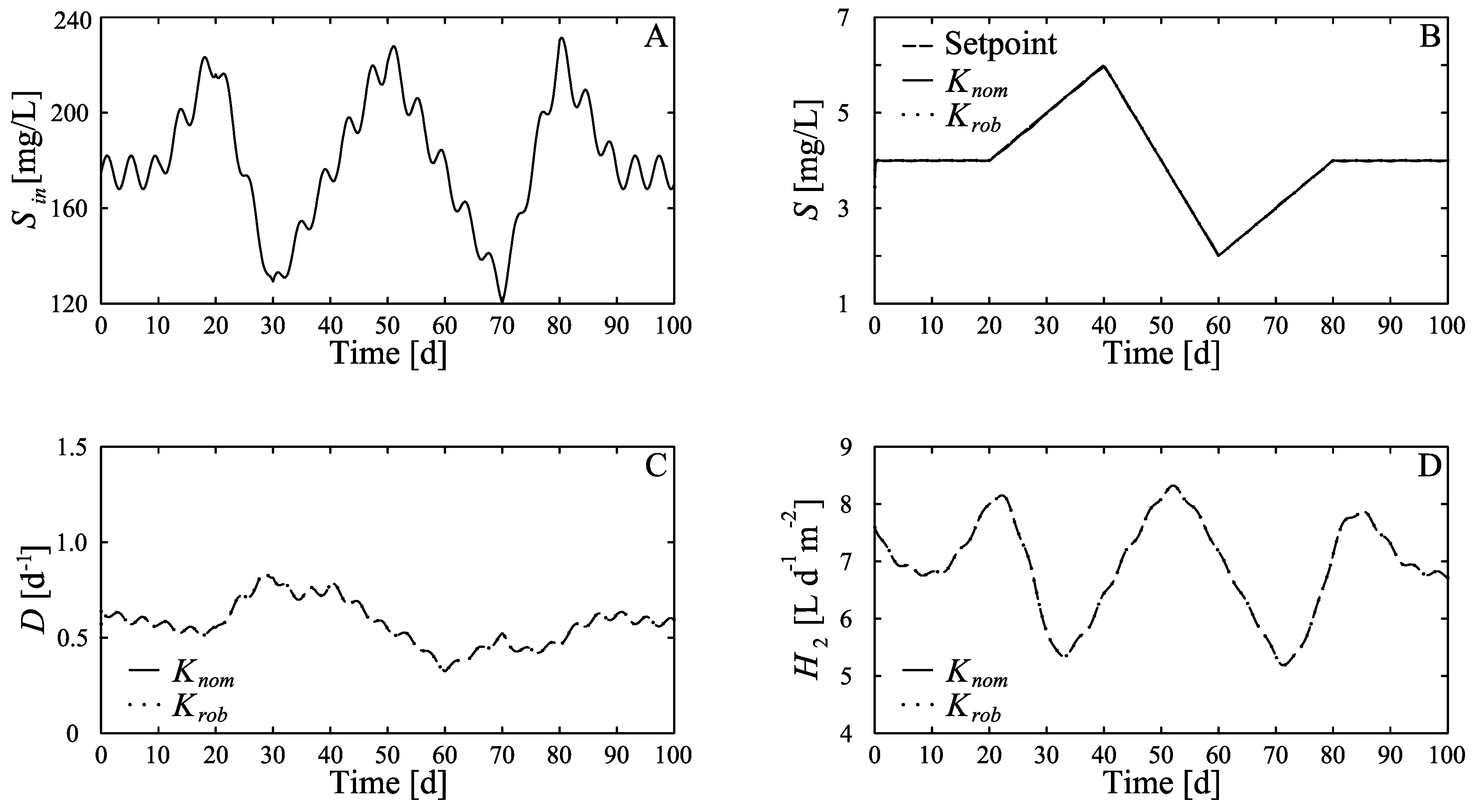
A realistic operating scenario is constructed by exposing the closed-loop MEC to a 100 [d] horizon that mimics the diurnal and weekly variability of real agro-industrial effluent. The inlet concentration S i n follows the fluctuating profile shown in Figure 11A, while the substrate set-point is varied through ramps and plateaus (Figure 11B, dashed).
Both the nominal and the robust H controllers keep S within a tight envelope around the reference trajectory (Figure 11B) without violating the physical bounds of the actuator ( D ( 0.1 , 1.1 ) [d−1], Figure 11C). Consequently, the derived hydrogen flow rate remains stable throughout the 100 [d] campaign (Figure 11D), confirming that substrate regulation directly safeguards BioH2 productivity. To verify that the H design inherently prevents windup, the simulations were repeated with hard constraints D ( 0.1 , 1.1 ) [d−1] imposed directly on the control signal. No anti-windup mechanism was required, as the weight W u in the synthesis already penalizes excessive control action, keeping the dilution rate within the admissible bounds throughout the entire horizon.
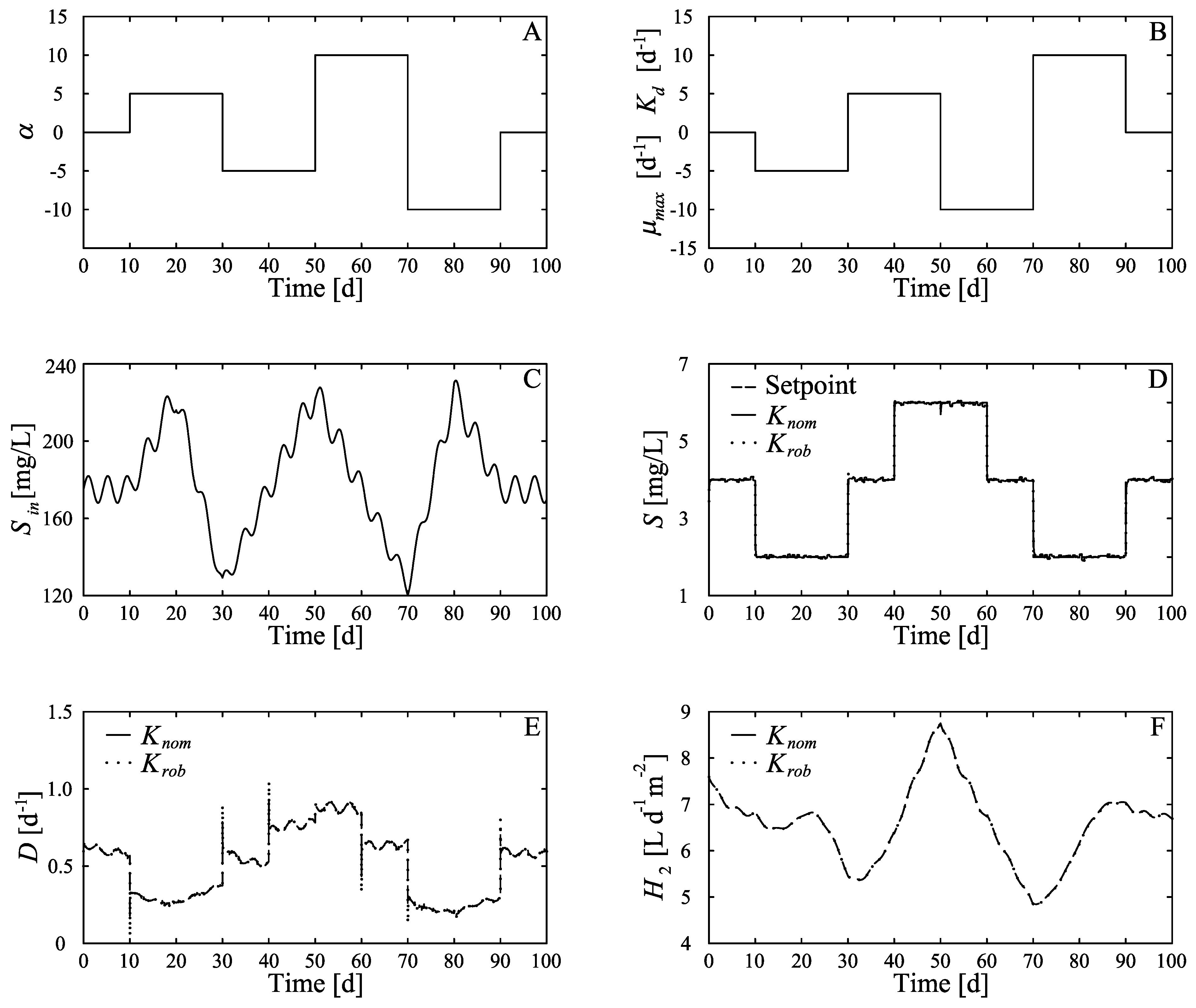
Pilot-scale MECs inevitably suffer from model–plant mismatch: Biomass yield and decay coefficients shift with temperature and inoculum age, while the effective retention factor α changes with biofilm detachment. To stress-test the controllers, case 2 superimposes simultaneous perturbations: piecewise-constant parametric offsets ( ± 10 % in α , μ m a x and K d ), the same inlet disturbance as in case 1, and band-limited measurement noise on S. To assess the robustness of the designed controller K n o m and K r o b under such conditions, a second scenario was simulated including (case 2): (i) parametric variation within the set Π π δ = { α ( 1 ± δ ) , μ max ( 1 ± δ ) , K d ( 1 ± δ ) } where α , μ max , K d are nominal values and 0 > δ > 0.1 ; (ii) inlet substrate disturbances; and (iii) measurement noise. Simulation results for this second scenario are depicted in Figure 12. Parametric variations are shown in Figure 12A,B, while inlet substrate disturbances are represented in Figure 12C. For these simulations, variations in the set-point were configured as step changes (see Figure 12D dashed line). Despite the simultaneous assault of load changes, parameter drift, and sensor noise, both controllers keep S locked to the set-point (Figure 12D). The dilution rate stays inside the admissible interval (Figure 12E), and the hydrogen output never collapses (Figure 12F), demonstrating that the robustness built into the frequency-domain weights is sufficient for realistic bioreactor operation.
The numerical conclusions above rely on the model assumptions in Section 2. We assess their robustness using the parameter screen in Figure 5 and Equation (14). We found that α , μ max , and K d have the greatest impact on the system’s dynamics, and we varied them by ± 15 %. This range reflects biological variation in MECs. H synthesis incorporates the worst-case behavior of this set into the weight function W p . Therefore, the closed-loop guarantees hold as long as real system changes stay within these limits. For practical use, we designed the controllers as simple, physically meaningful functions (third- and fourth-order with real poles and zeros) that can run on standard automation hardware. The tuning parameters ( K c and τ I for IMC-PI) can be applied to lab- and pilot-scale MEC systems using general guidelines. These include online substrate detection, peristaltic pump use, and retuning W e , W u , W n to match sensor noise and pump response. Although the validation is numerical, this approach aims to close the gap between simulation and real-world deployment.

Controller Order Reduction

Full-order H controllers are rarely deployed directly on industrial hardware. Balanced truncation [49] is therefore applied to K n o m and K r o b to obtain low-order approximations that retain the closed-loop bandwidth and peak-sensitivity characteristics. From the inspection of the Hankel singular values ( σ ) of the full-order transfer functions, the reduction of K n o m and K r o b can be proposed. This order reduction is made by identifying points of significant drop to ensure a balance between approximation accuracy and implementation simplicity [49]. The Hankel singular values of the 5th-order K n o m and 8th-order K r o b transfer functions are σ n o m = (7.2914, 0.1203, 0.0295, 0.0150, 0.0081) and σ r o b = (17.4397, 0.1364, 0.0568, 0.0211, 0.0167, 0.0063, 9.271 × 10 5 , 3.9562 × 10 8 . Thus, the obtained reduced-order transfer functions are
K n o m , r e d ( s ) = 193.6 s 2 + 2670 s + 2194 s 3 + 791.2 s 2 + 844.6 s + 148.6 K r o b , r e d ( s ) = 315.8 s 3 + 1.718 × 10 4 s 2 + 2.903 × 10 5 s + 1.731 × 10 5 s 4 + 1149 s 3 + 3.821 × 10 4 s 2 + 3.082 × 10 4 s + 4945
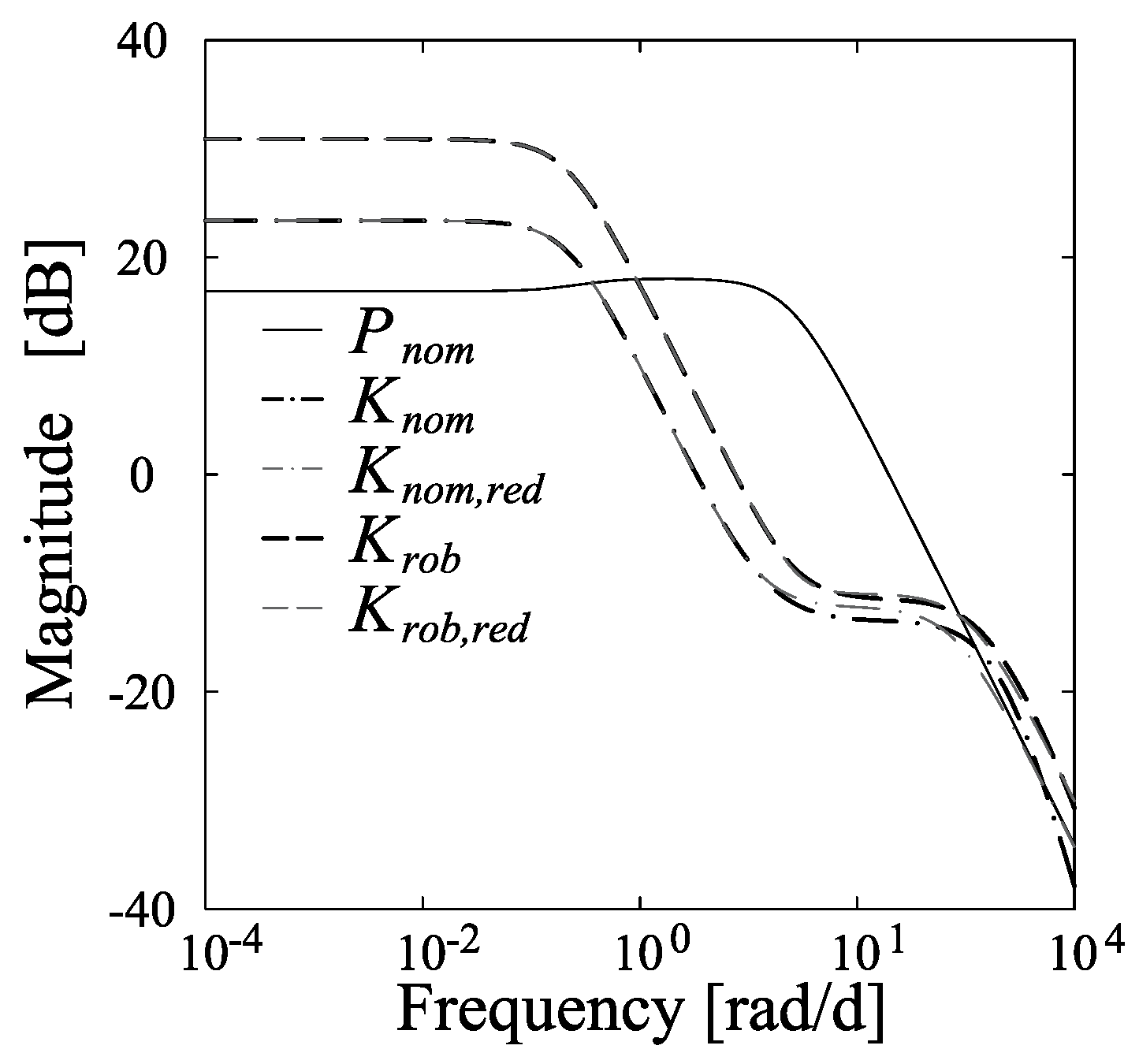
Figure 13 shows the frequency response of the nominal plant P n o m , the full-order controllers ( K n o m and K r o b ), and their reduced-order counterparts ( K n o m , r e d and K r o b , r e d ). As can be seen, the reduced-order controllers preserve the frequency-domain characteristics of their respective full-order versions.
To further assess performance, the reduced-order controllers were implemented in the nonlinear MEC system (1) for both case studies—case 1 (Figure 11) and case 2 (Figure 12)—and compared with the full-order controllers. The integral of absolute error (|IAE|) and the maximum dilution rate D m a x obtained from K n o m , r e d and K r o b , r e d were compared to those from K n o m and K r o b .
As summarized in Table 4, both nominal and robust reduced-order controllers yield |IAE| and D m a x values very close to their full-order equivalents. Although the robust controllers (full and reduced-order) exhibit slightly larger D m a x values than the nominal controllers, they consistently achieve lower |IAE| values, confirming improved disturbance rejection capabilities.
The reduced controllers are third- and fourth-order transfer functions, respectively, well within the real-time capability of entry-level programmable automation controllers or ARM-based embedded boards already used in wastewater plants. Should tighter memory constraints arise, optimal Hankel-norm reduction can be invoked as a post-processing step without repeating the Riccati synthesis.

4.2. Imc-Pi Control Implementation

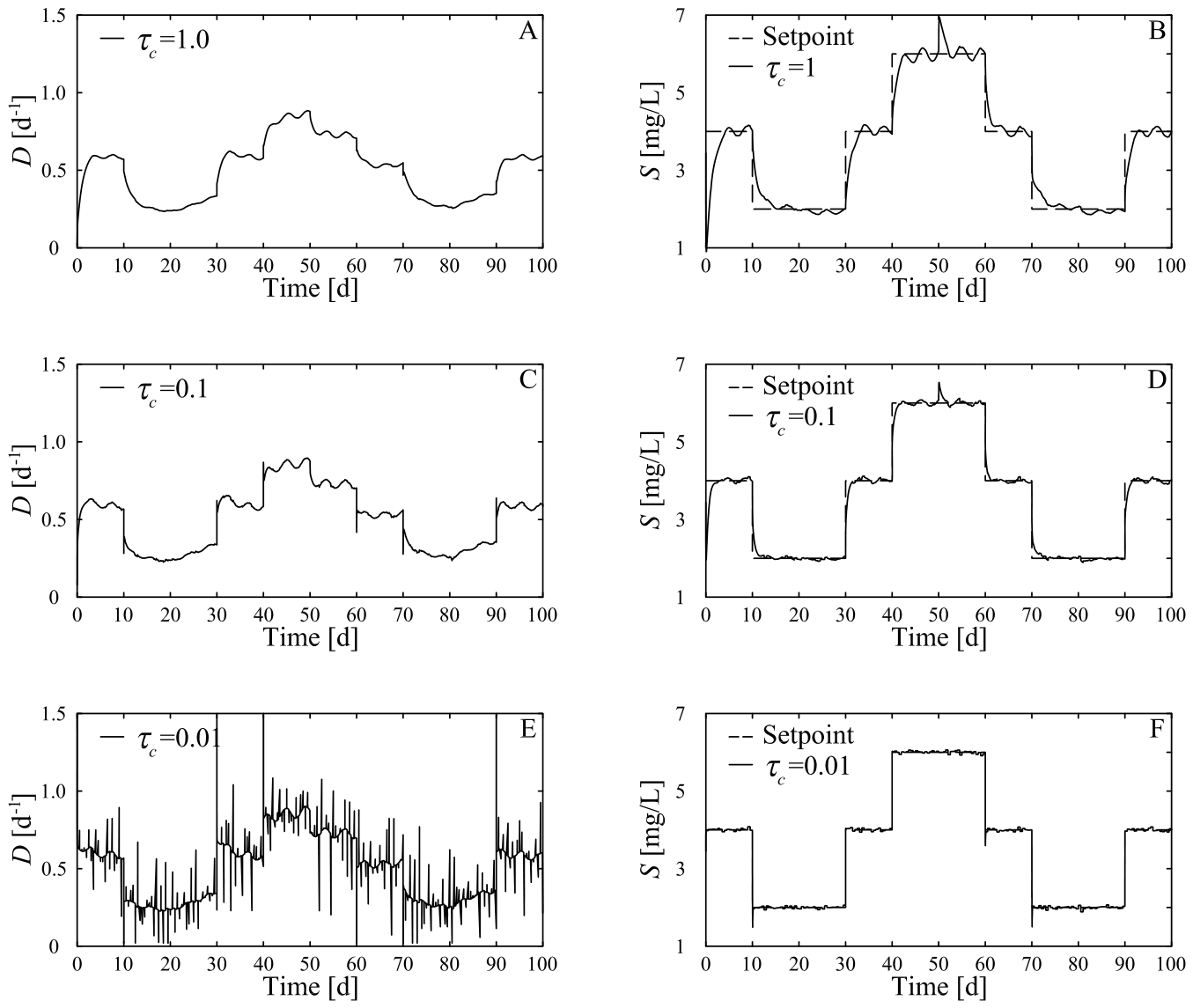
To benchmark the H designs against a conventional alternative, the IMC-PI controller is tested under the identical case 2 conditions (parametric variation, inlet disturbances, and noise). Three tentative values of the IMC filter time constant τ c are evaluated to expose the performance–effort trade-off.
Figure 14 confirms the expected behavior: Aggressive filtering ( τ c = 0.01 ) yields noisy, excessive control moves, while sluggish filtering ( τ c = 1.0 ) gives smooth but sluggish tracking; an intermediate value is required.
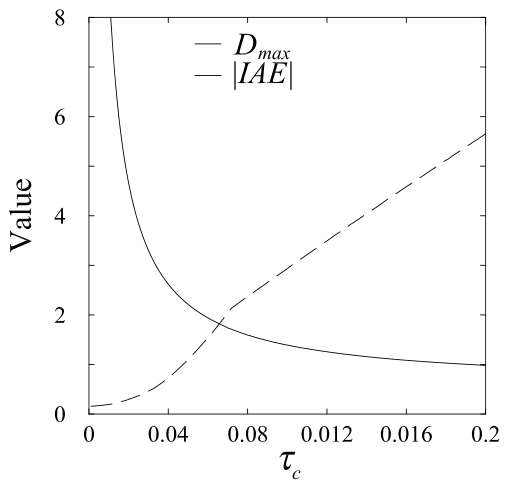
To determine the optimal τ c value, a multi-objective optimization problem is formulated aiming to simultaneously minimize the integral of absolute error (|IAE|) and the maximum dilution rate ( D m a x ). These two objectives are inherently conflicting: Smaller τ _ c values improve tracking performance (lower |IAE|) but demand larger control effort (higher D m a x ), whereas larger τ c values reduce the control effort at the expense of tracking precision.
Figure 15 shows the variation of |IAE| and D m a x as a function of τ c ( 0 , 2 ] . Since no single τ c can minimize both objectives independently, the optimal tuning parameter is selected as the compromise solution at the unique intersection of the two criteria, obtained for τ c = 0.0657 yielding | I A E | = D m a x = 1.8215 , where D m a x is attained at 40 [d]. This point represents a Pareto-optimal trade-off between tracking accuracy and actuator effort. As can be noted, the multi-objective problem admits a unique compromise solution for τ c at the intersection of the |IAE| and D m a x curves. The best performance is obtained for τ c = 0.0657 in the sense of the stated Pareto-optimal balance, where D m a x is obtained at 40 [d], and the parameter values of the IMC-PI are K c = 0.6261 and τ I = 0.2628 (21).
A comparative analysis between the optimized IMC-PI controller ( τ c = 0.0657 ) and the H controllers in terms of | I A E | and D m a x , reveals the following findings (see Table 4): First, the IMC-PI controller achieves a lower | I A E | value (1.8215) compared to nominal H controllers ( K n o m = 2.0051, K n o m , r e d = 2.0064). However, D m a x = 1.8215 for IMC-PI is nearly twice that obtained from nominal H controllers ( K n o m = 0.9405, K n o m , r e d = 0.9795). Also, robust H controllers ( K r o b and K r o b , r e d ) outperform the IMC-PI in both metrics, achieving lower | I A E | and smaller D m a x .
Although the current study relies on comprehensive numerical simulations to demonstrate the efficacy of the proposed H and IMC-PI control strategies, experimental validation remains a key avenue for future work to enhance practical applicability. The control strategies proposed could be implemented and tested in laboratory- or pilot-scale MEC systems using low-cost embedded platforms, which facilitate real-time control by integrating them with actuators such as peristaltic pumps or servo-controlled valves to manipulate the dilution rate while maintaining constant reactor volume. Substrate concentration can be monitored using online sensors (e.g., for chemical oxygen demand or spectrophotometric methods), providing closed-loop feedback to dynamically adjust inputs and assess robustness against real-world exogenous perturbations, such as influent variability. In addition, environmental variables can be monitored as well to analyze robustness against non-modeled uncertainties, such as pH and temperature variations. It is important to delineate the practical domain where the proposed control framework applies, along with the hardware and operational prerequisites for implementation. The methodology is designed for a continuous double-chamber MECs under conditions where anodophilic microorganisms dominate and the dilution rate remains within the NOC region (Propositions 1–4). Implementation requires an online substrate sensor, a flow-rate actuator to control the dilution rate, and a standard embedded controller capable of executing the transfer functions in real time. The modeling assumptions define the current practical boundaries, such as: (i) electrochemical transients are assumed quasi-steady relative to the slow biological dynamics; (ii) the biofilm is treated as spatially uniform; (iii) pH and temperature are considered constant. Implementing the approach to pilot or industrial scale will require experimental verification of these hypotheses and recalibration of the performance weights ( W e , W u , and W n ) to the specific sensor noise and actuator bandwidth of the target installation.

5. Concluding Remarks

This work proposed linear control strategies for a continuous two-chamber microbial electrochemical cell (MEC) system, aiming to regulate the substrate concentration. The dilution rate was used as the control input variable, and the substrate was used as the output variable. Despite the nonlinear nature of the MEC dynamics and the presence of inlet substrate disturbances, the proposed controllers successfully achieved both regulation and set-point tracking.
Two approaches were explored; the first was based on classical H control design, and the second was considered the IMC-PI control design. The H control approach included constraints on the error signal and control input, thus preventing dilution rate saturation and eliminating the need for anti-reset windup during disturbance rejection and the attenuation of load substrate disturbances. The IMC-PI control approach requires only one tuning parameter; however, in this work, an optimization approach was proposed to find a value by balancing tracking performance and control-action magnitude. Results showed that, although IMC-PI offers a simple structure and competitive tracking performance, the trade-off between robustness and control-effort magnitude clearly favors the H approach.
The proposed framework shows how nonlinear operability analysis (specifically, the local existence and stability conditions of normal operating conditions and washout boundaries derived in Propositions 1–4) can be systematically translated into frequency-domain robust control weights. By anchoring the linearization point locally validated NOC region and screening parametric sensitivity to construct an unstructured multiplicative uncertainty bound, the H synthesis explicitly accounts for the local nonlinear stability landscape of the MEC. The nominal H controller satisfied an unstructured robust stability test against modeling errors for the linearized plant family (i.e., parameter uncertainties), while the robust H controller achieves robustness by design. Furthermore, the methodology may be readily extended to other unstructured uncertainty representations, including multiplicative, additive, and coprime factor uncertainty models. Global nonlinear closed-loop stability proofs, invariant-set analysis, and structured singular-value ( μ ) synthesis are beyond the scope of this work and remain important directions for future research.
The contribution of this work lies in providing a systematic bridge between nonlinear process operability and linear robust control design for biological systems. Within the H framework, the trade-off between regulating the substrate concentration and limiting the control effort is explicitly managed by appropriately selecting the performance and uncertainty weighting functions. In the IMC-PI approach, the same trade-off is accomplished via a univariate multi-objective optimization that yields a Pareto-optimal compromise. The resulting control laws emerge as viable options for real-world application in pilot and industrial-scale MEC platforms, as they explicitly consider actuator limitations, achieve effective substrate regulation, maintain a simple linear structure that facilitates implementation, and provide robustness against modeling errors. This approach closes the gap between theoretical development of robust controllers and practical viability, facilitating the correct implementation of these control strategies in real-world BioH2 production processes.
Nevertheless, the proposed H control scheme presents certain drawbacks. Determining the parameters and tuning the weighting functions requires prior knowledge of the system, and the controller is designed for nominal operating conditions; if these conditions are not fulfilled, the internal stability of the closed-loop system may not be guaranteed. To overcome these limitations, the methodology could be extended by incorporating an auto-tuning procedure based on optimization techniques and by integrating a fault-detection structure. Furthermore, extending the approach to nonlinear control laws could help preserve closed-loop stability over a wider range of operating conditions (semi-global or even global). Candidate strategies include nonlinear PID structures, model predictive control, and super-twisting sliding-mode controllers. Although these extensions fall outside the scope of the present work, they represent natural directions for future research and will be reported in subsequent studies. Another limitation concerns the modeling of uncertainty. The present approach adopts an unstructured multiplicative weight for H controllers. Despite its verified robust stability margins, it does not account for the structural independence of the biological parameters. An important direction for future work is to investigate structured uncertainty representations and the corresponding μ -analysis or SSV-based worst-case performance criteria.

Author Contributions

Conceptualization, R.A.F.-E. and V.A.-G.; methodology, R.A.F.-E. and I.T.-Z.; software, R.A.F.-E. and J.d.J.C.R.; validation, R.A.F.-E., I.T.-Z. and F.L.-C.; formal analysis, R.A.F.-E., F.L.-C. and V.A.-G.; investigation, R.A.F.-E. and V.A.-G.; resources, R.A.F.-E. and I.T.-Z.; data curation, R.A.F.-E., J.d.J.C.R. and I.T.-Z.; writing—original draft preparation, R.A.F.-E.; writing—review and editing, R.A.F.-E., J.d.J.C.R., I.T.-Z., F.L.-C. and V.A.-G.; visualization, R.A.F.-E. and J.d.J.C.R.; supervision, R.A.F.-E.; project administration, R.A.F.-E. All authors have read and agreed to the published version of the manuscript.

Funding

We sincerely thank Universidad de Guadalajara, Campus CUCEI for the funding publication support.

Data Availability Statement

The raw data supporting the conclusions of this article will be made available by the authors on request.

Conflicts of Interest

The authors declare no conflicts of interest.

Appendix A. Stability Criteria for Planar Systems

The local stability proofs in Propositions 2 and 4 rely on the classical indirect Lyapunov method, which permits inferring local asymptotic stability of a nonlinear equilibrium from the eigenstructure of its linearization. For completeness, this appendix states the pertinent theorem and derives the trace–determinant criterion explicitly for two-dimensional systems.
Theorem A1 
(Indirect Lyapunov method [50]). Let  x = 0  be an equilibrium point of the nonlinear system  x ˙ = f ( x ) , where  f : D R n  is continuously differentiable and  D  is a neighborhood of the origin. Let  A = f x x = 0 . If all eigenvalues of A satisfy  Re ( λ i ) < 0 , then the origin is locally asymptotically stable. Conversely, if any eigenvalue has  Re ( λ i ) > 0 , the origin is unstable.
Proof. 
See [50] (Theorem 4.7).
For a planar system ( n = 2 ), the Jacobian J R 2 × 2 has the characteristic polynomial:
det ( λ I J ) = λ 2 tr ( J ) λ + det ( J ) = 0 ,
where tr ( J ) = J 11 + J 22 and det ( J ) = J 11 J 22 J 12 J 21 . Let λ 1 , λ 2 be the (possibly complex) roots. The following result connects the sign of the real parts to the elementary symmetric functions of the spectrum.
Proposition A1 
(Planar stability criterion [52]). Consider a  2 × 2  real matrix J with eigenvalues  λ 1  and  λ 2 . The conditions:  tr ( J ) < 0  and  det ( J ) > 0  are necessary and sufficient for  Re ( λ i ) < < 0  for  i = 1 , 2 .
Proof. 
From the characteristic polynomial, tr ( J ) = λ 1 + λ 2 and det ( J ) = λ 1 λ 2 , consider all admissible cases:
  • Real distinct roots. If λ 1 , λ 2 R and λ 1 λ 2 , then det ( J ) > 0 implies that both roots share the same sign. Since tr ( J ) = λ 1 + λ 2 < 0 , that sign must be negative; hence λ i < 0 .
  • Real repeated root. If λ 1 = λ 2 = λ , then tr ( J ) = 2 λ < < 0 yields λ < < 0 , and det ( J ) = λ 2 > 0 is automatically satisfied.
  • Complex conjugate pair. If λ 1 , 2 = α ± j β with β 0 , then tr ( J ) = 2 α < < 0 gives α < < 0 , while det ( J ) = α 2 + β 2 > 0 holds for any non-zero imaginary part.
Conversely, if Re ( λ i ) < < 0 in each case above, direct substitution shows tr ( J ) < 0 and det ( J ) > 0 . Thus the two inequalities are equivalent to Re ( λ i ) < < 0 for planar systems. □
Remark A1. 
Theorem A1 justifies the linearization step used in Propositions 1–4, while Proposition A1 provides the explicit computational criterion ( tr ( J ) < 0 ,  det ( J ) > 0 ) adopted in the proofs of Propositions 2 and 4. This derivation conforms the standard treatment of two-dimensional dynamical systems [52].

References

  1. Alcaraz-Gonzalez, V.; Flores-Estrella, R.A.; Haarstrick, A.; Gonzalez-Alvarez, V. Wastewater Explitation from Microbiological Activity to Energy. In Springer Water; Kostianoy, A.G., Shirshov, P.P., Eds.; Springer Nature: Cham, Switzerland, 2024. [Google Scholar]
  2. Choudhary, M.; Verma, P.; Ray, S. A comprehensive review on bio-electrochemical systems for wastewater treatment: Process, electricity generation and future aspect. Environ. Dev. Sustain. 2024. [Google Scholar] [CrossRef]
  3. Maureira, D.; Romero, O.; Illanes, A.; Wilson, L.; Ottone, C. Industrial bioelectrochemistry for waste valorization: State of the art and challenges. Biotechnol. Adv. 2023, 64, 108123. [Google Scholar] [CrossRef]
  4. Gautam, R.; Nayak, J.K.; Ress, N.V.; Steinberger-Wilckens, R.; Ghosh, U.K. Bio-hydrogen production through microbial electrolysis cell: Structural components and influencing factors. Chem. Eng. J. 2023, 455, 140535. [Google Scholar] [CrossRef]
  5. Recio-Garrido, D.; Perrier, M.; Tartakovsky, B. Modeling, optimization and control of bioelectrochemical systems. Chem. Eng. J. 2016, 289, 180–190. [Google Scholar] [CrossRef]
  6. Jadhav, D.A.; Park, S.G.; Pandit, S.; Yang, E.; Chae, K.J. Scalability of microbial electrochemical technologies: Applications and challenges. Bioresour. Technol. 2022, 345, 126498. [Google Scholar] [CrossRef]
  7. Zhen, G.; Lu, X.; Kumar, G.; Bakony, P.; Xu, K.; Zhao, Y. Microbial electrolysis cell platform for simultaneous waste biorefinery and clean electrofuels generation: Current situation, challenges and future perspectives. Prog. Energy Combust. Sci. 2017, 63, 119–145. [Google Scholar] [CrossRef]
  8. Rousseau, R.; Etcheverry, L.; Roubaud, E.; Basséguy, R.; Délia, M.L.; Bergel, A. Microbial electrolysis cell (MEC): Strengths, weaknesses and research needs from electrochemical engineering standpoint. Appl. Energy 2020, 257, 113938. [Google Scholar] [CrossRef]
  9. Jiang, J.; Lopez-Ruiz, J.A.; Bian, Y.; Sun, D.; Yan, Y.; Chen, X.; Zhu, J.; May, H.D.; Ren, Z.J. Scale-up and techno-economic analysis of microbial electrolysis cells for hydrogen production from wastewater. Water Res. 2023, 241, 120139. [Google Scholar] [CrossRef]
  10. Hernandez-Garcia, K.M.; Cercado, B.; Rodríguez, F.A.; Rivera, F.F.; Rivero, E.P. Modeling 3D current and potential distribution in a microbial electrolysis cell with augmented anode surface and non-ideal flow pattern. Biochem Eng. J. 2020, 162, 107714. [Google Scholar] [CrossRef]
  11. Asrul, M.A.M.; Atan, M.F.; Yun, H.A.H.; Tan, I.A.W.; Wahi, R.; Abdullah, R.; Elciana, A.D. Performance assessment through comprehensive analysis of mathematical model assumptions for biohydrogen production from various substrates in microbial electrolysis cell. Int. J. Hydrogen Energy 2025, 106, 896–920. [Google Scholar] [CrossRef]
  12. Pedroza-Medina, U.R.; Chazaro-Ruiz, L.F.; Femat, R.A.; Roman-Martinez, A. Intensification of a microbial electrolysis cell for biohydrogen production. Chem. Eng. Process 2024, 197, 109707. [Google Scholar] [CrossRef]
  13. Gadkari, S.; Gu, S.; Sadhukhan, J. Towards automated design of bioelectrochemical systems: A comprehensive review of mathematical models. Chem. Eng. J. 2018, 343, 303–316. [Google Scholar] [CrossRef]
  14. Li, Z.; Fu, Q.; Su, H.; Yang, W.; Chen, H.; Zhang, B.; Hua, L.; Xu, Q. Model development of bioelectrochemical systems: A critical review from the perspective of physiochemical principles and mathematical methods. Water Res. 2022, 226, 119311. [Google Scholar] [CrossRef]
  15. Mais, L.; Rodriguez, J.; Melis, N.; Vacca, A.; Mascia, M. Computational modelling as a design tool for bioelectrochemical systems. Curr. Opin. Electrochem 2024, 44, 101460. [Google Scholar] [CrossRef]
  16. Asrul, M.; Atan, M.F.; Yun, H.A.H.; Lai, J.C.H. Mathematical model of biohydrogen production in microbial electrolysis cell: A review. Int. J. Hydrogen Energy 2021, 46, 37174–37191. [Google Scholar] [CrossRef]
  17. Tartakovsky, B.; Mehta, P.; Santoyo, G.; Guiot, S.R. Maximizing hydrogen production in a microbial electrolysis cell by real-time optimization of applied voltage. Int. J. Hydrogen Energy 2011, 36, 10557–10564. [Google Scholar] [CrossRef]
  18. Pinto, R.P.; Tartakovsky, B.; Srinivasan, B. Optimizing energy productivity of microbial electrochemical cells. J. Process Control 2012, 22, 1079–1086. [Google Scholar] [CrossRef]
  19. Yahya, A.M.; Hussain, M.A.; Abdul, A.K. Modeling, optimization, and control of microbial electrolysis cells in a fed-batch reactor for production of renewable biohydrogen gas. Int. J. Energy Res. 2015, 39, 557–572. [Google Scholar] [CrossRef]
  20. Alcaraz-Gonzalez, V.; Rodriguez-Valenzuela, G.; Gomez-Martinez, J.J.; Dotto, G.L.; Flores-Estrella, R.A. Hydrogen Production Automatic Control in Continuous Microbial Electrolysis Cells Reactors used in Wastewater Treatment. J. Environ. Manag. 2021, 281, 111869. [Google Scholar] [CrossRef]
  21. Colín-Robles, J.D.; Torres-Zuñiga, I.; Ibarra-Manzano, M.A.; Alcaraz-Gonzalez, V. FPGA-Based Implementation of an Optimization Algorithm to Maximize the Productivity of a Microbial Electrolysis Cell. Processes 2021, 9, 1111. [Google Scholar] [CrossRef]
  22. Torres-Zuñiga, I.; Lopez-Caamal, F.; Hernandez-Escoto, H.; Alcaraz-Gonzalez, V. Extremum seeking control and gradient estimation based on the Super-Twisting algorithm. J. Process Control 2021, 105, 223–235. [Google Scholar] [CrossRef]
  23. Rahman, M.Z.U.; Liaquat, R.; Rizwan, M.; Martin-Barreiro, C.; Leiva, V. A Robust Controller of a Reactor Electromicrobial System Based on a Structured Fractional Transformation for Renewable Energy. Fractal Fract. 2022, 6, 736. [Google Scholar] [CrossRef]
  24. Rahman, M.Z.U.; Rizwan, M.; Liaquat, R.; Leiva, V.; Muddasar, M. Model-based optimal and robust control of renewable hydrogen gas production in a fed-batch microbial electrolysis cell. Int. J. Hydrogen Energy 2023, 48, 30685–30701. [Google Scholar] [CrossRef]
  25. Venkatesh, P.; Chowdhury, M.R.; Rajasekhar, N.; Radhakrishnan, T.K.; Samsudeen, N. Deep learning based modelling and control of a microbial electrolysis cell for enhanced bio hydrogen production. Int. J. Hydrogen Energy 2025, 137, 1308–1321. [Google Scholar] [CrossRef]
  26. Georgieva, P.G.; Azevedo, S.F. Robust control design of an activated sludge process. Int. J. Robust. Nonlinear Control 1999, 9, 949–967. [Google Scholar] [CrossRef]
  27. Xu, G. Robust Control of Continuous Bioprocesses. Math. Probl. Eng. 2010, 627035. [Google Scholar] [CrossRef]
  28. Zhu, X.; Yuan, J.L.; Wang, X.Y.; Feng, E.M.; Xiu, Z.L. μ-Synthesis of dissimilation process of glycerol to 1,3-propanediol in microbial continuous culture. World J. Microbiol. Biotechnol. 2014, 30, 767–775. [Google Scholar] [CrossRef] [PubMed]
  29. Phuc, B.D.H.; You, S.S.; Hung, B.M.; Kim, H.S. Robust control synthesis for the activated sludge process. Environ. Sci. Water Res. Technol. 2018, 4, 992–1001. [Google Scholar] [CrossRef]
  30. Kalchev, B.; Christov, N.; Simeonov, I. Output-Feedback H-infinity control for a second–order nonlinear model of a boitechnological process. Comptes Rendus Acad. Bulg. Sci. 2011, 64, 125–132. [Google Scholar]
  31. Chirosca, A.; Ifrim, G.; Filipescu, A.; Caraman, S. Multivariable H Control of Wastewater Biological Treatment Processes. Control Eng. Appl. Inf. 2013, 15, 11–21. [Google Scholar]
  32. Flores-Estrella, R.A.; Quiroz, G.; Mendez-Acosta, H.O.; Femat, R.A. H control of anaerobic digester for winery industry wastewater treatment. Ind. Eng. Chem. Res. 2013, 52, 2625–2632. [Google Scholar] [CrossRef]
  33. Flores-Estrella, R.A.; Alcaraz-Gonzalez, V.; Garcia-Sandoval, J.P.; Gonzalez-Alvarez, V. Robust output disturbance rejection control for anaerobic digestion processes. J. Process Control 2019, 75, 15–23. [Google Scholar] [CrossRef]
  34. Flores-Estrella, R.A.; Garza-Rubalcava, U.J.; Haarstrick, A.; Alcaraz-Gonzalez, V. A Dynamic Biofilm Model for a Microbial Electrolysis Cell. Chem. Eng. Commun. 2019, 7, 183. [Google Scholar] [CrossRef]
  35. Marcus, A.K.; Torres, C.I.; Rittmann, B.E. Conduction-Based Modeling of the Biofilm Anode of a Microbial Fuel Cell. Biotechnol. Bioeng. 2007, 98, 1171–1182. [Google Scholar] [CrossRef]
  36. Torres, C.I.; Marcus, A.K.; Rittmann, B.E. Kinetics of consumption of fermentation products by anode-respiring bacteria. Appl. Microbiol. Biotechnol. 2007, 77, 689–697. [Google Scholar] [CrossRef]
  37. Pinto, R.P.; Srinivasan, B.; Escapa, A.; Tartakovsky, B. Multi-Population Model of a Microbial Electrolysis Cell. Environ. Sci. Technol. 2011, 45, 5039–5046. [Google Scholar] [CrossRef] [PubMed]
  38. Hu, H.Q.; Fan, Y.Z.; Liu, H. Hydrogen production using single-chamber membrane-free microbial electrolysis cells. Water Res. 2008, 42, 4172–4178. [Google Scholar] [CrossRef]
  39. Chae, K.J.; Choi, M.J.; Kim, K.Y.; Ajayi, F.F.; Park, W.; Kim, C.W.; Kim, I.S. Methanogenesis control by employing various environmental stress conditions in two-chambered microbial fuel cells. Bioresour. Technol. 2010, 101, 5350–5357. [Google Scholar] [CrossRef] [PubMed]
  40. Hasany, M.; Mardanpour, M.M.; Yaghmaei, S. Biocatalysts in microbial electrolysis cells: A review. Int. J. Hydrogen Energy 2016, 41, 1477–1493. [Google Scholar] [CrossRef]
  41. Kumar, G.; Bakonyi, P.; Zhen, G.Y.; Sivagurunathan, P.; Kook, L.; Kim, S.H.; Toth, G.; Nemestothy, N.; Belafi-Bako, K. Microbial electrochemical systems for sustainable biohydrogen production: Surveying the experiences from a start-up viewpoint. Renew. Sustain. Energy Rev. 2017, 70, 589–597. [Google Scholar] [CrossRef]
  42. Lee, H.S.; Vermaas, W.F.J.; Rittmann, B.E. Biological hydrogen production: Prospects and challenges. Trends Biotechnol. 2010, 28, 262–271. [Google Scholar] [CrossRef]
  43. Rivera, I.; Bakonyi, P.; Cuautle-Martin, M.G.; Buitron, G. Evaluation of various cheese whey treatment scenarios in single-chamber microbial electrolysis cells for improved biohydrogen production. Chemosphere 2017, 174, 253–259. [Google Scholar] [CrossRef] [PubMed]
  44. Rivera, I.; Buitron, G.; Bakonyi, P.; Nemestothy, N.; Belafi-Bako, K. Hydrogen production in a microbial electrolysis cell fed with a dark fermentation effluent. J. Appl. Electrochem 2015, 45, 1223–1229. [Google Scholar] [CrossRef]
  45. Marone, A.; Ayala, O.R.; Trably, E.; Carmona-Martinez, A.A.; Moscoviz, R.; Latrille, E.; Steyer, J.P.; Alcaraz-Gonzalez, V.; Bernet, N. Coupling dark fermentation and microbial electrolysis to enhance biohydrogen production from agro-industrial wastewaters and by-products in a bio-refinery framework. Int. J. Hydrogen Energy 2017, 42, 1609–1621. [Google Scholar] [CrossRef]
  46. Pinto, R.P.; Srinivasan, B.; Manuel, M.F.; Tartakovsky, B. A two-population bio-electrochemical model of a microbial fuel cell. Bioresour. Technol. 2010, 101, 5256–5265. [Google Scholar] [CrossRef]
  47. Bernard, O.; Hadj-Sadok, Z.; Dochain, D.; Genovesi, A.; Steyer, J.P. Dynamical model development and parameter identification for an anaerobic wastewater treatment process. Biotechnol. Bioeng. 2001, 75, 424–438. [Google Scholar] [CrossRef]
  48. Doyle, J.C.; Glover, K.; Khargonekar, P.; Francis, B.A. State–Space Solutions to Standard H2 and H Control Problems. IEEE Trans. Autom. Control 1989, 34, 831–847. [Google Scholar] [CrossRef]
  49. Zhou, K.; Doyle, J.C. Essentials of Robust Control; Prentice Hall: Hoboken, NJ, USA, 1997. [Google Scholar]
  50. Khalil, H.K. Nonlinear Systems; Prentice Hall: Hoboken, NJ, USA, 2002. [Google Scholar]
  51. Skogestad, S. Simple analytic rules for model reduction and PID controller tuning. J. Process Control 2003, 13, 291–309. [Google Scholar] [CrossRef]
  52. Strogatz, S.H. Nonlinear Dynamics and Chaos: With Applications to Physics, Biology, Chemistry, and Engineering; CRC Press: Boca Raton, FL, USA, 2024. [Google Scholar]
Figure 1. Schematic diagram of continuous double-chamber MEC system.
Processes 14 01876 g001
Figure 2. Numerical evaluation of equilibrium coordinates ϕ i for i = 1 , 2 . (A) substrate concentration S , (B) eigenvalue λ 1 , (C) concentration of the anodophilic microorganisms X , (D) eigenvalue λ 2 .
Processes 14 01876 g002
Figure 3. Block diagram of the linear fractional transformation.
Processes 14 01876 g003
Figure 4. Block diagram of the control synthesis. (A) nominal control design, (B) robust control design.
Processes 14 01876 g004
Figure 5. Solution of sensitivity Equation (14). (A) Substrate sensitivity S f ( S ) ; dominant contributions from μ max and K d . (B) Biomass sensitivity S f ( X ) ; persistent influence of α and K d , with μ max governing the initial peak. The pronounced magnitudes of these three parameters justify their treatment as the uncertain subset in the robust control design.
Processes 14 01876 g005
Figure 6. Magnitude of frequency response of linear plants (dashed lines) and nominal plant P n o m (solid line).
Processes 14 01876 g006
Figure 7. Magnitude of frequency response of relative uncertainty U r e l (dashed lines) and m a x { U r e l } (solid line).
Processes 14 01876 g007
Figure 8. Magnitude of frequency response of relative uncertainty m a x { U r e l } (dashed lines) and weighting function W p (solid line).
Processes 14 01876 g008
Figure 9. Magnitude of frequency response of nominal plant P n o m , controller K n o m and K r o b , and sensitivity function S n o m and S r o b .
Processes 14 01876 g009
Figure 10. Block diagram of the numerical implementation of the controller K on the MEC model (1), where S i n is a substrate inlet concentration, and it is varied around a nominal value.
Processes 14 01876 g010
Figure 11. Numerical implementation of the set-tracking problem (case 1) in MEC model (1) using controller K n o m and K r o b . (A) Inlet disturbance concentration S i n , (B) set-point substrate concentration S s e t and outlet substrate concentration S, (C) dilution rate D, (D) BioH2 production.
Processes 14 01876 g011
Figure 12. Numerical implementation of the set-tracking problem (case 2) in the MEC model (1) using controller K n o m and K r o b . Parametric variation percentage around nominal values of a parameter subset (A) α ± 10 % , (B) μ m a x ± 10 % and K d ± 10 % , (C) inlet disturbance concentration S i n , (D) set-point substrate concentration S s e t and outlet substrate concentration S, (E) dilution rate D, (F) BioH2 production.
Processes 14 01876 g012
Figure 13. Magnitude of frequency response of nominal plant P n o m , full-order controller K n o m and K r o b , and reduced-order transfer functions K n o m , r e d and K r o b , r e d .
Processes 14 01876 g013
Figure 14. Numerical implementation of the set-point tracking problem in the MEC system (1) using an IMC-PI controller under parametric variation. Dilution rate D for an IMC-PI obtained from (A) τ c = 1.0 , (C) τ c = 0.1 , and (E) τ c = 0.01 . Set-point substrate concentration S s e t and outlet substrate concentration S for a IMC-PI obtained from (B) τ c = 1.0 , (D) τ c = 0.1 , and (F) τ c = 0.01 . The value of D in (E) was restricted to an upper bound D = 1.5 at (30,40,90) [d].
Processes 14 01876 g014
Figure 15. Numerical implementation of the optimization problem of the set-point tracking problem in the MEC system (1) using controller PI-IMC when parameter τ c is varied (0, 0.001, …, 0.2]. In all cases the maximum dilution rate was presented at 40 [d] time.
Processes 14 01876 g015
Table 1. Set of nominal parameters π .
SymbolValueUnitReference
α 0.5dimensionlessassumed
k6.670mg S/mg Xassumed
μ m a x 1.97d−1[19]
K d 0.02% μ m a x d−1[37]
K S 20.0mg S L−1[19]
Y H 2 0.8dimensionless[37]
f S 0 0.3dimensionlessassumed
b0.05d−1assumed
L f 25.0  × 10 6 massumed
γ S 37.22 mF / MW S assumed
γ X 0.0033 mF / MW X assumed
Table 2. Set of nominal operation conditions.
SymbolDescriptionValueUnit
DDilution factor0.5d−1
TTemperature298.15K
PPressure1atm
S i n Inlet concentration200mg/L
η Voltage0.75V
Table 3. Fundamental physical constants.
SymbolDescriptionValueUnit
RIdeal gas8.31J/(mol K)
FFaraday constant1.1167Ad/mol e−1
mElectrons per mol2mol e−1/mol M
Table 4. Integral of absolute error and maximum dilution rate obtained from numerical implementation of H nominal and robust, full-order and reduced-order controllers, case 1 and case 2.
ControllerCase|IAE| D max [ d 1 ] Time [ d ]
K n o m 1 *1.05780.835330
K n o m , r e d 11.06260.835230
K r o b 1 *0.45800.837230
K r o b , r e d 10.45920.837130
K n o m 2 **2.00510.940540
K n o m , r e d 22.00640.979540
K r o b 2 **0.98101.045240
K r o b , r e d 20.99331.062540
Note: D m a x is obtained at time 30 or 40, * from Figure 11, ** from Figure 12.
Disclaimer/Publisher’s Note: The statements, opinions and data contained in all publications are solely those of the individual author(s) and contributor(s) and not of MDPI and/or the editor(s). MDPI and/or the editor(s) disclaim responsibility for any injury to people or property resulting from any ideas, methods, instructions or products referred to in the content.