Article

Modeling and Seismic Response of Stress-Fracture Coupled Anisotropy Under Triaxial Stress

1
College of Geophysics and Petroleum Resources, Wuhan Campus, Yangtze University, Wuhan 430100, China
2
State Key Laboratory of Geomechanics and Geotechnical Engineering, Institute of Rock and Soil Mechanics, Chinese Academy of Sciences, Wuhan 430071, China
3
College of Earth Sciences and Engineering, Hohai University, Nanjing 211100, China
*
Author to whom correspondence should be addressed.
Processes 2026, 14(11), 1826; https://doi.org/10.3390/pr14111826
Submission received: 21 April 2026 / Revised: 27 May 2026 / Accepted: 2 June 2026 / Published: 4 June 2026

Abstract

In shale reservoirs, where stress heterogeneity and fracture systems commonly coexist, elastic anisotropy is jointly controlled by in situ stress and fractures, resulting in pronounced azimuthal dependence in wide-azimuth AVO/AVAZ responses. This behavior directly affects fracture characterization and hydraulic fracturing design. However, existing studies commonly attribute anisotropy to either fractures or uniaxial stress perturbations in isolation, and a systematic equivalent-medium formulation that unifies stress-driven stiffness evolution with fracture-weakness effects remains insufficient. To address this gap, we derive an acoustoelastic expression under the weak-stress perturbation assumption, combining background stiffness with third-order stress effects. By incorporating linear-slip fracture weakness, we construct a coupled stress–fracture equivalent stiffness matrix. Using Christoffel eigenanalysis and a welded-interface operator, we then compute anisotropic parameters and AVAZ responses under different stress paths. Numerical simulations show that the principal stress difference dominates both the splitting of reflection curves and azimuthal fluctuations, with an approximately linear sensitivity within the weak-stress regime. Unlike conventional descriptions of fracture-induced anisotropy, in which fracture parameters are commonly prescribed, the proposed framework constructs a physically traceable modeling chain from triaxial stress perturbations to stress-dependent fracture weakness, equivalent orthorhombic stiffness, Christoffel-equation-based wave propagation, and AVAZ responses. This provides a forward-modeling foundation for interpreting coupled stress–fracture anisotropy and for designing future inversion constraints under weak-perturbation conditions.

1. Introduction

Under in situ stress, the elastic moduli and equivalent stiffness of formation rocks undergo systematic changes controlled by loading, microcrack damage, and microcrack closure. At the seismic scale, these processes can produce observable anisotropic responses [1]. In wide-azimuth seismic data, such changes commonly appear as azimuthal anisotropy, characterized by direction-dependent amplitudes and generally associated with the combined effects of natural or induced fractures and variations in horizontal stress orientation [2]. In addition, principal stress differences regulate the opening and closure of microcracks and natural fractures. When superimposed on background anisotropy caused by bedding or fabric, this effect reshapes both the stiffness structure and the azimuthal seismic response during stress redistribution [3]. Therefore, estimating and monitoring in situ stress is of direct engineering significance for unconventional reservoir development and geophysical applications, because azimuthal seismic responses provide important constraints for identifying horizontal stress orientations, estimating stress parameters, and designing hydraulic fracturing treatments [4,5,6].
The in situ stress field is one of the dominant factors controlling the elastic properties and seismic responses of subsurface rocks. When imposed on subsurface media in a triaxial form, in situ stress can significantly affect both seismic velocity and anisotropy [7,8]. Therefore, tracking stress variations through velocity and reflection responses provides a feasible approach for stress characterization. Along this research direction, previous studies have gradually developed three interconnected paths: stress experiments and mechanism elucidation, stress–fracture coupled equivalent-medium modeling, and AVAZ-based inversion workflows and engineering applications [9,10].
In stress experiments and mechanism studies, Shapiro classified pores into hard and soft categories and developed stress-dependent response models for each pore type. Theoretically, this work established an approximately linear relationship between stress and induced anisotropy, thereby providing constraints for subsequent modeling [11]. Based on systematic experiments on shale samples, Sone and Zoback compared static and dynamic elastic parameters and their anisotropic characteristics. They identified significant differences in elastic moduli and anisotropy among samples, indicating the need to explicitly account for anisotropy rather than relying on a simple isotropic approximation [12]. Wang et al. conducted ultrasonic experiments along a uniaxial stress path under confining-pressure and axial-loading conditions, showing that velocity and anisotropy often exhibit staged and nonlinear responses to stress changes. Their results indicate that structural evolution, such as microcrack closure and fracture initiation, can reshape the elastic response [13]. Through experiments on dry and saturated rock samples, Winkler fitted nonlinear acoustoelastic constants and showed that saturation significantly alters stress sensitivity and fitting consistency. This suggests that although weak-perturbation linearization can be adopted, its applicable range and state dependence must be clearly defined within the model [14]. Sondergeld and Rai reviewed the mechanisms and characterization of shale anisotropy and emphasized the need to clarify the theoretical relationship between stress and anisotropy [15]. Overall, this research direction provides a solid experimental and mechanistic foundation for stress-induced elastic changes, while also highlighting the need to define applicability limits and boundary conditions when translating experimental observations into invertible parametric expressions [16,17].
In stress–fracture coupled equivalent-medium modeling, the primary objective is to incorporate stress perturbations and fracture compliance into a unified tensor framework, allowing both effects to enter seismic-response calculations in a consistent manner. Based on pore-pressure-controlled ultrasonic experiments on shale, Dewhurst and Siggins showed that anisotropy is jointly controlled by intrinsic fabric, microcracks, and stress state, and that both stress magnitude and stress difference can substantially modify the anisotropic response [18]. Schoenberg and Sayers, together with Shapiro and Kaselow, established the theoretical basis for representing fractures as compliance perturbations and for describing stress-dependent changes in effective elastic properties within an equivalent-medium framework [19,20]. Building on this foundation, Pan et al. applied physics-based AVAZ inversion to fracture-weakness estimation [21], while subsequent exact stress-dependent interface formulations extended the forward description of reflection and transmission coefficients under in situ horizontal stress [22]. More recent nonlinear direct exact inversion studies in deep shale reservoirs have further highlighted the need to treat fracture parameters and stress-sensitive elastic effects within a common forward–inverse framework [23]. Overall, this line of research has established a compatible basis for stress–fracture coupled modeling, while also showing that parameter trade-off and identifiability windows remain central bottlenecks in inversion workflows.
In AVAZ inversion and engineering applications, the focus has progressively shifted from merely detecting azimuthal amplitude variations to developing stable and interpretable workflows for reservoir characterization under real data conditions [24,25,26,27,28]. Huang et al. demonstrated that AVAZ inversion with explicit fracture-property parameterization can be used to estimate fracture properties in shale-gas reservoirs, thereby improving the engineering applicability of azimuthal seismic information [24]. From the perspective of engineering geomechanics, Gholami et al. further showed that reliable in situ stress estimation remains essential for wellbore-stability analysis under both isotropic and anisotropic conditions [25]. Subsequent studies have improved the identifiability of fracture-related attributes by introducing Bayesian inversion, enhanced AVAZ workflows, and azimuthal-amplitude-difference strategies constrained by azimuthal velocity anisotropy [26,27,28]. Overall, these studies indicate that the practical value of AVAZ depends not only on the availability of azimuthal information itself, but also on whether acquisition geometry, data quality, and physically consistent prior constraints are sufficient to support stable inversion and engineering interpretation.
However, existing studies have mainly focused either on anisotropic wave-response analysis and parameter estimation under simplified media assumptions, or on fracture-related seismic modeling under restricted stress conditions [29,30]. At the constitutive rock-physics level, how multiaxial non-hydrostatic stress reshapes the effective stiffness matrix remains insufficiently described. In particular, the joint role of fracture compliance and triaxial principal stresses in inducing orthorhombic anisotropy has not been systematically formulated within a unified equivalent-medium framework. Using wide-azimuth seismic data, Yang et al. showed that azimuth-sensitive observations can constrain the horizontal in situ stress field; however, such workflows are generally based on simplified anisotropic representations and are difficult to extend directly to complex orthorhombic scenarios [31]. Xu proposed a Bayesian inversion workflow based on azimuthal amplitude differences to improve fracture-weakness estimation under noisy conditions, but it remains mainly oriented toward HTI media and does not systematically address anisotropic-parameter evolution or AVAZ responses under different stress paths [32]. Therefore, what is still lacking is not another isolated AVAZ interpretation scheme, but a physically traceable constitutive-to-seismic framework linking triaxial stress, fracture weakness, equivalent stiffness evolution, and azimuthal reflection response.
In addition to seismic rock-physics formulations, anisotropic geomaterials have been widely studied within broader computational and continuum-mechanics frameworks, including coupled deformation–fluid-flow models for anisotropic porous media, random-field descriptions of spatially variable anisotropy, and phase-field models of fracture propagation in anisotropic rocks [33,34,35]. These studies provide important theoretical and numerical tools for describing anisotropic material behavior across multiple scales. However, they are generally not designed to explicitly connect stress-dependent fracture properties with seismic observables. Thus, the traceable linkage among stress evolution, fracture compliance, effective stiffness, and AVAZ response remains insufficiently established.
To address this gap, this study adopts a rock-physics constitutive perspective and introduces Schoenberg’s linear-slip theory under the weak-stress assumption [36,37]. Although classical fracture-induced anisotropy theories, including Schoenberg’s linear-slip model and Hudson’s effective-medium formulation [38], have established the basis for describing fractured media, most applications consider equivalent anisotropic responses under prescribed fracture properties. The stress-dependent evolution of fracture weakness under triaxial loading, together with its effects on equivalent stiffness, wave propagation, and AVAZ responses, has not been systematically integrated within a single forward-modeling framework.
The novelty of this study lies in constructing a continuous and physically traceable modeling chain from triaxial stress loading to AVAZ seismic response. Specifically, stress-dependent normal and tangential fracture weaknesses are introduced into the stiffness-updating process, allowing differential triaxial stress effects to propagate into equivalent orthorhombic stiffness coefficients. The resulting stiffness matrix is then used for Christoffel-equation-based wave-mode analysis and welded-interface reflection-coefficient calculation, enabling the coupled stress–fracture anisotropic response to be expressed through angle- and azimuth-dependent seismic amplitudes. By comparing curve splitting and azimuthal fluctuations under different stress paths, this study clarifies the dominant role of principal stress difference in induced anisotropy and provides a forward-modeling basis for future stress–fracture joint inversion using wide-azimuth seismic data.

2. Materials and Methods

2.1. In Situ Stress Affects the Equivalent Elastic Stiffness Matrix

In the absence of in situ stress, the ideal isotropic background medium can be described by the generalized Hooke’s law, and its stiffness matrix in Voigt notation is:
C b i s o = M b λ b λ b 0 0 0 λ b M b λ b 0 0 0 λ b λ b M b 0 0 0 0 0 0 μ b 0 0 0 0 0 0 μ b 0 0 0 0 0 0 μ b ,
where λ and μ represent the first and second Lamé constants, respectively, and M = λ + 2 μ denotes the P-wave modulus. Accordingly, the P-wave and S-wave velocities of the background medium are given by:
α b M b ρ b , β b μ b ρ b ,
where ρ b denotes the background density and b represents the background condition.
Furthermore, following linear-slip theory, we express the equivalent compliance matrix as a linear superposition of the background compliance S b and the fracture contribution S f :
S HTI = S b + S f = M b μ b μ b 3 M b 4 μ b + Z N 2 μ b M b 2 μ b 3 M b 4 μ b 2 μ b M b 2 μ b 3 M b 4 μ b 0 0 0 2 μ b M b 2 μ b 3 M b 4 μ b M b μ b μ b 3 M b 4 μ b 2 μ b M b 2 μ b 3 M b 4 μ b 0 0 0 2 μ b M b 2 μ b 3 M b 4 μ b 2 μ b M b 2 μ b 3 M b 4 μ b M b μ b μ b 3 M b 4 μ b 0 0 0 0 0 0 1 μ b 0 0 0 0 0 0 1 μ b + Z T 0 0 0 0 0 0 1 μ b + Z T ,
where the fracture-induced compliance increment can be expressed in a diagonal form:
s f = Z N 0 0 0 0 0 0 0 0 0 0 0 0 0 0 0 0 0 0 0 0 0 0 0 0 0 0 0 Z T 0 0 0 0 0 0 Z T .
Z N and Z T represent the normal and tangential fracture compliances, respectively, reflecting the contributions of fracture opening/closure and sliding to the elastic response.
On this basis, the equivalent stiffness matrix of the stress-free HTI medium can be obtained by inverting the total compliance matrix:
C HTI = M b ( 1 δ N ) λ b ( 1 δ N ) λ b ( 1 δ N ) 0 0 0 λ b ( 1 δ N ) M b ( 1 χ b 2 δ N ) λ b ( 1 χ b δ N ) 0 0 0 λ b ( 1 δ N ) λ b ( 1 χ b δ N ) M b ( 1 χ b 2 δ N ) 0 0 0 0 0 0 μ b 0 0 0 0 0 0 μ b ( 1 δ T ) 0 0 0 0 0 0 μ b ( 1 δ T ) ,
where χ b = λ b / M b is the modulus ratio. The parameters δ N and δ T are defined as the normal and tangential fracture weaknesses, respectively, which characterize the degree of equivalent stiffness reduction caused by fractures. The dimensionless relationship between these parameters and the fracture compliance is as follows:
δ N = M b Z N 1 + M b Z N , δ T = μ b Z T 1 + μ b Z T .

2.2. Model Assumptions and Relationship Between In Situ Stress and Fracture Weakness

In acoustoelastic theory, the “small-on-large” framework is commonly used to separate the finite deformation induced by static loading from the small perturbations associated with seismic wave propagation [39]. In this framework, the material configuration is divided into a natural stress-free reference state, an initially loaded state, and a perturbed current state. The reference state A defines the constitutive constants of the material, in which the medium is free from external loads, contains no initial stress, and undergoes no geometric deformation. Therefore, the fourth-order tensor and the sixth-order elastic tensor defined in this state can be regarded as the second- and third-order elastic constants of the material, respectively. Under static loading, the corresponding fourth- and sixth-order tensors are expressed as follows:
B i j p q = A t u v w b i a t b j a u b p a v b q a w ρ B ρ A ,
and
B i j p q r s = A t u v w r s b i a t b j a u b p a v b q a w ρ B ρ A ,
where ρ A and ρ B denote the densities under configurations A and B, respectively.
To incorporate seismic wave propagation, the perturbed state C is defined as the instantaneous configuration obtained by superimposing a small-amplitude, time-dependent dynamic displacement field onto the initial loaded state B, that is:
x = b ( a ) , x = x + u ( x , t ) ,
Here, x denotes the spatial coordinates in the initial state B, and x represents the instantaneous coordinates in the perturbed state C. The small-on-large assumption requires that the dynamic displacement field and its gradient remain sufficiently small so that the governing dynamic equations can be linearized around configuration B. In this case, the wave equation involves an incremental “tangent stiffness” or “effective stiffness” tensor H i j k l :
C i j p q = δ i p T j q + A t u v w + A t u v w r s ε r s b i a t b j a u b p a v b q a w ρ B ρ A ,
where T i j denotes the pre-existing stress field, and E m n is the static strain tensor describing the deformation from state A to state B. Under laboratory loading conditions or in most subsurface formations, the static strain is generally small, with ρ B ρ A . Therefore, under the small-deformation approximation, Equation (10) can be simplified as:
C i j p q = δ i p T j q + A i j p q + A i j p q r s ε r s .
Equation (11) indicates that the effective stiffness consists of the pre-stress contribution, the reference-state linear stiffness, and the nonlinear elastic correction associated with static strain. This simplified form is valid when the static strain is sufficiently small, and the stress-induced stiffness variation is dominated by first-order terms.
Accordingly, the effective stiffness adopted in this study is expressed as the sum of the stress-free stiffness, the stress-induced acoustoelastic correction, and the fracture-induced stiffness perturbation. Under the weak-perturbation assumption, the stress-induced correction is treated as locally linear with respect to principal stress increments or principal stress differences. This local linearization should not be interpreted as a globally linear stress–fracture–anisotropy relationship. In fractured rocks, nonlinear effects may arise from fracture closure, contact stiffening, pore-fluid pressure, and crack interactions, especially at higher stress levels. Therefore, the present formulation retains only the first-order tangent response and is most applicable to weak stress perturbations, stress redistribution, and differential-stress variations near a selected reference state.
To unify the stress-induced and fracture-induced contributions, the final stiffness tensor is expressed as a relative perturbation of the stress-free background stiffness. In this representation, the perturbation term includes both the acoustoelastic correction caused by the principal stress differences and the stiffness reduction associated with fracture normal and tangential weaknesses. Under the weak-anisotropy and weak-stress assumptions, only first-order perturbation terms are retained:
C i j p q = A i j 1 + Δ i j p q , Δ i j p q 1 ,
where A i j p q is the stiffness tensor of the stress-free background medium, and Δ i j p q describes the relative perturbation introduced by stress and fractures. Keeping only the first-order terms, the anisotropic parameters can be expressed as the sum of a background term and an induced term. Accordingly, under weak anisotropy and small stress perturbations, the response of Tsvankin’s anisotropic parameters to deviatoric stress can be approximated as linear:
ε ( h 1 ) = C 22 C 33 2 C 33 = ε ( v ) + K P 2 C 55 ( T 22 T 33 ) , ε ( h 2 ) = C 11 C 33 2 C 33 = ε ( v ) + K P 2 C 55 ( T 11 T 33 ) ;
γ ( h 1 ) = C 66 C 55 2 C 66 = γ ( v ) + K S 2 C 55 ( T 22 T 33 ) , γ ( h 2 ) = C 66 C 44 2 C 55 = γ ( v ) + K S 2 C 55 ( T 11 T 33 ) ;
δ ( h 1 ) = ( C 23 + C 44 ) 2 ( C 33 C 44 ) 2 2 C 33 ( C 33 C 44 ) = δ ( v ) + K P 2 C 55 ( T 22 T 33 ) ;
δ ( h 2 ) = ( C 13 + C 55 ) 2 ( C 33 C 55 ) 2 2 C 33 ( C 33 C 55 ) = δ ( v ) + K P 2 C 55 ( T 11 T 33 ) ;
δ ( v ) = ( C 12 + C 66 ) 2 ( C 11 C 66 ) 2 2 C 33 ( C 11 C 66 ) = K P 2 C 55 ( T 22 T 11 ) ;
Here, K p = 2 A 155 A 33 and K s = A 456 A 55 are related to the third-order elastic constants controlling the stress-induced P- and S-wave anisotropic components, respectively. The variables T 11 , T 22 , and T 33 denote the principal stress components along the x 1 -, x 2 -, and x 3 -directions. The parameters Δ N and Δ T denote the dimensionless normal and tangential fracture weaknesses, which describe the stiffness reduction caused by fracture opening/closure and sliding. δ v , γ v , ε v denote the anisotropic parameters under the stress corresponding to the x 1 , x 2 plane (i.e., vertical principal stress), δ h 1 , γ h 1 , ε h 1 denote the anisotropic parameters under the horizontal principal stress corresponding to the x 1 , x 3 plane, and δ h 2 , γ h 2 , ε h 2 denote the anisotropic parameters under the horizontal principal stress corresponding to the x 2 , x 3 plane. Therefore, we have:
ε ( h 1 ) ε v = K P 2 C 55 σ 22 σ 33 , ε ( h 2 ) ε v = K P 2 C 55 σ 11 σ 33 ;
γ ( h 1 ) γ v = K S 2 C 55 σ 22 σ 33 , γ ( h 2 ) γ v = K S 2 C 55 σ 11 σ 33 ;
incorporating the theory of weakly anisotropic media and assuming the initial (stress-free) state of the rock is isotropic, the expressions for fracture weakness parameters can be derived as follows, based on the aforementioned evolution relationships and the mapping between Tsvankin-type parameters and fracture weakness [40,41,42]:
Δ N 1 = 1 2 g ( 1 g ) ε ( h 2 ) = Δ N 1 0 1 4 g ( 1 g ) K P μ b ( 1 Δ T 3 ) T 11 ;
Δ N 2 = 1 2 g ( 1 g ) ε ( 1 ) = Δ N 1 0 1 4 g ( 1 g ) K P μ b ( 1 Δ T 3 ) T 22 ;
Δ N 3 = 1 2 g ( 1 g ) ε ( v ) = Δ N 1 0 1 4 g ( 1 g ) K P μ b ( 1 Δ T 3 ) T 33 ;
Δ T 1 = 2 γ ( h 2 ) = Δ T 1 0 K S μ b ( 1 Δ T 3 ) T 11 ;
Δ T 2 = 2 γ ( h 1 ) = Δ T 2 0 K S μ b ( 1 Δ T 3 ) T 22 ;
Δ T 3 = 2 γ ( v ) = Δ T 3 0 K S μ b ( 1 Δ T 3 ) T 33 ;
Here, Δ N i 0 and Δ T i 0 denote the fracture weaknesses induced by bedding or fractures in the absence of applied stress, respectively.
When rock is subjected to three mutually orthogonal in situ stresses, it develops orthorhombic anisotropy, with its physical symmetry defined by three orthogonal symmetry planes. The corresponding elastic stiffness matrix contains nine independent components. To clarify the relationship between stress and stiffness, this study uses fracture weakness parameters to establish their mapping. Specifically, the symbols Δ N i and Δ T i ( i = 1 , 2 , 3 ) represent the normal and tangential weakness parameters along the ( x , y , z ) axes, respectively, and the specific form of the stiffness matrix is as follows:
C = c 11 c 12 c 13 0 0 0 c 12 c 22 c 23 0 0 0 c 13 c 23 c 33 0 0 0 0 0 0 c 44 0 0 0 0 0 0 c 55 0 0 0 0 0 0 c 66 = C ~ 1 0 0 C ~ 2 ,
C ~ 1 = 1 d M b l 1 m 3 n 3 λ b l 1 m 1 n 2 λ b l 1 m 2 n 1 λ b l 1 m 1 n 2 M b l 3 m 1 n 3 λ b l 2 m 1 n 1 λ b l 1 m 2 n 1 λ b l 2 m 1 n 1 M b ( l 3 m 3 l 4 ) ,
C ~ 2 = μ b 1 Δ T 3 1 Δ T 2 0 0 0 μ b 1 Δ T 3 1 Δ T 1 0 0 0 μ b 1 Δ T 2 1 Δ T 1 1 Δ T 1 Δ T 2 ,
where
l 1 = 1 Δ N 1 , l 2 = 1 r Δ N 1 , l 3 = 1 r 2 Δ N 1 , l 4 = 4 r 2 g 2 Δ N 1 Δ N 2 , m 1 = 1 Δ N 2 , m 2 = 1 r Δ N 2 , m 3 = 1 r 2 Δ N 2 , n 1 = 1 Δ N 3 , n 2 = 1 r Δ N 3 , n 3 = 1 r 2 Δ N 3 , g = μ λ + 2 μ = V S 2 V P 2 , r = 1 2 g , d = 1 r 2 Δ N 1 Δ N 2 .
Here, the submatrices C 1 and C 2 are associated with the normal compression-shear coupling terms and pure shear terms, respectively. The dimensionless parameters Δ T i and Δ N i   ( i = 1 , 2 , 3 ) represent the tangential and normal fracture weaknesses along the three principal directions, respectively, aimed at quantitatively characterizing the degree of stiffness reduction caused by fracture interface compliance. Additionally, g denotes the dimensionless squared velocity ratio (or modulus ratio), and r is an intermediate coefficient. To simplify the linear expressions, composite coefficients l i , m i , n i and l 4 are introduced as follows:
C 11 = M b 1 r 2 Δ N 3 1 r 2 Δ N 1 Δ N 2 1 Δ N 1 1 r 2 Δ N 2 M b 1 r 2 Δ N 3 Δ N 1 r 2 Δ N 2 ;
C 12 = λ b 1 r Δ N 3 1 r 2 Δ N 1 Δ N 2 1 Δ N 1 1 Δ N 2 λ b 1 r Δ N 3 Δ N 1 Δ N 2 ;
C 13 = λ b 1 Δ N 3 1 r 2 Δ N 1 Δ N 2 1 Δ N 1 1 r Δ N 2 λ b 1 Δ N 3 Δ N 1 r Δ N 2 ;
C 22 = M b 1 r 2 Δ N 3 1 r 2 Δ N 1 Δ N 2 1 r 2 Δ N 1 1 Δ N 2 M b 1 r 2 Δ N 3 r 2 Δ N 1 Δ N 2 ;
C 23 = λ b 1 Δ N 3 1 r 2 Δ N 1 Δ N 2 1 r Δ N 1 1 Δ N 2 λ b 1 Δ N 3 r Δ N 1 Δ N 2 ;
C 33 = M b ( 1 Δ N 3 ) 1 r 2 Δ N 1 Δ N 2 ( 1 r 2 Δ N 1 ) ( 1 r 2 Δ N 2 ) 4 r 2 g 2 Δ N 1 Δ N 2 M b 1 Δ N 3 r 2 ( Δ N 1 + Δ N 2 ) ;
C 44 = μ b 1 Δ T 3 1 Δ T 2 μ b 1 Δ T 3 Δ T 2 ;
C 55 = μ b 1 Δ T 3 1 Δ T 1 μ b 1 Δ T 3 Δ T 1 ;
C 66 = μ b 1 Δ T 2 1 Δ T 1 1 Δ T 1 Δ T 2 = μ b 1 Δ T 2 Δ T 1 ;
Under general in situ conditions, formations are typically subjected to triaxial principal stresses T 11 , T 22 and T 33 . Following the small-on-large deformation framework and retaining only first-order terms induced by principal stress differences, the stress-induced stiffness correction can be expressed as a relative perturbation to the stiffness of the stress-free equivalent medium. To avoid additional coordinate-coupling effects, the principal stress directions are assumed to align with the symmetry coordinate system of the medium; that is, T 11 , T 22 and T 33 act along the three principal axes, respectively, with the stress-free equivalent medium taken as the reference:
C t r i a x = C 11 C 12 C 13 0 0 0 C 12 C 22 C 23 0 0 0 C 13 C 23 C 33 0 0 0 0 0 0 C 44 0 0 0 0 0 0 C 55 0 0 0 0 0 0 C 66 .
Under the first-order linearization approximation, each stiffness component can be expressed as the sum of a baseline weakness term and a triaxial stress perturbation term:
C 11 M b 1 r 2 ( Δ N 3 0 + Δ N 2 0 ) + Δ N 1 0 + 1 4 g ( 1 g ) K P μ b r 2 ( T 33 + T 22 ) + T 11 ;
C 12 λ b 1 ( r Δ N 3 0 + Δ N 1 0 + Δ N 2 0 ) + 1 4 g ( 1 g ) K P μ b ( r T 33 + T 11 + T 22 ) ;
C 13 λ b 1 ( Δ N 3 0 + Δ N 1 0 + r Δ N 2 0 ) + 1 4 g ( 1 g ) K P μ b ( T 33 + T 11 + r T 22 ) ;
C 22 M b 1 [ r 2 ( Δ N 1 0 + Δ N 3 0 ) + Δ N 2 0 ] + 1 4 g ( 1 g ) K P μ b [ r 2 ( T 11 + T 33 ) + T 22 ] ;
C 23 λ b 1 ( Δ N 3 0 + r Δ N 1 0 + Δ N 2 0 ) + 1 4 g ( 1 g ) K P μ b ( T 33 + r T 11 + T 22 ) ;
C 33 M b 1 [ Δ N 3 0 + r 2 ( Δ N 1 0 + Δ N 2 0 ) ] + 1 4 g ( 1 g ) K P μ b [ T 33 + r 2 ( T 11 + T 22 ) ] ;
C 44 μ b 1 ( Δ T 2 0 + Δ T 3 0 ) + K S μ b ( T 22 + T 33 ) ;
C 55 μ b 1 ( Δ T 3 0 + Δ T 1 0 ) + K S μ b ( T 33 + T 11 ) ;
C 66 μ b 1 ( Δ T 1 0 + Δ T 2 0 ) + K S μ b ( T 11 + T 22 ) ;
In summary, this section establishes the constitutive basis for propagating stress–fracture coupling effects into seismic responses. Triaxial principal stresses are not treated as isolated loading parameters; instead, they affect the equivalent medium through stress-induced stiffness perturbations and stress-dependent fracture weaknesses. The acoustoelastic correction describes the first-order change in tangent stiffness induced by the loaded state, whereas the normal and tangential fracture weaknesses characterize compliance variations associated with fracture opening, closure, and sliding.

2.3. Christoffel Forward Modeling Under Triaxial Stress

The equivalent orthorhombic stiffness matrix derived above serves as the input for subsequent seismic forward modeling. This section maps the stress–fracture-dependent stiffness matrix to observable reflection responses through three steps: solving the Christoffel equation to obtain phase velocities and polarization vectors, assembling displacement and traction terms at the welded interface, and solving the boundary-condition system to obtain reflection and transmission amplitudes for a given incident angle and azimuth.
In this study, stress and fracture effects are incorporated into the effective stiffness tensor of each layer, while the interface is assumed to be welded, requiring continuity of displacement and traction. For a given incident qP wave, the framework yields the amplitudes of all reflected and transmitted modes, including the PP-reflection coefficient and converted-wave components. The following numerical analysis focuses mainly on PP-wave AVAZ responses because they are the most commonly used observables in wide-azimuth surface seismic interpretation. Nevertheless, the same formulation can be extended to qS-related and converted-wave responses. Thus, the forward operator follows the sequence of equivalent stiffness construction, wave-mode calculation, interface-condition assembly, and reflection-coefficient extraction.
In Figure 1, θ represents the incident angle measured from the interface normal, whereas φ represents the azimuth angle measured in the horizontal interface plane. The symbols qP and qS denote quasi-P and quasi-S wave modes, respectively. The reflected and transmitted wave modes are calculated under welded-interface conditions by enforcing displacement and traction continuity across the interface.
Consider the interface at x 3 = 0 , with the upper incident layer occupying x 3 < 0 and the lower layer occupying x 3 > 0 . The x 3 -axis is taken as the interface normal, while x 1 and x 2 define the in-plane coordinates. To formulate reflection and transmission at the interface of anisotropic layered media, a frequency-domain plane-wave representation in slowness form is adopted. For the wave mode m { p , s 1 , s 2 } in layer l ( l = 1 , 2 ) , the displacement field is written as:
u m ( l ) ( x , t ) = A m ( l ) e m ( l ) exp i ω ( p m ( l ) x t ) , p m ( l ) = ( p 1 , p 2 , p 3 m ( l ) ) T ,
where A m ( l ) is the complex scalar amplitude, e m ( l ) is the polarization vector, and p m ( l ) is the slowness vector. Under the assumptions of linear elasticity and small perturbations, the spatial structure and polarization of each wave mode are determined by p m ( l ) and e m ( l ) , leaving as the only unknown amplitude. Thus, the interface scattering problem can be reduced to an algebraic system for a finite number of reflected and transmitted amplitudes.
For a given observation geometry defined by θ and ϕ , the phase normal vector is given by:
n 1 = cos ϕ sin θ , n 2 = sin ϕ sin θ , n 3 = cos θ ,
Here, n i represents the direction cosine of the phase normal along the x i -axis. For any fixed direction n , the phase velocities and polarizations of elastic waves in an anisotropic medium are obtained from the Christoffel eigenvalue problem:
Γ ( l ) ( n ) e m ( l ) = ρ ( l ) ( v m ( l ) ) 2 e m ( l ) , m = 1 , 2 , 3 ,
Here, Γ i k ( l ) ( n ) = C i j k l ( l ) n j n l is the Christoffel matrix, and ρ ( l ) is the density. This 3 × 3 eigenvalue problem yields three body-wave modes: one quasi-longitudinal wave ( qP ) and two quasi-shear waves ( qS 1 , qS 2 ). To maintain stable mode labeling during parameter sweeps, especially for azimuthal variations or near shear-wave singularities, a longitudinality criterion is used. The mode with the largest projection of displacement onto the propagation direction is identified as qP from which the phase velocities and polarization vectors of q P , qS 1 , and qS 2 in each layer are obtained. This unified eigenmode description supports not only PP-wave reflection analysis, but also qS -wave anisotropy, shear-wave splitting, and interface mode conversion, which are generally more sensitive to fracture orientation and stress-induced anisotropy.
For the interface x 3 = 0 , the unit normal is n I = e 3 = ( 0 , 0 , 1 ) T . According to continuum mechanics, the interface traction is defined as:
t = T n I , t i = T i j n I , j .
when n I = e 3 , it follows that t i = T i 3 ( i = 1 , 2 , 3 ), so the traction vector is given by the third column of the stress tensor. From the plane-wave displacement expression, the displacement gradient and strain can then be obtained:
u i x j = i ω e i p j , ε i j = 1 2 u i x j + u j x i = i ω 2 ( e i p j + e j p i ) ;
Applying the constitutive relation shows that the stress and traction terms share a common factor. To simplify the formulation and improve numerical stability, reduced stress and reduced traction are introduced:
T ~ i j = 2 i ω T i j , t ~ i = T ~ i 3 .
Due to translational invariance along the interface, the phase must be continuous across x 3 = 0 . This requires all incident, reflected, and transmitted waves to share the same tangential slowness components ( p 1 , p 2 ) , i.e., to satisfy the anisotropic Snell invariant. Thus, their exponential terms at the interface reduce to the common factor exp [ i ω ( p 1 x 1 + p 2 x 2 t ) ] , which can be factored out of the boundary conditions. The boundary conditions are therefore reduced to linear relations among amplitudes, polarizations, and tractions.
A welded interface is assumed, requiring continuity of both displacement and traction:
u ( 1 ) = u ( 2 ) , t ( 1 ) = t ( 2 ) ( x 3 = 0 ) .
In the scattering configuration, Layer 1 is the incident side, where the total field consists of incident and reflected waves, whereas Layer 2 is the transmission side, where only downward-propagating or decaying transmitted waves exist. This partition follows from the physical condition that the incident source is located in the upper half-space, with no independent incident wave in the lower half-space. For a unit-amplitude incident qP wave, the incident amplitude vector is defined as a = [ 1 , 0 , 0 ] T . The amplitudes of the three reflected waves in Layer 1 are collected in r = [ r p , r s 1 , r s 2 ] T , and those of the three transmitted waves in Layer 2 are collected in t = [ t p , t s 1 , t s 2 ] T .
The displacement polarization vectors and reduced traction vectors of the three wave modes in each layer are then assembled column-wise into 3 × 3 mode matrices:
E ( l ) = [ e p ( l ) , e s 1 ( l ) , e s 2 ( l ) ] , T ( l ) = [ t ~ p ( l ) , t ~ s 1 ( l ) , t ~ s 2 ( l ) ] .
In each layer, the columns of E ( l ) represent the displacement polarization contributions of the corresponding wave modes at the interface, whereas the columns of T ( l ) represent the corresponding reduced traction contributions. After incorporating the sign convention for incident, reflected, and transmitted waves, the welded-interface conditions can be written as two 3 × 1 vector equations:
E ( 1 ) ( a + r ) = E ( 2 ) t , T ( 1 ) ( a r ) = T ( 2 ) t .
The reflection matrix R is then obtained as:
R = ( ( E 1 ) 1 E 2 ( T 1 ) 1 T 2 ) ( ( E 1 ) 1 E 2 + ( T 1 ) 1 T 2 ) 1 .
Once the reflection matrix is obtained, the PP-reflection coefficient and the associated P-to-S converted-wave amplitudes can be extracted from its corresponding matrix components. Thus, PP-wave and qS-related responses are described consistently within the same forward operator, and the formulation is not restricted to pure PP-wave observables.
In the angular scanning used in this study, once the relevant parameters ( C ( U ) , ρ ( U ) , C ( L ) , ρ ( L ) , θ , ϕ ) are specified, the angle-dependent response R p p ( θ ) curve can be obtained by sampling θ at each fixed ϕ . Similarly, the azimuth-dependent response R p p ( ϕ ) can be obtained by scanning ϕ at each fixed θ . This provides a consistent forward-modeling operator for subsequent AVAZ attribute extraction and parameter-sensitivity analysis.

3. Results

3.1. Model Verification Using Experimental Constraints and Limiting-Case Tests

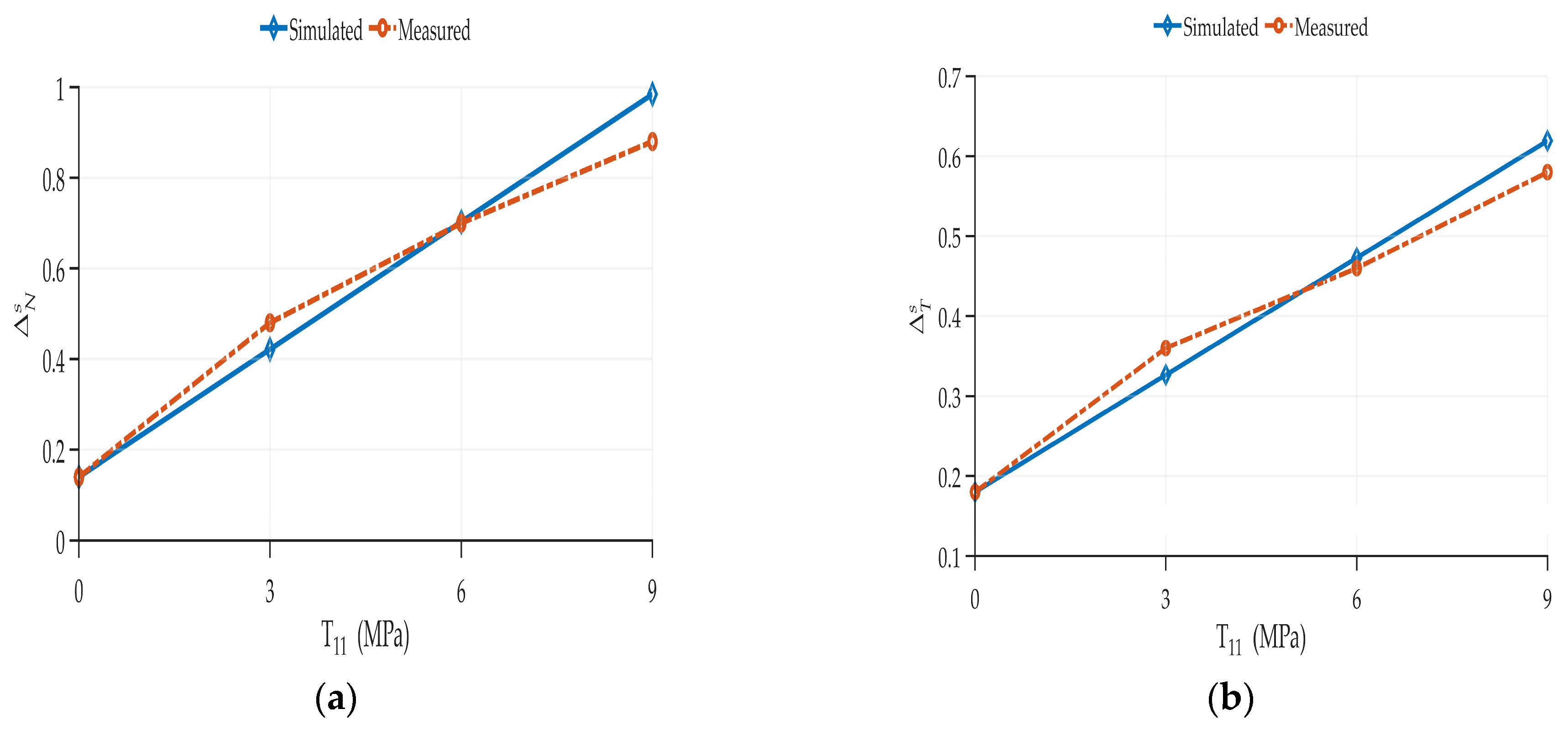
Because this study focuses on theoretical forward modeling rather than field-scale inversion, model verification is performed using experimental constraints and limiting-case consistency tests. Two levels of verification are conducted. First, stress-dependent anisotropic parameters and fracture-weakness trends are compared with laboratory constraints from Berea sandstone under uniaxial stress. Second, the reflection-coefficient operator is tested under degenerate isotropic conditions against the Zoeppritz exact solution and Rüger approximation. These tests examine whether the proposed formulation reproduces known stress-dependent anisotropic trends and whether the forward operator behaves correctly in limiting cases. Table 1 summarizes the evolution of elastic symmetry for different initial media under various stress-loading directions. Based on the Berea sandstone data reported by Sarkar et al. [43], the theoretical relationship between horizontal stress and anisotropic parameters is verified.
The anisotropy parameters calculated using the method of Sarkar et al. [43] are presented in Table 2. Furthermore, the normal fracture compliances ( Δ N 1 , Δ N 2 ) and tangential fracture compliances ( Δ T 1 , Δ T 2 ) are calculated, with the results shown in Table 3.
Figure 2 compares the fracture-weakness parameters predicted by the constitutive model with the measured Berea sandstone data reported by Sarkar et al. The predicted values calculated using K p = 2 A 155 A 33 and K s = A 456 A 55 (orange solid line) show good agreement with the measured data (blue dash-dotted line), serving as a reference for parameter sensitivity analysis. As observed from the figure, during the initial stage of low geostress (< 10   MPa ), the fracture weakness parameters vary approximately linearly with increasing geostress, which is consistent with the “first-order linear response” law derived in the preceding theoretical section. As the stress increases further, the relationship gradually deviates from linearity and exhibits significant nonlinear characteristics; therefore, the application scope of the method proposed in this paper should be restricted to the low-stress regime. Within this regime, a comparison between numerical simulations and experimental data shows that the two are in good overall agreement, although the fitting error tends to accumulate and amplify as the stress level rises. During the fitting of the experimental data, the parameters were set as K p = 387 and K s = 201 . For one set of results, the RMSE is 0.064, with deviations primarily concentrated around 3 MPa and 9 MPa. For the other set, the RMSE is 0.030, where the deviations mainly occur at 9 MPa. These comparisons indicate that the proposed formulation captures the first-order stress sensitivity of anisotropic parameters and fracture weaknesses within the low-stress range, supporting its applicability under the weak-stress perturbation assumption.
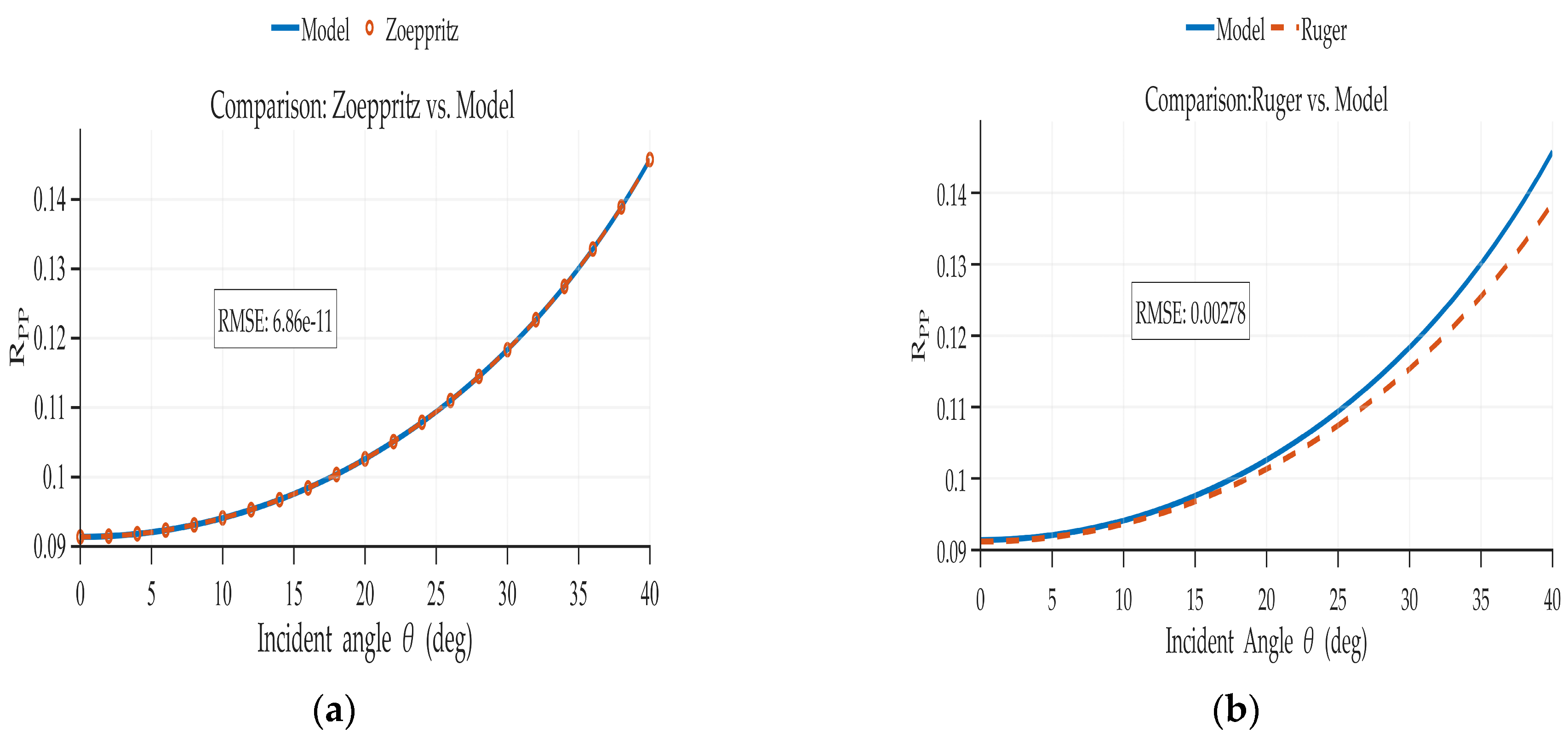
At the operator level, the forward-modeled results of the degenerate model are compared with analytical solutions (Figure 3). The blue curves represent the proposed model, the red dots denote the Zoeppritz exact solution, and the orange curves denote the Rüger approximation. Under the isotropic limit, the proposed model is highly consistent with the Zoeppritz exact solution within the small-angle range (Figure 3a). It also shows higher accuracy than the Rüger approximation in the comparison shown in Figure 3b.
The limiting-case test further confirms the numerical consistency of the reflection-coefficient operator. When anisotropic perturbations are removed, the proposed operator reduces to the isotropic reflection problem and reproduces the Zoeppritz solution within the expected angle range. Its agreement with the Rüger approximation at small-to-moderate incidence angles also confirms consistency with commonly used weak-anisotropy AVAZ formulations. Although this test does not replace field validation, it supports the internal consistency and numerical robustness of the proposed forward-modeling scheme.

3.2. Anisotropic Characteristics Induced by Weak Stress

Using an isotropic rock as the initial reference model, this study examines how different in situ stress-loading paths affect the evolution of induced anisotropy under controlled baseline conditions. Based on the theoretical derivations and parameter definitions above, this section conducts forward modeling and sensitivity analysis for three typical stress states: uniaxial, biaxial, and triaxial loading. By comparing the splitting magnitudes and evolution trends of anisotropic parameters under different loading constraints, the analysis evaluates the dominant role of principal stress differences in the formation and degradation of induced anisotropy. The elastic parameters of the initial isotropic rock, which provide the unified input baseline for all subsequent stress-path calculations, are listed in Table 4.

3.3. Response Curves of Anisotropic Characteristics

Regarding the loading direction and coordinate system conventions, the uniaxial stress path is defined as the application of the axial principal stress T 11 along the x 1 -axis with incremental increases, while the lateral stresses are maintained at zero ( T 22   =   T 33   =   0 ). In the biaxial stress path, while maintaining a confining pressure of T 33   =   10   MPa along the x 3 direction, the stress T 11 is adjusted along the x 1 direction ( T 22   =   0 ) to construct a stress process where T 11 incrementally approaches T 33 . That is, T   =   [ T 11 , 0 , 10 ]   MPa where T 11   =   [ 0 , 10 ] MPa . In the triaxial stress path, to introduce additional lateral constraints and better approximate realistic multiaxial stress states, the lateral stress along the x 2 direction is maintained at a constant value T 22   =   5   MPa . These three types of paths represent the evolution of differential stress degrees of freedom, ranging from single axial loading to differential stress decay under confining pressure, and finally to multiaxial collaborative loading with lateral constraints. This provides comparable conditions for identifying the dominant role of principal stress differences in induced anisotropy.
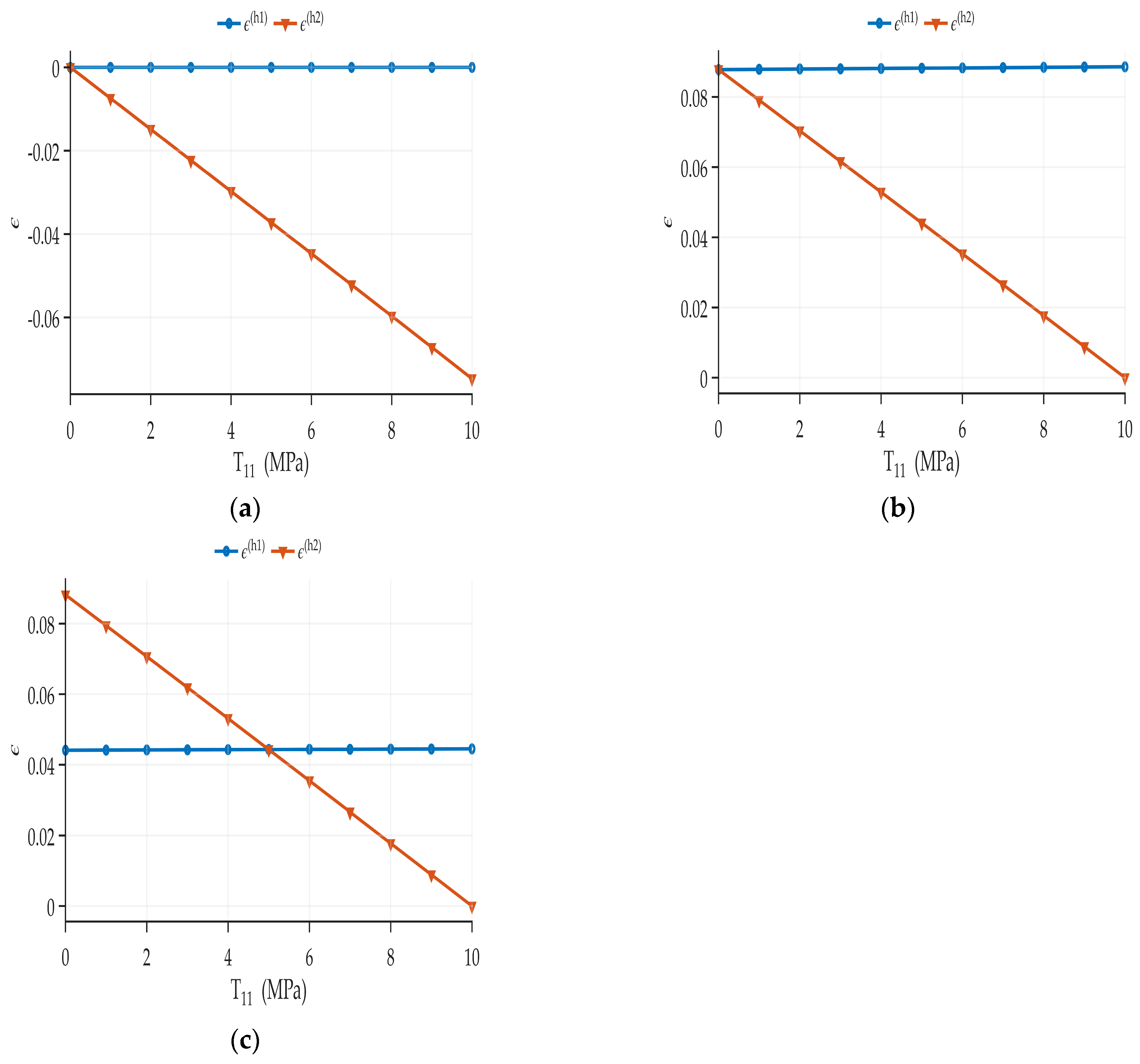
Figure 4a–c presents the response comparisons of ε under uniaxial, biaxial, and triaxial loading paths, respectively. The results show that ε is strongly controlled by the degree of symmetry breaking caused by principal stress differences. Under uniaxial loading, only T 11 increases while T 22 and T 33 remain unchanged. This produces the largest stiffness contrast among the principal directions, and therefore the most evident splitting of the ε -related curves. Under biaxial loading, the fixed lateral stress reduces the effective stress contrast as T 11 gradually approaches the constrained stress component. As a result, the ε splitting becomes weaker and tends toward convergence. Under triaxial loading, the additional lateral constraint further reduces the differential stress projected onto the relevant symmetry planes, leading to the weakest ε response among the three stress paths.
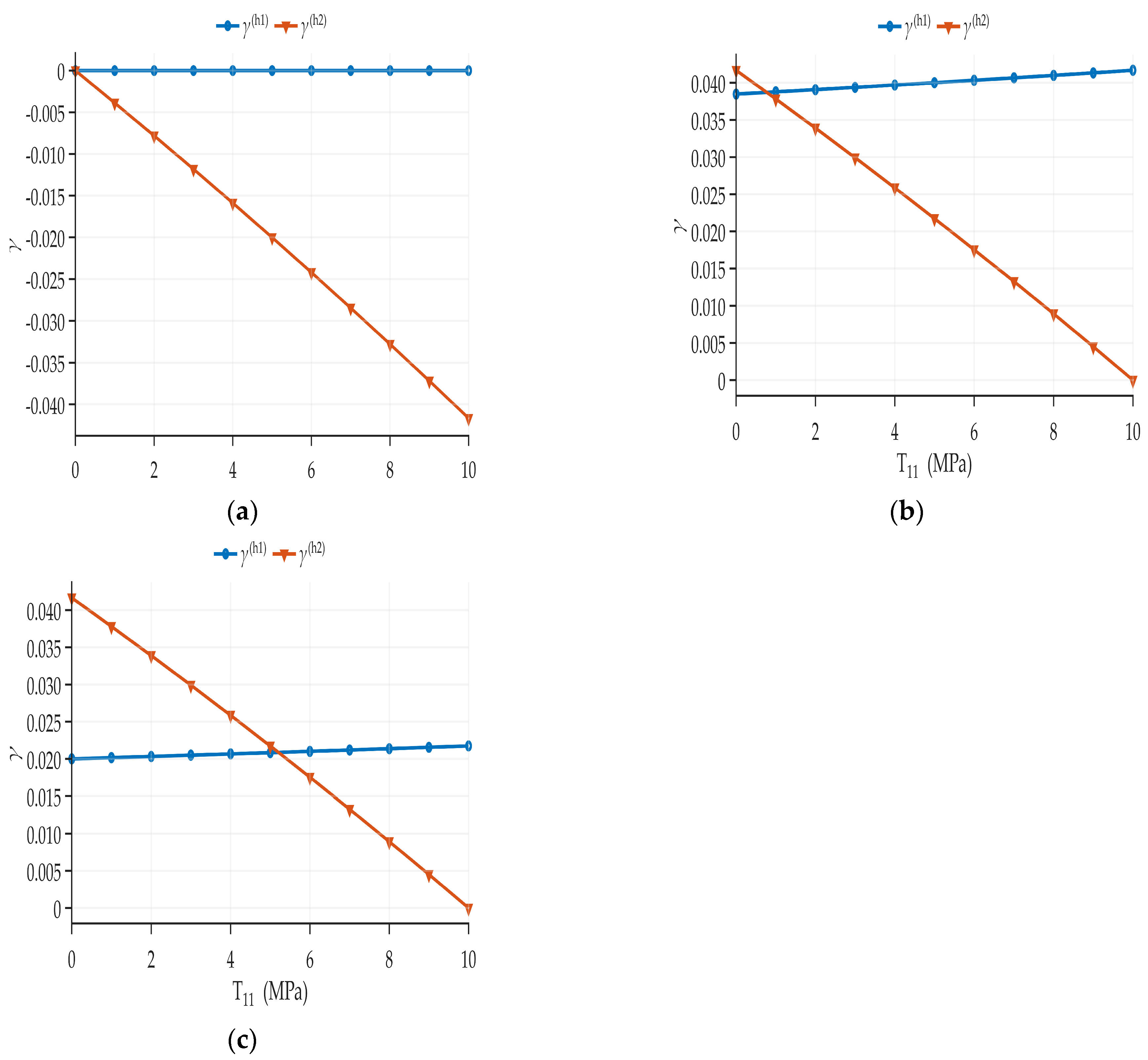
Figure 5a–c further presents the comparison results of the parameter γ under three loading paths: uniaxial, biaxial, and triaxial. Unlike ε , which primarily characterizes symmetry breaking in the longitudinal stiffness channel, γ more directly reflects the induced anisotropy associated with shear stiffness; therefore, its magnitude is controlled not only by the principal stress difference but is also more susceptible to modulation by the shear modulus background and the tangential weakness weights. Under uniaxial conditions (Figure 5a), γ exhibits an identifiable systematic evolution (enhanced splitting or monotonic shift) as T 11 increases, indicating that even when only one principal stress component is varied, the differential stress can still excite a first-order induced response in the shear channel. In contrast, under biaxial conditions (Figure 5b), the fixed T 33   =   10   MPa causes the differential stress T 11 T 33 to gradually decay with loading, resulting in the separation of γ curves being significantly compressed and trending toward zero; this demonstrates that it likewise satisfies the degradation limit under symmetry restoration conditions. Furthermore, under triaxial conditions (Figure 5c), after introducing a constant lateral stress T 22   =   5   MPa and allowing T 33 to participate in collaborative variations, the overall magnitude and stress sensitivity of γ continue to decrease compared to the biaxial results. Compared with ε , γ more directly reflects shear-stiffness contrast and tangential weakness, so its stress sensitivity is more closely related to the shear channel of the equivalent stiffness matrix.
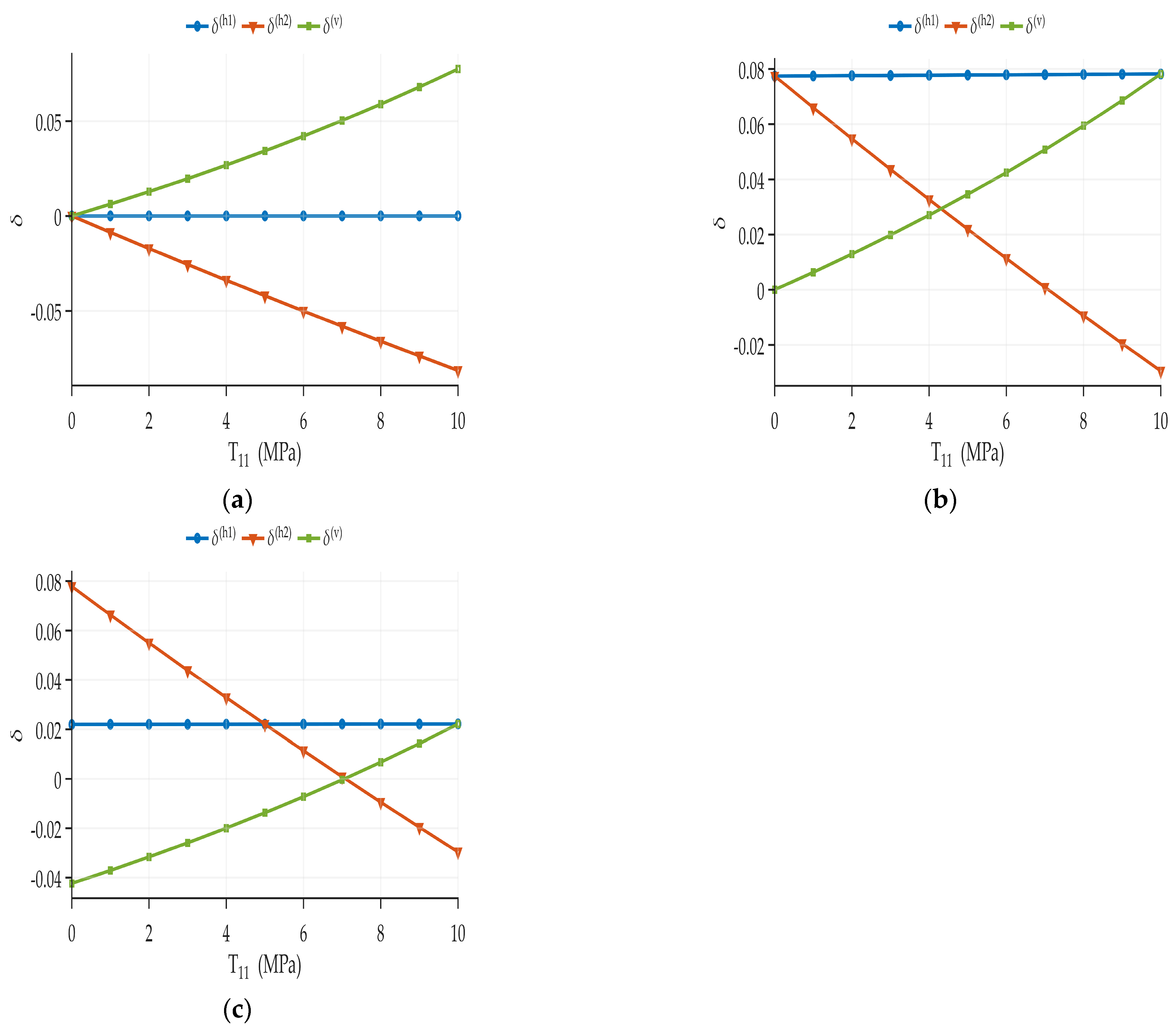
Figure 6a–c presents the evolution of the coupling anisotropic parameter δ under uniaxial, biaxial, and triaxial stress conditions. Unlike ε and γ , which are mainly associated with normal-stiffness and shear-stiffness contrasts, δ is more strongly affected by cross-stiffness terms and coupling between different symmetry planes. Therefore, its response is generally weaker and more easily influenced by stress-path constraints. Under uniaxial loading, the imposed stress along one principal direction breaks the initial isotropic symmetry and produces a systematic variation in δ , although its magnitude is smaller than those of ε and γ . Under biaxial loading, as T 11 approaches the fixed lateral stress, the coupling contrast between symmetry planes decreases, and the δ -related response tends to converge. Under triaxial loading, the additional lateral constraint further suppresses the coupling perturbation, making the δ response weaker and less distinguishable. This indicates that δ is a secondary but useful indicator of stress-induced orthorhombic coupling, especially when the principal stress differences are sufficiently large.
Overall, Figure 4, Figure 5 and Figure 6 show that ε , γ , and δ follow a consistent stress-path-dependent evolution. Uniaxial loading produces the strongest symmetry breaking because no lateral constraint is applied, leading to the clearest anisotropic response. Under biaxial and triaxial loading, the additional lateral stresses reduce the effective principal stress difference, so the anisotropic parameters gradually converge. This behavior indicates that stress-induced orthorhombic anisotropy is governed mainly by differential stress rather than absolute stress magnitude. Mechanistically, as the stress state becomes more balanced, the contrasts in normal stiffness, shear stiffness, and cross-stiffness among the principal directions decrease, and the induced anisotropy correspondingly degrades.

3.4. Response Characteristics of Anisotropy Parameters Under Horizontal Principal Stress Difference

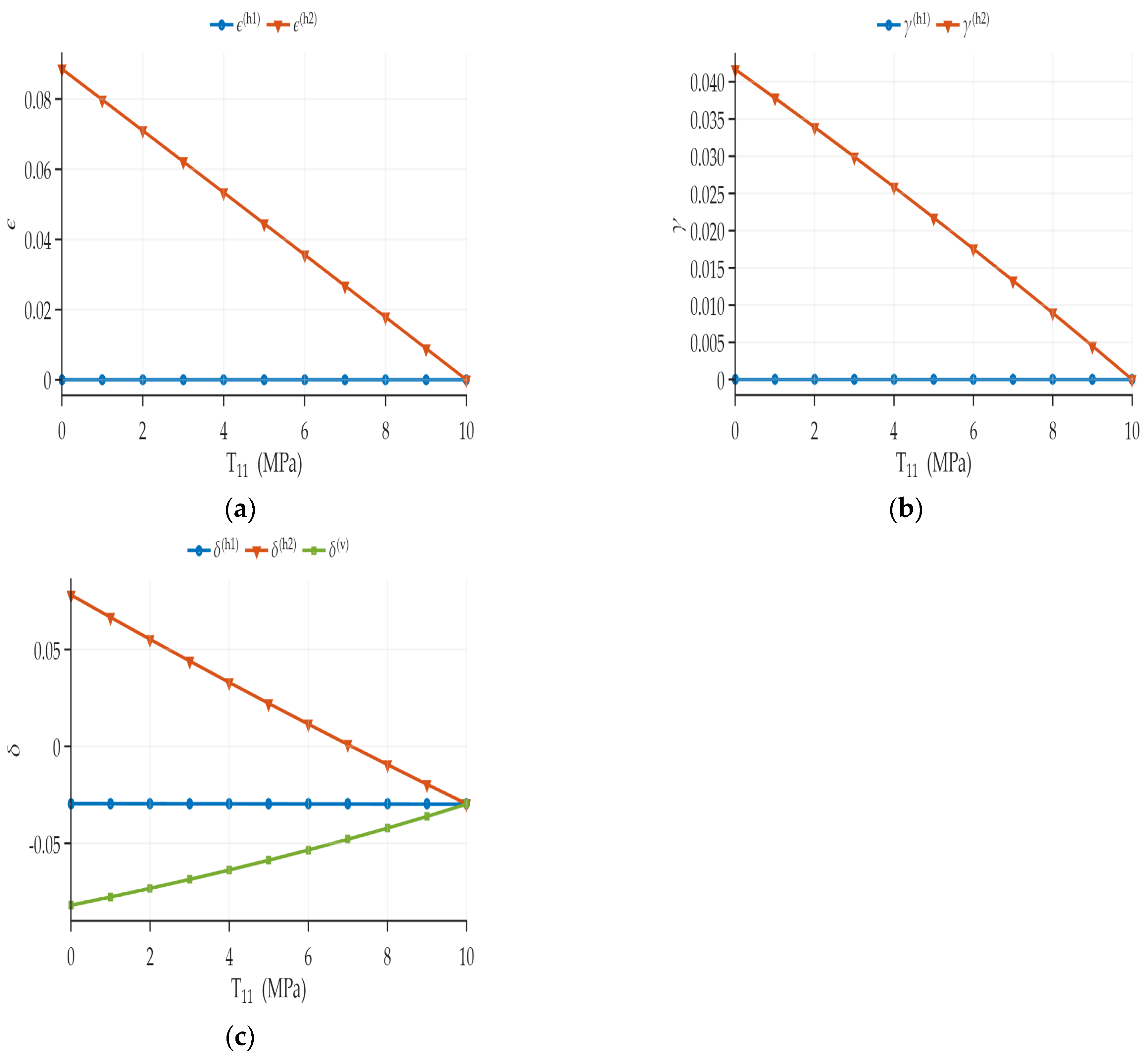
Figure 7a–c presents the response characteristics of the P-wave anisotropy parameter ε and the S-wave anisotropy parameter γ under the triaxial stress path T   =   [ T 11 , 10 , 10 ]   MPa (where T 11 varies from [ 0 , 10 ]   MPa ). Since identical stresses are applied in the x 2 and x 3 directions ( T 22   =   T 33 ), the parameters ε ( h 1 ) and γ ( h 2 ) related to this symmetry plane exhibit a near-linear attenuation as T 11 increases and approach zero as T 11 gradually reaches T 33 , reflecting the degradation of induced anisotropy as the stress state trends toward equality. Regarding the coupling parameters, δ ( h 1 ) remains relatively stable in the symmetry plane parallel to the loading direction; in contrast, δ ( h 2 ) and δ ( v ) exhibit opposite evolutionary trends: δ ( h 2 ) gradually decreases from approximately 0 and continues to change toward negative values to about 0.03 , while δ ( v ) rises nearly linearly from approximately 0.04 to 0, eventually approaching the numerical value of δ ( h 1 ) as stress increases. Based on the above phenomena, it is evident that the primary controlling factor for stress-induced anisotropy is the principal stress difference (especially the horizontal stress difference) rather than the absolute magnitude of the stress. Therefore, in engineering scenarios such as hydraulic fracturing, prioritizing the variations in horizontal stress difference is more conducive to capturing the evolutionary trends and identifiability of Anisotropy parameters under the triaxial stress path T = [T11, 10, 10] MPa: (a) ε; (b) γ; (c) δ.
The triaxial case in Figure 7 further verifies this mechanism under the condition T 22   =   T 33   =   10   Mpa and T 11 increasing from 0 to 10 MPa. As T 11 approaches T 22 and T 33 , the horizontal stress difference decreases, and the stress-induced orthorhombic components are gradually suppressed. When the three principal stresses become equal, the stress-induced symmetry breaking reaches its degradation limit. This result again demonstrates that the magnitude of stress-induced anisotropy depends mainly on the stress difference among principal directions, rather than on the absolute stress level alone.

3.5. PP-Wave Reflection Coefficient Curves

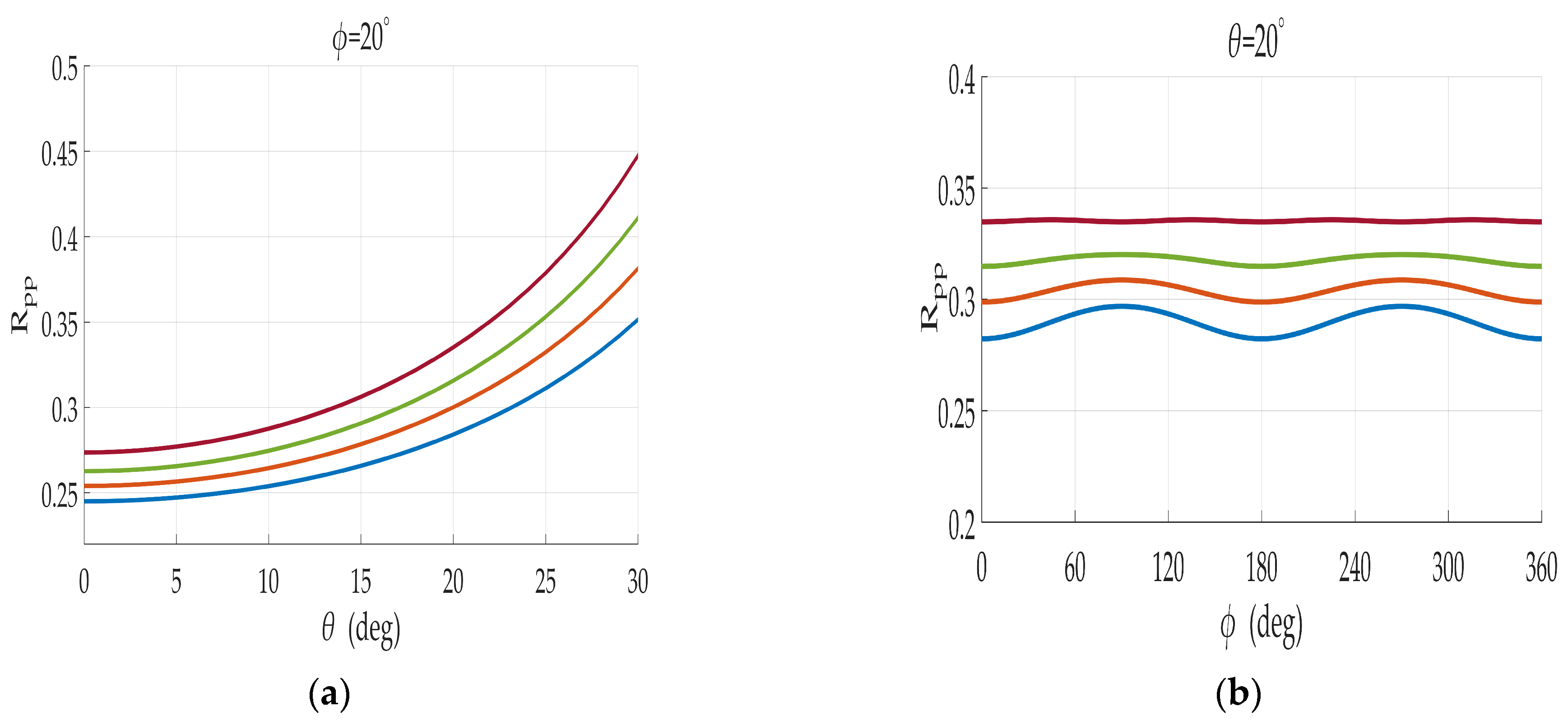
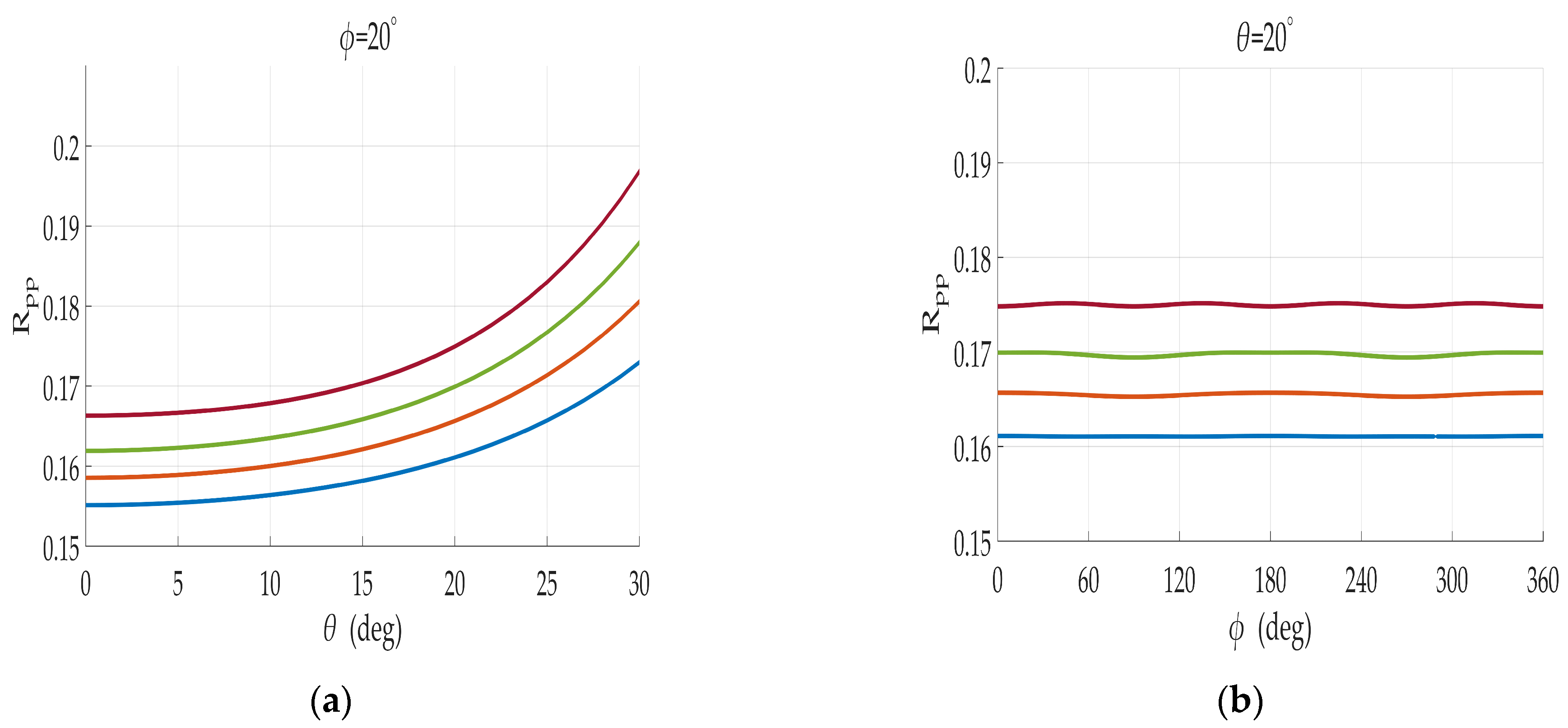
After characterizing the stress-dependent anisotropy parameters ε , γ and δ , we map them to seismic observables to evaluate the sensitivity of AVO and AVAZ responses to stress-induced effects. Based on the triaxial stress-dependent equivalent stiffness matrix and welded-interface conditions described above, a unified forward operator combining Christoffel eigen-solving and interface-scattering equations is used to calculate the PP-wave reflection coefficient R p p at the two-layer interface listed in Table 5 as a function of incident angle θ and azimuth ϕ . The corresponding AVO and AVAZ response curves are then obtained in the angle and azimuth domains, respectively.
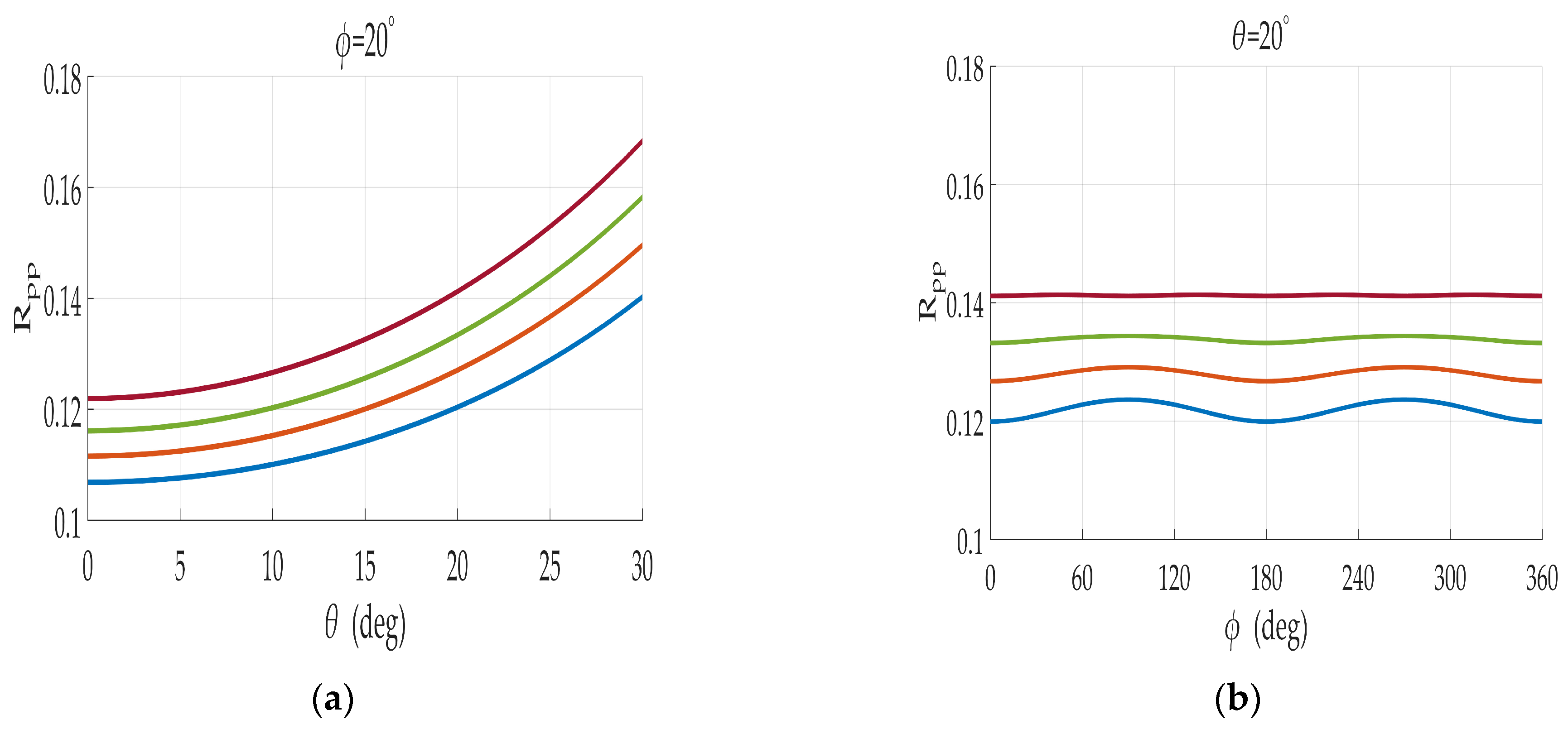
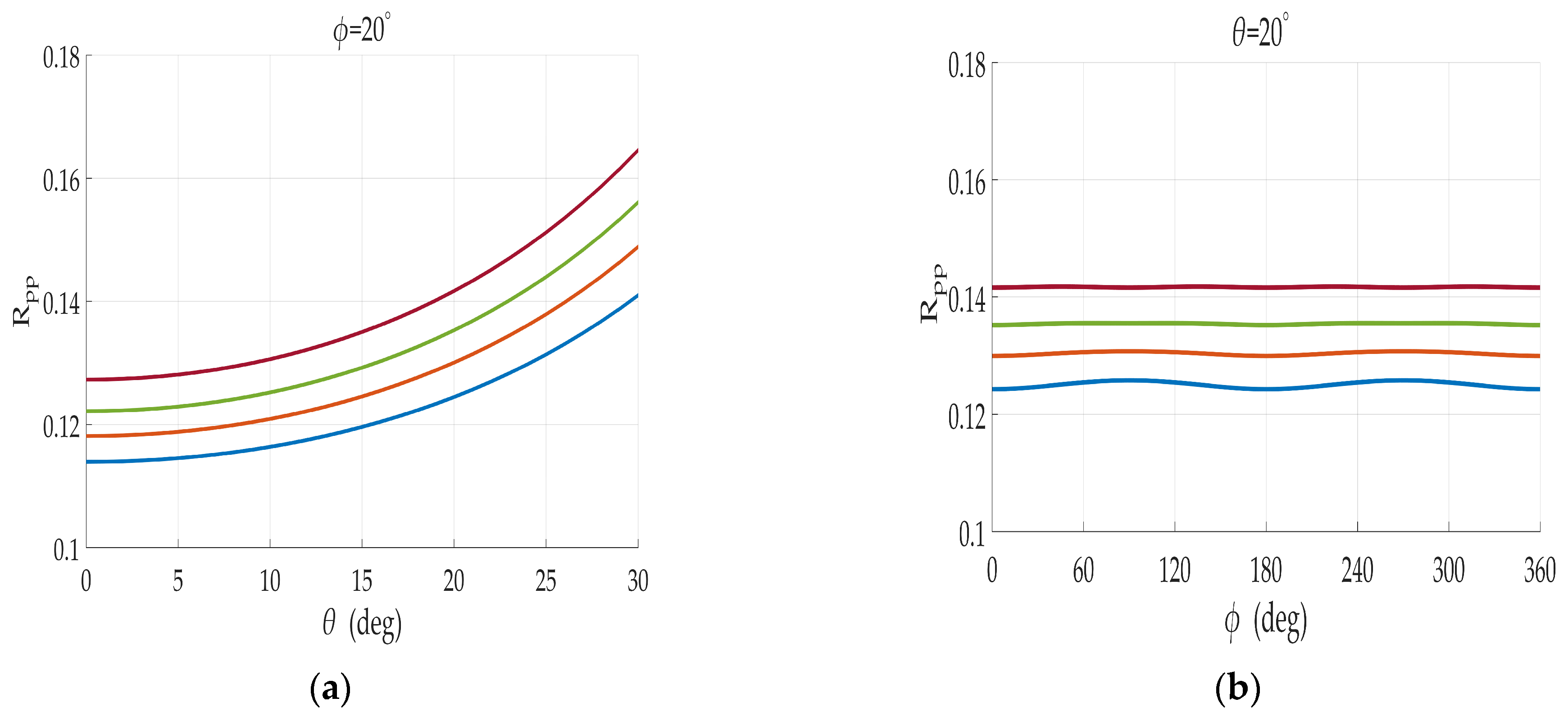
In the current numerical experiments, as summarized in Table 6 together with the corresponding color codes used in Figure 8, Figure 9, Figure 10 and Figure 11, we focus on comparing a triaxial non-hydrostatic stress path where the lateral stresses are fixed at T 22   =   T 33   =   10   Mpa . By scanning T 11 across 0 , 3 , 6 and 10   MPa , we aim to demonstrate the degradation limit as the differential stress approaches zero. The upper layer utilizes dry-state parameters, while the lower layer employs saturated-state parameters to highlight the coupling effects between fluid phase differences and stress sensitivity.
Table 6. Colors of the T1–T4 curves denote their meanings.
ColorStress (MPa)
T11T22T33
Blue01010
Orange31010
Green61010
Red101010
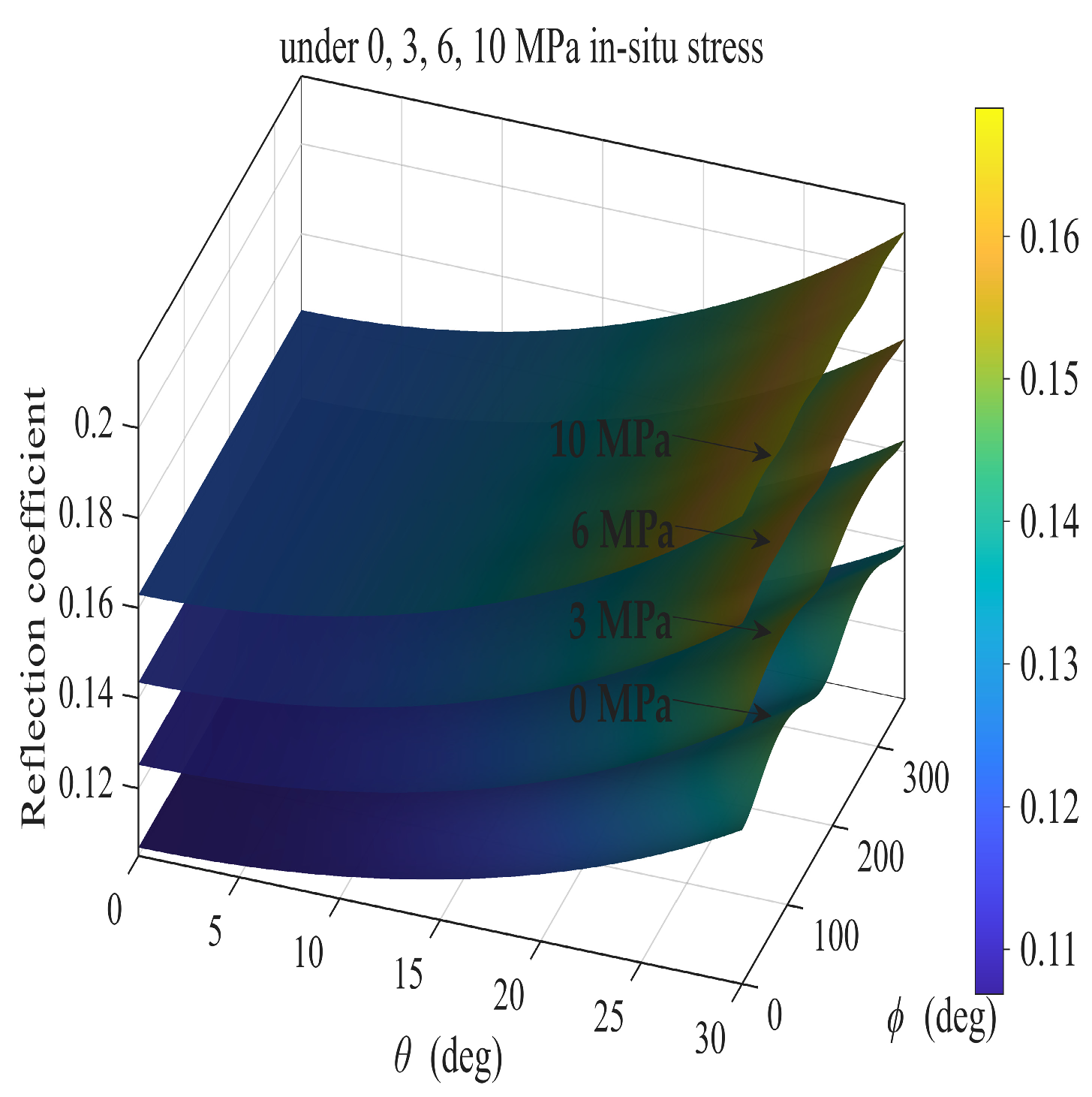
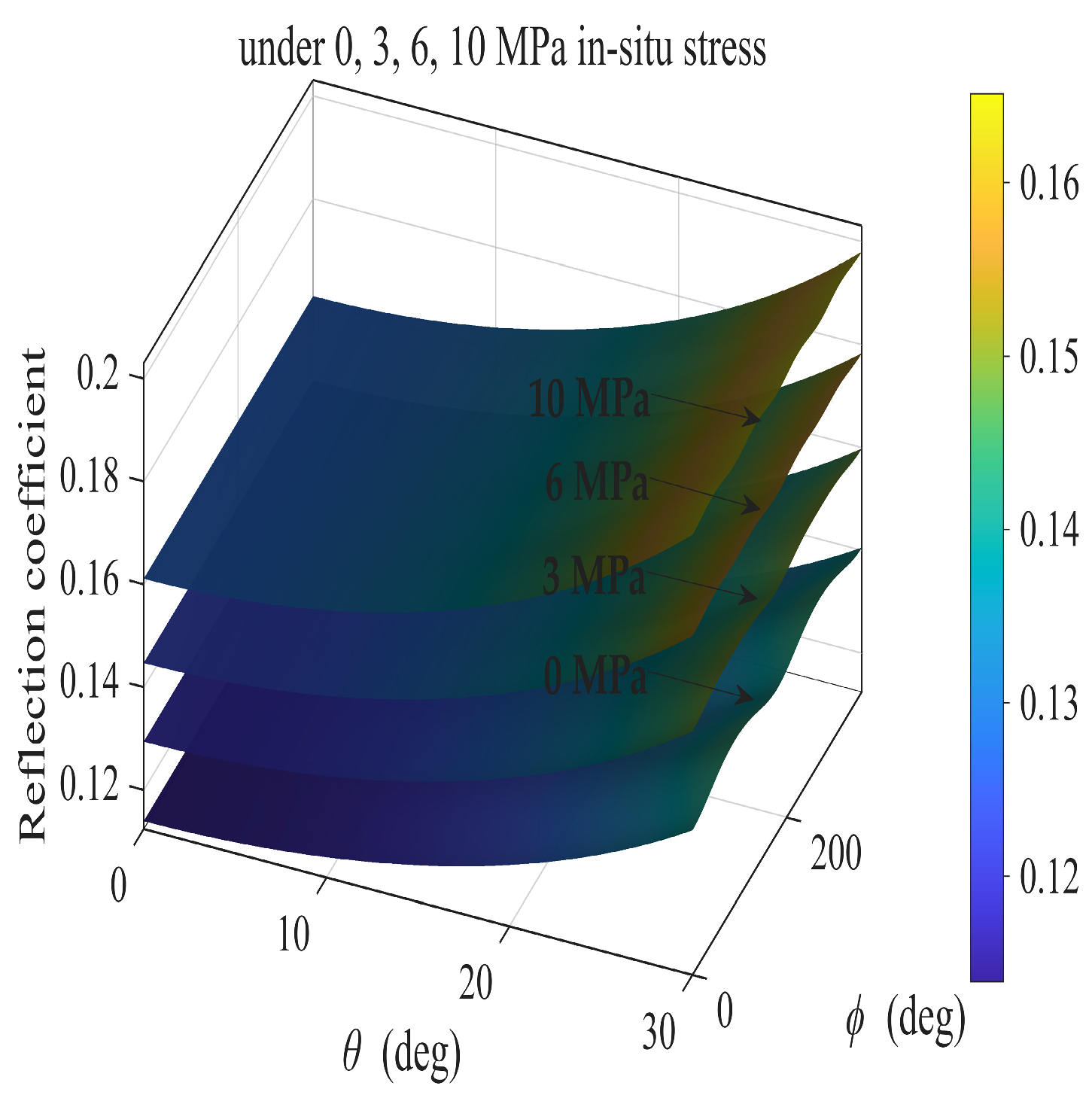
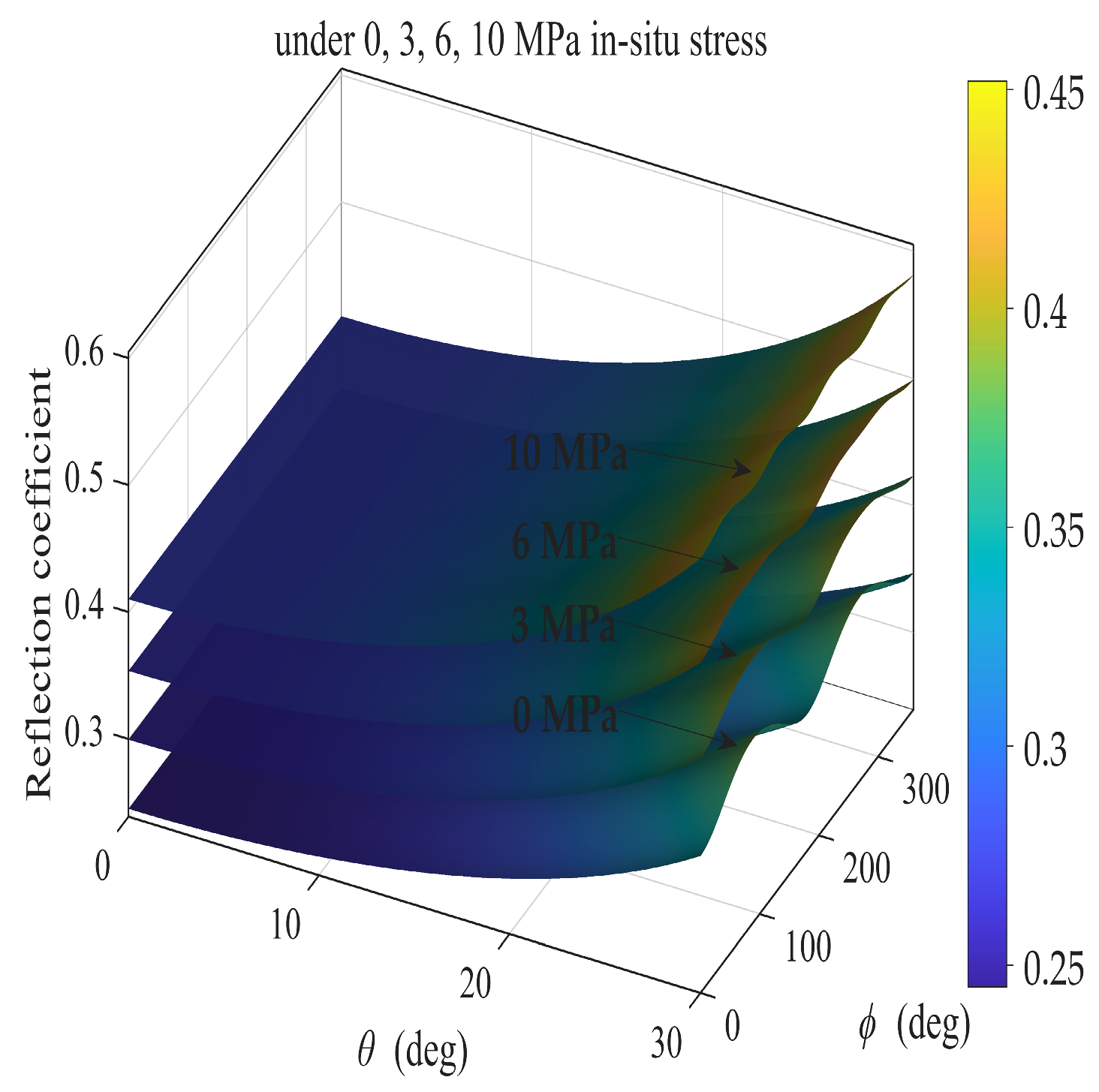
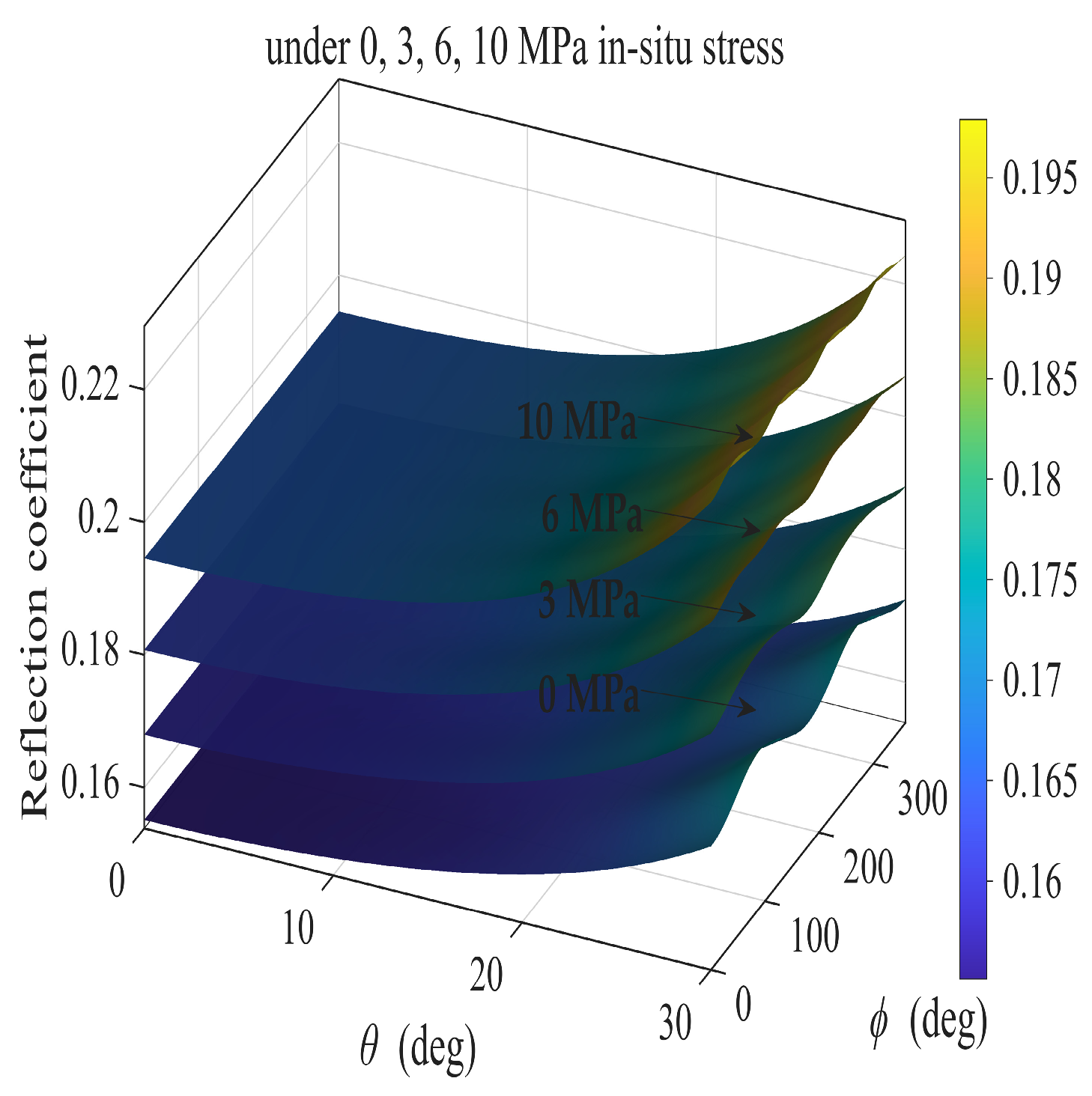
Under the triaxial path T   =   [ T 11 , 10 , 10 ]   MPa ( T 11   =   0 10   MPa ) , Figure 8, Figure 9, Figure 10 and Figure 11 illustrate the variation patterns of the PP-wave reflection coefficient with the incident angle for four sets of interfaces (T1–T4). Figure 12, Figure 13, Figure 14, and Figure 15 present the corresponding 3D views of Figure 8, Figure 9, Figure 10 and Figure 11 for interfaces T1–T4, respectively. The color codes correspond to the stress settings listed in Table 6. Overall, as the principal stress difference increases, the angular sensitivity of R p p exhibits a systematic enhancement. Curve separation is primarily concentrated in the intermediate incident angle window, which demonstrates higher stability and discriminability for stress variations. When the stress state approaches the isotropic reference ( T 11 T 22   =   T 33 ), the degree of curve separation significantly converges, indicating that the decay of differential stress drives the degradation of induced anisotropy and a return to the baseline response.
The strength of the azimuthal terms varies significantly among different interface combinations. For some interfaces, differential stress mainly modulates the azimuth-independent terms, such as equivalent impedance and average modulus contrasts, leading to weak azimuthal fluctuations. For others, distinct periodic azimuthal oscillations can still be observed even under low stress differences. This suggests that these interface combinations more effectively project stress-related stiffness perturbations onto azimuth-dependent terms, thereby producing identifiable AVAZ signals.
Although the proposed model shows good overall consistency with existing stress-induced azimuthal reflection theories in the angle domain, the evolution of azimuthal fluctuation amplitudes varies among the T-groups. This indicates that, under the same differential-stress scan, AVAZ responses are controlled not only by stress level, but also by fluid-state differences and elastic-parameter contrasts between layers, reflecting the coupling between stress sensitivity and background elastic contrast. These comparisons confirm the reproducibility of the stress-induced azimuthal correlation mechanism within the proposed forward-modeling framework and show that AVAZ attributes are sensitive not only to the presence of anisotropy, but also to how differential stress and fracture weakness are projected into azimuth-dependent stiffness contrasts. Therefore, the proposed AVAZ modeling results provide a basis for selecting effective angle–azimuth observation windows and constructing orthogonal azimuthal differences or azimuthal Fourier coefficients for future inversion applications.
Figure 12. 3D seismic response characteristics of the T1 interface.
Processes 14 01826 g012
Figure 13. 3D seismic response characteristics of the T2 interface.
Processes 14 01826 g013
Figure 14. 3D seismic response characteristics of the T3 interface.
Processes 14 01826 g014
Figure 15. 3D seismic response characteristics of the T4 interface.
Processes 14 01826 g015

4. Discussion

The nonlinear acoustoelastic theory adopted in this study is consistent with previous formulations. Rather than proposing a new constitutive law, this work extends the analysis from uniaxial stress perturbations to stiffness-tensor evolution under triaxial non-hydrostatic loading. Schoenberg’s linear-slip model is incorporated to introduce fracture weakness into the equivalent stiffness matrix, allowing stress-induced and fracture-induced contributions to be described within a unified first-order framework. The stress range of 0–10 MPa is used to characterize the initial response of elastic parameters to stress increments. Although deep reservoirs may involve much higher absolute in situ stresses, the induced anisotropy analyzed here is mainly controlled by relative stress changes and principal stress differences. Therefore, the present conclusions are most applicable to elastic deformation, weak-to-moderate fracture weakness, and preferentially oriented fractures. Under stronger crack closure, plastic deformation, high fracture density, complex fracture interaction, pore-pressure variation, or strong intrinsic anisotropy, the stress–fracture–stiffness relationship may become nonlinear or scale dependent.
The forward operator is based on Christoffel eigenanalysis and welded-interface boundary conditions and directly calculates angle- and azimuth-dependent reflection and transmission coefficients from the equivalent stiffness matrix. This provides a transparent workflow from stress and fracture parameters to stiffness construction, wave-mode solution, and AVAZ response prediction. Although the numerical examples focus on PP-wave AVAZ responses, the same framework can be extended to qS-wave and P-to-S converted-wave responses. For future inversion applications, stress perturbations and fracture weaknesses may produce coupled effects in the equivalent stiffness matrix and AVAZ amplitudes, leading to parameter trade-off and non-uniqueness. Therefore, stress magnitude, fracture weakness, and fracture orientation should not be interpreted independently from a single AVAZ attribute; instead, they should be constrained jointly using multi-angle and multi-azimuth seismic responses, together with well-log, laboratory, and geological prior information.
Several assumptions should be regarded as controlled simplifications rather than a complete representation of shale-reservoir complexity. An initially isotropic matrix is used to isolate stress- and fracture-induced anisotropy, although real shales may contain bedding- or fabric-related anisotropy. Fluid effects are not explicitly modeled; therefore, pore pressure, squirt-flow dispersion, attenuation, and fluid–solid coupling may affect fracture compliance and AVAZ responses. Fractures are represented by equivalent normal and tangential weaknesses within the linear-slip framework, which captures the leading-order effect of aligned fractures but does not fully describe complex fracture networks, strong fracture interaction, or scale-dependent scattering. When fracture density is high, or fracture spacing becomes comparable to the seismic wavelength, the first-order equivalent-medium approximation may lose accuracy. Quantitative application of the proposed framework, therefore, requires calibration with laboratory measurements, well logs, geological constraints, and amplitude-preserved wide-azimuth seismic data.

5. Conclusions

Under the weak-stress perturbation assumption, this study develops a stress–fracture coupled equivalent-stiffness formulation by combining nonlinear acoustoelastic theory with Schoenberg’s linear-slip model. A Christoffel-equation-based welded-interface operator is then used to map the equivalent stiffness matrix to angle- and azimuth-dependent seismic responses under triaxial non-hydrostatic loading. The main conclusions are as follows.
(1) A physically traceable modeling chain is established from triaxial principal stresses and fracture weaknesses to equivalent orthorhombic stiffness and AVAZ responses. The comparison with Berea sandstone experimental data shows that the proposed formulation can capture the first-order stress sensitivity of fracture-weakness parameters within the low-stress range. The RMSE values of the two compared parameter sets are 0.064 and 0.030, indicating reasonable agreement under the weak-stress perturbation assumption.
(2) Principal stress difference, rather than absolute stress magnitude, is the dominant factor controlling stress-induced anisotropy. Under uniaxial loading, the absence of lateral constraints produces the strongest symmetry breaking and the clearest separation of anisotropic parameters. Under biaxial and triaxial loading, additional lateral stresses reduce the effective principal stress difference, causing ε, γ, and δ to progressively converge. When the three principal stresses approach equality, the induced anisotropy is strongly suppressed, confirming the degradation limit as differential stress approaches zero.
(3) Forward modeling of PP-wave responses shows that increasing differential stress enhances reflection-curve separation and azimuthal fluctuation in both incidence-angle and azimuthal domains. This separation is more evident in the moderate incidence-angle range, whereas angular sensitivity and azimuthal variation decrease as the stress state approaches the isotropic reference condition. These results indicate that curve separation, azimuthal fluctuation, and angle-dependent sensitivity can provide useful constraints for future stress–fracture joint inversion, provided that wide-azimuth seismic data are amplitude-preserved and calibrated by well-log or laboratory information.
Future work should incorporate attenuation, dispersion, pore-fluid effects, non-ideal interface conditions, and field-data validation to further assess the applicability and inversion robustness of the proposed framework.

Author Contributions

Conceptualization, H.L. and G.H.; methodology, H.L.; software, H.L.; validation, H.L., X.Q., and Z.Y.; formal analysis, H.L.; investigation, H.L.; resources, G.H.; data curation, H.L.; writing—original draft preparation, H.L.; writing—review and editing, G.H., X.Q., Z.Y., M.W., and L.M.; visualization, H.L.; supervision, G.H.; project administration, G.H.; funding acquisition, G.H. All authors have read and agreed to the published version of the manuscript.

Funding

This work was supported in part by the National Key R&D Program of China under Grant 2024YFB4007100, in part by the National Major Science and Technology Projects of China under Grant 2024ZD1004300, in part by the National Natural Science Foundation of China under Grants 42304133 and 42574175, and in part by the Key Project from the Hubei Research Center for Basic Disciplines of Earth Sciences under Grant HRCES-202401.

Institutional Review Board Statement

Not applicable.

Informed Consent Statement

Not applicable.

Data Availability Statement

The original contributions presented in this study are included in the article. Further inquiries can be directed to the corresponding author.

Conflicts of Interest

The authors declare no conflicts of interest.

References

  1. Heap, M.J.; Faulkner, D.R.; Meredith, P.G.; Vinciguerra, S. Elastic moduli evolution and accompanying stress changes with increasing crack damage: Implications for stress changes around fault zones and volcanoes during deformation. Geophys. J. Int. 2010, 183, 225–239. [Google Scholar] [CrossRef]
  2. Zhang, K.; Guo, Y.; Zhang, B.; Trumbo, A.M.; Marfurt, K.J. Seismic azimuthal anisotropy analysis after hydraulic fracturing. Interpretation 2013, 1, T31–T49. [Google Scholar] [CrossRef]
  3. Lin, K.; Zhang, B.; Zhang, J.; Fang, H.; Xi, K.; Li, Z. Predicting the azimuth of natural fractures and in situ horizontal stress: A case study from the Sichuan Basin, China. Geophysics 2022, 87, R1–R15. [Google Scholar] [CrossRef]
  4. Li, L.; Wang, Y.; Cai, H.; Hu, G. Estimation of gravity-induced stress parameters from azimuthal seismic data in tilted transversely isotropic media. In Proceedings of the 85th EAGE Annual Conference & Exhibition, Oslo, Norway, 10–13 June 2024. [Google Scholar] [CrossRef]
  5. Tan, W.; Liu, W.; Wang, Y.; Shen, H. Quantifying the effects of micro-cracks on velocity anisotropy in lacustrine shales with variable sedimentary structures. J. Seism. Explor. 2025, 34, 28–41. [Google Scholar] [CrossRef]
  6. Ge, Z.J.; Pan, S.L.; Li, J.Y.; Huang, J.B.; Luo, H.R.; He, J. Seismic AVOaz inversion in low-loss viscoelastic orthorhombic medium. J. Seism. Explor. 2021, 30, 545–560. [Google Scholar]
  7. Reiter, K. Stress rotation-impact and interaction of rock stiffness and faults. Solid Earth 2021, 12, 1287–1307. [Google Scholar] [CrossRef]
  8. Kuila, U.; Dewhurst, D.N.; Siggins, A.F.; Raven, M.D. Stress anisotropy and velocity anisotropy in low-porosity shale. Tectonophysics 2011, 503, 34–44. [Google Scholar] [CrossRef]
  9. He, Y.X.; Angus, D.A.; Yuan, S.Y.; Xu, Y.G. Feasibility of time-lapse AVO and AVOA analysis to monitor compaction-induced seismic anisotropy. J. Appl. Geophys. 2015, 122, 134–148. [Google Scholar] [CrossRef]
  10. Chen, F.B.; Zong, Z.Y.; Yin, X.Y. Monitoring the change in horizontal stress with multi-wave time-lapse seismic response based on nonlinear elasticity theory. Pet. Sci. 2023, 20, 449–465. [Google Scholar] [CrossRef]
  11. Shapiro, S.A. Elastic piezosensitivity of porous and fractured rocks. Geophysics 2003, 68, 390–398. [Google Scholar] [CrossRef]
  12. Sone, H.; Zoback, M.D. Mechanical properties of shale-gas reservoir rocks—Part 1: Static and dynamic elastic properties and anisotropy. Geophysics 2013, 78, D381–D392. [Google Scholar] [CrossRef]
  13. Wang, Y.; Li, C.H. Investigation of the P- and S-wave velocity anisotropy of a Longmaxi formation shale by real-time ultrasonic and mechanical experiments under uniaxial deformation. J. Pet. Sci. Eng. 2017, 158, 766–778. [Google Scholar] [CrossRef]
  14. Winkler, K.W.; McGowan, L. Nonlinear acoustoelastic constants of dry and saturated rocks. J. Geophys. Res. Solid Earth 2004, 109, B10204. [Google Scholar] [CrossRef]
  15. Sondergeld, C.H.; Rai, C.S. Elastic anisotropy of shales. Lead. Edge 2011, 30, 324–331. [Google Scholar] [CrossRef]
  16. Gurevich, B.; Pervukhina, M.; Makarynska, D. An analytic model for the stress-induced anisotropy of dry rocks. Geophysics 2011, 76, WA1–WA12. [Google Scholar] [CrossRef]
  17. Kachanov, M. Effective elastic properties of cracked solids: Critical review of some basic concepts. Appl. Mech. Rev. 1992, 45, 336–345. [Google Scholar] [CrossRef]
  18. Dewhurst, D.N.; Siggins, A.F. Impact of fabric, microcracks and stress field on shale anisotropy. Geophys. J. Int. 2006, 165, 135–148. [Google Scholar] [CrossRef]
  19. Schoenberg, M.; Sayers, C.M. Seismic anisotropy of fractured rock. Geophysics 1995, 60, 204–211. [Google Scholar] [CrossRef]
  20. Shapiro, S.A.; Kaselow, A. Porosity and elastic anisotropy of rocks under tectonic stress and pore-pressure changes. Geophysics 2005, 70, O25–O36. [Google Scholar] [CrossRef]
  21. Pan, X.; Zhang, G.; Chen, H.; Yin, X. McMC-based AVAZ direct inversion for fracture weaknesses. J. Appl. Geophys. 2017, 138, 118–129. [Google Scholar] [CrossRef]
  22. Pan, X.-P.; Lu, C.-X.; Xu, H.-W.; Zhang, D.-Z. Exact P-wave reflection and transmission coefficients for horizontal transversely isotropic media at an imperfectly welded contact interface under in situ horizontal stress. Pet. Sci. 2025, 22, 1497–1512. [Google Scholar] [CrossRef]
  23. Wang, M.; Yu, L.; Guo, T.; Song, X.; Zhang, X.; Rui, Y. Pre-Stack Nonlinear Direct Exact Inversion of Fracture Parameters in Deep Shale Reservoirs. Processes 2025, 13, 426. [Google Scholar] [CrossRef]
  24. Huang, G.; Ba, J.; Gei, D.; Carcione, J.M. Amplitude variation with angle and azimuth inversion to estimate fracture properties in shale-gas reservoirs. J. Nat. Gas. Sci. Eng. 2023, 111, 204919. [Google Scholar] [CrossRef]
  25. Gholami, R.; Rasouli, V.; Aadnoy, B.; Mohammadi, R. Application of in situ stress estimation methods in wellbore stability analysis under isotropic and anisotropic conditions. J. Geophys. Eng. 2015, 12, 657–668. [Google Scholar] [CrossRef]
  26. Li, L.; Zhang, G.; Pan, X.; Zhang, J.; Zhu, Z.; Li, C.; Lin, Z. Bayesian AVAZ inversion for direct estimates of a new brittleness indicator and fracture density. Geophysics 2022, 87, R509–R524. [Google Scholar] [CrossRef]
  27. Nie, N.; Guo, Z.; Liu, C. Application of the improved seismic AVAZ inversion method for fracture characterization of a tight sandstone gas reservoir in the Ordos Basin. Rev. Geophys. Planet. Phys. 2024, 55, 358–368. [Google Scholar] [CrossRef]
  28. Ji, L.; Zong, Z.; Yang, Y. Azimuthal amplitude difference inversion constrained by azimuth velocity anisotropy. Geophys. J. Int. 2023, 233, ggac483. [Google Scholar] [CrossRef]
  29. Hao, Q.; He, Q. A standard linear solid model representation of frequency-dependent anisotropy due to multiple sets of aligned meso-scale fractures. J Seismic Explor. 2013, 22, 169-182. [Google Scholar] [CrossRef]
  30. Pan, X.; Zhang, G.; Liu, J.; Ren, Z. Estimating fluid term and anisotropic parameters in saturated transversely isotropic media with aligned fractures. J Seismic Explor. 2021, 30, 65-84. Available online: https://www.geophysical-press.com/journal/JSE/30/1/10.36922/JSE104 (accessed on 1 June 2026).
  31. Yang, J.; Zhang, F.; Li, C. Inversion of horizontal in situ stress field based on wide-azimuth seismic data. J. Geophys. Eng. 2022, 19, 131–141. [Google Scholar] [CrossRef]
  32. Xu, K. An inversion method of fracture weakness parameters based on Bayesian theory and azimuthal seismic amplitude-difference in HTI media. Geophys. Prospect. Pet. 2023, 62, 507–516. [Google Scholar] [CrossRef]
  33. Wang, X.; Li, S.; Zhao, J. A coupled solid deformation and fluid flow model for anisotropic porous media. Comput. Methods Appl. Mech. Eng. 2020, 373, 113225. [Google Scholar] [CrossRef]
  34. Phoon, K.K.; Santoso, A. Characterization of inherent anisotropy using random field theory. Can. Geotech. J. 2013, 50, 1115–1129. [Google Scholar] [CrossRef]
  35. Liu, S.; Wang, Y.; Geng, X. A generalized higher-order phase-field model for brittle fracture in anisotropic rocks. J. Mech. Phys. Solids. 2026, 210, 106526. Available online: https://doi.org/10.1016/j.jmps.2026.106526. [CrossRef]
  36. Schoenberg, M. Elastic wave behavior across linear slip interfaces. J. Acoust. Soc. Am. 1980, 68, 1516–1521. [Google Scholar] [CrossRef]
  37. Schoenberg, M. Reflection of elastic waves from periodically stratified media with interfacial slip. Geophys. Prospect. 1983, 31, 265–292. [Google Scholar] [CrossRef]
  38. Hudson, J.A. Wave speeds and attenuation of elastic waves in material containing cracks. Geophys. J. R. Astron. Soc. 1981, 64, 133–150. [Google Scholar] [CrossRef]
  39. Thurston, R.N.; Brugger, K. Third-order elastic constants and the velocity of small-amplitude elastic waves in homogeneously stressed media. Phys. Rev. 1964, 133, A1604–A1612. [Google Scholar] [CrossRef]
  40. Tsvankin, I. Reflection moveout and parameter estimation for horizontal transverse isotropy. Geophysics 1997, 62, 181–198. [Google Scholar] [CrossRef]
  41. Tsvankin, I.; Thomsen, L. Nonhyperbolic reflection moveout in anisotropic media. Geophysics 1994, 59, 1290–1304. [Google Scholar] [CrossRef]
  42. Grechka, V.; Tsvankin, I. 3-D moveout velocity analysis and parameter estimation for orthorhombic media. Geophysics 1999, 64, 820–837. [Google Scholar] [CrossRef]
  43. Sarkar, D.; Bakulin, A.; Kranz, R.L. Anisotropic inversion of seismic data for stressed media: Theory and a physical modeling study on Berea Sandstone. Geophysics 2003, 68, 690–704. [Google Scholar] [CrossRef]
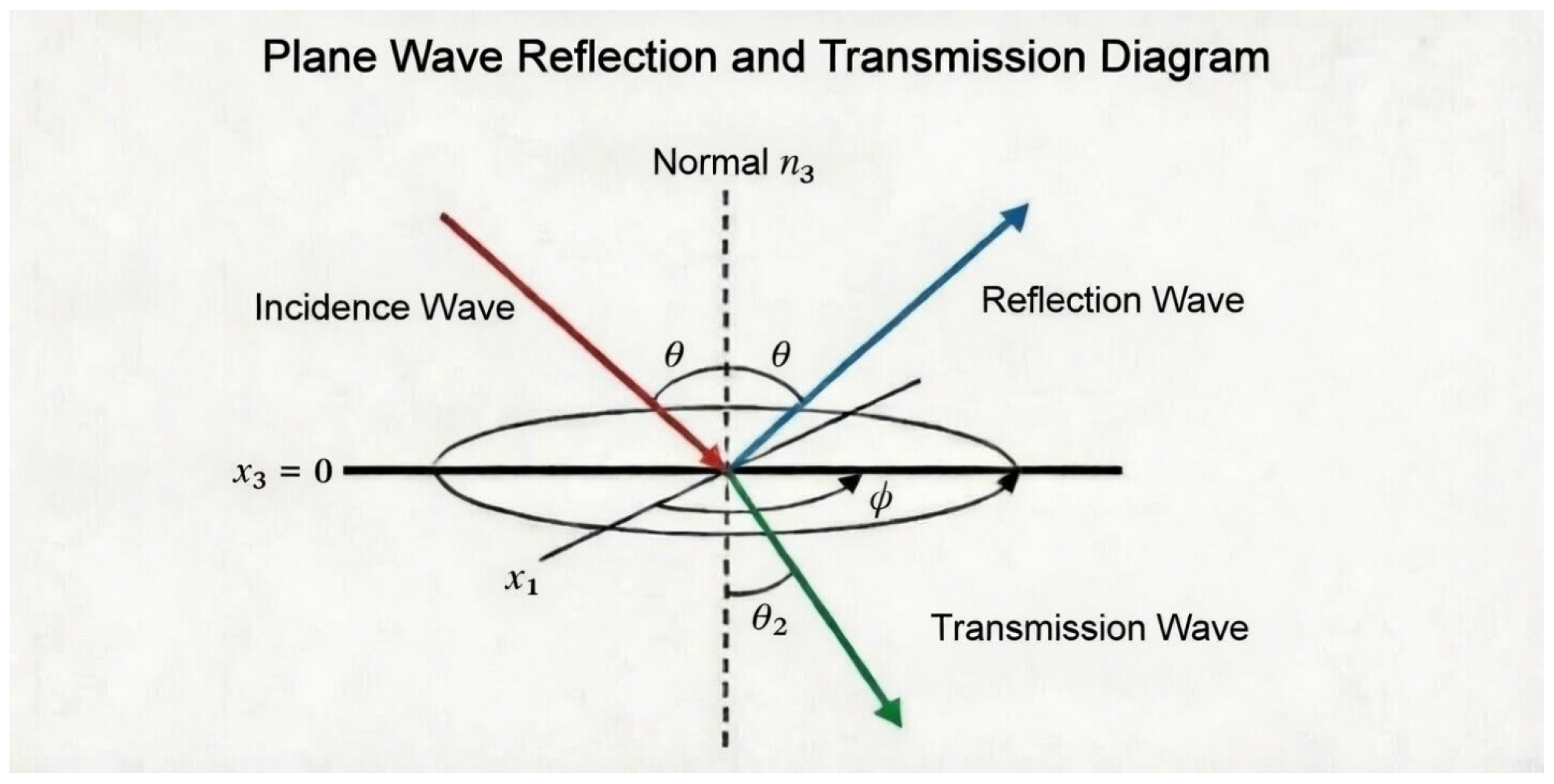
Figure 1. Schematic diagram of incident and reflected waves in a subsurface two-layer medium.
Processes 14 01826 g001
Figure 2. Comparison between simulated results and measured data of fracture weakness parameters under uniaxial stress: (a) comparison of ΔsN; (b) comparison of ΔsT.
Processes 14 01826 g002
Figure 3. Comparison between exact and modeled reflection coefficients under uniaxial stress: (a) comparison between Zoeppritz and the proposed model; (b) comparison between Rüger and the proposed model.
Processes 14 01826 g003
Figure 4. Comparison of ε under uniaxial (a), biaxial (b), and triaxial (c) stress conditions starting from an isotropic state. Under uniaxial, biaxial, and triaxial stress conditions starting from an isotropic state: (a) uniaxial stress condition; (b) biaxial stress condition; (c) triaxial stress condition.
Processes 14 01826 g004
Figure 5. Comparison of γ under uniaxial (a), biaxial (b), and triaxial (c) stress conditions starting from an isotropic state.
Processes 14 01826 g005
Figure 6. Comparison of δ under uniaxial (a), biaxial (b), and triaxial (c) stress conditions starting from an isotropic state.
Processes 14 01826 g006
Figure 7. Anisotropy characteristic curves under triaxial stress (10 MPa in both X2 and X3 directions, and 0–10 MPa in X1 direction).
Processes 14 01826 g007
Figure 8. Variation characteristics of P-wave reflection coefficients with incident angle (a) and azimuth (b) under triaxial stress at the T1 interface.
Processes 14 01826 g008
Figure 9. Variation characteristics of P-wave reflection coefficients with incident angle (a) and azimuth (b) under triaxial stress at the T2 interface.
Processes 14 01826 g009
Figure 10. Variation characteristics of P-wave reflection coefficients with incident angle (a) and azimuth (b) under triaxial stress at the T3 interface.
Processes 14 01826 g010
Figure 11. Variation characteristics of P-wave reflection coefficients with incident angle (a) and azimuth (b) under triaxial stress at the T4 interface.
Processes 14 01826 g011
Table 1. Dependence on the direction of applied stress relative to the initial medium.
Symmetry of the Initial MediumApplied StressDirection of Applied StressInduced Anisotropic SymmetryIndependent Elastic Constants
VTIHydrostatic/VTI5
UniaxialParallel to symmetry axisVTI5
UniaxialPerpendicular to symmetry axisOrthorhombic9
UniaxialTilted directionMonoclinic13
TriaxialParallel to symmetry axisOrthorhombic9
TriaxialTilted directionMonoclinic13
HTIHydrostatic/HTI5
UniaxialParallel to symmetry axisHTI5
UniaxialPerpendicular to symmetry axisOrthorhombic9
UniaxialTilted directionMonoclinic13
TriaxialParallel to symmetry axisOrthorhombic9
TriaxialTilted directionMonoclinic13
IsotropicHydrostatic/Isotropic2
UniaxialHorizontal directionHTI5
UniaxialVertical directionVTI5
Triaxial/Orthorhombic9
Table 2. Thomsen anisotropy parameters under uniaxial stress.
Stress (MPa)Parameter Symbol
ε(1)ε(2)γ(1)γ(2)δ(1)δ(2)
00.070.070.090.090.040.04
30.240.030.180.050.150.11
60.350.010.230.050.190.14
90.440.010.290.050.320.16
Table 3. Fracture weakness parameters under uniaxial stress.
Stress (MPa)Parameter Symbol
ΔN1ΔN2ΔT1ΔT2
00.140.140.180.18
30.060.480.10.36
60.020.70.10.46
90.020.880.10.58
Table 4. Rock elastic parameters.
M b (GPa) μ b (GPa) ρ b (GPa)
67.0926.142.55
Table 5. Elastic properties of rocks for two types of elastic interfaces (Sarkar, 2003, [43]).
Rock PropertiesSaturated StatePortland SandstoneIndiana LimestoneBerea1 SandstoneBerea2 Sandstone
V p ( m / s ) Dry3013373020512644
Saturated3324421628413230
V s ( m / s ) Dry1847221614231761
Saturated1726216613401855
ρ ( m / s ) Dry2140221020402100
Saturated2330239022802310
Disclaimer/Publisher’s Note: The statements, opinions and data contained in all publications are solely those of the individual author(s) and contributor(s) and not of MDPI and/or the editor(s). MDPI and/or the editor(s) disclaim responsibility for any injury to people or property resulting from any ideas, methods, instructions or products referred to in the content.