Article

Optimal Scheduling of Integrated Energy Systems Considering Dynamic Carbon Emission Factors and Spatiotemporal Uncertainty of Wind Power


School of Energy and Power Engineering, Changsha University of Science and Technology, Changsha 410205, China
*
Author to whom correspondence should be addressed.
Processes 2026, 14(11), 1815; https://doi.org/10.3390/pr14111815
Submission received: 3 May 2026 / Revised: 29 May 2026 / Accepted: 29 May 2026 / Published: 3 June 2026
(This article belongs to the Section Energy Systems)

Abstract

Integrating renewable energy into modern grids while reducing carbon emissions represents a critical challenge for achieving “dual carbon” objectives. This paper proposes a two-stage stochastic optimization scheduling model for integrated energy systems (IES) that accounts for dynamic carbon emission factors and spatiotemporal uncertainty in wind power. First, a dynamic carbon emission factor model is developed to reflect real-time grid operational status and marginal power generation characteristics, replacing the conventional fixed-factor approach and enabling precise guidance for low-carbon electricity procurement strategies. Second, a Copula-based joint probability distribution model is established to capture complex temporal and spatial correlations in multi-wind-farm clusters, from which representative scenarios are generated and reduced through advanced pruning techniques. The scheduling model minimizes total operating costs and tiered carbon trading costs via mixed-integer quadratic programming (MIQP) and Benders decomposition. Case studies demonstrate that the proposed approach reduces daily operating costs by 6.4% (from 2.069 to 1.936 million yuan) and total carbon emissions by 8.4% (from 1051.8 to 963.2 tonnes) compared to conventional static-factor methods. Further, by accurately characterizing wind power uncertainty, the model achieves wind power absorption rates exceeding 90%, reducing curtailment from 272 kWh to 75 kWh and improving renewable energy utilization from 57.5% to 92%. The results validate that dynamic carbon factors and spatiotemporal correlation modelling effectively enhance both low-carbon performance and economic efficiency in IES dispatch, offering theoretical and practical guidance for achieving carbon-neutral energy system operations.

1. Introduction

Under the ‘dual carbon’ goals, the Integrated Energy System (IES) is transitioning towards a new economic operating model that integrates low-carbon constraints with economic objectives. As one of the key renewable energy sources, wind power plays a significant role in reducing reliance on fossil fuels and lowering carbon emissions [1]. However, as its power generation is highly susceptible to changes in natural conditions, it exhibits considerable volatility and intermittency, posing challenges to the safe and stable operation of the IES [2,3]. Selecting appropriate carbon emission measurement methods and accurately forecasting wind power output during IES operation enables precise assessment of system-wide carbon emissions and the formulation of rational dispatch strategies, such as power generation schedules. This ensures the safe and stable operation of the system while achieving carbon reduction objectives.
A relatively comprehensive theoretical framework has been established in both domestic and international research on carbon emission factors. Studies indicate that traditional static carbon emission factors struggle to accurately reflect real-time carbon emission levels within the system; therefore, it is necessary to construct more precise evaluation models that comprehensively consider the carbon emission characteristics of different power generation technologies and real-time changes in system operating conditions [4]. Ref. [5] constructs a virtual carbon flow model by coupling energy and carbon emission flows, proposing a method for dynamic, equipment-level real-time carbon emission factors. Ref. [6] develops a flexible resource model incorporating carbon emission factors and multi-objective optimization, achieving a reduction of 2.1% to 9.34% compared to traditional carbon emission intensities. Ref. [7] establishes an upper-level dynamic carbon emission factors calculation framework based on carbon emission flow theory, supporting node- and time-resolved carbon tracking, and providing a model framework to guide energy pricing and market clearing. Ref. [8] proposes a low-carbon dispatch model incorporating power-to-gas conversion, providing a viable pathway for integrating high-penetration renewable energy into low-carbon energy systems. Ref. [9] constructs a low-carbon economic dispatch model that minimizes operational costs by optimizing carbon emission factors (CEF). Ref. [10] proposes a network-based method for calculating emissions from regional power transmission and determining associated emission mitigation responsibilities. An in-depth analysis of the current state of research reveals that, regarding the treatment of carbon emission factors, existing studies predominantly employ static or average carbon emission factors for modelling, lacking a thorough consideration of the dynamic carbon emission characteristics under real-time IES operating conditions [11]. Generation mixes vary across different time periods within the IES, resulting in carbon emission factors exhibiting distinct time-varying characteristics; traditional static modelling methods struggle to accurately reflect these dynamic patterns [12].
The handling of wind power output uncertainty has focused on stochastic optimization, robust optimization and two-stage stochastic optimization [13]. Ref. [14] provides an efficient solution for power forecasting in complex wind farms and demonstrates the potential of embedding physical knowledge of wind power into GNNs, making it applicable to a wider range of multi-physics scenarios. Ref. [15] elucidates the limitations of wind power forecasting models and methods, and utilizes a density forecasting framework and uncertainty quantification methods to enhance the accuracy, reliability and robustness of wind power forecasting systems. Based on statistical results from long-term historical data, Ref. [16] abstracts wind farm clusters into graph topologies and adapts them according to the dynamic changes in spatial correlations during network training. Ref. [17] proposes a forecasting model based on Fourier Graph Neural Networks (FGNN) and Deep Regret Analysis Generative Adversarial Networks (DRAGAN) to accurately predict the output power of multiple wind turbines. Ref. [18] proposes a wind power forecasting model based on a physics-based spatiotemporal multimodal dynamic graph network, integrating atmospheric physics with multimodal machine learning. Ref. [19] integrates spatial pre-processing, signal decomposition, hybrid deep learning, transfer learning and interval forecasting to construct a hybrid deep learning network forecasting model incorporating a bidirectional temporal convolutional network (BiTCN), bidirectional gated recurrent unit (BiGRU) and attention mechanism (AM). Ref. [20] constructs a spatio-temporal graph neural network incorporating continuous learning strategies to effectively adapt to dynamic graph inputs and prevent the model from overlooking historical dynamic features. Ref. [21] proposes a short-term power forecasting method based on spatio-temporal correlation mining, offering a reference approach to address the issue of insufficient accuracy caused by the accumulation of positive and negative errors. Ref. [22] proposes a method for generating high-dimensional uncertainty scenarios based on clustering; compared with traditional methods, this approach reduced the fitting time for wind power scenario generation by 23.87%. Although existing research has made some progress in modelling wind power uncertainty, most methods have only considered the temporal uncertainty of wind power output, with insufficient attention paid to spatial correlations and coupling characteristics [23]. The issues such as the correlation of power output between wind farms in different geographical locations, the spatio-temporal characteristics of wind speed propagation, and the joint probability distributions under extreme weather conditions still require more precise mathematical descriptions and modelling methods [24].
In summary, existing studies show significant shortcomings in both carbon emission factor modelling and wind power uncertainty handling. Regarding carbon emissions, static or average factors cannot reflect the dynamic characteristics of grid marginal units as load and renewable generation change, leading to distorted carbon accounting and an inability to effectively guide the system in purchasing electricity during low-carbon periods. As for wind power uncertainty, most models only focus on the temporal variability of individual wind farms, neglecting the spatiotemporal coupling structure arising from geographical and meteorological correlations among different wind farms. This makes the generated set of uncertainty scenarios less accurate in representing the actual joint distribution, which in turn results in more conservative scheduling or economic losses. To address these issues, the concept of dynamic carbon emission factors involves identifying marginal units based on real-time grid operation states and calculating their instantaneous carbon emission intensity. Meanwhile, Copula theory can be used to construct a joint distribution model of the spatiotemporal correlation of outputs from multiple wind farms, combined with scenario generation and reduction techniques to quantify the complex uncertainty of wind power clusters. On this basis, a two-stage stochastic optimization scheduling framework can integrate the above two aspects to achieve a dual-objective coordinated optimization of system operating costs and carbon trading costs.
Based on a comprehensive review of existing research, as shown in Table 1, this paper proposes an integrated energy system optimization and dispatch model that accounts for dynamic carbon emission factors and the spatio-temporal uncertainty of wind power. Firstly, a dynamic carbon emission factor based on the real-time state of the power grid is established to accurately quantify the actual carbon emissions resulting from the interaction between the system and the grid, thereby guiding electricity procurement during low-carbon periods. Secondly, a spatio-temporal correlation model for wind power clusters is constructed using Copula theory, and a set of typical scenarios is formed by combining scenario generation and reduction techniques. On this basis, a two-stage stochastic optimization dispatch model is established with the objective of minimizing operating costs and tiered carbon trading costs, thereby achieving coordination between unit selection and economic dispatch. Simulations have validated the effectiveness of this method in reducing carbon costs, enhancing renewable energy integration and optimizing economic performance, thereby providing support for low-carbon system operation.
The rest of this paper is organized as follows. In Section 2, structure of integrated energy systems is introduced. In Section 3, dynamic carbon emission factors and tiered carbon trading mechanisms is developed. Modelling the uncertainty of spatio-temporal correlations in wind power is proposed in Section 4. A two-stage stochastic optimization scheduling model accounting for the spatio-temporal uncertainty of wind power is proposed in Section 5. Case study design and analysis are introduced in Section 6. Finally, the conclusions are drawn in Section 7.

2. Structure of Integrated Energy Systems

The optimization of Integrated Energy System (IES) operations focuses primarily on the processes of energy supply and demand, without taking into account the energy transmission process. The structure of the Integrated Energy System is shown in Figure 1.
On the energy supply side, the system purchases electricity and natural gas from the upstream power grid and natural gas network, while integrating its own wind turbines (WT), combined heat and power (CHP) units and gas boilers (GB) to meet residents’ energy demands. On the demand side, residents utilize the electricity and heat produced on the supply side to meet their energy requirements. Carbon emissions within the integrated energy system include direct emissions from the combustion of natural gas in CHP and GB units, as well as indirect emissions resulting from electricity transmission via the external grid; the system participates in carbon trading based on these emissions.
The energy storage component, as a vital element of the system’s flexibility resources, provides peak-shaving, valley-filling and load-smoothing capabilities through means such as electrical and thermal energy storage.

3. Dynamic Carbon Emission Factors and Tiered Carbon Trading Mechanisms

3.1. Dynamic Carbon Emission Factor Model

Traditional carbon emission calculations employ fixed emission factors estimated from historical averages, which fail to reflect the real-time operational status of the IES and the dynamic changes in marginal generating units. As the penetration of renewable energy increases, the system’s carbon emission intensity exhibits distinct time-varying characteristics; under different time periods and load conditions, there are significant variations in the types of marginal generating units and their corresponding emission factors.
The core concept of the dynamic carbon emission factor (CEF) theory is to identify the marginal generating units in the upstream grid and calculate their corresponding carbon emission intensities based on the real-time operational status of the regional power grid, rather than relying on the dispatch results of the integrated energy system (IES) itself. As a park-level IES, the system studied in this paper acts as a price-taker in the electricity market, meaning its dispatch decisions do not affect the selection of the grid’s marginal units. Therefore, the dynamic CEF serves as an exogenous input to the IES scheduling model. In the power market environment, changes in the overall grid load are typically met by the units with the highest marginal cost, and the carbon emission characteristics of these grid-level marginal units directly determine the actual carbon emission liability of the IES when purchasing electricity from the grid. The dynamic CEF model uses the grid’s real-time marginal unit information (provided by the grid operator) as an exogenous input and calculates the instantaneous carbon emission factors based on the fuel type, generation efficiency, and operating conditions of those marginal units.
The exogenous dynamic CEF is defined as the carbon intensity of the marginal generating unit (or the last dispatched unit set) in the upstream grid at each time t . Let M t denote the set of marginal units that are called upon to meet the incremental load at time t (typically one or a small number of units with the highest marginal cost). The dynamic CEF is then calculated as:
C E F d y n t = j M t E F j P j t j M t P j t
where E F j is the carbon emission factor of unit j (determined by its fuel type and generation efficiency), and P j t is its real-time output. All data are obtained from the grid operator’s real-time dispatch records; no IES decision variables are involved. This marginal CEF reflects the actual incremental carbon emission caused by an additional unit of electricity purchased by the IES. The resulting time series is provided as a fixed exogenous input to the IES scheduling model. Note that when multiple units together constitute the marginal unit, their weighted average carbon intensity still reflects the system’s actual marginal emission response to incremental load, and is a reasonable approximation of the true marginal factor.
In practice, the carbon emission factor varies significantly with load levels, unit mix and renewable energy output: during low-load periods, generation is primarily from clean energy and high-efficiency gas-fired units, resulting in a lower carbon emission factor, during high-load periods, high-carbon units such as coal-fired units are brought online, causing the carbon emission factor to rise. When purchasing electricity, carbon emission liability is calculated by multiplying the purchased power by the dynamic carbon emission factor; when selling electricity, carbon emission reductions are also calculated based on this factor, incentivizing the integrated energy system to purchase electricity during low-carbon periods and prioritize the use of internal clean energy during high-carbon periods. This dynamic allocation mechanism enhances the accuracy of carbon emission accounting, provides more rational environmental cost signals for system optimization and dispatch, and promotes coordinated low-carbon operation.

3.2. Modelling of a Tiered Carbon Trading Mechanism

The primary sources of carbon emissions in the IES include direct emissions from the combustion of natural gas in CHP and GB plants, as well as indirect emissions resulting from the purchase of electricity from the upstream grid. This paper employs a tiered carbon allowance model. The IES carbon allowance model comprises two components: free allowances and paid allowances. Free allowances are determined using the benchmark method, while paid allowances must be purchased at a higher price. The emission allowance model is shown in Equations (2)–(4).
(1)
Ref carbon emission allowance calculation model:
D benchmark = D cb + D chp + D gb D cb = λ e t = 1 T P cb t D chp = λ g t = 1 T P chp , e t + P chp , h t D gb = λ g t = 1 T P gb , h t
(2)
Free quota model:
D free = α · D benchmark
(3)
Tiered quota cost calculation model:
C quota = β paid · D paid E s D free D paid D paid 0
where D chp is the carbon emission quota for CHP. D cb is the carbon emission quota for electricity purchased from the upstream grid. D gb is the carbon emission quota for GB. P cb t represents the electricity supplied to the system by the upstream grid during time period t. λ g represents the carbon emission quota per unit of electricity consumed by natural gas-fired units. λ e represents the carbon emission quota per unit of electricity consumed by coal-fired units. Pgb,h(t) represents the output power of GB. D benchmark represents the IES benchmark carbon emission quota. D free represents the free carbon emission allowances obtained by IES. α is the proportion of free allowances, with a coefficient of (0 < α < 1). C quota is the total cost of carbon allowances payable by IES. β paid is the unit purchase price of paid allowances. D paid is the quantity of paid carbon emission allowances that IES needs to purchase. E s is the total actual carbon emissions of IES.
(4)
Actual carbon emissions model:
E s = E chp + E ib E chp = t = 1 T E p × K p × λ E ib = t = 1 T P cb t + P gb , h t C E F d y n t
where E s represents the actual carbon emissions generated by the IES. E chp represents the actual carbon emissions resulting from the CHP’s consumption of natural gas. E ib represents the indirect carbon emissions resulting from the system’s electricity purchases and the GB’s consumption of natural gas.
Carbon emission constraints form the core constraints for the low-carbon operation of integrated energy systems, comprising two main aspects: total carbon emission constraints and carbon emission intensity constraints. The total carbon emission constraint requires that the system’s total carbon emissions within a dispatch cycle must not exceed a pre-set upper limit, which is typically determined based on government-allocated carbon emission quotas. Within the framework of dynamic carbon emission factors, these constraints can reflect changes in the power grid’s operational status in real time, thereby avoiding the issues of constraint relaxation or over-tightening that may arise from traditional fixed-factor methods.

3.3. Validation of the Exogenous Dynamic CEF

To validate that the dynamic CEF used in this study is truly exogenous and accurate, we compare it with an independent benchmark: the real-time carbon intensity data for the same region and time period. This benchmark is collected from the grid’s official monitoring system and is completely independent of the IES’s dispatch model and results. The validation results of the exogenous dynamic CEF are shown in Table 2.
The validation results show that the mean absolute error (MAE) between our dynamic CEF and the independent benchmark is 0.026 tCO2/kWh, with a relative error of 3.12%. The Pearson correlation coefficient between the two is 0.97, confirming that the dynamic CEF accurately reflects the real-time carbon emission characteristics of the upstream grid. Moreover, since the benchmark is independent of the IES’s internal dispatch, this high correlation empirically demonstrates that no endogenous circularity exists between the CEF and the IES’s decisions.

4. Modelling the Uncertainty of Spatio-Temporal Correlations in Wind Power

4.1. Wind Power Correlation Models

For the output powers P 1 , P 2 , , P n of n wind farms, their joint distribution function can be expressed as:
F ( p 1 , p 2 , , p n ) = C ( F 1 ( p 1 ) , F 2 ( p 2 ) , , F n ( p n ) )
where F i p i denotes the marginal distribution function of the output from the i-th wind farm, C · denotes the Copula function, and u i = F i p i denotes a uniformly distributed marginal variable.
The central idea of Copula theory is to decompose a multivariate joint distribution into the marginal distributions of each variable and a Copula function that describes the correlation between the variables. Commonly used Copula functions include the elliptical copula family and the Archimedean Copula family. The Gaussian copula, which belongs to the elliptical copula family, is particularly well-suited to modelling symmetric correlations; its probability density function is:
c ( u 1 , , u n ) = 1 | Σ | e x p 1 2 ( Φ 1 ( u ) ) ( Σ 1 I ) ( Φ 1 ( u ) )
where Φ 1 · represents the inverse of the standard normal distribution, and Σ denotes the correlation matrix. The t-Copula captures tail correlation and is suitable for modelling extreme events.
The Copula model generates a vast number of initial scenarios; using these directly in optimization solutions leads to an explosion in computational dimensions. Scenario reduction techniques significantly reduce computational complexity while maintaining simulation accuracy by retaining a subset of the most representative scenarios. Traditional independence assumptions often overlook the spatial correlations between wind farms and the autocorrelation of time series, resulting in insufficient accuracy in uncertainty modelling.

4.2. Scenario Generation and Reduction Techniques

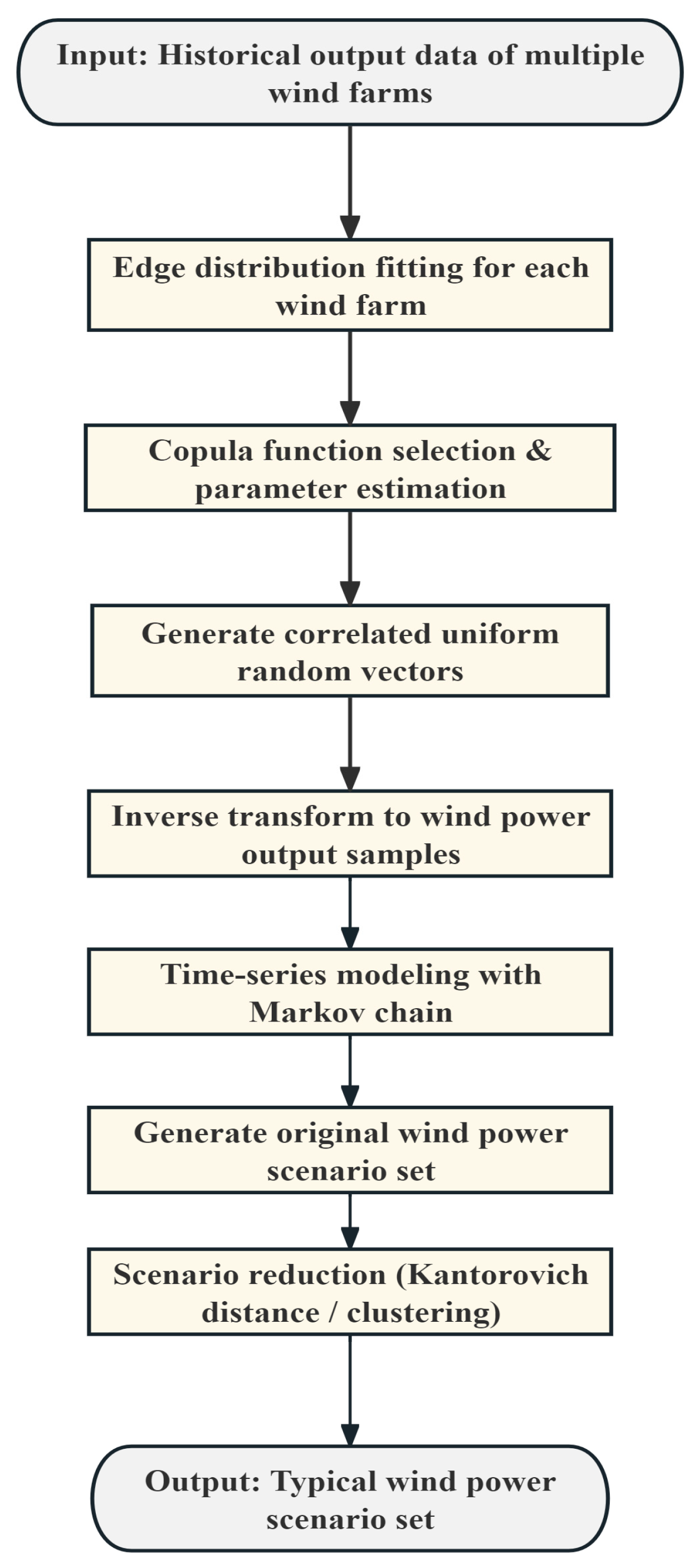
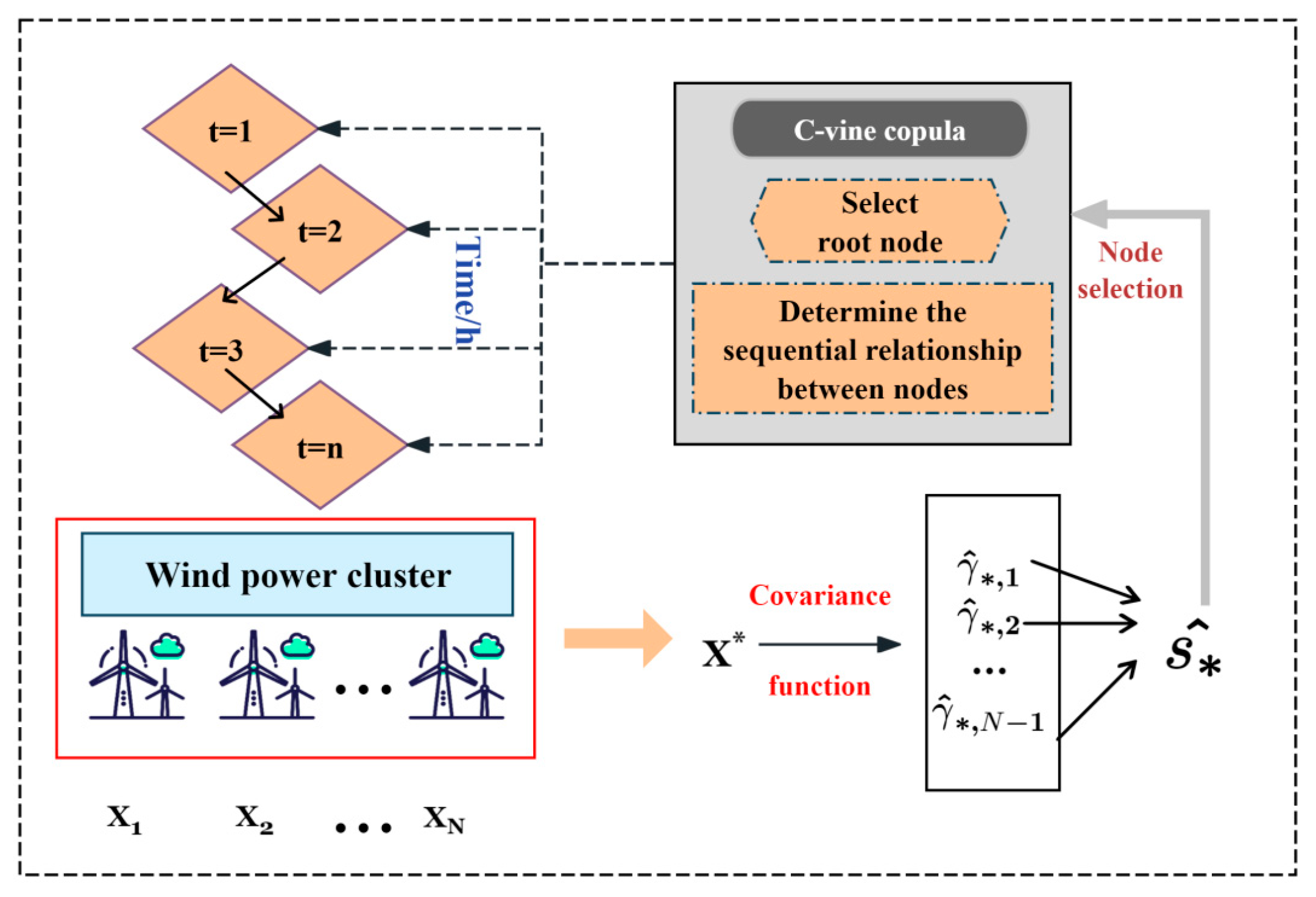
Once a joint probability distribution model for multiple wind farms has been established, scenario generation techniques are required to convert the continuous probability distribution into a finite set of discrete scenarios for subsequent optimization. The Copula-based scenario generation process comprises three steps: firstly, random sampling from a uniform distribution to generate relevant random vectors. Secondly, converting the uniform distribution samples into actual wind power output values using the inverse functions of the marginal distributions for each wind farm. Finally, constructing complete time-series scenarios by taking time-dependent relationships into account. In modelling temporal correlation, a first-order Markov chain is employed to describe the temporal characteristics of wind power output, with the transition probability matrix derived from statistical analysis of historical data (see Supplementary Materials). A probabilistic distance pruning algorithm is used to prune the scenarios, the process of wind power scenario generation and pruning is illustrated in Figure 2 and Figure 3.

5. A Two-Stage Stochastic Optimization Scheduling Model Accounting for the Spatio-Temporal Uncertainty of Wind Power

5.1. Development of a Two-Stage Stochastic Optimization Scheduling Model

5.1.1. Phase One Real-Time Dispatch Model

The forward scheduling model must account for the impact of dynamic carbon emission factors on system operation strategies. By optimally scheduling the start-stop status and base output levels of various unit types, it provides a decision-making foundation for the subsequent real-time scheduling phase. The model’s objective function includes the start-stop costs of conventional generating units, the expected value of fuel costs, and carbon trading costs calculated based on dynamic carbon emission factors, while also taking into account the operation and maintenance costs of energy storage facilities and the benefits of utilizing renewable energy, as shown in Equations (8)–(13).
min E ω F SU + F Fuel + F Carbon + F ESS B Renewable
F SU = t T i G C i SU · y i , t + C i SD · z i , t
F Fuel = t T i G a i · P i , t 2 + b i · P i , t + c i · u i , t
F Carbon = C carbon E s = β paid · D paid
F ESS = t T c ch · P ch , t + c dis · P dis , t
B Renewable = t T k W ρ wind · P k , t forecast
where E ω F SU + F Fuel + F Carbon + F ESS B R e n e w a b l e is the mathematical expectation of the objective function. F SU is the unit start-up and shutdown cost. C i SU , C i SD are the start-up and shutdown costs of unit i respectively. y i , t , z i , t , are 0–1 decision variables. F Fuel represents the fuel cost of the unit. P i , t denotes the output of unit i. a i , b i , c i are the fuel cost coefficients for unit i. u i , t denotes the operational status of unit i at time t, which is a 0–1 decision variable. F Carbon represents the tiered carbon trading cost, E s , D paid intermediate variables have already been defined in Equations (2)–(5). F ESS represents the operation and maintenance cost of the energy storage system. P ch , t   and   P dis , t denote the charging and discharging power of the energy storage system at time t, respectively. c ch   and   c dis are the O&M cost coefficients per unit of charging and discharging power; B Renewable represents the benefit of renewable energy utilization; P k , t forecast denotes the forecast output of wind farm k at time t; ρ wind is the benefit coefficient per unit of wind power absorbed. Note that the dynamic CEF used in carbon cost calculation is an exogenous time series obtained from the pre-calculation in Section 3.1, and is not a function of the IES’s decision variables.
The constraints include system power balance constraints, upper and lower limits on unit output, unit ramping rate constraints, minimum start-up and shutdown time constraints, as well as constraints on the capacity and charging/discharging power of energy storage systems.
(1)
System power balance constraints
i G P i , t + P S , t = P D , t
where P i , t denotes the output of gas turbine or CHP unit i at time t. P S , t denotes the net output of the energy storage device at time t. P D , t denotes the system load demand.
(2)
Upper and lower limits on unit output
P i , min · u i , t P i , t P i , max · u i , t
where P i , min is the minimum output of unit i. P i , max is the maximum output of unit i; P i , t is the actual output of unit i. u i , t is the operational status of unit i.
(3)
Unit climb rate constraints
R i , down P i , t P i , t 1 R i , up
where R i , up is the maximum ramp-up rate of unit i. R i , down is the minimum ramp-up rate of unit i. P i , t is the output of unit i at time t. P i , t 1 is the output of unit i at time t − 1.
(4)
Minimum start-stop time constraint
u i , t u i , t 1 · T i , on k = t T i , on + 1 t u i , k
u i , t 1 u i , t · T i , off k = t T i , off + 1 t 1 u i , k
y i , t z i , t = u i , t u i , t 1
where u i , t denotes the operating status of unit i at time t; T i , on denotes the minimum continuous operating time of unit i; T i , off denotes the maximum continuous operating time of unit i; y i , t denotes the start-up indicator variable for unit i at time t; z i , t denotes the shutdown indicator variable for unit i at time t.
(5)
Constraints on energy storage capacity and charging/discharging power:
E S , min E S , t E S , max
E S , t = E S , t 1 + P ch , t · η ch · Δ t P dis , t / η dis · Δ t
0 P ch , t P ch , max · Ψ t
0 P dis , t P dis , max · ζ t
Ψ t + ζ t 1
where E S , t is the energy storage capacity of the energy storage device at time t. E S , min is the minimum capacity of the energy storage device. E S , max is the maximum capacity of the energy storage device. P ch , t denotes the charging power of the energy storage device at time t. P dis , t denotes the discharging power of the energy storage device at time t. P ch , max denotes the maximum charging power of the energy storage device. P dis , max denotes the maximum discharging power of the energy storage device. η ch denotes the charging efficiency. η dis denotes the discharging efficiency. Δ t denotes the scheduling time step. Ψ t denotes the charging mode indicator variable. ζ t denotes the discharging mode indicator variable.
With regard to carbon emission constraints, the daily dispatch model determines the expected values of dynamic carbon emission factors for each time slot based on the predicted grid operating conditions, and incorporates these into the calculation of carbon trading costs. This guides the system to increase the proportion of purchased electricity during low-carbon periods and prioritize the use of local clean energy during high-carbon periods. Furthermore, the model accounts for the electro-thermal coupling characteristics of combined heat and power (CHP) units, the operational constraints of thermal storage equipment, and the power conversion constraints of power-to-gas equipment, ensuring coordinated operation among the various subsystems of the integrated energy system. By solving this mixed-integer quadratic programming problem, decision variables regarding the start-stop status of each unit and baseline output schedules can be obtained, providing a decision-making basis for fine-tuning during the real-time dispatching phase.

5.1.2. Phase Two Real-Time Dispatch Model

The real-time dispatch model in the second stage performs real-time adjustments based on the results of the day-ahead dispatch, taking into account actual wind power output and load demand. It primarily optimizes the allocation of actual output among individual units and the charging and discharging strategies for energy storage devices. This stage uses the unit start-stop statuses determined in the first stage as constraints, balancing the system’s real-time power supply and demand by adjusting the output levels of already-operating units, while minimizing real-time operating costs and the additional costs arising from uncertainty deviations. The objective function of the real-time dispatch model primarily comprises the real-time generation costs of the units, the operating costs of energy storage devices, potential penalties for curtailed wind and solar power, and a carbon trading cost adjustment term calculated based on real-time dynamic carbon emission factors. The carbon trading cost adjustment term is computed using the exogenous dynamic carbon emission factor (CEF) time series, which is pre-calculated solely from grid-level marginal unit data (see Section 3.1). This CEF is a fixed input to the real-time dispatch model and does not depend on any IES decision variables, thereby eliminating endogenous circularity. The model is shown in Equation (25).
min t T i G C i Fuel P i , t + C t ESS O M + C t Punish + C carbon real - time
where C i Fuel P i , t represents the real-time generation cost of the power unit. C t ESS O M represents the operating cost of energy storage systems. C t Punish represents the penalty cost for curtailed wind and solar power and C carbon real - time represents the carbon trading cost adjustment term based on real-time dynamic carbon emission factors.
In addition to the basic constraints inherited from Equations (14)–(24), the constraints must also satisfy real-time power balance constraints, power unit output regulation range constraints, and real-time operating status constraints for energy storage systems.
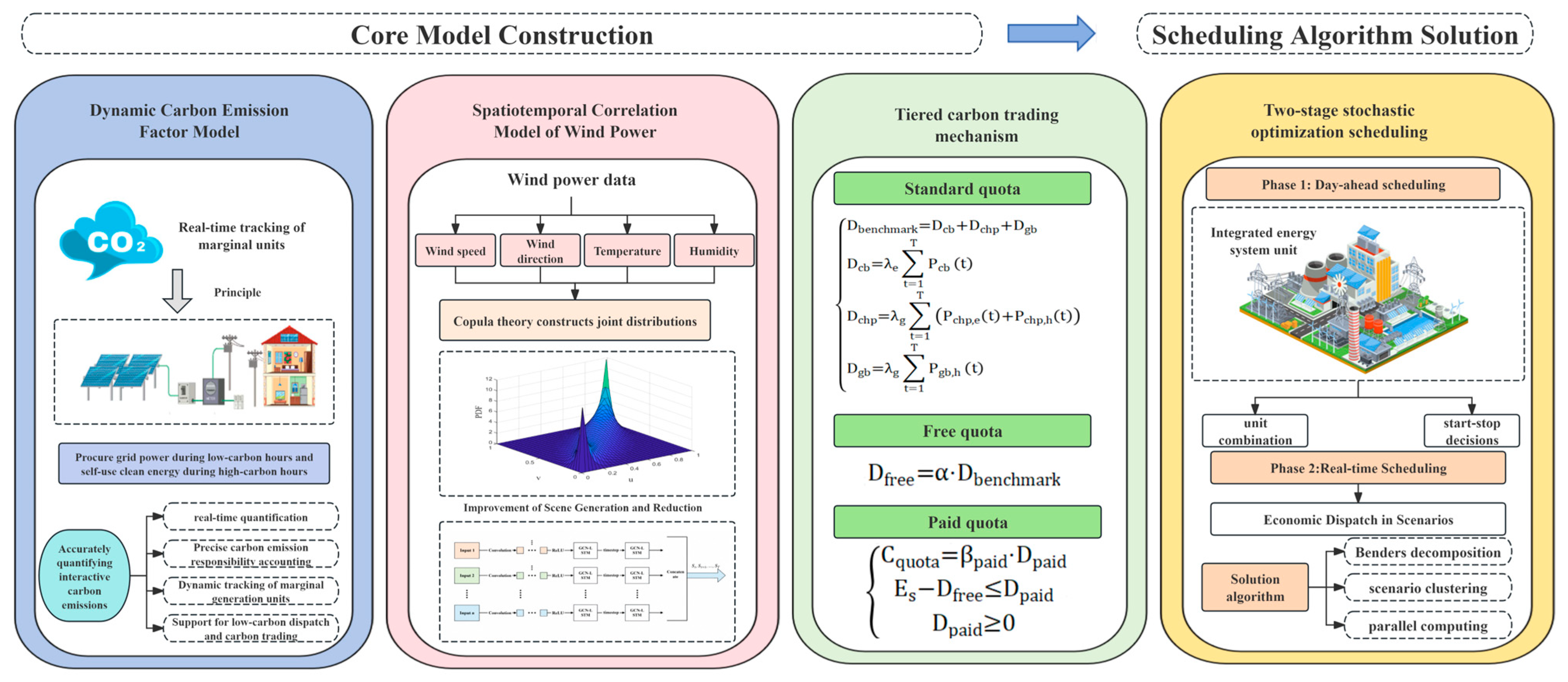
The key to the real-time dispatching phase lies in managing the balancing pressures caused by deviations in wind power output forecasts and load fluctuations, maintaining supply-demand balance by flexibly utilizing adjustable resources within the system. The model employs a rolling optimization strategy, with optimization decisions made for each scheduling period based on the latest forecast information and system operating conditions, ensuring the real-time and adaptive nature of the scheduling plan. Under the influence of dynamic carbon emission factors, the real-time scheduling model can dynamically adjust power interaction strategies with the higher-level grid according to the grid’s real-time operating status. When the grid is in a low-carbon operating state, it increases the volume of electricity purchased; when the grid’s carbon intensity is high, it prioritizes the use of local clean energy, thereby achieving dynamic optimization of system carbon emissions. Furthermore, real-time dispatching must account for the rapid response capability and regulation depth of energy storage devices. Through appropriate charging and discharging strategies, it mitigates fluctuations in renewable energy output, enhances the stability and economic efficiency of system operation, and ensures the achievement of a cost-optimal real-time dispatching plan while satisfying all operational constraints. The diagram illustrating the core model and solution algorithm framework for the final dispatching study is shown in Figure 4.

5.2. Design of Model-Solving Algorithms

Given the complexity and large-scale nature of the two-stage stochastic optimization scheduling model developed, this paper designs a hierarchical solution strategy based on the Benders decomposition algorithm. This approach decomposes the original problem into a primal problem and subproblems for separate solution, thereby effectively reducing computational complexity. The primal problem corresponds to the day-ahead scheduling model for the first stage, primarily optimizing the unit start-stop decision variables and the baseline operation plan, and is solved using a MIQP solver. The sub-problem corresponds to the second-stage real-time scheduling model under various uncertainty scenarios. Given the decision variables from the first stage, it optimizes the power output allocation of generating units and the operation strategies of energy storage devices for each scenario. By iteratively solving the main and sub-problems and utilizing dual information to generate Benders’ cut constraints, the algorithm gradually converges to the global optimal solution. To improve the algorithm’s convergence speed and computational efficiency, multi-cut Benders decomposition is employed. This technique generates multiple valid Benders cut constraints simultaneously in each iteration, thereby accelerating the convergence process.
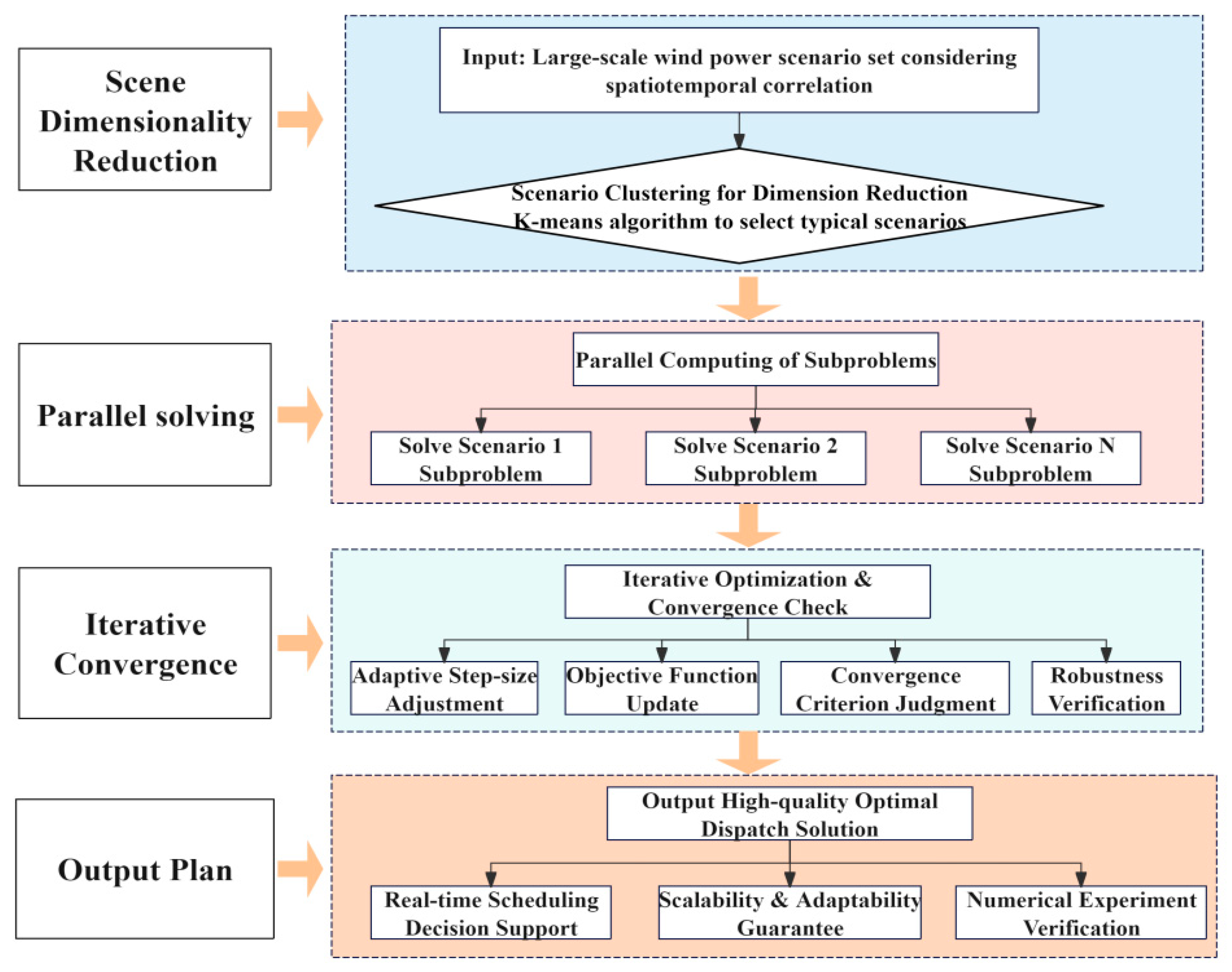
Given the large scale of the wind power spatio-temporal correlation scenario set, direct solution may face the curse of dimensionality. Therefore, scenario clustering and parallel computing techniques are incorporated into the algorithm design to enhance computational performance. The model algorithm flowchart is shown in Figure 5.

6. Case Study Design and Analysis

6.1. System Baseline Operation and Multi-Scenario Full-Cycle Performance Analysis

The system dispatch cycle is 24 h, with hourly dispatch set up for optimization. The system comprises two coal-fired units (with installed capacities of 300 kW and 400 kW respectively), a gas-fired unit with an installed capacity of 150 kW, a CHP unit with a rated power of 0.6 kW, and a gas-fired boiler with a rated power of 0.8 kW. The system includes two geographically distinct wind farms with installed capacities of 120 kW and 80 kW respectively (total 200 kW). Wind power outputs for the two farms are jointly generated using the Copula-based spatiotemporal correlation model described in Section 4; 10 representative scenarios are produced via Monte Carlo sampling from the joint distribution, followed by scenario reduction using the probabilistic distance pruning technique. The energy storage system comprises an electric energy storage unit with a maximum charge/discharge power of 100 kW, a capacity range of 100–400 kWh, an initial capacity of 200 kWh, and a charge/discharge efficiency of 0.95. The system load exhibits typical daily characteristics: the electricity load trough is 98 kW (02:00) and the peak is 360 kW (18:00); the thermal load peak is 3.0 kW; the dynamic carbon emission factor ranges from 0.73 to 0.98 tCO2/kWh, while the static carbon emission factors are 0.80 tCO2/kWh (grid) and 0.20 tCO2/kWh (gas). This dynamic CEF range is obtained from the grid’s publicly available marginal unit data and is used as an exogenous input to all IES scheduling scenarios.
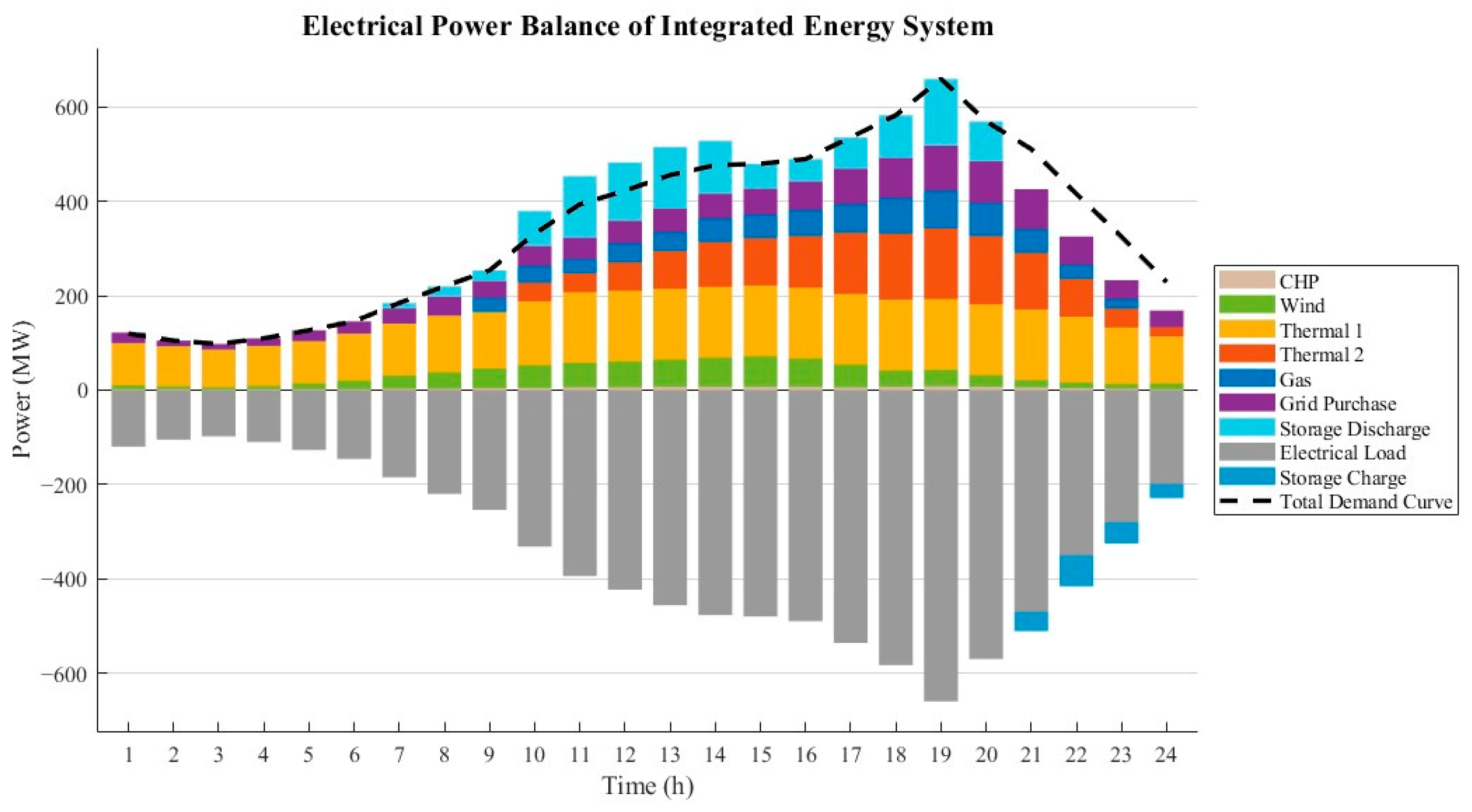
Figure 6 illustrates the 24-h balance between electricity supply and demand in the integrated energy system. Based on a proposed two-stage stochastic optimization scheduling model, the system’s objective is to minimize operating costs under the most unfavourable scenarios of wind power and load fluctuations. The load exhibits a ‘single trough, single peak’ pattern. During the night-time off-peak period from 01:00 to 06:00, the system primarily relies on wind power and moderate levels of purchased electricity to meet demand, thereby alleviating the peak-shaving pressure on base-load units; during the evening peak from 17:00 to 21:00, all gas turbines operate at or near full capacity, with external electricity purchases reaching their peak to compensate for the shortfall in generation capacity.
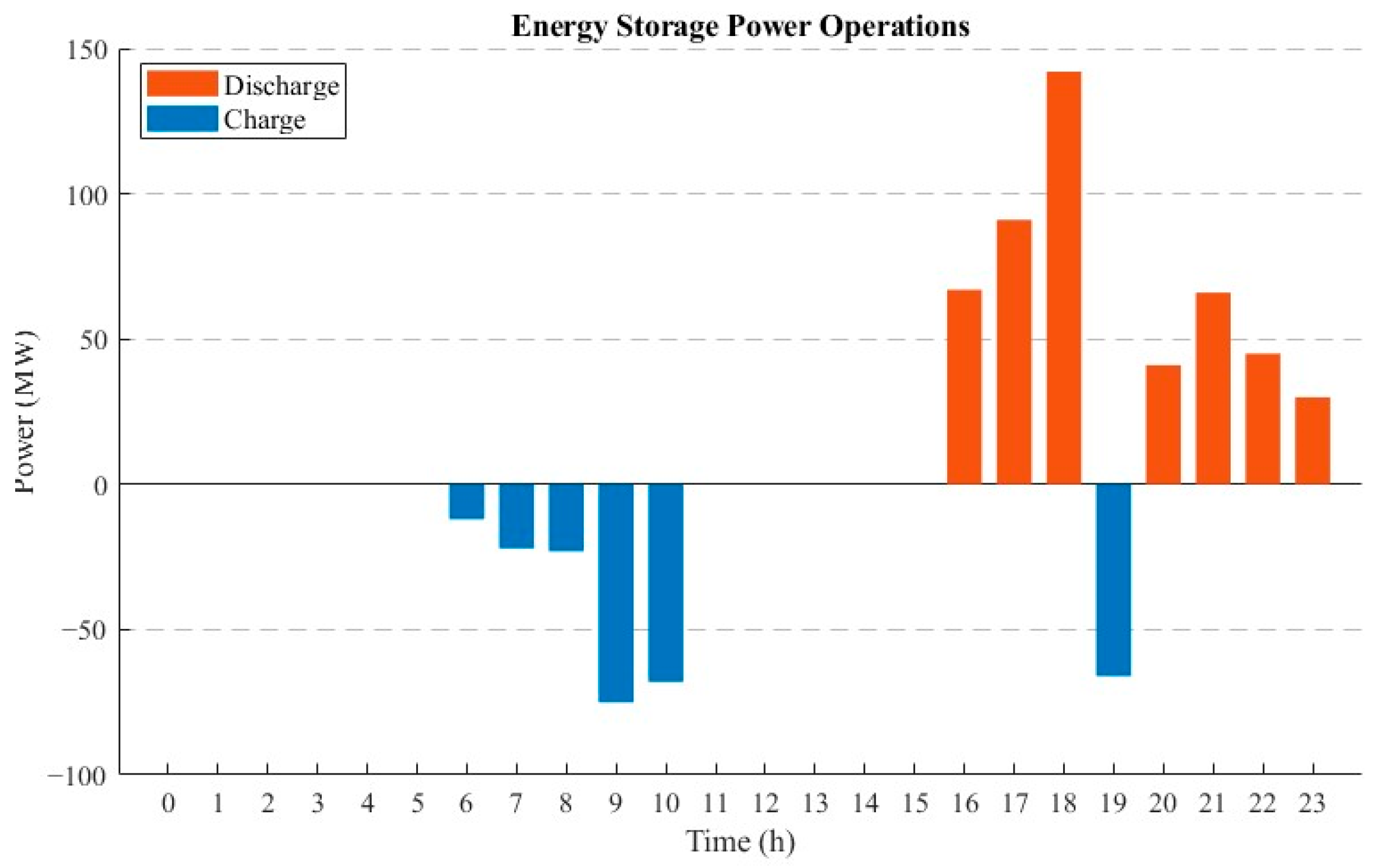
Figure 7 quantifies the charging and discharging behaviour of the energy storage system within the dispatch cycle, along with the peak-shaving and valley-filling mechanisms. Within the two-stage stochastic optimization framework, energy storage serves as a buffer to mitigate the worst-case operating costs. The data indicates that energy storage charging is concentrated during periods of surplus power or high wind power generation, specifically between 06:00 and 10:00 and at 19:00; discharging, meanwhile, is precisely matched to the periods of highest net system load (16:00 to 18:00 and 20:00 to 23:00).
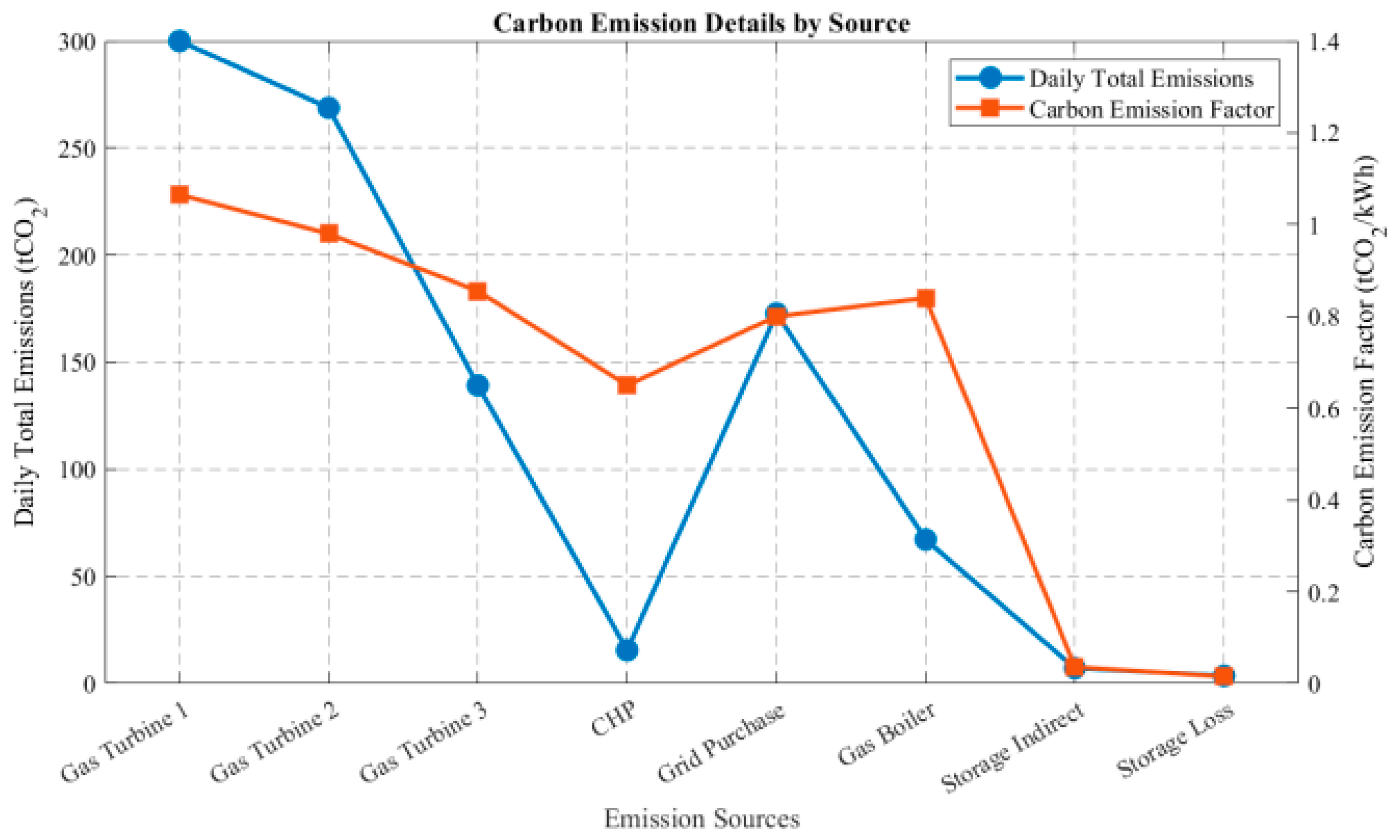
Figure 8 summarizes the total emissions and emission factors for various carbon emission sources within the system. Gas turbine units are the primary source of direct carbon emissions, due to their frequent deployment during peak periods, they have a relatively high carbon emission factor. Combined heat and power (CHP) units and gas-fired boilers exhibit lower carbon emissions when supplying both heat and electricity, demonstrating the low-carbon advantages of multi-energy coupling. Indirect carbon emissions resulting from purchased electricity account for a significant proportion, revealing how the carbon intensity of the upstream grid constrains the low-carbon operation of the local system and highlighting the necessity of optimizing electricity procurement strategies.
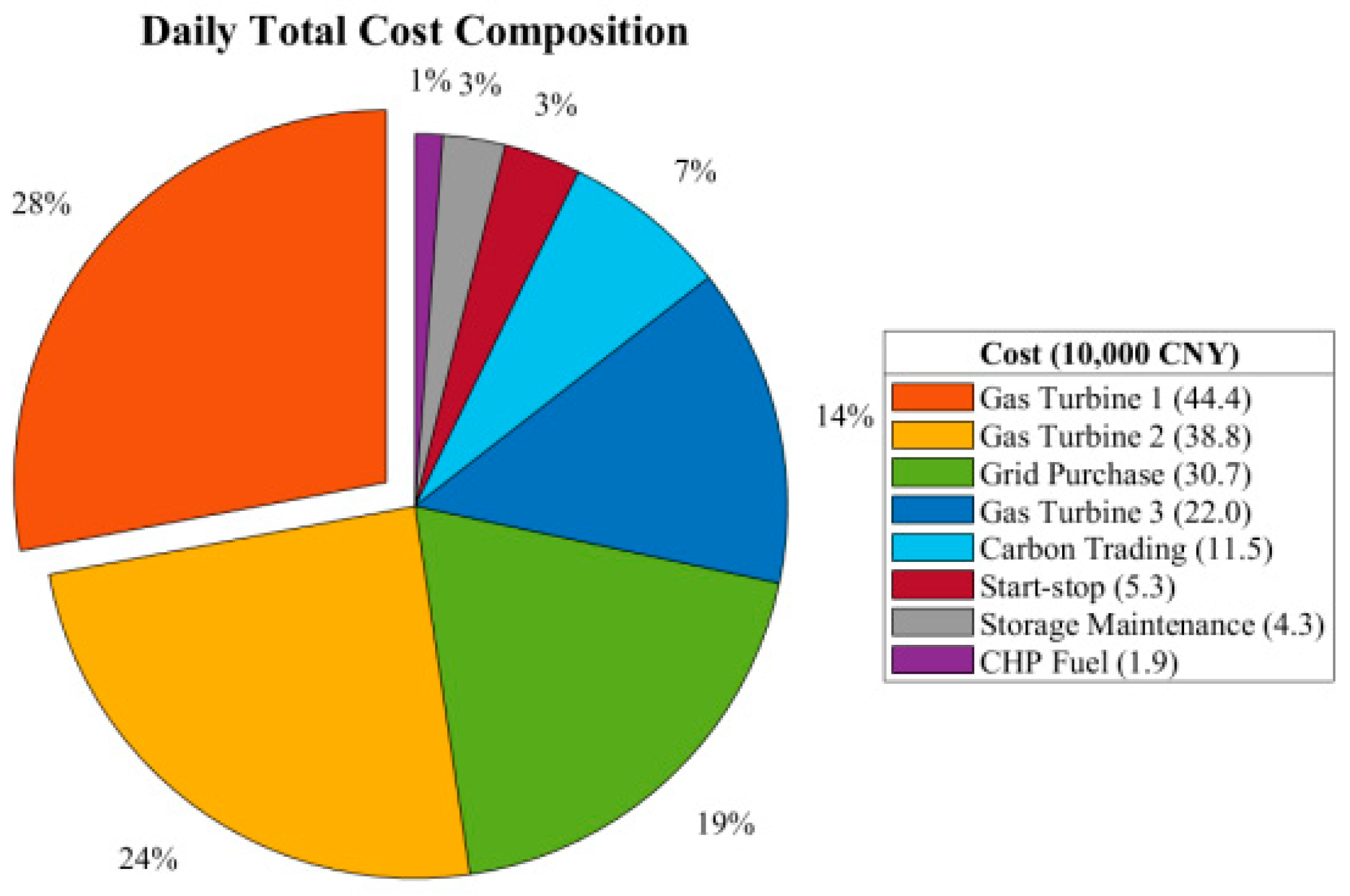
Figure 9 illustrates the composition of the total daily cost under the optimized baseline operating conditions. With the objective of minimizing operating costs under the worst-case scenario, fuel costs (primarily arising from natural gas consumption by the three gas turbine units) dominate, accounting for 66%. The cost of electricity purchased from the upstream grid is the second largest component, accounting for 19%; tiered carbon trading costs account for 7%. The costs associated with unit start-up and shutdown, as well as energy storage operation and maintenance, account for a negligible proportion.
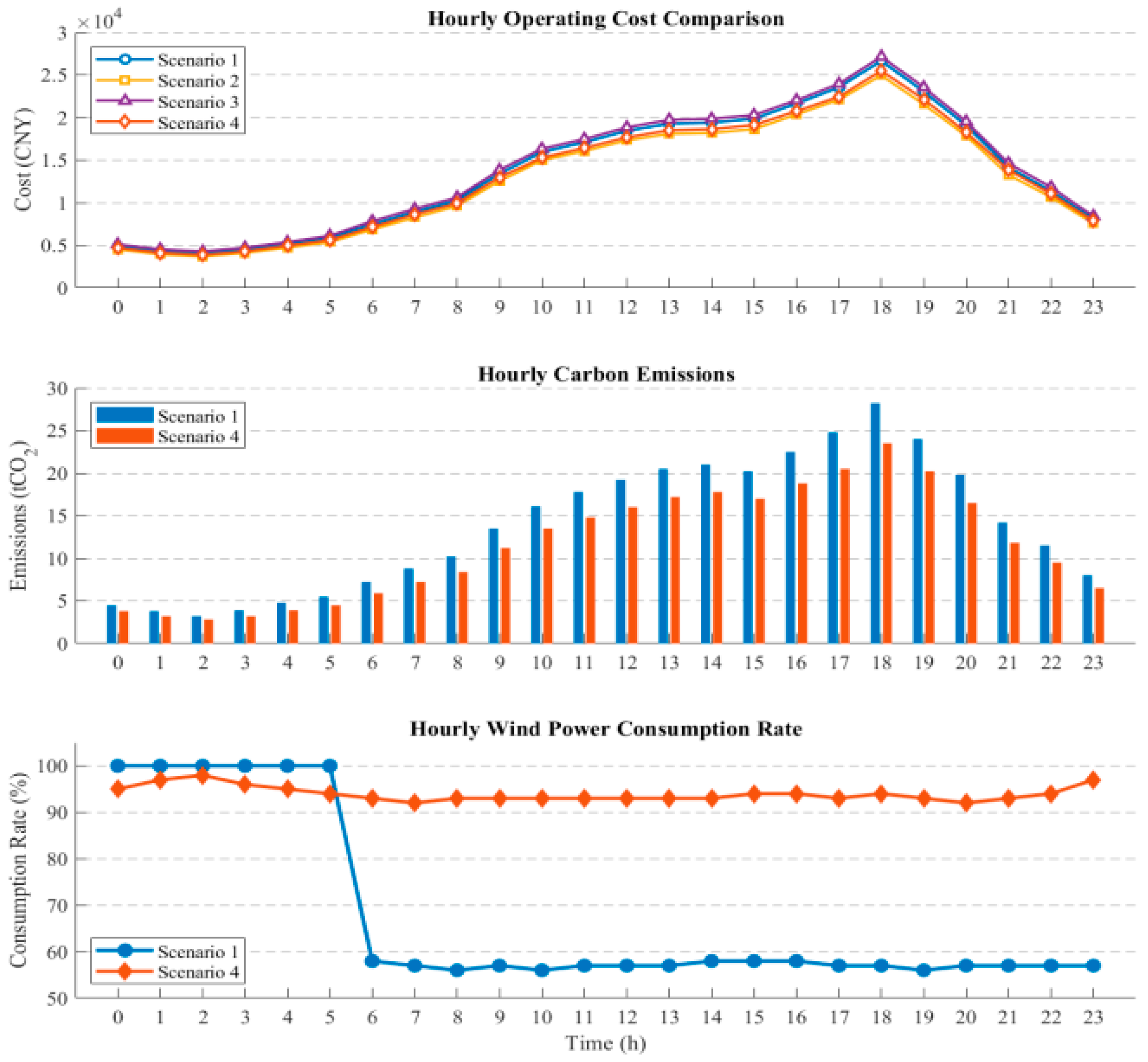
Figure 10 demonstrates the superiority of the two-stage stochastic optimization scheduling through a three-dimensional time-series view. In Scenario 4, the trajectory of operating costs and carbon emissions consistently remains close to the optimal envelope, with the wind power absorption rate maintained at over 90%, thereby avoiding the extreme risk of the absorption rate plummeting below 60% as seen in Scenario 1.
Based on the above analysis, the composition of daily total costs reveals the core contradiction in the operational optimization of integrated energy systems: fuel costs are dominant, and their dispatch strategy has a significant impact on economic efficiency; the proportion of electricity purchase costs from the upstream grid reflects the coupling relationship between the system and the external energy network, while carbon costs guide electricity procurement towards low-carbon periods. Although the costs associated with unit start-up and shutdown, as well as energy storage operation and maintenance, are minimal, their implicit value in smoothing wind power fluctuations and peak-shaving indirectly reduces other marginal costs, thereby supporting the synergistic optimization of economic efficiency and low-carbon performance. The multi-cost linkage effect validates the effectiveness of two-stage stochastic optimization scheduling in balancing uncertainty and economic efficiency.

6.2. Comparison of the Effectiveness of Dynamic Carbon Emission Factor Optimization

To verify the optimization effectiveness of the proposed dynamic carbon emission factor model for low-carbon economic dispatch in integrated energy systems, two sets of comparative scenarios were established for simulation analysis:
(1)
Scenario 1: This scenario employs a traditional fixed carbon emission factor, disregards the real-time operational status of marginal power generation units in the grid, and conducts optimization based on conventional economic dispatch objectives, serving as a benchmark for comparison.
(2)
Scenario 2: This employs the exogenous dynamic carbon emission factor model proposed in this paper. The IES does not alter this factor during optimization, tracking the output and carbon intensity of marginal power generation units in the grid in real time. A two-stage stochastic optimization scheduling model that accounts for dynamic carbon trading costs is constructed to achieve low-carbon optimization of the power procurement strategy.
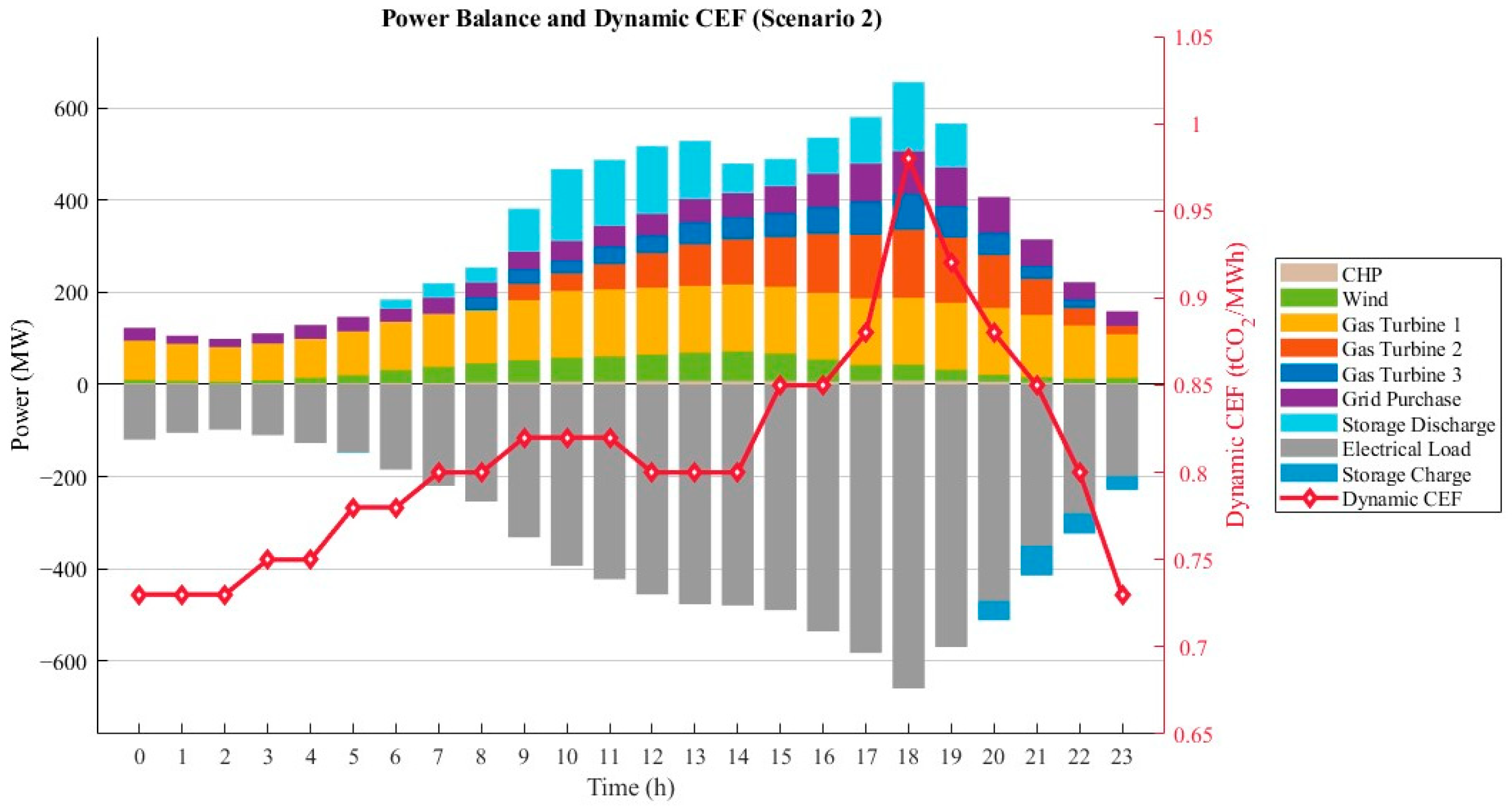
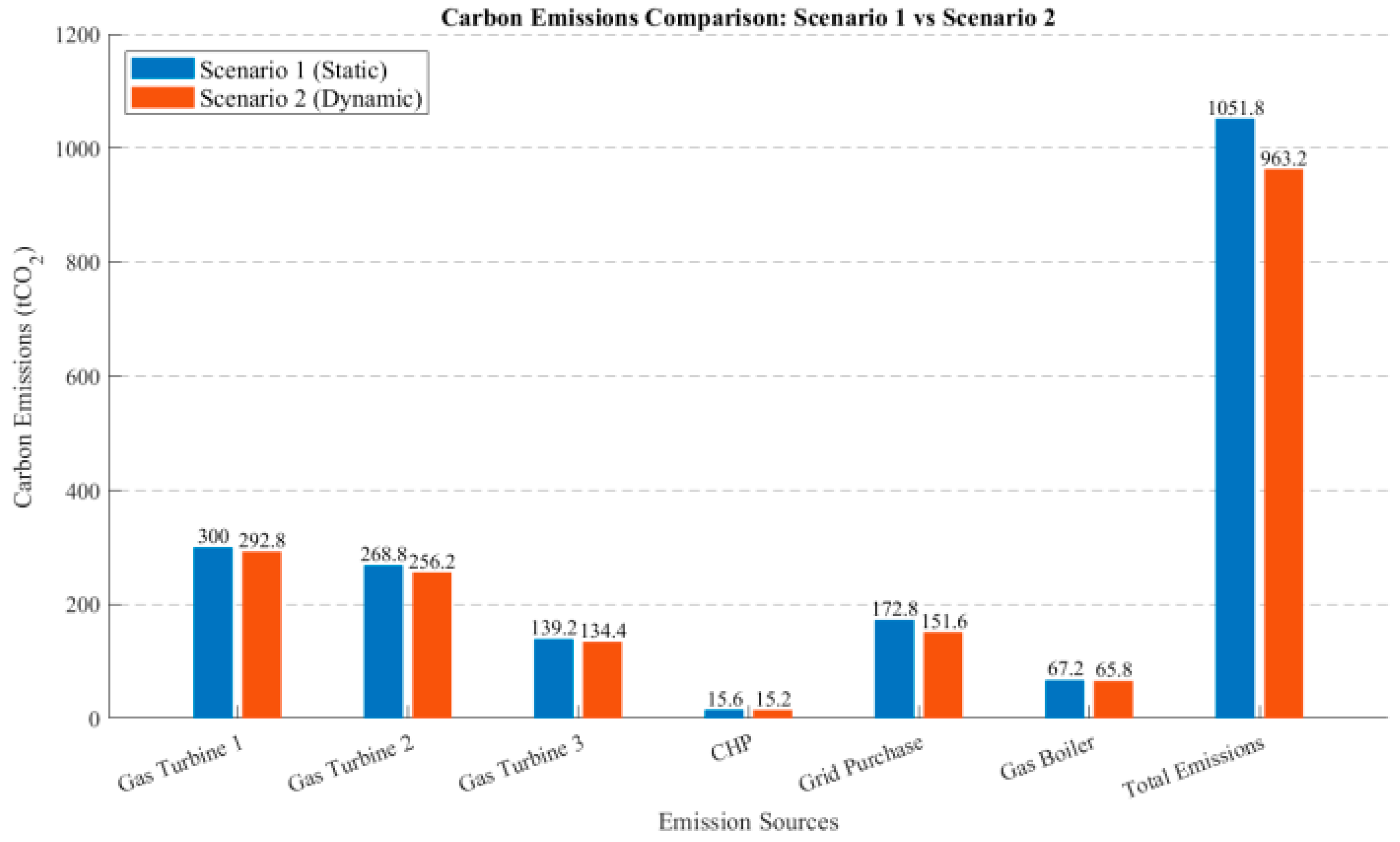
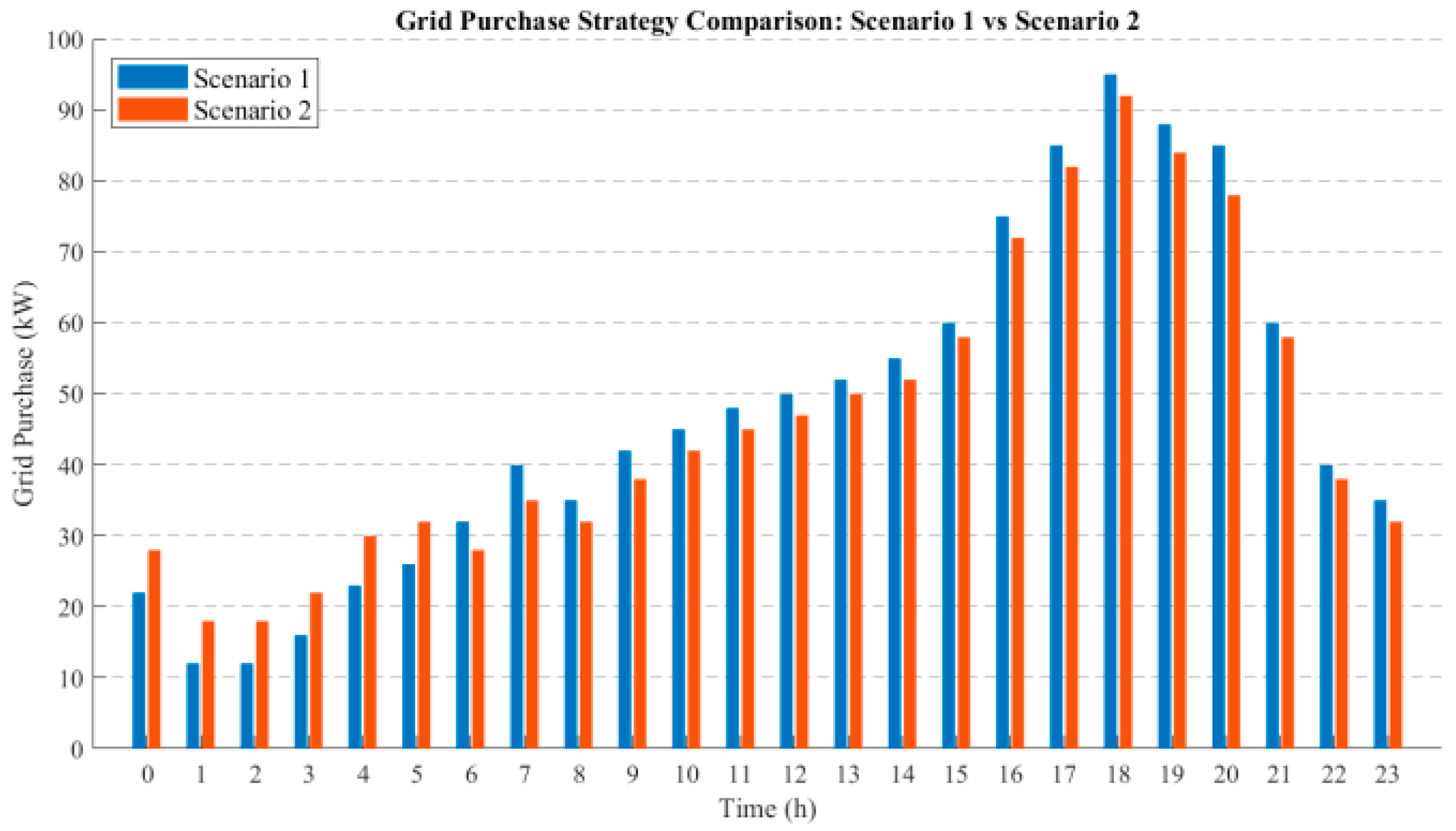
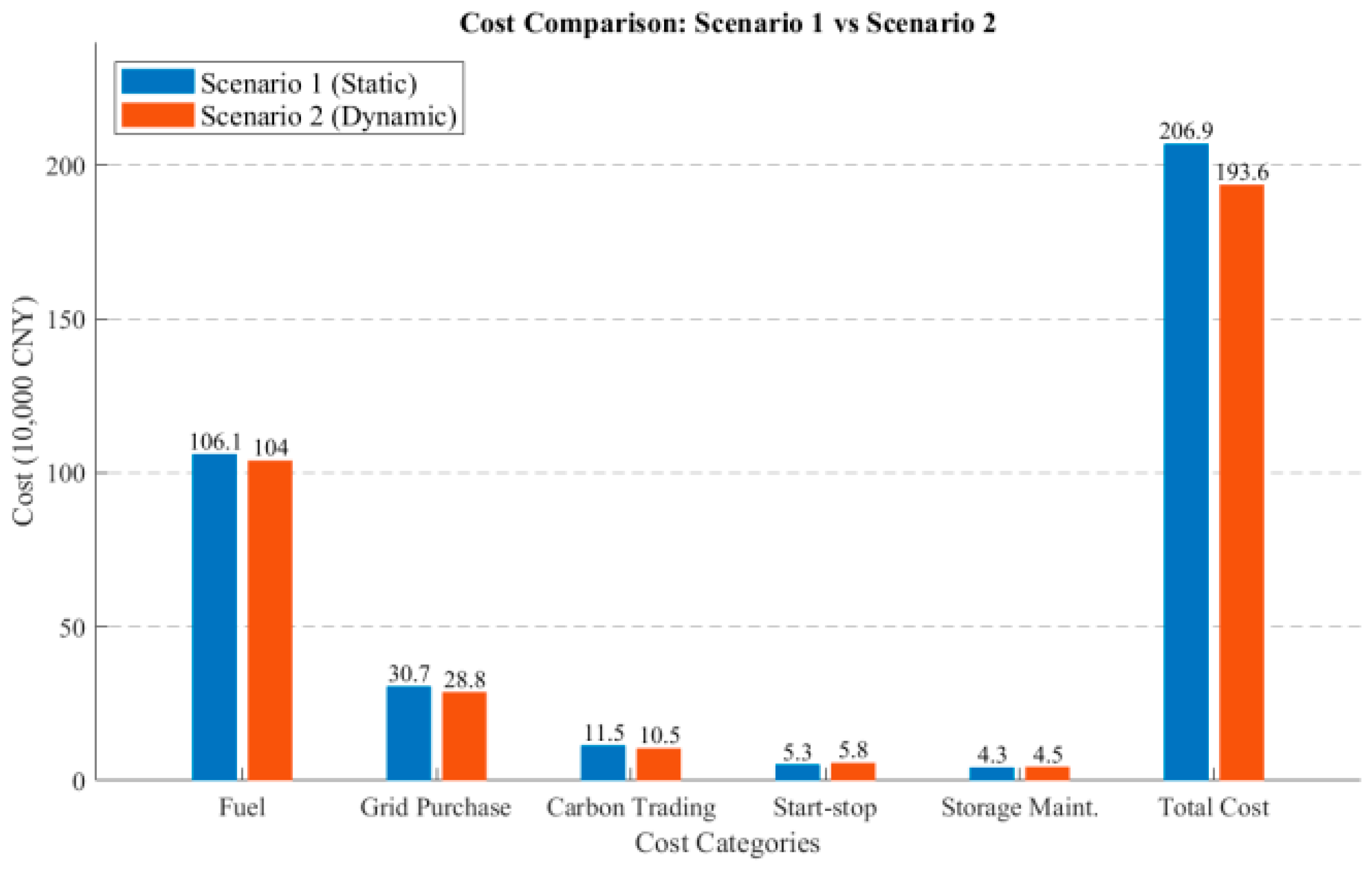
The two scenarios maintain complete consistency in basic parameters such as system load, wind power output, unit parameters, energy storage configuration and carbon trading allowances; the only difference lies in the method of calculating the carbon emission factor, in order to precisely quantify the improvements achieved by the dynamic carbon factor model in terms of reducing system operating costs, reducing carbon emissions and optimizing power procurement strategies. This paper adopts the 2019 baseline emission factor results for China’s regional power grids [25], taking 0.9419 t/kW∙h; the dynamic carbon emission factor is calculated based on the comparison results of Scenarios 1 and 2 using the dynamic carbon emission factor model established earlier. Figure 11 shows the power balance diagram under the dynamic carbon factor, Figure 12 shows the comparison of power purchase strategies, Figure 13 shows the cost comparison, and Figure 14 shows the carbon emissions comparison.
As can be seen from Figure 11, the grid carbon factor drops to its lowest point of the day during the midday period from 11:00 to 15:00, before rising rapidly to its peak during the evening peak period from 17:00 to 19:00. Guided by the economic signals of the dynamic carbon trading mechanism, the system exhibits highly responsive behaviour: during low-carbon emission periods (off-peak zones), the system significantly relaxes its electricity procurement constraints, substantially increasing the proportion of grid-purchased electricity to replace some of the high-cost internal generation.
Figure 12 provides a detailed comparison of the differences in hourly power purchase strategies under the constraints of a static carbon emission factor (Scenario 1) and a dynamic carbon emission factor (Scenario 2). Simulation results demonstrate that, following the introduction of the dynamic carbon factor, the system increased power purchases during the early morning and midday periods when grid carbon emissions are lower, while significantly reducing power purchases during the evening and night-time periods when carbon intensity is higher. This demonstrates that dynamic carbon factors can effectively guide load shifting towards low-carbon periods, thereby overcoming the regulatory limitations of fixed factors.
An analysis of the electricity procurement strategies and carbon emissions for Scenarios 1 and 2, as shown in Figure 13 and Figure 14, reveals that the total daily operating cost in Scenario 2 has steadily decreased from 2.069 million yuan in Scenario 1 to 1.936 million yuan. At the same time, the total daily carbon emissions in Scenario 2 have been significantly reduced, falling from 1051.8 tonnes in the baseline scenario to 963.2 tonnes. A detailed analysis of the data reveals that this marked cost reduction stems from the synergistic reduction of multiple cost components: fuel consumption costs, electricity purchase and interconnection costs with the upstream grid, and carbon trading costs constrained by the tiered pricing mechanism (reduced from 115,000 yuan to 105,000 yuan) have all been substantially lowered. The emission reduction achievements were primarily driven by two key optimizations: firstly, optimizing dispatch to reduce direct carbon emissions from the combustion of fossil fuels in the three main gas turbines; and secondly, precisely avoiding electricity purchases during high-carbon periods on the grid, thereby substantially reducing the inflow of indirect carbon emissions.

6.3. Modelling of Spatio-Temporal Correlations in Wind Power and Analysis of Grid Integration Performance

To quantitatively analyze the impact of spatio-temporal correlations in wind power on the integration level of wind power within integrated energy systems, as well as on system operational risks and computational efficiency, two distinct scenarios were designed for comparative simulation. The fundamental conditions—including system hardware parameters, load curves and carbon trading mechanisms—remain entirely consistent across all scenarios; the only distinction lies in the modelling methods applied to the wind power scenarios, thereby ensuring the fairness and persuasiveness of the analytical results.
(1)
Scenario 3: This scenario employs the traditional method for generating independent wind power scenarios, disregarding both temporal autocorrelation and spatial cross-correlation. The output scenarios for each wind farm are generated independently by sampling from its marginal distribution (without time dependence), and the two farms are treated as independent. The scale of the scenario set is the same as in Scenario 4. This serves as the baseline for evaluating the impact of spatiotemporal correlation.
(2)
Scenario 4: This scenario employs the Copula-based spatiotemporal correlation modelling method proposed in this paper. The joint distribution of the two wind farms’ outputs is constructed using a Gaussian Copula with parameters estimated from historical data, and the temporal autocorrelation of each farm is captured by a first-order Markov chain. The generated scenario set reflects the real spatiotemporal coupling characteristics and is used to validate the optimization effects of the proposed model in enhancing wind power integration, reducing system risk, and improving computational efficiency.
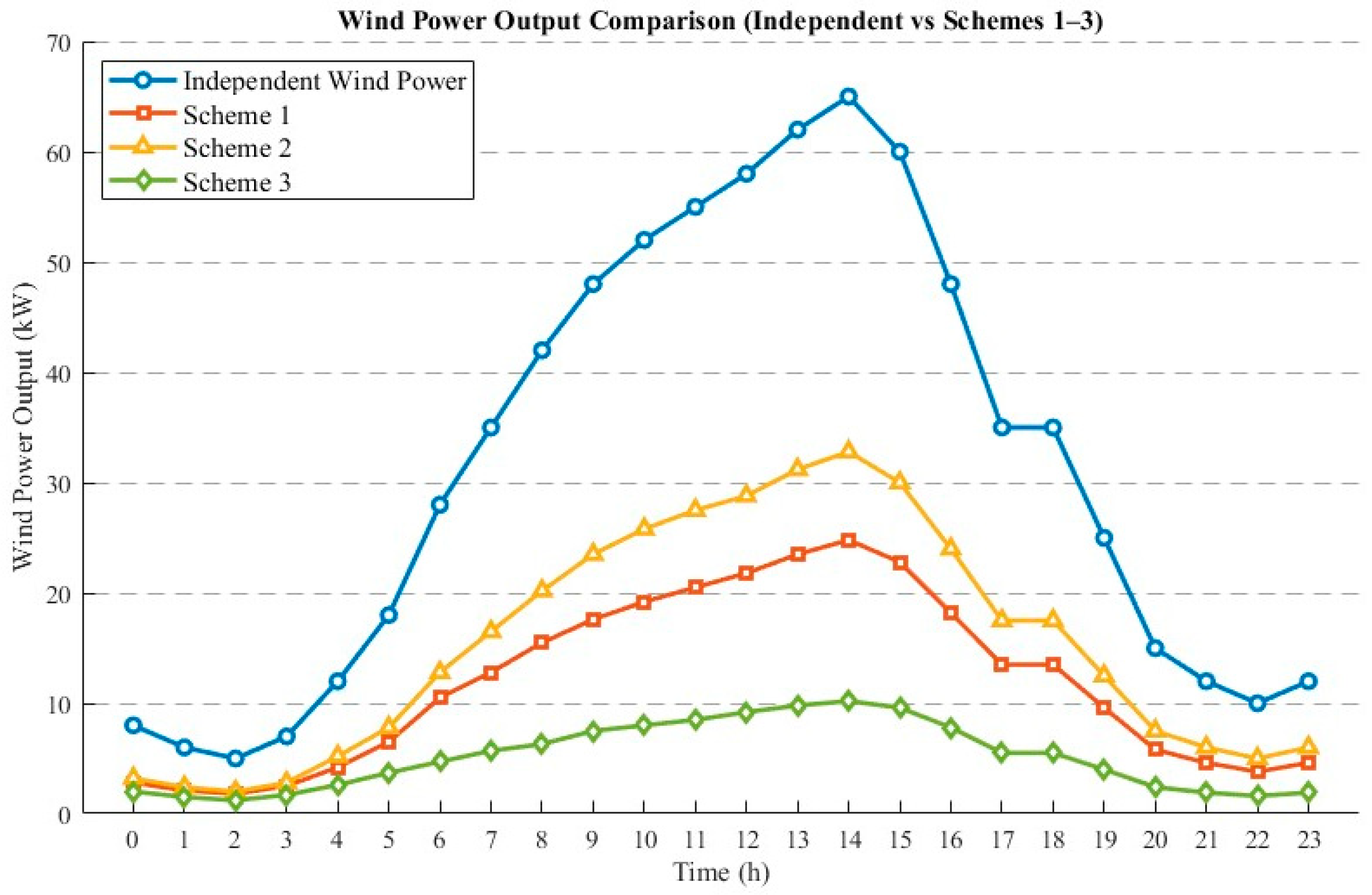
Figure 15 compares the wind power output ranges obtained using traditional independent assumptions with those derived from Copula-based spatio-temporal correlation modelling (Scenarios 1–3). Within the framework of range optimization, accurately characterizing the boundaries of uncertainty is crucial for reducing the conservatism of dispatch decisions. Traditional methods, by neglecting spatio-temporal correlations, result in significant output fluctuations and pronounced peak-to-trough differences, whereas Copula models, through multi-dimensional joint distributions, produce smoother output trajectories and statistical characteristics that more closely resemble reality, effectively avoiding reserve redundancy and excessive curtailment.
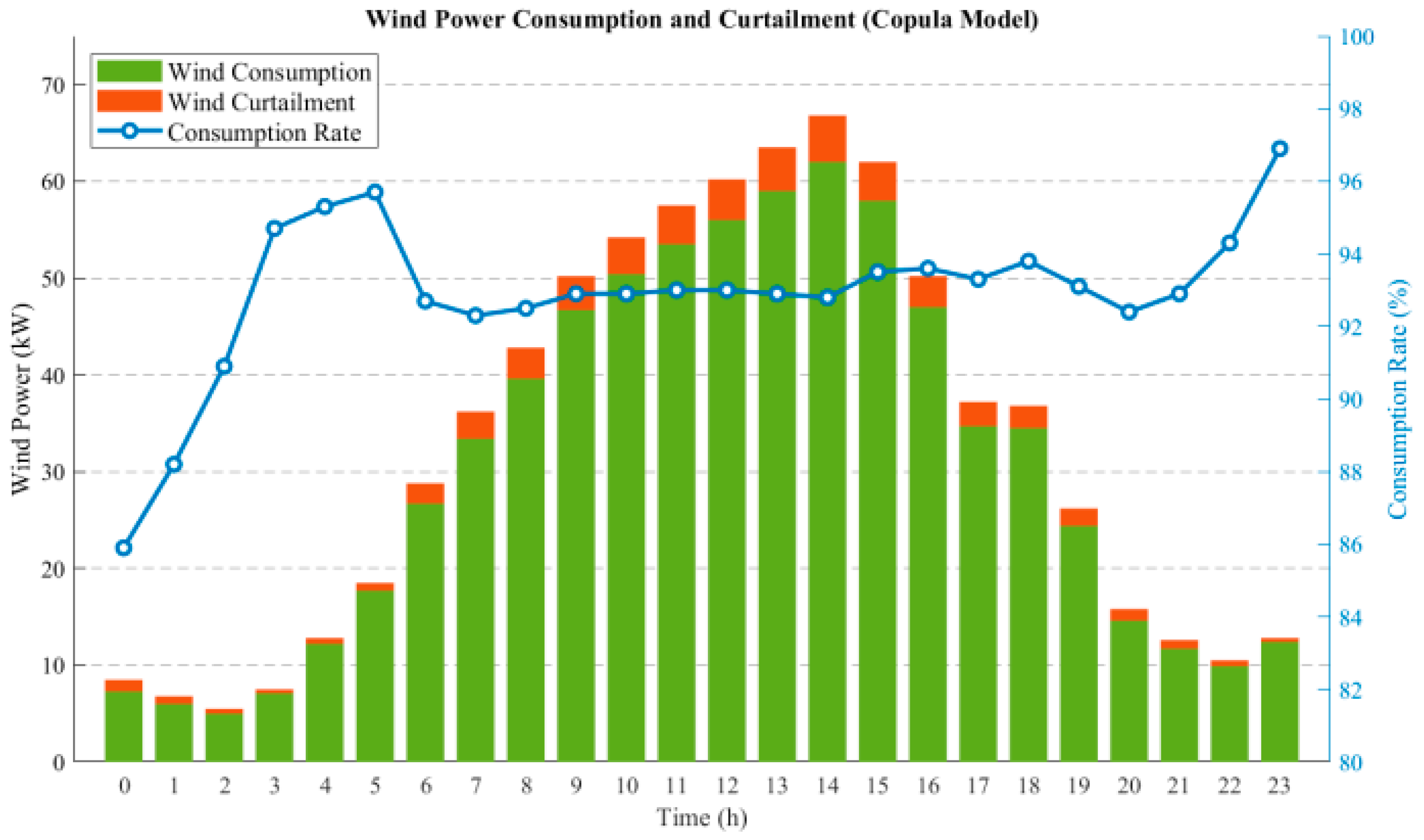
Figure 16 presents the distribution of whole-day wind power integration and curtailment after accounting for spatiotemporal correlations. Thanks to the more accurate fluctuation intervals, the system’s wind power integration rate remains stable at over 90%. Curtailment is primarily concentrated during the early morning off-peak hours (05:00–08:00) and at specific midday periods; constrained by energy storage capacity and the depth of peak-shaving by power generation units, this reflects the system’s true operational boundaries under extreme scenarios.
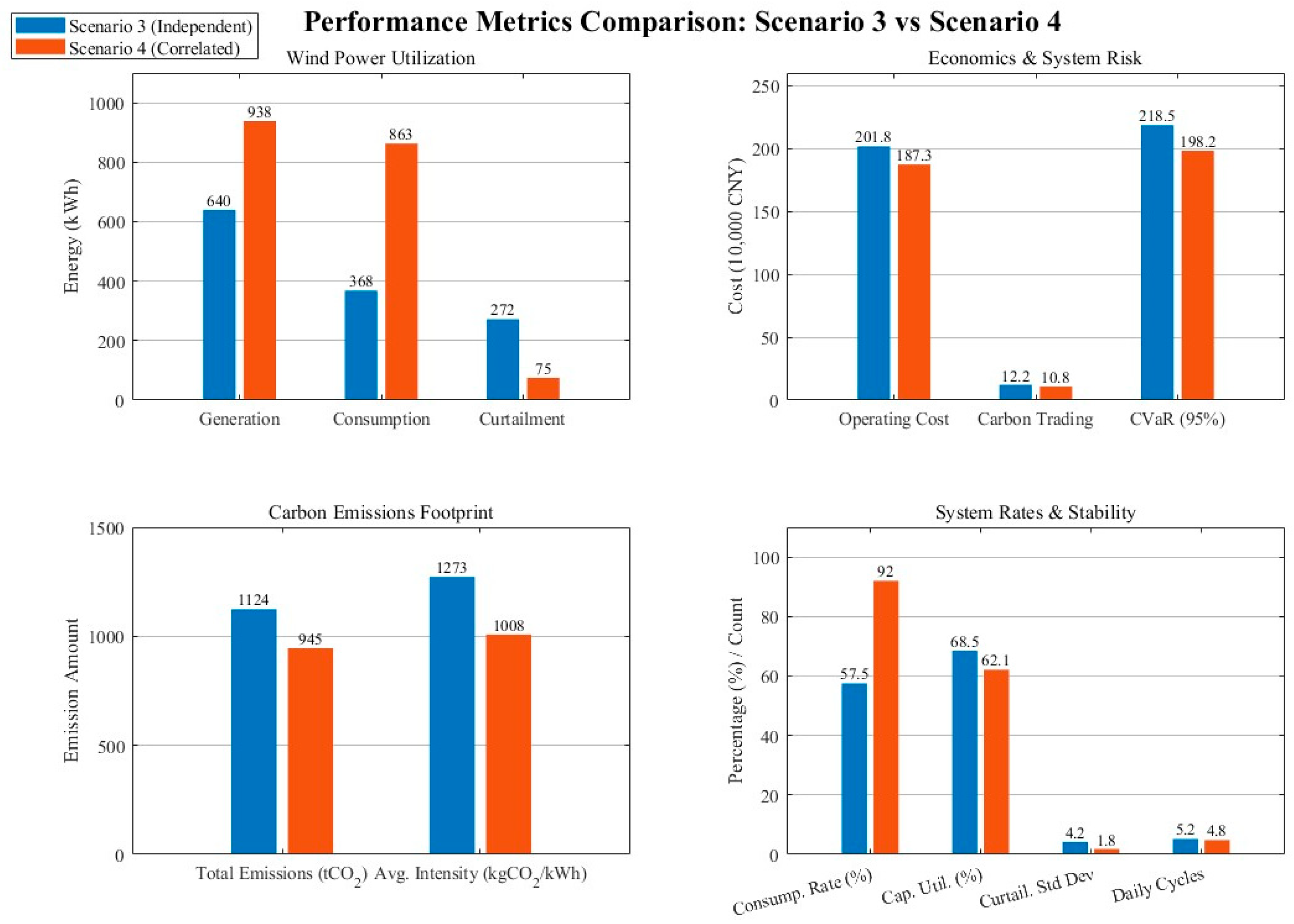
Figure 17 compares the overall operational performance of the system between the standalone wind power scenario (Scenario 3) and the scenario accounting for the spatio-temporal correlation of wind power (Scenario 4). Within the two-stage stochastic optimization decision-making framework, Scenario 4, by providing a more accurate characterization of wind power uncertainty, effectively reduces the system’s reserve and contingency costs in responding to extreme operating scenarios. It reduces total system carbon emissions from 1124 tonnes to 945 tonnes and daily curtailed wind power from 272 kWh to 75 kWh and the comprehensive utilization rate of wind power from 57.5% to 92%, fully demonstrating the crucial role of spatio-temporal correlation modelling in enhancing the system’s low-carbon operation and renewable energy integration capacity. Specific power generation, curtailment, and utilization are shown in Table 3.
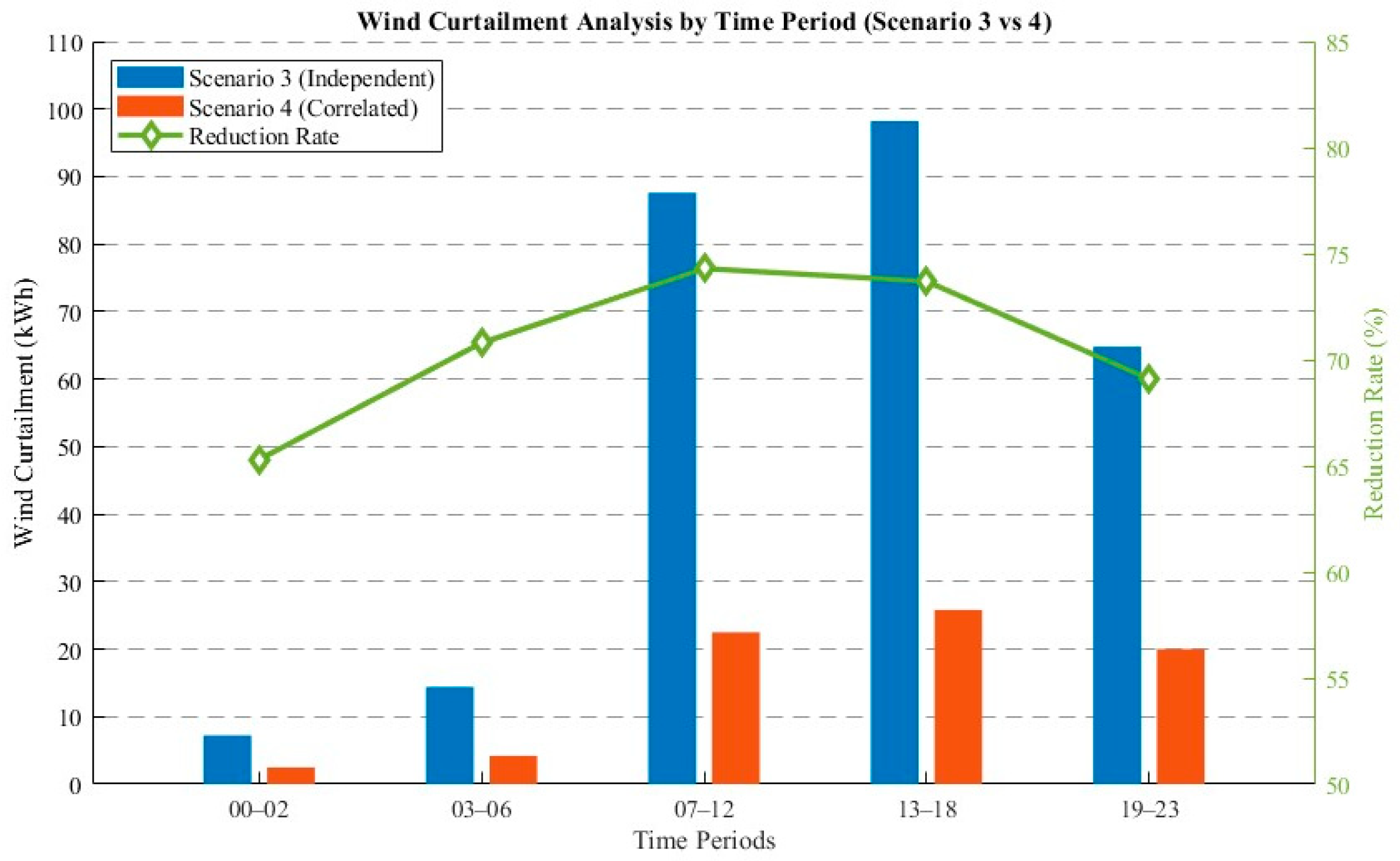
Building on this, Figure 18 further compares the improvements in wind power curtailment across different dispatch periods from a temporal perspective. Compared with the traditional independent random scenario, Scenario 4 significantly reduces curtailed wind power across all time periods, particularly during typical periods of high wind power output and significant load fluctuations (07:00–12:00 and 13:00–18:00), where the curtailment reduction rate reaches approximately 75%.
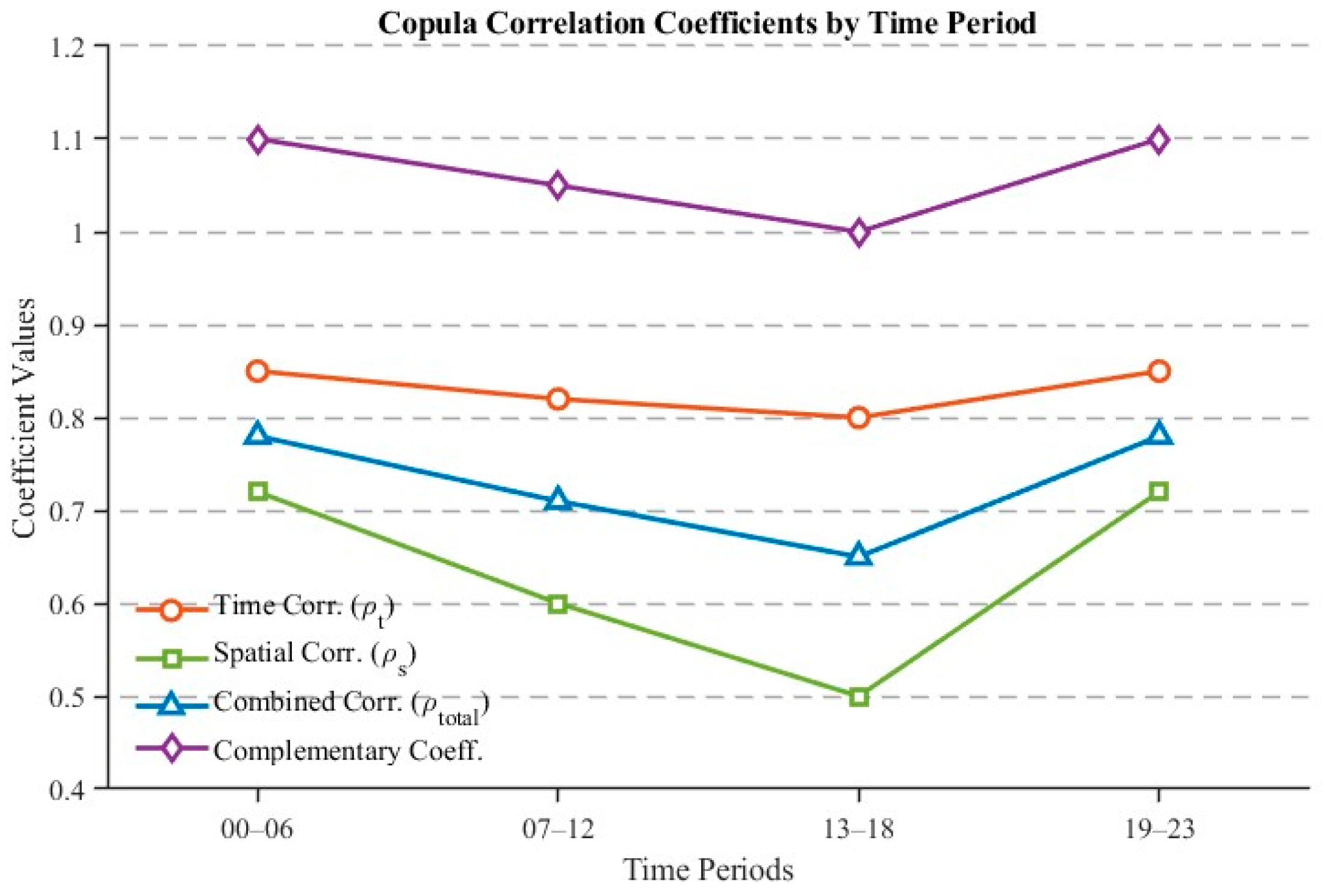
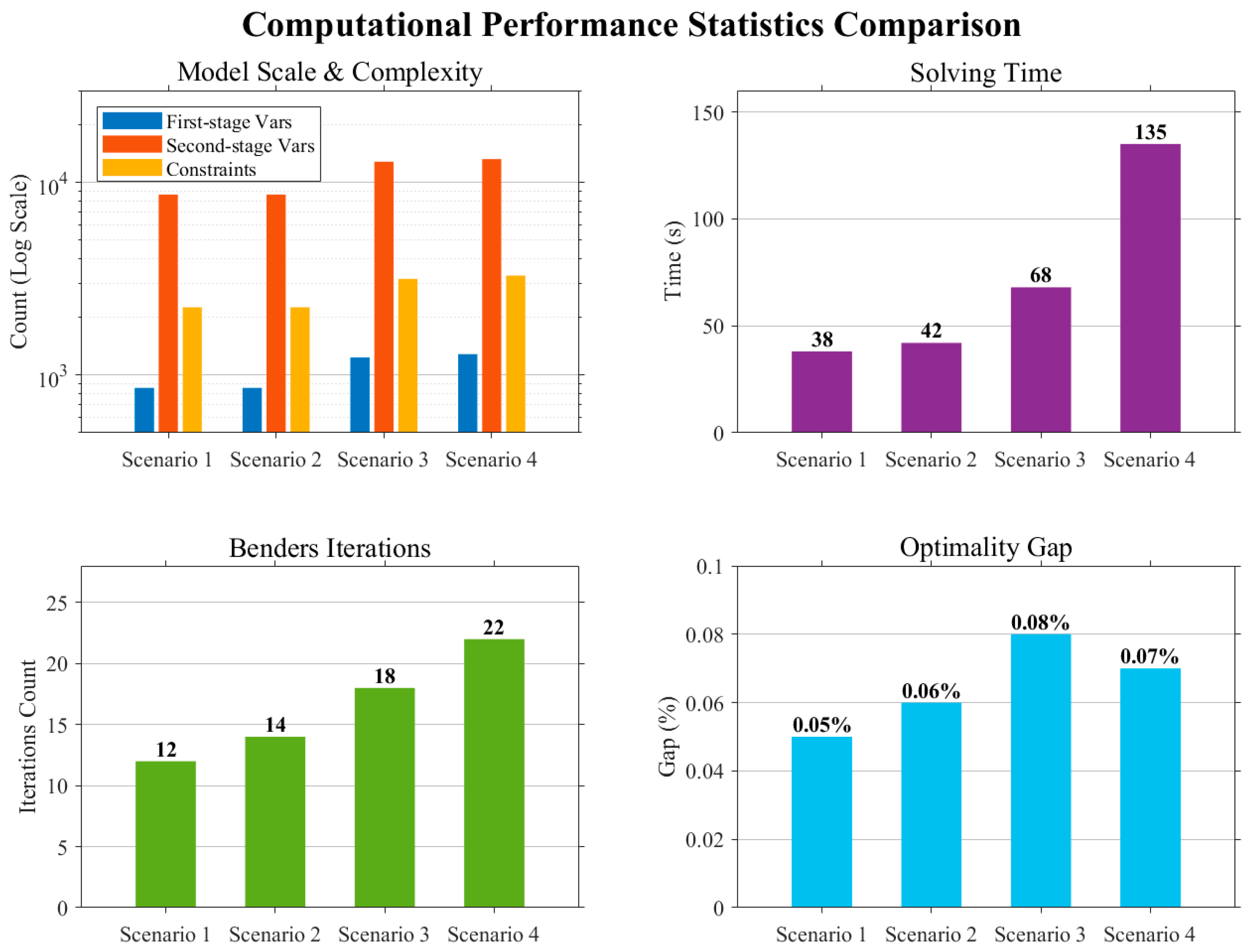
Analysis of the data in Figure 19 reveals that the autocorrelation of wind farm clusters in the temporal dimension, the cross-correlation in the spatial dimension, and the overall composite correlation do not exhibit static, constant characteristics; rather, they demonstrate distinct time-varying dynamic patterns. Particularly during the evening and early morning hours (19:00–23:00 and 00:00–06:00), influenced by local micro-meteorological conditions and physical processes in the lower atmosphere, the degree of spatiotemporal coupling between wind farms is significantly higher than during the daytime. Based on the above analysis, Scenario 4, which simultaneously considers dynamic carbon emission factors and the spatio-temporal correlation of wind power, achieves operating costs and carbon emissions close to the optimal boundary in 24-h dispatch, with the wind power absorption rate remaining stable at over 90%, effectively avoiding the problem of a sharp drop in the absorption rate during off-peak load periods. The scenario performance analysis is shown in Figure 20.

7. Conclusions

In response to the challenge of low-carbon economic dispatch in integrated energy systems under the ‘dual carbon’ goals, a two-stage stochastic optimization dispatch model has been proposed that accounts for dynamic carbon emission factors and the uncertainty in the spatio-temporal correlation of wind power. The following key research findings have been achieved:
(1)
An exogenous dynamic carbon emission factor model based on the real-time operational status of the power grid was developed, which uses only grid-level marginal unit data and is independent of the IES’s own dispatch decisions. The model was validated against an independent grid carbon intensity benchmark with a correlation coefficient of 0.97, confirming the absence of endogenous circularity. This model accurately quantifies the actual carbon emission responsibility during power exchange between the system and the higher-level grid, overcoming the limitations of traditional fixed carbon emission factors and effectively guiding the system to purchase electricity during low-carbon periods of the grid.
(2)
A joint probability distribution model for multiple wind farms was established using Copula theory, accurately capturing the complex correlation structure of wind power clusters across temporal and spatial dimensions. Combined with improved scenario generation and reduction techniques, a set of typical scenarios was constructed that fully reflects the randomness of wind power output.
(3)
A two-stage stochastic optimization dispatch model was established, optimized to minimize the sum of system operating costs and tiered carbon trading costs. This achieves an organic integration of robustness and economic efficiency in dispatch decision-making, providing effective theoretical support and practical guidance for the low-carbon and economical operation of integrated energy systems.
It should be noted that the dynamic carbon emission factor model developed in this study is derived from real-time operational data publicly available from the higher-level power grid; in practical engineering applications, the impact of data transmission delays and measurement errors on the accuracy of factor calculations must be taken into account.

Supplementary Materials

The following supporting information can be downloaded at: https://www.mdpi.com/article/10.3390/pr14111815/s1, Table S1: Supplementary Information Table; Table S2: Copula fitting results; Table S3: Static carbon emission factor and Wind power independent (Scenario 1); Table S4: Energy storage operation data (Scenario 1); Table S5: Detailed data on carbon emissions (Scenario 1); Table S6: Detailed Analysis of Cost Composition (Scenario 1); Table S7: Dynamic Carbon Emission Factors and Wind Power Independent (Scenario 2); Table S8: Comparison of Changes in Electricity Purchase Strategy Timing (Scenario 2); Table S9: Scenario 1, Scenario 2 Cost Comparison; Table S10: Scenario 1, Scenario 2 Carbon Emissions Comparison; Table S11: Analysis of the Mechanism of Dynamic Carbon Emission Factors; Table S12: Independent Wind Power Assumption 24-Hour Operation Data (Scenario 3); Table S13: Wind Power Spatiotemporal Correlation Model 24-Hour Operational Data (Scenario 4); Table S14: Scenario 3, Scenario 4 Performance Indicator Comparison; Table S15: Detailed Analysis of Abandoned Wind Capacity Time Distribution; Table S16: Impact of Copula Space Correlation Coefficient on Wind Curtailment; Table S17: Complete comparison of four scenarios; Table S18: Statistical Analysis of Four Scenarios; Table S19: Gurobi solver parameters; Table S20: Hardware specifications; Table S21: Solution statistics.

Author Contributions

Methodology, J.G. and L.Z.; Software, J.G., K.C., F.L., Y.B. and Y.M.; Validation, J.G. and K.C.; Resources, L.Z. and F.L.; Data curation, J.G., K.C., Y.B. and Y.M.; Writing—original draft, J.G.; Writing—review & editing, J.G. and L.Z. All authors have read and agreed to the published version of the manuscript.

Funding

This research received no external funding.

Data Availability Statement

The raw data supporting the conclusions of this article will be made available by the authors on request.

Conflicts of Interest

The authors declare no conflicts of interest.

References

  1. Wang, D.S.; Du, P.; Zhang, G.Y. A review of optimal dispatch of combined power and heat integrated energy system to promote wind power consumption. Coal Econ. Res. 2024, 44, 113–121. [Google Scholar]
  2. Yan, C.C. Research on Wind Power Prediction Algorithm Based on Deep Learning. Ph.D. Thesis, Tianjin University of Technology, Tianjin, China, 2024. [Google Scholar]
  3. Zhang, Z.W. Research on Distributed Optimal Dispatch of Inter-Regional Integrated Energy System Considering Wind Power Uncertainty. Ph.D. Thesis, Shandong University, Jinan, China, 2022. [Google Scholar]
  4. Shi, Y.; Li, W.; Zhang, L.; Zhang, Y.; Li, Y. Quantification model of carbon emission reduction benefits based on dynamic carbon emission factor. Other Conf. 2024, 13159, 874–881. [Google Scholar]
  5. Su, Z.; Huang, Y.; Gu, W.; Chen, L.; Niu, Y. Calculation method for dynamic carbon emission factors of thermal power plants based on coupling of energy flow and carbon flow. Energy Convers. Manag. 2026, 353, 121179. [Google Scholar] [CrossRef]
  6. Li, J.; Lu, F.; Xu, W.; Qiao, B.; Gang, W.; Li, Z.; Zhang, G.; Li, B.; Liu, M. Two-stage collaborative optimization for low-carbon park energy systems: Day-ahead planning and intra-day rolling with dynamic carbon emission factors. Renew. Energy 2026, 266, 125692. [Google Scholar] [CrossRef]
  7. Wang, Z.; Zhang, Y.; Li, W. A bi-level optimization operation method for hydrogen-enriched integrated energy systems incorporating dynamic carbon emission factors. Renew. Energy 2026, 256, 124168. [Google Scholar] [CrossRef]
  8. Zhang, C.; Qi, Y.; Cao, X.; Zhang, Y. Low-Carbon Economic Dispatch of an Integrated Energy System with Multi-Device Coupling under Ladder-Type Carbon Trading. Energy Eng. 2026, 123, 12. [Google Scholar] [CrossRef]
  9. Yang, Y.; He, J.; Chen, W.; Li, Z.; Chen, K. Low-Carbon Economic Dispatch of Electric-Thermal-Hydrogen Integrated Energy System Based on Carbon Emission Flow Tracking and Step-Wise Carbon Price. Energy Eng. 2025, 122, 4653–4678. [Google Scholar] [CrossRef]
  10. Zhai, M.; Su, S.; Gu, Y.; Liu, L.; Wu, Y. Dynamic modeling of interregional carbon emission transfers and mitigation responsibilities. Energy 2026, 347, 140361. [Google Scholar] [CrossRef]
  11. Hou, B.; Hui, Z.; Yu, Y. Research on Tracking and Calculating Model of Branch Carbon Flow in Power Grid Based on Dynamic Carbon Factor. In Proceedings of the 2023 IEEE 3rd International Conference on Data Science and Computer Application (ICDSCA); IEEE: New York, NY, USA, 2023; pp. 455–459. [Google Scholar]
  12. Liu, J.F.; Shuai, W.; Ma, R.H.; Xun, H.; Zheng, X.B.; Wang, Y.Y. The Research on the Factors Influencing the Characteristics of Power System Frequency. In Proceedings of the 2023 4th International Conference on Advanced Electrical and Energy Systems (AEES); IEEE: New York, NY, USA, 2023; pp. 108–113. [Google Scholar]
  13. Zhang, X.; Wu, J.; Zhang, C.; Han, W.; Zhang, Y. Research on modeling and evaluation of spatiotemporal uncertainty wind speed for wind turbines. Int. J. Reliab. Qual. Saf. Eng. 2025, 32, 2550017. [Google Scholar] [CrossRef]
  14. Liu, Y.; Qiu, Y.; Feng, Y.; Zhou, H.; Xiong, X.-L. Spatiotemporal physics-guided graph neural network for wind farm power prediction. Eng. Appl. Artif. Intell. 2026, 171, 114301. [Google Scholar] [CrossRef]
  15. Rathod, D.; Gidwani, L. A literature review based on density forecasting and uncertainty quantification of wind power generation. Renew. Sustain. Energy Rev. 2026, 229, 116559. [Google Scholar] [CrossRef]
  16. Wang, L.; Gao, J.; Li, Y.; Wang, D. A method for ultra-short-term wind power forecasting of large-scale wind farms based on adaptive spatiotemporal graph convolution. Renew. Energy 2025, 249, 123321. [Google Scholar] [CrossRef]
  17. He, H.; Zhao, D.; Zhang, Z.; Long, X.; Luo, D.; Huang, S. Multi-scale wind cluster power prediction based on unified spatiotemporal generative adversarial model. Electr. Power Syst. Res. 2026, 257, 112994. [Google Scholar] [CrossRef]
  18. Jiang, W.; Wang, J.; He, X.; He, M. PSTG-Net: A physics-informed spatiotemporal multimodal dynamic graph network for wind power forecasting. Expert Syst. Appl. 2026, 320, 132224. [Google Scholar] [CrossRef]
  19. Zhang, M.; Han, Y.; Sun, Y.; Zhang, H.; Yang, F.; Wang, C. Power forecasting for distributed wind farms using a1hybrid deep learning model with spatiotemporal clustering and feature mining. Measurement 2026, 265, 120383. [Google Scholar] [CrossRef]
  20. Zhang, Q.; Mei, K.; Zhou, Q.; Ding, X.; Dong, Z.; Tian, M.; Liu, D.; He, W.; Zeng, Z.; Li, M. A wind farm cluster power prediction method based on globally aware dynamic spatiotemporal graph continual learning framework. Energy 2026, 348, 140591. [Google Scholar] [CrossRef]
  21. Wang, D.; Yang, M.; Zhang, W.; Ma, C.; Su, X. Short-term power prediction method of wind farm cluster based on deep spatiotemporal correlation mining. Appl. Energy 2025, 380, 125102. [Google Scholar] [CrossRef]
  22. Tan, J.; Zhang, J.; Liu, H.; Lan, B. A high dimensional uncertain scenario generating method for wind power and photovoltaic considering spatiotemporal correlation. Energy 2025, 340, 139224. [Google Scholar] [CrossRef]
  23. Fang, X.; Hodge, B.; Jiang, H.; Zhang, Y. Decentralized wind uncertainty management: Alternating direction method of multipliers based distributionally-robust chance constrained optimal power flow. Appl. Energy 2019, 239, 259. [Google Scholar] [CrossRef]
  24. Gao, X.; Xiao, T.; Li, J.; Hao, J.; Ma, Z. Study on Wind Field Characteristics in a Coastal Plain Based on a New Three-Dimensional Joint Distribution Model. Appl. Sci. 2021, 11, 9114. [Google Scholar] [CrossRef]
  25. Ministry of Ecological Environment of the People’s Republic of China. China Regional Grid Baseline Emission Factors for FY2019 Emission Reduction Programs; Ministry of Ecological Environment of the People’s Republic of China: Beijing, China, 2020.
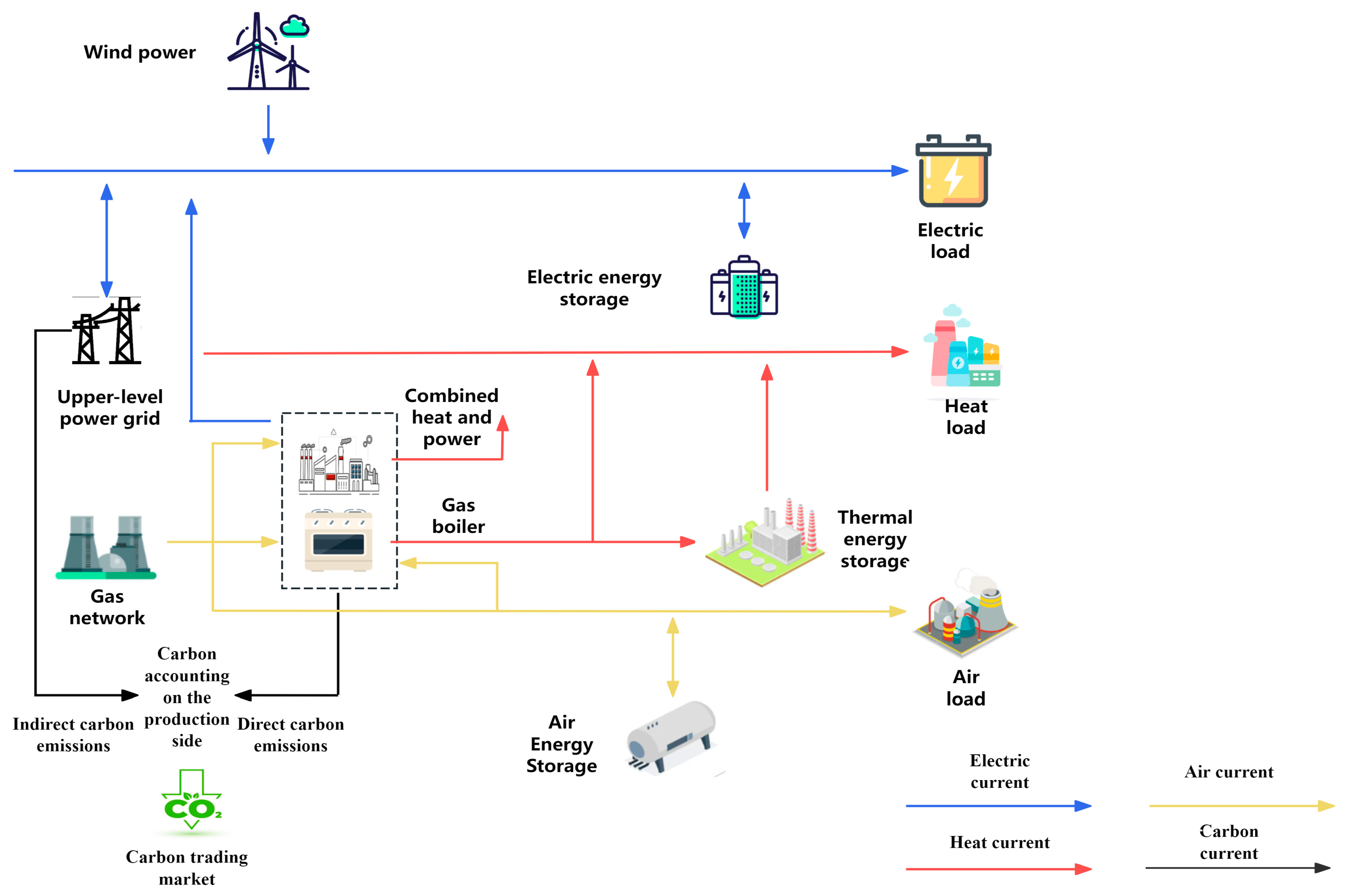
Figure 1. The integrated energy system architecture.
Processes 14 01815 g001
Figure 2. C-vine copula-based dependency modelling for spatio-temporal correlation of wind power clusters.
Processes 14 01815 g002
Figure 3. Framework of wind power scenario generation and reduction based on Copula theory and Markov chain.
Processes 14 01815 g003
Figure 4. Framework of core models and scheduling algorithm for low-carbon economic operation of integrated energy system.
Processes 14 01815 g004
Figure 5. Flowchart of the model algorithm framework.
Processes 14 01815 g005
Figure 6. Electrical power balance of the integrated energy system.
Processes 14 01815 g006
Figure 7. Energy Storage Power Operations.
Processes 14 01815 g007
Figure 8. Carbon Emission Details by Source.
Processes 14 01815 g008
Figure 9. Daily Total Cost Composition. Note: Percentages are rounded to the nearest integer; therefore, the sum may be approximately 100%.
Processes 14 01815 g009
Figure 10. Hourly Operating Cost Comparison/Hourly Carbon Emissions/Hourly Wind Power Consumption Rate.
Processes 14 01815 g010
Figure 11. Power Balance and Dynamic CEF (Scenario 2).
Processes 14 01815 g011
Figure 12. Grid Purchase Strategy Comparison: Scenario 1 vs. Scenario 2.
Processes 14 01815 g012
Figure 13. Cost Comparison: Scenario 1 vs. Scenario 2.
Processes 14 01815 g013
Figure 14. Carbon Emissions Comparison: Scenario 1 vs. Scenario 2.
Processes 14 01815 g014
Figure 15. Wind Power Output Comparison (Independent vs. Schemes 1–3).
Processes 14 01815 g015
Figure 16. Wind Power Consumption and Curtailment (Copula Model).
Processes 14 01815 g016
Figure 17. Performance Metrics Comparison: Scenario 3 vs. Scenario 4.
Processes 14 01815 g017
Figure 18. Wind Curtailment Analysis by Time Period (Scenario 3 vs. 4).
Processes 14 01815 g018
Figure 19. Copula Correlation Coefficients by Time Period.
Processes 14 01815 g019
Figure 20. Computational Performance Statistics Comparison.
Processes 14 01815 g020
Table 1. Detailed comparison of proposed method with published papers.
Ref.ObjectivesCarbon Emission FactorWind Power UncertaintySpatio-Temporal CorrelationScheduling Model
[5]Carbon responsibility allocation of thermal power plantsDynamic carbon emission factorEnergy flow-carbon flow coupling, equipment-level carbon accounting
[6]Day-ahead scheduling & intra-day rolling low-carbon optimizationDynamic carbon emission factorRenewable energy fluctuation consideredTwo-stage collaborative optimization, MPC rolling optimization
[7]Economic & low-carbon & hydrogen utilizationDynamic carbon emission factorStochastic volatility consideredBi-level optimization, Stackelberg game, P2G-CCS-CHP
[8]Economic & low-carbon & robustnessLadder-type carbon tradingWind-PV uncertainty consideredTwo-stage robust optimization, two-stage P2G, multi-equipment coordination
[9]Low-carbon economic dispatch of electricity-heat-hydrogen IESStepped carbon tradingWind-PV uncertainty consideredCarbon emission flow tracking, MILP model
[16]Ultra-short-term wind power forecastingWind power fluctuation consideredAdaptive spatio-temporal graph convolution modellingSpatiotemporal graph neural network, multi-head attention
[19]Wind farm cluster power forecasting accuracyIntermittency & fluctuation consideredSpatio-temporal correlation mining, graph attention networkGAT, Bi-directional recurrent residual network, multi-task learning
[20]Wind farm cluster power forecastingFluctuation & time-varying uncertaintyDynamic spatio-temporal graph, globally aware correlationGADSG-CL, spatiotemporal graph neural network, continual learning
[21]Ultra-short-term wind power predictionStochastic volatility & non-stationaritySpatial clustering & temporal feature miningIAO-VMD, BiTCN-BiGRU, attention mechanism, transfer learning
This paperMinimum operation cost & minimum carbon emissionDynamic carbon emission factorTwo-stage stochastic optimization & scenario clusteringCopula-based accurate modellingTwo-stage stochastic optimization, K-means, parallel computing
Note: ✗ indicates that the corresponding factor or method is not considered or not applied in the referenced paper.
Table 2. Validation results of the exogenous dynamic CEF.
MetricValue
Mean absolute error (MAE)0.026 tCO2/kWh
Relative error (mean)3.12%
Pearson correlation coefficient0.97
Table 3. Daily wind power generation, curtailment, and utilization comparison between Scenario 3 and Scenario 4.
ScenarioTotal Generation (kWh)Absorbed (kWh)Curtailed (kWh)Utilization Rate
Scenario 3 (independent)64036827257.5%
Scenario 4 (Copula)9388637592.0%
Disclaimer/Publisher’s Note: The statements, opinions and data contained in all publications are solely those of the individual author(s) and contributor(s) and not of MDPI and/or the editor(s). MDPI and/or the editor(s) disclaim responsibility for any injury to people or property resulting from any ideas, methods, instructions or products referred to in the content.