


Valorization of Grape Stalk Rachis for Particleboard Manufacturing: Chemical Characterization and Performance Assessment for Sustainable Interior Panel Applications

 , , , and
Abstract
1. Introduction
2. Materials and Methods
2.1. Raw Material Sourcing and Preparation
2.2. Chemical Characterization of Grape Stalk Cell Wall Components
2.3. Morphoanatomical Characterization
2.4. Adhesive System
2.5. Particleboard Manufacture and Experimental Design
2.6. Mechanical Properties: Internal Bond Strength
2.7. Physical Properties: Thickness Swelling and Water Absorption
2.8. Reaction-to-Fire Assessment Under NCh1974
2.9. Statistical Analysis
3. Results and Discussion
3.1. Chemical Composition of Grape Stalk Rachis

| Component (% w/w) | Grape Stalk Rachis | Woods [30] |
|---|---|---|
| Glucans (cellulose) | 31.6 ± 1.6 | 40–45 |
| Hemicellulose (total) | 19.1 ± 0.7 | 25–35 |
| Lignin—acid-soluble | 1.2 ± 1.1 | — |
| Lignin—acid-insoluble (Klason) | 16.2 ± 1.0 | — |
| Total lignin | 17.4 ± 1.5 | 20–30 |
| Acetone-soluble extractives | 15.9 ± 0.3 | 2–5 |
| Ash (inorganic fraction) | 9.3 ± 0.7 | 0.1–1 |
| Crude protein (Kjeldahl × 6.25) | 6.1 ± 0.1 | <0.5 |
3.2. Fiber Morphoanatomical Characterization
3.3. Physical and Mechanical Properties of Grape Stalk Particleboards
| Property | 550 kg/m3 | 650 kg/m3 | 750 kg/m3 | Standard Requirement |
|---|---|---|---|---|
| Internal bond, IB (N/mm2) | 0.246 | 0.517 * | 1.008 * | ≥0.35 [EN 312 P2] |
| Board density (kg/m3) | 579 | 664 * | 819 | 620–670 [36] |
| Thickness swelling, TS (%/24 h) | 18.45 | 16.69 | 12.71 * | ≤14 [20] |
| Water absorption, WA (%/24 h) | 63.71 | 75.47 | 49.67 | ≤40 [20] |
3.4. Reaction-to-Fire Performance Under NCh1974
4. Conclusions
- (1)
- Grape stalk rachis exhibits a distinctive lignocellulosic composition, characterized by moderate glucan content (31.6 ± 1.6%), elevated acetone-soluble extractives (15.9 ± 0.3%), high inorganic ash content (9.3 ± 0.7%), and parenchyma-dominated morphoanatomy. These features influence both interparticle bonding behavior and thermal response during combustion.
- (2)
- Pressing density was identified as a key processing parameter controlling panel performance. Boards manufactured at 650 and 750 kg/m3 achieved internal bond strength values of 0.517 and 1.008 N/mm2, respectively, meeting the EN 312 requirement for P2-type particleboards in terms of internal cohesion. However, thickness swelling met the reference criterion only at 750 kg/m3, and water absorption remained above recommended values for all formulations, indicating that moisture resistance requires further optimization.
- (3)
- Reaction-to-fire performance improved with increasing board density. A substantial reduction in carbonization index (62.5%) was observed from 550 to 750 kg/m3, while mass loss showed a smaller decrease (12.8%), suggesting that densification primarily limits char propagation rather than volatile release. When normalized to specimen mass, boards at ≥650 kg/m3 met the reference thresholds reported for commercial particleboards under NCh1974.
- (4)
- Based on the properties evaluated in this study, grape stalk residues show potential as a raw material for particleboard production. However, the absence of bending properties (MOR and MOE) limits a comprehensive assessment of their suitability for interior applications according to EN 312 requirements. Therefore, conclusions regarding end-use performance should be considered preliminary.
- (5)
- Although the valorization of grape stalk residues represents a promising pathway for the utilization of agro-industrial biomass, broader sustainability claims cannot be fully supported within the scope of this study. Additional assessments such as formaldehyde emissions, long-term durability, and life-cycle analysis are required to evaluate the environmental performance of panels produced with urea–formaldehyde resin systems.
Author Contributions
Funding
Data Availability Statement
Acknowledgments
Conflicts of Interest
References
- Scarlat, N.; Dallemand, J.F.; Monforti-Ferrario, F.; Nita, V. The role of biomass and bioenergy in a future bioeconomy: Policies and facts. Environ. Dev. 2015, 15, 3–34. [Google Scholar] [CrossRef]
- Blasi, A.; Verardi, A.; Lopresto, C.G.; De Bari, I.; Calabrò, V. Lignocellulosic agricultural waste valorization to obtain valuable products: An overview. Recycling 2023, 8, 61. [Google Scholar] [CrossRef]
- Ragauskas, A.J.; Williams, C.K.; Davison, B.H.; Britovsek, G.; Cairney, J.; Eckert, C.A.; Frederick, W.J.; Hallett, J.P.; Leak, D.J.; Liotta, C.L.; et al. The path forward for biofuels and biomaterials. Science 2006, 311, 484–489. [Google Scholar] [CrossRef]
- Cherubini, F. The biorefinery concept: Using biomass instead of oil for producing energy and chemicals. Energy Convers. Manag. 2010, 51, 1412–1421. [Google Scholar] [CrossRef]
- Stegmann, P.; Londo, M.; Junginger, M. The circular bioeconomy: Its elements and role in sustainability transitions. Resour. Conserv. Recycl. 2020, 6, 100029. [Google Scholar]
- Ahmad, W.; McCormack, S.J.; Byrne, A. Biocomposites for sustainable construction: A review. J. Build. Eng. 2025, 105, 112525. [Google Scholar] [CrossRef]
- Grigoriou, A.; Passialis, C.; Voulgaridis, E. Experimental particleboards from Kenaf plantations grown in Greece. Holz Roh Werkst. 2000, 58, 290–295. [Google Scholar] [CrossRef]
- Papadopoulos, A.N. Property comparisons and bonding efficiency of UF and PMDI bonded particleboards. BioResources 2006, 1, 201–208. [Google Scholar] [CrossRef]
- Lee, S.H.; Lum, W.C.; Boon, J.G.; Kristak, L.; Antov, P.; Pędzik, M.; Rogozinski, T.; Taghiyari, H.R.; Lubis, M.A.R.; Fatriasari, W.; et al. Particleboard from agricultural biomass and recycled wood waste: A review. J. Mater. Res. Technol. 2022, 20, 4630–4658. [Google Scholar] [CrossRef]
- Ping, L.; Brosse, N.; Sannigrahi, P.; Ragauskas, A. Evaluation of grape stalks as a bioresource. Ind. Crops Prod. 2011, 33, 200–204. [Google Scholar] [CrossRef]
- Prozil, S.O.; Evtuguin, D.V.; Lopes, L.P.C. Chemical composition of grape stalks of Vitis vinifera L. from red grape pomaces. Ind. Crops Prod. 2012, 35, 178–184. [Google Scholar] [CrossRef]
- ODEPA. Mercado del vino: Temporada 2025; Oficina de Estudios y Políticas Agrarias, Ministerio de Agricultura: Santiago, Chile, 2025. [Google Scholar]
- D’Amato, D.; Droste, N.; Allen, B.; Kettunen, M.; Lähtinen, K.; Korhonen, J.; Leskinen, P.; Matthies, B.D.; Toppinen, A. Green, circular, bio economy: A comparative analysis of sustainability avenues. J. Clean. Prod. 2017, 168, 716–734. [Google Scholar] [CrossRef]
- Jones, D.; Brischke, C. Performance of Bio-Based Building Materials; Woodhead Publishing: Duxford, UK, 2017. [Google Scholar]
- Ferrandez-Garcia, C.E.; Ferrandez-Garcia, M.T.; Garcia-Ortuño, T.; Ferrandez-Garcia, A.; Ferrandez-Villena, M. Physical-mechanical properties of binderless particleboards made from vine (Vitis vinifera L.) shoots. BioResources 2017, 12, 8598–8610. [Google Scholar]
- Instituto Nacional de Normalización (INN). NCh1974 Of.86: Prevención de Incendios en Edificios—Pinturas—Determinación del Retardo al Fuego; INN: Santiago, Chile, 1986. [Google Scholar]
- EN 312; Particleboards—Specifications. European Committee for Standarization: Brussets, Belgium, 2011.
- Auriga, R.; Auriga, A.; Borysiuk, P.; Fornalczyk, O.; Ochmian, I. Lignocellulosic biomass from grapevines as raw material for particleboard production. Polymers 2022, 14, 2483. [Google Scholar] [CrossRef]
- Sluiter, J.B.; Ruiz, R.O.; Scarlata, C.J.; Sluiter, A.D.; Templeton, D.W. Compositional analysis of lignocellulosic feedstocks. J. Agric. Food Chem. 2010, 58, 9043–9053. [Google Scholar] [CrossRef]
- Garay, R. Testing of particleboards and MDF under Chilean Standard NCh1974. Maderas Cienc. Tecnol. 2012, 14, 143–156. [Google Scholar]
- Spigno, G.; Maggi, L.; Amendola, D.; Dragoni, M.; De Faveri, D.M. Influence of cultivar on the lignocellulosic fractionation of grape stalks. Ind. Crops Prod. 2013, 46, 283–289. [Google Scholar] [CrossRef]
- Prozil, S.O.; Evtuguin, D.V.; Silva, A.M.S.; Lopes, L.P.C. Structural characterization of lignin from grape stalks (Vitis vinifera L.). J. Agric. Food Chem. 2014, 62, 5265–5272. [Google Scholar] [CrossRef]
- Dziurka, D.; Mirski, R.; Banaszak, A. Morphology, physical, and mechanical properties of particleboard made from rape straw and wood particles. BioResources 2010, 5, 1818–1828. [Google Scholar]
- Popescu, C.M.; Pfriem, A. Treatments and modification to improve the reaction to fire of wood and wood based products—An overview. Fire Mater. 2020, 44, 100–111. [Google Scholar] [CrossRef]
- Najahi, A.; Aguado, R.J.; Tarrés, Q.; Boufi, S.; Delgado-Aguilar, M. Harvesting value from agricultural waste: Dimensionally stable fiberboards and particleboards with enhanced mechanical performance and fire retardancy. Ind. Crops Prod. 2023, 204, 117336. [Google Scholar] [CrossRef]
- Lorenzo, M.; Moldes, D.; Rodríguez Couto, S.; Sanromán, A. Improving laccase production from lignocellulosic wastes. Bioresour. Technol. 2002, 82, 109–113. [Google Scholar] [CrossRef]
- Garcia, R.; Calvez, I.; Koubaa, A.; Cloutier, A.; Blanchet, P. Sustainability, circularity, and innovation in wood-based panel manufacturing in the 2020s. Curr. For. Rep. 2024, 10, 420–441. [Google Scholar] [CrossRef]
- Bekhta, P.; Mamoňová, M.; Sedliačik, J.; Novák, I. Anatomical study of thermo-mechanically densified alder wood veneer. Eur. J. Wood Wood Prod. 2016, 74, 821–829. [Google Scholar] [CrossRef]
- Carrillo, I.; Valenzuela, S.; Elissetche, J.P. Comparative evaluation of Eucalyptus globulus and E. nitens wood and fibre quality. IAWA J. 2017, 38, 105–116. [Google Scholar] [CrossRef]
- Zhang, X.; Li, I.; Xu, F. Chemical Characteristics of Wood Cell Wall with an Emphasis on Ultrastructure: A Mini-Review. Forest 2022, 13, 439. [Google Scholar] [CrossRef]
- Garay, R.; Leiva, P.; Rosales-Véjar, C.; González, P. Morphoanatomical analysis and particleboards from grape stalk. Maderas Cienc. Tecnol. 2009, 11, 199–212. [Google Scholar]
- Elissetche, J.P.; Puentes, C.; Vidal, C.; Valenzuela, S.; Carrillo, I. Waste biomass of wine industry: A potential application of unbleached fibers produced by green approach. Biomass Convers. Biorefin. 2021, 13, 13403–13413. [Google Scholar]
- Maloney, T.M. Modern Particleboard and Dry-Process Fiberboard Manufacturing; Miller Freeman Publications: San Francisco, CA, USA, 1993. [Google Scholar]
- Ntalos, G.A.; Grigoriou, A.H. Characterisation and utilisation of vine prunings as a wood substitute for particleboard production. Ind. Crops Prod. 2002, 16, 59–68. [Google Scholar]
- Hoseinzadeh, A.; Jamalirad, L.; Aminian, H.; Sedghi, M. Particles from grapevine pruning residue as a bio-based substitute for wood in hybrid particleboard production. Iran. J. Wood Pap. Ind. 2023, 13, 509–518. [Google Scholar]
- Wong, M.C.; Hendrikse, S.I.S.; Sherrell, P.C.; Ellis, A.V. Grapevine waste in sustainable hybrid particleboard production. Waste Manag. 2020, 118, 501–509. [Google Scholar]
- Fernandes, A.; Jesus, J.; Martins, A.; Figueiredo, A.; Nunes, L. Binderless particleboards obtained 100% from winery by-products for the packaging industry. Front. Food Sci. Technol. 2024, 4, 1376415. [Google Scholar]
- Szymański, W.; Mirski, R.; Derkowski, A. Evaluation of selected fire properties of recycled particleboards. Polymers 2025, 17, 805. [Google Scholar]
- Garay, R.; Henríquez, C. Comportamiento frente al fuego de tableros y madera. Maderas Cienc. Tecnol. 2010, 12, 3–14. [Google Scholar]
- Dömény, J.; Čermák, P.; Škvorčiková, P.; Koiš, V. Effect of spruce wood density on selected fire-technical parameters. Appl. Sci. 2024, 14, 170. [Google Scholar]
- Martínez-García, C.; González-Sánchez, M.; Martínez-Martínez, V.; Ferrández-García, C.L. Analysis of the thermal insulation and fire-resistance capacity of particleboards made from vine (Vitis vinifera L.) prunings. Forests 2020, 11, 613. [Google Scholar]


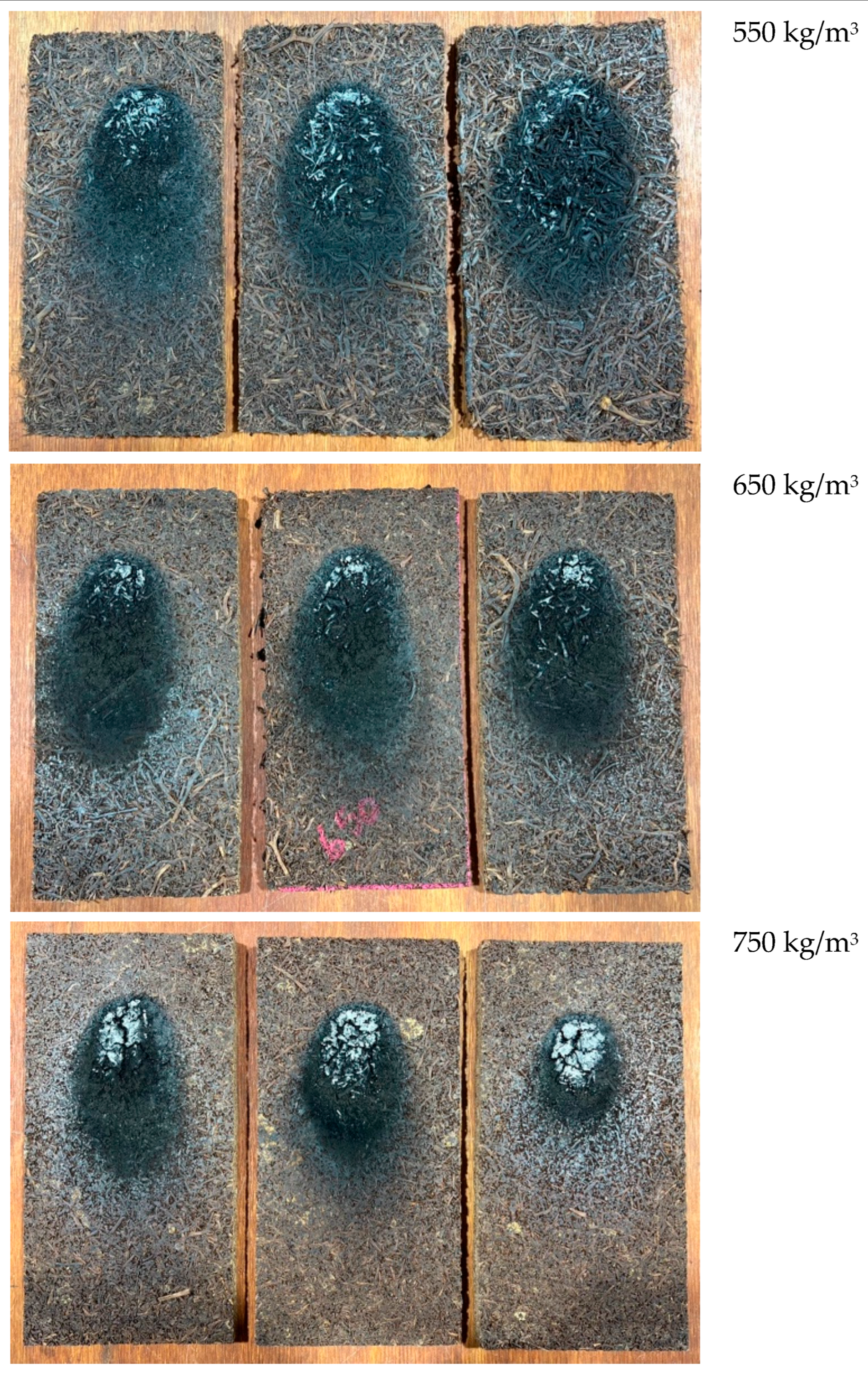
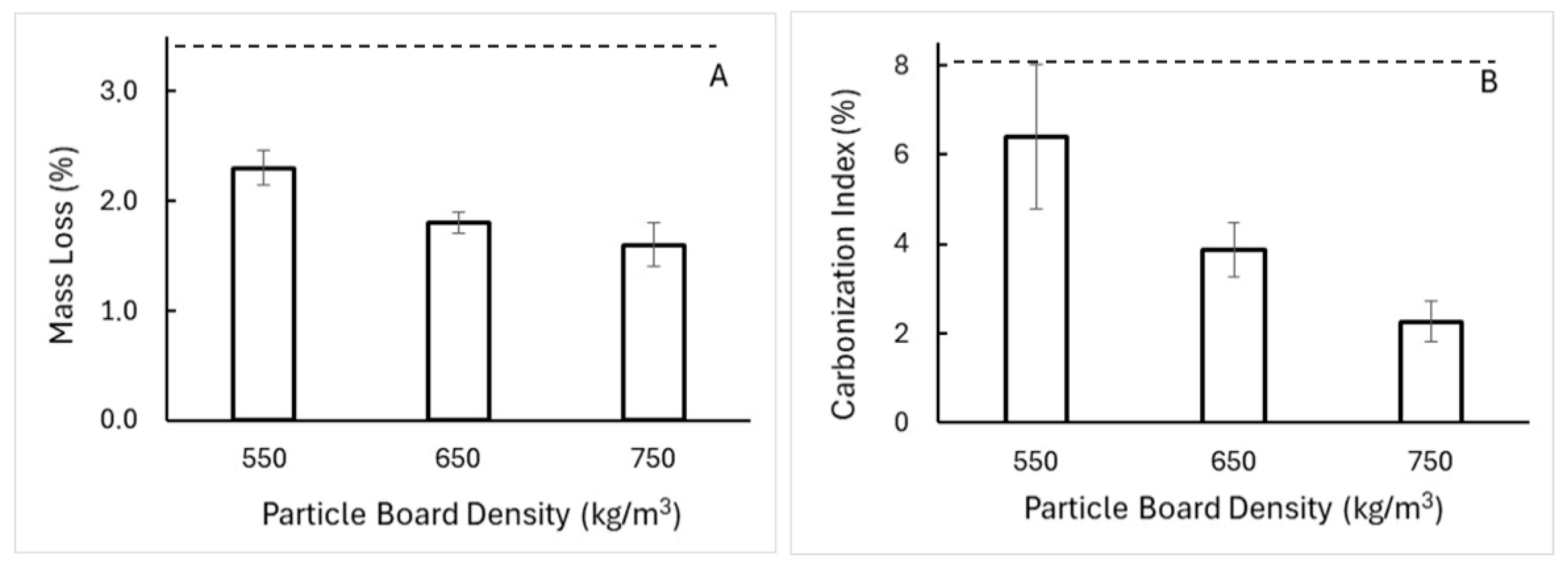
| Board Density (kg/m3) | Initial Mass (g) | Post-Combustion Mass (g) | Mass Loss (g) | Carbonization Index (cm3) |
|---|---|---|---|---|
| 550 | 460.4 ± 8.6 | 450.0 ± 8.9 | 10.9 ± 0.6 | 48.8 ± 8.4 |
| 650 | 579.5 ± 23.4 | 569.3 ± 23.0 | 10.1 ± 0.9 | 31.4 ± 4.9 |
| 750 | 567.2 ± 14.8 | 557.1 ± 14.8 | 9.5 ± 0.95 | 18.3 ± 3.7 |
| Reference values under NCh1974 [20] | ||||
| PB commercial | — | — | 3.04 ± 0.2 | 5.16 ± 0.3 |
| MDF commercial | — | — | 8.0 ± 1.0 | 19.46 ± 5.4 |
Disclaimer/Publisher’s Note: The statements, opinions and data contained in all publications are solely those of the individual author(s) and contributor(s) and not of MDPI and/or the editor(s). MDPI and/or the editor(s) disclaim responsibility for any injury to people or property resulting from any ideas, methods, instructions or products referred to in the content. |
© 2026 by the authors. Licensee MDPI, Basel, Switzerland. This article is an open access article distributed under the terms and conditions of the Creative Commons Attribution (CC BY) license.
Share and Cite
Elissetche, J.P.; Troncoso-Ortega, E.; Troncoso, L.; Puentes, C.; Alzamora, R.; Rubilar, R.; Hernández, V.; Parra-Fuentes, C. Valorization of Grape Stalk Rachis for Particleboard Manufacturing: Chemical Characterization and Performance Assessment for Sustainable Interior Panel Applications. Processes 2026, 14, 1768. https://doi.org/10.3390/pr14111768
Elissetche JP, Troncoso-Ortega E, Troncoso L, Puentes C, Alzamora R, Rubilar R, Hernández V, Parra-Fuentes C. Valorization of Grape Stalk Rachis for Particleboard Manufacturing: Chemical Characterization and Performance Assessment for Sustainable Interior Panel Applications. Processes. 2026; 14(11):1768. https://doi.org/10.3390/pr14111768
Chicago/Turabian StyleElissetche, Juan Pedro, Eduardo Troncoso-Ortega, Luis Troncoso, Carolina Puentes, Rosa Alzamora, Rafael Rubilar, Vicente Hernández, and Carolina Parra-Fuentes. 2026. "Valorization of Grape Stalk Rachis for Particleboard Manufacturing: Chemical Characterization and Performance Assessment for Sustainable Interior Panel Applications" Processes 14, no. 11: 1768. https://doi.org/10.3390/pr14111768
APA StyleElissetche, J. P., Troncoso-Ortega, E., Troncoso, L., Puentes, C., Alzamora, R., Rubilar, R., Hernández, V., & Parra-Fuentes, C. (2026). Valorization of Grape Stalk Rachis for Particleboard Manufacturing: Chemical Characterization and Performance Assessment for Sustainable Interior Panel Applications. Processes, 14(11), 1768. https://doi.org/10.3390/pr14111768



