Article

A Low-Carbon-Emission Combined Cooling, Heating, and Power System Integrated with Heat Pump Technology: Thermodynamic and Thermal Economic Analysis

1
School of Energy and Power Engineering, University of Shanghai for Science and Technology, Shanghai 200093, China
2
School of Statistics and Data Science, Shanghai University of International Business and Economics, Shanghai 200336, China
*
Author to whom correspondence should be addressed.
These authors contributed equally to this work.
Processes 2026, 14(11), 1764; https://doi.org/10.3390/pr14111764
Submission received: 24 April 2026 / Revised: 21 May 2026 / Accepted: 26 May 2026 / Published: 28 May 2026
(This article belongs to the Section Energy Systems)

Abstract

Against the backdrop of the global energy transition and decarbonization imperative targets, improving the efficiency of conventional energy systems while simultaneously reducing carbon emissions has become a pressing challenge. To address the widespread problem of insufficient waste heat utilization in combined cooling, heating, and power (CCHP) systems, this study proposes a novel low-carbon-emission CCHP system coupled with heat pump (HP) technology and a monoethanolamine (MEA)-based carbon capture and storage (CCS) subsystem. The HP unit enables cascaded recovery and temperature upgrading of low-grade waste heat from both the flue gas and the CCS regeneration column. A comprehensive five-dimensional evaluation framework—covering energy, exergy, life cycle environmental assessment, economic and exergoeconomic analyses—is established and benchmarked against a conventional low-carbon CCHP reference system. Thermodynamic results show that HP integration raises the overall energy efficiency from 74.25% to 81.22% and the waste heat recovery rate from 73.59% to 89.85%, while simultaneously reducing exergy losses by 365.06 kW and elevating exergy efficiency from 53.95% to 65.07%. Economic analysis reveals that the unit energy production cost decreases from 0.033 to 0.031 $/(kW·h), despite a marginal increase in unit power generation cost. Sensitivity analysis identifies operating hours and interest rate as the dominant cost drivers. Exergoeconomic analysis pinpoints the turbine, the CCS subsystem, and the compressor as contributing 67.02%, 17.11%, and 8.17% of the total exergoeconomic losses, respectively, identifying them as the primary targets for future optimization. These findings provide a theoretical foundation and engineering guidance for the development and deployment of high-efficiency, low-carbon multi-generation energy systems.

1. Introduction

Rapid economic growth and accelerating industrialization have substantially increased global energy demand while intensifying environmental pressures [1]. The excessive consumption of fossil fuels not only leads to low primary energy utilization efficiency—where large quantities of energy are dissipated during conversion and transmission—but also generates significant greenhouse gas emissions that exacerbate climate change. Reducing carbon dioxide and other greenhouse gas emissions and promoting a comprehensive green transition of economic and social development have become a global consensus [2].
In the context of the global energy transition and the “dual-carbon” climate targets, enhancing the efficiency of conventional energy systems and reducing carbon emissions have emerged as central objectives [3]. CCHP systems achieve significant improvements in overall energy efficiency through cascaded energy utilization [4] and are widely regarded as a critical direction for future energy systems. Zhang et al. [5] proposed a CCHP scheme based on solar thermochemical energy storage that increased thermal and exergy efficiencies by 14.23% and 3.24%, respectively. Hou et al. [6] designed a CCHP system integrating a PEM fuel cell and adsorption chiller, improving thermal efficiency by 14.72%, reducing greenhouse gas emissions by 22.51%, and lowering annual costs by 69.86%. Nevertheless, existing CCHP systems continue to suffer from insufficient low-grade waste heat utilization, high energy penalties associated with carbon capture processes, and limited overall system efficiency—factors that constrain their broader adoption.
In CCHP systems fueled by hydrocarbons such as natural gas, the combustion process inevitably produces substantial carbon emissions, highlighting the importance of CCS technology [7]. Hai et al. [8] employed machine learning to optimize a CCHP system, reducing CO2 emissions from 0.92 kg/s to 0.41 kg/s and improving thermal and exergy efficiencies to 49.2% and 36.71%, respectively. Yang et al. [9] proposed a zero-carbon-emission CCHP system that leveraged LNG cold energy for highly efficient CO2 capture, achieving electrical, exergy, and total efficiencies of 60.37%, 62.83%, and 79.09%, respectively. A key unresolved challenge in current research is the significant heat waste occurring in the CCS stage of CCHP systems because the available thermal energy is not matched and utilized at the appropriate temperature level.
HP technology is capable of transferring thermal energy from low-temperature to high-temperature reservoirs, enabling effective recovery and reuse of low-grade waste heat with only a small electrical input [10]. Integrating HP technology into CCHP systems targets the optimization of cascaded energy utilization pathways through multi-stage waste heat recovery and temperature-zone coordinated matching, thereby enhancing overall system efficiency and improving economic performance. Zhang et al. [11] applied a LiBr refrigeration–heat pump heat recovery technique in a CCHP system, recovering heat from the cooling water of the refrigeration subsystem to preheat boiler feedwater, reducing primary energy consumption by 26.6%. Wegener et al. [12] proposed an optimal design method for CCHP/HP systems under various climate scenarios applied to a historic building in Barcelona, achieving a 2.5% reduction in total project cost and more than a 75% reduction in carbon emissions. On the integration of HP with CCS, Huang et al. [13] proposed an absorption–compression cascade heat pump to assist post-combustion capture, achieving a waste heat recovery rate of 73.48%. Liu et al. [14] integrated HP and CCS in a coal-fired power plant, improving thermal efficiency by 0.854%.
Despite progress in each of these individual pairings, existing research predominantly focuses on the standalone application of HP technology in heating scenarios, and few studies have simultaneously explored the thermal integration potential of HP with both CCHP systems and CCS units [15]. In practical engineering applications, economic viability and environmental benefits are decisive factors for system deployment. The middle-temperature heat source required by the CCS desorption column and the output temperature range of the HP present a feasible optimization opportunity, yet current technical approaches have not established an effective energy transfer pathway between these two units, resulting in a dual thermodynamic barrier in waste heat recovery and CCS energy supply.
It is worth noting that, although CCHP–HP, CCHP–CCS, and HP–CCS integrations have each been individually investigated in prior work, the simultaneous tri-coupling of all three subsystems within a unified thermodynamic framework remains insufficiently explored [16]. Existing CCHP–HP studies typically focus on space heating or chilled-water applications and do not address the temperature-matching challenge between the HP output and the CCS desorption heat requirement. CCHP–CCS research has demonstrated feasible CO2 capture pathways but largely overlooks the substantial low-grade waste heat rejected by the CCS regeneration column, which represents an under-utilized recovery opportunity [17]. HP–CCS studies applied to power plants have confirmed efficiency gains from heat-pump-assisted capture, yet these configurations are not designed around the multi-product (cooling, heating, and power) dispatch logic inherent to CCHP operation. Consequently, none of the above pairings establishes the complete energy transfer chain—from low-grade waste heat recovery, through temperature upgrading by the HP, to simultaneous supply of CCS desorption heat and domestic hot water—that is required for a genuinely integrated low-carbon multi-generation system. The above works are summarized in Table 1.
To address these gaps, this study proposes a low-carbon-emission CCHP system based on HP technology, in which the HP unit recovers low-grade waste heat from both the CCS subsystem and the overall CCHP process, upgrades its temperature, and redirects it for feedstock preheating and reaction energy supply. The system is subject to a comprehensive five-dimensional evaluation: energy, exergy, environment, economic and exergoeconomic analysis. The core configurative innovation of this study is the first establishment of a thermodynamically closed-loop coupling among CCHP-HP-CCS subsystems. This overcomes the limitation of pairwise integration and broken energy transfer chains in existing studies. The integrated approach constructs a complete technical chain from low-temperature waste heat recovery and temperature elevation to precise energy supply, providing a new technical framework for achieving low-carbon, high-efficiency CCHP systems.

2. System Description

2.1. System Configuration

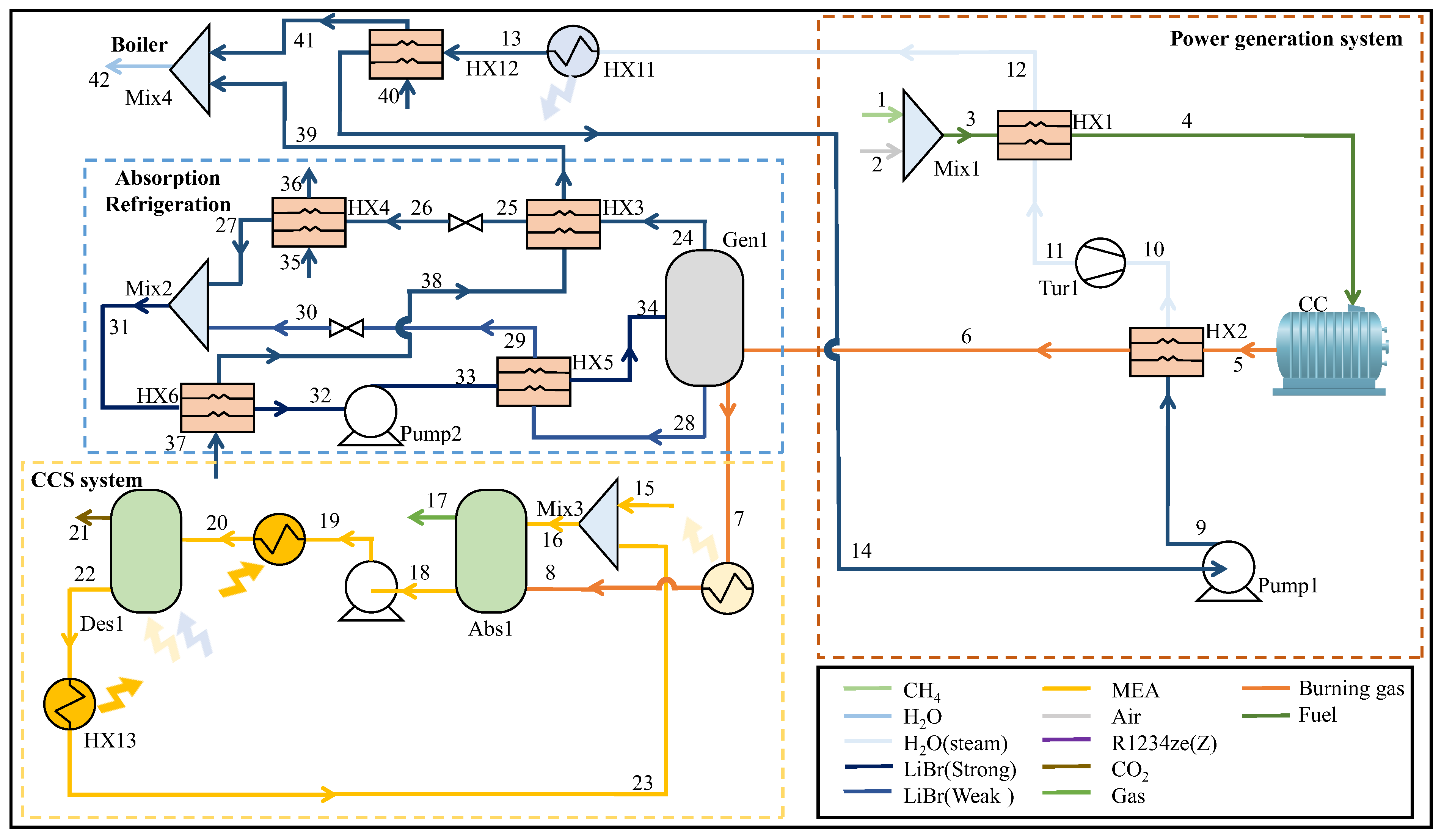
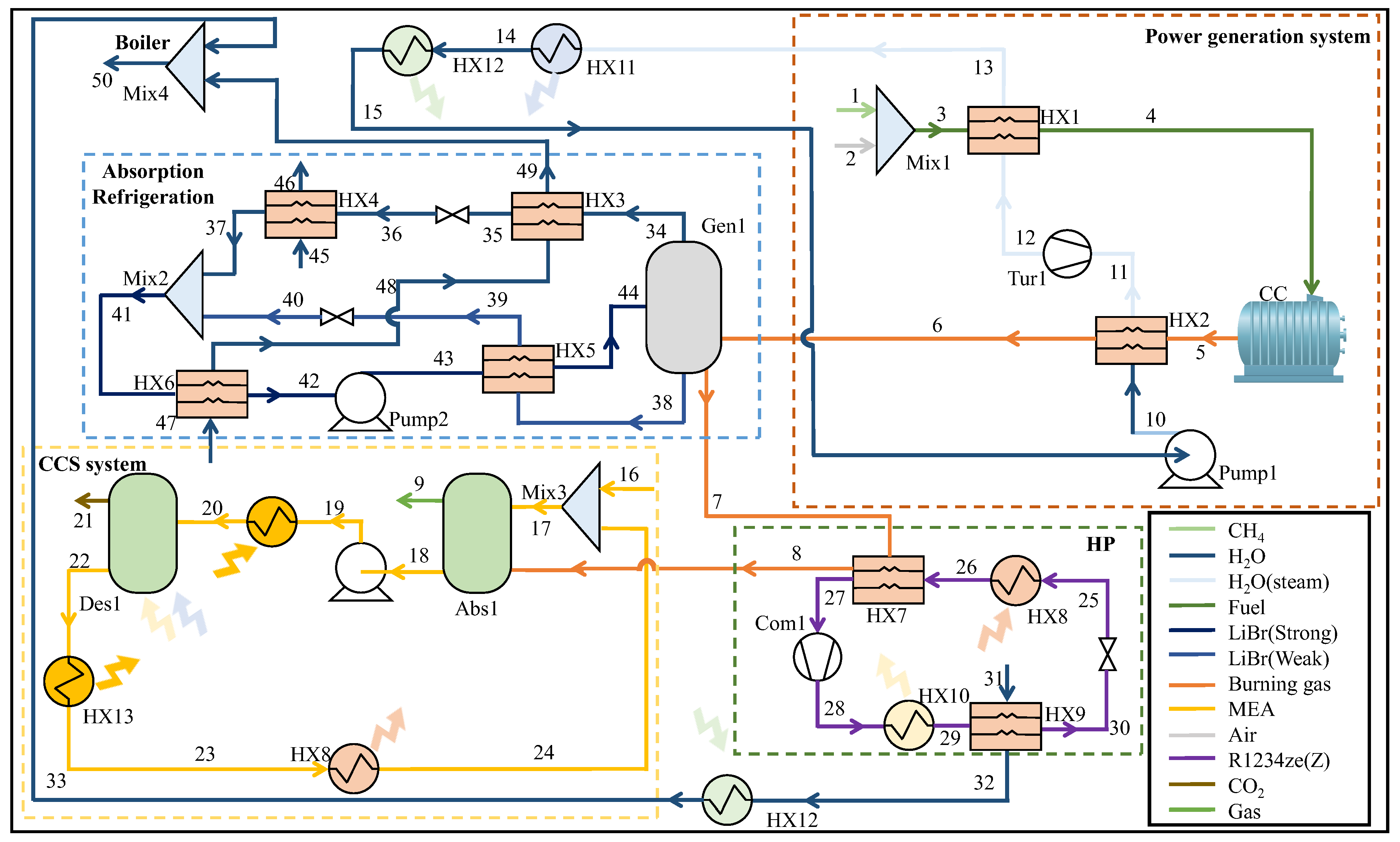
The proposed low-carbon-emission CCHP system uses natural gas combustion as its primary energy driver and integrates five major subsystems: a steam power generation subsystem, an absorption refrigeration subsystem, an MEA-based CCS subsystem, an HP subsystem, and a waste heat boiler (WHB). Figure 1 presents a schematic diagram of the system.
The combustion of methane follows the reaction [18]:
CH 4 + 2 O 2 2 H 2 O + CO 2
In the steam power generation subsystem, steam preheats feedwater in heat exchanger HX1; the fuel is subsequently preheated and then combusted in the combustion chamber (CC) to produce high-temperature flue gas. The flue gas enters HX2 to generate high-pressure steam, which drives the turbine (Tur1) to produce electricity. The steam created in the turbine exhaust sequentially supplies heat to the CCS desorption column (Des1) and the waste heat boiler. The high-temperature flue gas, after supplying the steam generator, provides thermal energy to the generator (Gen1) of the absorption refrigeration system and to the HP evaporator, and finally enters the absorption column (Abs1) of the CCS system to complete the CO2 capture cycle.
The HP subsystem uses R1234ze(Z) as its working fluid, selected for its favorable COP and low global warming potential. Additionally, this refrigerant offers strong compatibility across various operating conditions. Its atmospheric lifetime is only about 20 days. It is suitable for medium-to-high temperature ranges, with low flammability and low toxicity. Its evaporator is divided into two sections: the first section exchanges heat with the outlet stream of the CCS desorption column via HX8, and the second section recovers additional heat from the high-temperature flue gas via HX7. After compression in compressor (Com1), the high-temperature, high-pressure working fluid first supplies heat to the desorption column via HX9, and subsequently heats water in HX10 as part of the waste heat boiler network. This configuration follows the principle of “temperature matching and cascaded utilization,” constructing a complete pathway from low-grade waste heat recovery to temperature upgrading and targeted energy delivery. The thermodynamic equilibrium equations for the various components in the HP system are shown in Table 2.
The absorption refrigeration subsystem, driven by high-temperature flue gas, also produces hot water in the absorber (HX6) and condenser (HX3). Since the outlet water temperature of these two heat exchangers is close to the outlet temperature of the HP waste heat boiler section, the two water streams are merged and collectively supplied as the WHB output, enabling more complete heat utilization.
A conventional low-carbon-emission CCHP system (without the HP unit) is constructed as a reference for performance benchmarking. In the reference system, the CCS process is driven directly by the available thermal energy from flue gas and steam, without any heat recovery via HP technology, with only thermally recoverable streams above the minimum recovery threshold being utilized. Figure 2 shows the reference system.

2.2. Design Parameters

The main design parameters of the system are summarized in Table 3 [11,12]. The ambient temperature and pressure are set to 25 °C and 100 kPa, respectively. To ensure a fair comparison between the designed and reference systems, the natural gas flow rate is fixed at 600 kg/h and the combustion temperature at 1878 °C for both cases. Isentropic efficiencies of the turbine and compressor are both set to 90%, and all components are assumed to operate under steady-state conditions.

2.3. Model Validation

To verify the accuracy of the simulation model, the key subsystems are validated against experimental and literature data, as summarized in Table 4. The simulation results agree well with the reference values, with maximum deviations of 9.87% for steam cycle thermal efficiency, 7.71% for the CCS reboiler heat duty, and 4.67% for the HP coefficient of performance. To verify the rationality of the overall system simulation results, we compared our model with a similar integrated CCHP-CCS-HP system. Under the same output conditions, the system deviation can be controlled within 10%. These deviations are within acceptable ranges for engineering system simulations, confirming the reliability of the established model.

2.4. Model Assumptions

To ensure the reliability of the system analysis and evaluation, a series of rational assumptions must be established prior to model construction. The assumptions proposed in this study are as follows [19,20,21]:
(1)
All components within the system operate stably under the standard operating conditions set in the simulation.
(2)
Minor variations in kinetic and potential energy within the system are neglected.
(3)
Each piece of equipment in the system is in an equilibrium state.
(4)
For the purpose of calculation and analysis, the standard conditions are set at 25 °C and 1 bar.
It should be noted that the above assumptions focus mainly on the level of system. Processes such as heat pump operation and solvent regeneration will cause fluctuations in actual performance. These require separate discussion based on specific operating conditions.

3. Analytical Methodology

3.1. Thermodynamic Analysis

The energy balance of the system is expressed as follows [22]:
Q = W + m h
The overall energy efficiency of the system is evaluated as follows [23]:
η En = E n O u t + P N e t + Q Rea E n In + P In
where E n O u t and E n In are the energy carried by the system outlet and inlet streams (kW), respectively; P N e t is the net electrical output (kW); Q Rea is the heat consumed by chemical reactions within the system (kW); and P In is the electrical power input to the system (kW). For the HP subsystem, the coefficient of performance (COP) is defined as follows [24]:
COP = Q Con W Com
where Q Con is the heat released by the condenser (kW) and W Com is the electrical input to the compressor (kW).
The exergy of each stream encompasses both physical and chemical exergy [25]:
E x = E x ph + E x ch
Physical exergy is calculated as follows [26]:
E x ph = m [ ( h i h 0 ) T 0 ( s i s 0 ) ]
Chemical exergy accounts for the Gibbs free energy difference at the reference environment conditions. For streams lacking standard chemical exergy reference data, the thermal exergy is approximated as follows [27]:
E x Q h = Q h ( 1 ( T 0 T h ) )
The relative exergy loss rate of each component k is defined as follows [28]:
χ k = E x d , k E x d , t
The overall system exergy efficiency is as follows:
η Ex = E x Out E x In + E x ele
where E x Out and E x In are the exergy carried by the outlet and inlet streams (kW), and E x ele is the electrical exergy input (kW).

3.2. Life Cycle Environmental Assessment

The life cycle environmental assessment (LCA) is conducted using the CML (Centrum voor Milieukunde Leiden) methodology based on the Ecoinvent 3.11 database. The analysis covers both the production and the operational phases (cradle-to-gate) of the system. CO2 emissions are a key output of CCS operation. Therefore, this aspect is not considered separately during the operational phase. Key environmental impact categories assessed include acidification potential (AP), global warming potential (GWP), eutrophication potential (EP), human toxicity potential (HTP), freshwater aquatic ecotoxicity potential (FAETP), marine aquatic ecotoxicity potential (MAETP), terrestrial ecotoxicity potential (TETP), and abiotic depletion potential (ADP). Table 5 shows the assessment objects of LCA.
It should be noted that the CML method addresses environmental impacts at the component level; system-level phenomena such as refrigerant leakage are excluded through the model assumptions described above.

3.3. Economic Analysis

The total annualized system cost encompasses fuel cost ( C fuel ), environmental cost ( C env ), and investment cost ( C inv ) [29] are as follows:
C total = C fuel + C env + C inv
The environmental cost represents the penalty for CO2 emissions during system operation [30]:
C env = c CO 2 × m ˙ CO 2 × 3,600
where c CO 2 = 0.02 $/kg is the unit CO2 emission penalty coefficient, and m ˙ CO 2 is the CO2 mass flow rate (kg/h).
The investment cost per component is calculated using published cost correlations. The annualized investment cost is as follows [31]:
C inv = Z × ( CRF + ϕ ) N
where CRF is the capital recovery factor, ϕ = 0.06 is the operation and maintenance factor, and N is the annual operating time (6000 h/year, based on 20 h/day × 300 days/year). The capital recovery factor is as follows [32]:
CRF = i r ( 1 + i r ) l ( 1 + i r ) l 1
where i r = 12% is the discount rate and l = 15 years is the system lifetime. Component cost equations are listed in Table 6.

3.4. Exergoeconomic Analysis

Exergoeconomic analysis combines exergy and economic principles by associating monetary costs with exergy streams, thereby enabling a rigorous cost-based evaluation of thermodynamic irreversibilities. The exergy loss cost rate of each component k is as follows [40]:
C k = c k E x d , k
The exergoeconomic balance equation for each component is as follows:
C In + C inv = C Out
For components that produce two different product streams, costs are allocated proportionally to the exergy content of each output [41]:
C Out , 1 = C Out , 2
Auxiliary equations are introduced to resolve the system of cost equations based on the F-rule (fuel rule) and P-rule (product rule), as summarized in Table 7.

4. Results and Discussion

4.1. Energy Performance

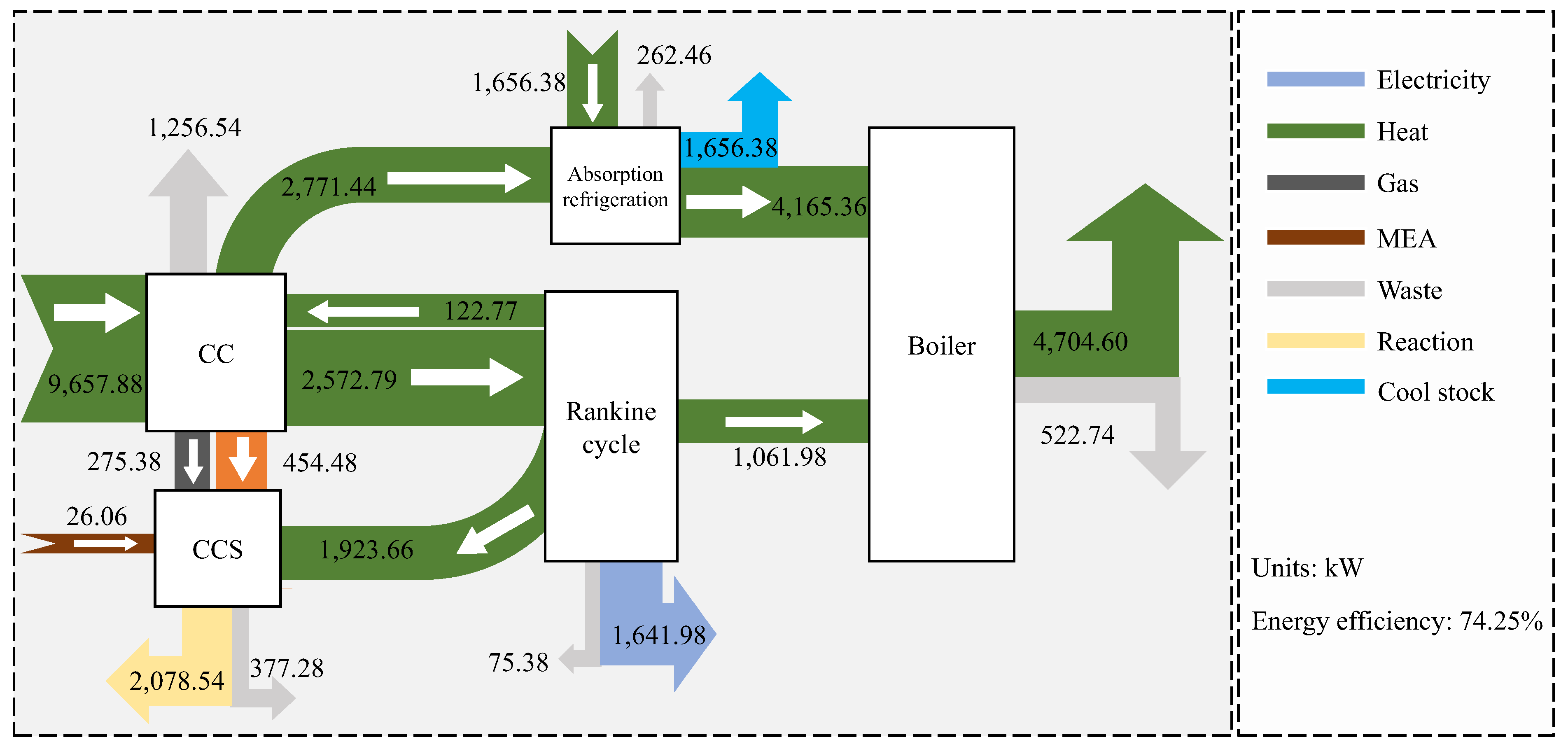
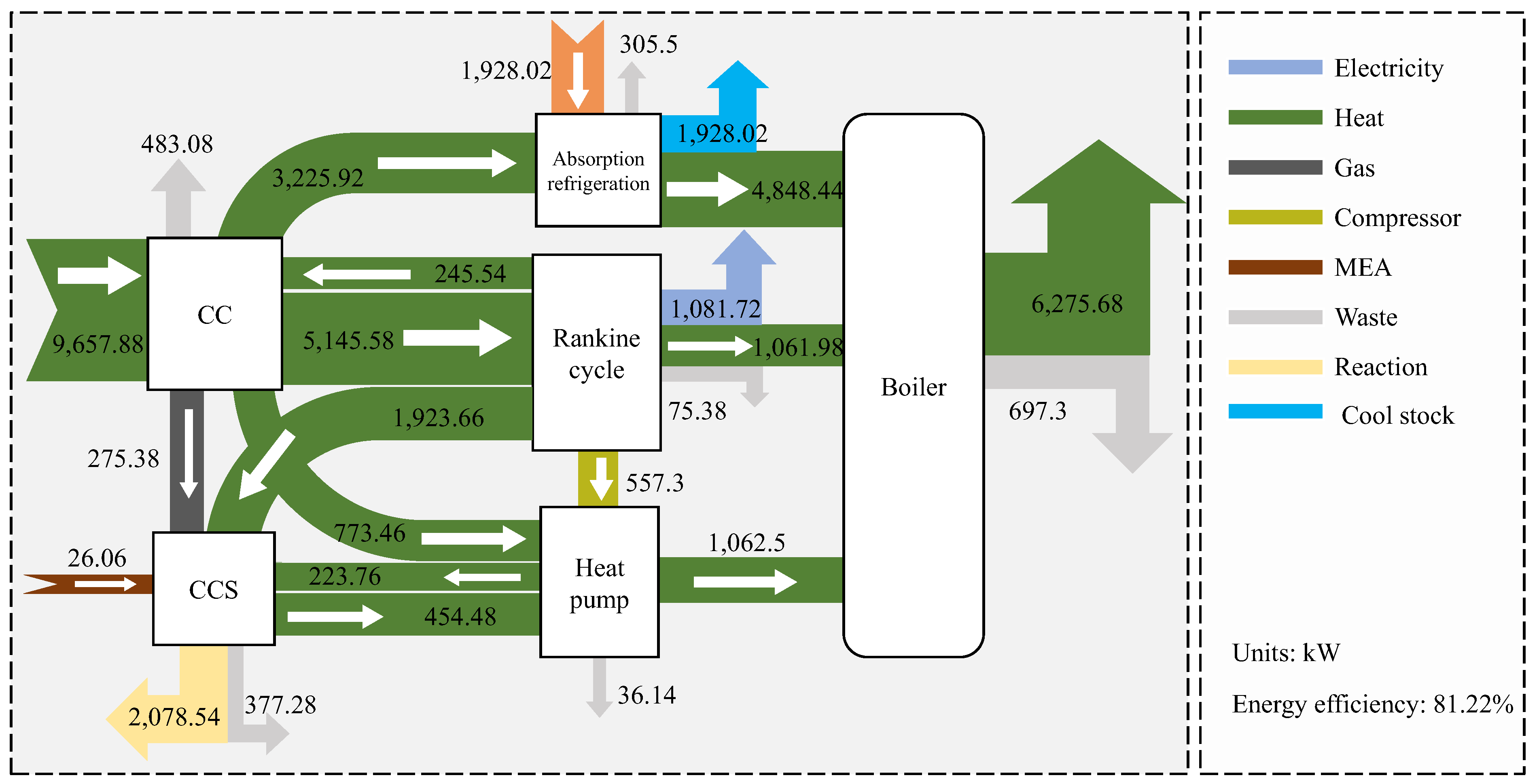
Following the methodology outlined in Section 3.1, energy analyses were performed for both CCHP systems. The energy flow diagram for the low-emission CCHP system is shown in Figure 3. In this system, the 9903.42 kW (9657.88 kW + 245.54 kW, 100%) of energy carried by the fuel serves as the primary energy source driving the entire system. Of the heat generated by combustion, 5145.58 kW (51.96%) is used to heat the water in the steam Rankine cycle. The steam drives a turbine to generate 1641.98 kW of electrical power, of which 557.3 kW is used to drive the compressor in the HP system; 254.45 kW of heat from the steam after power generation is used to preheat the fuel. Additionally, 1923.66 kW of heat is supplied to the desorption tower in the CCS system, and 1061.98 kW of heat is supplied to the waste heat boiler. Of the high-temperature flue gas remaining after heating the Rankine cycle, 3225.92 kW (32.57%) of heat is used to drive the generator in the absorption refrigeration cycle, thereby achieving 1928.02 kW of cooling in the evaporator and 4848.44 kW of hot water production in the absorber and condenser. After heating the generator, the flue gas is directed to the HP system, where 773.46 kW (7.81%) of heat is used to heat the heat transfer fluid. Combined with 223.76 kW of waste heat from carbon capture, and heated by electricity generated by the turbine, this provides 454.48 kW of heat to the desorption tower in the CCS system, while an additional 1062.5 kW of heat is supplied to the waste heat boiler. Finally, the flue gas enters the CCS system, where 275.38 kW (2.78%) of heat is lost. After exiting the CCS system, 483.02 kW (4.88%) of low-temperature waste heat is lost.
In the reference system, due to the absence of the heat pump (HP) system for waste heat recovery, additional energy is required to drive the operation of the carbon capture and storage (CCS) system. Consequently, only 2771.44 kW of heat from combustion is supplied to the absorption refrigeration system, resulting in a 14.01% reduction in cooling capacity and hot water production. However, since the generated electricity does not need to power the compressors in the HP system, 1641.98 kW of electrical energy can be entirely exported as the system’s electrical output. The energy flow diagram of the reference system is shown in Figure 4.
In summary, compared with the reference system, the energy efficiency of the designed system increases from 74.25% to 81.22%, and the waste heat recovery rate rises from 73.59% to 89.85%, substantially reducing waste heat dissipation.

4.2. Exergy Performance

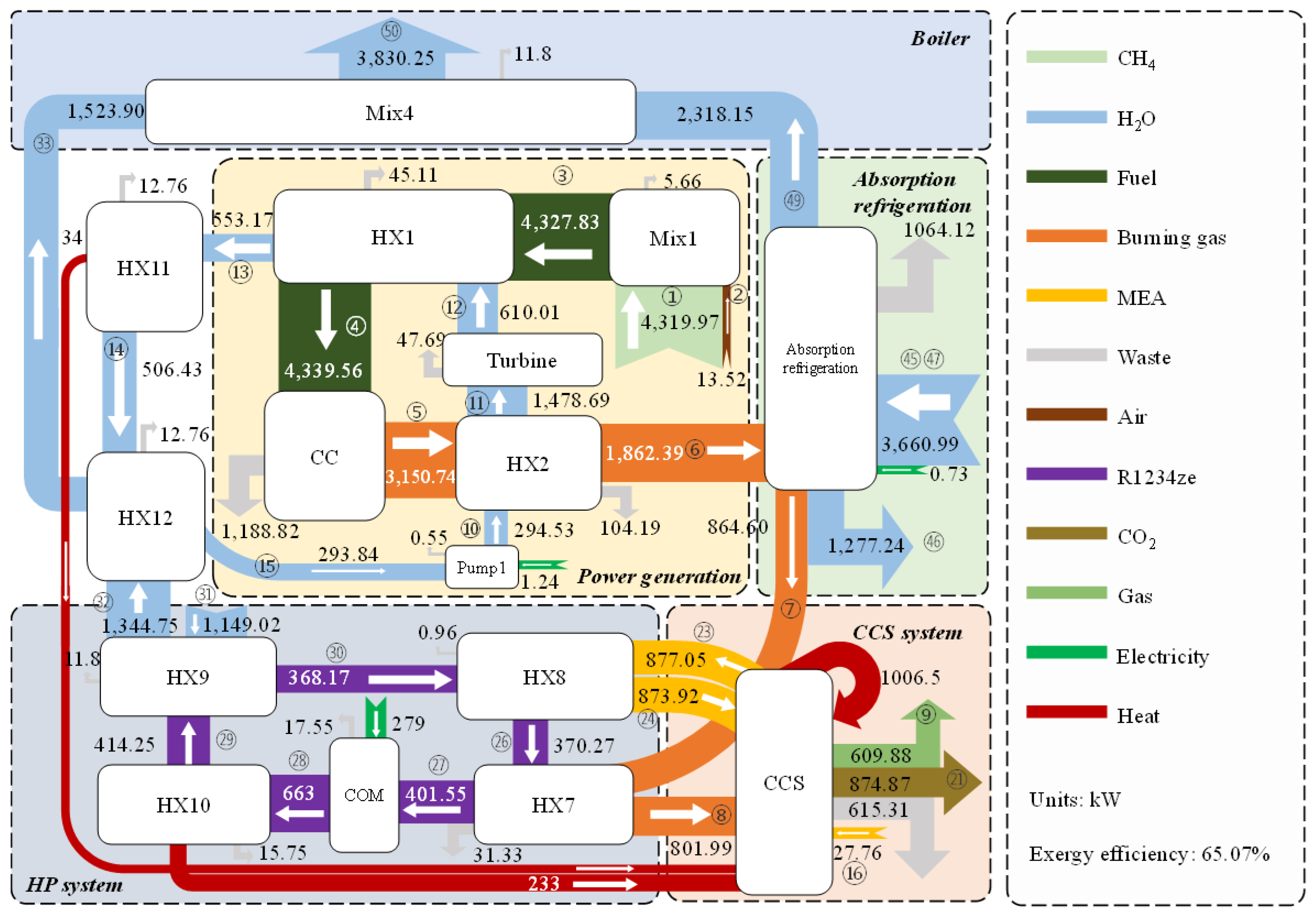
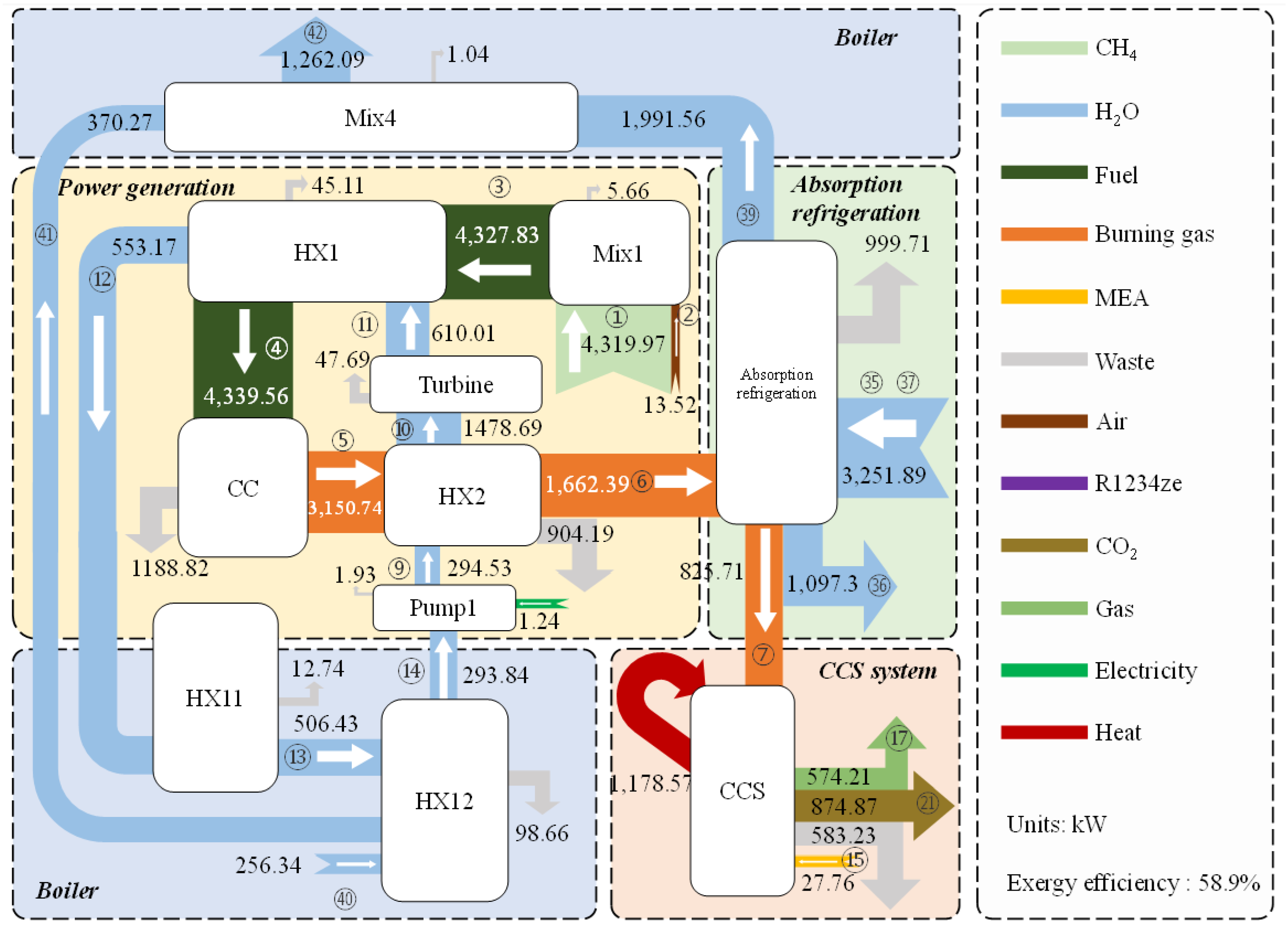
To quantify the quality of energy utilization and identify the locations of thermodynamic irreversibility, exergy analyses were performed for both systems following the approach described in Section 3.2. Table 8 provides detailed information on the main streams. Figure 5 and Figure 6 illustrate the exergy analysis of the proposed system and the reference system, respectively. According to the results, the overall exergy destruction of the designed system is reduced by 365.06 kW compared with the reference system. Specifically, the integration of the heat pump avoids 332.25 kW of irreversible losses from combustion heat, and the reduced availability of flue gas waste heat correspondingly decreases the exergy destruction in the absorption refrigeration and CCS systems of the reference system. However, due to severe waste heat dissipation, the energy output of the reference system is significantly reduced, with an overall exergy efficiency of 53.95%, whereas the designed system achieves an overall exergy efficiency of 65.07% owing to its superior waste heat recovery capability.
Although the integration of the heat pump system reduces electrical power generation, its efficient waste heat recovery effectively promotes the output increase of other subsystems and reduces irreversible losses within the system.
As illustrated in the aforementioned figures, steam power generation and absorption refrigeration systems constitute the primary sources of irreversible losses due to intense heat exchange processes, with their combined exergy destruction accounting for approximately 70% of the total system losses. In the reference system, the incomplete waste heat recovery from flue gas results in additional heat entering the absorption column, leading to a substantial exergy destruction of 1895.12 kW (27.97%) in the CCS system. The results indicate that the combustor, absorber, and desorber exhibit the highest exergy destruction ratios in both CCHP systems, implying significant potential for improvement in these three components. In conclusion, the integration of the heat pump effectively reduces system irreversible losses, while optimized design of key components will contribute to further enhancement in system efficiency.

4.3. Working Fluid Selection for the HP Subsystem

Four common refrigerants were evaluated for the HP subsystem: R1234ze(Z), R-410A, R1336mzz(Z), and R-245A. The simulation results are presented in Table 9. The differences in overall system performance across working fluids are modest; however, R1234ze(Z) achieves the highest COP (2.72) and the best system-level energy (81.22%) and exergy (65.07%) efficiencies. Furthermore, both R1234ze(Z) and R1336mzz(Z) possess low global warming potential values, offering favorable environmental profiles. On the basis of thermodynamic performance and environmental sustainability, R1234ze(Z) is selected as the working fluid for the HP subsystem.

4.4. Life Cycle Environmental Assessment

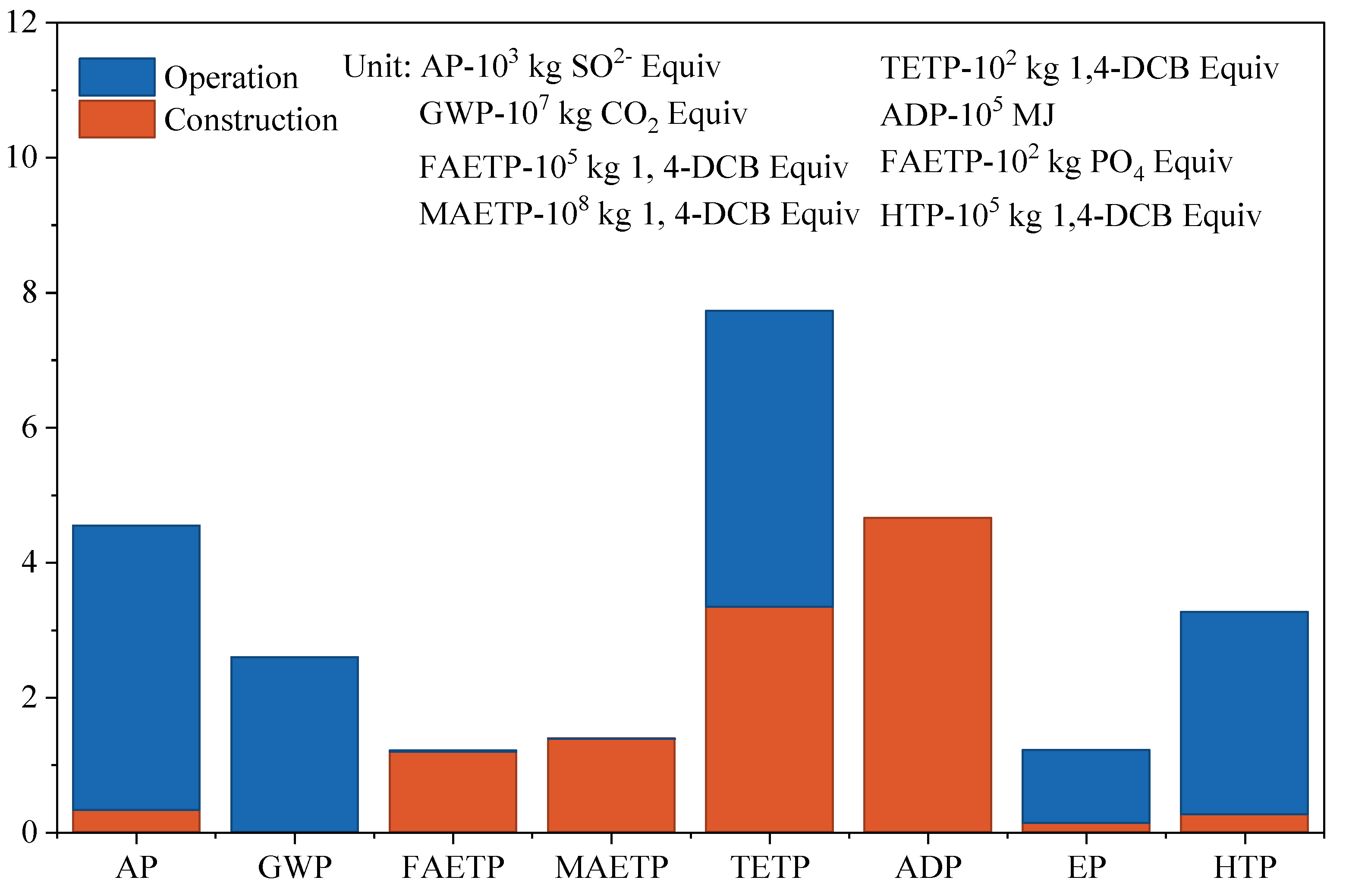
The LCA results for the designed system are presented in Table 9. The analysis reveals that the majority of AP, GWP, EP, and HTP impacts originate from the operational phase, reflecting the dominance of natural gas combustion in the system’s environmental footprint. In contrast, almost all FAETP, MAETP, and ADP impacts are attributable to the manufacturing phase, driven by the material and manufacturing energy requirements of the system components. TETP receives contributions from both phases.
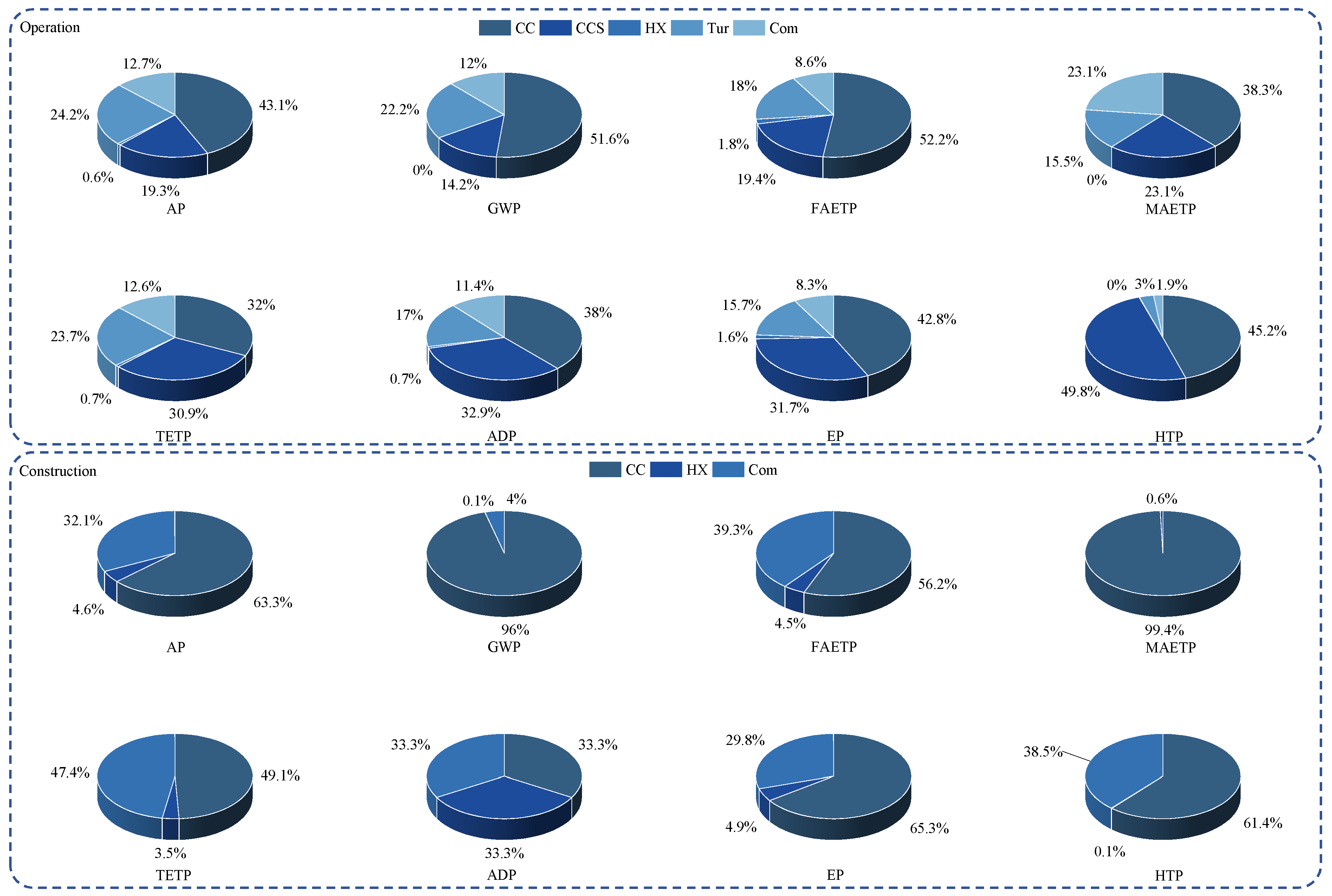
As shown in Figure 7, the high CO2 capture rate of 90% in the CCS subsystem substantially limits the operational GWP, reducing the environmental penalty cost to only 0.19 $/h. This underscores the critical role of CCS integration in mitigating the climate impact of natural gas-based energy systems. The contribution of each component at different stages for each indicator is shown in Figure 8. The CC contributes more to environmental impact in both the construction and operation phases. During operation, the CCS makes a relatively large contribution to indicators such as HTP and ADP. During construction, the Com shows a notable contribution to indicators such as TETP and FAETP.
Refrigerant leakage is also a key factor for environmental impact in this system. This study conducted scenario analyses for R1234ze(Z) leakage. The results are shown in Table 10. Even under the high leakage scenario (10%/year), the contribution of R1234ze(Z) leakage to the system life cycle GWP remains below 0.10%. This is far lower than the CO2 emission avoidance benefit from the CCS subsystem.
The LCA results provide guidance for identifying the environmental hotspots of the system and direct future optimization efforts toward both the reduction in operational emissions and the environmental impact of manufacturing.

4.5. Economic Analysis

Table 11 presents the total annualized cost breakdown for both systems. The introduction of the HP unit increases the investment cost from 25.73 $/h to 28.42 $/h, primarily due to the additional compressor and heat exchangers. Since the fuel cost and environmental cost are identical for both systems (determined by the same natural gas input and the same CO2 capture rate), the total cost increases from 142.98 $/h to 145.67 $/h—an increase of only 1.91%. However, the HP system significantly boosts the total energy output, which increases by 16.02%.
As shown in Table 12, HP integration increases the unit power generation cost from 0.17 to 0.20 $/(kW·h) due to the consumption of electricity by the HP compressor, which reduces the net electrical output from 1641.98 kW to 1081.72 kW. However, the unit energy production cost—which accounts for the full range of system outputs including cooling and heating—decreases from 0.04 to 0.03 $/(kW·h), reflecting the substantial gain in total useful energy output. This trade-off between unit power generation cost and unit energy production cost highlights the system-level advantage of HP integration: while power generation efficiency is somewhat penalized, the overall energy utilization efficiency and economic value of the system are markedly improved. In summary, although the power generation cost increases slightly, system integration effectively reduces the overall system cost.

4.6. Economic Sensitivity Analysis

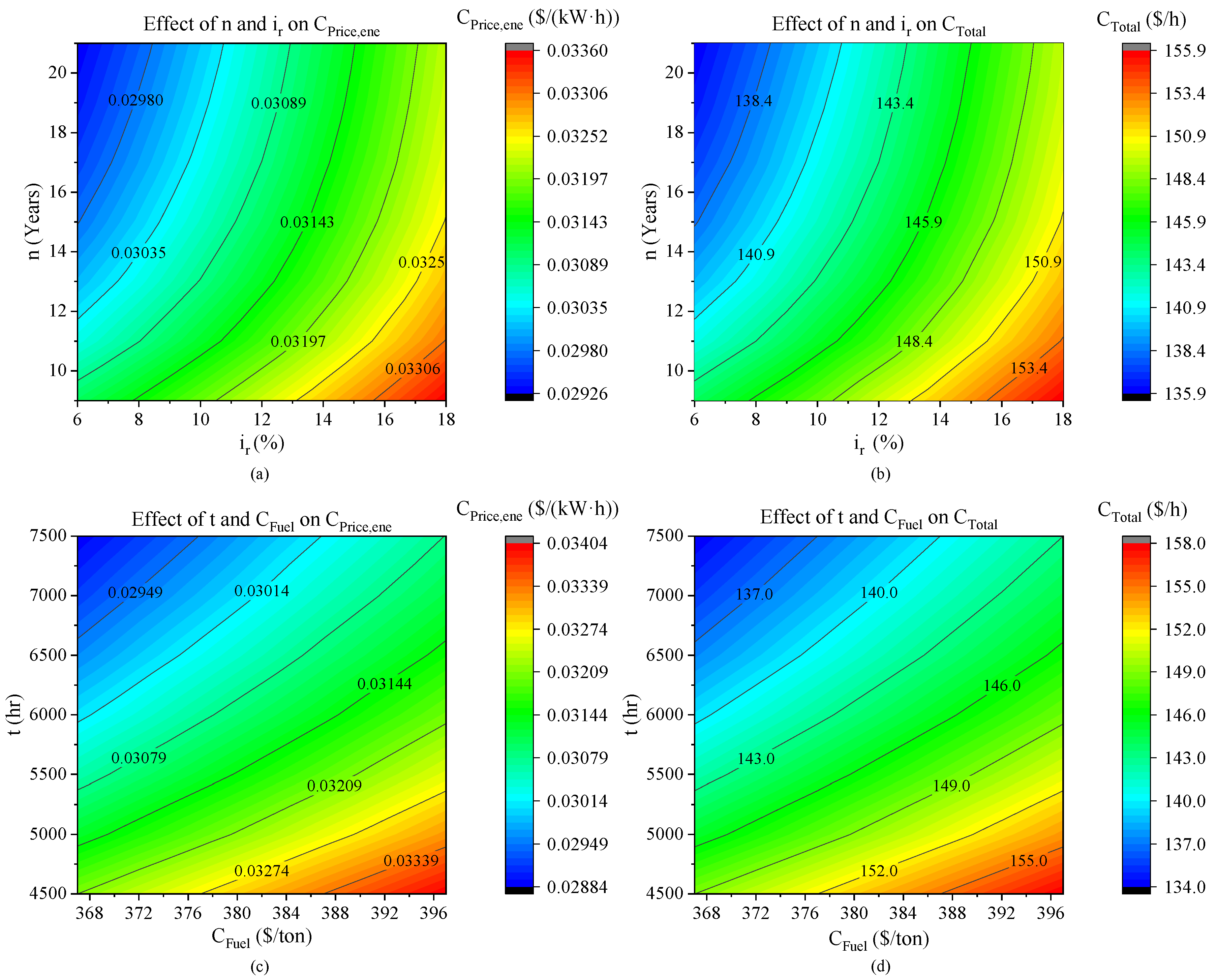
To quantify the influence of economic parameters on system costs, a sensitivity analysis was conducted by varying the interest rate, fuel price, system lifetime, and annual operating hours. Parameter variations were based on the relevant literature from recent years [41]. Figure 9 shows the analysis results. As shown in Figure 9, when the interest rate and system lifetime are varied, the unit energy production cost ranges from 0.029 to 0.033 $/(kW·h) and the total cost ranges from 135.42 to 156.25 $/h. Total system cost correlates positively with interest rate and negatively with system lifetime—reflecting the amortization benefit of longer operational periods.
When the fuel price and annual operating hours are varied, the unit energy production cost ranges from 0.028 to 0.035 $/(kW·h) and the total cost from 133.33 to 158.33 $/h. Although higher fuel prices increase total costs, longer operating hours significantly improve cost amortization, resulting in a net reduction in the levelized total cost. In summary, annual operating hours exert the greatest influence on system cost, followed by interest rate, while system lifetime has the smallest effect. These findings suggest that maximizing system utilization hours is the most effective operational strategy for reducing the levelized cost of the proposed system.

4.7. Exergoeconomic Analysis

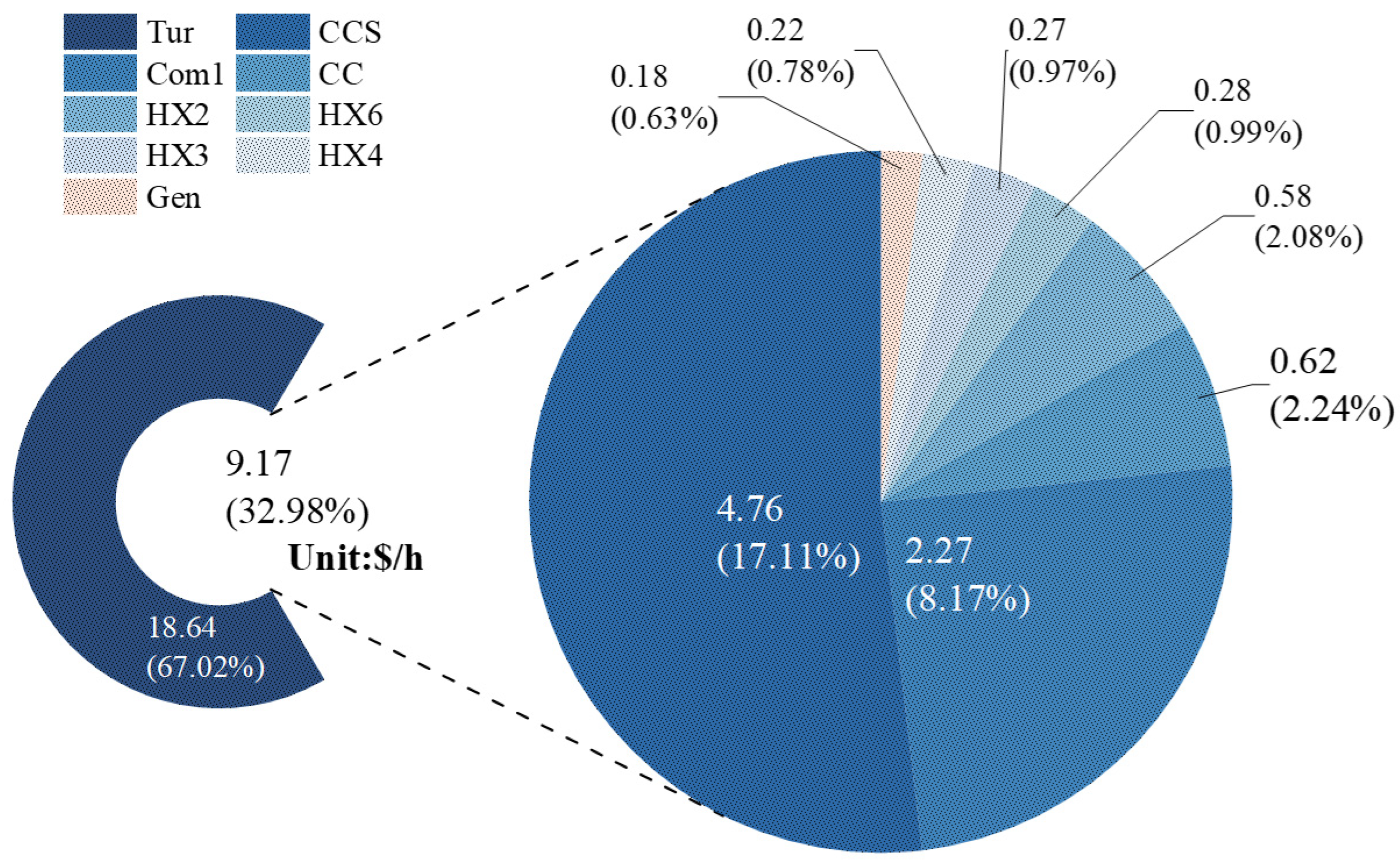
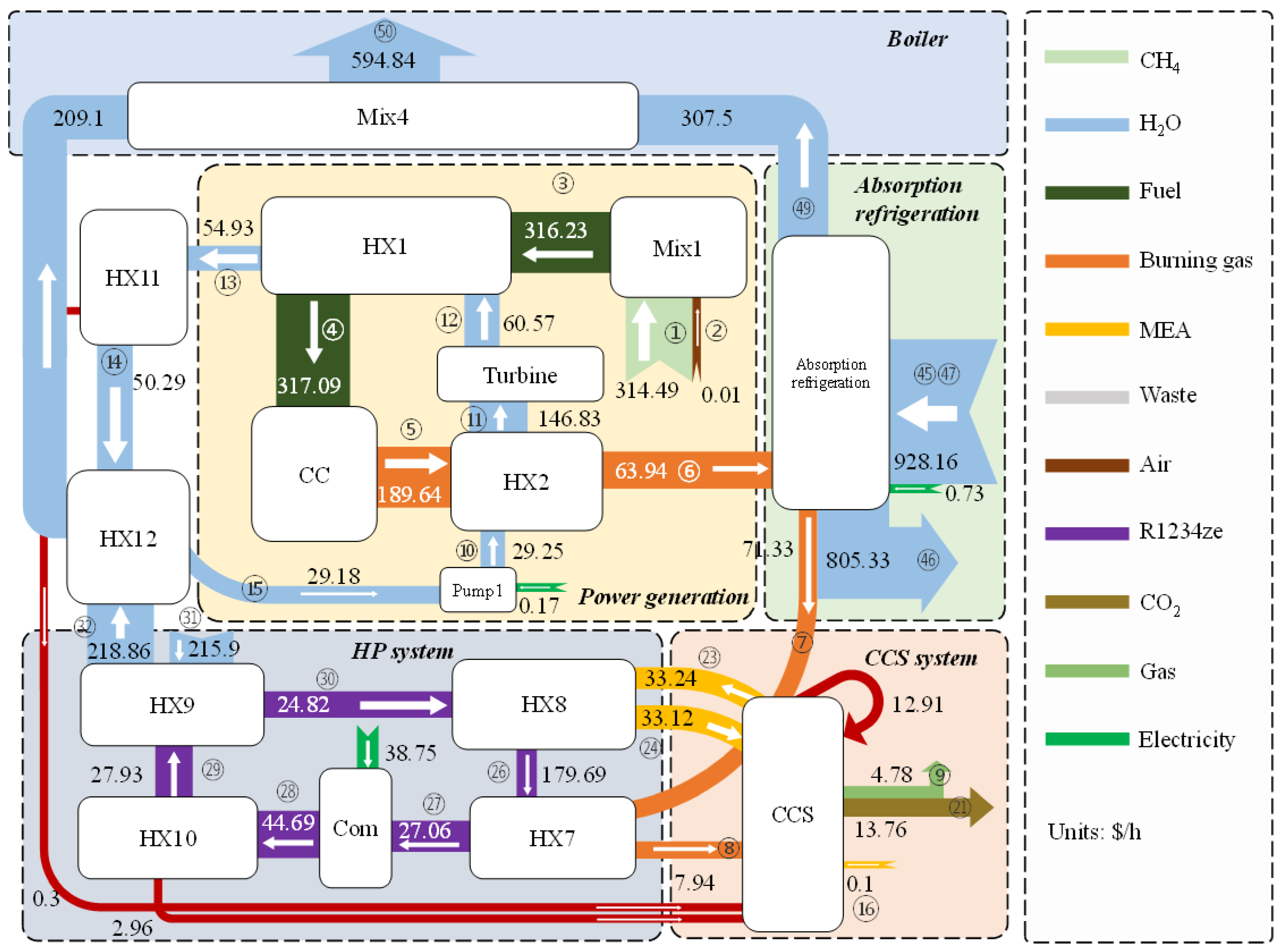
Figure 10 shows the exergy cost flow chart of the proposed system. The exergy cost flow diagram illustrates the cost rates associated with each stream and component in the designed CCHP system. Among the major components, the combustion chamber accounts for an exergy cost loss of 13.76 $/h, HX7 for 12.91 $/h, and HX9 for 11.01 $/h, indicating that combustion and heat exchange efficiencies urgently require improvement. The CCS system handles 33.12 $/h of CO2-related cost flows while generating 12.91 $/h in irreversibility losses, underscoring the economic significance of improving the thermochemical performance of the desorption process.
Figure 11 presents the exergoeconomic loss distribution across all components. The turbine (Tur1) accounts for the largest share of exergoeconomic losses at 67.02%, arising primarily from the irreversibilities inherent in the power generation process. The CCS system contributes 17.11%, mainly due to the strong thermochemical processes in the desorption column. The compressor contributes 8.17%, resulting from compression irreversibilities. All other components together account for the remaining 7.70%. These results clearly identify the turbine, CCS system, and compressor as the three primary targets for future system optimization.
The exergoeconomic analysis provides actionable guidance: optimizing the turbine design (e.g., adopting multi-stage expansion or improved blade geometry) could substantially reduce the dominant irreversibility; replacing the conventional MEA desorption process with advanced low-regeneration-energy solvents or alternative capture configurations could address the CCS-related losses; and variable-speed compressor control could minimize compression irreversibilities under part-load conditions.


5. Conclusions

This study has proposed and evaluated a novel low-carbon-emission CCHP system integrating heat pump technology with an MEA-based CCS subsystem. A comprehensive five-dimensional analysis framework—encompassing energy, exergy, environmental, economic, and exergoeconomic analyses—was established and applied to benchmark the proposed system against a conventional reference configuration. The principal conclusions are as follows:
(1)
HP technology enables multi-stage cascaded recovery of low-grade waste heat from both the flue gas and the CCS regeneration column, elevating the system’s energy efficiency from 74.25% to 81.22% and the waste heat recovery rate from 73.59% to 89.85%. The HP subsystem achieves a COP of 2.72 using R1234ze(Z) as the working fluid, which was identified as the optimal choice among four candidate refrigerants.
(2)
The comprehensive utilization of thermal energy substantially reduces irreversible losses in the system. Compared with the reference system, the total exergy loss is reduced by 365.06 kW and the exergy efficiency is improved from 53.95% to 65.07%, while maintaining the high CO2 capture rate of 90%.
(3)
HP integration increases the total system cost by only 1.91% while boosting total useful energy output by 16.02%. The unit energy production cost decreases from 0.033 to 0.031 $/(kW·h), demonstrating a clear economic advantage in multi-generation applications, despite a marginal increase in unit power generation cost.
(4)
Exergoeconomic analysis identifies the turbine, CCS system, and compressor as responsible for 67.02%, 17.11%, and 8.17% of total exergoeconomic losses, respectively, and designates them as the primary targets for future component-level optimization.
The present analysis is conducted under steady-state conditions and based on the 5E analyses. However, this study still has research gaps in off-design regulation and comprehensive performance optimization. Various feasibility issues also require further discussion for engineering applications. Future work will address grid-interactive operation of the proposed system and dynamic performance optimization incorporating energy storage technologies.

Author Contributions

Y.Y.: methodology, software, writing—original draft, J.H.: data curation, software, R.C.: validation, W.H.: funding acquisition, writing—review and editing. All authors have read and agreed to the published version of the manuscript.

Funding

This study was supported by the National Key Research and Development Program of China (No. 2024YFB4206500).

Data Availability Statement

The original contributions presented in this study are included in the article. Further inquiries can be directed to the corresponding author.

Conflicts of Interest

The authors declare no conflicts of interest.

References

  1. Li, Z.; Zhang, H.; Liu, G.; Zhou, Y.; Lan, J.; Chai, L.; Yang, Z.; Cheng, J. A Transient Thermo-Hydraulic Study of Mass and Heat Transfer and Phase Behavior of CO2 in Fractured Wellbores. Processes 2026, 14, 1330. [Google Scholar] [CrossRef]
  2. Shen, L.; Xue, K.; Xiao, B.; Chen, Y. Simulation of Heat Flow Field in Venlo Greenhouse in South China and Optimization of Its Cooling and Dehumidification System. Processes 2026, 14, 1331. [Google Scholar] [CrossRef]
  3. Huang, J.; Li, Y.; Lv, P.; Zhu, Y. Research on Ignition Matching for Magnesium-Based Water Ramjet Engines. Case Stud. Therm. Eng. 2024, 61, 104934. [Google Scholar] [CrossRef]
  4. Gong, X. The Impact of U.S. Political Decisions on Renewable and Fossil Energy Companies in the Era of the Paris Agreement. Financ. Res. Lett. 2024, 69, 106165. [Google Scholar] [CrossRef]
  5. Zhang, D.; Yang, X.; Li, H.; Jia, Z.; Zhang, S.; Tang, S.; Liu, D.; Wu, X. 4E Analysis and Parameter Study of a Solar-Thermochemical Energy Storage CCHP System. Energy Convers. Manag. 2024, 301, 118002. [Google Scholar] [CrossRef]
  6. Hou, X.; Sun, R.; Huang, J.; Geng, W.; Li, X.; Zhang, X. 4E Evaluation and Optimization of a Hybrid CCHP System Integrated PEM Fuel Cell and Adsorption Chiller. Renew. Energy 2024, 231, 120981. [Google Scholar] [CrossRef]
  7. Ye, H.; Tao, Y.; Chang, H.; Liu, Z.; Huang, Q.; Deng, Q. Topology Optimization of Fluid Channels for Thermal Management of Hydrogen Storage and Release Processes in Metal Hydrides Reactors. Int. J. Hydrogen Energy 2024, 60, 814–824. [Google Scholar] [CrossRef]
  8. Hai, T.; Asadollahzadeh, M.; Singh Chauhan, B.; A Al-Ebrahim, M.; Bunian, S.; Eskandarzade, A.; Salah, B. Machine Learning Optimization and 4E Analysis of a CCHP System Integrated into a Greenhouse System for Carbon Dioxide Capturing. Energy 2024, 309, 133028. [Google Scholar] [CrossRef]
  9. Yang, S.; Liu, Y.; Yu, Y.; Liu, Z.; Deng, C.; Xie, N. Thermodynamic and Parametric Analyses of a Zero-Carbon Emission SOFC-Based CCHP System Using LNG Cold Energy. Energy 2024, 307, 132748. [Google Scholar] [CrossRef]
  10. Chang, P.; Zhu, Q.; Xiao, Y.; Li, S.; Wu, T.; Li, L.; Li, C. Day-Ahead Optimal Scheduling of Hydro-Wind-Solar-Hydrogen Multi-Energy Coupling System Considering Spatiotemporal Correlations of Renewable Energy Processes. Renew. Energy 2026, 256, 124431. [Google Scholar] [CrossRef]
  11. Zhang, C.; Yang, M.; Lu, M.; Shan, Y.; Zhu, J. Experimental Research on LiBr Refrigeration—Heat Pump System Applied in CCHP System. Appl. Therm. Eng. 2011, 31, 3706–3712. [Google Scholar] [CrossRef]
  12. Wegener, M.; Malmquist, A.; Isalgue, A.; Martin, A.; Arranz, P.; Camara, O.; Velo, E. A Techno-Economic Optimization Model of a Biomass-Based CCHP/Heat Pump System under Evolving Climate Conditions. Energy Convers. Manag. 2020, 223, 113256. [Google Scholar] [CrossRef]
  13. Huang, Y.; Liu, W.; Zhang, Y.X.; Zhang, X.J.; Wang, T.; Fang, M.X.; Yao, Y.L.; Zheng, X.; Liu, X.Y.; Jiang, L. Post-Combustion Absorption Carbon Capture Assisted by Sorption-Compression Cascade Heat Pump. Carbon Capture Sci. Technol. 2025, 15, 100393. [Google Scholar] [CrossRef]
  14. Liu, W.; Huang, Y.; Zhang, X.J.; Wang, T.; Fang, M.X.; Jiang, L. Heat Pump Assisted Sorption Carbon Capture with Steam Condenser Heat Recovery in a Decarbonised Coal-Fired Power Plant. Energy Convers. Manag. 2024, 319, 118919. [Google Scholar] [CrossRef]
  15. Piersa, P.; Szufa, S.; Piersa, K.; Spławski, O.; Kazimierski, P. Analysis of the Potential for Thermochemical Utilization of Post-Production Maize Waste through the Production of Coal Substitutes in the Pyrolysis Process. Processes 2026, 14, 1319. [Google Scholar] [CrossRef]
  16. Wegener, M.; Isalgue, A.; Malmquist, A.; Martin, A.; Santarelli, M.; Arranz, P.; Camarra, O. Exergetic Model of a Small-Scale, Biomass-Based CCHP/HP System for Historic Building Structures. Energy Convers. Manag. X 2021, 12, 100148. [Google Scholar] [CrossRef]
  17. Khalvan, A.; Mehregan, M.; Kayhani, M.H.; Sheykhi, M. 4E Analysis of an Advanced CCHP Configuration with Gas Turbine Prime Mover Incorporating Inlet Cooling, a Modified Compression Refrigeration Cycle and Energy Storage with Renewable Energy Sources. Results Eng. 2026, 29, 108801. [Google Scholar] [CrossRef]
  18. Akbarnataj, K.; Saffaripour, M.; Houshfar, E. Membrane-Based CO2 Capture Integrated with CCHP for a Nearly Zero-Carbon Building. Build. Environ. 2025, 273, 112738. [Google Scholar] [CrossRef]
  19. Stoll, T.; Young, D.; Bandhauer, T. Data Center Sustainability: The Role of Flexible Fuel CCHP in Mitigating Grid Emissions and Power Constraints. Energy Convers. Manag. 2025, 326, 119455. [Google Scholar] [CrossRef]
  20. Zhang, Q.; Liu, Y.; Cao, Y.; Li, Z.; Hou, J.; Gou, X. Parametric Study and Optimization of MEA-Based Carbon Capture for a Coal and Biomass Co-Firing Power Plant. Renew. Energy 2023, 205, 838–850. [Google Scholar] [CrossRef]
  21. Yang, W.; Cao, X.; He, Y.; Yan, F. Theoretical Study of a High-Temperature Heat Pump System Composed of a CO 2 Transcritical Heat Pump Cycle and a R152a Subcritical Heat Pump Cycle. Appl. Therm. Eng. 2017, 120, 228–238. [Google Scholar] [CrossRef]
  22. Fukuhara, C.; Kamata, Y.; Igarashi, A. Catalytic Performance of Plate-Type Pd/Zn-Based Catalysts for Steam Reforming of Methanol, Prepared by Electroless Plating. Appl. Catal. A Gen. 2007, 330, 108–116. [Google Scholar] [CrossRef]
  23. Yang, S.-C.; Hung, T.-C.; Feng, Y.-Q.; Wu, C.-J.; Wong, K.-W.; Huang, K.-C. Experimental Investigation on a 3 kW Organic Rankine Cycle for Low-Grade Waste Heat under Different Operation Parameters. Appl. Therm. Eng. 2017, 113, 756–764. [Google Scholar] [CrossRef]
  24. Yang, S.; Liang, J.; Yang, S.; Qian, Y. A Novel Cascade Refrigeration Process Using Waste Heat and Its Application to Coal-to-SNG. Energy 2016, 115, 486–497. [Google Scholar] [CrossRef]
  25. Yan, C.; Yang, A.; Chien, I.-L.; Wei, S.; Shen, W.; Ren, J. Advanced Exergy Analysis of Organic Rankine Cycles for Fischer-Tropsch Syngas Production with Parallel Dry and Steam Methane Reforming. Energy Convers. Manag. 2019, 199, 111963. [Google Scholar] [CrossRef]
  26. Mehrpooya, M.; Mousavi, S.A. Advanced Exergoeconomic Assessment of a Solar-Driven Kalina Cycle. Energy Convers. Manag. 2018, 178, 78–91. [Google Scholar] [CrossRef]
  27. Martin, J. Renewable Hydrogen and Synthetic Fuels versus Fossil Fuels for Trucking, Shipping and Aviation: A Holistic Cost Model. Renew. Sustain. Energy Rev. 2023, 186, 113637. [Google Scholar] [CrossRef]
  28. Liu, J.; Zhou, T.; Yang, S. Advanced Exergy and Exergoeconomic Analysis of a Multi-Stage Rankine Cycle System Combined with Hydrate Energy Storage Recovering LNG Cold Energy. Energy 2024, 288, 129810. [Google Scholar] [CrossRef]
  29. Liang, W.; Yu, Z.; Bai, S.; Li, G.; Wang, D. Study on a Near-Zero Emission SOFC-Based Multi-Generation System Combined with Organic Rankine Cycle and Transcritical CO2 Cycle for LNG Cold Energy Recovery. Energy Convers. Manag. 2022, 253, 115188. [Google Scholar] [CrossRef]
  30. Kermani, A.A.; Houshfar, E. Design and Energy, Exergy, and Exergoeconomic Analyses of a Novel Biomass-Based Green Hydrogen and Power Generation System Integrated with Carbon Capture and Power-to-Gas. Int. J. Hydrogen Energy 2024, 52, 177–189. [Google Scholar] [CrossRef]
  31. Chen, L.; Zhang, L.; Wang, Y.; Xie, M.; Yang, H.; Ye, K.; Mohtaram, S. Design and Performance Evaluation of a Novel System Integrating Water-Based Carbon Capture with Adiabatic Compressed Air Energy Storage. Energy Convers. Manag. 2023, 276, 116583. [Google Scholar] [CrossRef]
  32. Moghimi, M.; Emadi, M.; Ahmadi, P.; Moghadasi, H. 4E Analysis and Multi-Objective Optimization of a CCHP Cycle Based on Gas Turbine and Ejector Refrigeration. Appl. Therm. Eng. 2018, 141, 516–530. [Google Scholar] [CrossRef]
  33. Habibi, H.; Zoghi, M.; Chitsaz, A.; Shamsaiee, M. Thermo-Economic Performance Evaluation and Multi-Objective Optimization of a Screw Expander-Based Cascade Rankine Cycle Integrated with Parabolic Trough Solar Collector. Appl. Therm. Eng. 2020, 180, 115827. [Google Scholar] [CrossRef]
  34. Chitgar, N.; Emadi, M.A. Development and Exergoeconomic Evaluation of a SOFC-GT Driven Multi-Generation System to Supply Residential Demands: Electricity, Fresh Water and Hydrogen. Int. J. Hydrogen Energy 2021, 46, 17932–17954. [Google Scholar] [CrossRef]
  35. Lee, Y.D.; Ahn, K.Y.; Morosuk, T.; Tsatsaronis, G. Exergetic and Exergoeconomic Evaluation of an SOFC-Engine Hybrid Power Generation System. Energy 2018, 145, 810–822. [Google Scholar] [CrossRef]
  36. Jiang, J.; Li, C.; Kong, M.; Ye, X. Insights into 4E Evaluation of a Novel Solar-Assisted Gas-Fired Decarburization Power Generation System with Oxygen-Enriched Combustion. Energy 2023, 278, 127771. [Google Scholar] [CrossRef]
  37. Javadi, M.; Jafari Najafi, N.; Khalili Abhari, M.; Jabery, R.; Pourtaba, H. 4E Analysis of Three Different Configurations of a Combined Cycle Power Plant Integrated with a Solar Power Tower System. Sustain. Energy Technol. Assess. 2021, 48, 101599. [Google Scholar] [CrossRef]
  38. Xia, J.; Li, J. Design and Detailed Examinations of a Geothermal-Biomass Driven Integrated Multigeneration System with CO2 Capturing Unit: Stability and 4E Evaluations. Fuel 2022, 330, 125300. [Google Scholar] [CrossRef]
  39. Ebrahimi, A.; Meratizaman, M.; Akbarpour Reyhani, H.; Pourali, O.; Amidpour, M. Energetic, Exergetic and Economic Assessment of Oxygen Production from Two Columns Cryogenic Air Separation Unit. Energy 2015, 90, 1298–1316. [Google Scholar] [CrossRef]
  40. Mohebali Nejadian, M.; Ahmadi, P.; Houshfar, E. Comparative Optimization Study of Three Novel Integrated Hydrogen Production Systems with SOEC, PEM, and Alkaline Electrolyzer. Fuel 2023, 336, 126835. [Google Scholar] [CrossRef]
  41. Wu, Z.; Zhu, P.; Yao, J.; Zhang, S.; Ren, J.; Yang, F.; Zhang, Z. Combined Biomass Gasification, SOFC, IC Engine, and Waste Heat Recovery System for Power and Heat Generation: Energy, Exergy, Exergoeconomic, Environmental (4E) Evaluations. Appl. Energy 2020, 279, 115794. [Google Scholar] [CrossRef]
Figure 1. Schematic diagram of low-carbon-emission CCHP system.
Processes 14 01764 g001
Figure 2. Schematic diagram of reference CCHP system.
Processes 14 01764 g002
Figure 3. Energy flow chart of proposed CCHP system.
Processes 14 01764 g003
Figure 4. Energy flow chart of reference CCHP system.
Processes 14 01764 g004
Figure 5. Exergy flow chart of proposed CCHP system.
Processes 14 01764 g005
Figure 6. Exergy flow chart of reference CCHP system.
Processes 14 01764 g006
Figure 7. Life cycle assessment results for proposed system.
Processes 14 01764 g007
Figure 8. Contribution of each component to environmental impact.
Processes 14 01764 g008
Figure 9. Effect of economic parameters on energy production cost and total cost.
Processes 14 01764 g009
Figure 10. Exergy cost flow chart of low-carbon-emission CCHP system.
Processes 14 01764 g010
Figure 11. Exergoeconomic loss distribution across system components.
Processes 14 01764 g011
Table 1. Review of related works on CCHP–HP, CCHP–CCS, and HP–CCS integrations.
CategoryAuthorSystem Configuration η En
CCHP-HPZhang et al. [11]LiBr HP recovering chiller cooling water-
Wegener et al. [12]CCHP-HP for historic building66.50%
CCHP-CCSHai et al. [8]ML-optimized CCHP-CCS49.20%
Yang et al. [9]Zero-carbon CCHP-LNG cold energy60.37%
HP-CCSHuang et al. [13]Absorption–compression cascade HP73.48
Liu et al. [14]Coal-fired plant HP-CCS-
Table 2. The thermodynamic equilibrium equations in the HP system.
ComponentThermodynamic Equilibrium Equation
HX7 Q HX 7 = m 7 ( h 7 h 8 ) = m 26 ( h 27 h 26 )
HX8 Q HX 8 = m 23 ( h 23 h 24 ) = m 26 ( h 26 h 25 )
HX9 Q HX 9 = m 28 ( h 28 h 29 ) = m 22 ( h 22 h 21 )
HX10 Q HX 10 = m 29 ( h 29 h 28 ) = m 32 ( h 32 h 31 )
Com1 W Com 1 = m 28 ( h 28 h 27 ) , h 28 = h 27 + ( h 28 s h 27 ) / η s
Valve h 25 = h 30
Table 3. Main design parameters of each component in low-carbon-emission CCHP system.
SubsystemComponentKey Parameters
Steam PowerCCPressure: 100 kPa; Temperature: 1878 °C
HX1Cold outlet temperature: 90 °C
HX2Cold outlet temperature: 1000 °C
HX11Hot outlet temperature: 95 °C
HX12Cold outlet temperature: 90 °C
Tur1Exhaust pressure: 40 kPa; Isentropic efficiency: 90%
Pump1Discharge pressure: 2500 kPa; Pump efficiency: 90%
CCS SystemHX7Hot outlet temperature: 40 °C
HX9Hot outlet temperature: 80 °C
HX10Hot outlet temperature: 27 °C
Com1Outlet pressure: 2400 kPa; Isentropic efficiency: 90%
HP SystemAbs1No. of trays: 15; Pressure: 100 kPa
HX8Heat duty: 118.88 kW
HX13Hot inlet–cold outlet temperature difference: 15 °C
Des1No. of trays: 10; Pressure: 200 kPa
HX3Hot outlet temperature: 45 °C
HX4Hot outlet temperature: 9 °C
HX5Hot outlet temperature: 80 °C
Absorption RefrigerationHX6Hot outlet temperature: 40 °C
Gen1Temperature: 99.47 °C; Pressure: 9.6 kPa
Pump2Outlet pressure: 9.6 kPa; Pump efficiency: 90%
CCPressure: 100 kPa; Temperature: 1878 °C
Table 4. Validation results of the subsystem models [11,12].
SubsystemParameterSimulatedReferenceDeviation (%)
Steam CycleHeat source temp. (°C)2892890
Condensation temp. (°C)2202200
Thermal efficiency (%)31.6028.489.87
CCSCO2 capture rate (%)90900
Reboiler temp. (°C)120.0120.00
Heat duty (GJ/t-CO2)3.233.507.71
HPSupply/return temp. (°C)75/5075/500
COP2.692.574.67
Integrated SystemSystem power (kW)25250
CO2 capture rate (%)75750
Energy efficiency (%)64.961.35.54
COP3.73.48.11
Table 5. Assessment objects of LCA.
StageComponentParameterValue
ConstructionCCRated heat output4828.94 kW
CCSCO2 capacity742.50 kg
HXHeat exchange10,446.67 kW
TurWork done540.86 kW
ComPower consumption278.85 kW
OperationCCHeat output4828.94 kW
CCRuntime90,000.00 h
HXHeat exchange10,446.67 kW
ComPower consumption278.85 kW
Table 6. Cost equations for the main system components.
ComponentCost Equation
Pump [33] Z Pump = 3,540 × W Pump 0.7
Gen [34] Z Gen = 130 A Gen 0.093 0.78
Com [35] Z Com = 7,900 × ( W Com ) 0.62
HX [36] Z HX = 6.534 × Q HX
CC [37] Z CC = 258.656 m air [ 1 + e ( 0.015 ( T out 1540 ) ) ] 1 , 540 ( P out / P in )
CCS [38] Z CCS = 0.504 × m CO 2 , Capture
Tur [39] Z Tur = W Tur ( 9,493.2 707.962 ln ( W Tur ) )
Table 7. Exergoeconomic balance and auxiliary equations for selected components.
ComponentExergy Cost Balance EquationsAuxiliary Equations
HX1 C 12 E x 12 C 13 E x 13 + C HX 1 = C 4 E x 4 C 3 E x 3 c 12 = c 13
HX2 C 5 E x 5 C 6 E x 6 + C HX 2 = C 11 E x 11 C 10 E x 10 c 5 = c 6
HX3 C 34 E x 34 C 35 E x 35 + C HX 3 = C 49 E x 49 C 48 E x 48 c 34 = c 35
HX4 C 45 E x 45 C 46 E x 46 + C HX 4 = C 37 E x 37 C 36 E x 36 c 45 = c 46
HX5 C 38 E x 38 C 39 E x 39 + C HX 5 = C 44 E x 44 C 43 E x 43 c 38 = c 39
HX6 C 41 E x 41 C 42 E x 42 + C HX 6 = C 48 E x 48 C 47 E x 47 c 41 = c 42
HX7 C 7 E x 7 C 8 E x 8 + C HX 7 = C 27 E x 27 C 26 E x 26 c 7 = c 8
HX8 C 23 E x 23 C 24 E x 24 + C HX 8 = C 26 E x 26 C 25 E x 25 c 23 = c 24
HX9 C 29 E x 29 C 30 E x 30 + C HX 9 = C 32 E x 32 C 31 E x 31 c 29 = c 30
Mix C 1 E x 1 + C 2 E x 2 + C Mix = C 3 E x 3
C 37 E x 37 + C 40 E x 40 + C Mix = C 41 E x 41
C 33 E x 33 + C 49 E x 49 + C Mix = C 50 E x 50
c 2 = c 3 , c 40 = c 41 c 33 + c 49 = c 50 C Sep = C Mix = 0
Gen C 6 E x 6 + C 7 E x 7 + C 44 E x 44 + C Gen = C 34 E x 34 + C 38 E x 38 c 6 = c 7
Tur C 11 E x 11 + C Tur = C 12 E x 12 + C ele E x ele c 11 = c 12 , c e = 0.49
CC C 4 E x 4 + C CC = C 5 E x 5 c 4 = c 1 + c 2
CCS C 16 E x 16 + C 8 E x 8 + C CCS + C 32 E x 32 C 33 E x 33 + C 13 E x 13 C 14 E x 14 = C 9 E x 9 + C 21 E x 21 + C 23 E x 23 C 24 E x 24 c 32 = c 33 , c 13 = c 14 c 23 = c 24
Table 8. The thermodynamic parameters of the various flow streams of the proposed system.
StreamT (℃)P (Bar)m (kg/h)h (kJ/kg)s (kJ/(kg·K))Exph (kW)Exch (kW)Ex (kW)
125.00 1.00 300.00 −4646.21 −5.02 0.00 4319.97 4319.97
225.00 1.00 6000.00 −0.28 0.14 0.00 13.52 13.52
324.99 1.00 6300.00 −221.51 −0.02 0.00 4327.83 4327.83
490.00 1.00 6300.00 −151.36 0.20 11.73 4327.83 4339.56
51878.28 1.00 6300.00 −151.36 2.46 3022.26 128.48 3150.74
6837.71 1.00 6300.00 −1621.52 1.53 1733.91 128.48 1862.39
780.00 1.00 6300.00 −2543.22 0.16 736.12 128.48 864.60
840.00 1.00 6300.00 −2764.20 −0.51 673.51 128.48 801.99
963.00 1.01 5837.82 −2304.91 0.00 533.55 76.33 609.88
1025.08 25.00 2000.00 −15,969.46 −9.32 1.57 292.96 294.53
111000.00 25.00 2000.00 −11,338.43 −0.94 1185.73 292.96 1478.69
12339.04 0.40 2000.00 −12,816.22 −0.65 317.05 292.96 610.01
13228.13 0.40 2000.00 −13,037.21 −1.05 260.21 292.96 553.17
1480.00 0.40 2000.00 −13,321.69 −1.72 213.47 292.96 506.43
1540.00 0.40 2000.00 −15,904.29 −9.10 0.88 292.96 293.84
Table 9. Simulated system performance with different HP working fluids.
Working FluidCOPEnergy Efficiency (%)Exergy Efficiency (%)
R1234ze(Z)2.7281.2265.07
R-410A2.6580.7564.75
R1336mzz(Z)2.6881.1265.01
R-245A2.7081.1565.02
Table 10. Scenario analysis results for refrigerant leakage.
ScenarioAnnual Leakage Rate20-Yr Cumulative (kg)GWP Impact (kg CO2-eq)Contribution to System GWP
Baseline0%000%
Low1%/yr2.792.79<0.01%
Medium3%/yr8.378.37<0.03%
High10%/yr27.927.9<0.10%
Table 11. Annualized cost comparison between the designed and reference CCHP systems ($/h).
SystemInvestment CostFuel CostEnvironmental CostTotal Cost
Designed System28.42115.941.31145.67
Reference System25.73115.941.31142.98
Table 12. Economic performance comparison.
IndicatorDesigned SystemReference System
Unit energy production cost ($/(kW·h))0.030.04
Unit power generation cost ($/(kW·h))0.200.17
Disclaimer/Publisher’s Note: The statements, opinions and data contained in all publications are solely those of the individual author(s) and contributor(s) and not of MDPI and/or the editor(s). MDPI and/or the editor(s) disclaim responsibility for any injury to people or property resulting from any ideas, methods, instructions or products referred to in the content.