


Abstract
Deep coalbed methane (CBM) has become an important contributor to natural gas production worldwide. Its fluid occurrence characterized by high free gas content and low water saturation suggests substantial gas-driven displacement caused by hydrocarbon generation overpressure. However, the microscopic evolution of this process and the corresponding occurrence remain poorly understood. To address these issues, we combined centrifugation experiments, nuclear magnetic resonance (NMR) monitoring, and theoretical modeling to systematically investigate pore-scale displacement dynamics and the associated fluid distribution. A dynamic evolution model for gas–water displacement in nanopores is developed by incorporating the capillary pressure and disjoining pressure, and validated against the centrifugation experimental data. At the pore scale, gas–water displacement is governed by critical displacement pressure and water film thickness. Water saturation declines sharply once the displacement pressure exceeds a critical threshold, after which it decreases slowly as the water film progressively thins. At the porous media scale, water saturation continuously decreases with increasing displacement pressure. For the high-rank coal samples in this study, the overall water saturation decreases to 49.15% as the displacement pressure increases to 10 MPa. The water film is negligible for pores larger than 20 nm, but significant for pores smaller than 20 nm. This critical pore size is not fixed, but is a dynamic threshold controlled by the disjoining pressure parameter. The occurrence of free gas in deep CBM is governed by the relative matching between hydrocarbon generation overpressure and reservoir pore structure. These findings provide a theoretical basis for resource assessment and efficient development of deep CBM.
1. Introduction
Natural gas, as a clean and efficient fossil fuel, plays an important role in the global energy transition and carbon neutrality [1]. Coalbed methane (CBM), an important unconventional natural gas resource, has attracted widespread attention in many countries for its vast resource potential and significant environmental benefits [2,3,4]. China is rich in CBM resources, with reserves at depths greater than 2000 m estimated at approximately 40.47 × 10¹² m3 [5]. In recent years, the development of deep CBM has shown great strategic prospects. Through adopting horizontal wells and large-scale volume fracturing technology [6,7], significant breakthroughs in deep CBM exploration have been achieved in the Ordos Basin of China, with multiple single wells achieving the production of over 100,000 cubic meters per day, indicating that deep CBM has entered a new stage of large-scale development [8].
Compared with a shallow one with a burial depth less than 1000 m, deep CBM exhibits remarkable differences in both fluid occurrence and production behavior. In terms of gas occurrence, deep CBMs have a high gas content with a value exceeding 20 m3/t [9]. Moreover, the proportion of free gas is considerably higher than previously recognized, and can even exceed 30%. The coexistence of adsorbed gas and free gas becomes a typical feature of deep CBM [10,11]. Regarding water occurrence, deep CBMs generally show a characteristic of ultra-low water saturation. Pressure-preserved coring tests reveal that initial water saturation in the actual reservoirs is significantly lower than irreducible water saturation measured in the experiments, with values even falling below 20% in some cases [12,13,14]. Together, the enrichment of free gas and the presence of ultra-low water saturation determine the distinctive production behavior of deep CBM reservoirs, i.e., immediate gas production upon well opening, high initial production rates, and minimal to no water production [15,16]. This production pattern stands in stark contrast to the slow gas breakthrough observed in shallow CBM, which follows the sequence of dewatering, pressure depletion, and desorption.
The high gas content, low water content, and free gas enrichment observed in deep CBM have been understood from a macroscopic geological perspective. During coalification under high-temperature and high-pressure conditions, the continuous and substantial generation of hydrocarbons increase the gas pressure in pores. As the intense overpressure is generated, water in coal pores is partially or completely displaced. Then, under the preservation of tight layers, free gas can effectively accumulate in pore and fracture systems [17,18]. However, our current understanding of the dynamic evolution of this displacement and the corresponding microscopic occurrence responses in deep CBM remains limited. Existing studies have largely focused on adsorbed gas content measurements under static conditions and the related influence factors, including moisture content, thermal maturity and pore structure [19,20,21,22], while systematic investigations into key issues such as the dynamic mechanisms, the variation in water film, and the relationship between displacement pressure and pore structure are still lacking. Conventional centrifugation experiments are constrained by the maximum pressure achievable with centrifuges and cannot replicate the actual displacement conditions associated with deep hydrocarbon generation overpressure [23,24,25], leading to inherent limitations in the evaluation of irreducible water saturation. Therefore, a theoretical model capable of describing the dynamic evolution of gas–water displacement in deep coal and elucidating the microscopic mechanisms of gas–water occurrence and transformation across different pore scales is urgently needed.
This study integrates centrifugation experiments, nuclear magnetic resonance (NMR) monitoring, and theoretical modeling to systematically investigate the dynamic evolution of gas–water displacement and the microscopic fluid occurrence in deep coal seams. First, NMR experiments are conducted to obtain T2 spectra under saturated water conditions and varying centrifugal forces, simulating the gas-driven water displacement process induced by hydrocarbon generation overpressure. Second, a theoretical model for gas displacing water in nanopores is developed by incorporating the effects of capillary pressure and disjoining pressure, enabling the quantification of key parameters such as critical displacement pressure and water film thickness. Then, based on the experimental results, the pore-scale model is subsequently extended to the porous medium scale at a high displacement pressure, providing a novel approach for the quantitative prediction of gas–water occurrence and dynamic evolution under deep geological environments. Moreover, the implications of these processes for free gas accumulation are also discussed. The findings aim to advance the understanding of deep CBM occurrence mechanisms and provide theoretical support for resource evaluation and efficient development.
2. Experiments and Methods
2.1. Experimental Samples
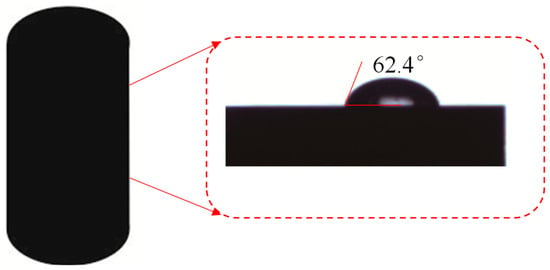
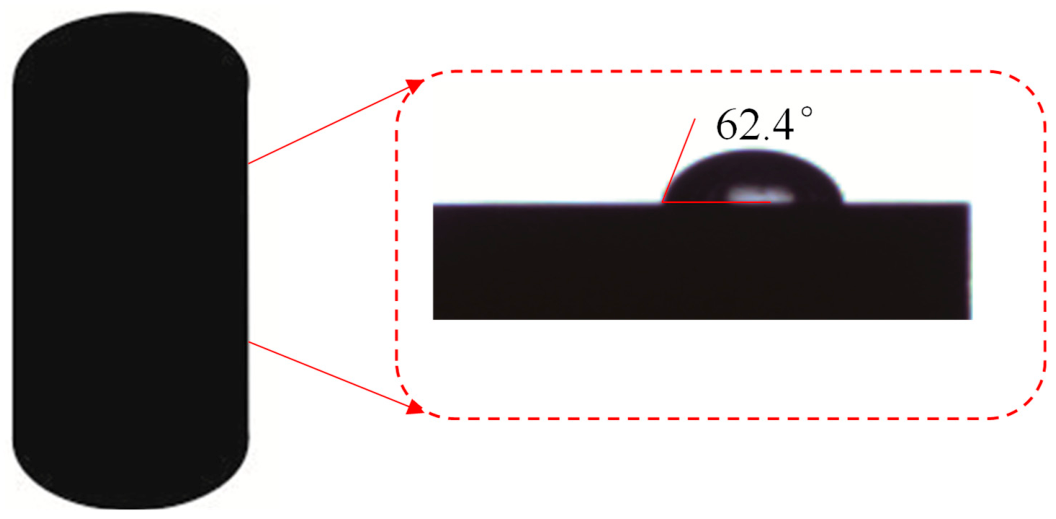
Our experimental samples were sourced from the Daning–Jixian Block in the Ordos Basin, China. The samples were at a highly mature stage with a thermal maturity (Ro) of 2.32%. Basic physical property tests yielded a permeability of 0.686 × 10⁻³ mD and a porosity of 6.23%. As shown in Figure 1, wettability measurement shows a contact angle of 62.4°, indicating that the coal is water-wet. Under such conditions, gas–water distribution is controlled by the coupled effects of capillary pressure and surface wettability.
Figure 1.
Contact angle of experimental sample.
2.2. Experimental Procedures
- (1)
- The pre-treated coal samples were dried in a constant-temperature oven at 105 °C to a constant weight. Subsequently, they were placed in a desiccator and allowed to cool to room temperature, after which the dry weights were recorded.
- (2)
- The dried samples were subjected to vacuum-pressurized saturation using a vacuum saturation device. Samples were evacuated under a vacuum of smaller than −0.1 MPa for 5 h, followed by pressurized saturation with water at 20 MPa for 24 h to achieve complete water saturation. After saturation, the wet weights of the samples were measured, and the samples were stored in solution to maintain full saturation before measurement.
- (3)
- After vacuum saturation, the coal samples were carefully wiped with tissue paper to eliminate surface moisture and wrapped with non-magnetic plastic film to prevent water evaporation. Nuclear magnetic resonance measurements were then conducted on the saturated samples using a GeoSpec 12-53 NMR spectrometer (Oxford Instruments, Abingdon, UK) to obtain the T2 spectra.
- (4)
- After measuring saturated samples, movable water in the cores was removed using a high-speed centrifuge at centrifugal forces of 0.3, 0.6, 0.9, 1.2, 1.5, 1.8, and 2.4 MPa, with a maximum rotation speed of 10,000 rpm. Each centrifugation step lasted at least 2 h. After each centrifugation, the samples were wrapped in plastic film and allowed to stabilize in a constant-temperature chamber.
- (5)
- After each centrifugal force step, NMR measurements were performed to obtain the T2 spectra under different centrifugal forces. Using a standard calibration curve, the total NMR porosity of the saturated samples was calculated, and the interval porosity and cumulative porosity curves for both saturated and centrifuged samples were derived.
2.3. Theoretical Model
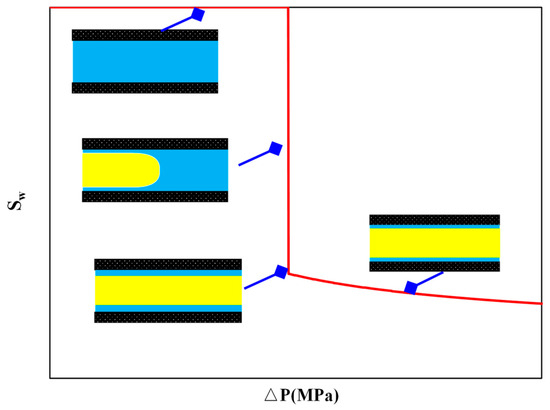
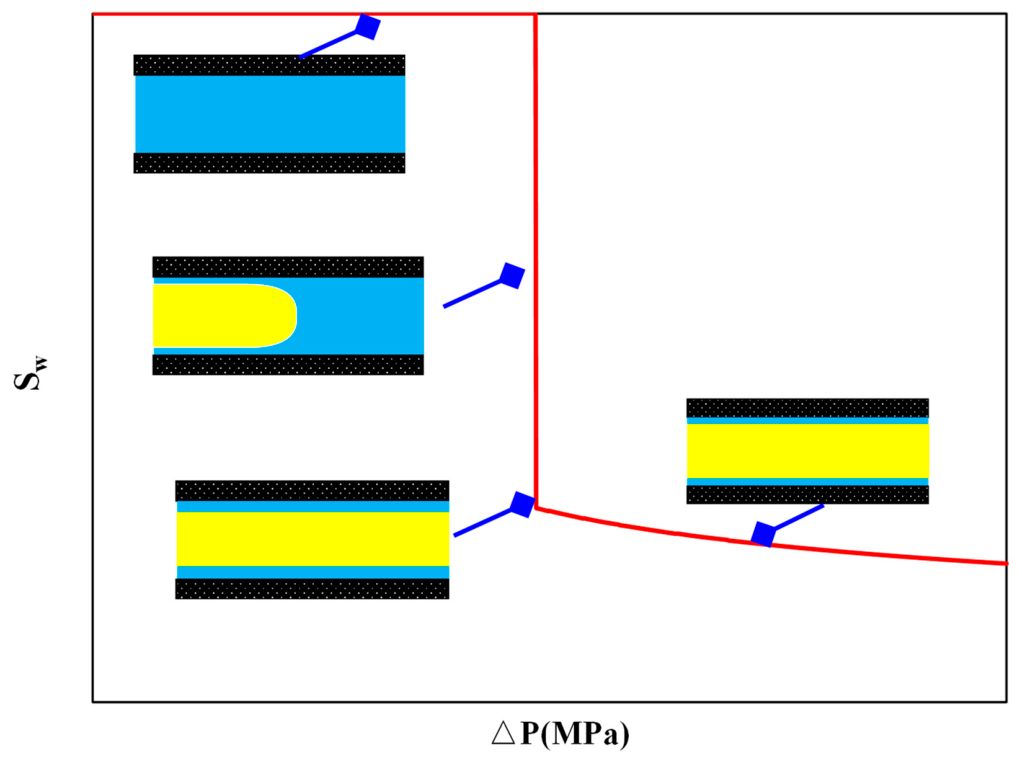
After the sample is saturated with water, the coal pores are filled with water. Centrifugation is subsequently used to simulate the gas displacement. As the centrifugal force (i.e., displacement pressure) gradually increases, more water is expelled, and the water saturation of the coal decreases. The physical process for a single pore is illustrated in Figure 2. When the displacement pressure is below the critical displacement pressure, the pore remains fully saturated with water, and the water phase is difficult to displace. Once the displacement pressure reaches the critical value, the gas phase begins to displace the water. In nanopores, due to the water-wet nature of the pore walls, strong solid–liquid interactions result in the persistent presence of a water film on the wall surface [26,27]. As the displacement pressure increases further, the interfacial shear stress gradually removes the liquid, causing the water film to thin progressively. Therefore, the key aspects of this physical process are the determination of the critical displacement pressure and the dynamic variation in water film thickness.
Figure 2.
Variation in water saturation during the gas displacement process.
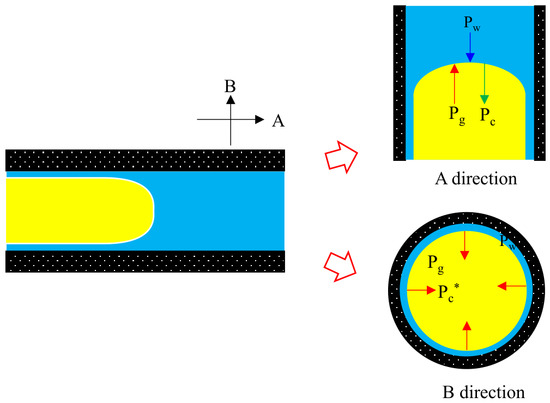
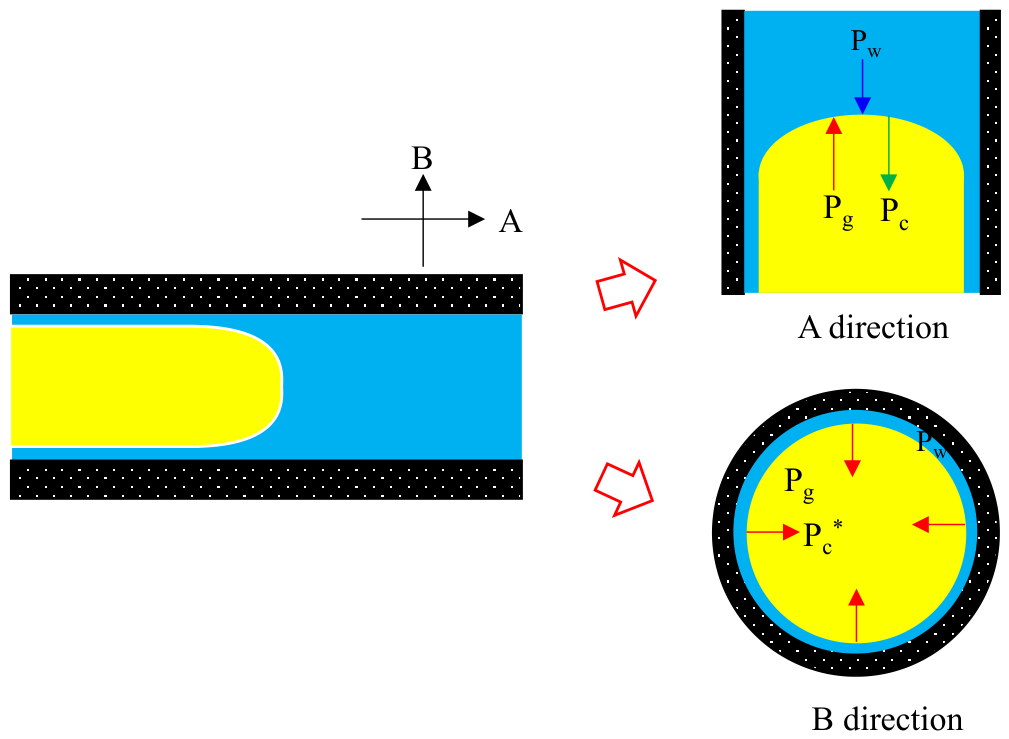
In our theoretical model, cylindrical geometry is adopted to describe capillary phenomena in porous media because it is widely used in pore structure characterization of unconventional reservoirs [28,29]. The primary resistance to the gas phase displacing the water phase is capillary pressure. For a single pore, as shown in Figure 3, in the displacement direction (A), under critical displacement conditions, the following equilibrium relationship holds among the gas pressure Pg*, capillary pressure Pc and the water pressure Pw
where h* is the critical water film thickness, nm; σ is the interfacial tension, mN/m; and θ is the three-phase contact angle among gas, liquid, and solid.
Figure 3.
Mechanical equilibrium during the pressure-driven displacement process.
Besides the equilibrium in the displacement direction, equilibrium also exists in the direction perpendicular to the pore wall (Direction B). Once the displacement pressure exceeds the critical value, the stability of the water film is maintained through the interaction among the gas phase, water film, and solid phase. According to interfacial chemistry theory [30], as the water film thickness decreases to the nanoscale, an additional force between the solid–liquid and liquid–gas interfaces begins to significantly affect water film stability. This additional force, named as disjoining pressure, acts perpendicular to the solid–liquid interface and points toward the gas–liquid interface. Moreover, because the water film within the pore is not flat, the cylindrical capillary pressure arising from the curved gas–liquid interface should also be considered. Thus, the mechanical equilibrium in Direction B can be expressed as
where is the cylindrical capillary pressure within a cylindrical pore, given by
Π(h) represents the disjoining pressure, which accounts for the surface interactions between these two interfaces. In theory, the disjoining pressure generally consists of molecular interaction forces, electrical double-layer forces, and structural forces, each of which is closely related to the thickness of water film and is also influenced by fluid type and solid surface properties. Based on measurements of disjoining pressure and water film thickness on quartz and other mineral surfaces, Gee et al. [31] proposed a simplified expression relating Π(h) to water film thickness h
Combining Equations (2)–(4) yields the relationship between gas pressure and water pressure
By integrating Equations (1) and (5), the critical water film thickness, the critical displacement pressure, and the variation in water film thickness with displacement pressure can be calculated in a single pore.
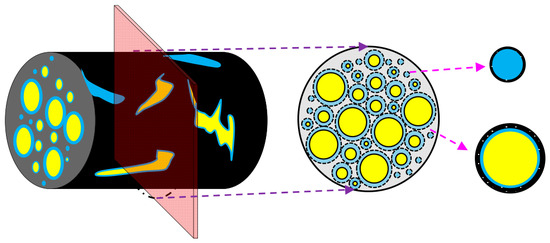
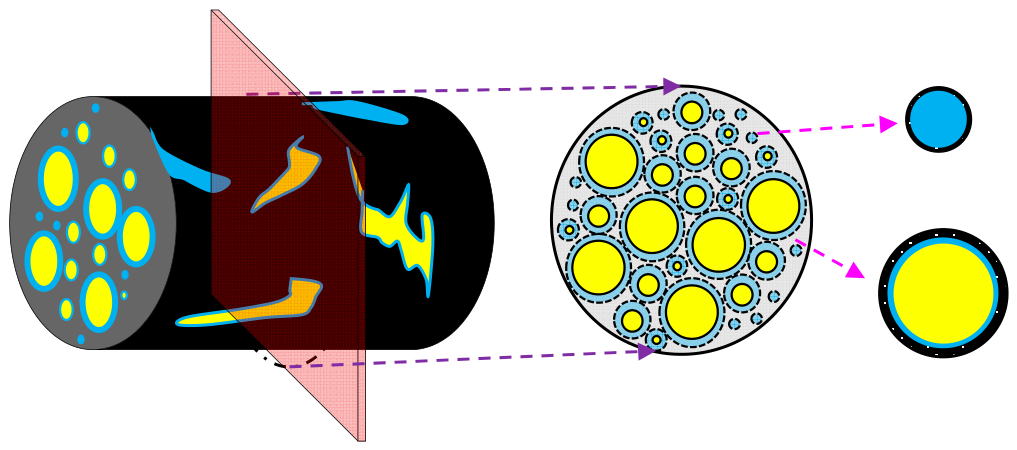
Actual coal reservoirs are typical porous media characterized by pores spanning a range of sizes. As illustrated in Figure 4, for a connected coal network with a specific pore size distribution, under a given displacement pressure, most of the water in pores with capillary pressures lower than the displacement pressure is expelled, leaving only a residual water film of a certain thickness. In contrast, in pores with capillary pressures higher than the displacement pressure, water cannot be effectively displaced and remains as capillary water. Under these different occurrence modes, the water saturation contributed by each pore type can be expressed as
Figure 4.
Schematic diagram of gas–water distribution in coal porous media.
The above characteristics indicate that, under a given displacement pressure, pores with dimensions smaller than the critical size remain completely water-saturated, while the larger pores exhibit a “gas core-water film” configuration. For a specific porous medium, the overall water saturation can be obtained by combining these occurrence modes
3. Results and Discussion
3.1. NMR T2 Spectra Under Different Centrifugal Forces
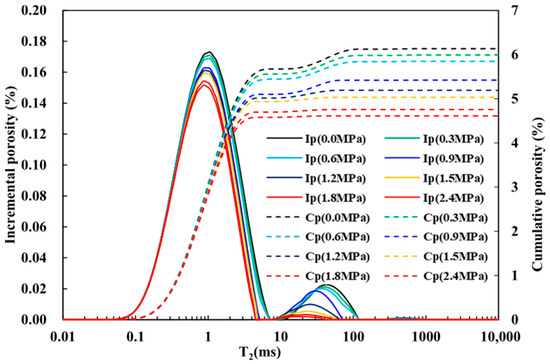
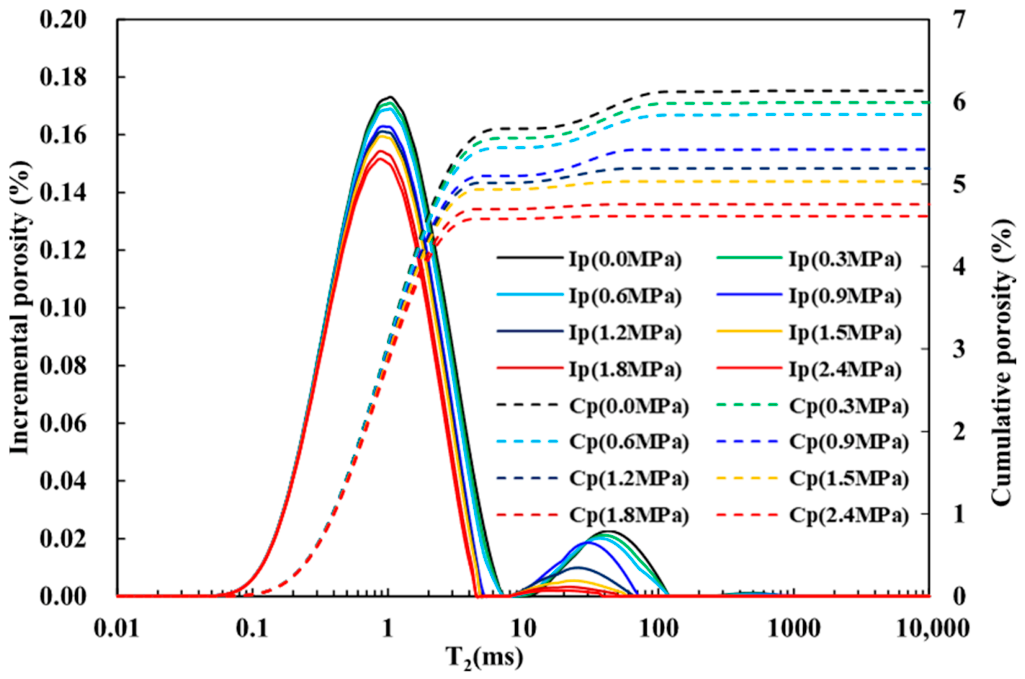
The NMR T2 spectra of coal samples under saturated conditions and different centrifugal forces are displayed in Figure 5. Under water-saturated conditions, the T2 spectra of the experimental coal samples exhibit a bimodal distribution. The first peak, located on the left with T2 values ranging from 0.01 to 3 ms, shows the strongest signal intensity and corresponds to well-developed micropores. The second peak, in the range of 10–100 ms, represents macropores. In addition, a weak signal is observed at approximately 1000 ms, indicating the presence of a small number of fractures in the samples.
Figure 5.
NMR T2 spectra of coal under saturated conditions and different centrifugal forces (Ip: incremental porosity; Cp: cumulative porosity).
Comparing the T2 spectra under different centrifugal forces, the mobility of fluids in pores with different dimensions can be further clarified. As the centrifugal force increases, the signal intensity of the first peak tends to decrease, suggesting that water can be displaced from micropores under sufficiently strong external forces. In contrast, the signal intensity of the second peak decreases sharply with increasing centrifugal pressure, indicating that fluids in macropores are predominantly movable and can be effectively expelled during accumulation or short-distance migration. Overall, fluids in the few developed fractures can be expelled even at low centrifugal pressures. The significant decrease in the second peak under high centrifugal forces indicates that free water in macropores has been largely displaced, leaving only residual bound water films. Meanwhile, the general reduction in the first peak suggests that, even under strong displacement conditions, a considerable amount of fluid remains effectively bound in the micropores of the coal matrix.
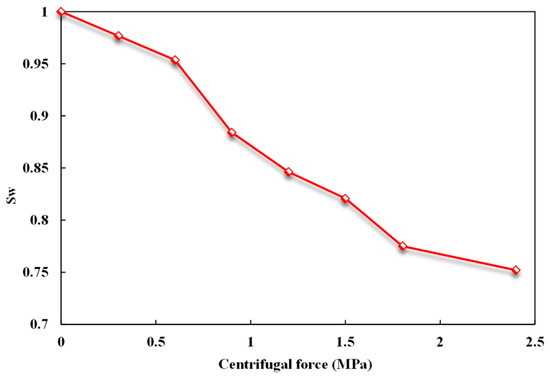
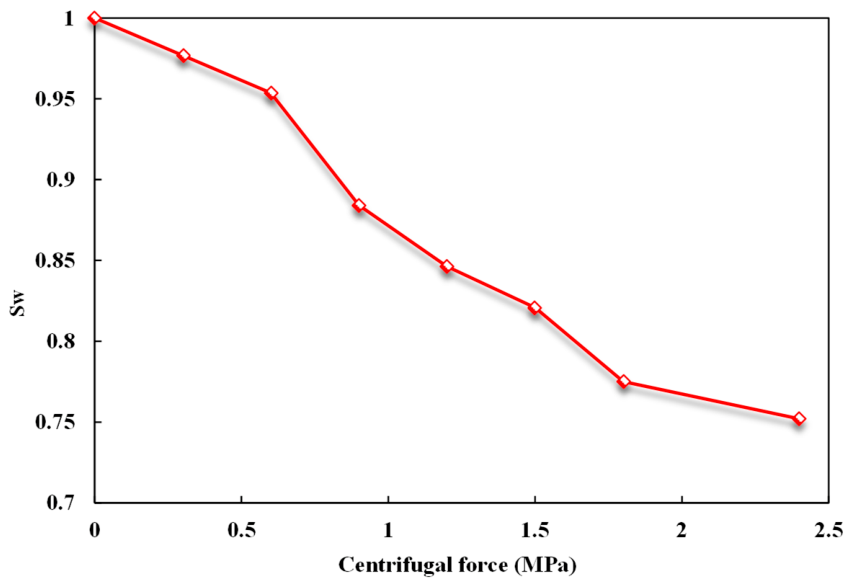
Based on the centrifugation NMR T2 spectra, the variation in water saturation with centrifugal pressure was further analyzed, and the results are illustrated in Figure 6. As shown in this figure, water saturation decreases significantly with increasing centrifugal pressure, implying the progressive expulsion of pore fluids under external displacement. As the centrifugal force reaches 2.4 MPa, approximately 25% of the original water in the coal pores has been effectively expelled, thereby releasing corresponding storage space for free gas. This finding provides valuable insights into the storage mechanisms and production potential of deep CBM.
Figure 6.
Water saturation of deep coal samples under different centrifugal forces.
Based on the NMR T2 spectra and water saturation under different centrifugal forces, the intrinsic mechanisms governing the displacement process at the pore scale are further discussed. Whether water in a nanopore can be effectively displaced essentially depends on the relative magnitude between the displacement pressure applied by the centrifugal force and the capillary pressure inherent to the pore. According to the Laplace equation, capillary pressure is inversely related to pore radius and is strongly influenced by interfacial tension. Under ambient surface conditions (σ = 72 mN/m), for a nanopore with radius of 10 nm, as the contact angle increases from 0° to 80°, the capillary pressure decreases from 14.40 MPa to 2.50 MPa. As the pore radius reduced to 5 nm, the corresponding capillary pressures are 28.80 and 5.00 MPa, respectively. However, the maximum centrifugal pressure achievable with current centrifuge technology is generally less than 5 MPa, implying that conventional centrifugation experiments are physically incapable of achieving effective displacement for water strongly held by capillary forces. The hydrocarbon expulsion conditions in deep coal reservoirs differ significantly from those in laboratory settings. As burial depth increases, coal-bearing strata enter the peak stage of hydrocarbon generation, during which substantial amounts of methane are generated [32]. Due to the small pore size and poor connectivity of the network in deep formations, the generated gas cannot be expelled immediately, resulting in the formation of hydrocarbon generation overpressure. When the pressure increases sufficiently to overcome capillary pressure, it serves as the driving force for water displacement. Such pressure values often exceed 10 MPa, far higher than those achievable in conventional centrifugation experiments.
This difference is particularly prominent in the evaluation of the water saturation of coal samples. This study and other scholars have measured the bound water saturation based on centrifugal and nuclear magnetic experiments conducted on deep coal samples, which is generally higher than 60%. However, the actual water saturation in deep CBM is usually lower, and in some cases, it is even lower than 20%, presenting the characteristics of “ultra-low water saturation” gas reservoirs. This contradiction clearly indicates that conventional centrifugal experiments have difficulty simulating the fluid distribution under deep reservoir conditions, and there are inherent limitations in their assessment of bound water saturation. Therefore, to accurately predict fluid displacement behavior across the full pore size range, it is necessary to perform extrapolation studies based on centrifugation experimental data combined with theoretical models.
3.2. Inversion of Full-Scale Pore Size Distribution
To accurately predict the dynamic evolution of displacement and the microscopic fluid occurrence across the full pore size range, it is first necessary to clarify the pore size distribution (PSD) of coal. Unlike the splicing method that combines CO2 adsorption, N2 adsorption, and mercury intrusion porosimetry [33], NMR technology is entirely non-destructive and provides a continuous pore size distribution without the need for data splicing, thereby avoiding the uncertainties associated with the selection of splicing points and data processing [34]. Currently, two main methods are available for converting NMR T2 spectra into PSD, including the centrifugation T2 cutoff method and the surface relaxivity method [35]. The centrifugation T2 cutoff method is an indirect approach that determines the relationship between the T2 cutoff value under an optimal centrifugal force and the pore radius, thereby indirectly obtaining the full-scale pore size distribution of the coal sample. However, previous studies have shown that this method has limitations in characterizing fluids in pores of different scales, as it cannot effectively distinguish between water film fluids in large pores and fluids expelled from smaller pores with good connectivity under centrifugal force [36]. In contrast, the surface relaxivity method converts T2 spectra into pore size distributions by determining the surface relaxivity of the coal sample.
NMR relaxation of fluids in confined space is influenced by the fluid properties, rock properties, and their interactions. Three independent relaxation mechanisms are involved: bulk relaxation, surface relaxation, and diffusion relaxation. Their relationship can be expressed as follows [36]:
where represent the surface relaxation time, bulk relaxation time, and diffusion relaxation time, respectively. Bulk relaxation is a function of the fluid’s intrinsic physical and chemical properties. For fully water-saturated samples, the bulk relaxation time is much longer than the surface relaxation time.
Surface relaxation occurs at the solid–liquid interface and is described as follows:
where is the surface relaxivity of the coal, S is the equivalent pore surface area, and V is the equivalent pore volume.
Diffusion relaxation originates from the self-diffusion motion of fluid molecules. It originates from proton spin diffusion through a strong internal field gradient and can be expressed as follows:
where D is the molecular diffusion coefficient, G is the field gradient, γ is the gyromagnetic ratio, and TE is the echo spacing. In this study, a uniform magnetic field without internal gradient field was used. Thus, the effect of diffusion relaxation can be ignored.
Therefore, for fully water-saturated samples, Equation (9) is simplified to
This yields a linear conversion relationship between T2 relaxation time and pore radius, where FS is the geometric shape factor, and its value is 2 for cylindrical pores and 3 for spherical pores.
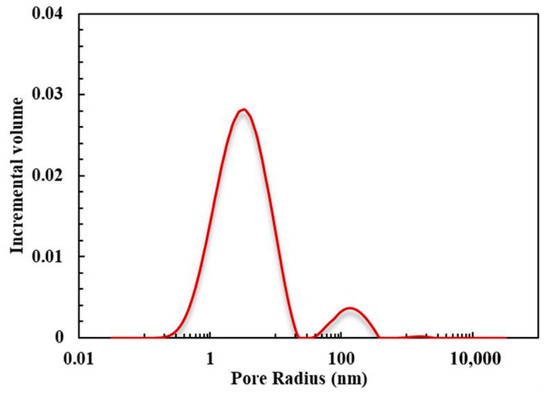
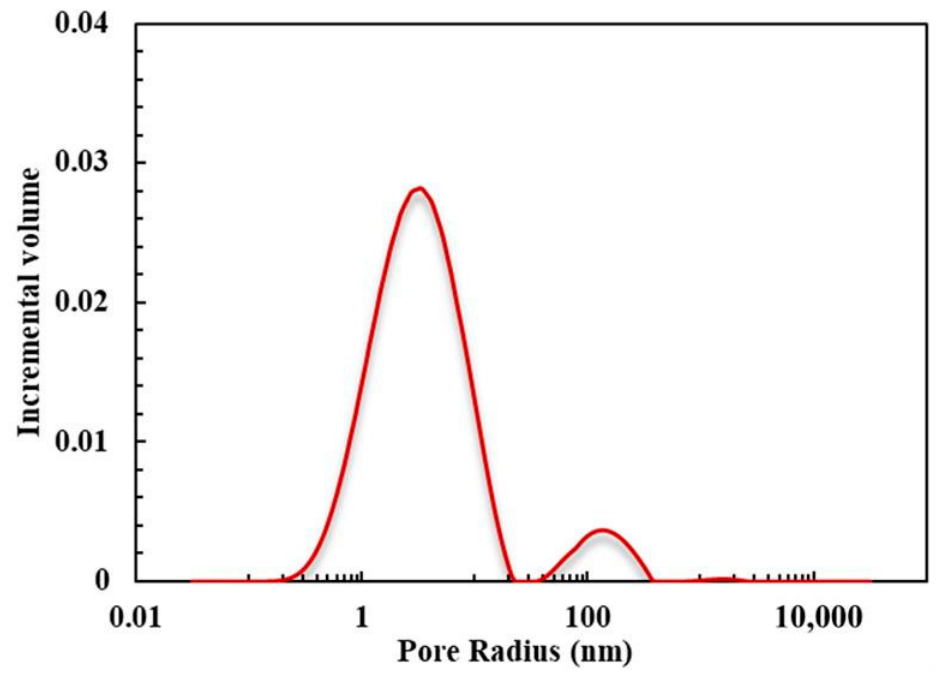
Regarding the surface relaxivity ρ2, Zheng et al. [37,38] summarized the relationship between ρ2 and vitrinite reflectance Ro based on systematic experimental studies. Their results show that surface relaxivity varies significantly among different coal ranks but exhibits minor variations within the same rank. Specifically, for high-rank coals, ρ2 ranges from 1.58 to 1.71 μm/s with an average of 1.6 μm/s. The samples in this study are high-rank coals. Thus, a surface relaxivity of 1.6 μm/s was adopted to convert the NMR T2 spectra into true full-scale pore size distributions, and the results are shown in Figure 7. Quantitative statistics indicate that micropores with pore diameters of less than 10 nm dominate the pore system, accounting for as much as 87% of the total pore volume. Meanwhile, it should be noted that, as the pore size is below 2 nm, the confinement effects result in ordered water arrangement, whose physical properties and relaxation behavior deviate significantly from those of bulk water. In this regime, the linear relationship between the T2 signal and pore radius breaks down [39]. However, in our subsequent analysis of gas–water dynamic evolution, pore diameters smaller than 2 nm are not involved. Therefore, the impact of surface relaxivity uncertainty on the results is limited.
Figure 7.
Full-scale pore size distribution of coal samples.
3.3. Dynamic Evolution of Displacement and Fluid Occurrence
3.3.1. Model Validation
To validate the reliability of the proposed models and to obtain the key parameters, model validation was performed using NMR centrifugation experimental data. The validation procedure was as follows: first, based on the PSD of the coal obtained from inversion of T2 spectra, the gas–water distribution model (Equations (1)–(8)) was used to calculate the variation in Sw of the experimental samples under different centrifugal pressures. Subsequently, the model predictions were compared with the water saturation measured experimentally to determine the key fitting parameters and to evaluate the predictive accuracy of the model.
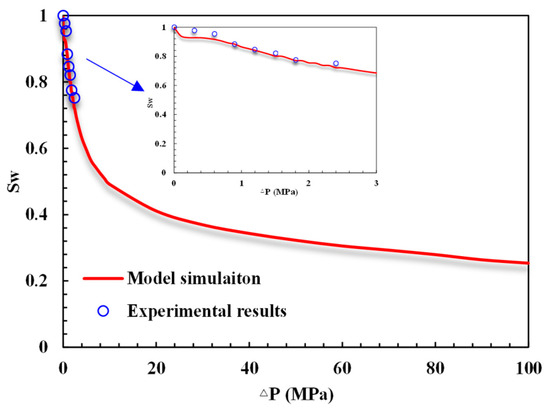
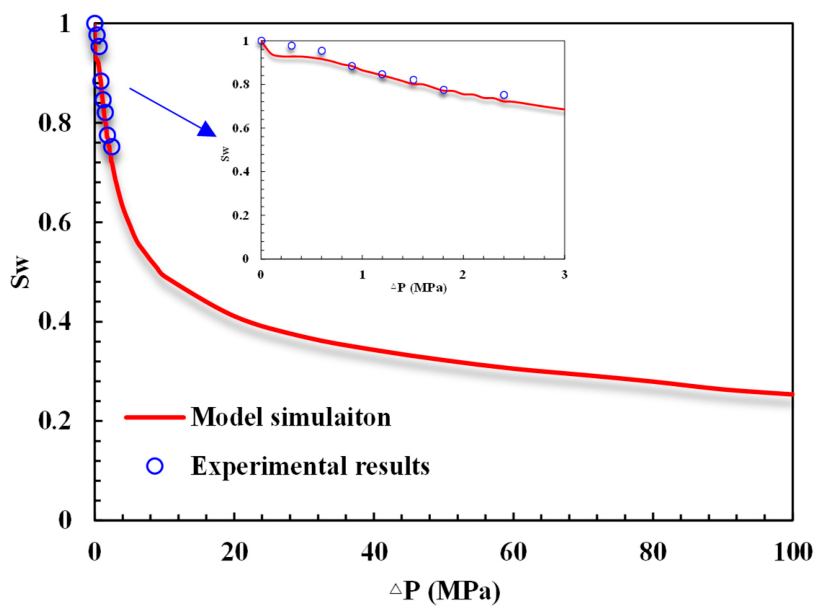
In the calculations, the disjoining pressure parameter AH served as the key fitting parameter, reflecting the strength of the interface interaction. By minimizing the discrepancy between the model predictions and the experimental data, the fitting yielded AH = 1.01 × 10⁻¹⁹ J. A comparison between the model predictions and the experimental measurements is shown in Figure 8. As demonstrated in this figure, the water saturation estimated by the proposed model is in good agreement with the experimental data under different centrifugal pressure conditions. Meanwhile, based on the seven experimental data points, the results were extended to a pressure of 100 MPa, showing that the variation trend of water saturation with pressure is smooth, confirming the numerical stability of the model in the high-pressure range. Thus, this result not only validates the reliability of the proposed model in describing the dynamic evolution of gas–water displacement in coal but also indicates that the selected disjoining pressure parameter reasonably reflects the microscopic mechanical mechanism of water film stability. In summary, the model proposed in this work can effectively predict the variation in water saturation across the full pore size range of coal, providing a theoretical basis for subsequent extrapolation studies of gas–water displacement behavior under deep reservoir conditions.
Figure 8.
Variation in water saturation of coal under different displacement pressures.
3.3.2. Gas–Water Occurrence and Dynamic Evolution in Nanopores
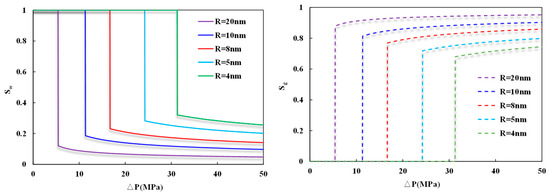
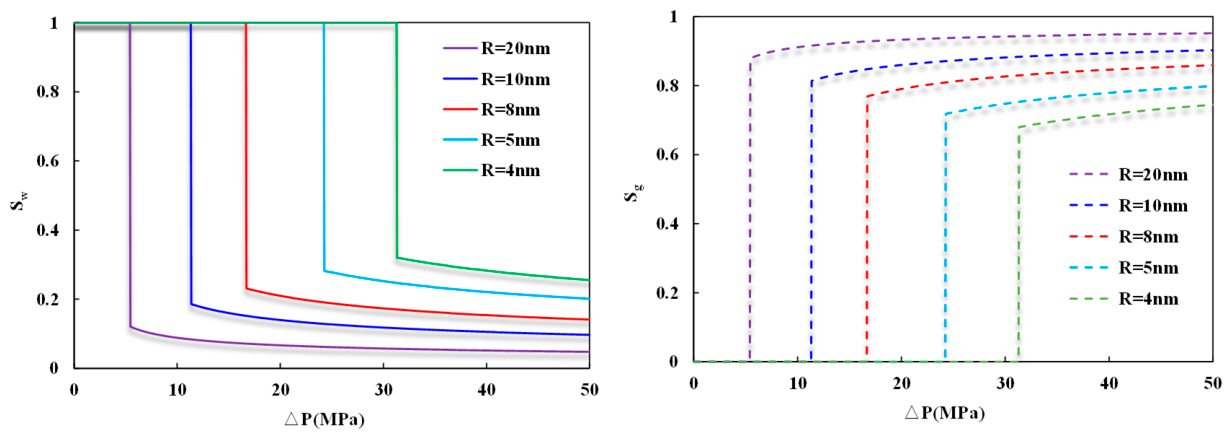
Based on the model established in this work and the obtained disjoining pressure parameter, the gas–water behavior and dynamic evolution in nanopores with different sizes were further simulated, and the results are shown in Figure 9. At the pore scale, the gas–water displacement process includes three stages. At the first stage, as the displacement pressure is below the critical displacement pressure, water in the pore is not displaced, and the water saturation remains at 100%. At the second stage, once the displacement pressure reaches the critical value, gas begins to enter the pore and displace the water, resulting in a sharp drop in water saturation. At the third stage, after most of the free water has been displaced, further increases in displacement pressure result in only a gradual decline in water saturation. This stage is mainly governed by the gradual thinning of the water film, reflecting the controlling role of disjoining pressure in stabilizing the water film.
Figure 9.
Dynamic evolution of gas–water displacement in nanopores of different sizes.
The critical displacement pressures and water film thicknesses for nanopores with different sizes are presented in Table 1. As the pore radius decreases, the critical displacement pressure increases significantly, while the critical water film thickness decreases gradually. However, the volume fraction of the water film relative to the pore space increases, indicating that stronger capillary retention in smaller pores leads to higher residual water saturation. Taking a pore with a radius of 10 nm as an example, as the displacement pressure reaches the critical value of 11.33 MPa, gas begins to enter the pore, with the water film occupying 19% of the pore volume. As the displacement pressure increases to 50 MPa, the water film thins further, and the gas saturation increases to 91%. In contrast, for a pore with a radius of 5 nm, the critical displacement pressure increases significantly to 24.32 MPa, with the water film accounting for 28%. As the displacement pressure increases to 50 MPa, the gas saturation reaches 80%, which is lower than that of the 10 nm pore under the same pressure. This difference further suggests that larger pores are more favorable for the accumulation of free gas.
Table 1.
Critical displacement pressures and water film thicknesses for pores of different sizes.
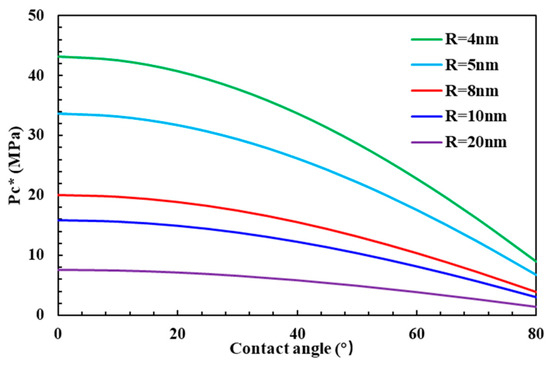
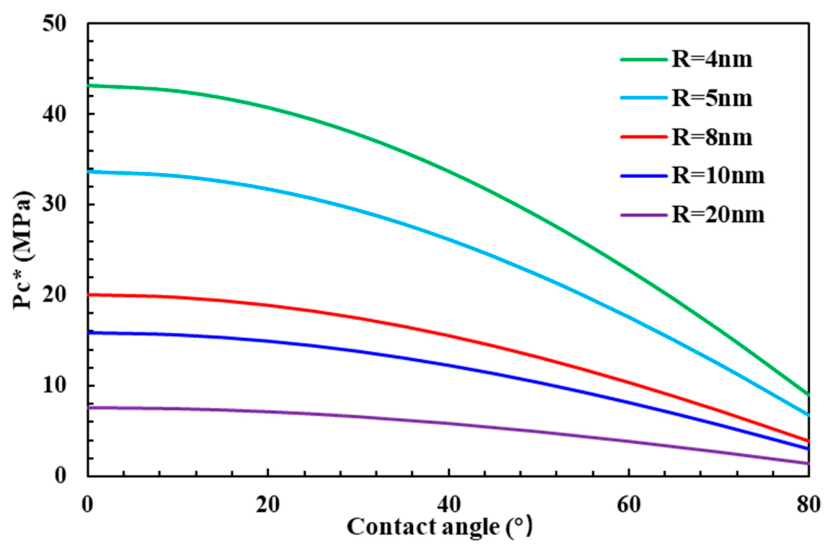
In addition to the parameters corresponding to the coal samples in this study, we further analyzed the effects of wettability and the disjoining pressure parameter A on the gas–water displacement process. Figure 10 shows the effect of wettability on critical displacement pressure. The results indicate that, as pore radius decreases or hydrophilicity increases, the critical displacement pressure gradually rises. This suggests that, during hydrocarbon expulsion, pores with larger sizes and larger contact angles are more easily displaced. Consequently, free gas preferentially enters these pores.
Figure 10.
Effect of wettability on critical displacement pressures.
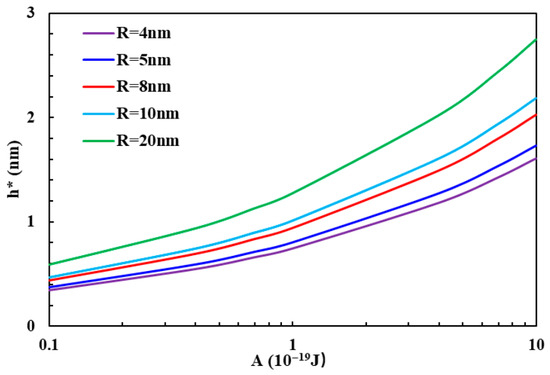
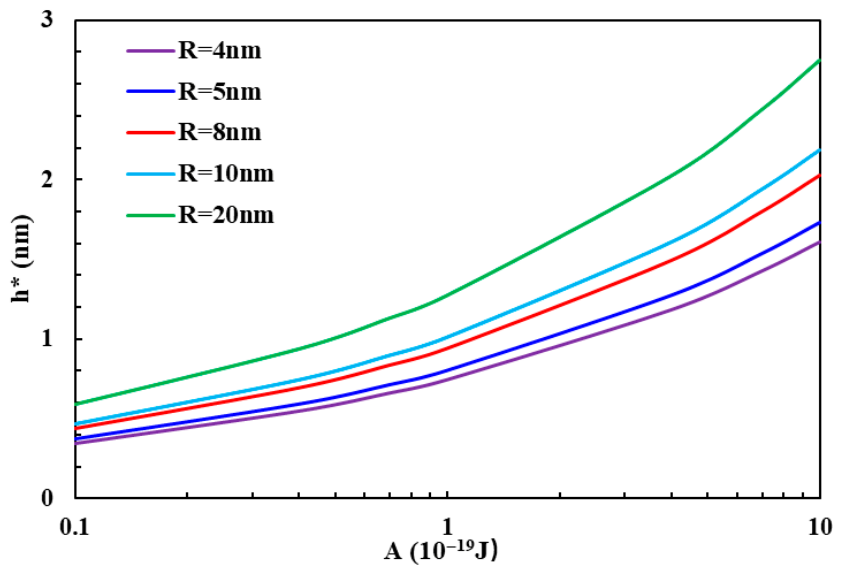
Figure 11 shows the effect of the disjoining pressure parameter AH on critical water film thickness. The results indicate that critical water film thickness increases with an increase in parameter AH. Actually, disjoining pressure describes the additional forces between the solid–liquid and liquid–gas interfaces, and its theoretical components include van der Waals forces, electrical double-layer forces, and structural forces [30]. The parameter A is an effective fitting parameter that reflects the interaction strength between different interfaces. A larger AH value indicates stronger solid–liquid interactions, making the water film more difficult to thin under the same displacement pressure. From the perspective of coal surface chemistry, parameter AH is expected to have a positive correlation with hydrophilic mineral content, oxygen-containing functional groups, and coal rank, which have been indirectly supported by previous studies [40,41]. For coals with different ranks or different mineral compositions, the AH value requires recalibration, but it can be inferred that, as coal rank increases, the coal matrix becomes more hydrophobic, thus AH tends to decrease. The fitted value AH = 1.01 × 10⁻¹⁹ J in this study is consistent with the overall water-wet characteristic of the samples, indicating relatively strong solid–liquid interactions. As the thermal maturity (Ro) of the experimental sample is 2.32%, it should be noted that their hydrophilicity mainly originates from hydrophilic minerals filling pores and fractures.
Figure 11.
Effect of disjoining pressure parameter A on critical water film thicknesses.
In summary, the presence of free gas in deep CBM is primarily attributed to the ability of deep hydrocarbon generation overpressure to overcome the capillary resistance of larger pores, thereby achieving efficient hydrocarbon expulsion and creating considerable storage space for free gas within the pore system. The occurrence and proportion of free gas are essentially controlled by the relative matching between pore-scale hydrocarbon expulsion and hydrocarbon generation overpressure.
3.3.3. Gas–Water Occurrence and Dynamic Evolution in Porous Media
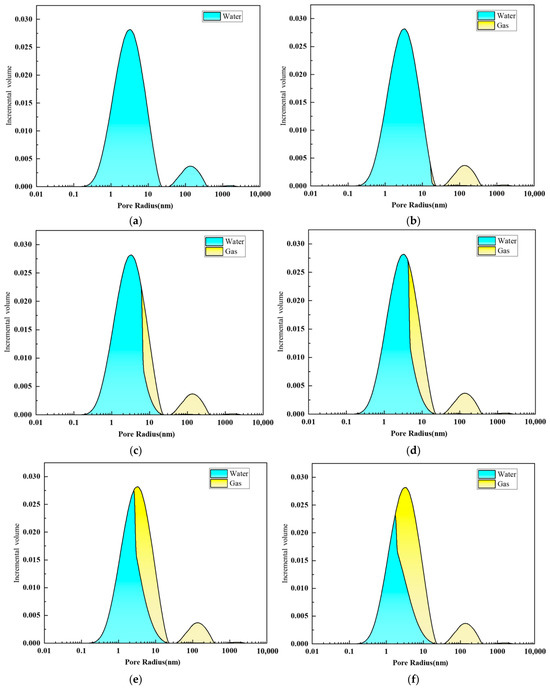
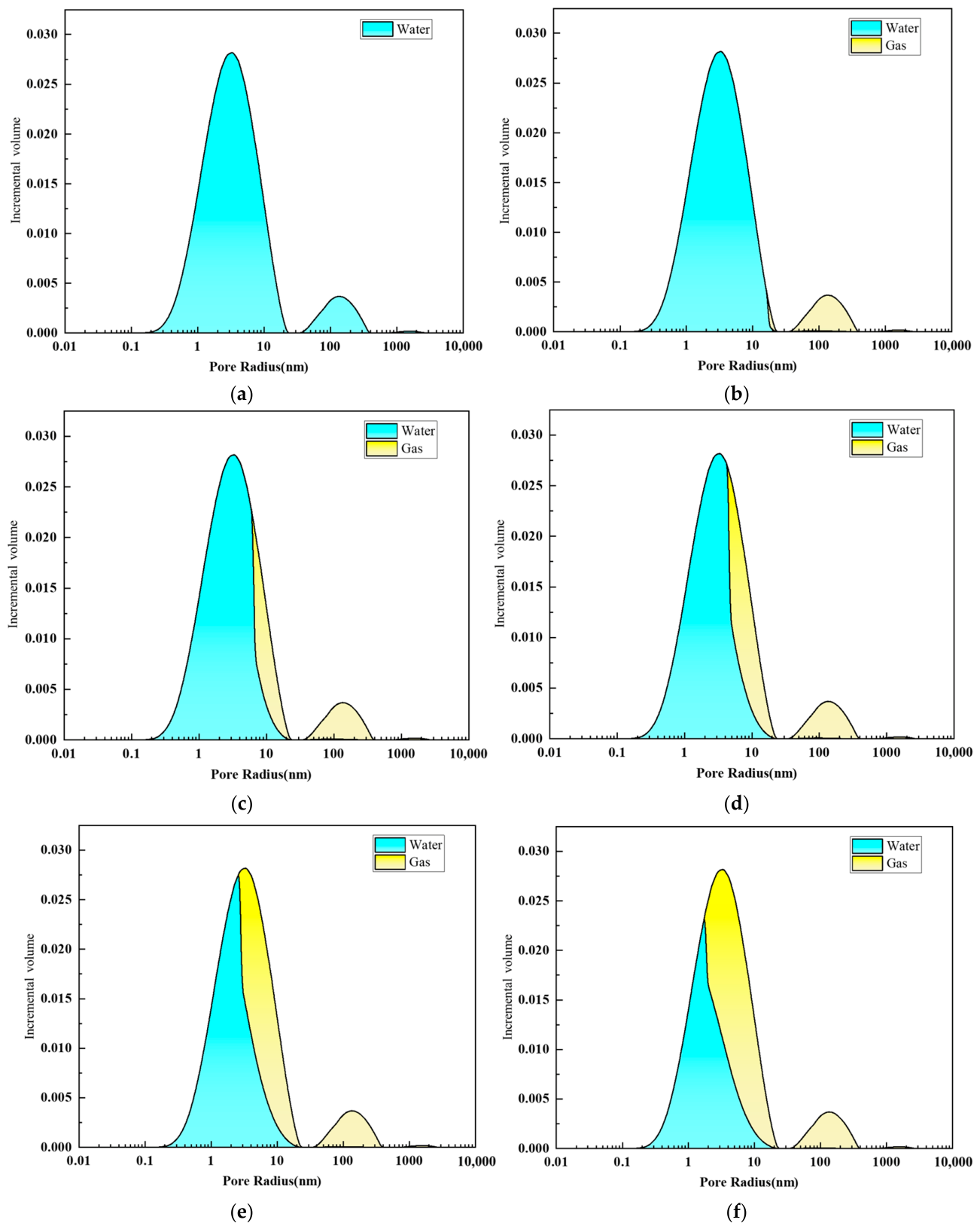
Coal rocks are porous media composed of pores with varying scales. The characteristics of gas–water occurrence and dynamic evolution in such systems are influenced not only by the behavior of individual pores but also by the combined effects of pore structure assemblages and displacement pressure. Building on the pore-scale simulations above, the dynamic evolution of displacement at the porous media scale was further simulated based on the pore size distribution of the experimental samples. The results are shown in Figure 12. It can be observed that, as the displacement pressure gradually increases, gas sequentially enters and displaces the water in pores of different sizes, with the displacement gradually extending to pores with smaller sizes. For the samples and conditions in this study, as the displacement pressure reaches 10 MPa, the overall water saturation of the porous media decreases to 49.15%, indicating that more than half of the pore space has been occupied by gas, forming considerable storage space for free gas. Notably, although a water film exists on all pore walls, its volume fraction exhibits a significant scale effect with pore size. When the pore radius exceeds 20 nm, the volume fraction of the water film is extremely small and can be essentially neglected. In contrast, when the pore radius is less than 20 nm, the volume fraction of the water film increases substantially and becomes a non-negligible component of water storage. This phenomenon reveals that, although the water film thickness is smaller in smaller pores, its relative volume fraction is higher due to stronger surface forces. Meanwhile, this value is not a fixed constant but a dynamic threshold controlled by the disjoining pressure parameter. It can be inferred from Figure 11 that this threshold increases with parameter A.
Figure 12.
The dynamic evolution of gas–water distribution in the porous media. (a) ΔP = 0 MPa, Sw = 100%. (b) ΔP = 0.5 MPa, Sw = 92.27%. (c) ΔP = 1.5 MPa, Sw = 80.15%. (d) ΔP = 2.5 MPa, Sw = 70%. (e) ΔP = 5.0 MPa, Sw = 59.63%. (f) ΔP = 10 MPa, Sw = 49.15%.
Overall, the gas saturation in deep CBM is not determined solely by the displacement pressure, but rather by the combined effects of displacement driving force, pore structure, and surface wettability. The differences in hydrocarbon expulsion efficiency among pores of different scales directly lead to the differentiation of gas-bearing systems. As the displacement pressure generated by hydrocarbon generation is sufficiently high to overcome the capillary resistance in most pores, especially larger ones, the displacement process occurs completely. Under such conditions, the residual water content in coal pores and fractures is extremely low, forming a storage space dominated by free gas. This type of system typically corresponds to high initial formation pressure and extremely low water saturation, representing the characteristics of high-yield deep CBM, which has been both geologically characterized and validated through production performance [42]. When the hydrocarbon generation pressure is insufficient to completely displace water from the pores, a large number of pores remain occupied by the water phase, while fractures or larger pores in the coal still contain formation water. In such cases, gas storage space is limited, and effective gas production relies on subsequent engineering measures such as dewatering and pressure depletion. Our work provides a microscopic mechanistic complement to the existing macroscopic understanding of free gas occurrence in deep coal seams, deepens the understanding of the dynamic displacement process, and offers a theoretical basis for predicting free gas-enriched zones and optimizing development strategies.
3.3.4. Limitations and Expectations
(1) In this study, cylindrical geometry and a connected coal network are assumed to establish the theoretical model. Therefore, the model results should be understood as predictions under idealized conditions or an equivalent treatment. Actually, SEM observations of real coal show a variety of pore shapes, including circular, slit-like, and irregular forms [43]. Corner water may exist in angular regions [44,45], leading to deviations in gas saturation predictions. In addition, real coal rocks contain numerous isolated pores or disconnected throats [46], where water is difficult to displace. The assumption that all pores are interconnected through a pore-throat system may overestimate water displacement efficiency and free gas content for coals with poor connectivity. Furthermore, the adsorption swelling effect of the coal matrix [47], which would further increase critical displacement pressures and reduce accessible pore space, is not incorporated in the current model. These aspects will be addressed in our future work.
(2) Wettability serves as the foundation for investigating the gas–water occurrence and dynamic evolution in coal. In this study, the coal samples overall exhibit water-wet characteristics, with hydrophilicity primarily arising from a relatively high content of hydrophilic minerals and the existence of oxygen-containing functional groups [40,41]. However, the above understanding cannot fully reflect the wettability heterogeneity of coal at the pore scale. Actual deep coal is a complex mixture, and its wettability exhibits significant variations at the nano-to-micrometer scale [48]. Some pores display hydrophobic characteristics while others remain strongly hydrophilic [49]. For the former, the hydrophobic surface makes the water film weak or even absent, resulting in a reduced A value, easier gas entry, and a lower critical displacement pressure. For the latter, the water film is stable with strong solid–liquid interactions, requiring a high critical displacement pressure for gas entry, which is consistent with our model [50]. The wettability heterogeneity exerts a considerable influence on the microscopic occurrence state of gas and water and on the dynamic displacement pathways [51]. In summary, due to the presence of locally hydrophobic regions, gas-driven water displacement may occur more easily than predicted. Building upon the findings of this study, future work will focus on the mechanisms by which wettability heterogeneity influences the dynamic evolution and occurrence of gas and water.
4. Conclusions
(1) For the high-rank coal samples in this study, pores smaller than 10 nm account for 87% of the total pore volume. Water saturation decreases with increasing centrifugal pressure, dropping to 75.21% at a centrifugal force of 2.4 MPa, indicating that conditions favorable for free gas accumulation have been established.
(2) A dynamic evolution model for gas-driven water displacement in nanopores is established by incorporating the effects of capillary pressure and disjoining pressure. The model defines the quantitative relationships between critical displacement pressure and water film thickness. Validated by centrifugation experimental data, the model effectively describes the dynamic variation in water film thickness with increasing displacement pressure and provides a tool for analyzing hydrocarbon overpressure-driven displacement in deep coal reservoirs.
(3) The displacement process in a single pore exhibits staged characteristics. Below the critical displacement pressure, water remains trapped and no displacement occurs. Once the critical pressure is exceeded, water saturation declines sharply as water is rapidly expelled. Subsequently, further pressure increases cause only a gradual decrease in water saturation, primarily due to progressive thinning of the water film. For a 10 nm coal pore in this study, the critical displacement pressure is 11.33 MPa with the water film accounting for 19% of the pore volume. For a 5 nm pore, the critical displacement pressure is 24.32 MPa with a water film volume fraction of 28%.
(4) Gas–water distribution in porous media is jointly controlled by pore structure and displacement pressure. Taking the high-rank coal samples from the Daning–Jixian Block as an example, as the displacement pressure reaches 10 MPa, the overall water saturation decreases to 49.15%. The volume fraction of water film is negligible as the pore radius exceeds 20 nm, whereas it becomes significant as the pore radius is less than 20 nm. This critical pore size is not a fixed constant but a dynamic threshold controlled by disjoining pressure parameter, and the general rules require more validation with additional samples and under diverse geological conditions in the future.
Author Contributions
Methodology, Y.W.; Validation, X.S.; Formal analysis, D.C. and W.S.; Investigation, W.S., Z.Z., H.H. and D.F.; Resources, Y.F. and M.W.; Data curation, S.L.; Writing—original draft, D.F.; Writing—review and editing, D.F.; Funding acquisition, Y.W. All authors have read and agreed to the published version of the manuscript.
Funding
This work is supported by the National Science and Technology Major Project of China (No. 2025ZD1405702), and the Scientific Research and Technology Development Project of PetroChina Coalbed Methane Co., Ltd. (Project No. 25MQCTSG010).
Data Availability Statement
The data presented in this study are available on request from the corresponding author.
Conflicts of Interest
Author Yuan Wang, Dong Chen, Wei Sun, Yanqing Feng, Shirui Liu, Zengping Zhao, Hongxing Huang, Xiaosong Shi, Mansheng Wu were employed by the company of National Engineering Research Center of China United Coalbed Methane Corp., Ltd. and PetroChina Coalbed Methane Company Limited. The remaining authors declare that the research was conducted in the absence of any commercial or financial relationships that could be construed as a potential conflict of interest.
References
- Zou, C.N.; Xiong, B.; Xue, H.Q.; Zheng, D.; Ge, Z.X.; Wang, Y.; Jiang, L.Y.; Pan, S.Q.; Wu, S.T. The role of new energy in carbon neutral. Pet. Explor. Dev. 2021, 48, 480–491. [Google Scholar] [CrossRef] [Scilit]
- Li, S.; Qin, Y.; Tang, D.; Shen, J.; Wang, J.; Chen, S.A. comprehensive review of deep coalbed methane and recent developments in China. Int. J. Coal Geol. 2023, 279, 104369. [Google Scholar] [CrossRef] [Scilit]
- Wang, X.; Duan, L.; Zhang, S.; Tang, S.; Lv, J.; Li, X. A New Method for Numerical Simulation of Coalbed Methane Pilot Horizontal Wells—Taking the Bowen Basin C Pilot Area in Australia as an Example. Processes 2024, 12, 616. [Google Scholar] [CrossRef] [Scilit]
- Joshi, D.; Prajapati, P.; Sharma, P.; Sharma, A. Past, present and future of Coal Bed Methane (CBM): A review with special focus on the Indian scenario. Int. J. Coal Prep. Util. 2023, 43, 377–402. [Google Scholar] [CrossRef] [Scilit]
- Qin, Y.; Moore, T.A.; Shen, J.; Yang, Z.; Shen, Y.; Wang, G. Resources and geology of coalbed methane in China: A review. In Coal Geology of China; Routledge: London, UK, 2020; pp. 247–282. [Google Scholar]
- Xue, Y.; Li, X.; Wang, L.; Liu, Y.; Cao, X.; Zhang, Y. Mesoscopic damage enhancement in granite under cyclic liquid nitrogen shocks characterized by computed tomography and texture analysis. Int. J. Rock. Mech. Min. Sci. 2025, 194, 106217. [Google Scholar] [CrossRef] [Scilit]
- Li, X.; Zhu, L.; Liu, J.; Cao, Z.; Xue, Y.; Dang, F. Fracture evolution and mechanical deterioration of granite under cyclic thermal and liquid nitrogen cryogenic impact. Phys. Fluids 2025, 37, 086652. [Google Scholar] [CrossRef] [Scilit]
- Li, C.L.; Yang, Z.B.; Yan, X.; Zhou, G.X.; Wang, G.; Gao, W.; Liu, C.Q.; Lu, B.J.; Liang, Y.H. Distribution law of occurrence state and content prediction of deep CBM: A case study in the Ordos Basin. China Nat. Resour. Res. 2024, 33, 1843–1869. [Google Scholar] [CrossRef] [Scilit]
- Zhou, L.; Li, Y.; Ding, R.; Xiong, X.; Hou, W.; Li, Y.; Ma, H.; Fu, H.; Du, Y.; Zhang, W.; et al. Differential accumulation characteristics and production of coalbed methane/coal-rock gas: A case study of the No. 8 coal seam of the Carboniferous Benxi Formation in the Daji block, Ordos Basin, NW China. Pet. Explor. Dev. 2025, 52, 872–882. [Google Scholar] [CrossRef] [Scilit]
- Li, H.Q.; Zhou, G.X.; Chen, S.D.; Li, S.; Tang, D.Z. In situ gas content and extraction potential of ultra-deep coalbed methane in the Sichuan Basin, China. Nat. Resour. Res. 2025, 34, 563–579. [Google Scholar] [CrossRef] [Scilit]
- Wang, Z.; Liu, D.; Yao, Y.; Li, P.; Sun, X.; Feng, D.; Duan, J. Occurrence state of deep coalbed methane: A study considering the co-evolution of stress and pore structure. Fuel 2026, 407, 137418. [Google Scholar] [CrossRef] [Scilit]
- Yan, X.; Xu, F.Y.; Xiong, X.Y.; Wang, F.; Li, C.H.; Zhang, J.Y.; Xu, B.; Cheng, Q.; Hu, X.; Zhu, X.; et al. Key experimental technology of deep CBM exploration and development and its development direction. Coal Geol. Explor. 2025, 53, 128–141. [Google Scholar]
- Qu, J.; Shen, J.; Li, C.; Qin, Y.; Zhang, H.; Li, G.; Cai, H. Characteristics, mechanism and prediction model of water saturation variation during gas and water interaction in deep coal reservoirs. Energy 2025, 320, 135042. [Google Scholar] [CrossRef] [Scilit]
- Liu, H.L.; Wang, H.C.; Deng, Z.; Huang, D.J. Discussion on the characteristics and genetic mechanism of highly mineralized formation water in deep coal-rock gas reservoirs of the Ordos Basin. Nat. Gas. Ind. 2025, 45, 17–29. [Google Scholar]
- Wang, X.; Jin, Z.; Cao, M.; Li, X.; Wang, H.; Zeng, Q.; Liu, K. Daily gas production prediction for a single CBM well using an integrated framework of temporal-multivariate dependency simultaneous modeling: A case study. Energy 2025, 342, 139527. [Google Scholar] [CrossRef] [Scilit]
- Hu, A.; Li, K.; Yao, C.; Zhu, X.; Chang, H.; Mao, Z.; Ma, X. Research and Application of Deep Coalbed Gas Production Capacity Prediction Models. Processes 2025, 13, 3149. [Google Scholar] [CrossRef] [Scilit]
- Li, J.; Cui, M.; Zhang, J.; Liu, L.; Qu, J.; Li, W. Experimental study on dynamic occurrence and migration of gas and water in deep coal measure reservoirs in Yan’an area of Eastern Ordos Basin. Fuel 2025, 405, 136654. [Google Scholar] [CrossRef] [Scilit]
- Zhang, Z.; Li, S.; Xiao, R.; Feng, P.; Zhou, H. Mechanisms and Predictive Modeling of Deep Coalbed Methane Enrichment: Insights from the Jinzhong Block, Qinshui Basin. Energy Fuels 2026, 40, 6103–6116. [Google Scholar] [CrossRef] [Scilit]
- Sakurovs, R.; Koval, L.; Grigore, M.; Sokolova, A.; Ruppert, L.F.; Melnichenko, Y.B. Nanometre-sized pores in coal: Variations between coal basins and coal origin. Int. J. Coal Geol. 2018, 186, 126–134. [Google Scholar] [CrossRef] [Scilit]
- Hazra, B.; Wood, D.A.; Panda, M.; Sethi, C.; Vishal, V.; Chandra, D.; Ostadhassan, M. Pore structural complexities and gas storage capacity of Indian coals with various thermal maturities. Energy Fuels 2025, 39, 5818–5831. [Google Scholar] [CrossRef] [Scilit]
- Wang, J.; Lao, J.; Zhou, Y.; Luo, X.; Du, S.; Song, H. In-depth review of colloidal and interfacial fundamentals in fracturing development of deep coal seam methane. Adv. Colloid Interface Sci. 2025, 344, 103611. [Google Scholar] [CrossRef] [Scilit] [PubMed]
- Feng, D.; Chen, Z.; Wu, K.; Li, J.; Dong, X.; Peng, Y.; Wang, D. A comprehensive review on the flow behaviour in shale gas reservoirs: Multi-scale, multi-phase, and multi-physics. Can. J. Chem. Eng. 2022, 100, 3084–3122. [Google Scholar] [CrossRef] [Scilit]
- Wen, H.; Zhai, C.; Xu, J.; Sun, Y.; Wu, F.; Xu, H.; Wang, Y. Pore characterization of coal cuttings based on low-field nuclear magnetic resonance: A new method. Fuel 2026, 406, 137066. [Google Scholar] [CrossRef] [Scilit]
- Quan, F.; Lu, W.; Song, Y.; Sheng, W.; Qin, Z.; Luo, H. Multifractal characterization of heterogeneous pore water redistribution and its influence on permeability during depletion: Insights from centrifugal NMR analysis. Fractal Fract. 2025, 9, 536. [Google Scholar] [CrossRef] [Scilit]
- Kang, Y.; Li, P.; Cao, W.; Chen, M.; You, L.; Liu, J.; Lai, Z. Investigation of pore structure alteration and permeability enhancement of shale matrix by supercritical water treatment after hydraulic fracturing. Petroleum 2024, 10, 265–274. [Google Scholar] [CrossRef] [Scilit]
- Feng, D.; Wu, K.; Wang, X.; Li, J.; Li, X. Modeling the confined fluid flow in micro-nanoporous media under geological temperature and pressure. Int. J. Heat Mass Transf. 2019, 145, 118758. [Google Scholar] [CrossRef] [Scilit]
- Feng, D.; Li, X.; Wang, X.; Li, J.; Sun, F.; Sun, Z.; Zhang, T.; Li, P.; Chen, Y.; Zhang, X. Water adsorption and its impact on the pore structure characteristics of shale clay. Appl. Clay Sci. 2018, 155, 126–138. [Google Scholar] [CrossRef] [Scilit]
- Feng, D.; Bakhshian, S.; Wu, K.; Song, Z.; Ren, B.; Li, J.; Hosseini, S.A.; Li, X. Wettability effects on phase behavior and interfacial tension in shale nanopores. Fuel 2021, 290, 119983. [Google Scholar] [CrossRef] [Scilit]
- Wang, Y.H.; Lei, Z.D.; Liu, Y.S.; Pan, X.X.; Chen, Z.W.; Zhang, Y.Q.; Zheng, X.Y.; Liu, P.C. Phase behavior of CO2-shale oil in nanopores. Pet. Explor. Dev. 2025, 52, 182–195. [Google Scholar] [CrossRef] [Scilit]
- Israelachvili, J.N. Intermolecular and Surface Forces: Revised, 3rd ed.; Academic Press: Cambridge, MA, USA, 2011. [Google Scholar]
- Gee, M.L.; Healy, T.W.; White, L.R. Hydrophobicity effects in the condensation of water films on quartz. J. Colloid Interface Sci. 1990, 140, 450–465. [Google Scholar] [CrossRef] [Scilit]
- Liu, D.; Zhao, Z.; Cai, Y.; Xu, S.; Qiu, F.; Sun, F. Review on Deep Coal Measure Gas Accumulation and Its Geological Effects of Efficient Coproduction. Energy Fuels 2025, 39, 14437–14454. [Google Scholar] [CrossRef] [Scilit]
- Chen, J.; Huang, Z.; Yao, G.; Zhang, W.; Pan, Y.; Qu, T. Analysis Method of Full-Scale Pore Distribution Based on MICP, CT Scanning, NMR, and Cast Thin Section Imaging—A Case Study of Paleogene Sandstone in Xihu Sag, East China Sea Basin. Processes 2023, 11, 1869. [Google Scholar] [CrossRef] [Scilit]
- Benavides, F.; Leiderman, R.; Souza, A.; Carneiro, G.; de Vasconcellos Azeredo, R.B. Pore size distribution from NMR and image based methods: A comparative study. J. Pet. Sci. Eng. 2020, 184, 106321. [Google Scholar] [CrossRef] [Scilit]
- Zhang, Z.; Cui, C.; Wu, Z.; Wang, Y.; Gao, X.; Wang, J. Heterogeneity of fluid distribution in shale based on nuclear magnetic resonance dual T2 cutoff values. SPE J. 2025, 30, 3567–3586. [Google Scholar] [CrossRef] [Scilit]
- Zheng, S.; Yao, Y.; Liu, D.; Sang, S.; Liu, S.; Wang, M.; Liu, T. Re-evaluating the accurate multiphase water distribution in coals: Unifying experiment and theory. Chem. Eng. J. 2023, 464, 142637. [Google Scholar] [CrossRef] [Scilit]
- Zheng, S.; Yao, Y.; Elsworth, D.; Wang, B.; Liu, Y. A novel pore size classification method of coals: Investigation based on NMR relaxation. J. Nat. Gas. Sci. Eng. 2020, 81, 103466. [Google Scholar] [CrossRef] [Scilit]
- Zheng, S.; Yao, Y.; Liu, D.; Cai, Y.; Liu, Y.; Li, X. Nuclear magnetic resonance T2 cutoffs of coals: A novel method by multifractal analysis theory. Fuel 2019, 241, 715–724. [Google Scholar] [CrossRef] [Scilit]
- Tian, H.; Weng, H.; Zhu, Z.; Fan, Q.; Xue, D.; Zheng, Y.; Chen, P.; Wei, C. Nuclear magnetic resonance relaxometry for pore size distribution in porous media: Accounting for diffusional coupling. J. Rock. Mech. Geotech. Eng. 2025; in press. [CrossRef] [Scilit]
- Zou, M.; Liu, Y.; Huang, Z.; Zhang, M.; Zhang, P. Geological control of irreducible water within the coal matrix. ACS Omega 2020, 5, 9540–9549. [Google Scholar] [CrossRef] [Scilit] [PubMed]
- Liu, X.; Li, C.; Nie, B.; Li, J.; Jia, X.; He, C.; Han, H.; Qi, L.; Li, Z.; Wang, J. Experimental and molecular dynamics investigations on the effects of surfactant on the wettability of coal. Energy 2025, 334, 137571. [Google Scholar] [CrossRef] [Scilit]
- Li, G.X.; Zhang, S.C.; He, H.Q.; He, X.X.; Zhao, Z.; Niu, X.B.; Xiong, X.; Zhao, Q.; Guo, X.; Hou, Y.T.; et al. Coal-rock gas: Concept, connotation and classification Criteria. Pet. Explor. Dev. 2024, 51, 897–911. [Google Scholar] [CrossRef] [Scilit]
- Zang, J.; Liu, J.; He, J.; Zhang, X. Characterization of the pore structure in Chinese anthracite coal using FIB-SEM tomography and deep learning-based segmentation. Energy 2023, 282, 128686. [Google Scholar] [CrossRef] [Scilit]
- Zhu, Q.; Wu, K.; Wang, T.; Zhang, S.; Tao, Z.; Li, J.; Chen, Z. Effect of corner film flow on two-phase relative permeability: A pore-scale perspective. Phys. Fluids 2025, 37, 122022. [Google Scholar] [CrossRef] [Scilit]
- Li, J.; Chen, Z.; Wu, K.; Zhang, T.; Zhang, R.; Xu, J.; Li, R.; Qu, S.; Shi, J.; Li, X. Effect of water saturation on gas slippage in circular and angular pores. AIChE J. 2018, 64, 3529–3541. [Google Scholar] [CrossRef] [Scilit]
- Yuan, Y.; Tang, Y.; Tong, L.; Cao, D.; Wei, Y.; Bi, C. Porosity Characteristics of Coal Seams and the Control Mechanisms of Coal Petrology in the Xishanyao Formation in the Western Part of the Southern Junggar Basin. Minerals 2024, 14, 543. [Google Scholar] [CrossRef] [Scilit]
- Miao, Y.; Li, X.; Zhou, Y.; Wu, K.; Chang, Y.; Xiao, Z.; Wu, Z.; Lin, W. A dynamic predictive permeability model in coal reservoirs: Effects of shrinkage behavior caused by water desorption. J. Pet. Sci. Eng. 2018, 168, 533–541. [Google Scholar] [CrossRef] [Scilit]
- Ma, S.; Lin, B.; Zhao, J.; Zhang, X.; Liu, Q.; Liu, T. Influence of high-temperature CO2 in hot flue gas on the wettability of coal surface: Experimental and molecular simulation study. Gas. Sci. Eng. 2025, 140, 205671. [Google Scholar] [CrossRef] [Scilit]
- Li, L.; Wang, J.; Hou, Y.; Zhang, H.; Yan, X.; He, M.; You, X. Study on the effect of cashew phenol-based surfactants on the wettability of coal surface using molecular dynamics simulation. Appl. Surf. Sci. 2025, 715, 164557. [Google Scholar] [CrossRef] [Scilit]
- Ma, R.; Yao, Y.; Feng, D.; Hu, X.; Sun, X.; Vandeginste, V. Effects of inorganic salt ions on the wettability of deep coal seams: Insights from experiments and molecular simulations. Appl. Surf. Sci. 2024, 672, 160832. [Google Scholar] [CrossRef] [Scilit]
- Zhang, S.; Li, J.; Coelho, R.C.; Wu, K.; Zhu, Q.; Guo, S.; Chen, Z. Lattice Boltzmann modeling of forced imbibition dynamics in dual-wetted porous media. Int. J. Multiph. Flow 2025, 182, 105035. [Google Scholar] [CrossRef] [Scilit]

Disclaimer/Publisher’s Note: The statements, opinions and data contained in all publications are solely those of the individual author(s) and contributor(s) and not of MDPI and/or the editor(s). MDPI and/or the editor(s) disclaim responsibility for any injury to people or property resulting from any ideas, methods, instructions or products referred to in the content. |
© 2026 by the authors. Licensee MDPI, Basel, Switzerland. This article is an open access article distributed under the terms and conditions of the Creative Commons Attribution (CC BY) license.