1. Introduction
Relative permeability (
Kr) characterizes the effective transport capacity of a fluid phase in the presence of other immiscible phases. As a cornerstone of the multiphase Darcy law,
Kr is an indispensable input parameter for macro-scale numerical models and plays a decisive role in predicting multiphase flow behavior [
1,
2]. In petroleum engineering,
Kr directly governs the relative mobility of fluids during displacement, thereby determining sweep efficiency and ultimate recovery factors, particularly in the design of enhanced oil recovery schemes [
3]. For carbon capture and storage,
Kr characteristics are essential for predicting CO
2 plume migration, assessing storage capacity, and evaluating long-term containment integrity [
4,
5]. In environmental engineering,
Kr dictates the migration, distribution, and entrapment of non-aqueous phase liquids and associated contaminants in subsurface formations [
6]. Furthermore, in emerging sectors such as geothermal energy and underground hydrogen storage,
Kr determines injection capacities, plume evolution, and overall system operational safety [
7]. Consequently, the accurate determination of reliable relative permeability curves is of paramount importance for both fundamental research and engineering applications in porous media.
Traditional methods for acquiring
Kr curves rely heavily on laboratory core flooding experiments, categorized as either unsteady-state or steady-state based on the attainment of dynamic equilibrium [
8,
9]. While the unsteady-state method is widely adopted in industry due to its relative simplicity and shorter duration, its results depend significantly on theoretical assumptions such as the Johnson–Bossler–Naumann (JBN) method. This often leads to non-unique solutions and high sensitivity to model assumptions and boundary treatments [
10]. Conversely, the steady-state method involves co-injecting phases at fixed ratios until flow rates and pressure gradients stabilize, allowing for direct calculation via Darcy’s law. Given its robust theoretical foundation and physical clarity, it is universally regarded as the benchmark for
Kr measurement and model validation [
11]. Beyond experimental means, theoretical frameworks like the Corey-type empirical models are utilized for their simplicity. Furthermore, navigating the wide variety of permeability models developed for complex multiphase systems presents a significant challenge. Recent studies have systematically demonstrated the complex equivalency and replaceability among different macroscopic permeability forms, highlighting the critical need for robust model selection and accurate parameter assignment to reduce uncertainties in simulation inputs [
12]. However, these macroscopic empirical models often fail to capture the complex pore geometries and multiphase mechanisms inherent in real media [
13,
14]. Recent advancements, such as dual-wettability network theories [
15] and connectedness theory [
16], have redefined
Kr through the lens of microscopic topology, explaining why the sum of phases typically yields less than unity. Nevertheless, these theories often depend on idealized structural assumptions, limiting their quantitative predictive capacity.
With the rapid development of computational techniques, pore-scale flow simulation has become a vital tool for
Kr research. By explicitly resolving pore geometries and the dynamic evolution of fluid-fluid and fluid-solid interfaces, these methods elucidate multiphase flow mechanisms [
13,
17]. Prominent approaches include pore network modeling [
18,
19], direct numerical simulation [
20], and the lattice Boltzmann method (LBM) [
21,
22,
23]. LBM, in particular, has gained traction for its ability to naturally handle complex boundaries and multiphase interfaces [
21,
24]. Previous LBM studies have identified phenomena such as the lubrication effect, where non-wetting phase permeability can exceed single-phase limits (
Kr,nw > 1) [
25], and the significant attenuation of non-wetting phase mobility due to wettability alterations [
26]. Recent investigations have further explored heterogeneous wettability [
27], 3D fractured-porous structures [
28], and the sensitivity of
Kr curves to capillary number (
Ca) and viscosity ratios (
M) [
29,
30]. In summary, an extensive body of literature has systematically examined the impact of critical parameters on relative permeability and elucidated complex pore-scale mechanisms, including droplet fragmentation, snap-off, the topological evolution of phase connectivity, and flow intermittency. These insights have established a robust physical framework for interpreting the emergent macroscopic behavior of relative permeability [
31,
32,
33].
Despite these advancements, a critical factor has been systematically overlooked: the influence of initial fluid distribution (IFD) on steady-state relative permeability. In most existing pore-scale simulations, initial conditions are constructed by randomly assigning fluid phases at a target saturation, implicitly assuming that microscopic distribution variance at a constant saturation is negligible. From a pore-scale perspective, this assumption is often invalid. The IFD fundamentally dictates phase connectivity, cluster morphology, interfacial configurations, and potential flow pathways. Even at identical saturations, disparate initial configurations can yield significantly different flow paths and pressure-drop responses, particularly in capillary-dominated regimes (low
Ca). This discrepancy may introduce substantial dispersion and uncertainty into steady-state
Kr results. While experimental evidence suggests flow behavior is path-dependent [
8], systematic quantification of IFD-induced uncertainty within numerical frameworks remains scarce. Ignoring this factor introduces stochasticity into single-run simulations, potentially undermining the reliability of upscaling pore-scale predictions to macro-scale models.
Motivated by these considerations, this work employs a color-gradient LBM to systematically investigate the impact of IFD on steady-state relative permeability and its associated uncertainty. Extensive parallel simulations were conducted across two porous media under diverse Ca and M combinations. The primary objective is to quantitatively evaluate the variance and statistical uncertainty of Kr under different IFD conditions and to explore the broader implications of this uncertainty for pore-scale prediction and multiscale modeling.
3. Results and Discussion
To systematically investigate the influence of IFD on relative permeability curves and multiphase flow patterns, steady-state simulations were conducted across different
Ca and
M. In this work, the capillary number is defined as the ratio of the applied body force to the interfacial tension,
, where
F represents the uniform body force (equivalent to the pressure gradient). This definition follows the work of Yiotis et al. [
46] and offers the distinct advantage of bypassing the need for a predefined injection velocity, thereby facilitating the implementation of periodic boundary conditions.
M is defined as the ratio of the non-wetting phase viscosity to that of the wetting phase (
). The investigation focuses on unfavorable displacement regimes where
M > 1. Furthermore, a constant contact angle of 30° was prescribed to emulate the characteristic behavior of oil-water systems in water-wet porous media. Detailed simulation parameters are summarized in
Table 1. In addition, to ensure the universality of the results, all physical quantities are reported in lattice units.
3.1. Effects of Ca and M on Relative Permeability Curves
For each combination of
Ca and
M, five specific
Sw were evaluated. To rigorously examine the influence of IFD on transport behavior, six independent simulations were performed for each saturation point, comprising three representative IFD patterns with two replicates each, resulting in a total of 240 numerical experiments. The derived relative permeability curves under varying
Ca and
M conditions are illustrated in
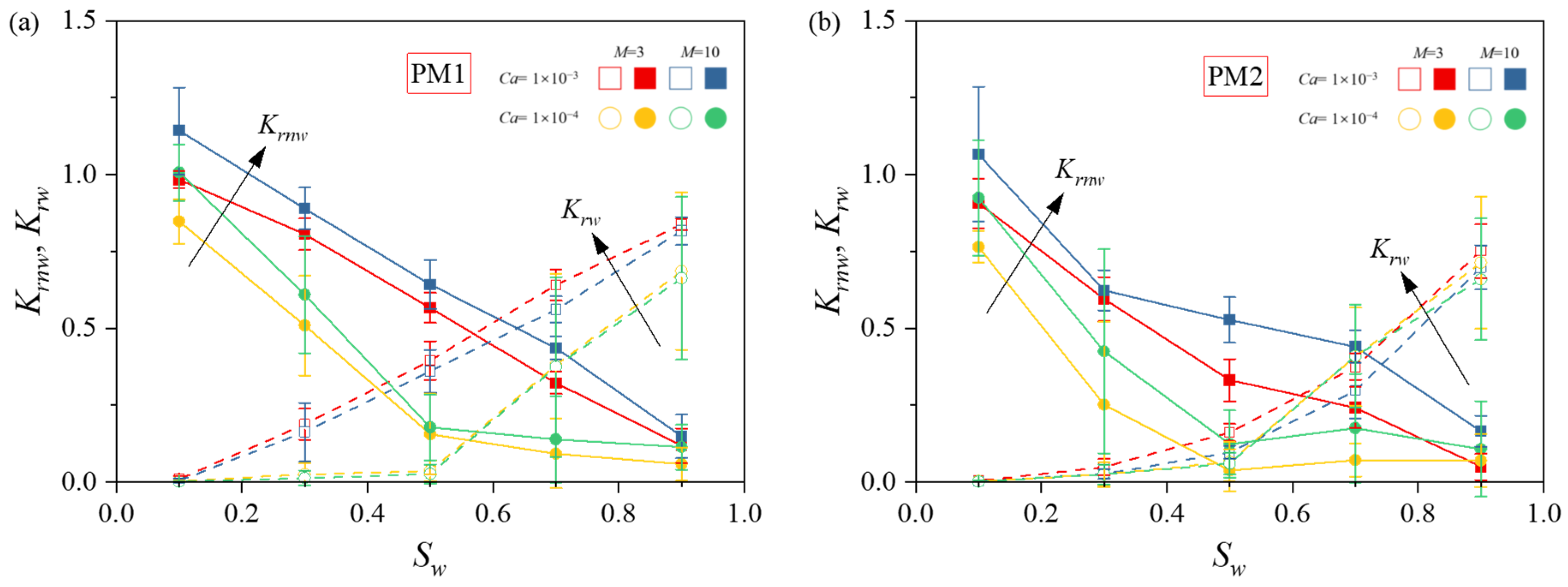
Figure 3. In addition to the ensemble-averaged trends, the discrete nature and fluctuational characteristics arising from varying IFDs are quantified via standard deviation error bars.
As depicted in
Figure 3a,
Krnw monotonically decreases while
Krw increases with rising
Sw, consistent with classical multiphase flow theory wherein increased wetting-phase saturation enhances phase connectivity. Across the investigated
Ca range, the increasing
M significantly impedes wetting-phase mobility while promoting non-wetting phase transport. Under unfavorable viscosity ratios, the high-viscosity non-wetting phase tends to form continuous, preferential flow paths, whereas the low-viscosity wetting phase is relegated to pore corners or grain surfaces, encountering higher flow resistance. At lower
Ca, the sensitivity of relative permeability to
M diminishes, with the wetting phase exhibiting lower statistical variance than the non-wetting phase. Furthermore, both phases show enhanced mobility with increasing
Ca, although this sensitivity wanes near the curve endpoints, suggesting that flow becomes dominated by the pore connectivity rather than the external pressure gradient. The fact that the
Krw endpoints are consistently lower than those of
Krnw further substantiates the strong hydrophilicity of the medium. Overall, the influence of
Ca on the
Kr curves outweighs that of
M. When the viscous effect become more significant (high
Ca),
Kr exhibits a near-linear response to saturation over a broad flow window; however, at
Ca = 1 × 10
−4, capillary trapping intensifies, leading to a drastic morphological shift in the curves, characterized by a distinct slope discontinuity near
Sw = 0.5.
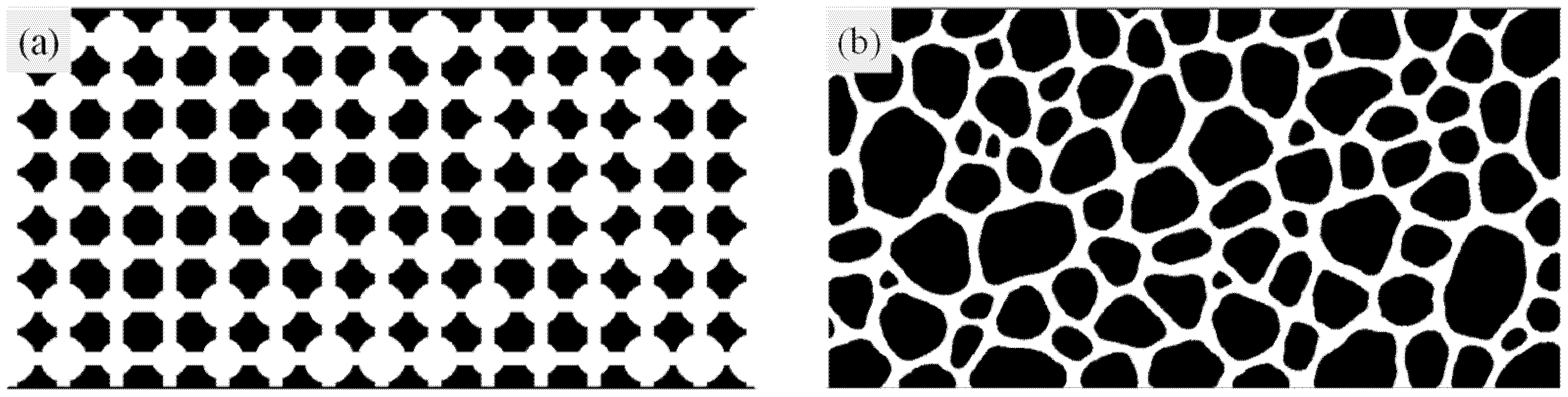
Figure 3b reveals more complex nonlinear evolution in the PM2 model. The more complex structure induces an exponential growth of
Krw with
Sw. Notably, at
Ca = 1 × 10
−4 and
Sw > 0.5, an anomalous increase in
Krnw with saturation is observed. While similar behaviors have been noted by Munarin et al. [
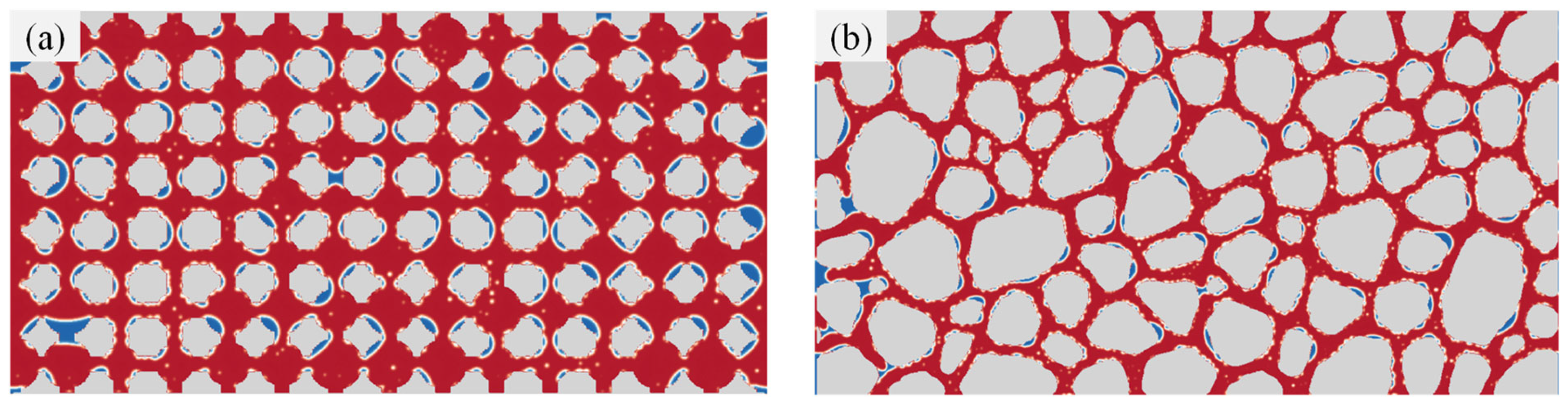
28], the current study elucidates the topological roots of this phenomenon in
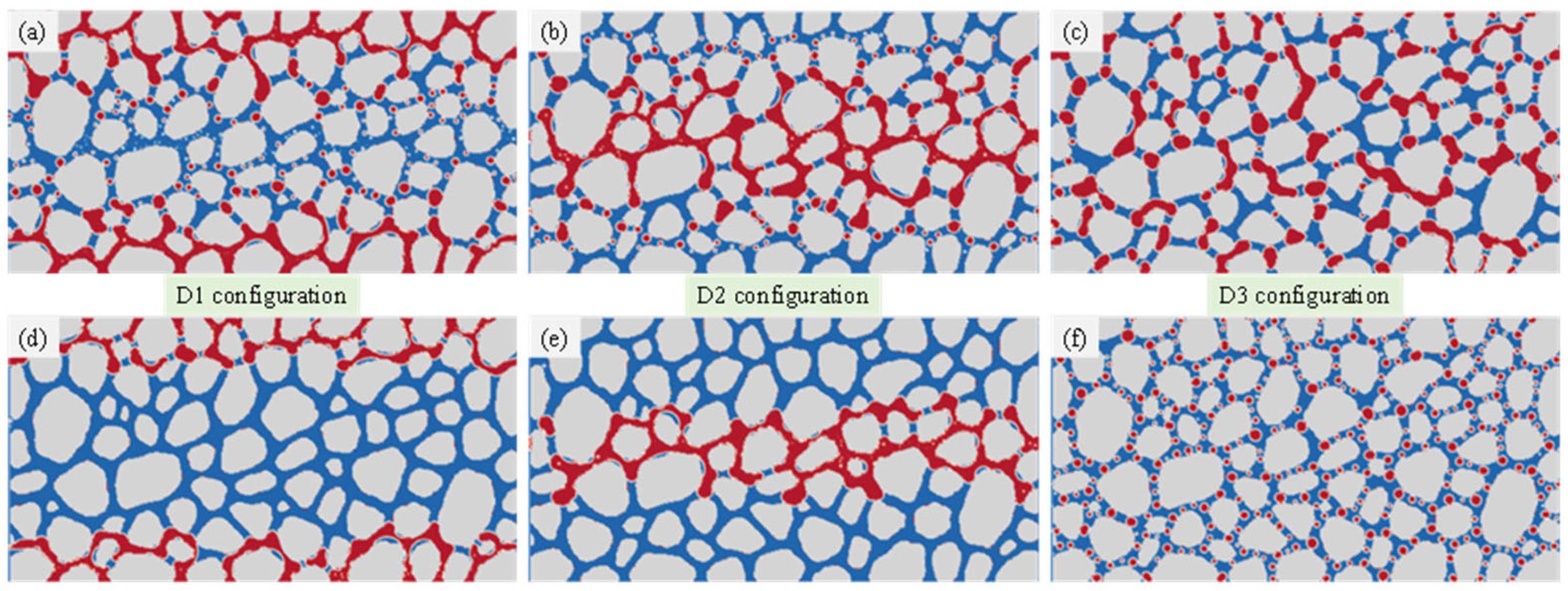
Figure 4. Different IFD patterns lead to divergent steady-state fluid topologies; this competition for spatial occupancy, triggered by the initial state, causes profound fluctuations in non-wetting phase transport capacity within specific saturation intervals, resulting in non-monotonic
Kr profiles.
The spatial distribution of error bars quantifies the uncertainty introduced by the IFD. In the PM1 model, statistical fluctuations intensify significantly with increasing
M and decreasing
Ca, with the wetting phase generally exhibiting higher dispersion (e.g., standard deviation > 0.25 at
Ca = 1 × 10
−4 and
Sw > 0.5). However, this trend shifts in the more complex PM2 model, where non-wetting phase uncertainty exceeds that of the wetting phase at
Ca = 1 × 10
−4 and
Sw < 0.5. This indicates that
Kr uncertainty is an emergent property resulting from the nonlinear coupling of
Ca,
M, and structural complexity (refer to
Figure S1 in the Supporting Information). Another salient observation occurs at
Ca = 1 × 10
−3 and
M = 10.0, where
Krnw in the low-saturation regime exceeds the single-phase flow limit
(Krnw > 1.0). Rather than numerical error, this phenomenon stems from the lubrication effect [
47,
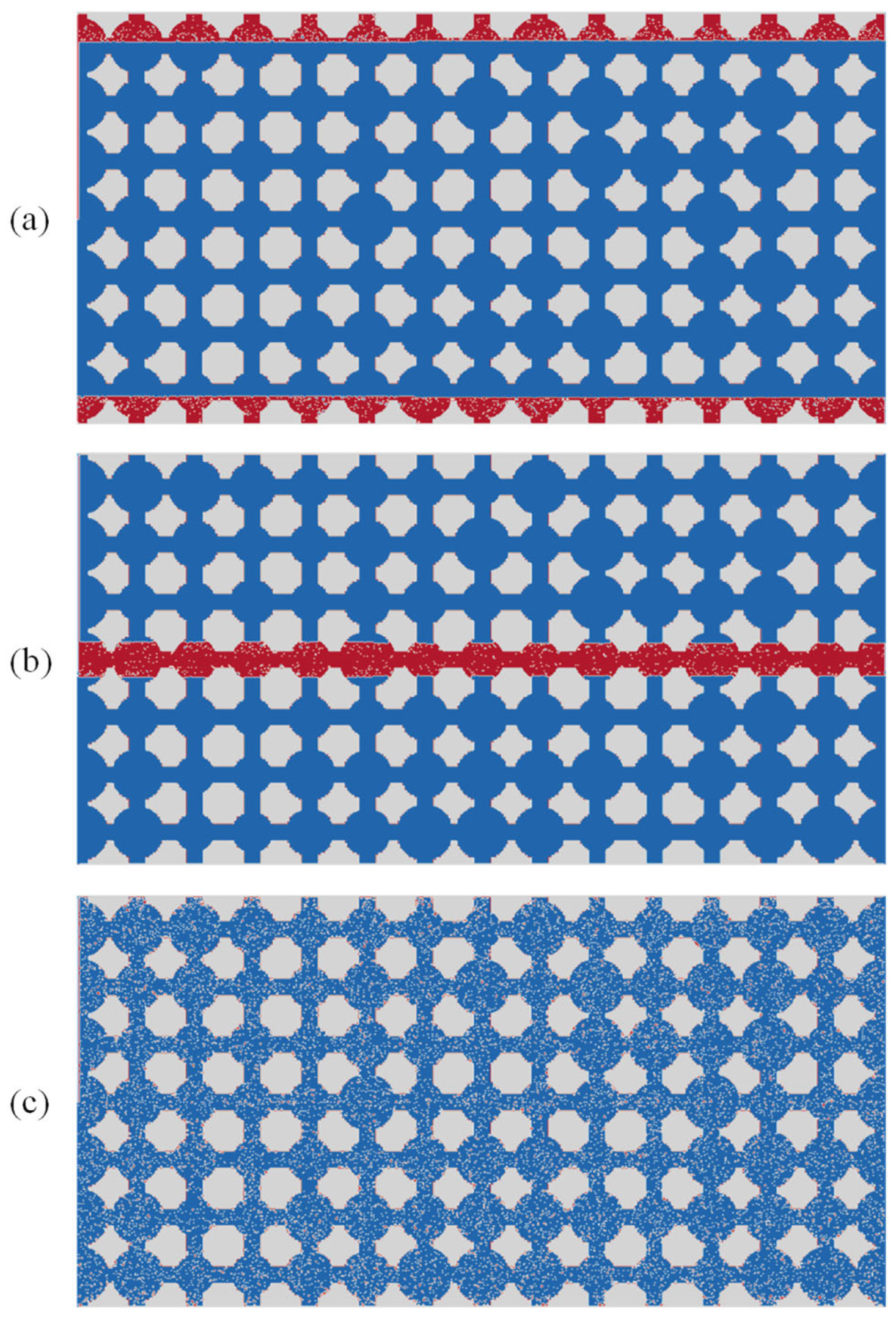
48], a manifestation of viscous coupling. As demonstrated in
Figure 5, the continuous low-viscosity wetting film coating the pore walls effectively lubricates the high-viscosity non-wetting phase, reducing shear resistance and enabling a transport capacity that surpasses its single-phase equivalent.
3.2. Effects of Ca and M on the Total Relative Permeability
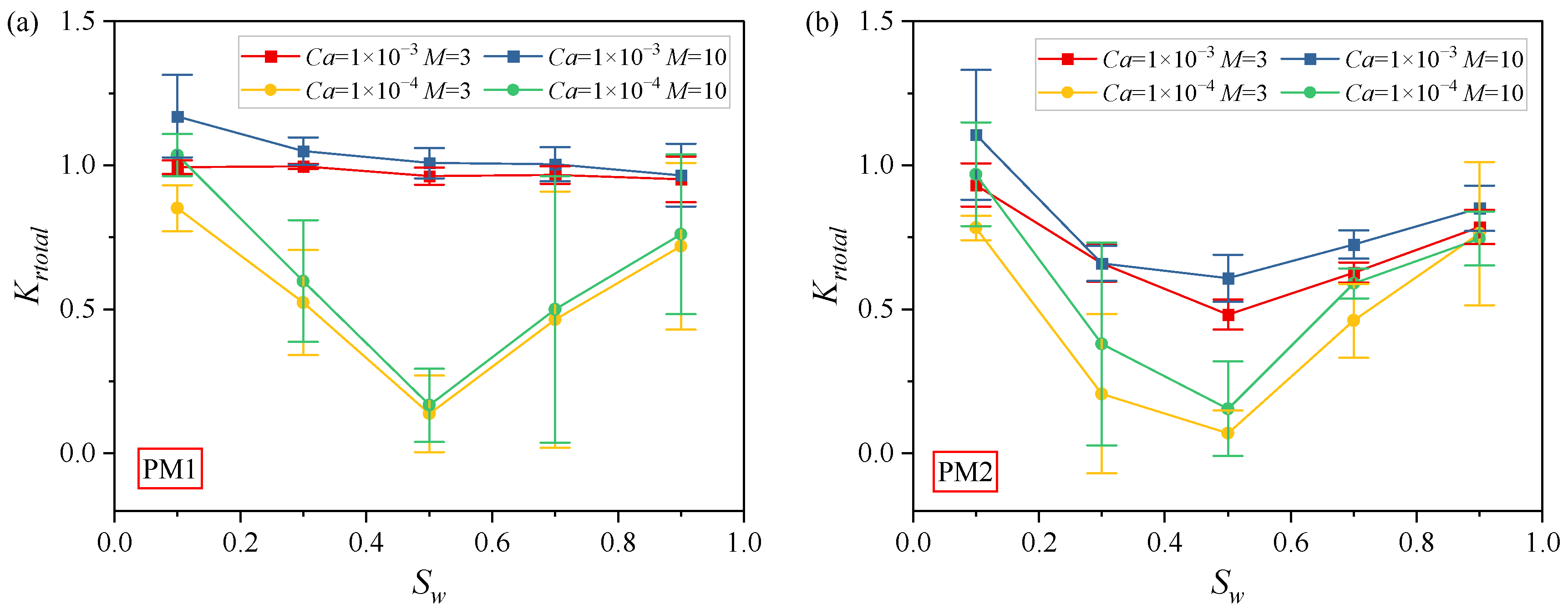
In addition to individual relative permeabilities, the total relative permeability (
Krtotal), defined as the sum of the non-wetting and wetting phase permeabilities (
Krtotal =
Krnw +
Krw), serves as a pivotal metric for evaluating the entire transport capacity within porous media. Following the analysis framework established in
Section 3.1,
Figure 6 elucidates the evolution of
Krtotal as a function of
Sw under diverse flow regimes. Our findings indicate that
Krtotal remains consistently below unity across the majority of the saturation range, with the notable exception of the
Sw = 0.1 regime, where the lubrication effect elevates
Krtotal above 1.0. This result underscores that the total flow resistance during multiphase co-existence typically exceeds that of single-phase flow. The mechanism of this phenomenon lies in the interfacial coupling effect, which induces auxiliary momentum exchange and viscous dissipation across the fluid-fluid interfaces [
32,
49]. Furthermore,
Ca and
M could significantly shift the
Krtotal. An elevation in
Ca consistently enhances
Krtotal, yielding smoother evolution profiles with attenuated fluctuations. This corroborates that augmenting
Ca by increasing the pressure gradient effectively counteracts capillary trapping forces, thereby attenuating the inhibitory effect of interfacial coupling on total flow capacity. Notably,
Krtotal typically reaches a minimum in the intermediate saturation regime, reflecting the intensified spatial competition and momentum interference between the two phases.
A comparative assessment of the PM1 and PM2 models elucidates the profound impact of pore structural complexity on the non-linear characteristics of Krtotal. Specifically, the pronounced heterogeneity inherent in the PM2 model induces significantly greater variation amplitude and curvature in the Krtotal profile as a function of Sw compared to the simpler PM1 model. These findings hold substantial implications for practical reservoir numerical simulations. In macroscopic modeling, neglecting the precipitous decline in Krtotal governed by microscopic structural features leads to a severe underestimation of the pressure gradient required for displacement. Consequently, when characterizing reservoirs with strong heterogeneity, reliance on simplistic, smooth empirical relative permeability curves is inadequate. It is imperative to account for flow efficiency losses induced by pore structure and, accordingly, implement necessary non-linear corrections to macroscopic hydrodynamic models.
To quantitatively assess the uncertainty introduced by the IFD mode, the evolution of the standard deviation of
Krtotal with respect to
Sw was examined (refer to
Supplementary Material, Figure S2). The results indicate that under conditions of low
Ca and
M, the standard deviation of
Krtotal remains consistently high. This suggests that the total flow capacity of the system is highly sensitive to the initial topological structure of the fluids within these parameter conditions. Notably, at low
Ca, the standard deviation exhibits a complex, non-monotonic evolutionary trajectory. For the PM1 model, maximum dispersion occurs near
Sw = 0.7; conversely, for the complex PM2 model, the peak of uncertainty shifts significantly to
Sw = 0.3. This distinct shift in peak location further corroborates the intricate coupling between structural heterogeneity and hydrodynamic parameters in determining the robustness of two-phase flow.
3.3. Quantitative Analysis of Uncertainty in Relative Permeability Curves
While the preceding sections utilized standard deviation to provide a preliminary assessment of uncertainty associated with two-phase relative permeabilities and their sum, this absolute metric is inherently sensitive to the mean value of the data. Consequently, standard deviation lacks the objectivity required for cross-comparison across different saturation regimes where Kr values fluctuate by orders of magnitude. To circumvent this limitation, we introduce the dimensionless coefficient of variation (CV), defined as the ratio of the standard deviation to the mean. This relative dispersion index effectively eliminates mean-scale interference, thereby offering a more precise elucidation of how initial fluid distribution influences Kr stochasticity under diverse physical conditions.
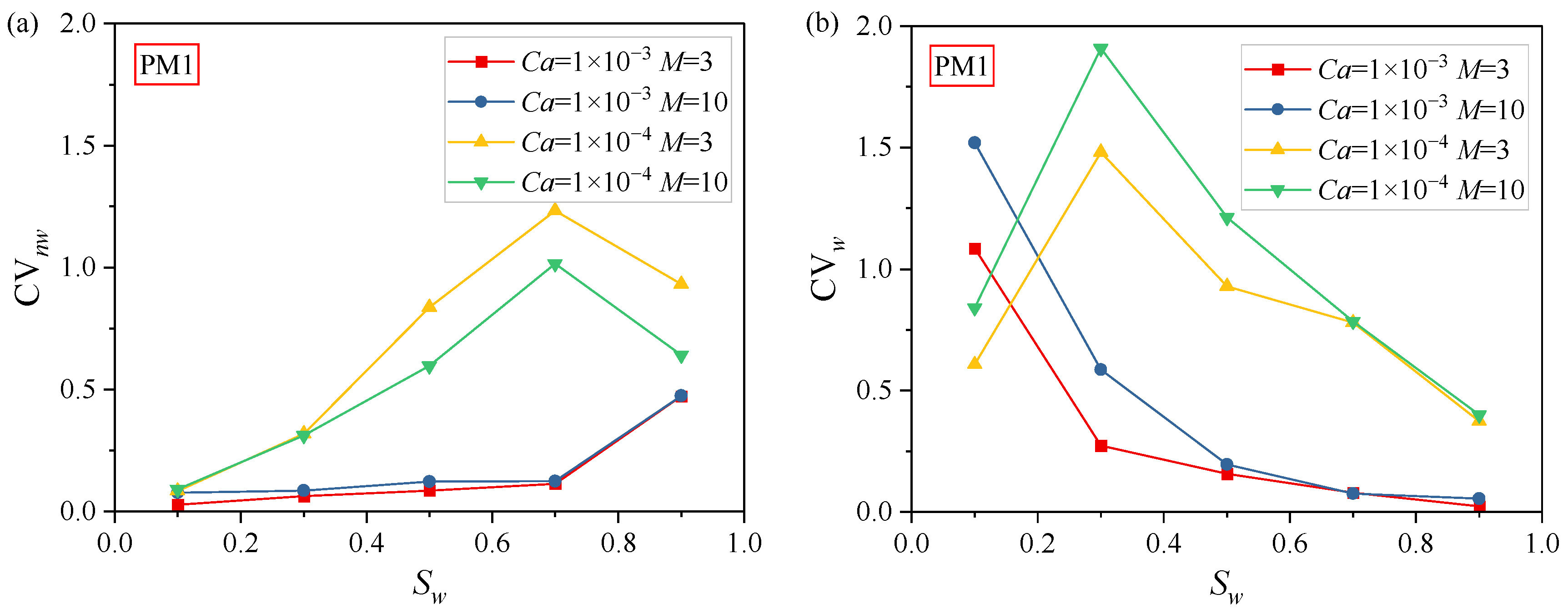
Figure 7a depicts the evolution of the non-wetting phase CV (CV
nw) in the PM1 model. Under high
Ca conditions, CV
nw exhibits a monotonic increase with
Sw. Conversely, in the low
Ca regime, CV
nw follows a non-monotonic trend, peaking at
Sw = 0.7. Generally, an inverse relationship is observed between
Ca and CV
nw, confirming that elevating the pressure gradient effectively suppresses the transport fluctuations induced by IFD. Furthermore, a pronounced coupling effect between
Ca and
M is observed: at high
Ca, elevated
M amplify uncertainty, whereas at low
Ca, the CV
nw is paradoxically higher for lower
M values. This suggests a complex role of viscous forces on flow stability when capillarity become significant. In contrast,
Figure 7b illustrates that the wetting-phase CV (CV
w) decreases progressively as
Sw increases, a trend diametrically opposed to that of the non-wetting phase. This indicates that the wetting phase is exceptionally sensitive to the IFD in the low-saturation regime. The mechanism of this behavior lies in the microscopic configuration of the wetting phase; at low
Sw, it exists primarily as confined thin films or isolated corner flows. In such states, minor stochastic variations in the microscopic topology can trigger drastic fluctuations in flow-path connectivity, significantly inflating CV
w. Notably, under low
Ca conditions, CV
w reaches its maximum at
Sw = 0.3. This finding provides critical guidance for engineering simulations: when modeling transport behavior near irreducible water saturation, the number of stochastic realizations must be substantially increased to ensure the robustness of statistical averages. Moreover, we recommend imposing stricter convergence criteria at these sensitive saturation points to shield against random perturbations and ensure the extracted data reflects the intrinsic transport properties of the medium.
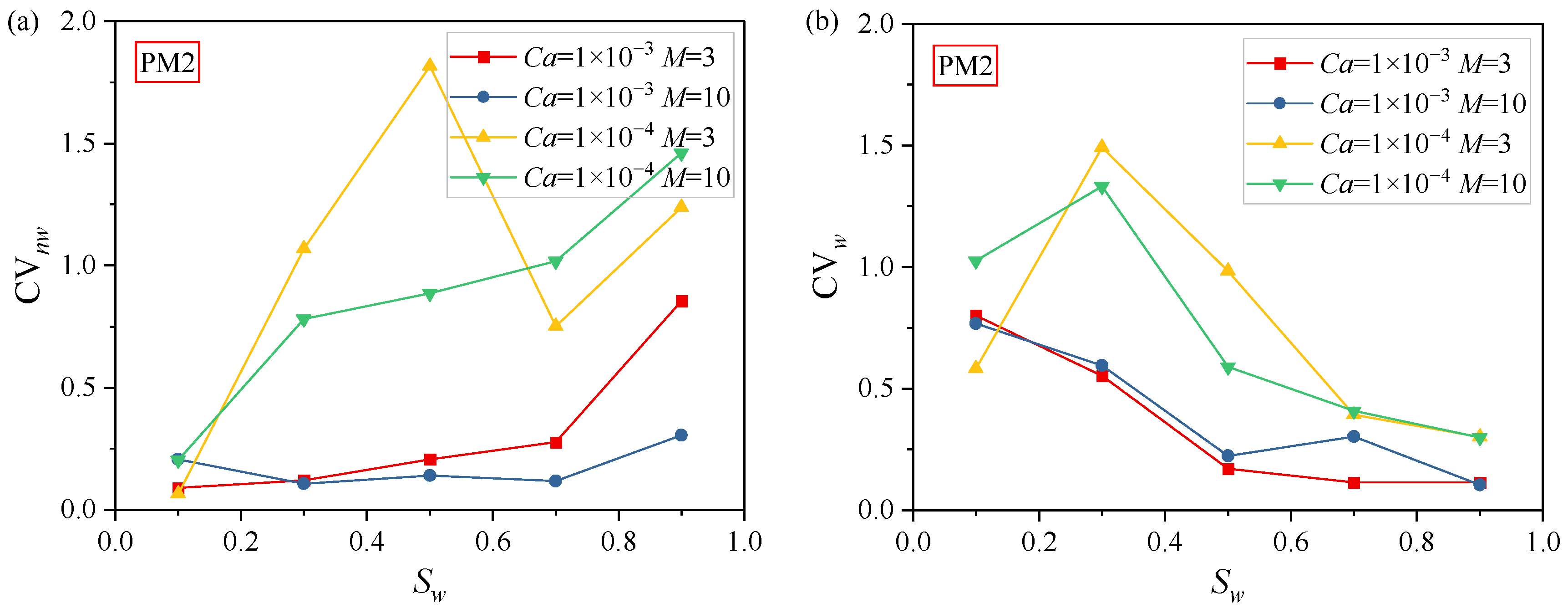
Regarding the more complex PM2 model (
Figure 8), the evolution of the CV largely aligns with the logic observed in PM1: high
Ca consistently reduces uncertainty, and the two phases exhibit opposing CV trends relative to saturation. However, the intense heterogeneity of PM2 introduces more intricate oscillatory patterns. For instance, at
Ca = 1 × 10
−4 and
M = 3.0, CV
w follows a rising-falling-rising trend, with a distinct extremum at
Sw = 0.5. This implies that in complex media, the randomness of spatial occupancy competition is more deeply influenced by structural topology, causing the “uncertainty risk window” to shift according to structural features. The multi-modal and non-monotonic characteristics of the CV in PM2 provide an essential reference for optimizing pore-scale simulation workflows. When characterizing highly heterogeneous models, a preliminary “CV scan” should be performed with a small sample size to identify critical uncertainty points (e.g.,
Sw = 0.5). For these saturation points, increasing the number of stochastic initialization samples is necessary to enhance predictive accuracy.
It should be noted that while the statistical analysis in this study is based on six realizations for each saturation point, the computational cost of transient color-gradient LBM simulations reaching steady state is exceptionally high. Each realization requires millions of time steps to satisfy the rigorous kinetic energy convergence criterion. Given these computational constraints, our study prioritizes the investigation of three fundamentally distinct, extreme IFD patterns to identify the uncertainty risk windows. Although this sample size is not intended for exhaustive probability density function mapping, the magnitude of variance captured across these representative patterns is sufficient to demonstrate that IFD is a primary, non-negligible source of uncertainty that can mask the sensitivity of physical parameters like Ca and M.
3.4. Quantitative Analysis of Uncertainty in the Total Relative Permeability Curves
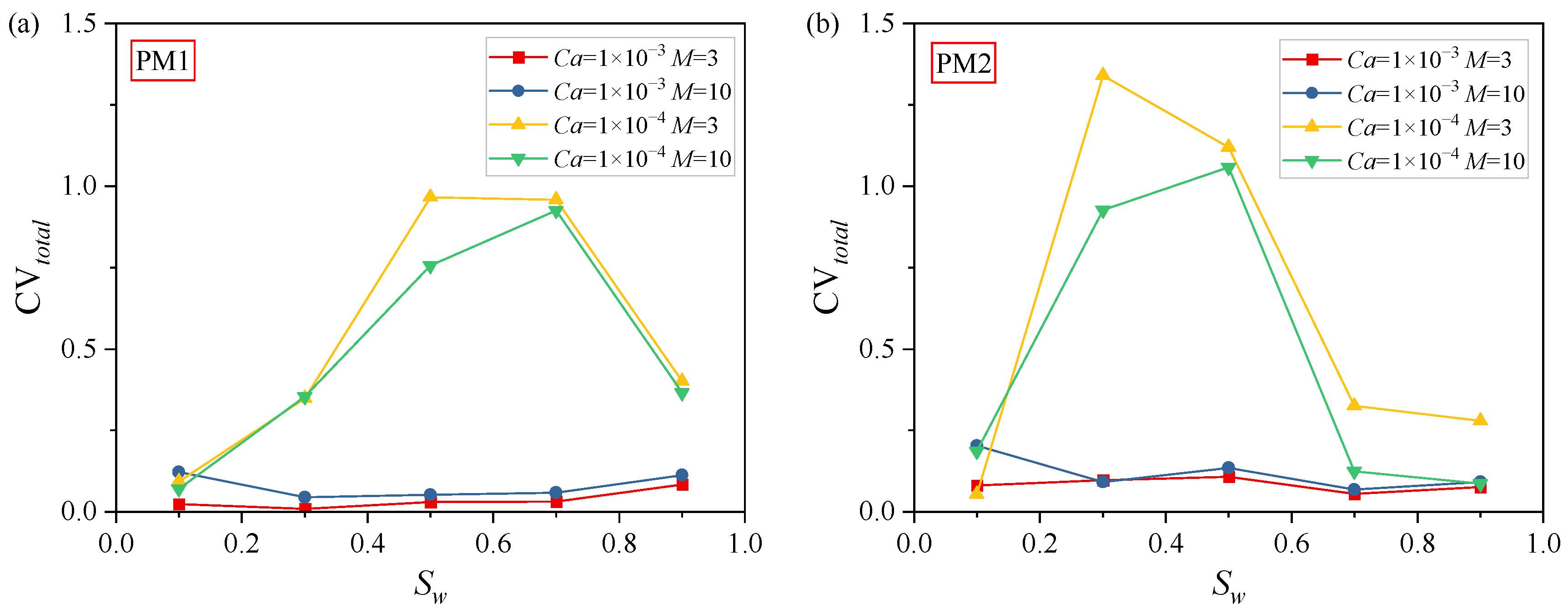
This section delves into the evolutionary characteristics of CV
total across both porous media models (
Figure 9). In contrast to the intricate patterns observed in individual phase uncertainties, CV
total exhibits a high degree of logical consistency across both PM1 and PM2. Generally, in low
Ca regimes, CV
total fluctuates drastically with
Sw, indicating a profound dependence on IFD. Conversely, in high
Ca regimes, the magnitude of CV
total variation is significantly attenuated. This suggests that increasing the pressure gradient effectively suppresses fluctuations in total mobility induced by IFD, leading to enhanced statistical stability. Our investigation further reveals a compelling crossover effect regarding the influence of
M on CV
total. In the low-
Ca regime, the CV
total under low
M is paradoxically higher than that under high
M. However, this trend reverses in high-
Ca regimes, where a higher
M yields greater uncertainty. This phenomenon highlights a fundamental shift in the source of stochasticity under different flow mechanisms: when two phase viscosities are comparable, the competition for spatial occupancy within the pore space becomes increasingly intensified under a low
Ca situation. Minimal variations in the initial distribution can trigger divergent path-topological evolutions. In contrast, interfacial instabilities and viscous coupling effects, exacerbated by high viscosity contrasts, become the primary contributors to transport uncertainty when
Ca is high.
Furthermore, the pore structure significantly dictates the distribution of the “uncertainty sensitivity window”. At low Ca, the CVtotal peaks for the simpler PM1 are concentrated in the mid-to-high saturation range (Sw ∈ [0.5, 0.7]). In contrast, for the heterogeneous PM2, these peaks shift toward the mid-to-low saturation range (Sw ∈ [0.3, 0.5]). This shift underscores how pore geometry reshapes the specific saturation intervals where two phase interference is most pronounced. These insights into CVtotal evolution are instrumental for enhancing the reliability of pore-scale modeling. Practically, while the number of independent stochastic realizations must be increased within these “sensitive windows” at low Ca to mitigate random errors, the sample size can be strategically reduced in low-CV (or high-Ca) regimes to optimize computational resources. Finally, the uncertainty characteristics identified here offer a novel perspective for the parameterization of macro-scale numerical models. When translating Kr curves from micro-scale simulations to macroscopic inputs, focus should transcend mere statistical averages. Instead, CVtotal profiles should be utilized to construct saturation-dependent uncertainty evaluation models. By integrating these micro-physically grounded uncertainty weighting factors, macro-scale models can more accurately predict pressure propagation and fluid distribution. This provides a rigorous probabilistic framework for risk assessment and scheme optimization in engineering applications such as hydrocarbon recovery and geological carbon sequestration.
3.5. Comparison of the Effects of Initial Fluid Distribution, Ca and M on Relative Permeability
Building on the systematic analyses of the mean, standard deviation, and CV, a central physical question naturally arises: is the magnitude of the stochasticity introduced by IFD sufficient to challenge or even obscure the dominance of primary physical parameters (
Ca and
M)? To quantitatively evaluate the competitive relationship between IFD-induced error and the parametric response, we examined statistically representative saturation points (determined by the peak uncertainty analysis), and plotted the relative permeability ranges across different distribution patterns for both PM1 and PM2 (
Figure 10 and
Figure 11).
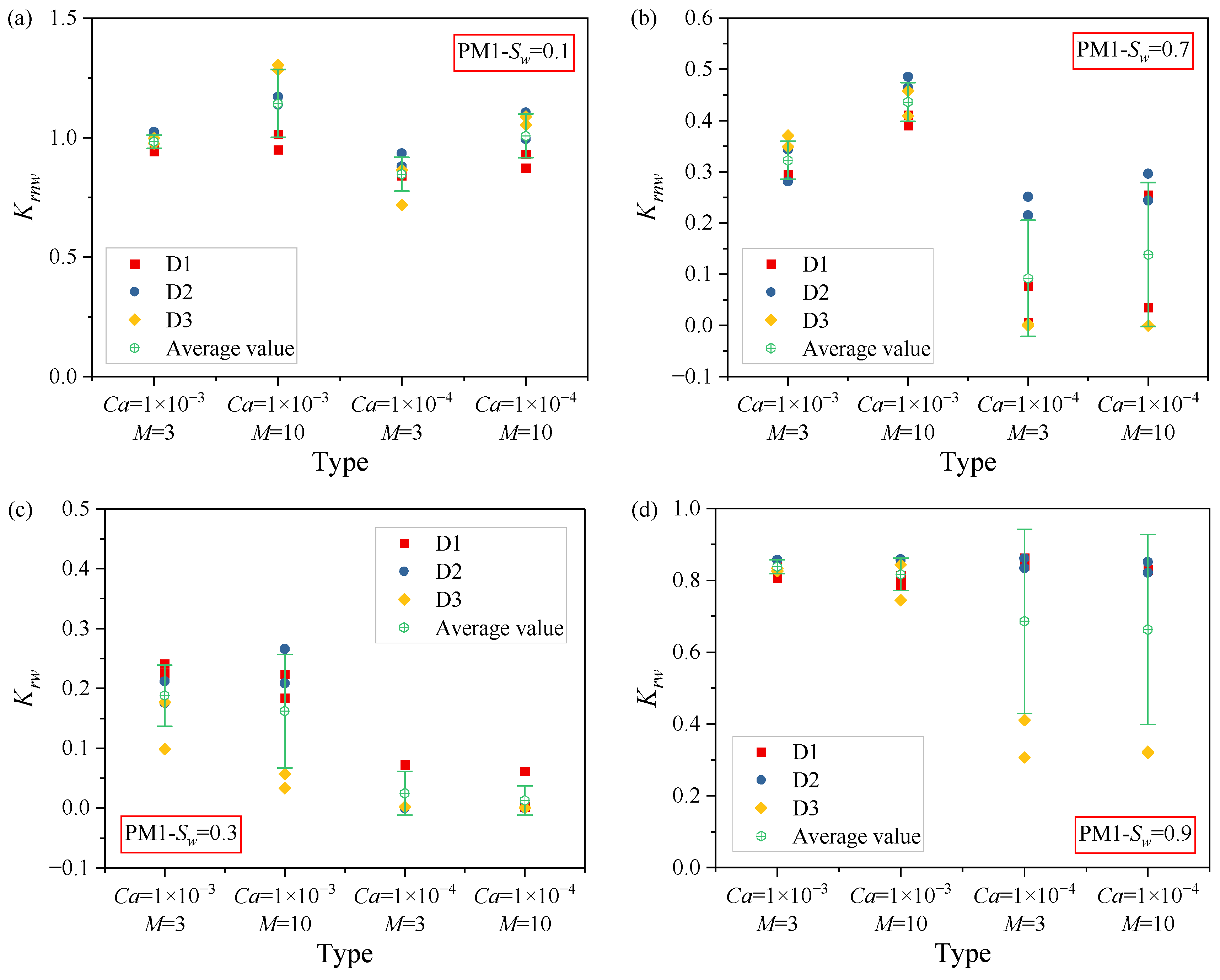
In the PM1 model, the degree of overlap between
Kr distribution intervals serves as a direct visual indicator of the “shielding effect” imposed by the IFD on physical parameter responses. As illustrated in
Figure 10a, when
Sw = 0.1 and
M = 3.0, the
Krnw ranges for different
Ca exhibit almost no overlap, indicating that
Ca maintains dominance over the transport behavior. However, when
M is increased to 10.0, the
Kr intervals for two
Ca cases begin to overlap significantly. At
Sw = 0.7 (
Figure 10b), the
Kr values corresponding to different
M under low
Ca conditions become highly overlapping. This suggests that the influence of initial topological configurations on
Krnw has severely interfered with the discernibility of viscosity ratio effects. For the wetting phase at
Sw = 0.3, the IFD primarily masks the influence of
M; at
Sw = 0.9 (
Figure 10d), the effects of either
Ca or
M on
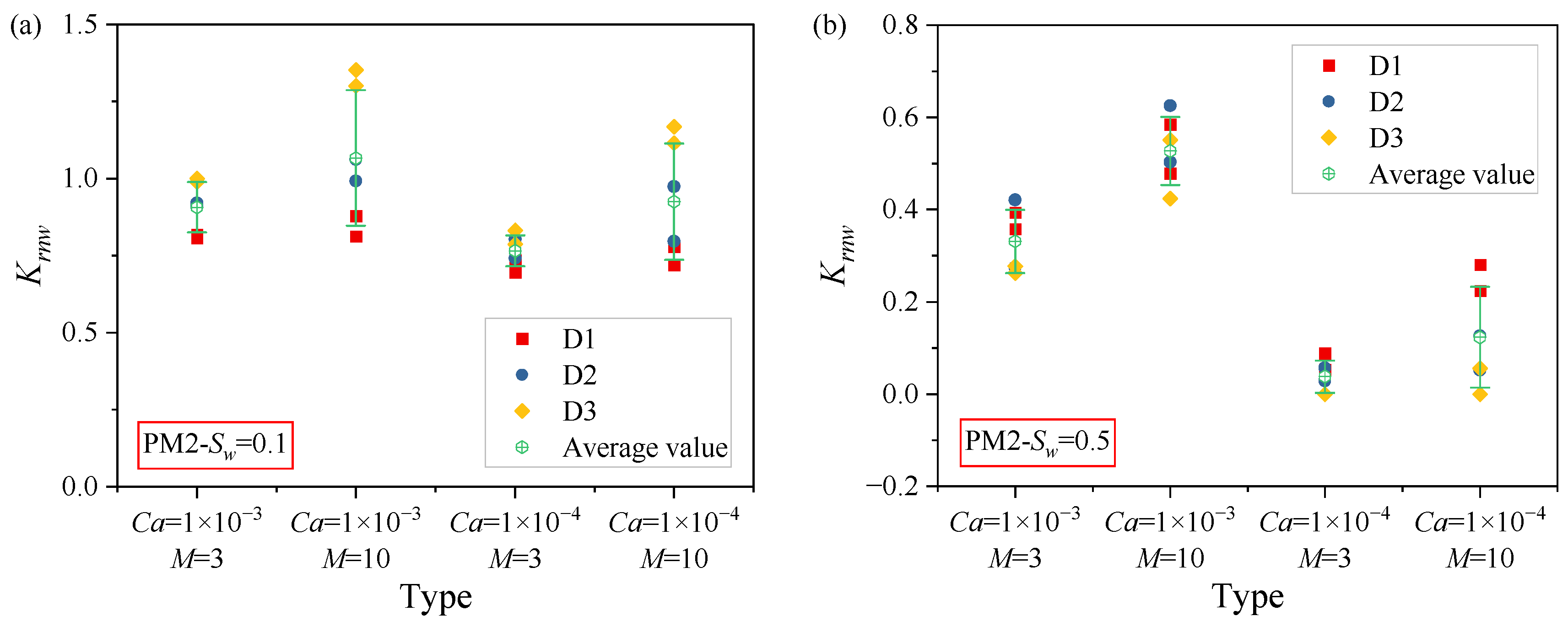
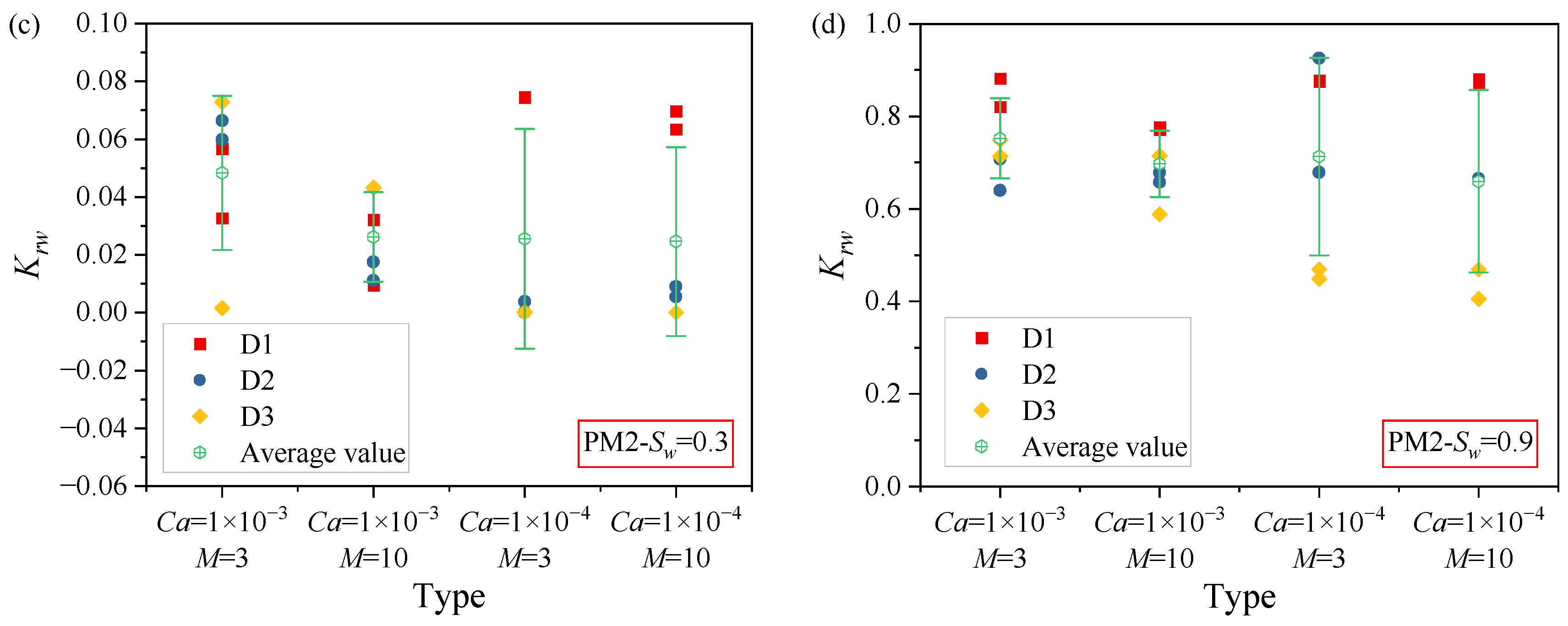
Krw are largely eclipsed by the statistical fluctuations stemming from the initial distribution. Analysis of the more complex PM2 model (
Figure 11) further substantiates the universality of these conclusions. The interference intensity of the IFD exhibits profound nonlinear coupling with fluid saturation,
Ca, and
M. For example, at specific conditions such as
Sw = 0.1 or
Sw = 0.5, the effects of the physical parameters remain relatively separable. By contrast, in high
Sw (
Figure 11c,d), uncertainty arising from the initial configuration exerts a pronounced control over
Krw, rendering the underlying physical trends induced by
Ca and
M nearly unidentifiable.
Collectively, the results from both models demonstrate that IFD is not merely a source of secondary numerical noise; rather, it is a core variable capable of substantively altering simulation conclusions. This finding mandates a rigorous statistical approach to IFD settings in future steady-state simulations, necessitating multi-sample ensemble averaging to ensure the accurate representation of fundamental physical laws.
3.6. Effect of Initial Fluid Distribution on the Fluid-Fluid Interfacial Characteristics
In multiphase flow through porous media, the fluid-fluid interfacial area (
Anw) is intrinsically linked to interphase mass transfer and energy dissipation. It serves as a fundamental bridge for developing thermodynamically consistent relative permeability models, predicting recovery factors, and mitigating capillary pressure hysteresis [
50,
51,
52]. This section investigates whether the stochasticity of IFD substantively alters the constitutive relationship between
Anw and
Sw, independent of fluid properties or pore geometry.
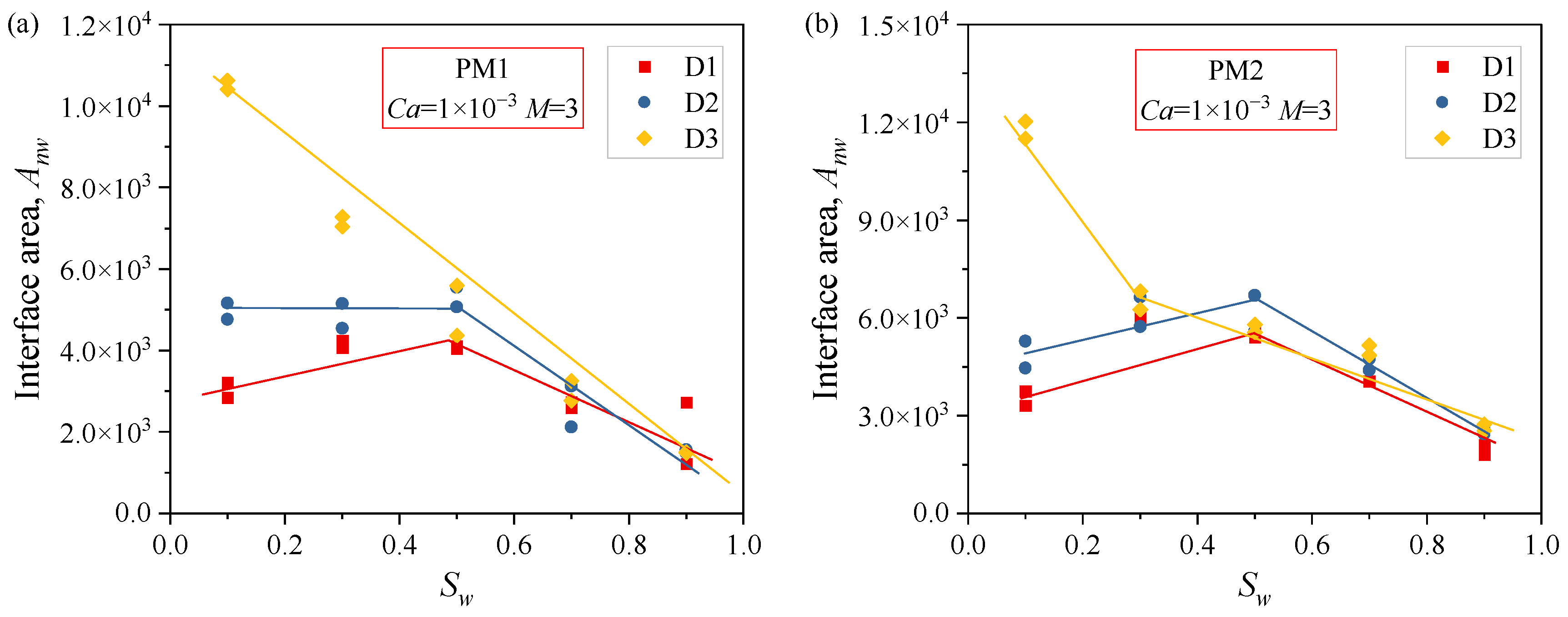
As illustrated in
Figure 12, distinct IFD patterns in both PM1 and PM2 models induce markedly different evolutionary trajectories for the
Anw-
Sw curves. Specifically, two characteristic trends were observed: a monotonic decrease in interfacial area with increasing
Sw, and a non-monotonic trend characterized by an initial increase followed by a subsequent decline. This diversity provides compelling evidence that the initial configuration not only alters flow capacity, but more fundamentally reshapes the pore-scale topology of fluids occupancy and the spatial evolution of interfaces within the pore space. Notably, while similar variations in curve trend have been reported by Adila et al. [
53] and Porter et al. [
50], such shifts are conventionally attributed to differences in fluid systems (e.g., oil-water vs. gas-water) or displacement modes (e.g., drainage vs. imbibition). By contrast, the present results reveal a more fundamental physical mechanism: even with identical fluid properties, pore structure, and external driving conditions, merely altering the initial fluid distribution is sufficient to reproduce the complex interfacial-area evolution modes described above. This finding offers a novel perspective on complex interfacial behavior in multiphase systems. At the pore scale, the IFD determines whether the fluid occupies the solid surfaces as continuous films or fills the channels as discrete ganglia and liquid bridges. These distinct initial topological states follow fundamentally different pathways of interface coalescence, breakup, and spreading as the system evolves toward steady state. Consequently, the interfacial area hysteresis or curve divergence observed in experimental studies may not stem exclusively from macroscopic displacement paths, but rather from the “topological memory” embedded within the system during its initialization. From a modeling perspective, these results suggest that IFD-induced uncertainty is a hidden driver of inconsistency in interfacial evolution. Unless the influence of the initial distribution is explicitly accounted for, constitutive equations and recovery predictions will struggle to eliminate the biases introduced by capillary hysteresis.
3.7. Implications and Outlook
The findings of this study regarding the influence of IFD on Kr uncertainty extend beyond conventional hydrocarbon recovery, offering critical insights for a wide spectrum of engineering domains involving multiphase transport in porous media. In the context of carbon capture and storage, subtle deviations in Kr curves directly impact injection pressure thresholds and storage capacity assessments. Similarly, in groundwater remediation, the microscopic distribution of non-aqueous phase liquids governs migration pathways and cleanup efficiency, while in the porous electrodes of proton exchange membrane fuel cells, the stochastic occupancy of water and gas profoundly alters mass transport resistance. Therefore, quantifying IFD-induced fluctuations is a prerequisite for the precision control of energy conversion and mass transport in these complex systems. The evolution patterns of CV identified in this work provide a novel probabilistic input strategy for multiscale modeling. Rather than relying on a single ensemble-averaged Kr curve, macro-scale simulators should incorporate uncertainty evaluation models based on CVtotal that evolve dynamically with fluid saturation. By introducing these micro-physically grounded uncertainty weighting factors, one can quantitatively assess how pore-scale stochasticity propagates and manifests at the macroscale as uncertainty in viscous/capillary fingering and sweep efficiency. This transition from deterministic parameters to probabilistic descriptions offers a more scientifically rigorous framework for risk assessment and decision-making in subsurface engineering.
To mitigate or eliminate the simulation biases stemming from IFD, several core methodological improvements are proposed. Priority should be given to the utilization of 3D porous media models, as the enhanced connectivity of 3D space facilitates critical physical processes, such as corner flow and wetting film transport, that are often restricted in 2D frameworks [
54]. For instance, 2D assumptions intrinsically overestimate capillary snap-off and underestimate bi-continuity, as out-of-plane bypass routes are absent. These 3D mechanisms may allow fluids to overcome local energy barriers, thereby spontaneously dampening the stochasticity of the initial distribution at the macroscopic level. Furthermore, there is a clear need to transition from simple random assignment to dynamic initialization schemes that emulate geological history or engineering evolution, such as reaching the target saturation through drainage or imbibition processes. Such methods ensure that the microscopic fluid topology remains physically consistent, thereby reducing statistical errors at the source. Furthermore, the present study establishes a foundational baseline by assuming a uniform wettability system. However, natural geological formations frequently exhibit mixed-wet or fractional-wet characteristics. Because wettability fundamentally dictates the topological rules of fluid spatial occupancy at the pore scale, altering the wetting conditions would likely shift the uncertainty risk windows identified in this study to completely different saturation regimes. Therefore, systematically investigating the coupled effects of initial fluid distribution and diverse wettability conditions represents a critical and highly promising direction for future research, which is essential for generalizing these uncertainty frameworks to complex unconventional reservoirs. From a methodological standpoint, ensuring the model size exceeds the representative elementary volume (REV) is crucial for stability, as local stochastic fluctuations can be spatially averaged out. Future research could further leverage geometric topological descriptors, such as Minkowski functionals or the Euler characteristic [
55], to establish mathematical mapping models between initial topology and permeability deviation. Such models could facilitate a posteriori compensation for stochastic bias, allowing smaller-scale simulations to reflect statistically significant macro-scale transport properties.
Finally, the evolution of the fluid-fluid interfacial area, which serves as a key metric for flow resistance and interphase mass transfer, is markedly influenced by the IFD. Our observation that disparate initial distributions can induce entirely different evolutionary modes, ranging from monotonic to non-monotonic trends, provides a fresh perspective on the complex interfacial behavior observed across various fluid systems. In light of this, future investigations should treat initial topological features as a primary independent variable rather than a secondary numerical setting. Establishing a correlation between initial topological characteristics and interfacial evolution paths will help elucidate the microscopic physics of capillary hysteresis from a more fundamental level. This approach will significantly enhance the predictive accuracy and physical consistency of models involving hysteretic effects, such as non-steady-state displacement and cyclic injection-production processes, ultimately leading to more robust descriptions of multiphase flow in heterogeneous porous media.





 ,
,