Article

Study on the Improvement in Nuclear Generation Flexibility Under a Unified Electricity Market with a High Share of Renewables


1
State Key Laboratory of Nuclear Power Safety Technology and Equipment, China Nuclear Power Engineering Co., Ltd., Shenzhen 518116, China
2
Department of Electrical Engineering, North China Electric Power University, Baoding 071003, China
*
Author to whom correspondence should be addressed.
Processes 2026, 14(1), 7; https://doi.org/10.3390/pr14010007
Submission received: 10 October 2025 / Revised: 2 December 2025 / Accepted: 11 December 2025 / Published: 19 December 2025
(This article belongs to the Special Issue Optimal Design, Control and Simulation of Energy Management Systems)

Abstract

China’s nuclear power plants traditionally operate to meet baseload needs, with minimal involvement in peak load regulation. However, as the share of renewable energy generation rapidly increases, the volatility of the power system and the demand for peak load regulation have significantly risen, necessitating greater nuclear power flexibility to meet the new power system’s requirements. Our study forecasts the energy structure and load demand for the Province of Liaoning in Northeastern China in 2035. Under this vision, it analyzes the flexibility challenges faced by nuclear generation units. A joint clearing model for spot electricity and ancillary services, along with an energy storage revenue model, was established. Based on this, this study analyzed the clearing results for various typical scenarios in the Province of Liaoning in 2035. The simulation results demonstrate that nuclear units will participate in peak shaving by the target year. This study demonstrates the feasibility of solid-state thermal storage in improving both flexibility and economic efficiency of nuclear generation. Based on these findings, policy recommendations are proposed, including improving regulation compensation mechanisms and promoting multi-energy coupling, providing crucial theoretical and practical support for the role transformation of nuclear generation entities in the new power system. This study establishes a full lifecycle economic assessment model for combined heat and power revenue versus thermal storage investment costs, considering integrated nuclear power–solid thermal energy storage heating systems as the primary technical pathway. Taking a configuration plan with a 715 MW heating capacity and a 6000 MWh thermal storage capacity as an example under Liaoning Province’s 2035 long-term scenario, the simulation results indicate that introducing solid thermal energy storage can significantly improve the revenue structure of nuclear units while meeting deep peak shaving demands, reducing the project’s static payback period to under 11 years.

1. Introduction

In China, due to safety and economic considerations, nuclear power plants most often provide baseload electricity and participate in limited peak shaving, limited only to special operating conditions such as holidays. This convention evolves alongside the implementation of the “dual carbon” goals. According to the dual carbon goals, the Central Committee of the Communist Party of China and the State Council project that the share of non-fossil energy consumption will increase to 25% by 2030 [1]. With the development of renewables and the continuous growth of nuclear power installed capacity (IC), the demand for peak shaving in the power system has increased significantly. Accordingly, nuclear power companies urgently need to break away from traditional operational modes to address the flexibility challenges posed by the new power system.
A researcher notes that China faces insufficient reserves of flexible power sources, particularly in the northwest [2]. Coal-fired generation is constrained by regulatory limitations, especially in winter, due to centralized heating demand. It is essential to establish a diversified, coordinated flexibility supply-and-demand system by introducing multiple regulatory measures. The literature [3,4] emphasizes the critical importance of system flexibility resource planning in a power system with a high share of renewable generation, as well as the development of specific flexibility assessment methods based on demand response and multi-scenario combinations, along with corresponding coordinated planning solution algorithms. Operational practices in France [5] confirm that approximately 40% of nuclear power units have day–night peak shaving capabilities and can flexibly adjust power output during low-load conditions. Studies [6,7] have verified the economic advantages of combined peak shaving using thermal storage and nuclear generation, and the feasibility of coordinated operation between nuclear power and pumped storage. A multi-source joint optimization model [8] is proposed that integrates nuclear, solar, storage, pumped storage, and thermal power. Researchers also confirm that nuclear power units combined with thermal storage possess flexible peak-shaving capabilities and emphasize that substantial nuclear power participation in peak shaving still requires coordinated scheduling with renewable energy, energy storage, and other power sources to enhance overall system flexibility [9,10].
However, existing research primarily focuses on qualitative analyses of the necessity of nuclear power for peak shaving. Given that construction time for nuclear units is at least 10 years, long-term predictions of load and power source structures for specific provinces are particularly important for nuclear power planning. The market environment is also changing constantly. By 2030, China will have completed the construction of a unified national electricity market, and the acquisition and clearing of peak-shaving capability will change completely, with significant implications for the operational economics of nuclear units. Existing articles lack quantitative studies that consider long-term forecasts and a changing market environment. Most studies still rely on assumptions about the current ancillary services market mechanism, failing to consider scenarios in which there is no peak-shaving compensation mechanism after continuous spot-market operation in the long term.
Given the above circumstances, this study takes Liaoning Province in Northeast China as an example. First, it analyzes the evolution of the energy structure and demand of the Liaoning power grid, revealing the flexibility challenges nuclear power faces under high proportions of renewable energy and the limitations of the guaranteed purchase mechanism. The remainder of this study is structured as follows: Section 2 presents the current and projected generation mix and load forecasts for the Liaoning grid up to 2035, analyzing the system’s peak-shaving capacity and the evolving role of nuclear power within it. Section 3 examines the impact of evolving electricity market mechanisms and settlement methods on the operational economics of nuclear units within a unified market framework, establishing a joint settlement model for spot and reserve power. Section 4 proposes flexibility enhancement strategies for nuclear power based on the preceding analysis. It constructs a market revenue and economic analysis model for pairing nuclear power with energy storage/thermal storage systems, presenting settlement outcomes and optimal configuration schemes under typical Liaoning scenarios. The concluding chapter summarizes findings and formulates policy recommendations to fully leverage nuclear power’s flexibility and multi-energy coupling advantages.

2. Basic Data of the Liaoning Power Grid and Its Forecast for 2035

2.1. Generation Mix and Load of Liaoning Power Grid in the Current Year and 2035

The government’s electricity consumption plan [11] noted that statistics show Liaoning Province’s maximum load in 2024 was 40.5 GW. The province’s installed power generation capacity was 73.8317 GW, including 38.5038 GW of thermal power, 3.6437 GW of hydropower, 14.6333 GW of wind power, 10.3757 GW of solar power, and 6.6752 GW of nuclear power.
The Province of Liaoning in Northeast China has been facing pressure from slowing economic growth over the past few years, with 2024 GDP growth below the national average. Its power supply and demand structure exhibits distinct characteristics: the region not only has a high proportion of traditional industrial load but also leverages its coastal geographical advantages to develop a cluster of large-scale nuclear power plants. Taking a certain under-construction nuclear power project as an example, the project plans to build six 1 GW pressurized water reactor units, with a total IC exceeding 7.6 GW. Upon full completion, the project will annually provide nearly 54 TWh of clean energy.
Liaoning has set a target to achieve carbon peaking by 2028 and to have renewable energy account for over 50% of IC by 2025 and over 50% of electricity generation by 2030 [12]. To achieve this, Liaoning must steadily optimize its energy structure, promote the clean and efficient use of coal, actively develop hydrogen energy and other renewable energy sources, and ensure energy supply security. The current and future power generation capacity mix of Liaoning is shown in Table 1 [13,14].
As shown in Table 1, the IC of nuclear power in Liaoning increased from 6.71 GW (8.54%) in 2024 to 19.357 GW (10.81%) in 2035, nearly tripling. In terms of electricity generation, Liaoning’s total output in 2024 was approximately 220.37 TWh, with nuclear power accounting for 51.37 TWh, or 23.31% of the province’s total, making it a key pillar of the regional energy structure [15]. According to the Clean Energy Plan for Province Liaoning [16], by 2025, the proportion of clean energy generation in Liaoning will reach over 48%, with nuclear power accounting for over 22%; by 2030, the proportion of the IC and generation of clean generations in the province will reach over 70%, with nuclear power accounting for over 30%.
Under the dual carbon vision, the construction of a new coal-fired generation unit is permitted on the condition that smaller thermal power units at the same site are retired. According to “The 14th Five-Year Plan for Energy Development in Province Liaoning” [17] and the fixed-asset investment project approval information from the Provincial Development and Reform Commission [18,19,20], a total of 3.46 GW of key coal-fired power projects are planned and commissioned. No other coal-fired generation will be constructed if it is not listed in the “14th Five-Year Plan”.
Based on the construction plan for Liaoning’s key coal-fired power projects in the long term (four 2 × 350 MW unit projects and one 1 × 660 MW combined heat and power project), the total IC of coal-fired power plants in Liaoning will be 43 GW by 2035 [18,19,20,21,22].
Currently, the total IC of large- and medium-sized hydropower stations in Liaoning is 1.36 GW, which has reached over 95% of the technically feasible generation capacity [17], determined by local water resources. Large-scale, economically viable medium- and small-scale hydropower resources have been largely developed, and the remaining small- and medium-sized hydropower resources face significant development challenges and economic costs, leaving limited room for future capacity expansion. Therefore, the hydropower IC in Liaoning will remain approximately 1.36 GW by 2035.
Considering the construction cycle of nuclear power plants, based on the new and planned projects during the 14th Five-Year Plan period, the total IC of nuclear power plants in Liaoning by 2035 will be 19,356.74 MWe [17].
According to an assessment of China’s wind and solar power generation potential [23], by 2035, the total IC of wind and solar power in Liaoning will reach 63.7 GW and 33 GW, respectively, for a total of 96.7 GW.
According to the instructions from the National Energy Administration’s meeting on optimizing the layout of medium- and long-term development plans for pumped-storage hydropower projects [24], the upper limit for the development scale for pumped-storage hydropower in Liaoning by 2035 is approximately 14 GW.
According to documents released by the Provincial Department of Ecology and Environment, it is estimated that by 2035, the Province of Liaoning’s total electricity consumption will reach 435.4 TWh [25]. Based on the relationship between electricity consumption and maximum load, using historical data in Table 2, the maximum load in Liaoning in 2035 is estimated to be 64.58 GW [26].

2.2. Downward Flexibility Changes in the Liaoning Power Grid

By 2035, Liaoning’s load demand will be 1.6 times that of 2024, with renewable generation and nuclear power’s ICs being 3.45 and 2.88 times higher, respectively.
With the increasing penetration of intermittent renewables, the demand for flexible regulation resources in the power system is becoming increasingly urgent. Nuclear power, traditionally regarded as a baseload supplier, is increasingly recognized for its potential to shave peaks, particularly its downward regulation capacity, which is becoming an important component of system operational flexibility. The system’s downward regulation capacity is defined as the sum of the available capacities of all adjustable power sources, subject to minimum-stable-operation constraints. This metric is influenced by factors such as the operating rate of thermal power units, minimum output, available charging capacity of pumped storage, power generation from renewables, and the charging power of the energy storage system.
In order to quantify the changes in system’s flexibility, the following assumptions are made: the operational rates of coal and gas power are set at 50%; the technical minimum output rate for conventional coal power is set at 50% (80% during the heating period); for gas power, it is set at 40%; the available charging rate for pumped storage is set at 80% for downward regulation; energy storage was not considered in 2024 but is fully accounted for in 2035 at its maximum charging power.
We define A, the ratio of nuclear generation units’ downward regulation capacity to the system’s total downward regulation capacity, as the downward flexibility with regard to nuclear units:
A = P n u c d o w n P d o w n
where P n u c d o w n refers to the downward regulation power of nuclear power (GW), and P d o w n refers to the total downward regulation power of the system (GW). The calculated results are shown in Table 3.
Analysis of the above data reveals the following:
(i)
In the non-heating season of the current year, considering the maximum peak-to-valley difference of 8.76 GW, the ratio of downward capacity to the maximum peak-to-valley difference is 1.68, indicating that downward regulation resources in the system are relatively abundant (mainly from coal power and pumped storage). Nuclear power provides nearly one-fifth of the downward regulation capacity, serving as an important but non-dominant regulating force.
(ii)
In the heating season of the current year (in Oct., Nov., Dec., Jan., Feb., and Mar.), the regulating capacity of combined heat and power (CHP) units is constrained, leading to a sharp decline in the system’s downward regulation capacity. During this period, nuclear power’s regulatory potential accounted for one-third of the system’s total regulatory capacity. This indicates that nuclear power is one of the absolute main forces for ensuring grid security and accommodating renewables.
(iii)
In the non-heating season of 2035, nuclear power’s IC increases significantly. However, due to the substantial downward regulation capacity contributed by pumped storage and energy storage (14.7 GW), the flexibility contribution of nuclear power increases but is relatively less prominent.
(iv)
In the heating season of 2035, the loss of regulating capacity in coal power due to heating tasks still needs to be compensated by nuclear power, pumped storage, and energy storage. Nuclear power’s nearly 30% share indicates that it remains a core regulatory means for addressing regulatory needs in winter conditions.
It is worth noting that by the 2035 heating season, with the large-scale commissioning of pumped storage and new energy storage technologies, the system’s overall downward regulation capacity will increase from 8.8 GW to 27.05 GW. The downward regulation capacity, contributed by pumped storage and energy storage, will rise from 2.16 GW to 14.7 GW, representing the primary driver of enhanced system flexibility. Concurrently, the downward regulation capacity of nuclear power units will also increase from 2.68 GW to 7.74 GW, nearly tripling. However, due to the more rapid growth of pumped storage and energy storage, its share of the system’s total downward regulation capacity will decrease slightly from approximately 30% to around 29%. Therefore, the slight relative decline in nuclear power’s share by 2035 does not imply diminished flexibility contributions but rather reflects the concurrent expansion of other flexible regulation resources. In terms of absolute scale and its critical role during heating seasons, nuclear power remains one of the core pillars supporting winter peak regulation.
Conclusion: The flexible downward regulation capacity of nuclear power is particularly prominent during the heating season. Efforts should be made to actively promote flexible technological transformations in nuclear power.
However, the operational economics of nuclear generators decline during the heating season. This contradiction highlights the disconnect between technological potential and market returns. Consequently, realizing the economic value of nuclear flexibility within an evolving market framework has become a critical issue. Addressing this requires sophisticated market simulation methods to scientifically assess hourly downward regulation demands for nuclear units under typical scenarios, thereby providing quantitative evidence for mechanism design.
Based on this assessment, the following sections will examine how the evolution of electricity market mechanisms affects the operational economics of nuclear units. We will analyze how market structure, clearing rules, and price formation mechanisms collectively shape the incentive structure and development pathways for nuclear power participation in peak shaving.

3. The Impact on the Operational Economy of Nuclear Units as the Evolution of Electricity Markets

3.1. Changes in Downward Regulation as the Evolution of Electricity Markets

Currently, China’s electricity market is in a critical transition phase, moving from a system dominated by medium- and long-term transactions and pilot spot markets to continuous spot market operations. Meanwhile, 29 provinces have launched pilot spot market operations. Electricity market mechanisms in Shanxi, Guangdong, Shandong, Gansu, and Inner Mongolia West lead the way in achieving continuous settlement, establishing a price mechanism based on 15-min rolling clearing; Liaoning, Anhui, Zhejiang, and other provinces have also initiated continuous pilot operations, while Fujian, Jiangsu, Hubei, Hunan, and other provinces have completed long-term pilot settlements spanning an entire month or longer.
Looking ahead to 2035, as the national unified power market is gradually established, the spot market will become the core venue for electricity trading and system regulation. Medium- and long-term transactions will primarily serve to guarantee the electricity supply and hedge the risk. The existing peak-shaving auxiliary service will no longer exist in the auxiliary market. It will be implemented in the spot market, with various power sources achieving regulation through spot bidding. Peak-shaving costs will no longer be listed separately as shared compensation; they will be naturally reflected in price signals. In the past electricity market, peak shaving services were mainly implemented through the ancillary services market [27], with compensation costs shared by all market participants within the system. Starting from March 2025, the spot market in Liaoning will conduct a trial operation of continuous settlement. The category of peak shaving no longer exists, and peak shaving compensation and cost-sharing fees are also canceled. Changes in downward peak-shaving fees are shown in Table 4.

3.2. The Impacts on Nuclear Units’ Operation

Nuclear generator operations follow strict operational procedures, with operational adjustments typically requiring prior planning and approval. This characteristic determines that traditional nuclear power primarily serves as a baseload provider.
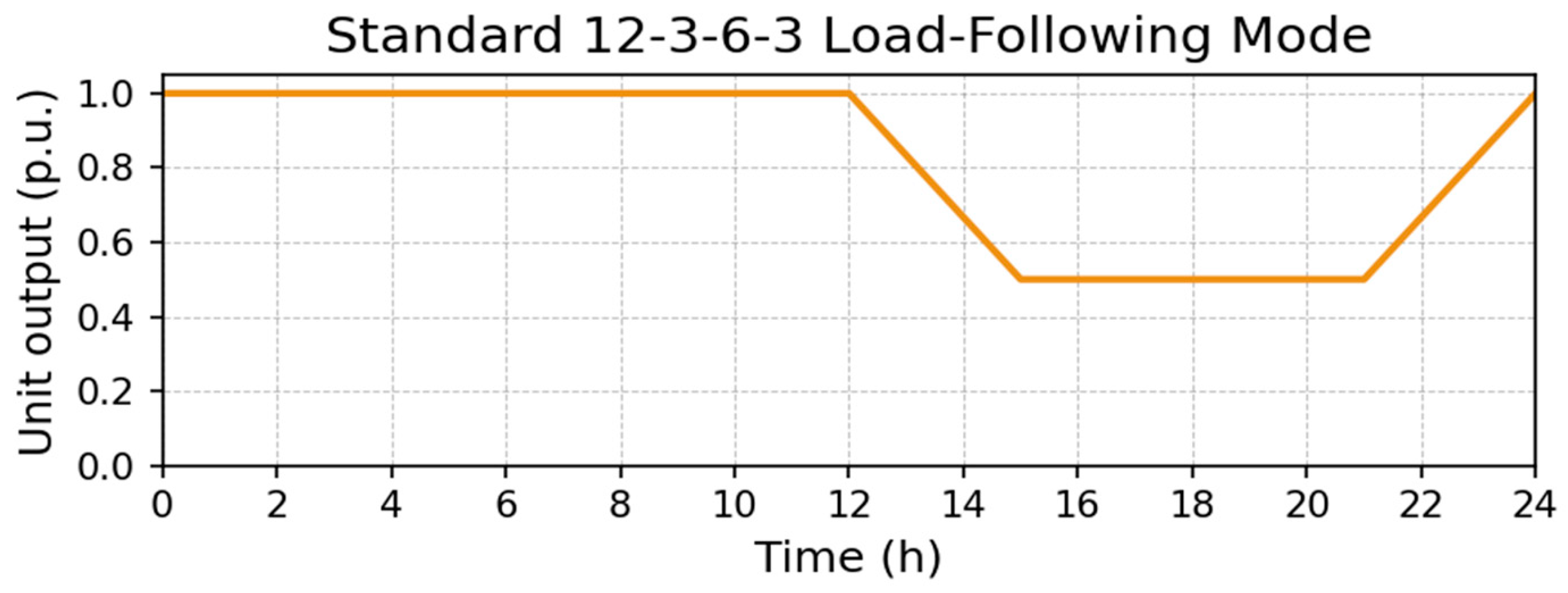
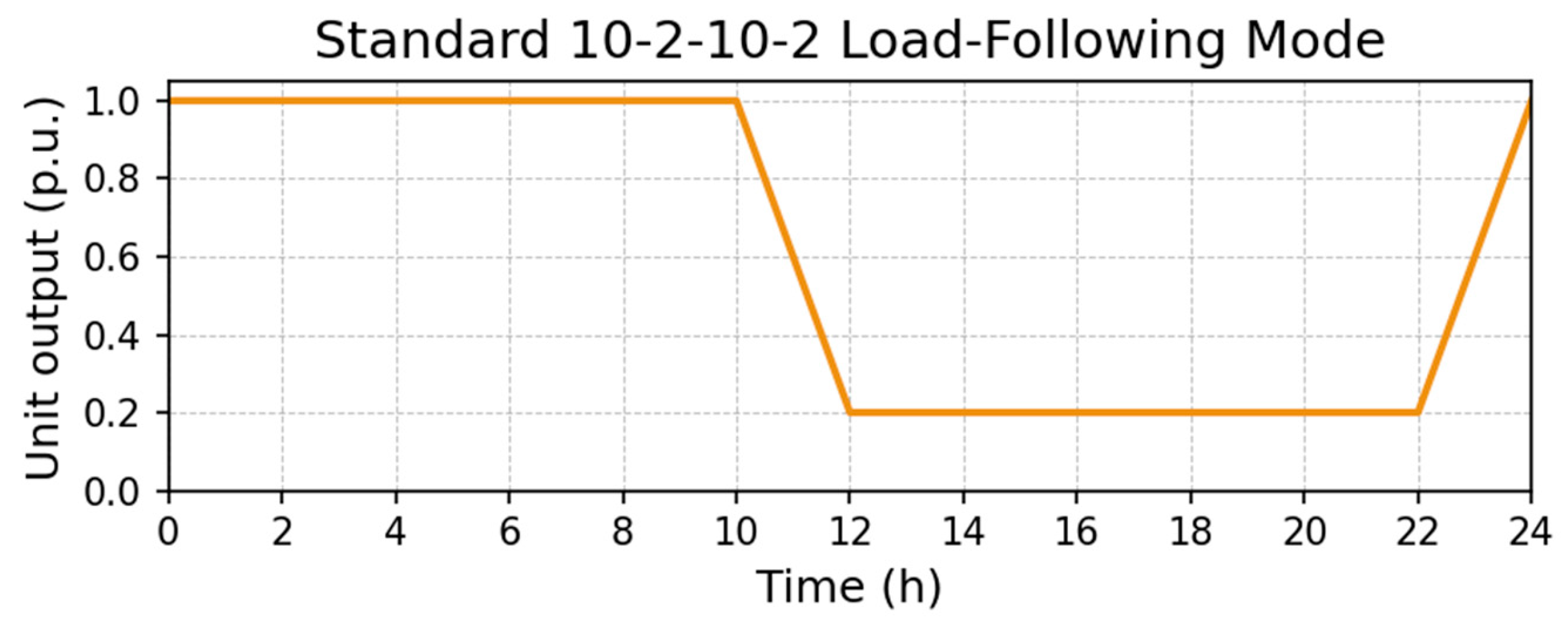
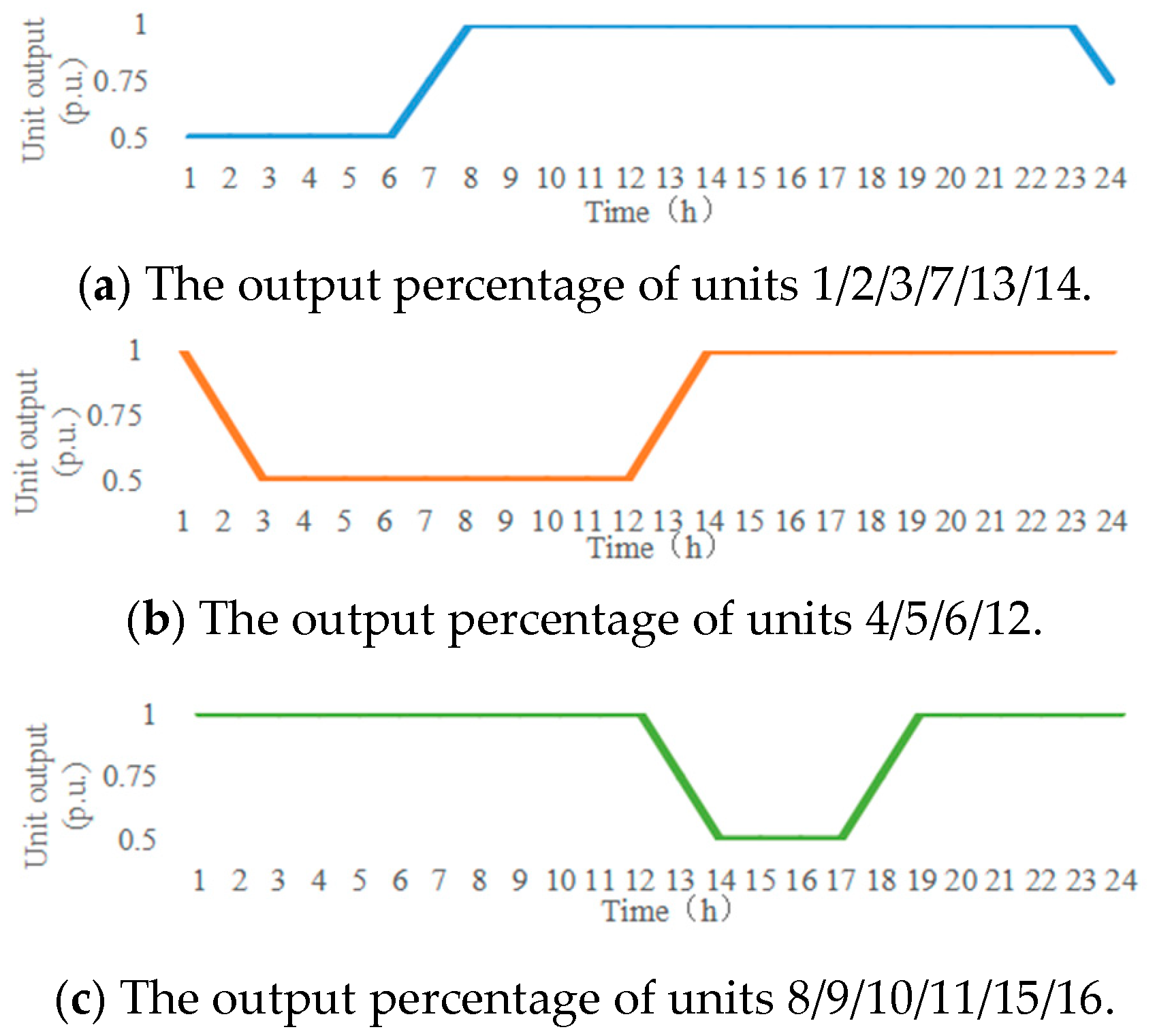
Currently, the main nuclear power generator models in operation in China include the M310, CPR1000, EPR, and AP1000 [28]. The peak-shaving modes and capacities for these four reactor types are shown in Table 5. Among these, the M310 and CPR1000 units operate under a “12-3-6-3” pattern within 80% of their operational lifespan [29,30]. This means that the unit will operate at 100% of rated power for 12 h. The output power is reduced to 50% of rated power within 3 h, then operated at this low power level for 6 h, and then increases to 100% of rated power within 3 h. In contrast, the EPR and AP1000 reactor types have stronger daily load curve-tracking capabilities, enabling a “10-2-10-2” daily load cycle over 90% of their operational lifespans. Although studies show that both types of reactors can operate at an output above 25% of nominal power in the long run, without constraints on operating cycles or power levels, in reality, 50% and above of nominal power is a common choice.
Both “10-2-10-2” and “12-3-6-3” are common operating modes in nuclear power plants. To illustrate their output variations more clearly, two regulation mode diagrams are shown in Figure 1 and Figure 2.
As the depth of nuclear generators’ participation in peak load regulation increases, the actual annual utilization hours of nuclear units will decrease, thereby reducing the loading factor of nuclear power plants. Since the nuclear fuel replacement cycle is relatively fixed (typically 12 or 18 months), participating in peak load regulation will significantly reduce the efficiency of nuclear fuel use. Therefore, under the current system, nuclear power’s participation in peak load regulation will reduce its economic viability.

4. The Improvement in the Nuclear Power Operational Economy

4.1. Flexibility Enhancement Alternatives

In the spot market, nuclear power flexibility refers to its ability to adjust output to respond to load changes. By 2035, the evaluation of nuclear power flexibility should also expand from purely technical indicators to include economic factors such as price responsiveness, regulation marginal cost, opportunity cost, and revenue sensitivity, to fully reflect its actual ability under market conditions.
Given that nuclear power plants may face prolonged reductions in output in the future, leading to a decline in operational economics, energy storage can be deployed to improve the economic efficiency of nuclear generators. The characteristics of common energy storage technologies are compared in Table 6.

4.2. Market Clearance Analysis of Liaoning Power Grid in 2035

In 2035, the peak shaving requirement and, therefore, the operational economics of the nuclear operator, depend on the bidding prices of various types of generation units and on spot market clearance. Therefore, market clearance needs to be simulated to determine the optimal configuration of the storage system to improve nuclear generator flexibility and operational efficiency.

4.2.1. Spot and Reserve Auxiliary Clearance Model in a Unified Large Market Environment

The market-clearing model constructed in this study is based on the Safety-Constrained Unit Combination (SCUC) and Safety-Constrained Economic Dispatch (SCED) framework, aiming to minimize the total system operating cost, which includes unit fuel costs, start-up/shutdown costs, and operating expenses of flexibility resources (such as thermal storage devices). Under constraints including power balance, unit operational characteristics, energy storage/thermal storage energy balance, system safety, and market-clearing mechanisms, the model simultaneously optimizes unit output, start-up/shutdown status, and energy storage power to balance economic efficiency and safety. The objective function and main constraints in the model are shown in Table 7. The clearance model, including the objective function, all constraints, and solution methods, is described in detail in Appendix A.

4.2.2. Bidding Prices of Various Types of Generators

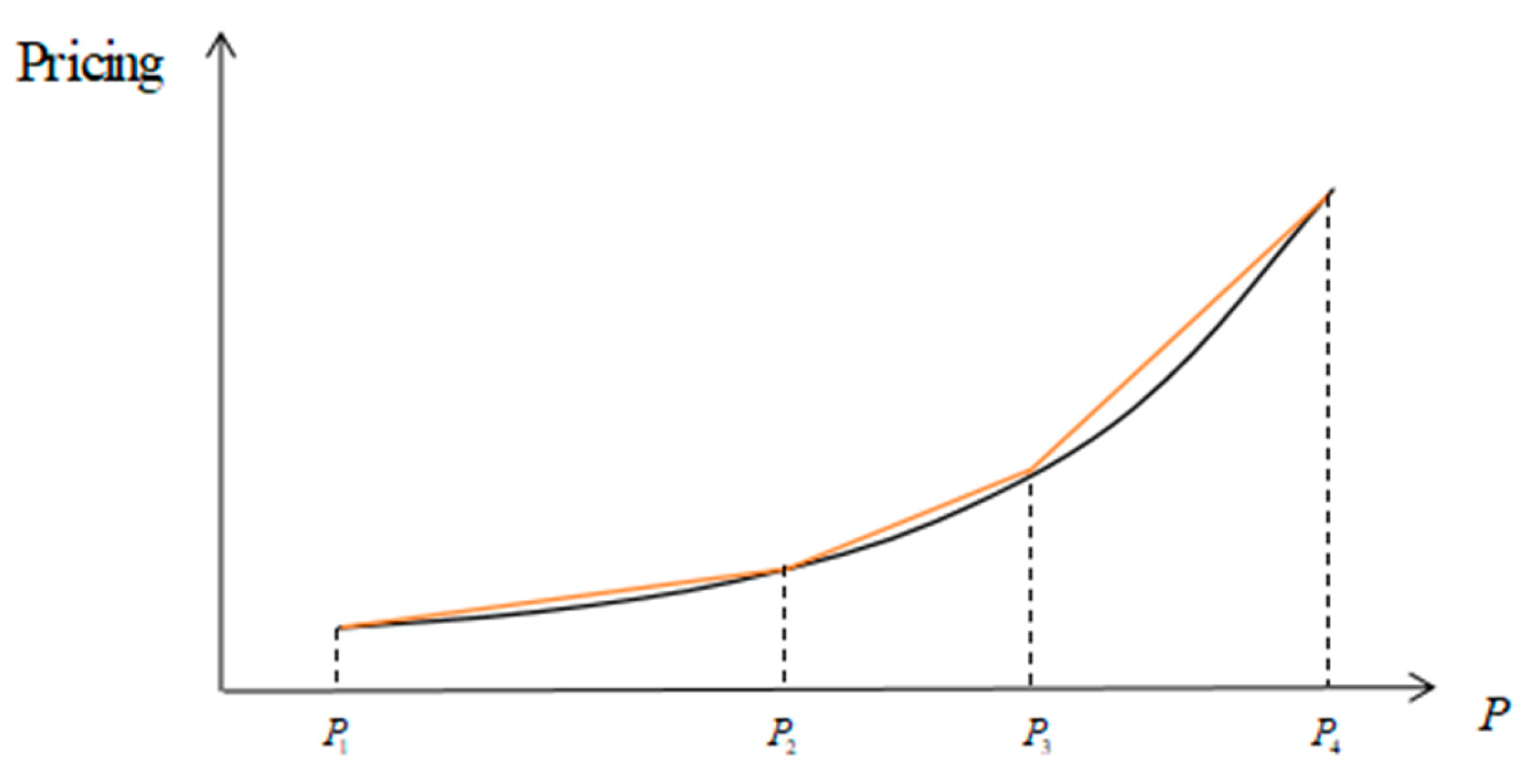
In the electricity spot market, power generation units generally adopt a piecewise pricing strategy (typically 3–5 steps). By choosing prices for each step, stepwise pricing can be regarded as a linearization of the nonlinear cost characteristic of coal-fired units. As shown in Figure 3 below, the nonlinear cost is linearized.
In order to reflect the difference in pricing among different generator groups, we designed the following bidding model for coal-fired generators and gas generators:
ρ m ( i ) = ρ m ¯ ε
M ranges from 1 to 3, representing three steps, respectively.   ρ m ¯ is the average bid price for the mth tier. To reflect differences in bid prices across units, a random number between 0.9 and 1.1 is introduced.
ρ m ( i ) is the actual bid price of the ith generator for the mth step.
The ρ m ¯ is chosen as follows:
ρ 1 ¯ is set at 250 CNY/MWh, slightly below the levelized cost of a coal-fired generator;
ρ 3 ¯ is set at 640 CNY/MWh, based on the highest March 2025 clearing price in Liaoning [31];
ρ 2 ¯ is chosen to be the average of ρ 1 ¯ and ρ 3 ¯ , set at 445 CNY/MWh.
The bidding strategy for nuclear generation in Liaoning is set at 0 CNY/MWh for an output below 70% of the nominated power and 375 CNY/MWh for 70%~100%. The 70% threshold is chosen in accordance with the requirements of the current long-term contract.
It should be clarified that the aforementioned assumption of low nuclear power bids is based on China’s current unified settlement framework, which combines the medium- to long-term and spot markets. The majority of nuclear power generation is locked in through annual or multi-year medium- to long-term contracts. These contracted volumes are decomposed into daily and settlement-period-specific time-of-use curves. For this ‘contract-decomposed electricity’, revenue is primarily determined by pre-agreed contract prices and is, in principle, independent of prevailing spot clearing prices. Only the shortfall between actual generation and contracted volumes constitutes deviation electricity, which is settled at spot prices and may incur penalty assessments, effectively repurchasing shortfall volumes at unfavourable rates. Consequently, nuclear operators’ primary objective in the spot market is to ensure physical fulfillment of contracted volumes and avoid deviation risks from under-generation, rather than seeking spot premiums on contracted electricity. Given these incentive constraints, this study treats approximately 70% of rated capacity as the baseload output range covered by contracts. Within this range, near-zero bid levels are adopted to approximate a rational bidding strategy of ‘suppressing prices to secure volume and prioritizing contract revenue protection’. Only for incremental output exceeding 70% are positive bids used to reflect marginal costs and capture additional spot-market returns.
The current combination of bidding parameters effectively defines a relatively conservative boundary, most unfavourable to nuclear power. Under this scenario, coal-fired units gain a competitive edge at prices below 375 CNY/MWh, because at least 30% (the percentage of generation unlocked by medium- and long-term contracts) of the maximum nuclear power generation bids at this price. Consequently, during low-load periods, the nuclear power volume does not clear. This study configures energy storage or thermal storage systems precisely under these boundary conditions to consume the nuclear electricity that would otherwise be unsold to the grid. The resulting storage capacity and the corresponding increase in nuclear electricity costs can be regarded as a conservative upper-bound estimate. Under more favourable competitive bidding conditions for nuclear power, its utilization hours and revenue levels would exceed those in this scenario, and the required energy storage/thermal storage capacity would be smaller than the results presented here. This lends greater robustness to this study’s conclusion that “deploying energy storage or thermal storage enhances nuclear power’s flexibility and economics”.

4.2.3. Basic Curves of Typical Scenarios in the Liaoning Power Grid in 2035

The generation mix and load demand of the Liaoning power grid in 2035 are shown in Table 1.
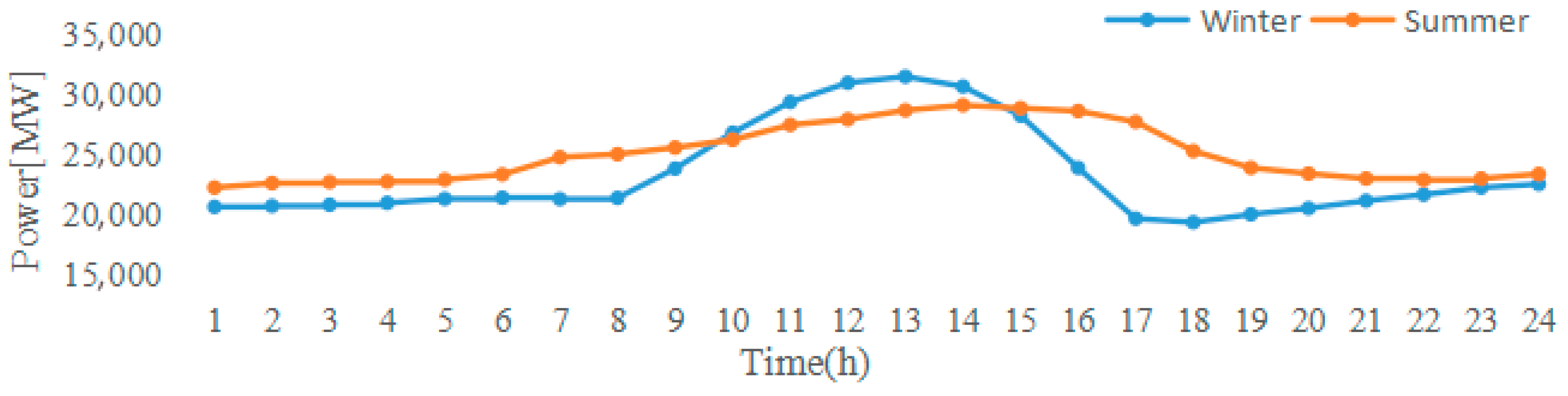
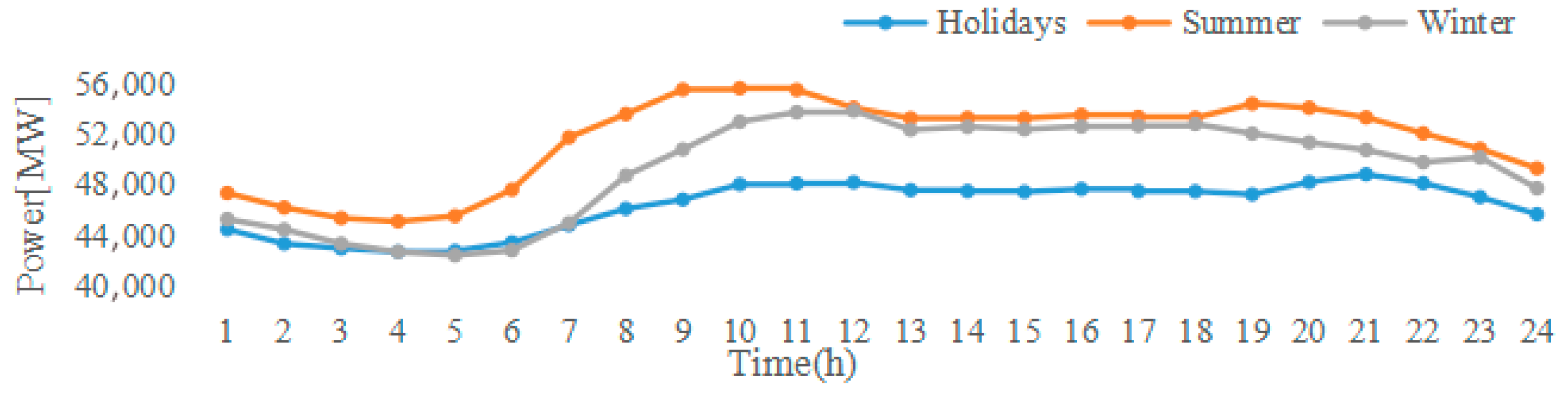
We retain the shapes of load curves for typical working days in summer and winter, and for non-working days in 2024, and construct the typical load curves in 2035 by scaling them by a factor. The scaling factor is the ratio between the maximum demand in 2035 and that in 2024. These typical load curves are shown in Figure 4. The renewable generators’ output curves are shown in Figure 5, obtained by scaling the 2024 output curves by the ratio of the installed capacity of renewables in 2035 to that in 2024.
It is worth emphasizing the rationale behind our construction of the 2035 load and renewable generation profiles. In this study, we preserve the intraday shapes of Liaoning’s 2024 typical curves and apply proportional scaling to reflect long-term growth, thereby obtaining representative 2035 load and renewable generation trajectories. The theoretical justification for this treatment rests on three main aspects.
(i)
Liaoning’s load composition has been structurally stable in recent years: peak hours, peak–valley span, and the daily profile shape exhibit only minor interannual variations. Using 2024 as the baseline, therefore, maintains realistic intraday load characteristics.
(ii)
The wind and solar profiles are extracted from measured 2024 provincial output rather than stylized assumptions. Scaling alters only the magnitude of generation while preserving meteorology-driven temporal patterns, which is consistent with the current absence of detailed siting and commissioning plans for future renewable projects.
(iii)
The primary objective of this study is to assess nuclear downward regulation requirements under a “maximum peak-to-trough” stress day. Proportional scaling strengthens the co-occurrence of high renewable output and deep load troughs, thereby defining a conservative boundary condition that is deliberately unfavourable to nuclear operation.
Most importantly, this modeling choice is also consistent with international practice. For example, the official NREL ReEDS academic model scales historical hourly load profiles using growth factors while keeping the temporal shape unchanged across study years [32].

4.2.4. Market Clearance in Typical Scenarios

Under this condition, the clearing price in winter reaches a maximum of 375 CNY/MWh, a minimum of 229.6 CNY/MWh, and an average of 288.13 CNY/MWh, while in summer, the average operational rate of thermal power units is 0.494, resulting in a maximum clearing price of 375 CNY/MWh, a minimum of 216.3 CNY/MWh, and an average of 294.62 CNY/MWh.
During holidays, due to lower load demand, the average operational rate of thermal power units is 0.41, leading to a maximum clearing price of 375 CNY/MWh, a minimum of 204.2 CNY/MWh, and an average of 253.62 CNY/MWh.
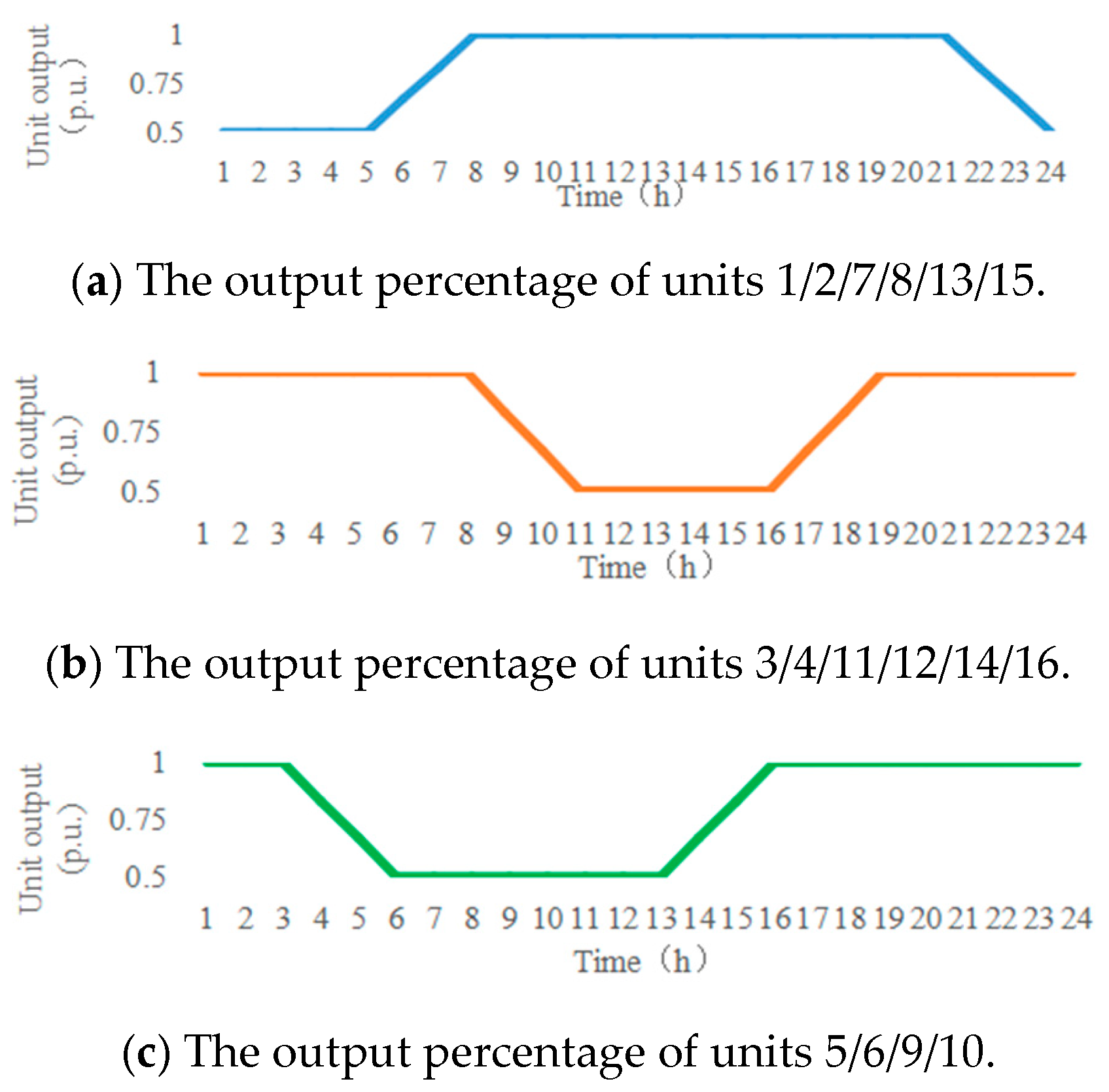
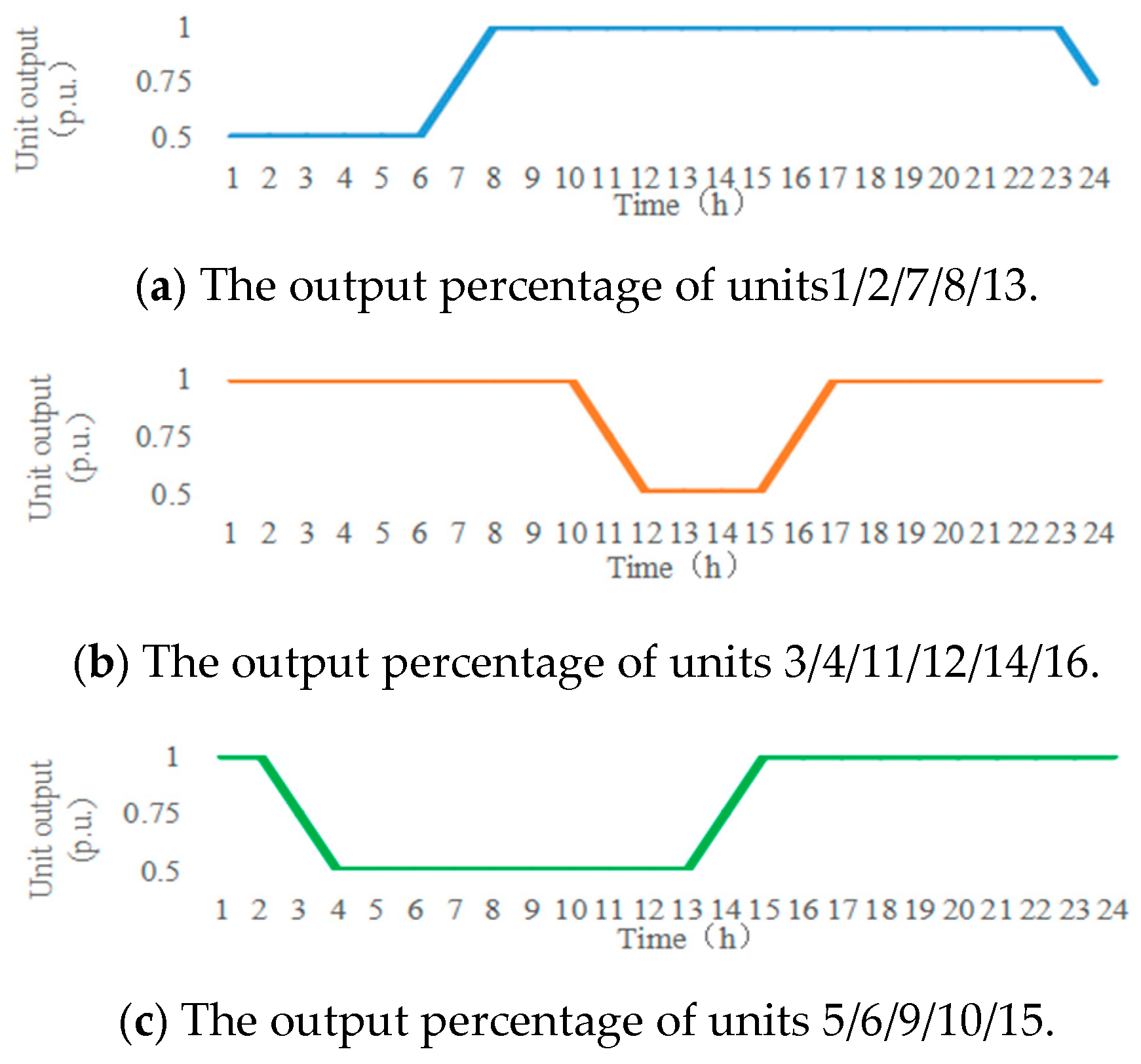
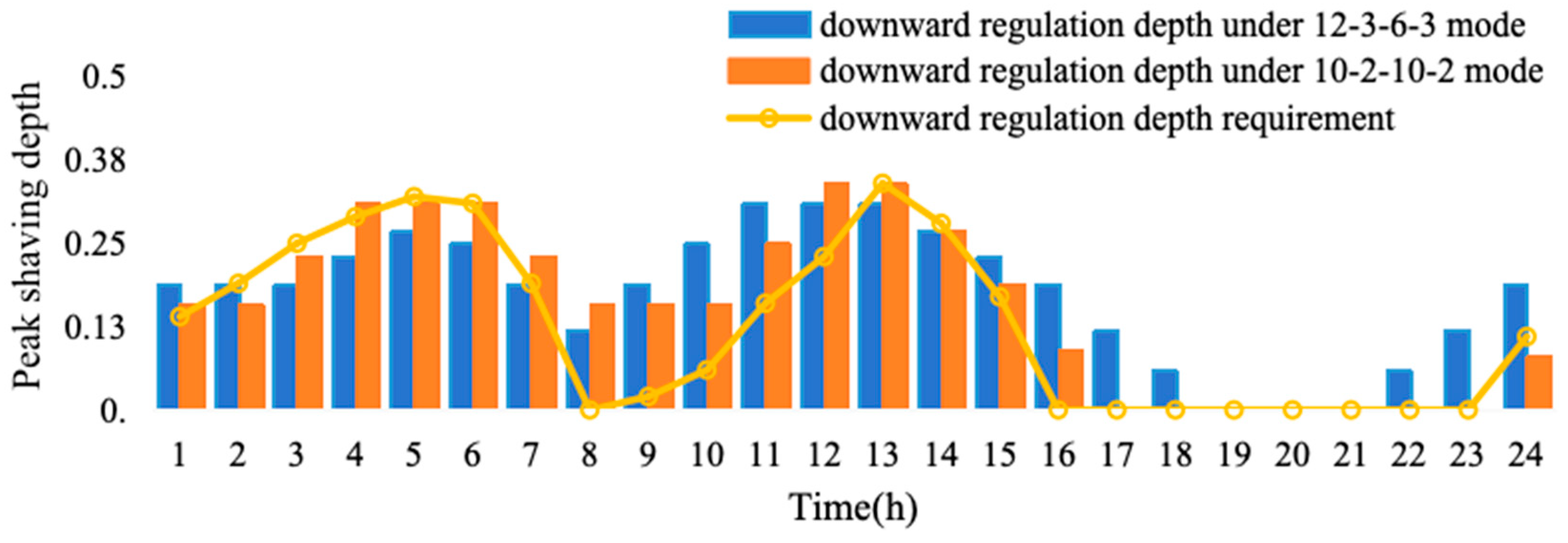
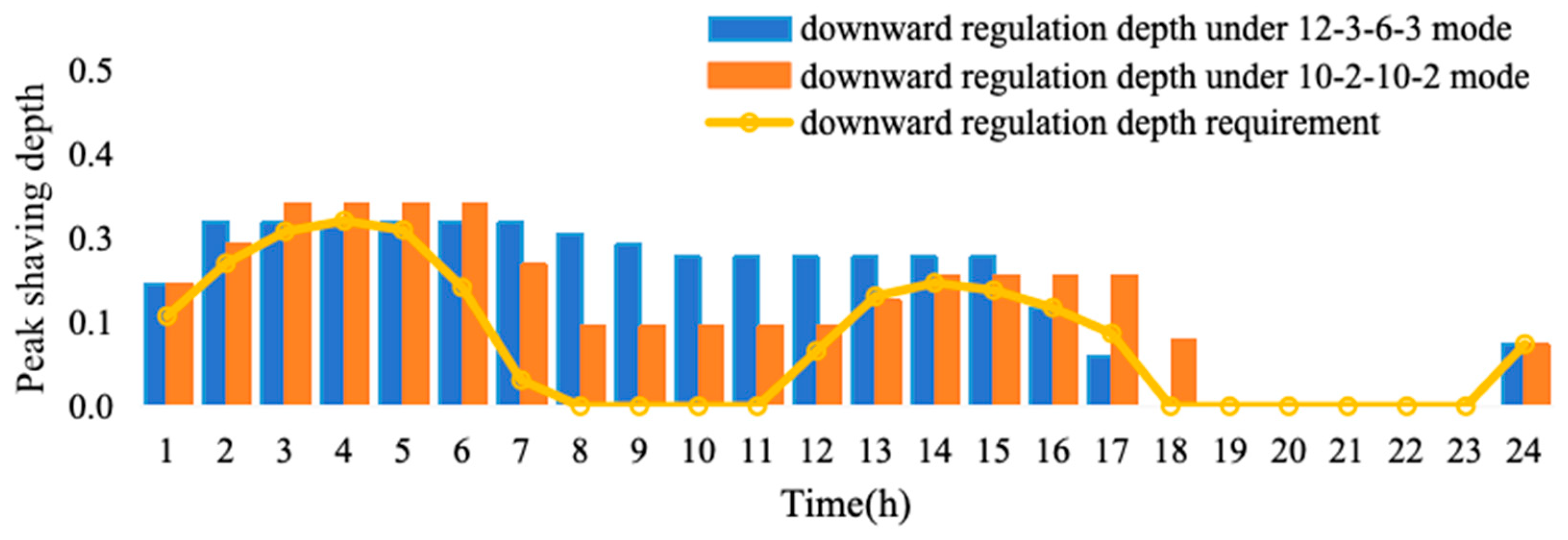
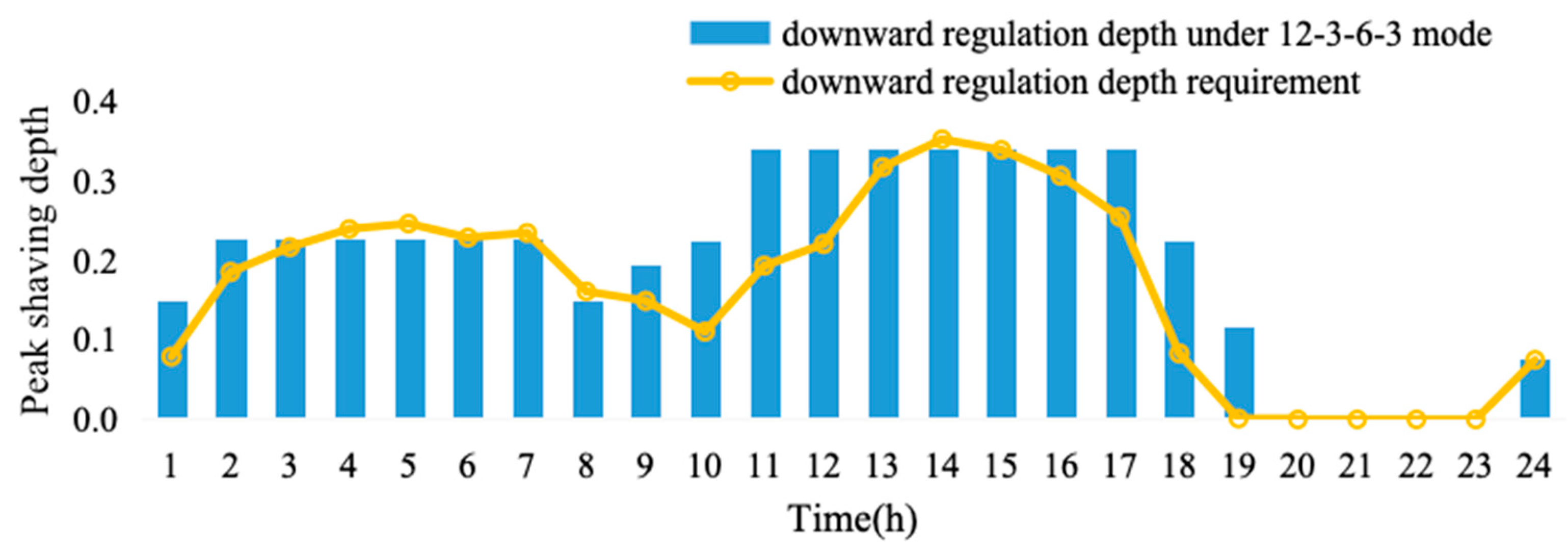
According to the clearing results, the theoretical peak-shaving requirements for all nuclear units are shown in Figure 6, Figure 7 and Figure 8. Considering the mandatory operational modes of nuclear units when downward regulation is needed, the actual peak-shaving depth achieved under different operational modes is shown in Figure 6, Figure 7 and Figure 8. The operational modes of nuclear power units corresponding to the actual peak-shaving depth and their output profiles are illustrated in Figure 9, Figure 10, Figure 11, Figure 12 and Figure 13.
During the winter, 16 nuclear power units participate in peak shaving under the “12-3-6-3” mode; the output coefficients are shown in Figure 9. The theoretical adjustment depth is not reached at 3–6 o’clock and 1 o’clock, and the total daily nuclear power generation is 382,349.22 MWh, accounting for 82.3% of the nuclear power’s maximum daily capacity.
Sixteen nuclear power units participate in peak shaving under the “10-2-10-2” mode; the output coefficients are shown in Figure 10. Under this mode, nuclear power demonstrates more flexibility. This solution is the most thermal power-friendly, with a total daily nuclear power generation of 392,027.59 MWh, accounting for 84.4% of the nuclear power plant’s maximum daily capacity.
In summer, sixteen nuclear power plants participate in peak shaving under the “12-3-6-3” mode; the output coefficients are shown in Figure 11, with a maximum peak-shaving depth of 28%. Only at 17:00 does the theoretical adjustment depth fail to reach the target, and the total daily electricity generation from nuclear power plants is 387,134.8 MWh, accounting for 83.3% of the maximum daily capacity.
Sixteen nuclear power units participated in peak shaving using the “10-2-10-2” model; the output coefficients are shown in Figure 12, achieving a peak shaving depth of 30%. The theoretical adjustment depth was achieved across all time periods, and the total daily nuclear power generation was 395,148.43 MWh, accounting for 85.1% of the nuclear power’s maximum daily capacity.
During holidays, as the Hongyanhe nuclear power units need to reduce output at all times, it is recommended to shut down one unit. The remaining five nuclear power units participate in peak shaving under the “12-3-6-3” mode; their output curves are shown in Figure 13.
Table 8 summarizes the characteristics of nuclear power in each scenario.

4.3. Operational Economy Improvement with the Incorporation of Energy Heating-to-Thermal Storage

In the Province of Liaoning, the heating season is long, and load flexibility is low. Combined heat and power (CHP) units are generally constrained by the “heat-driven power generation” principle, with minimum output ranging from 75% to 85%, significantly compressing the dispatch space for renewable energy and nuclear power. As nuclear power capacity grows, its operating model shifts from base load to flexible regulation. In the absence of peak shaving compensation and energy storage, nuclear power faces frequent output reductions and power curtailment during winter. Adopting a heating–heat storage solution not only reduces economic losses from nuclear power curtailment but also enhances the power grid’s regulation capacity, creating complementary advantages.

4.3.1. The Economic Feasibility Analysis Method for the Configuration of the Heating–Heat Storage System

We assume that excess electricity from nuclear generators can be converted to thermal energy via electric boilers or heat pumps. Assuming that the thermal power company or market provides a clear thermal price, revenue can be calculated by multiplying the thermal energy by the thermal price [33] as follows:
C = Q h e a t · λ h e a t
where C is heat revenue (CNY); Q h e a t is heat energy (kWh); and λ h e a t is the heat price, set at 0.2 CNY/kWh based on heating charges and subsidy policy [34].
The investment in a heating or heat storage system includes equipment, land, and construction costs. The equipment investment, evaluated by annual cost, is calculated as shown in Equations (4) and (5).
The annualized depreciation cost, C d e p a n n , of a heating or heat storage system is calculated in Equation (4):
C d e p a n n = P r ( 1 + r ) n ( 1 + r ) n 1
where P is the initial investment (CNY); n is the service life of the equipment (years); and r is the discount rate, which is set at 5.5%.
The annual O&M cost, C O & M , is considered a fixed proportion, for example, 1.25% of C d e p a n n .
The annual cost, P V , is the sum of C d e p a n n and C O & M .
The estimated payback period (discounted) is calculated by Equation (5).
n = ln ( 1 P V r C   ) ln ( 1 + r )
where P V represents the initial investment; C denotes the annualized net return; r , the discount rate, is set at 5.5%; and n is the payback period in years.

4.3.2. The Optimal Configuration of Heating–Heat Storage System Analysis

Given the strong winter demand for heating and minimal summer demand in the Province of Liaoning, the optimization analysis of heating–storage capacity focuses primarily on winter income from the heating and storage system, including 105 typical working days and 46 holidays.
Based on the clearance of nuclear units shown in Figure 6 and Figure 8, the residual electricity for a typical winter working day and a holiday can be extracted. The stable heating load from the residual electricity of one nuclear unit is the average of the downward regulation depth requirements, which are 853.6 MW and 1896.54 MW for working days and holidays, respectively.
By choosing an electric boiler as the main heating technology, the total investment in the heating devices and heat storage system for a stable heat consumer of 836.53 MW is calculated, as shown in Table 9, and the specific investment costs for each project are shown in Table 10.
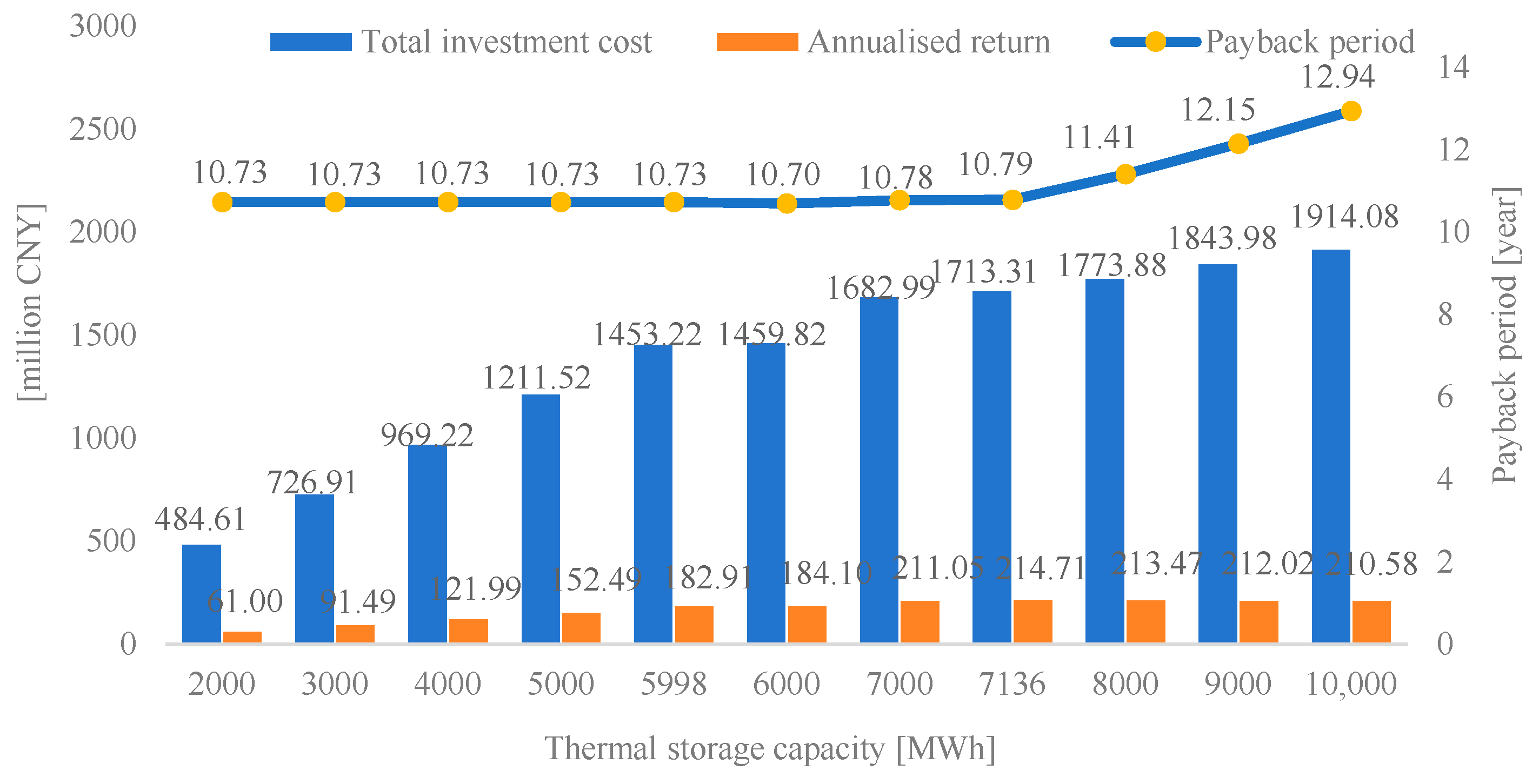
A sensitivity analysis was conducted, in which the heat storage system capacity ranged from 2000 MWh to 10,000 MWh, and the heating power varied accordingly to maintain a stable heat supply to consumers.
As shown in Figure 14, when the capacity of thermal storage is below 6000 MWh, the total investment and annualized net income increase linearly with the thermal storage capacity, while the payback period remains constant at 10.73 years; when the thermal storage capacity is 6000 MWh and the heating power is 716.63 MW, the payback period is the shortest, which is 10.7 years. When the thermal storage capacity exceeds 6000 MWh, the payback period gradually increases; at 7135.85 MWh, the annualized net revenue reaches its maximum; beyond 7135.85 MWh, it begins to decline.
Therefore, the optimal capacity of the thermal storage system is chosen to be 6000 MWh, with a heating power of 716.63 MW.
The following section provides an economic assessment of configuration schemes for heating power P heat = 715   MW and thermal storage capacity E s t o r e   = 6000   MWh .
(i)
Sensitivity to heat price λ h e a t
The annual heating revenue for the heating–storage system is defined as
R = Q h e a t   λ h e a t      
where Q h e a t denotes annual heat supply volume (determined jointly by the heat demand curve and heating capacity), and λ h e a t   denotes nuclear heat ex-works price (benchmark: 0.11 CNY/kWh).
At the benchmark heat price λ h e a t , 0 , the corresponding annual revenue is
R 0   = Q h e a t   λ h e a t , 0
If the heat price fluctuates around the benchmark:
λ h e a t   = ( 1 + δ λ   ) λ h e a t , 0  
Heat revenue changes to
R ( δ λ   ) = Q h e a t   ( 1 + δ λ   ) λ h e a t , 0   = ( 1 + δ λ   ) R 0  
and the annual net profit is
Π ( δ λ   ) = R ( δ λ   ) C a n n , 0   = ( 1 + δ λ   ) R 0   C a n n , 0  
where C a n n , 0   represents the annual total cost (investment depreciation + operational and maintenance costs) under the baseline scenario. The corresponding value for a 6000 MWh capacity in the report table is approximately CNY 101.579 million.
It is evident that thermal price variations linearly impact revenue, thereby influencing net profit and payback period:
T ( δ λ   ) = I 0 Π ( δ λ   )    
Within reasonable fluctuations around the benchmark thermal price, the net benefit Π ( δ λ ) varies between approximately CNY 1.3 × 10⁴ and 2.4 × 10⁴, while the payback period ranges from approximately 8 to 16 years. As the overall shape and relative ranking of the benefit–capacity curve remain unchanged, the optimal thermal storage capacity remains stable at approximately 6000 MWh.
(ii)
Sensitivity Analysis of Investment Cost I
In the report, the total investment III for the heating–storage system comprises electric boilers, solid thermal storage units, and associated building works. Detailed investment and operational maintenance rates for each component are specified in the Appendix A. The system’s annual capital cost is expressed using the annuity method:
C i n v   ( r ) = I ( P / A ( r , n ) )
where the annuity factors are
P / A ( r , n ) = r ( 1 + r ) n ( 1 + r ) n 1
r: Discount rate (benchmark 5.5%);
n: Lifecycle (20 years adopted in this text).
The annualized O&M cost is
C o m   = η I
where η represents the annual O&M rate (specified by equipment category in the report, with a typical value of 1.25%).
Therefore, the total annualized cost is
C a n n   ( r ) = I ( P / A ( r , n ) ) + η I = I [ ( P / A ( r , n ) ) + η ]
When the investment cost changes to
I = ( 1 + ε ) I 0  
The corresponding annualized cost becomes
C a n n   ( I ) = ( 1 + ε ) C a n n , 0  
Net profit is
Π ( I ) = R 0   C a n n   ( I )
The payback period is
T ( I ) = I Π ( I )   =   ( 1 + ε ) I 0   R 0   ( 1 + ε ) C a n n , 0  
It is evident that the investment cost exhibits a proportional relationship with the annual cost, a linear relationship with the net benefit, and a quasi-linear relationship with the payback period. Within the range where investment costs fluctuate reasonably around the benchmark value, the payback period for a typical 6000 MWh scheme generally falls between 8.5 and 12.8 years. The conclusion remains that the project is economically viable, and the optimal capacity position remains unchanged.
(iii)
Sensitivity of discount rate r .
The discount rate solely affects the investment depreciation component, with its influence reflected in the annuity factor P / A ( r , n ) .
The annualized cost is
C a n n   ( r ) = I 0   ( P / A ( r , n ) ) + η I 0  
As the O&M component ( η I 0 ) is independent of r , changes in the discount rate partially offset its impact on total annual costs. When r varies within a reasonable range (e.g., 3.5–7.5%), the annuity factor ( P / A ( r , n ) ) fluctuates by approximately ±15%, the annual total cost C a n n   ( r ) fluctuates by approximately ±10%, the net benefit Π ( I ) consequently varies within ±10%, and the payback period T ( I ) generally falls within the 9.5–12 year range.
Therefore, discount rate uncertainty does not cause the optimal capacity to shift from the 6000 MWh range.
To summarize the above analysis, in the Liaoning Province annual nuclear power heating application, sensitivity analysis of the heating–storage system indicates that when thermal prices, investment costs, and discount rates fluctuate within reasonable ranges around their benchmark values, although annual costs, annual revenues, and payback periods exhibit certain variations, the overall shape of the revenue–capacity curve remains stable. The optimal thermal storage capacity consistently centres around approximately 6000 MWh. Consequently, the energy storage capacity optimization results exhibit robust resilience to key economic parameters, with the primary conclusions of this study remaining substantially unaffected by variations in the aforementioned parameters.
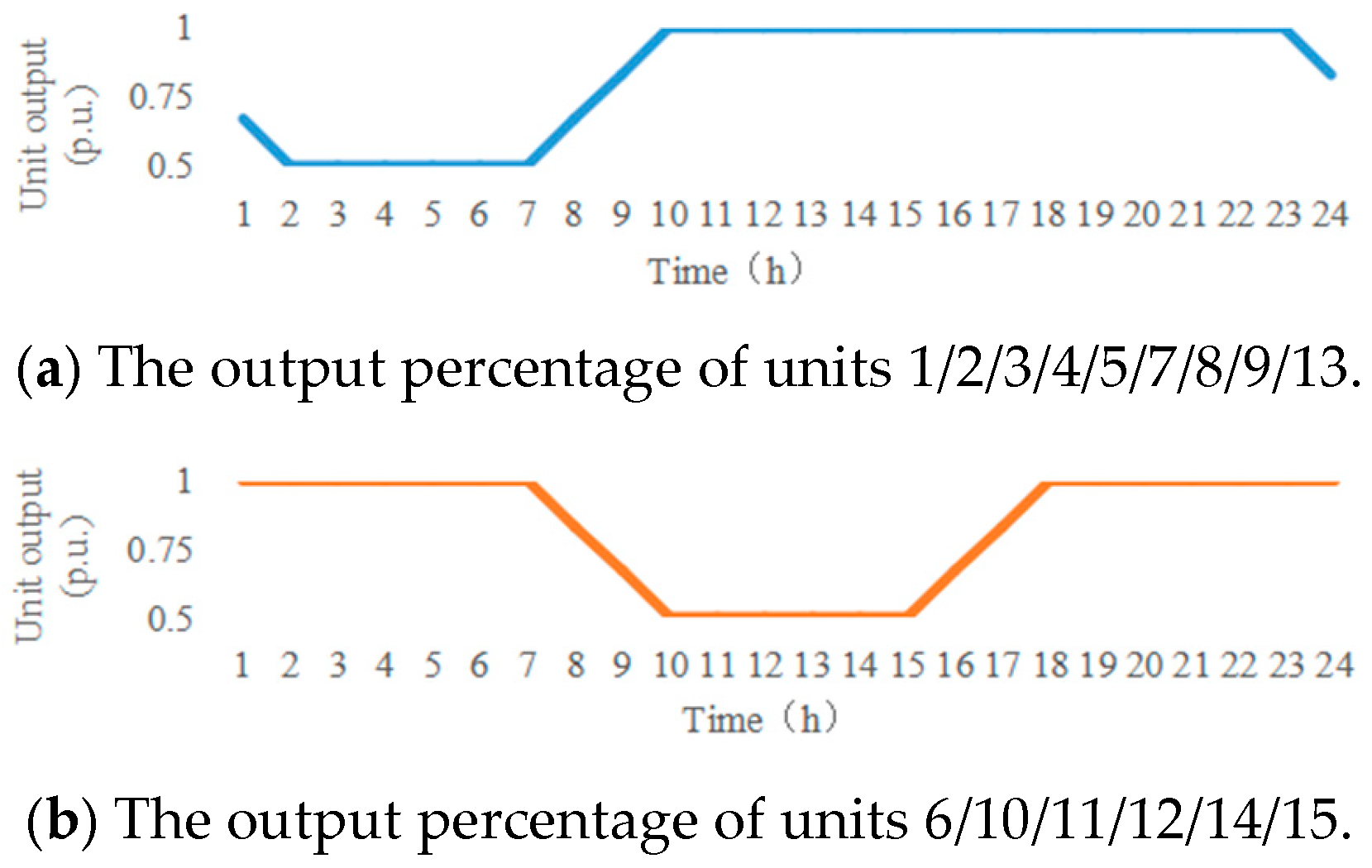
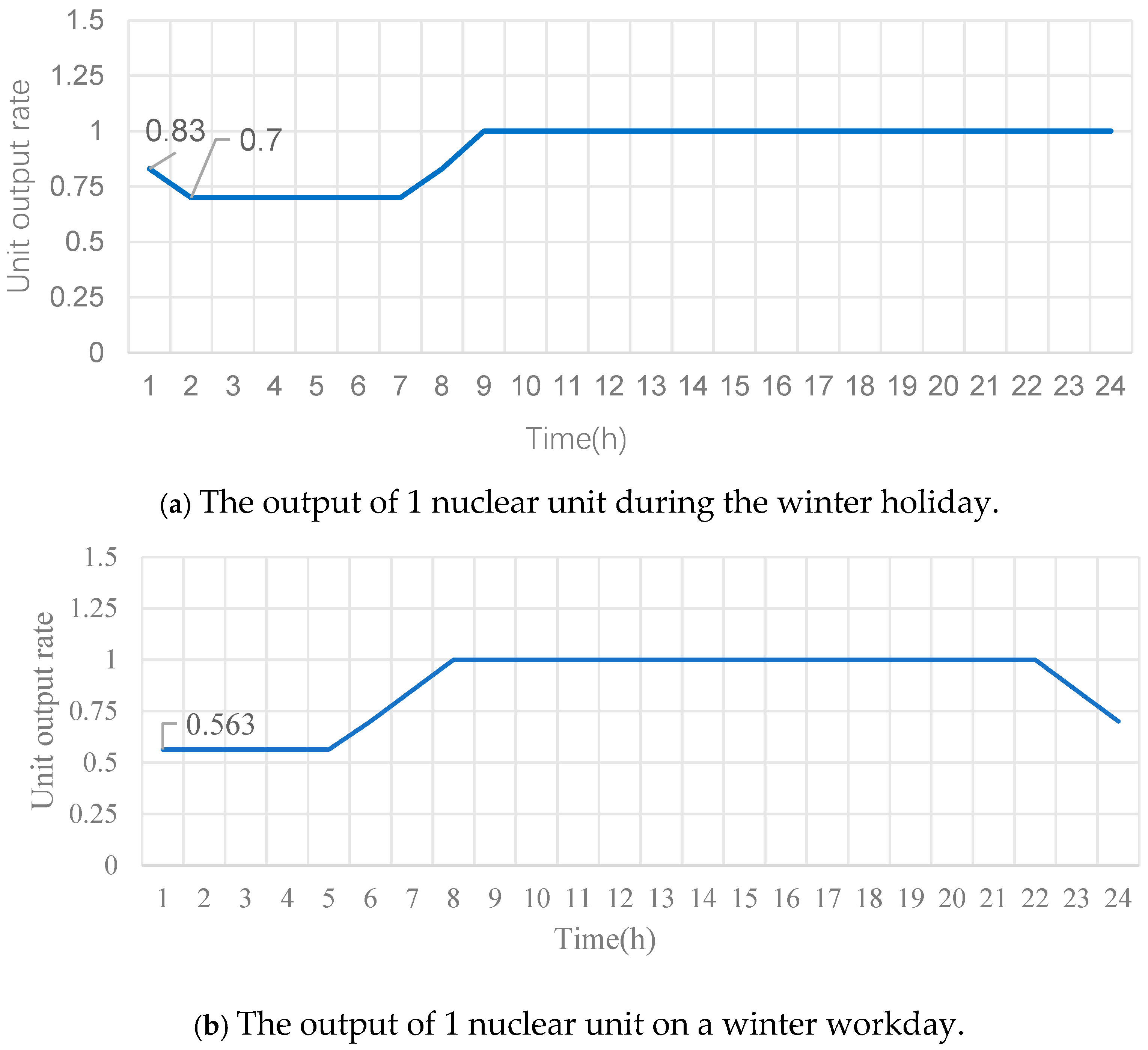
Even with the optimal configuration of heating power and capacity of the thermal storage system, the nuclear units still need to reduce their output to meet the downward regulation requirement and the need for heating power at each hour. There could be multiple operation modes for nuclear generator units in Liaoning. For example, during the winter holidays, we could schedule a planned outage for one unit and adjust the output of another unit, as shown in Figure 15a. On a winter workday, we could adjust the output of one unit as shown in Figure 15b.
The simulations and economic analysis in this section demonstrate that configuring thermal storage systems for nuclear power plants is not merely a technical upgrade but a strategic investment that yields multiple benefits. Its implications hold distinct significance for different stakeholders.
For nuclear plant operators, this approach is pivotal for survival and growth amid deepening electricity market reforms. It directly transforms “negative assets” during market troughs (revenue losses from forced output curtailment) into “new income streams” (heating revenues and higher market electricity prices). More significantly, it transforms nuclear power from a rigid baseload source into a flexible resource essential for the system, substantially enhancing its core competitiveness and commercial viability within future high-penetration renewable energy systems.
For power system dispatchers and regulators, the “nuclear power + thermal storage” solution offers a low-cost, highly reliable means of system regulation. Particularly during heating seasons, it effectively alleviates the longstanding “heat–power conflict” plaguing northern China’s grid. Without requiring additional coal-fired peak-shaving capacity, it substantially increases the integration potential for wind and solar power while reducing overall system carbon emissions. This provides a viable technical pathway towards achieving multiple objectives: energy security, green transition, and system-wide economic operation.
For investors and policymakers, this approach demonstrates a new pathway to enhance the return on investment and utilization efficiency of nuclear assets. Despite initial investment requirements, its clear profit model (with an approximate payback period of 10–11 years) and the positive externalities it generates for the system (such as emissions reductions) provide a compelling business case for attracting social capital to participate in nuclear flexibility retrofits. Consequently, policymakers should consider incorporating comprehensive nuclear energy use into clean energy support schemes. This can be achieved by refining market mechanisms and providing appropriate fiscal incentives to accelerate the widespread adoption of this technology.

4.3.3. Analysis of System Synergy Benefits

The aforementioned analysis primarily focuses on improving the operational economics of nuclear power units by integrating thermal energy storage systems. However, the value of this approach extends far beyond this scope. From the perspective of the entire power system, deploying energy storage alongside nuclear generation will yield significant synergies. These include facilitating the integration of renewable energy, reducing system-wide carbon emissions, and optimizing the structure of reserve resources. Based on market-clearing outcomes, we have further assessed the macro-level impact of energy storage deployment on system operations.
Taking the days with the largest peak-to-trough differences in winter as examples, assuming only 60% of the planned installed capacity for pumped storage is put into operation, the minimum net load moments on those days exhibit downward peak shaving gaps of approximately 21.07 million kilowatts. Without energy storage deployment, this shortfall would necessitate curtailing baseload generation or abandoning wind and solar output. With adequate nuclear-side energy storage, the corresponding surplus electricity could be fully absorbed through off-peak charging. Converted to one-hour durations, the displaced electricity during the typical winter period amounts to approximately 21.07 GWh. This indicates that with energy storage participation, curtailed wind and solar generation during these critical periods could be reduced from approximately 21.07 GWh to near zero. Under conservative assumptions, if the aforementioned reduction in peak demand gap occurs for just one hour per day on average during a typical month, approximately 653 GWh of wind and solar curtailment could be avoided in January. This demonstrates the significant potential of nuclear power and energy storage solutions to enhance renewable energy consumption.
Furthermore, assuming that the excess electricity absorbed by energy storage” would otherwise be supplied by marginal coal-fired units in the absence of proposed thermal storage, the corresponding change in CO2 emissions can be estimated by Equation (21):
Δ C O 2   = Δ E × E F c o a l  
where E F c o a l , the typical coal-fired power emission factor, is set at 0.82 t CO2/MWh for conversion. E denotes the daily downward regulation energy of nuclear units obtained in Section 4.2.4 (approximately 7.7 × 10⁴ MWh for the long-term winter typical day). Substituting these values into Equation (21) yields an avoided emission of approximately 6.3 × 10⁴ t CO2 per typical winter day, corresponding to approximately 2.0 × 10⁶ t CO2 over a representative 31-day winter month. These figures directly reflect the amount of energy that can be shifted from marginal coal-fired units to nuclear-side thermal storage and, therefore, provide a conservative lower-bound estimate of the system-level emission reduction achieved by the proposed flexibility enhancement scheme.
Regarding spinning reserves, Liaoning’s annual reserve requirement remains exogenously set at 10% of peak load, with peak load estimated at approximately 6458 MW. This corresponds to a required upward reserve capacity of roughly 645.8 MW. Without altering this reserve standard, if the energy storage capacity deployed on the nuclear power side were equivalent to the summer peak shaving deficit (approximately 9590.2 MW), its theoretical available regulation capacity would be approximately 1.5 times the system’s reserve requirement. In other words, subject to SOC constraints, the nuclear power plus energy storage combination could, at certain times, sufficiently shoulder the bulk of upward spinning reserve requirements. From a system-wide perspective, this equates to significantly reducing reliance on conventional coal-fired units for reserve capacity provision without compromising safety standards. Overall, although this study’s optimization objective does not aim to maximize system-wide social welfare, the Liaoning annual scenario demonstrates that adding energy storage to nuclear power not only improves the economic viability of nuclear units but also enhances the nuclear fleet’s overall economic viability. Within the given market and dispatch framework, it also delivers quantifiable synergistic benefits to the power system by reducing curtailed wind and solar generation, lowering thermal power operation and CO2 emissions, and partially replacing coal-fired power in the reserve capacity structure.

5. Conclusions

Nuclear power plants must balance safety and economic efficiency when providing peak load regulation. In systems with a high proportion of renewable energy, simply improving regulation speed is insufficient to address economic efficiency issues; instead, excess electricity must be absorbed through multi-energy coupling. Leveraging the high energy density and stable output characteristics of nuclear power, this study proposes an integrated energy solution combining nuclear power with thermal energy storage. By optimizing system efficiency through combined heat and power generation, this approach achieves mutual benefits for all parties involved.
This study reaches the following conclusions through its research:
Province Liaoning is taken as an example. By 2035, the installed capacity of wind power and solar power in the region is expected to increase to 63.7 GW and 33 GW, respectively, with their combined share rising to approximately 54%, making new energy the dominant power source. Concurrently, the share of coal-fired power will significantly decrease to 24.06%, while nuclear power capacity will nearly triple, increasing its share to 10.81%. The scale of flexible regulation resources will be significantly enhanced, but further improvements are still needed to adapt to the volatility characteristics of high-proportion renewable energy grid integration.
This study establishes a joint clearing model for spot and reserve services. Clearing simulations are conducted for typical days in summer, winter, and holidays in 2035, based on load and generation forecasts. Based on the simulation results, deep peak shaving can be achieved in both summer and winter, but certain time periods still fail to meet theoretical regulation requirements. By enhancing the flexibility of nuclear power plants, such as transitioning from a “12-3-6-3” mode to a “10-2-10-2” mode, not only can the maximum peak shaving depth be increased (from 28% to 30% in summer and from 31% to 34% in winter), but so can the annual electricity generation of nuclear power plants, demonstrating good system adaptability and economic efficiency.
Based on the climate in Liaoning Province, Northeast China, a coupled operational strategy for nuclear power and thermal storage equipment for heating was designed. Using six nuclear power units in a certain location with thermal storage capacities ranging from 2000 MWh to 10,000 MWh, the operational modes for different seasons were determined, and the stable heating load capacity under the coupled operation mode was calculated. Through a cost–benefit analysis, the optimal heating power and thermal storage capacity are determined. With the configuration, the reliable operation of the Liaoning power grid and the operational economy of nuclear units are both guaranteed.

Author Contributions

Methodology, H.R. and J.L.; Formal analysis, Q.G.; Resources, G.Q.; Data curation, D.L.; Validation, D.L.; Software, K.H. and Q.G.; Writing—original draft, K.H.; Writing—review & editing, H.R.; Project administration, J.X.; Funding acquisition, J.X.; Supervision, G.Q. All authors have read and agreed to the published version of the manuscript.

Funding

This research received no external funding.

Data Availability Statement

The original contributions presented in this study are included in the article. Further inquiries can be directed to the corresponding author.

Conflicts of Interest

Authors Ge Qin, Dongyuan Li and Jiaoshen Xu were employed by the State Key Laboratory of Nuclear Power Safety Technology and Equipment, China Nuclear Power Engineering Co., Ltd. The remaining authors declare that the research was conducted in the absence of any commercial or financial relationships that could be construed as a potential conflict of interest.

Appendix A. Joint SCUC/SCED Clearance Model of Provincial Electricity Spot Market

This appendix provides the complete mathematical formulation of the joint clearing model for the provincial electricity spot market, incorporating the Security Constrained Unit Combination (SCUC) and Security Constrained Economic Dispatch (SCED).

Appendix A.1. Security-Constrained Unit Combination (SCUC) Model

Appendix A.1.1. SCUC Objective Function

The provincial electricity spot market SCUC model aims to minimize the total intraday operational costs of the provincial system, comprehensively considering the generation, start-up/shutdown, and reserve costs of thermal power units and units with other generation techniques. The objective function can be expressed as
min A M { t = 1 T i = 1 N G A ρ i , t A ( P g , i , t A ) + C i , t U , A + C i , t D , A + ρ u , i A P u , i , t A +               t = 1 T n = 1 N W A ρ w , j A P w , j , t A + t = 1 T ( ρ t H C , o u t P e , t H C , o u t + ρ u , t H C P u , t H C ) }
where A denotes the province code; M represents the set of provinces within the region; T signifies the total number of time periods for power generation and transmission planning; N G A indicates the total number of thermal power units in Province A; N W A denotes the total number of renewable energy sites in Province A; N D A signifies the total number of load nodes in Province A; ρ i , t A represents the electricity energy bid for thermal power unit i; ρ u , i A denotes the reserve bid for thermal power unit i; ρ w , j A indicates the electricity energy bid for renewable energy site j; ζ i denotes the probability density distribution function corresponding to units’ bidding strategy; δ t e , l represents the average electricity price at time t over the past 30 trading days; δ t u , l denotes the average reserve price at time t over the past 30 trading days; P g , i , t A indicates the active power output of thermal power unit i in Province A during time period t; C u , i A signifies the reserve cost coefficient of thermal power unit i in Province A; C w , j A denotes the electricity cost coefficient of renewable energy station j in Province A during time period t; P w , j , t A represents the active power output of renewable energy station j in Province A during time period t; P u , i , t A denotes the reserve capacity provided by thermal power unit i in Province A during time period t; P e , t H C , o u t indicates the winning power of nuclear storage in the electricity energy market; P u , t H C signifies the winning capacity of nuclear storage in the reserve market; a i A , b i A , and c i A represent the coal consumption cost coefficients for thermal power unit i in Province A; c i U , A and c i D , A denote the start-up and shutdown cost coefficients for thermal power unit i in Province A, respectively; and α i , t A denotes the start-up/shutdown status of thermal power unit i in Province A during time period t, where 0 indicates shutdown and 1 indicates start-up. Equations (A6) and (A7) represent the mutual exclusion constraint for unit start-up and shutdown.
In Equation (A1), the electricity energy bidding function for thermal power units is as follows:
ρ i , t A ( P g , i , t A ) = C i , t A ( P g , i , t A ) + ( δ t e , l P g , i , t A C i , t A ( P g , i , t A ) ) ζ i
Reserve bid for thermal power units:
ρ u , i A = C u , i A + ( δ t u , l C u , i A ) ζ i
Electricity energy bidding for renewable energy stations:
ρ u , i A = C w , j A + ( δ t e , l C w , j A ) ζ j
Operating cost function for thermal power units:
C i , t A ( P g , i , t A ) = a i A ( P g , i , t A ) 2 + b i A P g , i , t A + c i A
Start-up costs for thermal power units:
C i , t U , A = c i U , A α i , t A ( 1 α i , t 1 A )
Fossil-fueled power unit shutdown costs:
C i , t D , A = c i D , A α i , t 1 A ( 1 α i , t A )

Appendix A.1.2. SCUC Constraints

(i)
Provincial power balance constraints.
i = 1 N G A P g , i , t A + j = 1 N W A P w , j , t A + z = 1 N T A P T , z , t A + P e , t H C , o u t = n = 1 N D A P n , t A , A , t
where P T , z , t A denotes the transmission power of interconnection line z connected to Province A, with positive values indicating inflow into Province A; N T A represents the total number of interconnection lines connected to Province A; and P n , t A denotes the net load at node n in Province A during time period t (excluding independent energy storage and pumped storage charging/discharging curves).
(ii)
Minimum local reserve capacity constraints.
During actual dispatch operations, when an emergency occurs in a province, priority is given to utilizing part of the province’s own reserve capacity. The upper limit for this reserve is the minimum local reserve capacity. Should the minimum local reserve capacity still prove insufficient, the additional reserve capacity within the province is utilized, or the reserve capacity from other provinces is called upon via the reserve-sharing mechanism. This approach safeguards the interests of the province’s generating units and facilitates the initial development of the electricity market.
i = 1 N G A P u , i , t A + P u , t H C P t u , A , A , t
where P t u , A represents province A’s minimum reserve capacity.
(iii)
Renewable energy output is constrained by
0 P w , j , t A P w , j , t , max A , A , j , t
(iv)
Unit output upper and lower limit constraints:
α i , t A P g , i , min A P g , i , t A α i , t A P g , i , max A , A , i , t
α t H C P e , min H C P e , t H C , o u t α t H C P e , max H C , t
where P g , i , max A and P g , i , min A denote the maximum and minimum technical outputs of thermal power unit i in province A, respectively; P e , min H C and P e , max H C denote the maximum and minimum technical outputs of nuclear storage, respectively; and α t H C denotes the start/stop status of nuclear storage at time t.
(v)
Unit ramping constraints.
P g , i , t A P g , i , t 1 A Δ P i U , A α i , t 1 A + P g , i , max A ( 1 α i , t A ) + P g , i , min A ( α i , t A α i , t 1 A ) , A , i , t
P g , i , t 1 A P g , i , t A Δ P i D , A α i , t A + P g , i , max A ( 1 α i , t 1 A ) P g , i , min A ( α i , t A α i , t 1 A ) , A , i , t
P e , t H C , o u t P e , t 1 H C , o u t Δ P U , H C α t 1 H C + P e , max H C ( 1 α t H C ) + P e , min H C ( α t H C α t 1 H C ) , t
P e , t 1 H C , o u t P e , t H C , o u t Δ P D , H C α t H C + P e , max H C ( 1 α t 1 H C ) P e , min H C ( α t H C α t 1 H C ) , t
where Δ P i U , A denotes the maximum ramp-up rate per unit time for thermal power unit i in Province A; Δ P i D , A denotes the maximum ramp-down rate per unit time for thermal power unit i in Province A; Δ P U , H C denotes the maximum ramp-up rate per unit time for nuclear storage; and Δ P D , H C denotes the maximum ramp-down rate per unit time for nuclear storage.
(vi)
Minimum continuous start-up/shutdown time constraints for units.
T i , t 1 on , A T i , min on , A α i , t 1 A α i , t A 0 , A , i , t
T i , t 1 off , A T i , min off , A α i , t A α i , t 1 A 0 , A , i , t
T i , t on , A = k = t T i , min on , A t 1 α i , k A
T i , t off , A = k = t T i , min off , A t 1 ( 1 α i , k A )
T t 1 on , H C T min on , H C α t 1 H C α t H C 0 , t
T t 1 off , H C T min off , H C α t H C α t 1 H C 0 , t
T t on , H C = k = t T min on , H C t 1 α k H C
T t off , H C = k = t T min off , H C t 1 ( 1 α k H C )
where T i , min on , A and T i , min off , A denote the minimum continuous operating time and minimum continuous shutdown time, respectively, for thermal power unit i in Province A; T i , t on , A and T i , t off , A denote the continuous operating time and continuous shutdown time, respectively, for thermal power unit i in Province A during time period t; T min on , H C and T min off , H C denote the minimum continuous operating time and minimum continuous shutdown time, respectively, for nuclear storage; and T t on , H C and T t off , H C denote the continuous operating time and continuous shutdown time, respectively, for nuclear storage during time period t.
(vii)
Reserve capacity limitation constraints.
For each time period, the reserve capacity provided by a unit is simultaneously constrained by the unit’s rate of change and its upper and lower output limits.
0 P u , i , t A min { Δ P i U , A , α i , t A P g , i , max A P g , i , t A } , A , i , t
0 P u , t H C min { Δ P U , H C , α t H C P e , max H C P e , t H C , o u t } , t
(viii)
Nuclear storage operation constraints.
0 P t c h b t c h R c h , t
0 P t d i s b t d i s R d i s , t
b t c h + b t d i s 1 , t
S O C t = S O C t 1 + P t c h e c h P t d i s / e d i s Δ t , t
0 S O C t E max E S
P e , t H C , o u t = P e , t H + P t d i s P t c h
where b t c h denotes the charging status of the energy storage system in time slot t ( b t c h = 0 indicates charging, =1 indicates not charging); R c h denotes the upper limit of charging power; b t d i s denotes the discharging status of the energy storage system in time slot t ( b t d i s = 0 indicates discharging, =1 indicates not discharging); R d i s denotes the upper limit of discharging power; S O C t denotes the energy level of the energy storage system in time slot t; E max E S denotes the maximum capacity of the energy storage system; and P e , t H denotes the output of nuclear power.

Appendix A.2. Security Constrained Economic Dispatch (SCED) Model

Appendix A.2.1. SCED Objective Function

The provincial electricity spot market SCED model provides a more refined generation dispatch plan, based on the unit combination schedule determined by the SCUC model. Consequently, the SCED model’s objective function omits unit start-up and shutdown costs compared to the SCUC model’s objective function, and can be expressed as
min A M { t = 1 T i = 1 N G A C i , t A ( P g , i , t A ) + C u , i A P u , i , t A + t = 1 T n = 1 N W A C w j A P w j , t A + t = 1 T n = 1 N D A C d A Δ P n , t A + t = 1 T ( ρ t H C , o u t P e , t H C , o u t + ρ u , t H C P u , t H C ) }

Appendix A.2.2. SCED Constraints

The SCED model constraints do not account for the minimum continuous operating time for units. The ramping constraints for units must be modified as follows:
P g , i , t A P g , i , t 1 A Δ P i U , A , A , t
P g , i , t 1 A P g , i , t A Δ P i D , A , A , t
Other constraints remain identical to the SCUC model.
During the solution process, we first construct the Lagrange function based on the objective function and constraints of the aforementioned security-constrained economic dispatch model. Subsequently, we compute the partial derivatives of this function with respect to the load and reserve capacity requirements, and we may then use the Karush–Kuhn–Tucker (KKT) conditions to obtain the electricity and reserve prices. Finally, the lower-level model must return these price signals, along with the reserve capacity awarded to nuclear units, to the upper-level model.

Appendix A.3. The Solution Method and Convergence Criteria

To address the aforementioned joint SCUC/SCED settlement model, in this study, the SCUC model (Equations (A1)–(A32)) is formulated as a mixed-integer linear programme (MILP) incorporating unit start/stop states, nuclear storage charge/discharge states, and energy storage quantities as 0–1 and continuous variables, respectively. The SCED model (Equations (A33)–(A35)) is formulated as a linear programme (LP) containing only continuous variables once the unit combination is specified. The models were implemented in Python 3.10 using the official Gurobi interface, gurobipy. The solution was obtained using Gurobi version 10.0.2 by establishing models with gp. Model(“SCUC”) and gp.Model(“SCED”), setting the objective function and constraints using setObjective and addConstr(s), and solving with model.optimize(). No manual modifications were made to Gurobi parameters. Consequently, the SCUC phase employed the solver’s default mixed-integer programming algorithm and convergence criterion (MIPGap = 1 × 10⁻⁴), while the SCED phase used the default linear programming solution accuracy. Numerical examples demonstrate that under default parameter settings, all scenarios converge to optimal solutions within acceptable computational time.

References

  1. Central People’s Government of the People’s Republic of China. Opinions of the CPCCentral Committee and the State Council on Accelerating the Comprehensive Green Transformation of Economic and Social Development. 2024. Available online: https://www.gov.cn/zhengce/202408/content_6967663.htm (accessed on 1 September 2025).
  2. Zhang, Z.G.; Kang, C.Q. Challenges and prospects of constructing new power systems under carbon neutrality goals. Proc. CSEE 2022, 42, 2806–2819. [Google Scholar] [CrossRef]
  3. Kang, C.Q.; Yao, L.Z. Key scientific issues and theoretical research framework for power systems with high-penetration renewable energy. Autom. Electr. Power Syst. 2017, 41, 2–11. [Google Scholar] [CrossRef]
  4. Lu, Z.X.; Li, H.B.; Qiao, Y. Flexibility planning and challenges in power systems with high-penetration renewable energy. Autom. Electr. Power Syst. 2016, 40, 147–158. [Google Scholar] [CrossRef]
  5. Cany, C.; Mansilla, C.; Mathonnière, G.; Da Costa, P. Nuclear power supply: Going against the misconceptions. Evidence of nuclear flexibility from the French experience. Energy 2018, 151, 289–296. [Google Scholar] [CrossRef]
  6. Zeng, S. Economic Analysis of Nuclear Power Units Participating in Power Grid Peak Regulation. Master’s Thesis, North China Electric Power University, Beijing, China, 2016. [Google Scholar]
  7. Zhao, J.; Liu, D.C.; Lei, Q.S.; Du, Z.; Wang, J.; Zhou, L.; Huang, Y. Research on nuclear power units participating in power grid peak regulation and joint operation with pumped storage power stations. Proc. CSEE 2011, 31, 1–6. [Google Scholar] [CrossRef]
  8. Wu, X.; Chen, K.W.; Guo, Q.S.; Liu, Y.C.; Yue, F.C. Low-carbon economic dispatch of multi-source joint operation considering flexible nuclear participation in peak regulation. Electr. Power Eng. Technol. 2024, 43, 1–11. [Google Scholar] [CrossRef]
  9. Lin, H.Y.; Ren, T.Y.; Qin, Z.J. Robust scheduling of multi-source coordination considering active peak regulation of nuclear power with thermal storage retrofits. Power Syst. Clean Energy 2025, 41, 134–144. [Google Scholar] [CrossRef]
  10. An, Y.; Wang, B.Y.; Hu, J.; Qiu, X.Y. International experience and enlightenment of nuclear power participation in electricity markets. China Power Enterp. Manag. 2023, 34, 60–63. [Google Scholar]
  11. Liaoning Provincial Department of Industry and Information Technology. Orderly Power Consumption Plan for Liaoning Province in 2024. 2024. Available online: https://gxt.ln.gov.cn/gxt/tztg/2024052215012517892/index.shtml (accessed on 1 September 2025).
  12. Liaoning Provincial People’s Government. Outline of the 14th Five-Year Plan for Liaoning’s National Economic and Social Development and Long-Range Objectives Through 2035. 2021. Available online: https://www.ln.gov.cn/web/zwgkx/zfwj/szfwj/zfwj2011_148487/5707988A77744C8BA6A039712A1B55FB/index.shtml (accessed on 1 September 2025).
  13. National Development and Reform Commission. 14th Five-Year Renewable Energy Development Plan. 2022. Available online: https://www.ndrc.gov.cn/xxgk/zcfb/ghwb/202206/P020220602315308557623.pdf (accessed on 1 September 2025).
  14. Liaoning Provincial Development and Reform Commission. Liaoning Energy Development “16th Five-Year” Plan (Draft for Comments). 2025. Available online: https://fgw.ln.gov.cn/fgw/attachDir/2025/04/2025040909190023262.pdf (accessed on 1 September 2025).
  15. Liaoning Provincial Bureau of Statistics. Energy Production of Industrial Enterprises Above Designated Size in Liaoning Province, January–December 2024. 2024. Available online: https://tjj.ln.gov.cn/tjj/tjsj/sjfb/sqzx/2025011821390757398/index.shtml (accessed on 1 September 2025).
  16. General Office of Liaoning Provincial People’s Government. Implementation Plan for Accelerating the Construction of a Clean Energy Strong Province in Liaoning. 2022. Available online: https://www.ln.gov.cn/web/zwgkx/zfwj/szfbgtwj/2022n/3DDE5AB6996941F6972DDE5AC09770C9/index.shtml (accessed on 1 September 2025).
  17. Liaoning Provincial People’s Government. Notice of the General Office of Liaoning Provincial People’s Government on Printing and Distributing the “14th Five-Year” Energy Development Plan of Liaoning Province. 2022. Available online: https://www.ln.gov.cn/web/zwgkx/zfxxgk1/fdzdgknr/ghxx/zxgh/2023031316173033809/index.shtml (accessed on 1 September 2025).
  18. Liaoning Provincial Development and Reform Commission. Approval Information for Fixed-Asset Investment Projects: Fuxin Power Company Phase IV 2 × 350 MW Cogeneration Unit Expansion Project. 2024. Available online: https://fgw.ln.gov.cn/fgw/zfxxgk/fdzdgknr/xzzf/2024011610524862774/index.shtml (accessed on 2 September 2025).
  19. Liaoning Provincial Development and Reform Commission. Approval Information for Fixed-Asset Investment Projects: Shenyang Quansheng 2 × 350 MW Thermal Power Project. 2024. Available online: https://fgw.ln.gov.cn/fgw/zfxxgk/fdzdgknr/xzzf/2024100809482533526/index.shtml (accessed on 2 September 2025).
  20. Liaoning Provincial Development and Reform Commission. Approval Information for Fixed-Asset Investment Projects: Huadian Dandong Jinshan Thermal Power Phase II 1 × 660 MW Cogeneration Expansion Project. 2024. Available online: https://fgw.ln.gov.cn/fgw/zfxxgk/fdzdgknr/xzzf/2024102917384143352/index.shtml (accessed on 2 September 2025).
  21. Ministry of Ecology and Environment of the People’s Republic of China. Emission Standard of Air Pollutants for Thermal Power Plants. 2014. Available online: https://www.mee.gov.cn/gkml/sthjbgw/spwj1/201412/t20141217_293097.htm (accessed on 2 September 2025).
  22. China Power Network. Liaoning Coal Power Key Project Construction Plan. 2024. Available online: http://www.chinapower.com.cn/fd/xmjs/20241220/271882.html (accessed on 2 September 2025).
  23. Cai, B.; Li, Y.; Lu, X.; Guo, J.; Wang, R. Assessment of China’s Wind and Solar Power Generation Potential; Ministry of Ecology and Environment: Beijing, China, 2024.
  24. Liaoning Provincial Development and Reform Commission. Reply to Proposal No. 1646 of the Second Session of the 14th Provincial People’s Congress on Including the Liaoning Canglongshan Pumped Storage Power Station Project in the Province’s “14th Five-Year” Key Implementation Projects. 2024. Available online: https://fgw.ln.gov.cn/fgw/xxgk/jyta/srddbjy/sssjrdechy2024n/2024082811202392681/ (accessed on 2 September 2025).
  25. Liaoning Provincial Department of Ecology and Environment. Public Participation Statement for the Environmental Impact Assessment of the Reclamation Project of Liaoning Zhuanghe Nuclear Power Plant Phase I. 2024. Available online: http://www.sic.gov.cn/sic/93/182/188/648/0919/2c97b8cb-8d20be1e-0192-094fe513-0f07.pdf (accessed on 2 September 2025).
  26. Hu, Y.S.; Ding, Y. Algorithm for forecasting total electricity consumption consideringpower economy correlation. Distrib. Energy 2018, 3, 16–21. [Google Scholar] [CrossRef]
  27. Liaoning Provincial Department of Industry and Information Technology; Liaoning Provincial Development and Reform Commission; Northeast Energy Regulatory Bureau of the National Energy Administration. Notice on Issuing the “Liaoning Electricity Market Operation Rules and Supporting Implementation Rules” (Trial Version 3.1). 2024. Available online: https://gxt.ln.gov.cn/gxt/tztg/2024110615382731258/index.shtml (accessed on 2 September 2025).
  28. Gao, X.; Zheng, K.; Cai, C.; Fan, Y.; Kuang, J. Economic research on hydrogen energy storage for nuclear power peak regulation. South. Energy Constr. 2021, 8, 1–8. [Google Scholar] [CrossRef]
  29. OECD; Nuclear Energy Agency (NEA). Technical and Economic Aspects of Load Following with Nuclear Power Plants; Nuclear Development Series; OECD Publishing: Paris, France, 2011. [Google Scholar] [CrossRef]
  30. Lokhov, A. Load-following with nuclear power plants. NEA News 2011, 29, 18–20. [Google Scholar]
  31. Liaoning Provincial Energy Research Association. Liaoning Provincial Development and Reform Commission Releases Latest Unified Settlement Point Electricity Price Information and Updates for the Liaoning Electricity Spot Market (March 1–4, 2025). 2025. Available online: https://mp.weixin.qq.com/s/YNhLe9iCA0UsPaz_SHE7NQ (accessed on 2 September 2025).
  32. National Renewable Energy Laboratory (NREL). Model Documentation—ReEDS 2.0. 2025. Available online: https://nrel.github.io/ReEDS-2.0/model_documentation.html (accessed on 2 September 2025).
  33. Li, H.; Song, J.; Sun, Q.; Wallin, F.; Zhang, Q. A dynamic price model based on levelized cost for district heating. Energy Ecol. Environ. 2019, 4, 15–25. [Google Scholar] [CrossRef]
  34. Shenyang Municipal Housing Bureau. Shenyang 2023–2024 heating charging standards and subsidy policy. Shenyang Daily, 2023. Available online: https://www.shenyang.gov.cn/zwgk/fdzdgknr/zdlyxxgk/bzzf/ (accessed on 2 September 2025).
Figure 1. Standard generation curve under 10-2-10-2 operating mode.
Processes 14 00007 g001
Figure 2. Standard generation curve under 12-3-6-3 operating mode.
Processes 14 00007 g002
Figure 3. Segmented linearization of coal-fired power pricing.
Processes 14 00007 g003
Figure 4. Typical daily load curves for summer, winter, and holidays in the Province of Liaoning in the target year.
Processes 14 00007 g004
Figure 5. Typical daily renewable energy output curves for summer and winter in the Province of Liaoning in the target year.
Processes 14 00007 g005
Figure 6. Theoretical and actual peak-shaving depth of nuclear power units in the winter of the target year in the Province of Liaoning under two modes.
Processes 14 00007 g006
Figure 7. Theoretical and actual peak-shaving depth of nuclear power units in the summer of the target year in the Province of Liaoning under two modes.
Processes 14 00007 g007
Figure 8. Theoretical and actual peak-shaving depth of nuclear power units in holidays of the target year in the Province of Liaoning.
Processes 14 00007 g008
Figure 9. Winter-time capacity factor of nuclear power units (12-3-6-3).
Processes 14 00007 g009
Figure 10. Winter-time capacity factor of nuclear power units (10-2-10-2).
Processes 14 00007 g010
Figure 11. Summer-time capacity factor of nuclear power units (12-3-6-3).
Processes 14 00007 g011
Figure 12. Summer-time capacity factor of nuclear power units (10-2-10-2).
Processes 14 00007 g012
Figure 13. Holiday capacity factor of nuclear power units (12-3-6-3).
Processes 14 00007 g013
Figure 14. Sensitivity analysis of a heat storage system with different capacities.
Processes 14 00007 g014
Figure 15. The operation mode of 1 nuclear unit in Liaoning after configuring the heating and thermal storage system with optimal capacity and power.
Processes 14 00007 g015
Table 1. Power source installation in the Province of Liaoning.
Power Source20242035
Capacity [MW]ShareCapacity [MW]Share
Coal power39,60650.39%43,06624.06%
Gas power0.00.00%10000.56%
Hydropower13561.72%13600.76%
Wind power16,48720.98%63,70035.59%
Solar PV11,74114.94%33,00018.44%
Nuclear power67108.54%19,35710.81%
Pumped storage27003.43%14,0007.82%
Energy storage35001.96%
Total78,600100.00%178,983100.00%
Table 2. Historical electricity consumption of the province of Liaoning and maximum load.
ProvinceYearTotal Electricity Consumption
[TWh]
Maximum Load
[GW]
Liaoning2020242.334.87
2021257.636.92
2022255.134.99
2023266.339.53
2024279.340.50
Table 3. Analysis of the downward regulation capacity of power sources.
Year20242035
SeasonNon-heating seasonHeating seasonNon-heating seasonHeating season
IC of coal-fired generation (GW)39.60639.60643.06643.066
Downward regulation capacity of coal-fired generation (GW)9.93.9610.774.31
IC of pumped storage (GW)2.72.71414
Pumped storage downward regulation (GW)2.162.1611.211.2
IC of renewables (GW)--3.53.5
New energy storage downward regulation (GW)--3.53.5
IC of gas power (GW)0011
Gas power downward regulation (GW)000.30.3
IC of nuclear generations (GW)6.716.7119.3619.36
Nuclear power downward regulation (GW)2.682.687.747.74
Total downward regulation (GW)14.748.833.5127.05
A0.180.300.230.29
Table 4. Changes in compensation and deviation penalties before and after continuous operation in electricity markets.
ProjectPrior to Continuous Spot Market OperationPost-Continuous Spot Market Operation (Continuous Clearing + Market-Based Peak Shaving)
Adjustment of peak shaving compensation form (pre-event compensation vs. post-event compensation)Peak shaving shall be treated as an independent ancillary service category, implementing a tiered pricing compensation mechanism. Upon completing output reduction in accordance with dispatch instructions, units shall receive separately settled peak shaving compensation fees based on the depth and duration of the peak shaving, in accordance with predetermined tiered standards.Peak shaving is no longer considered a separate ancillary service product; its value is naturally reflected in market electricity prices. Compensation derives from the energy price differential: peak shaving revenue ≈ (peak-period output × peak electricity price) − (off-peak reduction in output × off-peak electricity price). This constitutes an ex post compensation mechanism inherent to the energy market.
Cost and benefit allocation for peak-shavingPeak-shaving compensation costs are collectively shared by beneficiary units according to established rules, typically apportioned among coal-fired, nuclear, and renewable energy sources based on capacity or electricity volume weightings.There is no longer any explicit “cost allocation”. Each unit bears its own profits and losses: those able to profit from the price differential gain benefits, while those unable to adapt to the price signal bear the losses.
Peak-shaving execution benchmarkDispatch instructions or assessment curves issued by the dispatch authority serve as the execution benchmark, emphasizing compliance with administrative dispatch orders.Primarily based on spot market clearing results and contract execution curves, emphasizing consistency in executing market-based plans and contractual obligations. Peak shaving arrangements are increasingly formed endogenously through market transaction outcomes.
Deviation assessment and penalty mechanismOperating entities conduct post-event assessments of units’ compliance with peak-shaving directives. Where actual output deviates significantly from dispatch instructions or assessment curves, peak-shaving deviation penalties are levied at the rate of deviation volume multiplied by stipulated assessment tariffs, thereby constraining execution quality.A unified spot deviation assessment and penalty mechanism is introduced. Where actual unit output deviates from market-clearing results (or contract execution curves), charges are levied on the deviated electricity volume × the punitive deviation tariff (typically exceeding standard market rates). Punitive deviation tariffs are substantially higher than standard market rates to rigorously uphold the “bid-clear-execute” market order.
Table 5. Peak load regulation modes and capacities of nuclear power plants.
Reactor TypeDaily Load-Following CapabilityLowest Sustained Output Level
M310“12-3-6-3” mode (within 80% of lifespan)30%~50%
CPR1000“12-3-6-3” mode (within 80% of lifespan)30%~50%
EPR, AP1000“10-2-10-2” mode (within 90% of lifespan)25%
Table 6. Comparison of energy storage technologies for peak regulation.
Storage TechnologyDurationResponse SpeedLifespan
(Years)
Investment CostGeographic Requirements on SitingCompatibility with Nuclear Power
Pumped hydro6–12 hMinutes30–50CNY 4000–7000/kWHighBase load and long-duration
Li-ion batteries0.5–4 hMilliseconds8–15CNY 1000–2000/kWhLowRamping support
Hydrogen storageDays–monthsMinutes20+CNY 7000–8000/kWModerateHydrogen production
Compressed air energy storageDays–weeksMinutes30+CNY 3000–4000HighLarge-scale regulation
Thermal energy storage5–15 hMinutes20+CNY 200–300/kWhLowLong-term peak shaving
Table 7. Market-clearing model: objectives and constraints.
ModelObjective FunctionKey ConstraintsCharacteristics
SCUCMinimize total system costRegional power balance constraint; minimum local reserve capacity constraint for each province; renewable energy output constraint; upper and lower limits on unit output constraintOptimize unit start-up and shutdown status and power generation plans on a daily basis
SCEDMinimize real-time system cost:Upper and lower limits on unit output; unit ramping constraints; standby capacity constraints; nuclear storage operation constraintsPerform detailed unit output scheduling based on SCUC results on an hourly or smaller time step basis, and calculate marginal electricity prices and reserve prices
Table 8. Performance of nuclear power in each scenario.
TimeWinter
(12-3-6-3)
Winter
(10-2-10-2)
Summer
(12-3-6-3)
Summer
(10-2-10-2)
Holiday
Maximum peak-shaving depth0.310.340.280.30.3
Time at which the peak-shaving depth is not reached3–6, 132, 2417none4, 5, 8
The ratio of daily power generation to total0.8230.8440.8330.8510.3
Table 9. Key cost parameters and annualized costs of electric boilers and solid electric heat storage devices in the long term.
ItemInvestment CostInitial Investment
(CNY)
Annual O&M (CNY)Annual Depreciation (CNY)Total Annual Cost (CNY)
Electric boiler (1 MW)900,000 CNY/MW900,00011,25075,31186,561
Solid storage (8 MWh)160 CNY/kWh1,280,00016,000107,110123,110
Table 10. Examples of the calculation of the total investment of heating and heat storage system costs.
Capacity of Heat Storage
MWh
Heating Power
MW
CategoriesUnit CostConfiguration ScaleCalculationCost
(104 CNY)
7135.85836.53 Heating devicesEquipment investment135 × 104 CNY/MW836.53 MW135 × 836.53112,931.55
Land cost0.01485 × 104 CNY/MW836.53 MW0.01485 × 836.5312.42
Construction investment10 × 104 CNY/MW836.53 MW10 × 836.538365.30
Heat storageEquipment investment1.5 × 104 CNY/MWh7135.85 MWh1.5 × 7135.8510,703.78
Land cost0.0099 × 104 CNY/MWh7135.85 MWh0.0099 × 7135.8570.644915
Construction investment5.5 × 104 CNY/MWh7135.85 MWh5.5 × 7135.8539,247.18
Total investment171,330.87
Disclaimer/Publisher’s Note: The statements, opinions and data contained in all publications are solely those of the individual author(s) and contributor(s) and not of MDPI and/or the editor(s). MDPI and/or the editor(s) disclaim responsibility for any injury to people or property resulting from any ideas, methods, instructions or products referred to in the content.