
Article

Valorization of Green Arabica Coffee Coproducts for Mannanase Production and Carbohydrate Recovery


by
Raquel Coldibelli Ribeiro
1,2,†,
Leonardo João Bicalho de Moraes de Barros
1,†,
Laura Braga de Menezes
1,
Claudia Moraes de Rezende
2,
Ayla Sant’Ana da Silva
3,
Elba Pinto da Silva Bon
1 and
Ricardo Sposina Sobral Teixeira
1,*
1
Laboratório Bioetanol (LB), Instituto de Química, Universidade Federal do Rio de Janeiro, Cidade Universitária, Rio de Janeiro 21941-630, Brazil
2
Laboratório de Análise de Aroma (LAROMA), Instituto de Química, Universidade Federal do Rio de Janeiro, Cidade Universitária, Rio de Janeiro 21941-630, Brazil
3
Laboratório de Biocatálise, Bioprocessos e Bioprodutos, Divisão de Catálise, Biocatálise e Processos Químicos, Instituto Nacional de Tecnologia, Ministério da Ciência, Tecnologia, Inovações, Rio de Janeiro 70067-900, Brazil
*
Author to whom correspondence should be addressed.
These authors contributed equally to this work.
Processes 2025, 13(12), 3874; https://doi.org/10.3390/pr13123874 (registering DOI)
Submission received: 1 October 2025 / Revised: 20 November 2025 / Accepted: 24 November 2025 / Published: 1 December 2025
(This article belongs to the Special Issue Enzyme Production Using Industrial and Agricultural By-Products)

Abstract

Agro-industrial residues rich in carbohydrates represent low-cost and sustainable feedstock for enzyme production. This study demonstrates that green Arabica coffee press cake, a mannan-rich coproduct of oil extraction, is an efficient carbon source for Aspergillus niger (CFAM 1234) cultivation and for inducing mannanase production. Furthermore, the enzymes obtained were tested for mannose recovery in the enzymatic hydrolysis of healthy and defective coffee beans to investigate their hydrolytic potential. Mannanase production was investigated using various carbon sources—including ground coffee beans; coffee press cake; different particle sizes of coffee press cake; aqueous coffee cake extract (prepared at 30 g·L−1 under constant stirring (300 rpm) at 80 °C for 2 h, followed by filtration.); and a commercial galactomannan, locust bean gum (LBG). CNHSO analysis was performed in the best carbon source (coffee press cake) and LBG. Statistical optimization (Plackett–Burman and Central Composite Rotatable Design) simplified the culture medium composition to coffee press cake (48.78 g·L−1), yeast extract (4 g·L−1), and potassium phosphate (0.25 g·L−1, pH 5.5) and increased mannanases productivity to 22.4 ± 0.6 U·mL−1 within only 3 days (a 42.9% improvement compared to non-optimized conditions, which were 30 g·L−1, carbon source, 4 g·L−1 yeast extract, 1 g·L−1 Al2O3, 0.5 g·L−1 potassium phosphate buffer (pH 5.5), 0.5 g·L−1 of MgSO4·7H2O, and 0.05 g·L−1 of CaCl2·2H2O, which resulted in a maximum of ~20 U·mL−1 in 7 days). The crude extract also exhibited β-mannosidase activity (1.39 ± 0.06 U·mL−1). When applied to the hydrolysis of untreated healthy and defective coffee beans, the enzyme preparation enabled ~25% mannose recovery (considering the value obtained through acid hydrolysis as 100%), highlighting its potential as a mannose resource. The results demonstrate that coproducts from the coffee production chain can be used as an efficient carbon source (coffee cake) for mannanase production, as well as sugar recovery (defective coffee beans), offering an integrated strategy to strengthen the circular bioeconomy and generate carbohydrates with potential industrial and nutritional applications.

1. Introduction

The inappropriate disposal of agro-industrial waste from agriculture and food processing constitutes a significant environmental problem. However, these residues hold remarkable potential for biotechnology applications, since they are sources of cellulose, hemicellulose, and lignin [1]. Their application in bioprocesses, being used as a carbon source for microbial enzyme production, can simultaneously reduce environmental impacts while adding value to by-products that would otherwise be discarded [2,3,4]. Moreover, the conversion of agro-industrial residues into high-value-added products is aligned with the concept of the circular bioeconomy, a growing trend in global sustainable development [5], and contributes directly to the United Nations’ Sustainable Development Goals (SDGs) 9 (Industry, Innovation and Infrastructure) and 12 (Responsible Consumption and Production) [6].
Among agro-industrial residues, those generated by the coffee industry are particularly noteworthy, given that, according to the International Coffee Organization (2023) [7], only 5% of the coffee pulp remains in the final beverage for consumers. Waste from the coffee sector accounts for approximately 40% of the total production volume, consisting of coffee husks, pulp, mucilage, parchment, silverskin, and coffee grounds [8,9,10,11]. In addition, other residues can be considered, such as coffee press cake (which represents approximately 90% of the residual biomass from green coffee oil extraction [12]) and defective beans, which represent up to 20% of green coffee production [13]. Such biomass is often disposed of in landfills or incinerated, which can pose a significant risk to the environment, or incorporated into fodder and animal feed [14].
Brazil, as the world’s largest producer and exporter of coffee, generated 55.1 million processed 60 kg bags in 2023 [15], leading to a substantial volume of residues. Arabica coffee (Coffea arabica L.), the most widely cultivated species [16], contains about 50% polysaccharides in its dry matter (mainly mannans, galactomannans, and type II arabinogalactans) [17] and 7–17% lipids [16]. Approximately 70% of these lipids are triglycerides, which are widely exploited for coffee oil production [18,19,20]. Oil extraction by mechanical pressing yields a solid by-product known as coffee press cake [21]. This by-product is rich in the polysaccharide fraction of green coffee, mainly composed of cellulose, type II arabinogalactans, and galactomannans [22]. Due to its high mannan content (making up about 50%) [17,22], a hemicellulose composed of mannose chains linked by β-1,4 glycosidic bonds, this residue represents an attractive carbon source for microorganisms capable of producing mannan-degrading enzymes, such as mannanases (EC 3.2.1.78 and EC 3.2.1.25) [23].
Mannanases constitute a group of enzymes with diverse catalytic action. Endo-β-mannanases cleave internal (1,4-β-D-mannosidic) glycosidic bonds in the main chain of mannans, while β-mannosidases hydrolyze terminal mannose residues, releasing monosaccharides. Additionally, there are other accessory enzymes, including α-galactosidase, which catalyze the hydrolysis of galactose groups from galactomannans, as well as acetyl esterases and feruloyl esterases, which catalyze the hydrolysis of acetyl and ferulic groups, depending on the type of mannan present [23,24]. These enzymes have wide-ranging industrial applications, including juice clarification, wastewater treatment, papermaking, and improving oil and sugar extraction from plant matrices [25]. Furthermore, β-mannanases can perform partial hydrolysis of plant mannans, generating β-mannan-oligosaccharides (β-MOS), which exhibit prebiotic activity that stimulates the growth of beneficial gut bacteria in vitro [26,27,28]. Owing to these properties, mannanases have attracted significant interest from the food and pharmaceutical industries [29].
The production of mannanases can be carried out by different microorganisms, with fungi such as Aspergillus niger being among the most efficient producers due to their ability to secrete large amounts of extracellular enzymes [25,30]. This fungus is widely employed in fermentation processes due to its capacity to grow on a wide range of carbon sources [24,31]. Moreover, A. niger exhibits high resistance to pH and temperature variations, making it suitable for large-scale industrial applications [3,24], particularly in the production of enzyme cocktails for the degradation of plant polysaccharides into oligosaccharides and monosaccharides [30,32,33].
Submerged fermentation (SmF) is suitable for fungi growth, offering precise control of environmental parameters and nutrient availability, which ensures uniform and efficient microbial growth [3]. Even though SmF is a cultivation in liquid medium, there is the possibility of using solid components. In this context, the use of agro-industrial residues rich in mannan as carbon and energy sources in SmF represents an effective strategy to boost mannanase production. When optimized, SmF can yield significantly higher enzyme levels, requiring studies to define optimal cultivation conditions such as nutrient concentrations, pH, and incubation time [25,34]. Statistical approaches, including Plackett–Burman (PB) design and the Response Surface Methodology (RSM), are particularly useful, as they enable the identification of critical variables and fine-tuning of fermentation parameters to maximize enzyme production [29,35].
There are few studies reporting the production of mannanases using coffee grounds or husks [3,36,37,38], while green coffee press cake, the solid residue generated after oil extraction, remains largely underexplored for enzyme production, even though it is particularly rich in mannans. Thus, this is the first study to report the use of Arabica coffee press cake as a carbon source for the submerged fermentation of Aspergillus niger aimed at mannanase production. Furthermore, few studies address the production of β-mannosidase, which is essential for the complete hydrolysis of mannans into fermentable sugars such as mannose. The use of such low-cost substrates not only reduces enzyme production costs but also provides an environmentally sustainable route for agro-industrial waste valorization [29].
In this context, the present study investigates coffee press cake as a mannan-rich carbon source for submerged fermentation with Aspergillus niger, aiming at the induction of endo-β-mannanase and β-mannosidase production. Statistical optimization approaches were employed to enhance enzymatic yield, while the enzymes obtained were further evaluated in the hydrolysis of healthy and defective coffee beans to examine their hydrolytic potential, thus integrating waste valorization, process optimization, and circular bioeconomy opportunities.

2. Materials and Methods

2.1. Materials

2.1.1. Sample Preparation

The green Arabica coffees of the Catuaí Amarelo variety were obtained by semi-mechanized harvesting and post-harvesting by dry processing on a terrace. The coffee beans were obtained from the 2018 harvest from a farm located in São José do Vale do Rio Preto, Rio de Janeiro, Brazil (22°11′35.2″ S, 42°59′8.6″ W).
The coffee beans were ground using a Pulverisette 19 knife mill (Fritsch, Pittsboro, NC, USA) equipped with a 1 mm sieve, followed by lipid extraction through pressing (CA59O, IBG Monforts, Mönchengladbach, Germany) without heating, at 18 rpm, and with a 5 mm outlet diameter, according to a previously reported method for optimizing lipids extraction from green Arabica coffee beans [39]. The solid residue from pressing (coffee press cake) was reground and subjected to granulometry adjustment using a sieving system (Analysette 3 Spartan, Fritsch, Pittsboro, NC, USA) with 80- and 20-mesh sieves, amplitude of 2 mm, for 15 min.
Ground coffee beans, coffee cake, and commercial galactomannan (locust bean gum, LBG, Sigma-Aldrich, St. Louis, Missouri, USA) were tested as carbon to evaluate their effect as a carbon source for fungal mannanase production under submerged cultivation. The influence of particle size was also investigated by using two coffee cake fractions (80/20 and 20 mesh). In addition, an aqueous extract of coffee cake was also tested as a carbon source, prepared at 30 g·L−1 under constant stirring (300 rpm) at 80 °C for 2 h, followed by filtration.
For enzymatic hydrolysis, the coffee beans were ground using a Pulverisette 19 knife mill (Fritsch, Pittsboro, NC, USA) equipped with a 1 mm sieve.

2.1.2. Elementary Organic Analysis (CHNSO) in the Best Carbon Source

Elemental analyses were carried out on the selected carbon source (coffee cake) and on commercial mannan (LBG) for comparison, using an Unicube organic elemental analyzer (Elementar, Germany) equipped with a thermal conductivity detector and using helium as carrier gas. The analysis determined the mass percentage of carbon (C), nitrogen (N), hydrogen (H), sulfur (S), and oxygen (O) and allowed for the calculation of the C/N ratio in the culture media.

2.1.3. Microorganism

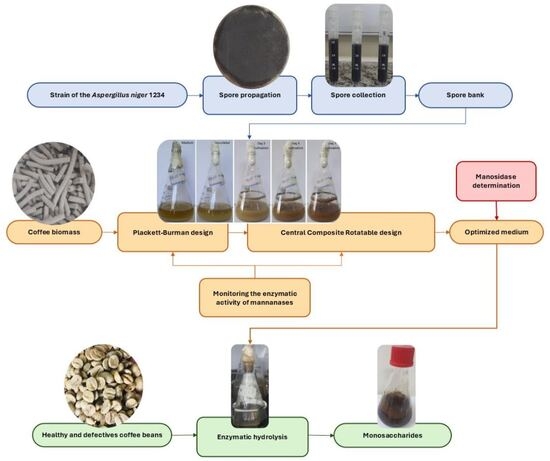
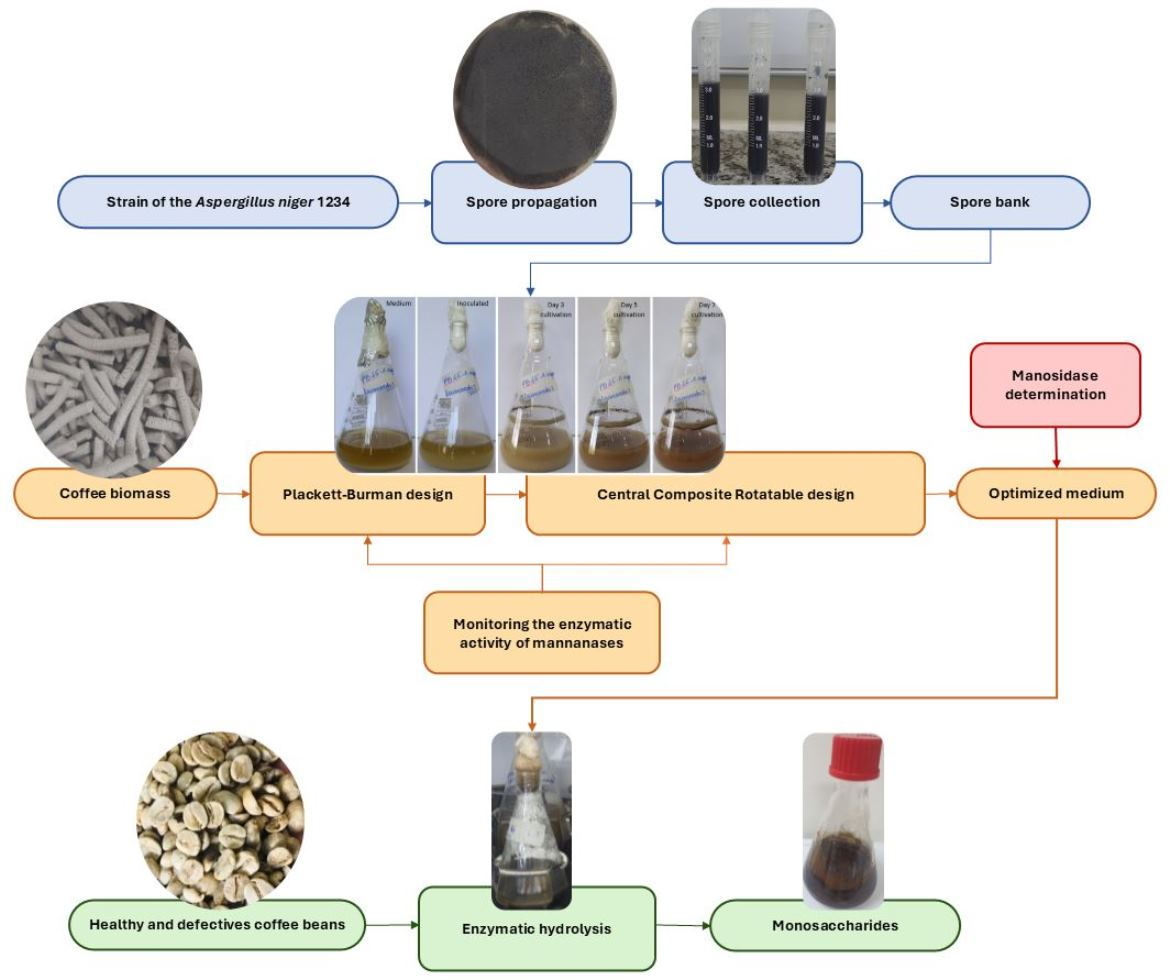
The microorganism used was a wild strain of Aspergillus niger from the Amazon Cultivation Collection (CFAM—Fiocruz), code 1234, isolated from drinking water in the community of Serra Baixa, Iranduba, Amazônia, Brazil. This strain was selected due to its high potential for mannanase production compared to other Aspergillus strains [40]. It was propagated on potato agar dextrose agar (PDA, Sigma-Aldrich) at 27 °C for 7 days in an incubator (Incucell 111, MMM Group, Planegg/München Germany). Spores were suspended in 0.9% NaCl solution and centrifuged at 9000 rpm for 15 min. The supernatant was discarded, and the conidia were resuspended in 20% glycerol to achieve 108 spores.mL−1, and stored in cryogenic vials at −18 °C (for later use in inoculation).

2.2. Enzyme Production

2.2.1. Preliminary Growth Medium Composition and Cultivation

The initial medium for mannanase production (Table 1) was formulated based on previous reports [41,42,43,44,45]. Potassium phosphate buffer was prepared by mixing 9.55 g of KH2PO4 with 0.24 g of K2HPO4, dissolving it in 800 mL of distilled water, and adjusting the pH to 5.5 with KOH or HCl. The final solution was brought to a volume of 1 L using a volumetric flask. Aluminum oxide (Al2O3) was used to prevent excessive growth of filamentous fungi, acting to reduce the size of fungal pellets and, consequently, helping to control hyphal development and minimize cell leakage [44]. Submerged cultivations were carried out in 1000 mL Erlenmeyer flasks containing 250 mL of medium, incubated in a shaker (Innova 44R, New Brunswick, NJ, USA) at 200 rpm and 30 °C. The cultivation time varied according to the purpose of each test. The pre-inoculum was prepared by inoculating 1% (v/v) of the spore suspension into the medium and incubating under the same conditions for 48 h. Each cultivation was then inoculated with 10% (v/v) of the pre-inoculum.

2.2.2. Determination of Mannanase Activity

Mannanase activity was performed using LBG as substrate, prepared at 0.5% (w/v) in 50 mM sodium citrate buffer (pH 4.8) [46]. The reaction mixture, which consisted of 0.25 mL of enzyme extract and 0.25 mL of substrate solution, was incubated at 50 °C for 10 min. The reaction was stopped by adding dinitrosalicylic acid (DNS), followed by heating at 100 °C for 5 min. The released reducing sugars were quantified according to Teixeira and coauthors [47]. One unit of enzymatic activity (U) was defined as the amount of enzyme required to release 1 μmol of reducing sugar (D-mannose-based) per minute at 50 °C.

2.2.3. Statistical Experimental Design for Mannanase Production

Plackett–Burman Design (PB)
The PB was carried out to evaluate the significance of six independent factors, tested at levels from −1 to +1, as shown in Table 2. Data analysis was performed in the Statistica 12.0 software, considering a 10% error level.
Central Composite Rotatable Design (CCRD)
The factors identified as significant in PB design were further evaluated using CCRD, tested at levels from −1.41 to +1.41, as shown in Table 3. Data analysis was carried out in the Statistica 12.0 software, considering a 10% error level.
This approach generated a predictive model equation for mannanase production, which was validated by comparing theoretical values (calculated by substituting the optimal conditions into the model equation) with the experimental results.

2.2.4. Determination of β-mannosidase Activity

The specific production of β-mannosidases was evaluated in the culture medium optimized for mannanase production after 3, 5, and 7 days of cultivation. β-mannosidase activity was carried out according to an adapted method from Gottschalk and coauthor [48], using 4-nitrophenyl-β-D-mannopyranoside (PNP-m) as substrate. The reaction mixture contained 0.1 mL of enzyme (diluted in 50 mM sodium acetate buffer, pH 5.0), 0.6 mL of ultrapure water, 0.2 mL of 500 mM sodium acetate buffer (pH 5.0), and 0.1 mL of substrate solution (10 mM). Reactions were incubated at 50 °C for 10 min in a water bath and stopped by adding 0.5 mL of 100 mM sodium carbonate solution. Absorbance was measured at 405 nm in a UV-1800 spectrophotometer (Shimadzu, Kyoto, Japan). An analytical curve of p-nitrophenol (0.02 to 0.20 mM) was used for quantification. One unit of β-mannosidase activity (U) was defined as the amount of enzyme required to release 1 μmol of PNP per minute under the assay conditions.

2.3. Hydrolysis Experiments of Coffee Beans

2.3.1. Enzymatic Hydrolysis

A crude mannanase preparation (culture supernatant) was used for the enzymatic hydrolysis of healthy and defective milled Arabica coffee beans to recover their monomeric sugars. Enzymatic hydrolysis was performed with 12% (w/v) dry biomass, enzymatic activity of 15 U·g−1 of dry biomass, and 100 mM sodium citrate buffer (pH 4.8) to complete 10 mL medium. Reactions were carried out at 50 °C and 200 rpm in a shaker incubator (Innova 44R, New Brunswick, NJ, USA). Aliquots were withdrawn in 0, 6, 24, and 48 h, heated at 100 °C for 5 min to stop the enzymatic reaction, and centrifuged at 8000 rpm for 10 min.
Monosaccharides were analyzed by HPLC-RI, using a Dionex Ultimate 3000 system (Thermo Fischer Scientific, Germany) equipped with a RefractoMax 521 refractive index detector (Thermo Fischer Scientific, Germany), and an Aminex HPX-87P column (300 mm × 7.8 mm, 9 μm, Bio-Rad, Hercules, CA, USA). The mobile phase was Milli-Q water at a flow rate of 0.6 mL·min−1, with a total run time of 25 min. Quantification was carried out using an external analytical curve with a mixture of sugar standards such as: D-glucose (6.2 mg·mL−1), D-xylose (2.98 mg·mL−1), D-galactose (2.12 mg·mL−1), L-arabinose (2.95 mg·mL−1), and D-mannose (4.91 mg·mL−1). Mannose and fructose content were reported together due to co-elution.

2.3.2. Acid Hydrolysis

To determine the yield of enzymatic hydrolysis (Equation (1)), acid hydrolysis was carried out on healthy and defective coffee beans according to the NREL Protocol [44], including extractives determination and hydrolysis with sulfuric acid. Monosaccharides were quantified as described for enzymatic hydrolysis.
Y i e l d   % = 100 × m a n o s e   c o n t e n t   ( e n z y m a t i c   h y d r o l y s i s ) m a n o s e   c o n t e n t   ( a c i d   h y d r o l y s i s )

2.4. Statistical Analyses

Statistical analyses were performed using Statistica 12 (StatSoft) and Microsoft Excel. All experiments were carried out in triplicate. Data were analyzed by one-way ANOVA, followed by Student’s t-test (for comparisons between two variables) and Tukey’s test (for comparisons with more than two variables), and differences were considered not significant for p ≤ 0.05.

3. Results

3.1. Enzyme Production

3.1.1. Influence of Carbon Source Arrangement

Ground coffee bean, coffee cake, coffee cake fractions (80/20 and 20 mesh), coffee cake extracts, and LBG were tested as carbon sources to evaluate their effect on mannanase production. Cultivations were conducted at 30 °C and 200 rpm, conditions commonly reported as optimal for Aspergillus [43,48,49,50]. The pH was adjusted to 4.8, based on previous studies on mannanase production from Aspergillus [41,42,43,44,45].
Figure 1 shows the mannanase production profile under these conditions with different carbon sources. The highest mannanase production was observed on day 7 of cultivation, consistent with the results reported by Saleh and coauthors [29], who obtained 20.92 U·mL−1 using A. niger MSSFW in submerged fermentation of coffee powder waste over 7 days.
The medium containing only LBG, a commercially available galactomannan, resulted in lower mannanase activity compared to media containing coffee cake or green coffee beans. These results indicate that coffee beans are an excellent substrate for mannanase production. Furthermore, since coffee cake is an industrial waste product, its use in the enzyme production process could be highly cost-effective.
The lowest mannanase activities were observed in media containing coffee cake extracts, indicating that the nutrient extraction process from the coffee cake was inefficient. The presence of lipids in green coffee beans negatively affects enzymatic activity compared to coffee cake. A hypothesis for this is that the fungus may be using the lipids present in the substrate as a source of carbon, redirecting its metabolism toward the production of enzymes related to lipid degradation, such as lipases, to the detriment of mannanases. Lin et al. (2004) [51] indicate that the presence of oil in copra (a fat-rich matrix) may depress mannanase production.
The highest activities were obtained in media containing coffee cake of different particle sizes, with no significant differences among them (p ≤ 0.05). Therefore, subsequent experiments were conducted using unprocessed coffee cake (20.39 ± 1.50 U·mL−1), as this simplifies the procedure and avoids a 3% mass loss.

3.1.2. Influence of Cultivation Time

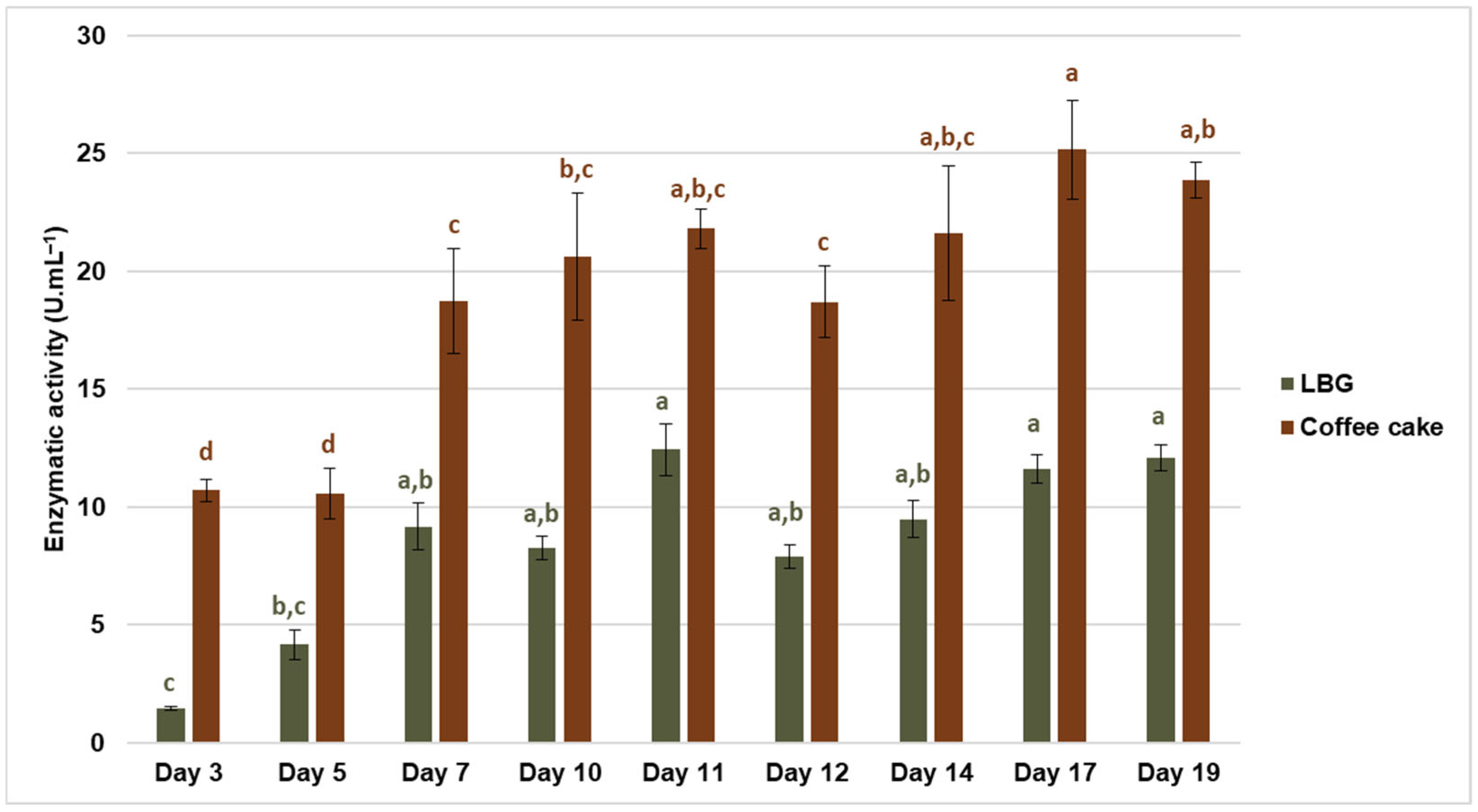
Mannanase production using coffee cake and LBG was evaluated over several days, as shown in Figure 2. On all sampling days, LBG showed significantly lower activity compared to coffee cake (p ≥ 0.05).
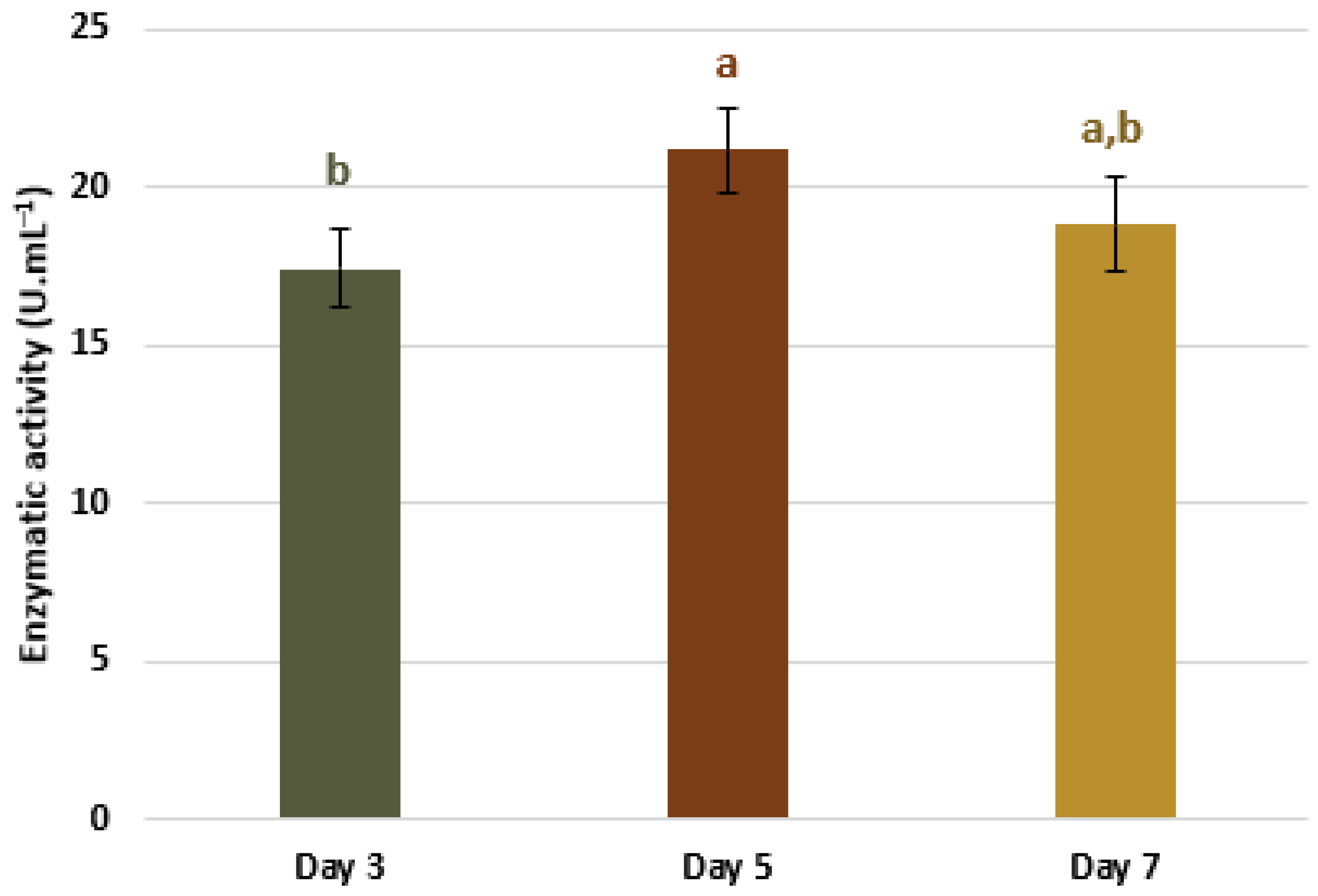
Peak mannanase production in the LBG-based medium occurred on day 11 (12.44 U·mL−1), followed by stabilization or a slight decline, suggesting substrate depletion. In contrast, the coffee cake medium maintained high activity for longer periods, peaking on day 17 (25.15 U·mL−1), which may be related to the greater structural complexity of the substrate and the gradual release of nutrients. In short, a notable discrepancy was observed between the maximum activity levels: the coffee cake medium reached an average of 25.15 ± 2.08 U·mL−1, while the LBG medium reached only 12.44 ± 1.09 U·mL−1, consistent with the preliminary tests. Considering productivity, the optimal cultivation day was day 7, which may reflect a characteristic of Aspergillus niger, as this trend was observed in both media.
One possible explanation for this activity difference between media is that coffee cake provides more favorable and sustained conditions for mannanase production, possibly because it contains components that act as inducers or because it offers a richer and more diverse nutritional environment. Coffee cake exhibited higher carbon, nitrogen, and sulfur content compared to LBG (Table 4), highlighting its potential as a low-cost source of mannan, compared to the commercial galactomannan extracted from Ceratonia siliqua seeds (LBG).
The availability of carbon and nitrogen in the culture medium is fundamental for the growth and metabolite production of Aspergillus niger. According to Chauhan and coauthors [52], carbon serves as both an energy source and an essential structural element. It can also influence the production of specific enzymes, such as mannanases, depending on the type and concentration present in the medium.
Although nitrogen is supplied to the medium through yeast extract, the nitrogen content in the biomass also contributes to fungal growth and enzyme synthesis. Different nitrogen sources may enhance the yield of specific enzymes. Moreover, the carbon-to-nitrogen (C/N) ratio plays a key role in regulating fungal growth and metabolite production [53]. Considering that the yeast extract used in the medium has 38.15 ± 0.07% carbon (%C) and 10.85 ± 0.24% nitrogen (%N), the C/N ratio was calculated for the medium containing coffee cake and LBG, resulting in 11.96 and 18.96, respectively. These results indicate that the C/N ratio of the coffee bean medium favors mannanase production, in agreement with findings reported by Gottschalk and coauthors [48] for Aspergillus awamori 2B.361 U2/1 cultivated on wheat bran and yeast extract (C/N equal to 10.3).

3.1.3. Validation of Preliminary Tests

Once the best arrangement of the carbon source had been determined, a new test was carried out, in a shorter time, to validate the results obtained, as shown in Figure 3.
In this experiment, the peak enzymatic activity of mannanases did not differ significantly (p ≤ 0.05) between the 5th and 7th days. It is common for biotechnological processes such as this to vary in terms of the ideal time, as everything depends on the development of the strain under the cultivation conditions [54]. As the peak of mannanase enzyme activity occurred on the fifth day of cultivation, this was considered the ideal day for enzyme production in subsequent studies.

3.1.4. Statistical Experimental Design

Data from the preliminary tests supported the application of statistical experimental designs to optimize mannanase production by modifying the nutritional composition of the culture medium. A Plackett–Burman (PB) design was employed to evaluate the influence of six independent variables and identify those with significant effects on mannanase production. Subsequently, a Central Composite Rotatable Design (CCRD) was applied to optimize the significant variables, enabling a more detailed evaluation of their individual and interactive effects through a full factorial approach. The statistical analyses were performed using response surface methodology (RSM) and analysis of variance (ANOVA), following established procedures for bioprocess optimization [54,55]. Results were expressed as means ± standard deviations, and variance analysis was performed using Tukey’s test at the 5% significance level.
Table 5 presents the characteristics of each test (12 experimental points and 4 central points), along with the results of the dependent variable under study. The results showed very close mannanase activities from 19 to 21 U·mL−1, which may indicate that the concentrations studied had no effect on the production of mannanases. Only assays 8 and 12 presented values below 15 U·mL−1.
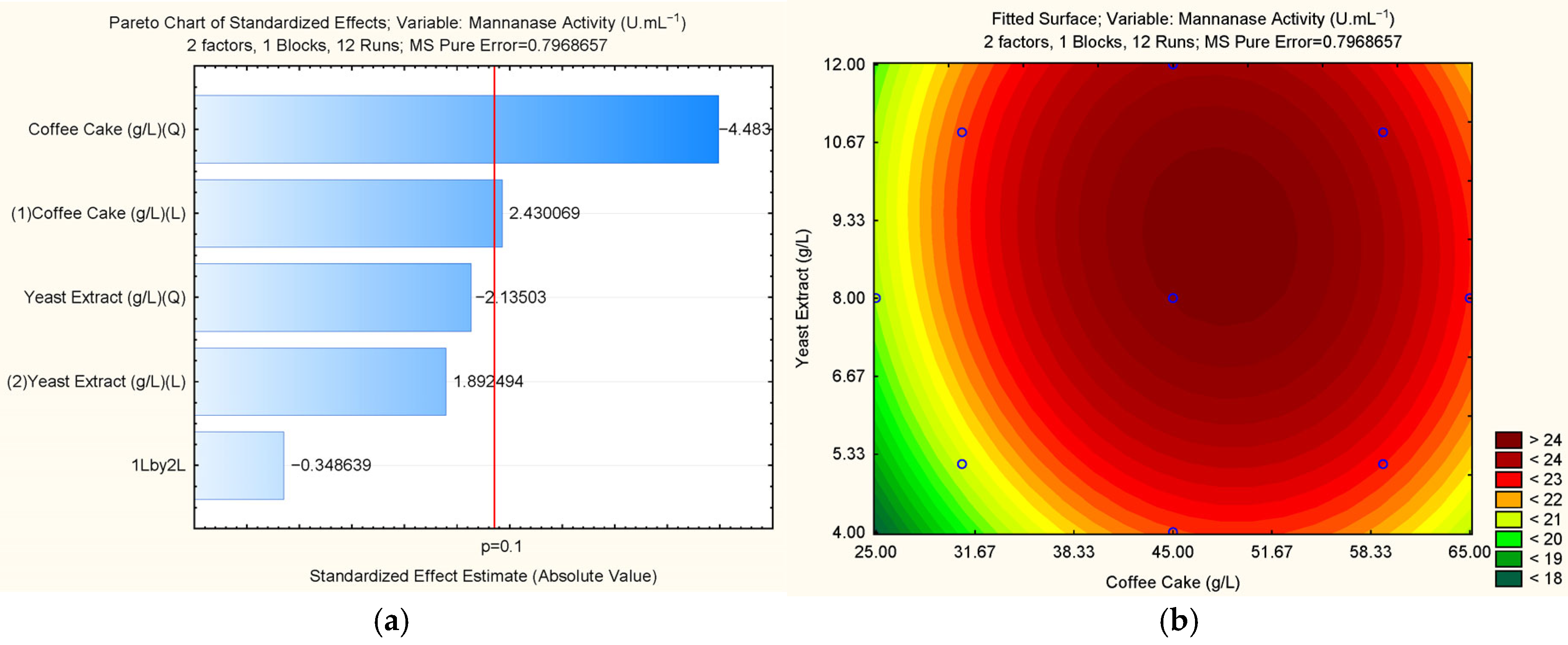
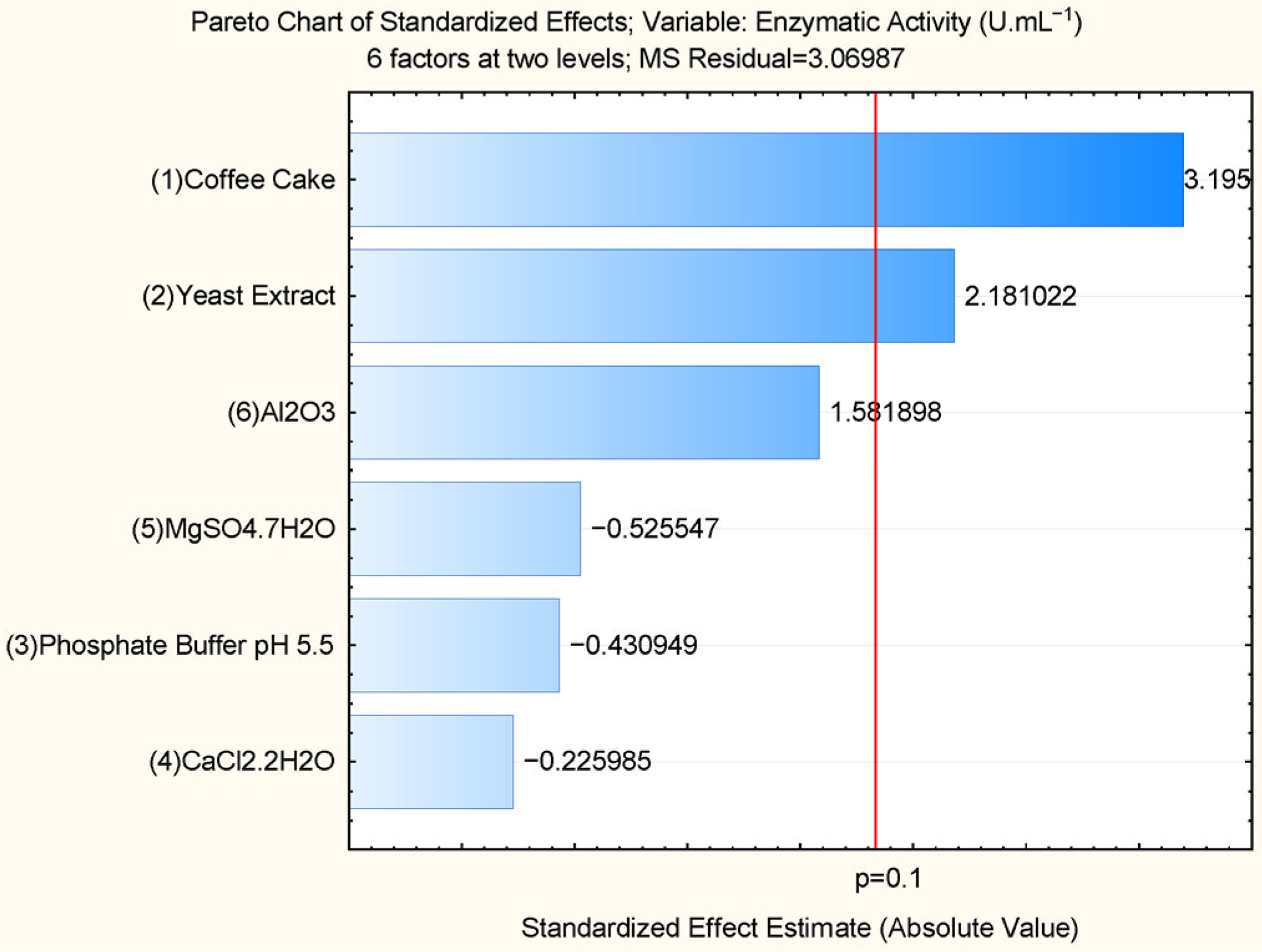
After analyzing the results with Statistica 12 software, the information from each assay was consolidated to generate the Pareto chart (Figure 4), which enabled the statistical interpretation of the studied variables. Pareto chart analysis revealed that only two variables were statistically significant: coffee cake (carbon source) and yeast extract (nitrogen source). Consequently, all independent factors with statistically insignificant effects—except for phosphate buffer—were excluded from the medium in the subsequent CCRD. The buffer was retained due to its essential role in adjusting the initial pH to levels suitable for Aspergillus niger growth. Since the phosphate buffer exhibited a negative effect, it was maintained at the minimum concentration tested (level −1, corresponding to 0.25 g·L−1, expressed as phosphate).
The CCRD was conducted with eight factorial points and four central points to improve the reliability of the results, as shown in Table 6. The highest mannanase activities were obtained in assays 8, 9, and 10, of which two tests correspond to the central points of the design.
Based on the results processed in Statistica 12, a Pareto chart was generated (Figure 5a) to interpret the significance of the studied variables, along with a response surface plot predicting the tested conditions and their corresponding responses (Figure 5b). Both the linear and quadratic terms for coffee cake were statistically significant, whereas neither term for yeast extract showed significance, leading to its exclusion from the model.
The mathematical model (Equation (2)), obtained for the Pareto chart, was used even though the variables corresponding to yeast extract (L and Q) were not statistically significant, due to the necessity of a nitrogen source to support fungal growth. Although yeast extract did not have a significant effect on the evaluated response, it is well known to be an essential nutrient source. Therefore, since the central composite rotatable design (CCRD) did not include experiments with zero concentration of this component, the minimum studied value was adopted. The model predicted a mannanase production (Manprod) of 24.32 U·mL−1.
Manprod (U·mL−1) = −1.58866Z12 − 0.75652Z22 + 0.76809Z1 + 0.59818Z2 + 24.77747
The validation assay of the statistical experimental design was performed using the yeast extract at the lowest level studied (4 g·L−1), since it had no significant effect. After five days of cultivation, the experimental activity was 21.85 ± 0.73 U·mL−1, close to the theoretical value of 24.32 U·mL−1 predicted by the CCRD model, with an error of approximately 10%. This confirmed the validity of the statistical model. It is important to emphasize that the equation enables the calculation of mannanase activity under varying cultivation conditions, allowing for the prediction of potential outcomes based on different concentration levels.
Additional assays under the optimized condition showed activities of 22.43 ± 0.59 U·mL−1 at three days and 17.26 ± 0.56 U·mL−1 at seven days of cultivation. The activities on days three and five were not significantly different (p ≤ 0.05), indicating that the peak of enzymatic activity shifted to the third day of cultivation.
The maximum activity obtained in the present was higher than that reported by Agu and coauthors [56], who used wild-type Aspergillus strains and agro-industrial residues as carbon sources. In that study, three species (A. niger, A. flavus, and A. tamari) were isolated from decomposing palm kernel cake and cultivated under submerged fermentation with coconut yam powder as the sole carbon source. A. niger produced the highest mannanase activity (0.35 U·mL−1), followed by A. flavus (0.18 U·mL−1) and A. tamari (0.15 U·mL−1).
The medium composition optimization allowed an increase in mannanase production of approximately 10% and a 42.9% increase in productivity, going from 20.39 ± 1.50 U·mL−1 (at seven days) to 22.44 ± 0.61 U·mL−1 (at three days). The reduction in cultivation time from seven to three days is particularly relevant for industrial applications, since shorter fermentations reduce energy consumption, contamination risks, and downstream processing costs. Moreover, the elimination of inorganic salts (CaCl2, MgSO4, Al2O3) from the medium highlights the robustness of the process, enabling a simplified and cost-effective formulation that relies almost exclusively on the coffee coproduct. Thus, the optimized cultivation medium consisted only of 48.78 g·L−1 of coffee cake, 4 g·L−1 of yeast extract, and 0.25 g·L−1 of potassium phosphate buffer (pH 5.5).

3.1.5. Determination of β-mannosidase Enzyme Activity

In addition to the high production of mannanases, the specific production of β-mannosidases was evaluated under the optimized culture medium using coffee cake. Enzyme activity was assessed after 3, 5, and 7 days of cultivation, resulting in 0.52 ± 0.01 U·mL−1, 0.88 ± 0.06 U·mL−1, and 1.39 ± 0.06 U·mL−1, respectively. The maximum β-mannosidase activity was observed on the seventh day, differing from β-mannanase production, which peaked on the third day. This value was 5.6-fold higher than that previously reported for A. niger (0.25 U·mL−1) cultivated with soya flour [57].
These results suggest that the strain used in this study has considerable potential for β-mannosidase production, even in a culture medium that has not been optimized for its production. β-Mannosidase catalyzes the hydrolysis of β-1,4-mannosidic bonds in mannose-containing polysaccharides such as galactomannan, playing a key role in converting complex carbohydrates into simpler sugars. Its applications extend to the food industry, where it improves ingredient digestibility and produces prebiotics, as well as to biotechnology, biofuel production, and animal feed, where it enhances nutritional efficiency and supports sustainable bioconversion processes [58,59,60]. A noteworthy aspect of the present study is the concomitant production of β-mannosidase, which broadens the applicability of the crude enzymatic cocktail. While most reports focus exclusively on β-mannanases, the simultaneous presence of β-mannosidase increases hydrolytic efficiency, particularly in generating fermentable mannose. Although this is a very positive result, the addition of an external β-mannosidase (either commercial or laboratory-concentrated) to balance the β-mannosidase/β-mannanase ratio could enhance the enzymatic hydrolysis of this material, enabling the complete conversion of polysaccharides into monosaccharides.
Using coffee press cake as a carbon source for β-mannosidase production also aligns with the principles of the circular economy and agro-industrial residue valorization. By-products of the coffee industry contain galactomannan and have been shown to support enzyme production by fungi of the Aspergillus species [61,62]. Leveraging coffee cake reduces production costs, promotes environmental sustainability, and repurposes waste that would otherwise be discarded, reinforcing its potential as an efficient and sustainable carbon source for enzyme production.
To expand this study, the enzymes produced were applied to the enzymatic hydrolysis of defective coffee beans, aiming to release fermentable sugars that could potentially be used for the generation of higher-value-added products.

3.2. Hydrolysis Experiments of Coffee Beans

It is estimated that approximately 20% of global coffee production consists of defective beans, which, due to their poor sensory quality, are unsuitable for consumption [8]. These beans, therefore, represent a potential worldwide residue, rich in mannan, whose processing faces significant challenges. To explore alternative uses, this study investigated the potential of the produced enzyme for mannose recovery from defective beans through enzymatic hydrolysis, with comparisons to the hydrolysis of healthy beans. Valorizing defective beans as a substrate is particularly relevant, as mannose can serve as a precursor for diverse bioproducts, such as immunostimulants [63], anti-tumor agents [64], vitamins [65], and D-mannitol [66].
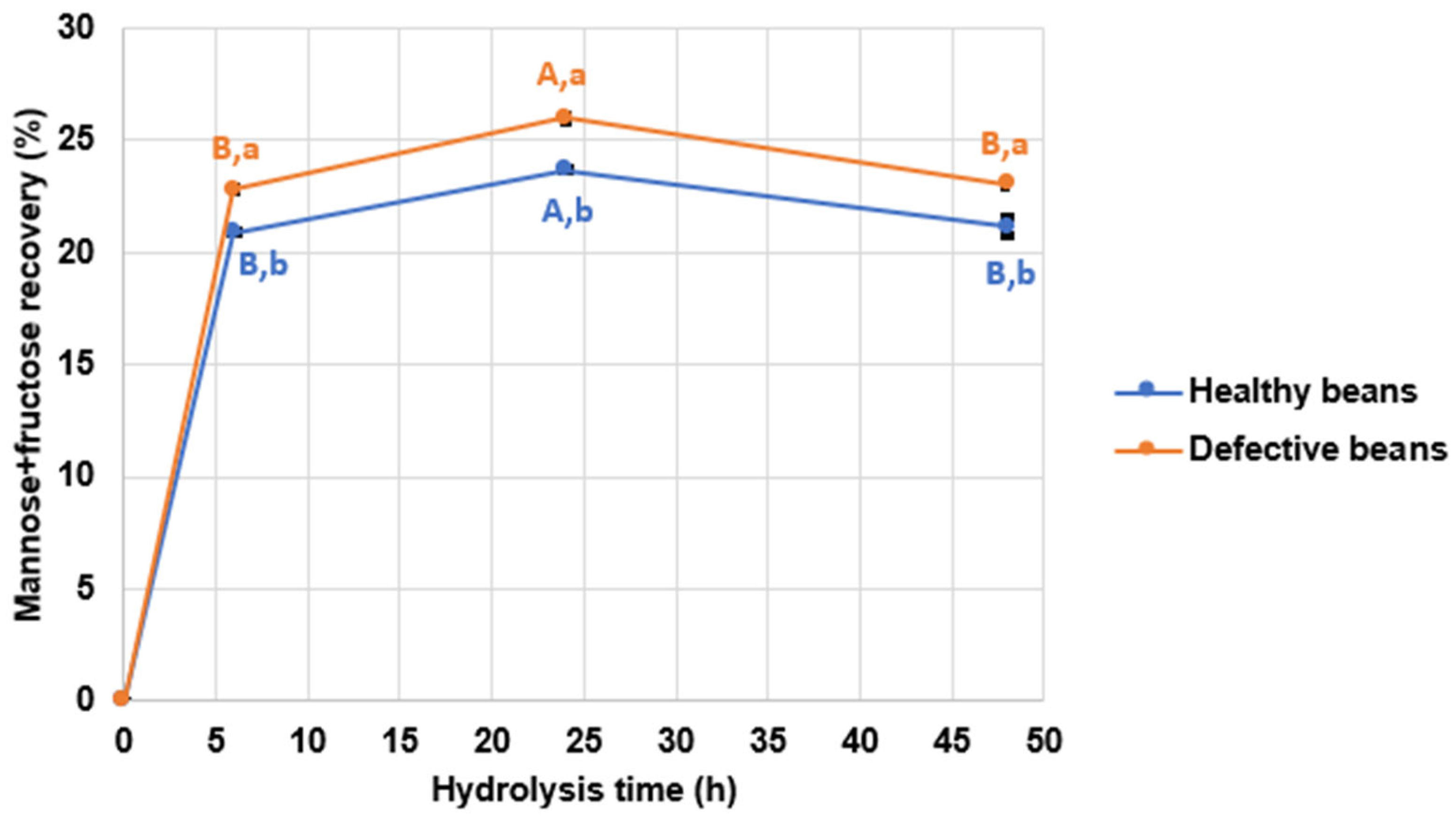
Polysaccharides, which account for 50–70% of the dry weight of green coffee beans, are mainly composed of galactomannans, arabinogalactans, and cellulose [17]. During hydrolysis, these polysaccharides are depolymerized into monosaccharides, mainly mannose, whose release was monitored at 0, 6, 24, and 48 h, as shown in Figure 6. Since the chromatographic column used did not separate mannose and fructose, their contents were quantified together. The reactions were conducted at 50 °C and 200 rpm in buffer at pH 4.8—conditions commonly reported as suitable for enzymatic hydrolysis—while agitation enhanced enzyme–substrate contact and activity [67,68,69,70,71].
The best mannose yield was obtained after 24 h, as shown in Figure 6. The mannose value obtained by acid hydrolysis was considered 100%. The efficiency of mannose recovery by enzymatic hydrolysis was 23.68 ± 0.03% for healthy beans and 25.98 ± 0.10% for defective beans, in 24 h of reaction. Although relatively low, these values demonstrate the enzyme’s potential, achieving ~25% mannose recovery directly from untreated biomass. Limited yields are attributed to the recalcitrant structure of coffee beans, where crystalline mannans hinder enzymatic access. To improve recovery, pretreatments—physical, chemical, or combined—are required to disrupt the cell wall, solubilize hemicelluloses and lignin, and increase surface area for enzymatic action [32,33,71,72,73]. Examples include extrusion, hydrothermal processing, acid or alkaline hydrolysis, and treatments with organic solvents [74]. Although only monosaccharides were quantified, presented in Table 7, mannanoligosaccharides (MOS) may also have been formed and remained in the reaction medium without being converted to mannose, due to the imbalance between β-mannosidase and β-mannanase activities.
In a related study [75], coffee grounds were used as a mannose-rich biomass (19.3 g 100 g−1). After enzymatic hydrolysis carried out with 50 mM sodium citrate buffer (pH 4.8), 10% dry matter, and an enzyme cocktail (cellulase—17.74 mg·g−1 of dry biomass; pectinase—16 mg·g−1 of dry biomass) for 24 h, a mannose recovery of approximately 47% was achieved. The higher yield observed in roasted beans was likely due to the previous processing, such as roasting, grinding, and hot-water extraction, which may remove enzyme inhibitors and promote biomass deconstruction, facilitating enzymatic access.
The enzyme produced in this study also demonstrated good potential for recovery of glucose (76% in healthy beans and 72% in defective beans) but limited recovery of galactose and arabinose. To maximize sugar release, integrated strategies should be adopted, including appropriate pretreatments, optimization of hydrolysis parameters (enzyme loading, pH, and temperature), and the use of tailored enzymatic cocktails containing accessory enzymes (e.g., β-galactosidase and β-glucosidase) to enhance the conversion of complex polysaccharides into fermentable sugars [74].
Furthermore, optimizing enzymatic hydrolysis conditions is essential, considering adjustments in solid matter concentration, enzyme proportion, and precise control of operational parameters such as pH and temperature. Another critical aspect is the use of tailored enzymatic cocktails containing accessory enzymes such as β-galactosidase and β-glucosidase, which work synergistically to enhance the conversion of structural biomass components into fermentable sugars, like mannose and glucose. These integrated approaches can significantly improve the efficiency of biotechnological processes.

4. Conclusions

This study demonstrated that green Arabica coffee press cake is an efficient and sustainable substrate for β-mannanase and β-mannosidase production by Aspergillus niger. The comparison of enzyme productivity was performed using the same carbon source (coffee press cake). After statistical optimization, the medium composition was simplified to 48.78 g·L−1 coffee cake, 4 g·L−1 yeast extract, and 0.25 g·L−1 potassium phosphate buffer (pH 5.5), which increased mannanase productivity to 22.4 ± 0.6 U·mL−1 within 3 days, representing a 42.9% improvement. The simplified medium composition—based solely on coffee press cake, yeast extract, and phosphate buffer—further enhances economic feasibility by eliminating the need for additional supplements (Al2O3, MgSO4·7H2O, and CaCl2·2H2O). Although mannose recovery from untreated coffee beans reached only ~25% (using the acid hydrolysis value at 100%), the results demonstrate the enzyme’s capacity to act on recalcitrant biomass, with higher efficiencies expected through pretreatment strategies and tailored enzymatic cocktails.
From an industrial and sustainability perspective, these findings align with circular bioeconomy principles. A low-value by-product (coffee press cake) was used as a carbon source for A. niger cultivation and production of a high-value enzymatic mixture, capable of valorizing another waste stream (defective beans), enabling the recovery of functional monosaccharides for food, nutritional, and pharmaceutical applications.

Author Contributions

Conceptualization, R.C.R., L.J.B.d.M.d.B., A.S.d.S. and R.S.S.T.; methodology, R.C.R. and L.J.B.d.M.d.B.; validation, R.C.R. and L.J.B.d.M.d.B.; formal analysis, R.C.R., L.J.B.d.M.d.B. and L.B.d.M.; investigation, L.J.B.d.M.d.B.; data curation, R.C.R., L.J.B.d.M.d.B. and L.B.d.M.; writing—original draft preparation, R.C.R. and L.J.B.d.M.d.B.; writing—review and editing, R.C.R., C.M.d.R., A.S.d.S., E.P.d.S.B. and R.S.S.T.; supervision, C.M.d.R. and R.S.S.T.; project administration, R.S.S.T.; funding acquisition, C.M.d.R., E.P.d.S.B. and R.S.S.T. All authors have read and agreed to the published version of the manuscript.

Funding

This research was funded by Fundação Carlos Chagas Filho de Amparo à Pesquisa do Estado do Rio de Janeiro, grant number E-26/010.002491/2019, the Financiadora de Estudos e Projetos, number 2621/22, the Coordenação de Aperfeicoamento de Pessoal de Nível Superior (CAPES), and the Institutional Scholarship Program for Scientific Initiation from the National Council for Scientific and Technological Development (CNPq) for the scholarships.

Data Availability Statement

The raw data supporting the conclusions of this article will be made available by the authors on request.

Acknowledgments

The authors express their thanks to the National Council for Scientific and Technological Development (CNPq), the Research Support Foundation for the State of Rio de Janeiro (FAPERJ), the Funding Authority of Studies and Projects (FINEP), and the Coordination for higher Education Staff Development (CAPES) for the resources granted for the development of this project. The authors also thank the partner laboratory, Laboratório de Análises Térmicas e Reologia (IQ/UFRJ), for their part in the analyses.

Conflicts of Interest

The authors declare no conflicts of interest.

References

  1. Ferreira-Leitão, V.; Gottschalk, L.M.F.; Ferrara, M.A.; Nepomuceno, A.L.; Molinari, H.B.C.; Bon, E.P.d.S. Biomass Residues in Brazil: Availability and Potential Uses. Waste Biomass Valoriz. 2010, 1, 65–76. [Google Scholar] [CrossRef]
  2. Castro, A.M.; Pereira, N. Produção, propriedades e aplicação de celulases na hidrólise de resíduos agroindustriais. Quim. Nova 2010, 33, 181–188. [Google Scholar] [CrossRef]
  3. Basmak, S.; Turhan, I. Production of β-Mannanase, Inulinase, and Oligosaccharides from Coffee Wastes and Extracts. Int. J. Biol. Macromol. 2024, 261, 129798. [Google Scholar] [CrossRef]
  4. Alencar, V.d.N.e.S.; Batista, J.M.d.S.; Nascimento, T.P.; da Cunha, M.N.C.; Leite, A.C.L. Resíduos Agroindustriais: Uma Alternativa Promissora e Sustentável Na Produção de Enzimas Por Microrganismos. In Ciência, Tecnologia e Inovação: Do Campo a Mesa, Proceedings of the Congresso Internacional da Agroindústria, Virtual Event, 25 September 2020; Editora IIDV: Recife, Brazil; pp. 1–16.
  5. Berto, P.J.; Ferraz, D.; Rebelatto, D.A.d.N. The Circular Economy, Bioeconomy, and Green Investments: A Systematic Review of the Literature. Rev. Gestão Produção Operações Sist. 2022, 17, 46–63. [Google Scholar] [CrossRef]
  6. United Nations. The 17 Goals. Available online: https://sdgs.un.org/goals (accessed on 7 September 2024).
  7. ICO. Beyond Coffee: Towards a Circular Coffee Economy; International Coffee Organization: London, UK, 2023. [Google Scholar]
  8. Kalschne, D.L.; Viegas, M.C.; De Conti, A.J.; Corso, M.P.; Benassi, M.d.T. Steam Pressure Treatment of Defective Coffea Canephora Beans Improves the Volatile Profile and Sensory Acceptance of Roasted Coffee Blends. Food Res. Int. 2018, 105, 393–402. [Google Scholar] [CrossRef]
  9. Klingel, T.; Kremer, J.I.; Gottstein, V.; De Rezende, T.R.; Schwarz, S.; Lachenmeier, D.W. A Review of Coffee By-Products Including Leaf, Flower, Cherry, Husk, Silver Skin, and Spent Grounds as Novel Foods within the European Union. Foods 2020, 9, 665. [Google Scholar] [CrossRef]
  10. Ribeiro, R.C.; Teixeira, R.S.S.; de Rezende, C.M. Extrusion Pretreatment of Green Arabica Coffee Beans for Lipid Enhance Extraction. Ind. Crops Prod. 2024, 221, 119318. [Google Scholar] [CrossRef]
  11. Pongsiriyakul, K.; Wongsurakul, P.; Kiatkittipong, W.; Premashthira, A.; Kuldilok, K.; Najdanovic-Visak, V.; Adhikari, S.; Cognet, P.; Kida, T.; Assabumrungrat, S. Upcycling Coffee Waste: Key Industrial Activities for Advancing Circular Economy and Overcoming Commercialization Challenges. Processes 2024, 12, 2851. [Google Scholar] [CrossRef]
  12. Vidal, O.L.; Tsukui, A.; Garrett, R.; Miguez Rocha-Leão, M.H.; Piler Carvalho, C.W.; Pereira Freitas, S.; Moraes de Rezende, C.; Simões Larraz Ferreira, M. Production of Bioactive Films of Carboxymethyl Cellulose Enriched with Green Coffee Oil and Its Residues. Int. J. Biol. Macromol. 2020, 146, 730–738. [Google Scholar] [CrossRef] [PubMed]
  13. Franca, A.S.; Oliveira, L.S.; Mendonça, J.C.F.; Silva, X.A. Physical and Chemical Attributes of Defective Crude and Roasted Coffee Beans. Food Chem. 2005, 90, 89–94. [Google Scholar] [CrossRef]
  14. Getachew, A.T.; Chun, B.S. Influence of Pretreatment and Modifiers on Subcritical Water Liquefaction of Spent Coffee Grounds: A Green Waste Valorization Approach. J. Clean. Prod. 2017, 142, 3719–3727. [Google Scholar] [CrossRef]
  15. Companhia Nacional de Abastecimento. Produção de Café Cresce 8,2% Em 2023 e Chega a 55,1 Milhões De. Available online: https://www.conab.gov.br/ultimas-noticias/5323-producao-de-cafe-cresce-8-2-em-2023-e-chega-a-55-1-milhoes-de-sacas (accessed on 7 September 2024).
  16. Silva, A.C.R.; da Silva, C.C.; Garrett, R.; de Rezende, C.M. Comprehensive Lipid Analysis of Green Arabica Coffee Beans by LC-HRMS/MS. Food Res. Int. 2020, 137, 109727. [Google Scholar] [CrossRef] [PubMed]
  17. Redgwell, R.; Fischer, M. Coffee Carbohydrates. Braz. J. Plant Physiol. 2006, 18, 165–174. [Google Scholar] [CrossRef]
  18. Dong, W.; Chen, Q.; Wei, C.; Hu, R.; Long, Y.; Zong, Y.; Chu, Z. Comparison of the Effect of Extraction Methods on the Quality of Green Coffee Oil from Arabica Coffee Beans: Lipid Yield, Fatty Acid Composition, Bioactive Components, and Antioxidant Activity. Ultrason. Sonochem. 2021, 74, 105578. [Google Scholar] [CrossRef] [PubMed]
  19. Farah, A. Coffee Constituents. In Coffee: Emerging Health Effects and Disease Prevention; Chu, Y.-F., Ed.; Blackwell Publishing Ltd.: Oxford, UK, 2012. [Google Scholar]
  20. Franca, A.S.; Oliveira, L.S. Chemistry of defective coffee beans. In Food Chemistry Research Developments; Nova Science Publishers: Hauppauge, NY, USA, 2008; p. 234. ISBN 9781604563030. [Google Scholar]
  21. Ramadan, M.F. Cold Pressed Oils: Green Technology, Bioactive Compounds, Functionality, and Applications; Elsevier: Amsterdam, The Netherlands, 2020; Volume 1. [Google Scholar]
  22. Arya, M.; Rao, L.J.M. An Impression of Coffee Carbohydrates. Crit. Rev. Food Sci. Nutr. 2007, 47, 51–67. [Google Scholar] [CrossRef]
  23. Singh, S.; Singh, G.; Arya, S.K. Mannans: An Overview of Properties and Application in Food Products. Int. J. Biol. Macromol. 2018, 119, 79–95. [Google Scholar] [CrossRef]
  24. Takahashi, J.A.; Lima, G.D.S.; Dos Santos, G.F.; Lyra, F.H.; Da Silva-Hughes, A.F.; Gonçalves, F.A.G. Filamentous Fungi and Chemistry: Old Friends, New Allies. Rev. Virtual Quim. 2017, 9, 2351–2382. [Google Scholar] [CrossRef]
  25. Srivastava, P.K.; Kapoor, M. Production, Properties, and Applications of Endo-β-Mannanases. Biotechnol. Adv. 2017, 35, 1–19. [Google Scholar] [CrossRef]
  26. Li, Y.; Liu, H.; Shi, Y.; Yan, Q.; You, X.; Jiang, Z. Preparation, Characterization, and Prebiotic Activity of Manno-Oligosaccharides Produced from Cassia Gum by a Glycoside Hydrolase Family 134 β-Mannanase. Food Chem. 2020, 309, 125709. [Google Scholar] [CrossRef]
  27. Jana, U.K.; Kango, N. Characteristics and Bioactive Properties of Mannooligosaccharides Derived from Agro-Waste Mannans. Int. J. Biol. Macromol. 2020, 149, 931–940. [Google Scholar] [CrossRef]
  28. Mary, P.R.; Prashanth, K.V.H.; Vasu, P.; Kapoor, M. Structural Diversity and Prebiotic Potential of Short Chain β-Manno-Oligosaccharides Generated from Guar Gum by Endo-β-Mannanase (ManB-1601). Carbohydr. Res. 2019, 486, 107822. [Google Scholar] [CrossRef]
  29. Saleh, S.A.A.; Mostafa, F.A.; Ahmed, S.A.; Zaki, E.R.; Salama, W.H.; Abdel Wahab, W.A. Date Nawah Powder as a Promising Waste for β-Mannanase Production from a New Isolate Aspergillus niger MSSFW, Statistically Improving Production and Enzymatic Characterization. Int. J. Biol. Macromol. 2024, 277, 134447. [Google Scholar] [CrossRef] [PubMed]
  30. Cairns, T.C.; Nai, C.; Meyer, V. How a Fungus Shapes Biotechnology: 100 Years of Aspergillus niger Research. Fungal Biol. Biotechnol. 2018, 5, 13. [Google Scholar] [CrossRef] [PubMed]
  31. Ntana, F.; Mortensen, U.H.; Sarazin, C.; Figge, R. Aspergillus: A Powerful Protein Production Platform. Catalysts 2020, 10, 1064. [Google Scholar] [CrossRef]
  32. Moro, M.K.; Teixeira, R.S.S.; da Silva, A.S.; Fujimoto, M.D.; Melo, P.A.; Secchi, A.R.; Bon, E.P.d.S. Continuous Pretreatment of Sugarcane Biomass Using a Twin-Screw Extruder. Ind. Crops Prod. 2017, 97, 509–517. [Google Scholar] [CrossRef]
  33. Fasheun, D.O.; de Oliveira, R.A.; Bon, E.P.S.; da Silva, A.S.A.; Teixeira, R.S.S.; Ferreira-Leitão, V.S. Dry Extrusion Pretreatment of Cassava Starch Aided by Sugarcane Bagasse for Improved Starch Saccharification. Carbohydr. Polym. 2022, 285, 119256. [Google Scholar] [CrossRef]
  34. Ganguly, A.; Mandal, A. Production and Optimization of Xylanase Enzyme from Bacillus Cereus BSA1 by Submerged Fermentation. Int. Res. J. Basic Appl. Sci. 2024, 9. Available online: https://www.researchgate.net/publication/385899118_Production_and_Optimization_of_Xylanase_Enzyme_from_Bacillus_cereus_BSA1_by_Submerged_Fermentation (accessed on 7 September 2024).
  35. Blibech, M.; Chaari, F.; Bhiri, F.; Dammak, I.; Ghorbel, R.E.; Chaabouni, S.E. Production of Manno-Oligosaccharides from Locust Bean Gum Using Immobilized Penicillium Occitanis Mannanase. J. Mol. Catal. B Enzym. 2011, 73, 111–115. [Google Scholar] [CrossRef]
  36. Cilmeli, S.; Doruk, T.; Könen-Adıgüzel, S.; Adıgüzel, A.O. A Thermostable and Acidophilic Mannanase from Bacillus Mojavensis: Its Sustainable Production Using Spent Coffee Grounds, Characterization, and Application in Grape Juice Processing. Biomass Convers. Biorefin. 2022, 14, 3811–3825. [Google Scholar] [CrossRef]
  37. Favaro, C.P.; Baraldi, I.J.; Casciatori, F.P.; Farinas, C.S. β-Mannanase Production Using Coffee Industry Waste for Application in Soluble Coffee Processing. Biomolecules 2020, 10, 227. [Google Scholar] [CrossRef]
  38. Ismail, S.A.; Kalthoum Khattab, O.H.; Nour, S.A.; Awad, G.E.A.; Abo-Elnasr, A.A.; Hashem, A.M. A Thermodynamic Study of Partially-Purified Penicillium Humicola β-Mannanase Produced by Statistical Optimization. Jordan J. Biol. Sci. 2019, 12, 209–217. [Google Scholar]
  39. Silva, R.; Brand, A.L.; Tinoco, N.; Freitas, S.; Rezende, C. Bioactive Diterpenes and Serotonin Amides in Cold-Pressed Green Coffee Oil (Coffea arabica L.). J. Braz. Chem. Soc. 2023, 35, 20230131. [Google Scholar] [CrossRef]
  40. Nunes, O.C.; Tupi, L.P.C.; Teixeira, R.S.S. Prospecção de Fungos Do Gênero Aspergillus Produtores de Mananases; Final Course Work; Universidade do Grande Rio: Rio de Janeiro, Brazil, 2019. [Google Scholar]
  41. Karahalil, E.; Germeç, M.; Turhan, I. β-Mannanase Production and Kinetic Modeling from Carob Extract by Using Recombinant Aspergillus sojae. Biotechnol. Prog. 2019, 35, e2885. [Google Scholar] [CrossRef]
  42. Mohamad, S.N.; Ramanan, R.N.; Mohamad, R.; Ariff, A.B. Improved Mannan-Degrading Enzymes’ Production by Aspergillus niger through Medium Optimization. New Biotechnol. 2011, 28, 146–152. [Google Scholar] [CrossRef] [PubMed]
  43. Ozturk, B.; Cekmecelioglu, D.; Ogel, Z.B. Optimal Conditions for Enhanced β-Mannanase Production by Recombinant Aspergillus sojae. J. Mol. Catal. B Enzym. 2010, 64, 135–139. [Google Scholar] [CrossRef]
  44. Yatmaz, E.; Germec, M.; Karahalil, E.; Turhan, I. Enhancing β-Mannanase Production by Controlling Fungal Morphology in the Bioreactor with Microparticle Addition. Food Bioprod. Process. 2020, 121, 123–130. [Google Scholar] [CrossRef]
  45. Yilmazer, C.; Gürler, H.N.; Erkan, S.B.; Ozcan, A.; Hosta Yavuz, G.; Germec, M.; Yatmaz, E.; Turhan, I. Optimization of Mannooligosaccharides Production from Different Hydrocolloids via Response Surface Methodology Using a Recombinant Aspergillus sojae β-Mannanase Produced in the Microparticle-Enhanced Large-Scale Stirred Tank Bioreactor. J. Food Process. Preserv. 2021, 45, e14916. [Google Scholar] [CrossRef]
  46. Stalbrand, H.; Siika-Aho, M.; Tenkanen, M.; Viikari, L. Purification and Characterization of Two B-Mannanases from Trichoderma Reesei. J. Biotechnol. 1993, 29, 229–242. [Google Scholar] [CrossRef]
  47. Teixeira, R.S.S.; Da Silva, A.S.; Ferreira-Leitão, V.S.; Bon, E.P.d.S. Amino Acids Interference on the Quantification of Reducing Sugars by the 3,5-Dinitrosalicylic Acid Assay Mislead Carbohydrase Activity Measurements. Carbohydr. Res. 2012, 363, 33–37. [Google Scholar] [CrossRef]
  48. Gottschalk, L.M.F.; Paredes, R.D.S.; Teixeira, R.S.S.; Da Silva, A.S.; Bon, E.P.D.S. Efficient Production of Lignocellulolytic Enzymes Xylanase, b-Xylosidase, Ferulic Acid Esterase and b-Glucosidase by the Mutant Strain Aspergillus awamori 2B.361 U2/1. Braz. J. Microbiol. 2013, 44, 569–576. [Google Scholar] [CrossRef]
  49. Piza, F.A.T.; Siloto, A.P.; Carvalho, C.V.; Franco, T.T. Production, Characterization and purification of chitosanase from Bacillus Cereus. Braz. J. Chem. Eng. 1999, 16, 185–192. [Google Scholar] [CrossRef]
  50. Abd-Aziz, S.; Ong, L.G.A.; Hassan, M.A.; Karim, M.I.A. Process Parameters Optimisation of Mannanase Production from Aspergillus niger FTCC 5003 Using Palm Kernel Cake as Carbon Source. Asian J. Biochem. 2008, 3, 297–307. [Google Scholar] [CrossRef]
  51. Lin, T.C.; Chen, C. Enhanced Mannanase Production by Submerged Culture of Aspergillus niger NCH-189 Using Defatted Copra Based Media. Process Biochem. 2004, 39, 1103–1109. [Google Scholar] [CrossRef]
  52. Chauhan, P.S.; Puri, N.; Sharma, P.; Gupta, N. Mannanases: Microbial Sources, Production, Properties and Potential Biotechnological Applications. Appl. Microbiol. Biotechnol. 2012, 93, 1817–1830. [Google Scholar] [CrossRef]
  53. Brandl, J.; Aguilar-Pontes, M.V.; Schäpe, P.; Noerregaard, A.; Arvas, M.; Ram, A.F.J.; Meyer, V.; Tsang, A.; de Vries, R.P.; Andersen, M.R. A Community-Driven Reconstruction of the Aspergillus niger Metabolic Network. Fungal Biol. Biotechnol. 2018, 5, 16–28. [Google Scholar] [CrossRef]
  54. Lee, K.-M.; Gilmore, D.F. Statistical Experimental Design for Bioprocess Modeling and Optimization Analysis. Appl. Biochem. Biotechnol. 2006, 135, 101–116. [Google Scholar] [CrossRef]
  55. Rodrigues, M.I.; Iemma, A.F. Planejamento de Experimentos e Otimização de Processos: Uma Estratégia Sequencial de Planejamentos, 3rd ed.; Cárita Editora: Campinas, Brazil, 2014. [Google Scholar]
  56. Agu, K.C.; Okafor, F.C.; Amadi, O.C.; Mbachu, A.E.; Awah, N.S.; Odili, L.C. Production of Mannanase Enzyme Using Aspergillus Spp. Isolated from Decaying Palm Press Cake. Sch. Acad. J. Biosci. 2014, 2, 863–870. [Google Scholar]
  57. Fliedrová, B.; Gerstorferová, D.; Křen, V.; Weignerová, L. Production of Aspergillus niger β-Mannosidase in Pichia Pastoris. Protein Expr. Purif. 2012, 85, 159–164. [Google Scholar] [CrossRef]
  58. Moreira, L.R.S.; Filho, E.X.F. An Overview of Mannan Structure and Mannan-Degrading Enzyme Systems. Appl. Microbiol. Biotechnol. 2008, 79, 165–178. [Google Scholar] [CrossRef] [PubMed]
  59. Subramaniyan, S.; Prema, P. Cellulase-Free Xylanases from Bacillus and Other Microorganisms. FEMS Microbiol. Lett. 2000, 183, 1–7. [Google Scholar] [CrossRef] [PubMed]
  60. Srivastava, N.; Srivastava, M.; Mishra, P.K.; Gupta, V.K.; Molina, G.; Rodriguez-Couto, S.; Manikanta, A.; Ramteke, P.W. Applications of Fungal Cellulases in Biofuel Production: Advances and Limitations. Renew. Sustain. Energy Rev. 2018, 82, 2379–2386. [Google Scholar] [CrossRef]
  61. Murthy, P.S.; Madhava Naidu, M. Sustainable Management of Coffee Industry By-Products and Value Addition—A Review. Resour. Conserv. Recycl. 2012, 66, 45–58. [Google Scholar] [CrossRef]
  62. Panagiotou, G.; Kekos, D.; Macris, B.J.; Christakopoulos, P. Production of Cellulolytic and Xylanolytic Enzymes by Fusarium Oxysporum Grown on Corn Stover in Solid State Fermentation. Ind. Crops Prod. 2003, 18, 37–45. [Google Scholar] [CrossRef]
  63. Ranta, K.; Nieminen, K.; Ekholm, F.S.; Poláková, M.; Roslund, M.U.; Saloranta, T.; Leino, R.; Savolainen, J. Evaluation of Immunostimulatory Activities of Synthetic Mannose-Containing Structures Mimicking the β-(1→2)-Linked Cell Wall Mannans of Candida Albicans. Clin. Vaccine Immunol. 2012, 19, 1889–1893. [Google Scholar] [CrossRef]
  64. Kamel, M.M.; Ali, H.I.; Anwar, M.M.; Mohamed, N.A.; Soliman, A.M. Synthesis, Antitumor Activity and Molecular Docking Study of Novel Sulfonamide-Schiff’s Bases, Thiazolidinones, Benzothiazinones and Their C-Nucleoside Derivatives. Eur. J. Med. Chem. 2010, 45, 572–580. [Google Scholar] [CrossRef]
  65. Chen, F.-E.; Zhao, J.-F.; Xiong, F.-J.; Xie, B.; Zhang, P. An Improved Synthesis of a Key Intermediate for (+)-Biotin from D-Mannose. Carbohydr. Res. 2007, 342, 2461–2464. [Google Scholar] [CrossRef]
  66. Mishra, D.K.; Hwang, J.S. Selective Hydrogenation of D-Mannose to d-Mannitol Using NiO-Modified TiO2 (NiO-TiO2) Supported Ruthenium Catalyst. Appl. Catal. A Gen. 2013, 453, 13–19. [Google Scholar] [CrossRef]
  67. Filipigh, A.A.; Rojo, E.M.; Pila, A.N.; Bolado, S. Fractional Recovery of Proteins and Carbohydrates from Secondary Sludge from Urban Wastewater Treatment Plants. Chem. Eng. J. Adv. 2024, 20, 100686. [Google Scholar] [CrossRef]
  68. Baraldi, I.J.; Giordano, R.L.C.; Zangirolami, T.C. Enzymatic Hydrolysis as an Environmentally Friendly Process Compared to Thermal Hydrolysis for Instant Coffee Production. Braz. J. Chem. Eng. 2016, 33, 763–771. [Google Scholar] [CrossRef]
  69. Carvalho, M.L.; Sousa, R., Jr.; Rodríguez-Zúñiga, U.F.; Suarez, C.A.G.; Rodrigues, D.S.; Giordano, R.C.; Giordano, R.L.C. Kinetic Study of the Enzymatic Hydrolysis of Sugarcane Bagasse. Braz. J. Chem. Eng. 2013, 30, 437–447. [Google Scholar] [CrossRef]
  70. Eugenio, M.E.; Domínguez, G.; Molina-Guijarro, J.M.; Hernández, M.; Arias, M.E.; Ibarra, D. Boosting Enzymatic Hydrolysis of Steam-Pretreated Softwood by Laccase and Endo-β-Mannanase Enzymes from Streptomyces Ipomoeae CECT 3341. Wood Sci Technol 2023, 57, 965–987. [Google Scholar] [CrossRef]
  71. Fasheun, D.O.; da Silva, A.S.; Teixeira, R.S.S.; Ferreira-Leitão, V.S. Enhancing Methane Production from Cassava Starch: The Potential of Extrusion Pretreatment in Single-Stage and Two-Stage Anaerobic Digestion. Fuel 2023, 366, 131406. [Google Scholar] [CrossRef]
  72. Jiao, T.; Liang, F.; Fang, G.; Jiao, J.; Huang, C.; Tian, Q.; Zhu, B.; Deng, Y.; Han, S.; Zhou, X. An Integrated Pretreatment Strategy for Enhancing Enzymatic Hydrolysis Efficiency of Poplar: Hydrothermal Treatment Followed by a Twin-Screw Extrusion. Ind. Crops Prod. 2024, 211, 118169. [Google Scholar] [CrossRef]
  73. Monteiro, A.F.; Miguez, I.S.; Silva, J.P.R.B.; da Silva, A.S.A. High Concentration and Yield Production of Mannose from Açaí (Euterpe Oleracea Mart.) Seeds via Mannanase-Catalyzed Hydrolysis. Sci. Rep. 2019, 9, 10939. [Google Scholar] [CrossRef]
  74. Galbe, M.; Wallberg, O. Pretreatment for Biorefineries: A Review of Common Methods for Efficient Utilisation of Lignocellulosic Materials. Biotechnol. Biofuels 2019, 12, 294. [Google Scholar] [CrossRef] [PubMed]
  75. Nguyen, Q.A.; Cho, E.; Trinh, L.T.P.; Jeong, J.; Bae, H.-J. Development of an Integrated Process to Produce D-Mannose and Bioethanol from Coffee Residue Waste. Bioresour. Technol. 2017, 244, 1039–1048. [Google Scholar] [CrossRef] [PubMed]
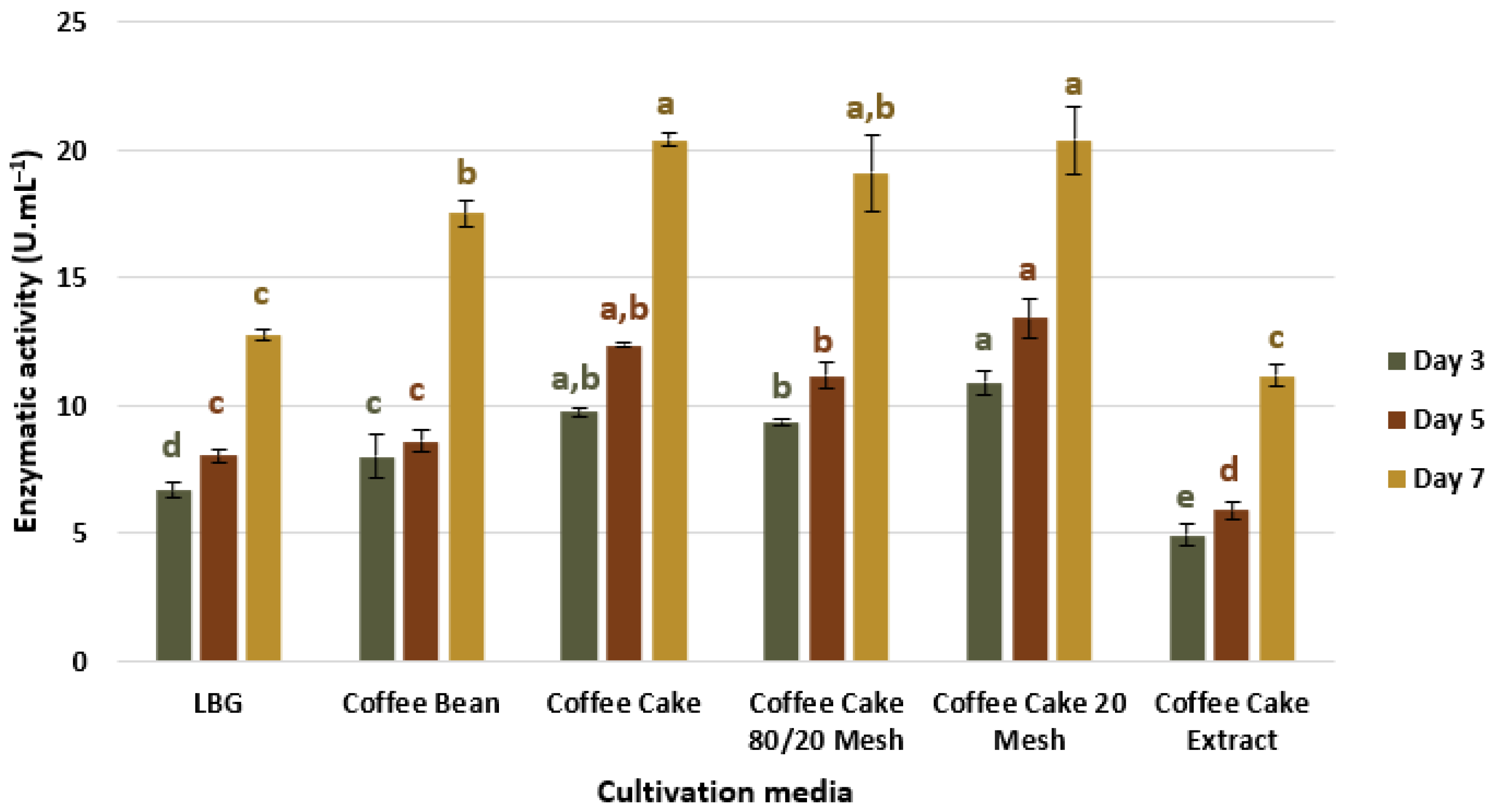
Figure 1. Mannanase production profile measured on days 3, 5, and 7 of cultivation using the initial medium described in Table 1 and different carbon sources, incubated in a shaker at 30 °C and 200 rpm. The comparison of mannanase activity between cultivation days was performed using a one-way ANOVA. Identical letters, for the same day, indicate no significant difference (p ≤ 0.05) between carbon sources for mannanase production, according to Tukey’s test.
Processes 13 03874 g001
Figure 2. Mannanase production profile over 19 days of cultivation using coffee cake and LBG as carbon sources, in the columns, with the initial medium described in Table 1, incubated in a shaker at 30 °C and 200 rpm. The comparison of mannanase activity between cultivation days was performed using a one-way ANOVA. Identical letters, in the same carbon source, indicate no significant difference (p ≤ 0.05) between cultivation days for mannanase production, according to Tukey’s test.
Processes 13 03874 g002
Figure 3. Mannanase production profile over 7 days of cultivation using coffee cake as a carbon source, with the initial medium described in Table 1, incubated in a shaker at 30 °C and 200 rpm. The comparison of mannanase activity between cultivation days was performed using a one-way ANOVA. Identical letters indicate no significant difference (p ≤ 0.05) between cultivation days for mannanase production, according to Tukey’s test.
Processes 13 03874 g003
Figure 4. Pareto chart of effects for mannanase production (U·mL−1).
Processes 13 03874 g004
Figure 5. (a) Pareto chart of effects and (b) contour curves graph obtained through the two-factor CCRD conditions (coffee cake and yeast extract content) from culture medium for mannanase production (U·mL−1).
Processes 13 03874 g005
Figure 6. Mannose plus fructose recovery (%) obtained from the enzymatic hydrolysis of healthy and defective coffee beans at 50 °C and 250 rpm, using the optimized enzyme productized. The mannose value obtained by acid hydrolysis was considered 100%. The comparison of mannose + fructose recovery between cultivation days and between biomass was performed using a one-way ANOVA. Identical uppercase letters indicate no significant difference (p ≤ 0.05) between hydrolysis time, in the same biomass, for mannose recovery, according to Tukey’s test. Identical lowercase letters indicate no significant difference (p ≤ 0.05) between biomass, in the same hydrolysis time, for mannose recovery, according to Student’s t test.
Processes 13 03874 g006
Table 1. Initial cultivation media formulated based on scientific prospecting [41,42,43,44,45].
CompoundConcentration (g·L−1)
Carbon Source *30.0
Yeast extract4.0
Potassium phosphate buffer (pH 5.5)0.5
CaCl2·2H2O0.05
MgSO4·7H2O0.5
Al2O31.0
* ground coffee bean, coffee cake, coffee cake 80/20 mesh, coffee cake 20 mesh, coffee cake extracts, or LBG.
Table 2. Coded levels and corresponding values of the independent factors in the Plackett–Burman design.
IDIndependent Factor (g·L−1)Level
−101
X1Coffee cake203040
X2Yeast extract246
X3Phosphate buffer (pH 5.5)0.250.50.75
X4CaCl2·2H2O00.0050.1
X5MgSO4·7H2O00.51
X6Al2O3012
Table 3. Coded (−1.41, −1, 0, +1, +1.41) and decoded values of central composite rotatable design factors.
IDIndependent Factor (g·L−1)Level
−1.41−10+1+1.41
Z1Coffee cake2530.824559.1865
Z2Yeast extract45.16810.8412
Table 4. Elementary organic analysis (CHNSO) of the coffee cake and locust bean gum (LBG).
Carbon Source%C%H%N%S%O
LBG38.85 ± 0.12 a6.64 ± 0.04 a0.87 ± 0.01 b0.15 ± 0.03 a53.49 ± 0.17 a
Coffee cake43.42 ± 0.05 a6.36 ± 0.00 b2.61 ± 0.00 a0.23 ± 0.01 a47.38 ± 0.04 a
The comparison of elementary organic analysis between LBG and coffee cake was performed using one-way ANOVA. Identical letters, in the same element, indicate no significant difference (p ≤ 0.05) between the carbon sources, according to Student’s t-test.
Table 5. Results of the Plackett–Burman design, represented in codified variables, for mannanase production on the fifth day of cultivation.
IDX1X2X3X4X5X6VI1VI2VI3VI4VI5Mannanase Activity (U·mL−1)
11−11−1−1−1111−1121.87 ± 1.64
211−11−1−1−1111−121.49 ± 0.24
3−111−11−1−1−111119.42 ± 0.61
41−111−11−1−1−11120.44 ± 0.41
511−111−11−1−1−1121.67 ± 0.77
6111−111−11−1−1−120.77 ± 0.93
7−1111−111−11−1−119.96 ± 0.81
8−1−1111−111−11−113.56 ± 0.83
9−1−1−1111−111−1119.53 ± 1.34
101−1−1−1111−111−120.79 ± 0.43
11−11−1−1−1111−11120.65 ± 0.30
12−1−1−1−1−1−1−1−1−1−1−114.52 ± 0.22
130000000000020.74 ± 0.14
140000000000020.57 ± 0.14
150000000000020.20 ± 0.17
160000000000020.52 ± 0.07
ID—identification assay number; X1—Coffee cake; X2—Yeast extract; X3—Phosphate buffer (pH 5.5); X4—CaCl2·2H2O; X5—MgSO4·7H2O; X6—Al2O3; IV1–5—dummy variables, included to complete the design matrix, estimate the experimental error, and allow identification of the real factors that have a significant effect on mannanase production.
Table 6. Results of the Central Composite Rotatable Design for mannanase production, on the fifth day of cultivation, where Z1 is the coffee cake concentration, and Z2 is the yeast extract concentration, represented in codified variables.
IDZ1Z2Mannanase Activity (U·mL−1)
1−1−121.01 ± 0.27
21−122.97 ± 0.45
3−1121.30 ± 0.18
41122.65 ± 0.27
5−1.41021.07 ± 0.59
61.41023.07 ± 0.43
70−1.4122.02 ± 0.61
801.4125.43 ± 0.84
90025.63 ± 0.48
100025.33 ± 0.30
110023.64 ± 0.29
120024.50 ± 0.52
Table 7. Monosaccharides from the acid and enzymatic hydrolysis of healthy and defective coffee beans. Enzymatic hydrolysis was performed at 50 °C and 200 rpm.
SamplesMonosaccharides (g·100 g−1)
GlucoseGalactoseArabinoseMannose + Fructose
Acid hydrolysis
Healthy beans6.56 ± 0.2113.53 ± 0.701.91 ± 0.3819.69 ± 4.06
Defective beans5.52 ± 0.5312.59 ± 0.761.68 ± 0.1318.50 ± 2.07
Enzymatic hydrolysis (24 h)
Healthy beans5.01 ± 0.330.18 ± 0.000.004.66 ± 0.01
Defective beans3.96 ± 0.390.17 ± 0.010.004.81 ± 0.02
Xylose was not detected for any sample.
Disclaimer/Publisher’s Note: The statements, opinions and data contained in all publications are solely those of the individual author(s) and contributor(s) and not of MDPI and/or the editor(s). MDPI and/or the editor(s) disclaim responsibility for any injury to people or property resulting from any ideas, methods, instructions or products referred to in the content.