Article

Degassing N2 from the Direct Oxidation of Total Ammonia in Mariculture Using a Three-Dimensional Electrode System


1
School of Marine Science and Technology, Tianjin University, Tianjin 300072, China
2
School of Marine Sciences (State Key Laboratory of Marine Resources Utilization in Souths China Sea), Hainan University, Haikou 570228, China
3
National Industry-Education Platform for Energy Storage (Tianjin University), Tianjin University, Tianjin 300350, China
4
Key Laboratory of Advanced Energy Materials Chemistry (Ministry of Education), Nankai University, Tianjin 300071, China
*
Authors to whom correspondence should be addressed.
Processes 2025, 13(12), 3851; https://doi.org/10.3390/pr13123851
Submission received: 23 October 2025 / Revised: 14 November 2025 / Accepted: 25 November 2025 / Published: 28 November 2025
(This article belongs to the Special Issue Advanced Materials for Marine Energy and Environment)

Abstract

Elevated levels of total ammonia nitrogen (TAN) are recognized as a primary contributor to acute toxicity in aquatic organisms across freshwater aquaculture and mariculture environments. Existing technologies for TAN removal from wastewater are constrained by complex processes, high energy consumption, and an inability to meet discharge standards in a single step. Conventional electrochemical routes often over-oxidize TAN to nitrate, which undermines the goal of achieving truly harmless wastewater. Herein, we use a three-dimensional (3D) electrochemical system packed with particulate electrodes to realize the “TAN to N2” in one step. The design exploits a synergistic mechanism in which anodic ·OH and HClO cooperatively oxidize TAN while cathodic sites concurrently reduce nitrate nitrogen, turning NH4+ directly to N2 without nitrate accumulation. The 3D electrochemical system is particularly suitable for marine aquaculture wastewater, especially when addressing the low TAN concentration characteristic. Results show that the 3D system increased N2 selectivity from 67.90% to 92.06% while stabilizing wastewater pH within a mildly alkaline window. The system operates in situ, enabling direct recycle of culture water and offering a new technological paradigm for harmless, on-site treatment and resource recovery from mariculture wastewater.

1. Introduction

Total ammonia nitrogen (TAN) has been widely recognized as the primary pollutant in wastewater [1,2,3,4,5]. Particularly in aquaculture systems, even trace amounts of TAN can induce neurological symptoms for the aquatic organism [6,7]. Persistently elevated TAN concentrations trigger excessive phytoplankton growth, frequently leading to harmful algal blooms and rapid water quality deterioration [8]. Furthermore, prolonged exposure to high concentrations of nitrate and nitrite can exert toxic effects on aquatic organisms, such as causing organ damage in fish and inducing systemic pathologies [9,10].
The strategies for removing TAN from aquaculture wastewater include physical methods, biological methods, breakpoint chlorination, and electrochemical oxidation. Physicochemical methods encompass adsorption, filtration, ion exchange, and other techniques. Cheng et al. [11] achieved a maximum TAN adsorption of 1.909 mg·g−1 using pyrolytic biochar from Eupatorium adenophorum (300 °C) in a coexisting ammonia–phosphorus system. They rely on functional materials such as adsorbents and membrane components, whose performance is highly sensitive to salinity, organic matter, temperature, and pH [11,12]. Biological methods typically convert TAN into nitrate through microbial nitrification. Terada et al. [13] employed a Membrane Aerated Biofilm Reactor (MABR) system, utilizing ammonia-oxidizing bacteria (AOB) within the biofilm to treat wastewater with a TAN concentration of 100 mg·L−1. After continuous operation for 70 days, the TAN was ultimately converted into nitrate. Nevertheless, the oxidation efficiency of biological methods is constrained by microbial activity, resulting in extended treatment cycles [13]. Breakpoint chlorination employs sodium hypochlorite to remove TAN. Zhang et al. [14] employed a combined Ultraviolet (UV)/HClO process to achieve 50% TAN removal at a Cl2/N molar ratio of 0.8 and TAN concentration of 1.00 mg·L−1. The products included NO3 and trace amounts of NO2, with minimal disinfection byproducts generated. Breakpoint chlorination consumes large amounts of reagents, operates with low efficiency, and requires extended treatment cycles. When operating, pH may change due to the generation of H+ [15], which affects oxidation removal effectiveness, as it varies with pH [16]. None of the above methods truly achieves pollutant removal; they merely convert TAN into adsorbed forms or oxidize it into nitrate or nitrite, which also pose toxicity to aquatic environments and threaten the survival of aquatic organisms. Moreover, achieving direct liquid-phase oxidation of TAN to N2 without causing secondary pollution has significant practical value.
Electrochemical oxidation (EO) technology offers simple operation, high pollutant removal efficiency, and adaptability to complex water conditions such as low temperatures and high salinity. It can indirectly oxidize TAN by generating HClO, theoretically converting TAN into N2. However, in actual wastewater treatment (including seawater), TAN is often over-oxidized to nitrite and nitrate, leading to the accumulation of toxic byproducts [17]. Díaz et al. [18] employed boron-doped diamond (BDD) electrodes to oxidize Cl into HClO for treating TAN in aquaculture wastewater. Conducted at current densities of 10–50 A·m−2, the study demonstrated poor TAN removal efficiency and generated significant byproducts, resulting in nitrate accumulation and toxicity. Therefore, improvements to existing methods are needed to further enhance N2 selectivity and reduce the formation of byproducts such as nitrate.
Seawater contains abundant Cl, which can be oxidized to generate HClO for TAN oxidation. Electrochemical oxidation of TAN using HClO offers advantages of “low cost, high efficiency, and strong adaptability” [19,20]. Commercial Ti/RuO2–IrO2 anodes exhibit low initial chlorine evolution overpotentials, effectively suppressing oxygen evolution reaction (OER) to promote chloride oxidation and enhance chlorine evolution selectivity, which is an excellent chlorine-evolving electrode [21]. Furthermore, during electrochemical TAN oxidation, ·OH radicals can directly participate in the oxidation reaction, thereby reducing the formation of harmful intermediate products [22]. SnO2 exhibits high conductivity and OER catalytic activity, generating highly reactive species like ·OH to accelerate pollutant oxidation and degradation [23]. Incorporating Sb into SnO2 alters its structure, enhances conductivity, and provides active sites that promote electrode adsorption of target pollutants [24].
Therefore, we employed a commercial Ti/RuO2–IrO2 anode and a Ti mesh cathode as the base electrochemical cell to construct a SnO2-Sb2O3@GAC (granular activated carbon) 3D electrode system for the efficient oxidative removal of TAN. During the treatment of mariculture wastewater, no additional reagents are required; the electrode system operates continuously and stably using only the inherent substances in seawater (NaCl, H2O). The synergistic action of in situ-generated HClO and hydroxyl radicals rapidly and efficiently oxidizes TAN into N2, directly converting pollutants into volatile, non-polluting gases and preventing secondary water contamination. This research provides theoretical and technological support for high-efficiency recycling of mariculture wastewater.

2. Materials and Methods

2.1. Methods for Measuring Related Substances and Sources of Chemical Reagents

TAN was quantified spectrophotometrically with Nessler’s reagent following the Chinese national standard HJ 535-2009 [25]. Nitrate nitrogen was determined by Ultraviolet (UV) spectrophotometry according to HJ/T 346-2007 [26], whereas nitrite nitrogen was assayed by the N-(1-naphthyl) ethylenediamine photometric method specified in GB 7493-1987 [27]. Total and free residual chlorine were measured by the N,N-diethyl-1,4-phenylenediamine (DPD) spectrophotometric procedure described in HJ 586-2010 [28]. Combined chlorine was calculated as the difference between total and free chlorine concentrations. The relevant instruments used in our experiment are listed in Table S1. The sources and purity of the relevant chemical reagents are shown in Table S2. Commercial Ti/RuO2–IrO2 electrodes were purchased from Schulte Industrial Technology (Suzhou, China).

2.2. Synthesis of Granular Electrodes

SnO2-Sb2O3@GAC granules were prepared by an impregnation–calcination route. Briefly, GAC was pretreated by rinsing five times with deionized water and dried at 105 °C for 4 h. A precursor solution containing SnCl4·5H2O (0.5 mol·L−1) and SbCl3 (0.05 mol·L−1) was prepared in a mixed solvent of n-butanol (490 mL) and concentrated HCl (10 mL). The dried GAC was immersed in the precursor solution and magnetically stirred for 4 h to ensure uniform coating. After impregnation, the slurry was filtered, and the solids were dried at 105 °C for 4 h, then calcined in a muffle furnace at 400 °C for 4 h under static air. The above sequence was repeated three times to yield the final SnO2-Sb2O3@GAC granular electrodes. Air treatment at 400 °C causes some degree of pore structure shrinkage or blockage, but does not completely destroy its porosity, retaining a high specific surface area [23,24,29,30,31,32,33,34].

2.3. Electrochemical Testing

All experiments were carried out in a rectangular polymethyl methacrylate (PMMA) electrolytic cell with an effective volume of 500 mL. Grooves (2 mm apart) machined on the inner side walls accommodate the electrodes, allowing a maximum inter-electrode gap of 4 cm.
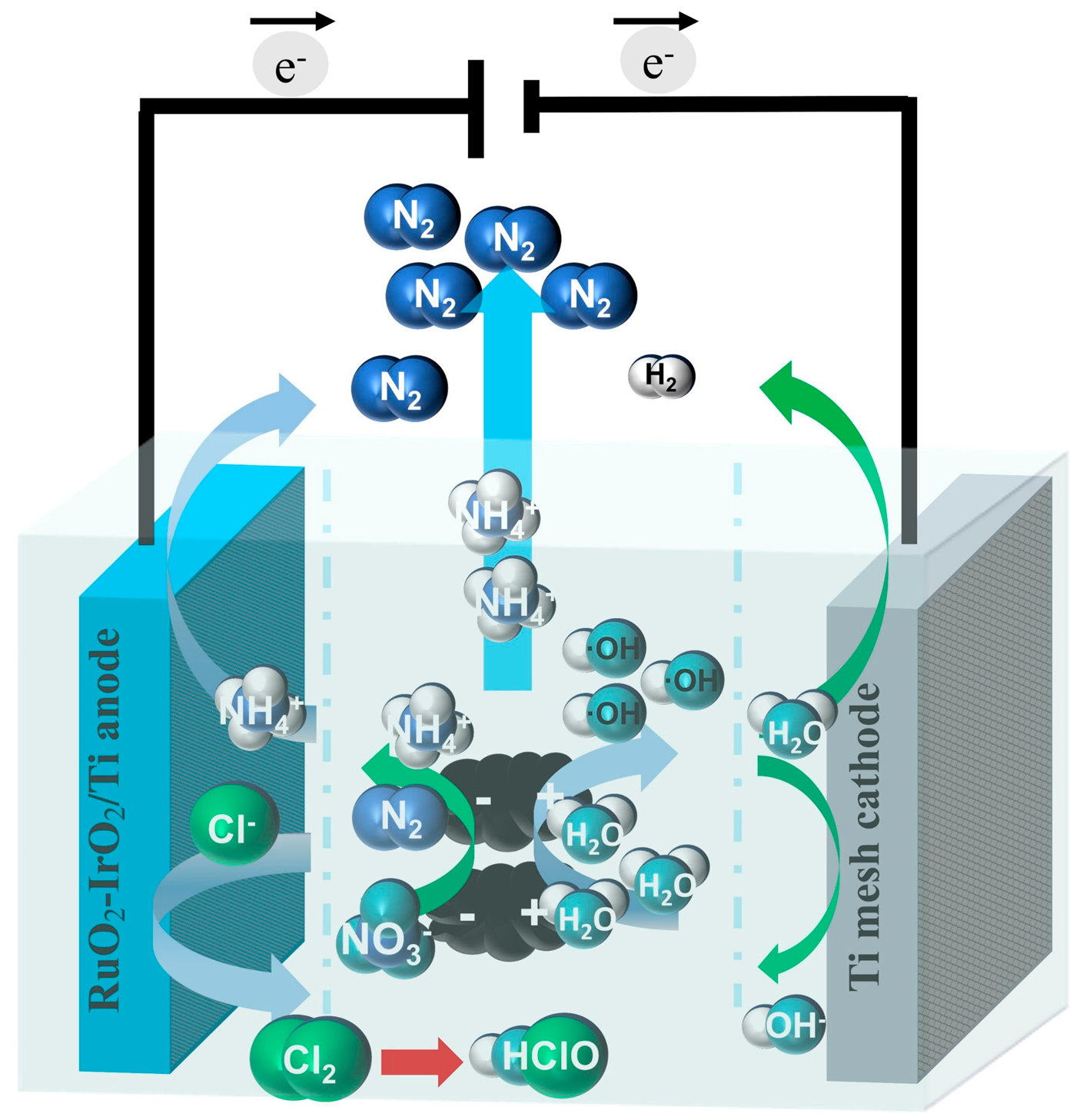
For two-dimensional (2D) electrode tests, a dimensionally stable Ti/RuO2–IrO2 anode (100 × 100 × 1 mm, geometric area 100 cm2) was employed, with a Ti mesh cathode of identical dimensions. The pair was connected to a Direct Current (DC) regulated power supply. A 3D electrode system was constructed by packing the prepared particles between the anode and cathode (Figure 1).
Synthetic freshwater aquaculture wastewater was prepared by dissolving (NH4)2SO4, NaCl, and Na2SO4 in deionized water. The Na2SO4 dosage was adjusted to maintain a constant conductivity. Based on the TAN levels reported for intensive fish-pond wastewater [35,36,37,38], initial TAN concentrations of 10 mg·L−1 and 50 mg·L−1 were selected. Chloride was introduced as NaCl at gradient concentrations of 500, 1250, and 1875 mg·L−1. An inter-electrode distance of 4 cm was adopted, and electrolysis was conducted at a constant current density of 5 mA·cm−2.
Artificial seawater was prepared by dissolving commercial marine salt in deionized water to a salinity of 33‰. The detailed ionic composition is given in Table S3. Ammonia was supplied as (NH4)2SO4, and all other experimental operations and parameters were identical to those in the freshwater system. To simulate real marine-culture wastewater, a synthetic solution was formulated according to the pollutant concentrations documented in the literature by adding NaNO3, NaNO2, and (NH4)2SO4 to the artificial seawater, yielding initial concentrations of 20 mg·L−1 NH4+-N, 10 mg·L−1 NO3-N, and 2 mg·L−1 NO2-N. The initial pH was 8.44, and electrolysis was performed at a constant current density of 5 mA·cm−2.

2.4. Formulas for Relevant Parameters

The calculation method for pollutant removal efficiency η ( % ) is as follows:
η = 100 × c 0 c t c 0
where c 0 (mg·L−1) is the initial concentration, and c t (mg·L−1) is the concentration after electrolysis time t (min).
Energy consumption (kWh·m−3) is calculated using the following formula, with units representing the electrical energy consumed per unit volume of TAN removed from aquaculture wastewater:
W = U × I × t m × 60 × c 0 c t
where U (V) is the voltage between electrodes, I (A) is the current intensity through the electrode plates, t (min) is the electrolysis time, m (mg) is the amount of TAN removed during electrolysis time t , and c 0 (g·m−3) is the initial concentration, and c t (g·m−3) is the concentration after electrolysis time t .
The current density (mA·cm−2) is calculated using the following equation, where the unit represents the proportion of electricity consumption used for TAN removal relative to total electricity consumption:
C E = 100 × m × 3 × F 14 × I × t × 60 × 1000
where m (mg) is the amount of TAN removed during electrolysis time t (min), F (C·mol−1) is the faraday constant, whose value is 96,485, and I (A) is the current intensity through the electrode plates.
The method of calculating the N2 Selection Efficiency ɑ ( % ) is given by the following equation:
ɑ = 1 c 1 + c 2 + c 3 c 0 × 100 %
where c 0 (mg·L−1) represents the initial NH4+-N concentration, c 1 (mg·L−1) denotes the NO3-N concentration in the wastewater, c 2 (mg·L−1) indicates the NO2-N concentration in the wastewater, and c 3 (mg·L−1) signifies the NH2Cl-N concentration in the wastewater (expressed as NH2Cl).
As demonstrated by some related studies [39,40,41], introducing HClO oxidizes TAN under various conditions (high salinity, acidity, presence of recalcitrant organic matter). Quantitative detection of NOx (including NO and N2O) revealed concentrations below the detection limit, rendering them negligible. Therefore, in this work, it can be concluded that other nitrogen-containing gaseous byproducts were negligible compared with N2.

3. Results and Discussion

3.1. Characterization of Granular Electrode Materials

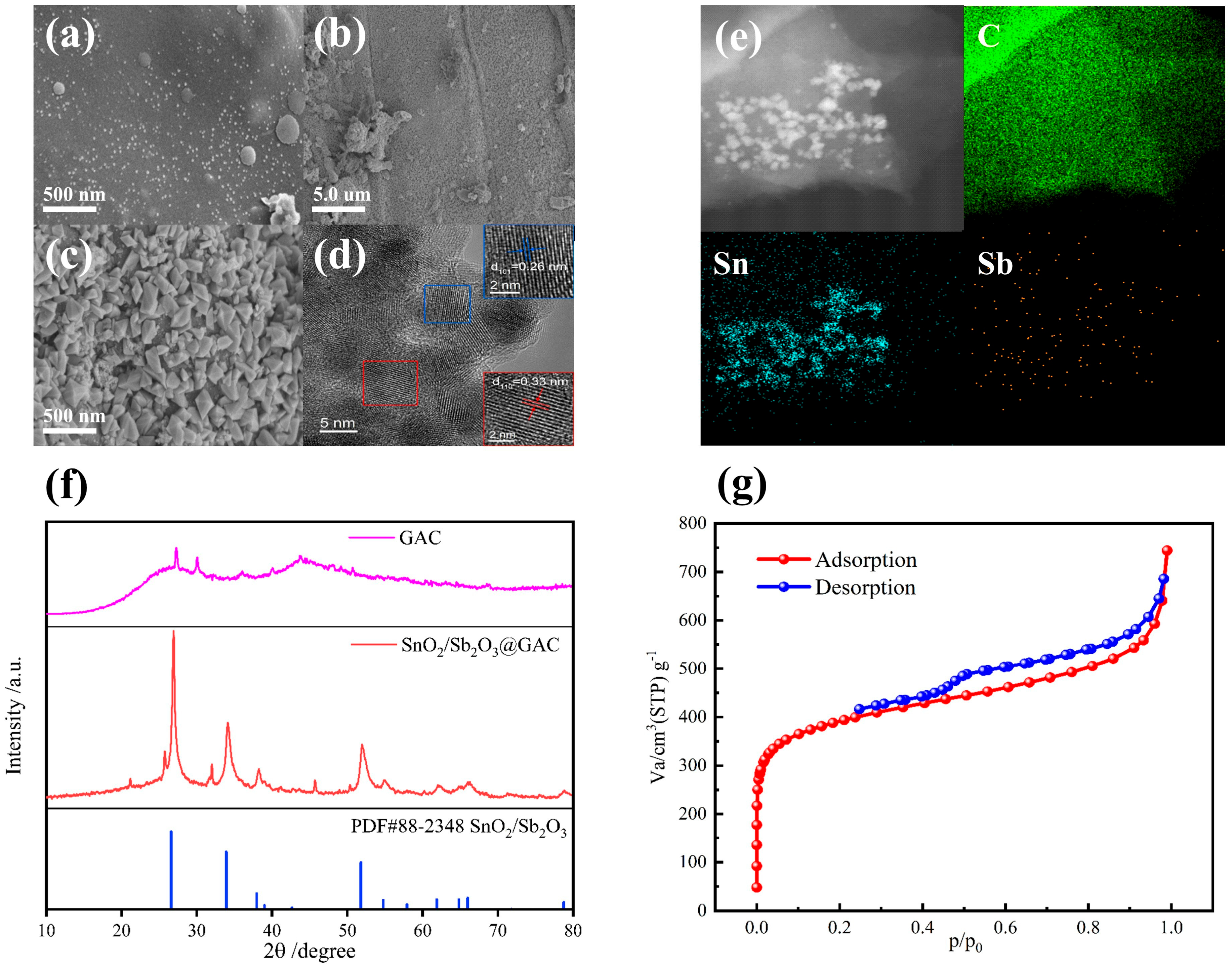
The microstructure of pristine GAC, the fresh electrode, was examined by scanning electron microscopy (SEM). Low- and high-magnification micrographs of the pristine GAC (Figure 2a) reveal a relatively smooth surface perforated by abundant macropores. After deposition, the SnO2-Sb2O3@GAC surface is uniformly decorated with densely packed bipyramidal crystallites with a size of ~100 nm (Figure 2b,c), yielding a markedly rougher morphology than the bare carbon.
The transmission electron microscopy (TEM) image in Figure 2d resolves the microstructure of the particulate electrode. The activated-carbon matrix appears as a featureless, lattice-fringe-free matrix, consistent with amorphous carbon. Discrete crystallites exhibiting well-defined lattice fringes are anchored on this support. Inter-planar spacings of 0.26 nm and 0.33 nm measured directly from the high-resolution micrograph correspond to the (101) and (110) planes of the SnO2-Sb2O3. Energy-dispersive X-ray elemental maps (Figure 2e) further reveal a homogeneous distribution of Sn and Sb across the carbon surface. Confirming the successful and uniform decoration of the activated carbon with SnO2-Sb2O3.
Figure 2f presents the X-ray diffraction (XRD) patterns of GAC and the as-prepared SnO2-Sb2O3@GAC particle electrode. The diffractogram of SnO2-Sb2O3@GAC exhibits characteristic reflections of a tin–antimony oxide phase (PDF#88-2348), confirming the successful formation of Sb2O3.
N2 adsorption–desorption isotherm of SnO2-Sb2O3@GAC was conducted to evaluate the surface area and the pore structure of the as-prepared materials in Figure 2g, showing the isotherm of type IV with an H4 hysteresis loop in the mid-to-high relative-pressure region, indicating the coexistence of micro- and meso-pores. The specific surface area is calculated to be 1.42 × 10³ m2·g−1, and the total pore volume and mean pore width are 1.15 cm3·g−1 and 1.62 nm, respectively, placing the material at the micropore–mesopore boundary. This hierarchical porosity endows the particle electrode with both high surface area and ample void volume, facilitating rapid molecular diffusion and efficient guest accommodation.

3.2. Mechanism and Effect of TAN Oxidation in Electrode Systems

Electrochemical oxidation of TAN proceeds by two pathways: direct oxidation and indirect oxidation. Direct oxidation relies on the direct electron transfer from ammonia species at the anode surface [42]. Theoretically, NH4+-N can be converted to N2 by losing three electrons at the anode. However, the weak adsorption of NH4+ on most electrode surfaces makes direct oxidation kinetically unfavorable [43,44]. To verify the contribution of the direct pathway, a synthetic wastewater containing 70 mg·L−1 NH4+-N (prepared with (NH4)2SO4 and Na2SO4) was electrolyzed for 120 min at a constant current using a Ti/RuO2–IrO2 anode and a Ti-mesh cathode. The concentration of NH4+-N decreased only from 71.31 to 67.71 mg·L−1, corresponding to a removal efficiency of 5.04% (Figure S1). This marginal reduction indicates that direct oxidation makes a negligible contribution to ammonia removal. Consequently, indirect oxidation was adopted as the principal strategy for subsequent TAN treatment.
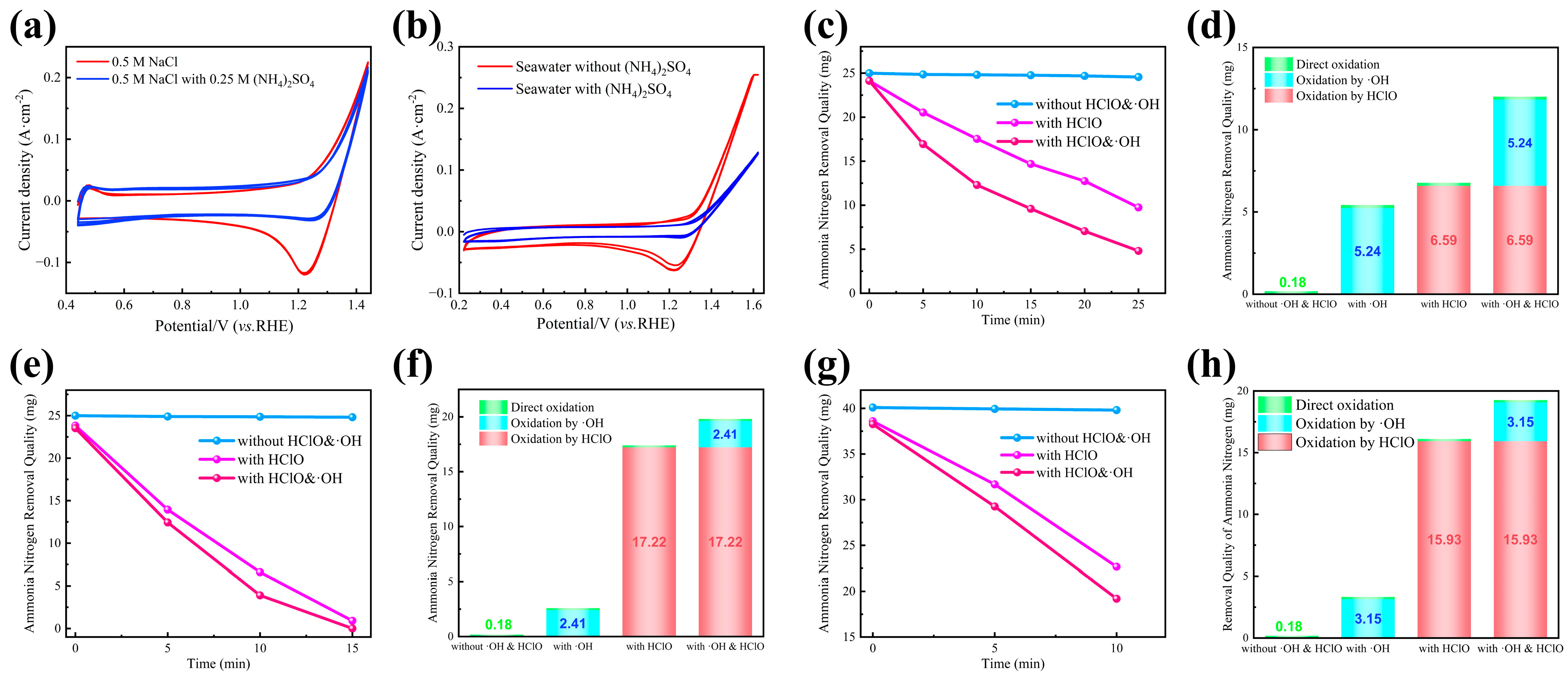
Indirect TAN oxidation is achieved by introducing an electroactive species that is converted on the anode into a potent oxidant, which then diffuses into the bulk solution and reacts homogeneously with NH4+-N. Cl was added to the system to ensure that it could be electro-transformed into Cl2 on the Ti/RuO2–IrO2 anode by the chlorine-evolution reaction (CER), and the dissolved Cl2 rapidly hydrolyses to produce ClO/HClO, which subsequently oxidizes ammonia. CV curves of the Ti/RuO2–IrO2 electrode in 0.5 M NaCl and in artificial seawater (Figure 3a,b) show a marked anodic current increase at ~1.2 V (vs. RHE), corresponding to CER, followed by a cathodic peak at the same potential, according to the Pourbaix diagram of CER and OER in 0.5 M NaCl, this phenomenon can be assigned to HClO reduction. Upon the addition of 0.25 M (NH4)2SO4 to both solutions, the reduction peak vanished, indicating that TAN was rapidly consumed by hypochlorous acid. These results confirm that HClO generated from Cl oxidation is the key mediator of TAN oxidation. The reactions occurring at the anode, cathode, and in the bulk are as follows:
Anodic reaction:
2Cl → Cl2↑ + 2e
Cathodic reaction:
2H2O + 2e → H2↑ + 2OH
Physical phase reaction:
Cl2 + H2O → HClO + H+ + Cl
HClO + 2 3 NH 4 +   1 3 N 2 + H 2 O + 5 3 H + + Cl
4HClO + NH4+ → NO3 + H2O + 6H+ + 4Cl
HClO + NH4+ → NH2Cl + H2O + H+
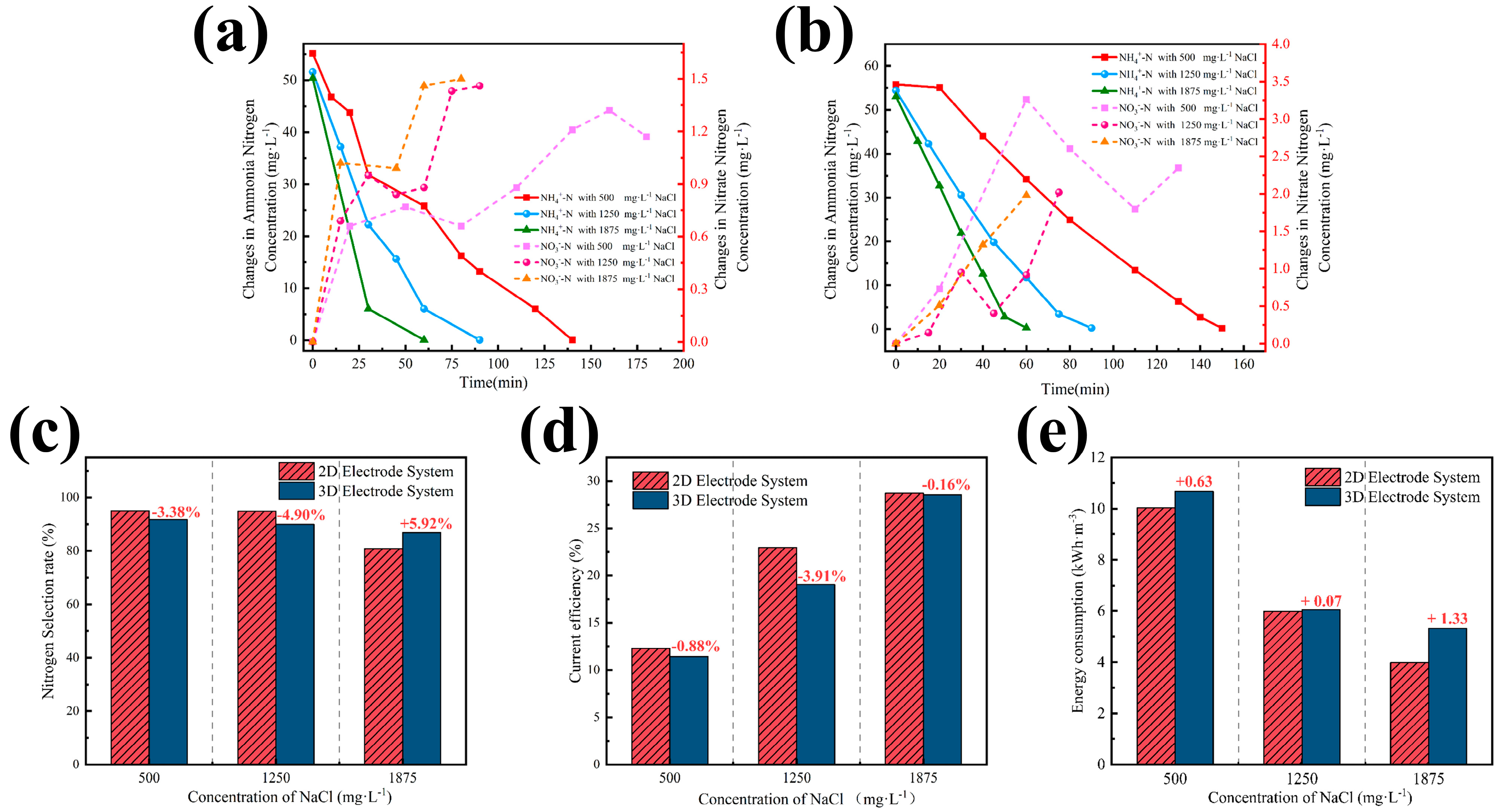
In a 2D electrolytic system, the Ti/RuO2–IrO2 anode exhibits high activity toward both chlorine evolution and ammonia oxidation. However, this is accompanied by the formation of bound chlorine (chloramines) and NO3-N as undesired byproducts. During the oxidation of TAN by the strongly oxidizing HClO, the concentration of NO2-N remains below the detection limit and is therefore regarded as negligible [45]. Consistently, the wastewater nitrite concentration was found to be extremely low throughout the experiments. Under conditions of fixed anode surface area, the rate of HClO generation depends on the bulk chloride concentration. We conducted three sets of experiments with Cl concentrations of 500, 1250, and 1875 mg·L−1 according to the relevant multiples of 2.5 and 1.5. When the concentration of Cl is 500 mg·L−1, the low rate of HClO generation leads to extended electrolysis time, reduced current efficiency, and increased energy consumption. Raising the concentration of Cl to 1875 mg·L−1 accelerates HClO production and achieves rapid ammonia removal. Yet a substantial fraction of the electrical charge is diverted to chlorine generation. Despite improvements in electrical efficiency, energy consumption remains high. The concentration of NH2Cl, a byproduct in the wastewater, reached as high as 7.74 mg·L−1, which is significantly higher compared to other experiments. Therefore, the concentration of Cl was not further increased in the freshwater system. Concurrently, partial over-oxidation of TAN to nitrate nitrogen occurs, diminishing the selectivity toward N2 (Figure 4). Reducing the initial TAN concentration from 50 to 10 mg·L−1 does not alter the observed removal trends (Figure S3).
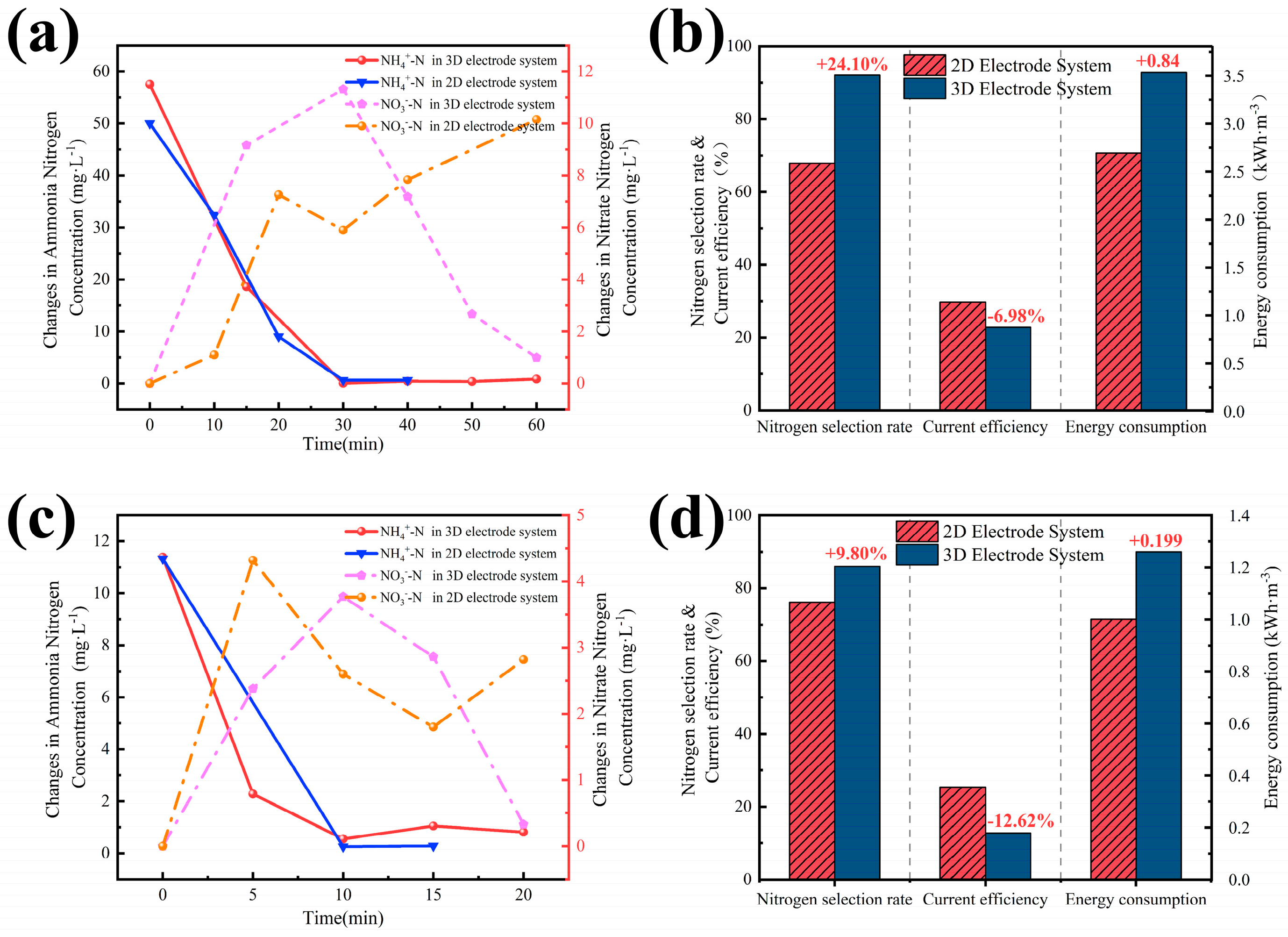
According to Reactions (7–10), the oxidation of NH4+ by HClO releases stoichiometric amounts of H+. Although cathodic reduction simultaneously generates OH, the net proton balance remains positive, stabilizing the bulk pH in a strongly acidic window of 3.00–4.00. In freshwater systems, the 2D electrode system achieves selective oxidation of TAN to N2 with minimal NaCl addition. The strongly acidic wastewater fails to meet water quality standards for recirculating aquaculture systems and poses a threat to fish survival. Next, we conducted TAN removal tests in simulated mariculture wastewater. When initial TAN concentrations were 50 and 10 mg·L−1 (Figure 5), the concentration of nitrate nitrogen in wastewater reached 10.12 mg·L−1 and 2.82 mg·L−1, respectively. The former exceeded the wastewater standard limit, resulting in a final N2 selection rate of only 67.90% and 76.16% (Figure 5a). The underlying reason is that in seawater systems, the 2D electrode system generates a large amount of HClO instantaneously during TAN treatment. This excessively oxidizes TAN into nitrate, leading to nitrate accumulation and reduced N2 selectivity. Excessive nitrate accumulation can also poison fish, and the resulting acidification of the water is ultimately unsuitable for fish survival. Therefore, improvements to the 2D electrode system are necessary: While HClO exhibits excellent TAN oxidation activity, excessively high concentrations readily drive over-oxidation of TAN, diminishing the efficiency of directed N2 conversion. Building upon the original chlorine oxidation approach, we introduced novel reactive species to partially replace chlorine’s oxidative function.
To elucidate the oxidation mechanism of TAN in the 3D granular-electrode system, a 50 mg·L−1 NH4+-N solution (prepared from (NH4)2SO4) containing 0.1 M Na2SO4 as supporting electrolyte was electrolyzed at 5 mA·cm−2, while the temporal decay of NH4+-N was monitored. An identical solution was then spiked with 30 mM tert-butanol (TBA) to scavenge ·OH radicals, and the electrolysis was repeated under the same conditions. As shown in Figure S2, the removal efficiency of NH4+-N was 14.7% in the presence of TBA, significantly lower than the 82.3% achieved in its absence. This pronounced inhibition indicates that TBA suppresses ·OH generation, thereby hindering TAN oxidation, confirming the pivotal role of ·OH radicals in the catalytic removal of NH4+-N in the 3D electrode system.
In addition, to verify the relative oxidation contribution rate of ·OH compared to HClO, we conducted quenching experiments under different salinities (Figure 3). The seawater used in the experiments was configured with a salinity of 33‰, corresponding to a NaCl concentration of approximately 16,000 mg·L−1. On this basis, two NaCl concentration gradients (8000 mg·L−1 and 2000 mg·L−1) were established. Na2SO4 was added to maintain consistent electrical conductivity across all groups, followed by electrolytic treatment at a current density of 5 mA·cm−2. In each group of experiments, ·OH was quenched with TBA to retain only the oxidative effect of HClO on TAN; meanwhile, an experimental group with the combined oxidation of TAN by ·OH and HClO was established. The difference between the two groups represents the mass of TAN oxidized by ·OH. Data at the 10-min point were analyzed for all three groups, and the results indicated that the higher the NaCl concentration, the greater the oxidation contribution ratio of HClO rose. This is attributed to the fact that an increase in Cl concentration promotes the generation of HClO, while the generation rate of ·OH shows no significant change. However, when the NaCl concentration reaches a certain level, the maximum concentration of HClO that the system can produce per unit time reaches a limit. At this point, the oxidation contribution ratio of HClO to ·OH tends to stabilize, with HClO consistently occupying a dominant position.
The reaction area and active sites of the 2D electrode system are limited to two electrode plates. After filling with granular electrodes, these particles can form many microelectrolytic cells under the influence of an electric field, significantly increasing the reaction area, shortening the mass transfer distance between pollutants and the electrode, and enhancing the reaction kinetics. This approach significantly accelerates the electrochemical oxidation of target pollutants on the particle electrode surfaces while substantially enhancing mass transfer efficiency, thereby addressing limitations such as restricted mass transfer capacity in a 2D electrode system [29,33]. Moreover, the SnO2-Sb2O3 metal oxides loaded onto the particle electrode surface exhibit high catalytic activity, promoting the generation of highly oxidative ·OH radicals. These ·OH radicals synergistically interact with HClO produced by the Ti/RuO2–IrO2 anode, achieving deep removal of TAN. Under applied electric fields, each particle polarizes into a bipolar microelectrode: The cathode-facing side of the particle acts as an anode driving water oxidation (2H2O → H2O2/·OH + 2H+ + 2e), while the anode-facing side functions as a cathode promoting nitrate reduction (2NO3 + 12H+ + 10e → N2 + 6H2O). The overall reaction schematic is shown in Figure 1.
Firstly, we tested the TAN treatment performance of the 3D electrode system in freshwater systems. In freshwater, the 3D system utilizes the synergistic action of the strong oxidizing species ·OH and HClO to degrade TAN. After ·OH partially replaced HClO, the H+ accumulation rate decreased, maintaining the wastewater pH within a neutral to weakly alkaline range (the endpoint pH of the 2D system was significantly lower than the initial value, while the 3D system remained near neutral).
Compared with a 2D electrode system, a 3D electrode system filled with granular electrodes exhibits increased particle-to-particle contact, which induces short-circuit currents. These short-circuit currents reduce the system’s effective reaction current. At low ion concentrations, the efficiency of active substance generation decreases while the occurrence of other side reactions increases [46]. At lower Cl concentrations (500 mg·L−1, 1250 mg·L−1), the presence of short-circuit currents reduces system current efficiency and increases energy consumption, further diminishing active substance generation efficiency and TAN oxidation effectiveness. Higher concentrations of byproducts like chloramines lead to reduced N2 selectivity. As Cl concentration further increases, the 3D electrode system remains affected by short-circuit current, resulting in reduced effective reaction current. However, at this concentration, more HClO is generated, which is sufficient to effectively oxidize TAN. During this process, ·OH partially replaces HClO in oxidizing TAN, reducing the formation of chloramine byproducts and thereby improving N2 selectivity.
When the initial TAN concentration decreased to 10 mg·L−1, the Cl/NH4+ molar ratio correspondingly increased, and the TAN removal times for both systems showed no difference (Figure S2). The corresponding patterns for the 3D electrode system were identical to those observed at a Cl concentration of 1875 mg·L−1. At this TAN concentration, the 3D electrode system demonstrated superior TAN removal performance compared to the 2D electrode system. The wastewater pH remained neutral to weakly alkaline, resulting in higher wastewater quality. Although the 3D electrode system exhibits lower current efficiency and higher energy consumption, it resolves wastewater acidification issues, making the discharge water meet relevant standards.
Secondly, we tested its TAN treatment performance in a seawater system. At an initial TAN concentration of 50 mg·L−1, nitrate nitrogen concentration first peaked, then continuously declined during the reaction. This turning point precisely coincided with the moment TAN was nearly fully oxidized (Figure 5a). This phenomenon stems from the continuous reduction of nitrate (NO3 → N2) within the cathodic polarization zone on the granular electrode surface. Since the oxidation rate of TAN exceeds the reduction rate of nitrate, NH4+ conversion occurs preferentially. Once NH4+ is depleted, nitrate reduction becomes the dominant pathway, resulting in the characteristic “rise–fall” curve pattern. Although the short-circuit current of the system reduced current efficiency and increased energy consumption per unit (Figure 5b), both residual nitrate and HClO concentrations in the final wastewater decreased, with N2 selectivity improving from 67.90% to 92.06%. Consequently, the 3D structure demonstrated more pronounced performance advantages in seawater, exhibiting outstanding TAN removal efficiency. However, in freshwater environments, corresponding nitrate reduction is negligible. This is due to the influence of Cl and nitrate concentrations. Lan et al. [47] systematically investigated the effect of Cl concentration on nitrate reduction in simulated wastewater by gradually increasing the NaCl concentration from 0.001 mol·L−1 to 0.1 mol·L−1. Results showed that as Cl concentration increased, nitrate removal efficiency within a fixed period of time exhibited an upward trend, indicating that Cl promotes nitrate reduction. Furthermore, increasing nitrate concentration enhances its contact with active sites on granular electrodes, thereby promoting reduction. This is evidenced by the linear increase in nitrate removal efficiency when the initial nitrate concentration rose from 14.8 mg·L−1 to 39.8 mg·L−1, indicating that higher nitrate concentrations are more conducive to the reduction reaction.
Therefore, it can be indicated that in freshwater systems, the low concentration of Cl results in a weaker promotion of nitrate reduction. Simultaneously, the nitrate concentration generated in freshwater systems remains consistently low, preventing it from contacting active sites on granular electrodes. These dual factors lead to negligible nitrate reduction. In contrast, seawater systems feature high Cl concentrations and generate significantly higher nitrate concentrations. This environment further promotes nitrate reduction at the cathode region of granular electrodes, resulting in a more pronounced reduction phenomenon in seawater.
Subsequently, when the initial TAN concentration was reduced to 10 mg·L−1, the characteristic pattern of nitrate nitrogen first increasing and then decreasing was still observed in seawater, with rapid oxidation of TAN similarly achieved. This result aligns with findings under higher TAN (50 mg·L−1) conditions, demonstrating that the N2 selectivity of the 3D electrode system significantly outperforms that of 2D systems (Figure 5c,d). The particulate electrodes simultaneously achieve efficient NH4+ oxidation and directed NO3-N reduction, making the 3D electrode system more advantageous for treating mariculture wastewater with low TAN concentrations.
Finally, we investigated and compared the advantages of the 3D electrode system over other methods in treating TAN (Table 1). The electrochemical method achieves faster oxidation rates and higher removal efficiency for TAN, typically achieving near-complete removal. Unlike biological or physical methods, it is unaffected by toxic substances such as antibiotics and phenols present in water bodies, making it adaptable to diverse and complex aquatic environments. However, while traditional electrochemical methods also primarily produce N2 as the main product, they generate significant byproducts such as nitrates. The 3D electrode system incorporates granular electrodes. These particles form numerous microelectrolytic cells under the influence of an electric field, significantly increasing the electrode reaction area. Compared to the 2D electrode system, this enhances mass transfer efficiency while simultaneously achieving efficient oxidation of NH4+ and reduction of NO3-N, further improving nitrogen N2 selectivity.

3.3. Three-Dimensional Electrode System Treats Simulated Real Marine Aquaculture TAN Wastewater

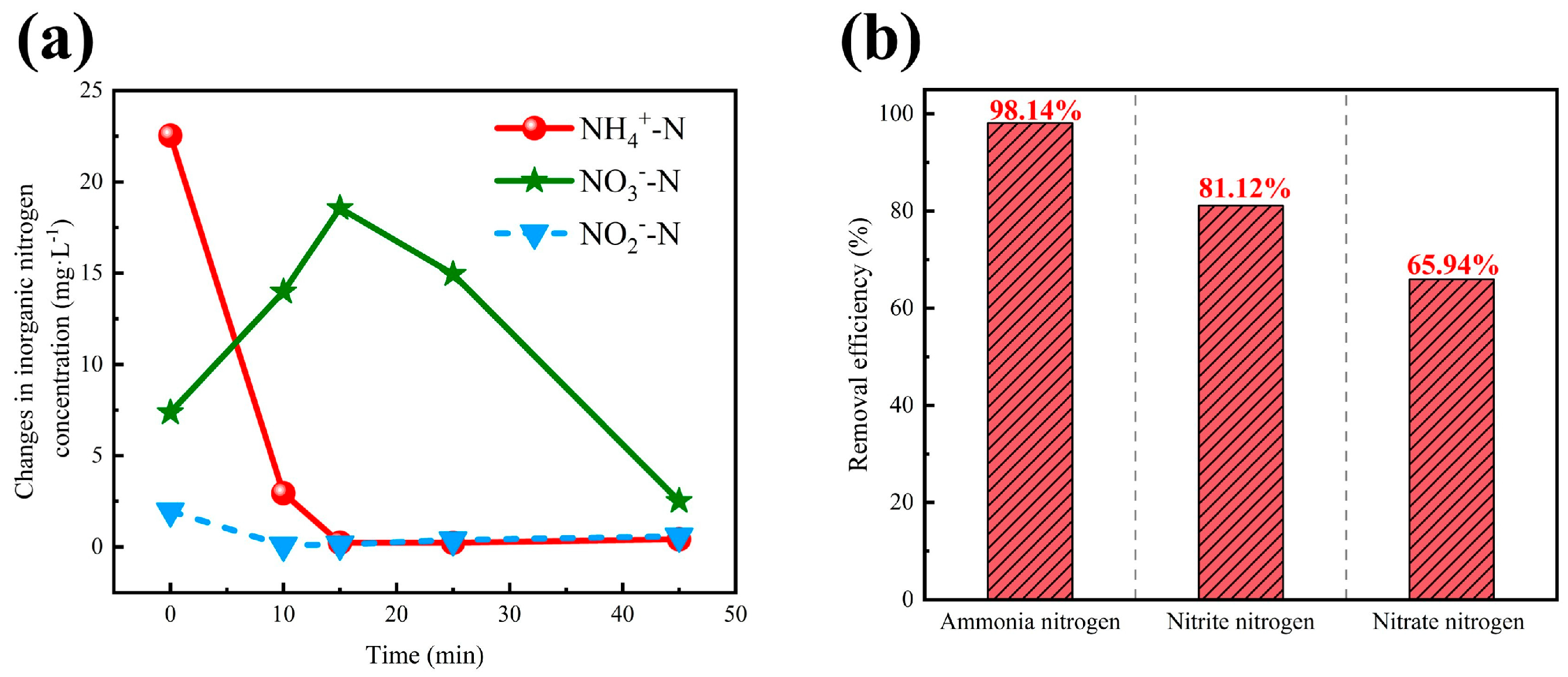
As demonstrated in the preceding section, a 3D electrode system in seawater can simultaneously achieve high N2 selectivity and selective NO3-N reduction, while maintaining a weakly alkaline pH. Previous batch experiments have afforded nearly complete removal of NH4+-N and NO3-N without detectable accumulation of NO2-N. Nevertheless, in real marine-culture wastewater, nitrite toxicity to fish and invertebrates remains a critical concern. To verify the practical applicability of the 3D electrode system, we therefore challenged it with a synthetic seawater matrix that closely mimics actual aquaculture wastewater. Simulated wastewater was prepared by dissolving NaNO3, NaNO2, and (NH4)2SO4 in artificial seawater solution, with initial concentrations of 20 mg·L−1 NH4+-N, 10 mg·L−1 NO3-N, and 2 mg·L−1 NO2-N (pH 8.44). Electrolysis was performed at a constant current density of 5 mA·cm−2. As shown in Figure 6a, NO3-N was rapidly reduced on the granular surfaces, while NO2-N declined sharply within the first 10 min. When NH4+ oxidation approached completion, the NO3-N profile exhibited a clear inflection and continued to decrease thereafter. concomitantly, NH4+ and NO2-N concentrations rose slightly, indicating ongoing NO3 → NO2 → N2 cascade reduction in the cathodic micro-domains of the granules. After 45 min of treatment, removal efficiencies reached 98.14% for NH4+-N, 65.94% for NO3-N, and 81.12% for NO2-N (Figure 6b), with all final concentrations below the respective emission limits. The wastewater pH stabilized at 7.50, satisfying water-reuse criteria for marine aquaculture. These results demonstrate that the 3D granular-electrode system can integrate high-efficiency NH4+ oxidation with deep NO3 reduction, directing both species selectively toward N2 and enabling single-step treatment and recycling of real seawater culture wastewater with robust nitrogen removal and water-quality security.
However, real seawater is not a simple electrolyte solution but a highly complex mixture: besides cations and anions such as Na+, Mg2+, Ca2+, Cl, and SO42−, it is also rich in dissolved organic matter (DOM), active microorganisms, colloidal particles, and trace elements like bromine and iodine. Among these, chloramines readily react with certain organic compounds to form nitrogenous disinfection byproducts (N-DBPs) such as haloacetic acids (HAAs), halo-N-methylamines (HNMs), and nitrosamines (NAs). Sun et al. [49] investigated the relationship between chloramine concentration and N-DBP levels. When chloramine concentrations ranged from 2.57 to 25.73 mg·L−1, the formation of N-DBPs from antibiotic precursors such as levofloxacin (LEV) and sulfamethoxazole (SMX) showed a significant and sustained increase, the formation of N-DBPs from antibiotic precursors like levofloxacin LEV and SMX significantly and continuously increased. This concentration range represents the critical dose range where chloramines promote DBP formation. In contrast, the amine concentrations generated by the 3D electrode system in seawater ranged from 0.96 to 2.72 mg·L−1, falling out of the lower limit of the range reported in the literature. This suggests that the amine concentrations produced by this system are insufficient to drive substantial formation of disinfection byproducts, thereby minimizing toxic effects.
Furthermore, although long-term stability testing of the granular electrodes in simulated wastewater demonstrated sustained high-efficiency TAN removal performance across multiple experimental cycles, the composition of real seawater is highly complex. Validation of the long-term stability of granular electrodes under field conditions.

4. Conclusions

This study focuses on the efficient conversion of TAN into N2 using a 3D electrode system, achieving a one-step transformation of pollutants from the liquid phase to the gas phase. It simultaneously suppresses the formation of toxic byproducts such as nitrate and nitrite, eliminates secondary pollution, and effectively stabilizes the pH of the wastewater. In marine aquaculture environments, this process enables efficient, low-consumption, and stable recycling of mariculture wastewater without the need for additional chemical additives, which is highly promising for the future development of a new paradigm for pollutant control in marine aquaculture.

Supplementary Materials

The following supporting information can be downloaded at: https://www.mdpi.com/article/10.3390/pr13123851/s1, Figure S1: Direct oxidation for TAN removal effectiveness; Figure S2: Radical quenching experiment; Processes 13 03851 i001, with TBA; Processes 13 03851 i002, without TBA; Figure S3: (a,b) Variation curves of TAN and nitrate nitrogen concentrations at different Cl concentrations in two-dimensional/three-dimensional electrode systems when the TAN concentration in the freshwater system is 10 mg·L−1; Processes 13 03851 i003, NH4+-N with 500 mg L−1 NaCl; Processes 13 03851 i004, NH4+-N with 1250 mg L−1 NaCl; Processes 13 03851 i005, NO3-N with 500 mg L−1 NaCl; Processes 13 03851 i006, NO3-N with 1250 mg L−1 NaCl; (c–e) Comparison of Cl concentration, nitrogen selection rate, current efficiency, and energy consumption between two-dimensional and three-dimensional electrode systems; Processes 13 03851 i007, 2D Electrode System; Processes 13 03851 i008, 3D Electrode System; Figure S4: Standard curves for (a) ammonia nitrogen, (b) nitrate nitrogen, (c) nitrite nitrogen, and (d) total chlorine. Table S1: Main Instruments and Equipment for the Experiment; Table S2: Chemicals; Table S3: Main components of ecological sea salt and their concentrations; Table S4: Determination methods of conventional water quality indicators; method for TAN, ref. [25]; free chlorine, ref. [28]; combined chlorine, total chlorine minus free chlorine; total chlorine, ref. [28]; nitrate nitrogen, ref. [36]; nitrite nitrogen, ref. [27]; pH, with pH meter; Table S5: Water quality standards for freshwater aquaculture water; standard for TAN, ref. [50]; total chlorine, ref. [51]; nitrate nitrogen, ref. [50]; nitrite nitrogen, ref. [36]; pH, ref. [52]; Table S6: Water quality standards for mariculture water; standard for TAN, ref. [50]; total chlorine, ref. [53]; nitrate nitrogen, ref. [50]; nitrite nitrogen, ref. [26]; pH, ref. [54]; Table S7: Nitrogen adsorption and desorption instrument parameters; Table S8: Changes of ammonia nitrogen, nitrate nitrogen, and active chlorine chloride concentration in two-dimensional electrode system of freshwater system at initial ammonia nitrogen concentration of 50 mg·L−1 and NaCl concentration of 500 mg·L−1; Table S9: Values for each parameter; Table S10: Changes of ammonia nitrogen, nitrate nitrogen, and active chlorine chloride concentration in two-dimensional electrode system of freshwater system at initial ammonia nitrogen concentration of 50 mg·L−1 and NaCl concentration of 1250 mg·L−1; Table S11: Values for each parameter; Table S12: Changes of ammonia nitrogen, nitrate nitrogen, and active chlorine chloride concentration in two-dimensional electrode system of freshwater system at initial ammonia nitrogen concentration of 50 mg·L−1 and NaCl concentration of 1875 mg·L−1; Table S13: Values for each parameter; Table S14: Changes of ammonia nitrogen, nitrate nitrogen, and active chlorine chloride concentration in three-dimensional electrode system of freshwater system at initial ammonia nitrogen concentration of 50 mg·L−1 and NaCl concentration of 500 mg·L−1; Table S15: Values for each parameter; Table S16: Changes of ammonia nitrogen, nitrate nitrogen, and active chlorine chloride concentration in three-dimensional electrode system of freshwater system at initial ammonia nitrogen concentration of 50 mg·L−1 and NaCl concentration of 1250 mg·L−1; Table S17: Values for each parameter; Table S18: Changes of ammonia nitrogen, nitrate nitrogen, and active chlorine chloride concentration in three-dimensional electrode system of freshwater system at initial ammonia nitrogen concentration of 50 mg·L−1 and NaCl concentration of 1875 mg·L−1; Table S19: Values for each parameter; Table S20: Changes of ammonia nitrogen, nitrate nitrogen, and active chlorine chloride concentration in two-dimensional electrode system of freshwater system at initial ammonia nitrogen concentration of 10 mg·L−1 and NaCl concentration of 500 mg·L−1; Table S21: Values for each parameter; Table S22: Changes of ammonia nitrogen, nitrate nitrogen, and active chlorine chloride concentration in two-dimensional electrode system of freshwater system at initial ammonia nitrogen concentration of 10 mg·L−1 and NaCl concentration of 1250 mg·L−1; Table S23: Values for each parameter; Table S24: Changes of ammonia nitrogen, nitrate nitrogen, and active chlorine chloride concentration in three-dimensional electrode system of freshwater system at initial ammonia nitrogen concentration of 10 mg·L−1 and NaCl concentration of 500 mg·L−1; Table S25: Values for each parameter; Table S26: Changes of ammonia nitrogen, nitrate nitrogen, and active chlorine chloride concentration in three-dimensional electrode system of freshwater system at initial ammonia nitrogen concentration of 10 mg·L−1 and NaCl concentration of 1250 mg·L−1; Table S27: Values for each parameter; Table S28: Changes of ammonia nitrogen, nitrate nitrogen, and active chlorine concentration in two-dimensional electrode system of seawater system at initial ammonia nitrogen concentration of 50 mg·L−1; Table S29: Values for each parameter; Table S30: Changes of ammonia nitrogen, nitrate nitrogen, and active chlorine concentration in three-dimensional electrode system of seawater system at initial ammonia nitrogen concentration of 50 mg·L−1; Table S31: Values for each parameter; Table S32: Changes of ammonia nitrogen, nitrate nitrogen, and active chlorine concentration in two-dimensional electrode system of seawater system at initial ammonia nitrogen concentration of 10 mg·L−1; Table S33: Values for each parameter; Table S34: Changes of ammonia nitrogen, nitrate nitrogen, and active chlorine concentration in three-dimensional electrode system of seawater system at initial ammonia nitrogen concentration of 10 mg·L−1; Table S35: Values for each parameter; Table S36: Changes in ammonia nitrogen, nitrate nitrogen, and nitrite nitrogen concentrations in simulated real mariculture wastewater treated with three-dimensional electrode system; Table S37: Values for each parameter.

Author Contributions

Y.H. and Z.P. contributed equally to this work. Conceptualization, C.Z.; writing—original draft, Y.H. and Z.P.; methodology, Y.H. and Z.P.; investigation, Y.L. and Y.H.; data curation, Y.H., Z.P. and Y.L.; formal analysis, Y.L. and G.L.; writing—review and editing, C.Z.; supervision, C.Z. and G.L.; funding acquisition, C.Z. and G.L. All authors have read and agreed to the published version of the manuscript.

Funding

This research was funded by the National Natural Science Foundation of China (Grant Nos. 52172223 and 52272230), the National Key Research and Development Program of China (Grant Nos. 2021YFF0500600 and 2022YFB2404500), and the Tianjin Young Scientific and Technological Talents Program (Level Two).

Data Availability Statement

The original contributions presented in this study are included in the article.

Acknowledgments

The authors gratefully acknowledge the funding sources for providing the financial resources essential for the experimental work and publication of this study.

Conflicts of Interest

The authors declare that the research was conducted in the absence of any commercial or financial relationships that could be construed as a potential conflict of interest.

Abbreviations

The following abbreviations are used in this manuscript:
TANTotal Ammonia Nitrogen
3DThree-Dimensional
2DTwo-Dimensional
EOElectrochemical Oxidation
GACGranular Activated Carbon
SEMScanning Electron Microscopy
TEMTransmission Electron Microscopy
XRDX-ray Diffraction
CVCyclic Voltammograms
CERChlorine-Evolution Reaction
OEROxygen Evolution Reaction
DPDN, N-diethyl-1,4-phenylenediamine
TBATert-Butanol
MABRMembrane Aerated Biofilm Reactor
AOBAmmonia-Oxidizing Bacteria
UVUltraviolet
DCDirect Current
PMMAPolymethyl Methacrylate
RHEReversible Hydrogen Electrode
N-DBPsNitrogenous Disinfection Byproducts
HAAsHaloacetic Acids
HNMsHalo-N-methylamines
NAsNitrosamines
LEVLevofloxacin
SMXSulfamethoxazole

References

  1. Shao, Q.; Zhang, Y.; Liu, Z.; Long, L.; Liu, Z.; Chen, Y.; Hu, X.-M.; Lu, M.; Huang, L.-Z. Phosphorus and nitrogen recovery from wastewater by ceramsite: Adsorption mechanism, plant cultivation and sustainability analysis. Sci. Total Environ. 2022, 805, 150288. [Google Scholar] [CrossRef]
  2. Han, F.; Zhou, W. Nitrogen recovery from wastewater by microbial assimilation—A review. Bioresour. Technol. 2022, 363, 127933. [Google Scholar] [CrossRef] [PubMed]
  3. Zangeneh, A.; Sabzalipour, S.; Takdatsan, A.; Yengejeh, R.J.; Khafaie, M.A. Ammonia removal form municipal wastewater by air stripping process: An experimental study. S. Afr. J. Chem. Eng. 2021, 36, 134–141. [Google Scholar] [CrossRef]
  4. Pourbavarsad, M.S.; Jalalieh, B.J.; Harkins, C.; Sevanthi, R.; Jackson, W.A. Nitrogen oxidation and carbon removal from high strength nitrogen habitation wastewater with nitrification in membrane aerated biological reactors. J. Environ. Chem. Eng. 2021, 9, 106271. [Google Scholar] [CrossRef]
  5. Guida, S.; Conzelmann, L.; Remy, C.; Vale, P.; Jefferson, B.; Soares, A. Resilience and life cycle assessment of ion exchange process for ammonium removal from municipal wastewater. Sci. Total Environ. 2021, 783, 146834. [Google Scholar] [CrossRef] [PubMed]
  6. Randall, D.; Tsui, T. Ammonia toxicity in fish. Mar. Pollut. Bull. 2002, 45, 17–23. [Google Scholar] [CrossRef]
  7. Zhong, L.; Liu, S.; Zuo, F.; Geng, Y.; Ouyang, P.; Chen, D.; Yang, S.; Zheng, W.; Xiong, Y.; Cai, W.; et al. The IL17 signaling pathway: A potential signaling pathway mediating gill hyperplasia and inflammation under ammonia nitrogen stress was identified by multi-omics analysis. Sci. Total Environ. 2023, 867, 161581. [Google Scholar] [CrossRef]
  8. Xu, Z.; Cao, J.; Qin, X.; Qiu, W.; Mei, J.; Xie, J. Toxic Effects on Bioaccumulation, Hematological Parameters, Oxidative Stress, Immune Responses and Tissue Structure in Fish Exposed to Ammonia Nitrogen: A Review. Animals 2021, 11, 3304. [Google Scholar] [CrossRef]
  9. Shen, C.; Cao, S.; Mohsen, M.; Li, X.; Wang, L.; Lu, K.; Zhang, C.; Song, K. Effects of chronic nitrite exposure on hematological parameters, oxidative stress and apoptosis in spotted seabass (Lateolabrax maculatus) reared at high temperature. Aquac. Rep. 2024, 35, 102022. [Google Scholar] [CrossRef]
  10. Camargo, J.A.; Alonso, A.; Salamanca, A. Nitrate toxicity to aquatic animals: A review with new data for freshwater invertebrates. Chemosphere 2005, 58, 1255–1267. [Google Scholar] [CrossRef]
  11. Cheng, N.; Wang, B.; Feng, Q.; Zhang, X.; Chen, M. Co-adsorption performance and mechanism of nitrogen and phosphorus onto eupatorium adenophorum biochar in water. Bioresour. Technol. 2021, 340, 11. [Google Scholar] [CrossRef]
  12. Farghali, M.; Chen, Z.; Osman, A.I.; Ali, I.M.; Hassan, D.; Ihara, I.; Rooney, D.W.; Yap, P.-S. Strategies for ammonia recovery from wastewater: A review. Environ. Chem. Lett. 2024, 22, 2699–2751. [Google Scholar] [CrossRef]
  13. Terada, A.; Yamamoto, T.; Igarashi, R.; Tsuneda, S.; Hirata, A. Feasibility of a membrane-aerated biofilm reactor to achieve controllable nitrification. Biochem. Eng. J. 2006, 28, 123–130. [Google Scholar] [CrossRef]
  14. Zhang, X.; Li, W.; Blatchley, E.; Wang, X.; Ren, P. UV/chlorine process for ammonia removal and disinfection by-product reduction: Comparison with chlorination. Water Res. 2015, 68, 804–811. [Google Scholar] [CrossRef]
  15. Capodaglio, A.G.; Hlavínek, P.; Raboni, M. Physico-chemical technologies for nitrogen removal from wastewaters: A review. Rev. Ambient. Água 2015, 10, 481–498. [Google Scholar] [CrossRef]
  16. Zhang, Y.; Yin, S.; Li, H.; Liu, J.; Li, S.; Zhang, L. Treatment of ammonia-nitrogen wastewater by the ultrasonic strengthened break point chlorination method. J. Water Process Eng. 2022, 45, 102501. [Google Scholar] [CrossRef]
  17. Yao, J.; Mei, Y.; Yuan, T.; Chen, J.; Pan, H.; Wang, J. Electrochemical removal of nitrate from wastewater with a Ti cathode and Pt anode for high efficiency and N2 selectivity. J. Electroanal. Chem. 2021, 882, 7. [Google Scholar] [CrossRef]
  18. Díaz, V.; Ibáñez, R.; Gómez, P.; Urtiaga, A.; Ortiz, I. Kinetics of electro-oxidation of ammonia-N, nitrites and COD from a recirculating aquaculture saline water system using BDD anodes. Water Res. 2011, 45, 125–134. [Google Scholar] [CrossRef]
  19. Li, F.; Peng, X.; Liu, Y.; Mei, J.; Sun, L.; Shen, C.; Ma, C.; Huang, M.; Wang, Z.; Sand, W. A chloride-radical-mediated electrochemical filtration system for rapid and effective transformation of ammonia to nitrogen. Chemosphere 2019, 229, 383–391. [Google Scholar] [CrossRef]
  20. Baqer, A.R.; Beddai, A.A.; Farhan, M.M.; Badday, B.A.; Mejbel, M.K. Efficient coating of titanium composite electrodes with various metal oxides for electrochemical removal of ammonia. Results Eng. 2021, 9, 100199. [Google Scholar] [CrossRef]
  21. Luna-Trujillo, M.; Palma-Goyes, R.; Vazquez-Arenas, J.; Manzo-Robledo, A. Formation of active chlorine species involving the higher oxide MOx+1 on active Ti/RuO2-IrO2 anodes: A DEMS analysis. J. Electroanal. Chem. 2020, 878, 7. [Google Scholar] [CrossRef]
  22. Quan, F.; Zhan, G.; Zhou, B.; Ling, C.; Wang, X.; Shen, W.; Li, J.; Jia, F.; Zhang, L. Electrochemical removal of ammonium nitrogen in high efficiency and N2 selectivity using non-noble single-atomic iron catalyst. J. Environ. Sci. 2023, 125, 544–552. [Google Scholar] [CrossRef]
  23. Cao, F.; Tan, J.; Zhang, S.; Wang, H.; Yao, C.; Li, Y. Preparation and Recent Developments of Ti/SnO2-Sb Electrodes. J. Chem. 2021, 2021, 2107939. [Google Scholar] [CrossRef]
  24. Hoang, V.; Nguyen, D.; Tu, N.; Tran, V.; Lam, V.; Duong, T. One-Step Hydrothermal Synthesis and Characterization of Highly Dispersed Sb-Doped SnO2 Nanoparticles for Supercapacitor Applications. Electrochem 2025, 6, 22. [Google Scholar] [CrossRef]
  25. HJ 535-2009; Water Quality—Determination of Ammonia Nitrogen—Nessler’s Reagent Spectrophotometry. Ministry of Ecology and Environment of the People’s Republic of China: Beijing, China, 2009.
  26. HJ/T 346-2007; Water Quality—Determination of Nitrate-Nitrogen-Ultraviolet Spectrophotometry. Ministry of Ecology and Environment of the People’s Republic of China: Beijing, China, 2007.
  27. GB 7493-1987; Water Quality—Determination of Nitrogen (Nitrite)—Spectrophotometric Method. Ministry of Ecology and Environment of the People’s Republic of China: Beijing, China, 1987.
  28. HJ 586-2010; Water Quality—Determination of Free Chlorine and Total Chlorine-Spectrophotonetric Method Using N,N-Diethyl-1,4-Phenylenediamine. Ministry of Ecology and Environment of the People’s Republic of China: Beijing, China, 2010.
  29. Razack, G.; Wang, J.; Zhao, X.; Noel, W.; Sun, H.; Pang, J.; Ding, J.; Wang, W.; Yang, X.; Cui, C.; et al. Current State of Research on the Three-Dimensional Particle Electrode System for Treating Organic Pollutants from Wastewater Streams: Particle Electrode, Degradation Mechanism, and Synergy Effects. Water 2025, 17, 2490. [Google Scholar] [CrossRef]
  30. Liu, S.; Lu, J.; Yu, X.; Pang, H.; Zhang, Q.; Park, H.S. Rational design of metal–organic framework-nanoparticle composite electrocatalysts for sustainable nitrogen electrochemistry. eScience 2025, 5, 100378. [Google Scholar] [CrossRef]
  31. Teng, X.; Si, D.; Chen, L.; Shi, J. Synergetic catalytic effects by strong metal–support interaction for efficient electrocatalysis. eScience 2024, 4, 100272. [Google Scholar] [CrossRef]
  32. Pu, Y.; Zhao, F.; Chen, Y.; Lin, X.; Yin, H.; Tang, X. Enhanced Electrocatalytic Oxidation of Phenol by SnO2-Sb2O3/GAC Particle Electrodes in a Three-Dimensional Electrochemical Oxidation System. Water 2023, 15, 1844. [Google Scholar] [CrossRef]
  33. Li, X.; Lu, S.; Zhang, G. Three-dimensional structured electrode for electrocatalytic organic wastewater purification: Design, mechanism and role. J. Hazard. Mater. 2023, 445, 130524. [Google Scholar] [CrossRef] [PubMed]
  34. Li, S.; Liang, J.; Wei, P.; Liu, Q.; Xie, L.; Luo, Y.; Sun, X. ITO@TiO2 nanoarray:An efficient and robust nitrite reduction reaction electrocatalyst toward NH3 production under ambient conditions. eScience 2022, 2, 382–388. [Google Scholar] [CrossRef]
  35. Huang, F.; Pan, L.; He, Z.; Zhang, M.; Zhang, M. Culturable heterotrophic nitrification-aerobic denitrification bacterial consortia with cooperative interactions for removing ammonia and nitrite nitrogen in mariculture effluents. Aquaculture 2020, 523, 735211. [Google Scholar] [CrossRef]
  36. Hu, H. Study on Ammonia Treatment for Aquaculture Wastewater Abstract. Ph.D. Thesis, Ocean University of China, Qingdao, China, 2007. [Google Scholar]
  37. Ashour, M.; Alprol, A.; Heneash, A.; Saleh, H.; Abualnaja, K.; Alhashmialameer, D.; Mansour, A. Ammonia Bioremediation from Aquaculture Wastewater Effluents Using Arthrospira platensis NIOF17/003: Impact of Biodiesel Residue and Potential of Ammonia-Loaded Biomass as Rotifer Feed. Materials 2021, 14, 5460. [Google Scholar] [CrossRef]
  38. Ding, Y.; Guo, Z.; Ma, B.; Wang, F.; You, H.; Mei, J.; Hou, X.; Liang, Z.; Li, Z.; Jin, C. The Influence of Different Operation Conditions on the Treatment of Mariculture Wastewater by the Combined System of Anoxic Filter and Membrane Bioreactor. Membranes 2021, 11, 729. [Google Scholar] [CrossRef]
  39. Yan, Z.; Dai, Z.; Zheng, W.; Lei, Z.; Qiu, J.; Kuang, W.; Huang, W.; Feng, C. Facile ammonium oxidation to nitrogen gas in acid wastewater by in situ photogenerated chlorine radicals. Water Res. 2021, 205, 117678. [Google Scholar] [CrossRef] [PubMed]
  40. Shin, Y.; Yoo, H.; Kim, S.; Chung, K.; Park, Y.; Hwang, K.; Hong, S.; Park, H.; Cho, K.; Lee, J. Sequential Combination of Electro-Fenton and Electrochemical Chlorination Processes for the Treatment of Anaerobically-Digested Food Wastewater. Environ. Sci. Technol. 2017, 51, 10700–10710. [Google Scholar] [CrossRef] [PubMed]
  41. Xiao, S.; Qu, J.; Zhao, X.; Liu, H.; Wan, D. Electrochemical process combined with UV light irradiation for synergistic degradation of ammonia in chloride-containing solutions. Water Res. 2009, 43, 1432–1440. [Google Scholar] [CrossRef]
  42. Xu, J.; Wang, L.; Mao, X.; Zou, H.; Liu, G. Enhanced electrochlorination for efficient ammonia oxidation facilitated by accelerating electron cycling on Co2+/Co3+. J. Environ. Chem. Eng. 2025, 13, 115415. [Google Scholar] [CrossRef]
  43. Rahardjo, S.; Shih, Y. Electrochemical characteristics of silver/nickel oxide (Ag/Ni) for direct ammonia oxidation and nitrogen selectivity in paired electrode system. Chem. Eng. J. 2023, 452, 139370. [Google Scholar] [CrossRef]
  44. Pous, N.; Baneras, L.; Corvini, P.F.-X.; Liu, S.-J.; Puig, S. Direct ammonium oxidation to nitrogen gas (Dirammox) in Alcaligenes strain HO-1: The electrode role. Environ. Sci. Ecotechnol. 2023, 15, 100253. [Google Scholar] [CrossRef] [PubMed]
  45. Ji, Y.; Bai, J.; Li, J.; Luo, T.; Qiao, L.; Zeng, Q.; Zhou, B. Highly selective transformation of ammonia nitrogen to N2 based on a novel solar-driven photoelectrocatalytic-chlorine radical reactions system. Water Res. 2017, 125, 512–519. [Google Scholar] [CrossRef]
  46. Liu, S.; Wang, Z.; Li, J.; Zhao, C.; He, X.; Yang, G. Fabrication of slag particle three-dimensional electrode system for methylene blue degradation: Characterization, performance and mechanism study. Chemosphere 2018, 213, 377–383. [Google Scholar] [CrossRef] [PubMed]
  47. Lan, H.; Liu, X.; Liu, H.; Liu, R.; Hu, C.; Qu, J. Efficient Nitrate Reduction in a Fluidized Electrochemical Reactor Promoted by Pd-Sn/AC Particles. Catal. Lett. 2016, 146, 91–99. [Google Scholar] [CrossRef]
  48. Yao, J.; Mei, Y.; Jiang, J.; Xia, G.; Chen, J. Process Optimization of Electrochemical Treatment of COD and Total Nitrogen Containing Wastewater. Int. J. Environ. Res. Public Health 2022, 19, 850. [Google Scholar] [CrossRef] [PubMed]
  49. Sun, Z.; Chen, Z.; Mow, M.; Liao, X.; Wei, X.; Ma, G.; Wang, X.; Yu, H. Chloramine Disinfection of Levofloxacin and Sulfaphenazole: Unraveling Novel Disinfection Byproducts and Elucidating Formation Mechanisms for an Enhanced Understanding of Water Treatment. Molecules 2024, 29, 396. [Google Scholar] [CrossRef] [PubMed]
  50. GB 3838-2002; Environmental Quality Standards for Surface Water. Ministry of Ecology and Environment of the People’s Republic of China: Beijing, China, 2002.
  51. SC/T 9101-2007; Requirement for Water Discharge from Freshwater Aquaculture Pond. Ministry of Agriculture and Rural Affairs of the People’s Republic of China: Beijing, China, 2007.
  52. GB 11607-89; Water Quality Standard for Fisheries. Ministry of Ecology and Environment of the People’s Republic of China: Beijing, China, 1989.
  53. SC/T 9103—2007; Water Drainage Standard for Sea Water Mariculture. Ministry of Agriculture and Rural Affairs of the People’s Republic of China: Beijing, China, 2007.
  54. GB 3097-1997; Sea Water Quality Standard. Ministry of Ecology and Environment of the People’s Republic of China: Beijing, China, 1997.
Figure 1. Schematic of the three-dimensional electrode system.
Processes 13 03851 g001
Figure 2. Scanning electron microscopy (SEM) images of (a) GAC, (b) and (c) prepared SnO2-Sb2O3@GAC particle electrodes. (d) Transmission electron microscopy (TEM) of SnO2-Sb2O3@GAC. (e) Energy-dispersive X-ray elemental maps of SnO2-Sb2O3@GAC. (f) X-ray diffraction (XRD) patterns of GAC and SnO2-Sb2O3@GAC. (g) The adsorption–desorption isotherm of SnO2-Sb2O3@GAC.
Processes 13 03851 g002
Figure 3. (a) Cyclic voltammograms (scan rate = 10 mV·s−1) recorded at Ti/RuO2–IrO2 electrode before and after addition of TAN sulfate in acidified 0.5 M NaCl solution. (b) Cyclic voltammograms (scan rate = 10 mV·s−1) recorded at the Ti/RuO2–IrO2 electrode before and after the addition of TAN sulfate in an acidified artificial seawater solution. (c) Quenching experiment of the active substance in a NaCl solution with a concentration of 2000 mg·L−1. (d) The mass percentage of TAN removed by the active substance at 10 min in a solution with a NaCl concentration of 2000 mg·L−1. (e) Quenching experiment of the active substance in a NaCl solution with a concentration of 8000 mg·L−1. (f) The mass percentage of TAN removed by the active substance at 10 min in a solution with an NaCl concentration of 8000 mg·L−1. (g) Experiments on the quenching of active substances in simulated seawater. (h) At 10 min, the mass percentage of TAN removed by the active substance in the simulated seawater.
Processes 13 03851 g003
Figure 4. (a,b) Variation curves of TAN and nitrate nitrogen concentrations at different Cl concentrations in 2D/3D electrode systems when the TAN concentration in the freshwater system is 50 mg·L−1. (ce) Comparison of Cl concentration, N2 selection rate, current efficiency, and energy consumption between 2D and 3D electrode systems.
Processes 13 03851 g004
Figure 5. (ad) Comparison of concentration change curves for TAN and nitrate nitrogen in seawater systems using 2D/3D electrode systems at an initial TAN concentration of 50 and 10 mg·L−1, along with comparisons of nitrogen selectivity, current efficiency, and energy consumption.
Processes 13 03851 g005
Figure 6. (a) Changes in TAN, nitrate nitrogen, and nitrite nitrogen concentration in simulated real mariculture wastewater treated by the 3D electrode system. (b) Removal efficiency of TAN, nitrite nitrogen, and nitrate nitrogen.
Processes 13 03851 g006
Table 1. Comparison of Different Methods.
MethodsCraftsmanshipInitial TAN ConcentrationTAN
Removal Efficiency
Final Product
Physical Method [11]EBC Adsorption50.0 mg·L−1 1.909 mg·g−1within EBC
Biological Method [13]MABR (nitrification)100.0 mg·L−1Nearly 100%NO3
Breakpoint Chlorination [14]254 nm UV with HClO1.0 mg·L−150%NO3, NO2
Electrochemical Oxidation [48]Ti/PbO2 Electrodes60.0 mg·L−1Nearly 100%N2 (87.00%), NO3, NH2Cl
This workSnO2-Sb2O3@GAC granular electrode50.0 mg·L−1Nearly 100%N2 (92.60%), NO3 (1.96%), NH2Cl (5.44%)
Disclaimer/Publisher’s Note: The statements, opinions and data contained in all publications are solely those of the individual author(s) and contributor(s) and not of MDPI and/or the editor(s). MDPI and/or the editor(s) disclaim responsibility for any injury to people or property resulting from any ideas, methods, instructions or products referred to in the content.