Article

Performance Analysis and Evaluation of Vegetable Cold-Chain Drying Equipment

1
Nanjing Institute of Agricultural Mechanization, Ministry of Agriculture and Rural Affairs, Nanjing 210014, China
2
Sichuan Province Engineering Technology Research Center for Drying and Cold Chain Equipment, Chengdu 610066, China
3
Sichuan Academy of Agricultural Machinery Sciences, 5 Niusha Road, Chengdu 610066, China
4
College of Mechanical and Electrical Engineering, Hohai University, Changzhou 213000, China
*
Authors to whom correspondence should be addressed.
Processes 2025, 13(12), 3810; https://doi.org/10.3390/pr13123810
Submission received: 19 October 2025 / Revised: 11 November 2025 / Accepted: 20 November 2025 / Published: 25 November 2025
(This article belongs to the Special Issue Advanced Drying Technologies in Food Processing (2nd Edition))

Abstract

This study proposes a systematic performance analysis and evaluation framework for vegetable cold-chain drying equipment, aiming to enhance its energy efficiency, automation level, and standardization. First, common drying technologies are compared to assess their effects on energy consumption, drying efficiency, and product quality. Subsequently, key energy consumption metrics are established for this equipment. Furthermore, a comprehensive performance evaluation index system is developed using a fusion approach based on machine learning techniques that combine Boosting algorithms with multiple kernel functions.

1. Introduction

China is a major global producer and consumer of agricultural products, leading to a distinct “fruits from west to east” and “vegetables from south to north” distribution pattern [1]. However, high postharvest losses persist due to seasonal production, geographic concentration, and underdeveloped technologies in storage, cold-chain logistics, and deep-processing. This is evidenced by China’s significantly lower vegetable storage capacity and cold-chain penetration rate compared to developed countries [2].
Cold-chain technology is vital for ensuring food safety, extending shelf life, and increasing the value of agricultural products. Nevertheless, existing systems in China face challenges such as technical immaturity, safety hazards, equipment shortages, and fragmented information flows [3].
As a key deep-processing method, vegetable drying offers a solution to seasonal gluts and insufficient fresh storage capacity [4]. Currently, the domestic industry relies heavily on hot-air drying due to its simple design and low cost. However, this method often results in uneven drying, poor product quality, high energy consumption, and labor intensity.
Therefore, establishing a comprehensive performance evaluation system for cold-chain vegetable drying equipment is crucial. Such a system is essential for analyzing energy efficiency, improving drying performance, and ultimately promoting equipment standardization and intelligence. To address the current lack of relevant energy-efficiency indicators and evaluation methodologies, this study: (1) develops performance evaluation indicators, (2) analyzes key factors affecting energy efficiency and drying performance, (3) constructs a comprehensive index system, and (4) investigates suitable evaluation methods.

2. Characteristic Analysis of Cold-Chain Vegetable Drying Equipment

2.1. Overview of Vegetable Drying Equipment

Drying is a process in which heat is applied to remove moisture from a product, yielding a solid material [5]. As vegetables have a short shelf life and their nutrients are prone to degradation, they are well suited to drying; this process not only extends their preservation period but also enhances texture and flavor, offering consumers a wider range of options [6]. In the agricultural processing industry, drying technology plays a critical role in ensuring product quality, extending shelf life, and reducing transportation costs.

2.1.1. Analysis of the Technical Characteristics of Vegetable Drying

Different vegetables are suited to different drying methods, each with its own advantages and disadvantages; energy efficiency, operational throughput, and the resulting flavor and quality also vary among techniques.
  • Hot-air drying (HAD): one of the most traditional and widely used drying technologies, remains prevalent in the fruit and vegetable industry due to its operational simplicity, high throughput, and broad applicability. However, it suffers from low energy efficiency and high consumption, primarily due to exhaust gases carrying away substantial latent and sensible heat, coupled with thermal losses from equipment and material heating. Moreover, prolonged and non-uniform drying often causes severe quality degradation in vegetables, including deterioration in texture and flavor [7,8]. The majority of Jew’s ear mushrooms in the market are dried with traditional drying techniques [9].
  • Heat pump drying (HPD): offers relatively high energy efficiency and preserves heat-sensitive components in vegetables, thus enhancing product quality [10]. However, it entails higher capital costs and relies on conventional eco-friendly refrigeration. Low-temperature HPD systems can reduce energy consumption through controlled atmospheric evaporation, yielding improved food quality. In peanut drying, HPD strikes a favorable balance between drying efficiency and the preservation of color, nutritional components, and oil quality [11].
  • Infrared drying (IR): employs electromagnetic waves of 0.75–1000 µm, matching the vibrational frequencies of food molecules to induce resonance and energy transfer directly into the product without heating the surrounding air, thereby minimizing quality degradation [12]. Consequently, IR offers high drying efficiency, low energy consumption, and minimal material damage [13].
  • Freeze drying (FD): freezes moisture in fruit into a solid state, then sublimates it directly into vapor, effectively preserving nutrients [14]. Precise control of freezing rates and moisture-loss parameters is required to balance product quality with energy consumption.
  • Microwave drying (MD): ions and water molecules within the material oscillate more vigorously under the electromagnetic field, raising surface temperature and causing moisture evaporation [15]. Current challenges include uneven heating due to large sample sizes, irregular geometries, and heterogeneous tissue composition.
  • Combined hot-air and microwave drying (HAD-MD): offers simple operation, excellent drying performance, and produces rehydrated products with superior color and texture compared to traditional HAD, while significantly reducing drying time and energy use; however, microwave-induced unevenness remains a key challenge.
  • Combined hot-air and infrared drying (HAD-ID): because infrared energy is directly absorbed by the material, this method prevents structural and compositional damage caused by surface-to-core temperature gradients [16]. Internal vaporization and pressure-driven moisture movement preserve texture and flavor [17], enabling shorter drying times while maintaining quality.
  • Combined hot-air and vacuum freeze-drying (HAD-FD): can reduce drying time and costs while ensuring product quality. A study on Jerusalem artichoke chips demonstrated the effectiveness of this approach, where optimized processing conditions significantly enhanced product color, texture, and flavor profile, achieving a quality comparable to freeze-dried products but with higher energy efficiency [18].
  • Vacuum drying (VD): conducted in a sealed chamber under pressure significantly below atmospheric pressure. Vacuum drying lowers the water boiling point under reduced pressure, enabling rapid low-temperature dehydration with relatively low energy consumption. Its low-temperature, oxygen-free environment excellently preserves heat-sensitive components, natural color, and flavor while preventing oxidation. For instance, water chestnuts have been shown to retain a well-preserved microstructure following vacuum drying [19]. However, the vacuum system requires high equipment investment and energy consumption, which, combined with its typical batch-operation mode, results in high operating costs and limited processing capacity.
  • Combined microwave and vacuum drying (MD-VD): effectively lowers process temperatures and, while maintaining efficiency, maximizes retention of texture and nutritional content. A study on shiitake mushrooms demonstrated that ultrasonic-assisted MD-VD not only better preserved polysaccharide content compared to conventional hot-air drying but also modified the molecular weight and apparent viscosity of the polysaccharides, contributing to a more homogeneous product [20].
  • Freeze drying–microwave vacuum drying (FD-MVD): integrates three drying techniques to yield high-quality dried products while leveraging the high efficiency, rapid processing, and low energy consumption of microwave vacuum drying [21].
  • Air impingement drying (AID): employs heated, pressurized gas directed through nozzles onto the material surface for heating and drying. The high-speed jets impinge on the surface, reducing the thermal boundary layer and the resistance to heat and mass transfer, thereby significantly enhancing the heat exchange rate and shortening the drying duration [22]. This technique offers a higher convective heat transfer coefficient, a faster drying rate, and lower energy consumption while maintaining product quality.
In summary, comparative analysis of the presented drying technologies supports the following empirical inferences: combined drying techniques generally exhibit greater potential than single-mode methods due to synergistic effects, achieving a more favorable balance between energy efficiency and product quality. This is exemplified by combined microwave and vacuum drying (MD-VD), which is particularly suitable for high-value, heat-sensitive produce such as edible mushrooms, as it enables rapid, low-temperature dehydration in an oxygen-free environment. Future efforts should focus on developing intelligent control strategies to optimize such multi-mode drying processes, along with innovating cost-effective techniques to enhance heat and mass transfer efficiency. Ultimately, the selection of an appropriate drying technology should be based on a balanced consideration of energy use, product quality, and operational feasibility, supported by increased automation and intelligent oversight.

2.1.2. Energy Consumption Analysis of Vegetable Drying Equipment

With rising energy prices and increasingly stringent environmental regulations, selecting appropriate drying technology and improving its energy efficiency have become imperative.
The main components of a vegetable dryer include the heating system, air circulation system, drying chamber, moisture discharge system, optional heat recovery system, and sensors and monitoring equipment. These systems work in concert to fulfill requirements for continuous heating, moisture removal, temperature and humidity control, uniform heating and dehydration, time regulation, and cooling. The drying process flow is shown in Figure 1.
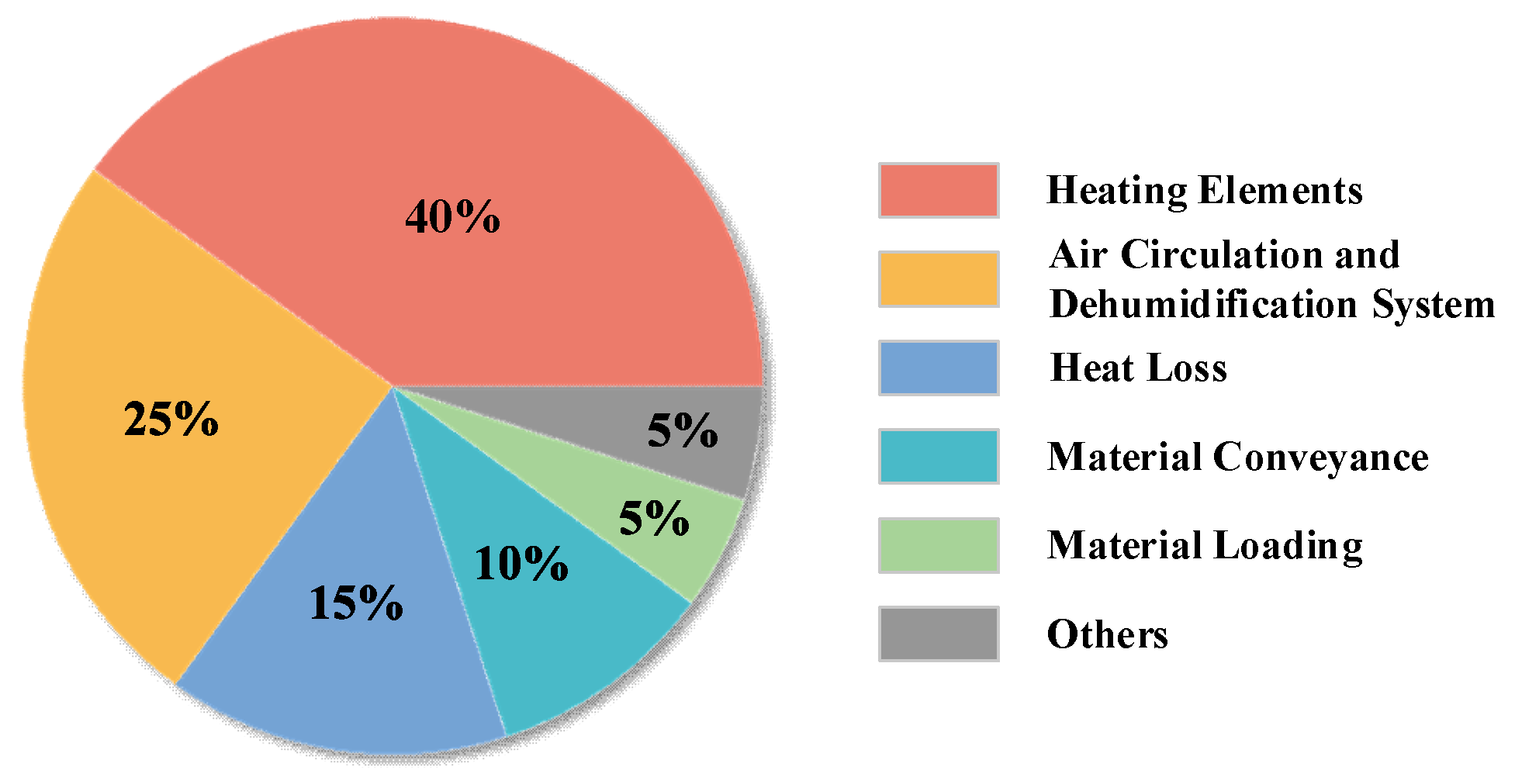
The entire drying process consists of three main energy-intensive stages: the heating phase, the constant-rate drying phase, and the falling-rate dehydration phase. The heating system requires continuous thermal input, while energy is also consumed by the moisture removal system (responsible for exhausting humid air) and the dehumidification system (which reduces the moisture content of the air). The approximate energy distribution in selected drying equipment is illustrated in Figure 2 [23]; material properties, the chosen drying technology, and environmental conditions all influence the drying process.
Based on the above analysis, vegetable drying equipment experiences significant energy losses during operation, which not only waste energy but also negatively impact operational efficiency and long-term performance. Energy losses in vegetable drying equipment typically manifest as excessive temperature fluctuations and heat dissipation, directly resulting in reduced efficiency of the heating and evaporation systems. Furthermore, issues such as friction, vibration, and poor heat conduction increase energy consumption and shorten equipment lifespan. Inaccurate temperature control and ineffective moisture regulation also compromise product drying quality, thereby reducing overall process efficiency. Therefore, to improve equipment performance, enhance energy utilization efficiency, and increase economic benefits, it is essential to strengthen the research and application of energy-saving technologies to reduce unnecessary energy losses. Different drying technologies have their own advantages and disadvantages; thus, it is necessary to optimize the balance between energy consumption and product quality while enhancing system intelligence.

2.2. Characteristics of Vegetable Cold-Chain Equipment

With the acceleration of global economic integration, China’s food trade volume has grown continuously. Cold-chain logistics, serving as a vital link between production and consumption, plays an indispensable role in ensuring food safety, reducing post-harvest losses, and enhancing economic efficiency.

2.2.1. Composition of Vegetable Cold-Chain Equipment

The standard cold-chain process comprises five stages: pre-cooling, freezing/refrigeration, refrigerated transport, refrigerated sales, and end-of-chain storage. This study focuses exclusively on the refrigerated transport segment. Common equipment for refrigerated transport includes insulated boxes, refrigerated trucks, and refrigerated containers, the latter doubling as temporary storage units. Depending on the mode of conveyance, refrigerated transport can be classified into road, rail, marine, and air transport, with road transport accounting for the largest share.
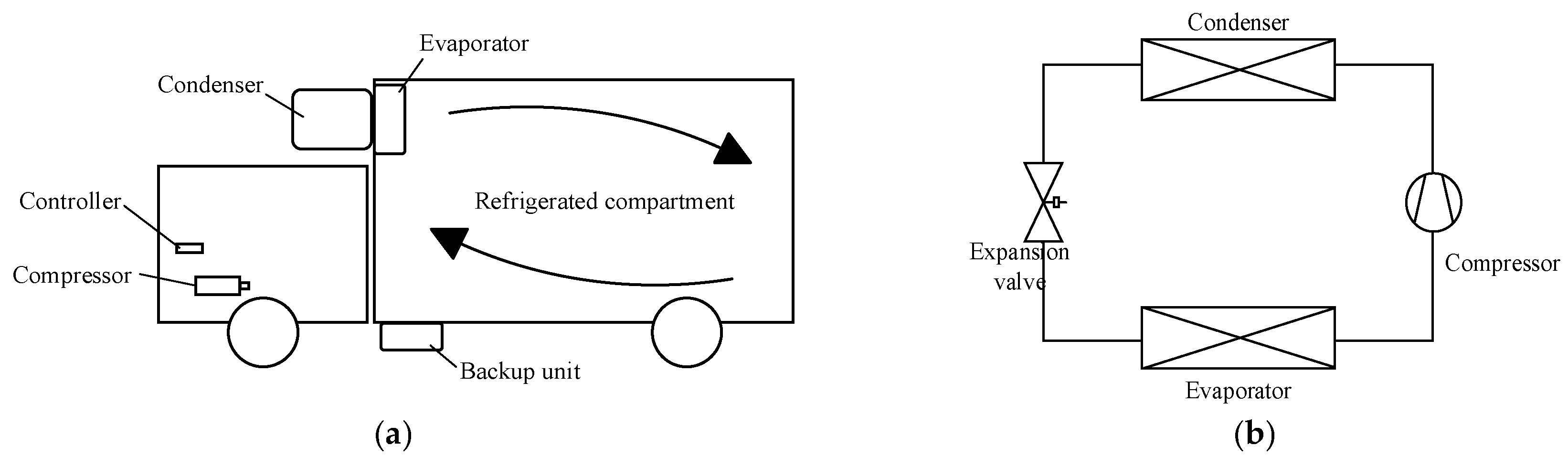
Refrigerated trucks are further categorized by their cooling systems into mechanical, cold-plate, liquid-nitrogen, and dry-ice types. Among these, mechanical refrigerated trucks are the most prevalent in the market. Their core refrigeration module typically employs a single-stage vapor-compression cycle, with its system configuration and a schematic of the working principle shown in Figure 3a and Figure 3b, respectively.
The cycle consists of four primary components—the compressor, condenser, expansion valve, and evaporator—and the models developed for these components can be adapted to other refrigeration cycles as well.

2.2.2. Energy-Consumption Analysis of Vegetable Cold-Chain Equipment

According to the principles of the vapor-compression cycle, the principal energy-consuming components are the compressor, the evaporator (for interior heat exchange), and the condenser (for exterior heat exchange). Among these, the compressor accounts for the largest proportion of total system power consumption, since the cooling capacity is generated primarily by the work it performs on the refrigerant. The evaporator and condenser also influence overall power draw and cooling output, while the type of refrigerant used and its charge mass within the compressor further affect both energy consumption and cooling capacity.
The system’s simplified energy-consumption model can be expressed as:
P total = P com + P e
where P total is the total power consumption, P c o m is the compressor power, and P e is the combined power of the evaporator and condenser fans. Moreover, cooling capacity is generated primarily by the compressor’s conversion of mechanical energy into the refrigerant’s chemical potential energy.
In refrigerated transport, the energy usage of key components—compressor, evaporator, condenser, and expansion valve—directly determines cooling performance and overall energy efficiency. As the system’s core, the compressor’s share of power consumption is substantial, and cooling capacity hinges on its mechanical compression of the refrigerant. Moreover, parameters such as refrigerant selection, refrigerant charge mass, and operating frequency significantly influence the system’s final energy consumption and cooling output.
For highly temperature-sensitive products like fruits and vegetables, maintaining a uniform temperature within the compartment is crucial. Uneven temperature distribution can lead to localized hotspots or overcooling, compromising product quality and forcing the refrigeration system to expend additional energy to correct load imbalances, thereby reducing overall efficiency.

3. Research on the Evaluation Index System of Vegetable Drying Cold-Chain Equipment

Establishing a scientifically sound and rational evaluation-index system is a key prerequisite for assessing the performance of vegetable drying cold-chain equipment. Since this type of equipment involves multiple stages and its drying performance and energy consumption are influenced by various factors, it is particularly important to develop a comprehensive and precise evaluation system. Below, we analyze the main factors affecting the equipment’s drying performance and energy consumption, judiciously select key evaluation indicators, and ultimately construct an integrated performance-evaluation system to provide theoretical support for optimizing equipment design and enhancing both energy efficiency and drying quality.

3.1. Analysis of Drying Evaluation Indicators

The quality of dried vegetables is evaluated from three main aspects: appearance quality, sensory quality, and nutritional quality.
Appearance quality is a critical factor influencing consumer acceptance, with color being one of the primary indicators for assessing dried products [24]. The chromaticity value is calculated as follows:
Δ E = L L 0 2 + a a 0 2 + b b 0 2
In the formula, L represents the lightness of the sample; a is redness (positive values indicate red, negative values indicate green); and b is yellowness (positive values indicate yellow, negative values indicate blue).
Sensory quality is analyzed in terms of textural properties, taste profiles, and overall sensory evaluation scores. Textural properties are assessed by parameters such as bulk density, microstructure, shrinkage ratio, hardness, elasticity, adhesiveness, chewiness, water activity, and rehydration ratio. Bulk density is defined as:
ρ b = m V b
In this equation, ρ b is the bulk density ( g / c m 3 ), m is the sample mass ( g ), and V b is the total volume ( c m 3 ). Dried products with high bulk density are generally considered of lower quality, whereas those with high porosity and low bulk density are deemed superior in quality. The shrinkage ratio is defined as:
S = V 0 V f V 0 × 100 %
In this formula, S is the shrinkage ratio, V 0 is the initial sample volume, and V f is the sample volume after drying. Plant nutrients contract proportionally with water loss during drying. At low drying rates, samples shrink and become denser; at higher rates, surface hardening occurs, which partially inhibits shrinkage. From a textural standpoint, consumers prefer dried fruits and vegetables with a crisp texture. Water activity is defined as:
a w = P / P 0 = E R H
Water activity ( a w ) is the ratio of the vapor pressure of water in the food ( P ) to that of pure water ( P 0 ) under equilibrium with the surrounding atmosphere. Here, a w is water activity, P is the water vapor pressure over the sample, P 0 is the vapor pressure of pure water, and E R H is the equilibrium relative humidity (the atmospheric relative humidity at which the material neither gains nor loses moisture). The calculation of rehydration capacity ( R C ) is defined as:
R C = M r M d M f M d × 100 %
In this equation, M r is the mass of the rehydrated sample ( g ), M d is the mass of the dried sample ( g ), and M f is the mass of the fresh sample ( g ). Generally, higher temperatures accelerate the rehydration rate, especially in the initial stage.
Taste attributes such as sourness, saltiness, umami, bitterness, astringency, and sweetness are quantified. The overall sensory evaluation focuses on color, odor, shape, and mouthfeel of the dried vegetables.
Nutritional quality analysis includes measurements of antioxidant activity, total phenolic content, vitamin C, total sugars, reducing sugars, protein content, and total amino acid content. Antioxidant activity assays in drying studies help to evaluate the effects of temperature, drying methods, and treatments on the retention of antioxidant capacity. Phenolic compounds serve as natural antioxidants; higher drying temperatures release more bound phenolics from the tissue, thereby intensifying this effect. Vitamin C is an important indicator of vegetable quality, and its degradation is attributed to prolonged exposure to high temperatures and extended storage. Total sugar, which encompasses all soluble carbohydrates, directly determines a product’s overall sweetness and caloric value. In contrast, reducing sugars (e.g., glucose and fructose), characterized by their free aldehyde or ketone groups that confer reducing capacity, act as the key chemical substrates driving the Maillard reaction, thereby governing the browning intensity and flavor generation in dried vegetables.
Based on the foregoing analyses, the drying evaluation indicators are summarized in Table 1.

3.2. Analysis of Energy Consumption Evaluation Metrics

3.2.1. Energy Consumption of Vegetable Drying Equipment

Based on the characteristics of the aforementioned drying technologies, both drying efficiency and the quality of the final product are critically important. For example, selecting an appropriate temperature can accelerate the drying process and reduce drying time, while optimizing the thickness of vegetable slices can enhance both the economic performance and the quality of the dried product.
According to the first law of thermodynamics, the input energy rate of a vegetable dryer comprises two components: the heat transfer rates of the incoming air and that of the material. In contrast, the output energy rate consists of four components: the heat carried away by the exhaust air, the heat carried by the dried material, the energy associated with moisture evaporation, and the energy lost through the dryer walls.
E ˙ a , i n E ˙ a , o u t = Q ˙ m , h e a t Q ˙ e v a p Q ˙ l o s s
Let E ˙ a , i n denote the energy rate of the incoming air (kJ/s), E ˙ a , o u t the energy rate of the exhaust air, Q ˙ m , h e a t the heat transfer rate of the material (kJ/s), Q ˙ e v a p the heat transfer rate associated with moisture evaporation, and Q ˙ l o s s the heat transfer rate lost through the dryer walls.
Based on ambient temperature, the thermal energy rates carried by the air entering and leaving the drying chamber can be expressed as follows:
E ˙ a , i n = m ˙ a , i n c d a + c v a p ω a , i n T a , i n T 0
E ˙ a , i n = m ˙ a , i n c d a + c v a p ω a , o u t T a , o u t T 0
where m ˙ a , i n is the mass flow rate of the incoming air, c d a the specific heat capacity of dry air (kJ/(kg K)), c v a p the specific heat capacity of water vapor, ω a , i n and ω a , o u t the absolute humidity of the inlet and outlet air streams (kgwater/kgdry air), and T a , i n (°C)and T a , o u t (°C) their respective temperatures, T 0 the air temperature before increasing (°C).
Based on the above analysis, the energy consumption evaluation metrics for vegetable drying equipment are summarized in Table 2.

3.2.2. Energy Consumption of Vegetable Cold Chain Equipment

The internal environment of a refrigerated truck involves complex nonlinear interactions in both thermodynamics and fluid aerodynamics. To make the model tractable, the following simplifying assumptions are adopted. Applying the first law of thermodynamics (energy balance principle), a simplified refrigeration equation is derived to describe the heat exchange within the compartment. The heat-exchange balance over a unit time interval is given by:
d T d t × c p × ρ × V = Q 1 + Q 2 + Q 3 Q 0
where Q 0 is the cooling capacity of the refrigerated truck’s air-conditioning unit (W), Q 1 is the heat ingress through the truck body (W), Q 2 is the heat ingress due to air and water–vapor leakage, Q 3 and is the respiration heat of the loaded cargo (W). The latter depends on the unit respiration rate and total cargo mass and is treated as a constant during simulation. c p is the specific heat capacity of air at constant pressure, set to 1004 (J/(kg K)) under typical conditions. V is the compartment volume (m3), and ρ is the air density (kg/m3), fixed at 1.29 kg/m3 for simplicity. Here, T denotes the compartment temperature during cooling (°C), and t represents the corresponding time (s). The refrigerated air-conditioning system model comprises four main components: compressor, condenser, evaporator, and expansion valve. The compressor’s power consumption and cooling capacity are given by:
Q 1 = F p f , t e , t c
Here, Q 1 denotes the compressor’s cooling capacity (W), f is the compressor operating frequency (Hz), t e is the refrigerant’s evaporation temperature measured at the compressor outlet (°C), and t c is the condensation temperature at the condenser–fan side (°C).
During cold-chain transportation, energy consumption mainly arises from vehicle fuel usage and the additional load imposed on the refrigeration system while the vehicle is in motion. Frequent start–stop cycles, traffic congestion, and extended transport distances significantly increase engine load and fuel consumption, and they also force the refrigeration system to maintain low-temperature operation for longer durations, further exacerbating energy usage.
Based on the foregoing analysis, the energy consumption evaluation indicators for vegetable cold-chain equipment are summarized in Table 3.

4. Fusion Analysis Based on Boosting and Multiple Kernel Functions

4.1. Evaluation Method

In recent years, the Online Sequential Extreme Learning Machine (OSELM) has quickly become a popular approach in the field of data evaluation. Derived from the Extreme Learning Machine (ELM), OSELM omits the incremental learning formula for new samples, thereby significantly improving both training speed and model generalization ability [25,26]. OSELM can rapidly solve for weights, avoiding the slow convergence issues inherent in traditional backpropagation-based gradient updates in neural networks. Moreover, owing to its simplified parameter configuration, OSELM exhibits greater adaptability in dynamic data environments. However, determining the optimal number of hidden layers remains a major challenge for OSELM.
To address this issue, the Kernel Extreme Learning Machine (KELM) was introduced. By employing kernel functions to map input data into a high-dimensional feature space, it more effectively captures the nonlinear relationships between inputs and outputs. Commonly used kernel functions include:
Linear kernel: Computes the inner product between input samples in the original feature space. Equivalent to no kernel, it models linear relationships between data points:
K x i , x j = x i T x j
Polynomial kernel: Calculates similarity based on a polynomial expansion of input samples, introducing nonlinearity by accounting for higher-order interactions among features:
K x i , x j = a x i T x j + b p
Gaussian (RBF) kernel: Measures similarity using a radial basis function, which applies an exponentially decaying function of the Euclidean distance between samples:
K x i , x j = exp x i x j 2 2 σ 2
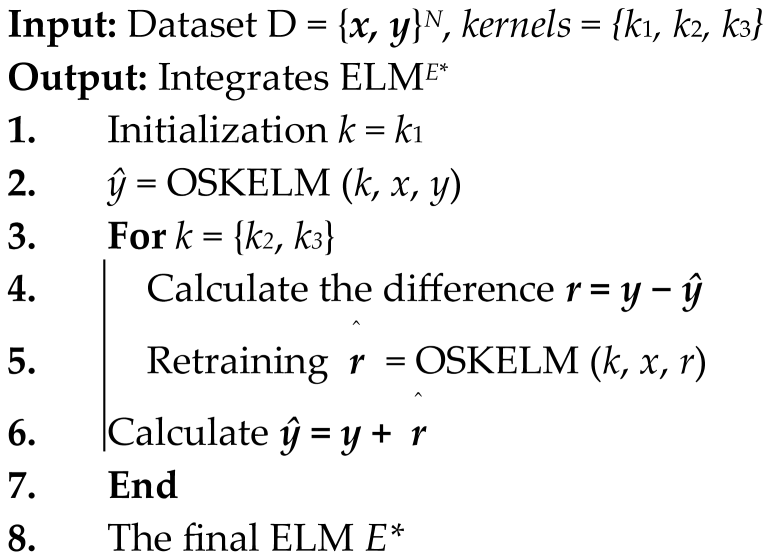
Building on this, to further enhance model performance, we adopt ensemble learning principles combined with Boosting techniques and propose a fusion method based on multiple kernel functions. This method first constructs an initial model using OSELM to obtain predictions; it then computes the discrepancy between these predictions and the true values, using this error as the training target for the subsequent model iteration. After multiple iterations—typically employing three different or identical kernel functions—a stable and highly generalizable evaluation model is obtained. This fusion approach effectively overcomes the limitations of individual kernel functions in nonlinear modeling, thereby enhancing the overall robustness and accuracy of the model.
Not only does this method improve the training efficiency and predictive accuracy of the online learning algorithm, but the synergy between multiple kernel functions and Boosting also mitigates instability issues caused by inappropriate hidden layer sizing.
The pseudocode for the Boosting-OSKELM algorithm is presented below. In practice, the same kernel function may be reused—for example, applying the Gaussian kernel multiple times. Taking into account gradient explosion and performance precision, no more than three kernel functions are used in this study.
Pseudocode of boosting-OSKELM
Processes 13 03810 i001

4.2. Case Study

In the experimental section, this study constructed a dataset based on actual batch data from a vegetable-drying cold-chain equipment factory, comprising 50 samples, each described by 72 evaluation metrics. Through preprocessing operations—such as missing-value imputation and outlier removal—the data quality was ensured to be stable and reliable. Each sample was paired with expert evaluation results, serving as supervisory information for the model.
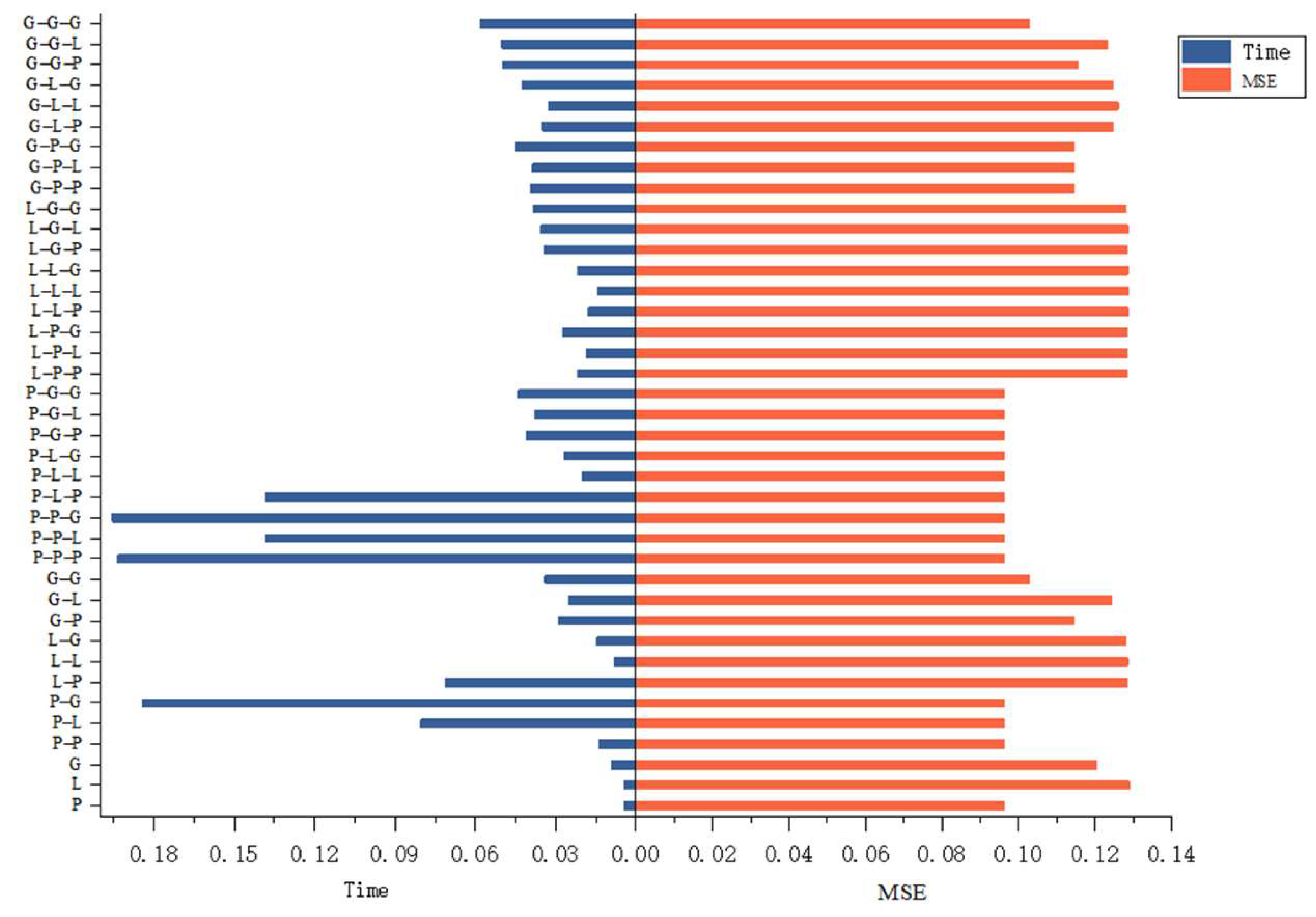
Table 4 presents the parameters of the Boosting-OSKELM model, while Figure 4 displays the computational results under different kernel function combinations, including the mean squared error (MSE) and runtime (in seconds), to evaluate the model’s performance and computational overhead.
This study visualized the performance of the boosting-OSKELM model under different mode combinations (P, L, G, and their sequential variants) using bidirectional bar charts. The experiment compared two core metrics—mean squared error (MSE) and runtime—under fixed parameter settings. The results demonstrate that the single P-mode achieved optimal performance in both metrics, with an MSE as low as 0.0962 and a runtime of only 0.0044 s, significantly outperforming the L-mode, G-mode, and all combined forms. Although repeated P-mode combinations (e.g., P–P) led to a slight reduction in MSE, they provided no practical performance improvement. This experiment offers quantitative support for mode selection in the boosting-OSKELM model, confirming that the single P-mode is the optimal solution for balancing prediction accuracy and computational efficiency.
This evaluation system helps manufacturers understand the performance characteristics of various vegetable-drying cold-chain devices, enabling them to identify each device’s strengths, weaknesses, and areas for improvement. The system can continuously update the model with new data without requiring extensive retraining for every update, thereby avoiding the resource-intensive process of involving multiple experts in model retraining.
Future research should focus on combinatorial optimization of different drying processes, using experimental data and model analysis to further investigate the effects of process parameters on drying performance and energy consumption. This will drive the development of vegetable-drying cold-chain equipment toward greater efficiency, intelligence, and environmental sustainability. For example, compound drying methods, such as hot air-microwave, hot air-infrared combined drying, and freeze-drying-microwave vacuum drying show great potential. These methods not only shorten drying time and reduce energy consumption but also largely preserve the nutritional content and flavor of vegetables, meeting consumer demand for high-quality products.

5. Conclusions

This study analyzed the characteristics of vegetable-drying cold-chain equipment and established a scientific performance evaluation framework, addressing current deficiencies in energy efficiency, intelligence, and standardization. By examining the advantages, limitations, and applicable scenarios of different drying technologies, an intelligent evaluation system comprising 72 indicators was developed. A fusion method based on multi-kernel function boosting—Boosting-OSKELM—was introduced with the objective of combining multiple weak learners into a single strong learner within an acceptable time delay. This methodology facilitates the selection of appropriate drying techniques and cold-chain equipment, thereby enabling comparability across different methods and devices.
Based on the evaluation indicators of this study, combined drying technologies are highly recommended for industrial-scale vegetable cold-chain applications. Specifically, combined microwave and vacuum drying (MD-VD) is particularly suitable for high-value, heat-sensitive vegetables, as it enables rapid, low-temperature dehydration while maximizing nutrient and texture retention. Additionally, technologies such as heat pump drying (HPD) and infrared drying (IR) show significant potential for leafy and root vegetables due to their high efficiency and quality preservation capabilities. To form a complete low-carbon chain, it is advised to integrate drying equipment featuring heat recovery systems with refrigeration storage facilities that offer precise environmental control and real-time monitoring.
In summary, the established framework is of paramount importance for improving efficiency, reducing energy consumption, extending equipment lifespan, and promoting the industry’s green transformation.

Author Contributions

M.X. (Minglu Xie): Funding acquisition, Writing—review & editing. X.L.: Investigation, Writing—review & editing. P.W.: Investigation, Validation. M.X. (Man Xu): Writing—review & editing. X.W.: Writing—original draft, methodology. All authors have read and agreed to the published version of the manuscript.

Funding

The authors sincerely appreciate the careful and precise reviews by the anonymous reviewers and editors. This work was supported by the open project of Sichuan province drying & cold-chain equipment engineering technology research center (No. 2024HGLL002).

Data Availability Statement

The raw data supporting the conclusions of this article will be made available by the authors upon request.

Conflicts of Interest

We declare that we do not have any commercial or associative interests that represent conflicts of interest in connection with the work submitted.

References

  1. Guo, L. Application of Vacuum Freeze-Drying Technology in Agricultural Product Processing in China. Mod. Agric. Sci. Technol. 2020, 219–220. [Google Scholar] [CrossRef]
  2. Chen, L.M.; Jin, X.; Bi, J.F.; Hu, L.; Qiu, Y.; Lu, J. Effect of Ultrasonic—Assisted Sugar Osmotic Pretreatment on Quality and Hygroscopicity of Vacuum Freeze—Dried Peach Chips. Food Sci. 2022, 43, 117–123. [Google Scholar] [CrossRef]
  3. Yabin, D.; Ming, X.; Shelie, S.M. Overview of cold chain development in China and methods of studying its environmental impacts. Environ. Res. Commun. 2020, 2, 122002. [Google Scholar] [CrossRef]
  4. Azwin, K.; Hasanuzzaman, M.; Rahim, N.A. Global advancement of solar drying technologies and its future prospects: A review. Sol. Energy 2021, 221, 559–582. [Google Scholar] [CrossRef]
  5. Mujumdar, A.S. Handbook of Industrial Drying, 4th ed.; CRC Press: Boca Raton, FL, USA, 2014. [Google Scholar] [CrossRef]
  6. Bon, J.; Váquiro, H.; Benedito, J.; Telis-Romero, J. Thermophysical properties of mango pulp (Mangifera indica L. cv. Tommy Atkins). J. Food Eng. 2010, 97, 563–568. [Google Scholar] [CrossRef]
  7. Maskan, M. Drying, shrinkage and rehydration characteristics of kiwifruits during hot air and microwave drying. J. Food Eng. 2001, 48, 177–182. [Google Scholar] [CrossRef]
  8. Zhou, X.; Ramaswamy, H.; Qu, Y.; Xu, R.; Wang, S. Combined radio frequency-vacuum and hot air drying of kiwifruits: Effect on drying uniformity, energy efficiency and product quality. Innov. Food Sci. Emerg. Technol. 2019, 56, 102182. [Google Scholar] [CrossRef]
  9. Ásványi, B.; Sik, B.; Lakatos, E.; Schott, Z.; Székelyhidi, R. Assessing the texture profile and optimizing the temperature and soaking time for the rehydration of hot air-dried Auricularia auricula-judae mushrooms. Discov. Food 2025, 5, 299. [Google Scholar] [CrossRef]
  10. Li, L.; Sun, J.; Sheng, J.F.; Li, J.; Li, C.; Zheng, F.; Feng, D.; You, X. Heat Pump Drying Characteristics and Mathematical Model of Yam. Mod. Food Sci. Technol. 2014, 30, 212–217. [Google Scholar] [CrossRef]
  11. Zhang, T.; Zhao, X.; Bo, J.; Zhu, W.; Chen, P.; Jiang, M.; Chen, G. Comprehensive analysis of changes in the drying characteristics, quality, and metabolome of peanuts by different drying methods. Food Res. Int. 2025, 221, 117625. [Google Scholar] [CrossRef]
  12. Adak, N.; Heybeli, N.; Ertekin, C. Infrared drying of strawberry. Food Chem. 2017, 219, 109–116. [Google Scholar] [CrossRef]
  13. Bingol, G.; Wang, B.; Zhang, A.; Pan, Z.; McHugh, T.H. Comparison of water and infrared blanching methods for processing performance and final product quality of French fries. J. Food Eng. 2014, 121, 135–142. [Google Scholar] [CrossRef]
  14. Marques, L.G.; Silveira, A.M.; Freire, J.T. Freeze-drying characteristics of tropical fruits. Dry. Technol. 2006, 24, 457–463. [Google Scholar] [CrossRef]
  15. González-Cavieres, L.; Pérez-Won, M.; Tabilo-Munizaga, G.; Jara-Quijada, E.; Díaz-Álvarez, R.; Lemus-Mondaca, R. Advances in vacuum microwave drying (VMD) systems for food products. Trends Food Sci. Technol. 2021, 116, 626–638. [Google Scholar] [CrossRef]
  16. Wang, Q.F.; Li, S.; Han, X.; Ni, Y.; Zhao, D.; Hao, J. Quality evaluation and drying kinetics of shitake mushrooms dried by hot air, infrared and intermittent microwave-assisted drying methods. LWT Food Sci. Technol. 2019, 107, 236–242. [Google Scholar] [CrossRef]
  17. Yang, Z.; Li, H.; Xu, Y.; Liu, Y.; Kan, H.; Fan, F. Vacuum impregnation and drying of iron-fortified water chestnuts. J. Food Process. Preserv. 2019, 43, e14260. [Google Scholar] [CrossRef]
  18. Mu, Y.; Gao, W.; Lv, S.; Zhu, T.; Zhao, C. Enhanced quality and optimized volatile profile of Jerusalem artichoke chips: A combined approach of pretreatment optimization and hybrid vacuum freeze-hot air drying. J. Agric. Food Res. 2025, 22, 102121. [Google Scholar] [CrossRef]
  19. Ai, Z.; Xie, Y.; Li, X.; Zhu, G.; Peng, Z.; Liu, Y.; Mowafy, S.; Guo, J. Mechanism of freezing treatment to improve the efficiency of hot air impingement drying of steamed Cistanche deserticola and the quality attribute of the dried product. Ind. Crops Prod. 2023, 195, 116472. [Google Scholar] [CrossRef]
  20. Lei, Y.; Xu, Y.; Meng, P.; Tu, D.; Zhao, Y.; Fu, L.; Tian, Y. Impact of combined ultrasonic and microwave vacuum drying on physicochemical properties and structural characteristics of polysaccharides from shiitake mushrooms (Lentinus edodes). Ultrason. Sonochem. 2025, 115, 107283. [Google Scholar] [CrossRef]
  21. Datta, A.K.; Ni, H. Infrared and hot-air-assisted microwave heating of foods for control of surface moisture. J. Food Eng. 2002, 51, 355–364. [Google Scholar] [CrossRef]
  22. Jiang, N.; Liu, C.; Li, D.; Zhang, Z.; Liu, C.; Wang, D.; Niu, L.; Zhang, M. Evaluation of freeze drying combined with microwave vacuum drying for functional okra snacks: Antioxidant properties, sensory quality, and energy consumption. LWT Food Sci. Technol. 2017, 82, 216–226. [Google Scholar] [CrossRef]
  23. Mondal, H.T.; Sarker, S.H. Comprehensive energy analysis and environmental sustainability of industrial grain drying. Renew. Sustain. Energy Rev. 2024, 199, 114442. [Google Scholar] [CrossRef]
  24. Deng, Y.Y.; Tang, Q.; Zhang, R.F.; Zhang, Y.; Wei, Z.; Liu, L.; Ma, Y.; Zhang, M. Effects of Different Drying Methods on the Nutrition and Physical Properties of Momordica Charania. Sci. Agric. Sin. 2017, 50, 362–371. [Google Scholar] [CrossRef]
  25. Zhou, X.; Huang, J.Q.; Lu, F.; Zhou, W.; Liu, P. A Novel Compound Fault-tolerant Method Based on Online Sequential Extreme Learning Machine with Cycle Reservoir for Turbofan Engine Direct Thrust Control. Aerosp. Sci. Technol. 2023, 132, 108059. [Google Scholar] [CrossRef]
  26. Montazeri-Gh, M.; Nekoonam, A. Gas Path Component Fault Diagnosis of an Industrial Gas Turbine Under Different Load Condition Using Online Sequential Extreme Learning Machine. Eng. Fail. Anal. 2022, 135, 106115. [Google Scholar] [CrossRef]
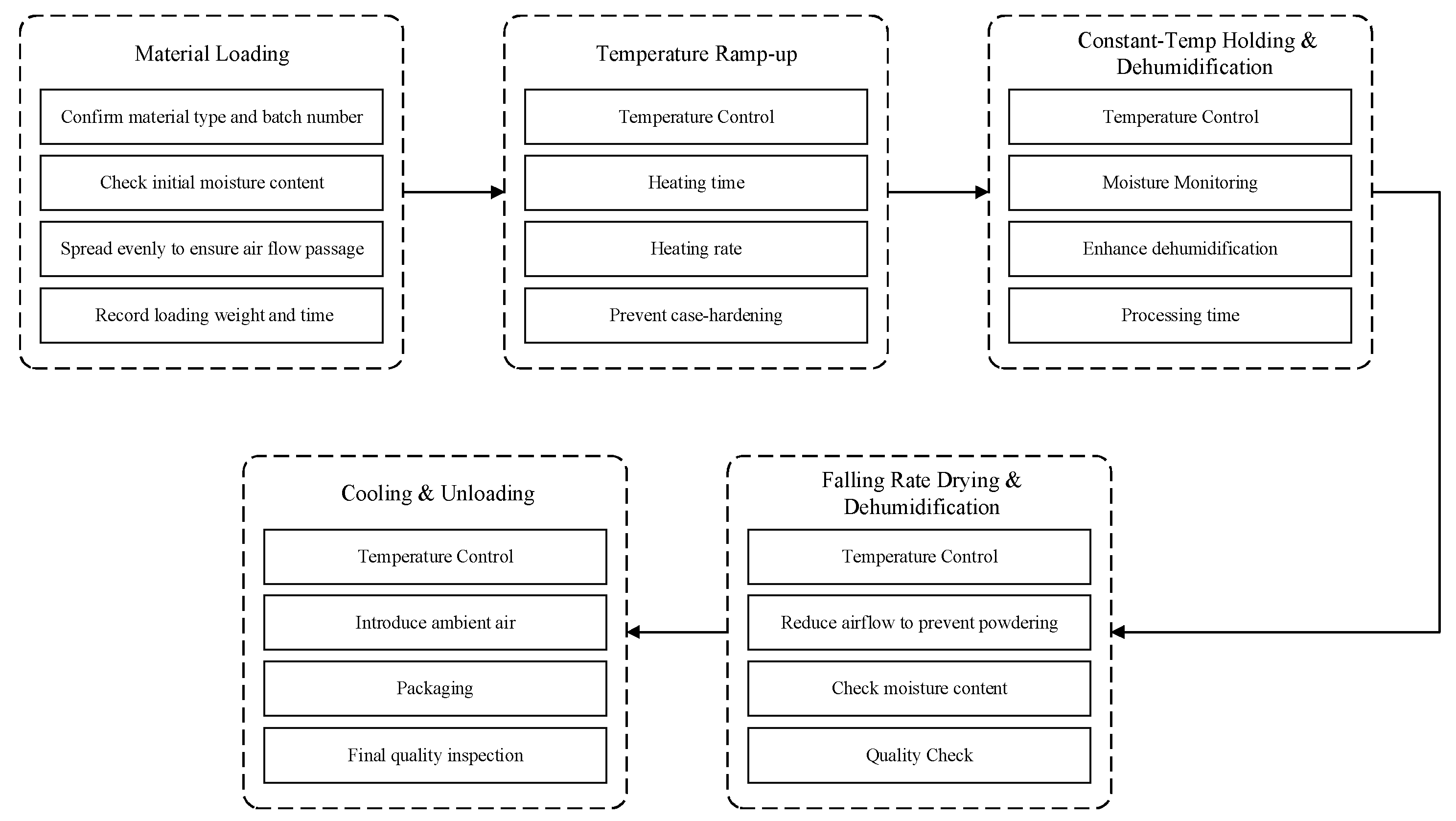
Figure 1. Process flow of vegetable drying.
Processes 13 03810 g001
Figure 2. Approximate energy distribution in selected drying equipment.
Processes 13 03810 g002
Figure 3. Composition of vegetable cold-chain equipment. (a) Refrigeration system configuration of the cold storage unit. (b) Schematic of the single-stage compression refrigeration cycle.
Processes 13 03810 g003
Figure 4. Computational results of the boosting-OSKELM model.
Processes 13 03810 g004
Table 1. Specific evaluation indicators for vegetable drying equipment.
No.Classification LevelMain CategorySpecific Indicator
1Appearance qualityChromaticity valueBrightness value
2Redness
3Yellowness
4Sensory qualityTextural characteristicsApparent density
5Microstructure
6Shrinkage rate
7Hardness;
8Elasticity
9Adhesiveness
10Chewiness
11Water activity
12Rehydration ratio
13Taste valuesSourness
14Saltiness
15Umami
16Bitterness
17Astringency
18Sweetness
19Sensory evaluation indicatorsColor
20Odor
21Shape
22Mouthfeel
23Nutritional qualityBioactive componentsAntioxidant activity
24Vitamin C content
25Total phenolic content
26CarbohydratesTotal sugar content
27Reducing sugar content
28Proteins and amino acidsProtein content
29Total amino acid content
Table 2. Energy-Consumption Evaluation Indicators for Vegetable Drying Equipment.
No.Classification LevelMain CategorySpecific Indicator
1Energy consumption CharacteristicsInput energyInlet air heat transfer rate
2Inlet material heat transfer rate
3Output energyOutlet air heat transfer rate
4Material heat transfer rate
5Moisture evaporation energy
6Dryer wall heat loss
7System efficiencyThermal efficiency
8Energy consumption per unit moisture evaporation
9Performance coefficient
10Operating parametersTemperatureSet temperature
11Actual temperature
12HumidityDesign humidity
13Actual humidity
14Air velocitySet air velocity
15Actual air velocity
16MaterialSlice thickness
17TimeDrying time
18Environmental impactEnvironmental conditionsAmbient humidity
19Ambient temperature
20Carbon emissionsCarbon emissions per unit output
21Energy typeElectric energy
22Gas
23Other energy sources
Table 3. Energy consumption evaluation indicators for vegetable cold-chain equipment.
No.Classification LevelMain CategorySpecific Indicator
1Storage energy consumptionEnergy-consumption characteristicsCooling capacity
2Heat ingress into the cargo compartment
3Heat ingress due to air and water-vapor leakage
4System-component performanceCompressor operating frequency
5Evaporator-fan speed
6Condenser-fan speed
7Expansion-valve flow coefficient
8Temperature parametersCondensing temperature
9Evaporating temperature
10Refrigerant characteristicsType of refrigerant
11Refrigerant charge amount
12Environmental parametersAmbient temperature
13Ambient humidity
14Carbon emissions
15Transportation energy consumptionEnergy consumption during transportTransport distance
16Cargo mass
17Loading/unloading energy consumptionLoading method
18Loading/unloading duration
19Other parametersAmbient temperature
20Vehicle insulation performance
Table 4. The parameters of the boosting-OSKELM model.
No.Sequences(a, b, p, σ)Time (s)MSE
1P(3, 1, 3, 10)0.00440.0962
2L(1, 1, 1, 10)0.00430.1289
3G(1, 1, 1, 100)0.00930.1203
4P–P(3, 1, 3, 10)0.01370.0962
5P–L(3, 1, 3, 10)0.08020.0962
6P–G(3, 1, 3, 100)0.18430.0962
7L–P(3, 1, 3, 10)0.07110.1284
8L–L(1, 1, 1, 10)0.00810.1285
9L–G(1, 1, 1, 100)0.01460.1279
10G–P(3, 1, 3, 100)0.02880.1145
11G–L(1, 1, 1, 10)0.02520.1244
12G–G(1, 1, 1, 50)0.03380.1028
13P–P–P(3, 1, 3, 10)0.19320.0962
14P–P–L(3, 1, 3, 10)0.13830.0962
15P–P–G(3, 1, 3, 100)0.19530.0962
16P–L–P(3, 1, 3, 10)0.13820.0962
17P–L–L(3, 1, 3, 10)0.02000.0962
18P–L–G(3, 1, 3, 100)0.02660.0962
19P–G–P(3, 1, 3, 50)0.04090.0962
20P–G–L(3, 1, 3, 50)0.03770.0962
21P–G–G(3, 1, 3, 100)0.04370.0962
22L–P–P(3, 1, 3, 10)0.02160.1284
23L–P–L(3, 1, 3, 10)0.01850.1284
24L–P–G(3, 1, 3, 100)0.02730.1284
25L–L–P(3, 1, 1, 10)0.01790.1285
26L–L–L(1, 1, 1, 10)0.01410.1285
27L–L–G(1, 1, 1, 10)0.02160.1285
28L–G–P(3, 1, 3, 100)0.03410.1284
29L–G–L(1, 1, 1, 50)0.03560.1285
30L–G–G(1, 1, 1, 100)0.03810.1279
31G–P–P(3, 1, 3, 100)0.03940.1145
32G–P–L(3, 1, 3, 100)0.03860.1145
33G–P–G(3, 1, 3, 100)0.04520.1145
34G–L–P(3, 1, 3, 10)0.03500.1248
35G–L–L(1, 1, 1, 10)0.03270.1259
36G–L–G(1, 1, 1, 10)0.04260.1246
37G–G–P(3, 1, 3, 10)0.04950.1154
38G–G–L(1, 1, 1, 10)0.05000.1232
39G–G–G(1, 1, 1, 50)0.05790.1028
Note: In the “Sequences” column, P, L, and G denote the polynomial, linear, and Gaussian kernel functions, respectively; the parameters a, b, p, and σ represent the model’s hyperparameter settings.
Disclaimer/Publisher’s Note: The statements, opinions and data contained in all publications are solely those of the individual author(s) and contributor(s) and not of MDPI and/or the editor(s). MDPI and/or the editor(s) disclaim responsibility for any injury to people or property resulting from any ideas, methods, instructions or products referred to in the content.