Article

Active–Reactive Coordination Optimal Dispatch of Active Distribution Network Considering Grid Balance Degree

1
Economic and Technological Research Institute of State Grid Anhui Electric Power Co., Ltd., Hefei 230022, China
2
Anhui Provincial Key Laboratory of New Energy Utilization and Energy Saving (Hefei University of Technology), Hefei 230009, China
*
Author to whom correspondence should be addressed.
Processes 2025, 13(11), 3724; https://doi.org/10.3390/pr13113724
Submission received: 14 October 2025 / Revised: 6 November 2025 / Accepted: 10 November 2025 / Published: 18 November 2025
(This article belongs to the Section Energy Systems)

Abstract

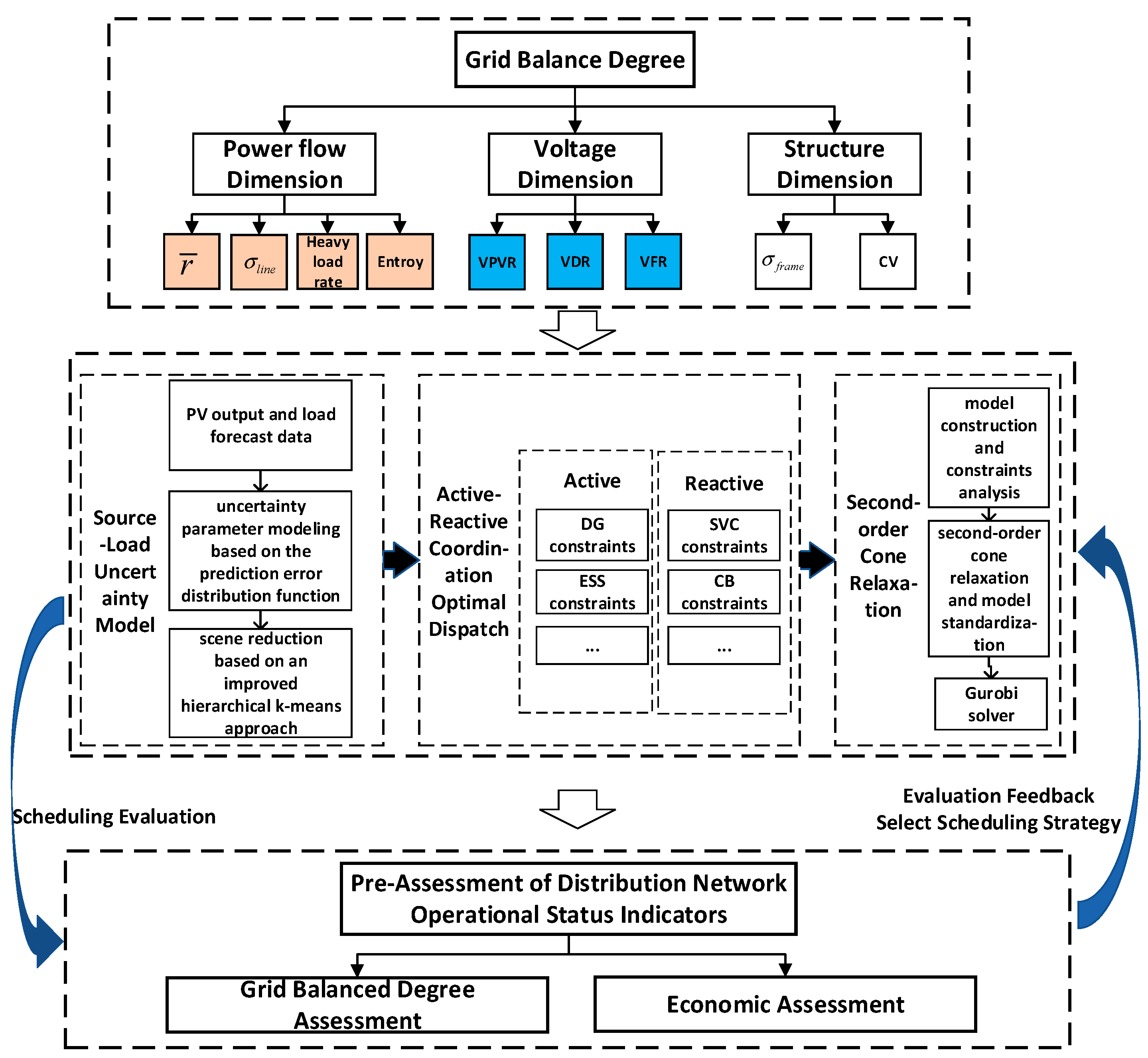
To address the impact of source-load uncertainty on voltage security and power flow distribution, this study proposes an active distribution network (ADN) active–reactive power coordinated optimal dispatch strategy that incorporates the grid balance degree (GBD). First, we analyzed GBD by defining it across three key dimensions: power flow, voltage, and network structure. We combined GBD with economic indicators to establish a pre-assessment indicators system to determine grid operational status. Second, to address source-load uncertainty, a dispatch model is established, incorporating a load factor penalty term into the optimal objective. Nonlinear terms in the model are linearized for efficient solution using the Gurobi solver. Finally, GBD is adjusted through measures such as load factor penalty threshold, voltage constraint upper/lower limits, and network restructuring. The optimal dispatch strategy is selected by comparing pre-assessment indicators of operational states across different dispatch schemes. Case studies demonstrate that compared to the baseline dispatch scheme, the proposed strategy achieves a 17.4% reduction in heavy load rates, a 5.7% decrease in power flow entropy, a 5.2% reduction in voltage peak-to-valley difference rates, and a 3% decrease in network losses. Although operating costs slightly increase by 0.56%, the operation reliability of the distribution network and power quality are further optimized. This fully demonstrates the gain value of GBD optimization and provides a reference for the optimization of ADN dispatch to achieve high operational reliability.
Keywords: active distribution network (ADN); active–reactive power optimal dispatch; grid balance degree (GBD); pre-assessment of operational status active distribution network (ADN); active–reactive power optimal dispatch; grid balance degree (GBD); pre-assessment of operational status