Article

Modeling Production Decline for Fractured Wells with Non-Uniform Fracture Properties: A Semi-Analytical Approach Based on Double-Segment Fracture Model


1
College of Petroleum, China University of Petroleum-Beijing at Karamay, Karamay 834000, China
2
College of Petroleum Engineering, China University of Petroleum (Beijing), Beijing 102249, China
*
Author to whom correspondence should be addressed.
Processes 2025, 13(11), 3627; https://doi.org/10.3390/pr13113627
Submission received: 19 October 2025 / Revised: 29 October 2025 / Accepted: 7 November 2025 / Published: 9 November 2025

Abstract

Hydraulic fracturing operations can create complex fractures with spatiotemporal variations that significantly affect the transient rate performance of fractured wells. To address such heterogeneous fracture characteristics, the double-segment fracture model was adopted, allowing for distinct fracture conductivity and permeability modulus assignments to each fracture segment. A novel semi-analytical model was developed, validated, and applied to investigate the influence of non-uniform fracture properties on transient rate behavior for fractured wells. More specifically, the slab source function method and finite difference method were applied to solve the fluid flow problems in the matrix and fracture subsystems, respectively. The nonlinearity caused by the pressure-dependent fracture conductivity was tackled by the iteration method. Additionally, production type curves were constructed to assess the impact of non-uniform fracture properties on transient rate behavior. It is found that the fracture conductivity and stress-sensitivity of the fracture segment near the wellbore (FSNW) have a more significant impact on the well production rate than those of the fracture segment near the fracture tip (FSNT). As the fracture conductivity near the wellbore decreases, the production rate decreases correspondingly, whereas the fracture conductivity near the fracture tip has a negligible influence on the transient rate when fracture conductivity exceeds 10. The length of the fracture segment similarly affects the transient rate behavior, where longer high-conductivity fracture segments are associated with higher production rates. The stress-sensitivity of the FSNW greatly affects the transient rate, where higher stress-sensitivity levels result in a lower production rate. In contrast, the effect of stress-sensitivity of the FSNT on the transient rate can be neglected. The results and findings obtained in this work can help us analyze the practical production rate curves with more accurate approaches, thereby obtaining more reasonable and reliable estimation results of the fracture properties.

1. Introduction

With the decline of conventional resources, unconventional reserves, including but not limited to tight oil and shale gas, gradually become the main concerns of the global oil and gas resources, which have demonstrated huge reserves [1]. However, their economic development currently relies severely on the techniques of horizontal well drilling and hydraulic fracturing [2]. A complex fracture network can be induced during the hydraulic fracturing process, which can make the oil/gas production from such low-permeability reservoirs technically feasible and economically efficient [3,4,5]. Additionally, to quantify such properties of the generated fractures is critically important, as it forms the foundation and prerequisite for the evaluation of the hydraulic fracturing process and prediction of the well production performance. Therefore, it is of paramount importance to accurately estimate the fracture properties in an accurate and rigorous manner.
Rate transient analysis (RTA) is now a widely applied technology to evaluate hydraulic fracturing treatment and quantify fracture properties [6,7,8]. After decades of development, various RTA models have been established to account for a variety of factors, which are capable of meeting RTA demands under most scenarios. For example, the fracture conductivity was assumed as infinite or finite in previous work [9,10]. Meanwhile, models can also consider a series of phenomena affecting the fluid flow behavior within and near the fractures, including the stress-sensitivity effect caused by stress change acting on fractures [11] and the non-Darcy phenomenon resulting from a high flow rate along high-permeability fractures [12]. Such phenomena can lead to time-varying fracture conductivity, thereby affecting the rate response for the fractured wells [13]. Also, various models have been proposed to investigate the transient rate behavior under different conditions, including the Blasingame type curves [13,14], Agarwal–Gardner type curves [8,15], and normalized pressure integral (NPI) type curves [15,16]. However, existing RTA approaches fail to take the spatiotemporal heterogeneity of fracture properties into account in a unified and rigorous manner.
For the spatial heterogeneity of the fractures, most current models assume that the fracture width and conductivity along the fractures are uniform and the fracture can be treated as an ideal bi-wing rectangular fracture type [17,18]. However, the fracture half-length typically ranges from tens of to a hundred meters, and their width and conductivity distribution apparently differ from the idealized fracture model. For example, during the fracturing operations, the fracture width gradually decreases from its maximum value at the wellbore toward zero at the fracture tip [19,20], revealing an elliptical cross-section along the fracture propagation direction (see Figure 1a). Some models simplify the complex fracture geometry by reducing to a linear decrease in the fracture width [21,22], thereby leading to the triangular type (see Figure 1b). Also, as the proppant delivery efficiency of fracturing fluid decreases along the fracture propagation directions, resulting in high proppant concentration near the wellbore and low proppant concentration near the fracture tips [22,23], the concave fracture geometry can be assumed (see Figure 1c). Additionally, during the fracturing fluid injection or flow-back stages, over-displacement or flowback phenomena can create a heterogeneous fracture pattern where fracture conductivity near the wellbore is lower than that near the fracture tip [24,25] (see Figure 1d). If the assumption of uniform fracture properties is used in the RTA model, the realistic transient rate response cannot be accurately captured for the fractured wells.
Fracture properties also exhibit dynamic time-varying characteristics. The stress-sensitivity effect is the most common and significant reason. During the depletion production process, fracture compaction, proppant deformation, proppant embedment, or even crushing can occur [26,27,28]. Consequently, fracture conductivity decreases with time. Numerous efforts have been made to investigate the stress-sensitivity effect on the transient rate behavior [11,29]. Nevertheless, it is assumed that the permeability modulus is a fixed average value along the whole fracture length, which is not realistic. There exists a difference in stress-sensitivities between the regions with a different fracture width and proppant concentration, and such a difference may cause ambiguity in the estimated parameters for the RTA process [10,13,29]. Therefore, it is important to distinguish the different stress-sensitivity levels at different fracture segments, which is crucial for us to obtain an accurate estimation of the fracture parameters and understand the evolution behavior of the fracture conductivities.
In this work, a novel transient rate analysis model for fractured wells with non-uniform fractures was developed. More specifically, the spatiotemporal heterogeneity was distinguished by using a double-segment fracture model, where each fracture segment can be assigned with a distinct fracture conductivity and permeability modulus. Compared to the previous double-segment fracture model, our proposed model can take the non-uniform fracture conductivity and stress-sensitivity into account in a unified and rigorous semi-analytical manner. The model has been validated, and the effect of the spatiotemporal heterogeneity of the fractures on the transient rate response has been thoroughly analyzed and discussed. The proposed model in this work can enhance the accuracy and reliability of RTA results. It provides more reliable and technical support for accurately evaluating fracturing operations and optimizing development schemes for such fractured wells with spatiotemporal heterogeneity in fractures.

2. Theoretical Formulations

In this work, a segmental fracture model was proposed to investigate the effect of the spatiotemporal heterogeneity of fractures on the transient rate behavior for a fractured well in a rectangular reservoir (see Figure 1e). The main assumptions are listed as follows:
(1)
The box-shaped reservoir is isotropic and homogeneous with constant thickness, while the reservoir has a no-flow outer boundary condition.
(2)
The reservoir fluid is slightly compressible with constant viscosity, and the total compressibility coefficient is a constant value.
(3)
The hydraulic fractures penetrate the reservoir with half-length xf, and one half of the fracture is divided into two segments [29,30] (see Figure 1e), while different properties are aligned, including conductivity and permeability modulus.
(4)
The fractured vertical well produces under constant pressure conditions, and the wellbore storage is not considered.
With the aforementioned assumptions, the double segment fracture model (DSF) is applied to characterize the non-uniform fractures. As shown in Figure 1e, the fracture can be divided into two segments: the fracture segment near the wellbore (FSNW) and the fracture segment near the fracture tip (FSNT).

2.1. Governing Equations

2.1.1. Governing Equations for Matrix Subsystem

Dimensionless variables and parameters are defined for the convenience of solution and analysis [13,29]:
p m D = p i p m p i p w , p f D = p i p f p i p w t D = k m t ϕ m μ c t m x f 2 , C f D = k f p f w f k m x f q f D = q f x f μ B π k m h p i p w , q N D = q N μ B 2 π k m h p i p w x D = x x f , y D = y x f , γ f D = γ f p i p w
where pi and pw are the initial pressure and well bottomhole pressure, respectively; pf and pm are the pressure in the fracture and matrix subsystem, respectively; CfD is the dimensionless fracture conductivity, xf is the fracture half-length, kf is the fracture permeability, km is the matrix permeability, wf is the fracture width, ctm is the total compressibility, ϕm is the matrix porosity, h is the reservoir thickness, qf is the fluid flux along fractures, qN is the fluid flow rate within fractures, μ is the fluid viscosity, and γf is the fracture permeability modulus.
As the fracture fully penetrates the reservoir, the fluid flow in the porous media can be treated as a 2-D fluid flow problem. The governing equations for the fluid flow in the matrix system, together with the boundary and initial conditions, can be written in the following dimensionless form [13]:
2 p m D x D 2 + 2 p m D y D 2 = p m D t D p m D y D y D = y w D = q f D x D , t D , x w D x f D x D x w D + x f D p m D x D x D = 0 , x e D = 0 , 0 y D y e D p m D y D y D = 0 , y e D = 0 , 0 x D x e D p m D x D , y D , t D = 0 = 0

2.1.2. Governing Equations for DSF Subsystem

For the fracture subsystem, two fracture segments, including the FSNW and FSNT, are applied to deal with the non-uniform fracture properties. At each segment, different values of fracture conductivity and permeability modulus are assigned. The governing equations in such a fracture subsystem can be denoted as follows in the dimensionless form:
x D δ p f D x D π q f D C f D i = 0 δ p f D x D x D = x w D = π q w D C f D i p f D x D x D = x w D ± x f D = 0 p f D x D , y D , t D = 0 = 0 p f D x D = x w D = p w D = 1
where the parameter δ is applied to take the stress-sensitivity effect into account, which can be described by the following equation [13,31]:
δ = C f D C f D i = C f D min C f D i + 1 C f D min C f D i exp γ f D p f D
where CfDi is the initial fracture conductivity, and CfDmin is the minimum fracture conductivity during the pressure depletion process, which is introduced to describe the phenomenon that the conductivity of a proppant-filled fracture will approach a small value rather than zero when the pressure changes approach infinity. Such a phenomenon has been observed and proven by the experimental results [31].
It should be noted that the initial fracture conductivity CfDi and permeability modulus γfD exhibit different values at different fracture segments. However, the governing equations for different fracture segments can be written in the unified form above. In the following section, the fracture conductivities for the regions near the wellbore and near the tips are denoted by CfD1 and CfD2, respectively. The same nomenclature applies to the parameters γfD.

2.2. Solutions for the Fractured Systems

2.2.1. Solutions for Matrix Subsystem

As the fractures were divided into small elements, such discretized elements could be treated as several uniform-flux slab sources. The source function method together with the superposition method in the Laplace domain can be applied to solve the fluid flow problem within the matrix subsystem, where the inner boundary (i.e., fracture elements) can be treated as a uniform-flux boundary. In this work, a slab source function proposed in our previous work was adopted to describe the pressure change at a point (xD, yD) caused by the production of a fracture element. Such a slab solution can be written as follows:
p ¯ m D x D , y D , s D = π x f D , j x e D y f D , j q ¯ f D , j s D S ¯ p y D , y w D , j , y f D , j , s D + 2 n = 1 F n x f D , j / x e D cos n π x w D , j x e D cos n π x D x e D S ¯ p n y D , y w D , j , y f D , j , α n D , s D
where pmD refers to the dimensionless pressure at point (xD, yD) caused by production from fracture element #j, and sD is the dimensionless Laplace variable. The bar over a variable indicates the variable after the Laplace transformation. Other terms in the above equation can be found in our previous work, where detailed definitions and derivations are given [11,12,22].

2.2.2. Solutions for DSF Subsystem

The governing equations obtained for the DSF subsystem are nonlinear due to the existence of the stress-sensitivity effect (i.e., δ in the equation). The average approximation method was applied to deal with the spatial variation in δ, where the value of δ in each fracture element can be assumed as equal. Therefore, the governing equation for fracture Element #j can be written as follows:
2 p f D x D 2 π q f D , j δ j C f D i = 0 , x D , j x D x D , j + 1
With the following boundary condition for each fracture element:
p f D x D x D = x D , j = π q N D , j δ j C f D i , p f D x D x D = x D , j + 1 = π q N D , j + 1 δ j + 1 C f D i
With the handling approach above, the nonlinear governing equation can be linearized for each fracture element. And the solutions for all fracture elements can be readily obtained by integrating the governing equations with the boundary conditions [13].
p ¯ f D , j = p ¯ w D π C f D i 2 Δ x f D k = 1 j 1 q ¯ N D , k δ k + Δ x f D q ¯ N D , j δ j Δ x f D 2 2 k = 1 j 1 q ¯ f D , k δ k Δ x f D 2 8 q ¯ f D , j δ j
where pfD,j is the dimensionless fracture pressure at Element #j, pwD is the dimensionless well bottomhole pressure, and ΔxfD is the dimensionless length of the fracture element, which is identical for all fracture elements in this work.

2.3. Coupling the Solutions

In this work, the fracture is divided into 2M elements. To reduce the computational cost, only half of the fracture elements on one side of the wellbore will be considered in the following solution. Thus, the total unknowns of the coupling fluid flow problem for the matrix and DFS subsystems will be 2M + 1, namely, the flux from the matrix to each fracture element qfD,j (with M unknowns), the flow rate at each fracture element node qND,j (with M unknowns), and the well production rate qwD. It can be noted that the pressure at each fracture element can be easily obtained through Equation (8) once the unknowns mentioned above are determined.
The constraints first include the pressure continuity equation at each fracture element surface between the matrix and DSF subsystems, and M constraints can be obtained.
p ¯ f D , j p ¯ m D , j = 0
Other constraints can be obtained based on the continuity equation within each fracture element, and another M constraints can be obtained. As the incompressible flow is assumed with the small volume fracture element, the fluid flow rate into each fracture element equals the flow rate out of each fracture element.
q ¯ N D , j q ¯ N D , j + 1 Δ x f D 2 q ¯ f D , j = 0
Moreover, one constraint can be obtained based on the prescribed production condition of the well, and the last constraint equation can be obtained as follows:
p ¯ w D = 1 / s D
Based on the above constraints, the coupling problem can be addressed by solving the following set of equations:
A x = b
x = q ¯ N D , 1 , q ¯ N D , M , q ¯ f D , 1 q ¯ f D , M , p ¯ w D T
where matrix A is a coefficient matrix of dimension (2M + 1) × (2M + 1). The details of the matrix elements can be found elsewhere [11,12,13].
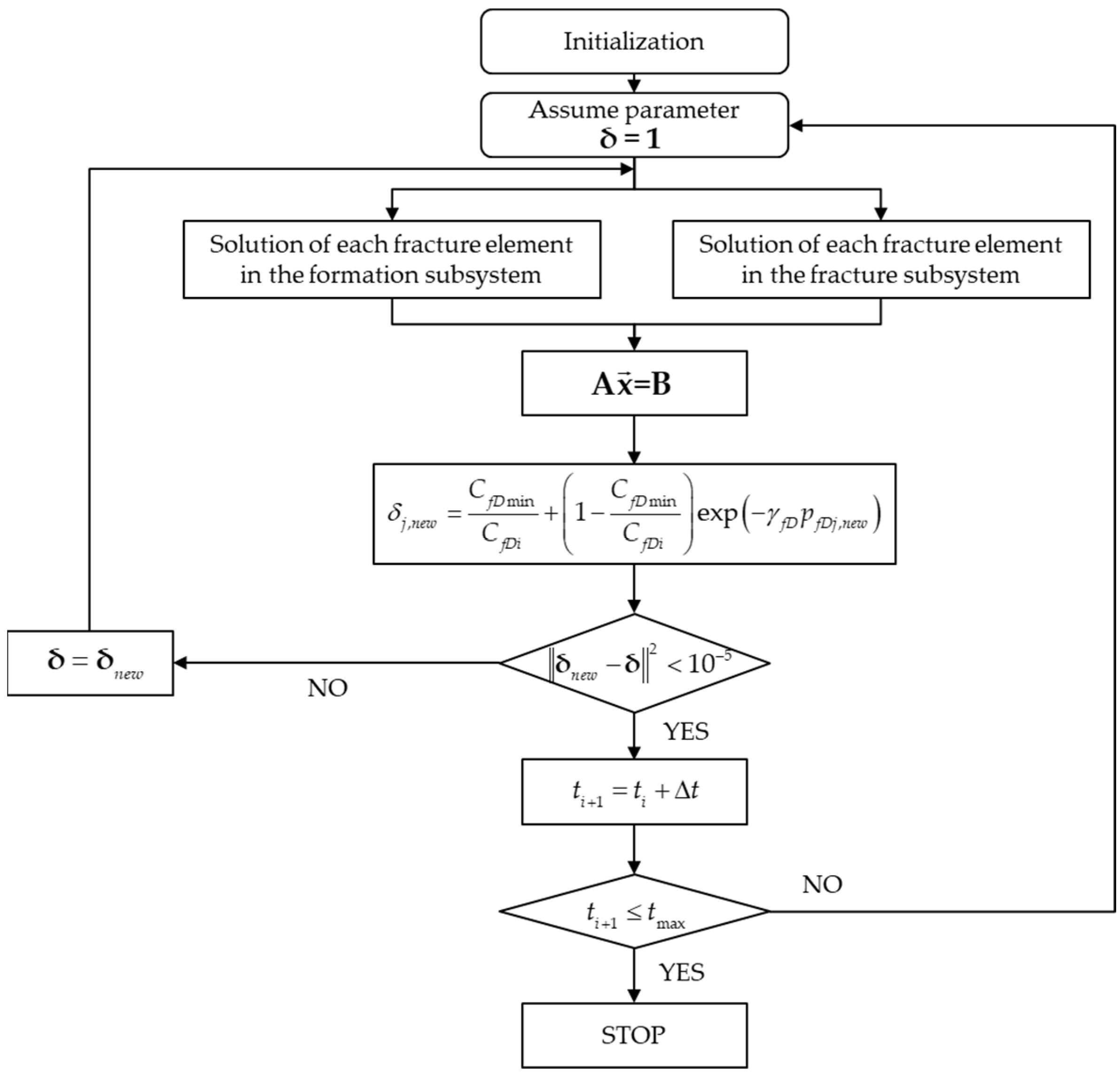
Also, it is worth noting that the variables δj are pressure-dependent, which are to be determined. Therefore, an iterative approach is adopted to address such nonlinear problems. At each time step, initial values were assigned for the unknowns δj, and then the equation systems were solved in the Laplace domain. The Stehfest inverse algorithm [32] was then used to transfer the solution to the real-time domain, and the updated value of δj could be obtained based on Equation (4). The convergence criterion adopted in this work is defined as follows: ε = δ n e w δ o l d 2 < 10 5 . The iterations continued until the convergence criterion was satisfied. The main flowchart can be found in Figure 2.

3. Model Validation

3.1. Fracture with Uniform Conductivity and Stress-Sensitivity Level

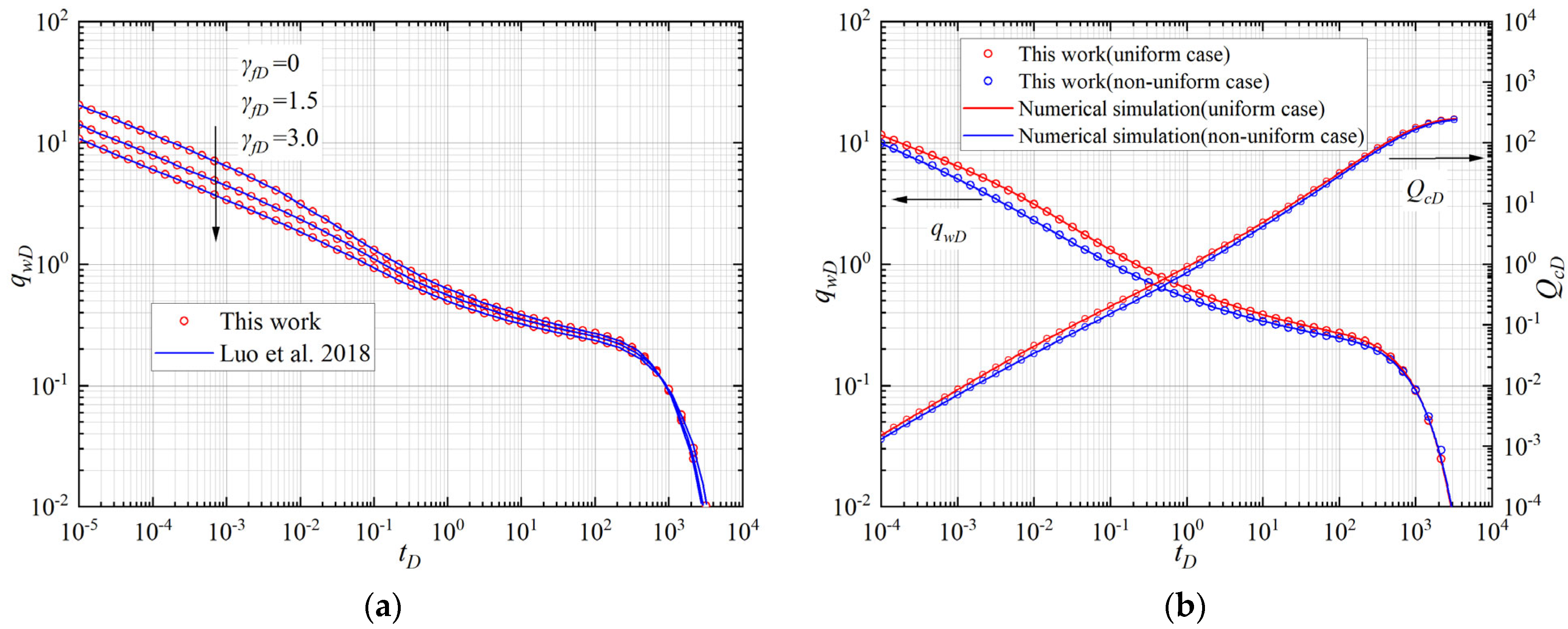
The proposed model was first validated through comparison of the results from the literature [33] and those from this work. In the validation case, the fracture was assumed with uniform conductivity and permeability modulus. The main parameters used for validation are as follows: xeD = 40, yeD = 40, CfDi = 10, and CfDmin = 0.1. The comparison results can be found in Figure 3a, revealing an excellent agreement and verifying the accuracy of the proposed model in this work to deal with uniform fracture properties.

3.2. Fracture with Non-Uniform Conductivities and Stress-Sensitivity Level

Currently, no semi-analytical models have been proposed to handle the non-uniform problems mentioned in this work. The numerical simulation method (i.e., CMG version 2022) is applied to validate the proposed model, which can take the non-uniform fracture properties into account. The main parameters used for validation are listed in Table 1. Two main cases are considered, including uniform fracture properties and non-uniform fracture properties. For the uniform case, the dimensionless fracture conductivity and permeability modulus are 10 and 0, respectively. For the non-uniform case, the main parameters are as follows: LcD = 0.5, CfD1 = 10, CfD2 = 1, γfD1 = 0.5, and γfD2 = 1.5. Figure 3b shows the comparison between the results obtained from the numerical simulation method and those obtained from this work. It can be found that the results of both the production rate and cumulative production are in excellent agreement for such two methods, verifying the validity of the proposed model in this work to deal with non-uniform fracture properties.

4. Results and Discussion

In this section, sensitivity analyses were conducted by investigating the effect of spatiotemporal heterogeneities of fractures on the transient rate curves for a fractured vertical well, while thorough discussions were performed. The main parameters used are listed as follows: xeD = yeD = 40, CfD1 = CfD2 =10, γfD1 =γfD2 = 0, and LcD = 0.5. Unless otherwise specified, these parameters are held constant for different scenarios.

4.1. Effect of Fracture Conductivity

4.1.1. Scenarios with the Same Fracture Conductivity of the FSNW (CfD1)

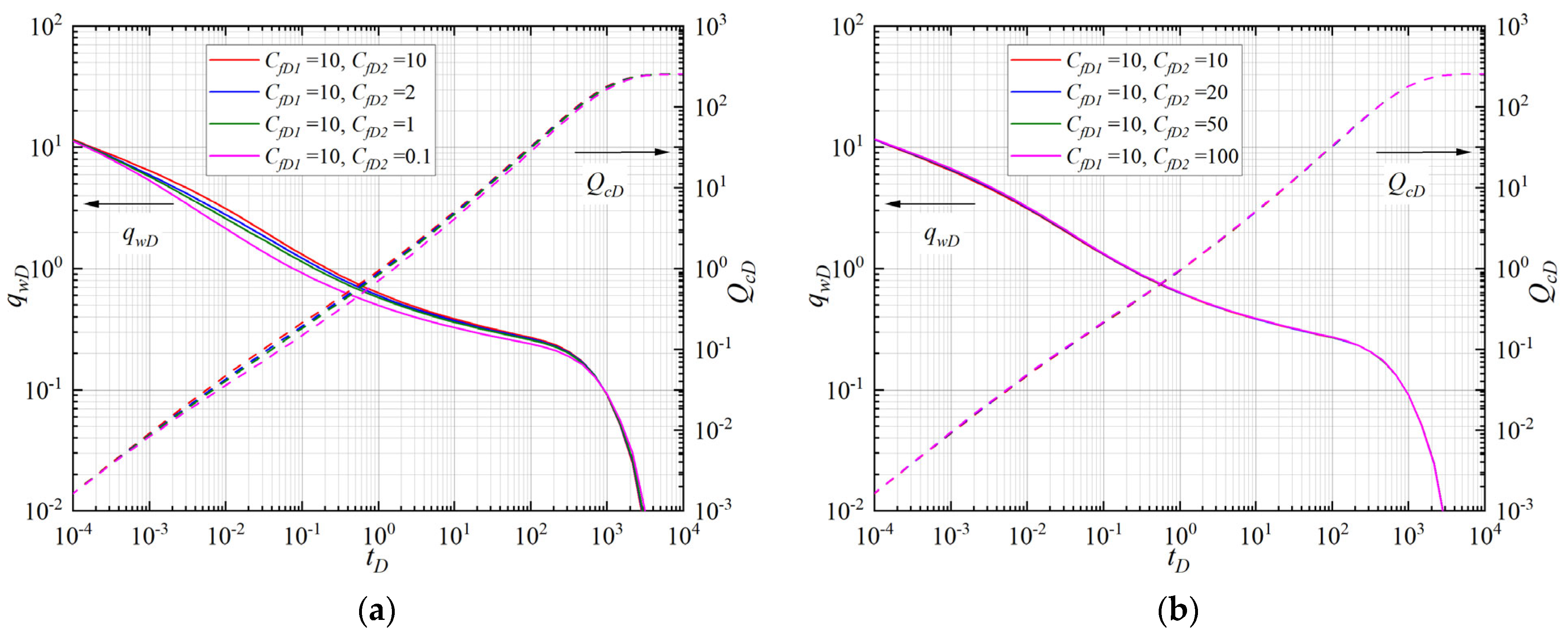
In this part, the fracture conductivities of the FSNW were assumed to be the same for different scenarios, while the effect of the conductivities for the FSNT was investigated. No stress-sensitivity effect was considered in this part (i.e., γfD1 = γfD2 = 0), and the fracture conductivities of the two fracture segments were CfD1 = 10 and CfD2 = 10, 2, 1, 0.1.
Similarly, four other cases were investigated. The fracture conductivities of the FSNW were assumed to be the same as CfD1 = 10, while the conductivities of the FSNT were larger than those of the FSNW for the following scenarios: CfD2 = 10, 20, 50, 100.
Figure 4a,b depict the effect of the fracture conductivity of the FSNT on well performance. As can be seen from Figure 4a, the dimensionless production rates are nearly the same at the early time stage. This is due to the fact that the fracture conductivities near the wellbore are the same for all cases, and the early production rate is mainly controlled by the properties of fractures connected to or near the wellbore. At the middle time stage, the production rate decreases as the fracture conductivity of the FSNT decreases. Such a difference can be readily understood, as the lower the fracture conductivity, the larger the flow resistance within the fractures, and the lower the production rate. At the late time stage, all the curves can nearly converge into a single curve with minimal difference. This flow regime is called the boundary-dominant flow regime [8,13].
Also, another four cases were investigated, as shown in Figure 4b. It can be found that the difference in production rate at the middle time stage is nearly the same, with a negligible difference. This is due to the fact that the fracture conductivity of the FSNT is sufficiently high. Consequently, during the middle time stage, when CfD2 ≥ 10, the flow resistance within the fractures becomes negligible.

4.1.2. Scenarios with the Same Fracture Conductivity of the FSNT (CfD2)

Additionally, the effect of the fracture conductivity of the FSNW on well performance was examined, while the conductivities of the FSNT were kept the same.
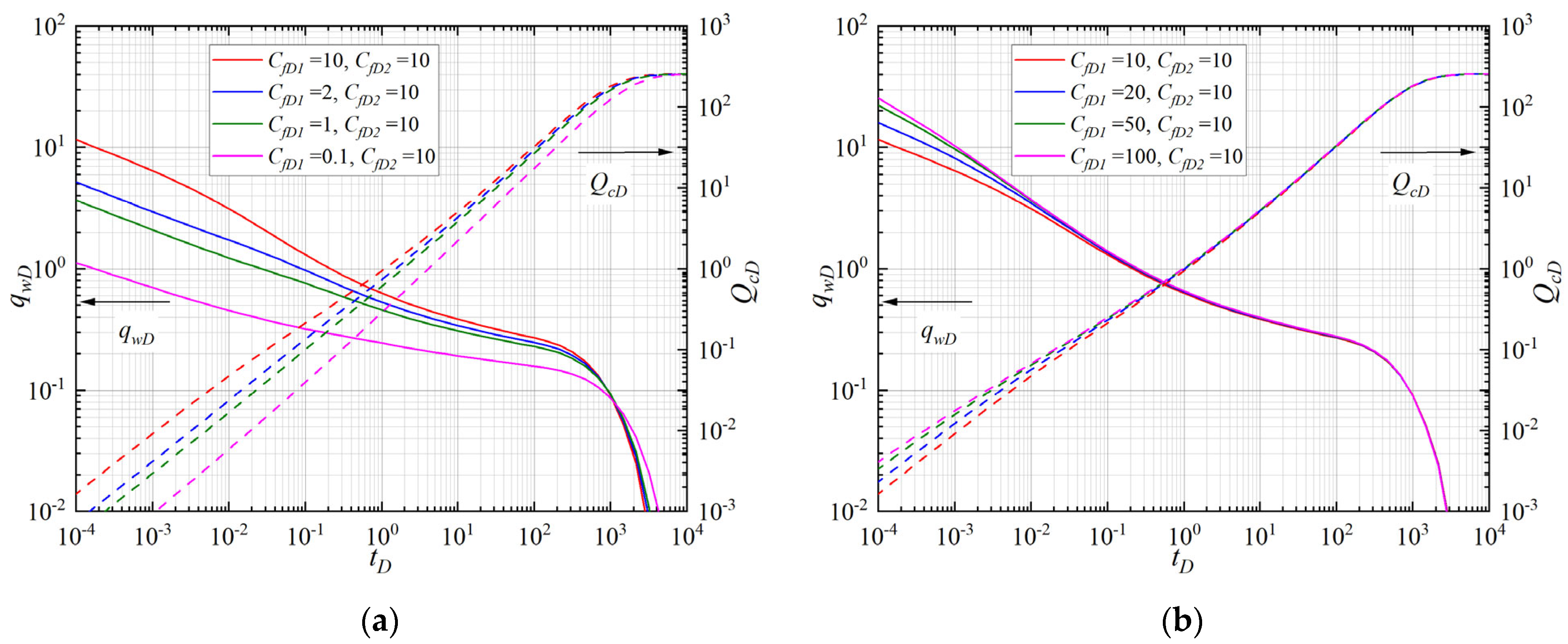
Figure 5a,b display the effect of CfD1 on well performance. Compared to the results in Figure 4, it can be easily found that the fracture conductivity of the fracture segment near the wellbore has a greater and more pronounced impact on well productivity. As seen from Figure 5a, it is evident that the production rate in the early stage decreases as CfD1 decreases. Also, the production rate for the case (CfD1 = 10) is nearly ten times larger than that for the case (CfD1 = 0.1) at the early time stage. This is also due to the fact that the fracture conductivity near the wellbore is the main controlling factor for the production rate in the early time period. Differences in production rates among the cases are also observed during the middle and late time periods. It is noteworthy that the boundary-dominated flow regime arrives later in the case that has the lowest production rate in the early and middle stages.
Also, the other four cases were considered, and the results can be found in Figure 5b. Compared to the results shown in Figure 5a, the differences in production rates between different cases are smaller. Especially in the middle and late time periods, the differences in production rate can be negligible. The main reason for this phenomenon, as previously discussed, is that cases with higher-conductivity fractures (i.e., CfD1 ≥ 10) result in relatively low flow resistance, thereby exhibiting minimal differences for the production rate compared to the cases shown in Figure 5a.

4.2. Effect of FSNW Length

4.2.1. Scenarios Without Stress-Sensitivity Effect

In this part, the effect of the dimensionless length of the FSNW on the transient rate behavior has been investigated. First, the stress-sensitivity effect is not considered; only the effect of the dimensionless length of the FSNW is taken into account.
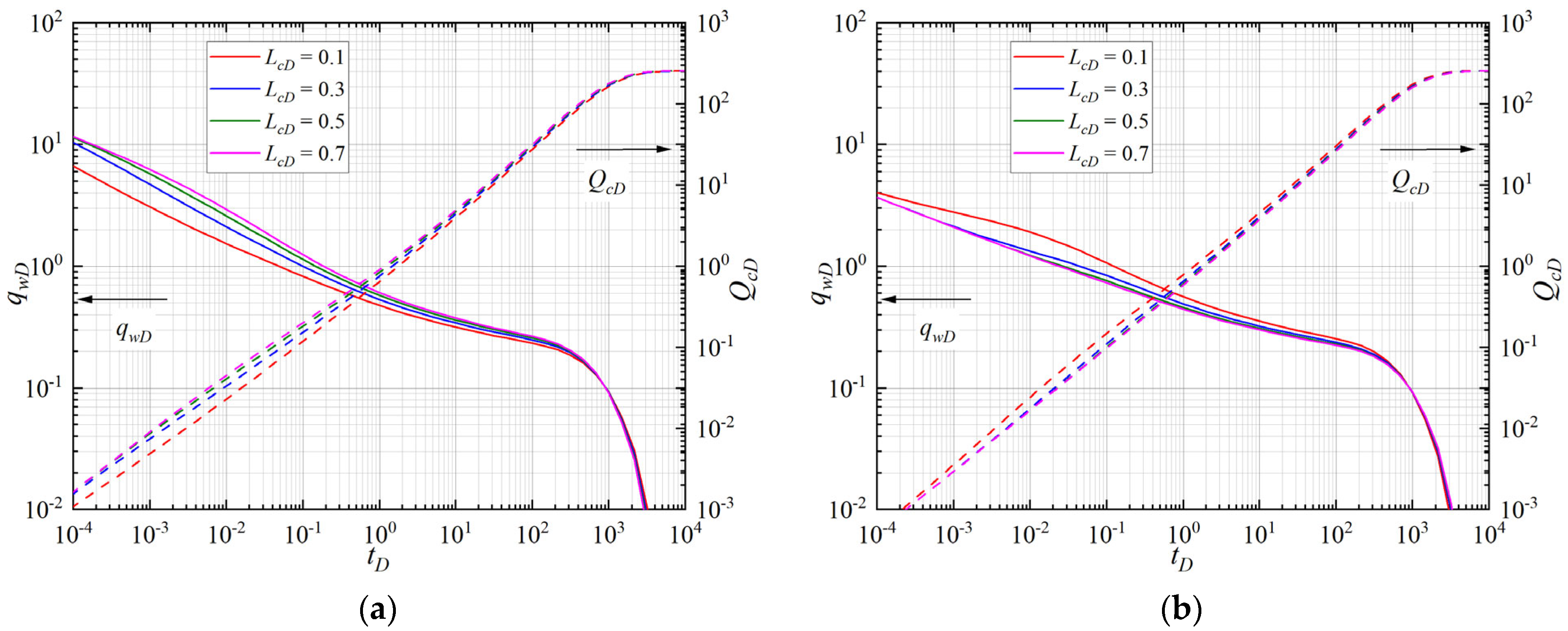
Figure 6a,b show the effect of the FSNW length on well performance. In Figure 6a, the main parameters used are CfD1 = 10 and CfD2 = 1. It can be observed from the figure that, as the length of the FSNW increases, the dimensionless production rate of the well also increases in the early and middle time periods. Also, as shown in Figure 6b, where CfD1 = 1 and CfD2 = 10, the differences between the various curves are not very significant compared to the curves shown in Figure 6a. However, a similar conclusion can be drawn: the longer the fracture with larger fracture conductivity, the higher the production rate [22]. Meanwhile, since the fracture conductivity of the FSNW is the same, the production rate curves show little difference at the early time stage, and the differences occur in the middle time period.

4.2.2. Scenarios with Uniform Stress-Sensitivity Effect

In this part, the combined effects of the FSNW length and stress-sensitivity are considered, while the permeability modulus for both fracture segments are the same: γfD1 = γfD2 = 1.5.
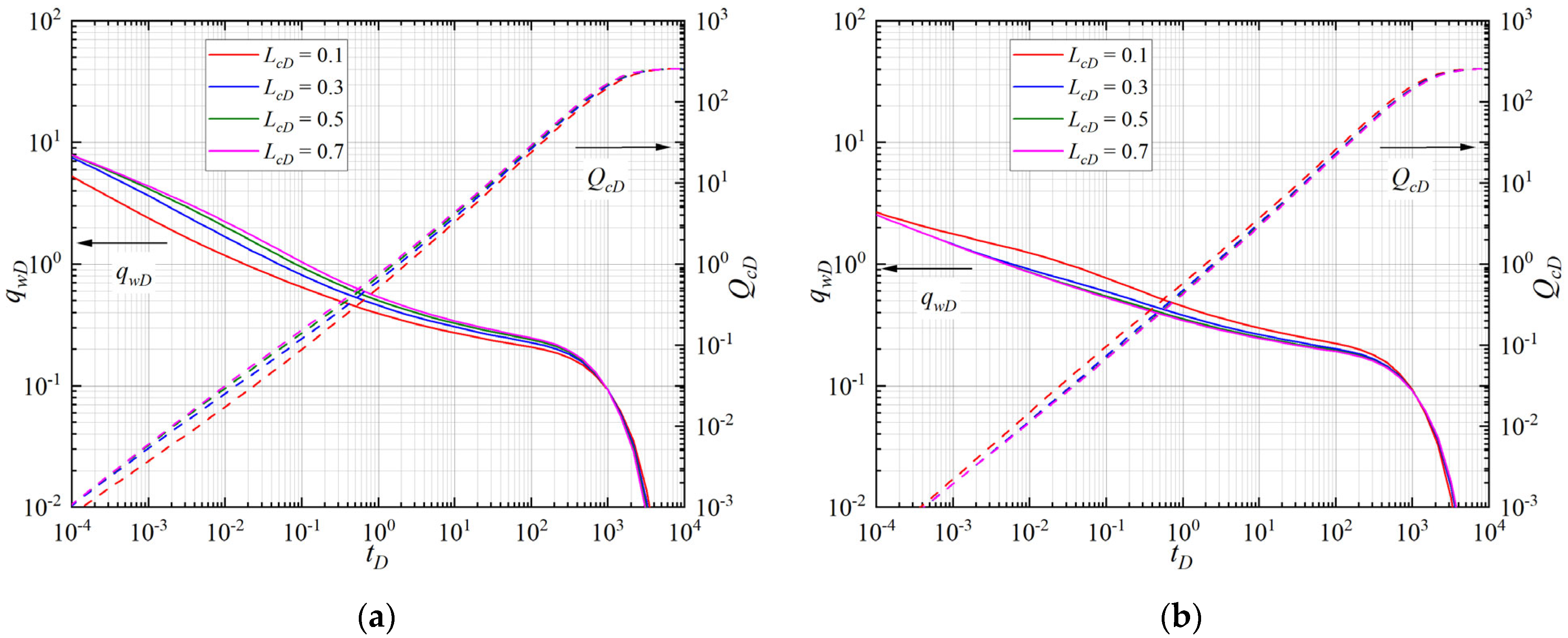
Figure 7 exhibits a trend similar to that in Figure 6. For example, as shown in Figure 7a, the well production rate increases with the length of the FSNW when CfD1 > CfD2. Conversely, Figure 7b shows that the production rate decreases with longer FSNW lengths when CfD1 < CfD2. Also, compared to the cases without considering the stress-sensitivity effect in Figure 6, the production rate will be slightly lower when the stress-sensitivity is taken into account. This is due to the fact that, when stress-sensitivity exists, the pressure within fractures decreases as production continues, which in turn results in a corresponding decline in the fracture conductivity. A decrease in fracture conductivity leads to an increase in flow resistance within the fracture, thereby reducing the well production rate.

4.3. Effect of Fracture Stress-Sensitivity Effect

4.3.1. Scenarios with the Same Fracture Permeability Modulus of FSNW (γfD1)

This section investigates the effect of the permeability modulus of the FSNT on the transient rate behavior, with γfD1 held the same.
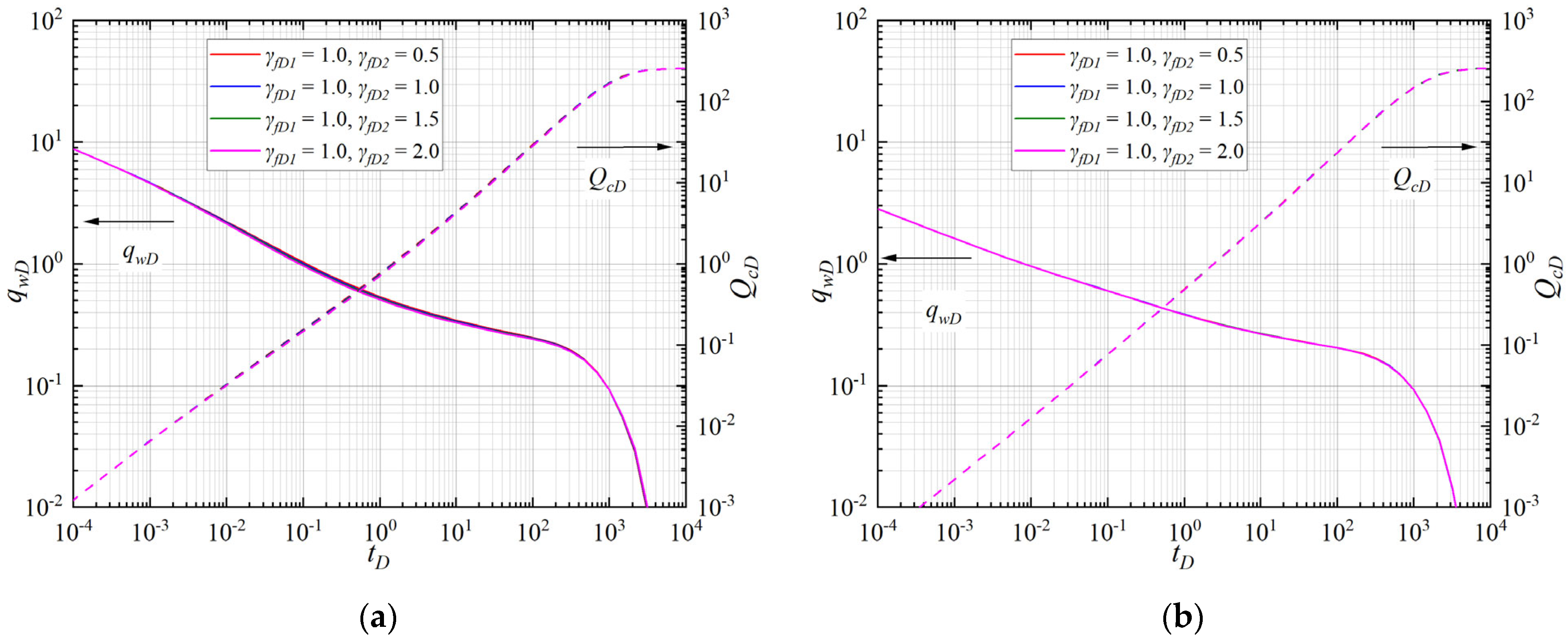
Figure 8 presents the dimensionless rate curves together with the cumulative production under various values of γfD2. Figure 8a shows the results for the cases with CfD1 = 10 and CfD2 = 1. As can be seen, the differences in the production rate mainly occur in the middle time stage, but such differences are very small. However, in Figure 8b, we considered the cases with CfD1 = 1 and CfD2 = 10. From the figure, the well production rate curves almost overlap for the whole time period, meaning no significant differences for the production rate. The reason for the differences shown in Figure 8 can be easily understood. This is due to the fact that the fracture conductivity and stress-sensitivity effect of the FSNW are the same; therefore, the well production rates for different cases are consistent, with no differences. In the middle and late time periods, even though the permeability moduli of the fracture segments near fracture tip are different, their influence on the well production rate is very small and can be neglected.

4.3.2. Scenarios with the Same Fracture Permeability Modulus of FSNT (γfD2)

In this part, the stress-sensitivity level of the FSNT was consistent. The impact of the stress-sensitivity level of the FSNW on well performance was investigated.
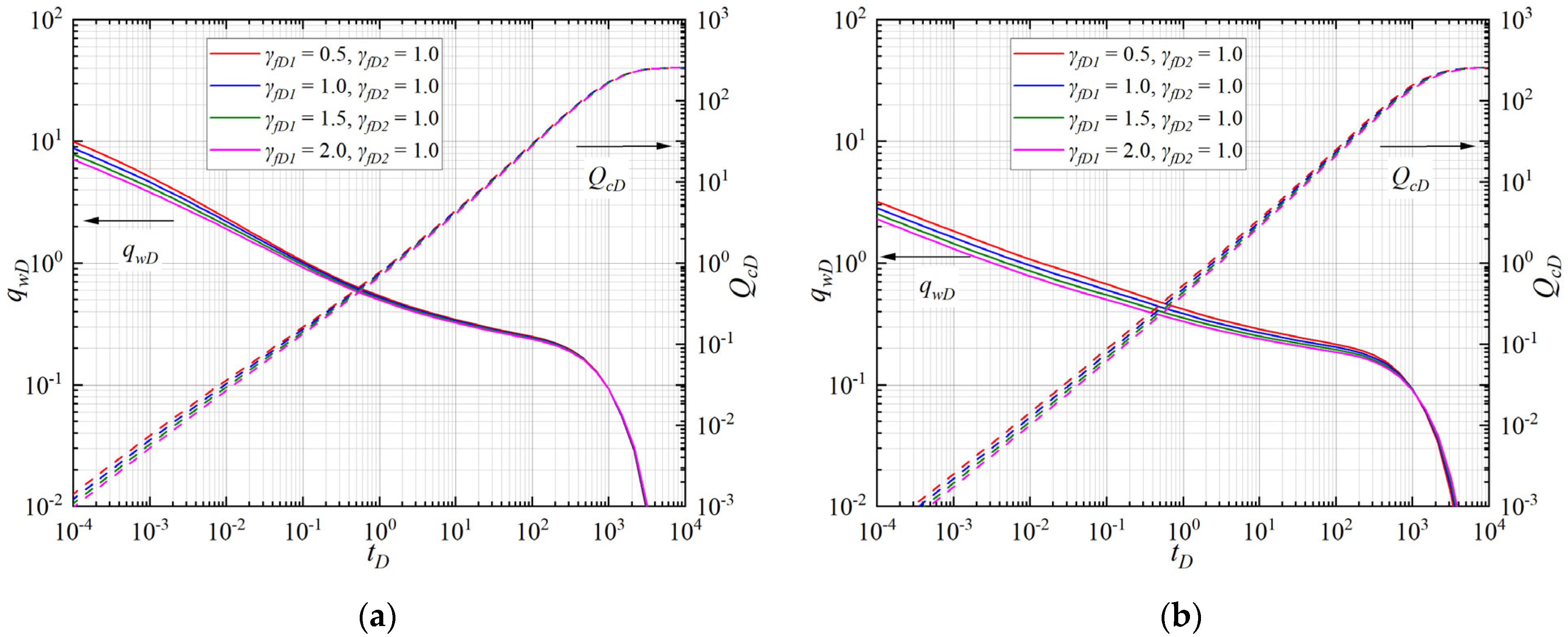
Figure 9a,b depict the effect of γfD1 on well performance. Compared to the results in Figure 8, the impact of the permeability modulus of the FSNW is relatively obvious. Specifically, in Figure 9a, the differences in γfD1 lead to variations in the early-stage production rate. As the permeability modulus of the FSNW increases, the production rate decreases. In the middle and late time periods, the differences between the curves are relatively small. Meanwhile, in Figure 9b, the differences between the curves persist for a longer period. In the middle time stage, the impact of the stress-sensitivity degree of the FSNW can also be observed. The main reason for the above differences in the figures has also been explained above. That is, what are closely related to the well production rate are the properties of the FSNW, including the fracture conductivity and fracture stress-sensitivity [26]. If there are differences in the fracture permeability modulus, it will result in differences in fracture conductivity as production proceeds, which in turn results in the aforementioned variation trend for the well production rate.

5. Conclusions

(1)
A novel RTA model has been proposed with the following features: the spatiotemporal properties, including the fracture conductivity and permeability modulus, can be taken into account by the double segment fracture model. The novel type curves are more beneficial to the analysis of the well production rate, which can identify the non-uniform properties of the fractures.
(2)
The fracture conductivity and stress-sensitivity of the FSNW have a more significant impact on the well production rate than those of the FSNT. It is worth noting that fracture properties estimated or obtained during the RTA process by analyzing the production rate mainly reflect the properties of the FSNW rather than the average properties of the entire fractures.
(3)
The model proposed in this work can be readily extended to account for more complicated non-uniform fracture properties by dividing the fracture into more segments with different properties. However, this will introduce more unknowns during the RTA processes, which is not beneficial for the fracture properties estimation and characterization.
(4)
The limitations inherent in the proposed model include its simplified two-segment fracture representation and the exclusion of complex fracture networks. To broaden its practical applications, our future work will aim to develop models that incorporate continuously varying properties and multi-branch fracture networks, while also addressing the key challenge of integrating multiphase flow into the fractured reservoir.

Author Contributions

Conceptualization, L.J. and J.L.; methodology, L.J. and J.L.; software, Y.M.; validation, Y.M. and J.W.; formal analysis, T.L. and L.J.; writing—original draft preparation, L.J. and J.L.; writing—review and editing, L.J.; funding acquisition, L.J. All authors have read and agreed to the published version of the manuscript.

Funding

This research was funded by Fundamental Research Fund for Universities in the Xinjiang Uygur Autonomous Region (grant No. XJEDU2024P102); National Natural Science Foundation of China (grant No. 52404051); Natural Science Foundation of Xinjiang Uygur Autonomous Region (grant No. 2024D01B97); Tianchi Talent Program of Xinjiang Uygur Autonomous Region; and Xinjiang Tianshan Innovation Team Program (grant No. 2024D14004).

Data Availability Statement

The original contributions presented in this study are included in the article material. Further enquiries can be directed to the corresponding author.

Conflicts of Interest

The authors declare no conflicts of interest.

Abbreviations

The following abbreviations are used in this manuscript:
FSNWFracture segment near wellbore
FSNTFracture segment near fracture tip
DSFDouble-segment fracture
CfDDimensionless fracture conductivity
LcDDimensionless length of FSNW
γfDDimensionless permeability modulus
qwDDimensionless well production rate
QcDDimensionless cumulative production

References

  1. Wang, L.; Yu, W. Mechanistic Simulation Study of Gas Puff and Huff Process for Bakken Tight Oil Fractured Reservoir. Fuel 2019, 239, 1179–1193. [Google Scholar] [CrossRef]
  2. Clarkson, C.R. Production Data Analysis of Unconventional Gas Wells: Review of Theory and Best Practices. Int. J. Coal Geol. 2013, 109–110, 101–146. [Google Scholar] [CrossRef]
  3. Zhou, W.; Banerjee, R.; Poe, B.D.; Spath, J.; Thambynayagam, M. Semianalytical Production Simulation of Complex Hydraulic-Fracture Networks. SPE J. 2014, 19, 6–18. [Google Scholar] [CrossRef]
  4. Hofmann, H.; Babadagli, T.; Zimmermann, G. Numerical simulation of complex fracture network development by hydraulic fracturing in naturally fractured ultratight formations. J. Energy Resour. Technol. 2014, 136, 042905. [Google Scholar] [CrossRef]
  5. Shakiba, M.; de Araujo Cavalcante Filho, J.S.; Sepehrnoori, K. Using embedded discrete fracture model (EDFM) in numerical simulation of complex hydraulic fracture networks calibrated by microseismic monitoring data. J. Nat. Gas Sci. Eng. 2018, 55, 495–507. [Google Scholar] [CrossRef]
  6. Clarkson, C.R.; Qanbari, F.; Williams-Kovacs, J.D. Innovative use of rate-transient analysis methods to obtain hydraulic-fracture properties for low-permeability reservoirs exhibiting multiphase flow. Lead. Edge 2014, 33, 1108–1122. [Google Scholar] [CrossRef]
  7. Nobakht, M.; Clarkson, C.R.; Kaviani, D. New and improved methods for performing rate-transient analysis of shale gas reservoirs. SPE Reserv. Eval. Eng. 2012, 15, 335–350. [Google Scholar] [CrossRef]
  8. Jiang, L.; Liu, J.; Liu, T.; Yang, D. Production decline analysis for a fractured vertical well with reorientated fractures in an anisotropic formation with an arbitrary shape using the boundary element method. J. Pet. Sci. Eng. 2022, 208, 109213. [Google Scholar] [CrossRef]
  9. Nashawi, I.S. Pressure-transient analysis of infinite-conductivity fractured gas wells producing at high-flow rates. J. Pet. Sci. Eng. 2008, 63, 73–83. [Google Scholar] [CrossRef]
  10. He, Y.; Cheng, S.; Rui, Z.; Qin, J.; Fu, L.; Shi, J.; Wang, Y.; Li, D.; Patil, S.; Yu, H.; et al. An improved rate-transient analysis model of multi-fractured horizontal wells with non-uniform hydraulic fracture properties. Energies 2018, 11, 393. [Google Scholar] [CrossRef]
  11. Jiang, L.; Liu, T.; Yang, D. Effect of stress-sensitive fracture conductivity on transient pressure behavior for a horizontal well with multistage fractures. SPE J. 2019, 24, 1342–1363. [Google Scholar] [CrossRef]
  12. Jiang, L.; Liu, T.; Yang, D. A semianalytical model for predicting transient pressure behavior of a hydraulically fractured horizontal well in a naturally fractured reservoir with non-Darcy flow and stress-sensitive permeability effects. SPE J. 2019, 24, 1322–1341. [Google Scholar] [CrossRef]
  13. Jiang, L.; Liu, J.; Liu, T.; Yang, D. Semi-analytical modeling of transient rate behaviour of a horizontal well with multistage fractures in tight formations considering stress-sensitive effect. J. Nat. Gas Sci. Eng. 2020, 82, 103461. [Google Scholar] [CrossRef]
  14. Wei, M.; Wang, H.; Yang, W.; Tian, W.; Yang, N.; Duan, Y. Analysis of Production Decline Type Curves Considering Water Influx in Naturally Fractured Gas Reservoirs. ASME J. Energy Res. Technol. 2025, 1, 021005. [Google Scholar] [CrossRef]
  15. Huang, Y.; Li, X.; Guo, W.; Liu, X.; Lin, W.; Qian, C.; Zhou, M.; Cui, Y.; Shi, X. Research on Productivity Evaluation Method Based on Shale Gas Well Early Flow Stage Data. Geofluids 2023, 2023, 2529837. [Google Scholar] [CrossRef]
  16. Huang, Y.; Li, X.; Liu, X.; Zhai, Y.; Fang, F.; Guo, W.; Qian, C.; Han, L.; Cui, Y.; Jia, Y. Review of the productivity evaluation methods for shale gas wells. J. Pet. Explor. Prod. Technol. 2024, 14, 25–39. [Google Scholar] [CrossRef]
  17. Yang, D.; Zhang, F.; Styles, J.A.; Gao, J. Performance Evaluation of a Horizontal Well With Multiple Fractures by Use of a Slab-Source Function. SPE J. 2015, 20, 652–662. [Google Scholar] [CrossRef]
  18. Wu, S.; Xing, G.; Cui, Y.; Wang, B.; Shi, M.; Wang, M. A Semi-Analytical Model for Pressure Transient Analysis of Hydraulic Reorientation Fracture in an Anisotropic Reservoir. J. Pet. Sci. Eng. 2019, 179, 228–243. [Google Scholar] [CrossRef]
  19. Jamaloei, B.Y. A critical review of common models in hydraulic-fracturing simulation: A practical guide for practitioners. Theor. Appl. Fract. Mech. 2021, 113, 102937. [Google Scholar] [CrossRef]
  20. Geertsma, J.; De Klerk, F. A Rapid Method of Predicting Width and Extent of Hydraulically Induced Fractures. J. Pet. Technol. 1969, 21, 1571–1581. [Google Scholar] [CrossRef]
  21. Qin, J.; Cheng, S.; He, Y.; Wang, Y.; Feng, D.; Li, D.; Yu, H. An innovative model to evaluate fracture closure of multi-fractured horizontal well in tight gas reservoir based on bottom-hole pressure. J. Nat. Gas Sci. Eng. 2018, 57, 295–304. [Google Scholar] [CrossRef]
  22. Jiang, L.; Liu, J.; Liu, T.; Yang, D. A semianalytical model for transient pressure analysis of a horizontal well with non-uniform fracture geometry and shape-dependent conductivity in tight formations. J. Pet. Sci. Eng. 2020, 195, 107860. [Google Scholar] [CrossRef]
  23. Gong, Y.; Mehana, M.; El-Monier, I.; Viswanathan, H. Proppant placement in complex fracture geometries: A computational fluid dynamics study. J. Nat. Gas Sci. Eng. 2020, 79, 103295. [Google Scholar] [CrossRef]
  24. Card, R.J.; Howard, P.R.; Feraud, J.P. A Novel Technology to Control Proppant Backproduction. SPE Prod. Facil. 1995, 10, 271–276. [Google Scholar] [CrossRef]
  25. Zander, D.M.; Czehura, M.P.; Snyder, D.; Seale, R.A. Horizontal Drilling and Completion Optimization in a North Dakota Bakken Oilfield. In Proceedings of the SPE Annual Technical Conference and Exhibition, Florence, Italy, 19–22 September 2010. [Google Scholar] [CrossRef]
  26. Chen, D.; Ye, Z.; Pan, Z.; Zhou, Y.; Zhang, J. A permeability model for the hydraulic fracture filled with proppant packs under combined effect of compaction and embedment. J. Pet. Sci. Eng. 2017, 149, 428–435. [Google Scholar] [CrossRef]
  27. Li, J.H.; Li, B.B.; Cheng, Q.Y.; Gao, Z. Characterization of the fracture compressibility and its permeability for shale under the effects of proppant embedment and compaction: A preliminary study. Pet. Sci. 2022, 19, 1125–1138. [Google Scholar] [CrossRef]
  28. Bandara, K.; Ranjith, P.G.; Rathnaweera, T.D.; Wanniarachchi, W.A.M.; Yang, S.Q. Crushing and embedment of proppant packs under cyclic loading: An insight to enhanced unconventional oil/gas recovery. Geosci. Front. 2021, 12, 100970. [Google Scholar] [CrossRef]
  29. Jiang, L.; Liu, J.; Liu, T.; Yang, D. Semi-analytical modeling of transient pressure behaviour for a fractured vertical well with hydraulic/natural fracture networks by considering stress-sensitive effect. J. Nat. Gas Sci. Eng. 2020, 82, 103477. [Google Scholar] [CrossRef]
  30. Qin, J.; Cheng, S.; Li, P.; He, Y.; Lu, X.; Yu, H. Interference well-test model for vertical well with double-segment fracture in a multi-well system. J. Pet. Sci. Eng. 2019, 183, 106412. [Google Scholar] [CrossRef]
  31. Weaver, J.; Rickman, R.; Luo, H. Fracture-conductivity loss caused by geochemical interactions between man-made proppants and formations. SPE J. 2010, 15, 116–124. [Google Scholar] [CrossRef]
  32. Stehfest, H. Algorithm 368: Numerical inversion of Laplace transforms. Commun. ACM 1970, 13, 47–49. [Google Scholar] [CrossRef]
  33. Luo, W.; Tang, C.; Feng, Y.; Zhu, M. Mechanism of fluid flow along a dynamic conductivity fracture with pressure-dependent permeability under constant wellbore pressure. J. Pet. Sci. Eng. 2018, 166, 465–475. [Google Scholar] [CrossRef]
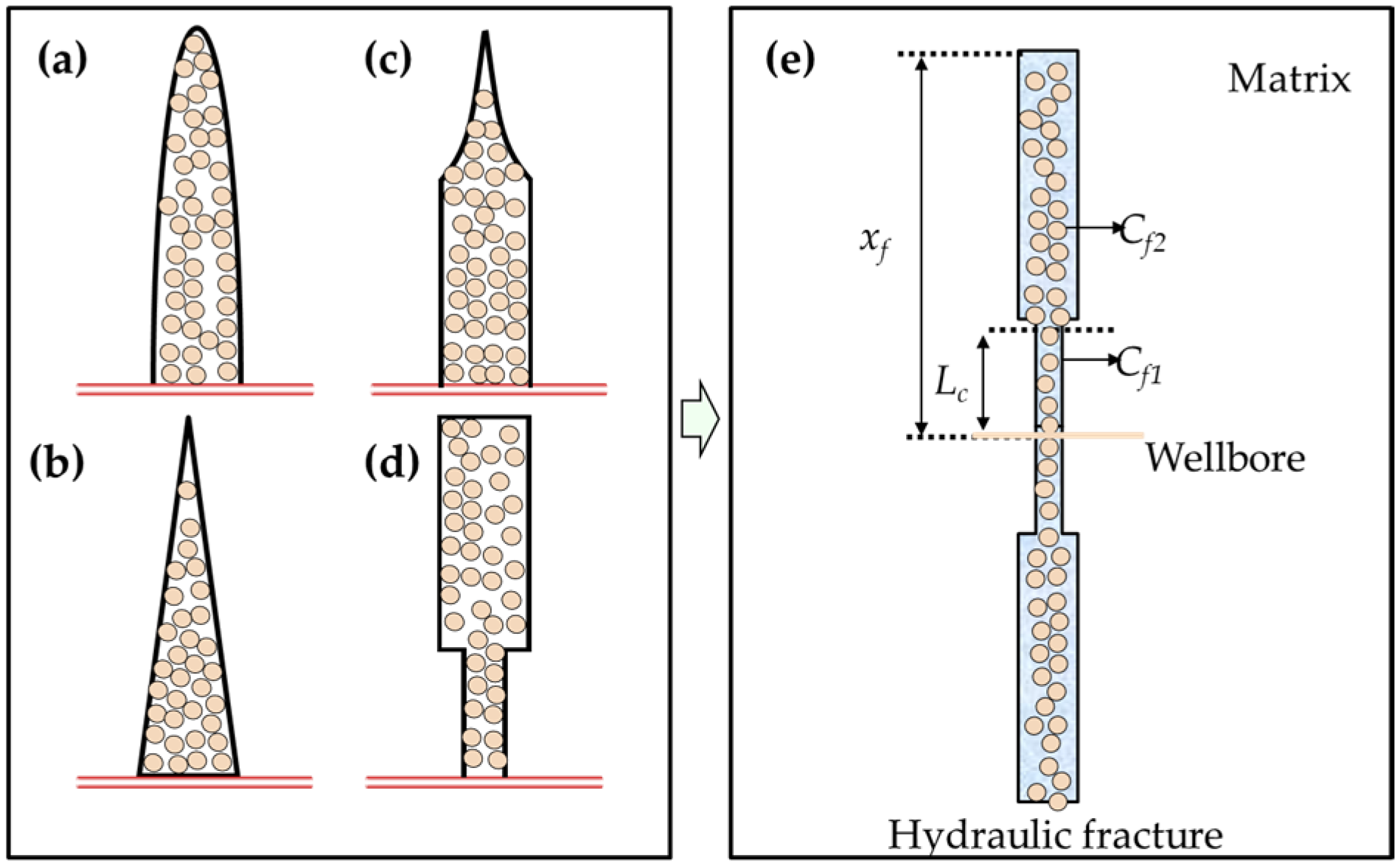
Figure 1. Non-uniform fracture geometries for different cases, modified from [22]: (a) elliptical type; (b) triangular type; (c) concave type; (d) double rectangular type; and (e) double segment fracture model used in this work.
Processes 13 03627 g001
Figure 2. Flowchart of solving the fluid flow problems with stress-sensitive fractures.
Processes 13 03627 g002
Figure 3. Comparison of the results obtained from the literature [33], numerical simulation, and this work: (a) comparison of the production rate of the fractured well considering uniform fracture conductivity and uniform permeability modulus; (b) comparison of production rate and cumulative production for the fractured well considering both uniform and non-uniform fracture properties.
Processes 13 03627 g003
Figure 4. Effect of the fracture conductivities of the FSNT on the transient rate and cumulative production for a fractured well: (a) CfD1CfD2; (b) CfD1CfD2.
Processes 13 03627 g004
Figure 5. Effect of the fracture conductivities of the FSNW on the transient rate and cumulative production for a fractured well: (a) CfD1CfD2; (b) CfD1CfD2.
Processes 13 03627 g005
Figure 6. Effect of the dimensionless length of FSNW on the transient rate and cumulative production for a fractured well: (a) CfD1 = 10 and CfD2 = 1; (b) CfD1 = 1 and CfD2 = 10.
Processes 13 03627 g006
Figure 7. Effect of the dimensionless length of FSNW on the transient rate and cumulative production for a fractured well: (a) CfD1 = 10, CfD2 = 1, and γfD1 = γfD2 = 1.5; (b) CfD1 = 1, CfD2 = 10, and γfD1 = γfD2 = 1.5.
Processes 13 03627 g007
Figure 8. Effect of the fracture permeability modulus for FSNT on the transient rate and cumulative production for a fractured well: (a) CfD1 = 10 and CfD2 = 1; (b) CfD1 = 1 and CfD2 = 10.
Processes 13 03627 g008
Figure 9. Effect of the fracture permeability modulus for FSNW on the transient rate and cumulative production for a fractured well: (a) CfD1 = 10 and CfD2 = 1; (b) CfD1 = 1 and CfD2 = 10.
Processes 13 03627 g009
Table 1. Basic parameters used for validation.
TypeParametersValueUnit
ReservoirReservoir thickness, h10m
Initial pressure, pi30MPa
Matrix porosity, ϕm0.1Fraction
Matrix permeability, km1mD
Reservoir length/width, xe, ye2000m
WellWell bottomhole pressure, pw10MPa
FractureFracture half-length, xf50m
Fracture conductivity, CfDi10, 1m3
Fracture width, wf0.005m
Fracture permeability, kf100,000, 10,000mD
Permeability modulus, γf0.025; 0.075MPa−1
FluidViscosity, μ0.001Pa·s
Volume factor, B1.2m3/m3
Total compressibility, Ct4.0 × 10−3MPa−1
Disclaimer/Publisher’s Note: The statements, opinions and data contained in all publications are solely those of the individual author(s) and contributor(s) and not of MDPI and/or the editor(s). MDPI and/or the editor(s) disclaim responsibility for any injury to people or property resulting from any ideas, methods, instructions or products referred to in the content.