


Abstract
Continuous bioprocessing has great potential to address issues of flexibility, cost, and robustness in pharmaceutical manufacturing. Despite the identified benefits, continuous bioprocessing has not yet been adopted for commercial production owing to the difficulty of integrating the cultivation and purification processes. Surge tanks installed between unit operations play a critical role in integrated bioprocessing, but their role has not been fully understood and defined. In this study, we examined the function of surge tanks in an integrated and continuous bioprocessing (ICB) system. We developed the ICB train equipped with surge tanks, used a 10 L bioreactor to produce monoclonal antibodies, and conducted a 6-day experiment. During the experiment, unexpected issues related to the surge tanks emerged, and they were analyzed using a fault tree diagram. Key findings highlight the surge tanks’ role in balancing flow between upstream and downstream operations and raise considerations about antibody concentration fluctuations and residence time. Proposed improvements based on these findings include optimizing the capacity and placement of surge tanks, strengthening monitoring and control systems, and enabling the flexible adjustment of operating conditions. These measures are expected to further facilitate seamless upstream integration and contribute to the stability of the operation of the ICB system.
1. Introduction
Biopharmaceuticals are becoming increasingly important for patient care and financial outcomes, with the therapeutic antibody market expanding rapidly. Improving biomanufacturing efficiency and adaptability is thus crucial [1].
Continuous processing enables flexible, cost-effective, and robust pharmaceutical manufacturing by adjusting product outflow to production time. Interest in continuous manufacturing is growing [2,3,4,5]. Implementing quality-by-design with process analytical technologies allows for real-time monitoring and control [6,7], improving product quality [8,9]. Regulatory agencies, including the Food and Drug Administration, support this approach [10], and the International Council for Harmonisation of Technical Requirements for Pharmaceuticals for Human Use (ICH) guideline Q13 [11] details scientific and regulatory considerations throughout the lifecycle of continuous manufacturing.
Continuous bioprocessing in pharmaceutical manufacturing generally comprises biological upstream and chemical-based downstream steps, such as chromatography, filtration, and viral inactivation [12,13]. Various continuous technologies have been developed for both upstream and downstream processes [14,15,16,17,18,19]. In effective continuous bioprocessing, these operations are typically integrated and managed automatically on a digital platform to address critical parameters, process variations, and disturbances [20,21,22,23,24,25], supported by real-time process monitoring tools [26,27,28]. Technical and operational challenges must be resolved for the practical application of integrated and continuous bioprocessing (ICB) [20,29]. Several studies have demonstrated ICB systems [30,31,32,33,34,35], indicating their feasibility for stable operation and quality control.
Although process-wide control and innovative monitoring technologies have attracted significant interest, there has been less focus on essential devices that connect unit operations. Surge tanks, placed between unit processes to buffer process flows, are necessary to realize ICB operation. In an ideal continuous process, synchronized flow rates would eliminate the need for such buffers. However, as highlighted in ICH guideline Q13, surge tanks make continuous operation feasible by compensating for variations in mass flow or process dynamics. They also provide operational flexibility, making it possible to maintain equipment or handle unforeseen issues [29].
In addition, surge tanks help balance process variations like product concentrations and gradients after chromatography elution [36]. Thakur developed a continuous monoclonal antibody production system using surge tanks and suggested guidelines for their placement, sizing, and control [37]. However, because the process began with harvested culture fluid, the integration of surge tanks with perfusion cultivation and periodic counter-current chromatography has not yet been evaluated.
In this study, we investigated the function of surge tanks in ICB by developing monoclonal antibody production, integrating 10 L perfusion cultivation and periodic downstream processing via surge tanks. During the 6-day experimental operation of an ICB system, unexpected issues related to surge tanks emerged, and they were analyzed using a fault tree diagram. Key findings highlight the surge tanks’ role in balancing flow between upstream and downstream operations and raise considerations about antibody concentration fluctuations and residence time. Proposed improvements based on these findings include optimizing the capacity and placement of surge tanks, strengthening monitoring and control systems, and enabling the flexible adjustment of operating conditions.
2. Materials and Methods
2.1. Experimental Design of Pilot-Scale ICB
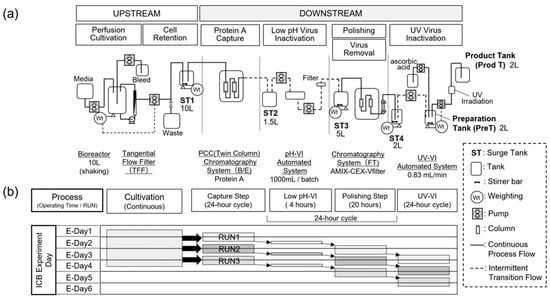
We realized ICB as a hybrid approach, combining continuous upstream processes with cyclical downstream processes by adjusting the time schedule. Our process train comprised a continuous upstream operation (perfusion cultivation and cell separation) and a downstream operation running on a 24 h cycle, which included two-column periodic counter-current chromatography (PCC), automated low-pH virus inactivation, flow-through polishing chromatography, in-line virus filtration, and ultraviolet (UV) virus inactivation. These unit operations were integrated via surge tanks (ST1, ST2, ST3, and ST4). Figure 1a illustrates the process flow of the experimental process train including the surge tanks. The ICB experiment was conducted for 6 days, involving three downstream cycles. The schedule details are shown in Figure 1b.
Figure 1.
Overview of the experimental train and operation. (a) Process flow diagram of the experimental devices with surge tanks and their corresponding inflows and outflows. The continuous flows are shown as solid lines whereas the intermittent flows are shown as dashed lines. (b) Operation schedule for the experiment. The timeline is shown as E-Day 1 to E-Day 6, representing the number of days since the experiment began and encompassing both upstream and downstream operations. The overall process comprises a continuous upstream (cell cultivation) and a downstream operated in 24 h cycles, referred to as runs, including capture chromatography, low-pH virus inactivation, polishing chromatography with virus filtration, and UV virus inactivation. The upstream provides the fluid continuously whereas the downstream stores each day’s output and processes it on the following day.
2.2. Upstream Operations
Recombinant antibody-producing Chinese hamster ovary-derived cells (CHO-MK-CL1008) were cultivated in a 10 L shaking perfusion bioreactor developed by ZACROS (Fujimori Kogyo Co., Ltd., Tokyo, Japan) in cooperation with the Manufacturing Technology Association of Biologics (MAB), our organization in Japan. CHO-MK-CL1008 was constructed from the parental cell line (CHO-MK), which exhibits a significantly shorter doubling time, approximately half that of conventional CHO cells [38], and produced IgG antibody. Gp013.2.3 medium (Fujifilm Wako Pure Chemical Corporation, Osaka, Japan), containing 4 mM L-glutamine, was used for both the basal and perfusion phases. Cell retention was achieved using our custom-made tangential flow filtration (TFF) system from Toray Industries, Inc., Tokyo, Japan which enabled continuous separation of the antibody-containing supernatant from the cell culture. The supernatant, called the harvest, was collected in the surge tank (ST1), serving as the link between upstream and downstream processes. Fresh medium was supplied continuously, while an equal volume was withdrawn as harvest and bleed. The harvest flow rate was adjusted dynamically to keep a constant reactor weight, and the bleed flow containing cells was fixed to maintain stable culture conditions. The collected harvest in ST1 was then transferred to the downstream capture chromatography process.
The perfusion culture process was operated to deliver at least 10 L per day of harvest, containing an antibody concentration of 2 g/L for downstream processing, with a viable cell concentration (VCC) maintained at 7.0 × 10⁷ cells/mL.
2.3. Downstream Operations
The integrated continuous downstream process (ICDSP) was developed by MAB [18]. Each ICDSP unit operation was conducted on a 24 h cycle and connected through surge tanks. Before each new run, operators performed maintenance tasks, such as column washing and replacement, as well as changing plastic bags, bottles, and filters. Liquids processed in each stage were stored in a surge tank for the next step.
2.3.1. Capture Chromatography (Capture Step)
Harvest from ST1 was processed through a two-column capture step using Contichrom CUBE (YMC Co., Ltd., Kyoto, Japan) with 15 mL KANEKA KanCapA 3G resin (KANEKA CORPORATION, Tokyo and Osaka, Japan). The columns functioned in parallel in bind-and-elute mode, switching at predetermined intervals according to the resin binding capacity and harvest monoclonal antibody concentration to align with upstream process conditions. Each cycle was completed within 24 h; this time included the pause for preparations such as column cleaning. Eluate from each run was collected in ST2.
2.3.2. Low-pH Virus Inactivation (Low-pH-VI)
Low-pH viral inactivation was performed using an original automated device developed by ZACROS (Fujimori Kogyo Co., Ltd., Tokyo, Japan) in collaboration with MAB. The device comprises a disposable plastic bag with pH and conductivity sensors on a rocking platform, disposable tubes, and peristaltic pumps for buffers. The automated virus inactivation process was manually initiated after completion of the capture step.
The process began by transferring the capture column eluate from ST2 to the viral inactivation bag, followed by the addition of a buffer rinse to the same bag. Next, 0.1 M hydrochloric acid was introduced to adjust the pH to 3.4, which was maintained for 1 h. Afterward, tris buffer and water were sequentially added to set the appropriate pH and conductivity for polishing chromatography. Once the required levels were reached, the inactivated product was filtered and transferred to ST3. Each stage was initiated automatically according to predetermined time, pH, and conductivity parameters, with the complete virus inactivation process lasting approximately 4 h. After each run, the operator replaced the filter in preparation for the next cycle.
2.3.3. Polishing Chromatography and Virus Removal (Polishing Step)
Polishing chromatography was performed adopting a flow-through process with two sequential 100 mL resins: Cellufine MAX IB and Cellufine DexS-HbP (JNC Corporation, Tokyo, Japan). A 0.001 m2 Planova BioEX virus removal filter (Asahi Kasei Life Science Corporation, Tokyo, Japan) was connected in series with the column train to enable simultaneous chromatography and virus removal.
After virus inactivation, the fluid was transferred to ST3, where the polishing process was manually started. To ensure timely processing of the fluid from low-pH-VI, which was completed within 4 h, the flow rate was adjusted so that polishing would be finished in 20 h, maintaining a 24 h cycle for downstream operations.
2.3.4. Continuous Virus Inactivation Using UV Radiation (UV-VI)
Continuous virus inactivation was performed by passing the process fluid through a tunnel irradiated with UV light-emitting diodes, using a system developed for this purpose. The product stored in ST4 was transferred to the preparation tank (Pre T), where it was mixed with ascorbic acid to protect antibody molecules from potential UV damage. The mixture was then continuously fed into the tunnel, and the final product was collected in the product tank (Prod T), which was replaced with an empty tank at the conclusion of each run.
2.4. Setup of Surge Tanks and Integration of Unit Operations
Surge tanks facilitated the connection of unit operations and integrated them into a continuous process, with manual tasks performed by operators. While the upstream processes operated continuously, the downstream ones operated on a 24 h cycle with units running sequentially. Therefore, the purposes of the surge tanks were different; ST1 primarily served to accommodate process dynamic differences, whereas ST2, ST3, and ST4 provided storage to support cyclical operation. Moreover, the integration of each process into a continuous process required manual initiations for unit processes and maintenance tasks by operators, which should be scheduled within standard working hours (9:00–18:00).
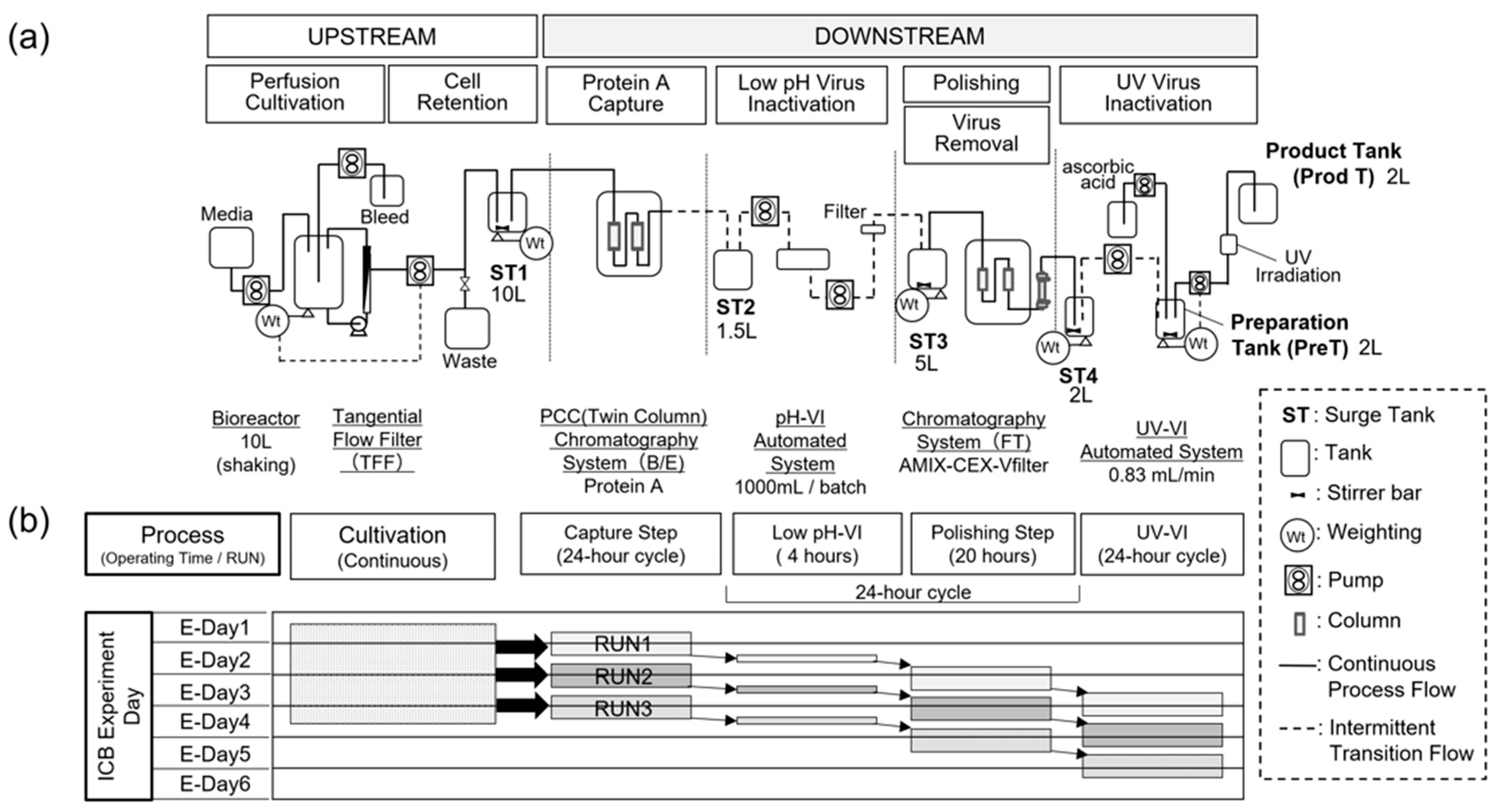
In verifying system robustness and operational feasibility, simulations of each surge tank’s material balance were performed to predict liquid volume changes over time. The material balance was calculated according to the settings of the inflow and outflow rates for each surge tank. The simulation results (see Figure 2) informed the operation strategy, ensuring sufficient surge tank capacity and the timely completion of operator tasks. Note that the flow rate settings and liquid volumes used in the simulations were idealistic examples; in the experiments, the values were set according to the situation.
Figure 2.
Simulation of the liquid volume time course for each surge tank. This simulation is based on the material balance for each surge tank calculated using the planned inflow/outflow rate or volume. The simulation indicated that the manual tasks performed by operators, such as washing columns, replacing filters and bottles, and setting lines, could be conducted within working hours. The operating conditions used in the simulation were design values and not the same as actual operating conditions.
ST1 was positioned between the harvest from TFF (inflow) and the feed to PCC (outflow), but exactly matching the inflow and outflow flow rates was challenging. Additionally, PCC required a maintenance interval following each run. To address the flow rate imbalance in ST1, we planned and simulated a strategy of adjusting the outflow rate for each run based on the surge tank’s liquid level (see Figure 2). In RUN1, the outflow rate (6.5 mL/min) was set lower than the inflow rate (7.0 mL/min) to avoid liquid shortage, causing the volume in ST1 to increase over time. After RUN1 of PCC, a post-run maintenance interval was required. If the harvest continued to be supplied to ST1 without feeding it to PCC, the liquid volume in ST1 would continue to increase. To reduce the increased liquid volume to the target minimum of 500 mL, RUN2 was planned with an outflow rate to PCC (8.8 mL/min) higher than the inflow rate (7.0 mL/min). For the same purpose, RUN3 was set with an outflow rate of 8.3 mL/min and an inflow rate of 7.0 mL/min. Under these conditions, the system appeared to be capable of effective operation. Additionally, the harvest could be redirected to the waste tank (see Figure 1a) to pause its supply to ST1.
In each cycle, ST2 received the PCC eluate from a single run, which was subsequently transferred to the low-pH viral inactivation (VI) step. The fluid in ST3, representing one cycle of low-pH-treated product, was then used in the polishing step. ST4 received the processing fluid from the polishing step along with rinsing buffer for use in the next UV-VI step. Figure 2 shows that the liquid volume in these STs increased or decreased proportionally with the inflow or outflow volume. No changes to the flow rate settings were planned during operation.
Consequently, for ST1, considering the risk of being unable to respond to changes in flow settings during nighttime operation, a 10 L capacity was chosen in accordance with the anticipated daily harvest (10 L) from upstream processes. A 10 L sterilized plastic bottle, equipped with a stirrer, was placed on a weighing scale for this purpose. The volumes of ST2, ST3, and ST4 were determined by estimating the cycle amount of fluid. ST2 (720 mL per run) was a 1 L plastic bag whereas ST3 (910 mL per run) was a 5 L plastic bottle with a stirrer on a weighting scale. For ST4, an initial estimate of 2300 mL per run was later adjusted downward owing to the possibility of reducing the rinsing buffer in the polishing step, and a 2 L glass bottle with a stirrer on a weighing scale was used. All wetted parts, including tubing, were sterilized (reusables by autoclave and disposables by gamma irradiation) and connected aseptically to prevent contamination. Each surge tank was equipped with a vent filter; sterile vent filters with a pore size of 0.2 µm were installed on all tanks except ST4.
3. Results
The experiment was conducted over 6 days, including 4 days of continuous cultivation integrated with downstream processing. During this period, three downstream cycles were completed to process all the harvest provided by the upstream operation. In this study, we examined the function of surge tanks. The following subsections present results related to surge tank performance, focusing on cultivation processes and material balances within the surge tank.
3.1. Cultivation Process
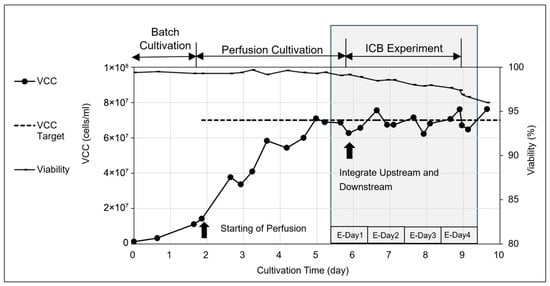
Cultivation was initiated using a batch process with 10 L of medium containing seeding cells (1.28 × 10⁶ cells/mL). The reactor was operated at 37 °C, pH > 6.9, and 50% DO (adjusted to 30% after the fourth day of cultivation), whereas glucose concentrations were controlled between 1 and 2 g/L. After 2 days of batch culture, perfusion was initiated at a medium renewal rate of 2 VVD, which was determined based on a predefined process design. Upon reaching specified conditions (VCC above 7.0 × 10⁷ cells/mL and a product concentration over 2.0 g/L) on the fifth day, harvest fluid was supplied to PCC via ST1. The feed medium was supplied to the bioreactor at approximately 20 L/day (2 VVD). Of this, 10 L/day was directed downstream as cell-free harvest, while the remaining volume was collected in the waste tank as bleed-containing cells. The sixth day marked the beginning of the ICB experiment (E-day1), with the medium renewal rate set to 1.8 VVD. Figure 3 shows that cultivation stayed within the defined parameters during the experiment.
Figure 3.
Time course of viable cell concentration (VCC) and viability in the cultivation. The cultivation started in a batch process with 10 L medium containing seeding cells (1.28 × 10⁶ cells/mL). After 2 days of batch culture, fresh medium was provided to the cells at the same rate as the spent medium removal without cell waste (bleed) in which two vessel volumes per day (VVD) of medium was exchanged. Once the target conditions (VCC: more than 7.0 × 10⁷ cells/mL; product concentration: more than 2.0 g/L) were achieved on the fifth day of cultivation, the experiment of the integrated continuous bioprocessing (ICB) started on the sixth day of cultivation (which was E-Day1: the first day of the experiment). Perfusion cultivation provided the harvest fluid to the downstream process for 3 days at a perfusion rate of 1.8 VVD. Note that the day for cultivation time is the time converted into cumulative time, whereas the experimental day (E-Day) is the actual time.
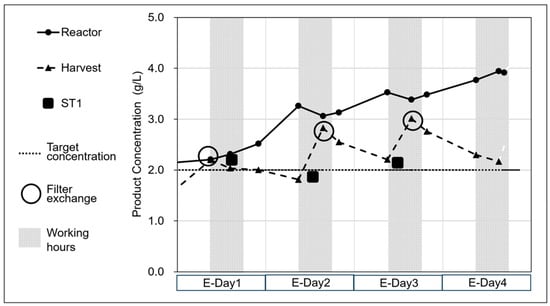
Figure 4 presents the time course of product concentrations in the bioreactor (C1), the TFF filtrate (C2), and ST1 (C3). The concentration in C1 remained above 2 g/L and gradually increased during the experiment. In contrast, the concentration in C2 decreased through membrane fouling in TFF, which reduced antibody transmission over time. To maintain the target concentration, the membrane was replaced, and two parallel TFFs with twice the surface area (relative to RUN1) were used for RUN2 and RUN3. The concentration at C3 was measured only before each run, so variations within each run were not captured.
Figure 4.
Concentration fluctuation of the product (antibody) in the culture medium of the bioreactor (C1), the filtrated fluid (harvest) from the TFF (C2), and the fluid held in ST1 (C3). To improve the transmission of the antibody in the membrane in RUN2 and RUN3, we replaced the TFF membrane with a new one which had twice the surface area as that used in RUN1. This caused fluctuation as shown in C2. The concentration in C3 was measured only prior to the start of each run, so its variation dynamics during the runs remain unclear.
3.2. Integration of the Upstream and Downstream Through ST1
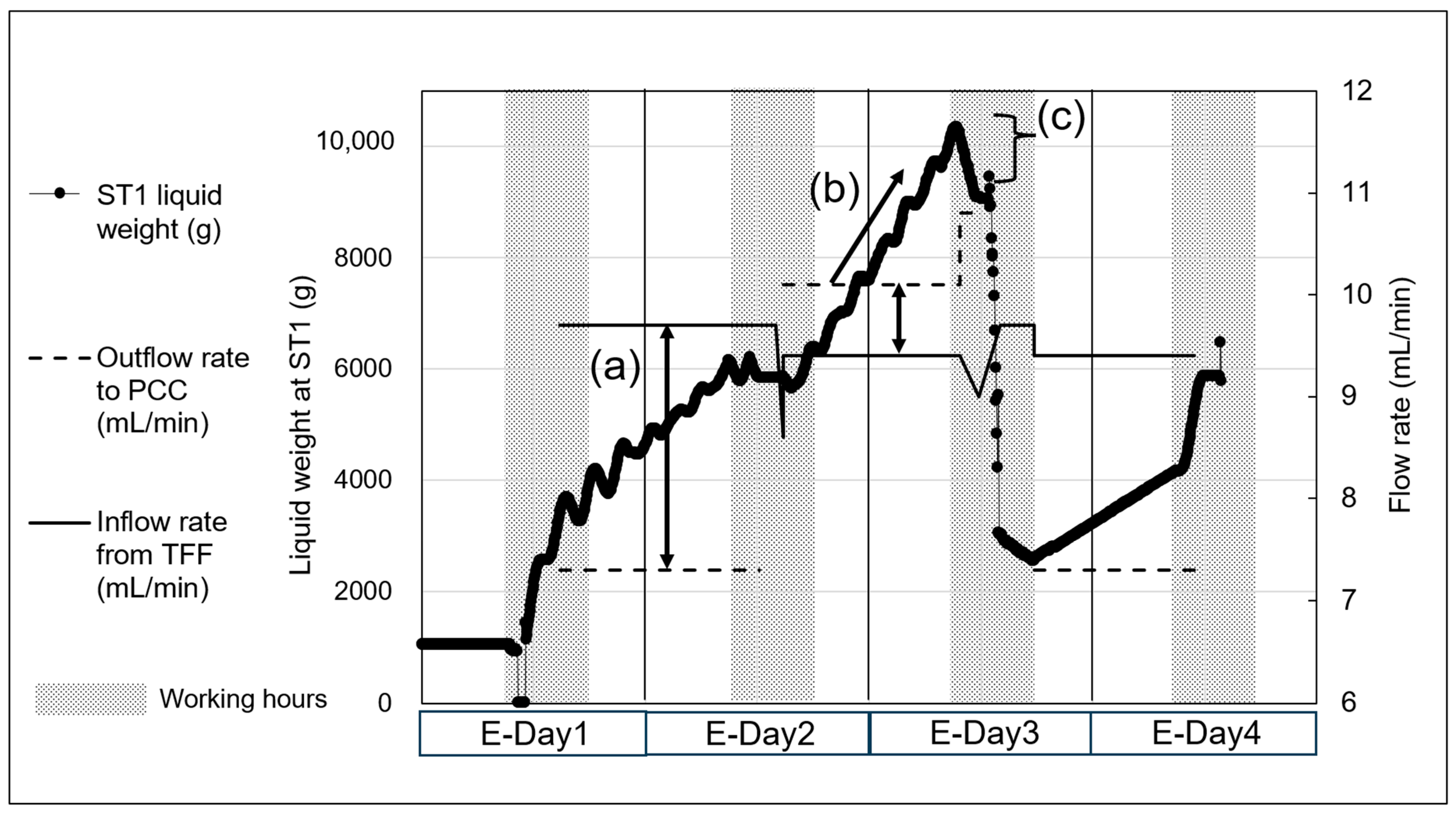
Figure 5 presents the material balance at ST1, showing the time course of liquid weight alongside the target flow rates for inflow and output. The inflow to ST1, identified as the harvest flow, was regulated to sustain a consistent liquid weight in the bioreactor. The inflow and outflow flow rates indicated in Figure 5 are target values; actual measurements were not obtained because no flow meter was available. The inflow volume to the surge tank was predicted to vary only slightly owing to factors such as bioreactor evaporation and the speed of the control system response, whereas the ST1 outflow, corresponding to the load to PCC, was expected to remain constant.
Figure 5.
Material balance in ST1 during the experiment, showing the time course of liquid weight alongside the set inflow and outflow flow rates. The flow rates were not measured in the experiment, and the actual values remain uncertain. The liquid weight profile of ST1 shows unexpected issues that occurred in the experiment. (a) In RUN1, the inflow rate (9.7 mL/min) was set higher than the outflow flow rate (7.5 mL/min) to avoid a liquid shortage, resulting in the planned increase in liquid volume. (b) In RUN2, the outflow flow rate (10 mL/min) was set higher than the inflow flow rate (9.4 mL/min) to accommodate the increased fluid volume in ST1. However, the liquid weight in ST1 continued to rise. (c) By the end of RUN2, ST1 was full, and excess liquid had to be drained.
We aimed to use ST1 as a buffer to balance flow, but as shown in Figure 5, this did not work as expected. In RUN1, the outflow rate (7.5 mL/min) was set below the inflow rate (9.7 mL/min) to prevent liquid shortage, causing the volume in ST1 to rise. In RUN2, outflow (10 mL/min) exceeded inflow (9.4 mL/min) to lower fluid levels, yet ST1 still reached full capacity. Therefore, prior to RUN3, we drained approximately 6 L from ST1. This issue resulted from a PCC problem during RUN2, as the actual load flow to the PCC was less than expected.
One suspected cause of this issue was the presence of air bubbles obstructing flow within the column. These bubbles may have originated from insufficient column cleaning or from external sources, such as air entrained by stirrer-induced agitation. Supporting this claim, air bubbles were detected in the loading line to PCC. In addition, the residence time of the harvest fluid in ST1 increased owing to the higher held volume, raising concerns about potential impacts on product quality.
There was also concern regarding PCC yields, calculated as the total recovered protein divided by the total loaded protein. We determined PCC yields for each run (RUN1: 89%; RUN2: 72%; RUN3: 96%) using only ST1 data collected before each run. However, dynamical concentration changes during a run, possibly caused by TFF fouling and replacement (see Figure 4), may have led to inaccurate PCC yield estimates, as ST1 product concentrations were likely unstable.
3.3. Storage Downstream: ST2, ST3, and ST4
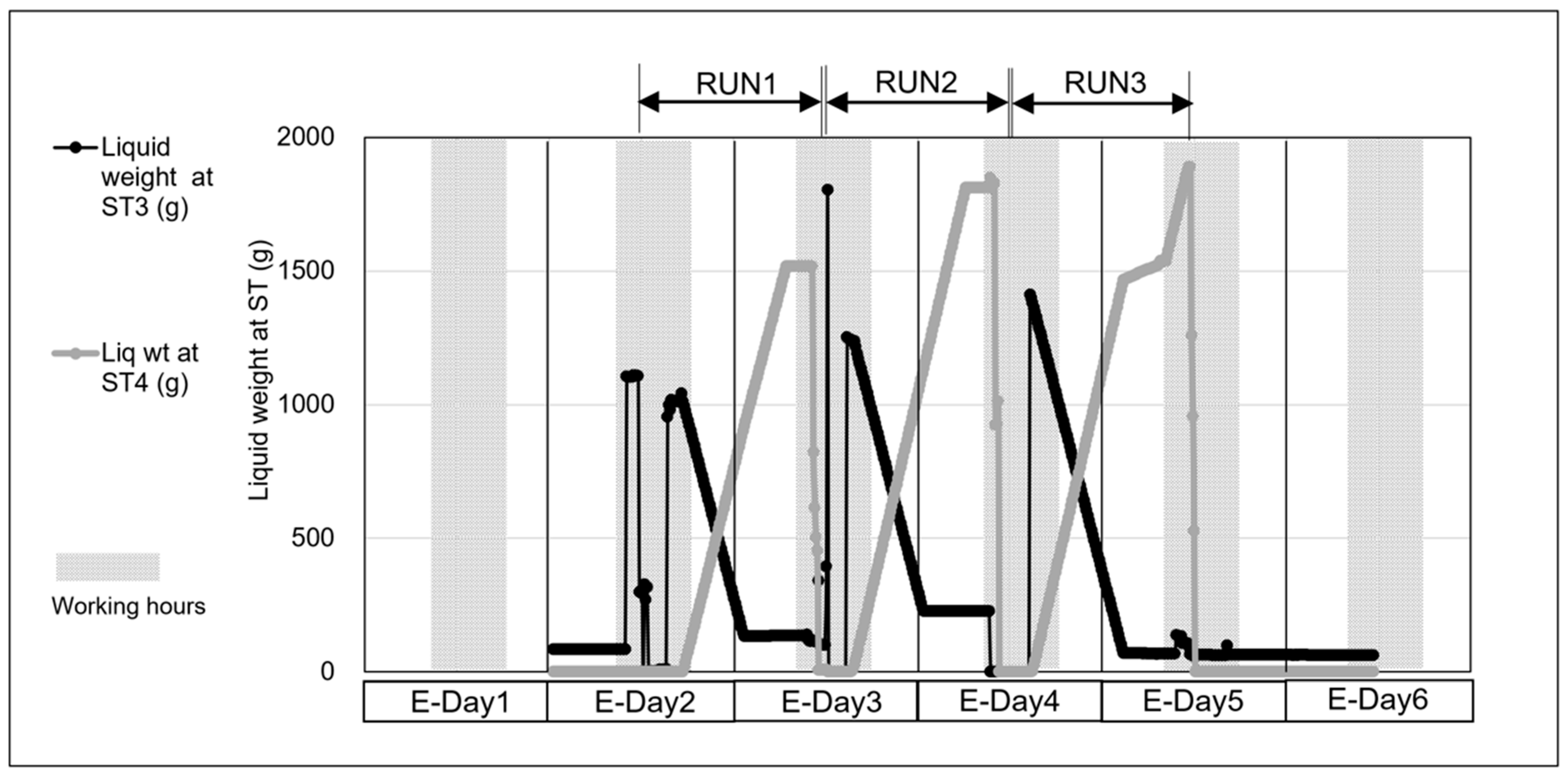
ST2, ST3, and ST4 were installed primarily for storage. Such storage allows a batch process to run continuously in a cycle. The final antibody concentration after purification reached approximately 8 g/L, yielding slightly less than 2 L of the fluid. Figure 6 shows the time course of the fluid weight in ST3 and ST4. (The weight of the fluid was measured in ST3 and ST4, but ST2 had no balance.) The virus inactivation fluid was held in ST3 for one cycle, then transferred to the next step—polishing chromatography and virus removal—after which the processed fluid flowed into ST4. The column rinsing buffer also entered ST4, making the liquid weight there greater than that in ST3. However, the weight in ST4 did not increase steadily as expected in RUN1 and RUN3, which means that there were problems in the operation of the polishing chromatography process. These problems were suspected to relate to the chromatography device setup error in RUN1 and the pump problem due to air bubbles in RUN3.
Figure 6.
Time course of liquid weight in ST3 and ST4. In RUN1 and RUN3, the weight in ST4 did not increase steadily as expected, indicating operational issues in the polishing chromatography process. These problems were attributable to the chromatography device setup error in RUN1 and the pump problem caused by air bubbles in RUN3.
In addition, precipitates were observed in ST3 with stirring during RUN1. Then, during RUN2 and RUN3, stirring was stopped and no precipitates were observed. Therefore, it was suspected that the liquid in contact with air could have caused the precipitation.
4. Discussion
4.1. Visualizing Surge Tank Failure Events
The ICB experiment was conducted successfully; nevertheless, several failures were identified, as previously outlined. Establishing a dependable link between upstream and downstream processes remains critical for the effective deployment of ICB technology. Consequently, a thorough analysis of the failed events at the interface device, specifically ST1 in this study, offers valuable perspectives.
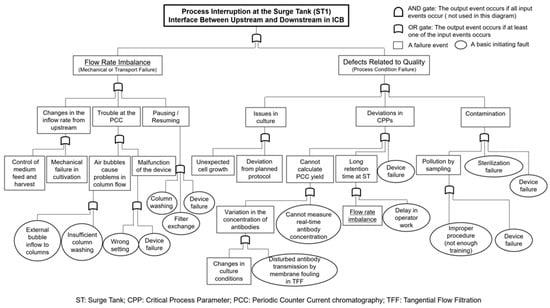
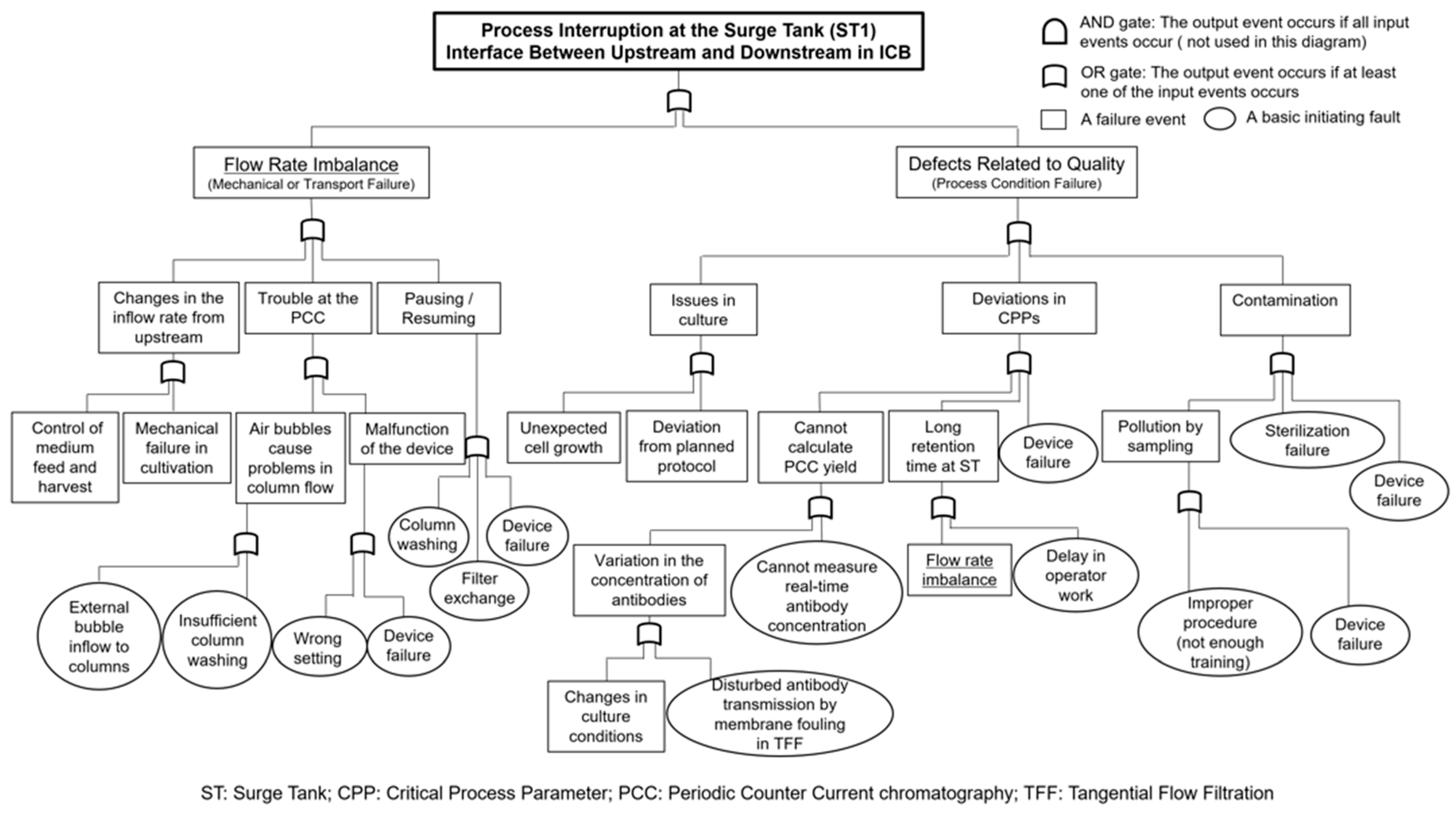
To visualize the key failures identified during the experiment, we employed the fault tree (FT) diagram depicted in Figure 7. An FT serves as a comprehensive visual representation of a system, illustrating the logical relationships between contributing events and their causes leading to failure. This methodology aids in identifying root causes, prioritizing corrective actions, and understanding the interplay between functional and equipment factors in a systematic manner.
Figure 7.
Fault tree diagram showing failure events in the experiment, focusing on the surge tank between the upstream and downstream processes. We set the top event as “Process Interruption at Surge Tank,” with two causal categories: “Flow Rate Imbalance” and “Defects Related to Quality.” Breaking down each event as a cause–effect tree to identify the failure factors, we find “Flow Rate Imbalance” (underlined) in both trees. It is thus a key factor to address in preventing process interruption, which is a critical challenge for making ICB a practical technology.
The development of an FT begins by defining the top event—a specific undesirable outcome resulting from various interactions within the system. The FT is constructed by systematically decomposing this event into causative sub-events or factors at each level. Ultimately, this process leads to the identification of fundamental initiating faults, referred to as basic, terminal, or primary events. Boolean logic gates are used to represent the relationships among different branches within the tree structure.
For this analysis, “Process Interruption at Surge Tank” was set as the top event, with two primary contributory causes identified, “Flow Rate Imbalance” and “Defects Related to Quality”, representing operational and quality perspectives, respectively. Using these visualized factors, in the subsequent section, we discuss identified challenges and proposed solutions for ICB.
4.2. Considerations Associated with the Surge Tanks in ICB
Surge tanks are used to stabilize process conditions by compensating for sudden pressure changes or temporary fluid imbalances. In this study, we examine additional functions of surge tanks within integrated continuous bioprocessing. Using the FT diagram (Figure 7), in the following subsections, we describe the roles of surge tanks in integrating upstream and downstream processes, focusing on aspects of control, function, and sizing considerations along with possible solutions. We also address the considerations for practical application perspectives, for example, scale-up.
4.2.1. Control Perspective
By decomposing each event into a cause–effect tree to identify failure factors, it is evident that “Flow Rate Imbalance” (underlined in Figure 7) appears in both trees, highlighting its importance as a key factor in preventing process interruptions. Addressing this critical issue is essential for making ICB a practical technology. In our experiment, the surge tank positioned between the upstream and downstream processes served as a mechanism to regulate flow disparities. However, the experiment showed that unexpected problems could still arise.
To address such deviations, it is essential that the surge tank’s liquid volume status is effectively communicated to other unit operations. It is difficult to change operational conditions without affecting the culture state and thus judicious to adjust the downstream PCC feed, which can be modified during the bind and elute cycle. One possible approach is to implement a control protocol that allows adjustment of the PCC’s operating parameters, thereby supporting ongoing integration between upstream and downstream units during process fluctuations. To implement this strategy, the liquid level in the surge tank may be designated as the control variable [35]. When the volume surpasses the established operational threshold, the loading volume should be increased accordingly. Conversely, if the volume drops below the specified limit, operations should be temporarily suspended until the required volume is achieved. To achieve this purpose, it is effective to establish a control strategy or control model that accounts for the concentration of antibodies present in the process solution [39].
4.2.2. Dimension Perspective
As shown in Figure 7, one reason for flow rate imbalance is maintenance activities, such as column washing or filter replacement. In this experiment, the washing of columns and replacement of filters were accomplished by holding the fluid in the surge tank. Moreover, the process operation could continue overnight when unexpected issues occurred.
Surge tanks enable brief process stops for maintenance or troubleshooting. Increasing the capacity of a surge tank may extend the allowable pause duration; however, a longer residence time may affect product quality [31,34]. In this experiment, even in RUN2, where the residence time in ST1 was presumed to be longer than in other runs, no significant variation in product quality was observed across different runs. However, when handling different cell lines or antibodies that have different characteristics, such effects may emerge. It is therefore necessary to examine the relationship between residence time and product quality, as well as defining appropriate operating ranges for surge tanks as critical process parameters, which are variables that affect production processes in pharmaceutical manufacturing. When determining the appropriate size for surge tanks, both operational reliability and product quality should be considered.
4.2.3. Function Perspective
As indicated in the FT’s branch related to quality defects, we could not accurately determine the PCC process percentage yield during the experiment. Unit operation yields are crucial for verifying operational integrity and product consistency, and they should thus be recorded in master production records (also referred to as master batch records or master manufacturing formulas) as good manufacturing practice [40]. Throughout the experiment, fluctuations were observed in the product (antibody) concentration in the harvest flow, which serves as the inflow for the surge tank. These fluctuations are likely attributable to changes in culture conditions or fouling in the TFF process. To enable accurate calculation of the percentage yield at the PCC step, it is recommended to implement technology or systems capable of real-time antibody concentration measurement in the surge tank (ST1) located between upstream and downstream operations. At-line protein A high-performance liquid chromatography could be adopted in the integrated continuous antibody production process to adjust capture unit parameters [25,31]. Surge tanks can serve as at-line or in-line analysis points for these technologies.
Alternatively, a potential approach is to implement two or more alternating surge tanks and perform switching operations to address concentration fluctuations. Sencar described a two-surge-tank system designed to homogenize chromatography elution fluid [36]. In this configuration, one tank collects and homogenizes the variable fluid while the other supplies a consistent outflow to the next unit operation at a constant concentration.
The experiment indicated that additional functions may be required for the surge tanks, including ST1. The column issue associated with air bubbles suggests the need to prevent air bubbles from entering subsequent operations, which could involve adjustments in surge tank positioning and tubing arrangement as well as the installation of air release devices such as air taps. Furthermore, the presence of the precipitate at ST3, related to the stirring speed, suggests that an appropriate stirring speed should be selected according to the properties of each fluid.
Moreover, it is necessary to take measures to prevent contamination. Especially, devices handling nutrient-rich fluids, like ST1, are at high risk and require sterilization of liquid-contact surfaces and vent filters. Operator sampling also poses a contamination risk; proper procedures, equipment, and training are essential. In addition, surge tanks should have temperature control devices where required by product or process specifics.
4.2.4. Practical Application Perspective
Scale-up is essential for practical implementation; however, simply increasing the size of surge tanks may introduce risks such as concentration gradients and extended residence times. Conversely, scaling up the bioreactor increases the volume of harvested material supplied to downstream processes. Without a corresponding increase in surge tank capacity, the buffer time available for troubleshooting or maintenance diminishes, potentially compromising process robustness.
On the other hand, continuous manufacturing enables increased production volume by extending the operating time, without the need for equipment scale-up. The presence of surge tanks in the purification process allows for maintenance operations, such as column cleaning, to be performed between runs. As a result, even when upstream cultivation is sustained over an extended period, the downstream purification process can reliably proceed without interruption.
To ensure stable operation of a continuous manufacturing train, it is desirable to establish an integrated automatic control system that enables dynamic interaction between unit operations and holistic management of the entire continuous process. Surge tanks can be utilized to regulate flow balance within a continuous manufacturing train and facilitate the development of an automated control system [41]. In addition, ST1, located between the upstream and downstream processes, handles cell-free fluid and thus serves as a strategic point for implementing Process Analytical Technology (PAT). By incorporating PAT targeting key product quality attributes, it becomes possible not only to adjust operating conditions in downstream unit operations, but also to provide feedback to the upstream cultivation process. Such control systems enhance overall process robustness and contribute to consistent product quality.
In addition, when using cell lines or antibodies with differing characteristics, it may be necessary to implement specific measures within the surge tanks to mitigate potential impacts on product quality. For instance, depending on temperature conditions, the installation of temperature control devices, adjustment of agitation speed, and clear definition of maximum residence time may be required.
Finally, a comparison between batch and continuous processes is presented. In our previous batch process experiments using a different cell line, the main culture and purification process for a 50 L batch typically required one month to complete. In the batch with the highest antibody concentration, 190 g of antibody was obtained (3.8 g/L × 50 L). Assuming the same total amount of antibody is processed using the approach in this experiment, a harvest of 2 g/L × 10 L/day supplied to the purification process and processed cyclically could be completed in approximately two weeks. Furthermore, the equipment footprint was about half that of the batch process. However, medium consumption at 2 VVD, as applied in this experiment, would be approximately 200 L—four times greater than that of the batch process. While ICB offers significant advantages in terms of space efficiency and time reduction, practical implementation requires consideration of cost-saving strategies, such as minimizing medium consumption.
5. Conclusions
In this study, an ICB train was set up using equipment and processes developed by MAB to facilitate the production and purification of a monoclonal antibody. Continuous upstream and periodic downstream operations were connected via surge tanks. Preliminary simulations of material balances in the surge tanks enabled the planning of tank capacities and control procedures, including manual operations, for the full process. A 6-day experiment was subsequently conducted.
There was no interactive control between unit operations during implementation. In supporting continuous operation, a manual control strategy was employed to adjust the PCC loading flow rate according to the liquid volume status at ST1. Air bubbles were suspected to have obstructed the column flow, resulting in reductions in load flow rate and leading to overflow in the surge tank. Moreover, variability in product concentration affected the accuracy of the PCC yield estimates. These experimental issues indicated the need for system-wide control and automation, as well as advanced process monitoring technologies, to make ICB a practical technology. Surge tanks are identified as important components within such systems. Additionally, failure events were reviewed using an FT diagram focusing on the surge tank between upstream and downstream processes, with proposals made regarding control strategies, dimensions, functions, and practical applications.
In this study, we found that surge tanks are essential for integrating unit operations and maintaining stability in the ICB system.
Author Contributions
Conceptualization, M.N.-M. and T.O.; investigation, M.N.-M.; data curation, M.N.-M.; writing—original draft preparation, M.N.-M.; writing—review and editing, T.O. and N.Y.-A. All authors have read and agreed to the published version of the manuscript.
Funding
This research was supported by AMED under grant numbers JP18ae0101056, JP18ae0101057, JP18ae0101058, and JP21ae0121014. M.N. was supported by JST SPRING under grant number JPMJSP2138.
Data Availability Statement
The original contributions presented in this study are included in the article. Further inquiries can be directed to the corresponding author.
Acknowledgments
We thank the study participants, the associate members (S.M., K.K., K.U., Y.K., F.K., M.T., S.Y., H.M., and S.I.), and the staff of Manufacturing Technology Association of Biologics (MAB) for their significant contributions to the study. We also thank the Center for Mathematical Modeling and Data Science, The University of Osaka, for coordinating the joint research with Kikuo Fujita through the program they provide.
Conflicts of Interest
The authors declare that the research was conducted in the absence of any commercial or financial relationships that could be construed as a potential conflict of interest.
References
- Erickson, J.; Baker, J.; Barrett, S.; Brady, C.; Brower, M.; Carbonell, R.; Charlebois, T.; Coffman, J.; Connell-Crowley, L.; Coolbaugh, M.; et al. End-to-End Collaboration to Transform Biopharmaceutical Development and Manufacturing. Biotechnol. Bioeng. 2021, 118, 3302–3312. [Google Scholar] [CrossRef] [Scilit]
- Pollock, J.; Coffman, J.; Ho, S.V.; Farid, S.S. Integrated Continuous Bioprocessing: Economic, Operational, and Environmental Feasibility for Clinical and Commercial Antibody Manufacture. Biotechnol. Prog. 2017, 33, 854–866. [Google Scholar] [CrossRef] [Scilit]
- Yang, O.; Qadan, M.; Ierapetritou, M. Economic Analysis of Batch and Continuous Biopharmaceutical Antibody Production: A Review. J. Pharm. Innov. 2019, 14, 182–200. [Google Scholar] [CrossRef] [Scilit]
- Mahal, H.; Branton, H.; Farid, S.S. End-to-End Continuous Bioprocessing: Impact on Facility Design, Cost of Goods, and Cost of Development for Monoclonal Antibodies. Biotechnol. Bioeng. 2021, 118, 3468–3485. [Google Scholar] [CrossRef] [Scilit]
- Ding, C.; Ardeshna, H.; Gillespie, C.; Ierapetritou, M. Process Design of a Fully Integrated Continuous Biopharmaceutical Process Using Economic and Ecological Impact Assessment. Biotechnol. Bioeng. 2022, 119, 3567–3583. [Google Scholar] [CrossRef] [Scilit] [PubMed]
- Gerzon, G.; Sheng, Y.; Kirkitadze, M. Process Analytical Technologies—Advances in Bioprocess Integration and Future Perspectives. J. Pharm. Biomed. Anal. 2022, 207, 114379. [Google Scholar] [CrossRef] [Scilit] [PubMed]
- Liu, Y.; Zhang, C.; Chen, J.; Fernandez, J.; Vellala, P.; Kulkarni, T.A.; Aguilar, I.; Ritz, D.; Lan, K.; Patel, P.; et al. A Fully Integrated Online Platform For Real Time Monitoring Of Multiple Product Quality Attributes In Biopharmaceutical Processes For Monoclonal Antibody Therapeutics. J. Pharm. Sci. 2022, 111, 358–367. [Google Scholar] [CrossRef] [Scilit] [PubMed]
- Kornecki, M.; Strube, J. Process Analytical Technology for Advanced Process Control in Biologics Manufacturing with the Aid of Macroscopic Kinetic Modeling. Bioengineering 2018, 5, 25. [Google Scholar] [CrossRef] [Scilit]
- Schmidt, A.; Helgers, H.; Lohmann, L.J.; Vetter, F.; Juckers, A.; Mouellef, M.; Zobel-Roos, S.; Strube, J. Process Analytical Technology as Key-Enabler for Digital Twins in Continuous Biomanufacturing. J. Chem. Technol. Biotechnol. 2022, 97, 2336–2346. [Google Scholar] [CrossRef] [Scilit]
- Lee, S.L.; O’Connor, T.F.; Yang, X.; Cruz, C.N.; Chatterjee, S.; Madurawe, R.D.; Moore, C.M.V.; Yu, L.X.; Woodcock, J. Modernizing Pharmaceutical Manufacturing: From Batch to Continuous Production. J. Pharm. Innov. 2015, 10, 191–199. [Google Scholar] [CrossRef] [Scilit]
- International Council for Harmonisation of Technical Requirements for Pharmaceuticals for Human Use (ICH). Guideline Q13 on Continuous Manufacturing of Drug Substances and Drug Products; International Council for Harmonisation of Technical Requirements for Pharmaceuticals for Human Use (ICH): Geneva, Switzerland, 2022. [Google Scholar]
- Konstantinov, K.; Conney, C. White Paper on Continuous Bioprocessing. J. Pharm. Sci. 2014, 104, 813–820. [Google Scholar] [CrossRef] [Scilit]
- Coffman, J.; Brower, M.; Connell-Crowley, L.; Deldari, S.; Farid, S.S.; Horowski, B.; Patil, U.; Pollard, D.; Qadan, M.; Rose, S.; et al. A Common Framework for Integrated and Continuous Biomanufacturing. Biotechnol. Bioeng. 2021, 118, 1721–1735. [Google Scholar] [CrossRef] [Scilit] [PubMed]
- Karst, D.J.; Serra, E.; Villiger, T.K.; Soos, M.; Morbidelli, M. Characterization and Comparison of ATF and TFF in Stirred Bioreactors for Continuous Mammalian Cell Culture Processes. Biochem. Eng. J. 2016, 110, 17–26. [Google Scholar] [CrossRef] [Scilit]
- Khanal, O.; Lenhoff, A.M. Developments and Opportunities in Continuous Biopharmaceutical Manufacturing. MAbs 2021, 13, 1903664. [Google Scholar] [CrossRef] [Scilit] [PubMed]
- Sakaki, A.; Namatame, T.; Nakaya, M.; Omasa, T. Model-Based Control System Design to Manage Process Parameters in Mammalian Cell Culture for Biopharmaceutical Manufacturing. Biotechnol. Bioeng. 2024, 121, 605–617. [Google Scholar] [CrossRef] [Scilit]
- Rathore, A.S.; Kateja, N.; Kumar, D. ScienceDirect Process Integration and Control in Continuous Bioprocessing. Curr. Opin. Chem. Eng. 2018, 22, 18–25. [Google Scholar] [CrossRef] [Scilit]
- Konoike, F.; Taniguchi, M.; Yamamoto, S. Integrated Continuous Downstream Process of Monoclonal Antibody Developed by Converting the Batch Platform Process Based on the Process Characterization. Biotechnol. Bioeng. 2024, 121, 2269–2277. [Google Scholar] [CrossRef] [Scilit]
- MacDonald, M.A.; Nöbel, M.; Roche Recinos, D.; Martínez, V.S.; Schulz, B.L.; Howard, C.B.; Baker, K.; Shave, E.; Lee, Y.Y.; Marcellin, E.; et al. Perfusion Culture of Chinese Hamster Ovary Cells for Bioprocessing Applications. Crit. Rev. Biotechnol. 2022, 42, 1099–1115. [Google Scholar] [CrossRef] [Scilit]
- Kumar, A.; Udugama, I.A.; Gargalo, C.L.; Gernaey, K.V. Why Is Batch Processing Still Dominating the Biologics Landscape? Towards an Integrated Continuous Bioprocessing Alternative. Processes 2020, 8, 1641. [Google Scholar] [CrossRef] [Scilit]
- Narayanan, H.; Sponchioni, M.; Morbidelli, M. Integration and Digitalization in the Manufacturing of Therapeutic Proteins. Chem. Eng. Sci. 2022, 248, 117159. [Google Scholar] [CrossRef] [Scilit]
- Fisher, A.C.; Kamga, M.H.; Agarabi, C.; Brorson, K.; Lee, S.L.; Yoon, S. The Current Scientific and Regulatory Landscape in Advancing Integrated Continuous Biopharmaceutical Manufacturing. Trends Biotechnol. 2019, 37, 253–267. [Google Scholar] [CrossRef] [Scilit]
- Chopda, V.; Gyorgypal, A.; Yang, O.; Singh, R.; Ramachandran, R.; Zhang, H.; Tsilomelekis, G.; Chundawat, S.P.S.; Ierapetritou, M.G. Recent Advances in Integrated Process Analytical Techniques, Modeling, and Control Strategies to Enable Continuous Biomanufacturing of Monoclonal Antibodies. J. Chem. Technol. Biotechnol. 2022, 97, 2317–2335. [Google Scholar] [CrossRef] [Scilit]
- Grampp, G.; Bosley, A.; Qadan, M.; Schiel, J.; Spasoff, A.; Valax, P.; Schaefer, G. Managing Integrated Continuous Bioprocesses in Real Time: Deviations in Product Quality. Biotechnol. Prog. 2024, 40, e3414. [Google Scholar] [CrossRef] [Scilit] [PubMed]
- Feidl, F.; Vogg, S.; Wolf, M.; Podobnik, M.; Ruggeri, C.; Ulmer, N.; Wälchli, R.; Souquet, J.; Broly, H.; Butté, A.; et al. Process-Wide Control and Automation of an Integrated Continuous Manufacturing Platform for Antibodies. Biotechnol. Bioeng. 2020, 117, 1367–1380. [Google Scholar] [CrossRef] [Scilit] [PubMed]
- Santos, R.M.; Kessler, J.M.; Salou, P.; Menezes, J.C.; Peinado, A. Monitoring MAb Cultivations with In-Situ Raman Spectroscopy: The Influence of Spectral Selectivity on Calibration Models and Industrial Use as Reliable PAT Tool. Biotechnol. Prog. 2018, 34, 659–670. [Google Scholar] [CrossRef] [Scilit] [PubMed]
- Webster, T.A.; Hadley, B.C.; Hilliard, W.; Jaques, C.; Mason, C. Development of Generic Raman Models for a GS-KOTM CHO Platform Process. Biotechnol. Prog. 2018, 34, 730–737. [Google Scholar] [CrossRef]
- Mandenius, C.F. Measurement Technologies for Upstream and Downstream Bioprocessing. Processes 2021, 9, 143. [Google Scholar] [CrossRef] [Scilit]
- Rathore, A.S.; Nikita, S.; Thakur, G.; Deore, N. Challenges in Process Control for Continuous Processing for Production of Monoclonal Antibody Products. Curr. Opin. Chem. Eng. 2021, 31, 100671. [Google Scholar] [CrossRef] [Scilit]
- Godawat, R.; Konstantinov, K.; Rohani, M.; Warikoo, V. End-to-End Integrated Fully Continuous Production of Recombinant Monoclonal Antibodies. J. Biotechnol. 2015, 213, 13–19. [Google Scholar] [CrossRef] [Scilit]
- Karst, D.J.; Steinebach, F.; Soos, M.; Morbidelli, M. Process Performance and Product Quality in an Integrated Continuous Antibody Production Process. Biotechnol. Bioeng. 2017, 114, 298–307. [Google Scholar] [CrossRef] [Scilit]
- Kornecki, M.; Schmidt, A.; Lohmann, L.; Huter, M.; Mestmäcker, F.; Klepzig, L.; Mouellef, M.; Zobel-Roos, S.; Strube, J. Accelerating Biomanufacturing by Modeling of Continuous Bioprocessing—Piloting Case Study of Monoclonal Antibody Manufacturing. Processes 2019, 7, 495. [Google Scholar] [CrossRef] [Scilit]
- Steinebach, F.; Ulmer, N.; Wolf, M.; Decker, L.; Schneider, V.; Wälchli, R.; Karst, D.; Souquet, J.; Morbidelli, M. Design and Operation of a Continuous Integrated Monoclonal Antibody Production Process. Biotechnol. Prog. 2017, 33, 1303–1313. [Google Scholar] [CrossRef] [Scilit] [PubMed]
- Coolbaugh, M.J.; Varner, C.T.; Vetter, T.A.; Davenport, E.K.; Bouchard, B.; Fiadeiro, M.; Tugcu, N.; Walther, J.; Patil, R.; Brower, K. Pilot-Scale Demonstration of an End-to-End Integrated and Continuous Biomanufacturing Process. Biotechnol. Bioeng. 2021, 118, 3287–3301. [Google Scholar] [CrossRef] [Scilit] [PubMed]
- Gomis-Fons, J.; Schwarz, H.; Zhang, L.; Andersson, N.; Nilsson, B.; Castan, A.; Solbrand, A.; Stevenson, J.; Chotteau, V. Model-Based Design and Control of a Small-Scale Integrated Continuous End-to-End MAb Platform. Biotechnol. Prog. 2020, 36, e2995. [Google Scholar] [CrossRef] [Scilit]
- Sencar, J.; Hammerschmidt, N.; Jungbauer, A. Modeling the Residence Time Distribution of Integrated Continuous Bioprocesses. Biotechnol. J. 2020, 15, e2000008. [Google Scholar] [CrossRef] [Scilit]
- Thakur, G.; Saxena, N.; Tiwari, A.; Rathore, A.S. Control of Surge Tanks for Continuous Manufacturing of Monoclonal Antibodies. Biotechnol. Bioeng. 2021, 118, 1913–1931. [Google Scholar] [CrossRef] [Scilit]
- Masuda, K.; Kubota, M.; Nakazawa, Y.; Iwama, C.; Watanabe, K.; Ishikawa, N.; Tanabe, Y.; Kono, S.; Tanemura, H.; Takahashi, S.; et al. Establishment of a Novel Cell Line, CHO-MK, Derived from Chinese Hamster Ovary Tissues for Biologics Manufacturing. J. Biosci. Bioeng. 2024, 137, 471–479. [Google Scholar] [CrossRef] [Scilit]
- Löfgren, A.; Gomis-Fons, J.; Andersson, N.; Nilsson, B.; Berghard, L.; Lagerquist Hägglund, C. An Integrated Continuous Downstream Process with Real-Time Control: A Case Study with Periodic Countercurrent Chromatography and Continuous Virus Inactivation. Biotechnol. Bioeng. 2021, 118, 1664–1676. [Google Scholar] [CrossRef] [Scilit]
- International Council for Harmonisation of Technical Requirements for Pharmaceuti-cals for Human Use. Good Manufacturing Practice Guide for Active Pharmaceutical Ingredients; International Council for Harmonisation of Technical Requirements for Pharmaceuticals for Human Use (ICH): Geneva, Switzerland, 2000. [Google Scholar]
- Rathore, A.S.; Thakur, G.; Saxena, N.; Tiwari, A. Surge Tank Based System for Controlling Surge Tanks Automation Control Continuous Manufacturing Train. U.S. Patent Application US17/395,510, 31 August 2021. [Google Scholar]
Disclaimer/Publisher’s Note: The statements, opinions and data contained in all publications are solely those of the individual author(s) and contributor(s) and not of MDPI and/or the editor(s). MDPI and/or the editor(s) disclaim responsibility for any injury to people or property resulting from any ideas, methods, instructions or products referred to in the content. |
© 2025 by the authors. Licensee MDPI, Basel, Switzerland. This article is an open access article distributed under the terms and conditions of the Creative Commons Attribution (CC BY) license (https://creativecommons.org/licenses/by/4.0/).