Abstract
Cobalt–molybdenum -carbides are attractive hydrodesulfurization (HDS) catalysts, yet controlling their phase composition and nanostructure remains challenging. Here, a powder was prepared by mechanical alloying in a horizontal mill, with and without superimposed vertical vibration. Phase composition was determined by X-ray diffraction using the reference-intensity-ratio method, and the nanostructure was examined by SEM and HRTEM. Aquathermolysis of a heavy crude was monitored by ATR-FTIR in the window characteristic of S–S and C–S vibrations. Both milling routes produced the -carbides C and C, as well as , , and C; vibration-assisted milling increased the C fraction and generated thin lamellae exhibiting Moiré contrast. In FTIR, the C-rich powder showed strong attenuation of the disulfide and thioether bands, whereas the C-rich powder behaved similarly to the water-only baseline under mild conditions (100 °C, 4 h). These results indicate that mechanical alloying with superposed vibration enables control over phase and nanostructure, and that a higher C fraction correlates with a stronger HDS response under aquathermolysis. The approach offers a scalable route to Co–Mo carbides that are active for desulfurization at 100 °C in water without added .
1. Introduction
Transition metal carbides (TMCs) are now widely used in science and industry, supported by increasingly mature, scalable nanostructure fabrication methods. Over the last four decades, many new structures, decomposition pathways, and properties have been discovered or predicted. Key attributes include high hardness, electronic behavior governed by bonding, and chemical stability that depends on particle size. As a result, TMCs act as effective catalysts in a broad set of reactions, including hydrogen-related processes [1]. Within this family, the -carbides (for example, C and C) show clear crystal chemistry and relations between structure and properties that are established crystallographically [2].
Catalytic studies on TMCs span several reactions. In ammonia synthesis, composition and temperature, rather than crystal structure, were identified as the most influential variables. Cobalt and carbon play central roles through exchange between carbon and nitrogen. In that context, C showed limited activity until it transformed into N at 500 °C [3]. For methane decomposition, cobalt and molybdenum -carbides have also been reported as active phases [4]. In parallel, chemical routes followed by heat treatment have produced (Co, Mo, W) carbide nanoparticles, whose distinction between C and C can only be resolved using high-resolution imaging [5].
This carbide family is also relevant to catalytic aquathermolysis, a pretreatment step before hydrodesulfurization (HDS) of heavy and extra-heavy crude oils aimed at lowering viscosity and improving mobility during extraction. These hydrocarbons often contain high levels of sulfur-bearing compounds and other species that increase density and viscosity. Typical sulfur contents in heavy crudes range from 0.5 to 2 wt%, and extra heavy crudes exceed 2 wt%. Specific systems, including some from the Gulf of Mexico, may reach even higher values. The main target molecules are disulfides and thioethers, which are linked to high viscosity and handling issues in production pipelines [6,7,8,9,10,11,12,13,14,15,16,17].
Conventional HDS typically operates at 300–500 °C using supported sulfides or noble metal catalysts [18,19,20,21]. Pretreatments that can be applied on site, such as catalytic aquathermolysis, therefore require sulfur-tolerant catalysts that remain active under much milder conditions. TMCs are compelling in this role because they can display hydrogenation and hydrogenolysis similar to noble metals while resisting sulfur poisoning [1]. Within TMCs, cobalt and molybdenum -carbides (C and C) combine extended metal and carbon frameworks with the well-known synergy between cobalt and molybdenum in desulfurization chemistry. These features provide interfacial sites that promote cleavage of carbon–sulfur and sulfur–sulfur bonds under aquathermolysis [2]. With this in mind, we synthesized Co–Mo–C -carbides by mechanical alloying, a scalable, support-free route that generates defect rich lamellar nanostructures with high accessible surface area, and evaluated their performance under mild aquathermolysis [22].
Related catalyst designs further motivate this approach. Unsupported nanostructured TMCs such as NiWMoC made by mechanical alloying have shown catalytic activity at relatively low temperatures, with morphology and defect chemistry playing key roles [22]. Additional formulations include carbon-supported sulfides and molecular or coordination strategies to remove sulfur-bearing species [23,24].
Carbon nanostructures and hybrids have also been explored to enhance HDS through improved conductivity, dispersion, and interfacial engineering. Examples include graphene-based supports, metal and carbon systems, and graphene and hybrids, as well as low-temperature plasma routes and mesoporous oxides modified with graphene. Several reviews summarize these methods and applications [25,26,27,28,29,30,31,32]. At the nanoscale, stacked or twisted lamellae can show Moiré interference patterns, a signature of local misorientation or registry that may indicate stacking defect evolution [33]. The HDS literature often contrasts cobalt and molybdenum catalysts on carbon supports with alumina supported analogues, revealing notable activity trends [34].
In view of these considerations, and the long-standing observation that catalysts containing cobalt, molybdenum, and carbon show high activity and strong performance in HDS, this work examines the mechanical milling of the system. Our aim is to identify processing conditions that yield nanostructured -carbides (C and C) and to assess whether these nanostructures can be used for the desulfurization of heavy and extra-heavy crude oils.
2. Materials and Methods
2.1. Materials
Graphite (C), cobalt (Co), and molybdenum (Mo) powders (all from Sigma-Aldrich (Merck KGaA), St. Louis, MO, USA) were used as received. Graphite (99.99% purity) had an average particle size µm, molybdenum powder (99.8% purity) had a particle size of 1 to 5 µm, and cobalt powder (99.8% purity) had a particle size µm.
2.2. Powder Preparation and Mechanical Alloying
A 40 g batch with overall composition (50 wt% C, 25 wt% Co, 25 wt% Mo) was blended and mechanically alloyed in a high-speed horizontal ball mill operated at 400 rpm. To increase the specific kinetic energy of the media, the axis of one roller was offset by 0.7 mm to add a vertical vibration with a velocity amplitude of 13.2 mm . The powder blend was loaded into a stainless steel container together with stainless steel balls of two diameters, 1/4 in (6.35 mm) and 3/8 in (9.53 mm), using a ball-to-powder mass ratio (BPR) of 10:1. Typical individual ball masses were ∼1.04 g and ∼3.51 g. The loaded container was transferred to a glove box, evacuated, and backfilled with high-purity argon to minimize oxidation and contamination.
Two processing configurations were used and are referred to as M1 and M2 throughout:
- M1: horizontal milling at 400 rpm for 26 h with no added vibration.
- M2: same base conditions (400 rpm, 26 h) with the added vertical vibration described above (velocity amplitude 13.2 mm from the 0.7 mm axis offset).
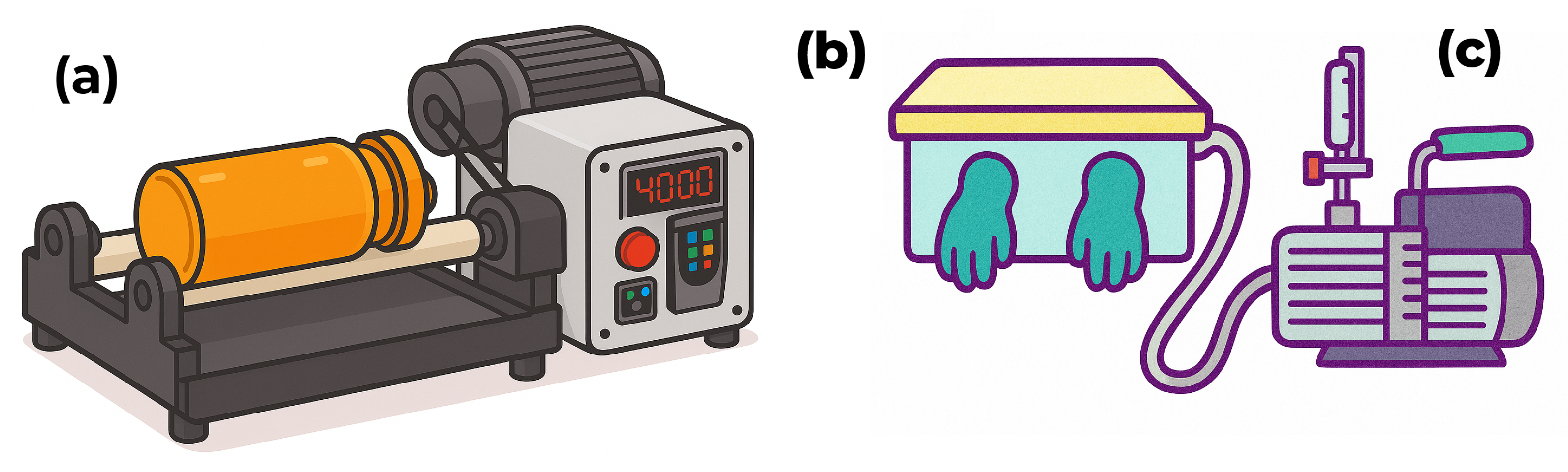
Figure 1 shows the main equipment used.
Figure 1.
(a) High-speed horizontal ball mill, (b) glove box, and (c) vacuum pump used during processing.
2.3. X-Ray Diffraction (Phase Analysis)
Phase analysis was performed using a D8 Discover diffractometer (Bruker AXS GmbH, Karlsruhe, Germany) with Cu K radiation ( Å). Data were collected over at a scan rate of . Phase identification used PCPDFWIN 2.0 (ICDD PDF-2, 2003; International Centre for Diffraction Data, Newtown Square, PA, USA). Where indicated in the Results (Table 1 and Table 2), phase fractions were estimated semi-quantitatively by the reference-intensity-ratio (RIR) method [35,36].
Table 1.
Phase composition of the system milled for 26 h in a horizontal mill at 400 rpm (sample M1).
Table 2.
Phase composition of the system milled for 26 h at 400 rpm with vibration assisted milling (sample M2).
2.4. Electron Microscopy
Morphology was examined by field emission scanning electron microscopy (FE-SEM; JEOL JSM-6701F, JEOL Ltd., Tokyo, Japan) at 5 kV with a beam current of 0.60 nA and a working distance of 5.4 to 7.7 mm in secondary electron mode. Energy dispersive X-ray spectroscopy (EDS) spectra were collected in area mode (full frame region of interest) unless noted otherwise.
Transmission electron microscopy (TEM) was performed with a TITAN 80-300, FEI (Thermo Fisher Scientific), Hillsboro, OR, USA, operated at 200 kV (point resolution 1.9 Å). Bright-field TEM (BF-TEM) and high-resolution TEM (HRTEM) images were acquired at 200 kV. Interplanar spacings (d-spacings) were measured from lattice fringes using Gatan DigitalMicrograph v3.4, Gatan Inc., Pleasanton, CA, USA, with the microscope calibration stored in the image metadata.
2.5. Aquathermolysis Experiments and ATR-FTIR
To evaluate desulfurization related reactivity under mild aqueous thermolysis (aquathermolysis) conditions, oil in water emulsions were prepared and thermally treated in a water bath reactor. Equal masses of distilled water and a heavy crude oil (initial sulfur content 1.7 wt%) were dispensed into 100 mL stainless steel beakers. Catalyst was added at 1 wt% relative to the total mass of water plus crude. A control sample containing only crude and water (no catalyst) was also prepared. Beakers were placed in a Rite Hete Round Melting Pot (quart capacity) equipped with a modified steel lid to limit uncontrolled vapor release and a thermocouple port for temperature monitoring. Samples were heated by steam, with beakers resting on an aluminum stand above distilled water, at 50 °C and 100 °C for 4 h in parallel. The 50 °C experiments did not yield measurable changes in the sulfur related FTIR bands and are not discussed further.
After treatment, samples were analyzed by attenuated total reflectance Fourier transform infrared spectroscopy (ATR-FTIR) using a Spectrum Two, PerkinElmer Inc., Waltham, MA, USA; ZnSe crystal. Spectra were collected over 4000 to 650 cm−1 with acquisition times of 2, 5, and 10 s. For clarity in the Results, samples are labeled Only Water (water + crude, no catalyst), Water + M1 (water + crude with M1 at 1 wt%), and Water + M2 (water + crude with M2 at 1 wt%).
3. Results and Discussion
3.1. X-Ray Diffraction
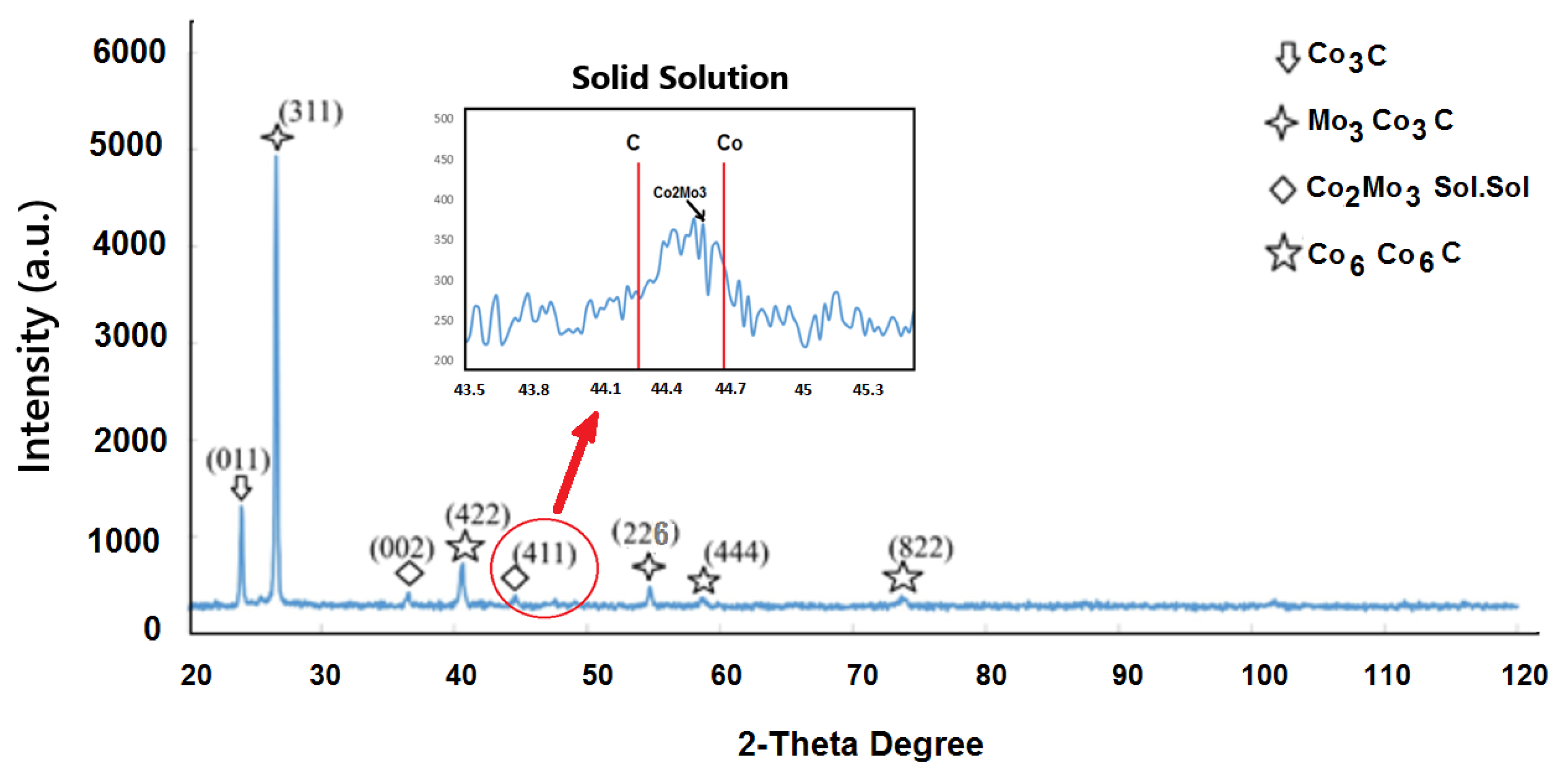
XRD patterns of the starting elemental powders (graphite, Mo, and Co) are provided in the Supplementary Materials (Figures S1–S3). Figure 2 shows the XRD pattern of after 26 h of milling in a horizontal mill at 400 rpm. The pattern can be indexed to tetragonal , orthorhombic C, and the cubic (diamond-type) -carbides C and C, which adopt the space group characteristic of the -carbide family [37]. Mechanical alloying is a nonequilibrium process and is known to promote solid-state diffusion, intercalation, and defect-assisted reactions that favor carbide formation [38]. Phase fractions estimated by the reference-intensity-ratio (RIR) method, along with refined lattice parameters and space groups, are summarized in Table 1 [35,36]. For clarity, we refer to this horizontally milled specimen as M1 (horizontal milling, 400 rpm, 26 h; no added vibration). The data indicate that milling at 400 rpm for 26 h promotes -carbide formation, with C as the majority phase, while and C remain minority constituents.
Figure 2.
X-ray diffraction pattern of the system milled in a horizontal rotary mill at 400 rpm for 26 h (sample M1, no vibration).
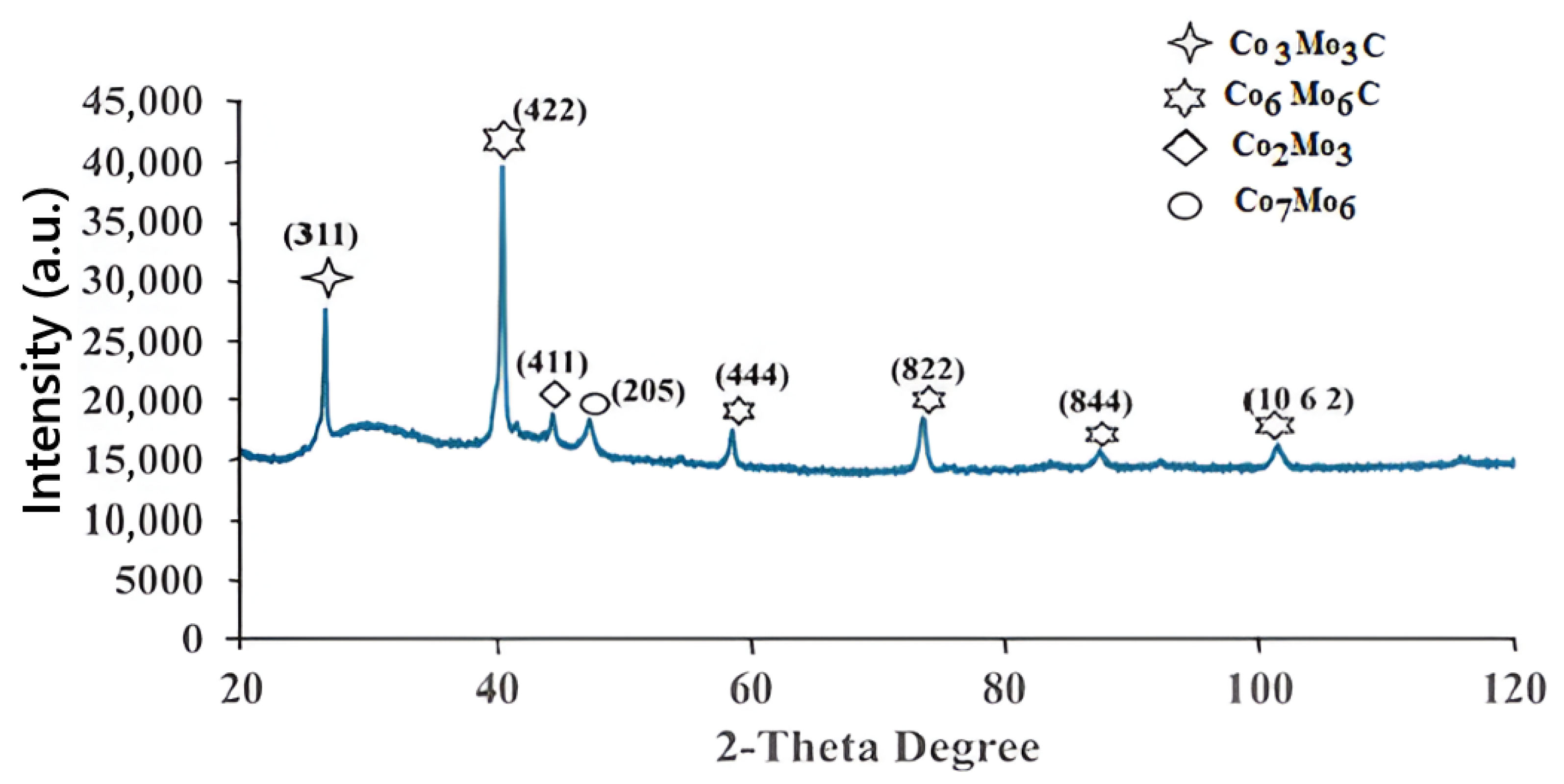
A second 26 h milling run was performed at the same rotational speed using vibration-assisted milling (superimposed vertical vibration; vibration velocity amplitude 13.2 mm ). The resulting pattern in Figure 3 is dominated by the -carbides (C), with peaks at °, 32.9°, 35.9°, 40.5° (strongest), 47.1°, to 59.6°, and to 74.1° (Cu K). The weak peaks that do not belong to the -carbides occur at ° (, ) and 46.4 to 46.6° (, ), and no distinct C reflections are resolved above background in M2. We refer to this vibration-assisted specimen as M2 (horizontal milling with superimposed vertical vibration, 400 rpm, 26 h; velocity amplitude 13.2 mm ). Comparison of Figure 2 and Figure 3 shows the effect of the added vibration in enhancing mechanical activation, consistent with higher defect density and faster solid-state reactions during milling [38]. A quantitative comparison is provided in Table 2 [35,36]. This behavior suggests a change from a regime dominated by attrition (rolling) in M1 to a mixed impact-and-attrition regime in M2, caused by the added vibration, which increases collision frequency and the normal component of impacts, thereby raising defect density and accelerating the reaction rate [38,39].
Figure 3.
X-ray diffraction pattern of the system milled for 26 h at 400 rpm with vibration-assisted milling (superimposed vertical vibration; vibration velocity amplitude 13.2 mm ) (sample M2).
In the M2 pattern (Figure 3), the phases identified are tetragonal , rhombohedral , and the two cubic -carbides C and C, with C being the most abundant. The RIR-based fractions are summarized in Table 2 [35,36]. Relative to M1, the added vibrational energy increases C, decreases C, and suppresses C. The emergence of at higher mechanical activation, together with the persistence or reformation of , is consistent with defect-assisted diffusion and reaction pathways. Notably, Alshibane et al. reported a C → C transformation upon heating, attributed to carbon removal and defect generation; the nonequilibrium milling here aligns with that picture [4].
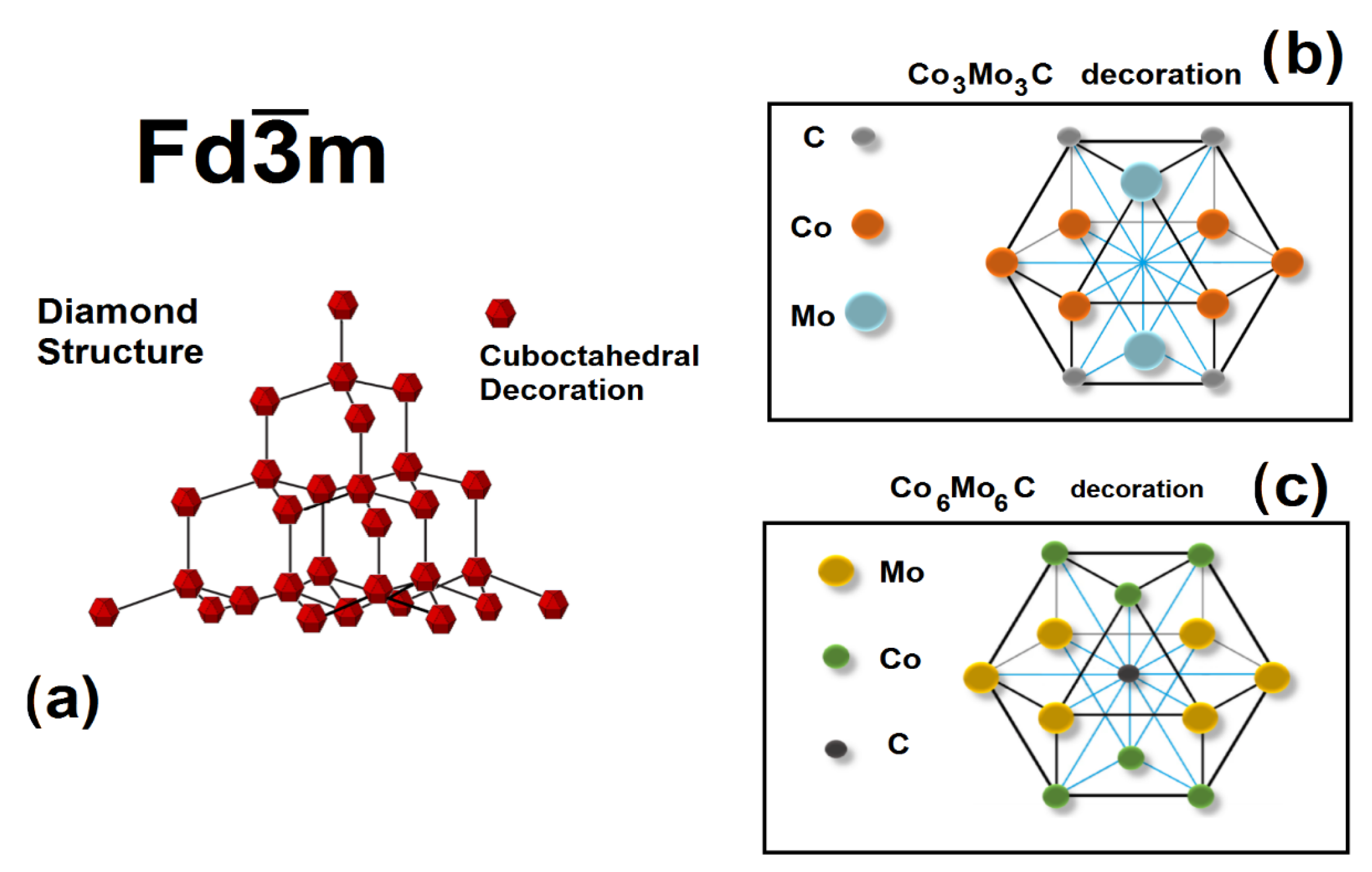
The schematic in Figure 4 follows published crystallographic descriptions for (No. 227) [2,37]. In Figure 4b,c, the distribution of chemical species differs between the two -carbides, which helps explain their different energetic requirements. For C (Figure 4b), the interior of the cuboctahedral decoration is vacant in the schematic. Read in layers, the first layer shows molybdenum coordinated to carbon, the second shows cobalt, and the third again shows Mo–C coordination. In contrast, for C (Figure 4c), the interior of the cuboctahedral motif contains carbon surrounded by metals. This suggests that carbon diffusion into the lattice during milling can facilitate metal rearrangements and the C → C transformation when sufficient mechanical energy is supplied, since mechanical alloying promotes deformation, intercalation, and enhanced solid-state solubility [38]. To favor C without excessive milling times, which increase wear of the stainless-steel vial and balls and risk Fe, Cr, and Ni pickup, we used two horizontal milling configurations (with and without superimposed vibration) at the same base speed and avoided very high-energy mills. Phase fractions were estimated semi-quantitatively using the RIR method [35,36].
Figure 4.
Space group (No. 227): (a) crystal framework with cuboctahedral decoration; (b) structural motif for C; (c) decoration for C.
3.2. Scanning Electron Microscopy (SEM)
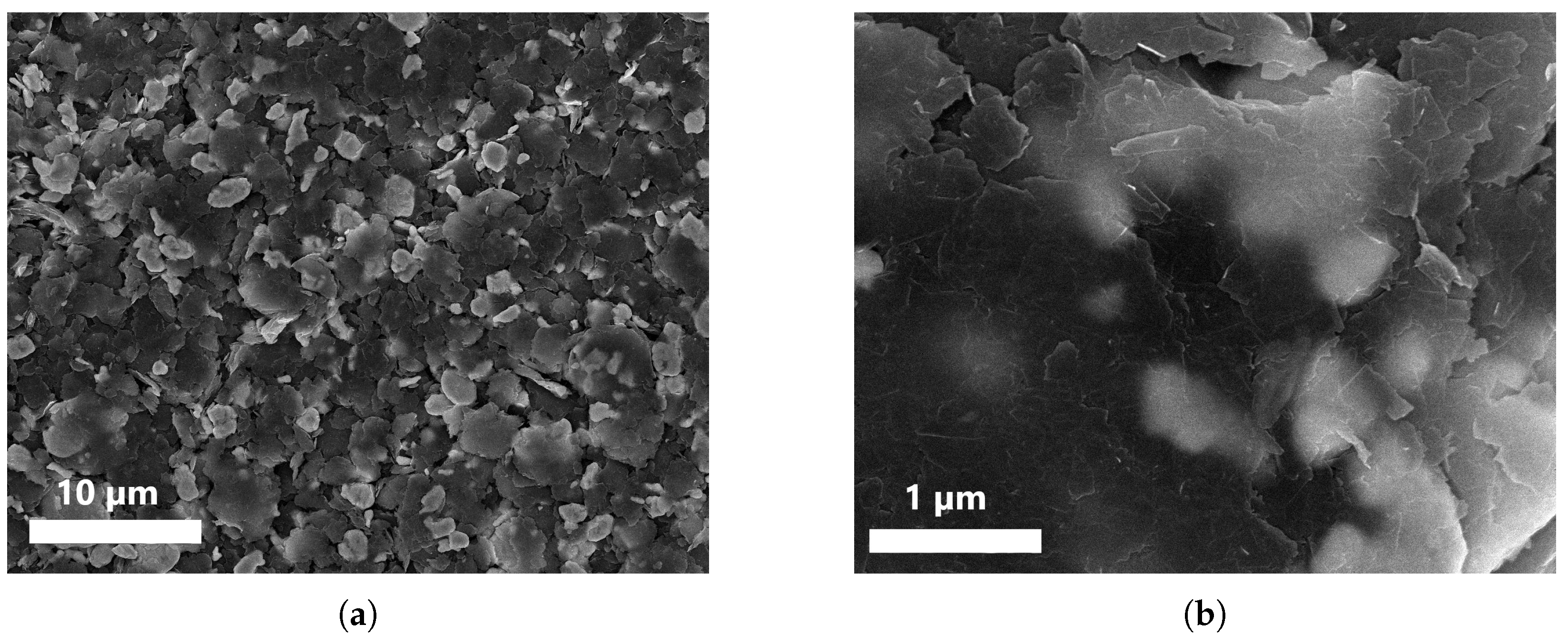
SEM images of the starting elemental powders (Co, C, and Mo) are provided in the Supplementary Materials (Figure S4a–c). Figure 5 summarizes the morphology of the milled powders obtained under vibration-assisted milling (sample M2). At lower magnification (Figure 5a), the material consists of flake-like aggregates formed by successive cold welding and fracture during ball–powder–vial impacts. The higher-magnification view (Figure 5b) resolves stacks of thin lamellae and small fragments decorating the platelets, consistent with enhanced fragmentation and layer sliding promoted by the superposed vibration. Acquisition parameters are detailed in Section 2 (Electron microscopy).
Figure 5.
Sample M2: SEM morphology after 26 h of vibration assisted milling. (a) Low-magnification view showing a flake-dominated powder formed by repeated cold welding and fracture (scale bar: 10 µm). (b) Higher-magnification view resolving stacked lamellae and small fragments on the platelets, consistent with enhanced fragmentation and layer sliding (scale bar: 1 µm).
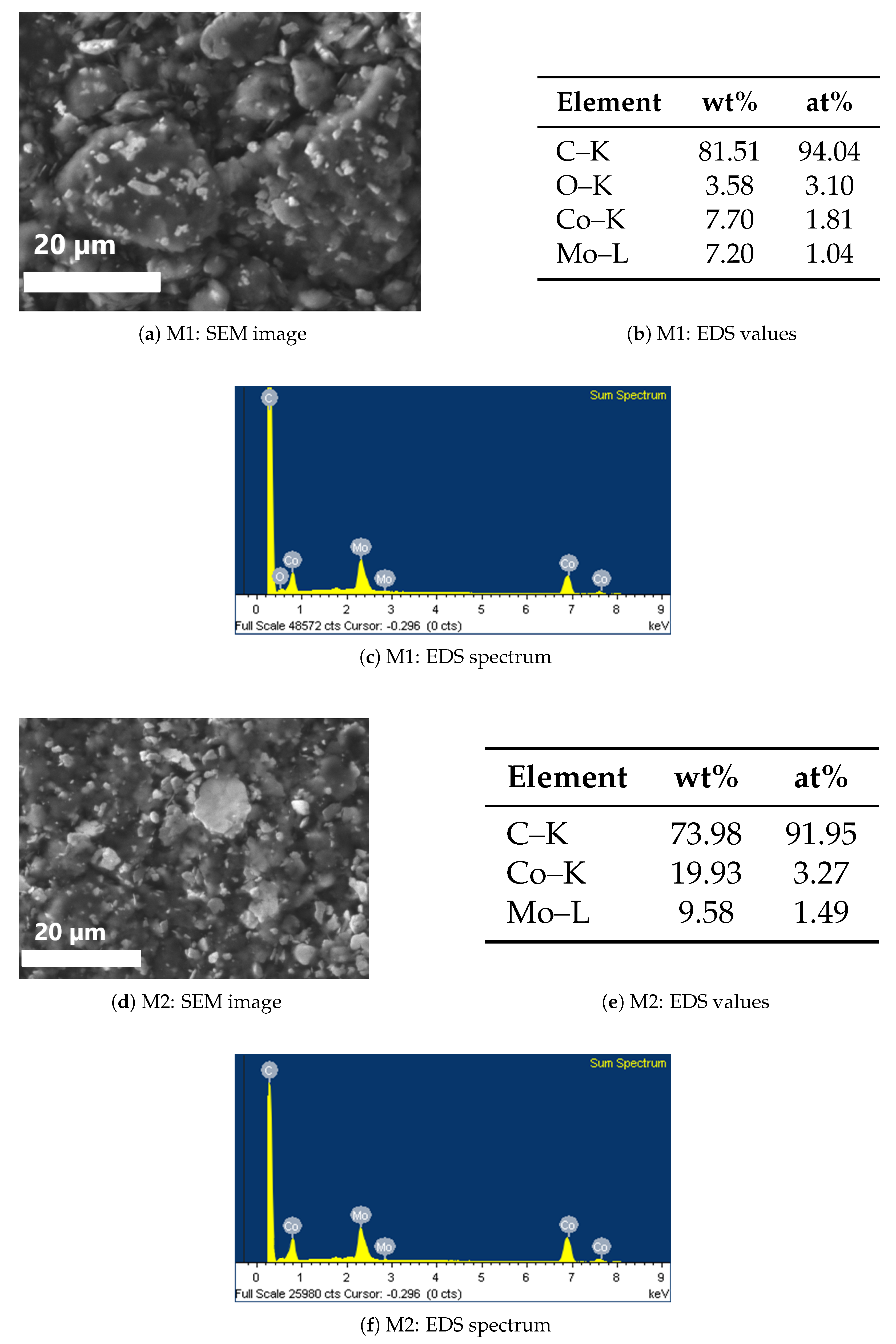
Local composition was assessed by SEM–EDS on representative fields (Figure 6). The EDS spectra in Figure 6c and Figure 6f were acquired in area mode, integrating over the full SEM frames shown in Figure 6a and Figure 6d, respectively. For M1 (Figure 6a–c), the semi-quantitative analysis indicates a carbon-rich matrix with minor cobalt and molybdenum and a small oxygen signal (C 81.51 wt%/94.04 at%; O 3.58 wt%/3.10 at%; Co 7.70 wt%/1.81 at%; Mo 7.20 wt%/1.04 at%), likely due to superficial oxidation or adsorbed species upon air exposure. For M2 (Figure 6d–f), higher relative metal contents are measured (C 73.98 wt%/91.95 at%; Co 19.93 wt%/3.27 at%; Mo 9.58 wt%/1.49 at%), consistent with more intimate mixing between metallic and carbonaceous constituents under vibration-assisted conditions. Given the powders’ rough, porous surfaces and the low accelerating voltage used (see Section 2), the EDS values are interpreted comparatively rather than absolutely.
Figure 6.
SEM and EDS characterization of mechanically alloyed . (a–c) Sample M1: SEM micrograph, semi-quantitative EDS composition (wt% and at%), and the corresponding spectrum integrated over the full field of view shown in (a). (d–f) Sample M2: analogous SEM image, EDS table, and spectrum integrated over the full field of view shown in (d).
To remove the effect of carbon on the ratios, we normalized Co and Mo to their sum (Co + Mo). In M1, Co/(Co + Mo) is ∼0.52 by weight and ∼0.64 by atom (Co/Mo ≈ 1.07 wt and 1.74 at), whereas in M2 it increases to ∼0.68 by weight and ∼0.69 by atom (Co/Mo ≈ 2.08 wt and 2.19 at). The larger cobalt share in M2 is consistent with (1) preferential exposure of lamellae terminated by Co at the probed surface; (2) Co rich intermetallic fragments (e.g., ; see Table 2); and (3) field of view heterogeneity inherent to mechanically alloyed powders. Conversely, the higher C/(Co + Mo) atomic ratio in M1 [C/(Co + Mo) ≈ 33] relative to M2 [C/(Co + Mo) ≈ 19] indicates a larger fraction of carbon matrix with respect to exposed metals in the probed regions, consistent with a less advanced mixing and alloying stage for M1.
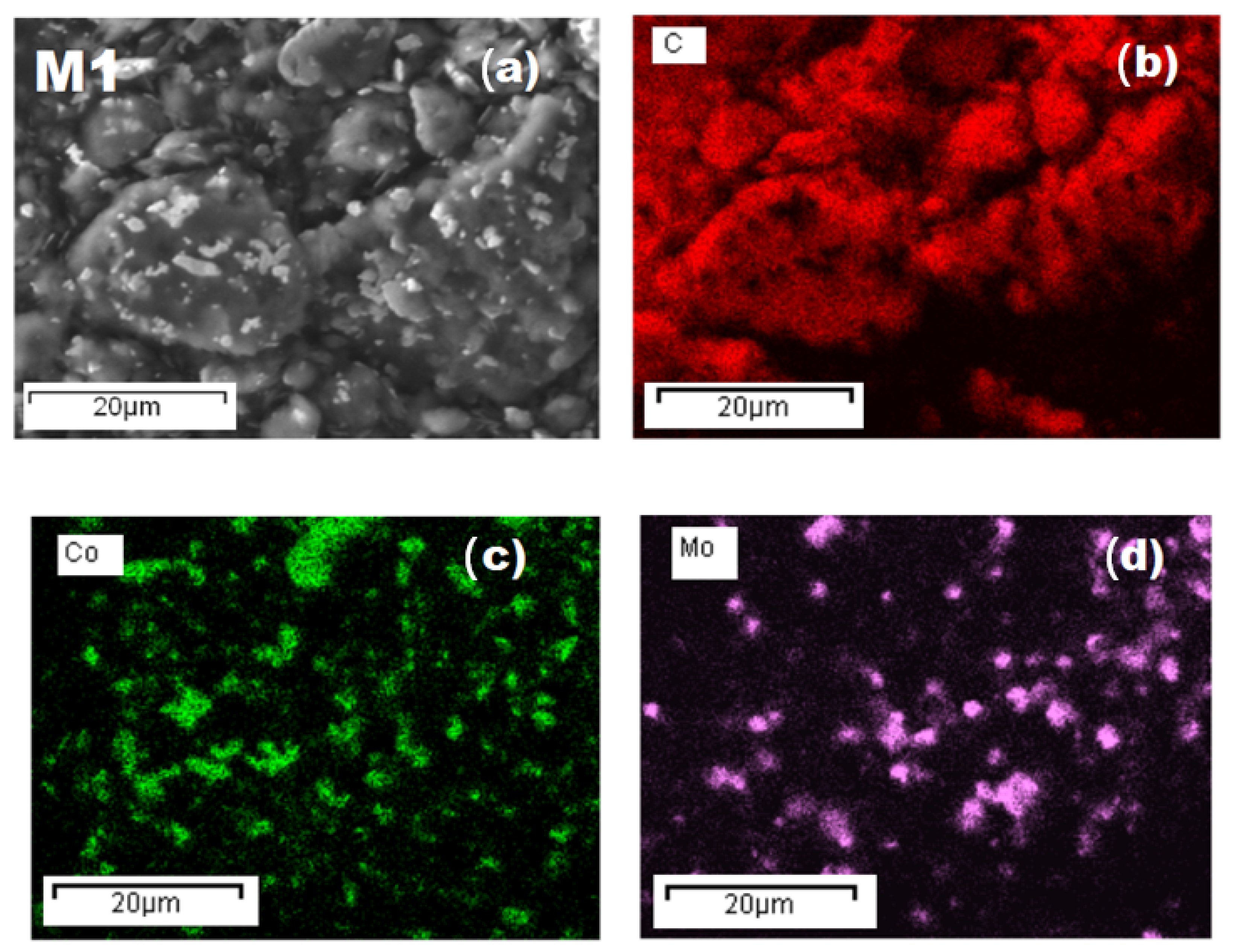
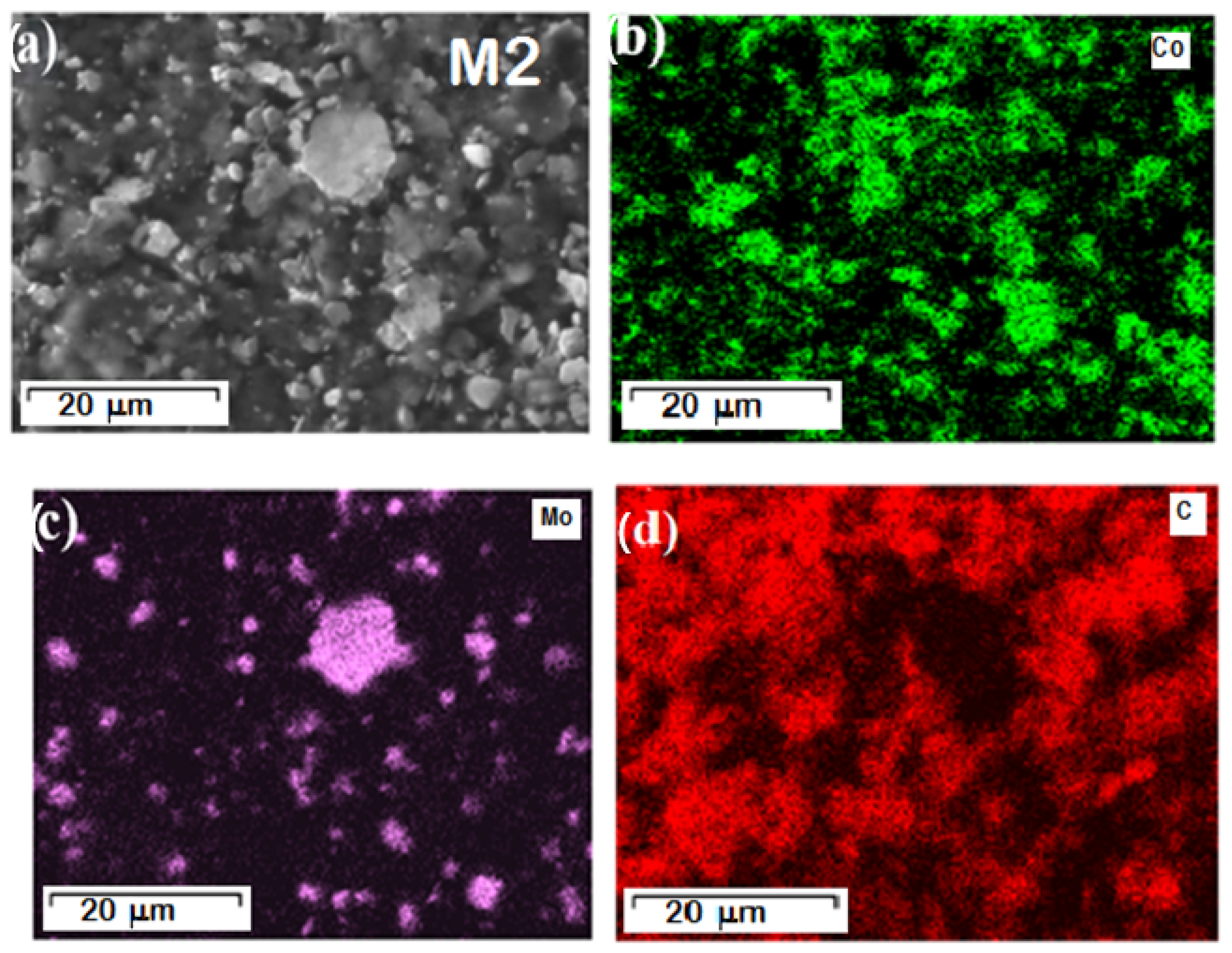
Elemental maps corroborate these trends. In M1 (Figure 7), carbon forms a continuous background, cobalt appears as finely dispersed domains, and molybdenum as micron-scale islands, pointing to incomplete alloying under the lower-energy condition. This spatial pattern explains the metal-normalized EDS in M1 and aligns with the XRD phase assembly in which C is the majority -carbide with residual C and (Table 1). In contrast, M2 (Figure 8) exhibits an almost homogeneous dispersion of Co, Mo, and C across the field of view; only a single ∼10 µm Mo-rich grain persists. The improved uniformity agrees with the stronger mechanical activation imparted by the superposed vibration and with the XRD result that C becomes the dominant -carbide alongside C and minor (Table 2).
Figure 7.
Elemental maps for sample M1. (a) SEM micrograph reproducing the same field of view as Figure 6a; (b) carbon (C K1) map, showing a continuous carbon background; (c) cobalt (Co K1) map, with finely dispersed Co domains; (d) molybdenum (Mo L1) map, highlighting micron-scale Mo-rich islands. The distribution indicates incomplete alloying under the lower-energy condition. Scale bar: 20 µm.
Figure 8.
Elemental maps for sample M2. Composite of the mapped area: (a) SEM micrograph reproducing the same field of view as Figure 6d; (b) cobalt (Co K1) map; (c) molybdenum (Mo L1) map; (d) carbon (C K1) map. Co is almost homogeneously distributed across the field of view; a local Mo-rich grain (∼10 µm) is also observed. Scale bar: 20 µm.
From a structure–function standpoint, two features of M2 are noteworthy: (1) the lamellar morphology, which provides extended, few-layer carbide surfaces (Figure 5); and (2) the higher and more uniformly dispersed metal fraction evidenced by EDS/mapping (Figure 6, Figure 7 and Figure 8). Both factors are expected to increase interfacial contact with the aqueous hydrocarbon phase during aquathermolysis; the catalytic implications of these microstructural differences are examined in the FTIR subsection.
3.3. High Resolution Transmission Electron Microscopy (HRTEM)
High-resolution bright-field TEM (BF-TEM) was performed on sample M2 to examine the two most abundant -carbide phases identified by XRD, C and C, both present in the milled material. Interplanar spacings (d-spacings) measured from lattice fringes were compared with ICDD PDF-2/4 entries to support phase assignment. We focused TEM on M2 because it contains dominant -carbide nanolamellae (C with C) that exhibit nanoscale features such as Moiré patterns (overlap fringes). For M1, XRD, together with SEM/EDS mapping, already define morphology and phase distribution, so additional TEM images are not essential here; representative BF-HRTEM micrographs of M1 are available in the Supplementary Materials (Figure S5).
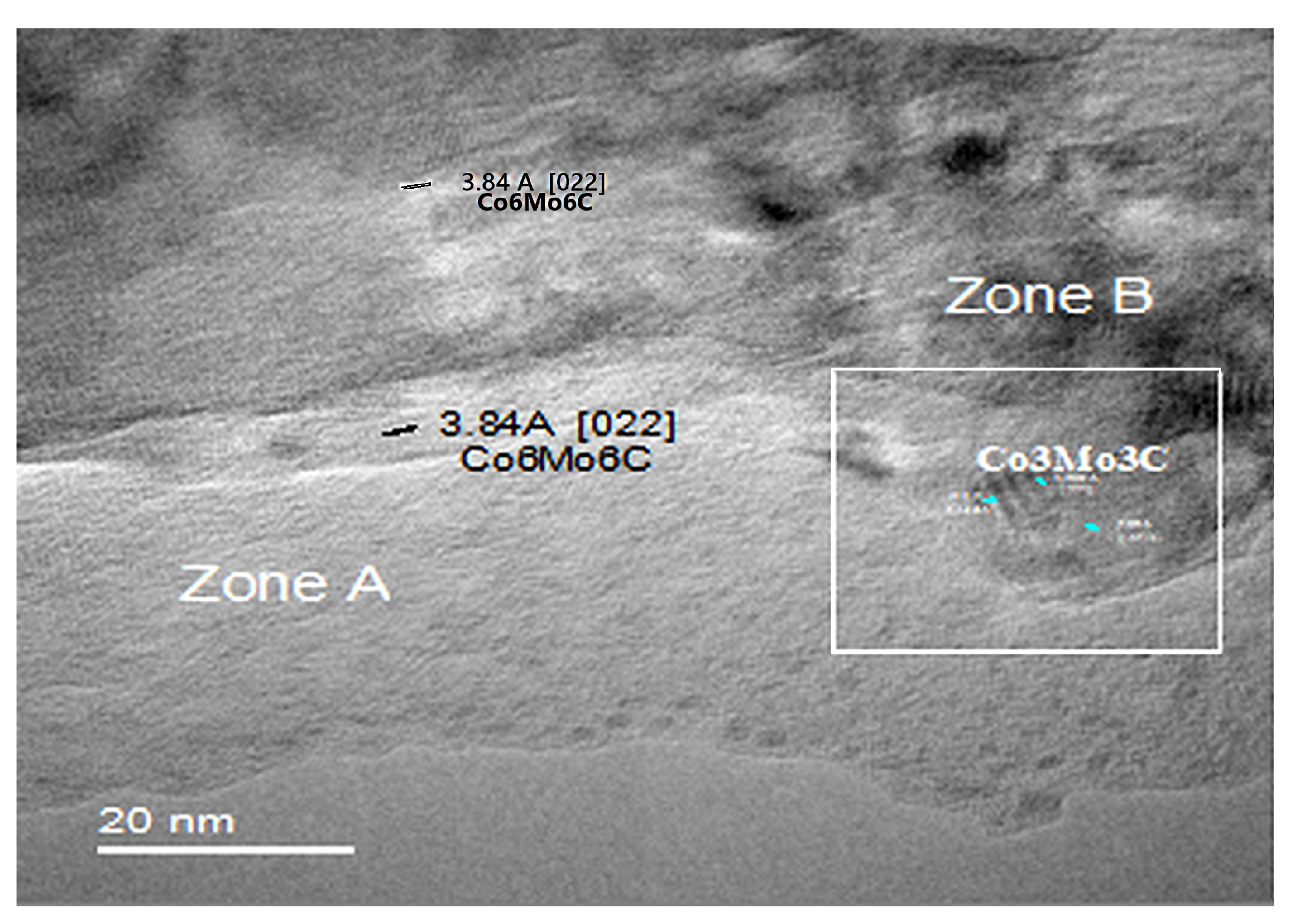
Figure 9 shows a representative BF-TEM micrograph from M2. The field of view contains thin stacked lamellae (thin layers) decorated by small clusters and nanoparticles. Two areas are marked: Zone A, dominated by extended lamellae indexed to C (space group ), and Zone B, a small domain with clear Moiré fringe contrast consistent with C (). Many clusters sit on the lamellae; in these BF images, their internal order is insufficient to permit definitive structural assignment by HRTEM alone. Based on the XRD results, these clusters may be fragments of the intermetallics and and of the cobalt monocarbide C; confirmation would require local diffraction or atomic-resolution STEM.
Figure 9.
BF TEM micrograph of sample M2. Zone A (left) is dominated by extended lamellae indexed to C; Zone B (right) contains a nanoparticle with Moiré fringe contrast assigned to C. A magnified view of Zone B is shown in Figure 10.
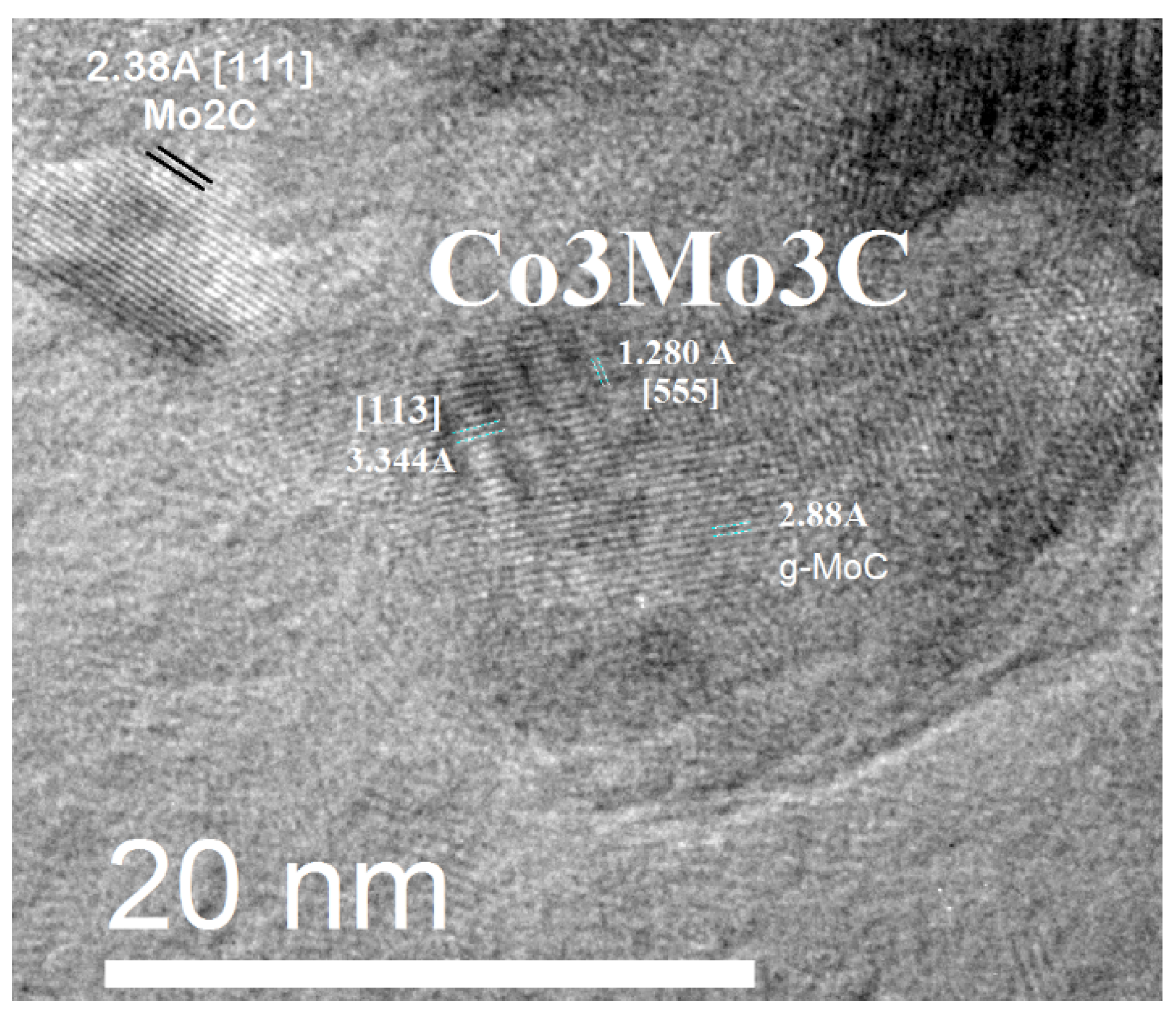
A higher-magnification view of the Moiré nanoparticle is presented in Figure 10. In mechanically alloyed lamellar aggregates, repeated stacking, intercalation, and compaction of thin crystalline sheets are common. Local misorientation between overlapping lattices produces Moiré interference patterns, that are well documented in layered materials [33]. Around the C domain, other lamellae can be indexed to monocarbides: C with (No. 225, Å) and -MoC with ( Å, Å), consistent with local polymorphism in C-rich Mo phases under nonequilibrium processing. Representative d-spacings are annotated and match the PDF values.
Figure 10.
Detail of the Moiré nanoparticle assigned to C (Zone B from Figure 9). Surrounding lamellae are indexed to C (, Å) and -MoC (, Å, Å). Local stacking and slight misorientation of thin crystalline sheets produce the Moiré interference contrast.
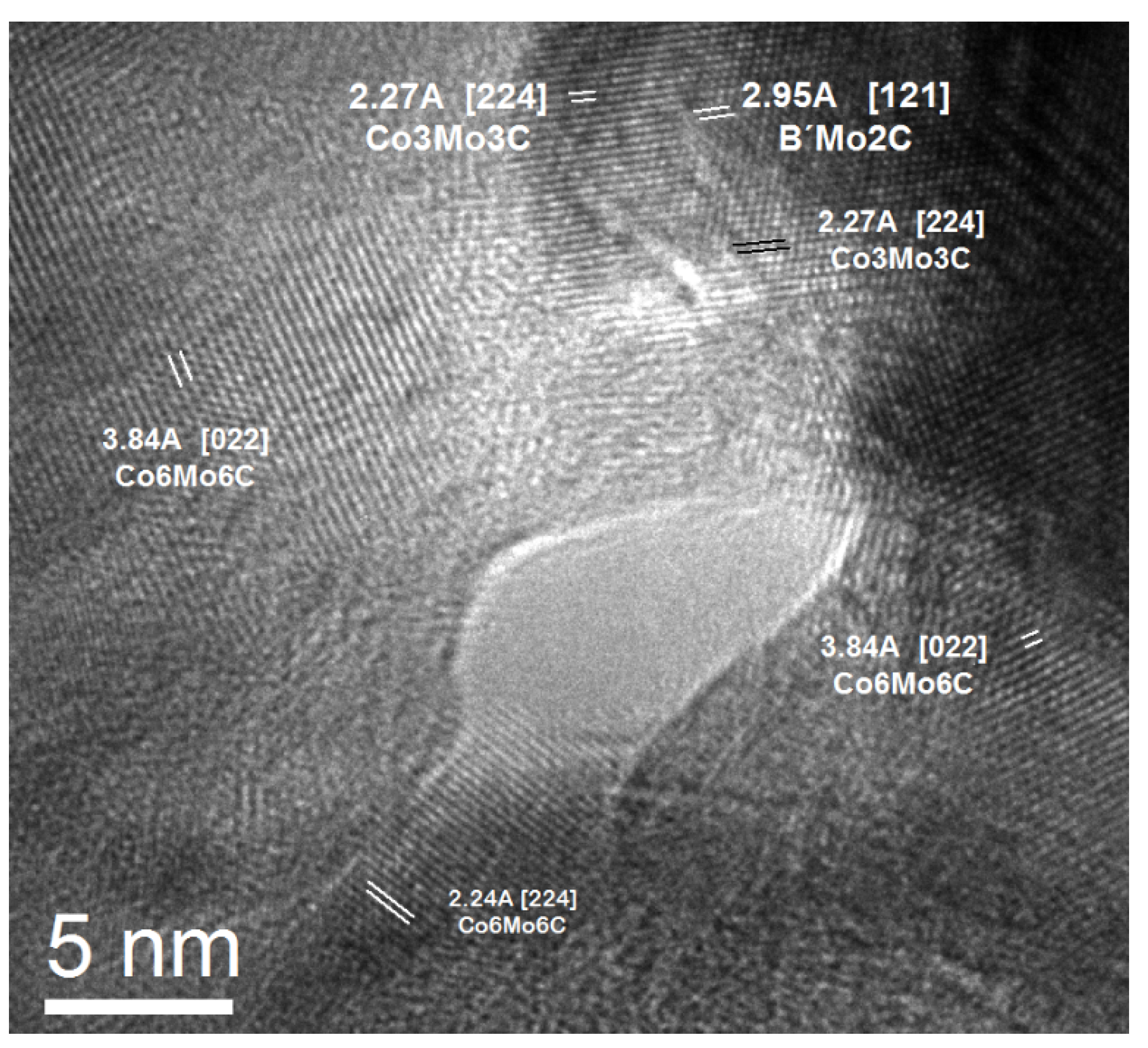
Figure 11 shows a region where C and C coexist with a lamellar domain assigned to C (region ). At the C/C interface a faint Moiré pattern appears; the weak and irregular fringes are consistent with a twist angle that is not optimal or a slight lattice mismatch between the overlapping sheets. Thin C lamellae are present throughout the image; near the hole edge, a single layer lamella is visible, which shows the strong thinning achieved under vibration assisted milling. Measured d spacings (e.g., ∼2.27 Å for C {224} and ∼3.84 Å for C {022}) agree with indexing.
Figure 11.
Coexistence of lamellar C with C and C in sample M2. A faint Moiré pattern appears at the C/C interface. Extended, few layer C lamellae are present throughout the field of view.
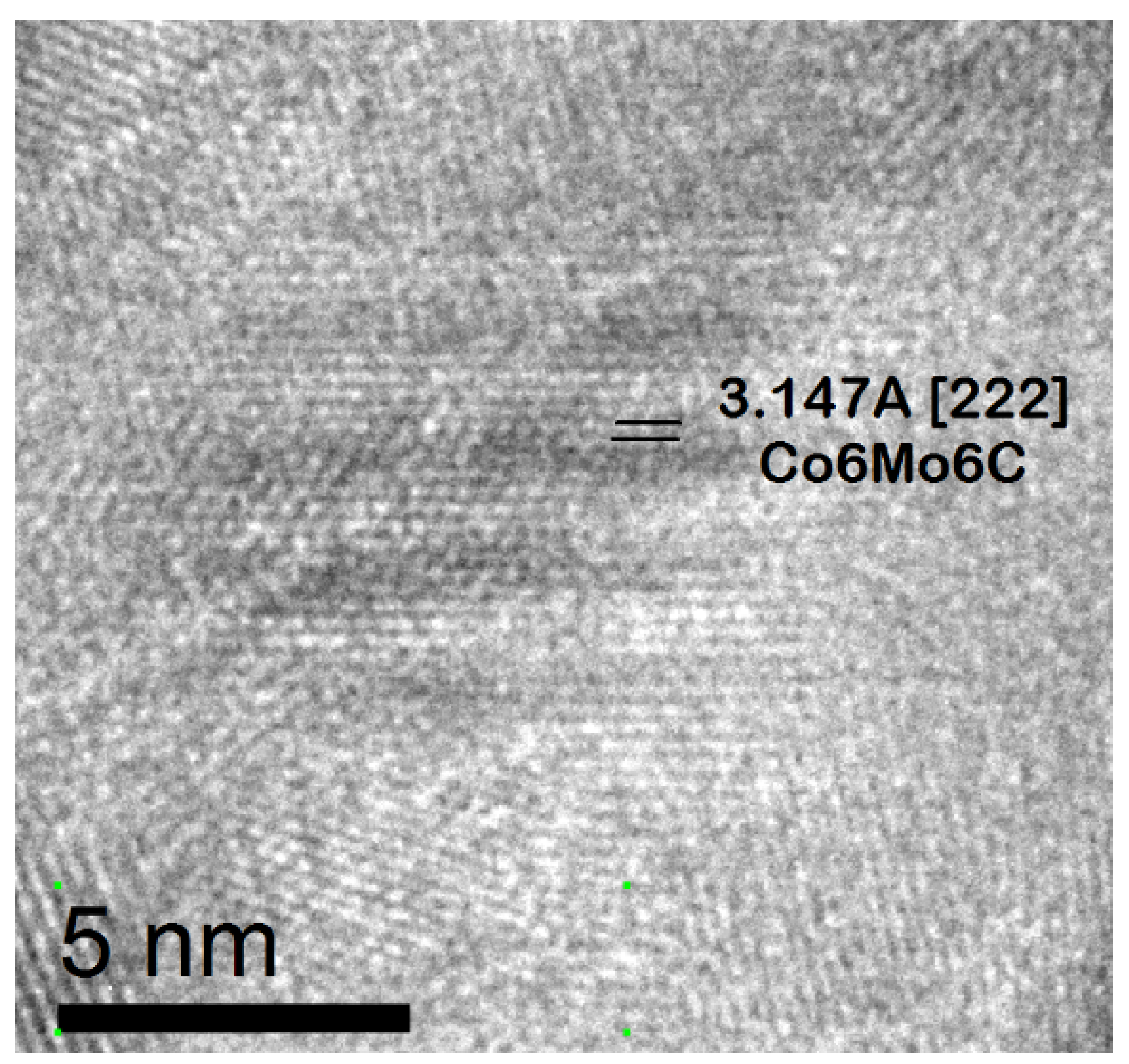
Finally, C can also form Moiré type nanostructures under these conditions. Figure 12 shows overlapping C lamellae that produce a clear Moiré superlattice; the annotated d spacing (∼3.147 Å for {222}) matches the expected value. Together with the C case, these results show that nonequilibrium mechanical alloying, enhanced by the superimposed vibration, leads to stacked layers, intercalation, and defects in -carbides, which creates local lattice alignment that produces Moiré interference.
Figure 12.
Moiré nanoparticle formed by overlapping C lamellae in sample M2, showing the tendency of the -carbide to develop superlattice interference under nonequilibrium milling.
3.4. Fourier Transform Infrared Spectroscopy (FTIR)
We tested whether the materials produced here can help desulfurize high-viscosity heavy crude by conducting catalytic aquathermolysis. Three samples were prepared: a reference with equal masses of distilled water and heavy crude (only water); and two catalytic runs where equal masses of water and crude were treated with catalyst M1 or M2 at 1 wt% relative to the water + crude mass (water + M1 and water + M2). All samples were heated at 100 °C for 4 h in the water-bath reactor described in Section 2, after which samples were analyzed by ATR-FTIR. We focus on the 500– region, which contains characteristic bands of sulfur-containing groups in hydrocarbons [40,41]. Table 3 summarizes the assignments used.
Table 3.
Vibrational assignments used for the 500– region [40,41].
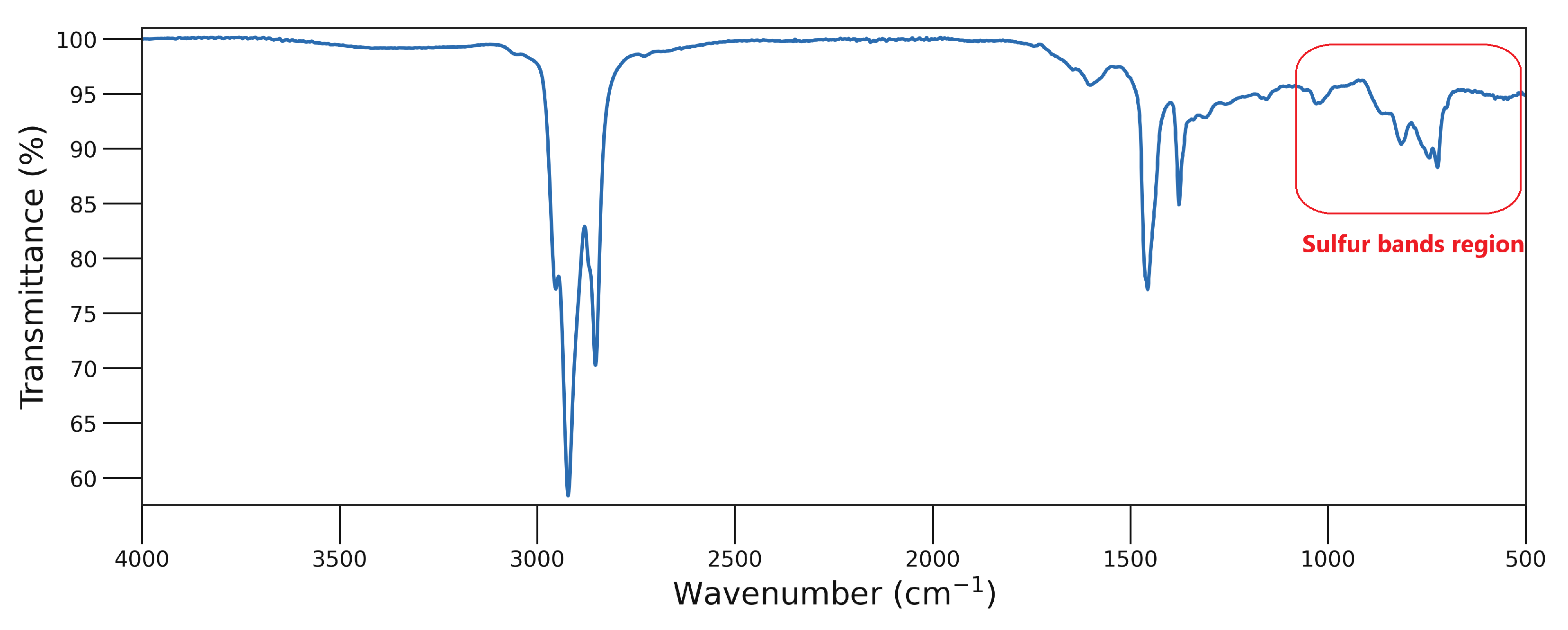
Figure 13 shows the spectrum of the untreated crude (initial reference). The most intense sulfur-related features lie near ∼650– (C–S stretch of thioethers) and around ∼ (C–S stretch of disulfides), with additional S–S stretching bands in the 600– window. These groups are known contributors to the high viscosity of heavy crudes [10,11].
Figure 13.
FTIR spectrum of the initial heavy crude (untreated reference). The analysis focuses on the window that contains bands of sulfur-containing groups.
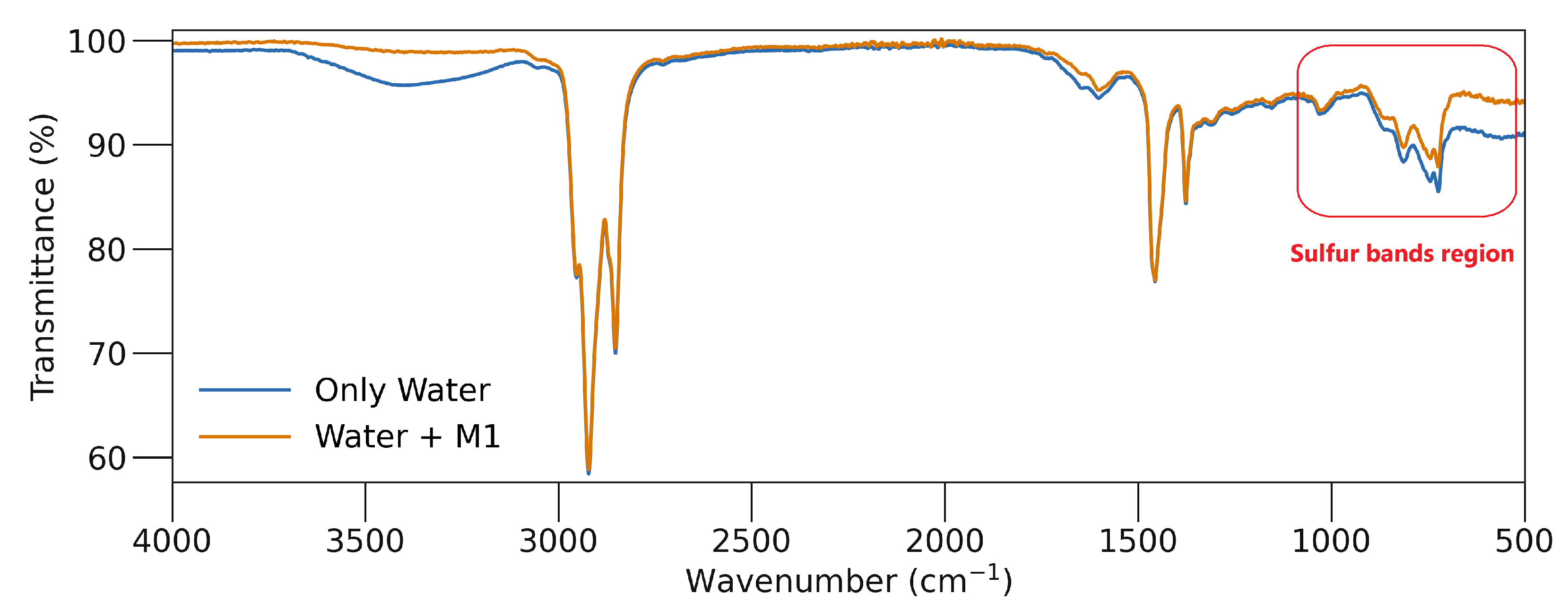
Figure 14 compares only water and water + M1 after aquathermolysis at 100 °C for 4 h. The water only trace shows attenuation of the sulfur-related bands, quantified in Table 4. Under the same conditions, the water + M1 overlay shows reductions of similar size (Table 5). Prior studies report that lower catalyst loadings generally require longer times and possibly higher temperatures [10,11,22]. Longer treatments would likely be needed to reveal the intrinsic activity of M1 in this setup.
Figure 14.
Aquathermolysis at 100 °C for 4 h: comparison of the FTIR spectra for only water and water + M1.
Table 4.
Estimated attenuation of sulfur-related bands for the only water sample at 100 °C (run compared with the initial crude).
Table 5.
Estimated attenuation of sulfur-related bands for water + M1 at 100 °C (relative to the initial crude).
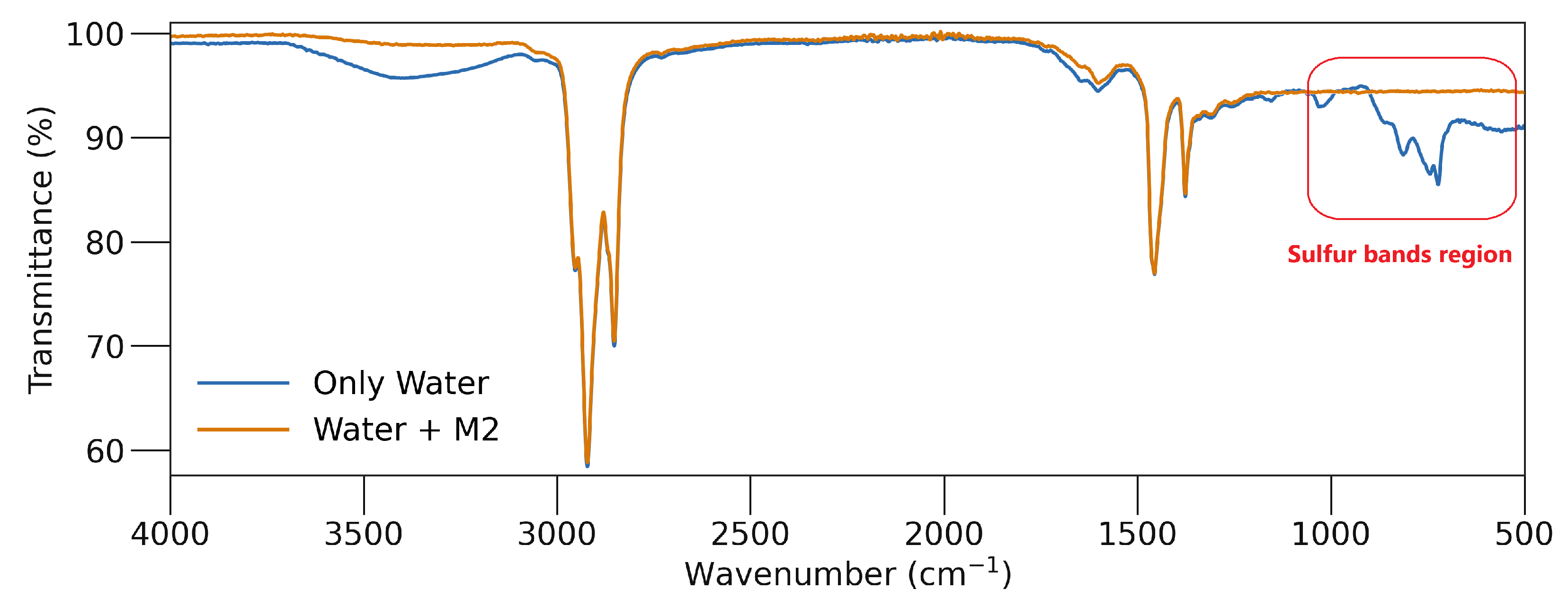
Figure 15 compares only Water and water + M2 under identical conditions. The only Water replicate shows changes of similar magnitude (Table 6). In contrast, the water + M2 spectrum is nearly featureless across 500–, with a transmittance of ∼94.3%. Based on FTIR alone, this behavior is consistent with extensive cleavage of S–S and C–S bonds and/or conversion into species outside the probed window. One likely interpretation is that reactive sulfur fragments bind to metal sites on the catalyst, forming surface sulfide or polysulfide species, while the hydrocarbon matrix loses the disulfide and thioether signatures. Confirming this would require complementary analyses (for example, XPS of spent catalysts and total sulfur by elemental analysis).
Figure 15.
Aquathermolysis at 100 °C for 4 h: comparison of the FTIR spectra for only water and water + M2. The Water + M2 trace is essentially featureless in the 500– region.
Table 6.
Only water replicate for the water + M2 comparison at 100 °C.
Catalyst M2 is predominantly the -carbide C, with C and minor and . The Mo and Co rich surfaces, together with the few-layer lamellae seen by HRTEM, are consistent with increased contact between active sites and the hydrocarbon phase during aquathermolysis. By contrast, M1 (C-rich) behaves similarly to water alone under the short and mild treatment used here. In line with this, FTIR at 100 °C for 4 h shows the 500– region becoming nearly featureless for water + M2 (∼94.3% transmittance), whereas water + M1 follows the water-only baseline, indicating stronger attenuation of disulfide and thioether bands with M2.
These FTIR results are consistent with two roles under aquathermolysis: C-rich lamellae catalyze C–S bond scission in disulfides and thioethers, while C provides hydrogenation of the resulting fragments. In parallel, the intermetallic constituents (, ) bind sulfur to form surface sulfide or polysulfide species. In situ formation of sulfides on Co–Mo carbides is widely recognized as part of the active state in HDS rather than a purely stoichiometric sorption process [10,11,22]. The broad attenuation of S-related bands at only 1 wt% catalyst loading is therefore difficult to explain by adsorption capacity alone. Definitive identification of sulfur-containing surface states and catalyst turnover will be addressed in future work via sulfur mass balance and XPS of spent catalysts.
4. Conclusions
This work demonstrates that the bimetallic -carbides C and C can be synthesized in the system by short-time mechanical alloying. The resulting powders are nanostructured and consist of micrometer-scale lamellar aggregates decorated with clusters of about 5–10 nm; in selected regions, Moiré superlattice contrast is observed.
The phase balance is controlled by the mechanical energy input. Vibration-assisted milling (M2) yields C as the majority -carbide, whereas lower-energy milling (M1) favors C. These trends agree with the XRD-derived phase assemblies and with the lamellar stacking and defect structures observed by HRTEM.
Catalytic tests under mild aquathermolysis conditions (100 °C, 4 h, 1 wt%) indicate that the C-rich material (M2) shows a stronger desulfurization response than M1 and than water alone. FTIR shows strong attenuation, up to near disappearance, of the disulfide and thioether bands for Water + M2, while Water + M1 shows only small changes. The observations are consistent with two roles: -carbide domains promote carbon–sulfur bond scission and hydrogenation, while cobalt–molybdenum intermetallics (for example, and ) capture sulfur as surface sulfide or polysulfide species.
Relative to conventional HDS formulations that typically require much higher temperatures and pressure, the present system shows low-temperature activity in water, which suggests operational flexibility and potential cost and energy advantages. The synthesis route is scalable, solvent-free, and low energy, and it enables production of abundant nanostructured catalysts with tunable ratios of C to C without using very high-energy mills.
Future work should quantify catalyst lifetime, cycling stability, and regeneration under practical conditions, and compare performance with state-of-the-art HDS catalysts via sulfur mass balance and post-reaction surface analysis.
Supplementary Materials
The following supporting information can be downloaded at: Figshare (https://doi.org/10.6084/m9.figshare.30174841) (accessed on 20 September 2025): Figure S1: (Graphite—diffraction pattern), Figure S2: (Molybdenum—diffraction pattern), Figure S3: (Cobalt — diffraction pattern), Figure S4: (SEM micrographs of elemental powders), Figure S5: (BF-HRTEM images of sample M1).
Author Contributions
Conceptualization, I.C.-M., J.N.R.O. and L.G.D.B.A.; methodology, I.C.-M. and J.N.R.O.; validation, I.C.-M., J.N.R.O. and L.G.D.B.A.; formal analysis, J.N.R.O., L.G.D.B.A. and I.C.-M.; investigation, J.N.R.O., B.E.G.C., A.I.R.d.l.T., V.G.F. and L.G.R.; data curation, J.N.R.O., B.E.G.C. and A.I.R.d.l.T.; writing—original draft preparation, B.E.G.C. and J.N.R.O.; writing—review and editing, I.C.-M., L.G.D.B.A. and J.N.R.O.; supervision, I.C.-M. and L.G.D.B.A.; funding acquisition, I.C.-M. and L.G.D.B.A. All authors have read and agreed to the published version of the manuscript.
Funding
This research was funded by ESIQIE-IPN, Grant No. SIP-20250968.
Data Availability Statement
All data and Supplementary Files are openly available at Figshare: https://doi.org/10.6084/m9.figshare.30174841 (accessed on 20 September 2025).
Acknowledgments
Brenda Edith García Caudillo gratefully acknowledges a doctoral scholarship from the Secretaría de Ciencia, Humanidades, Tecnología e Innovación (Secihti), Mexico.
Conflicts of Interest
The authors declare no conflicts of interest.
References
- Šaponjić, A.; Šaponjić, D.; Perović, I.; Vuković, M.; Vladi, S. Synthesis and characterization of Co–Mo bimetallic carbides. Sci. Sinter. 2019, 51, 319–326. [Google Scholar] [CrossRef]
- Jiang, C.; Wang, Y.; Zhang, H.; Chang, N.; Li, L.; Xie, K.; Mochida, I. Effect of initial Si/Al ratios on the performance of low crystallinity Hβ-x zeolite supported NiMo carbide catalysts for aromatics hydrogenation. Catal. Sci. Technol. 2019, 9, 5031–5044. [Google Scholar] [CrossRef]
- AlShibane, I.; Daisley, A.; Hargreaves, J.S.J.; Hector, A.L.; Laassiri, S.; Rico, J.L.; Smith, R.I. The role of composition for cobalt molybdenum carbide in ammonia synthesis. ACS Sustain. Chem. Eng. 2017, 5, 9214–9222. [Google Scholar] [CrossRef]
- AlShibane, I.; Laassiri, S.; Rico, J.L.; Hargreaves, J.S.J. Methane cracking over cobalt molybdenum carbides. Catal. Lett. 2018, 148, 1643–1650. [Google Scholar] [CrossRef]
- Blin, T.; Girard, A.; Fossard, F.; Guillou, N.; Catala, L.; Loiseau, A.; Huc, V. η-Carbides (Co, Mo, or W) nanoparticles from octacyanometalates precursors-based network. Small 2023, 19, 2301299. [Google Scholar] [CrossRef]
- Society of Petroleum Engineers (SPE). Challenges in Processing and Transporting Heavy Crude Oil. Available online: https://jpt.spe.org/challenges-processing-and-transporting-heavy-crude (accessed on 27 August 2025).
- Furimsky, E. Metal carbides and nitrides as potential catalysts for hydroprocessing. Appl. Catal. A Gen. 2003, 240, 1–28. [Google Scholar] [CrossRef]
- Nickel–Molybdenum Catalysts for Hydrodesulfurization Treating of Heavy Crude Fractions. Energy Technology Data Exchange (ETDE); Office of Scientific and Technical Information (OSTI): France, 1980 (April); Abstract Collection 1522. Available online: https://www.osti.gov/etdeweb/biblio/6227594 (accessed on 27 August 2025).
- Hsu, C.S.; Robinson, P.R. (Eds.) Practical Advances in Petroleum Processing; Springer: New York, NY, USA, 2006; Volume 1, ISBN 978-0-387-25811-9. [Google Scholar] [CrossRef]
- Speight, J.G. Handbook of Petroleum Refining; CRC Press: Boca Raton, FL, USA, 2016. [Google Scholar] [CrossRef]
- Speight, J.G. The Chemistry and Technology of Petroleum, 4th ed.; CRC Press: Boca Raton, FL, USA, 2006. [Google Scholar] [CrossRef]
- Oil and Gas Training Center. Classification of Crude Oil Based on API Gravity. 2021. Available online: https://oilandgascourses.org/classification-of-crude-oil-based-on-api-gravity/ (accessed on 27 August 2025).
- Almao, P.P. In situ upgrading of bitumen and heavy oils via nanocatalysis. Can. J. Chem. Eng. 2012, 90, 320–329. [Google Scholar] [CrossRef]
- National Hydrocarbons Commission (CNH). Annual Report 2023; Mexico City, Mexico. 2023. Available online: https://www.cnh.gob.mx/estadisticas/informe-anual-2023 (accessed on 27 August 2025).
- Petróleos Mexicanos (PEMEX). Maya Crude Oil—Features. 2025. Available online: https://www.pemex.com/en/commercialization/products/Paginas/oil/maya-crude.aspx (accessed on 27 August 2025).
- Alagorni, A.H.; Yaacob, Z.B.; Nour, A.H. An overview of oil production stages: Enhanced oil recovery techniques and nitrogen injection. Int. J. Environ. Sci. Dev. 2015, 6, 693–701. [Google Scholar] [CrossRef]
- Areej, N.A.; Wasan, S.A.; Sufiyan, M.M. An overview of oil recovery techniques: From primary to enhanced oil recovery methods. J. Res. Appl. Basic Sci. 2023, 3, 392–399. [Google Scholar] [CrossRef]
- Kalita, P.; Sharma, V.; Pandey, L.; Tiwari, P. Secondary and tertiary oil recovery processes. In Green Energy and Technology; Springer: Singapore, 2022; pp. 49–72. [Google Scholar] [CrossRef]
- Koninckx, E.; Colin, J.G.; Broadbelt, L.J.; Vernuccio, S. Catalytic conversion of alkenes on acidic zeolites: Automated generation of reaction mechanisms and lumping technique. ACS Eng. Au 2022, 2, 257–271. [Google Scholar] [CrossRef] [PubMed]
- Tanimu, A.; Alhooshani, K. Advanced hydrodesulfurization catalysts: A review of design and synthesis. Energy Fuels 2019, 33, 2810–2838. [Google Scholar] [CrossRef]
- Arora, S.; Singh, R.; Khan, R.; Kunzru, D.; Sivakumar, S. Challenges and opportunities to design a highly active hydrodesulfurization catalyst: A comprehensive review. Mol. Catal. 2025, 583, 115220. [Google Scholar] [CrossRef]
- Rivera Olvera, J.N.; Gutiérrez, G.J.; Romero Serrano, J.A.; Medina Ovando, A.; Garibay Febles, V.; Díaz Barriga Arceo, L. Use of unsupported, mechanically alloyed NiWMoC nanocatalyst to reduce the viscosity of aquathermolysis reaction of heavy oil. Catal. Commun. 2014, 43, 131–135. [Google Scholar] [CrossRef]
- Dipheko, T.D.; Maximov, V.V.; Osman, M.E.; Eliseev, O.L.; Cherednichenko, A.G.; Sheshko, T.F.; Kogan, V.M. Synthesis of oxygenated hydrocarbons from ethanol over sulfided KCoMo-based catalysts: Influence of novel fiber- and powder-activated carbon supports. Catalysts 2022, 12, 1497. [Google Scholar] [CrossRef]
- Storozhenko, V.N.; Kamyshnikova, A.S.; Pashchenko, K.P.; Okhlobystin, A.O.; Eremenko, I.L.; Berberova, N.T. Transition metal (Zn(II), Co(II), Cu(II), Ni(II)) complexes for the removal of acidic sulfur impurities from hydrocarbon fuel. Russ. J. Coord. Chem. 2023, 49, S97–S127. [Google Scholar] [CrossRef]
- Hajjar, Z.; Kazemeini, M.; Rashidi, A.; Bazmi, M. Graphene based catalysts for deep hydrodesulfurization of naphtha and diesel fuels: A physiochemical study. Fuel 2016, 165, 468–476. [Google Scholar] [CrossRef]
- Zhang, L.; Chen, X.; Chen, Y.; Li, W.; Yang, K.; Liang, C. Non-metal doping Ni@C as highly efficient and stable hydrodesulfurization catalysts for clean liquid fuels. Mol. Catal. 2022, 528, 112440. [Google Scholar] [CrossRef]
- Vinogradov, N.A.; Timoshkina, V.V.; Tsilimbaeva, E.A.; Zasypalov, G.O.; Pimerzin, A.A.; Glotov, A.P. CoPMoV sulfide catalysts supported on natural halloysite nanotubes in hydrotreating of dibenzothiophene and naphthalene. Pet. Chem. 2023, 63, 524–533. [Google Scholar] [CrossRef]
- Bharech, S.; Kumar, R. A review on the properties and applications of graphene. J. Mater. Sci. Mech. Eng. 2015, 2, 70–73. [Google Scholar]
- Nguyen Bich, H.; Nguyen Van, H. Promising applications of graphene and graphene-based nanostructures. Adv. Nat. Sci. Nanosci. Nanotechnol. 2016, 7, 023002. [Google Scholar] [CrossRef]
- Al-Daous, M.A. Graphene–MoS2 composite: Hydrothermal synthesis and catalytic property in hydrodesulfurization of dibenzothiophene. Catal. Commun. 2015, 72, 180–184. [Google Scholar] [CrossRef]
- Wang, X.; Xu, W.; Liu, N.; Yu, Z.; Li, Y.; Qiu, J. Synthesis of metallic Ni–Co/graphene catalysts with enhanced hydrodesulfurization activity via a low-temperature plasma approach. Catal. Today 2015, 256, 203–208. [Google Scholar] [CrossRef]
- Wang, H.; Xiao, B.; Cheng, X.; Wang, C.; Zhao, L.; Zhu, Y.; Zhu, J.; Lu, X. NiMo catalysts supported on graphene-modified mesoporous TiO2 toward highly efficient hydrodesulfurization of dibenzothiophene. Appl. Catal. A Gen. 2015, 502, 157–165. [Google Scholar] [CrossRef]
- Leonard, J.R.; Hu, L.; High, A.A.; Hammack, A.T.; Wu, C.; Butov, L.V.; Campman, K.L.; Gossard, A.C. Moiré pattern of interference dislocations in condensate of indirect excitons. Nat. Commun. 2021, 12, 1175. [Google Scholar] [CrossRef] [PubMed]
- Wang, Z.; Liu, Y.; Li, X.; Gao, R.; Sun, J.; Liu, J.; Yao, S. NiMo/C-HY catalyst prepared from doping zeolite slurry in a superabsorbent polymer for DBT and 4,6-DMDBT hydrodesulfurization. Microporous Mesoporous Mater. 2023, 347, 112349. [Google Scholar] [CrossRef]
- Hubbard, C.R. RIR—Measurement and use in quantitative XRD. Powder Diffr. 1988, 3, 74–77. [Google Scholar] [CrossRef]
- International Centre for Diffraction Data (ICDD). Quantitative Analysis: Reference Intensity Ratio (RIR); ICDD: Newtown Square, PA, USA, 2011; Available online: https://www.icdd.com/assets/tutorials/Quantitative-Analysis-RIR.pdf (accessed on 28 August 2025).
- Materials Project. Materials Project (Next-Gen) Portal. Available online: https://next-gen.materialsproject.org (accessed on 28 August 2025).
- Suryanarayana, C. Mechanical Alloying and Milling; Marcel Dekker: New York, NY, USA, 2004. [Google Scholar] [CrossRef]
- Díaz Barriga Arceo, L.G.; González Reyes, L.; Rivera Olvera, J.N.; Medina Ovando, A.; Garibay Febles, V. Intercalated intermetallic compounds AlTi3 and Fe2Ti in microrods and microtubes obtained by invariant reaction of mechanically milled system Al43Ti36Fe21. Materials 2019, 12, 3806. [Google Scholar] [CrossRef]
- Coates, J. Interpretation of infrared spectra: A practical approach. In Encyclopedia of Analytical Chemistry; John Wiley & Sons, Ltd.: Chichester, UK, 2000. [Google Scholar] [CrossRef]
- Larkin, P.J. Infrared and Raman Spectroscopy: Principles and Spectral Interpretation, 2nd ed.; Elsevier: Amsterdam, The Netherlands, 2017; ISBN 978-0128041628. [Google Scholar]
Disclaimer/Publisher’s Note: The statements, opinions and data contained in all publications are solely those of the individual author(s) and contributor(s) and not of MDPI and/or the editor(s). MDPI and/or the editor(s) disclaim responsibility for any injury to people or property resulting from any ideas, methods, instructions or products referred to in the content. |
© 2025 by the authors. Licensee MDPI, Basel, Switzerland. This article is an open access article distributed under the terms and conditions of the Creative Commons Attribution (CC BY) license (https://creativecommons.org/licenses/by/4.0/).