

Equity, Function, and Data: A Review of Social and Functional Representation in AI Datasets for Traumatic Brain Injury

Abstract
1. Introduction
1.1. Artificial Intelligence in Traumatic Brain Injury Research
1.2. Cognitive Justice Framework
1.3. Purpose of the Study
1.4. Significance and Innovation
2. Materials and Methods
2.1. Phase 1: Systematic Literature Review
2.2. Phase 2: Indirect Dataset Characterization
2.3. Data Transparency
3. Results
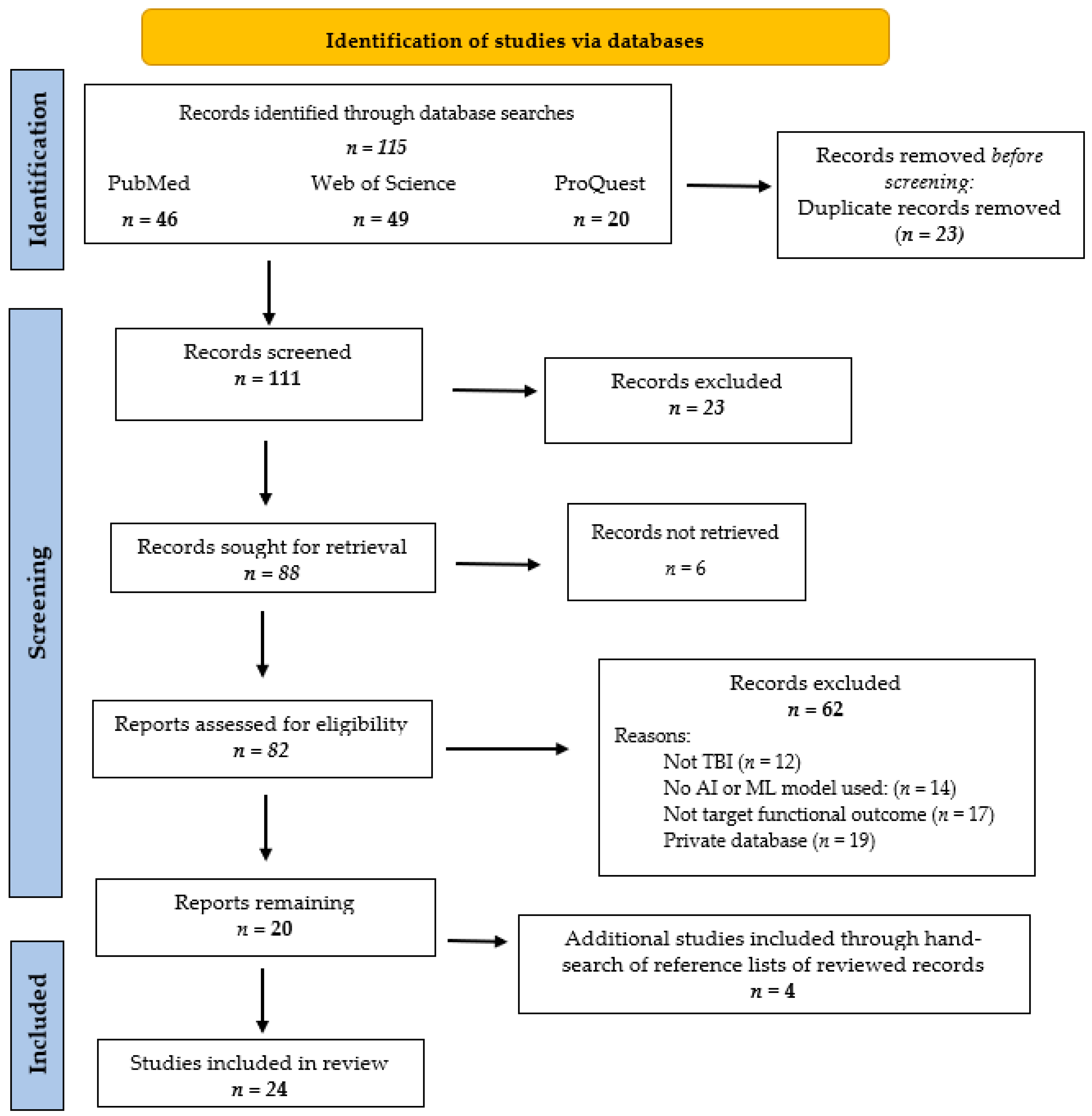
3.1. Phase 1: Literature Review Findings
3.2. Publication Trends
3.3. Phase 2: Indirect Dataset Audit Findings
3.4. Overview of the Datasets
3.5. Types of Artificial Intelligence or Machine Learning Used
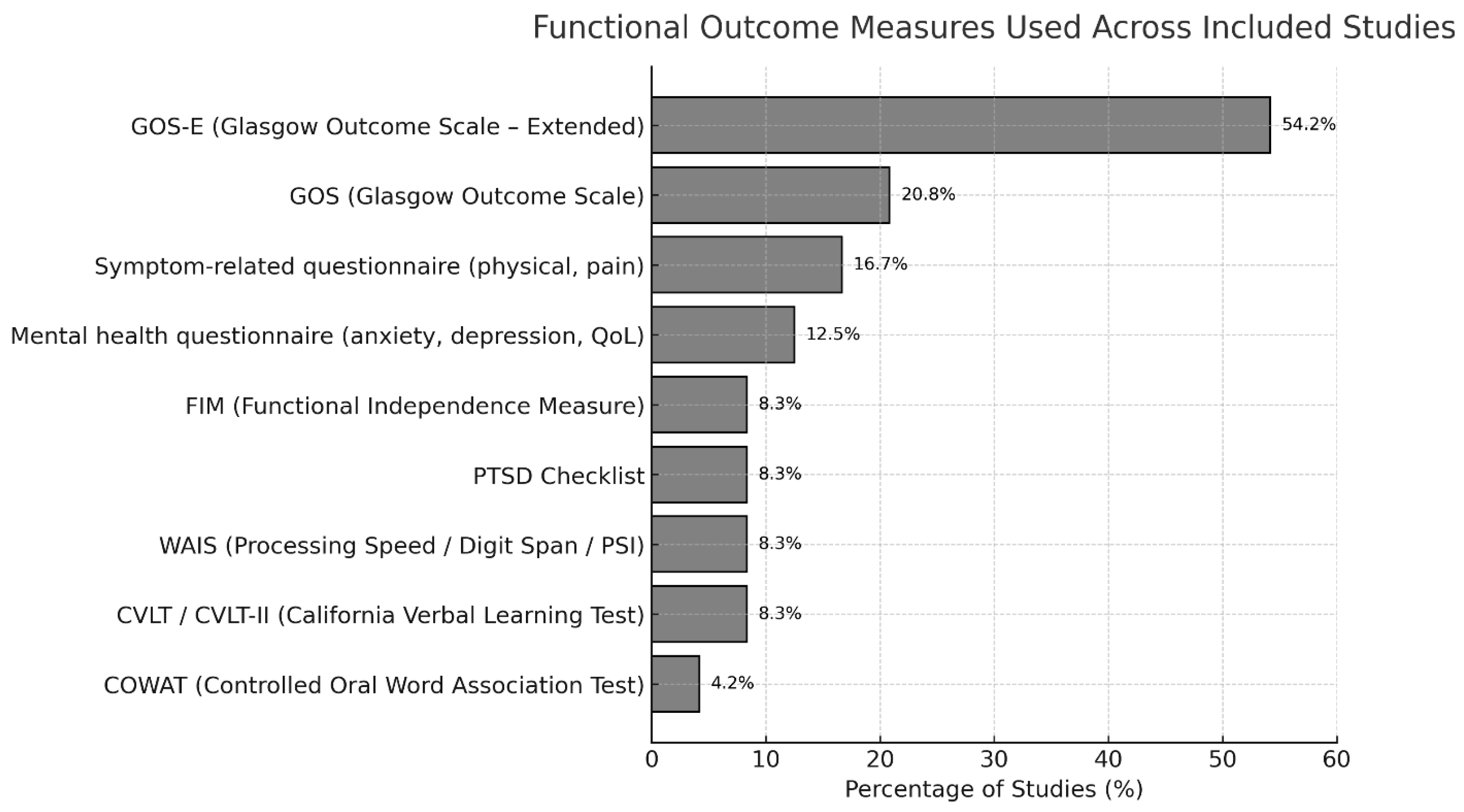
3.6. Injury Severity, Functional Outcomes, and Follow-Up Periods
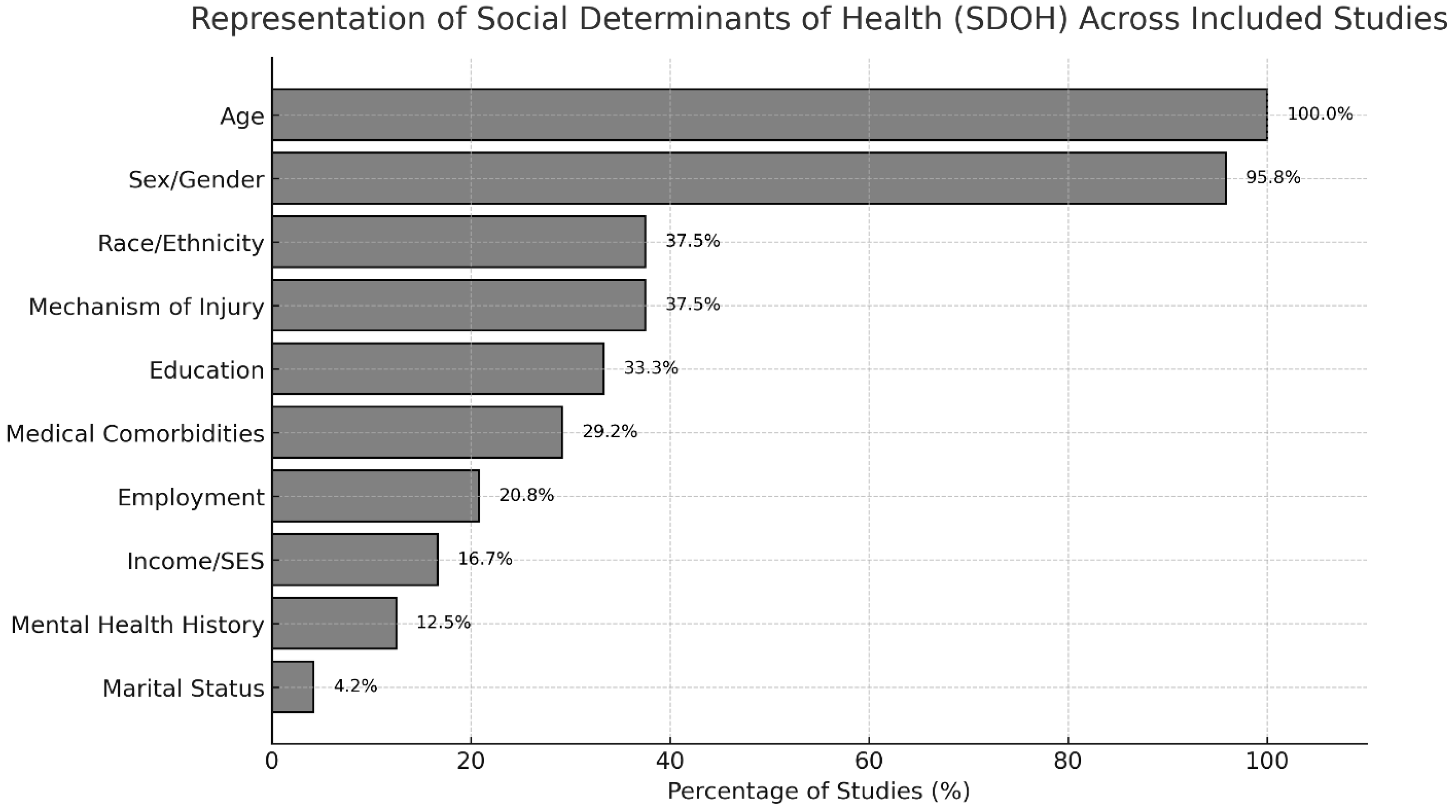
3.7. Representation of Social Determinants of Health
4. Discussion
4.1. Discussion of AI-TBI Datasets
4.2. Methodological Limitations of This Review
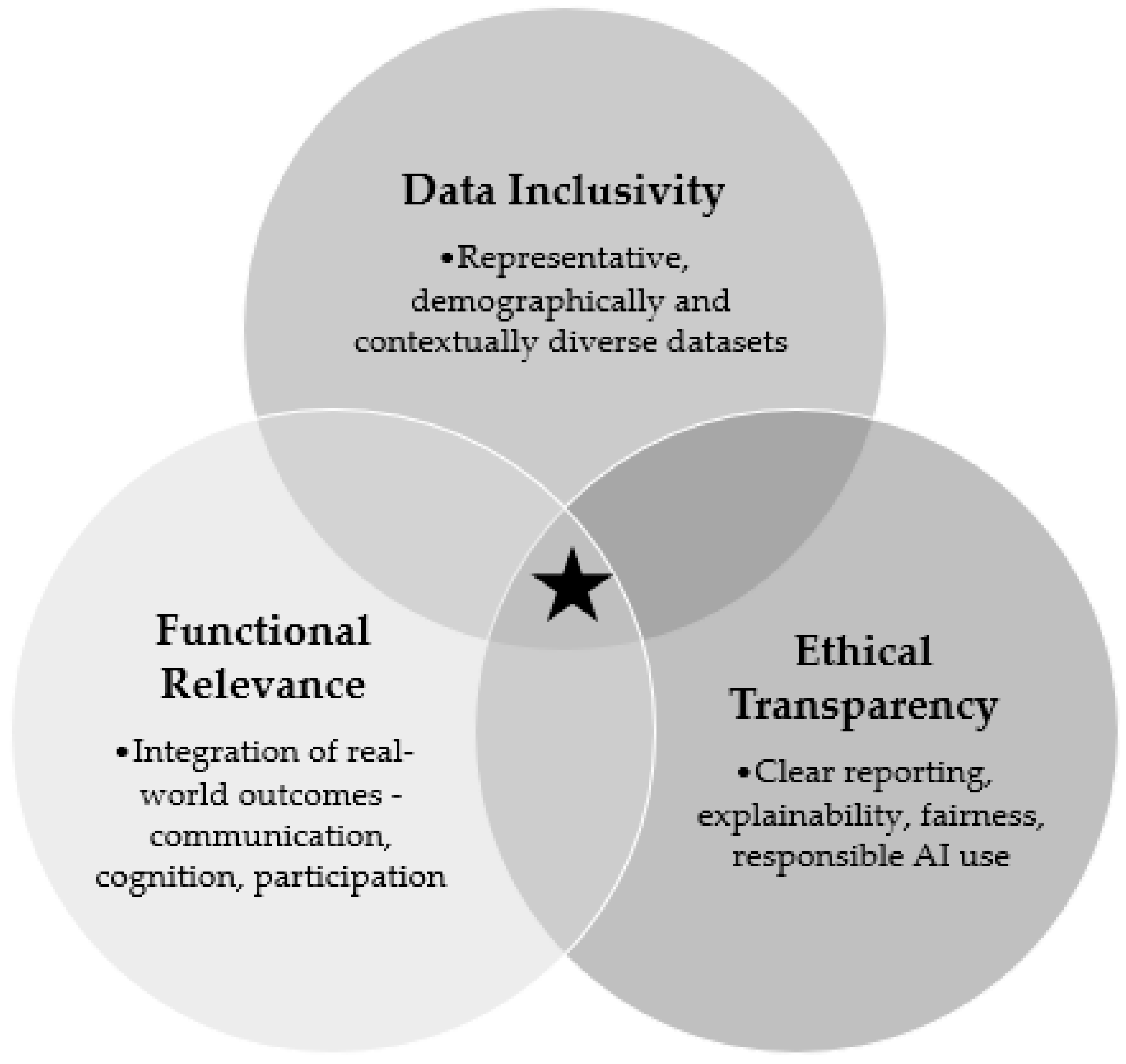
4.3. Within the Context of Cognitive Justice
5. Conclusions
Supplementary Materials
Author Contributions
Funding
Institutional Review Board Statement
Informed Consent Statement
Data Availability Statement
Acknowledgments
Conflicts of Interest
Abbreviations
| AI | Artificial Intelligence |
| ML | Machine Learning |
| TBI | Traumatic Brain Injury |
| SDOH | Social Determinants of Health |
| PRISMA | Preferred Reporting Items for Systematic Reviews and Meta-Analyses |
| CENTER-TBI | Collaborative European NeuroTrauma Effectiveness Research in TBI |
| TRACK-TBI | Transforming Research and Clinical Knowledge in TBI |
| COBRIT | Citicoline Brain Injury Treatment Trial |
| IMPACT-II | International Mission for Prognosis and Analysis of Clinical Trials in TBI (Phase II) |
| AURORA | Understanding Recovery After Trauma Consortium |
| CINTER-TBI | Central Interdisciplinary Neurotrauma Research in TBI |
| GAIN | Genetic and Imaging Network |
| ProTECT III | Progesterone for the Treatment of Traumatic Brain Injury, Phase III |
| TBI-PBE | Traumatic Brain Injury Practice-Based Evidence Project |
| GOS | Glasgow Outcome Scale |
| GOS-E | Glasgow Outcome Scale—Extended |
| FIM | Functional Independence Measure |
| WAIS | Wechsler Adult Intelligence Scale |
| PSI | Processing Speed Index (WAIS subtest) |
| CVLT/CVLT-II | California Verbal Learning Test/California Verbal Learning Test—Second Edition |
| COWAT | Controlled Oral Word Association Test |
| IRB | Institutional Review Board |
Appendix A
Database Search Strategies
Appendix B
Citations of the Studies Included in This Review
References
- Wilson, L.; Stewart, W.S.; Dams-O’Connor, K.; Diaz-Arrastia, R.; Horton, L.; Menon, D.K.; Polinder, S. The chronic and evolving neurological consequences of traumatic brain injury. Lancet Neurol. 2017, 16, 813–825. [Google Scholar] [CrossRef]
- Alshami, A.; Nashwan, A.; AlDardour, A.; Qusini, A. Artificial intelligence in rehabilitation: A narrative review on advancing patient care. Rehabilitación 2025, 59, 100911. [Google Scholar] [CrossRef] [PubMed]
- Cabitza, F.; Campagner, A.; Albano, D.; Aliprandi, A.; Bruno, A.; Chianca, V.; Corazza, A.; DiPietto, F.; Gambino, A.; Gitto, S.; et al. The elephant in the machine: Proposing a new metric of data reliability and its application to a medical case to assess classification reliably. Appl. Sci. 2020, 10, 4041. [Google Scholar] [CrossRef]
- Esteva, A.; Robicquet, A.; Ramsundar, B.; Kuleshov, V.; DePristo, M.; Chou, K.; Cui, C.; Corrado, G.; Thru, S.; Dean, J. A guide to deep learning in healthcare. Nat. Med. 2019, 25, 24–29. [Google Scholar] [CrossRef]
- Ashrafi, N.; Abdollahi, A.; Alaei, K.; Pishgar, M. Enhanced prediction of ventilator-associated pneumonia in patients with traumatic brain injury using advanced machine learning techniques. Sci. Rep. 2025, 15, 11363. [Google Scholar] [CrossRef] [PubMed]
- Osong, B.; Sribnick, E.; Groner, J.; Stanley, R.; Schulz, L.; Lu, B.; Cook, L.; Xiang, H. Development of clinical decision support for patients older than 65 years with fall-related TBI using artificial intelligence modeling. PLoS ONE 2025, 20, e0316462. [Google Scholar] [CrossRef] [PubMed]
- Jia, L.; Yin, Y.; Zhang, B.Y.; Li, Q.Z.; Jia, L.N.; Lai, D.T.; Yu, L.; Luo, Q.C.; Guo, E.W. Mechanisms of zhenwu decoction in targeting ATP2A2 and ATP2C1 for treating traumatic cerebral edema. Tradit. Med. Res. 2025, 10, 34. [Google Scholar] [CrossRef]
- Brazdzionis, J.; Radwan, M.M.; Thankan, F.; Mari, Y.M.; Baron, D.; Connett, D.; Agrawal, D.K.; Miulli, D.E. A swine model of neural circuit electromagnetic fields: Effects of immediate electromagnetic field stimulation on cortical injury. Cureus 2023, 15, e43774. [Google Scholar] [CrossRef]
- Zhang, Y.; Li, N.; Sun, H.; Cheng, H. Establishment and validation of a ResNet-based radiomics model for predicting prognosis in cervical spinal cord injury patients. Sci. Rep. 2025, 15, 9163. [Google Scholar] [CrossRef]
- Jojczuk, M.; Kaminski, P.; Gajewski, J.; Karpinski, R.; Krakowski, P.; Jonak, J.; Nogalisk, A.; Gluchowski, D. Use of neural networks based on international classification ICD-10 in patients with head and neck injuries in Lublin Province, Poland between 2006-2018, as a predictive value of the outcomes of injury sustained. Ann. Agric. Environ. Med. 2023, 30, 281–286. [Google Scholar] [CrossRef]
- Su, Y.; Protas, H.; Luo, J.; Chen, K.; Alosco, M.L.; Adler, C.H.; Balcer, L.J.; Bernick, C.; Au, R.; Banks, S.J.; et al. Flortaucipir tau PET findings from former professional and college american football players in the DIAGNOSE CTE research project. Alzheimer’s Dement. 2023, 20, 1827–1838. [Google Scholar] [CrossRef]
- Alosco, M.L.; Tripodis, Y.; Baucom, Z.H.; Adler, C.H.; Balcher, L.J.; Bernick, C.; Mariani, M.L.; Au, R.; Banks, S.J.; Barr, W.B.; et al. White matter hyperintensities in former football players. Alzheimer’s Dement. 2023, 19, 1260–1273. [Google Scholar] [CrossRef] [PubMed]
- Hong, Y.; Froese, L.; Ponten, E.; Fletcher-Sandersjoo, A.; Tatter, C.; Hammarlund, C.; Akerlund, C.A.I.; Tjerkaski, J.; Alpkvist, P.; Bartek, J., Jr.; et al. Critical thresholds of long-pressure reactivity index and impact of intracranial pressure monitoring methods in traumatic brain injury. Crit. Care 2024, 28, 256. [Google Scholar] [CrossRef] [PubMed]
- Kwak, G.H.; Kamdar, H.A.; Douglas, M.J.; Ack, S.E.; Lissak, I.A.; Williams, A.E.; Yechoor, N.; Rosenthal, E.S. Social determinants of health and limitation of life-sustaining therapy in neurocritical care: A CHoRUS pilot project. Neurocrit. Care 2024, 41, 866–879. [Google Scholar] [CrossRef] [PubMed]
- Ibrahim, H.; Liu, X.; Math, N.Z.; Morris, A.D.; Dennistron, A.K. Health data poverty: An assailable barrier to equitable digital health care. Lancet Digit. Health 2021, 3, e260–e265. [Google Scholar] [CrossRef]
- Visvanathan, S. The Search for Cognitive Justice. Knowledge in the Question Symposium, May 2009. Available online: http://www.india-seminar.com/2009/597/597_shiv_visvanathan.htm (accessed on 10 October 2025).
- Lukersmith, S.; Salvador-Carulla, L.; Chung, Y.; Du, W.; Sarkissian, A.; Millington, M. A realist evaluation of case-management models for people with complex health conditions using novel analytic tools. Int. J. Environ. Res. Public Health 2023, 20, 4362. [Google Scholar] [CrossRef]
- Carlozzi, N.E.; Troost, J.; Lombard, W.L.; Miner, J.A.; Graves, C.M.; Choi, S.W.; Wu, Z.; Sen, S.; Sander, A.M. Completion and compliance rates for an intensive mHealth study design to promote self-awareness and self-care among care partners of individuals with traumatic brain injury: Secondary analysis of a randomized controlled trial. JMIR Mhealth Uhealth 2025, 13, e54028. [Google Scholar] [CrossRef]
- Mavroudis, I.; Chatzikonstantinou, S.; Petridis, F.; Kazis, D.; Kamal, F.Z.; Diaconu, S.; Visternicu, M.; Ciobica, A.; Iordache, A.; Stadoleanu, C.; et al. Unveiling the functional component in post-concussive cognitive impairment: A novel modelling approach. BRAIN Broad Res. Artif. Intell. Neurosci. 2025, 16, 83–94. [Google Scholar] [CrossRef]
- Venkatesan, M.; Lucke-Wold, B. Mind the gut: Navigating the complex landscape of gastroprotection in neurosurgical patients. World J. Gastroenterol. 2025, 31, 102959. [Google Scholar] [CrossRef]
- Alsaigh, R.; Mehmood, R.; Katib, I.; Liang, X.; Alshanqiti, A.; Corchado, J.M.; See, S. Harmonizing AI governance regulations and neuroinformatics: Perspectives on privacy and data sharing. Front. Neuroinform. 2024, 18, 1472653. [Google Scholar] [CrossRef]
- Hegde, A.; Vijaysenan, D.; Mandava, P.; Menon, G. The use of cloud based machine learning to predict outcome in intracerebral haemorrhage without explicit programming expertise. Neurosurg. Rev. 2024, 47, 883. [Google Scholar] [CrossRef] [PubMed]
- Arksey, H.; O’Malley, L. Scoping studies: Towards a methodological framework. Int. J. Soc. Res. Methodol. 2005, 8, 19–32. [Google Scholar] [CrossRef]
- Levac, D.; Colquhoun, H.; O’Brien, K.K. Scoping studies: Advancing the methodology. Implement. Sci. 2010, 5, 69. [Google Scholar] [CrossRef]
- Tricco, A.C.; Lillie, E.; Zarin, W.; O’Brien, K.K.; Colquhoun, H.; Levac, D.; Moher, D.; Peters, M.D.; Horsley, T.; Weeks, L.; et al. PRISMA extension for scoping reviews (PRISMAScR): Checklist and explanation. Ann. Intern. Med. 2018, 169, 467–473. [Google Scholar] [CrossRef]
- Teasdale, G.; Jennett, B. Assessment of coma and impaired consciousness: A practical scale. Lancet 1974, 304, 81–84. [Google Scholar] [CrossRef] [PubMed]
- Maas, A.I.R.; Menon, D.K.; Steyerberg, E.W.; Citerio, G.; Lecky, F.; Manley, G.T.; Hill, S.; Legrand, V.; Sorgner, A. Collaborative european neurotrauma effectiveness research in traumatic brain injury (CENTER-TBI): A prospective longitudinal observational study. Neurosurgery 2015, 76, 67–80. [Google Scholar] [CrossRef]
- Yue, J.K.; Vassar, M.J.; Lingsma, H.F.; Cooper, S.R.; Okonkwo, D.O.; Valadka, A.B.; Gordon, W.A.; Maas, A.I.R.; Mukherjee, P.; Yuh, E.L.; et al. Transforming research and clinical knowledge in traumatic brain injury pilot: Multicenter implementation of the common data elements for traumatic brain injury. J. Neurotrauma 2013, 30, 1831–1844. [Google Scholar] [CrossRef]
- Pan, Y.; Fang, C.; Zhu, X.; Wan, J. Construction of a predictive model based on MIV-SVR for prognosis of traumatic brain injury. Digit. Health 2023, 9, 20552076231217814. [Google Scholar] [CrossRef]
- Zafonte, R.; Friedewald, W.T.; Lee, S.M.; Levin, B.; Diaz-Arrastia, R.; Ansel, B.; Eisenberg, H.; Timmons, S.D.; Temkin, N.R.; Novack, T.; et al. The citicoline brain injury treatment trial (COBRIT): Design and methods. J. Neurotrauma 2009, 26, 1993–2000. [Google Scholar] [CrossRef]
- Marmarou, A.; Lu, J.; Butcher, I.; McHugh, G.S.; Mushkudiani, N.A.; Murray, G.D.; Steyerberg, E.W.; Maas, A.I.R. IMPACT database of traumatic brain injury: Design and Description. J. Neurotrauma 2007, 24, 239–250. [Google Scholar] [CrossRef]
- McLean, S.A.; Ressler, K.J.; Koenen, K.C.; Neylan, T.; Germine, L.; Jovanovic, T.; Clifford, G.D.; Zeldin, D.C.; Rasmusson, A.M.; Baker, D.G.; et al. The AURORA study: A longitudinal, multimodal library of brain biology and function after traumatic stress exposure. Mol. Psychiatry 2019, 25, 283–296. [Google Scholar] [CrossRef] [PubMed]
- Hibi, A.; Cusimano, M.D.; Bilbily, A.; Krishnan, R.G.; Tyrrell, P.N. Development of a multimodal machine learning-based prognostication model for traumatic brain injury using clinical data and computed tomography scans: A CENTER-TBI and CINTER-TBI study. J. Neurotrauma 2024, 41, 1323–1336. [Google Scholar] [CrossRef] [PubMed]
- Kals, M.; Kunzmann, K.; Parodi, L.; Radmanesh, F.; Wilson, L.; Izzy, S.; Anderson, C.D.; Puccio, A.M.; Okonkwo, D.O.; Temkin, N.; et al. A genome-wide association study of outcome from traumatic brain injury. eBioMedicine 2022, 77, 103933. [Google Scholar] [CrossRef]
- Wright, D.W.; Yeatts, S.D.; Silbergleit, R.; Palesch, Y.Y.; Hertzberg, V.S.; Frankel, M.; Goldstein, F.C.; Caveney, A.F.; Howlett-Smith, H.; Bengelink, E.M.; et al. Very early administration of progesterone for acute traumatic brain injury. N. Engl. J. Med. 2014, 371, 2457–2466. [Google Scholar] [CrossRef]
- Horn, S.D.; Corrigan, J.; Bogner, J.; Hammond, F.; Seel, R.; Smout, R.; Barrett, R.; Dijkers, M.; Whiteneck, G. Traumatic brain injury—Practice based evidence study: Design and patients, centers, treatments, and outcomes. Arch. Phys. Med. Rehabil. 2015, 96, S178–S196. [Google Scholar] [CrossRef]
- Nyholm, L.; Howells, T.; Enblad, P.; Lewen, A. Introduction of the Uppsala traumatic brain injury register for regular surveillance of patient characteristics and neurointensive care management including secondary insult quantification and clinical outcome. Upsala J. Med. Sci. 2013, 118, 169–180. [Google Scholar] [CrossRef]
- Laic, R.A.G.; Sloten, J.V.; Depreitere, B. Traumatic brain injury in the elderly population: A 20-year experience in a tertiary neurosurgery center in Belgium. Acta Neurochir. 2022, 164, 1407–1419. [Google Scholar] [CrossRef]
- Farrokhi, A.; Jalali, M.; Jabal, M.S.; Abdollahifard, S.; Taheri, R.; Yousefi, O.; Niakan, A.; Khalili, H. A practical approach to predicting long-term outcomes in traumatic brain injury: Enhancing clinical decision-making with machine learning. Comput. Biol. Med. 2025, 196, 110827. [Google Scholar] [CrossRef]
- Yin, A.-A.; Zhang, X.; He, Y.-L.; Zhao, J.-J.; Zhang, X.; Fei, Z.; Lin, W.; Song, B.-Q. Machine learning prediction models for in-hospital postoperative functional outcome after moderate-to-severe traumatic brain injury. Eur. J. Trauma Emerg. Surg. 2024, 50, 1219–1228. [Google Scholar] [CrossRef]
- Zimmerman, A.; Elahi, C.; Rocha, T.A.H.; Saklta, F.; Mmbaga, B.T.; Staton, C.A.; Ricardo, J.; Vissoci, N. Machine learning models to predict traumatic brain injury outcomes in Tanzania: Using delays to emergency care as predictors. PLoS Glob. Public Health 2023, 3, e0002153. [Google Scholar] [CrossRef] [PubMed]
- Say, I.; Chen, Y.E.; Sun, M.Z.; Li, J.J.; Lu, D.C. Machine learning predicts improvement of functional outcomes in traumatic brain injury patients after inpatient rehabilitation. Front. Rehabil. Sci. 2022, 3, 1005168. [Google Scholar] [CrossRef]
- Pease, M.; Arefan, D.; Barber, J.; Yuh, E.; Puccio, A.; Hochberger, K.; Nwachuku, E.; Roy, S.; Casillo, S.; Temkin, N.; et al. Outcome prediction in patients with severe traumatic brain injury using deep learning from head CT scans. Radiology 2022, 304, 385–394. [Google Scholar] [CrossRef]
- Wilson, J.T.L.; Pettigrew, L.E.L.; Teasdale, G.M. Structured interviews for the glasgow outcome scale and the extended glasgow outcome scale: Guidelines for their use. J. Neurotrauma 1998, 15, 573–585. [Google Scholar] [CrossRef]
- Jennett, B.; Bond, M. Assessment of outcome after severe brain damage: A practical scale. Lancet 1975, 305, 480–484. [Google Scholar] [CrossRef] [PubMed]
- Keith, R.A.; Granger, C.V.; Hamilton, B.B.; Sherwin, F.S. The Functional independence measure: A new tool for rehabilitation. Adv. Clin. Rehabil. 1987, 1, 6–18. [Google Scholar] [PubMed]
- Wechsler, D. Wechsler Adult Intelligence Scale, 4th ed.; (WAIS-IV) Manual; Pearson: London, UK, 2008; Available online: https://psycnet.apa.org/doi/10.1037/t15169-000 (accessed on 10 October 2025).
- Delis, D.C.; Kramer, J.H.; Kaplan, E.; Ober, B.A. California Verbal Learning Test, 2nd ed.; CVLT-II; Psychological Corporation: San Antonio, TX, USA, 2000; Available online: https://psycnet.apa.org/doi/10.1037/t15072-000 (accessed on 10 October 2025).
- Benton, A.L.; Hamsher, K.; Sivan, A.B. Multilingual Aphasia Examination, 3rd ed.; Manual; AJA Associates: Iowa City, IA, USA, 1994. [Google Scholar]
- Beard, K.; Pennington, A.M.; Gauff, A.K.; Mitchell, K.; Smith, J.; Marion, D.W. Potential applications and ethical considerations for artificial intelligence in traumatic brain injury management. Biomedicines 2024, 12, 2459. [Google Scholar] [CrossRef]
- Balaji, N.N.A.; Beaulieu, C.L.; Bogner, J.; Ning, X. Traumatic brain injury rehabilitation outcome prediction using machine learning methods. Arch. Rehabil. Res. Clin. Transl. 2023, 5, 100295. [Google Scholar] [CrossRef]
- Fang, C.; Pan, Y.; Zhao, L.; Niu, Z.; Guo, Q.; Zhao, B. A machine learning-based approach to predict prognosis and length of hospital stay in adults and children with traumatic brain injury: Retrospective cohort study. J. Med. Internet Res. 2022, 24, e41819. [Google Scholar] [CrossRef]
- Gravesteijn, B.Y.; Nieboer, D.; Ercole, A.; Lingsma, H.F.; Nelson, D.; van Calster, B.; Steyerberg, E.W. Machine learning algorithms performed no better than regression models for prognostication in traumatic brain injury. J. Clin. Epidemiol. 2020, 122, 95–107. [Google Scholar] [CrossRef]
- Orenuga, S.; Jordache, P.; Mirzai, D.; Monteros, T.; Gonzalez, E.; Madkoor, A.; Hirani, R.; Tiwari, R.K.; Etienne, M. Traumatic brain injury and artificial intelligence: Shaping the future of neurorehabilitation—A review. Life 2025, 15, 424. [Google Scholar] [CrossRef]
- Bark, D.; Boman, M.; Depreitere, B.; Wright, D.W.; Lewen, A.; Enblad, P.; Hanell, A.; Rostami, E. Refining outcome prediction after traumatic brain injury with machine learning algorithms. Sci. Rep. 2024, 14, 8036. [Google Scholar] [CrossRef]
- Uparela-Reyes, M.J.; Villegas-Trujillo, L.M.; Cespedes, J.; Velásquez-Vera, M.; Rubiano, A.M. Usefulness of artificial intelligence in traumatic brain injury: A bibliometric analysis and mini-review. World Neurosurg. 2024, 188, 83–92. [Google Scholar] [CrossRef]
- Beaudoin, F.L.; An, X.; Basu, A.; Ji, Y.; Liu, M.; Kessler, R.C.; Doughtery, R.F.; Zeng, D.; Bollen, K.A.; House, S.L.; et al. Use of serial smartphone-based assessments to characterize diverse neuropsychiatric symptom trajectories in a large trauma survivor cohort. Transl. Psychiatry 2023, 13, 4. [Google Scholar] [CrossRef]
- Bhattacharyay, S.; Milosevic, I.; Wilson, L.; Menon, D.K.; Stevens, R.D.; Steyerberg, E.W.; Nelson, D.W.; Ercole, A. CENTER-TBI Investigators Participants. The leap to ordinal: Detailed functional prognosis after traumatic brain injury with a flexible modelling approach. PLoS ONE 2022, 17, e0270973. [Google Scholar] [CrossRef] [PubMed]
- Bhattacharyay, S.; van Leeuwen, F.D.; Beqiri, E.; Åkerlund, C.A.I.; Wilson, L.; Steyerberg, E.W.; Nelson, D.W.; Maas, A.I.R.; Menon, D.K.; Ercole, A.; et al. TILTomorrow today: Dynamic factors predicting changes in intracranial pressure treatment intensity after traumatic brain injury. Sci. Rep. 2025, 15, 95. [Google Scholar] [CrossRef]
- Arora, A.; Alderman, J.E.; Palmer, J.; Ganapathi, S.; Laws, E.; McCradden, M.D.; Oakden-Rayner, L.; Pfohl, S.R.; Ghassemi, M.; McKay, F.; et al. The value of standards for health datasets in artificial intelligence-based applications. Nat. Med. 2023, 29, 2929–2938. [Google Scholar] [CrossRef] [PubMed]
- Makoelle, T.M. Cognitive justice: A road map for equitable inclusive learning environments. Int. J. Educ. Res. 2014, 2, 505–518. Available online: http://www.ijern.com/journal/July-2014/39.pdf (accessed on 11 September 2025).



| Dataset Name, Scope, Region | AI Used | SDOH Rating | Functional Outcome Measure | Follow-Up Time Period | Access |
|---|---|---|---|---|---|
| CENTER-TBI (n = 5) Multicenter, Europe and Israel | Deep Learning | Partial | GOS-E | At 6 months post-injury | Public |
| Traditional ML | Limited | GOS-E | At 6 months post-injury | ||
| Deep Learning | Limited | GOS-E | At 6 months post-injury | ||
| Deep Learning | Moderate | GOS-E; Therapy Intensity Level | Daily predictions of next day therapy intensity; 6 months post-injury | ||
| Deep Learning | Limited | GOS-E | At 6 months post-injury | ||
| TRACK-TBI (n = 4) Multicenter, US | Hybrid/Ensemble | Strong | GOS-E; Symptom Checklist | At 3 and 6 months post-injury | Public |
| Unsupervised/Clustering | Moderate | GOS-E | At 3 and 6 months post-injury | ||
| Unsupervised/Clustering | Partial | GOS-E | At 3 and 6 months post-injury | ||
| Deep Learning | Limited | GOS | At 6 months post-injury | ||
| Second and First Affiliated Hospital of Anhui Medical University (n = 2) Institutional, China | Hybrid/Ensemble | Limited | GOS | At discharge from hospital | Request |
| Hybrid/Ensemble | Limited | At discharge from hospital | |||
| COBRIT (n = 2) Multicenter, US | Hybrid/Ensemble | Moderate | GOS-E; CVLT-II, WAIS-III, COWAT, BSI-18 | At 1 month, 3 months and 6 months post-injury | Public |
| Unsupervised/Ensemble | Partial | GOS-E | At 3 and 6 months post-injury | ||
| Uppsala TBI Registry (n = 1) Multicenter, Europe | Traditional ML | Partial | GOS-E | Within 6–12 months post-injury | Request |
| Leuven TBI Registry (n = 1) Multicenter, Europe | Traditional ML | Partial | GOS-E | Within 6–12 months post-injury | Request |
| ProTECT III (n = 1) Multicenter, US | Traditional ML | Partial | GOS-E | Within 6–12 months post-injury | Request |
| AURORA Consortium (n = 1) Multicenter, US | Traditional ML | Strong | Symptom Checklist | Multiple time points before 8 weeks post-injury, and again at 8 weeks post-injury | Public |
| TBI-PBE (n = 1) Multicenter, US | Traditional ML | Moderate | FIM | At discharge from acute rehab, and at 9 months post-discharge | Request |
| IMPACT-II (n = 1) Multicenter, Europe and Israel | Traditional ML | Limited | GOS-E | At 6 months post-injury | Public |
| CINTER-TBI (n = 1) Multicenter, Europe, Israel and India | Deep Learning | Limited | GOS-E | At 6 months post-injury | Public |
| GAIN Consortium (n = 1) Multicenter, US and Europe | Traditional ML | Moderate | GOS-E | At 6 months post-injury | Public |
| Rajaee (Emtiaz) Trauma Hospital (n = 1), Institutional, Iran | Traditional ML | Moderate | GOS-E | At 3 and 6 months post-injury | Request |
| University of Pittsburgh Medical Center (n = 1), Institutional, US | Deep Learning | Limited | GOS | At hospital discharge | Public |
| Casa Colina Acute Rehab Unit (n = 1) Institutional, US | Traditional ML | Limited | FIM | At acute rehab discharge | Request |
| Wroclow University Hospital (n = 1) Institutional, Europe | Deep Learning | Limited | GOS; GOS-E | At 3 or 6 months post-injury | Public |
| Xijing Hospital (n = 1) Institutional, China | Hybrid/Ensemble | Limited | GOS-E | At hospital discharge | Request |
| Korea Neuro-Trauma Data Bank System (n = 1), Institutional, Korea | Traditional ML | Limited | GOS | At hospital discharge | Request |
| Kilimanjaro (n = 1) Institutional, Tanzania | Traditional ML | Moderate | GOS | At hospital discharge | Request |
Disclaimer/Publisher’s Note: The statements, opinions and data contained in all publications are solely those of the individual author(s) and contributor(s) and not of MDPI and/or the editor(s). MDPI and/or the editor(s) disclaim responsibility for any injury to people or property resulting from any ideas, methods, instructions or products referred to in the content. |
© 2026 by the authors. Licensee MDPI, Basel, Switzerland. This article is an open access article distributed under the terms and conditions of the Creative Commons Attribution (CC BY) license.
Share and Cite
Johnson, L.W.; Hall, K.D. Equity, Function, and Data: A Review of Social and Functional Representation in AI Datasets for Traumatic Brain Injury. Informatics 2026, 13, 33. https://doi.org/10.3390/informatics13020033
Johnson LW, Hall KD. Equity, Function, and Data: A Review of Social and Functional Representation in AI Datasets for Traumatic Brain Injury. Informatics. 2026; 13(2):33. https://doi.org/10.3390/informatics13020033
Chicago/Turabian StyleJohnson, Leslie W., and Kellyn D. Hall. 2026. "Equity, Function, and Data: A Review of Social and Functional Representation in AI Datasets for Traumatic Brain Injury" Informatics 13, no. 2: 33. https://doi.org/10.3390/informatics13020033
APA StyleJohnson, L. W., & Hall, K. D. (2026). Equity, Function, and Data: A Review of Social and Functional Representation in AI Datasets for Traumatic Brain Injury. Informatics, 13(2), 33. https://doi.org/10.3390/informatics13020033