
A Model-Driven Engineering Approach to AI-Powered Healthcare Platforms




Abstract
1. Introduction
- Many prototypes emphasize code generation without covering the full development lifecycle.
- Semantic interoperability is only partially addressed, with limited integration of standards such as HL7 FHIR and SNOMED CT.
- Federated learning (FL) has seldom been combined with MDE, leaving issues of privacy, governance, and reproducibility largely unresolved.
- RQ1: How can MDE principles be applied to design healthcare AI platforms that ensure interoperability, privacy, and traceability?
- RQ2: Can a healthcare-focused domain-specific language reduce the programming effort required to specify and adapt machine learning pipelines in multi-center healthcare settings?
- RQ3: How effective is a model-driven, federated approach in producing accurate predictive models across multiple clinical sites?
- MILA: A DSL that incorporates clinical ontologies and HL7 FHIR resources to guarantee semantic consistency across heterogeneous datasets.
- Integration with Federated Learning: A model-driven pipeline that ensures consistent preprocessing and training at all sites, enabling privacy-preserving multi-center analytics.
- Empirical Evaluation: A cancer immunotherapy case study across four European clinical centers, showing that the framework achieves strong predictive performance across multiple tasks, with best-performing models reaching up to 98.5% accuracy, while also reducing manual coding effort and providing end-to-end traceability.
2. Related Work
2.1. Model-Driven Engineering and Domain-Specific Languages in Healthcare
2.2. Semantic Interoperability in Healthcare
2.3. Federated Learning
2.4. Condensed Gap-Analysis Table (Systems Level)
3. Methods and Framework
3.1. Research Methodology
Mapping Research Questions to Evidence
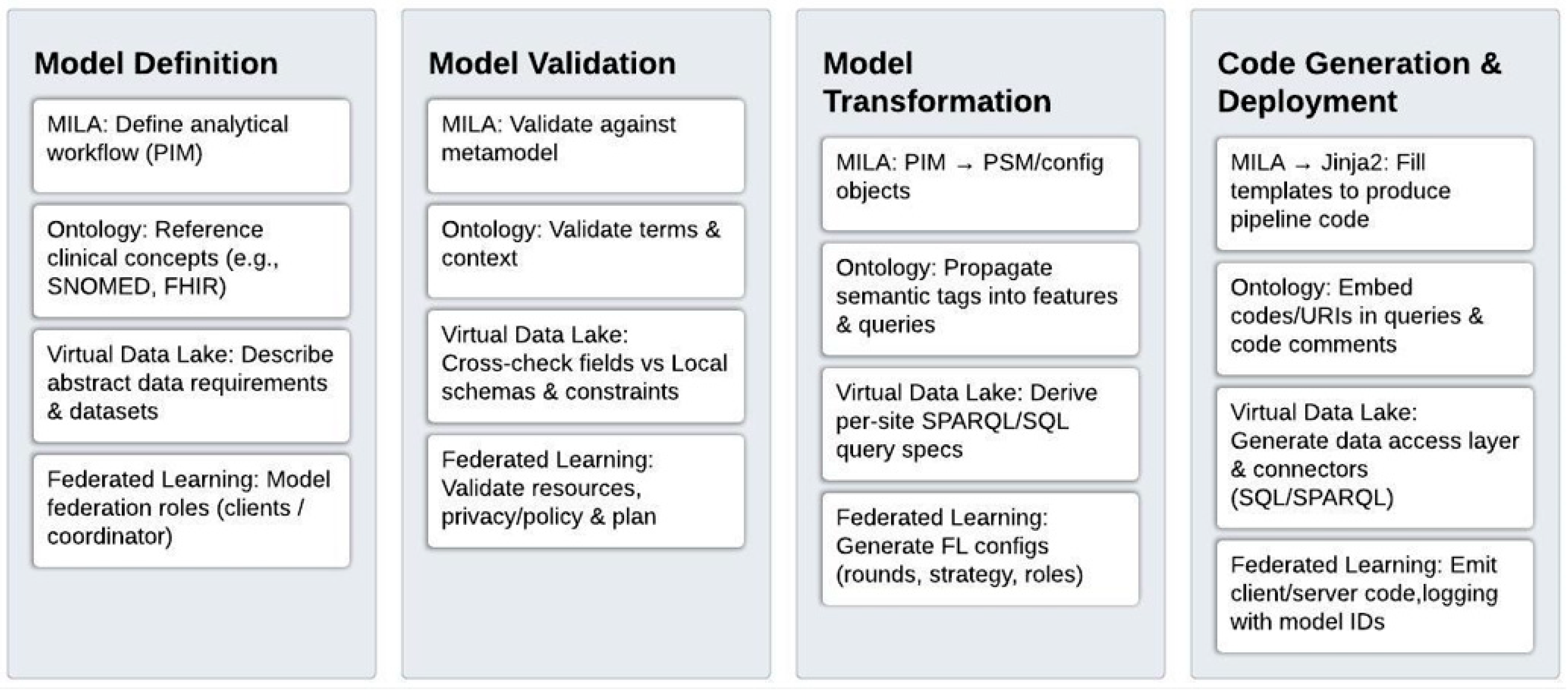
3.2. Overview of the MDE4AI Framework
- In the Model Definition stage, clinicians and data scientists describe analytical goals and data needs in MILA, referencing ontology-backed clinical concepts while remaining agnostic to storage and infrastructure.
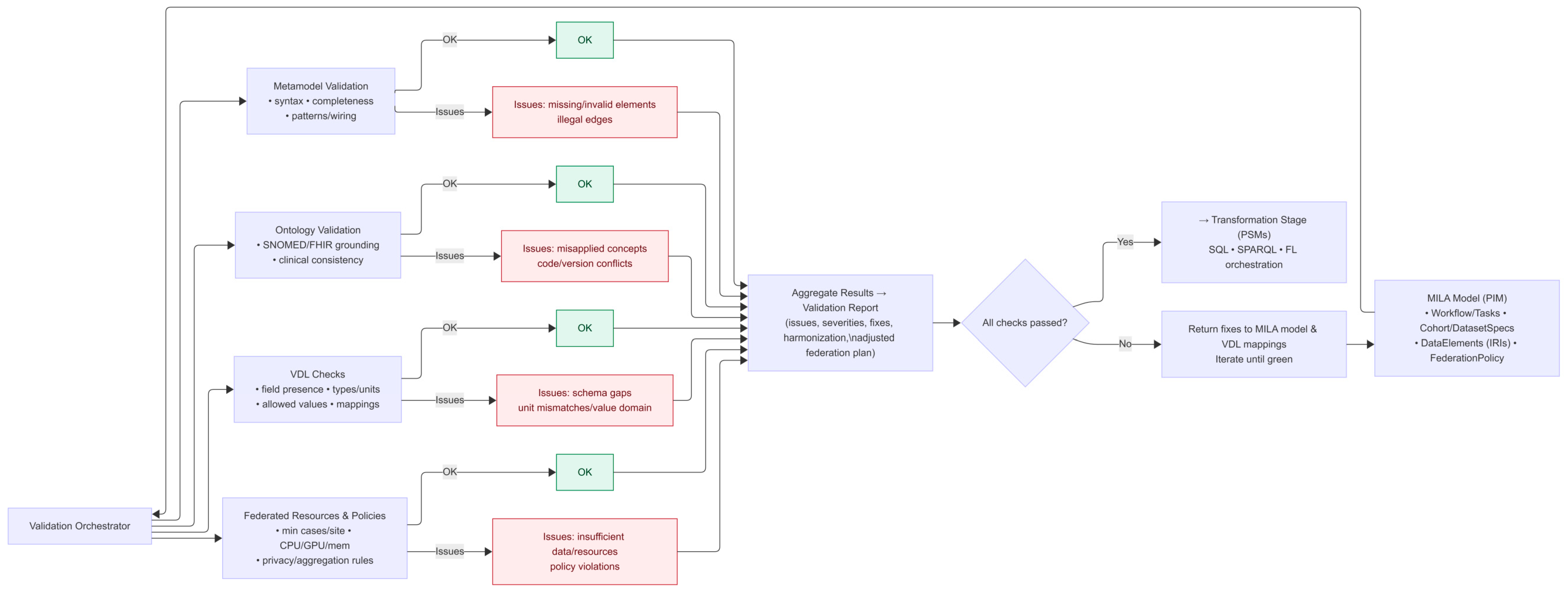
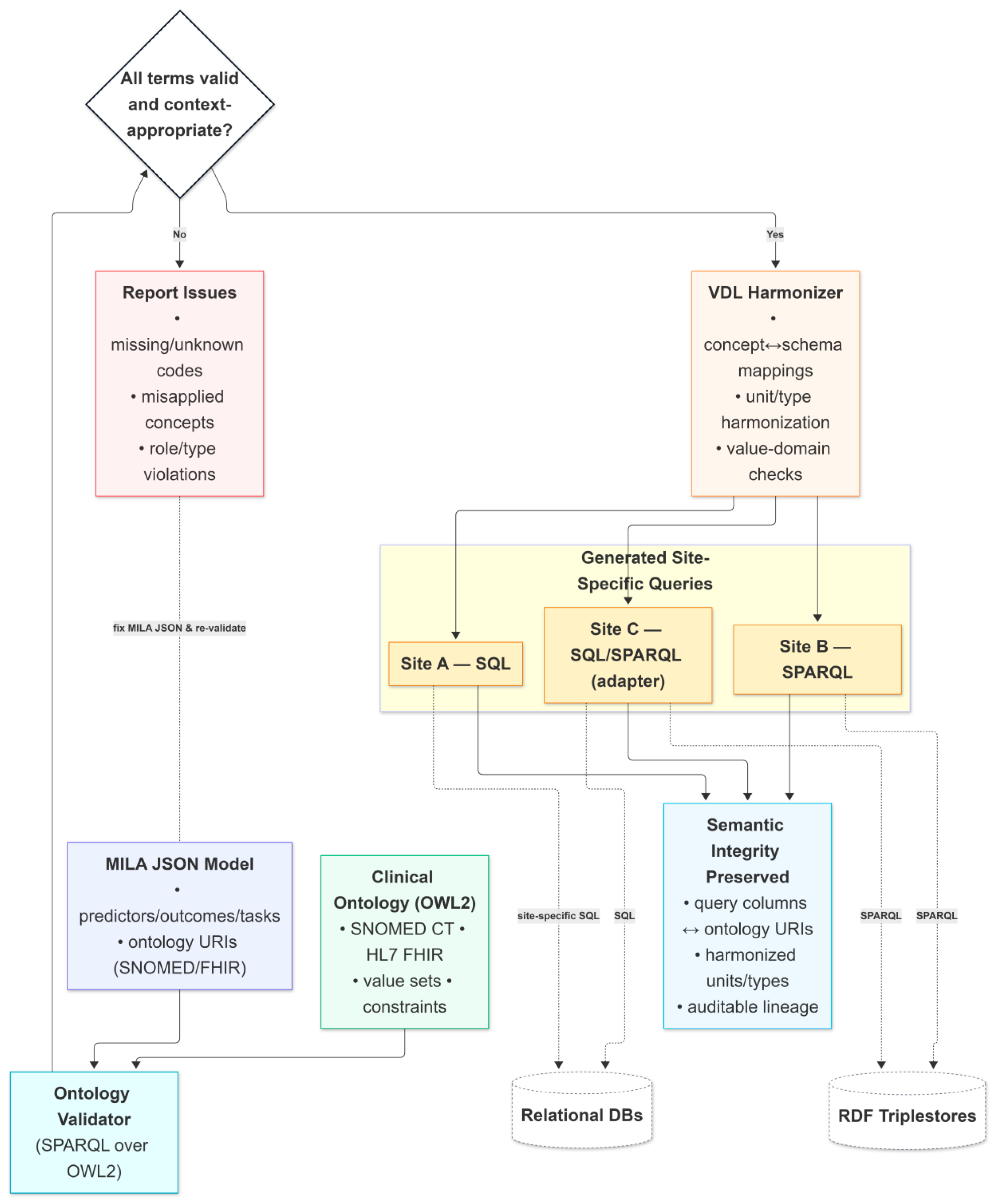
- During Model Validation, the model is checked for correctness, semantic integrity, and data availability across the federation, with safeguards for privacy and resource constraints.
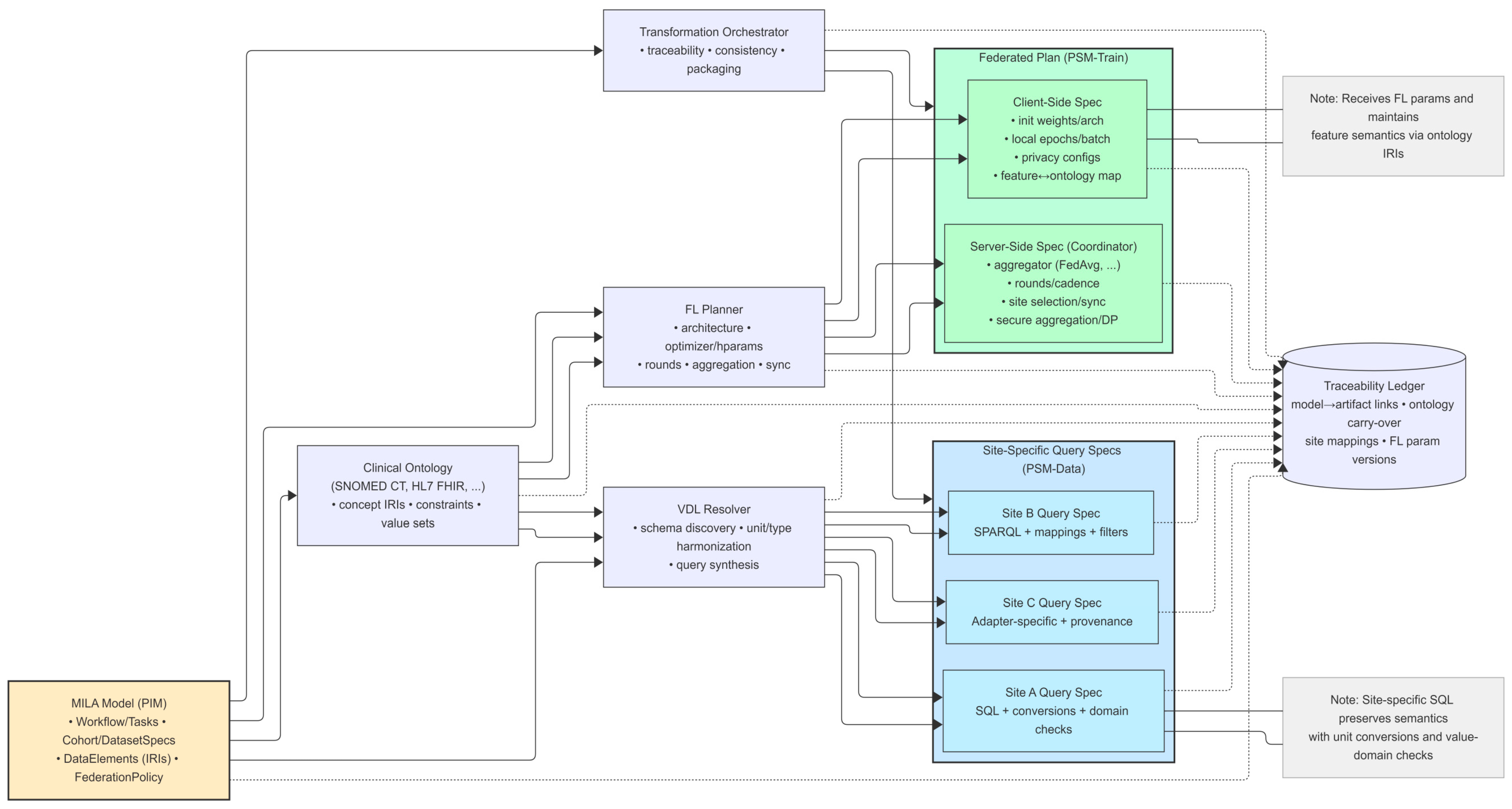
- The Model Transformation stage then converts the abstract specification into platform-specific designs and configurations, resolving data access through the Virtual Data Lake and generating federated learning parameters.
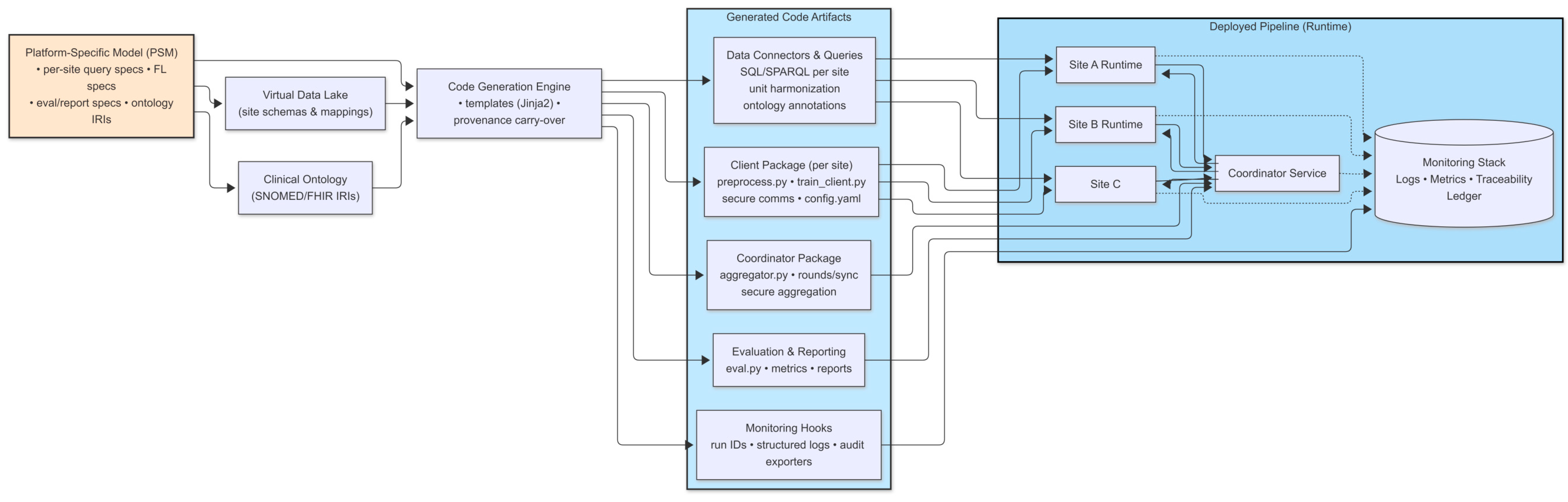
- Finally, Code Generation & Deployment produces executable scripts and connectors, embedding ontology references for traceability and enabling distributed execution across participating sites.
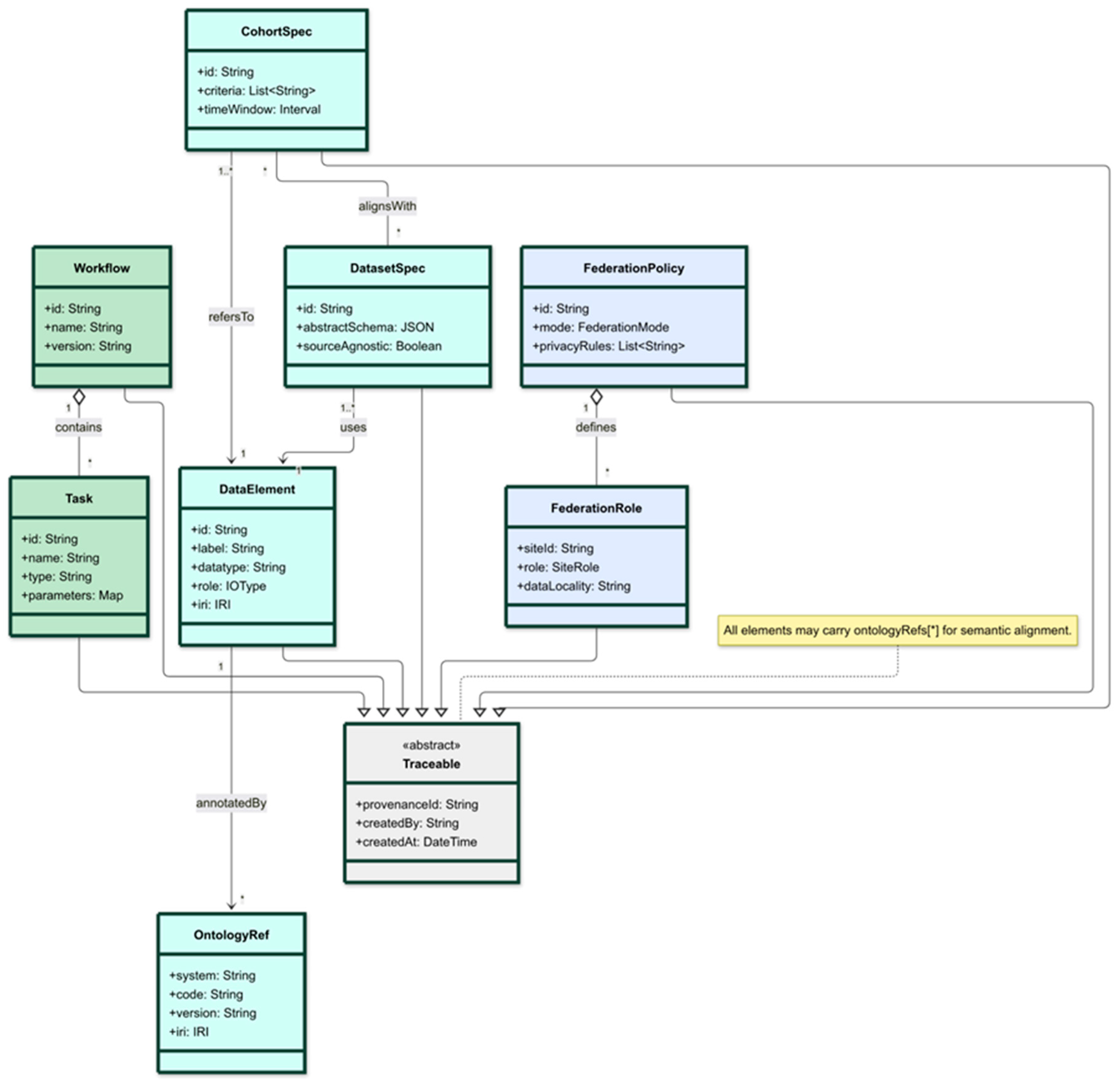
3.3. The MILA DSL and Metamodel Design
- Workflows and Tasks, which describe the steps of an analysis (e.g., preprocessing, feature extraction, model training).
- Data Elements, which are linked to standardized concepts in clinical ontologies such as SNOMED CT and HL7 FHIR. This ensures that inputs and outputs are described unambiguously and remain interoperable across sites.
- Cohort and Dataset Specifications, which allow abstract requirements to be stated (e.g., “patients with metastatic melanoma who received immunotherapy within the last 12 months”). These remain agnostic to the physical data sources, which are resolved later by the Virtual Data Lake.
- Federation Roles, which define whether a workflow is to be executed locally, across multiple hospitals, or in a federated setting. This makes data locality and privacy constraints explicit from the outset.
3.4. Semantic Interoperability Layer
Validation Mechanisms and Expert Involvement
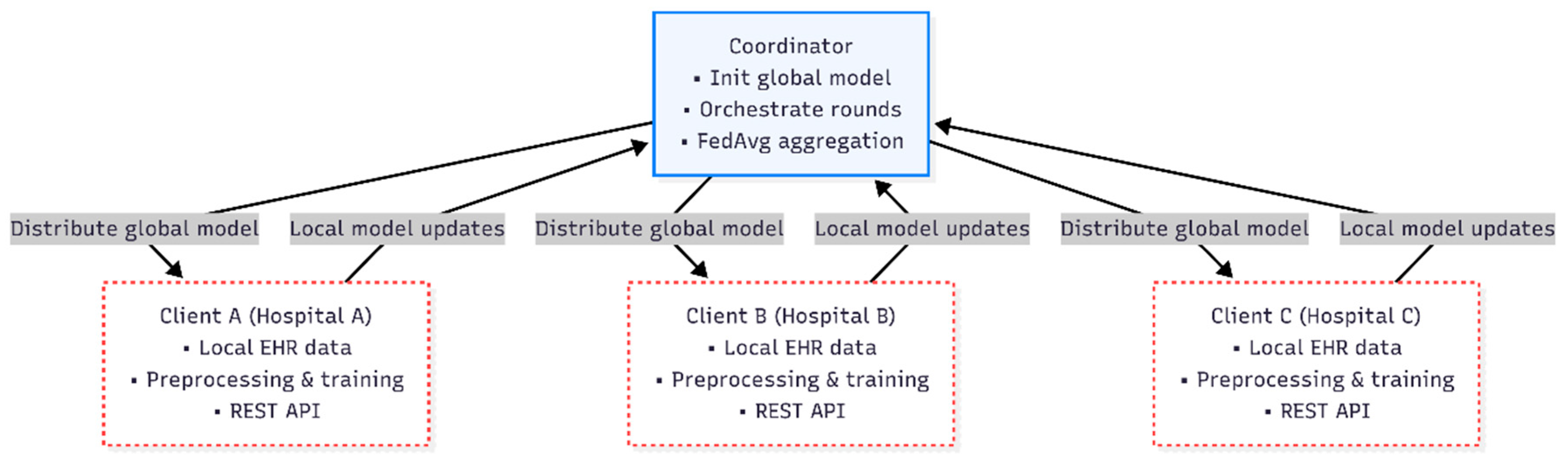
3.5. Federated Learning Architecture
3.6. MDE Pipeline: From Definition to Deployment
3.7. Architectural Rationale and Design Trade-Offs
4. Implementation
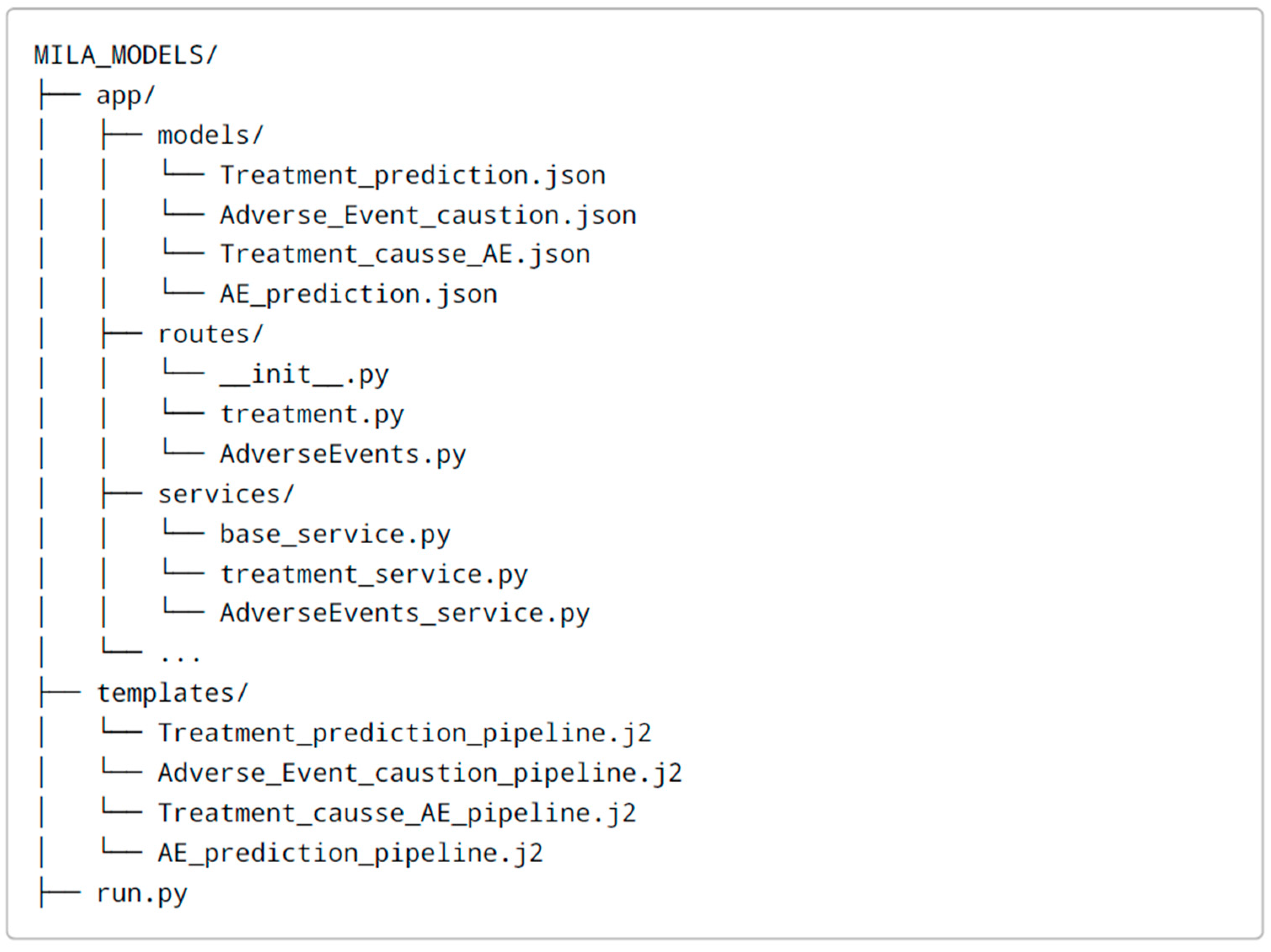
4.1. Toolchain and Model Specification
4.2. Semantic Interoperability in Practice
4.3. Federated Learning Deployment
5. Case Study: QUALITOP Evaluation and Results
5.1. Experimental Setup
- Predictive performance—could standardized federated pipelines achieve competitive accuracy across sites?
- Uniformity and traceability—were the generated workflows consistent across hospitals, and could model outputs be traced back to their MILA specifications?
- Development effort—how much manual coding was avoided by using MILA compared to a conventional implementation?
5.2. Experimental Protocol
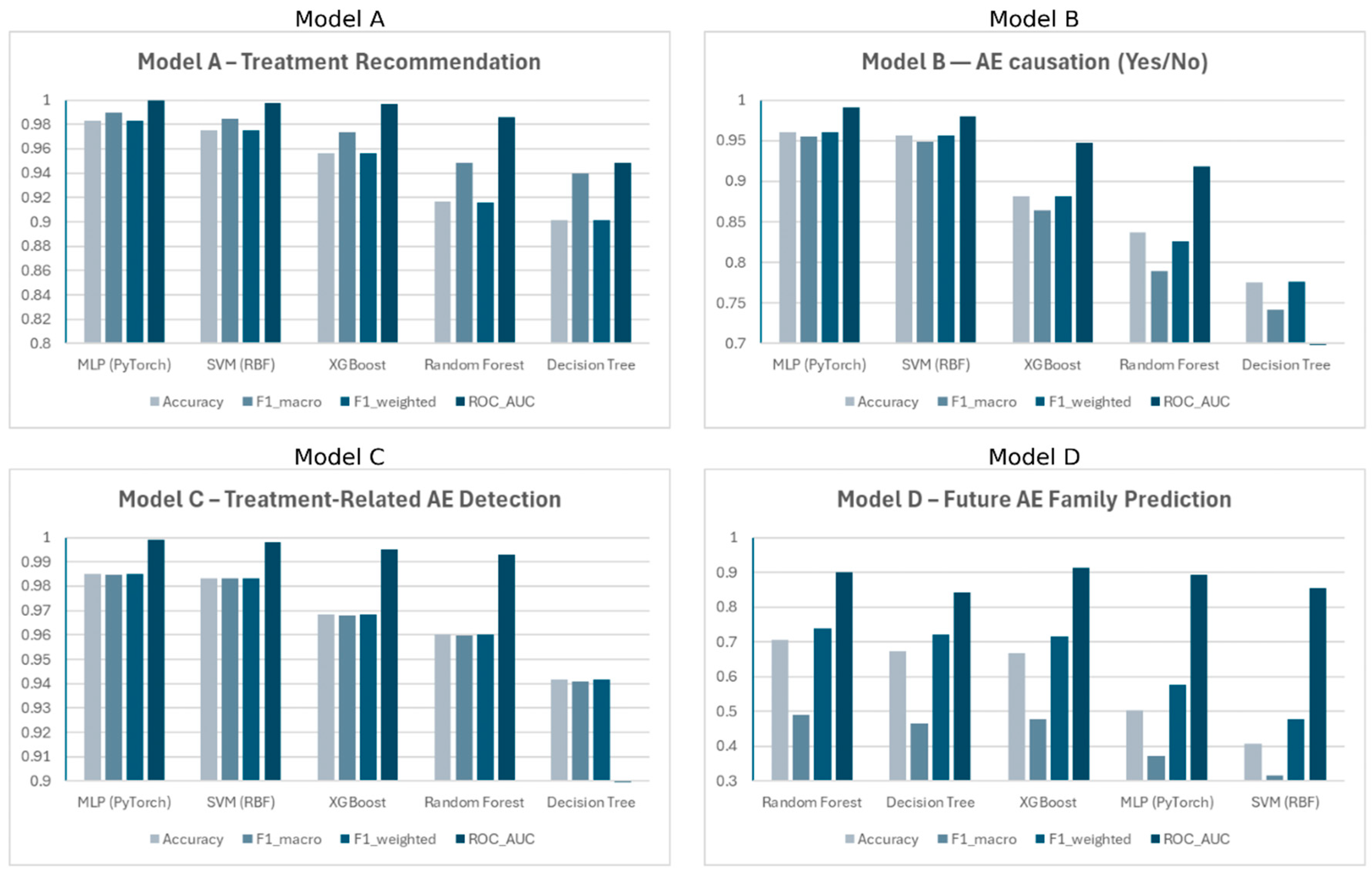
5.3. Model Performance
5.4. Traceability and Uniformity Validation
5.5. Development Effort Comparison
5.6. Threats to Validity
5.7. Summary of Results
6. Discussion
6.1. Framework Benefits
6.2. Clinical and Regulatory Relevance
6.3. Limitations and Challenges
6.4. Future Directions
7. Conclusions
Author Contributions
Funding
Data Availability Statement
Acknowledgments
Conflicts of Interest
References
- Yoo, J.H.; Jeong, H.; Lee, J.; Chung, T.M. Open problems in medical federated learning. Int. J. Web Inf. Syst. 2022, 18, 77–99. [Google Scholar] [CrossRef]
- Abbas, S.R.; Abbas, Z.; Zahir, A.; Lee, S.W. Federated Learning in Smart Healthcare: A Comprehensive Review on Privacy, Security, and Predictive Analytics with IoT Integration. Healthcare 2024, 12, 2587. [Google Scholar] [CrossRef]
- Steffen, B. Bridging the Gap Between AI and Reality; Springer Nature: Cham, Switzerland, 2025. [Google Scholar]
- Rädler, S.; Berardinelli, L.; Winter, K.; Rahimi, A.; Rinderle-Ma, S. Bridging MDE and AI: A systematic review of domain-specific languages and model-driven practices in AI software systems engineering. Softw. Syst. Model. 2025, 24, 445–469. [Google Scholar] [CrossRef]
- Naveed, H.; Arora, C.; Khalajzadeh, H.; Grundy, J.; Haggag, O. Model driven engineering for machine learning components: A systematic literature review. Inf. Softw. Technol. 2024, 169, 107423. [Google Scholar] [CrossRef]
- Brandon, C.; Singh, A.; Margaria, T. Model Driven Development for AI-Based Healthcare Systems: A Review. In International Conference on Bridging the Gap between AI and Reality; Lecture Notes in Computer Science (including subseries Lecture Notes in Artificial Intelligence and Lecture Notes in Bioinformatics); Springer Nature: Cham, Switzerland, 2025; Volume 14129 LNCS, pp. 245–265. [Google Scholar] [CrossRef]
- Amar, F.; April, A.; Abran, A. Electronic Health Record and Semantic Issues Using Fast Healthcare Interoperability Resources: Systematic Mapping Review. J. Med. Internet Res. 2024, 26, e45209. [Google Scholar] [CrossRef]
- Palojoki, S.; Lehtonen, L.; Vuokko, R. Semantic Interoperability of Electronic Health Records: Systematic Review of Alternative Approaches for Enhancing Patient Information Availability. JMIR Med. Inform. 2024, 12, e53535. [Google Scholar] [CrossRef] [PubMed]
- Bossenko, I.; Randmaa, R.; Piho, G.; Ross, P. Interoperability of health data using FHIR Mapping Language: Transforming HL7 CDA to FHIR with reusable visual components. Front. Digit. Health 2024, 6, 1480600. [Google Scholar] [CrossRef]
- Rigas, E.S.; Lagakis, P.; Karadimas, M.; Logaras, E.; Latsou, D.; Hatzikou, M.; Poulakidas, A.; Billis, A.; Bamidis, P.D. Semantic interoperability for an AI-based applications platform for smart hospitals using HL7 FHIR. J. Syst. Softw. 2024, 215, 112093. [Google Scholar] [CrossRef]
- Crowson, M.G.; Moukheiber, D.; Arévalo, A.R.; Lam, B.D.; Mantena, S.; Rana, A.; Goss, D.; Bates, D.W.; Celi, L.A. A systematic review of federated learning applications for biomedical data. PLoS Digit. Health 2022, 1, e0000033. [Google Scholar] [CrossRef] [PubMed]
- Liu, J.C.; Goetz, J.; Sen, S.; Tewari, A. Learning from others without sacrificing privacy: Simulation comparing centralized and federated machine learning on mobile health data. JMIR Mhealth Uhealth 2021, 9, e23728. [Google Scholar] [CrossRef]
- Antunes, R.S.; Da Costa, C.A.; Küderle, A.; Yari, I.A.; Eskofier, B. Federated Learning for Healthcare: Systematic Review and Architecture Proposal. ACM Trans. Intell. Syst. Technol. 2022, 13, 1–23. [Google Scholar] [CrossRef]
- Mammen, P.M. Federated Learning: Opportunities and Challenges. arXiv 2021, arXiv:2101.05428. [Google Scholar] [CrossRef]
- Teo, Z.L.; Jin, L.; Li, S.; Miao, D.; Zhang, X.; Ng, W.Y.; Tan, T.F.; Lee, D.M.; Chua, K.J.; Heng, J.; et al. Federated machine learning in healthcare: A systematic review on clinical applications and technical architecture. Cell Rep. Med. 2024, 5, 101419. [Google Scholar] [CrossRef] [PubMed]
- Kalokyri, V.; Tachos, N.S.; Kalantzopoulos, C.N.; Sfakianakis, S.; Kondylakis, H.; Zaridis, D.I.; Colantonio, S.; Regge, D.; Papanikolaou, N.; The ProCAncer-I consortium; et al. AI Model Passport: Data and System Traceability Framework for Transparent AI in Health. arXiv 2025, arXiv:2506.22358. [Google Scholar] [CrossRef] [PubMed]
- Namli, T.; Anıl Sınacı, A.; Gönül, S.; Herguido, C.R.; Garcia-Canadilla, P.; Muñoz, A.M.; Esteve, A.V.; Ertürkmen, G.B.L. A scalable and transparent data pipeline for AI-enabled health data ecosystems. Front. Med. 2024, 11, 1393123. [Google Scholar] [CrossRef]
- Au Yeung, J.; Shek, A.; Searle, T.; Kraljevic, Z.; Dinu, V.; Ratas, M.; Al-Agil, M.; Foy, A.; Rafferty, B.; Oliynyk, V.; et al. Natural language processing data services for healthcare providers. BMC Med. Inform. Decis. Mak. 2024, 24, 356. [Google Scholar] [CrossRef]
- Gruendner, J.; Schwachhofer, T.; Sippl, P.; Wolf, N.; Erpenbeck, M.; Gulden, C.; Kapsner, L.A.; Zierk, J.; Mate, S.; Stürzl, M.; et al. KETOS: Clinical decision support and machine learning as a service—A training and deployment platform based on Docker, OMOP-CDM, and FHIR Web Services. PLoS ONE 2019, 14, e0223010. [Google Scholar] [CrossRef]
- Ayaz, M.; Pasha, M.F.; Alahmadi, T.J.; Abdullah, N.N.B.; Alkahtani, H.K. Transforming Healthcare Analytics with FHIR: A Framework for Standardizing and Analyzing Clinical Data. Healthcare 2023, 11, 1729. [Google Scholar] [CrossRef]
- McMurry, A.J.; Gottlieb, D.I.; Miller, T.A.; Jones, J.R.; Atreja, A.; Crago, J.; Desai, P.M.; Dixon, B.E.; Garber, M.; Ignatov, V. Cumulus: A federated EHR-based learning system powered by FHIR and AI. medRxiv 2024. [Google Scholar] [CrossRef]
- Lehmann, J.; Wimberg, G.; Autexier, S.; Acebes, A.; Kalloniatis, C.; Lamprinoudakis, C.; Giannakopoulos, T.; Menegatos, A.; Delvinioti, A.; Pagliari, G. Federated Learning in Multi-Center, Personalized Healthcare for COPD and Comorbidities: The RE-SAMPLE Platform. In BIOSTEC (2): HEALTHINF; Science and Technology Publications: Setúbal, Portugal, 2025. [Google Scholar] [CrossRef]
- Sinaci, A.A.; Gencturk, M.; Alvarez-Romero, C.; Laleci Erturkmen, G.B.; Martinez-Garcia, A.; Escalona-Cuaresma, M.J.; Parra-Calderon, C.L. Privacy-preserving federated machine learning on FAIR health data: A real-world application. Comput. Struct. Biotechnol. J. 2024, 24, 136–145. [Google Scholar] [CrossRef]
- Elgammal, A.; Krämer, B.J.; Papazoglou, M.P.; Raheem, M. A Semantic Framework for Patient Digital Twins in Chronic Care. arXiv 2025, arXiv:2510.09134. [Google Scholar] [CrossRef]
- Vinke, P.C.; Combalia, M.; de Bock, G.H.; Leyrat, C.; Spanjaart, A.M.; Dalle, S.; Gomes da Silva, M.; Fouda Essongue, A.; Rabier, A.; Pannard, M.; et al. Monitoring multidimensional aspects of quality of life after cancer immunotherapy: Protocol for the international multicentre, observational QUALITOP cohort study. BMJ Open 2023, 13, e069090. [Google Scholar] [CrossRef] [PubMed]



| Category of Prior Work | Representative Studies | Observed Gap | Our Bridge |
|---|---|---|---|
| MDE/DSLs | Declarative extraction for AI on FHIR/CDMs [17] Clinical NLP service [18] Docker/OMOP/FHIR training & deployment [19] | Clinician-usable end-to-end modeling still missing; DSLs/tools remain engineer-centric. | MILA + MDE pipeline: healthcare-specific DSL, full lifecycle (prep → train → deploy → monitor). |
| Semantic Interop | Smart-hospital FHIR platform [10] FHIR Mapping Language tooling) [9] FHIR analytics framework [20] | Semantics handled at data layer, not embedded into modeling/automation. | Semantics-by-design: FHIR/ontologies in the metamodel/DSL; generators emit FHIR-consistent artifacts. |
| Federated Learning | Federated data/analytics [21] multi-center FL with FHIR sync [22] FL on FAIR/FHIR [23] | Ad hoc data harmonization; limited governance; no DSL for clinician-authored FL tasks. | Model-driven FL: PIM-level federation, auto-generated adapters, governance hooks, clinician DSL. |
| Model | Model A (Treatment) | Model B (AE Causality) | Model C (Treatment-AE) | Model D (Future AE Family) |
|---|---|---|---|---|
| MLP (PyTorch 1.13) | 0.977 | 0.961 | 0.985 | 0.488 |
| SVM (RBF) | 0.975 | 0.956 | 0.983 | 0.407 |
| XGBoost | 0.957 | 0.881 | 0.968 | 0.668 |
| Random Forest | 0.917 | 0.837 | 0.960 | 0.707 |
| Decision Tree | 0.902 | 0.776 | 0.942 | 0.673 |
| Prediction Task (Model) | Traced to Json Model? | Traced to Mila Specification? | Ontology Reference Preserved? |
|---|---|---|---|
| Model A—Treatment Recommendation | Satisfied | Satisfied | Satisfied |
| Model B—AE Causality | Satisfied | Satisfied | Satisfied |
| Model C—Treatment-Related AE | Satisfied | Satisfied | Satisfied |
| Model D—Future AE Family | Satisfied | Satisfied | Satisfied |
| Development Activity | Manual Coding Effort | Mde4ai Effort (Mila + Generation) |
|---|---|---|
| Data Parsing & Connectors | Days of custom scripting | Automated from Virtual Data Lake |
| Feature Engineering | Manual coding per dataset | Declared in MILA specification |
| Model Configuration | Hand-written hyperparameters | Defined once in MILA model |
| Code Implementation | 100 s–1000 s lines of code | Auto-generated from templates |
| Total Time (Per Task) | Days to weeks | Hours (JSON authoring only) |
Disclaimer/Publisher’s Note: The statements, opinions and data contained in all publications are solely those of the individual author(s) and contributor(s) and not of MDPI and/or the editor(s). MDPI and/or the editor(s) disclaim responsibility for any injury to people or property resulting from any ideas, methods, instructions or products referred to in the content. |
© 2026 by the authors. Licensee MDPI, Basel, Switzerland. This article is an open access article distributed under the terms and conditions of the Creative Commons Attribution (CC BY) license.
Share and Cite
Raheem, M.; Eltazi, N.; Papazoglou, M.; Krämer, B.; Elgammal, A. A Model-Driven Engineering Approach to AI-Powered Healthcare Platforms. Informatics 2026, 13, 32. https://doi.org/10.3390/informatics13020032
Raheem M, Eltazi N, Papazoglou M, Krämer B, Elgammal A. A Model-Driven Engineering Approach to AI-Powered Healthcare Platforms. Informatics. 2026; 13(2):32. https://doi.org/10.3390/informatics13020032
Chicago/Turabian StyleRaheem, Mira, Neamat Eltazi, Michael Papazoglou, Bernd Krämer, and Amal Elgammal. 2026. "A Model-Driven Engineering Approach to AI-Powered Healthcare Platforms" Informatics 13, no. 2: 32. https://doi.org/10.3390/informatics13020032
APA StyleRaheem, M., Eltazi, N., Papazoglou, M., Krämer, B., & Elgammal, A. (2026). A Model-Driven Engineering Approach to AI-Powered Healthcare Platforms. Informatics, 13(2), 32. https://doi.org/10.3390/informatics13020032