Article

Pruning Policy for Image Classification Problems Based on Deep Learning

by
Cesar G. Pachon
1,†,‡,
Javier O. Pinzon-Arenas
2,‡ and
Dora Ballesteros
1,*,†,‡
1
Faculty of Engineering, Universidad Militar Nueva Granada, Bogota 110111, Colombia
2
Biomedical Engineering, University of Connecticut, Storrs, CT 06269, USA
*
Author to whom correspondence should be addressed.
Current address: Kra. 11 101-80, Universidad Militar Nueva Granada, Bogota 11011, Colombia.
These authors contributed equally to this work.
Informatics 2024, 11(3), 67; https://doi.org/10.3390/informatics11030067

Submission received: 17 July 2024 / Revised: 14 August 2024 / Accepted: 6 September 2024 / Published: 12 September 2024
(This article belongs to the Section Machine Learning)

Abstract

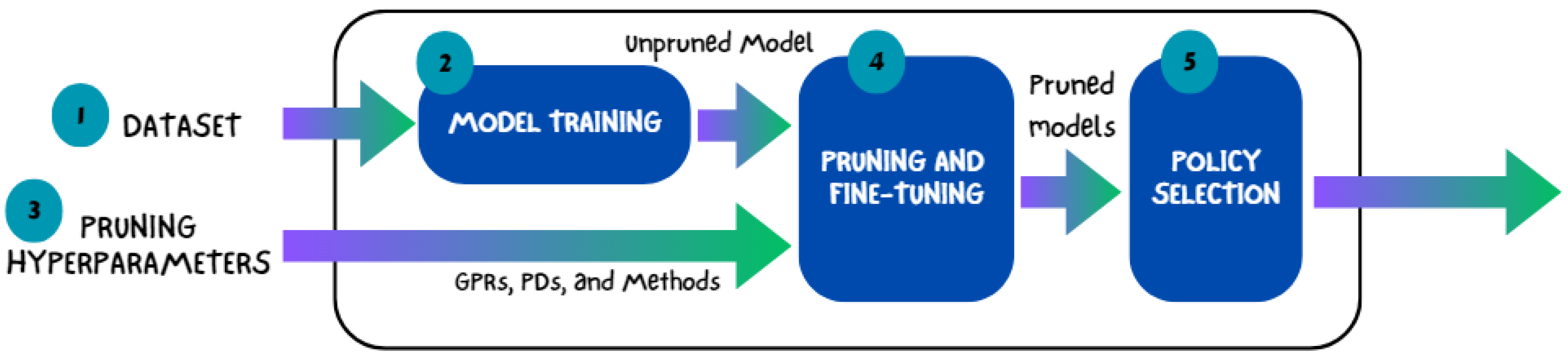
In recent years, several methods have emerged for compressing image classification models using CNNs, for example, by applying pruning to the convolutional layers of the network. Typically, each pruning method uses a type of pruning distribution that is not necessarily the most appropriate for a given classification problem. Therefore, this paper proposes a methodology to select the best pruning policy (method + pruning distribution) for a specific classification problem and global pruning rate to obtain the best performance of the compressed model. This methodology was applied to several image datasets to show the influence not only of the method but also of the pruning distribution on the quality of the pruned model. It was shown that the selected pruning policy affects the performance of the pruned model to different extents, and that it depends on the classification problem to be addressed. For example, while for the Date Fruit Dataset, variations of more than 10% were obtained, for CIFAR10, variations were less than 5% for the same cases evaluated.
Keywords: convolutional neural network; compression model; pruning policy; global pruning rate; pruning distribution; pruning method convolutional neural network; compression model; pruning policy; global pruning rate; pruning distribution; pruning method