Article

Employee Stock Ownership Plans and Market Stability: A Longitudinal Analysis of Stock Price Crash Risk in China

1
The International Business School, Shaanxi Normal University, Xi’an 710119, China
2
School of Marketing and International Business, Victoria University of Wellington, Wellington 6011, New Zealand
*
Author to whom correspondence should be addressed.
Risks 2025, 13(12), 234; https://doi.org/10.3390/risks13120234
Submission received: 3 November 2025 / Revised: 14 November 2025 / Accepted: 20 November 2025 / Published: 1 December 2025

Abstract

Reducing stock price crash risk is vital for capital market stability, particularly in emerging economies such as China. This study investigates whether Employee Stock Ownership Plans (ESOPs) can mitigate crash risk by analyzing panel data from A-share listed firms between 2014 and 2022. In contrast to prior research that has largely centered on managers and controlling shareholders, we highlight employees as active participants in corporate governance. Employing firm, year, and industry fixed effects, together with propensity score matching and instrumental variable techniques, we find robust evidence that ESOPs significantly reduce crash risk. Mediation analyses indicate that this effect operates through reduced agency costs both between managers and shareholders and between controlling and minority shareholders, as well as enhanced corporate productivity. Moderation tests further show that ESOPs are most effective when investor attention is high and when exit threats from non-controlling major shareholders are stronger. Heterogeneity analyses reveal that ESOPs exert greater influence in non-state-owned enterprises, in eastern regions, in firms with higher employee participation, and when shares are sourced from the secondary market. By extending the observation window to nearly a decade and deploying multiple robustness checks, this study provides one of the most comprehensive examinations of ESOPs and crash risk to date. It contributes to the literature by reframing employees as central actors in market stability and offers actionable insights for managers, investors, and regulators seeking to enhance corporate governance and reduce systemic risk.

1. Introduction

China’s capital market has grown rapidly but remains highly volatile, with sharp swings in stock prices undermining investor confidence and threatening systemic stability. A particular concern is stock price crash risk, sudden, severe declines in firm value often linked to the accumulation and delayed disclosure of bad news by insiders (Bao et al. 2021; Liu et al. 2017; Habib et al. 2018). Prior research identifies a wide range of antecedents, including information opacity, weak internal controls, executive characteristics, and equity pledging by controlling shareholders, as well as external factors such as anti-corruption campaigns, government consistency, and institutional herding (Callen and Fang 2015; Chen et al. 2018; Lee and Wang 2017; Fu et al. 2021). More recent studies extend this line of inquiry by incorporating environmental and governance dimensions. For example, Yu et al. (2024) show how Environmental, Social, and Governance (ESG) uncertainty interacts with investor attention to influence crash risk, while Zhang and Phua (2024) find that ESG performance is negatively related to crash risk in Chinese listed firms, highlighting the growing importance of non-financial governance factors.
Beyond China, similar mechanisms have been observed globally. For instance, Hutton et al. (2009) and An and Zhang (2013) document that managerial bad-news hoarding predicts stock price crashes in U.S. and international markets, while Kim et al. (2014) show that stronger corporate transparency and board independence mitigate crash risk. These findings suggest that crash-risk determinants reflect universal governance dynamics rather than country-specific anomalies.
Yet, one critical stakeholder group “employees” has received little attention in this literature (Ali et al. 2022). Although there is emerging work in this direction, such as Li et al. (2019), which documents an association between ESOP announcements and reduced crash risk, subsequent research remains limited. More recent scholarship, including Quang (2025), emphasizes how ESOP policy design and transparency shape the risk-mitigating potential of ESOPs. Nevertheless, comprehensive evidence on the mechanisms and boundary conditions of ESOPs in China is still lacking.
ESOPs align employee wealth with firm performance, potentially encouraging monitoring, improving information flows, and fostering a longer-term orientation (Xiao 2023). While common in Western markets, ESOPs only became prominent in China after the 2014 Guiding Opinions on the Pilot Implementation of ESOPs by Listed Companies. In mature markets such as the United States and the United Kingdom, long-established employee-ownership systems have been shown to enhance firm resilience and reduce opportunistic behavior (Blasi et al. 2017), providing an international benchmark for understanding how ESOPs can promote stability in emerging economies.
However, prior studies report mixed evidence on the risk-mitigating effects of ESOPs, partly because many focus on short-term market reactions or treat employee ownership merely as compensation rather than governance. For instance, while (Li et al. 2019) find a negative link between ESOP announcements and crash risk, other studies show insignificant or reversed results when participation is concentrated among executives or disclosure is weak. These inconsistencies suggest that ESOP effectiveness depends on design, transparency, and institutional context.
Drawing on stewardship theory and stakeholder theory, this study views ESOPs as participatory governance mechanisms. Stewardship theory posits that employee-owners act as stewards who align personal and firm interests through shared trust (Davis et al. 1997), while stakeholder theory emphasizes that shared ownership broadens accountability and enhances firm stability (Freeman 2010). Together, these perspectives explain how ESOPs can mitigate managerial opportunism and improve information integrity.
This reform provides a valuable opportunity to investigate whether ESOPs mitigate crash risk in China’s institutional setting, characterized by concentrated ownership, evolving governance, and heterogeneous regional development. Recent studies such as Quang (2025) explicitly address how ESOP policy design and transparency affect crash risk, reinforcing the importance of disclosure regimes in ESOP effectiveness. Similarly, Huang et al. (2025) bring in non-financial external signals, such as investor sentiment, as predictors of performance in ESOP settings, hinting at broader external moderators relevant to crash risk.
This study examines the relationship between ESOPs and stock price crash risk using panel data on A-share firms from 2014 to 2022. It makes three contributions. First, it introduces employees into the crash-risk discussion by showing that ESOPs are robustly associated with lower crash risk across multiple estimation techniques. Second, it identifies the mechanisms through which ESOPs reduce crash risk, namely by lowering agency costs both between managers and shareholders and between controlling and minority shareholders, and by improving productivity. Third, it demonstrates that ESOP effectiveness depends on external oversight, strengthening when firms face high investor attention and greater exit threats from non-controlling major shareholders. By combining internal and external perspectives, this study not only extends existing literature but also provides practical insights for managers, investors, and policymakers on how ESOPs can enhance market stability in emerging economies. Building on recent advances in the literature on crash risk and governance (e.g., Yu et al. 2024; Quang 2025), this study extends the analysis by focusing specifically on employees as active governance participants and by providing one of the longest observation windows studied to date.

2. Theoretical Analysis and Hypotheses

2.1. Conceptual Background

ESOPs tie employee wealth to firm value, encouraging attention to operations, timely information sharing, and participation in processes that support long-term performance (Xiao 2023). Relative to external investors, employees observe granular, real-time operational signals, which can narrow information asymmetry (Vo 2019; Yu et al. 2024). In ownership environments where control is concentrated, employees who become minority shareholders add a layer of internal scrutiny, constraining private benefit extraction by controlling owners and discouraging bad-news hoarding (Dang and Nguyen 2021; Xue and Ying 2020; Lin and Sutunyarak 2024). In parallel, ESOP-induced incentives can raise productivity, improving earnings quality and smoothing performance trajectories, both of which are inconsistent with the bad-news-accumulation channel that produces crash risk. Because stock price crash risk originates from the accumulation and concealment of bad news, ESOPs influence crash risk primarily by reshaping information flows, incentives, and internal governance. Taken together, ESOPs may reduce the incidence and intensity of stock price crashes.
H1 (Main effect). 
ESOP implementation is associated with lower stock price crash risk.

2.2. Mechanisms

Building on this foundation, the following subsections explain the specific mechanisms through which ESOPs influence the generation, concealment, and release of bad news.

2.2.1. Agency-Cost Channels

The first mechanism concerns agency conflicts, which are central to the formation of bad-news hoarding and thus to crash risk. ESOPs can reduce the manager–shareholder agency wedge by improving internal transparency and aligning incentives (Li et al. 2019; Sun et al. 2025). As employees bear direct wealth consequences, they are more motivated to surface operational issues and resist short-term manipulation that would postpone bad-news disclosure.
They can also counterbalance controlling shareholders in “one-share dominance” structures by becoming organized minority owners, raising the perceived cost of tunneling and curbing negative-news concealment (Xiao 2023).
H2a. 
ESOPs reduce manager–shareholder agency costs, which in turn reduce crash risk.
H2b. 
ESOPs reduce controlling–minority shareholder agency costs, which in turn reduce crash risk.

2.2.2. Productivity Channel

Beyond agency costs, ESOPs also shape firms’ operating fundamentals, which influence whether negative performance shocks accumulate and trigger left-tail events. By linking payoffs to performance, ESOPs enhance effort, coordination, and innovation, improving productivity and earnings quality. Smoother fundamentals lower the likelihood that accumulated losses are suddenly recognized, reducing left-tail risk (Xiao 2023).
H3. 
ESOPs increase productivity, which in turn reduces crash risk.

2.2.3. External Oversight as Moderators

In addition to internal mechanisms, external monitoring conditions determine how strongly ESOPs can function as governance tools. External monitoring shapes the salience and credibility of ESOPs as governance devices. Investor attention pressures insiders to avoid bad-news hoarding and rewards timely disclosure, complementing ESOP-driven internal checks (Jin et al. 2024). Likewise, the potential exit of non-controlling major shareholders deters opportunism and raises the reputational/valuation costs of concealment. ESOPs should be most effective where such oversight is stronger.
H4. 
ESOPs’ crash-risk reduction is stronger when investor attention is higher.
H5. 
ESOPs’ crash-risk reduction is stronger when the exit threat of non-controlling major shareholders is greater.

2.2.4. Non-Controlling Major Shareholder

Non-controlling major shareholders, while not in control, still have significant influence and a strong interest in corporate stability. Their oversight can help constrain both management and controlling shareholders, improving the quality of financial disclosures (Li et al. 2019). When these shareholders exit, the market often interprets it as a warning, leading to sharp price declines. To prevent such reactions, firms with ESOPs may adopt stronger governance practices and improve transparency to reassure investors. In this way, the presence of influential yet non-controlling shareholders can strengthen the risk-reducing effects of ESOPs.
H6. 
The greater the threat of non-controlling major shareholder exit, the stronger the effect of ESOPs in reducing stock price crash risk.
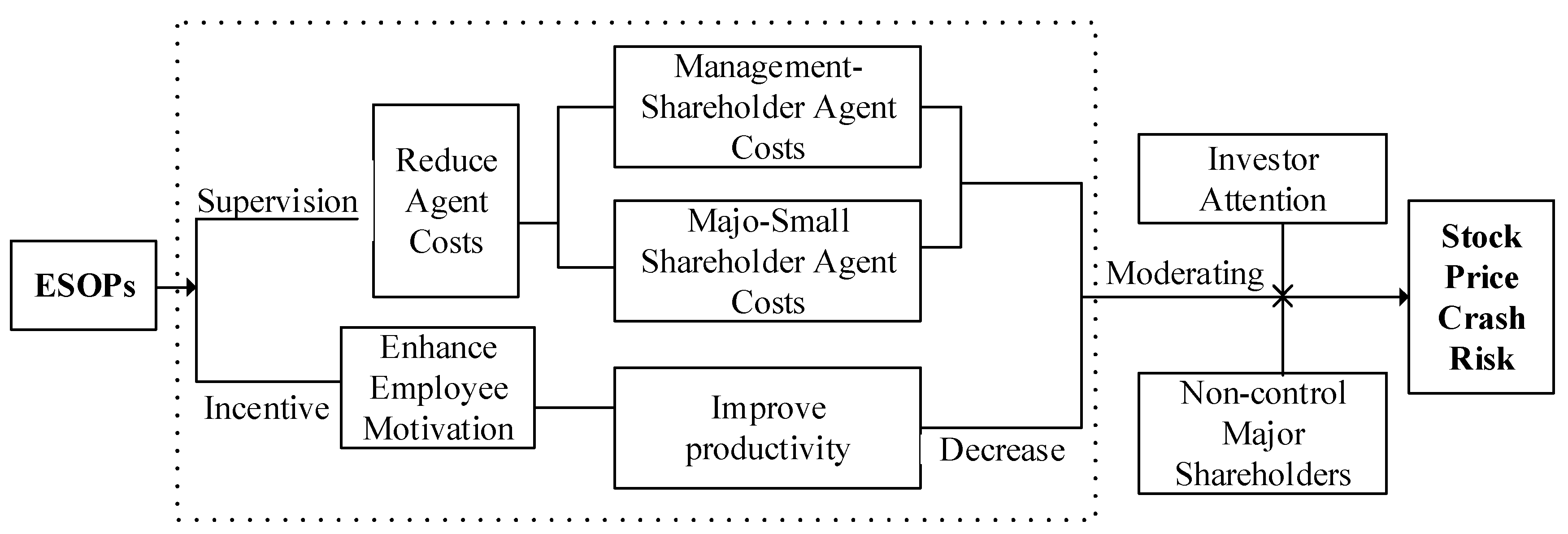
In summary, the mechanisms by which ESOPs impact stock price crash risk are illustrated in Figure 1. The main pathways are as follows: ESOPs reduce agency costs by aligning employees’ interests with shareholders’, improving information flow, and reducing conflicts between management and shareholders, thereby lowering crash risk. ESOPs also enhance productivity by motivating employees to participate in operations, management, and decision-making, thus strengthening the company’s resilience, both of which act as mediating mechanisms. Meanwhile, investor attention and non-controlling major shareholder oversight serve as moderating mechanisms. Increased investor attention improves information disclosure and market supervision, while oversight by non-controlling major shareholders enhances governance, further reducing crash risk. These mechanisms demonstrate how ESOPs can help mitigate stock price crash risk and promote corporate stability.

3. Data and Model

3.1. Data and Variables

We select A-share listed companies in the Shanghai and Shenzhen Stock Exchanges from 2014 to 2022 as the research sample. Data processing involved the following steps: (1) excluding financial sector companies; (2) excluding ST and PT companies; (3) excluding companies newly listed in 2022; (4) removing companies with a debt-to-asset ratio above 1; (5) excluding those with fewer than 30 weeks of annual trading; and (6) excluding companies with significant missing data. Companies with unapproved or terminated ESOPs were also excluded. Firms with invalid or repeated ESOP events were excluded. The final sample comprised 10,777 company-year observations. Continuous variables were winsorized at the 1st and 99th percentiles. Data was sourced from the China Research Data Service Platform: Wind Database and RESSET Database.

3.1.1. Stock Price Crash Risk

We measure stock price crash risk using negative return skewness (NCSKEW) and down-to-up volatility (DUVOL), following the methodology of Khan and Rizwan (2021), and Yao et al. (2023).
First, Equation (1) removes the market impact on individual stock returns. r i , t represents the weekly return of company i , while r M , t is the average market return weighted by circulating market value in week t . Model (1) also includes a two-period lag and lead of the market portfolio return to account for asynchronous trading effects. The regression residual ε i , t represents the portion of the individual stock return that is not explained by market fluctuations. We define W i , t = ln ( 1 + ε i , t ) as the market-adjusted return of stock i in week t .
r i , t = α i + β 1 r M , t 2 + β 2 r M , t 1 + β 3 r M , t + β 4 r M , t + 1 + β 5 r M , t + 2 + ε i , t
The calculation for the Negative Coefficient of Skewness of Returns (NCSKEW) is shown in Equation (2), where n represents the number of trading weeks for the stock i in year t . A higher NCSKEW value indicates a greater degree of negative skewness in stock returns, suggesting a higher risk of stock price crashes, while a lower value indicates reduced crash risk.
N C S K E W i , t = n ( n 1 ) 3 / 2 W i , t 3 / ( n 1 ) ( n 2 ) ( W i , t 2 ) 3 / 2
The calculation for the Up and Down Volatility Ratio (DUVOL) is shown in Equation (3), where n u and n d represent the number of weeks the stock price has risen and fallen, respectively. An “up week” occurs when the return of stock iii exceeds the average annual return, while a “down week” is when it falls below. A higher DUVOL value indicates greater left skewness, suggesting a higher risk of stock price crashes, whereas a lower DUVOL value implies reduced crash risk.
D U V O L i , t = ln ( n u 1 ) D o w n W i , t 2 / ( n d 1 ) U p W i , t 2

3.1.2. Employee Stock Ownership Plan (ESOP)

We measure ESOP using two indicators: whether an ESOP is implemented (ESOP_D) and the proportion of shares under the ESOP (ESOP_R). ESOP_D equals 1 if the company announces or has an active ESOP during the year, and 0 otherwise. ESOP_R represents the proportion of shares under the ESOP relative to the company’s total shares or during the period the ESOP is in effect.

3.1.3. Control Variables

This study controls for two categories of related variables. The first category consists of variables selected based on the stock market, including excess turnover rate weekly return volatility, and average weekly return. The second category consists of variables selected based on company characteristics, including company size, debt-to-asset ratio, price-earnings ratio, and whether the CEO and chairman positions are held by the same person. The specific definitions of the control variables are shown in Table 1. To clarify the role of the control variables, this study follows prior literature and includes controls that capture both market-level and firm-level factors known to influence crash risk. DTurn, Sigma, and Ret reflect stock liquidity, volatility, and return performance, which may directly affect the likelihood of extreme price movements. lnSize, LEV, and PE capture essential firm characteristics related to size, financial leverage, and valuation, all of which influence firms’ risk profiles and information environments. Duality controls for governance structure, as the concentration of managerial power may exacerbate bad-news hoarding. In addition, year and industry fixed effects are included to absorb macroeconomic conditions and sector-specific shocks that could otherwise bias the estimated relationship between ESOPs and crash risk.

3.2. Model Design

To test the hypothesis H1, we construct a multiple linear equation for regression analysis, as shown in Equation (4). Here, ESOP_Di,t represents the employee stock ownership plan variable for period t; Crashriski,t+1 denotes the stock price crash risk variable for period t + 1, measured by NCSKEWi,t+1 and DUVOLi,t+1; CVi,t are the control variables. Firm, Year, and Ind are included to capture firm, year, and industry fixed effects, respectively. We employ clustered robust standard errors at the company level. To mitigate endogeneity concerns, all independent and control variables are lagged by one period relative to the dependent variable.
C r a s h r i s k i , t + 1 = α 0 + α 1 E S O P _ D i , t + α 2 C V i , t + F i r m i + Y e a r t + I n d i + + ε i , t

4. Empirical Analysis Results and Discussion

4.1. Descriptive Statistics

Table 2 shows the descriptive statistics for each variable. The mean values of NCSKEW and DUVOL are −0.313 and −0.208, respectively, with minimum values of −2.383 and −1.356 and maximum values of 1.550 and 0.966. The standard deviations are 0.688 and 0.460, respectively, indicating relatively large variations in the degree of stock price crash risk among the sample companies, which requires further research. Additionally, the distribution of other variables is observed to be within a reasonable range. To better understand how these variables interact in the empirical model, we next examine whether multicollinearity or other specification issues might influence the regression results.
Before running the regression, we tested for potential multicollinearity among the explanatory variables. The correlation results show no evident collinearity. To confirm, we calculated the variance inflation factors (VIFs). As shown in Table 3, the average VIF is 1.35 and the maximum is 1.82, both far below the commonly accepted threshold of 10, indicating no serious multicollinearity issue.

4.2. Baseline Regression Analysis

Before estimating the main coefficients, it is essential to select the most appropriate panel model to ensure reliable inference. Given that pooled OLS regression may ignore firm-specific heterogeneity and lead to biased estimates, we conducted a series of diagnostic tests to determine the appropriate panel model. As shown in Table 4, the F-test was first used to compare the pooled model with the fixed-effects model. The p-values for both columns (1) and (2) are 0.000, strongly rejecting the null hypothesis and indicating that the fixed-effects model is superior to the pooled regression. Next, the LM test was performed to decide between the random-effects and pooled models, and the results again favor a panel specification. Finally, the Hausman test was conducted to distinguish between the fixed-effects and random-effects models. The test statistics show that the null hypothesis—that individual effects are uncorrelated with the regressors, is rejected at the 1% level (p = 0.000). Therefore, the fixed-effects model is adopted for subsequent regression analyses.
With the fixed-effects model confirmed as the most suitable specification, we now turn to the baseline regression results. The baseline regression results are presented in Table 5. Column (1) reports the regression results using the negative conditional skewness (NCSKEW) as the proxy for stock price crash risk, while Column (2) uses the down-to-up volatility (DUVOL) as the proxy. The employee stock ownership plan variable (ESOP_D) coefficients are −0.2021 and −0.1282, respectively, and both are statistically significant at the 1% level. These findings indicate a significant negative relationship between employee stock ownership plans and stock price crash risk, suggesting that ESOPs can effectively reduce the likelihood of stock price crashes. Therefore, Hypothesis 1 is supported.

4.3. Robustness Checks

To further verify that our findings are not driven by model choice or sample selection bias, a series of robustness checks are conducted.

4.3.1. Propensity Score Matching (PSM) Test

Using a logit model, we scored the samples based on company size, company age, book-to-market ratio, return on assets, weekly return volatility, and average weekly return. Three types of sample matching were performed, and the results are shown in Table 6.
The three matched samples were sequentially regressed using Equation (4), and the results are presented in Table 7. Columns (1) and (2) report the regression results based on 1:2 nearest neighbor matching with replacement and a caliper of 0.05. Columns (3) and (4) present the results based on 1:4 nearest neighbor matching with replacement and a caliper of 0.001. Columns (5) and (6) display the results from radius matching with a caliper of 0.001. Across all three sets of regressions, the results consistently demonstrate that employee stock ownership plans significantly reduce stock price crash risk, indicating that the main conclusions remain robust.

4.3.2. Instrumental Variable Regression

Following Chang et al. (2015), we use the industry average ESOPs of other companies in the same year (IV) as the instrumental variable for the regression. Using the industry average ESOP adoption as an instrument, the two-stage regression confirms the negative relationship between ESOPs and crash risk (Table 8).

4.3.3. Changing the Measurement of the Independent Variable

This study replaces ESOP_D with the proportion of implemented ESOPs (ESOP_R). The results are shown in columns (1) and (2) of Table 9. Replacing ESOP_D with ESOP_R yields similar results, confirming robustness.

5. Further Analysis

5.1. Test of Mediation Mechanism

Following the mediation effect testing approach (Wen and Ye 2014; Wen et al. 2004), this study uses a stepwise regression method to test the mediation effects of the supervision and incentive mechanisms.
M e d i , t + 1 = β 0 + β 1 E S O P _ D i , t + β 2 C V i , t + F i r m i + Y e a r t + I n d i + ε i , t
C r a s h r i s k i , t + 1 = δ 0 + δ 1 E S O P _ D i , t + δ 2 M e d i , t + 1 + δ 3 C V i , t + F i r m i + Y e a r t + I n d i + ε i , t
In Equations (5) and (6), med denotes the mediating variable, and all other variables are consistent with those in Equation (4). According to the standard procedure for testing mediation effects, we first estimate Equation (5). If β 1 is statistically significant, indicating that the employee stock ownership plan (ESOP) significantly affects the mediating variable. Next, we estimate Equation (6). If both δ 1 , δ 2 are statistically significant, it suggests that the mediating variable partially mediates the relationship between ESOPs and stock price crash risk.
We examine agency costs and productivity growth as two potential mediating mechanisms based on the preceding theoretical analysis.

5.1.1. Regression Results of Agency Costs

We calculate two agency cost variables: (1) Shareholder-Management Agency Costs (SMAc): Following Singh and Davidson (2003) shareholder-management agency costs are measured using the management expense ratio (management expenses/revenue) (Singh and Davidson 2003). (2). Large Shareholder-Minority Shareholder Agency Costs (LSAc): Referring to Jiang’s method, LSAc is measured using the annual increment of other receivables. A higher LSAc indicates higher agency costs between large shareholders and minority shareholders (Jiang et al. 2010). Columns (1)–(3) of Table 10 report the mediating effect of shareholder–management agency costs, while Columns (4)–(6) present the regression results for large shareholder–minority shareholder agency costs.
The results indicate that the mediating effects of both SMAc and LSAc are statistically significant. This finding suggests that employee stock ownership can somewhat weaken the information advantage held by management, thereby reducing shareholder–management agency costs. At the same time, employee participation in ownership helps constrain the expropriation behavior of controlling shareholders, thus lowering agency costs between controlling and minority shareholders. Ultimately, this contributes to a reduction in the firm’s stock price crash risk. These results confirm Hypotheses H2a and H2b proposed in this study.

5.1.2. Regression Results of Productivity Growth

The results in Table 11 show that the employee stock ownership plan can significantly improve the company’s total factor productivity, enhance enterprise value, improve the enterprise’s ability to resist risks, and greatly reduce the risk of a stock price crash. Hypothesis 3 has been verified.

5.2. Test of the Regulatory Effect

To test the regulatory effect, this paper adds the variable cross-product term to test the regulatory effect of investor attention and the exit threat of non-controlling large shareholders.
Table 10 shows that higher investor attention limits the concealment of bad news, enhancing ESOP effectiveness. The situation of the instantaneous impact on the stock price decreases, strengthening the role in reducing the risk of stock price crashes. These results support Hypothesis 4. Similarly, as the regression results in Table 12 show, when non-controlling shareholders may exit, management behaves more cautiously, amplifying ESOP effects. Hypothesis 5 is verified.

5.3. Heterogeneity Test

First, we divide the samples into state-owned enterprises and non-state-owned enterprises for regression, and the results are shown in Table 13. There is no significant relationship between employee stock ownership plan and stock price collapse risk in the sample of state-owned enterprises; In the sample of non-state-owned enterprises, employee stock ownership plan can reduce the risk of stock price collapse. Compared with state-owned enterprises, when non-state-owned enterprises implement employee stock ownership plans, the ownership structure of non-state-owned enterprises is usually clearer, and the incentive mechanism is more direct and effective. ESOPs appear more effective in non-SOEs due to clearer ownership structures and stronger incentives.
Second, Liaoning Province, Hebei Province, Tianjin City, Beijing City, Shandong Province, Jiangsu Province, Shanghai City, Zhejiang Province, Fujian Province, and Guangdong Province are classified as the eastern region. In contrast, the remaining regions are classified as the central and western regions (He and Duchin 2007). Subsequently, regressions are conducted respectively. The outcomes are presented in Table 14. Compared to enterprises in the central and western regions, enterprises in the eastern region possess a higher level of marketization. Consequently, the employee stock ownership plan can be implemented more seamlessly and has a more significant impact on enhancing the internal governance environment of the company.
Third, the group test is carried out based on the median employee subscription ratio of the sample data, and the regression results are shown in Table 15. Compared with enterprises having a low employee subscription ratio, in enterprises with a high employee subscription ratio, the greater the employee subscription ratio, the better the implementation effect of the employee stock ownership plan. Furthermore, employees will participate more actively in corporate governance and production and operation, thereby reducing the risk of stock price collapse of enterprises.
Fourth, regression is carried out based on the grouping criteria of stock sources being the secondary market and non-public offering, and the results are shown in Table 16. Secondary market-sourced stocks appear to enhance ESOP incentives more than private offerings.

6. Research Conclusions and Management Implications

6.1. Findings

This study examines the role of ESOPs in enhancing market stability through a longitudinal analysis of their impact on stock price crash risk in China’s volatile capital market. Extending the data window to 2014–2022, it provides one of the longest longitudinal analyses to date. While prior studies have focused mainly on announcement effects or short-term informational efficiency (Yu et al. 2024), this research advances the literature by demonstrating that implemented ESOPs, not merely announced ones, consistently reduce crash risk through verifiable governance mechanisms. The results are robust across fixed effects, propensity score matching, and instrumental variable tests, with mechanism analysis confirming that ESOPs lower agency costs and enhance productivity. Moreover, the effectiveness of ESOPs is amplified by higher investor attention and stronger exit threats from non-controlling blockholders, and is most pronounced in non-SOEs, eastern regions, and firms with greater employee participation and secondary-market share sourcing. These results differ from findings in some developed markets, where ESOPs have shown weaker or even negative governance effects due to leverage concerns or managerial entrenchment. This comparison suggests that China’s institutional environment, characterized by concentrated ownership and higher information asymmetry, may strengthen the governance role of ESOPs, supporting the external validity of our conclusions. Collectively, these findings reframe employees as active governance agents and expand the theoretical understanding of ESOPs’ stabilizing role in capital markets.

6.2. Managerial Implications

For managers, this study contributes by highlighting that the governance value of ESOPs depends on their substantive design rather than symbolic implementation. While earlier works primarily viewed ESOPs as signaling tools, our findings show that programs with broader employee participation and secondary-market share sourcing exert stronger motivational and monitoring effects that directly reduce crash risk. Managers in non-SOEs and eastern regions, where marketization and institutional support are stronger, can leverage ESOPs to enhance accountability and transparency. By contrast, firms in weaker governance environments should complement ESOPs with timely disclosure and internal control mechanisms to prevent bad-news hoarding. Integrating employee incentives with transparent reporting processes ensures that ESOPs function not just as ownership tools but as strategic governance mechanisms that sustain long-term market stability.

6.3. Investor Implications

For investors, this research enriches the understanding of ESOPs as credible long-term governance signals rather than temporary announcement effects. Firms with well-structured ESOPs, featuring extensive employee involvement and secondary-market share sourcing, display stronger internal oversight and lower downside risk, offering investors a meaningful indicator of governance quality. However, ESOP effectiveness is contingent on context: it is greatest when investor attention is high and when active blockholder oversight reinforces internal incentives. These findings suggest that investors should evaluate ESOPs in conjunction with firm transparency, ownership structure, and information environment, as such interactions determine whether ESOPs genuinely strengthen corporate governance or serve merely as symbolic gestures.

6.4. Policy Implications

For policymakers and regulators, this study extends the literature by identifying design-level and contextual determinants that ensure ESOPs effectively reduce crash risk. While previous studies (Quang 2025) emphasized transparency, our results demonstrate that meaningful employee participation and secondary-market share sourcing are equally vital for ensuring governance integrity. Regulators should promote broader ESOP adoption through simplified procedures and lower participation barriers while enforcing mechanisms that prevent superficial implementation. Strengthening disclosure standards, protecting non-controlling shareholders, and improving market information transparency can amplify the external oversight that enhances ESOPs’ benefits. These policy directions would transform ESOPs from firm-level incentive instruments into systemic stabilizers that support sustainable market confidence and financial resilience.

6.5. Limitations and Future Research

The main limitation of this study lies in its data coverage, which concludes in 2022. Although this extended window provides a comprehensive view across more than a decade, encompassing various policy shifts, market reforms, and economic cycles, it does not capture potential long-term effects that may emerge beyond 2022 as new regulatory and market dynamics unfold. Future research could build on this foundation by incorporating post-2022 data to examine the durability of the observed relationships under evolving ESOP regulations, corporate governance reforms, and broader capital market transformations.
Second, this study relies on publicly available firm-level data, which restricts the measurement of certain internal governance mechanisms. For example, the dataset cannot fully capture informal monitoring, internal communication flows, or unobservable incentive structures that may influence how ESOPs shape managerial behavior. Future work could integrate survey data, textual analysis, or proprietary internal datasets to provide a more granular understanding of how ESOPs affect information disclosure and bad-news hoarding at the micro level.
Third, although the study controls for a wide range of firm and market characteristics, the empirical design cannot completely rule out all forms of endogeneity. While fixed effects, PSM, and IV methods reduce bias, unobservable time-varying factors may still affect both ESOP adoption and crash risk. Future research may employ natural experiments, regulatory shocks, or difference-in-differences designs to better establish causal identification. Further research might also explore alternative disclosure shocks, undertake cross-market comparisons, or examine the full life cycle of ESOPs from initiation to termination. Given that institutional environments differ markedly across countries, comparative studies could clarify how ownership structures, investor protection, and labor market systems condition the effectiveness of ESOPs. Micro-level studies of information flows within firms could provide valuable insight into how employee ownership discourages bad-news hoarding and strengthens transparency.


Author Contributions

Conceptualization, M.L., X.J., and X.T.; Methodology, M.L.; Data Curation, X.T.; Writing—Original Draft Preparation, M.L.; Writing—Review and Editing, X.J.; Project Administration, X.J. All authors have read and agreed to the published version of the manuscript.

Funding

This research received no external funding.

Institutional Review Board Statement

This article does not contain any studies involving animals or human participants performed by any authors.

Data Availability Statement

The data presented in this study are available on request from the corresponding author. Access is restricted due to licensing agreements with third-party commercial databases (Wind and RESSET), which do not permit public redistribution of their proprietary data.

Acknowledgments

The authors gratefully acknowledge the support of the China Scholarship Council, which funded the study of one of the authors and made this research possible.

Conflicts of Interest

The authors declare no competing interests.

References

  1. Ali, Waris, Jeffrey Wilson, and Muhammad Husnain. 2022. Micro-, meso- and macro-level determinants of stock price crash risk: A systematic survey of literature. Managerial Finance 48: 784–804. [Google Scholar] [CrossRef]
  2. An, Heng, and Ting Zhang. 2013. Stock price synchronicity, crash risk, and institutional investors. Journal of Corporate Finance 21: 1–15. [Google Scholar] [CrossRef]
  3. Bao, Dichu, Yongtae Kim, and Lixin Su. 2021. Do firms redact information from material contracts to conceal bad news? The Accounting Review 97: 29–57. [Google Scholar] [CrossRef]
  4. Blasi, Joseph, Douglas Kruse, and Richard Freeman. 2017. Having a Stake: Evidence and Implications for Broad-Based Employee Stock Ownership and Profit Sharing. Washington: Third Way NEXT, pp. 1–51. [Google Scholar]
  5. Callen, Jeffrey L., and Xiaohua Fang. 2015. Short interest and stock price crash risk. Journal of Banking & Finance 60: 181–94. [Google Scholar] [CrossRef]
  6. Chang, Xin, Kangkang Fu, Angie Low, and Wenrui Zhang. 2015. Non-executive employee stock options and corporate innovation. Journal of Financial Economics 115: 168–88. [Google Scholar] [CrossRef]
  7. Chen, Yunsen, Yuan Xie, Hong You, and Yanan Zhang. 2018. Does crackdown on corruption reduce stock price crash risk? Evidence from China. Journal of Corporate Finance 51: 125–41. [Google Scholar] [CrossRef]
  8. Dang, Van Cuong, and Quang Khai Nguyen. 2021. Internal corporate governance and stock price crash risk: Evidence from Vietnam. Journal of Sustainable Finance & Investment 14: 24–41. [Google Scholar] [CrossRef]
  9. Davis, James H., F. David Schoorman, and Lex Donaldson. 1997. Toward a Stewardship Theory of Management. The Academy of Management Review 22: 20–47. [Google Scholar] [CrossRef]
  10. Freeman, R. Edward. 2010. Strategic Management: A Stakeholder Approach. Cambridge: Cambridge University Press. [Google Scholar]
  11. Fu, Junhui, Xiang Wu, Yufang Liu, and Rongda Chen. 2021. Firm-specific investor sentiment and stock price crash risk. Finance Research Letters 38: 101442. [Google Scholar] [CrossRef]
  12. Habib, Ahsan, Mostafa Monzur Hasan, and Haiyan Jiang. 2018. Stock price crash risk: Review of the empirical literature. Accounting & Finance 58: 211–51. [Google Scholar] [CrossRef]
  13. He, Lining, and Faye Duchin. 2007. Regional Development in China: Interregional Transportation Infrastructure and Regional Comparative Advantage. Economic Systems Research 21: 3–22. [Google Scholar] [CrossRef]
  14. Huang, Yiping, Shixin Huang, and Xiangjian Chen. 2025. Predictive model on employee stock ownership impacting corporate performance: Predictive model on employee stock ownership impacting corporate performance. Scientific Reports 15: 22133. [Google Scholar] [CrossRef] [PubMed]
  15. Hutton, Amy P., Alan J. Marcus, and Hassan Tehranian. 2009. Opaque financial reports, R2, and crash risk. Journal of Financial Economics 94: 67–86. [Google Scholar] [CrossRef]
  16. Jiang, Guohua, Charles M. C. Lee, and Heng Yue. 2010. Tunneling through intercorporate loans: The China experience. Journal of Financial Economics 98: 1–20. [Google Scholar] [CrossRef]
  17. Jin, Yu, Rui Wang, Yi Zhang, and Zhongze Li. 2024. Does the presence of executives with a marketing background affect stock price crash risk? Accounting & Finance 64: 4749–69. [Google Scholar] [CrossRef]
  18. Khan, Muhammad Hamza, and Muhammad Rizwan. 2021. The impact of stock price crash risk on the cost of capital: Empirical study from China. Journal of Economic Impact 3: 88–97. [Google Scholar] [CrossRef]
  19. Kim, Yongtae, Haidan Li, and Siqi Li. 2014. Corporate social responsibility and stock price crash risk. Journal of Banking & Finance 43: 1–13. [Google Scholar] [CrossRef]
  20. Lee, Wei, and Lihong Wang. 2017. Do political connections affect stock price crash risk? Firm-level evidence from China. Review of Quantitative Finance and Accounting 48: 643–76. [Google Scholar] [CrossRef]
  21. Li, Yan, Bao Sun, and Shangyao Yu. 2019. Employee stock ownership plan and stock price crash risk. Frontiers of Business Research in China 13: 14. [Google Scholar] [CrossRef]
  22. Lin, Yibin, and Chonlavit Sutunyarak. 2024. Internal control effectiveness and stock price crash. Journal of Infrastructure, Policy and Development 8: 3458. [Google Scholar] [CrossRef]
  23. Liu, Jinyu, Jeffrey Ng, Dragon Yongjun Tang, and Rui Zhong. 2017. Withholding bad news in the face of credit default swaps trading: Evidence from stock price crash risk. Journal of Financial and Quantitative Analysis 59: 557–95. [Google Scholar] [CrossRef]
  24. Quang, Luu Thu. 2025. ESOP Policy, Transparency and Stock Price Crash Risk. SAGE Open 15: 1–19. [Google Scholar] [CrossRef]
  25. Singh, Manohar, and Wallace N. Davidson, III. 2003. Agency costs, ownership structure and corporate governance mechanisms. Journal of Banking & Finance 27: 793–816. [Google Scholar] [CrossRef]
  26. Sun, Xiaohan, Yongyu Lu, and Shan Tian. 2025. The effect of employee stock ownership plans on enhancing corporate innovation. Finance Research Letters 79: 107233. [Google Scholar] [CrossRef]
  27. Vo, Xuan Vinh. 2019. Large shareholders and information asymmetry in a transition economy—Evidence from Vietnam. The Singapore Economic Review 68: 1551–67. [Google Scholar] [CrossRef]
  28. Wen, Zhonglin, and Baojuan Ye. 2014. Analyses of mediating effects: The development of methods and models. Advances in Psychological Science 22: 731–45. [Google Scholar] [CrossRef]
  29. Zhonglin, Wen, Chang Lei, Hau Kit-Tai, and Liu Hongyun. 2004. Testing procedures of mediating effects and their applications. Acta Psychologica Sinica 5: 614–20. [Google Scholar]
  30. Xiao, Di. 2023. A literature review of stock price crash risk: Evidence from its influencing factors. SHS Web of Conferences 169: 01072. [Google Scholar] [CrossRef]
  31. Xue, Changyong, and Yeung Ying. 2020. Financial quality, internal control and stock price crash risk. Asia-Pacific Journal of Accounting & Economics 29: 1671–91. [Google Scholar]
  32. Yao, Xiao, Dongxiao Wu, Zhiyong Li, and Haoxiang Xu. 2023. On the prediction of stock price crash risk using textual sentiment of management statement. China Finance Review International 14: 310–31. [Google Scholar] [CrossRef]
  33. Yu, Danni, Tiantian Meng, Minyu Zheng, and Rongyi Ma. 2024. ESG uncertainty, investor attention and stock price crash risk in China: Evidence from PVAR model analysis. Humanities & Social Sciences Communications 11: 1152. [Google Scholar] [CrossRef]
  34. Zhang, Hanxiao, and Lian Kee Phua. 2024. Effect of ESG performance on stock price crash risk: Evidence from China. Applied Economics 57: 8587–611. [Google Scholar] [CrossRef]
Figure 1. The Mechanisms by Which ESOPs Impact Stock Price Crash Risk.
Risks 13 00234 g001
Table 1. Variable Definitions.
VariablesDefinition
NCSKEWCalculated based on Equation (2)
DUVOLCalculated based on Equation (3)
ESOP_DThe value is 1 in the year or duration of the announcement of the employee stock ownership plan, otherwise it is 0
DTurnThe difference between the average monthly turnover rate of the current year and the average monthly turnover rate of the previous year
SigmaStandard deviation of a company’s annual weekly return
RetAn annual average indicator of the weekly yield of a company’s stock
lnSizeNatural log of total assets
LEVAsset-liability ratio
PEChoose the rolling P/E ratio of the listed company to measure
DualityThe value is 1 if the chairman and the general manager are in the same position, otherwise the value is 0
Table 2. Descriptive Statistics of Variables.
VariableObservationsMeansdMinp50Max
NCSKEW10,777−0.3130.688−2.383−0.2641.550
DUVOL10,777−0.2080.460−1.356−0.2010.966
ESOP_D10,7770.2060.4050.0000.0001.000
DTurn10,7770.0100.240−0.6810.0040.752
Sigma10,7770.0620.0240.0240.0560.143
Ret10,7770.0030.009−0.0130.0020.031
lnSize10,77723.1301.03521.24022.98026.310
LEV10,7770.4160.1870.0680.4100.839
PE10,77761.34089.9104.71633.550618.337
Duality10,7770.2610.4390.0000.0001.000
Table 3. Results of Multicollinearity Test.
VariableVIF1/VIF
Ret1.8200.550
Sigma1.8100.553
DTurn1.4700.679
lnSize1.3300.753
LEV1.2500.799
PE1.1000.906
Duality1.0300.974
ESOP_D1.0100.986
Mean VIF1.350
Table 4. Hausman Test Results.
Variable(1)(2)
NCSKEWDUVOL
F-test15.0614.73
(0.000)(0.000)
LM test218.42207.39
(0.000)(0.000)
Hausman test71.6971.50
(0.000)(0.0)
Table 5. Baseline Regression Results.
Variable(1)(2)
NCSKEWDUVOL
ESOP_D−0.2021 ***−0.1282 ***
(−5.310)(−4.863)
DTurn0.1363 ***0.0944 ***
(3.517)(3.583)
Sigma−3.1281 ***−2.0021 ***
(−6.392)(−6.106)
Ret−10.5756 ***−7.5721 ***
(−8.255)(−8.628)
lnSize0.0964 ***0.0504 ***
(4.046)(2.752)
LEV−0.2310 *−0.1773 **
(−1.764)(−2.004)
PE0.0004 ***0.0003 ***
(2.711)(2.668)
Duality−0.0361−0.0342
(−1.046)(−1.467)
FirmYesYes
YearYesYes
IndYesYes
_cons−2.2222 ***−1.1533 ***
(−4.157)(−2.787)
Observations82328232
Within R20.03520.0379
Note: Values in parentheses are t-statistics. ***, **, and * indicate significance at the 0.01, 0.05, and 0.1 levels.
Table 6. Average Treatment Effects on the Treated (ATT) after PSM.
(1)(2)(3)(4)(5)(6)
variablediscrepancyT-valuediscrepancyT-valuediscrepancyT-value
NCSKEW0.0580 ***2.970.0549 ***3.080.0585 ***3.60
DUVOL0.0250 *1.900.0245 **2.030.0264 **2.39
Notes: ***, **, and * indicate statistical significance at the 1%, 5%, and 10% levels, respectively.
Table 7. Regression Results after Propensity.
Variable(1)(2)(3)(4)(5)(6)
NCSKEWDUVOLNCSKEWDUVOLNCSKEWDUVOL
ESOP_D−0.1981 ***−0.1274 ***−0.2001 ***−0.1260 ***−0.2001 ***−0.1273 ***
(−4.465)(−4.115)(−5.057)(−4.535)(−5.267)(−4.807)
CVYesYesYesYesYesYes
FirmYesYesYesYesYesYes
YearYesYesYesYesYesYes
IndYesYesYesYesYesYes
_cons−1.0897−0.2871−2.1502 ***−1.0073 **−2.1344 ***−1.0876 **
(−1.376)(−0.484)(−3.266)(−2.043)(−3.877)(−2.559)
Observations437043705823582381898189
Within R20.04090.03950.04130.04130.03470.0375
Notes: ***, and ** indicate statistical significance at the 1%, and 5% levels, respectively.
Table 8. Instrumental Variable Regression Results.
VariableThe First StageThe Second Stage
(1)(2)(3)
ESOP_DNCSKEWDUVOL
ESOP_D −1.2007 ***−0.5273 ***
(−5.437)(−3.812)
IV0.9737 ***
(8.994)
CVYesYesYes
FirmYesYesYes
YearYesYesYes
IndYesYesYes
_cons−1.7414 ***−4.8064 ***−2.1860 ***
(−5.457)(−5.339)(−3.508)
Observations823282328232
Notes: *** indicates statistical significance at the 1% level.
Table 9. Regression Results with Changed Measurement of Independent Variable.
Variable(1)(2)
NCSKEWDUVOL
ESOP_R−0.0778 ***−0.0438 ***
(−4.414)(−3.664)
CVYesYes
FirmYesYes
YearYesYes
IndYesYes
_cons−1.9329 ***−0.9531 **
(−3.670)(−2.359)
Observations82328232
Within R20.03390.0363
Notes: ***, and ** indicate statistical significance at the 1%, and 5% levels, respectively.
Table 10. Mediation Effect Test Results for Agency Costs.
Variable(1)(2)(3)(4)(5)(6)
SMAcNCSKEWDUVOLLSAcNCSKEWDUVOL
ESOP_D−0.0158 ***−0.1808 ***−0.1150 ***−0.0018 ***−0.1981 ***−0.1257 ***
(−8.094)(−4.769)(−4.370)(−2.884)(−5.217)(−4.781)
SMAc 1.3440 ***0.8347 ***
(4.064)(3.870)
LSAc 2.1900 ***1.3858 ***
(2.716)(2.724)
CVYesYesYesYesYesYes
FirmYesYesYesYesYesYes
YearYesYesYesYesYesYes
IndYesYesYesYesYesYes
_cons0.3936 ***−2.7513 ***−1.4818 ***0.0025−2.2278 ***−1.1568 ***
(9.494)(−4.857)(−3.373)(0.304)(−4.176)(−2.802)
Observations823282328232823282328232
Within R20.16110.03780.04020.00420.03650.0391
Notes: *** indicates statistical significance at the 1% level.
Table 11. Test Results of Mediating Effect for Hypothesis H3.
Variable(1)(2)(3)(4)(5)(6)
TFP_OPNCSKEWDUVOLTFP_LPNCSKEWDUVOL
ESOP_D0.1110 ***−0.1905 ***−0.1207 ***0.1104 ***−0.1912 ***−0.1213 ***
(6.960)(−4.996)(−4.551)(6.641)(−5.012)(−4.577)
TFP_OP −0.1039 ***−0.0676 ***
(−2.929)(−2.812)
TFP_LP −0.0987 ***−0.0620 ***
(−2.887)(−2.681)
FirmYesYesYesYesYesYes
CVYesYesYesYesYesYes
YearYesYesYesYesYesYes
IndYesYesYesYesYesYes
_cons−3.0132 ***−2.5352 ***−1.3570 ***−3.2229 ***−2.5403 ***−1.3530 ***
(−8.391)(−4.647)(−3.263)(−8.224)(−4.709)(−3.297)
Observtions823282328232823282328232
Within R20.39530.03640.03910.45440.03640.0389
Notes: *** indicates statistical significance at the 1% level.
Table 12. Test results of the adjustment effect.
Variable(1)(2)(3)(4)(5)(6)
NCSKEWDUVOLNCSKEWDUVOLNCSKEWDUVOL
ESOP_D−0.1813 ***−0.1149 ***−0.1840 ***−0.1198 ***−0.2000 ***−0.1270 ***
(−4.820)(−4.342)(−4.784)(−4.507)(−5.278)(−4.826)
AttentionS0.0423 ***0.0089
(3.566)(1.295)
ESOP_D * AttentionS−0.0418 ***−0.0327 ***
(−3.889)(−2.913)
AttentionaA 0.1320 ***0.0574 ***
(5.133)(3.400)
ESOP_D * AttentionA −0.1235 ***−0.0683 **
(−3.021)(−2.268)
ET 9.35184.3728
(0.974)(0.650)
ESOP_D * ET −60.7360 ***−33.8250 ***
(−3.464)(−2.669)
CVYesYesYesYesYesYes
FirmYesYesYesYesYesYes
YearYesYesYesYesYesYes
IndYesYesYesYesYesYes
_cons−2.0788 ***−1.1014 ***−1.6383 ***−0.9134 **−2.2143 ***−1.1510 ***
(−3.892)(−2.662)(−3.012)(−2.153)(−4.147)(−2.781)
Observations823282328232823282328232
Within R20.03850.03960.04080.04070.03670.0389
Notes: ***, **, and * indicate statistical significance at the 1%, 5%, and 10% levels, respectively.
Table 13. Results of heterogeneity test based on property rights.
VariableState-Owned EnterprisesNon-State-Owned Enterprises
(1)(2)(3)(4)
NCSKEWDUVOLNCSKEWDUVOL
ESOP_D−0.0701−0.0123−0.1810 ***−0.1159 ***
(−0.577)(−0.147)(−4.491)(−4.136)
CVYesYesYesYes
FirmYesYesYesYes
YearYesYesYesYes
IndYesYesYesYes
_cons−5.3319 ***−2.7396 ***−0.9252−0.4379
(−4.967)(−3.576)(−1.559)(−0.940)
Observations3108310851245124
Within R20.06320.06650.02950.0330
Notes: *** indicates statistical significance at the 1% level.
Table 14. Results of heterogeneity test based on geographical location.
VariableEastern RegionsCentral and Western Regions
(1)(2)(3)(4)
NCSKEWDUVOLNCSKEWDUVOL
ESOP_D−0.2311 ***−0.1502 ***−0.0981−0.0628
(−5.464)(−5.054)(−1.186)(−1.146)
CVYesYesYesYes
FirmYesYesYesYes
YearYesYesYesYes
IndYesYesYesYes
_cons−2.4355 ***−1.3224 ***−2.2883 **−1.2628 *
(−3.856)(−2.867)(−2.395)(−1.875)
Observations5809580924232423
Within R20.03350.03640.04890.0494
Notes: ***, **, and * indicate statistical significance at the 1%, 5%, and 10% levels, respectively.
Table 15. Results of heterogeneity test based on employee subscription ratio.
VariableHigh Employee Subscription RateLow Employee Subscription Ratio
(1)(2)(3)(4)
NCSKEWDUVOLNCSKEWDUVOL
ESOP_D−0.3031 ***−0.1889 ***−0.0693−0.1216
(−5.381)(−5.025)(−0.597)(−1.382)
CVYesYesYesYes
FirmYesYesYesYes
YearYesYesYesYes
IndYesYesYesYes
_cons−1.2929−0.1656−2.3792 ***−1.1673 **
(−1.146)(−0.209)(−3.710)(−2.306)
Observations1719171965136513
Within R20.06510.05460.03250.0367
Notes: ***, and ** indicate statistical significance at the 1%, and 5% levels, respectively.
Table 16. Heterogeneity test results based on stock source.
VariableSecondary MarketPrivate Offering
(5)(6)(7)(8)
NCSKEWDUVOLNCSKEWDUVOL
ESOP_D−0.3002 ***−0.2004 ***−0.2255−0.0675
(−5.178)(−5.197)(−1.216)(−0.532)
CVYesYesYesYes
FirmYesYesYesYes
YearYesYesYesYes
IndYesYesYesYes
_cons−1.8918 *−0.85731.17962.2821
(−1.760)(−1.125)(0.332)(0.877)
Observations15271527294294
Within R20.06600.05610.08160.0811
Notes: ***, and * indicate statistical significance at the 1%, and 10% levels, respectively.
Disclaimer/Publisher’s Note: The statements, opinions and data contained in all publications are solely those of the individual author(s) and contributor(s) and not of MDPI and/or the editor(s). MDPI and/or the editor(s) disclaim responsibility for any injury to people or property resulting from any ideas, methods, instructions or products referred to in the content.