Article

The Emotional Response to Pandemic of Middle- and High-School Students of an Italian Northern Province: The ERP Study


by
Massimiliano Povero
1,*,
Paola Turco
2 and
Roberto Walter Dal Negro
2
1
AdRes Health Economics and Outcome Research, 10121 Torino, Italy
2
Research & Clinical Governance, 37100 Verona, Italy
*
Author to whom correspondence should be addressed.
Children 2022, 9(1), 59; https://doi.org/10.3390/children9010059

Submission received: 25 November 2021 / Revised: 15 December 2021 / Accepted: 29 December 2021 / Published: 4 January 2022
(This article belongs to the Section Global Pediatric Health)

Abstract

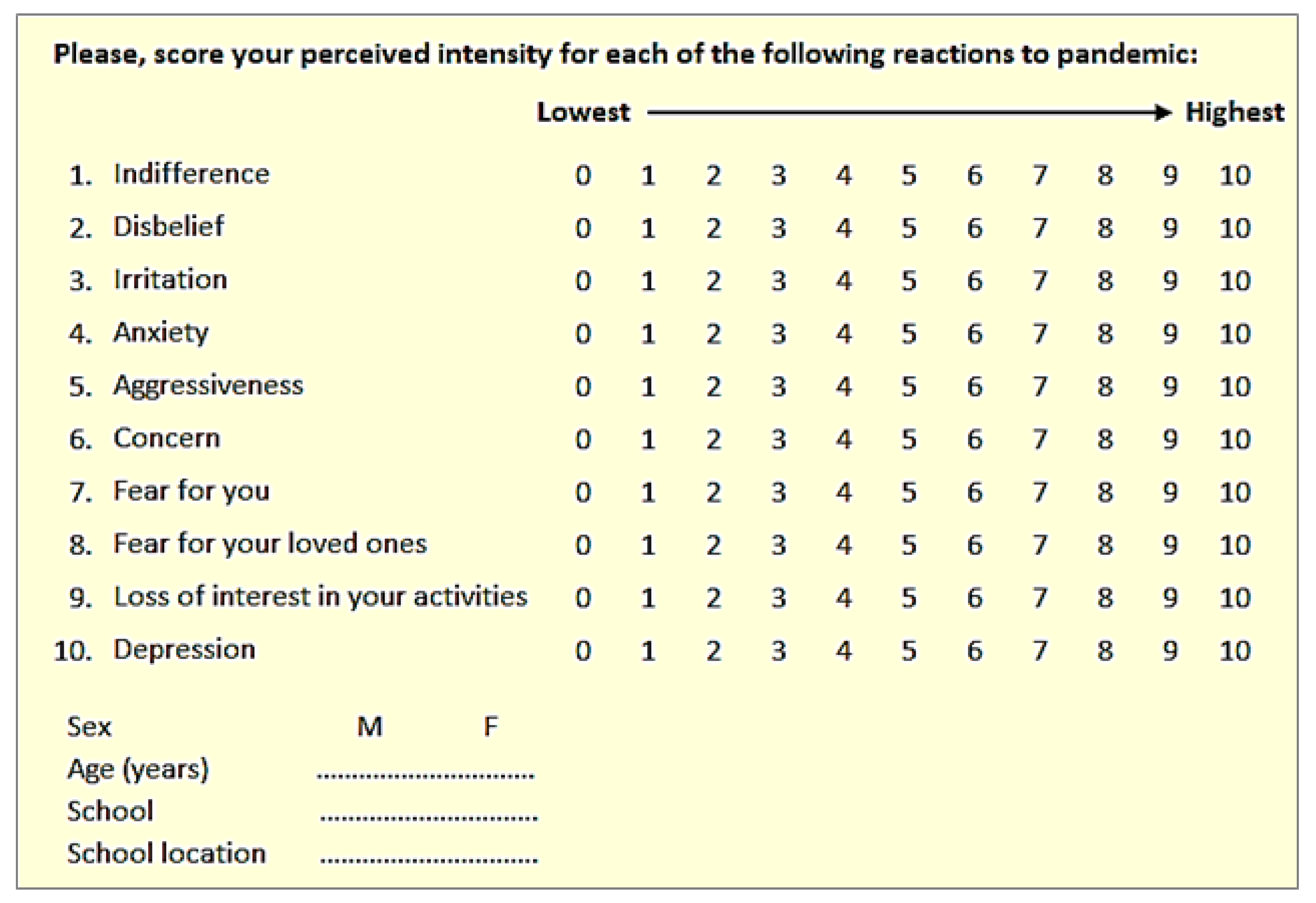
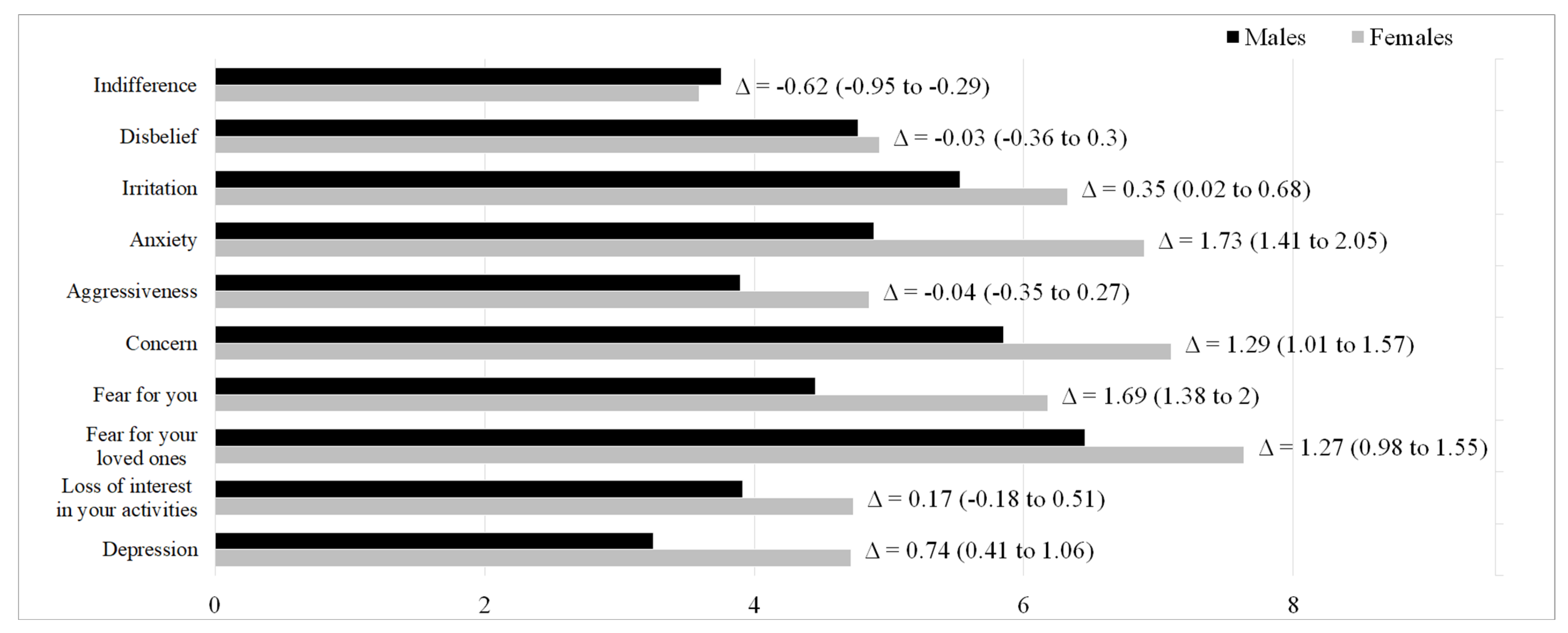
The COVID-19 outbreak variably affected people’s mental reactions worldwide but was only episodically investigated in healthy Italian teenagers. Our aim was to investigate the emotional responses of Italian middle and high school students to the pandemic. An anonymous 10-item questionnaire was distributed in pre-selected school samples. Responders had to score their perceived extent for each reaction from 0 (lowest perception) to 10 (highest perception). A group of adults was selected as control. Generalized linear models were used to estimate differences among adults and students, high school (HS) and middle school (MS) students, and urban (U) and rural (R) MS students. Comparisons were presented as mean difference (Δ) with a 95% confidence interval (CI). A total of 1512 questionnaires (635 adults, 744 HS, 67 UMS, and 66 RMS) were analyzed. Students appeared more indifferent (Δ = 1.97, 1.52–2.41), anxious (Δ = 0.56, 0.07–1.04), aggressive (Δ = 2.21, 1.72–2.70), and depressed (Δ = 1.87, 1.40–2.34) than adults did, and claimed a higher loss of interest in their activities (Δ = 1.21, 0.72–1.70). Students were less disbelieving (Δ = −0.93, −1.50–0.35) and feared for their loved ones (Δ = −0.89, −1.40–0.39). MS students were less affected by the outbreak than HS students were. Furthermore, R-MS students were significantly less aggressive and depressed, but more indifferent and disbelieving than U-MS. Female sex was an independent factor associated to almost all the questionnaire domains. The pattern of the psychological responses to the pandemic in Italian students proved multifaceted. In addition to anxiety, loss of interest in activities, and depression, aggressiveness emerged as the most characterizing mental attitude in response to the pandemic.
Keywords: COVID-19 pandemic; emotional reactions; teenagers; students COVID-19 pandemic; emotional reactions; teenagers; students