Illness Uncertainty in Pediatric Irritable Bowel Syndrome: A Pilot Study
 , ,
, ,
Highlights
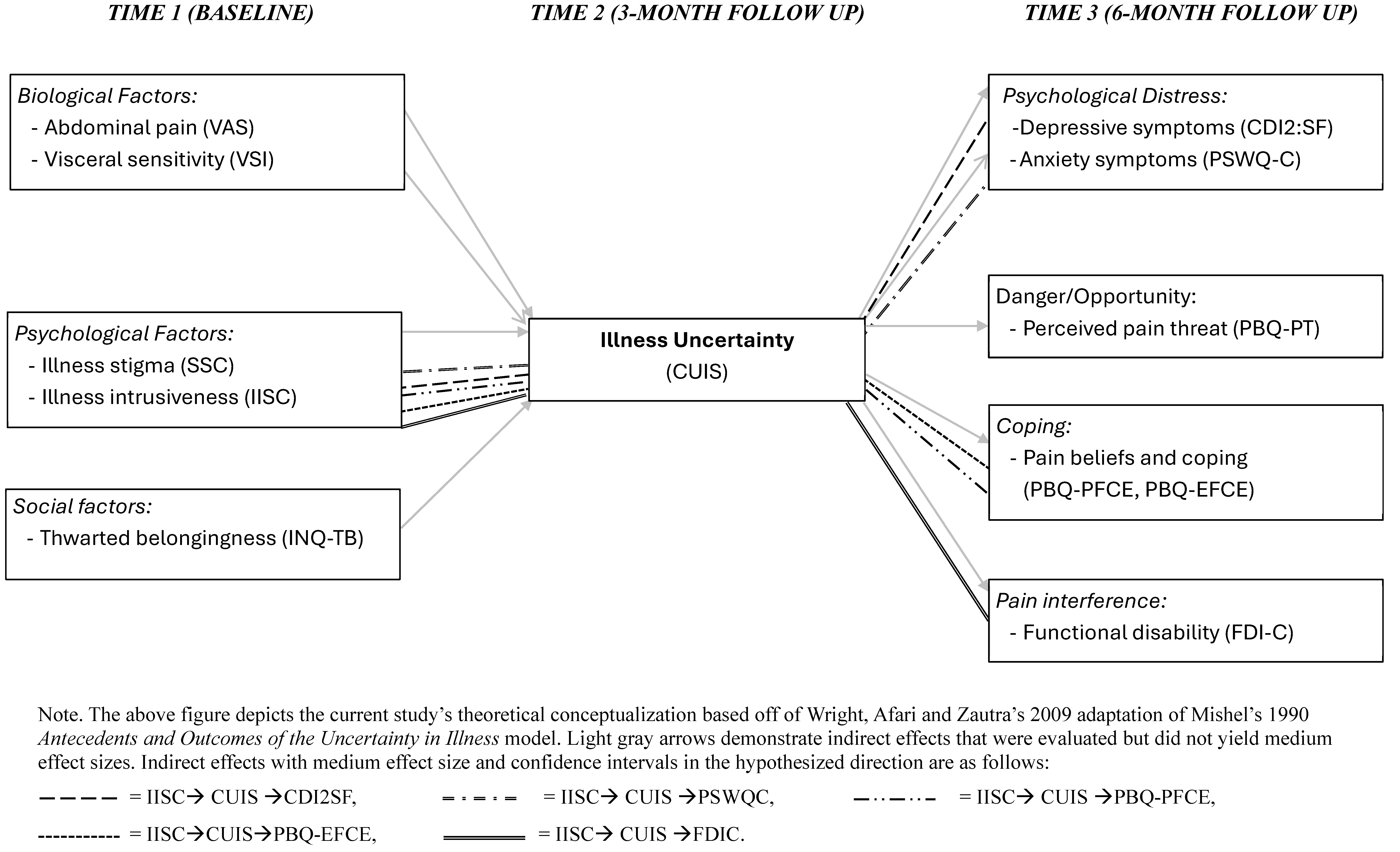
- Exploratory indirect effects demonstrated clinical signals for the relationship between illness intrusiveness, uncertainty, and mood, pain related coping, and functional disability.
- Illness uncertainty is a key variable in pediatric IBS and future adequately powered studies should use the findings from this study as a platform to build from.
- Targeting illness uncertainty in future interventions may lead to improved psy-chosocial and health related outcomes for youth with IBS.
Abstract
1. Introduction
2. Materials and Methods
- Participants and Procedures
- Measures
- Demographics
- Disease Parameters
- Illness Appraisals
- Belonginess and Mood
- Data Analysis Plan
3. Results
- Descriptives
- Mediation Models
- Model Performance
- Direct Effects
- Indirect Effects
- Exploratory Indirect Effects
4. Discussion
Author Contributions
Funding
Institutional Review Board Statement
Informed Consent Statement
Data Availability Statement
Conflicts of Interest
Abbreviations
| AMA | American Medical Association |
| APA | American Psychological Association |
| CDI2:SF | Child Depressive Inventory 2nd Edition—Short Form |
| CUIS | Child Uncertainty in Illness Scale |
| FDI-C | Functional Disability Index—Child |
| GI | Gastroenterology |
| IBD | Inflammatory Bowel Disease |
| IBS | Irritable Bowel Disease |
| IIS-C | Illness Intrusiveness Scale—Child |
| INQ-TB | Interpersonal Needs Questionnaire—Thwarted Belongingness Subscale |
| PBQ-EFCE | Pain Beliefs Questionnaire—Emotion-Focused Coping Efficacy |
| PBQ-PFCE | Pain Beliefs Questionnaire—Problem-Focused Coping Efficacy |
| PBQ-PT | Pain Beliefs Questionnaire—Pain Threat |
| PSWQ-C | Penn State Worry Questionnaire—Child |
| SS-C | Stigma Scale—Child |
| T1 | Baseline |
| T2 | 3-Month Follow-Up |
| T3 | 6-Month Follow-Up |
| VAS | Visual Analog Scale |
| VSI | Visceral Sensitivity Index |
References
- Devanarayana, N.M.; Rajindrajith, S. Irritable bowel syndrome in children: Current knowledge, challenges and opportunities. World J. Gastroenterol. 2018, 24, 2211–2235. [Google Scholar] [CrossRef] [Scilit] [PubMed]
- Castilloux, J.; Noble, A.; Faure, C. Is visceral hypersensitivity correlated with symptom severity in children with functional gastrointestinal disorders? J. Pediatr. Gastroenterol. Nutr. 2008, 46, 272–278. [Google Scholar] [CrossRef] [Scilit] [PubMed]
- Walker, L.S.; Greene, W. The Functional Disability Inventory: Measuring a neglected dimension of child health status. J. Pediatr. Psychol. 1991, 16, 39–58. [Google Scholar] [CrossRef] [Scilit] [PubMed]
- Hearn, M.; Whorwell, P.J.; Vasant, D.H. Stigma and irritable bowel syndrome: A taboo subject? Lancet. Gastroenterol. Hepatol. 2020, 5, 607–615. [Google Scholar] [CrossRef] [Scilit] [PubMed]
- Elsenbruch, S.; Ballou, S.; Keefer, L.; Murphy, T.B.; Van Oudenhove, L.; van Tilburg, M.A.; Vasant, D.H.; Levy, R.L. Biopsychosocial aspects of adult and pediatric disorders of gut-brain interactions. Gastroenterology 2026, 170, 1205–1223. [Google Scholar] [CrossRef] [Scilit] [PubMed]
- Guadagnoli, L.; Heathcote, L.C.; Van Oudenhove, L.; Elsenbruch, S.; Keefer, L. The psychobiological model of disorders of gut-brain interaction: Introduction of a novel, integrated, and testable model. Lancet Gastroenterol. Hepatol. 2025, 10, 1041–1052. [Google Scholar] [CrossRef] [Scilit] [PubMed]
- Newton, E.; Schosheim, A.; Patel, S.; Chitkara, D.K.; van Tilburg, M.A. The role of psychological factors in pediatric functional abdominal pain disorders. Neurogastroenterol. Motil. 2019, 31, e13538. [Google Scholar] [CrossRef] [Scilit] [PubMed]
- Windgassen, S.; Moss-Morris, R.; Goldsmith, K.; Chalder, T. Key mechanisms of cognitive behavioural therapy in irritable bowel syndrome: The importance of gastrointestinal related cognitions, behaviours and general anxiety. J. Psychosom. Res. 2019, 118, 73–82. [Google Scholar] [CrossRef] [Scilit] [PubMed]
- Donovan, E.; Martin, S.R.; Lung, K.; Evans, S.; Seidman, L.C.; Cousineau, T.M.; Cook, E.; Zeltzer, L.K. Pediatric irritable bowel syndrome: Perspectives on pain and adolescent social functioning. Pain Med. 2019, 20, 213–222. [Google Scholar] [CrossRef] [Scilit] [PubMed]
- Dancey, C.P.; Hutton-Young, S.A.; Moye, S.; Devins, G.M. Perceived stigma, illness intrusiveness and quality of life in men and women with irritable bowel syndrome. Psychol. Health Med. 2002, 7, 381–395. [Google Scholar] [CrossRef] [Scilit]
- Devins, G.M.; Binik, Y.M.; Hutchinson, T.A.; Hollomby, D.J.; Barre, P.E.; Guttmann, R.D. The emotional impact of end-stage renal disease: Importance of patients’ perceptions of intrusiveness and control. Int. J. Psychiatry Med. 1983, 13, 327–343. [Google Scholar] [CrossRef] [Scilit] [PubMed]
- van Tilburg, M.A.L.; Drossman, D.A.; Knowles, S.R. Psychogastroenterology: The brain-gut axis and its psychological applications. J. Psychosom. Res. 2021, 152, 110684. [Google Scholar] [CrossRef] [Scilit] [PubMed]
- Gamwell, K.L.; Baudino, M.N.; Bakula, D.M. Perceived illness stigma, thwarted belongingness, and depressive symptoms in youth with inflammatory bowel disease (IBD). Inflamm. Bowel Dis. 2018, 24, 960–965. [Google Scholar] [CrossRef] [Scilit] [PubMed]
- Lackner, J.M.; Gudleski, G.D.; Firth, R. Negative aspects of close relationships are more strongly associated than supportive personal relationships with illness burden of irritable bowel syndrome. J. Psychosom. Res. 2013, 74, 493–500. [Google Scholar] [CrossRef] [Scilit] [PubMed]
- Wright, L.J.; Afari, N.; Zautra, A. The illness uncertainty concept: A review. Curr. Pain Headache Rep. 2009, 13, 133–138. [Google Scholar] [CrossRef] [Scilit] [PubMed]
- Mishel, M.H. Reconceptualization of the uncertainty in illness theory. Image J. Nurs. Scholarsh. 1990, 22, 256–262. [Google Scholar] [CrossRef] [Scilit] [PubMed]
- Gamwell, K.L.; Mara, C.A.; Hommel, K.A.; Kashikar-Zuck, S.; Cunningham, N.R. Establishing clinical cut-points on the Pediatric PROMIS-Pain Interference scale in Youth with abdominal pain. Clin. J. Pain 2021, 38, 173–181. [Google Scholar] [CrossRef] [Scilit] [PubMed]
- Kashikar-Zuck, S.; Flowers, S.R.; Claar, R.L.; Guite, J.W.; Logan, D.E.; Lynch-Jordan, A.M.; Palermo, T.M.; Wilson, A.C. Clinical utility and validity of the Functional Disability Inventory among a multicenter sample of youth with chronic pain. Pain 2011, 152, 1600–1607. [Google Scholar] [CrossRef] [Scilit] [PubMed]
- Labus, J.S.; Bolus, R.; Chang, L.; Wiklund, I.; Naesdal, J.; Mayer, E.A.; Naliboff, B.D. The Visceral Sensitivity Index: Development and validation of a gastrointestinal symptom-specific anxiety scale. Aliment. Pharmacol. Ther. 2004, 20, 89–97. [Google Scholar] [CrossRef] [Scilit] [PubMed]
- Labus, J.S.; Mayer, E.A.; Chang, L.; Bolus, R.; Naliboff, B.D. The central role of gastrointestinal-specific anxiety in irritable bowel syndrome: Further validation of the Visceral Sensitivity Index. Psychosom. Med. 2007, 69, 89–98. [Google Scholar] [CrossRef] [Scilit] [PubMed]
- Gamwell, K.L.; Roberts, C.M.; Kraft, J.D.; Edwards, C.S.; Baudino, M.N.; Grunow, J.E.; Jacobs, N.J.; Tung, J.; Mullins, L.L.; Chaney, J.M. Factor analysis of the stigma scale-child in pediatric inflammatory bowel disease. J. Psychosom. Res. 2023, 164, 111095. [Google Scholar] [CrossRef] [Scilit] [PubMed]
- Roberts, C.M.; Baudino, M.N.; Gamwell, K.L.; Edwards, C.S.; Traino, K.A.; Tung, J.; Grunow, J.E.; Jacobs, N.J.; Mullins, L.L.; Chaney, J.M. Illness stigma, worry, intrusiveness, and depressive symptoms in youth with inflammatory bowel disease. J. Pediatr. Gastroenterol. Nutr. 2021, 72, 404–409. [Google Scholar] [CrossRef] [Scilit] [PubMed]
- Wagner, J.L.; Chaney, J.M.; Hommel, K.A.; Page, M.C.; Mullins, L.L.; White, M.M.; Jarvis, J.N. The influence of parental distress on child depressive symptoms in juvenile rheumatic diseases: The moderating effect of illness intrusiveness. J. Pediatr. Psychol. 2003, 28, 453–462. [Google Scholar] [CrossRef] [Scilit] [PubMed]
- Pai, A.L.; Mullins, L.L.; Drotar, D.; Burant, C.; Wagner, J.; Chaney, J.M. Exploratory and confirmatory factor analysis of the child uncertainty in illness scale among children with chronic illness. J. Pediatr. Psychol. 2007, 32, 288–296. [Google Scholar] [CrossRef] [Scilit] [PubMed]
- Stone, A.L.; Walker, L.S.; Laird, K.T.; Shirkey, K.C.; Smith, C.A. Pediatric Pain Beliefs Questionnaire: Psychometric properties of the short form. J. Pain 2016, 17, 1036–1044. [Google Scholar] [CrossRef] [Scilit] [PubMed]
- Van Orden, K.A.; Witte, T.K.; Gordon, K.H.; Bender, T.W.; Joiner, T.E., Jr. Suicidal desire and the capability for suicide: Tests of the interpersonal-psychological theory of suicidal behavior among adults. J. Consult. Clin. Psychol. 2008, 76, 72–83. [Google Scholar] [CrossRef] [Scilit] [PubMed]
- Kovacs, M. Children’s Depression Inventory—2nd Edition (CDI-2): Technical Manual; Multi-Health Systems: Toronto, ON, Canada, 2011. [Google Scholar]
- Houghton, S.; Lawrence, D.; Hunter, S.C.; Zadow, C.; Kyron, M.; Paterson, R.; Carroll, A.; Christie, R.; Brandtman, M. Loneliness accounts for the association between diagnosed Attention Deficit-Hyperactivity Disorder and symptoms of depression among adolescents. J. Psychopathol. Behav. Assess. 2020, 42, 237–247. [Google Scholar] [CrossRef] [Scilit]
- Chorpita, B.F.; Tracey, S.A.; Brown, T.A.; Collica, T.J.; Barlow, D.H. Assessment of worry in children and adolescents: An adaptation of the Penn State Worry Questionnaire. Behav. Res. Ther. 1997, 35, 569–581. [Google Scholar] [CrossRef] [Scilit] [PubMed]
- Pestle, S.L.; Chorpita, B.F.; Schiffman, J. Psychometric Properties of the Penn State Worry Questionnaire for Children in a large clinical sample. J. Clin. Child Adolesc. Psychol. 2008, 37, 465–471. [Google Scholar] [CrossRef] [Scilit] [PubMed]
- Asparouhov, T.; Muthén, B. Bayesian Analysis Using Mplus: Technical Implementation, 4th ed.; Muthén & Muthén: Los Angeles, CA, USA, 2023; Mplus Technical Report; Available online: https://www.statmodel.com/papers.shtml?utm_source=chatgpt.com (accessed on 25 June 2025).
- Hollier, J.M.; Czyzewski, D.I.; Self, M.M.; Liu, Y.; Weidler, E.M.; van Tilburg, M.A.; Varni, J.W.; Shulman, R.J. Associations of abdominal pain and psychosocial distress measures with health-related quality-of-life in pediatric healthy controls and irritable bowel syndrome. J. Clin. Gastroenterol. 2021, 55, 422–428. [Google Scholar] [CrossRef] [Scilit] [PubMed]
- Miočević, M.; O’Rourke, H.P.; MacKinnon, D.P.; Brown, H.C. Statistical properties of four effect-size measures for mediation models. Behav. Res. Meth. 2018, 50, 285–301. [Google Scholar] [CrossRef] [Scilit] [PubMed]
- Preacher, K.J.; Kelley, K. Effect size measures for mediation models: Quantitative strategies for communicating indirect effects. Psychol. Methods 2011, 16, 93–115. [Google Scholar] [CrossRef] [Scilit] [PubMed]
- Gamwell, K.L.; Roberts, C.M.; Espeleta, H.C.; Baudino, M.N.; Hommel, K.A.; Grunow, J.E.; Jacobs, N.J.; Gillaspy, S.R.; Mullins, L.L.; Chaney, J.M. Perceived stigma, illness uncertainty, and depressive symptoms in youth with inflammatory bowel disease: The moderating effect of mindfulness. Psychol. Health Med. 2020, 25, 1037–1048. [Google Scholar] [CrossRef] [Scilit] [PubMed]
- Roberts, C.M.; Gamwell, K.L.; Baudino, M.N.; Perez, M.N.; Delozier, A.M.; Sharkey, C.M.; Grant, D.M.; Grunow, J.E.; Jacobs, N.J.; Tung, J.; et al. Youth and parent illness appraisals and adjustment in pediatric inflammatory bowel disease. J. Dev. Phys. Disabil. 2019, 31, 777–790. [Google Scholar] [CrossRef] [Scilit]
- Gamwell, K.L.; Peugh, J.; Santucci, N.; Graham, K.; Hommel, K.A. Pediatric irritable bowel syndrome self-management and treatment adherence. J. Psychosom. Res. 2025, 198, 112396. [Google Scholar] [CrossRef] [Scilit] [PubMed]
- Knowles, S.R.; Austin, D.W.; Sivanesan, S.; Tye-Din, J.; Leung, C.; Wilson, J.; Castle, D.; Kamm, M.A.; Macrae, F.; Hebbard, G. Relations between symptom severity, illness perceptions, visceral sensitivity, coping strategies and well-being in irritable bowel syndrome guided by the common sense model of illness. Psychol. Health Med. 2017, 22, 524–534. [Google Scholar] [CrossRef] [Scilit] [PubMed]
- Taft, T.H.; Riehl, M.E.; Dowjotas, K.L.; Keefer, L. Moving beyond perceptions: Internalized stigma in irritable bowel syndrome. Neurogastroenterol. Motil. 2014, 26, 1026–1035. [Google Scholar] [CrossRef] [Scilit] [PubMed]
- Essner, B.S.; Boyle, S.L. Innovations in the psychological care of pediatric disorders of gut–brain interaction. Clin. Pract. Pediatr. Psychol. 2023, 11, 357–366. [Google Scholar] [CrossRef] [Scilit]
- Self, M.M.; Czyzewski, D.I.; Chumpitazi, B.P.; Weidler, E.M.; Shulman, R.J. Subtypes of Irritable Bowel Syndrome in Children and Adolescents. Clin. Gastroenterol. Hepatol. 2014, 12, 1468–1473. [Google Scholar] [CrossRef] [Scilit] [PubMed]
- Koen Vermeijden, N.; de Silva, L.; Manathunga, S.; Spoolder, D.; Korterink, J.; Vlieger, A.; Rajindrajith, S.; Benninga, M. Epidemiology of pediatric functional abdominal pain disorders: A meta-analysis. Pediatrics 2025, 155, e2024067677. [Google Scholar] [CrossRef] [Scilit] [PubMed]
- Velasco-Benítez, C.A.; Collazos-Saa, L.I.; García-Perdomo, H.A. A systematic review and meta-analysis in schoolchildren and adolescents with functional gastrointestinal disorders according to Rome IV criteria. Arq. Gastroenterol. 2022, 59, 304–313. [Google Scholar] [CrossRef] [Scilit] [PubMed]


| Variable | N (Valid %) |
|---|---|
| IBS type | |
| Constipation | 37 (74) |
| Diarrhea | 5 (10) |
| Mixed Constipation and Diarrhea | 8 (16) |
| Race | |
| White | 47 (94) |
| Black | 1 (2) |
| Asian American/Pacific Islander | 1 (2) |
| Biracial/Multiracial | 1 (2) |
| Ethnicity | |
| Non-Hispanic | 49 (98) |
| Hispanic | 1 (2) |
| Gender Identity | |
| Female | 40 (80) |
| Male | 10 (20) |
| 1. | 2. | 3. | 4. | 5. | 6. | 7. | 8. | 9. | 10. | 11. | 12. | 13. | 14. | M (SD) | |
|---|---|---|---|---|---|---|---|---|---|---|---|---|---|---|---|
| 1. Age | - | 14.50 (2.38) | |||||||||||||
| 2. Gender identity | 0.04 | - | -- | ||||||||||||
| T1 | |||||||||||||||
| 3. VAS | −0.11 | 0.03 | - | 5.32 (2.19) | |||||||||||
| 4. IIS-C | 0.17 | 0.04 | 0.44 | - | 27.76 (17.55) | ||||||||||
| 5. VSI | 0.20 | 0.29 | 0.14 | 0.42 | - | 36.24 (18.06) | |||||||||
| 6. SS-C | 0.19 | 0.06 | 0.17 | 0.54 | 0.54 | - | 19.06 (6.56) | ||||||||
| 7. INQ-TB | 0.14 | −0.07 | 0.03 | 0.39 | 0.26 | 0.53 | - | 24.88 (12.52) | |||||||
| T2 | |||||||||||||||
| 8. CUIS | −0.01 | 0.06 | 0.24 | 0.52 | 0.42 | 0.44 | 0.30 | - | 66.55 (13.62) | ||||||
| T3 | |||||||||||||||
| 9. CDI2:SF | 0.16 | 0.01 | 0.20 | 0.45 | 0.19 | 0.44 | 0.68 | 0.41 | - | 6.88 (4.55) | |||||
| 10. PSWQ-C | 0.01 | 0.13 | 0.16 | 0.39 | 0.39 | 0.45 | 0.33 | 0.52 | 0.46 | - | 24.42 (10.84) | ||||
| 11. PBQ-PFCE | −0.15 | −0.16 | −0.21 | −0.18 | −0.33 | −0.28 | −0.16 | −0.44 | −0.43 | −0.29 | - | 10.13 (5.46) | |||
| 12. PBQ-EFCE | 0.22 | 0.06 | −0.04 | −0.05 | −0.26 | −0.07 | −0.18 | −0.40 | −0.41 | −0.25 | 0.51 | - | 16.25 (4.82) | ||
| 13. PBQ-PT | 0.25 | 0.19 | 0.13 | 0.16 | 0.26 | 0.18 | 0.28 | 0.31 | 0.55 | 0.26 | −0.66 | −0.59 | - | 9.54 (4.90) | |
| 14. FDI-C | 0.12 | 0.07 | 0.32 | 0.57 | 0.24 | 0.40 | 0.41 | 0.43 | 0.70 | 0.26 | −0.47 | −0.37 | 0.45 | - | 13.44 (11.31) |
Disclaimer/Publisher’s Note: The statements, opinions and data contained in all publications are solely those of the individual author(s) and contributor(s) and not of MDPI and/or the editor(s). MDPI and/or the editor(s) disclaim responsibility for any injury to people or property resulting from any ideas, methods, instructions or products referred to in the content. |
© 2026 by the authors. Licensee MDPI, Basel, Switzerland. This article is an open access article distributed under the terms and conditions of the Creative Commons Attribution (CC BY) license.
Share and Cite
Gamwell, K.L.; Robbertz, A.S.; Peugh, J.L.; Santucci, N.; Graham, K.; Hommel, K.A. Illness Uncertainty in Pediatric Irritable Bowel Syndrome: A Pilot Study. Children 2026, 13, 1106. https://doi.org/10.3390/children13081106
Gamwell KL, Robbertz AS, Peugh JL, Santucci N, Graham K, Hommel KA. Illness Uncertainty in Pediatric Irritable Bowel Syndrome: A Pilot Study. Children. 2026; 13(8):1106. https://doi.org/10.3390/children13081106
Chicago/Turabian StyleGamwell, Kaitlyn L., Abigail S. Robbertz, James L. Peugh, Neha Santucci, Kahleb Graham, and Kevin A. Hommel. 2026. "Illness Uncertainty in Pediatric Irritable Bowel Syndrome: A Pilot Study" Children 13, no. 8: 1106. https://doi.org/10.3390/children13081106
APA StyleGamwell, K. L., Robbertz, A. S., Peugh, J. L., Santucci, N., Graham, K., & Hommel, K. A. (2026). Illness Uncertainty in Pediatric Irritable Bowel Syndrome: A Pilot Study. Children, 13(8), 1106. https://doi.org/10.3390/children13081106