When Asthma Leads to Air: Pneumomediastinum in a Child
 , , and
Highlights
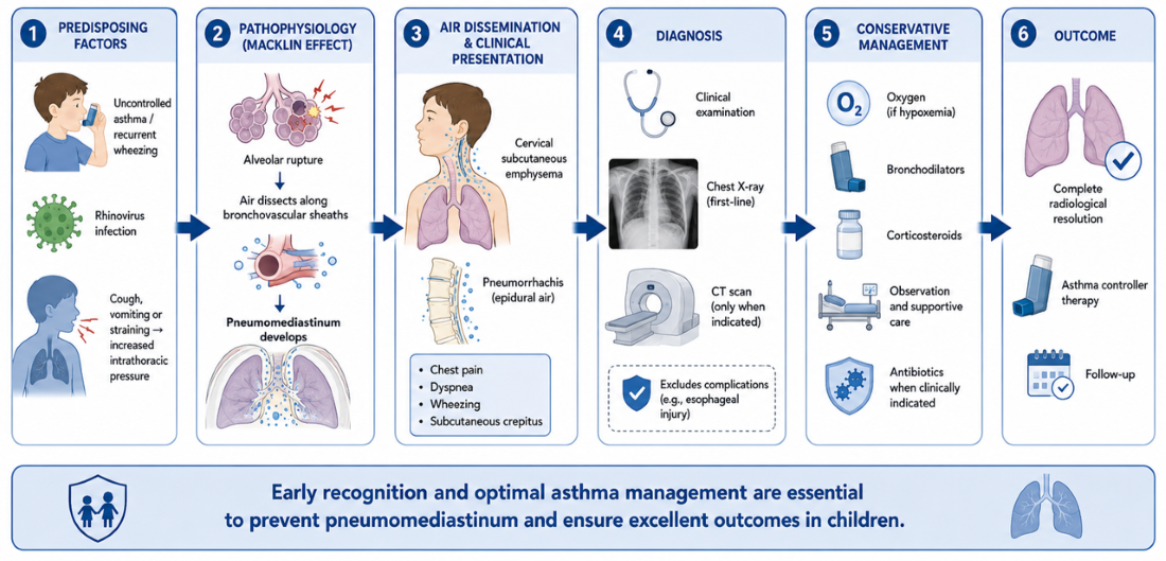
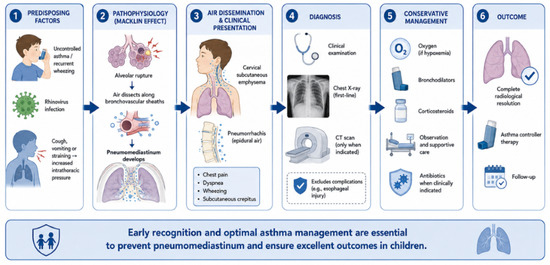
- Respiratory diseases, particularly asthma, are among the most frequent predisposing conditions to pediatric pneumomediastinum.
- Diagnosis relies on clinical assessment and chest imaging, while management is mainly conservative.
- Prompt and accurate recognition, along with appropriate management of underlying respiratory conditions, is essential to prevent complications such as pneumomediastinum and to ensure favorable outcomes.
- Pediatric pneumomediastinum is usually self-limiting when identified early and in the absence of severity criteria. Timely intervention, targeted therapy, and close follow-up are critical, allowing most children to recover fully without the need for invasive procedures.
Abstract
1. Introduction
2. Case Report

| Sex | Male |
| Age | 12 years |
| Vital signs | HR 102 beats/min, BP 110/60 mmHg, RR 40/min, SpO2 99% on 1–2 L/min supplemental O2 via nasal cannula, T 36.5 °C |
| Symptoms | Difficulty in breathing and chest pain. One episode of vomiting; no fever |
| Past medical history | Allergic rhino-conjunctivitis and recurrent bronchospasm. |
| Family history | Spontaneous pneumothorax in his father at 18 years of age. |
| Risk factors | Recurrent wheezing |
| Venous blood gas analysis | pH 7.37, pCO2 40 mmHg, HCO3 23 mmol/L, BE −2, lactate 2.7 mmol/L |
| WBC on hospital admission | 12,890/mm3 (NR 4500–13,000) |
| C-Reactive Protein on hospital admission | 3 mg/L (NR < 5) |
| Alpha-1 antitrypsin level | 1.47 g/L (NR 0.9–2) |
| Respiratory viral panel on nasopharyngeal aspirate | Rhinovirus |
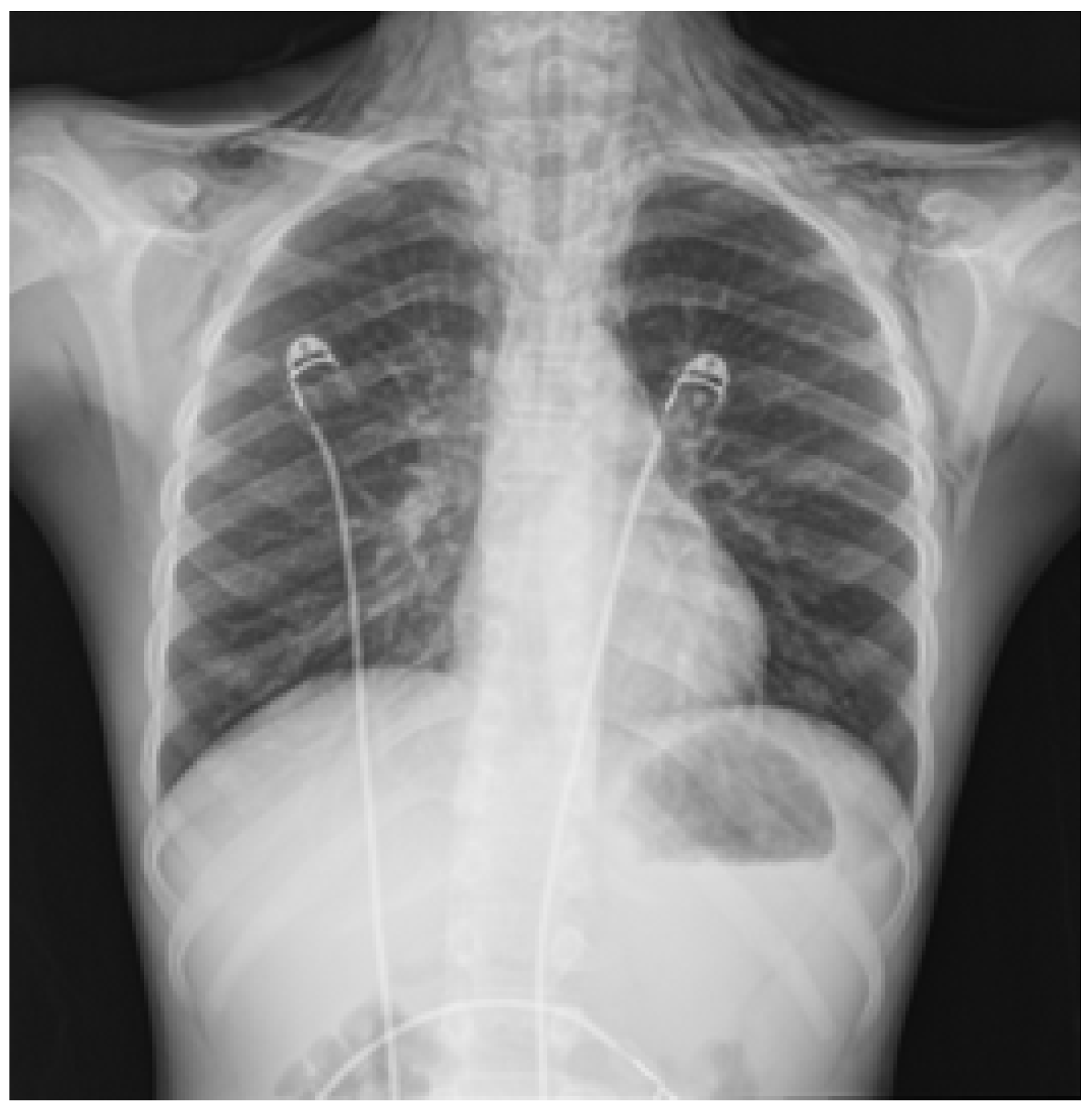
| Chest X-ray | Pneumomediastinum with extension into the bilateral later cervical soft tissues and the chest wall, more pronounced on the left No pleural effusion. No parenchymal lesions |
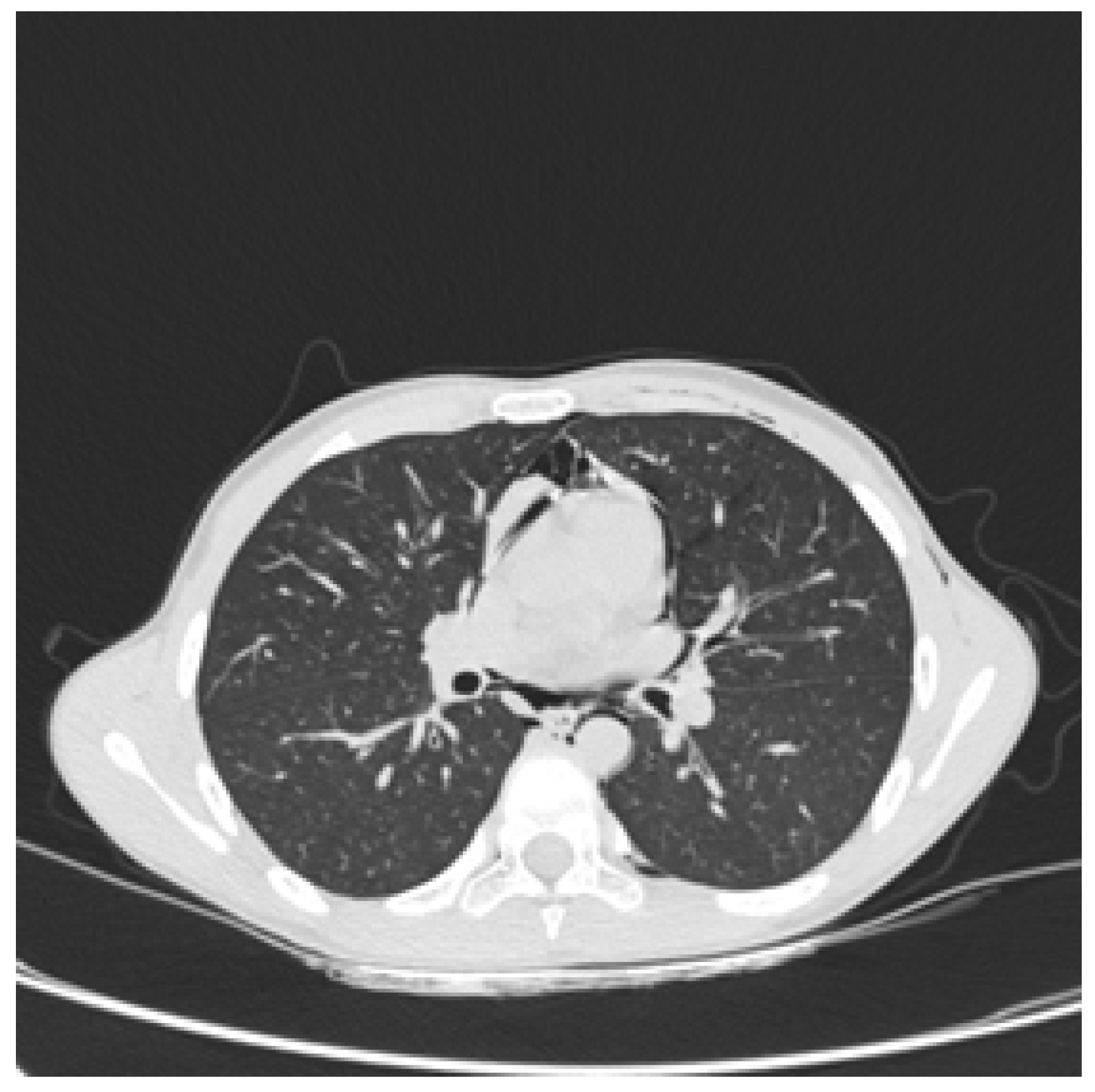
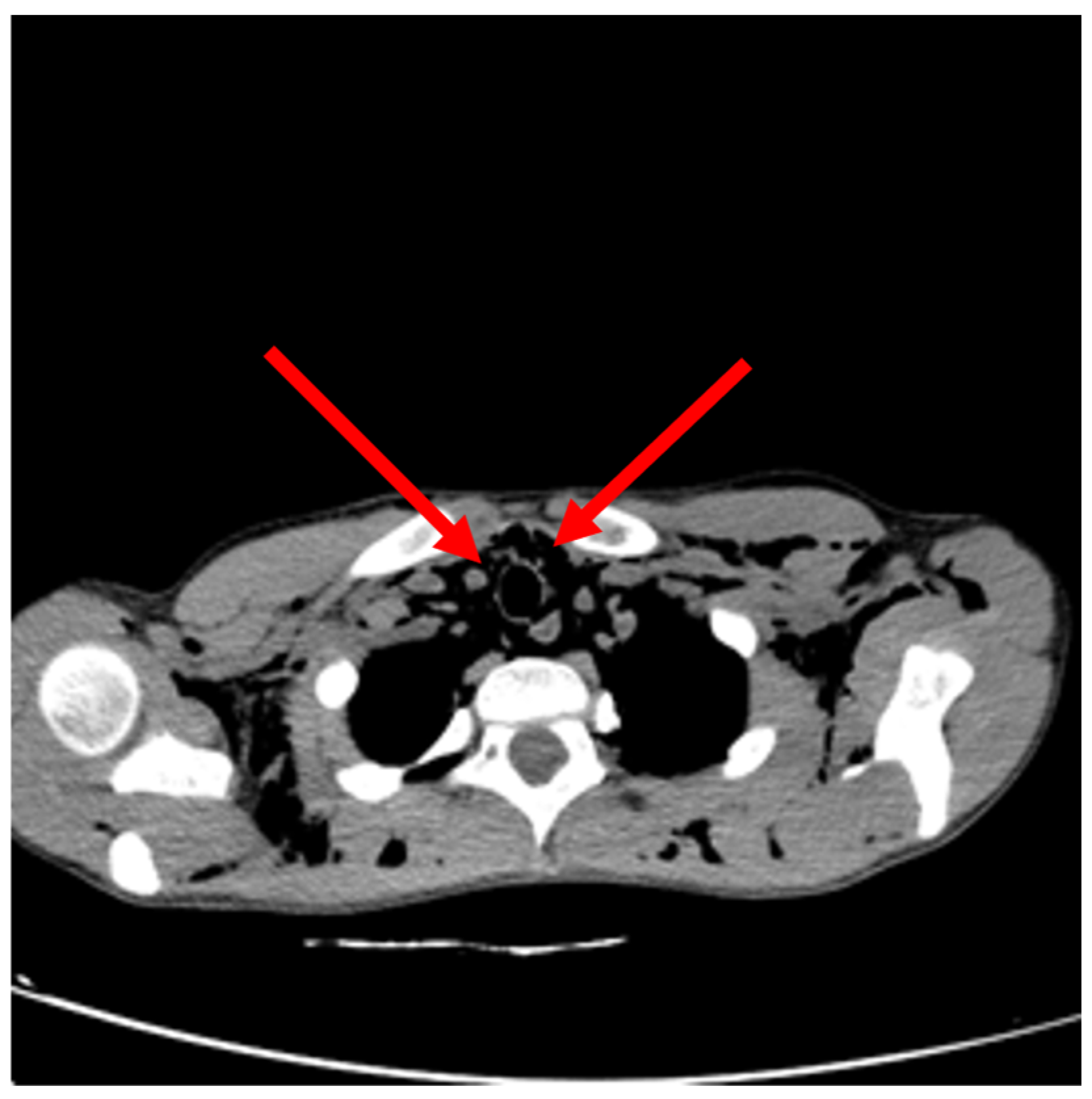
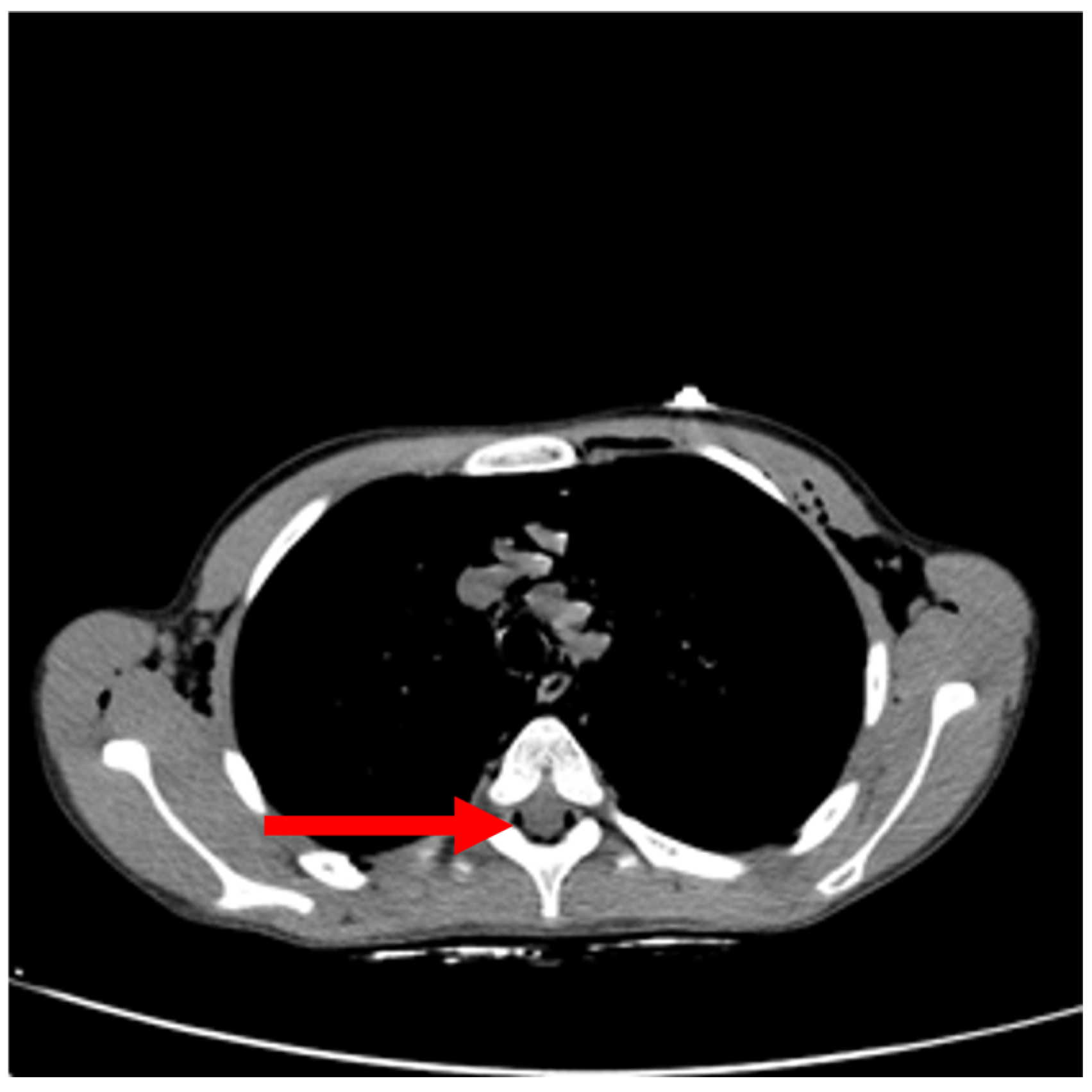
| Chest CT | Hypodense material in the subsegmental bronchial branches of the lower lobes No pleural effusion Marked pneumomediastinum with subcutaneous emphysema involving the soft tissues of the neck and the proximal portions of the chest wall and back Air foci within the spinal canal |
| Therapy | Oxygen, oral prednisone, inhaled salbutamol, ipratropium and beclomethasone Oral Amoxicillin/Clavulanic Acid |
| Therapy at discharge | Salmeterol/Fluticasone propionate 25/50 mcg, 2 inhalations twice daily |
| Chest X-ray at follow-up | Resolution |
3. Discussion
| Case 1 [10] | Case 2 [11] | Case 3 [12] | Case 4 [13] | Case 5 [14] | Case 6 [15] | Case 7 [15] | Case 8 [16] | Case 9 [17] | |
|---|---|---|---|---|---|---|---|---|---|
| Age | 14 | 18 | 18 | 16 | 10 | 5 | 8 | 5 | 9 |
| Sex | Male | Male | Male | Male | Female | Female | Male | Male | Male |
| Symptoms | Wheezing, cough, respiratory distress, crepitus of the neck | Dyspnea, chest tightness, thoracic pain, cough | Dyspnea, chest tightness, cough | “Neck fullness”, cough, wheezing, shortness of breath | Cough, dyspnea, chest/neck pain | Cough, fever | Neck pain, cough | Cough, dyspnea, odynophagia, dysphagia with food refusal and neck pain | Thoracic pain, dyspnea |
| Subcutaneous emphysema | Yes | Yes | Yes | Yes | Yes | Yes | No | Yes | Yes |
| Pneumorrhachis | No | Yes | Yes | No | No | No | No | No | Yes |
| History of Asthma | Yes | Yes | Yes | Yes | Yes | No | No | No | No |
| Other risk factors | No | No | Smoking history | No | ETS and ash after a recent fire | First-time wheezing episode | First-time wheezing episode | Recurrent wheezing | Exertional dyspnea |
| Chest X-ray | Yes | Yes | Yes | Yes | Yes | Yes | Yes | Yes | Yes |
| Chest CT | No | Yes | Yes | Yes | No | No | Yes | No | Yes |
| Therapy | Inhaled salbutamol and ipratropium, IV magnesium, and steroids | Inhaled salbutamol, systemic steroids | Inhaled salbutamol and symptomatic treatment | Inhaled salbutamol ipratropium, oral steroids | Inhaled salbutamol and ipratropium, IV steroids | Conservative | Conservative | Analgesia, salbutamol, steroids | Inhaled salbutamol, steroids |
| Oxygen | No | No | No | No | Yes | No | No | Yes | No |
| Antibiotics | No | Yes | No | No | No | No | No | No | Yes |
| Chest X-ray at follow-up | No | No | No, but repeated CT scan 5 days later | Yes | Yes | Yes | Yes | No | Yes |
| Length of stay | 7 days | 1 day | Not reported | Not reported | 4 days | 7 days | 4 days | 5 days | Not reported |
| Therapy at discharge | Inhaled salbutamol and oral prednisone | ICS and SLIT | Not reported | Not reported | ICS | Not reported | Not reported | Not reported | ICS |
4. Conclusions
Author Contributions
Funding
Institutional Review Board Statement
Informed Consent Statement
Data Availability Statement
Acknowledgments
Conflicts of Interest
Correction Statement
Abbreviations
| A1AT | Alpha-1 antitrypsin |
| CT | Computed tomography |
References
- Ferlisi, A.; Orlando, M.A.; Termini, L.; Ficili, F.; Cardilicchia, M.; Angelici, V.; Zuccaro, N.; Corsello, G. Pneumomediastinum and pneumorrhachis. Rare complications in pediatric age: Case Report and its management. Pediatr. Respir. J. 2025, 3, 92–98. [Google Scholar] [CrossRef] [Scilit]
- Chalumeau, M.; Le Clainche, L.; Sayeg, N.; Sannier, N.; Michel, J.L.; Marianowski, R.; Jouvet, P.; Scheinmann, P.; de Blic, J. Spontaneous pneumomediastinum in children. Pediatr. Pulmonol. 2001, 31, 67–75. [Google Scholar]
- Damore, D.T.; Dayan, P.S. Medical causes of pneumomediastinum in children. Clin. Pediatr. 2001, 40, 87–91. [Google Scholar] [CrossRef] [Scilit] [PubMed]
- Hu, M.; Green, R.; Gungor, A. Pneumomediastinum and subcutaneous emphysema from bronchial foreign body aspiration. Am. J. Otolaryngol. 2013, 34, 85–88. [Google Scholar] [CrossRef] [Scilit] [PubMed]
- Brito Rojas, I.C.; Hernandez Peñuela, M.A.; La rotta, M.A.; Medina Gaviria, V. Spontaneous pneumomediastinum in previously healthy pediatric patients: A case series. J. Pediatr. Surg. Case Rep. 2024, 108, 102854. [Google Scholar] [CrossRef] [Scilit]
- Versteegh, F.G.; Broeders, I.A. Spontaneous pneumomediastinum in children. Eur. J. Pediatr. 1991, 150, 304–307. [Google Scholar] [CrossRef] [Scilit] [PubMed]
- Noorbakhsh, K.A.; Williams, A.E.; Langham, J.J.W.; Wu, L.; Krafty, R.T.; Furtado, A.D.; Zuckerbraun, N.S.; Manole, M.D. Management and Outcomes of Spontaneous Pneumomediastinum in Children. Pediatr. Emerg. Care 2021, 37, e1051–e1056. [Google Scholar] [CrossRef] [Scilit] [PubMed]
- Wong, K.S.; Wu, H.M.; Lai, S.H.; Chiu, C.Y. Spontaneous pneumomediastinum: Analysis of 87 pediatric patients. Pediatr. Emerg. Care 2013, 29, 988–991. [Google Scholar] [CrossRef] [Scilit] [PubMed]
- Lee, C.Y.; Wu, C.C.; Lin, C.Y. Etiologies of spontaneous pneumomediastinum in children of different ages. Pediatr. Neonatol. 2009, 50, 190–195. [Google Scholar] [CrossRef] [Scilit] [PubMed]
- St Clair, T.M.; Zwemer, E. Diffuse Subcutaneous Emphysema. N. Engl. J. Med. 2019, 380, e20. [Google Scholar] [CrossRef] [Scilit] [PubMed]
- Ramses Bedolla-Pulido, T.; Bedolla-Barajas, M.; González-Mendoza, T.; Hollyver Sánchez-Uribe, E.; Delgado-Figueroa, N.; León-García, S. Epidural pneumorrhachis, a rare complication of asthma exacerbation. J. Asthma 2019, 56, 1356–1359. [Google Scholar] [CrossRef] [Scilit] [PubMed]
- Campos Modesto, L.; Magalhães Negreiros de Almeida, P.R.; Modesto Dos Santos, V.; Silva Bertulucci Angotti, F.; Sousa Santana, L.; Gadelha Costa Hentges, N. Hamman syndrome in an 18-year-old male patient. An. Sist. Sanit. Navar. 2024, 47, e1096. [Google Scholar] [CrossRef] [Scilit] [PubMed]
- Di Gaetano, L.; Hirsch, D. Spontaneous pneumomediastinum in an asthmatic adolescent. Vis. J. Emerg. Med. 2020, 18, 100683. [Google Scholar] [CrossRef] [Scilit]
- Tortajada-Girbés, M.; Moreno-Prat, M.; Ainsa-Laguna, D.; Mas, S. Spontaneous pneumomediastinum and subcutaneous emphysema as a complication of asthma in children: Case report and literature review. Ther. Adv. Respir. Dis. 2016, 10, 402–409. [Google Scholar] [CrossRef] [Scilit] [PubMed]
- Yurtseven, A.; Saz, E.U. Red flag; wheezing with neck pain may be a clue to the early diagnosis of spontaneous pneumomediastinum. Tuberk. Toraks 2017, 65, 146–149. [Google Scholar] [CrossRef] [Scilit] [PubMed]
- Cachão, J.; Banganho, D.; Figueiredo, C.; Raminhos, I. Pneumomediastinum and subcutaneous emphysema: A rare cause of odynophagia. BMJ Case Rep. 2020, 13, e234401. [Google Scholar] [CrossRef] [Scilit] [PubMed]
- Colavita, L.; Cuppari, C.; Pizzino, M.R.; Sturiale, M.; Mondello, B.; Monaco, F.; Barone, M.; Salpietro, C. Pneumomediastinum, subcutaneous emphysema and pneumorrhachis in asthmatic children. J. Biol. Regul. Homeost. Agents 2016, 30, 585–588. [Google Scholar] [PubMed]
- Halitim, P.; Weisenburger, G.; Bunel-Gourdy, V.; Godet, C.; Salpin, M.; Mouren, D.; Thibaut de Menonville, C.; Goletto, T.; Medraoui, C.; Tran Dinh, A.; et al. Spontaneous pneumomediastinum. Rev. Mal. Respir. 2022, 39, 228–240. [Google Scholar] [CrossRef] [Scilit] [PubMed]
- Bourrous, M.; Lahmini, W.; Nouri, H.; Haimeur, N. Subcutaneous emphysema and pneumomediastinum in child with asthma revealing occult foreign body aspiration: A case report. J. Med. Case Rep. 2019, 13, 157. [Google Scholar] [CrossRef] [Scilit] [PubMed]
- Murayama, S.; Gibo, S. Spontaneous pneumomediastinum and Macklin effect: Overview and appearance on computed tomography. World J. Radiol. 2014, 6, 850–854. [Google Scholar] [CrossRef] [Scilit] [PubMed]
- Alemu, B.N.; Yeheyis, E.T.; Tiruneh, A.G. Spontaneous primary pneumomediastinum: Is it always benign? J. Med. Case Rep. 2021, 15, 157. [Google Scholar] [CrossRef] [Scilit] [PubMed]
- Hernandez, P.; Bossé, Y.; Bush, P.; Chapman, K.R.; Maltais, F.; Penz, E.D.; Walker, B.L.; Lal, A.; Marciniuk, D.D. Alpha-1-Antitrypsin Deficiency Targeted Testing and Augmentation Therapy: A Canadian Thoracic Society Meta-Analysis and Clinical Practice Guideline. Chest 2025, 167, 1044–1063. [Google Scholar] [CrossRef] [Scilit] [PubMed]
- Song, I.H.; Lee, S.Y.; Lee, S.J.; Choi, W.S. Diagnosis and treatment of spontaneous pneumomediastinum: Experience at a single institution for 10 years. Gen. Thorac. Cardiovasc. Surg. 2017, 65, 280–284. [Google Scholar] [CrossRef] [Scilit] [PubMed]
- Palumbo, D.; Zangrillo, A.; Belletti, A.; Guazzarotti, G.; Calvi, M.R.; Guzzo, F.; Pennella, R.; Monti, G.; Gritti, C.; Marmiere, M.; et al. A radiological predictor for pneumomediastinum/pneumothorax in COVID-19 ARDS patients. J. Crit. Care 2021, 66, 14–19. [Google Scholar] [CrossRef] [Scilit] [PubMed]
- Alsulaihebi, A.S.; Almaghrabi, M.; Alqarni, M.M.; Al-Doboke, A.; Alqasim, A. Pneumomediastinum and Pneumopericardium as Uncommon Complications of COVID-19 Infection: A Review Article. Cureus 2022, 14, e30244. [Google Scholar] [CrossRef] [Scilit] [PubMed]
- Tang, H.; Wang, J.; Qi, Z.; Liu, J.; Liu, Z. Clinical characteristics of 40 patients with spontaneous pneumomediastinum: A retrospective study and literature review. J. Cardiothorac. Surg. 2026, 21, 116. [Google Scholar] [CrossRef] [Scilit] [PubMed]
- Bakhos, C.T.; Pupovac, S.S.; Ata, A.; Fantauzzi, J.P.; Fabian, T. Spontaneous pneumomediastinum: An extensive workup is not required. J. Am. Coll. Surg. 2014, 219, 713–717. [Google Scholar] [CrossRef] [Scilit] [PubMed]
- Dirie, A.M.H.; Aydın, N.; Hussein, A.M.; Osman, A.A.; Ahmed, A.A. Spontaneous pneumorrhachis, pneumomediastinum, pneumopericardium, and subcutaneous emphysema. Rare features of Hamman Syndrome. Ann. Med. Surg. 2022, 74, 103346. [Google Scholar] [CrossRef] [Scilit] [PubMed]
- Osunronbi, T.; Sofela, A.; Sharma, H.; Muquit, S. Traumatic pneumorrhachis: Systematic review and an illustrative case. Neurosurg. Rev. 2021, 44, 731–739. [Google Scholar] [CrossRef] [Scilit] [PubMed]
- Pothiawala, S.; Civil, I. Narrative review of traumatic pneumorrhachis. World J. Crit. Care Med. 2023, 12, 248–253. [Google Scholar] [CrossRef] [Scilit] [PubMed]
- Fitzwater, J.W.; Silva, N.N.; Knight, C.G.; Malvezzi, L.; Ramos-Irizarry, C.; Burnweit, C.A. Management of spontaneous pneumomediastinum in children. J. Pediatr. Surg. 2015, 50, 983–986. [Google Scholar] [CrossRef] [Scilit] [PubMed]
- Patel, V.; Carey, N.; Briatico, D.; VanHouwelingen, L. Management of Pediatric Patients With Spontaneous Pneumomediastinum: A Retrospective Chart Review. J. Pediatr. Surg. 2024, 59, 930–934. [Google Scholar] [CrossRef] [Scilit] [PubMed]
- Wald, L.; Yergin, C.; Petroze, R.; Larson, S.; Islam, S. The unnecessary workups and admissions of adolescents and young adults with spontaneous pneumomediastinum. Sci. Rep. 2024, 14, 4501. [Google Scholar] [CrossRef] [Scilit] [PubMed]
- Dajer-Fadel, W.L.; Argüero-Sánchez, R.; Ibarra-Pérez, C.; Navarro-Reynoso, F.P. Systematic review of spontaneous pneumomediastinum: A survey of 22 years’ data. Asian Cardiovasc. Thorac. Ann. 2014, 22, 997–1002. [Google Scholar] [CrossRef] [Scilit] [PubMed]
- Kim, K.S.; Jeon, H.W.; Moon, Y.; Kim, Y.D.; Ahn, M.I.; Park, J.K.; Jo, K.H. Clinical experience of spontaneous pneumomediastinum: Diagnosis and treatment. J. Thorac. Dis. 2015, 7, 1817–1824. [Google Scholar] [CrossRef] [Scilit] [PubMed]
- Jacobs, S.S.; Krishnan, J.A.; Lederer, D.J.; Ghazipura, M.; Hossain, T.; Tan, A.M.; Carlin, B.; Drummond, M.B.; Ekström, M.; Garvey, C.; et al. Home Oxygen Therapy for Adults with Chronic Lung Disease. An Official American Thoracic Society Clinical Practice Guideline. Am. J. Respir. Crit. Care Med. 2020, 202, e121–e141. [Google Scholar] [CrossRef] [Scilit] [PubMed]
- Dougherty, D.; Meyer, K.M.; Thompson, A.R.; Speck, K.E. Pediatric pneumomediastinum: Symptom-based management. J. Pediatr. Surg. 2023, 58, 427–431. [Google Scholar] [CrossRef] [Scilit] [PubMed]
- Ebina, M.; Inoue, A.; Takaba, A.; Ariyoshi, K. Management of spontaneous pneumomediastinum: Are hospitalization and prophylactic antibiotics needed? Am. J. Emerg. Med. 2017, 35, 1150–1153. [Google Scholar] [CrossRef] [Scilit] [PubMed]


Disclaimer/Publisher’s Note: The statements, opinions and data contained in all publications are solely those of the individual author(s) and contributor(s) and not of MDPI and/or the editor(s). MDPI and/or the editor(s) disclaim responsibility for any injury to people or property resulting from any ideas, methods, instructions or products referred to in the content. |
© 2026 by the authors. Licensee MDPI, Basel, Switzerland. This article is an open access article distributed under the terms and conditions of the Creative Commons Attribution (CC BY) license.
Share and Cite
Ferrante, G.; Tenero, L.; Carlesso, E.; Dalla Vista, G.; Rosa, S.; Piazza, M.; Piacentini, G. When Asthma Leads to Air: Pneumomediastinum in a Child. Children 2026, 13, 959. https://doi.org/10.3390/children13070959
Ferrante G, Tenero L, Carlesso E, Dalla Vista G, Rosa S, Piazza M, Piacentini G. When Asthma Leads to Air: Pneumomediastinum in a Child. Children. 2026; 13(7):959. https://doi.org/10.3390/children13070959
Chicago/Turabian StyleFerrante, Giuliana, Laura Tenero, Eleonora Carlesso, Giorgia Dalla Vista, Stefano Rosa, Michele Piazza, and Giorgio Piacentini. 2026. "When Asthma Leads to Air: Pneumomediastinum in a Child" Children 13, no. 7: 959. https://doi.org/10.3390/children13070959
APA StyleFerrante, G., Tenero, L., Carlesso, E., Dalla Vista, G., Rosa, S., Piazza, M., & Piacentini, G. (2026). When Asthma Leads to Air: Pneumomediastinum in a Child. Children, 13(7), 959. https://doi.org/10.3390/children13070959