Ocular Alignment and Strabismus-Related Findings Associated with Low-Dose Atropine for Myopia Control in Children: A Structured Narrative Review

Highlights
- Clinical and interventional studies did not show consistent worsening of ocular alignment or binocular vision with low-dose atropine.
- Case reports described temporally associated esodeviation or strabismus-related findings, particularly in children with potentially unstable binocular systems.
- Baseline and symptom-driven binocular vision assessment may be useful during myopia-control follow-up, especially after dose escalation.
- Case-based findings should be interpreted cautiously because incidence and causality cannot be established.
Abstract
1. Introduction
2. Materials and Methods
2.1. Review Design
2.2. Literature Search
2.3. Eligibility Criteria
2.4. Study Selection
2.5. Data Extraction and Synthesis
2.6. Methodological Appraisal
3. Results
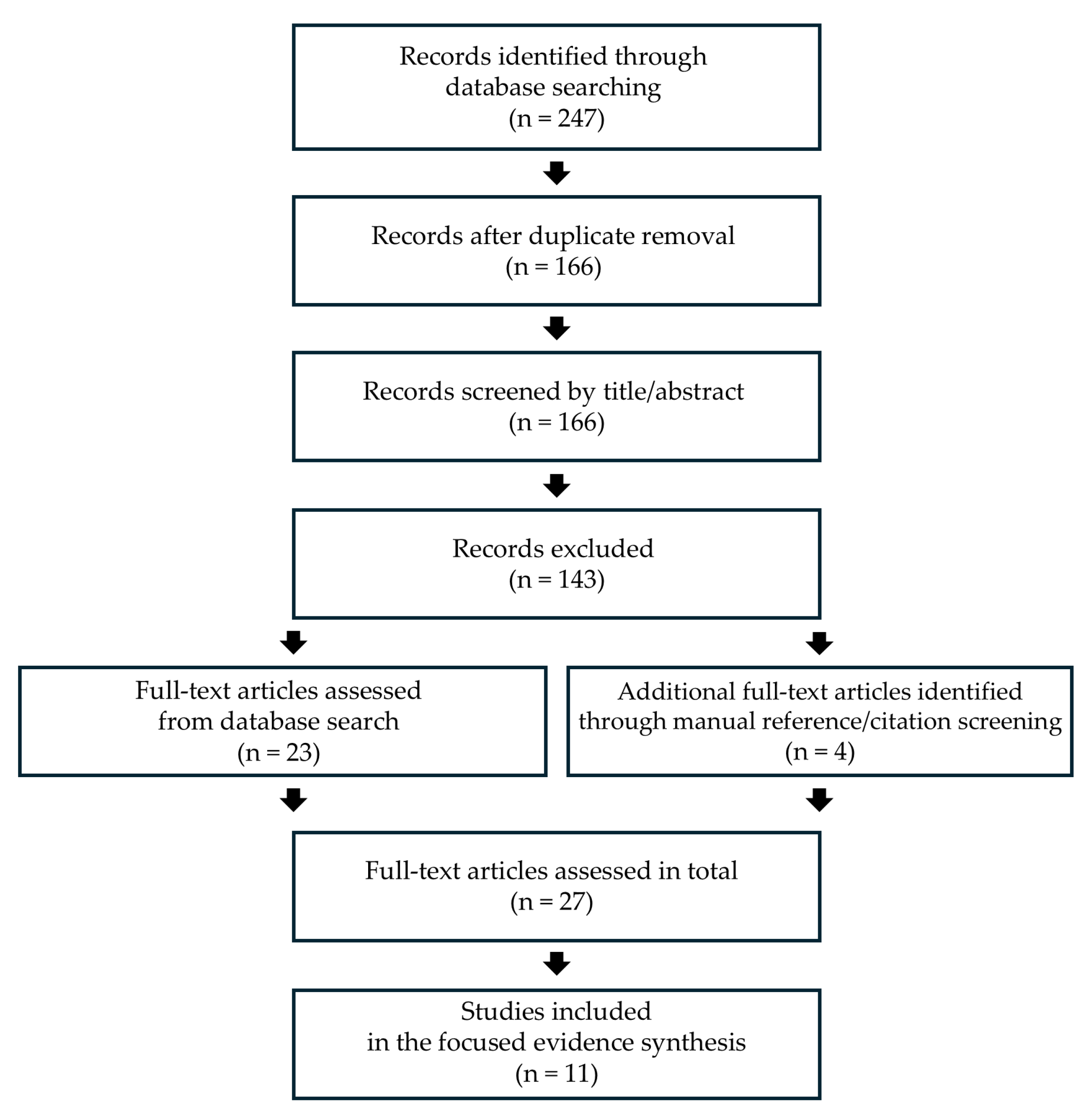
3.1. Literature Search Results
3.2. Characteristics of the Included Studies
3.3. Studies Directly Reporting Ocular Alignment and Strabismus-Related Findings
3.3.1. Esodeviation
3.3.2. Intermittent Exotropia
3.4. Studies Evaluating Binocular and Accommodative Parameters Relevant to Ocular Alignment
3.4.1. Binocular Vision, Accommodation, and Fusional Vergence
3.4.2. Studies Showing Transient Binocular/Accommodative Changes Without Reported Strabismus
4. Discussion
4.1. Discrepancy Between Case-Based Reports and Comparative Studies
4.2. Exclusion of High-Risk Binocular Populations from Comparative Studies
4.3. Heterogeneity in Atropine Concentration, Outcome Measures, and Assessment Timing
4.4. Dose-Related Accommodative and Vergence Responses
4.5. Responses in Intermittent Exotropia and Esodeviation-Prone Patients
4.6. Clinical Monitoring, Low-Dose Atropine, and Binocular-Vision Exclusion Criteria
4.7. Discontinuation, near Addition, and Treatment Modification
4.8. Atropine Concentration, Iris Pigmentation, and Individual Variability
4.9. Strengths and Limitations
4.10. Future Research
5. Conclusions
Supplementary Materials
Author Contributions
Funding
Institutional Review Board Statement
Informed Consent Statement
Data Availability Statement
Acknowledgments
Conflicts of Interest
Abbreviations
| AC/A | accommodative convergence/accommodation |
| AMIXT | 0.01% Atropine Eye Drops in Children with Myopia and Intermittent Exotropia trial |
| ATOM2 | Atropine for the Treatment of Myopia 2 |
| D | diopter |
| DIMS | defocus incorporated multiple segments |
| IXT | intermittent exotropia |
| LAMP | Low-Concentration Atropine for Myopia Progression |
| NPC | near point of convergence |
| NPA | near point of accommodation |
| NRA | negative relative accommodation |
| OK | orthokeratology |
| PAL | progressive addition lens |
| PD | prism diopter |
| PFA | positive fusional amplitude |
| PFV | positive fusional vergence |
| PRA | positive relative accommodation |
| RCT | randomized controlled trial |
References
- Liang, J.; Pu, Y.; Chen, J.; Liu, M.; Ouyang, B.; Jin, Z.; Ge, W.; Wu, Z.; Yang, X.; Qin, C.; et al. Global prevalence, trend and projection of myopia in children and adolescents from 1990 to 2050: A comprehensive systematic review and meta-analysis. Br. J. Ophthalmol. 2025, 109, 362–371. [Google Scholar] [CrossRef]
- Haarman, A.E.G.; Enthoven, C.A.; Tideman, J.W.L.; Tedja, M.S.; Verhoeven, V.J.M.; Klaver, C.C.W. The complications of myopia: A review and meta-analysis. Investig. Ophthalmol. Vis. Sci. 2020, 61, 49. [Google Scholar] [CrossRef]
- Ohno-Matsui, K.; Wu, P.C.; Yamashiro, K.; Vutipongsatorn, K.; Fang, Y.; Cheung, C.M.G.; Lai, T.Y.Y.; Ikuno, Y.; Cohen, S.Y.; Gaudric, A.; et al. IMI pathologic myopia. Investig. Ophthalmol. Vis. Sci. 2021, 62, 5. [Google Scholar] [CrossRef] [PubMed]
- Yam, J.C.; Jiang, Y.; Tang, S.M.; Law, A.K.; Chan, J.J.; Wong, E.; Ko, S.T.; Young, A.L.; Tham, C.C.; Chen, L.J.; et al. Low-concentration atropine for myopia progression (LAMP) study: A randomized, double-blinded, placebo-controlled trial of 0.05%, 0.025%, and 0.01% atropine eye drops in myopia control. Ophthalmology 2019, 126, 113–124. [Google Scholar] [CrossRef] [PubMed]
- Cho, P.; Cheung, S.W. Retardation of myopia in orthokeratology (ROMIO) study: A 2-year randomized clinical trial. Investig. Ophthalmol. Vis. Sci. 2012, 53, 7077–7085. [Google Scholar] [CrossRef]
- Chamberlain, P.; Peixoto-de-Matos, S.C.; Logan, N.S.; Ngo, C.; Jones, D.; Young, G. A 3-year randomized clinical trial of MiSight lenses for myopia control. Optom. Vis. Sci. 2019, 96, 556–567. [Google Scholar] [CrossRef]
- Lam, C.S.Y.; Tang, W.C.; Tse, D.Y.; Lee, R.P.K.; Chun, R.K.M.; Hasegawa, K.; Qi, H.; Hatanaka, T.; To, C.H. Defocus incorporated multiple segments (DIMS) spectacle lenses slow myopia progression: A 2-year randomised clinical trial. Br. J. Ophthalmol. 2020, 104, 363–368. [Google Scholar] [CrossRef] [PubMed]
- Chia, A.; Lu, Q.S.; Tan, D. Five-year clinical trial on atropine for the treatment of myopia 2: Myopia control with atropine 0.01% eyedrops. Ophthalmology 2016, 123, 391–399. [Google Scholar] [CrossRef]
- Zadnik, K.; Schulman, E.; Flitcroft, I.; Fogt, J.S.; Blumenfeld, L.C.; Fong, T.M.; Lang, E.; Hemmati, H.D.; Chandler, S.P.; CHAMP Trial Group Investigators; et al. Efficacy and safety of 0.01% and 0.02% atropine for the treatment of pediatric myopia progression over 3 years: A randomized clinical trial. JAMA Ophthalmol. 2023, 141, 990–999. [Google Scholar] [CrossRef]
- Wang, Z.; Li, T.; Zuo, X.; Zhang, T.; Liu, L.; Zhou, C.; Leng, Z.; Chen, X.; Wang, L.; Wang, X.; et al. 0.01% atropine eye drops in children with myopia and intermittent exotropia: The AMIXT randomized clinical trial. JAMA Ophthalmol. 2024, 142, 722–730. [Google Scholar] [CrossRef]
- Jiang, J.; Long, W.; Hu, Y.; Zhao, F.; Zhao, W.; Zheng, B.; Feng, Z.; Li, Z.; Yang, X. Accommodation and vergence function in children using atropine combined with orthokeratology. Contact Lens Anterior Eye 2023, 46, 101704. [Google Scholar] [CrossRef] [PubMed]
- Neena, R.; Nasheetha, A.; Prakash, N.; Giridhar, A. Atropine in myopia—Does it reduce progression? Results of phase 1 clinical trial in children attending a tertiary eye care center in South India. Kerala J. Ophthalmol. 2022, 34, 21–26. [Google Scholar] [CrossRef] [PubMed]
- Breliant, R.E.; Pang, Y.; Bandstra, A.; Kattouf, V. Effect of low-dose atropine on binocular vision and accommodation in children aged 6 to 17 years. Optom. Vis. Sci. 2023, 100, 550–556. [Google Scholar] [CrossRef] [PubMed]
- Pan, W.; Wu, H.; Tang, Y.; Yang, Y.; Xu, Q.; Luo, Z.; Hu, Z.; Gao, W.; Hou, L.; Deng, Y.; et al. Resolution of near-work-related effects, accommodation, and binocular vision changes of 0.05% atropine after 1 year: Secondary analysis of a prospective study. Ophthalmol. Ther. 2025, 14, 3047–3057. [Google Scholar] [CrossRef]
- dos Santos-Neto, E.; Dantas, D.O.; Amaral, D.C.; Castro Neto, F.C.; Louzada, R.N.; Alves, M.R. Changes in accommodation and vergence parameters with topical use of 0.025% and 0.05% atropine in myopes aged between 7 and 17 years. Eye 2025, 39, 2664–2670. [Google Scholar] [CrossRef]
- Iwata, Y.; Sakoh, T.; Handa, T.; Ishikawa, H. Accommodative esotropia associated with low-dose atropine for myopia control: A case report with longitudinal AC/A ratio. J. AAPOS 2026, 104809. [Google Scholar] [CrossRef]
- Kothari, M.; Modak, M.; Khan, H.; Jahan, S.; Solanki, M.; Rathod, V. Convergence excess consecutive esotropia associated with 0.01% atropine eye drops usage in patients operated for intermittent exotropia. Indian J. Ophthalmol. 2020, 68, 653–656. [Google Scholar] [CrossRef]
- Jahan, S.; Kothari, M.; Solanki, M. Treatment of 0.01% atropine eye drops induced convergence excess esotropia and rebound myopia managed with 1% atropine eye drops. Indian J. Ophthalmol. Case Rep. 2021, 1, 140–141. [Google Scholar] [CrossRef]
- Belbase, U.; Chhetri, S.; Gamal, N.S.; Subedi, A.; Canto-Cerdan, M. A rare case of esotropia induced by short-term use of 0.01% atropine for myopia control. Clin. Optom. 2025, 17, 365–368. [Google Scholar] [CrossRef]
- Aman, S.; Guyton, D.L. Esotropia caused by low-dose atropine for rapidly progressive myopia in a 15-year-old boy. J. AAPOS 2025, 29, 104122. [Google Scholar] [CrossRef]
- Woodman-Pieterse, E.C.; Hughes, R.P.J.; Hopkins, S.; Cunningham, A.F.; Niemand, J.; Romeo, B.; Westcott, N. Response of accommodation and vergence systems to low dose atropine. Ophthalmic Physiol. Opt. 2025, 45, 1608–1621. [Google Scholar] [CrossRef]
- Hughes, R.P.J.; Woodman-Pieterse, E.C.; Read, S.A.; Vincent, S.J.; Collins, M.J. Effect of 0.025% atropine on ocular biometry changes during accommodation. Ophthalmic Physiol. Opt. 2025, 45, 865–876. [Google Scholar] [CrossRef]
- Mitsukawa, T.; Suzuki, Y.; Momota, Y.; Suzuki, S.; Yamada, M. Effects of 0.01% atropine instillation assessed using swept-source anterior segment optical coherence tomography. J. Clin. Med. 2021, 10, 4384. [Google Scholar] [CrossRef]
- Dehghanian Nasrabadi, F.; Mirzajani, A.; Soltan Sanjari, M.; Jafarzadehpur, E.; Abolghasemi, J. Using low-dose atropine in control of intermittent exotropia. Clin. Exp. Optom. 2026. [Google Scholar] [CrossRef] [PubMed]
- Sun, H.Y.; Tsai, J.D.; Nien, Y.S.; Peng, C.C.; Ke, C.H.; Kuo, H.Y. The use of progressive addition lenses to improve the daily visual function of children receiving topical atropine treatment. Ophthalmic Physiol. Opt. 2023, 43, 195–201. [Google Scholar] [CrossRef]
- Joachimsen, L.; Farassat, N.; Bleul, T.; Bohringer, D.; Lagreze, W.A.; Reich, M. Side effects of topical atropine 0.05% compared to 0.01% for myopia control in German school children: A pilot study. Int. Ophthalmol. 2021, 41, 2001–2008. [Google Scholar] [CrossRef] [PubMed]
- Loughman, J.; Flitcroft, D.I. The acceptability and visual impact of 0.01% atropine in a Caucasian population. Br. J. Ophthalmol. 2016, 100, 1525–1529. [Google Scholar] [CrossRef] [PubMed]
- Janti, S.S.; Mali, K.; Sahithi, E.; Tejaswini, A.; Kamble, B.; Kalluri, S. Safety and efficacy of atropine 0.05% versus 0.01% for prevention of myopic progression in Indian children: A randomized clinical trial. Cureus 2025, 17, e84010. [Google Scholar] [CrossRef]
- Adhikari, S.; Gupta, N.; Mahat, B.; Poudel, M.; Parajuli, R.; Lama, A.J. Safety and efficacy of low dose atropine in Nepalese children with progressive myopia. Nepal. J. Ophthalmol. 2023, 15, 24–33. [Google Scholar] [CrossRef]
- Kuo, H.Y.; Ke, C.H.; Chen, S.T.; Sun, H.Y. The impact of clinical atropine use in Taiwanese schoolchildren: Changes in physiological characteristics and visual functions. Children 2021, 8, 1054. [Google Scholar] [CrossRef]


| Study | Design/ Participants | Age | Atropine Regimen | Follow-Up or Assessment Window | Baseline Assessment/Parameters | Main Findings |
|---|---|---|---|---|---|---|
| Clinical and interventional studies | ||||||
| Wang et al., 2024 (AMIXT) [10] | Placebo-controlled RCT; 300 children with myopia and basic-type IXT | 6–12 years | 0.01% once nightly for 12 months | 12 months; repeated assessments during follow-up | Baseline and repeated assessments over 12 months: alignment, exotropia control, stereoacuity, NPC, AC/A ratio, fusional vergence | Near exodeviation decreased in the atropine group; no adverse effect on exotropia condition or binocular vision |
| Jiang et al., 2023 [11] | Prospective RCT; 62 children completed evaluation | 8–12 years | 0.01% alone, 0.01% + OK, OK alone, or control for 3 months | 3 months | Baseline and 3 months: accommodation and vergence function | No obvious deterioration in vergence parameters or AC/A ratio in the atropine-alone group |
| Neena et al., 2022 [12] | Prospective case–control study; 36 atropine-treated children and 19 controls | 6–16 years | 0.01% once nightly; minimum follow-up 6 months | Minimum 6 months; treatment initiation, 1 month, then every 6 months | Treatment initiation, 1 month, then every 6 months: ocular alignment, NPA, NPC | No significant changes in ocular alignment or NPC; mild pupil dilation and NPA recession |
| Breliant et al., 2023 [13] | Randomized double-masked study; 46 children | 6–17 years | Single instillation of placebo, 0.01%, 0.03%, or 0.05% | Single instillation; 30 min, 60 min, and 24 h | Baseline, 30 min, 60 min, and 24 h: phoria, NPC, fusional vergence, accommodation | No significant changes in phoria, NPC, fusional vergence, or accommodation; pupil size increased mainly with 0.03% and 0.05% |
| Pan et al., 2025 [14] | Secondary analysis of a prospective study; 205 children | 6–14 years | 0.05% once daily, twice weekly, or once weekly for 12 months | 12 months; baseline, week 2, month 6, and month 12 | Baseline, week 2, month 6, and month 12: accommodation and binocular vision | Short-term accommodation/binocular vision changes were observed, but most returned close to baseline by 12 months; no strabismus |
| Santos-Neto et al., 2025 [15] | Randomized interventional study; 34 myopic schoolchildren | 7–17 years | 0.025% or 0.05% once nightly for 14 nights | 14 nights; assessed on the morning of day 15 | Baseline and morning of day 15: accommodation and vergence parameters | Accommodative function worsened and limited PFV changes were observed; no manifest strabismus |
| Case reports and case series | ||||||
| Iwata et al., 2026 [16] | Case report; 1 child | 8 years | 0.025% once nightly | Baseline, 1 month after initiation, and after discontinuation | Baseline, 1 month after initiation, and after discontinuation: ocular alignment and AC/A ratio | Near intermittent esotropia and elevated AC/A ratio developed after initiation and improved after discontinuation |
| Kothari et al., 2020 [17] | Case series; 3 children after surgery for IXT | 4–6 years | 0.01% for 4–16 months | 4–16 months of atropine use; recovery after discontinuation described | Pre-event clinical findings and post-discontinuation course were described | Convergence excess consecutive esotropia with high AC/A ratio occurred; fusion recovered after discontinuation |
| Jahan et al., 2021 [18] | Case report; 1 child | 10 years | 0.01% after switch from 1% atropine | Clinical course before, during, and after 0.01% atropine described | Clinical course before, during, and after 0.01% atropine was described | Near esophoria and rebound myopia occurred during 0.01% use and normalized after discontinuation |
| Belbase et al., 2025 [19] | Case report; 1 child | 8 years | 0.01% for 3 months | Baseline, 3 months after initiation, and after treatment change | Baseline, 3 months after initiation, and after treatment change were described | Intermittent esotropia with high AC/A ratio, diplopia, and reduced stereopsis developed; fusion improved after discontinuation and treatment change |
| Aman and Guyton 2025 [20] | Case report; 1 adolescent | 15 years | Escalating concentrations after initiation with low-dose atropine | Long-term clinical course during dose escalation | Long-term clinical course described; not a fixed low-dose regimen | Acquired esotropia developed during long-term dose escalation; interpreted separately from fixed low-dose regimens |
| Evidence Category | References | Role in this Review |
|---|---|---|
| Formally included studies | [10,11,12,13,14,15,16,17,18,19,20] | Contributed to the focused evidence synthesis, Results, Table 1, and main conclusions regarding ocular alignment, strabismus-related findings, binocular vision, accommodation, or vergence outcomes in children using low-dose atropine for myopia control. |
| Supporting mechanistic literature | [21,22,23] | Used only to inform mechanistic interpretation of accommodative or vergence-related changes; not counted as formally included evidence. |
| Supporting clinical or contextual literature | [24,25,26,27,28,29,30] | Used only to provide broader clinical context, management considerations, dose-related safety information, or comparison with related atropine literature; not counted as formally included evidence. |
| Study | Study Design/Sample Size | Main Methodological Strengths | Main Limitations/Interpretive Weight |
|---|---|---|---|
| Wang et al., 2024 (AMIXT) [10] | Placebo-controlled randomized clinical trial; n = 300 | Randomized design, placebo control, large sample size, 12-month follow-up, and direct assessment of exotropia condition and binocular vision | Strongest included evidence for group-level safety in children with stable basic-type intermittent exotropia; generalizability to esophoria, high AC/A ratio, postoperative strabismus, or unstable binocular systems is limited |
| Jiang et al., 2023 [11] | Prospective randomized controlled trial; n = 62 completed evaluation | Prospective design, comparator groups, and assessment of accommodation and vergence function at baseline and follow-up | Short follow-up duration; atropine-alone group was not the sole focus; limited power for rare ocular alignment events |
| Neena et al., 2022 [12] | Prospective case–control study; 36 atropine-treated children and 19 controls | Prospective clinical follow-up with a control group; ocular alignment and near point of convergence were assessed | Non-randomized design; relatively small sample; ocular alignment and binocular function were not the primary focus |
| Breliant et al., 2023 [13] | Randomized double-masked study; n = 46 | Randomized and masked design; direct short-term assessment of binocular vision and accommodation after different atropine concentrations | Single-instillation design with short observation window; limited ability to assess longer-term or rare strabismus-related events |
| Pan et al., 2025 [14] | Secondary analysis of a prospective study; n = 205 | Prospective 12-month follow-up; repeated accommodation and binocular vision assessments; comparison of 0.05% dosing regimens | Secondary analysis; children with abnormal binocular function or strabismus were excluded; limited applicability to high-risk binocular populations |
| Santos-Neto et al., 2025 [15] | Randomized interventional study; n = 34 | Direct assessment of accommodation and vergence parameters after 0.025% and 0.05% atropine | Small sample; short treatment duration; not designed to estimate incidence of manifest strabismus |
| Iwata et al., 2026 [16] | Case report; n = 1 | Detailed longitudinal clinical course, including ocular alignment and AC/A ratio before and after discontinuation | Hypothesis-generating only; cannot establish incidence or causality |
| Kothari et al., 2020 [17] | Case series; n = 3 | Clinically relevant postoperative intermittent exotropia cases with documented high AC/A ratio and recovery after discontinuation | Small uncontrolled case series; high susceptibility to publication and selection bias; patients had pre-existing binocular vulnerability |
| Jahan et al., 2021 [18] | Case report; n = 1 | Detailed clinical course before, during, and after 0.01% atropine exposure | Hypothesis-generating only; prior atropine exposure and baseline binocular status limit causal interpretation |
| Belbase et al., 2025 [19] | Case report; n = 1 | Detailed description of ocular alignment, diplopia, stereopsis, and improvement after treatment change | Hypothesis-generating only; cannot separate atropine effect from baseline binocular vulnerability or other clinical factors |
| Aman and Guyton 2025 [20] | Case report; n = 1 | Clinically relevant report of acquired esotropia during long-term atropine treatment | Escalating atropine concentrations rather than fixed low-dose monotherapy; should be interpreted separately from standard 0.01–0.05% fixed regimens |
Disclaimer/Publisher’s Note: The statements, opinions and data contained in all publications are solely those of the individual author(s) and contributor(s) and not of MDPI and/or the editor(s). MDPI and/or the editor(s) disclaim responsibility for any injury to people or property resulting from any ideas, methods, instructions or products referred to in the content. |
© 2026 by the authors. Licensee MDPI, Basel, Switzerland. This article is an open access article distributed under the terms and conditions of the Creative Commons Attribution (CC BY) license.
Share and Cite
Iwata, Y.; Handa, T.; Ishikawa, H. Ocular Alignment and Strabismus-Related Findings Associated with Low-Dose Atropine for Myopia Control in Children: A Structured Narrative Review. Children 2026, 13, 818. https://doi.org/10.3390/children13060818
Iwata Y, Handa T, Ishikawa H. Ocular Alignment and Strabismus-Related Findings Associated with Low-Dose Atropine for Myopia Control in Children: A Structured Narrative Review. Children. 2026; 13(6):818. https://doi.org/10.3390/children13060818
Chicago/Turabian StyleIwata, Yo, Tomoya Handa, and Hitoshi Ishikawa. 2026. "Ocular Alignment and Strabismus-Related Findings Associated with Low-Dose Atropine for Myopia Control in Children: A Structured Narrative Review" Children 13, no. 6: 818. https://doi.org/10.3390/children13060818
APA StyleIwata, Y., Handa, T., & Ishikawa, H. (2026). Ocular Alignment and Strabismus-Related Findings Associated with Low-Dose Atropine for Myopia Control in Children: A Structured Narrative Review. Children, 13(6), 818. https://doi.org/10.3390/children13060818