New Approaches in Motor Intervention for Infants Aged 0–2 Years with or at High Risk of Unilateral or Bilateral Cerebral Palsy: A Systematic Review

 , , ,
, , ,
Highlights
- Early motor interventions for infants with or at high risk of cerebral palsy share common therapeutic principles despite heterogeneity in intervention models.
- There is a trend toward clinically meaningful improvements in motor and developmental outcomes after all types of intervention, although methodological limitations remain.
- Early, family-centered, and task-specific interventions should be prioritized during the first year of life to maximize neuroplastic potential.
- Standardization of outcome measures and inclusion of younger infants are essential to advance evidence-based early intervention.
Abstract
1. Introduction
2. Materials and Methods
2.1. Eligibility Criteria
2.2. Information Source and Search Strategy
2.3. Selection Process
2.4. Data Collection Process and Synthesis Methods
2.5. Data Items
2.5.1. Types of Studies
2.5.2. Participant Characteristics
2.5.3. Outcomes
2.5.4. Interventions and Comparators
2.6. Study Risk of Bias Assessment
2.7. Effect Measures
2.8. Registration
3. Results
Risk of Bias
4. Discussion
4.1. Key Concepts in Early Motor Intervention
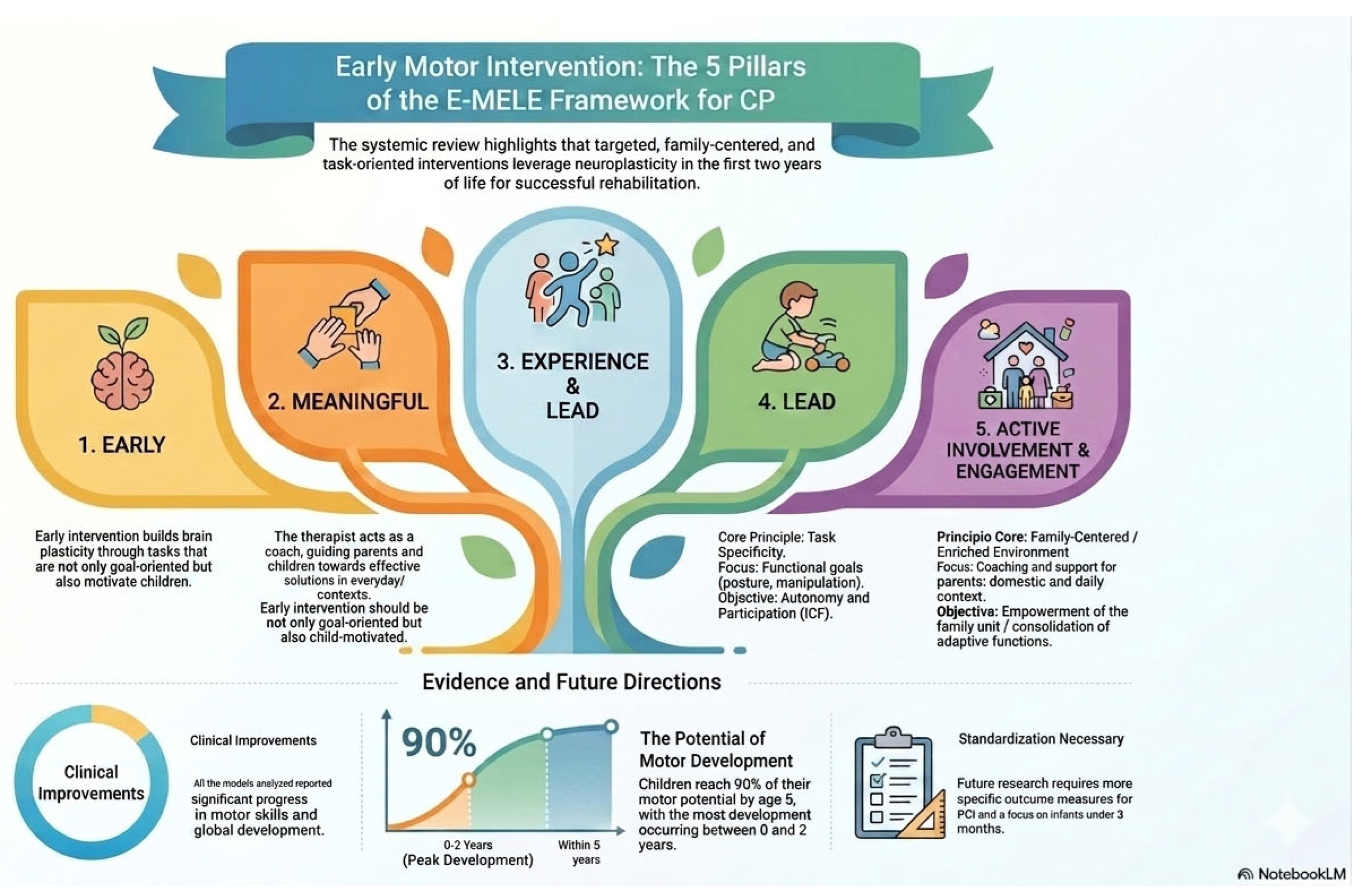
- Early (time and age matter): It is widely recognized that the first two years of life represent a critical period for the development of adaptive functions [15,30]. To achieve these functions, it is crucial for therapists to sustain the attachment process between mother and infant. This bond helps the child establish homeostatic balance with their environment, a necessary step before initiating a proper skills-directed treatment [17,31].
- Meaningful (goal- or task-specific, motor learning principle, the just-right challenge): The therapist should design activities that capture the child’s attention, interest, and emotional involvement, combining hands-off and hands-on strategies of intervention while providing a sense of satisfaction [17,20]. In doing so, they will promote the acquisition of foundational motor functions such as posture, manipulation, gait, and vision [16,20].
- Experience (use it or lose it, use it and improve it, enriched environment): The therapist should enable the child to actively experience adaptive functions, so that they can be stably consolidated across all life contexts [18]. These contexts will be adapted to the child’s abilities, thus generating repeated and intensive experiences [15,19,32,33].
- Lead (coaching, affordances): The therapist plays a key role in guiding the child and their parents to identify the most appropriate solutions within a given task and to achieve effective and efficient outcomes [16,17,21]. This is accomplished by carefully managing the environment and the objects involved, with particular attention to the affordances they provide [34,35].
4.2. Future Direction (Pilot Studies and Protocols)
4.3. Limitations of the Articles
4.4. Limitations of the Review
5. Conclusions
Supplementary Materials
Author Contributions
Funding
Institutional Review Board Statement
Informed Consent Statement
Data Availability Statement
Acknowledgments
Conflicts of Interest
Abbreviations
| CP | Cerebral Palsy |
| RCT | Randomized Controlled Trial |
| PRISMA | Preferred Reporting Items for Systematic reviews and Meta-Analyses |
| ICF | International Classification of Functioning, Disability and Health |
| GMs | General Movements |
References
- Graham, H.K.; Rosenbaum, P.; Paneth, N.; Dan, B.; Lin, J.-P.; Damiano, D.L.; Becher, J.G.; Gaebler-Spira, D.; Colver, A.; Reddihough, D.S.; et al. Cerebral Palsy. Nat. Rev. Dis. Primers 2016, 2, 15082. [Google Scholar] [CrossRef] [Scilit] [PubMed]
- Bax, M.C.O.; Flodmark, O.; Tydeman, C. Definition and Classification of Cerebral Palsy. Dev. Med. Child Neurol. Suppl. 2007, 109, 39–41. [Google Scholar] [CrossRef] [Scilit] [PubMed]
- Care Pathways Della Paralisi Cerebrale Infantile 2023. Available online: https://simfer.it/care-pathways-della-paralisi-cerebrale-infantile/ (accessed on 30 March 2026).
- Faccioli, S.; Sassi, S.; Pagliano, E.; Maghini, C.; Perazza, S.; Siani, M.F.; Sgherri, G.; Farella, G.M.; Foscan, M.; Viganò, M.; et al. Care Pathways in Rehabilitation for Children and Adolescents with Cerebral Palsy: Distinctiveness of the Adaptation to the Italian Context. Children 2024, 11, 852. [Google Scholar] [CrossRef] [Scilit]
- Novak, I.; Morgan, C.; Adde, L.; Blackman, J.; Boyd, R.N.; Brunstrom-Hernandez, J.; Cioni, G.; Damiano, D.; Darrah, J.; Eliasson, A.-C.; et al. Early, Accurate Diagnosis and Early Intervention in Cerebral Palsy: Advances in Diagnosis and Treatment. JAMA Pediatr. 2017, 171, 897–907. [Google Scholar] [CrossRef] [Scilit]
- Teuber, H.L.; Rudel, R.G. Behaviour after Cerebral Lesions in Children and Adults. Dev. Med. Child Neurol. 1962, 50, 324. [Google Scholar] [CrossRef] [Scilit]
- Anderson, V.; Northam, E.; Wrennall, J. Developmental Neuropsychology: A Clinical Approach, 2nd ed.; Routledge: London, UK, 2018. [Google Scholar]
- Novak, I.; Morgan, C.; McNamara, L.; Te Velde, A. Best Practice Guidelines for Communicating to Parents the Diagnosis of Disability. Early Hum. Dev. 2019, 139, 104841. [Google Scholar] [CrossRef] [Scilit]
- Morgan, C.; Fetters, L.; Adde, L.; Badawi, N.; Bancale, A.; Boyd, R.N.; Chorna, O.; Cioni, G.; Damiano, D.L.; Darrah, J.; et al. Early Intervention for Children Aged 0 to 2 Years with or at High Risk of Cerebral Palsy: International Clinical Practice Guideline Based on Systematic Reviews. JAMA Pediatr. 2021, 175, 846–858. [Google Scholar] [CrossRef] [Scilit]
- Novak, I.; Morgan, C.; Fahey, M.; Finch-Edmondson, M.; Galea, C.; Hines, A.; Langdon, K.; Namara, M.M.; Paton, M.C.; Popat, H.; et al. State of the Evidence Traffic Lights 2019: Systematic Review of Interventions for Preventing and Treating Children with Cerebral Palsy. Curr. Neurol. Neurosci. Rep. 2020, 20, 3. [Google Scholar] [CrossRef] [Scilit] [PubMed]
- Rosenbaum, P.L.; Walter, S.D.; Hanna, S.E.; Palisano, R.J.; Russell, D.J.; Raina, P.; Wood, E.; Bartlett, D.J.; Galuppi, B.E. Prognosis for Gross Motor Function in Cerebral Palsy: Creation of Motor Development Curves. JAMA 2002, 288, 1357–1363. [Google Scholar] [CrossRef] [Scilit]
- Ferrari, A.; Cioni, G. Le Forme Spastiche Della Paralisi Cerebrale Infantile: Guida All’esplorazione Delle Funzioni Adattive; Springer: Milano, Italy, 2005. [Google Scholar]
- Page, M.J.; McKenzie, J.E.; Bossuyt, P.M.; Boutron, I.; Hoffmann, T.C.; Mulrow, C.D.; Shamseer, L.; Tetzlaff, J.M.; Akl, E.A.; Brennan, S.E.; et al. The PRISMA 2020 Statement: An Updated Guideline for Reporting Systematic Reviews. BMJ 2021, 372, n71. [Google Scholar] [CrossRef] [Scilit]
- Ouzzani, M.; Hammady, H.; Fedorowicz, Z.; Elmagarmid, A. Rayyan—A Web and Mobile App for Systematic Reviews. Syst. Rev. 2016, 5, 210. [Google Scholar] [CrossRef] [Scilit] [PubMed]
- Benfer, K.A.; Whittingham, K.; Ware, R.S.; Ghosh, A.K.; Chowdhury, S.; Moula, G.; Samanta, S.; Khan, N.Z.; Bell, K.L.; Oftedal, S.; et al. Efficacy of Early Intervention for Infants with Cerebral Palsy in an LMIC: An RCT. Pediatrics 2024, 153, e2023063854. [Google Scholar] [CrossRef] [Scilit]
- Cemali, M.; Pekçetin, S.; Akı, E. The Effectiveness of Sensory Integration Interventions on Motor and Sensory Functions in Infants with Cortical Vision Impairment and Cerebral Palsy: A Single Blind Randomized Controlled Trial. Children 2022, 9, 1123. [Google Scholar] [CrossRef] [Scilit]
- Hielkema, T.; Hamer, E.G.; Boxum, A.G.; La Bastide-Van Gemert, S.; Dirks, T.; Reinders-Messelink, H.A.; Maathuis, C.G.B.; Verheijden, J.; Geertzen, J.H.B.; Hadders-Algra, M.; et al. LEARN2MOVE 0-2 Years, a Randomized Early Intervention Trial for Infants at Very High Risk of Cerebral Palsy: Neuromotor, Cognitive, and Behavioral Outcome. Disabil. Rehabil. 2020, 42, 3752–3761. [Google Scholar] [CrossRef] [Scilit]
- Hielkema, T.; Boxum, A.G.; Hamer, E.G.; La Bastide-Van Gemert, S.; Dirks, T.; Reinders-Messelink, H.A.; Maathuis, C.G.B.; Verheijden, J.; Geertzen, J.H.B.; Hadders-Algra, M. LEARN2MOVE 0-2 Years, a Randomized Early Intervention Trial for Infants at Very High Risk of Cerebral Palsy: Family Outcome and Infant’s Functional Outcome. Disabil. Rehabil. 2020, 42, 3762–3770. [Google Scholar] [CrossRef] [Scilit]
- Harbourne, R.T.; Dusing, S.C.; Lobo, M.A.; McCoy, S.W.; Koziol, N.A.; Hsu, L.-Y.; Willett, S.; Marcinowski, E.C.; Babik, I.; Cunha, A.B.; et al. START-Play Physical Therapy Intervention Impacts Motor and Cognitive Outcomes in Infants with Neuromotor Disorders: A Multisite Randomized Clinical Trial. Phys. Ther. 2021, 101, pzaa232. [Google Scholar] [CrossRef] [Scilit]
- Babik, I.; Cunha, A.B.; Choi, D.; Koziol, N.A.; Harbourne, R.T.; Dusing, S.C.; McCoy, S.W.; Bovaird, J.A.; Willett, S.L.; Lobo, M.A. The Effect of START-Play Intervention on Reaching-Related Exploratory Behaviors in Children with Neuromotor Delays: A Secondary Analysis of a Randomized Controlled Trial. Phys. Occup. Ther. Pediatr. 2023, 43, 321–337. [Google Scholar] [CrossRef] [Scilit] [PubMed]
- Hielkema, T.; Blauw-Hospers, C.H.; Dirks, T.; Drijver-Messelink, M.; Bos, A.F.; Hadders-Algra, M. Does Physiotherapeutic Intervention Affect Motor Outcome in High-Risk Infants? An Approach Combining a Randomized Controlled Trial and Process Evaluation. Dev. Med. Child Neurol. 2011, 53, e8–e15. [Google Scholar] [CrossRef] [Scilit]
- Harbourne, R.T.; Berger, S.E. Embodied Cognition in Practice: Exploring Effects of a Motor-Based Problem-Solving Intervention. Phys. Ther. 2019, 99, 786–796. [Google Scholar] [CrossRef] [Scilit]
- Lobo, M.A.; Paul, D.A.; Mackley, A.; Maher, J.; Galloway, J.C. Instability of Delay Classification and Determination of Early Intervention Eligibility in the First Two Years of Life. Res. Dev. Disabil. 2014, 35, 117–126. [Google Scholar] [CrossRef] [Scilit] [PubMed]
- Harbourne, R.T.; Dusing, S.C.; Lobo, M.A.; Westcott-McCoy, S.; Bovaird, J.; Sheridan, S.; Galloway, J.C.; Chang, H.-J.; Hsu, L.-Y.; Koziol, N.; et al. Sitting Together And Reaching To Play (START-Play): Protocol for a Multisite Randomized Controlled Efficacy Trial on Intervention for Infants with Neuromotor Disorders. Phys. Ther. 2018, 98, 494–502. [Google Scholar] [CrossRef] [Scilit]
- Sterne, J.A.C.; Savović, J.; Page, M.J.; Elbers, R.G.; Blencowe, N.S.; Boutron, I.; Cates, C.J.; Cheng, H.-Y.; Corbett, M.S.; Eldridge, S.M.; et al. RoB 2: A Revised Tool for Assessing Risk of Bias in Randomised Trials. BMJ 2019, 366, l4898. [Google Scholar] [CrossRef] [Scilit]
- Damiano, D.L.; Longo, E. Early Intervention Evidence for Infants with or at Risk for Cerebral Palsy: An Overview of Systematic Reviews. Dev. Med. Child Neurol. 2021, 63, 771–784. [Google Scholar] [CrossRef] [Scilit] [PubMed]
- Krumlinde-Sundholm, L.; Ek, L.; Sicola, E.; Sjöstrand, L.; Guzzetta, A.; Sgandurra, G.; Cioni, G.; Eliasson, A. Development of the Hand Assessment for Infants: Evidence of Internal Scale Validity. Dev. Med. Child Neurol. 2017, 59, 1276–1283. [Google Scholar] [CrossRef] [Scilit] [PubMed]
- Pin, T.W.; Butler, P.B.; Cheung, H.-M.; Shum, S.L.-F. Segmental Assessment of Trunk Control in Infants from 4 to 9 Months of Age—A Psychometric Study. BMC Pediatr. 2018, 18, 182. [Google Scholar] [CrossRef] [Scilit] [PubMed]
- Calder, S.; Ward, R.; Jones, M.; Johnston, J.; Claessen, M. The Uses of Outcome Measures within Multidisciplinary Early Childhood Intervention Services: A Systematic Review. Disabil. Rehabil. 2018, 40, 2599–2622. [Google Scholar] [CrossRef] [Scilit]
- Nelson, C.A. The Neurobiological Bases of Early Intervention. In Handbook of Early Childhood Intervention; Shonkoff, J.P., Meisels, S.J., Eds.; Cambridge University Press: Cambridge, UK, 2000; pp. 204–228. [Google Scholar]
- Provenzi, L.; Fumagalli, M.; Bernasconi, F.; Sirgiovanni, I.; Morandi, F.; Borgatti, R.; Montirosso, R. Very Preterm and Full-Term Infants’ Response to Socio-Emotional Stress: The Role of Postnatal Maternal Bonding. Infancy 2017, 22, 695–712. [Google Scholar] [CrossRef] [Scilit]
- Morgan, C.; Novak, I.; Badawi, N. Enriched Environments and Motor Outcomes in Cerebral Palsy: Systematic Review and Meta-Analysis. Pediatrics 2013, 132, e735–e746. [Google Scholar] [CrossRef] [Scilit]
- Zhou, X.; Li, X.; Jin, M.; Zhou, X.; Liang, J.; Zhu, J.; Meng, Q.; Du, Q. The Effects of Environmental Enrichment in Infants with or at High Risk of Cerebral Palsy: An Updated Systematic Review and Meta-Analysis. BMC Pediatr. 2025, 25, 642. [Google Scholar] [CrossRef] [Scilit]
- Maranesi, M.; Bonini, L.; Fogassi, L. Cortical Processing of Object Affordances for Self and Others’ Action. Front. Psychol. 2014, 5, 538. [Google Scholar] [CrossRef] [Scilit]
- Rizzolatti, G.; Fogassi, L. The Mirror Mechanism: Recent Findings and Perspectives. Philos. Trans. R. Soc. Lond. B Biol. Sci. 2014, 369, 20130420. [Google Scholar] [CrossRef] [Scilit] [PubMed]
- Murray, L.; De Pascalis, L.; Bozicevic, L.; Hawkins, L.; Sclafani, V.; Ferrari, P.F. The Functional Architecture of Mother-Infant Communication, and the Development of Infant Social Expressiveness in the First Two Months. Sci. Rep. 2016, 6, 39019. [Google Scholar] [CrossRef] [Scilit]



| Study | Participants | Intervention | Comparison | Outcomes | Measurement of Outcomes | Main Results or Findings | Limits and Strengths Declared by the Authors |
|---|---|---|---|---|---|---|---|
| Efficacy of Early Intervention for Infants with Cerebral Palsy in an LMIC: An RCT Benfer et al. [15] 2023 | Infants 12–40 weeks corrected age at risk for CP 153 randomized (77–76) 33 dropouts Effect size 142 | LEAP-CP (Learning through Everyday Activities with Parents- CP) 15 home visits by a peer trainer | HA (health advice) Equal dose by peer trainer | 1. Mobility function/caregiver mental health 2. Infant development | 1. PEDI-CAT mobility, DASS 2. COPM, PDMS-2, BSID-III, Near Detection Scale, nutritional status, HINE, HOME, PSOC | Primary and secondary outcomes improve in both arms without a difference between groups. When stratified for GMFCS (96 infants), children with GMFCS I and II in Leap-cp scored better than HA on PEDI-CAT mobility and HINE. Intervention groups improve parent reported motor skills (Pedi-cat) and neurological status (Hine) in ambulatory children with cp. Ambulatory children have better response reported than non-ambulatory. | An absence of true active control arm. Greater severity of the sample in the Leap group. LMIC populations skewed toward poorer motor function and comorbidities. Use of GMFCS at 18 months is less accurate than use in older children. The study did not exclude children with significant comorbidities. Real-world setting in low- and middle-income countries. Both study arms had clinically and statistically important improvements for all outcomes. Peer supporters instill hope and facilitate service involvement. |
| The Effectiveness of Sensory Integration Interventions on Motor and Sensory Functions in Infants with Cortical Vision Impairment and Cerebral Palsy: A Single Blind Randomized Controlled Trial. Cemali et al. [16] 2022 | Infants 12–18 months with CP and CVI 36 randomized (17–17) 2 dropouts Effect size 34 | Sensory integration training + conventional physiotherapy 4 sessions of 45 min/week for 8 weeks in outpatient setting (dedicated room) by a physiotherapy | Conventional physiotherapy 2 sessions of 45 min/week for 8 weeks in outpatient setting | 1. Sensory and motor functions | 1. TSFI, AIMS | Both groups improved significantly. Intervention group in TSFI (except for subheading oculomotor control) scored better than controls. AIMS improved in the same way between groups. | Infants participating were not homogeneous for type of cp and gender. Duration of intervention was limited. Use of protocol and checklist in the intervention group to systematize the intervention. The study will guide clinicians in understanding the importance of sensory processing in infants with CVI. |
| LEARN2MOVE 0–2 years, a randomized early intervention trial for infants at very high risk of cerebral palsy: neuromotor, cognitive, and behavioral outcome. Hielkema et al. [17] 2020 LEARN2MOVE 0–2 years, a randomized early intervention trial for infants at very high risk of cerebral palsy: family outcome and infant’s functional outcome. Hielkema et al. [18] 2020 | Infants 0–9 months at risk for CP (bilateral and unilateral) 43 randomized (23–20) 4 dropouts Effect size 38 | COPCA (Coping with and caring for infants with special needs) Once a week, 30–60 min per session, at home by pediatric physiotherapist | TIP (traditional infant physiotherapy) Equal dose | Neuromotor, cognitive and behavioral outcomes 1. Activities and participation of infants 2. Family empowerment outcomes 3. Quality of life | 1. IMP 2. AIMS, GMFM-66/GMFM-88, BSID II, CBCL, video recording session analyzed with Groningen Observer Protocol 2.0 1. FES, NOSIK, UCL 2. PEDI, VABS 3. ITQOL, CBS-list | Primary trial results: Infants’ neuromotor, cognitive and behavioral outcomes improve significantly over time. The improvement was similar in both groups. Secondary analysis: 1. The effect of COPCA and TIP on the family outcomes was similar. 2. In both intervention groups PEDI and VABS scores increased significantly over time 3. Similar effect in both groups but in COPCA group some domains scores changed significantly over time. Caregivers were more satisfied with general health. They felt less emotionally worried and less restricted. | Clinicians need good measurement tools because some scales have been developed for the general population and only few are specifically for CP. A long recruitment period which increases risk of contamination between groups. The intervention dosage may have affected outcomes. A longitudinal evaluation of early infants at very high risk of cp. A detailed process analysis of the intervention contents. Brain imaging is available which could be able to investigate relations between lesions and outcome over time. A small sample size. Not all measurements were appropriate for young age (es. Nosi-k). Questionnaires were lower than infants’ motor measures (selection bias). Evaluation of both infants and family outcomes. A large battery of measurement. A longitudinal study (12 months). |
| START-Play Physical Therapy Intervention Impacts Motor and Cognitive Outcomes in Infants with Neuromotor Disorders: A Multisite Randomized Clinical Trial. Harbourne et al. [19] 2021 The Effect of START-Play Intervention on Reaching-Related Exploratory Behaviors in Children with Neuromotor Delays: A Secondary Analysis of a Randomized Controlled Trial. Babik et al. [20] 2023 | Infants 7–16 months with motor delay (CP, risk for CP, unknown origin) Stratification in 2 groups (Severity and Mild) 112 randomized (57–55) 23 dropouts Effect size 152 | START-Play (sitting together and reaching to play) + UC-EI (usual care—early intervention) Twice weekly 40–60 min home visit for 12 weeks + UC | UC-EI (usual care-early intervention) 4, 5 sessions per week for 12 weeks (Severity 5,5 Mild 2,5 sessions for week) | 1. Sitting, reaching 2. roblem solving, global developmental outcome Reaching-related exploratory behaviors | 1. GMFM, reach video assessment 2. APSP, Bayley III Videos of the reaching assessment (10 behavioral outcomes) | Primary trial results: Aggregating across severity level there were no differences between groups. Stratified for severity, they found different results over time. SHORT PERIOD 1. There were no significant effects. 2. There were significant positive effects for START-P for severity infants in APSP and Bayley cognitive and motor domain. 3. Significant positive effects in UC for mild infants in APSP and Bayley communication domain. LONG PERIODS 1. Significant positive effects for START-P for Severity infants in reaching frequency. 2. Significant positive effects for START-P for Severity infants in the Bayley fine-motor domain. 1.2. No significant effects in mild infants. Secondary analysis: BASELINE In UC group, severity infants were higher than START-P. SHORT PERIOD Mild Infants in START-P catch up with their peers. LONG PERIOD Mild Infants in START-P improved in reaching and looking objects. | There was underpower caused by a dropout. The decision to stratify groups was not planned when determining the power of the study. Testing problem assessment in infants is difficult. Dose of intervention was not equal between groups. Contained short and long follow-up. Stratification could help to better understand the impact of intervention across different samples. Both interventions incorporate literature suggestions such as a natural environment, coaching, focusing on whole-child ability, and meaningful routines. Current analyses could lead to spurious inferences. Significant baseline differences among groups. Interventions focused on reaching skills with the contexts of problem solving should be considered for children with significant motor delay. |
Disclaimer/Publisher’s Note: The statements, opinions and data contained in all publications are solely those of the individual author(s) and contributor(s) and not of MDPI and/or the editor(s). MDPI and/or the editor(s) disclaim responsibility for any injury to people or property resulting from any ideas, methods, instructions or products referred to in the content. |
© 2026 by the authors. Licensee MDPI, Basel, Switzerland. This article is an open access article distributed under the terms and conditions of the Creative Commons Attribution (CC BY) license.
Share and Cite
Beccani, L.; Valle, M.; Damilano, S.; Venturelli, F.; Vicentini, M.; Vecchi, O.; Faccioli, S. New Approaches in Motor Intervention for Infants Aged 0–2 Years with or at High Risk of Unilateral or Bilateral Cerebral Palsy: A Systematic Review. Children 2026, 13, 762. https://doi.org/10.3390/children13060762
Beccani L, Valle M, Damilano S, Venturelli F, Vicentini M, Vecchi O, Faccioli S. New Approaches in Motor Intervention for Infants Aged 0–2 Years with or at High Risk of Unilateral or Bilateral Cerebral Palsy: A Systematic Review. Children. 2026; 13(6):762. https://doi.org/10.3390/children13060762
Chicago/Turabian StyleBeccani, Laura, Monica Valle, Sara Damilano, Francesco Venturelli, Massimo Vicentini, Olivia Vecchi, and Silvia Faccioli. 2026. "New Approaches in Motor Intervention for Infants Aged 0–2 Years with or at High Risk of Unilateral or Bilateral Cerebral Palsy: A Systematic Review" Children 13, no. 6: 762. https://doi.org/10.3390/children13060762
APA StyleBeccani, L., Valle, M., Damilano, S., Venturelli, F., Vicentini, M., Vecchi, O., & Faccioli, S. (2026). New Approaches in Motor Intervention for Infants Aged 0–2 Years with or at High Risk of Unilateral or Bilateral Cerebral Palsy: A Systematic Review. Children, 13(6), 762. https://doi.org/10.3390/children13060762