“What’s in It for the Kid?”: An Approach for the Bedside Ethicist
 , ,
, ,
Highlights
- “What’s in it for the kid?” recentres decisions focusing on the child’s lived experience, rather than the goals or needs of decision makers.
- It acts as an accessible tool that complements existing frameworks by clarifying risks, benefits, and meaning for the child.
- The approach makes ethical decision-making more practical, accessible, and explicitly child focused.
- It promotes clearer weighing of benefit versus burden from the child’s perspective.
Abstract
1. Introduction
2. “What’s in It for the Kid?”
3. Shared Decision-Making
4. Zone of Parental Discretion
5. Goods of Childhood and Best Interest Standard
6. Care Ethics and a Rights-Based Approach
7. Conclusions
Supplementary Materials
Author Contributions
Funding
Institutional Review Board Statement
Informed Consent Statement
Data Availability Statement
Conflicts of Interest
Abbreviations
| SNI | Severe neurological impairment |
| SDM | Shared decision-making |
| ZPD | Zone of Parental Discretion |
| BIS | Best Interests Standard |
References
- Salter, E.K. Reimagining childhood: Responding to the challenge presented by severe developmental disability. HEC Forum 2017, 29, 241–256. [Google Scholar] [CrossRef]
- Cahill, P.; Papageorgiou, A. Triadic communication in the primary care paediatric consultation: A review of the literature. Br. J. Gen. Pract. 2007, 57, 904–911. [Google Scholar] [CrossRef]
- Bogetz, J.F.; Trowbridge, A.; Lewis, H.; Shipman, K.J.; Jonas, D.; Hauer, J.; Rosenberg, A.R. Parents are the experts: A qualitative study of the experiences of parents of children with severe neurological impairment during decision-making. J. Pain Symptom Manag. 2021, 62, 1117–1125. [Google Scholar] [CrossRef] [PubMed]
- Bogetz, J.; Kett, J.C.; Wightman, A. Preparing for medical decision-making in response to concerns about suffering in children with severe neurologic impairment. Acta Paediatr. 2021, 110, 755–758. [Google Scholar] [CrossRef] [PubMed]
- Ross, L.F. Better than best (interest standard) in pediatric decision making. J. Clin. Ethics 2019, 30, 183–195. [Google Scholar] [CrossRef] [PubMed]
- Bieber, E.D.; Edelsohn, G.A.; McGee, M.E.; Shekunov, J.; Romanowicz, M.; Vande Voort, J.L.; McKean, A.J.S. The role of parental capacity for medical decision-making in medical ethics and the care of psychiatrically ill youth: Case report. Front. Psychiatry 2020, 11, 559263. [Google Scholar] [CrossRef]
- Bester, J.C. The best interest standard and children: Clarifying a concept and responding to its critics. J. Med. Ethics 2019, 45, 117–124. [Google Scholar] [CrossRef]
- Allen, J.; Brenner, M.; Hauer, J.; Molloy, E.; McDonald, D. Severe neurological impairment: A Delphi consensus-based definition. Eur. J. Paediatr. Neurol. 2020, 29, 81–86. [Google Scholar] [CrossRef]
- Hinwood, G.L.; Loftus, H.; Shepherd, D.A.; Guzys, A.; Reddihough, D.S.; Reid, S.M. Survival of individuals with cerebral palsy in Victoria, Australia: A longitudinal cohort study spanning four decades. Dev. Med. Child Neurol. 2023, 65, 580–587. [Google Scholar] [CrossRef]
- Page, B.F.; Hinton, L.; Harrop, E.; Vincent, C. The challenges of caring for children who require complex medical care at home. Health Expect. 2020, 23, 1144–1154. [Google Scholar] [CrossRef]
- McCallum, Z.; Delany, C.; Gillam, L. Crossing the line? Ethics of parenteral nutrition in paediatric neurodisability complicated by intestinal failure. Arch. Dis. Child. 2023, 108, 11–14. [Google Scholar] [CrossRef]
- Cooper, M.S.; McCallum, Z.; Antolovich, G. Whispers in the waiting room. Brain 2023, 146, 4401–4402. [Google Scholar] [CrossRef]
- Adams, R.C.; Levy, S.E.; Council on Children with Disabilities. Shared decision-making and children with disabilities: Pathways to consensus. Pediatrics 2017, 139, e20170956. [Google Scholar] [CrossRef] [PubMed]
- Cureton, A.; Silvers, A. Respecting the dignity of children with disabilities in clinical practice. HEC Forum 2017, 29, 257–276. [Google Scholar] [CrossRef] [PubMed]
- Turnham, H.; Wilkinson, D. Severe cognitive disability, medically complex children and long-term ventilation. Monash Bioeth. Rev. 2025. [Google Scholar] [CrossRef]
- Gillam, L. The zone of parental discretion: An ethical tool for dealing with disagreement between parents and doctors about medical treatment for a child. Clin. Ethics 2016, 11, 1–8. [Google Scholar] [CrossRef]
- Marron, J.M.; Jones, E.; Wolfe, J. Is there ever a role for the unilateral do not attempt resuscitation order in pediatric care? J. Pain Symptom Manag. 2018, 55, 164–171. [Google Scholar] [CrossRef]
- Salter, E.K.; Hester, D.M.; Vinarcsik, L.; Matheny Antommaria, A.H.; Bester, J.; Blustein, J.; Wright Clayton, E.; Diekema, D.S.; Iltis, A.S.; Kopelman, L.M.; et al. Pediatric decision making: Consensus recommendations. Pediatrics 2023, 152, e2023061832. [Google Scholar] [CrossRef]
- Maio, G. Fundamentals of an ethics of care. In Care in Healthcare: Reflections on Theory and Practice; Krause, F., Boldt, J., Eds.; Palgrave Macmillan: Cham, Switzerland, 2018; pp. 51–63. [Google Scholar]
- Antolovich, G.C.; Sutherland, I.; McCallum, Z.; Cooper, M.S. Centring the child in complex decision making. Lancet Child Adolesc. Health 2025, 9, 295–296. [Google Scholar] [CrossRef]
- Antolovich, G.; Kett, J.C. Deciding with children—Beyond disability. In Deciding with Children; Massie, J., Hall, G., Gillam, L., Eds.; Elsevier: Melbourne, Australia, 2025. [Google Scholar]
- Daboval, T.; Shidler, S. Ethical framework for shared decision making in the neonatal intensive care unit: Communicative ethics. Paediatr. Child Health 2014, 19, 302–304. [Google Scholar] [CrossRef]
- Zaal-Schuller, I.H.; Willems, D.L.; Ewals, F.; van Goudoever, J.B.; de Vos, M.A. How parents and physicians experience end-of-life decision-making for children with profound intellectual and multiple disabilities. Res. Dev. Disabil. 2016, 59, 283–293. [Google Scholar] [CrossRef]
- Lam, H.S.; Wong, S.P.S.; Liu, F.Y.B.; Wong, H.L.; Fok, T.F.; Ng, P.C. Attitudes toward neonatal intensive care treatment of preterm infants with a high risk of developing long-term disabilities. Pediatrics 2009, 123, 1501–1508. [Google Scholar] [CrossRef] [PubMed]
- Zaal-Schuller, I.H.; Geurtzen, R.; Willems, D.L.; de Vos, M.A.; Hogeveen, M. What hinders and helps in the end-of-life decision-making process for children: Parents’ and physicians’ views. Acta Paediatr. 2022, 111, 873–887. [Google Scholar] [CrossRef]
- Boland, L.; Graham, I.D.; Légaré, F.; Lewis, K.; Jull, J.; Shephard, A.; Lawson, M.L.; Davis, A.; Yameogo, A.; Stacey, D. Barriers and facilitators of pediatric shared decision-making: A systematic review. Implement. Sci. 2019, 14, 7. [Google Scholar] [CrossRef] [PubMed]
- Mahant, S.; Cohen, E.; Nelson, K.E.; Rosenbaum, P. Decision-making around gastrostomy tube feeding in children with neurologic impairment: Engaging effectively with families. Paediatr. Child Health 2018, 23, 209–213. [Google Scholar] [CrossRef]
- Jacobs, S.; Davies, N.; Butterick, K.L.; Oswell, J.L.; Siapka, K.; Smith, C.H. Shared decision-making for children with medical complexity in community health services: A scoping review. BMJ Paediatr. Open 2023, 7, e001866. [Google Scholar] [CrossRef]
- Zaal-Schuller, I.H.; Willems, D.L.; Ewals, F.; van Goudoever, J.B.; de Vos, M.A. Considering quality of life in end-of-life decisions for severely disabled children. Res. Dev. Disabil. 2018, 73, 67–75. [Google Scholar] [CrossRef] [PubMed]
- Feudtner, C.; Schall, T.; Hill, D. Parental personal sense of duty as a foundation of pediatric medical decision-making. Pediatrics 2018, 142, S133–S141. [Google Scholar] [CrossRef]
- Gower, W.A.; Golden, S.L.; King, N.M.P.; Nageswaran, S. Decision-making about tracheostomy for children with medical complexity: Caregiver and health care provider perspectives. Acad. Pediatr. 2020, 20, 1094–1100. [Google Scholar] [CrossRef]
- October, T.W.; Fisher, K.R.; Feudtner, C.; Hinds, P.S. The parent perspective: ‘Being a good parent’ when making critical decisions in the PICU. Pediatr. Crit. Care Med. 2014, 15, 291–298. [Google Scholar] [CrossRef]
- Nuffield Council on Bioethics. Disagreements in the Care of Critically Ill Children; Nuffield Council on Bioethics: London, UK, 2023. [Google Scholar]
- Treadgold, B.M.; Teasdale, E.; Muller, I.; Roberts, A.; Coulson, N.; Santer, M. Parents’ and carers’ experiences of seeking health information and support online for long-term physical childhood conditions: A systematic review. BMJ Open 2020, 10, e042139. [Google Scholar] [CrossRef] [PubMed]
- Weaver, M.S.; October, T.; Feudtner, C.; Hinds, P.S. ‘Good-parent beliefs’: Research, concept, and clinical practice. Pediatrics 2020, 145, e20194018. [Google Scholar] [CrossRef] [PubMed]
- Ubel, P.A. Afterword: Giving good advice: It is not what doctors say, but how they say it. Curr. Probl. Pediatr. Adolesc. Health Care 2011, 41, 128–130. [Google Scholar] [PubMed]
- Boland, R.A.; Davis, P.G.; Dawson, J.A.; Doyle, L.W. What are we telling the parents of extremely preterm babies? Aust. N. Z. J. Obstet. Gynaecol. 2016, 56, 274–281. [Google Scholar] [CrossRef]
- Downs, J.; Keeley, J.; Skoss, R.; Mills, J.; Nevill, T.; Schippers, A.; Lindly, O.; Thompson, S. Perspectives on the essential skills of healthcare decision making in children and adolescents with intellectual disability. Int. J. Equity Health 2024, 23, 119. [Google Scholar] [CrossRef]
- Delany, C.; Gillam, L.; McDougall, R. (Eds.) When Doctors and Parents Disagree: Ethics, Paediatrics and the Zone of Parental Discretion; Federation Press: Leichhardt, Australia, 2016. [Google Scholar]
- Marshall, A. I Can Jump Puddles, 3rd ed.; Penguin: Sydney, Australia, 2010. [Google Scholar]
- Kopelman, L.M. The best-interests standard as threshold, ideal, and standard of reasonableness. J. Med. Philos. 1997, 22, 271–289. [Google Scholar] [CrossRef]
- März, J.W. What does the best interests principle of the convention on the rights of the child mean for paediatric healthcare? Eur. J. Pediatr. 2022, 181, 3805–3816. [Google Scholar] [CrossRef]
- Malek, J. What really is in a child’s best interest? Toward a more precise picture of the interests of children. J. Clin. Ethics 2009, 20, 175–182. [Google Scholar] [CrossRef]
- Coulson-Smith, P.; Fenwick, A.; Lucassen, A. In defense of best interests: When parents and clinicians disagree. Am. J. Bioeth. 2018, 18, 67–69. [Google Scholar] [CrossRef]
- Rhodes, R.; Holzman, I.R. Is the best interest standard good for pediatrics? Pediatrics 2014, 134, S121–S129. [Google Scholar] [CrossRef]
- Matthew, P. Other-Person-Ness and the Person with Profound Disabilities; Routledge: London, UK, 2022. [Google Scholar]
- Shakespeare, T. Disability Rights and Wrongs; Routledge: London, UK, 2006. [Google Scholar]


| Centres the child |
| Focused consideration of the child’s experience, not others |
| Child at the heart of the decision-making |
| Child is the subject, not the object of discussion |
| Distils the question to consider what is really at stake Puts clinicians and parents in “child’s shoes” and opens discussion to examine and discuss: |
| What is meaningful to the child? |
| What brings them joy? |
| What does it mean to the child right now? |
| What might the decision mean for the future child? |
| What is the cost to the child? |
| Enables overt examination of risks versus benefits to the child |
| Focus on needs and potential gains of the child (not those of parent or clinician) |
| Helps us to consider risks in view of what the child might gain |
| Is there an acceptable balance between risks and benefits? |
| Quietens “the chorus” |
| Elevates the child’s “voice” (personhood) |
| Quietens the voices that are speaking to their own values, fears, and prior experiences |
| Challenges us to understand how we might “best” represent the child |
| Examines parental and clinicians’ values, beliefs, hopes and desires: |
| How are these influencing the discussion? |
| How are these influencing decisions? |
| How do they consider and incorporate what the child might want? |
| Explores the risk that the values, beliefs, hopes, desires, and fears of the parent and the clinician may override what the child might want, or what “the child might choose for themselves” |
| Encourages thinking about the gains, not only the risks |
| Requires reflexivity in practice |
| Critical when uncertainty prevails |
| Questions whether the values and fears of the clinician influence the delivery of the message or the options presented |
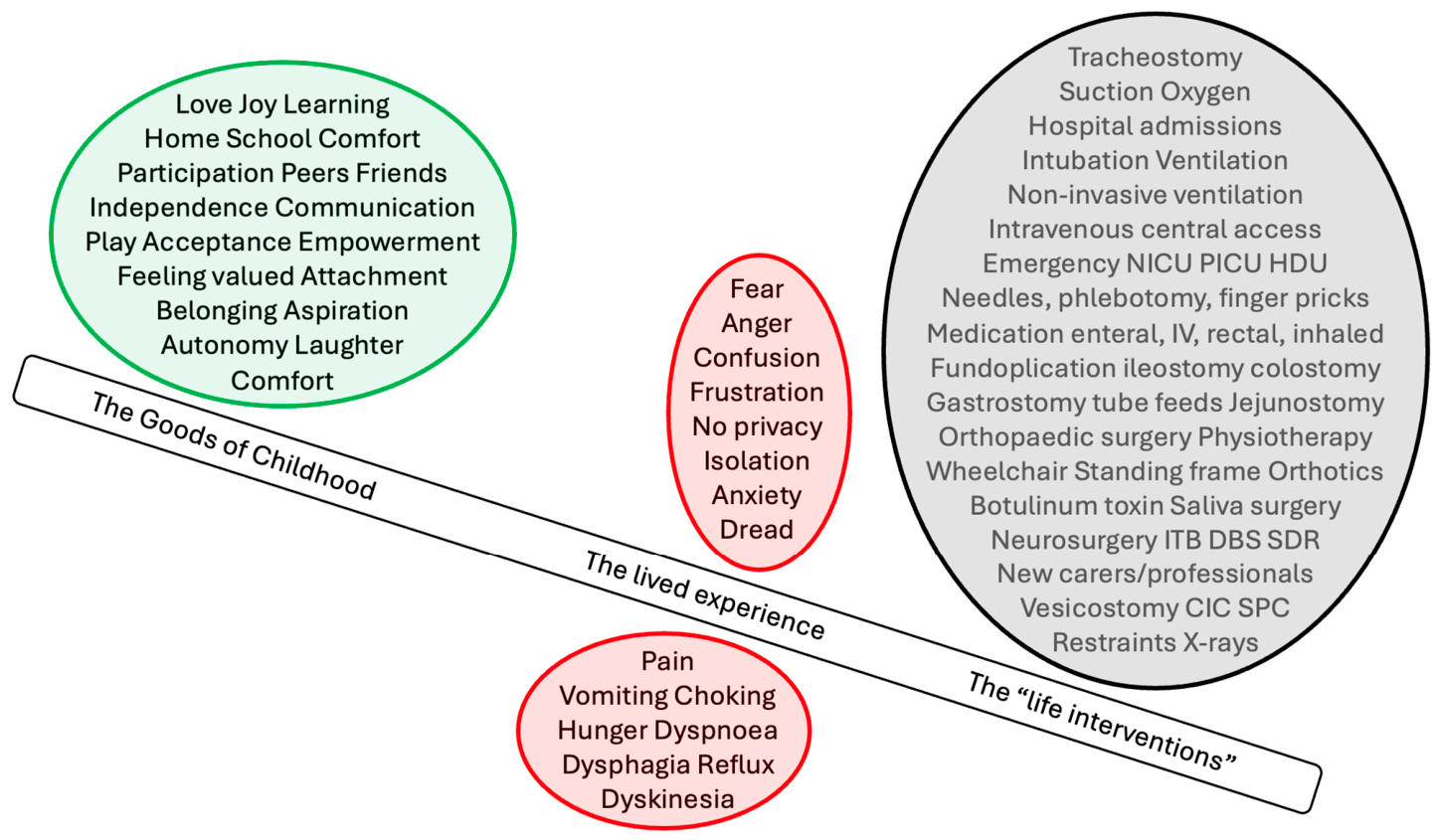
| Domain | Typically Developing Children | Children with Severe Neurological Impairment |
|---|---|---|
Intrinsic Value of Life | Life is valuable, often seen as a “a given” and understood in terms of potential for an open future Intrinsic value of childhood—not just a pathway to adulthood | Life is inherently valuable, and may be under threat of premature death Are the interventions required to sustain life tolerable for the child? Life at all costs? |
| Relationships and Emotional Connection  | Communication, play, and emotional reciprocity to form attachment and complex relationships with family and peers | Responsive caregiving fosters a bond through voice, touch, eye contact, gesture, body language and movement, and presence and predictability Bonds with caregivers, siblings, and others which promote a sense of security and love and belonging Engaged with a broader circle of caregivers given medical complexity and therapies Establishment and maintenance of peer relationships complicated by barriers: physical, communication, environmental, opportunity, societal |
| Pleasure and Sensory Enjoyment  | Pleasure from active, autonomous exploration, play, and social interaction | Enjoyment from tactile, auditory, and visual experiences (e.g., music, touch, nature) Comfort from familiar routines and environments, addressing sensory needs and positioning Reliant upon others to enable these experiences—to bring them to the child, to ensure the child is able and supported to participate |
Security and Protection | Security enables confident exploration Autonomy evolves As child grows older and more autonomous, safety increases, and they are able to provide their own care and communicate needs | Requires consistent and responsive caregiving Physical and emotional security Requires trust in systems, known communication methods Child needs to know that their needs will be anticipated, heard, understood, and responded to Need for environmental security—a stable home with modifications to enable full participation, such as an accessible bathroom or mobile hoist |
| Being Valued and Recognized, Belonging  | Achievement, participation, freedom of self-expression | Being treated with dignity Participation in family life, inclusion in daily routines, community participation, reinforce belonging with structures in place to ensure participation (access and carer support)—meaningful inclusion Awareness in community of disability needs Being visible in community through inclusion and representation: “You can’t be what you can’t see” |
Education | Fosters individual growth by developing critical thinking, communication, and problem-solving skills, while also preparing individuals to be autonomous, active, contributing members of society by imparting knowledge and interacting with others | A school environment that is adapted to ensure safe and enjoyable participation, learning, personal empowerment, and development of autonomy Critical importance of being able to express needs and wants—communication in both verbal and non-verbal means and with support of augmentative and alternative communication (AAC) Developmental level may not be reflected by chronological age in children with an intellectual disability; access to individual learning plan tailored to the child’s abilities and needs Children with a severe physical disability will require adapted teaching and learning environments to enable optimal participation and learning, e.g., specialized exercise equipment |
| Play and Leisure Adapted to Ability  | Active play, imagination, rules, and peer interaction | Engagement with sounds, movements, or interaction suited to functional, sensory, and developmental level Joy and stimulation through therapeutic or recreational activities Adapted activities, e.g., sensory play, passive movement Access to opportunities for play and participation through adapted programs and support for care givers (physical and financial) |
| Freedom from Pain and Distress  | Focus on emotional regulation and learning to manage discomfort or frustration | Optimal medical care focused on detection of pain and emphasis on comfort and symptom management Quality of life Prevention of pain Secure and supported caregiver and home environment |
Expression of Preferences | Multiple ways to communicate through language, communication, thoughts, choices, and emotions | Opportunities to express likes/dislikes and preferences Recognition of agency, even in limited forms |
| Spiritual and Existential Fulfilment  | Involved through family-led rituals or presence in community traditions Emerges to form personal understanding and participation in cultural/spiritual life | Involved through family-led rituals or presence in community traditions Exposure to spiritual or cultural practices meaningful to the family and child Recognition of the child’s role within a broader community or belief system Complexity of cross-cultural perceptions of disability |
Disclaimer/Publisher’s Note: The statements, opinions and data contained in all publications are solely those of the individual author(s) and contributor(s) and not of MDPI and/or the editor(s). MDPI and/or the editor(s) disclaim responsibility for any injury to people or property resulting from any ideas, methods, instructions or products referred to in the content. |
© 2026 by the authors. Licensee MDPI, Basel, Switzerland. This article is an open access article distributed under the terms and conditions of the Creative Commons Attribution (CC BY) license.
Share and Cite
Antolovich, G.C.; Sutherland, I.; McCallum, Z.; Cooper, M.S. “What’s in It for the Kid?”: An Approach for the Bedside Ethicist. Children 2026, 13, 707. https://doi.org/10.3390/children13050707
Antolovich GC, Sutherland I, McCallum Z, Cooper MS. “What’s in It for the Kid?”: An Approach for the Bedside Ethicist. Children. 2026; 13(5):707. https://doi.org/10.3390/children13050707
Chicago/Turabian StyleAntolovich, Giuliana C., Ingrid Sutherland, Zoe McCallum, and Monica S. Cooper. 2026. "“What’s in It for the Kid?”: An Approach for the Bedside Ethicist" Children 13, no. 5: 707. https://doi.org/10.3390/children13050707
APA StyleAntolovich, G. C., Sutherland, I., McCallum, Z., & Cooper, M. S. (2026). “What’s in It for the Kid?”: An Approach for the Bedside Ethicist. Children, 13(5), 707. https://doi.org/10.3390/children13050707