1. Introduction
Atopic dermatitis (AD) is the most common chronic, relapsing, non-infectious inflammatory skin disease in children. It affects up to 20% of the pediatric population, with 90% of children diagnosed before the age of 5 years [
1]. Several factors contribute to the pathogenesis of AD, including genetic disorders, epidermal barrier dysfunction, increased transepidermal water loss, immune dysregulation, and disruption of the skin microbiome [
2]. Atopic diseases can also occur in the context of inborn errors of immunity (IEIs), which result from mutations in genes that regulate host defense and immune function. The triad of eosinophilia, AD, and increased serum immunoglobulin E (IgE) is seen in common allergic diseases. However, it may also be a clinical presentation of an IEI [
3,
4].
Hypogammaglobulinemia is defined according to the ESID/PAGID diagnostic criteria as a serum IgG level at least two standard deviations (SDs) below the age-adjusted mean reference value [
5]. Serum IgG levels in infants are lowest at three to six months of age due to the catabolism of passive maternal IgG antibodies. Subsequently, Ig levels increase as the infant initiates endogenous IgG production. Transient hypogammaglobulinemia of infancy (THI) affects infants between 5 and 24 months of age and is characterized by transiently low levels (two standard deviations below normal) of serum immunoglobulins. Several studies have reported an increased frequency of allergic diseases, including atopic dermatitis, with THI [
5,
6,
7]. In a previous study conducted in Turkey, the frequency of atopic dermatitis in children with THI was reported to be approximately 5% [
6].
Atopic dermatitis may occur in certain immunodeficiencies, presenting as an “atopic phenotype” characterized by peripheral eosinophilia and elevated total IgE levels. This phenotype can be observed in conditions such as Netherton syndrome, IPEX syndrome, hyper-IgE syndrome, Omenn syndrome, Wiskott-Aldrich syndrome, and STAT6 gain-of-function mutation [
8,
9]. The presence of serum total IgE at >2000 kU/L, severe eosinophilia (>1500/μL), lymphocytopenia, neutropenia, thrombocytopenia, anemia, and clinical findings suggestive of immunodeficiency, especially in the first 3 months of life, has been regarded as a red flag [
10].
This study aimed to assess the prevalence of hypogammaglobulinemia in a large pediatric AD cohort and to characterize the clinical and laboratory features of patients with coexisting AD and hypogammaglobulinemia, given its potential link to underlying congenital immunodeficiency.
2. Method
The electronic medical records of patients aged 0–18 years diagnosed with AD between 2020 and 2022 at the Pediatric Immunology and Allergy Clinic of Bursa Medical Faculty City Hospital were reviewed. This was a retrospective cohort study with a cross-sectional baseline analysis and a longitudinal follow-up subgroup. Atopic dermatitis was diagnosed according to the Hanifin and Rajka criteria [
11]. Patients with metabolic disorders, previously diagnosed immunodeficiency, nephrotic syndrome, or chronic conditions that may lead to immunoglobulin loss and secondary hypogammaglobulinemia (such as chronic diarrhea, liver disease, or epilepsy requiring antiepileptic therapy) were excluded. In addition, patients receiving systemic immunosuppressive therapy at the time of immunoglobulin measurement (e.g., systemic corticosteroids, cyclosporine, methotrexate, azathioprine, or biological agents) were excluded to avoid confounding by immunosuppression-associated secondary hypogammaglobulinemia. During this period, all patients newly diagnosed with atopic dermatitis at our clinic were systematically screened for serum immunoglobulin levels (IgG, IgA, and IgM) at the time of initial presentation.
After the exclusion criteria were applied, hypogammaglobulinemia was identified in 200 patients (10.8%) within our cohort of 1850 children with atopic dermatitis who were systematically screened for serum immunoglobulin levels; these patients constituted the final study population. Patients with concomitant reductions in serum IgA and/or IgM levels below −2 SDs of the age-specific reference values were not excluded from the cohort. Serum immunoglobulin levels were interpreted according to age-specific reference ranges established for healthy Turkish children, and values below −2 SDs from the age-adjusted mean were considered low [
12].
The primary cross-sectional outcomes were (i) the prevalence of hypogammaglobulinemia among children with AD; (ii) the distribution of immunoglobulin levels by age and disease severity; and (iii) the association of hypogammaglobulinemia with food sensitization, eosinophilia, total IgE, and clinical comorbidities. The longitudinal outcomes, evaluated in the subgroup of 142 patients who underwent sequential immunoglobulin measurements every 3 months, were the change in immunoglobulin levels and the proportion of patients reaching age-appropriate normal IgG values during follow-up.
At each follow-up visit, infection history was assessed through a systematic review of medical records. Secondary bacterial skin infections (infected dermatitis) requiring systemic antibiotic treatment or hospitalization, upper and lower respiratory tract infections requiring antibiotic treatment, and other infections requiring hospitalization were recorded. Information on viral upper respiratory tract infections managed in outpatient primary care settings without hospitalization was not systematically available and was therefore not included in the analysis. Regarding infections, only one patient developed infected dermatitis requiring hospitalization and intravenous antibiotic treatment during the follow-up period.
The severity of AD was assessed using the SCORAD index at the time of first presentation. Patients with a SCORAD index below 25 were classified as having mild AD, those with a score from 25 to 50 had moderate AD, and those with a score above 50 were classified as having severe AD [
13,
14]. For analysis, the patients were grouped into mild versus moderate-to-severe AD. Atopic dermatitis is a disease characterized by a relapsing course with recurrent exacerbations. In this study, immunoglobulin levels and the SCORAD index were assessed at the time of the initial presentation, reflecting the disease activity at first admission.
Clinical data (demographic information, allergen sensitization findings via skin prick test, history of recurrent or severe infections, other accompanying allergic diseases) and laboratory findings (hemogram, serum total protein and albumin levels, and immunologic tests) were recorded. Serum IgG, IgA, and IgM levels were measured by immunoturbidimetric assay on a cobas 8000 modular analyzer (Roche Diagnostics, Mannheim, Germany), and lymphocyte subset levels (CD3+ T cells, CD4+ T cells, CD8+ T cells, CD19+ B cells, and CD3-CD16+CD56+ NK (Natural Killer) cells) were measured by means of flow cytometry. The following data were collected from electronic files and evaluated retrospectively: allergen-specific IgE, 25-hydroxyvitamin D, vitamin B12, tetanus, and hepatitis B vaccine-specific antibody responses. Specific IgE measurements were performed using the IMMULITE® immunoassay method (Siemens, Washington, DC, USA), and a cut-off value of 0.35 kU/L was used to define allergic sensitization. Allergy testing was performed for cow’s milk, egg yolk, egg white, wheat, peanut, beef, soybean, and house dust mites. A cutoff value of 0.35 kU/L was used to confirm allergic sensitization. All patients underwent a skin prick test. Skin prick testing was performed in the pediatric allergy clinic test room using standardized allergen extracts (Diater Laboratorios, Madrid, Spain). Patients were considered allergen-sensitized if the skin prick test or specific IgE was positive. Elimination diets were implemented for foods with positive test results. In patients who showed clinical improvement, an oral food challenge was performed after 4 weeks to confirm the diagnosis of food allergy.
4. Results
Of the 1850 children with AD who were systematically screened for serum immunoglobulins, 200 (10.8%) met the criteria for hypogammaglobulinemia and were included in this study. Of these 200 patients, 128 (64%) were male and 72 (36%) were female. The median age at first clinic presentation was 8 months (interquartile range (IQR) 25–75%: 5–16). Most patients were infants or young children: 56 (28%) were aged 3–6 months, 81 (40.5%) were 7–12 months, 55 (27.5%) were 13–48 months, and only eight (4%) were older than 49 months. According to the SCORAD index, AD severity was mild in 150 (75%) patients and moderate-to-severe in 50 (25%). Food allergy was present in 72 (36%) patients. The most frequently detected food allergens, in order of frequency, were milk (
n = 52, 26%), egg yolk (
n = 48, 24%), egg white (
n = 43, 21.5%), beef (
n = 29, 14.5%), peanut (
n = 23, 11.5%), wheat (
n = 20, 10%), soy (
n = 18, 9%), and hazelnut (
n = 16, 8%). Ten (5%) patients tested positive for house dust mite sensitization. The total IgE level was a median of 23.4 IU/mL (IQR 25–75%: 7.9–67.4). The median immunoglobulin levels were IgG 351 mg/dL (IQR 25–75%: 300–456), IgA 13 mg/dL (IQR 25–75%: 10–20), and IgM 45 mg/dL (IQR 25–75%: 22.8–65.5). The eosinophil count (cells/μL) was 320 (IQR 25–75%: 200–500).
Table 1 presents the distribution of immunoglobulin values among patients by age group.
The lymphocyte subgroups were within the normal age range in 185 (92.5%) of the patients. None of the patients received intravenous immunoglobulin (IVIG) treatment. Regarding infections, only one patient experienced an episode of infected dermatitis requiring hospitalization and intravenous antibiotic therapy during follow-up. In most cases, exacerbations of atopic dermatitis responded to topical antibiotic treatment. Among the comorbid allergic diseases, asthma was present in three patients (1.5%), allergic rhinitis in 15 patients (7.5%), proctocolitis in 19 patients (9.5%), and anaphylaxis in three patients (1.5%). The low prevalence of asthma (1.5%) is largely explained by the very young age of the cohort (68.5% under 12 months), since asthma is typically diagnosed at older ages.
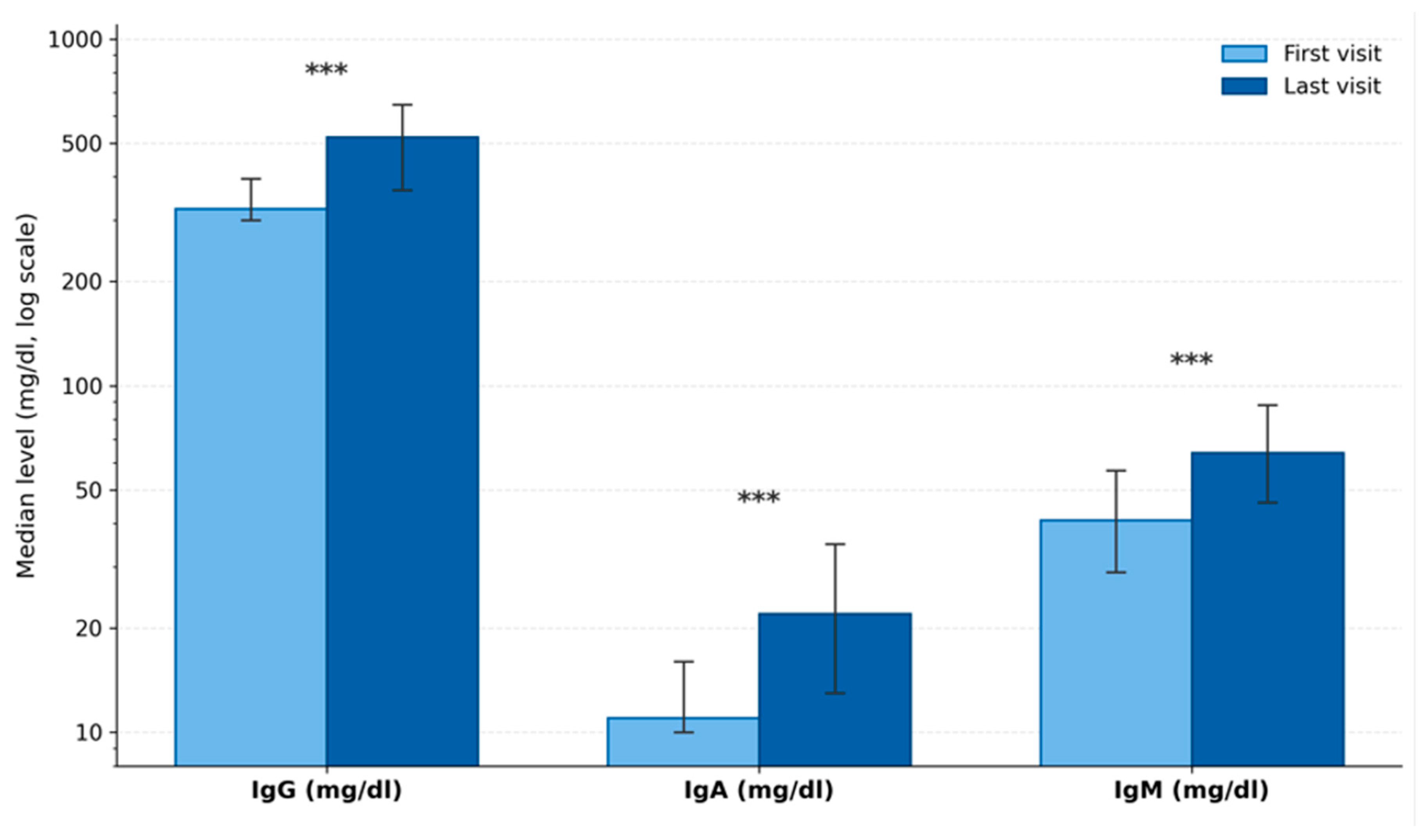
Among the 200 patients, 142 underwent sequential serum immunoglobulin measurements at approximately 3-month intervals during follow-up. Among these 142 patients, IgG titers increased from baseline in 125 patients and remained unchanged in 17. However, only 56 of the 142 patients (39%) reached age-appropriate normal IgG levels during follow-up, and hypogammaglobulinemia persisted in the remaining 86 (61%) over a median follow-up period of 18 months (range 3–25 months). There was a statistically significant increase observed in the median immunoglobulin G, A, and M values when the initial immunoglobulin values were compared with the immunoglobulin values at the last visit (
p < 0.001) (
Table 2) (
Figure 1). There was no difference in IgG, IgA, or IgM levels among patients with and without food allergies. However, the total IgE level was significantly higher in the group with food allergies. Patients sensitive to two or more allergens had significantly higher total IgE levels compared to those sensitive to a single allergen; however, no difference was observed in their IgA, IgG, or IgM levels (
Table 2).
The SCORAD index was not significantly different between male and female patients (
p = 0.29), but it was significantly higher in children with food allergies compared to those without (
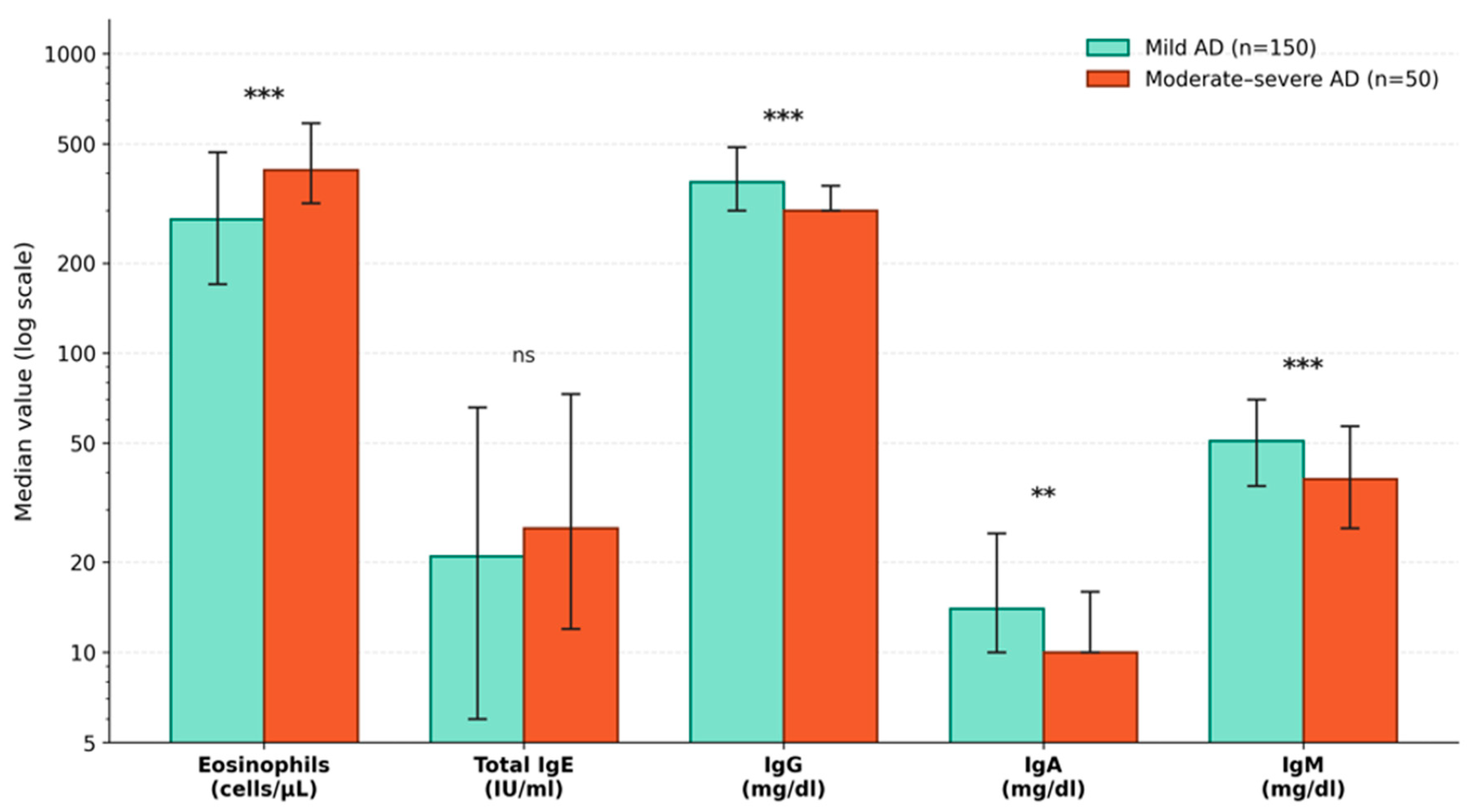
p < 0.001). The mean vitamin B12 and 25-hydroxyvitamin D levels were normal in all groups. The moderate-to-severe group had a significantly higher median eosinophil count than the mild group (
p < 0.001). The median IgG, IgA, and IgM levels of patients with moderate-to-severe AD were significantly lower than those of patients with mild AD (
Table 3) (
Figure 2). The differences in IgG (r = −0.346), IgM (r = −0.319), and eosinophil count (r = 0.332) between the mild and moderate-to-severe AD groups corresponded to medium effect sizes, indicating that these associations were not only statistically significant but also clinically meaningful. In contrast, total IgE showed a negligible effect size (r = 0.070), confirming the absence of a meaningful difference between the severity groups (
Table 3).
Multivariate logistic regression analysis was performed to identify independent predictors of moderate-to-severe AD, adjusting for age, sex, eosinophil counts, total IgE, food allergy status, and baseline immunoglobulin levels. Among all the covariates, only the IgG level was independently associated with moderate-to-severe disease (OR = 0.993 per 1 mg/dL increase; 95% CI: 0.988–0.999;
p = 0.013). When expressed per 100 mg/dL decrease in IgG, the odds of moderate-to-severe AD nearly doubled (OR = 1.97; 95% CI: 1.15–3.39) (
Table 4). In multiple linear regression with the SCORAD index as the continuous outcome variable (
Table 5), food allergy was the strongest independent predictor (B = 11.97; 95% CI: 6.41–17.54;
p < 0.001), while IgG showed a borderline negative association with the SCORAD index (B = −0.029;
p = 0.055).
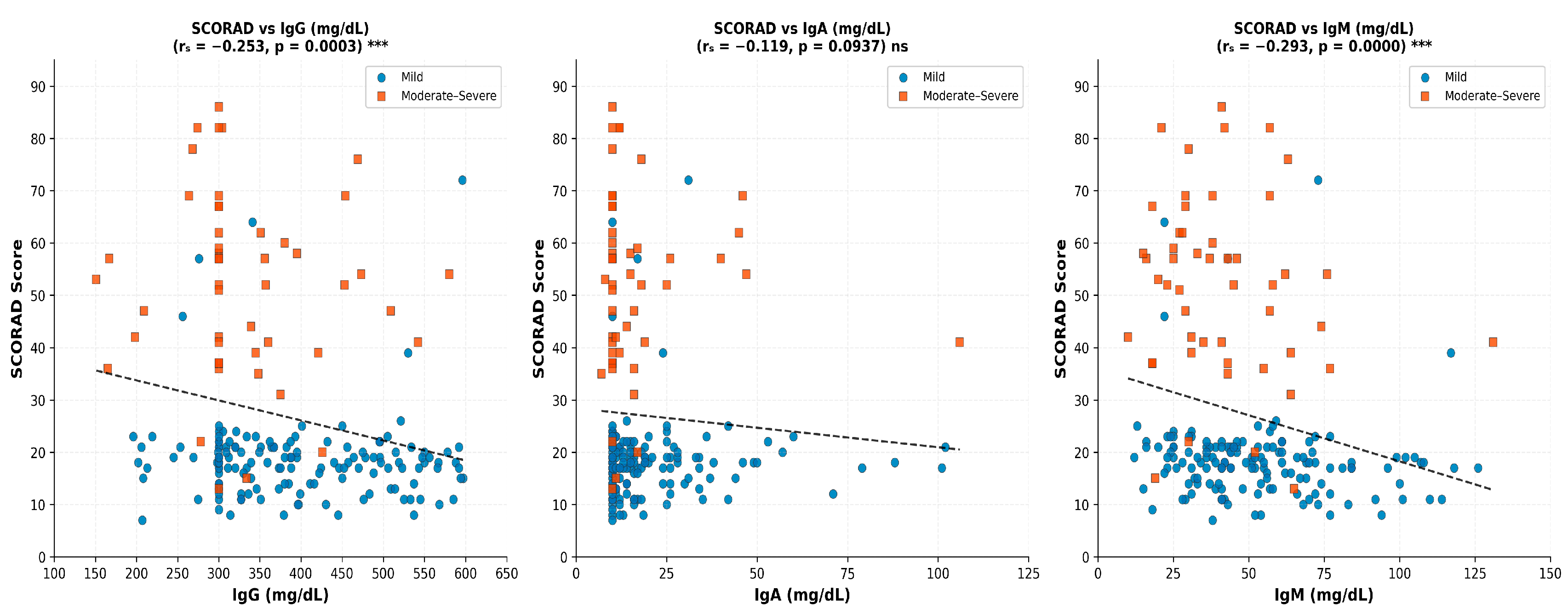
To identify individual-level patterns and extreme-value behaviors that may be masked by group-level summary statistics, scatterplots were constructed to visualize the relationships between the SCORAD index and baseline serum IgG, IgA, and IgM levels, stratified by disease severity.
The scatterplot findings are consistent with and reinforce the results of both the univariate and multivariate analyses. The visual clustering of moderate-to-severe patients in the low-immunoglobulin range corroborates the independent association between lower IgG and disease severity identified through logistic regression (OR = 1.97 per 100 mg/dL decrease) (
Figure 3).
Among the 200 patients with low IgG levels, decreased IgA levels were detected in 81 patients (40.5%), decreased IgM levels in 48 patients (24%), and reductions in all immunoglobulin isotypes below −2 standard deviations (SDs) of age-adjusted reference values in 10 patients (5%). Overall, 61 patients (30.5%) had isolated IgG deficiency, whereas 139 patients (69.5%) exhibited concomitant low IgA and/or IgM levels. The characteristics of both groups are compared in
Table 6. Baseline IgG levels were significantly lower in the concomitant deficiency group than in the isolated IgG deficiency group (median 336 vs. 399 mg/dL,
p = 0.014), consistent with the broader immunoglobulin impairment observed in these patients. However, disease severity, food allergy prevalence, SCORAD index values, and total IgE levels did not differ significantly between the groups.
Importantly, normalization of IgG levels during follow-up was significantly more frequent in patients with isolated IgG deficiency than in those with concomitant low IgA and/or IgM levels (53.7% vs. 25.87%, p = 0.001).
To further evaluate the impact of the hypogammaglobulinemia subtype on persistent hypogammaglobulinemia, logistic regression analysis was performed. Concomitant hypogammaglobulinemia, defined as low IgG accompanied by low IgA and/or IgM levels, emerged as a significant independent predictor of persistent hypogammaglobulinemia during follow-up (OR = 3.37, 95% CI: 1.21–9.40, p = 0.020). These findings support the clinical relevance of subclassifying patients according to accompanying immunoglobulin deficiencies. Notably, although baseline IgG levels were lower in the concomitant deficiency group (median 309 vs. 395 mg/dL, p = 0.031), the persistence of hypogammaglobulinemia was more strongly associated with the presence of multiple affected immunoglobulin isotypes than with the absolute IgG level itself (IgG decrease per 100 mg/dL: OR = 1.30, p = 0.278).
The most common comorbid conditions were allergic rhinitis (7.5%) and proctocolitis (9.5%). No increase in the frequency of proctocolitis or allergic rhinitis was observed in patients with AD and low immunoglobulin levels. When patients with low levels of IgG, IgA, or IgM were evaluated separately, no difference in allergic comorbidities was observed.
5. Discussion
This study examined the prevalence and clinical characteristics of hypogammaglobulinemia in children diagnosed with AD and investigated its relationship with disease severity, food allergies, and comorbidities. Two hypotheses regarding the relationship between AD and immune system defects have been proposed. The first hypothesis is that a defect in the immune system occurs first, followed by the development of an allergen-induced epidermal barrier disorder. The second hypothesis is that a skin barrier disruption occurs first, followed by immune dysregulation [
15].
One of the immune system defects associated with AD is THI. It has been reported that AD symptoms may improve after serum IgG levels return to normal [
16]. Infants with THI usually present with atopic manifestations such as food allergies, high IgE levels, and moderate-to-severe AD. Although low IgM levels are rare, these patients typically show isolated decreases in serum IgG levels [
17]. In our study, the prevalence of hypogammaglobulinemia in children with AD was 10.8%. In contrast, Çeliksoy et al. reported a higher incidence of hypogammaglobulinemia (28/160; 17.5%) in their cohort of pediatric AD patients; however, they did not identify any significant association between disease severity and hypogammaglobulinemia [
18]. Notably, our cohort was approximately 11.5 times larger than that in the aforementioned study, thereby providing substantially greater statistical power to detect differences in immunoglobulin levels across severity groups. Importantly, the observation of significantly lower immunoglobulin levels in the moderate AD group in our study suggests that this association may have been underrecognized in smaller cohorts. These findings underscore the value of larger sample sizes in elucidating clinically relevant immunological patterns and lend meaningful support to a potential link between AD severity and humoral immune response.
In our study, patients with moderate-to-severe AD had significantly lower median IgG, IgA, and IgM levels than did those with mild disease. Several non-mutually exclusive mechanisms may underlie this observation. First, severe AD is characterized by extensive disruption of the epidermal barrier and chronic cutaneous inflammation, which may lead to subclinical transcutaneous protein loss, potentially contributing to lower circulating immunoglobulin levels [
19]. Second, the marked T-helper-2 (Th2)-skewed inflammatory milieu in severe AD may impair B-cell class switching toward IgG and favor IgE production, a pattern compatible with the elevated IgE and eosinophilia observed in our moderate-to-severe group [
20]. Third, severe early-onset atopic dermatitis may be an early phenotypic manifestation of an underlying congenital immune disorder (such as STAT6 GOF, DOCK8 deficiency, Wiskott–Aldrich syndrome, or hyper-IgE syndrome) [
21]. From a clinical perspective, children with severe early-onset atopic dermatitis and persistently low immunoglobulin levels require closer immunological monitoring.
Severity classification (mild vs. moderate-to-severe) showed lower IgG, IgA, and IgM levels in the more severe group. In the logistic regression analysis performed in this study, after adjustments for possible confounding factors such as age, gender, eosinophilia, total IgE, and food allergy, IgG was the only immunoglobulin independently associated with AD severity. A complementary finding from the linear regression analysis revealed that food allergy was the dominant independent predictor of the SCORAD index. These two regression models evaluated different but complementary aspects of disease severity. In the logistic regression analysis, low IgG levels emerged as a categorical risk indicator for moderate-to-severe AD; in the linear regression analysis, food allergy was identified as a consistent severity predictor associated with increased SCORAD index.
The unexpectedly low median total IgE (23.4 IU/mL) and the low prevalence of asthma (1.5%) in our cohort, despite AD being classically associated with elevated IgE and atopic comorbidities, can be explained by the very young age structure of our population: 68.5% of patients were under 12 months, and 96% were under 48 months. Total IgE levels physiologically increase with age and with progression along the atopic march [
22]. In a study of 52 patients, Berce et al. found that those sensitive to food and/or aeroallergens, as well as those with low serum IgM levels, had more severe AD scores [
16]. Consistent with that report, in our cohort, the median SCORAD index value was higher in patients with food sensitization (23, IQR 20–57) than in those without (18.5, IQR 16–22).
Sensitization to foods (e.g., cow’s milk, egg whites, nuts) is common in infants and young children, while sensitization to airborne allergens (e.g., house dust mites, pets, pollen) becomes more common in older children [
23]. In our study, 96% of our patients were younger than 48 months, with 68.5% being younger than 12 months. The prevalence of food allergy was 36%, and that of house dust mite sensitization was 5%. The association between food allergies and hypogammaglobulinemia was stronger than that observed with inhalant allergies. Children with AD who are sensitized (polysensitized) to more than five foods and/or aeroallergens are more likely to experience a more severe form of the disease. More than two food allergies were detected in 82 of our patients (41%). While the polysensitization rate was 22.4% in previous studies, our study found a higher rate since we considered at least two food sensitivities as multiple sensitivities [
23].
In patients with sensitization to at least two allergens, the SCORAD index was 22 (IQR 25–75%: 18–51), whereas it was 19 (IQR 25–75%: 15–23) in monosensitized patients, and this difference was statistically significant. When monosensitized patients were compared with those sensitized to at least two allergens, IgE levels were significantly higher in the latter group. At the same time, no difference was found in IgG, IgA, or IgM levels. Previous studies did not evaluate the effect of the sensitivity count on immunoglobulin levels. A study by Wahn et al. reported a correlation between the SCORAD index and the number of allergen sensitizations [
24]. In our study, we also found that the SCORAD index was higher in patients with multiple sensitivities.
In a study by Dadkhah et al., the prevalence of AD was found to be 8.9% among 45 patients receiving IVIG treatment for hypogammaglobulinemia [
25]. Yartsev et al. found that AD was the most common allergic disease in patients with IEIs [
26]. In Wang’s study, IgG level normalization was observed in seven of eight patients within 2 years of hypogammaglobulinemia diagnosis [
27].
In our investigation, hypogammaglobulinemia persisted in 86 (61%) of the 142 patients followed over a median period of 18 months (range 3–25 months). Importantly, IgG level normalization during follow-up was significantly more frequent in patients with isolated IgG deficiency than in those with concomitant low IgA and/or IgM levels (53.7% vs. 25.87%). This finding suggests that concomitant hypogammaglobulinemia may represent a more persistent or biologically distinct immunological condition requiring closer long-term monitoring. These findings support the clinical relevance of subclassifying patients according to accompanying immunoglobulin deficiencies. Notably, although baseline IgG levels were lower in the concomitant deficiency group, the persistence of hypogammaglobulinemia was more strongly associated with the presence of multiple affected immunoglobulin isotypes than with the absolute IgG level itself. The coexistence of low IgA and/or IgM levels may therefore reflect a deeper defect in humoral immunity and may indicate a lower likelihood of spontaneous normalization over time.
Griffin et al., in their recently published retrospective study, evaluated 24 AD patients with hypogammaglobulinemia alongside a cohort of 180 patients with AD; however, they did not demonstrate a significant association between AD severity and IgG levels [
28]. This lack of association is not unexpected, given the very small subgroup sizes—particularly the presence of only eight patients with moderate AD and three with mild AD—which substantially limits the statistical reliability of comparisons across severity strata. In contrast, our study comprised a considerably larger cohort of 200 hypogammaglobulinemic AD patients, enabling more robust, adequately powered analyses. Notably, we observed that IgG, IgA, and IgM levels were significantly lower in patients with moderate-to-severe AD compared with those with mild disease.
Therefore, the principal strength of our study and its key contribution to the literature lies in demonstrating that hypogammaglobulinemia is associated not only with severe but also with moderate atopic dermatitis, suggesting a relationship between increasing AD severity and broader humoral immune alterations. These findings may broaden current perspectives on the association between AD severity and immunoglobulin levels, and underscore the need for increased clinical awareness and systematic immunological screening in this subgroup.
In a study by Yasuno et al., a significant association was found between immunoglobulin level normalization and AD symptom improvement in five patients with THI and AD. The skin findings of patients with AD resolved after their IgG levels returned to normal at 12 months of age, suggesting a relationship between THI and the occurrence of AD. Their study suggests that hypogammaglobulinemia in patients with AD may be attributed to a failure in production rather than protein loss from the skin and/or intestine [
29]. Walker et al. reported that 12 of 15 THI patients had symptoms of atopic disease or food allergy/intolerance, and they suggested that subclinical intestinal protein loss due to allergic inflammation may contribute to the development of THI [
30].
According to the Immune Deficiency Foundation, the estimated frequency of THI is approximately 1 in 1000 children; however, these figures are widely acknowledged to underestimate the true incidence, as immunoglobulins are not routinely measured in healthy children. Studies based on primary immunodeficiency registries indicate that THI accounts for approximately 2–2.3% of diagnosed IEI cases; however, these data do not reflect population-based prevalence [
28,
31]. In Kilic et al.’s two-center cohort, antibody deficiencies accounted for 73.5% of all IEIs, and THI accounted for 31% of primary antibody deficiencies (22.9% of all IEIs), suggesting a diagnosed THI prevalence of approximately 7 per 100,000 in Turkey [
32]. This figure falls at the lower bound of Walker et al.’s international estimate (0.061–1.1 per 1000 live births), indicating that THI is likely substantially underdiagnosed in Turkey [
30]. In the largest prospective European cohort (Italian Primary Immunodeficiency Network, IPINET), the IgG values of 72% of 57 children with an initial THI diagnosis spontaneously normalized within 24 months [
33]. Similarly, Karaca et al. reported that 90.1% of 101 Turkish THI patients achieved IgG normalization at a mean of 29.2 ± 15.2 months [
34]. Importantly, Sütçü et al., in an analysis of 91 THI patients focusing on predictive factors for recovery, found that IgG normalization occurred at a mean of 30.6 ± 11.88 months; 69.3% of patients recovered within the first 3 years of life, whereas 30.7% exhibited delayed recovery beyond this period. The presence of atopy, low initial IgA and IgM levels, and a history of more than six recurrent infections per year were significantly associated with late recovery [
35]. In our cohort, only 56 of 142 patients (39%) achieved age-appropriate IgG normalization after a median follow-up of 18 months, a rate markedly lower than those reported in the aforementioned series. This discrepancy may be attributable to the shorter follow-up period, concurrent atopic dermatitis, and the young age structure of our population; however, it also underscores the need for prolonged immunological surveillance in this patient group. It should be noted that the 10.8% prevalence of hypogammaglobulinemia observed in our study reflects a selected atopic dermatitis population and cannot be directly compared with population-based THI incidence estimates.
One possible reason for the lack of a significant increase in infection frequency is that a large majority of patients (75%) had mild atopic dermatitis. Mild atopic dermatitis is associated with more limited epidermal barrier impairment, so a lower risk of secondary skin infections is expected. Furthermore, none of the patients showed clinical or immunological findings suggestive of serious combined immunodeficiency or other T-cell defects; this was supported by lymphocyte subgroup analyses that were normal in 92.5% of patients. In addition, the mean follow-up period of 18 months may have been insufficient to fully capture the spectrum of infection-related morbidity. The retrospective nature of the data collection may also have prevented the recording of infections treated outside our center. Our findings are consistent with those from previous studies on THI, which reported no significant increase in the frequency of serious infections in most children with THI. To more accurately and comprehensively assess the infection burden, prospective studies incorporating standardized infection surveillance are needed [
36,
37].
Although immunoglobulin therapy has been reported to improve AD symptoms in selected severe cases [
38], immunoglobulin replacement therapy is not recommended for AD due to the lack of proven results and the concern that passive antibody administration may delay the maturation of humoral immunity [
39,
40,
41]. In our study, none of the patients received immunoglobulin replacement therapy.