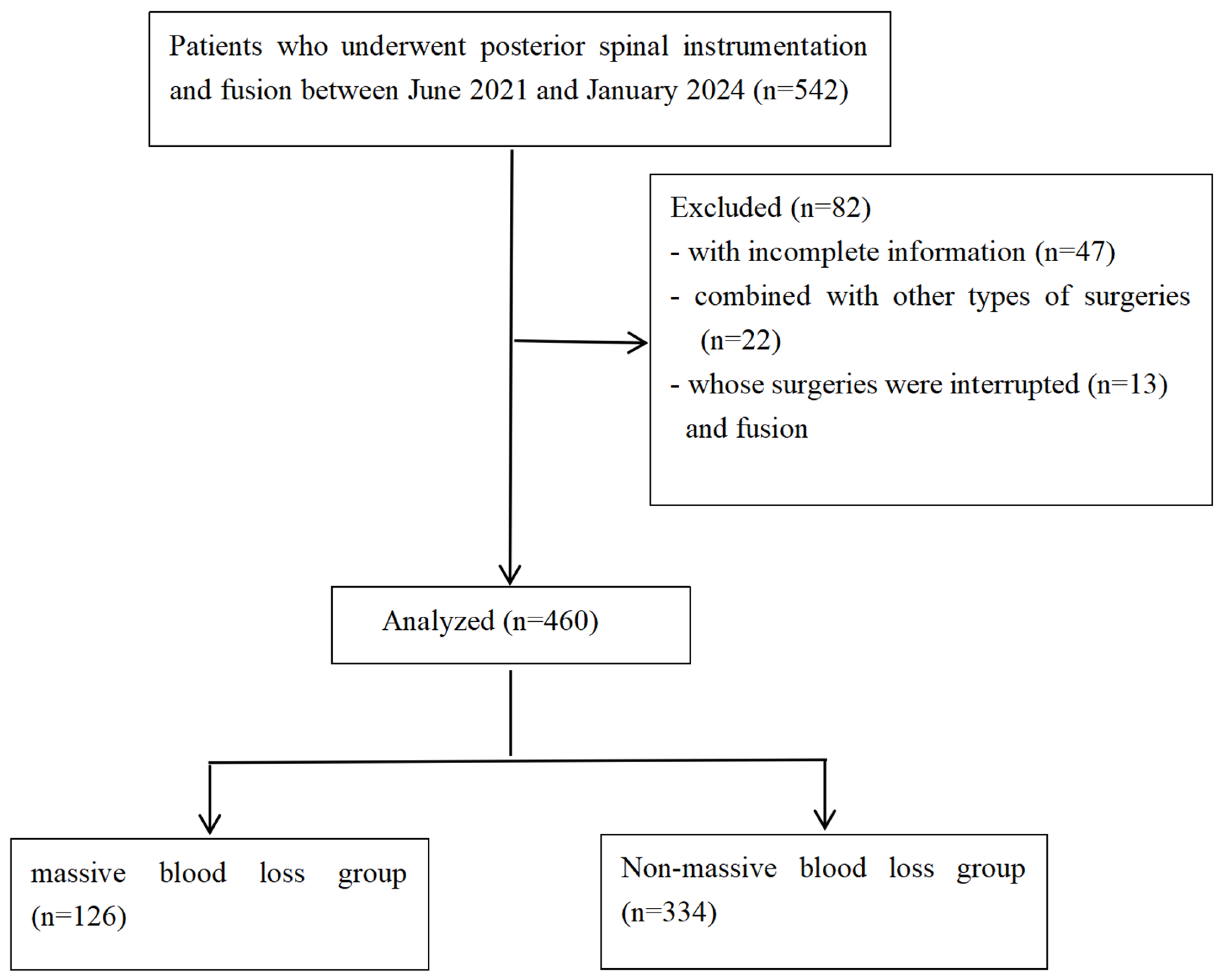
Risk Factors for Massive Intraoperative Blood Loss During Posterior Spinal Instrumentation and Fusion in Children: A Retrospective Cohort Study
 , ,
, ,
Highlights
- •
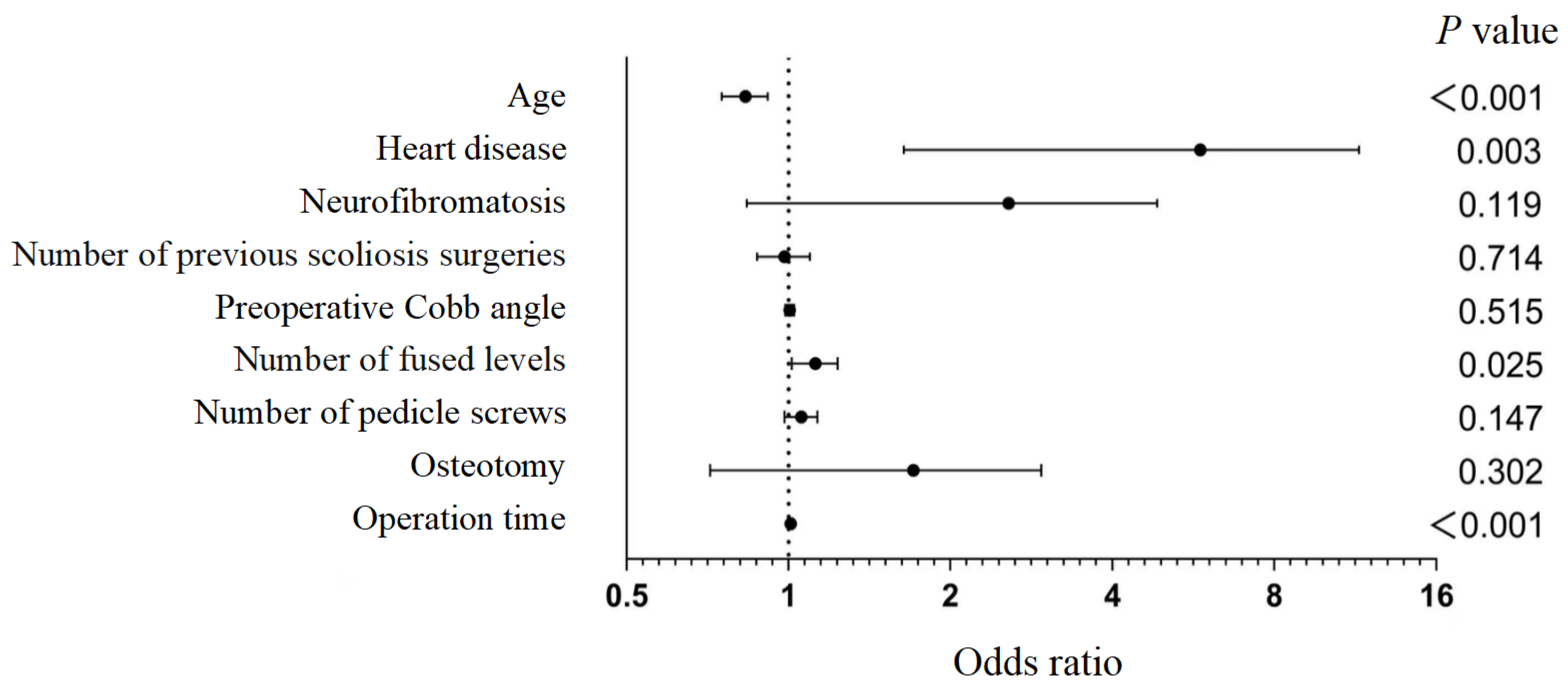
- Younger age, history of heart disease, a greater number of fused levels, and longer operative time are independent risk factors for massive intraoperative blood loss (≥30% of estimated blood volume) in children undergoing posterior spinal instrumentation and fusion for scoliosis.
- •
- Massive intraoperative blood loss is associated with longer postoperative hospital stay and a higher rate of postoperative allogeneic blood transfusion.
- •
- Early identification of high-risk pediatric patients using these factors can guide perioperative blood conservation strategies and optimize anesthetic management to reduce massive bleeding.
- •
- Children with preexisting heart disease require particularly vigilant preoperative cardiopulmonary evaluation and intraoperative monitoring to mitigate the substantially increased risk of massive hemorrhage.
Abstract
1. Introduction
2. Materials and Methods
2.1. Patient Selection
2.2. Surgical and Anesthetic Management
2.3. Data Collection
2.4. Statistical Analysis
3. Results
4. Discussion
5. Conclusions
Author Contributions
Funding
Institutional Review Board Statement
Informed Consent Statement
Data Availability Statement
Acknowledgments
Conflicts of Interest
Abbreviations
| PSIF | posterior spinal instrumentation and fusion |
| EBL | estimated blood loss |
| EBV | estimated blood volume |
| OR | odds ratio |
| CI | confidence interval |
| ASA | American Society of Anesthesiologists |
| HR | heart rate |
| MAP | mean arterial pressure |
| Hb | hemoglobin |
| BMI | body mass index |
| Hct | hematocrit |
| ASD | Atrial septal defect |
| VSD | Ventricular septal defect |
| PDA | Patent Ductus Arteriosus |
| TOF | Tetralogy of Fallot |
| TXA | tranexamic acid |
| ICU | intensive care unit |
| CVP | central venous pressure |
References
- Grant, J.A.; Howard, J.; Luntley, J.; Harder, J.; Aleissa, S.; Parsons, D. Apr-May Perioperative blood transfusion requirements in pediatric scoliosis surgery: The efficacy of tranexamic acid. J. Pediatr. Orthop. 2009, 29, 300–304. [Google Scholar] [CrossRef] [PubMed]
- El-Hawary, R.; Chukwunyerenwa, C. Update on evaluation and treatment of scoliosis. Pediatr. Clin. N. Am. 2014, 61, 1223–1241. [Google Scholar] [CrossRef] [PubMed]
- Addai, D.; Zarkos, J.; Bowey, A.J. Current concepts in the diagnosis and management of adolescent idiopathic scoliosis. Child’s Nerv. Syst. 2020, 36, 1111–1119. [Google Scholar] [CrossRef]
- Miller, D.J.; Cahill, P.J.; Vitale, M.G.; Shah, S.A. Posterior correction techniques for adolescent idiopathic scoliosis. J. Am. Acad. Orthop. Surg. 2020, 28, e363–e373. [Google Scholar] [CrossRef] [PubMed]
- Chen, K.; Wang, L.; Gao, Q.; Masood, U.; Zeng, Z.; Yang, H.; Song, Y. Tranexamic acid can reduce blood loss in adolescent scoliosis surgery: A systematic review and meta-analysis. BMC Musculoskelet. Disord. 2023, 24, 686. [Google Scholar] [CrossRef]
- Yu, X.; Xiao, H.; Wang, R.; Huang, Y. Prediction of massive blood loss in scoliosis surgery from preoperative variables. Spine 2013, 38, 350–355. [Google Scholar] [CrossRef]
- Bartley, C.E.; Yaszay, B.; Bastrom, T.P.; Shah, S.A.; Lonner, B.S.; Asghar, J.; Miyanji, F.; Samdani, A.; Newton, P.O. Perioperative and delayed major complications following surgical treatment of adolescent idiopathic scoliosis. J. Bone Jt. Surg. Am. 2017, 99, 1206–1212. [Google Scholar] [CrossRef]
- Kato, S.; Chikuda, H.; Ohya, J.; Oichi, T.; Matsui, H.; Fushimi, K.; Takeshita, K.; Tanaka, S.; Yasunaga, H. Risk of infectious complications associated with blood transfusion in elective spinal surgery-a propensity score matched analysis. Spine J. 2016, 16, 55–60. [Google Scholar] [CrossRef]
- Kim, H.J.; Park, H.S.; Jang, M.J.; Koh, W.U.; Song, J.-G.; Lee, C.-S.; Yang, H.-S.; Ro, Y.-J. Predicting massive transfusion in adolescent idiopathic scoliosis patients undergoing corrective surgery: Association of preoperative radiographic findings. Medicine 2018, 97, e10972. [Google Scholar] [CrossRef]
- Koerner, J.D.; Patel, A.; Zhao, C.; Schoenberg, C.B.; Mishra, A.; Vives, M.J.; Sabharwal, S. Blood loss during posterior spinal fusion for adolescent idiopathic scoliosis. Spine J. 2014, 39, 1479–1487. [Google Scholar] [CrossRef]
- Li, C.; Yang, M.; Wang, C.; Wang, C.; Fan, J.; Chen, Z.; Wei, X.; Zhang, G.; Bai, Y.; Zhu, X.; et al. Preoperative factors predicting intraoperative blood loss in female patients with adolescent idiopathic scoliosis. Medicine 2015, 94, e359. [Google Scholar] [CrossRef] [PubMed]
- Dong, Y.; Tang, N.; Wang, S.; Zhang, J.; Zhao, H. Risk factors for blood transfusion in adolescent patients with scoliosis undergoing scoliosis surgery: A study of 722 cases in a single center. BMC Musculoskelet. Disord. 2021, 22, 13. [Google Scholar] [CrossRef] [PubMed]
- Morais, S.V.; Araújo, A.M.M.; Sousa, C.C.L. Blood loss control in patients with idiopathic scoliosis undergoing spinal fusion: Prospective evaluation of a cohort. Rev. Bras. Ortop. 2023, 58, e905–e911. [Google Scholar] [CrossRef]
- Soini, V.; Syvänen, J.; Helenius, I.; Helenius, L.; Raitio, A. Perioperative Risk Factors for Bleeding in Adolescents Undergoing Pedicle Screw Instrumentation for Scoliosis. Children 2023, 10, 381. [Google Scholar] [CrossRef]
- Liu, H.; Li, D.; Zhang, X.; Qi, X.; Guo, D.; Bai, Y.; Tian, M. Predictors of perioperative blood loss in primary posterior hemivertebra resection for pediatric patients with congenital scoliosis. J. Pediatr. Orthop. B 2022, 31, 565–571. [Google Scholar] [CrossRef]
- Noe, M.C.; Hagaman, D.; Sipp, B.; Qureshi, F.; Warren, J.R.; Kaji, E.; Sherman, A.; Schwend, R.M. The effect of surgical time on perioperative complications in adolescent idiopathic scoliosis cases. A propensity score analysis. Spine Deform. 2024, 12, 1053–1060. [Google Scholar] [CrossRef]
- Bjure, J.; Grimby, G.; Nachemson, A. Correction of body height in predicting spirometric values in scoliotic patients. Scand. J. Clin. Lab. Investig. 1968, 21, 191–192. [Google Scholar] [CrossRef]
- Tambe, A.D.; Panikkar, S.J.; Millner, P.A.; Tsirikos, A.I. Current concepts in the surgical management of adolescent idiopathic scoliosis. Bone Jt. J. 2018, 100, 415–424. [Google Scholar] [CrossRef]
- Raitio, A.; Heiskanen, S.; Soini, V.; Helenius, L.; Syvänen, J.; Helenius, I. Hidden blood loss and bleeding characteristics in children with congenital scoliosis undergoing spinal osteotomies. Int. Orthop. 2024, 48, 1569–1577. [Google Scholar] [CrossRef]
- Minhas, S.V.; Chow, I.; Bosco, J.; Otsuka, N.Y. Assessing the rates, predictors, and complications of blood transfusion volume in posterior arthrodesis for adolescent idiopathic scoliosis. Spine 2015, 40, 1422–1430. [Google Scholar] [CrossRef]
- Liu, Z.; Zhang, M.; Huo, Q.; Zhu, T. Changes in ET-1, plasma neuropeptide Y, and CGRP in child patients with congenital heart disease complicated with pulmonary hypertension before and after operation. Clin. Pediatr. 2021, 60, 56–63. [Google Scholar] [CrossRef] [PubMed]
- Thompson, M.E.; Kohring, J.M.; McFann, K.; McNair, B.; Hansen, J.K.; Miller, N.H. Predicting excessive hemorrhage in adolescent idiopathic scoliosis patients undergoing posterior spinal instrumentation and fusion. Spine J. 2014, 14, 1392–1398. [Google Scholar] [CrossRef] [PubMed]
- Yoshihara, H.; Yoneoka, D. Predictors of allogeneic blood transfusion in spinal fusion for pediatric patients with idiopathic scoliosis in the United States, 2004–2009. Spine 2014, 39, 1860–1867. [Google Scholar] [CrossRef] [PubMed]
- Tang, C.Y.K.; Kamath, V.H.D.; Cheung, P.W.H.; Cheung, J.P.Y. Predictive factors for intraoperative blood loss in surgery for adolescent idiopathic scoliosis. BMC Musculoskelet. Disord. 2021, 22, 225. [Google Scholar] [CrossRef]
- Li, X.; Ding, W.; Zhao, R.; Yang, S. Risk factors of total blood loss and hidden blood loss in patients with adolescent idiopathic scoliosis: A retrospective study. BioMed Res. Int. 2022, 2022, 9305190. [Google Scholar] [CrossRef]
- Song, J.S.; Sun, J.J.; Sun, Y.E.; Liu, Y.; Gu, X.P.; Ma, Z.L. Risk factors of massive intraoperative blood loss in posterior spinal fusion for adolescent idiopathic scoliosis. Zhonghua Yi Xue Za Zhi 2021, 101, 1002–1008. [Google Scholar] [CrossRef]
- Hassan, N.; Halanski, M.; Wincek, J.; Reischman, D.; Sanfilippo, D.; Rajasekaran, S.; Wells, C.; Tabert, D.; Kurt, B.; Mitchell, D.; et al. Blood management in pediatric spinal deformity surgery: Review of a 2-year experience. Transfusion 2011, 51, 2133–2141. [Google Scholar] [CrossRef]
- Yao, Z.; Li, H.; Zhang, X.; Li, C.; Qi, X. Incidence and risk factors for instrumentation related complications after scoliosis surgery in pediatric patients with NF-1. Spine 2018, 43, 1719–1724. [Google Scholar] [CrossRef]
- Li, Y.; Luo, M.; Wang, W.; Shen, M.; Xu, G.; Gao, J.; Xia, L. A computed tomography-based comparison of abnormal vertebrae pedicles between dystrophic and nondystrophic scoliosis in neurofibromatosis type 1. World Neurosurg. 2017, 106, 898–904. [Google Scholar] [CrossRef]
- Goobie, S.M.; Zurakowski, D.; Glotzbecker, M.P.; McCann, M.E.; Hedequist, D.; Brustowicz, R.M.; Sethna, N.F.; Karlin, L.I.; Emans, J.B.; Hresko, M.T. Tranexamic acid is efficacious at decreasing the rate of blood loss in adolescent scoliosis surgery: A randomized placebo-controlled trial. J. Bone Jt. Surg. Am. 2018, 100, 2024–2032. [Google Scholar] [CrossRef]
- Johnson, D.J.; Johnson, C.C.; Goobie, S.M.; Nami, N.; Wetzler, J.A.; Sponseller, P.D.; Frank, S.M. High-dose versus low-dose tranexamic acid to reduce transfusion requirements in pediatric scoliosis surgery. J. Pediatr. Orthop. 2017, 37, e552–e557. [Google Scholar] [CrossRef]



| Variable | Nonmassive Blood Loss Group (n = 334) | Massive Blood Loss Group (n = 126) | Z/x2 | p |
|---|---|---|---|---|
| Age (years) | 10.0 (5.0–13.0) | 11.0 (8.0–13.0) | 2.9 | 0.003 |
| Sex | 1.4 | 0.242 | ||
| Male | 142 (42.5) | 46 (36.5) | ||
| Female | 192 (57.5) | 80 (63.5) | ||
| Corrected height (cm) | 132.5 (108.0–154.3) | 140.0 (120.8–157.3) | 1.7 | 0.083 |
| Weight (kg) | 27.9 (17.1–45.1) | 33.7 (22.3–42.2) | 0.9 | 0.359 |
| BMI (kg/m2) | 16.2 (14.6–19.0) | 16.1 (14.1–18.6) | −1.3 | 0.194 |
| ASA (n (%)) | 4.4 | 0.221 | ||
| I | 0 (0) | 1 (0.8) | ||
| II | 316 (94.6) | 115 (91.3) | ||
| III | 17 (5.1) | 10 (7.9) | ||
| IV | 1 (0.3) | 0 (0) | ||
| Preoperative Hb (g/L) | 133.0 (126.8–141.0) | 135.0 ± 11.37 | 1.3 | 0.183 |
| Preoperative Hct (%) | 39.7 (37.5–42.4) | 40.5 ± 3.5 | 1.8 | 0.065 |
| Preoperative Cobb angle (°) | 35.0 (26.0–45.0) | 46.0 (35.0–55.0) | 5.1 | <0.001 |
| Heart disease (n, %) | 11 (3.3) | 12 (9.5) | 7.5 | 0.006 |
| ASD | 4 | 5 | ||
| VSD | 5 | 1 | ||
| PDA | 1 | 3 | ||
| TOF | 0 | 1 | ||
| ASD + VSD | 1 | 2 | ||
| Neurofibromatosis (n, %) | 15 (4.5) | 12 (9.5) | 4.2 | 0.041 |
| Number of previous scoliosis surgeries (≥1 time) | 72 (21.6) | 45 (35.7) | 9.7 | 0.002 |
| Surgeon | Nonmassive Blood Loss Group (n = 334) | Massive Blood Loss Group (n = 126) | Total | Massive Blood Loss Rate (%) | Z/x2 | p |
|---|---|---|---|---|---|---|
| Surgeon 1 | 102 | 41 | 143 | 28.7% | ||
| Surgeon 2 | 89 | 35 | 124 | 28.2% | ||
| Surgeon 3 | 143 | 50 | 193 | 25.9% | ||
| Total | 334 | 126 | 460 | 27.4% | 0.357 | 0.837 |
| Variable | Nonmassive Blood Loss Group (n = 334) | Massive Blood Loss Group (n = 126) | Z/x2 | p |
|---|---|---|---|---|
| Operative time (min) | 192.5 (155.0–310.0) | 273.0 (219.0–343.5) | 8.3 | <0.001 |
| Surgery-related | ||||
| Number of fusion segments | 6.0 (4.0–12.0) | 12.0 (6.0–14.0) | 7.3 | <0.001 |
| Number of pedicle screws | 10.0 (6.0–17.0) | 17.0 (10.0–21.3) | 6.4 | <0.001 |
| Osteotomy (n, %) | 138 (41.3) | 86 (68.3) | 26.6 | <0.001 |
| Bleeding volume (mL/kg) | 11.8 (8.4–16.1) | 27.6 (23.4–37.2) | 16.4 | <0.001 |
| Intraoperative infusion of blood products | ||||
| Autologous blood (mL/kg) | 6.0 (4.4–8.0) | 13.9 (11.9–18.6) | 15.7 | <0.001 |
| Allogeneic red blood cells (mL/kg) | 0 (0–0) | 5.6 (0–9.2) | 9.5 | <0.001 |
| Plasma (mL/kg) | 0 (0–0) | 0 (0–5.5) | 8.6 | <0.001 |
| Allogeneic blood transfusion rate (n, %) | 36 (10.8) | 70 (55.6) | 103.4 | <0.001 |
| Tranexamic acid (n, %) | 123 (36.8) | 37 (29.4) | 2.2 | 0.134 |
| Intraoperative urine volume (mL/kg) | 16.1 (11.5–23.8) | 19.1 (12.2–27.4) | 2.9 | 0.003 |
| Variable | Nonmassive Blood Loss Group (n = 334) | Massive Blood Loss Group (n = 126) | Z/x2 | p |
|---|---|---|---|---|
| Postoperative hospital stay (day) | 7.0 (6.0–8.0) | 7.0 (6.0–8.3) | 2.7 | 0.008 |
| Postoperative blood transfusion (n, %) | 4 (1.2) | 9 (7.1) | 11.8 | 0.002 |
| Postoperative complications | ||||
| Subcutaneous effusion (n, %) | 16 (4.8) | 5 (4.0) | 0.1 | 0.706 |
| Pulmonary complications (n, %) | 12 (3.6) | 2 (1.6) | 1.2 | 0.369 |
| Postoperative destination | 5.3 | 0.075 | ||
| Orthopedic ward (n, %) | 334 (100) | 124 (98.4) | ||
| ICU (n, %) | 0 (0) | 2 (1.6) | ||
| Postoperative Hb (g/L) | 117.5 (110.0–124.0) | 114.6 ± 15.7 | 1.3 | 0.183 |
| Postoperative Hct (%) | 34.9 ± 3.7 | 33.8 ± 4.5 | 2.6 | 0.01 |
| Postoperative Cobb angle (°) | 5.0 (3.0–13.0) | 15.0 (5.0–25.0) | 6.0 | <0.001 |
| Major curve correction rate (%) | 82.8 (68.7–91.9) | 68.5 (55.6–83.3) | −5.2 | <0.001 |
| Factors | Univariable Model | Multivariable Model | ||||||
|---|---|---|---|---|---|---|---|---|
| B | OR | 95% CI | p | B | OR | 95% CI | p | |
| Age (years) | 0.082 | 1.086 | 1.043–1.143 | 0.02 | −0.188 | 0.829 | 0.751–0.914 | <0.001 |
| Heart disease (n, %) | 1.128 | 3.091 | 1.327–7.199 | 0.009 | 1.468 | 4.338 | 1.637–11.498 | 0.003 |
| Neurofibromatosis (n, %) | 0.806 | 2.239 | 1.017–4.926 | 0.045 | 0.699 | 2.012 | 0.836–4.843 | 0.119 |
| Preoperative Cobb angle (°) | 0.027 | 1.027 | 1.015–1.040 | <0.001 | −0.021 | 1.005 | 0.990–1.020 | 0.515 |
| Number of previous scoliosis surgeries (≥1 time) | 0.092 | 1.096 | 1.003–1.198 | 0.043 | 0.005 | 0.979 | 0.874–1.096 | 0.714 |
| Number of fused levels | 0.180 | 1.198 | 1.138–1.261 | <0.001 | 0.112 | 1.118 | 1.014–1.233 | 0.025 |
| Number of pedicle screws | 0.103 | 1.109 | 1.074–1.144 | <0.001 | 0.053 | 1.054 | 0.982–1.132 | 0.147 |
| Osteotomy (n, %) | 1.116 | 3.054 | 1.979–4.712 | <0.001 | 0.373 | 1.452 | 0.715–2.950 | 0.302 |
| Operative time | 1.010 | 1.010 | 1.007–1.012 | <0.001 | 0.008 | 1.008 | 1.005–1.012 | <0.001 |
Disclaimer/Publisher’s Note: The statements, opinions and data contained in all publications are solely those of the individual author(s) and contributor(s) and not of MDPI and/or the editor(s). MDPI and/or the editor(s) disclaim responsibility for any injury to people or property resulting from any ideas, methods, instructions or products referred to in the content. |
© 2026 by the authors. Licensee MDPI, Basel, Switzerland. This article is an open access article distributed under the terms and conditions of the Creative Commons Attribution (CC BY) license.
Share and Cite
Zhang, S.; Gao, Z.; Hu, J.; Ren, Y.; Cui, X.; Li, L.; Zhang, J.; Wang, F. Risk Factors for Massive Intraoperative Blood Loss During Posterior Spinal Instrumentation and Fusion in Children: A Retrospective Cohort Study. Children 2026, 13, 671. https://doi.org/10.3390/children13050671
Zhang S, Gao Z, Hu J, Ren Y, Cui X, Li L, Zhang J, Wang F. Risk Factors for Massive Intraoperative Blood Loss During Posterior Spinal Instrumentation and Fusion in Children: A Retrospective Cohort Study. Children. 2026; 13(5):671. https://doi.org/10.3390/children13050671
Chicago/Turabian StyleZhang, Shanshan, Zhengzheng Gao, Jing Hu, Yi Ren, Xiaohuan Cui, Lijing Li, Jianmin Zhang, and Fang Wang. 2026. "Risk Factors for Massive Intraoperative Blood Loss During Posterior Spinal Instrumentation and Fusion in Children: A Retrospective Cohort Study" Children 13, no. 5: 671. https://doi.org/10.3390/children13050671
APA StyleZhang, S., Gao, Z., Hu, J., Ren, Y., Cui, X., Li, L., Zhang, J., & Wang, F. (2026). Risk Factors for Massive Intraoperative Blood Loss During Posterior Spinal Instrumentation and Fusion in Children: A Retrospective Cohort Study. Children, 13(5), 671. https://doi.org/10.3390/children13050671