Factors Influencing Asthma in Children at Early Childhood Development Centres in a Densely Populated Urban Informal Township in Gauteng Province, South Africa

Highlights
- The prevalence of asthma is high among children 5 years or younger in urban informal settlements.
- The occurrence of asthma and wheeze is influenced by individual and environmental risk factors among children 5 years or younger in urban informal settlements.
- There is a need for a holistic approach to addressing preventable factors influencing the prevalence of asthma.
Abstract
1. Introduction
2. Materials and Methods
2.1. Study Design and Setting
2.2. Study Population, Selection Criteria, and Sampling
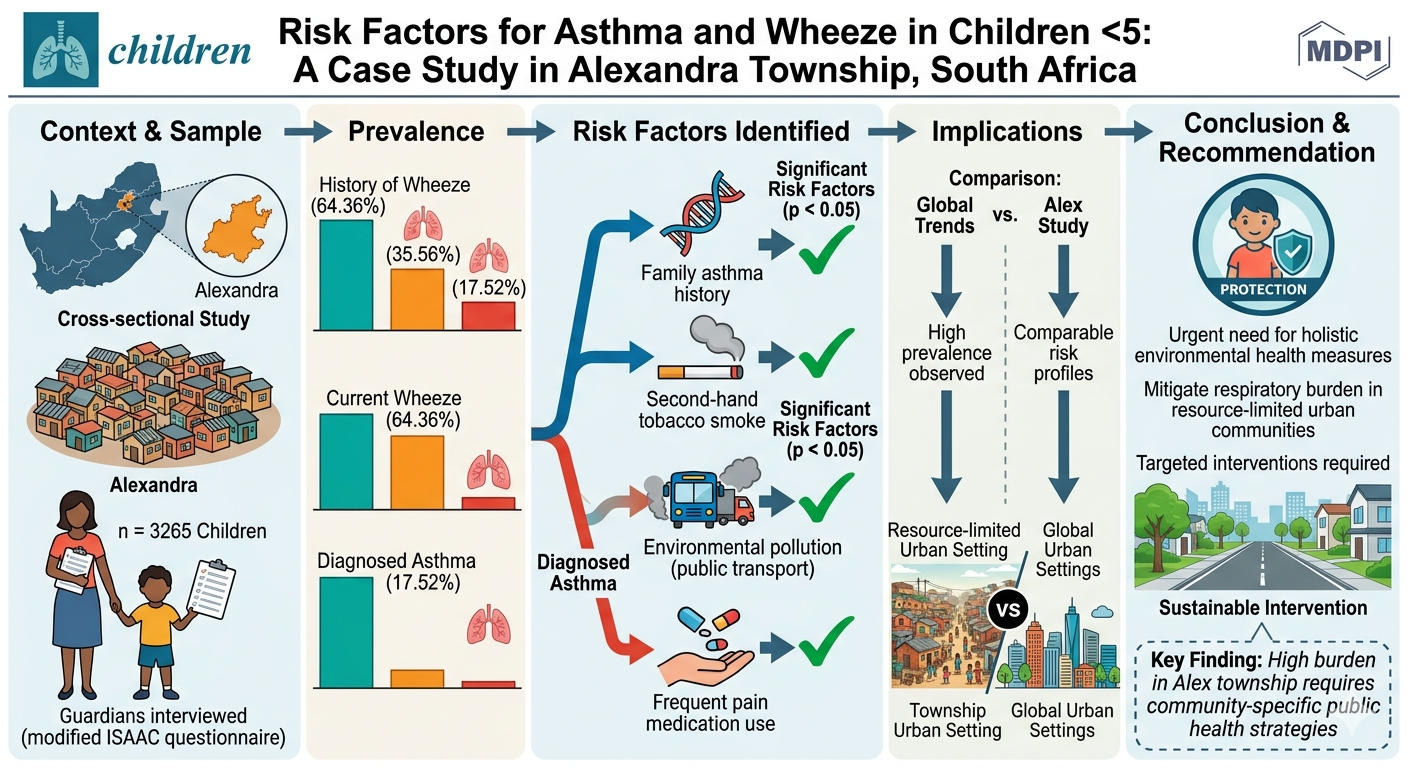
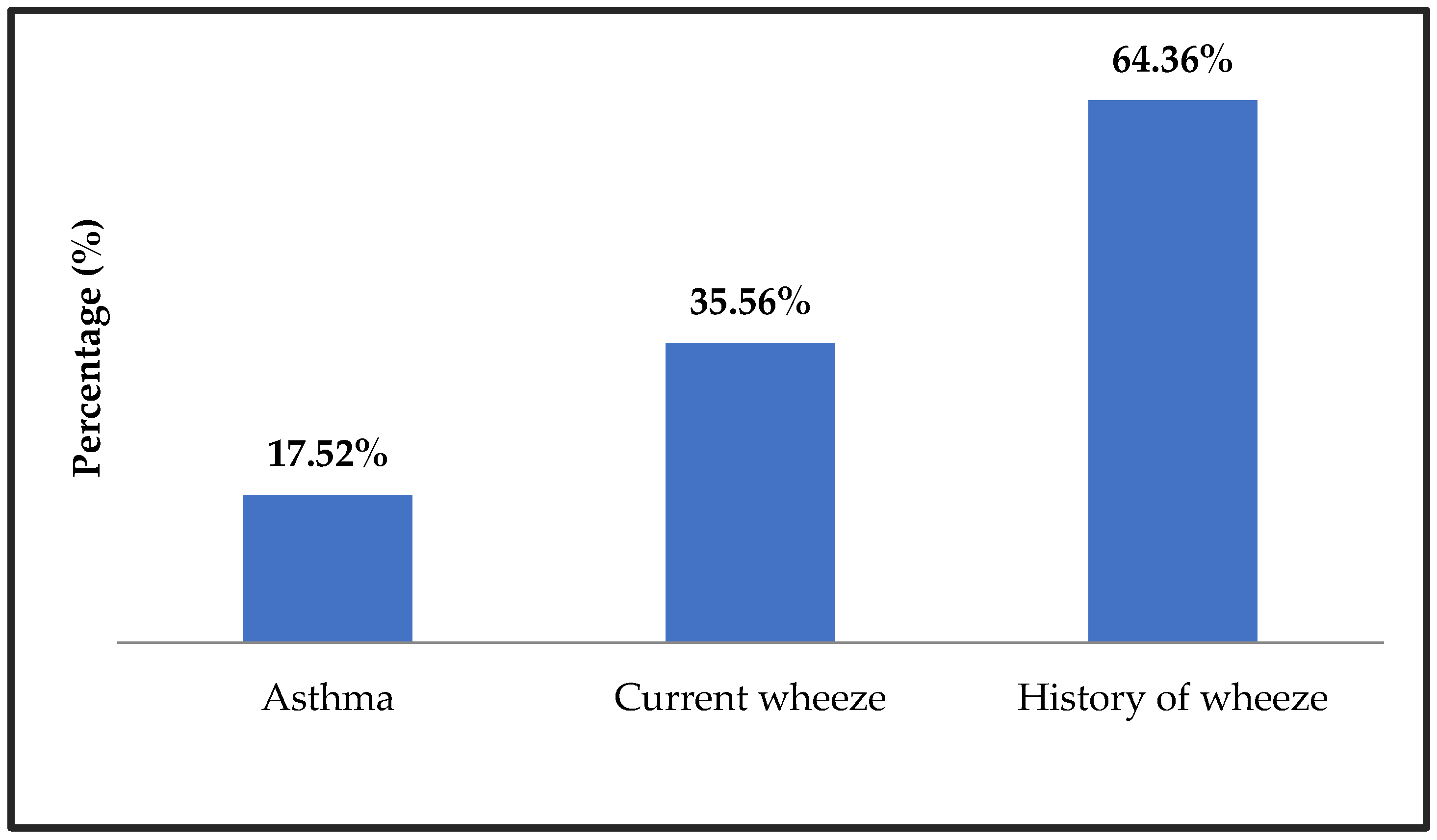
2.3. Prevalence of Asthma and Wheeze (Current and Historical)
- The outcome “asthma” was defined as a positive response to the question “Has your child ever had asthma?”
- The outcome “current wheeze” was defined as a positive response to the question “Has your child experienced wheezing, or whistling in the chest, in the past 12 months?”
- The outcome “history of wheeze” was defined as a positive response to the question “Has your child ever experienced wheezing, or whistling in the chest, any time in the past?” (The current wheeze and history of wheeze are the same for children aged 0 to 12 months).
2.4. Study Risk (Household and Environmental) Factors
2.5. Data Management and Analysis
3. Results
3.1. Participants’ Socio-Demographic Characteristics
3.2. Prevalence Rates for Asthma
3.3. Household and Environmental Risk Factors
3.4. Association Between Asthma Prevalence and Socio-Demographics and Risk Factors
3.4.1. Bivariate Relationship Between Asthma, Current Wheeze, and History of Wheeze and Socio-Demographics and Risk Factors
3.4.2. Factors Associated with Asthma, Current Wheeze, and History of Wheeze
4. Discussion
4.1. Prevalence of Asthma and Associated Risk Factors in the Study
4.2. Prevalence of Current Wheeze and History of Wheeze and Associated Risk Factors in the Study
4.3. Strengths and Limitations
5. Conclusions
Author Contributions
Funding
Institutional Review Board Statement
Informed Consent Statement
Data Availability Statement
Conflicts of Interest
References
- Papadopoulos, N.G.; Bacharier, L.B.; Jackson, D.J.; Deschildre, A.; Phipatanakul, W.; Szefler, S.J.; Gall, R.; Ledanois, O.; Jacob-Nara, J.A.; Sacks, H. Type 2 Inflammation and Asthma in Children: A Narrative Review. J. Allergy Clin. Immunol. Pract. 2024, 12, 2310–2324. [Google Scholar] [CrossRef]
- Qaid, E.Y.A.; Long, I. Asthma unravelled: A comprehensive review of epidemiology, phenotypes, pathophysiology, and emerging therapies. Egypt. J. Bronchol. 2025, 19, 82. [Google Scholar] [CrossRef]
- Masekela, R.; Risenga, S.M.; Kitchin, O.P.; White, D.A.; Davis, G.; Goussard, P.; Manjra, A.I.; Kritzinger, F.E.; Levin, M.; Zar, H.; et al. The diagnosis of asthma in children: An evidence-based approach to a common clinical dilemma. S. Afr. Med. J. 2018, 108, 540. [Google Scholar] [CrossRef]
- Kortianou, E.A.; Isakoglou, M.; Dalamarinis, P.; Alevizos, D.; Mavronasou, A.; Sapouna, V. The Social Aspect of Children and Adolescents with Chronic Respiratory Diseases. Encyclopedia 2025, 5, 90. [Google Scholar] [CrossRef]
- Faniyi, A.A.; Okesanya, O.J.; Nukpezah, R.N.; Ibiwoye, D.O.; Eshun, G.; Adigun, O.A.; Okon, I.I.; Ukoaka, B.M.; Olabode, O.N.; Eliseo, D.L.-P. Addressing the asthma crisis in Africa: Challenges, strategies, and recommendations for improved management. Egypt. J. Intern. Med. 2024, 36, 76. [Google Scholar] [CrossRef]
- Oh, J.; Kim, S.; Kim, M.S.; Abate, Y.H.; Abd ElHafeez, S.; Abdelkader, A.; Abdi, P.; Abdulah, D.M.; Aboagye, R.G.; Abolhassani, H.; et al. Global, regional, and national burden of asthma and atopic dermatitis, 1990–2021, and projections to 2050: A systematic analysis of the Global Burden of Disease Study 2021. Lancet Respir. Med. 2025, 13, 425–446. [Google Scholar] [CrossRef]
- Oyenuga, V.O.; Mosler, G.; Addo-Yobo, E.; Adeyeye, O.O.; Arhin, B.; Fortune, F.; Griffiths, C.J.; Kasekete, M.; Mkutumula, E.; Mphahlele, R.; et al. Asthma symptoms, severity, and control with and without a clinical diagnosis of asthma in early adolescence in sub-Saharan Africa: A multi-country, school-based, cross-sectional study. Lancet Child. Adolesc. Health 2024, 8, 859–871. [Google Scholar] [CrossRef]
- Vázquez-Rodríguez, C.F.; Vázquez-Rodríguez, E.M.; Vázquez-Nava, F.; Ortega-Betancourt, N.V.; Castillo-Ruiz, O.; Alemán-Castillo, S.J.; Garcia, J.A. Unhealthy habits and comorbidities associated with uncontrolled asthma in young people. J. Asthma 2024, 61, 1655–1662. [Google Scholar] [CrossRef]
- Boutros, P.; Kassem, N.; Boudo, V.; Sié, A.; Munga, S.; Maggioni, M.A.; Golec, M.; Simion, R.; Bärnighausen, T.; Winkler, V.; et al. Understanding the Risk Factors, Burden, and Interventions for Chronic Respiratory Diseases in Low- and Middle-Income Countries: A Scoping Review. Public Health Rev. 2024, 45, 1607339. [Google Scholar] [CrossRef]
- Mphahlele, R.E.M.; Masekela, R. A historical overview of childhood asthma in southern Africa: Are we there yet? Afr. J. Thorac. Crit. Care Med. 2021, 24, 163–167. [Google Scholar] [CrossRef]
- Zhou, W.; Tang, J. Prevalence and risk factors for childhood asthma: A systematic review and meta-analysis. BMC Pediatr. 2025, 25, 50. [Google Scholar] [CrossRef]
- González-de Paz, L.; Valdesoiro-Navarrete, L.; Roma, J.; Blat-Guimerà, E.; Benavent-Areu, J.; Bartra, J.; Sisó-Almirall, A. Prevalence and Impact of Asthma and Allergy on Daily Life, Health Outcomes and Use of Healthcare Services in Children: A Population-Based Study. Arch. Bronconeumol. 2023, 59, 481–487. [Google Scholar] [CrossRef]
- Chong Neto, H.J.; Rosário, N.A.; Solé, D. Asthma and Rhinitis in South America: How Different They are From Other Parts of the World. Allergy Asthma Immunol. Res. 2012, 4, 62. [Google Scholar] [CrossRef]
- Adeloye, D.; Chan, K.Y.; Rudan, I.; Campbell, H. An estimate of asthma prevalence in Africa: A systematic analysis. Croat. Med. J. 2013, 54, 519–531. [Google Scholar] [CrossRef] [PubMed]
- Liu, J.; Perret, J.L.; Lodge, C.J.; Vicendese, D.; Bowatte, G.; Lowe, A.J.; Idrose, N.S.; Frith, P.; Wood-Baker, R.; Mishra, G.D.; et al. Paternal prepubertal passive smoke exposure is related to impaired lung function trajectories from childhood to middle age in their offspring. Thorax 2025, 81, 131–139. [Google Scholar] [CrossRef] [PubMed]
- Ciaccio, C.E.; DiDonna, A.; Kennedy, K.; Barnes, C.S.; Portnoy, J.M.; Rosenwasser, L.J. Secondhand tobacco smoke exposure in low-income children and its association with asthma. Allergy Asthma Proc. 2014, 35, 462–466. [Google Scholar] [CrossRef] [PubMed]
- Mudau, R.; Voyi, K.; Shirinde, J. Prevalence of Wheezing and Its Association with Environmental Tobacco Smoke Exposure among Rural and Urban Preschool Children in Mpumalanga Province, South Africa. Int. J. Environ. Res. Public Health 2024, 21, 469. [Google Scholar] [CrossRef]
- Masuku, B. Questioning governance of urban informality: A study of township economy in Alexandra, Johannesburg. J. Foresight Thought Leadersh. 2023, 2, 14. [Google Scholar] [CrossRef]
- Ochoa-Avilés, C.; Morillo, D.; Rodriguez, A.; Cooper, P.J.; Andrade, S.; Molina, M.; Parra, M.; Parra-Ullauri, A.; Mejía, D.; Neira, A.; et al. Prevalence and risk factors for asthma, rhinitis, eczema, and atopy among preschool children in an Andean city. PLoS ONE 2020, 15, e0234633. [Google Scholar] [CrossRef] [PubMed]
- Yusuf, R.A.; Rathebe, P.C.; Mbonane, T.P. Association between Environmental Exposures and Asthma among Children in King Williams Town, South Africa. Diseases 2022, 10, 123. [Google Scholar] [CrossRef] [PubMed]
- Kekana, H.N.; Ruhiiga, T.M.; Ndou, N.N.; Palamuleni, L.G. Environmental justice in South Africa: The dilemma of informal settlement residents. GeoJournal 2023, 88, 3709–3725. [Google Scholar] [CrossRef] [PubMed]
- Khan, M.H. Urban health in megacities of developing countries. Public Health Forum 2012, 20, 29–30. [Google Scholar] [CrossRef]
- Marutlulle, N.K. A critical analysis of housing inadequacy in South Africa and its ramifications. Afr. Public Serv. Deliv. Perform. Rev. 2021, 9, 16. [Google Scholar] [CrossRef]
- Morales Suárez-Varela, M.; García-Marcos, L.; Kogan, M.D.; Llopis González, A.; Martínez Gimeno, A.; Ontoso, I.A.; IDíaz, C.G.; Peña, A.A.; Aurrecoechea, B.D.; Monge, R.B.; et al. Parents’ smoking habit and prevalence of atopic eczema in 6-7 and 13-14 year-old schoolchildren in Spain. ISAAC phase III. Allergol. Immunopathol. 2008, 36, 336–342. [Google Scholar] [CrossRef] [PubMed]
- Thompson, V.; Shirinde, J.; Masekameni, M.D.; Mbonane, T.P. A Study Protocol to Assess the Association Between Ambient Air Pollution and Asthma and Other Respiratory Health Outcomes Amongst Children Below 5 Years of Age in Alexandra Township’s Early Childhood Development Centers, Johannesburg. Methods Protoc. 2025, 8, 84. [Google Scholar] [CrossRef]
- International Study of Asthma and Allergies in Childhood. International Study Manual of Asthma and Allergies. Report. Available online: https://doc.ukdataservice.ac.uk/doc/8131/mrdoc/pdf/8131_isaac1_manual.pdf (accessed on 27 March 2024).
- Pearce, N.; Ait-Khaled, N.; Beasley, R.; Mallol, J.; Keil, U.; Mitchell, E.; Robertson, C. Worldwide trends in the prevalence of asthma symptoms: Phase III of the International Study of Asthma and Allergies in Childhood (ISAAC). Thorax 2007, 62, 758–766. [Google Scholar] [CrossRef]
- Asher; Weiland. The International Study of Asthma and Allergies in Childhood (ISAAC). Clin. Exp. Allergy 1998, 28, 52–66. [Google Scholar] [CrossRef]
- Mudau, R.; Voyi, K.; Shirinde, J. Prevalence of asthma and wheeze among preschool and school-aged children in Africa: A meta-analysis. Public Health Chall. 2024, 3, e199. [Google Scholar] [CrossRef]
- Chang, A.B.; Fortescue, R.; Grimwood, K.; Alexopoulou, E.; Bell, L.; Boyd, J.; Bush, A.; Chalmers, J.D.; Hill, A.T.; Karadag, B.; et al. European Respiratory Society guidelines for the management of children and adolescents with bronchiectasis. Eur. Respir. J. 2021, 58, 2002990. [Google Scholar] [CrossRef]
- Ren, J.; Xu, J.; Zhang, P.; Bao, Y. Prevalence and Risk Factors of Asthma in Preschool Children in Shanghai, China: A Cross-Sectional Study. Front. Pediatr. 2022, 9, 793452. [Google Scholar] [CrossRef]
- Alfonso, J.; Pérez, S.; Bou, R.; Amat, A.; Ruiz, I.; Mora, A.; Escolano, S.; Chofre, L. Asthma prevalence and risk factors in school children: The RESPIR longitudinal study. Allergol. Immunopathol. 2020, 48, 223–231. [Google Scholar] [CrossRef] [PubMed]
- Brożek, G.; Nowak, B.; Prendergast, C.; Gil, A.; Nakiela, P.; Skoczyński, S.; Barański, K.; Swinarew, A.; Lawson, J. Thirty year trends in childhood asthma and allergic conditions in Poland. Respir. Med. 2025, 248, 108379. [Google Scholar] [CrossRef] [PubMed]
- Lotfata, A.; Moosazadeh, M.; Helbich, M.; Hoseini, B. Socioeconomic and environmental determinants of asthma prevalence: A cross-sectional study at the U.S. County level using geographically weighted random forests. Int. J. Health Geogr. 2023, 22, 18. [Google Scholar] [CrossRef] [PubMed]
- Taherian, M.R.; Fatemian, F.; Halimi, A.; Soleimani, Y.; Jorjani, G.; Nozari, P.; Jarrahi, A.M.; Nazari, S.S.H.; Al-Yateem, N.; Al-Marzouqi, A.; et al. Prevalence of asthma among children and adolescents in WHO’s Eastern Mediterranean Region: A meta-analysis of over 0.5 million participants. BMC Public Health 2024, 24, 2148. [Google Scholar] [CrossRef]
- Ferrante, G.; La Grutta, S. The Burden of Pediatric Asthma. Front. Pediatr. 2018, 6, 186. [Google Scholar] [CrossRef]
- Naeem, A.; Silveyra, P. Sex Differences in Paediatric and Adult Asthma. Eur. Med. J. 2019, 4, 27–35. [Google Scholar] [CrossRef] [PubMed]
- Idris, I.B.; Ghazi, H.F.; Zhie, K.H.; Khairuman, K.A.; Yahya, S.K.; Abd Zaim, F.A.; Nam, C.W.; Rasid, H.Z.A.; Isa, Z.M. Environmental Air Pollutants as Risk Factors for Asthma Among Children Seen in Pediatric Clinics in UKMMC, Kuala Lumpur. Ann. Glob. Health 2016, 82, 202. [Google Scholar] [CrossRef]
- Romero-Mesones, C.; Ojanguren, I.; Espejo, D.; Granados, G.; González-Barcala, F.J.; Cruz, M.J.; Muñoz, X. Influence of the environment on the characteristics of asthma. Sci. Rep. 2022, 12, 20522. [Google Scholar] [CrossRef]
- Madaniyazi, L.; Xerxes, S. Outdoor air pollution and the onset and exacerbation of asthma. Chronic Dis. Transl. Med. 2021, 7, 100–106. [Google Scholar] [CrossRef]
- Breysse, P.N.; Diette, G.B.; Matsui, E.C.; Butz, A.M.; Hansel, N.N.; McCormack, M.C. Indoor Air Pollution and Asthma in Children. Proc. Am. Thorac. Soc. 2010, 7, 102–106. [Google Scholar] [CrossRef]
- Pecoraro, L.; Lanzilotti, A.G.; De Musso, M.; Di Muri, E.; Tramacere, F.; Altavilla, E.; Indrio, F. The Role of Environmental Exposures in Pediatric Asthma Pathogenesis: A Contemporary Narrative Review. Children 2025, 12, 1327. [Google Scholar] [CrossRef]
- Gasana, J.; Dillikar, D.; Mendy, A.; Forno, E.; Ramos Vieira, E. Motor vehicle air pollution and asthma in children: A meta-analysis. Environ. Res. 2012, 117, 36–45. [Google Scholar] [CrossRef] [PubMed]
- Tenero, L.; Tezza, G.; Cattazzo, E.; Piacentini, G. Wheezing in preschool children. Early Hum. Dev. 2013, 89, S13–S17. [Google Scholar] [CrossRef] [PubMed]
- Al-Shamrani, A.; Bagais, K.; Alenazi, A.; Alqwaiee, M.; Al-Harbi, A.S. Wheezing in children. Int. J. Pediatr. Adolesc. Med. 2019, 6, 68–73. [Google Scholar] [CrossRef]
- Geng, L.; Tang, X.; Hua, L.; Liu, H.; Ren, S.; Zhong, W.; Zhang, J. The analysis of risk factors for recurrent wheezing in infants and clinical intervention. Transl. Pediatr. 2023, 12, 1810–1822. [Google Scholar] [CrossRef] [PubMed]
- Al Omari, S.; Taybeh, E.; Abutaima, R.; Sawan, H.; Alsaraireh, M. Understanding and Managing Viral-Induced Wheezing in Children: The Role of Parental Knowledge. J. Asthma Allergy 2025, 18, 1585–1597. [Google Scholar] [CrossRef]
- Michel, G.; Silverman, M.; Strippoli, M.P.F.; Zwahlen, M.; Brooke, A.M.; Grigg, J.; Kuehni, C.E. Parental understanding of wheeze and its impact on asthma prevalence estimates. Eur. Respir. J. 2006, 28, 1124–1130. [Google Scholar] [CrossRef]
- Bolat, E.; Arikoglu, T.; Sungur, M.A.; Batmaz, S.B.; Kuyucu, S. Prevalence and risk factors for wheezing and allergic diseases in preschool children: A perspective from the Mediterranean coast of Turkey. Allergol. Immunopathol. 2017, 45, 362–368. [Google Scholar] [CrossRef]


| Socio-Demographics | Frequency (n) | Percent (%) |
|---|---|---|
| Gender | ||
| Males | 1538 | 47% |
| Females | 1727 | 53% |
| Age | ||
| 12 months or younger | 303 | 9.3% |
| 13–36 months | 1478 | 45.3% |
| 37 months or older | 1484 | 45.5% |
| Duration of residence in township | ||
| Less than 1 year | 1394 | 42.7% |
| 1 to 3 years | 630 | 19.3% |
| 3 years or longer | 1240 | 38% |
| Family history of asthma | ||
| No | 1907 | 58.4% |
| Yes | 1358 | 41.6% |
| Mother/female guardian smoking | ||
| Yes | 410 | 12.6% |
| No | 2855 | 87.4% |
| Father/male guardian smoking | ||
| Yes | 760 | 23.3% |
| No | 2505 | 76.7% |
| Use of pain medication | ||
| Never | 2628 | 80.5% |
| Occasionally | 263 | 8.1% |
| Frequently | 374 | 11.5% |
| Risk Factor | Frequency (n) | Percentage (%) |
|---|---|---|
| Running water | ||
| Yes | 1878 | 57.5% |
| No | 1387 | 42.5% |
| Fuels used for cooking | ||
| Dirty fuels | 438 | 13.4% |
| Clean fuels | 2827 | 86.6% |
| Fuels used for heating | ||
| Dirty fuels | 271 | 8.3% |
| Clean fuels | 2994 | 91.7% |
| Cat | ||
| Yes | 444 | 13.6% |
| No | 2821 | 86.4% |
| Dog | ||
| Yes | 452 | 13.8% |
| No | 2813 | 86.2% |
| Public transport | ||
| Never | 1478 | 45.3% |
| Seldom | 830 | 25.4% |
| Frequently throughout the day | 624 | 19.1% |
| Almost all day | 333 | 10.2% |
| Exposure to second-hand tobacco smoke | ||
| Yes | 870 | 26.6% |
| No | 2395 | 73.4% |
| Socio-Demographics | Asthma | Current Wheeze | History of Wheeze | ||||
|---|---|---|---|---|---|---|---|
| COR | p-Value ** | COR | p-Value | COR | p-Value | ||
| Gender | Male | Ref | |||||
| Female | 0.931 | 0.426 | 1.105 | 0.169 | 0.837 | 0.018 * | |
| Age | 12 months or younger | Ref | |||||
| 13–36 months | 1.394 | 0.059 | 1.486 | 0.003 * | 0.460 | <0.001 * | |
| 37 months or older | 1.436 | 0.039 * | 0.949 | 0.694 | 0.419 | <0.001 * | |
| Duration of residence in township | Less than 1 year | Ref | |||||
| 1 to 3 years | 0.930 | 0.554 | 0.586 | <0.001 * | 1.080 | 0.467 | |
| 3 years or longer | 0.962 | 0.699 | 0.447 | <0.001 * | 0.750 | 0.001 * | |
| Family history of asthma | No | Ref | |||||
| Yes | 2.748 | <0.001 * | 2.400 | <0.001 * | 2.606 | <0.001 * | |
| Mother/female guardian smoking | No | Ref | |||||
| Yes | 2.315 | <0.001 * | 1.753 | <0.001 * | 1.090 | 0.448 | |
| Father/male guardian smoking | No | Ref | |||||
| Yes | 2.346 | <0.000 * | 1.429 | 0.000 * | 1.047 | 0.602 | |
| Use of pain medication | Never | Ref | |||||
| Occasionally | 2.055 | <0.001 * | 0.467 | <0.001 * | 0.388 | <0.001 * | |
| Frequently | 2.883 | <0.001 * | 0.144 | <0.001 * | 1.438 | 0.004 * | |
| Running water | No | Ref | |||||
| Yes | 1.136 | 0.161 | 0.597 | <0.001 * | 0.332 | <0.001 * | |
| Cooking fuels | Clean fuels | Ref | |||||
| Dirty fuels | 1.016 | 0.906 | 3.939 | <0.001 * | 0.771 | 0.023 * | |
| Heating fuels | Clean fuels | Ref | |||||
| Dirty fuels | 0.718 | 0.027 * | 2.243 | <0.001 * | 1.087 | 0.533 | |
| Cat | No | Ref | |||||
| Yes | 1.728 | <0.001 * | 0.916 | 0.406 | 1.512 | <0.001 * | |
| Dog | No | Ref | |||||
| Yes | 1.502 | 0.001 * | 1.118 | 0.308 | 1.451 | <0.001 * | |
| Public transport | Never | Ref | |||||
| Seldom | 0.778 | 0.025 * | 0.523 | <0.001 * | 1.098 | 0.317 | |
| Frequently throughout the day | 0.679 | 0.003 * | 0.520 | <0.001 * | 1.055 | 0.599 | |
| Almost all day | 0.941 | 0.6688 | 0.304 | <0.001 * | 0.770 | 0.307 | |
| Exposure to second-hand tobacco smoke | No | Ref | |||||
| Yes | 2.468 | <0.001 * | 1.397 | <0.001 * | 1.057 | 0.511 | |
| Socio-Demographics | Asthma | Current Wheeze | History of Wheeze | ||||
|---|---|---|---|---|---|---|---|
| AOR | p-Value ** | AOR | p-Value | AOR | p-Value | ||
| Gender | Male | Ref | |||||
| Female | 1.008 | 0.931 | 1.133 | 0.114 | 0.866 | 0.066 | |
| Age | 12 months or younger | Ref | |||||
| 13–36 months | 1.269 | 0.217 | 1.361 | 0.034 * | 0.485 | <0.001 * | |
| 37 months or older | 1.295 | 0.200 | 1.218 | 0.199 | 0.456 | <0.001 * | |
| Duration of residence in township | Less than 1 year | Ref | |||||
| 1 to 3 years | 0.989 | 0.941 | 0.863 | 0.199 | 0.940 | 0.601 | |
| 3 years or longer | 1.027 | 0.844 | 1.707 | 0.002 * | 1.757 | 0.011 * | |
| Family history of asthma | No | Ref | |||||
| Yes | 2.745 | <0.001 * | 1.437 | <0.001 * | 2.450 | <0.001 * | |
| Mother/female guardian smoking | No | Ref | |||||
| Yes | 1.186 | 0.329 | 1.849 | <0.001 * | 0.871 | 0.418 | |
| Father/male guardian smoking | No | Ref | |||||
| Yes | 1.200 | 0.469 | 1.825 | 0.014 * | 1.084 | 0.749 | |
| Use of pain medication | Never | Ref | |||||
| Occasionally | 3.135 | <0.001 * | 0.561 | <0.001 * | 1.467 | 0.067 | |
| Frequently | 2.974 | <0.001 * | 0.243 | <0.001 * | 1.102 | 0.486 | |
| Running water | No | Ref | |||||
| Yes | 1.118 | 0.259 | 0.678 | <0.001 * | 1.252 | <0.001 * | |
| Cooking fuels | Dirty fuels | Ref | |||||
| Clean fuels | 1.563 | 0.500 | 2.126 | 0.074 | 0.900 | 0.420 | |
| Heating fuels | Dirty fuels | Ref | |||||
| Clean fuels | 0.962 | 0.168 | 1.370 | 0.065 | 1.064 | 0.683 | |
| Cat | No | Ref | |||||
| Yes | 1.150 | 0.297 | 1.689 | 0.004 * | 1.389 | 0.011 * | |
| Dog | No | Ref | |||||
| Yes | 0.962 | 0.787 | 1.045 | 0.722 | 1.030 | 0.814 | |
| Public transport | Never | Ref | |||||
| Seldom | 1.672 | 0.004 * | 1.704 | 0.001 * | 1.96 | 0.964 | |
| Frequently throughout the day | 0.467 | 0.278 | 0.976 | 0.843 | 1.032 | 0.811 | |
| Almost all day | 0.143 | 0.251 | 0.457 | 0.211 | 1.060 | 0.799 | |
| Exposure to second-hand tobacco smoke | No | Ref | |||||
| Yes | 1.880 | 0.025 * | 1.672 | 0.142 | 1.873 | 0.509 | |
Disclaimer/Publisher’s Note: The statements, opinions and data contained in all publications are solely those of the individual author(s) and contributor(s) and not of MDPI and/or the editor(s). MDPI and/or the editor(s) disclaim responsibility for any injury to people or property resulting from any ideas, methods, instructions or products referred to in the content. |
© 2026 by the authors. Licensee MDPI, Basel, Switzerland. This article is an open access article distributed under the terms and conditions of the Creative Commons Attribution (CC BY) license.
Share and Cite
Thompson, V.; Shirinde, J.; Masekameni, M.D.; Mbonane, T.P. Factors Influencing Asthma in Children at Early Childhood Development Centres in a Densely Populated Urban Informal Township in Gauteng Province, South Africa. Children 2026, 13, 627. https://doi.org/10.3390/children13050627
Thompson V, Shirinde J, Masekameni MD, Mbonane TP. Factors Influencing Asthma in Children at Early Childhood Development Centres in a Densely Populated Urban Informal Township in Gauteng Province, South Africa. Children. 2026; 13(5):627. https://doi.org/10.3390/children13050627
Chicago/Turabian StyleThompson, Velisha, Joyce Shirinde, Masilu D. Masekameni, and Thokozani P. Mbonane. 2026. "Factors Influencing Asthma in Children at Early Childhood Development Centres in a Densely Populated Urban Informal Township in Gauteng Province, South Africa" Children 13, no. 5: 627. https://doi.org/10.3390/children13050627
APA StyleThompson, V., Shirinde, J., Masekameni, M. D., & Mbonane, T. P. (2026). Factors Influencing Asthma in Children at Early Childhood Development Centres in a Densely Populated Urban Informal Township in Gauteng Province, South Africa. Children, 13(5), 627. https://doi.org/10.3390/children13050627