

Quality of Life in Children with Developmental Language Disorder

 , , ,
, , ,
Highlights
- The quality of life of children with DLD is below that of their typically developing peers at 4 and 9 years.
- Emotional well-being is particularly vulnerable in children with DLD.
- Quality of life could be an additional outcome to monitor in children with DLD.
- Early peer problems are a potential indicator of reduced quality of life.
Abstract
1. Introduction
1.1. Quality of Life in DLD
1.2. Factors Associated with QoL in Children with DLD
1.3. The Present Study
- How does QoL change in children with DLD between 4 and 9 years?
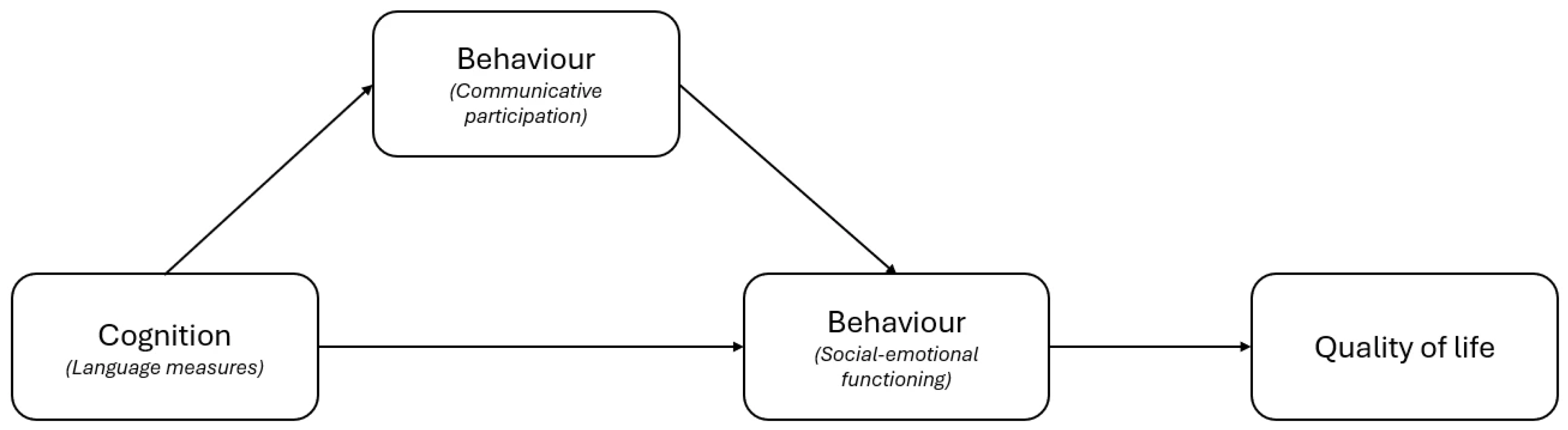
- What is the role of cognitive, behavioural, and/or environmental factors in the change in QoL between 4 and 9 years in this group?
2. Methods & Materials
2.1. Participants
- Parents indicated DLD was diagnosed after children left the early intervention group; or,
- Children attended special education for DLD after leaving the intervention group (In the Netherlands, children are only eligible to attend special education for DLD when they meet the criteria for DLD.)
2.2. Measures
2.2.1. Quality of Life
2.2.2. Language Ability
2.2.3. Communicative Participation (CP)
2.2.4. Peer and Emotional Problems
2.3. Procedures
2.4. Statistical Analysis
3. Results
3.1. Differences in QoL over Time
3.2. Factors Associated with Change in QoL Between 4 and 9 Years
4. Discussion
4.1. Changes in the QoL of Children with Presumed and Confirmed DLD
4.2. Factors Associated with Change in QoL of Children with DLD
4.3. Limitations
5. Conclusions
Supplementary Materials
Author Contributions
Funding
Institutional Review Board Statement
Informed Consent Statement
Data Availability Statement
Acknowledgments
Conflicts of Interest
Abbreviations
| DLD | Developmental Language Disorder |
| TD | Typically developing |
| EF | Executive function |
| QoL | Quality of life |
| SEF | Social–emotional functioning |
| ToM | Theory of Mind |
| CP | Communicative participation |
| SES | Socio-economic status |
References
- Bishop, D.V.M. Why is it so hard to reach agreement on terminology? The case of developmental language disorder (DLD). Int. J. Lang. Commun. Disord. 2017, 52, 671–680. [Google Scholar] [CrossRef]
- Bretherton, L.; Prior, M.; Bavin, E.; Cini, E.; Eadie, P.; Reilly, S. Developing relationships between language and behaviour in preschool children from the Early Language in Victoria Study: Implications for intervention. Emot. Behav. Difficulties 2014, 19, 7–27. [Google Scholar] [CrossRef]
- Clegg, J.; Hollis, C.; Mawhood, L.; Rutter, M. Developmental language disorders—A follow-up in later adult life. Cognitive, language and psychosocial outcomes. J. Child Psychol. Psychiatry 2005, 46, 128–149. [Google Scholar] [CrossRef]
- Clegg, J.; Crawford, E.; Spencer, S.; Matthews, D. Developmental Language Disorder (DLD) in Young People Leaving Care in England: A Study Profiling the Language, Literacy and Communication Abilities of Young People Transitioning from Care to Independence. Int. J. Environ. Res. Public Health 2021, 18, 4107. [Google Scholar] [CrossRef]
- Conti-Ramsden, G.; Durkin, K.; Toseeb, U.; Botting, N.; Pickles, A. Education and employment outcomes of young adults with a history of developmental language disorder. Int. J. Lang. Commun. Disord. 2018, 53, 237–255. [Google Scholar] [CrossRef] [PubMed]
- Wilmot, A.; Boyes, M.; Sievers, R.; Leitão, S.; Norbury, C. Impact of developmental language disorders on mental health and well-being across the lifespan: A qualitative study including the perspectives of UK adults with DLD and Australian speech-language therapists. BMJ Open 2024, 14, e087532. [Google Scholar] [CrossRef] [PubMed]
- van Barreveld, M.; Scheper, A.; Vissers, C.; Duinmeijer, I.; Hakvoort, B. Social–Emotional Functioning and Quality of Life in Language Disorders: A Systematic Review of Development from Childhood to Adolescence. Int. J. Lang. Commun. Disord. 2025, 60, e70039. [Google Scholar] [CrossRef]
- Eadie, P.; Conway, L.; Hallenstein, B.; Mensah, F.; McKean, C.; Reilly, S. Quality of life in children with developmental language disorder. Int. J. Lang. Commun. Disord. 2018, 53, 799–810. [Google Scholar] [CrossRef]
- Markham, C.; Van Laar, D.; Gibbard, D.; Dean, T. Children with speech, language and communication needs: Their perceptions of their quality of life. Int. J. Lang. Commun. Disord. 2009, 44, 748–768. [Google Scholar] [CrossRef] [PubMed]
- Bishop, D.V.M.; Snowling, M.J.; Thompson, P.A.; Greenhalgh, T. The CATALISE-2 Consortium. Phase 2 of CATALISE: A multinational and multidisciplinary Delphi consensus study of problems with language development: Terminology. J. Child Psychol. Psychiatry 2017, 58, 1068–1080. [Google Scholar] [CrossRef]
- The LIVSFORSKNetwork; Haraldstad, K.; Wahl, A.; Andenæs, R.; Andersen, J.R.; Andersen, M.H.; Beisland, E.; Borge, C.R.; Engebretsen, E.; Eisemann, M.; et al. A systematic review of quality of life research in medicine and health sciences. Qual. Life Res. 2019, 28, 2641–2650. [Google Scholar] [CrossRef]
- Líška, D.; Liptaková, E.; Babičová, A.; Batalik, L.; Baňárová, P.S.; Dobrodenková, S. What is the quality of life in patients with long COVID compared to a healthy control group? Front. Public Health 2022, 10, 975992. [Google Scholar] [CrossRef]
- Ravens-Sieberer, U.; Kaman, A.; Erhart, M.; Devine, J.; Schlack, R.; Otto, C. Impact of the COVID-19 pandemic on quality of life and mental health in children and adolescents in Germany. Eur. Child Adolesc. Psychiatry 2022, 31, 879–889. [Google Scholar] [CrossRef] [PubMed]
- Hubert-Dibon, G.; Bru, M.; Gras Le Guen, C.; Launay, E.; Roy, A. Health-Related Quality of Life for Children and Adolescents with Specific Language Impairment: A Cohort Study by a Learning Disabilities Reference Center. PLoS ONE 2016, 11, e0166541. [Google Scholar] [CrossRef]
- Le, H.N.D.; Mensah, F.; Eadie, P.; McKean, C.; Sciberras, E.; Bavin, E.L.; Reilly, S.; Gold, L. Health-related quality of life of children with low language from early childhood to adolescence: Results from an Australian longitudinal population-based study. J. Child Psychol. Psychiatry 2021, 62, 349–356. [Google Scholar] [CrossRef]
- Swaab, H.; Bouma, A.; Hendriksen, J. Clinical Child Neuropsychology, 2nd ed.; Boom Uitgevers: Amsterdam, The Netherlands, 2016. [Google Scholar]
- Smit, L.G.H. Cognitive and Social-Emotional Functioning in Adolescents with Communication Problems. Ph.D. Thesis, Radboud University, Nijmegen, The Netherlands, 2024. Available online: https://repository-ubn-ru-nl.ru.idm.oclc.org/bitstream/handle/2066/305804/305804.pdf?sequence=1 (accessed on 13 November 2025).
- Vygotsky, L.S. The Problem of the Cultural Development of the Child. In The Vygotsky Reader; Wiley-Blackwell: Hoboken, NJ, USA, 1994; pp. 57–72. Available online: https://www.marxists.org/archive/vygotsky/works/1929/cultural_development.htm (accessed on 10 November 2025).
- Vissers, C.; Koolen, S.; Hermans, D.; Scheper, A.; Knoors, H. Executive functioning in preschoolers with specific language impairment. Front. Psychol. 2015, 6, 1574. [Google Scholar] [CrossRef]
- Haukedal, C.L.; Wie, O.B.; Schauber, S.K.; Von Koss Torkildsen, J. Children with Developmental Language Disorder Have Lower Quality of Life Than Children with Typical Development and Children with Cochlear Implants. J. Speech Lang. Hear. Res. 2023, 66, 3988–4008. [Google Scholar] [CrossRef]
- Nicola, K.; Watter, P. Health-related quality of life from the perspective of children with severe specific language impairment. Health Qual. Life Outcomes 2015, 13, 127. [Google Scholar] [CrossRef] [PubMed]
- Niu, T.; Wang, S.; Ma, J.; Zeng, X.; Xue, R. Executive functions in children with developmental language disorder: A systematic review and meta-analysis. Front. Neurosci. 2024, 18, 1390987. [Google Scholar] [CrossRef]
- De Vries, M.; Geurts, H. Influence of Autism Traits and Executive Functioning on Quality of Life in Children with an Autism Spectrum Disorder. J. Autism Dev. Disord. 2015, 45, 2734–2743. [Google Scholar] [CrossRef] [PubMed]
- Schwörer, M.C.; Reinelt, T.; Petermann, F.; Petermann, U. Influence of executive functions on the self-reported health-related quality of life of children with ADHD. Qual. Life Res. 2020, 29, 1183–1192. [Google Scholar] [CrossRef] [PubMed]
- Singer, I.; Klatte, I.S.; Welbie, M.; Cnossen, I.C.; Gerrits, E. A Multidisciplinary Delphi Consensus Study of Communicative Participation in Young Children with Language Disorders. J. Speech Lang. Hear. Res. 2020, 63, 1793–1806. [Google Scholar] [CrossRef]
- Duinmeijer, I.; Peet, S.; Janssen, L.; Scheper, A.; Zwitserlood-Nijenhuis, M.; Bliekendaal, W.; Zoons, M.; Hakvoort, B. Language, Communicative Participation, and Well-Being in Young Children with (Presumed) Developmental Language Disorder. Int. J. Lang. Commun. Disord. 2025, 60, e70037. [Google Scholar] [CrossRef]
- Burnley, A.; St Clair, M.; Bedford, R.; Wren, Y.; Dack, C. Understanding the prevalence and manifestation of anxiety and other socio-emotional and behavioural difficulties in children with Developmental Language Disorder. J. Neurodev. Disord. 2023, 15, 17. [Google Scholar] [CrossRef]
- Charman, T.; Ricketts, J.; Dockrell, J.E.; Lindsay, G.; Palikara, O. Emotional and behavioural problems in children with language impairments and children with autism spectrum disorders. Int. J. Lang. Commun. Disord. 2015, 50, 84–93. [Google Scholar] [CrossRef] [PubMed]
- Conti-Ramsden, G.; Mok, P.; Durkin, K.; Pickles, A.; Toseeb, U.; Botting, N. Do emotional difficulties and peer problems occur together from childhood to adolescence? The case of children with a history of developmental language disorder (DLD). Eur. Child Adolesc. Psychiatry 2019, 28, 993–1004. [Google Scholar] [CrossRef]
- St Clair, M.C.; Forrest, C.L.; Yew, S.G.K.; Gibson, J.L. Early Risk Factors and Emotional Difficulties in Children at Risk of Developmental Language Disorder: A Population Cohort Study. J. Speech Lang. Hear. Res. 2019, 62, 2750–2771. [Google Scholar] [CrossRef]
- Goodman, R. The Strengths and Difficulties Questionnaire: A Research Note. J. Child Psychol. Psychiatry 1997, 38, 581–586. [Google Scholar] [CrossRef]
- Didsbury, M.S.; Kim, S.; Medway, M.M.; Tong, A.; McTaggart, S.J.; Walker, A.M.; White, S.; Mackie, F.E.; Kara, T.; Craig, J.C.; et al. Socio-economic status and quality of life in children with chronic disease: A systematic review. J. Paediatr. Child Health 2016, 52, 1062–1069. [Google Scholar] [CrossRef]
- Kim, K.W.; Wallander, J.L.; Peskin, M.; Cuccaro, P.; Elliott, M.N.; Schuster, M.A. Associations Between Parental SES and Children’s Health-Related Quality of Life: The Role of Objective and Subjective Social Status. J. Pediatr. Psychol. 2018, 43, 534–542. [Google Scholar] [CrossRef] [PubMed]
- Savina, E.; Wan, K.P. Cultural Pathways to Socio-Emotional Development and Learning. J. Relatsh. Res. 2017, 8, e19. [Google Scholar] [CrossRef]
- De Houwer, A. Well-being for families in bilingual settings. In Handbook of Home Language Maintenance and Development; Eisenchlas, S., Schalley, A., Eds.; Mouton de Gruyter: Berlin, Germany, 2020; pp. 63–83. [Google Scholar]
- Müller, L.-M.; Howard, K.; Gibson, J.; Katsos, N. Bilingualism in the family and child well-being: A scoping review. Int. J. Biling. 2020, 24, 1049–1070. [Google Scholar] [CrossRef]
- Le, H.N.D.; Le, L.K.D.; Nguyen, P.K.; Mudiyanselage, S.B.; Eadie, P.; Mensah, F.; Sciberras, E.; Gold, L. Health-related quality of life, service utilization and costs of low language: A systematic review. Int. J. Lang. Commun. Disord. 2020, 55, 3–25. [Google Scholar]
- Van Vraag Naar Ondersteuning. Siméa. 2014. Available online: https://simea.nl/media/richtlijnen/simea-brochure-van-vraag-naar-ondersteuning-nov-2014_.pdf (accessed on 10 September 2025).
- Dalgaard, N.T.; Bondebjerg, A.; Viinholt, B.C.A.; Filges, T. The effects of inclusion on academic achievement, socioemotional development and wellbeing of children with special educational needs. Campbell Syst. Rev. 2022, 18, e1291. [Google Scholar] [CrossRef] [PubMed]
- Ravens-Sieberer, U.; Bullinger, M. KINDL-R: Questionnaire for Measuring Health-Related Quality of Life in Children and Adolescents, Revised Version (Manual); Office of Quality of Life Measures, University Medical Center Hamburg-Eppendorf: Hamburg, Germany, 2000. [Google Scholar]
- Ravens-Sieberer, U.; Ellert, U.; Erhart, M. Gesundheitsbezogene Lebensqualität von Kindern und Jugendlichen in Deutschland: Eine Normstichprobe für Deutschland aus dem Kinder- und Jugendgesundheitssurvey (KIGGS). Bundesgesundheitsblatt-Gesundheitsforsch.-Gesundheitsschutz 2007, 50, 810–818. [Google Scholar] [CrossRef]
- Dunn, L.M.; Dunn, L.M. Peabody Picture Vocabulary Test (PPVT-III); American Guidance Service: Circle Pines, MN, USA, 1997. [Google Scholar] [CrossRef]
- Schlichting, L.J.E.P.T.L.; Lutje Spelberg, H.C. Schlichting Test Voor Taalbegrip [Schlichting Test for Language Comprehension]; Bohn Stafleu van Loghum: Utrecht, The Netherlands, 2010. [Google Scholar]
- Schlichting, L.J.E.P.T.L.; Lutje Spelberg, H.C. Schlichting Test Voor Taalproductie-II [Schlichting Test for Language Production]; Bohn Stafleu van Loghum: Utrecht, The Netherlands, 2010. [Google Scholar]
- Zwitserlood-Nijenhuis, M.A.; Wiefferink, C.H.; Gerrits, E. A randomized study of parent- versus child-directed intervention for Dutch toddlers with DLD. Int. J. Lang. Commun. Disord. 2023, 58, 1768–1782. [Google Scholar] [CrossRef] [PubMed]
- Van Widenfelt, B.M.; Goedhart, A.W.; Treffers, P.D.A.; Goodman, R. Dutch version of the Strengths and Difficulties Questionnaire (SDQ). Eur. Child Adolesc. Psychiatry 2003, 12, 281–289. [Google Scholar] [CrossRef]
- St Clair, M.C.; Pickles, A.; Durkin, K.; Conti-Ramsden, G. A longitudinal study of behavioral, emotional and social difficulties in individuals with a history of specific language impairment (SLI). J. Commun. Disord. 2011, 44, 186–199. [Google Scholar] [CrossRef]
- Elshamy, F.; Hamadeh, A.; Billings, J.; Alyafei, A. Mental illness and help-seeking behaviours among Middle Eastern cultures: A systematic review and meta-synthesis of qualitative data. PLoS ONE 2023, 18, e0293525. [Google Scholar] [CrossRef]
- Blom, E.; Boerma, T. Effects of language impairment and bilingualism across domains: Vocabulary, morphology and verbal memory. Linguist. Approaches Biling. 2017, 7, 277–300. [Google Scholar] [CrossRef]
- Barkus, E. Effects of working memory training on emotion regulation: Transdiagnostic review. PsyCh J. 2020, 9, 258–279. [Google Scholar] [CrossRef]
- McLeod, S. Speech pathologists’ application of the ICF to children with speech impairment. Adv. Speech Lang. Pathol. 2004, 6, 75–81. [Google Scholar] [CrossRef]



| N for Which Data Was Available | Total Sample | N for Which Data Was Available | Confirmed DLD | |
|---|---|---|---|---|
| Male gender n (%) | 296 | 215 (73) | 168 | 117 (70) |
| Age (years) at T0, mean (sd) | 272 | 3; 11 (0; 3) | 157 | 3; 11 (0; 3) |
| Age (years) at T1, mean (sd) | 296 | 4; 8 (0; 2) | 168 | 4;8 (0; 2) |
| Age (years) at T3, mean (sd) | 296 | 8; 10 (0; 6) | 168 | 8; 10 (0; 6) |
| Multilingual n (%) | 296 | 46 (16) | 168 | 30 (18) |
| SES n (%) | 293 | 168 | ||
| Low | 16 (5) | 9 (5) | ||
| Medium | 87 (29) | 55 (33) | ||
| High | 190 (64) | 104 (62) | ||
| Education regular/special T1 n (%) | 261 | 143 (55)/118 (45) | 157 | 39 (25)/118 (75) |
| NVIQ (SON-R 7 or 8), mean (sd) | 259 | 102 (12.9) | 152 | 101 (11.0) |
| Language at T0, Q-scores, mean (sd) | ||||
| Language comprehension (Schlichting) | 253 | 91.2 (15.0) | 147 | 88.8 (15.4) |
| Word comprehension (Peabody) | 231 | 98.4 (12.4) | 134 | 96.9 (12.9) |
| Word production (Schlichting) | 261 | 88.2 (19.8) | 151 | 83.7 (19.4) |
| Sentence production (Schlichting) | 262 | 78.8 (9.9) | 151 | 75.6 (8.8) |
| T0 (3; 11 Years) | T1 (4; 8 Years) | T3 (8; 10 Years) |
|---|---|---|
| Word comprehension | Communicative participation | Quality of life |
| Language comprehension | Peer problems | Information about DLD diagnosis |
| Expressive vocabulary | Quality of life | |
| Expressive grammar | Educational support | |
| Non-verbal IQ | ||
| Background information (SES/multilingualism) |
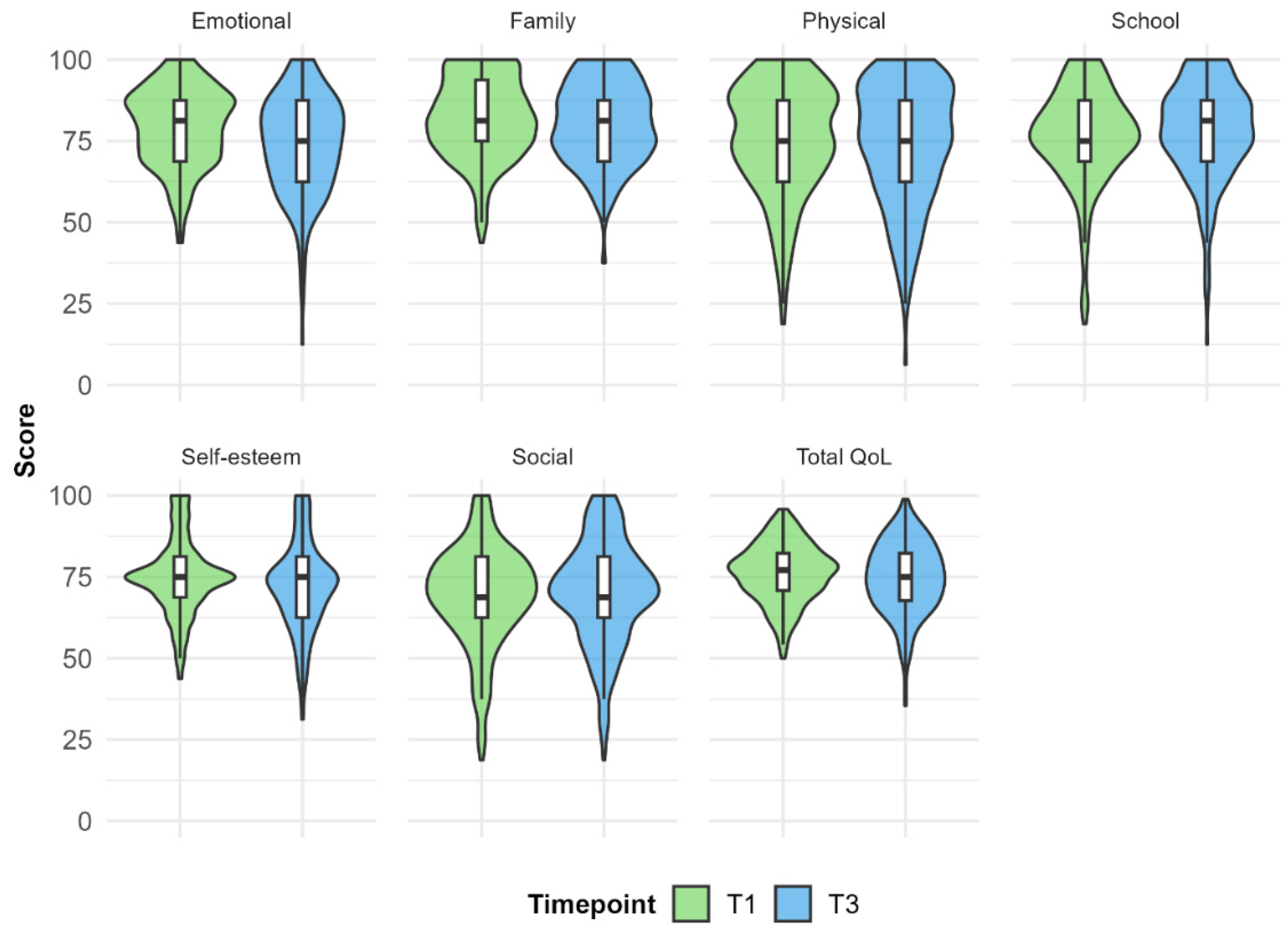
| KINDL Domains | T1 (4–5 Years) | T3 (8–9 Years) | t (291) | p | Cohen’s d | ||
|---|---|---|---|---|---|---|---|
| DLD | Norm | DLD | Norm | ||||
| Physical well-being | 75.47 (16.99) *** | 80.2 | 73.92 (18.51) *** | 80.5 | 1.143 | 0.254 | 0.067 |
| Emotional well-being | 79.32 (12.10) *** | 83.0 | 73.86 (15.15) *** | 82.3 | 6.591 | <0.001*** | 0.386 |
| Self-esteem | 76.39 (14.89) * | 73.6 | 72.23 (13.67) | 70.8 | 3.404 | <0.001*** | 0.199 |
| Family | 81.83 (12.23) | 80.7 | 80.24 (12.36) | 79.8 | 2.046 | 0.042 * | 0.120 |
| Social well-being | 69.24 (15.40) *** | 79.7 | 69.93 (16.22) *** | 78.3 | −0.969 | 0.333 | −0.057 |
| School | 76.39 (14.89) *** | 83.8 | 77.81 (14.98) *** | 82.6 | −1.431 | 0.152 | −0.084 |
| Total | 76.23 (8.97) *** | 80.0 | 74.67 (10.86) *** | 79.0 | 2.491 | 0.013 * | 0.120 |
| KINDL Score | Change | |||||||
|---|---|---|---|---|---|---|---|---|
| Improve | Deteriorate | Stable | ||||||
| n | % | Range | n | % | Range | n | % | |
| Physical | 126 | 43 | 6.25–68.75 | 125 | 43 | −68.75–−6.25 | 41 | 14 |
| Emotional | 79 | 27 | 6.25–31.25 | 159 | 54 | −81.25–−6.25 | 54 | 18 |
| Self-esteem | 90 | 31 | 6.25–37.5 | 126 | 43 | −56.25–−6.25 | 76 | 26 |
| Family | 104 | 36 | 6.25–43.75 | 122 | 42 | −37.5–−6.25 | 66 | 23 |
| Social | 122 | 42 | 6.25–56.25 | 110 | 38 | −62.5–−6.25 | 60 | 21 |
| School | 137 | 47 | 6.25–56.25 | 116 | 40 | −87.5–−6.25 | 39 | 13 |
| Total | 125 | 43 | 1.04–22.92 | 151 | 52 | −42.71–−1.04 | 16 | 5 |
| KINDL Domain | Variable(s) | Est. | SE | 95%CI | p | p (Corrected) | Model R2 | |
|---|---|---|---|---|---|---|---|---|
| LL | UL | |||||||
| Physical | Word production | −0.169 | 0.085 | −0.352 | −0.019 | 0.029 * | 0.136 | 0.365 |
| Emotional problems | −0.108 | 0.620 | −2.530 | −0.098 | 0.034 * | 0.136 | ||
| Emotional | Multilingualism | 0.164 | 3.188 | 2.421 | 10.148 | 0.001 ** | 0.009 ** | 0.181 |
| Emotional problems | −0.121 | 0.478 | −1.878 | −0.005 | 0.049 * | 0.146 | ||
| Peer problems | −0.149 | 0.582 | −2.457 | −0.174 | 0.024 * | 0.095 | ||
| Self-esteem | Multilingualism | 0.123 | 1.897 | 1.249 | 8.686 | 0.009 ** | 0.053 | 0.280 |
| Emotional problems | −0.116 | 0.474 | −1.874 | −0.018 | 0.046 * | 0.183 | ||
| Peer problems | −0.097 | 0.483 | −1.843 | 0.050 | 0.063 | 0.190 | ||
| Family | No significant factor(s) | |||||||
| Social | Language comprehension | 0.142 | 0.069 | 0.025 | 0.296 | 0.021 * | 0.068 | 0.342 |
| SES | −0.111 | 1.739 | −7.368 | −0.552 | 0.023 * | 0.068 | ||
| Multilingualism | 0.081 | 2.35 | −0.176 | 7.799 | 0.061 | 0.146 | ||
| Peer problems | −0.224 | 0.655 | −3.702 | −1.133 | <0.001 *** | 0.001 *** | ||
| School | No significant factor(s) | |||||||
| Total QoL | Word production | −0.180 | 0.043 | −0.175 | −0.008 | 0.032 * | 0.171 | 0.180 |
| Multilingualism | 0.102 | 1.436 | 0.036 | 5.667 | 0.047 * | 0.171 | ||
| Peer problems | −0.114 | 0.385 | −1.488 | 0.022 | 0.057 | 0.171 | ||
Disclaimer/Publisher’s Note: The statements, opinions and data contained in all publications are solely those of the individual author(s) and contributor(s) and not of MDPI and/or the editor(s). MDPI and/or the editor(s) disclaim responsibility for any injury to people or property resulting from any ideas, methods, instructions or products referred to in the content. |
© 2026 by the authors. Licensee MDPI, Basel, Switzerland. This article is an open access article distributed under the terms and conditions of the Creative Commons Attribution (CC BY) license.
Share and Cite
van Barreveld, M.; Duinmeijer, I.; Scheper, A.; Hakvoort, B.; Vissers, C. Quality of Life in Children with Developmental Language Disorder. Children 2026, 13, 418. https://doi.org/10.3390/children13030418
van Barreveld M, Duinmeijer I, Scheper A, Hakvoort B, Vissers C. Quality of Life in Children with Developmental Language Disorder. Children. 2026; 13(3):418. https://doi.org/10.3390/children13030418
Chicago/Turabian Stylevan Barreveld, Mélanie, Iris Duinmeijer, Annette Scheper, Britt Hakvoort, and Constance Vissers. 2026. "Quality of Life in Children with Developmental Language Disorder" Children 13, no. 3: 418. https://doi.org/10.3390/children13030418
APA Stylevan Barreveld, M., Duinmeijer, I., Scheper, A., Hakvoort, B., & Vissers, C. (2026). Quality of Life in Children with Developmental Language Disorder. Children, 13(3), 418. https://doi.org/10.3390/children13030418