N-Acetylcysteine Reduces Tissue Injury Induced by Oxygen–Glucose Deprivation in an Organotypic Culture of Mouse Cerebral Cortex Slices


Highlights
- •
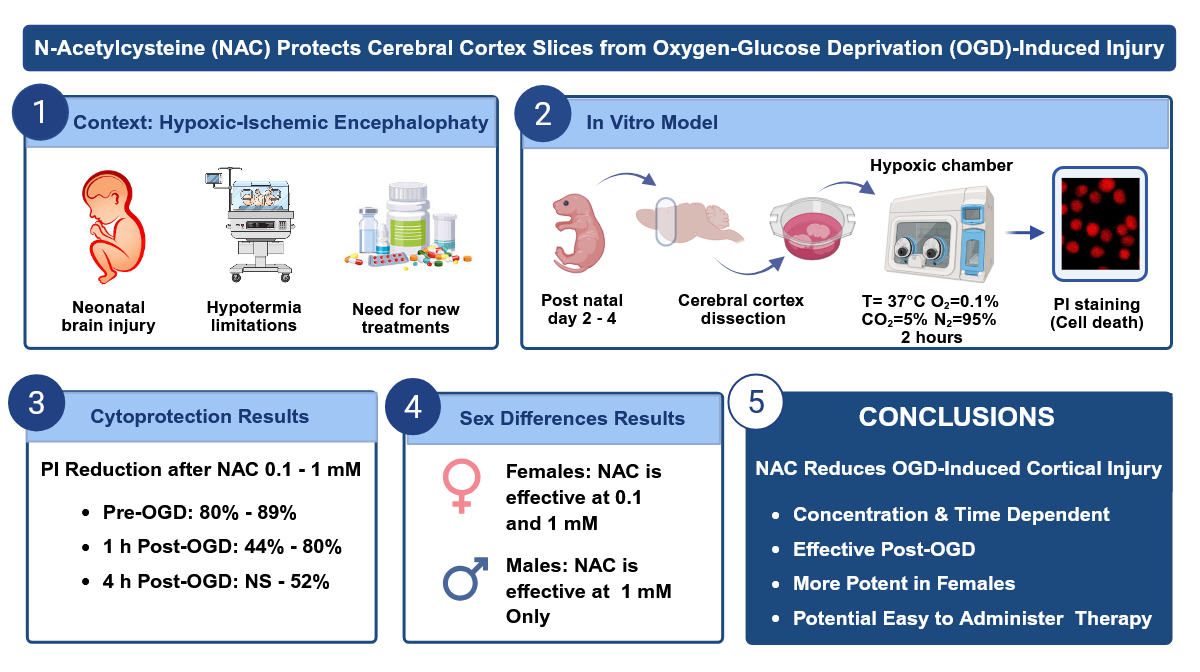
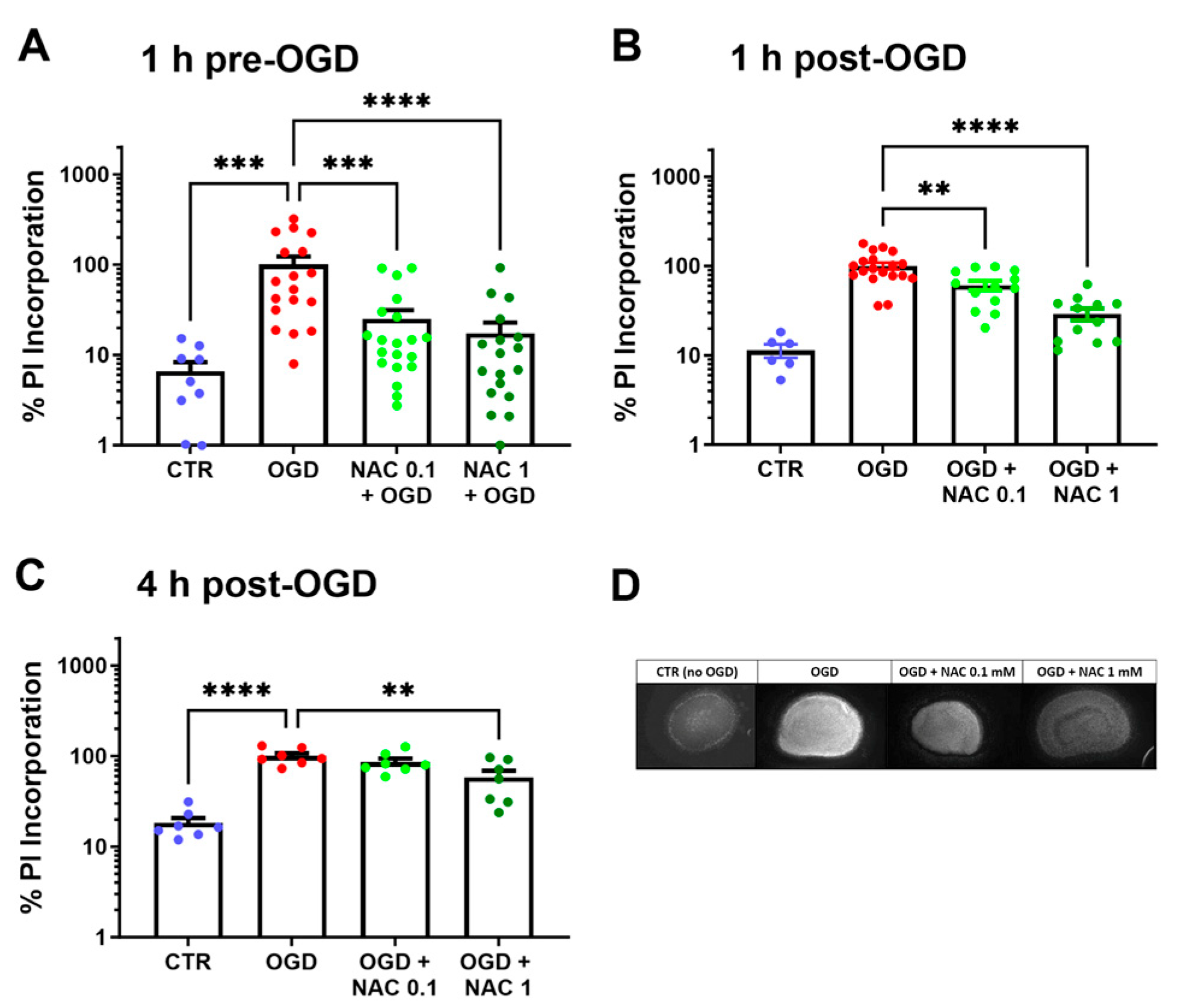
- In an in vitro model of hypoxic–ischemic cell death, N-acetylcysteine exerts a direct, concentration-dependent cytoprotective effect on cerebral cortex slices whether administered before or after oxygen–glucose deprivation.
- •
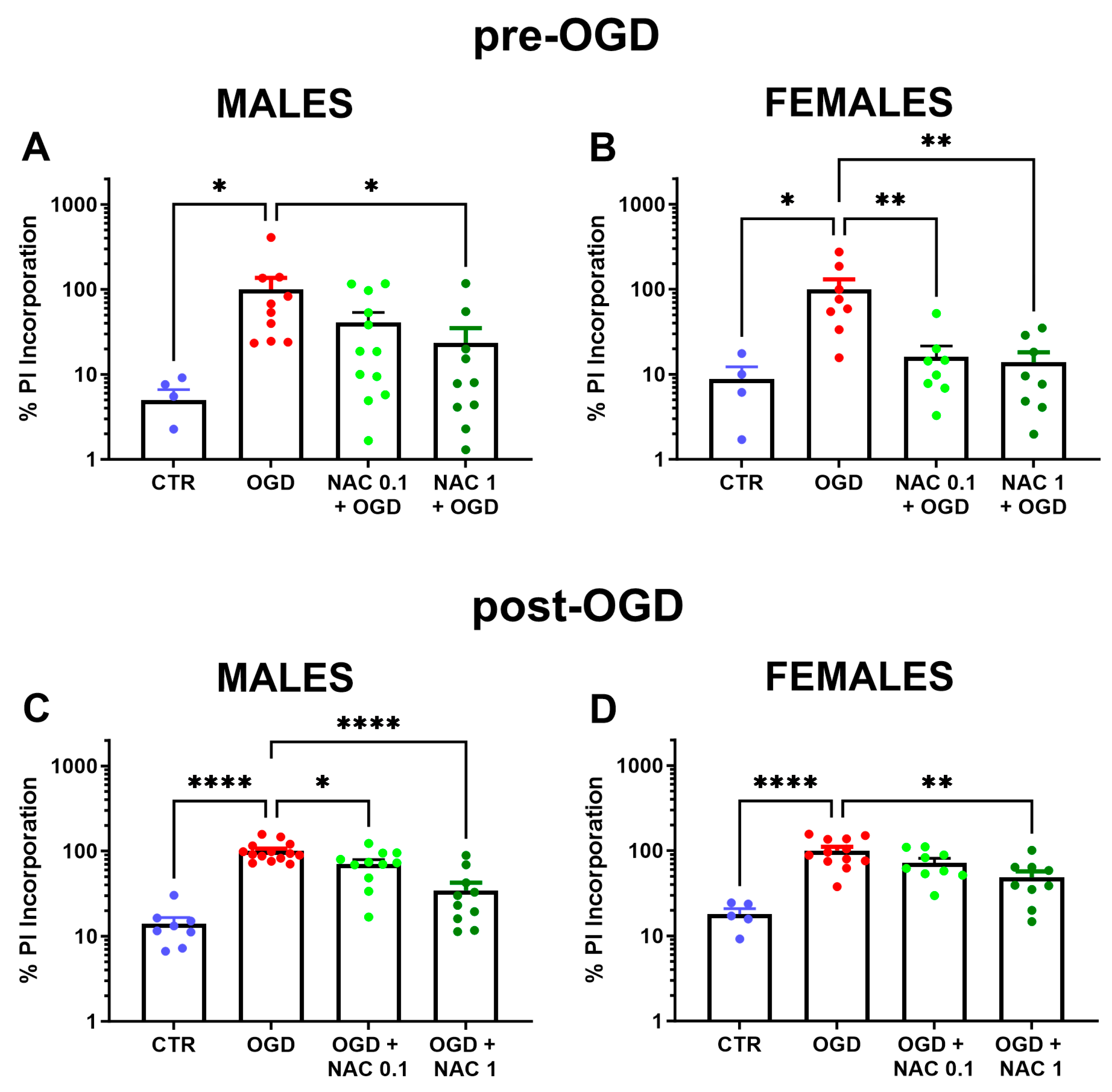
- N-acetylcysteine is more potent in reducing cellular damage in cerebral cortex slices derived from female mice than in those from male mice. This effect is associated with an increase in total glutathione levels in the tissue.
- •
- It is anticipated that systemic doses of N-acetylcysteine capable of achieving brain drug concentrations similar to those that are cytoprotective in vitro may be effective in in vivo models of hypoxia. This marks a further step toward the potential application of N-acetylcysteine to reduce hypoxia-induced brain damage in newborns.
Abstract
1. Introduction
2. Materials and Methods
2.1. Experimental Subjects and Study Design
2.2. Preparation of Cerebral Cortex Slice Cultures
2.3. Hypoxic Chamber
2.4. Assessment of Cell Viability
2.5. Determination of Tissue Levels of Glutathione
2.6. Outcome and Data Analysis
3. Results
3.1. Effect of NAC on PI Incorporation into Cerebral Cortex Slices
3.2. Effect of NAC on OGD-Induced Increase in PI Incorporation into Cerebral Cortex Slices
3.3. The Effect of NAC on Tissue Damage Induced by OGD Is Influenced by Sex
3.4. Effect of NAC on Total Glutathione Levels in Cerebral Cortex Slices
4. Discussion
5. Conclusions
Supplementary Materials
Author Contributions
Funding
Institutional Review Board Statement
Informed Consent Statement
Data Availability Statement
Acknowledgments
Conflicts of Interest
Abbreviations
| aCSF | Artificial cerebrospinal fluid |
| ANOVA | Analysis of variance |
| CTR | Control |
| HIE | Hypoxic–ischemic encephalopathy |
| NAC | N-acetylcysteine |
| OGD | Oxygen–glucose deprivation |
| P2–P4 | Postnatal days 2–4 |
| PBS | Phosphate buffer saline |
| PI | Propidium iodide |
References
- Kurinczuk, J.J.; White-Koning, M.; Badawi, N. Epidemiology of Neonatal Encephalopathy and Hypoxic–Ischaemic Encephalopathy. Early Hum. Dev. 2010, 86, 329–338. [Google Scholar] [CrossRef] [PubMed]
- Arnautovic, T.; Sinha, S.; Laptook, A.R. Neonatal Hypoxic-Ischemic Encephalopathy and Hypothermia Treatment. Obstet. Gynecol. 2024, 143, 67–81. [Google Scholar] [CrossRef] [PubMed]
- Jacobs, S.E.; Berg, M.; Hunt, R.; Tarnow-Mordi, W.O.; Inder, T.E.; Davis, P.G. Cooling for Newborns with Hypoxic Ischaemic Encephalopathy. Cochrane Database Syst. Rev. 2013, 13, CD003311. [Google Scholar] [CrossRef] [PubMed]
- Kukka, A.J.; Waheddoost, S.; Brown, N.; Litorp, H.; Wrammert, J.; Kc, A. Incidence and Outcomes of Intrapartum-Related Neonatal Encephalopathy in Low-Income and Middle-Income Countries: A Systematic Review and Meta-Analysis. BMJ Glob. Health 2022, 7, e010294. [Google Scholar] [CrossRef]
- Tagin, M.; Abdel-Hady, H.; Rahman, S.U.; Azzopardi, D.V.; Gunn, A.J. Neuroprotection for Perinatal Hypoxic Ischemic Encephalopathy in Low- and Middle-Income Countries. J. Pediatr. 2015, 167, 25–28. [Google Scholar] [CrossRef]
- Thayyil, S.; Pant, S.; Montaldo, P.; Shukla, D.; Oliveira, V.; Ivain, P.; Bassett, P.; Swamy, R.; Mendoza, J.; Moreno-Morales, M.; et al. Hypothermia for Moderate or Severe Neonatal Encephalopathy in Low-Income and Middle-Income Countries (HELIX): A Randomised Controlled Trial in India, Sri Lanka, and Bangladesh. Lancet Glob. Health 2021, 9, e1273–e1285. [Google Scholar] [CrossRef]
- Faix, R.G.; Laptook, A.R.; Shankaran, S.; Eggleston, B.; Chowdhury, D.; Heyne, R.J.; Das, A.; Pedroza, C.; Tyson, J.E.; Wusthoff, C.; et al. Whole-Body Hypothermia for Neonatal Encephalopathy in Preterm Infants 33 to 35 Weeks’ Gestation: A Randomized Clinical Trial. JAMA Pediatr. 2025, 179, 396. [Google Scholar] [CrossRef]
- Berube, M.W.; Puia-Dumitrescu, M.; McAdams, R.M. Does Mild Hypoxic Ischemic Encephalopathy Adversely Affect Neurodevelopmental Outcome? J. Perinatol. 2021, 41, 901–904. [Google Scholar] [CrossRef]
- Nair, J.; Kumar, V.H.S. Current and Emerging Therapies in the Management of Hypoxic Ischemic Encephalopathy in Neonates. Children 2018, 5, 99. [Google Scholar] [CrossRef]
- Juul, S.E.; Ferriero, D.M. Pharmacologic Neuroprotective Strategies in Neonatal Brain Injury. Clin. Perinatol. 2014, 41, 119–131. [Google Scholar] [CrossRef]
- Malla, R.R.; Asimi, R.; Teli, M.A.; Shaheen, F.; Bhat, M.A. Erythropoietin Monotherapy in Perinatal Asphyxia with Moderate to Severe Encephalopathy: A Randomized Placebo-Controlled Trial. J. Perinatol. 2017, 37, 596–601. [Google Scholar] [CrossRef] [PubMed]
- Martini, S.; Austin, T.; Aceti, A.; Faldella, G.; Corvaglia, L. Free Radicals and Neonatal Encephalopathy: Mechanisms of Injury, Biomarkers, and Antioxidant Treatment Perspectives. Pediatr. Res. 2020, 87, 823–833. [Google Scholar] [CrossRef] [PubMed]
- Elsayed, N.A.; Boyer, T.M.; Burd, I. Fetal Neuroprotective Strategies: Therapeutic Agents and Their Underlying Synaptic Pathways. Front. Synaptic Neurosci. 2021, 13, 680899. [Google Scholar] [CrossRef] [PubMed]
- Farr, S.A.; Poon, H.F.; Dogrukol-Ak, D.; Drake, J.; Banks, W.A.; Eyerman, E.; Butterfield, D.A.; Morley, J.E. The Antioxidants A-lipoic Acid and N-acetylcysteine Reverse Memory Impairment and Brain Oxidative Stress in Aged SAMP8 Mice. J. Neurochem. 2003, 84, 1173–1183. [Google Scholar] [CrossRef]
- Katz, M.; Won, S.J.; Park, Y.; Orr, A.; Jones, D.P.; Swanson, R.A.; Glass, G.A. Cerebrospinal Fluid Concentrations of N-Acetylcysteine after Oral Administration in Parkinson’s Disease. Park. Relat. Disord. 2015, 21, 500–503. [Google Scholar] [CrossRef]
- Wiest, D.B.; Chang, E.; Fanning, D.; Garner, S.; Cox, T.; Jenkins, D.D. Antenatal Pharmacokinetics and Placental Transfer of N-Acetylcysteine in Chorioamnionitis for Fetal Neuroprotection. J. Pediatr. 2014, 165, 672–677.e2. [Google Scholar] [CrossRef]
- Aoyama, K. Glutathione in the Brain. Int. J. Mol. Sci. 2021, 22, 5010. [Google Scholar] [CrossRef]
- Kelen, D.; Robertson, N.J. Experimental Treatments for Hypoxic Ischaemic Encephalopathy. Early Hum. Dev. 2010, 86, 369–377. [Google Scholar] [CrossRef]
- Mcelhatton, P.R.; Sullivan, F.M.; Volans, G.N. Paracetamol Overdose in Pregnancy Analysis of the Outcomes of 300 Cases Referred to the Teratology Information Service. Reprod. Toxicol. 1997, 11, 85–94. [Google Scholar] [CrossRef]
- Ahola, T.; Lapatto, R.; Raivio, K.O.; Selander, B.; Stigson, L.; Jonsson, B.; Jonsbo, F.; Esberg, G.; Stövring, S.; Kjartansson, S.; et al. N-Acetylcysteine Does Not Prevent Bronchopulmonary Dysplasia in Immature Infants: A Randomized Controlled Trial. J. Pediatr. 2003, 143, 713–719. [Google Scholar] [CrossRef]
- Gutziet, O.; Iluz, R.; Ben Asher, H.; Segal, L.; Ben Zvi, D.; Ginsberg, Y.; Khatib, N.; Zmora, O.; Ross, M.G.; Weiner, Z.; et al. Maternal N-Acetyl-Cysteine Prevents Neonatal Hypoxia-Induced Brain Injury in a Rat Model. Int. J. Mol. Sci. 2021, 22, 13629. [Google Scholar] [CrossRef]
- Adams, L.E.; Moss, H.G.; Lowe, D.W.; Brown, T.; Wiest, D.B.; Hollis, B.W.; Singh, I.; Jenkins, D.D. NAC and Vitamin D Restore CNS Glutathione in Endotoxin-Sensitized Neonatal Hypoxic-Ischemic Rats. Antioxidants 2021, 10, 489. [Google Scholar] [CrossRef]
- Jatana, M.; Singh, I.; Singh, A.K.; Jenkins, D. Combination of Systemic Hypothermia and N-Acetylcysteine Attenuates Hypoxic-Ischemic Brain Injury in Neonatal Rats. Pediatr. Res. 2006, 59, 684–689. [Google Scholar] [CrossRef] [PubMed]
- Lowe, D.W.; Fraser, J.L.; Rollins, L.G.; Bentzley, J.; Nie, X.; Martin, R.; Singh, I.; Jenkins, D. Vitamin D Improves Functional Outcomes in Neonatal Hypoxic Ischemic Male Rats Treated with N-Acetylcysteine and Hypothermia. Neuropharmacology 2017, 123, 186–200. [Google Scholar] [CrossRef]
- Jenkins, D.D.; Moss, H.G.; Brown, T.R.; Yazdani, M.; Thayyil, S.; Montaldo, P.; Vento, M.; Kuligowski, J.; Wagner, C.; Hollis, B.W.; et al. NAC and Vitamin D Improve CNS and Plasma Oxidative Stress in Neonatal HIE and Are Associated with Favorable Long-Term Outcomes. Antioxidants 2021, 10, 1344. [Google Scholar] [CrossRef]
- Paintlia, M.K.; Paintlia, A.S.; Barbosa, E.; Singh, I.; Singh, A.K. N-acetylcysteine Prevents Endotoxin-induced Degeneration of Oligodendrocyte Progenitors and Hypomyelination in Developing Rat Brain. J. Neurosci. Res. 2004, 78, 347–361. [Google Scholar] [CrossRef]
- Beloosesky, R.; Ginsberg, Y.; Khatib, N.; Maravi, N.; Ross, M.G.; Itskovitz-Eldor, J.; Weiner, Z. Prophylactic Maternal N-Acetylcysteine in Rats Prevents Maternal Inflammation–Induced Offspring Cerebral Injury Shown on Magnetic Resonance Imaging. Am. J. Obstet. Gynecol. 2013, 208, 213.e1–213.e6. [Google Scholar] [CrossRef]
- Jenkins, D.D.; Wiest, D.B.; Mulvihill, D.M.; Hlavacek, A.M.; Majstoravich, S.J.; Brown, T.R.; Taylor, J.J.; Buckley, J.R.; Turner, R.P.; Rollins, L.G.; et al. Fetal and Neonatal Effects of N-Acetylcysteine When Used for Neuroprotection in Maternal Chorioamnionitis. J. Pediatr. 2016, 168, 67–76.e6. [Google Scholar] [CrossRef]
- Pischiutta, F.; Brunelli, L.; Romele, P.; Silini, A.; Sammali, E.; Paracchini, L.; Marchini, S.; Talamini, L.; Bigini, P.; Boncoraglio, G.B.; et al. Protection of Brain Injury by Amniotic Mesenchymal Stromal Cell-Secreted Metabolites. Crit. Care Med. 2016, 44, e1118–e1131. [Google Scholar] [CrossRef]
- Reyes, R.C.; Cittolin-Santos, G.F.; Kim, J.-E.; Won, S.J.; Brennan-Minnella, A.M.; Katz, M.; Glass, G.A.; Swanson, R.A. Neuronal Glutathione Content and Antioxidant Capacity Can Be Normalized In Situ by N-Acetyl Cysteine Concentrations Attained in Human Cerebrospinal Fluid. Neurotherapeutics 2016, 13, 217–225. [Google Scholar] [CrossRef]
- Kim, U.J.; Lee, K.H. Neuroprotective Effects of N-Acetylcysteine Amide against Oxidative Injury in an Aging Model of Organotypic Hippocampal Slice Cultures. NeuroReport 2022, 33, 173–179. [Google Scholar] [CrossRef] [PubMed]
- Olsson, B.; Johansson, M.; Gabrielsson, J.; Bolme, P. Pharmacokinetics and Bioavailability of Reduced and Oxidized N-Acetylcysteine. Eur. J. Clin. Pharmacol. 1988, 34, 77–82. [Google Scholar] [CrossRef] [PubMed]
- Holmay, M.J.; Terpstra, M.; Coles, L.D.; Mishra, U.; Ahlskog, M.; Öz, G.; Cloyd, J.C.; Tuite, P.J. N-Acetylcysteine Boosts Brain and Blood Glutathione in Gaucher and Parkinson Diseases. Clin. Neuropharmacol. 2013, 36, 103–106. [Google Scholar] [CrossRef] [PubMed]
- Nie, X.; Lowe, D.W.; Rollins, L.G.; Bentzley, J.; Fraser, J.L.; Martin, R.; Singh, I.; Jenkins, D. Sex-Specific Effects of N-Acetylcysteine in Neonatal Rats Treated with Hypothermia after Severe Hypoxia-Ischemia. Neurosci. Res. 2016, 108, 24–33. [Google Scholar] [CrossRef]
- Smith, A.; Garbus, H.; Rosenkrantz, T.; Fitch, R. Sex Differences in Behavioral Outcomes Following Temperature Modulation During Induced Neonatal Hypoxic Ischemic Injury in Rats. Brain Sci. 2015, 5, 220–240. [Google Scholar] [CrossRef]
- Hagberg, H.; Wilson, M.A.; Matsushita, H.; Zhu, C.; Lange, M.; Gustavsson, M.; Poitras, M.F.; Dawson, T.M.; Dawson, V.L.; Northington, F.; et al. PARP-1 Gene Disruption in Mice Preferentially Protects Males from Perinatal Brain Injury. J. Neurochem. 2004, 90, 1068–1075. [Google Scholar] [CrossRef]
- Wang, L.; Ahn, Y.J.; Asmis, R. Sexual Dimorphism in Glutathione Metabolism and Glutathione-Dependent Responses. Redox Biol. 2020, 31, 101410. [Google Scholar] [CrossRef]
- Smith, A.L.; Alexander, M.; Rosenkrantz, T.S.; Sadek, M.L.; Fitch, R.H. Sex Differences in Behavioral Outcome Following Neonatal Hypoxia Ischemia: Insights from a Clinical Meta-Analysis and a Rodent Model of Induced Hypoxic Ischemic Brain Injury. Exp. Neurol. 2014, 254, 54–67. [Google Scholar] [CrossRef]
- Yin, B.; Barrionuevo, G.; Weber, S.G. Optimized Real-Time Monitoring of Glutathione Redox Status in Single Pyramidal Neurons in Organotypic Hippocampal Slices during Oxygen–Glucose Deprivation and Reperfusion. ACS Chem. Neurosci. 2015, 6, 1838–1848. [Google Scholar] [CrossRef]
- Moss, H.G.; Brown, T.R.; Wiest, D.B.; Jenkins, D.D. N-Acetylcysteine Rapidly Replenishes Central Nervous System Glutathione Measured via Magnetic Resonance Spectroscopy in Human Neonates with Hypoxic-Ischemic Encephalopathy. J. Cereb. Blood Flow Metab. Off. J. Int. Soc. Cereb. Blood Flow Metab. 2018, 38, 950–958. [Google Scholar] [CrossRef]
- Vargas, M.R.; Johnson, D.A.; Johnson, J.A. Decreased Glutathione Accelerates Neurological Deficit and Mitochondrial Pathology in Familial ALS-Linked hSOD1G93A Mice Model. Neurobiol. Dis. 2011, 43, 543–551. [Google Scholar] [CrossRef]
- De La Cruz, J.P.; Villalobos, M.A.; Cuerda, M.A.; Guerrero, A.; González-Correa, J.A.; Sánchez De La Cuesta, F. Effects of S-Adenosyl-L-Methionine on Lipid Peroxidation and Glutathione Levels in Rat Brain Slices Exposed to Reoxygenation after Oxygen-Glucose Deprivation. Neurosci. Lett. 2002, 318, 103–107. [Google Scholar] [CrossRef]
- Miller, V.M.; Lawrence, D.A.; Mondal, T.K.; Seegal, R.F. Reduced Glutathione Is Highly Expressed in White Matter and Neurons in the Unperturbed Mouse Brain–Implications for Oxidative Stress Associated with Neurodegeneration. Brain Res. 2009, 1276, 22–30. [Google Scholar] [CrossRef]
- Detcheverry, F.; Senthil, S.; Narayanan, S.; Badhwar, A. Changes in Levels of the Antioxidant Glutathione in Brain and Blood across the Age Span of Healthy Adults: A Systematic Review. NeuroImage Clin. 2023, 40, 103503. [Google Scholar] [CrossRef]



| Treatment | Concentration | PI Incorporation |
|---|---|---|
| (% of CTRL) | ||
| CTR | 100 ± 35 (11) | |
| NAC | 0.1 mM | 130 ± 30 (10) |
| NAC | 1 mM | 126 ± 29 (13) |
| NAC | 10 mM | 432 ± 147 ** (13) |
| Treatment | NAC | Total Glutathione |
|---|---|---|
| Concentration | (nmoles/mg Protein) | |
| CTR | 2.8 ± 0.4 | |
| OGD | 3.4 ± 0.8 | |
| OGD + NAC | 0.1 mM | 6.3 ± 1.1 * |
| OGD + NAC | 1 mM | 5.2 ± 0.6 |
Disclaimer/Publisher’s Note: The statements, opinions and data contained in all publications are solely those of the individual author(s) and contributor(s) and not of MDPI and/or the editor(s). MDPI and/or the editor(s) disclaim responsibility for any injury to people or property resulting from any ideas, methods, instructions or products referred to in the content. |
© 2026 by the authors. Licensee MDPI, Basel, Switzerland. This article is an open access article distributed under the terms and conditions of the Creative Commons Attribution (CC BY) license.
Share and Cite
Villani, C.; Di Clemente, A.; Invernizzi, R.W.; Rezzonico, R. N-Acetylcysteine Reduces Tissue Injury Induced by Oxygen–Glucose Deprivation in an Organotypic Culture of Mouse Cerebral Cortex Slices. Children 2026, 13, 379. https://doi.org/10.3390/children13030379
Villani C, Di Clemente A, Invernizzi RW, Rezzonico R. N-Acetylcysteine Reduces Tissue Injury Induced by Oxygen–Glucose Deprivation in an Organotypic Culture of Mouse Cerebral Cortex Slices. Children. 2026; 13(3):379. https://doi.org/10.3390/children13030379
Chicago/Turabian StyleVillani, Claudia, Angelo Di Clemente, Roberto William Invernizzi, and Rossano Rezzonico. 2026. "N-Acetylcysteine Reduces Tissue Injury Induced by Oxygen–Glucose Deprivation in an Organotypic Culture of Mouse Cerebral Cortex Slices" Children 13, no. 3: 379. https://doi.org/10.3390/children13030379
APA StyleVillani, C., Di Clemente, A., Invernizzi, R. W., & Rezzonico, R. (2026). N-Acetylcysteine Reduces Tissue Injury Induced by Oxygen–Glucose Deprivation in an Organotypic Culture of Mouse Cerebral Cortex Slices. Children, 13(3), 379. https://doi.org/10.3390/children13030379