Phenotyping Pediatric Long COVID: Symptom Clusters from a Longitudinal Multicenter Italian Cohort

 , , , ,
  , , ,
, , , 

 , , and
on behalf of the Long-Covid-Ped Italian Study Groupadd
Show full author list
, , and
on behalf of the Long-Covid-Ped Italian Study Groupadd
Show full author list
Highlights
- In a longitudinal cohort of 850 children, cluster analysis identified three age-related trajectories.
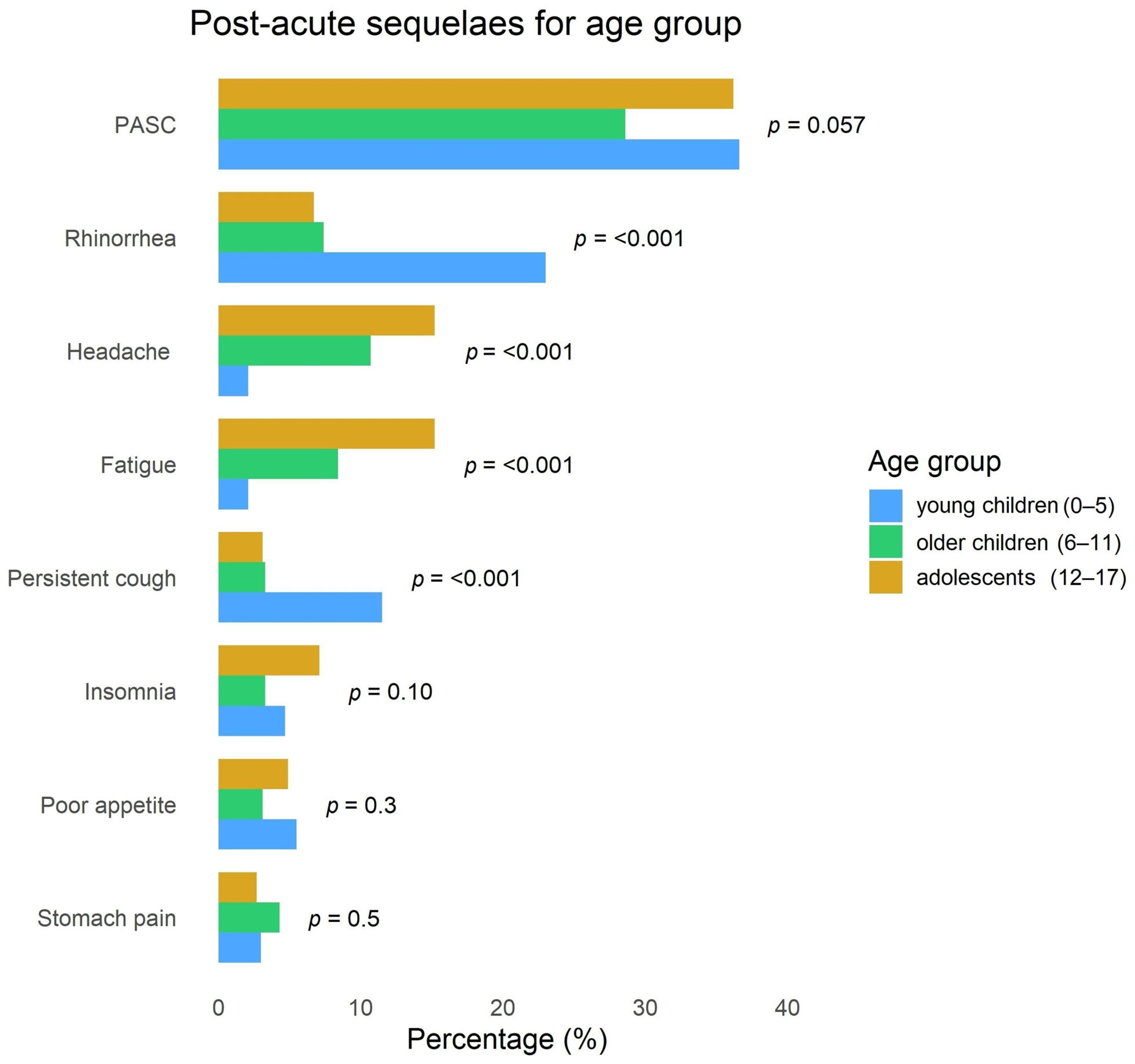
- Young children (0–5 years) mainly had respiratory symptoms and higher hospitalization risk, with sequelae often persisting; older children (6–11 years) experienced mild disease and good recovery; adolescents (12–17 years), particularly females, showed more severe acute symptoms and were most affected by long-term neuropsychological sequelae like fatigue and insomnia.
- Pediatric PASC management should be age-tailored: vaccination and respiratory follow-up should be reinforced in young children, and neuropsychological support should be prioritized for adolescent girls.
- Future research should confirm these patterns in larger groups of people, observe how they change over time, and combine biological and psychosocial information, as well as potential biomarkers and objective measures (e.g., neurocognitive testing and pulmonary function), to help design prevention and intervention strategies.
Abstract
1. Introduction
2. Materials and Methods
2.1. Study Design, Setting, and Participants
2.2. Statistical Analyses
3. Results
3.1. Clinical and Demographic Characteristics
3.2. Frequency and Distribution of Acute Symptoms
3.3. Occurrence of PASC and Related Sequelae
3.4. Clustering of Cases with COVID-19 Infection
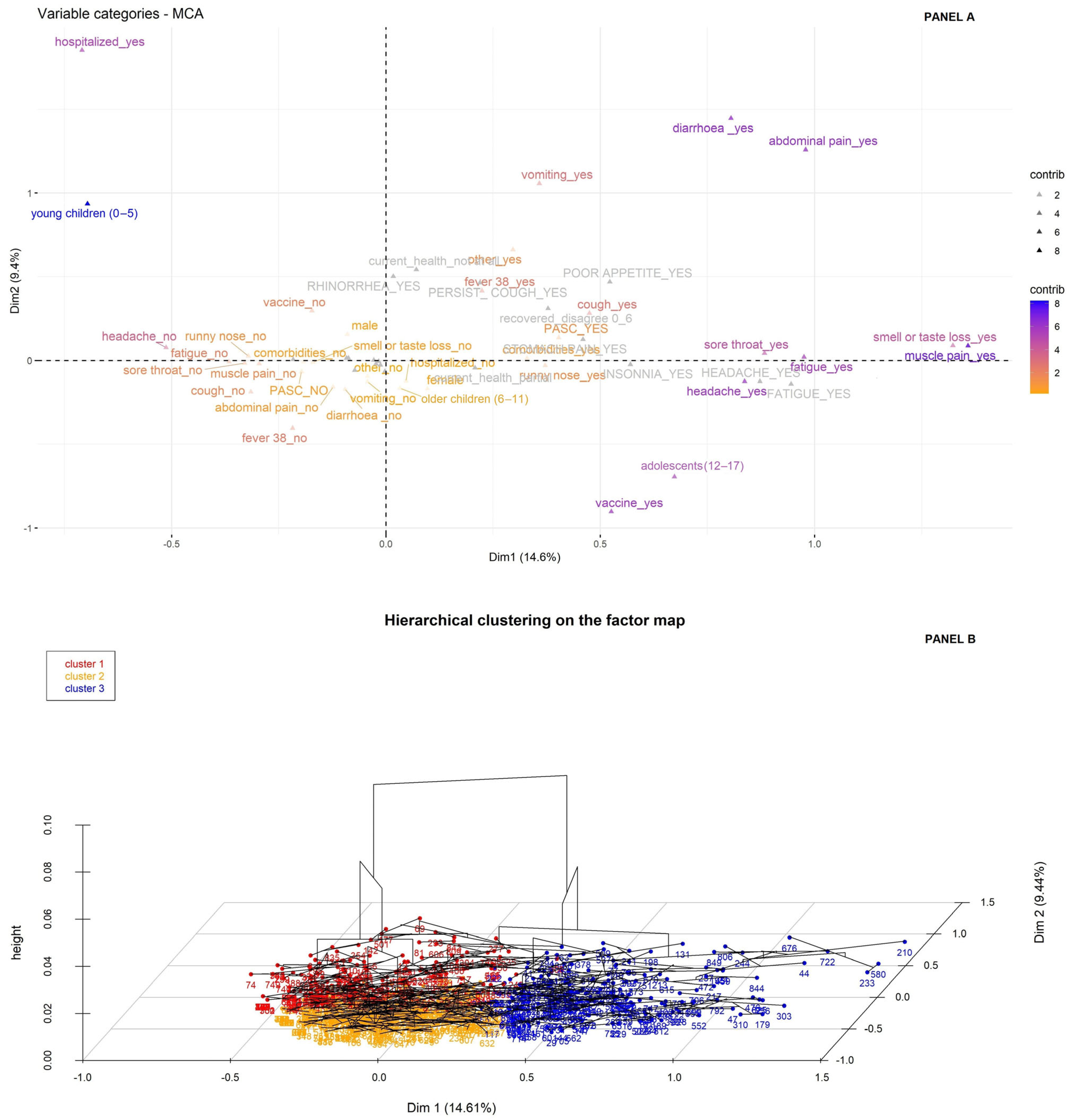
- Cluster 1 consisted of young children (v-test = 25.40) who were predominantly hospitalized (v-test = 10.12) and unvaccinated against COVID-19 (v-test = 11.45). This cluster presented fever during the acute phase (v-test = 5.61), and rhinorrhea (v-test = 6.12) and persistent cough (v-test = 3.94) as post-acute sequelae.
- Cluster 2 comprised older children (v-test = 13.14) who reported no acute symptoms and who generally did not develop PASC (v-test = 6.58).
- Cluster 3 was characterized by adolescent girls (v-test = 8.63 and 1.98), predominantly vaccinated, with comorbidities (v-test = 4.63 and 4.64). This cluster exhibited acute symptoms including headache (v-test = 16.72), myalgia (v-test = 15.67), fatigue (v-test = 14.25), and anosmia/ageusia (v-test = 10.97) and generally developed PASC (v-test = 5.87) with sequelae including headache, fatigue, and insomnia (v-test = 6.30, 5.96 and 3.23, respectively).
3.5. Clustering of Cases with PASC
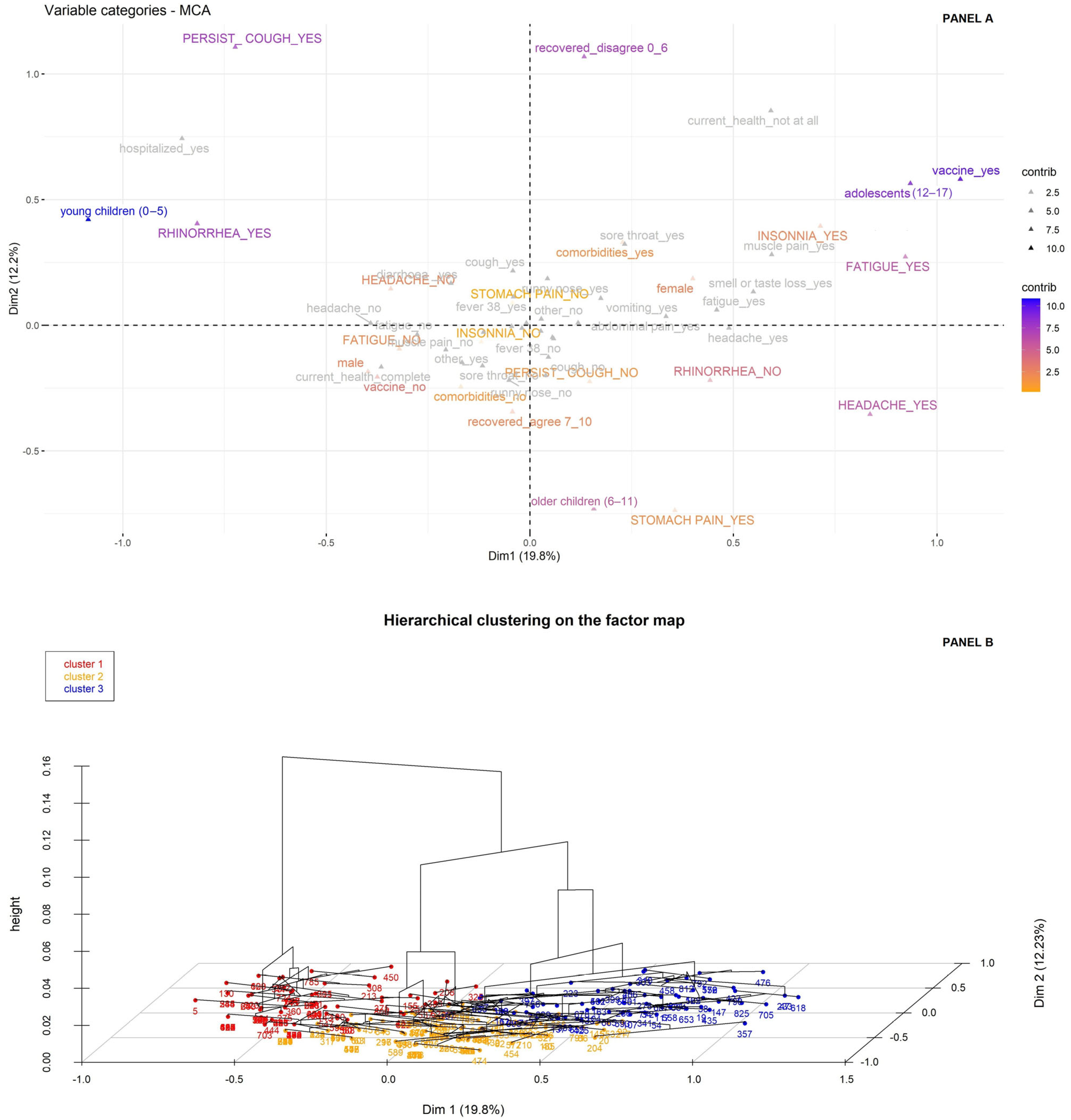
- Cluster 1 consisted of young children (v-test = 14.56) who were predominantly unvaccinated against COVID-19 (v-test = 6.07). Post-acute phase features included rhinorrhea (v-test = 8.58) and a persistent cough (v-test = 6.64).
- Cluster 2 comprised older children (v-test = 11.71), predominantly male (v-test = 2.83), reporting full recovery (v-test = 5.43). Post-acute sequelae included headache and stomach/abdominal pain (v-test = 3.31 and 3.02).
- Cluster 3 consisted of adolescents (v-test = 11.98), predominantly girls (v-test = 5.51), vaccinated (v-test = 11.55), with perceived incomplete recovery and comorbidities (v-test = 3.46 and 2.10). Post-acute sequelae included insomnia (v-test = 3.73) and fatigue (v-test = 5.19).
4. Discussion
5. Conclusions
Supplementary Materials
Author Contributions
Funding
Institutional Review Board Statement
Informed Consent Statement
Data Availability Statement
Acknowledgments
Conflicts of Interest
Abbreviations
| HCPC | Hierarchical Clustering on Principal Components |
| IQR | interquartile range |
| ISARIC | International Severe Acute Respiratory and Emerging Infection Consortium |
References
- Xu, Z.; Wang, W.; Zhang, D.; Tam, K.W.; Li, Y.; Chan, D.C.C.; Yang, Z.; Wong, S.Y.S. Excess risks of long COVID symptoms compared with identical symptoms in the general population: A systematic review and meta-analysis of studies with control groups. J. Glob. Health 2024, 14, 05022. [Google Scholar] [CrossRef]
- Taher, M.K.; Salzman, T.; Banal, A.; Morissette, K.; Domingo, F.R.; Cheung, A.M.; Cooper, C.L.; Boland, L.; Zuckermann, A.M.; Mullah, M.A.; et al. Global prevalence of post-COVID-19 condition: A systematic review and meta-analysis of prospective evidence. Health Promot. Chronic Dis. Prev. Can. 2025, 45, 112–138. [Google Scholar] [CrossRef] [PubMed]
- Yonker, L.M.; Kane, B.; Pretorius, E.; Putrino, D.; McFarland, S.; Brodin, P.; Zimmerman, K.O.; Munblit, D.; Rowe, P.C.; Vos, T.; et al. Equity in research: A global consensus statement on the urgency of including children in long COVID clinical trials. Eur. Respir. J. 2025, 65, 2500092. [Google Scholar] [CrossRef] [PubMed]
- Long COVID and kids: More research is urgently needed. Nature 2022, 602, 183. [CrossRef] [PubMed]
- Gross, R.S.; Carmilani, M.; Stockwell, M.S. Long COVID in Young Children, School-Aged Children, and Teens. JAMA Pediatr. 2025, 179, 809. [Google Scholar] [CrossRef]
- Esposito, S.; Puntoni, M.; Deolmi, M.; Ramundo, G.; Maglietta, G.; Poeta, M.; Zampogna, S.; Colomba, C.; Suppiej, A.; Cardinale, F.; et al. Long COVID in pediatric age: An observational, prospective, longitudinal, multicenter study in Italy. Front. Immunol. 2025, 16, 1466201. [Google Scholar] [CrossRef]
- Esposito, S.; Deolmi, M.; Ramundo, G.; Puntoni, M.; Caminiti, C.; Principi, N. True prevalence of long COVID in children: A narrative review. Front. Microbiol. 2023, 14, 1225952. [Google Scholar] [CrossRef]
- Fainardi, V.; Meoli, A.; Chiopris, G.; Motta, M.; Skenderaj, K.; Grandinetti, R.; Bergomi, A.; Antodaro, F.; Zona, S.; Esposito, S. Long COVID in Children and Adolescents. Life 2022, 12, 285. [Google Scholar] [CrossRef]
- Basaca, D.-G.; Jugănaru, I.; Belei, O.; Nicoară, D.-M.; Asproniu, R.; Stoicescu, E.R.; Mărginean, O. Long COVID in Children and Adolescents: Mechanisms, Symptoms, and Long-Term Impact on Health—A Comprehensive Review. J. Clin. Med. 2025, 14, 378. [Google Scholar] [CrossRef]
- Ketharanathan, N.; Dulfer, K.; de Hoog, M.; Otten, M.; Buysse, C. Generation C: The scope and effects of paediatric long COVID. Lancet 2025, 405, 541–542. [Google Scholar] [CrossRef]
- World Health Organization (WHO). A Clinical Case Definition for Post COVID-19 Condition in Children and Adolescents by Expert Consensus. 16 February 2023. Available online: https://www.who.int/publications/i/item/WHO-2019-nCoV-Post-COVID-19-condition-CA-Clinical-case-definition-2023-1 (accessed on 15 September 2025).
- Zapata, T.; Gosling, J.; McFarland, S. We can do better for young people with long COVID. BMJ 2024, 386, q1664. [Google Scholar] [CrossRef] [PubMed]
- Liu, V.Y.; Godfrey, M.; Dunn, M.; Fowler, R.; Guthrie, L.; Dredge, D.; Holmes, S.; Johnston, A.M.; Simoneau, T.; Fasano, A.; et al. Diagnostic challenges of long COVID in children: A survey of pediatric health care providers’ preferences and practices. Front. Pediatr. 2024, 12, 1484941. [Google Scholar] [CrossRef] [PubMed]
- Buonsenso, D.; Di Gennaro, L.; De Rose, C.; Morello, R.; D’iLario, F.; Zampino, G.; Piazza, M.; Boner, A.L.; Iraci, C.; O’cOnnell, S.; et al. Long-term outcomes of pediatric infections: From traditional infectious diseases to long COVID. Future Microbiol. 2022, 17, 551–571. [Google Scholar] [CrossRef] [PubMed]
- Greenhalgh, T.; Sivan, M.; Perlowski, A.; Nikolich, J. Long COVID: A clinical update. Lancet 2024, 404, 707–724. [Google Scholar] [CrossRef]
- Miaskowski, C.; Barsevick, A.; Berger, A.; Casagrande, R.; Grady, P.A.; Jacobsen, P.; Kutner, J.; Patrick, D.; Zimmerman, L.; Xiao, C.; et al. Advancing Symptom Science Through Symptom Cluster Research: Expert Panel Proceedings and Recommendations. J. Natl. Cancer Inst. 2017, 109, djw253. [Google Scholar] [CrossRef]
- Niewolik, J.; Mikuteit, M.; Klawitter, S.; Schröder, D.; Stölting, A.; Vahldiek, K.; Heinemann, S.; Müller, F.; Behrens, G.; Klawonn, F.; et al. Cluster analysis of long COVID symptoms for deciphering a syndrome and its long-term consequence. Immunol. Res. 2024, 72, 605–613. [Google Scholar] [CrossRef]
- López-Güell, K.; Català, M.; Dedman, D.; Duarte-Salles, T.; Kolde, R.; López-Blasco, R.; Martínez, Á.; Mercier, G.; Abellan, A.; Arinze, J.T.; et al. Clusters of post-acute COVID-19 symptoms: A latent class analysis across 9 databases and 7 countries. J. Clin. Epidemiol. 2025, 185, 111867. [Google Scholar] [CrossRef]
- Weakley, K.E.M.; Schikler, A.M.; Green, J.V.; Blatt, D.B.; Barton, S.M.M.; Statler, V.A.M.; Feygin, Y.; Marshall, G.S. Clinical Features and Follow-up of Referred Children and Young People with Long COVID. Pediatr. Infect. Dis. J. 2023, 42, 1093–1099. [Google Scholar] [CrossRef]
- Noij, L.C.E.; Blankestijn, J.M.; Lap, C.R.; van Houten, M.A.; Biesbroek, G.; der Zee, A.-H.M.-V.; Abdel-Aziz, M.I.; van Goudoever, J.B.; Alsem, M.W.; Brackel, C.L.H.; et al. Clinical-based phenotypes in children with pediatric post-COVID-19 condition. World J. Pediatr. 2024, 20, 682–691. [Google Scholar] [CrossRef]
- Gross, R.S.; Thaweethai, T.; Kleinman, L.C.; Snowden, J.N.; Rosenzweig, E.B.; Milner, J.D.; Tantisira, K.G.; Rhee, K.E.; Jernigan, T.L.; Kinser, P.A.; et al. Characterizing Long COVID in Children and Adolescents. JAMA 2024, 332, 1174–1188. [Google Scholar] [CrossRef]
- Floridia, M.; Buonsenso, D.; Macculi, L.; Weimer, L.E.; Giuliano, M.; Pricci, F.; Bianchi, L.; Toraldo, D.M.; Onder, G.; The ISS Long-COVID Study Group. Adolescents with Persistent Symptoms Following Acute SARS-CoV-2 Infection (Long-COVID): Symptom Profile, Clustering and Follow-Up Symptom Evaluation. Children 2024, 12, 28. [Google Scholar] [CrossRef]
- Lorman, V.; Rao, S.; Jhaveri, R.; Case, A.; Mejias, A.; Pajor, N.M.; Patel, P.; Thacker, D.; Bose-Brill, S.; Block, J.; et al. Understanding pediatric long COVID using a tree-based scan statistic approach: An EHR-based cohort study from the RECOVER Program. JAMIA Open 2023, 6, ooad016. [Google Scholar] [CrossRef] [PubMed]
- Lorman, V.; Razzaghi, H.; Song, X.; Morse, K.; Utidjian, L.; Allen, A.J.; Rao, S.; Rogerson, C.; Bennett, T.D.; Morizono, H.; et al. A machine learning-based phenotype for long COVID in children: An EHR-based study from the RECOVER program. PLoS ONE 2023, 18, e0289774. [Google Scholar] [CrossRef] [PubMed]
- Lorman, V.; Bailey, L.C.; Song, X.; Rao, S.; Hornig, M.; Utidjian, L.; Razzaghi, H.; Mejias, A.; Leikauf, J.E.; Brill, S.B.; et al. Pediatric Long COVID Subphenotypes: An EHR-based study from the RECOVER program. PLoS Digit. Health 2025, 4, e0000747. [Google Scholar] [CrossRef] [PubMed]
- ISARIC Global COVID-19 Paediatric Follow-Up. Available online: https://isaric.org/research/covid-19-clinical-research-resources/paediatric-follow-up (accessed on 15 September 2025).
- Breen, J.J.; Eisinger, R.W.; Read, S.W.; Beigel, J.; Palmore, T.N.; Lane, H.C.; Menetski, J.P.; Adam, S.J.; Geerling, E.; Roy, E.; et al. Navigating the path forward for evidence-based management of long COVID. Nat. Immunol. 2025, 26, 536–539. [Google Scholar] [CrossRef]
- Toepfner, N.; Brinkmann, F.; Augustin, S.; Stojanov, S.; Behrends, U. Long COVID in pediatrics-epidemiology, diagnosis, and management. Eur. J. Pediatr. 2024, 183, 1543–1553. [Google Scholar] [CrossRef]
- Alizadeh, A.H.; Nurchis, M.C.; Garlasco, J.; Mara, A.; Pascucci, D.; Damiani, G.; Gianino, M.M. Pediatric post COVID-19 condition: An umbrella review of the most common symptoms and associated factors. Eur. J. Public Health 2024, 34, 517–523. [Google Scholar] [CrossRef]
- Miller, C.M.; Borre, C.; Green, A.; Funaro, M.; Oliveira, C.R.; Iwasaki, A. Postacute Sequelae of COVID-19 in Pediatric Patients Within the United States: A Scoping Review. Am. J. Med. Open 2024, 12, 100078. [Google Scholar] [CrossRef]
- Kaman, A.; Devine, J.; Erhart, M.; Napp, A.-K.; Reiss, F.; Moeller, S.; Zoellner, F.; Behn, S.; Ravens-Sieberer, U. Youth Mental Health in Times of Global Crises: Evidence from the German Longitudinal COVID-19 and Psychological Health Study. J. Adolesc. Health 2025, 77, 1050–1057. [Google Scholar] [CrossRef]
- Puntoni, M.; Esposito, S.; Patrizi, L.; Palo, C.M.; Deolmi, M.; Autore, G.; Fainardi, V.; Caminiti, C.; On Behalf of the University Hospital of Parma LONG-COVID Research Team. Impact of Age and Sex Interaction on Post-Acute Sequelae of COVID-19: An Italian Cohort Study on Adults and Children. J. Clin. Med. 2023, 12, 2924. [Google Scholar] [CrossRef]
- Dun-Dery, F.; Xie, J.; Zemek, R.; Winston, K.; Burstein, B.; Sabhaney, V.; Emsley, J.; Gravel, J.; Kam, A.; Mater, A.; et al. Pediatric SARS-CoV-2 infection and development of anxiety and depression. Front. Pediatr. 2025, 13, 1524617. [Google Scholar] [CrossRef] [PubMed]
- Pazukhina, E.; Rumyantsev, M.; Baimukhambetova, D.; Bondarenko, E.; Markina, N.; El-Taravi, Y.; Petrova, P.; Ezhova, A.; Andreeva, M.; Iakovleva, E.; et al. Event rates and incidence of post-COVID-19 condition in hospitalised SARS-CoV-2 positive children and young people and controls across different pandemic waves: Exposure-stratified prospective cohort study in Moscow (StopCOVID). BMC Med. 2024, 22, 48. [Google Scholar] [CrossRef] [PubMed]
- Buonsenso, D.; Pazukhina, E.; Gentili, C.; Vetrugno, L.; Morello, R.; Zona, M.; De Matteis, A.; D’ilario, F.; Lanni, R.; Rongai, T.; et al. The Prevalence, Characteristics and Risk Factors of Persistent Symptoms in Non-Hospitalized and Hospitalized Children with SARS-CoV-2 Infection Followed-Up for up to 12 Months: A Prospective, Cohort Study in Rome, Italy. J. Clin. Med. 2022, 11, 6772. [Google Scholar] [CrossRef] [PubMed]



| Variable | Overall N = 850 (100%) 3 | Adolescents 1 N = 224 (26.3%) 3 | Older Children 1 N = 391 (46%) 3 | Young Children 1 N = 235 (27.7%) 3 | p-Value 2 |
|---|---|---|---|---|---|
| Age, mean (SD), y | 7.8 (4.2) | 13.0 (2.1) | 8.1 (1.4) | 2.4 (1.7) | |
| Sex, female | 409 (48.1%) | 123 (54.9%) | 183 (46.8%) | 103 (43.8%) | 0.046 |
| Comorbidities: 4,5 | 313 (36.8%) | 99 (44.2%) | 148 (37.9%) | 66 (28.1%) | 0.001 |
| Vaccinated 4 | 210 (24.7%) | 126 (56.3%) | 79 (20.2%) | 5 (2.1%) | <0.001 |
| Hospitalized 4 | 53 (6.2%) | 5 (2.2%) | 4 (1.0%) | 44 (18.7%) | <0.001 |
| Acute symptoms 6 | |||||
| Fever ≥38 | 419 (49.3%) | 99 (44.2%) | 178 (45.5%) | 142 (60.4%) | <0.001 |
| Runny nose | 394 (46.4%) | 124 (55.4%) | 168 (43.0%) | 102 (43.4%) | 0.007 |
| Cough | 339 (39.9%) | 96 (42.9%) | 135 (34.5%) | 108 (46.0%) | 0.010 |
| Headache | 323 (38.0%) | 119 (53.1%) | 182 (46.5%) | 22 (9.4%) | <0.001 |
| Fatigue | 232 (27.3%) | 89 (39.7%) | 120 (30.7%) | 23 (9.8%) | <0.001 |
| Sore throat | 231 (27.2%) | 86 (38.4%) | 98 (25.1%) | 47 (20.0%) | <0.001 |
| Muscle pain | 152 (17.9%) | 67 (29.9%) | 71 (18.2%) | 14 (6.0%) | <0.001 |
| Loss of smell/taste | 97 (11.4%) | 45 (20.1%) | 47 (12.0%) | 5 (2.1%) | <0.001 |
| Abdominal pain | 95 (11.2%) | 24 (10.7%) | 50 (12.8%) | 21 (8.9%) | 0.30 |
| Vomiting | 91 (10.7%) | 25 (11.2%) | 33 (8.4%) | 33 (14.0%) | 0.087 |
| Diarrhea | 90 (10.6%) | 23 (10.3%) | 38 (9.7%) | 29 (12.3%) | 0.60 |
| Other symptoms | 107 (12.6%) | 16 (7.1%) | 55 (14.1%) | 36 (15.3%) | 0.015 |
| Fully recovered from infection 4 | 713 (83.9%) | 181 (80.8%) | 343 (87.7%) | 189 (80.4%) | 0.019 |
Disclaimer/Publisher’s Note: The statements, opinions and data contained in all publications are solely those of the individual author(s) and contributor(s) and not of MDPI and/or the editor(s). MDPI and/or the editor(s) disclaim responsibility for any injury to people or property resulting from any ideas, methods, instructions or products referred to in the content. |
© 2026 by the authors. Licensee MDPI, Basel, Switzerland. This article is an open access article distributed under the terms and conditions of the Creative Commons Attribution (CC BY) license.
Share and Cite
Esposito, S.M.R.; Maglietta, G.; Campana, B.R.; Fainardi, V.; Poeta, M.; Zampogna, S.; Colomba, C.; Suppiej, A.; Cardinale, F.; Bosis, S.; et al. Phenotyping Pediatric Long COVID: Symptom Clusters from a Longitudinal Multicenter Italian Cohort. Children 2026, 13, 279. https://doi.org/10.3390/children13020279
Esposito SMR, Maglietta G, Campana BR, Fainardi V, Poeta M, Zampogna S, Colomba C, Suppiej A, Cardinale F, Bosis S, et al. Phenotyping Pediatric Long COVID: Symptom Clusters from a Longitudinal Multicenter Italian Cohort. Children. 2026; 13(2):279. https://doi.org/10.3390/children13020279
Chicago/Turabian StyleEsposito, Susanna Maria Roberta, Giuseppe Maglietta, Beatrice Rita Campana, Valentina Fainardi, Marco Poeta, Stefania Zampogna, Claudia Colomba, Agnese Suppiej, Fabio Cardinale, Samantha Bosis, and et al. 2026. "Phenotyping Pediatric Long COVID: Symptom Clusters from a Longitudinal Multicenter Italian Cohort" Children 13, no. 2: 279. https://doi.org/10.3390/children13020279
APA StyleEsposito, S. M. R., Maglietta, G., Campana, B. R., Fainardi, V., Poeta, M., Zampogna, S., Colomba, C., Suppiej, A., Cardinale, F., Bosis, S., Castagnola, E., Midulla, F., Giaquinto, C., Giordano, P., Biasucci, G., Nunziata, F., Grandinetti, R., Condemi, A., Raiola, G., ... Caminiti, C., on behalf of the Long-Covid-Ped Italian Study Group. (2026). Phenotyping Pediatric Long COVID: Symptom Clusters from a Longitudinal Multicenter Italian Cohort. Children, 13(2), 279. https://doi.org/10.3390/children13020279