Artificial Intelligence in Pediatric Dentistry: A Systematic Review and Meta-Analysis


Abstract
1. Introduction
2. Materials and Methods
2.1. Protocol and Reporting
2.2. Eligibility Criteria
- Studies involving pediatric populations aged 0–18 years.
- Evaluation of an AI model (machine learning, deep learning, or hybrid approaches) applied to a diagnostic or predictive task in dentistry.
- Reporting of at least one diagnostic performance metric: sensitivity, specificity, accuracy, area under the receiver operating characteristic curve (AUC), or mean absolute error (MAE).
- Animal or in vitro experimental studies.
- Technical algorithm development studies lacking clinical validation.
- Studies without extractable diagnostic performance outcomes.
- Reviews, commentaries, editorials, and conference abstracts without full data.
2.3. Search Strategy
2.4. Study Selection
2.5. Data Extraction
- Study characteristics (year, country, sample size, age group);
- Diagnostic modality (panoramic radiograph, bitewing, intraoral photograph, clinical data, microbiome profile);
- AI model architecture (CNN, ANN, YOLO-based detectors, hybrid models);
- Diagnostic target (caries detection, ECC prediction, age estimation, mesiodens identification, tooth numbering, MIH classification);
- Reference standard used;
- Diagnostic performance metrics (sensitivity, specificity, accuracy, AUC, MAE).
2.6. Quality Assessment
- Index test: The AI model evaluated for diagnostic or predictive performance.
- Reference standard: The benchmark method (expert consensus, clinical examination, radiographic interpretation, histological confirmation).
- Flow and timing: Whether all participants received both the index test and reference standard; whether exclusions occurred post-enrollment; and whether timing between tests posed risk of bias.
2.7. Statistical Analysis
2.8. Data, Materials, and Code Availability
2.9. Ethical Considerations
2.10. Use of Generative Artificial Intelligence
3. Results
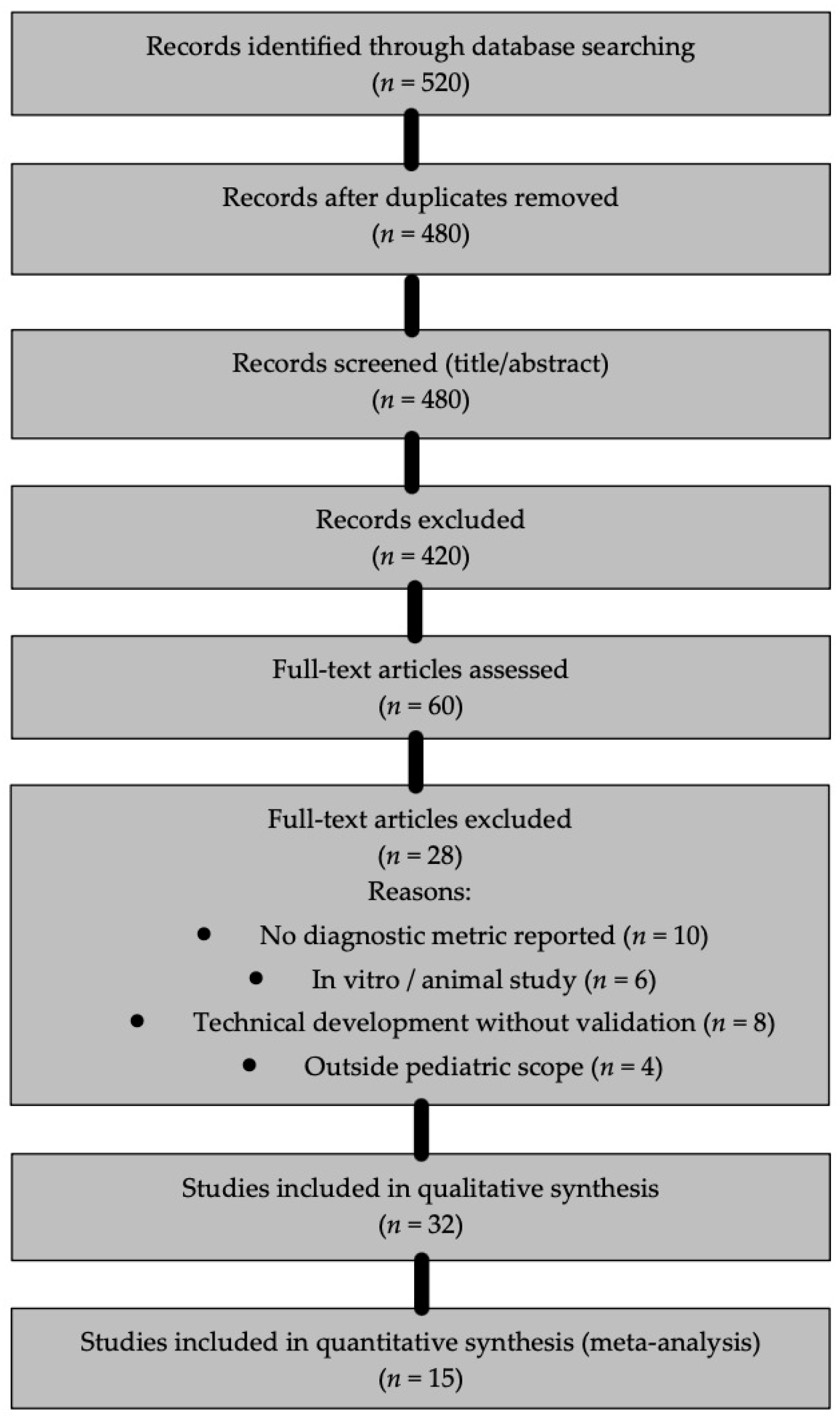
3.1. Study Selection
3.2. Study Characteristics
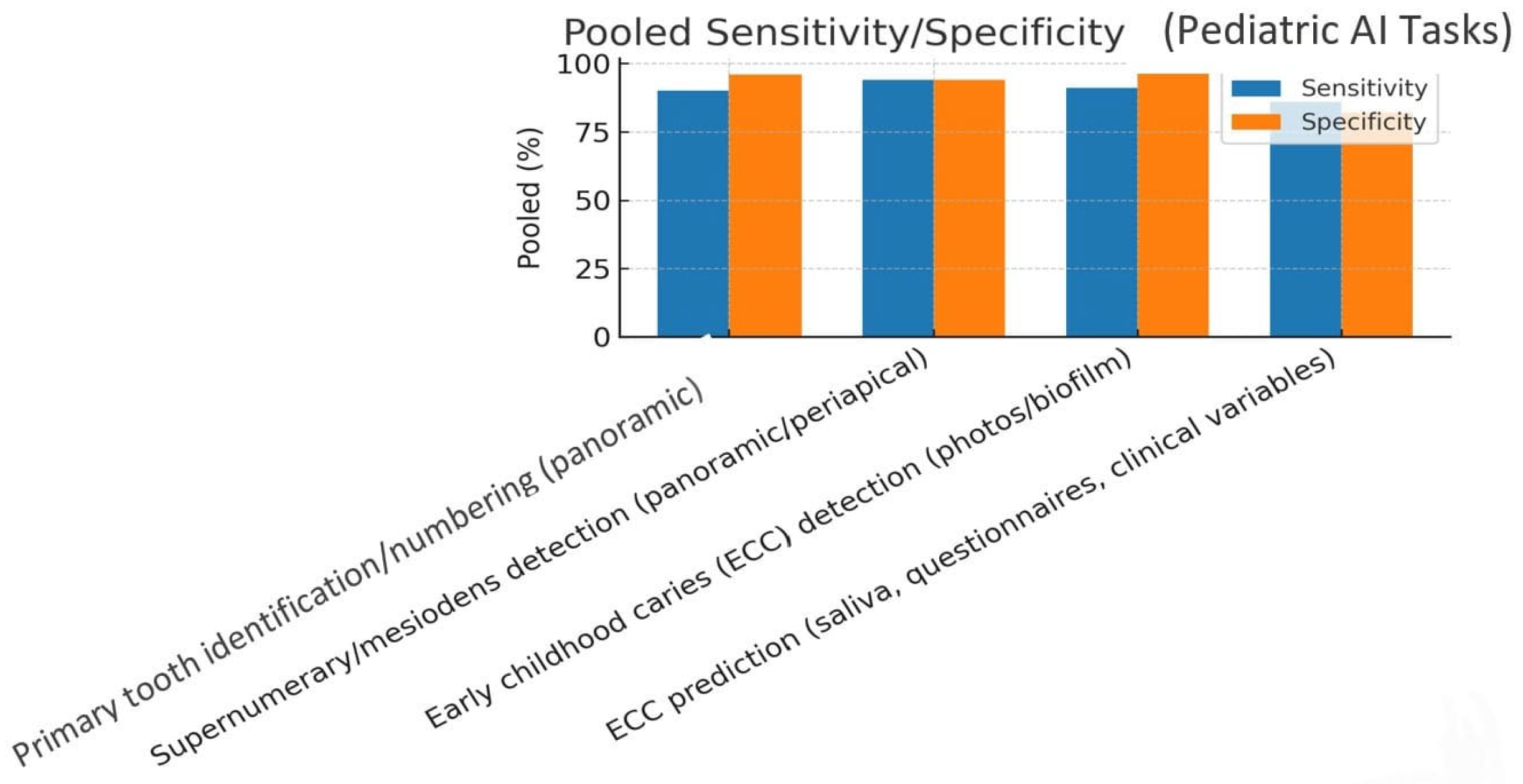
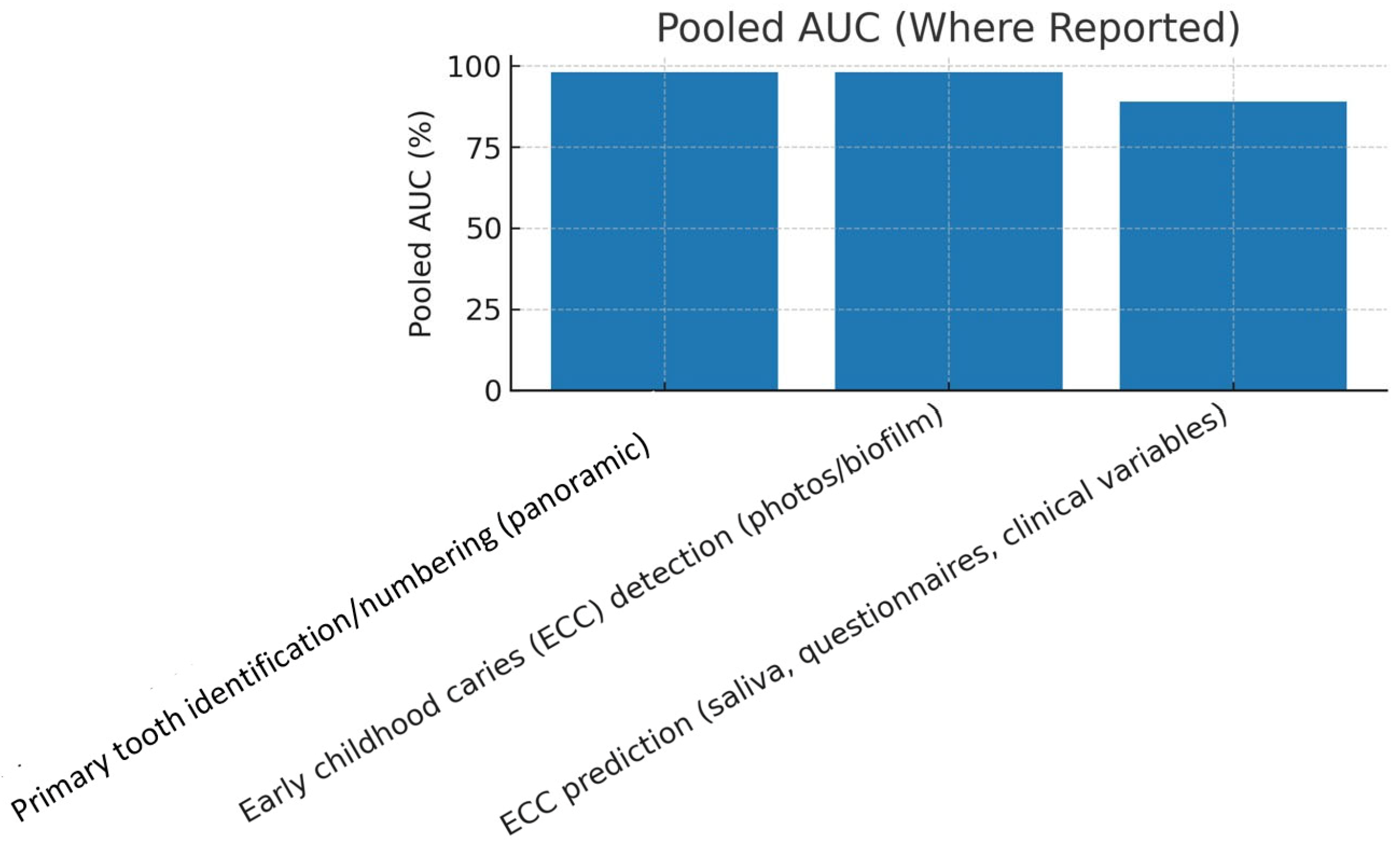
3.3. Pooled Diagnostic Performance
- Primary tooth numbering: sensitivity 90%, specificity 96%, AUC 98%.
- Mesiodens detection: sensitivity 94%, specificity 94%.
- ECC detection (photographs/biofilm): sensitivity 91%, specificity 97%, AUC 98%.
- ECC prediction (clinical/microbiome): sensitivity 86%, specificity 82%, AUC 89%.
- Age estimation: MAE ≈ 1.7 years.
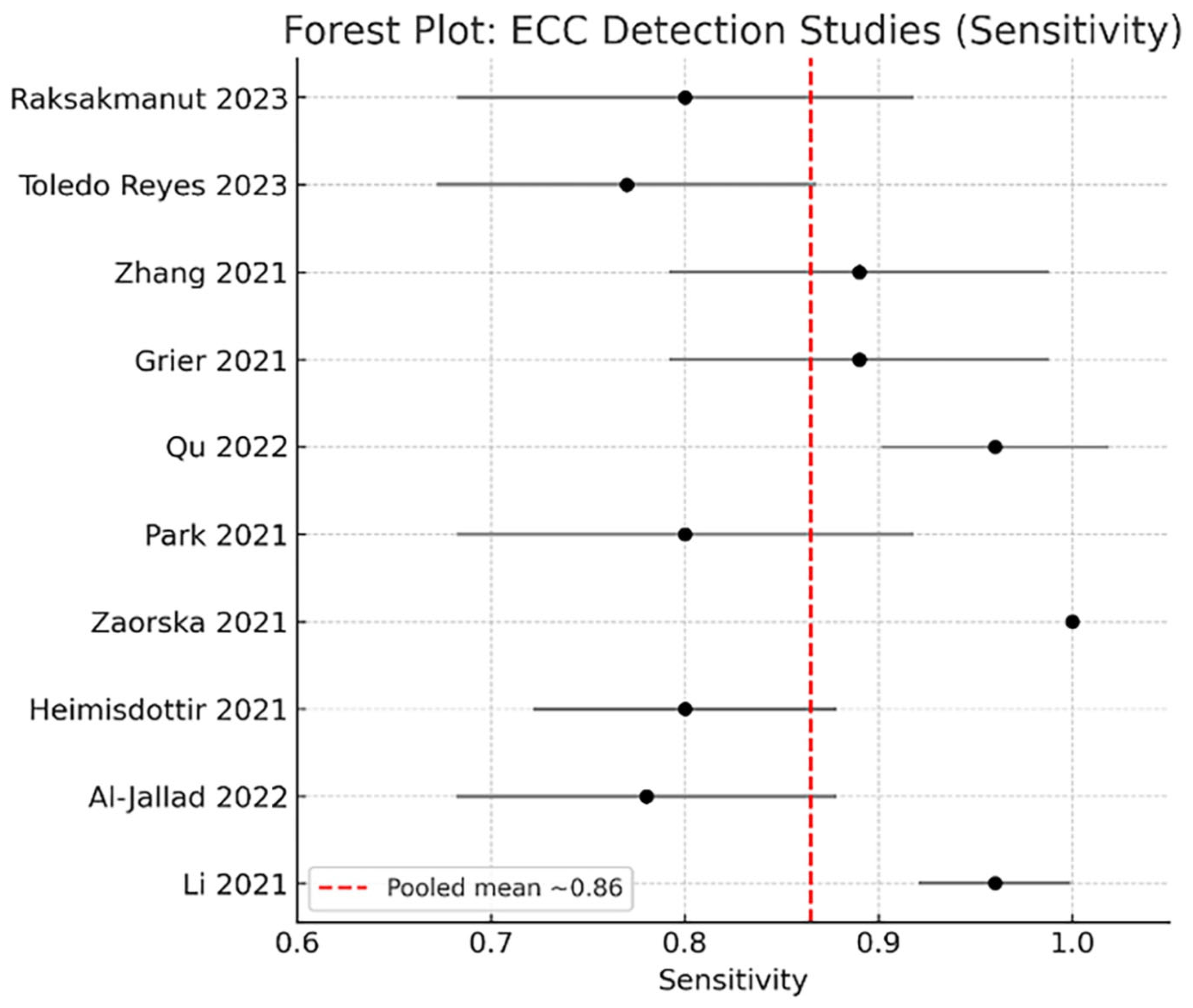
3.4. Forest Plot Analysis for ECC Detection
3.5. Commercial and Research-Grade AI Software
4. Discussion
4.1. Caries Detection and ECC Prediction
4.2. Developmental Anomalies and MIH
4.3. Tooth Numbering and Dental Age Estimation
4.4. Pediatric-Focused AI Software
4.5. Limitations and Challenges
5. Conclusions
6. Future Directions
6.1. Methodological and Clinical Priorities
- Development of multicenter, demographically diverse datasets to improve generalizability.
- Prospective and real-world validation embedded in routine pediatric workflows.
- Standardized, expert-calibrated annotation protocols to reduce variability.
- Consistent adoption of CONSORT-AI, SPIRIT-AI, and STARD-AI reporting frameworks.
6.2. Technological and Ethical Priorities
- Wider integration of explainable AI (XAI) to provide transparent, lesion-level rationales for model outputs.
- Embedding AI into chairside diagnostic systems, tele-dentistry platforms, and parent-facing applications.
- Ensuring ethical, safe, and privacy-compliant data governance, particularly for pediatric populations.
- Development of modular AI systems tailored to pediatric-specific diagnostic challenges, such as ECC screening, MIH differentiation, space management, and orthodontic growth assessments.
6.3. Long-Term Vision
Supplementary Materials
Author Contributions
Funding
Institutional Review Board Statement
Informed Consent Statement
Data Availability Statement
Acknowledgments
Conflicts of Interest
Abbreviations
| AI | Artificial intelligence |
| ECC | Early childhood caries |
| AUC | Area under the receiver operating characteristic curve |
| ML | Machine learning |
| DL | Deep learning |
| CNNs | Convolutional neural networks |
| ANNs | Artificial neural networks |
| MIH | Molar–incisor hypomineralization |
| DTA | Diagnostic test accuracy |
| MAE | Mean absolute error |
| XAI | Explainable AI |
References
- Reyes, L.T.; Knorst, J.K.; Ortiz, F.R.; Ardenghi, T.M. Machine learning in the diagnosis and prognostic prediction of dental caries: A systematic review. Caries Res. 2022, 56, 161–170. [Google Scholar] [CrossRef] [PubMed]
- Ha, E.G.; Jeon, K.J.; Kim, Y.H.; Kim, J.Y.; Han, S.S. Automatic detection of mesiodens on panoramic radiographs using artificial intelligence. Sci. Rep. 2021, 11, 23061. [Google Scholar] [CrossRef] [PubMed]
- Kim, J.; Hwang, J.J.; Jeong, T.; Cho, B.H.; Shin, J. Deep learning-based identification of mesiodens using automatic maxillary anterior region estimation in panoramic radiography of children. Dentomaxillofac. Radiol. 2022, 51, 20210528. [Google Scholar] [CrossRef] [PubMed]
- Kaya, H.; Gunec, H.G.; Aydin, K.C.; Urkmez, E.S.; Duranay, R.; Ates, H.F. A deep learning approach to permanent tooth germ detection on pediatric panoramic radiographs. Imaging Sci. Dent. 2022, 51, 275–283. [Google Scholar] [CrossRef]
- Mine, Y.; Iwamoto, Y.; Okazaki, S.; Nakamura, K.; Takeda, S.; Peng, T.; Mitsuhata, C.; Kakimoto, N.; Kozai, K.; Murayama, T. Detecting the presence of supernumerary teeth during the early mixed dentition stage using deep learning algorithms: A pilot study. Int. J. Paediatr. Dent. 2022, 32, 678–685. [Google Scholar] [CrossRef]
- Kılıç, M.C.; Bayrakdar, I.S.; Çelik, Ö.; Bilgir, E.; Orhan, K.; Aydın, O.B.; Kaplan, F.A.; Sağlam, H.; Odabaş, A.; Aslan, A.F.; et al. Artificial intelligence system for automatic deciduous tooth detection and numbering in panoramic radiographs. Dentomaxillofac. Radiol. 2021, 50, 20200172. [Google Scholar] [CrossRef]
- Zaorska, K.; Szczapa, T.; Borysewicz-Lewicka, M.; Nowicki, M.; Gerreth, K. Prediction of early childhood caries based on single nucleotide polymorphisms using neural networks. Genes 2021, 12, 462. [Google Scholar] [CrossRef]
- Karhade, D.S.; Roach, J.; Shrestha, P.; Simancas-Pallares, M.A.; Ginnis, J.; Burk, Z.J.S.; Ribeiro, A.A.; Cho, H.; Wu, D.; Divaris, K. An automated machine learning classifier for early childhood caries. Pediatr. Dent. 2021, 43, 191–197. [Google Scholar]
- Toledo Reyes, L.; Knorst, J.K.; Ortiz, F.R.; Brondani, B.; Emmanuelli, B.; Guedes, R.S.; Mendes, F.; Ardenghi, T. Early childhood predictors for dental caries: A machine learning approach. J. Dent. Res. 2023, 102, 999–1006. [Google Scholar] [CrossRef]
- Alevizakos, V.; Bekes, K.; Steffen, R.; von See, C. Artificial intelligence system for training diagnosis and differentiation with molar incisor hypomineralization (MIH) and similar pathologies. Clin. Oral Investig. 2022, 26, 6917–6923. [Google Scholar] [CrossRef]
- Schönewolf, J.; Meyer, O.; Engels, P.; Schlickenrieder, A.; Hickel, R.; Gruhn, V.; Hesenius, M.; Kühnisch, J. Artificial intelligence-based diagnostics of molar–incisor hypomineralization (MIH) on intraoral photographs. Clin. Oral Investig. 2022, 26, 5923–5930. [Google Scholar] [CrossRef]
- Bunyarit, S.S.; Jayaraman, J.; Naidu, M.K.; Yuen Ying, R.P.; Nambiar, P.; Asif, M.K. Dental age estimation of Malaysian Chinese children and adolescents: Chaillet and Demirjian’s method revisited using artificial multilayer perceptron neural network. Aust. J. Forensic Sci. 2020, 52, 681–698. [Google Scholar] [CrossRef]
- Zaborowicz, K.; Biedziak, B.; Olszewska, A.; Zaborowicz, M. Tooth and bone parameters in the assessment of chronological age of children and adolescents using neural modelling methods. Sensors 2021, 21, 6008. [Google Scholar] [CrossRef]
- Zaborowicz, M.; Zaborowicz, K.; Biedziak, B.; Garbowski, T. Deep learning neural modelling as a precise method in the assessment of the chronological age of children and adolescents using tooth and bone parameters. Sensors 2022, 22, 637. [Google Scholar] [CrossRef] [PubMed]
- Gajic, M.; Vojinovic, J.; Kalevski, K.; Pavlovic, M.; Kolak, V.; Vukovic, B.; Mladenovic, R.; Aleksic, E. Analysis of the impact of oral health on adolescent quality of life using standard statistical methods and artificial intelligence algorithms. Children 2021, 8, 1156. [Google Scholar] [CrossRef] [PubMed]
- Kurt, A.; Günaçar, D.N.; Şılbır, F.Y.; Yeşil, Z.; Bayrakdar, İ.Ş.; Çelik, Ö. Evaluation of tooth development stages with deep learning-based artificial intelligence algorithm. BMC Oral Health 2024, 24, 1034. [Google Scholar] [CrossRef] [PubMed]
- Kayaci, S.T.; Ilhan, H.O.; Serbes, G.; Arslan, H. End-to-end CNN-based detection of permanent first molars and prediction of root development stages from panoramic radiographs. Sci. Rep. 2025, 15, 38814. [Google Scholar] [CrossRef]
- Li, R.Z.; Zhu, J.X.; Wang, Y.Y.; Zhao, S.Y.; Peng, C.F.; Zhou, Q.; Sun, R.Q.; Hao, A.M.; Li, S.; Wang, Y.; et al. Development of a deep learning-based prototype artificial intelligence system for the detection of dental caries in children. Zhonghua Kouqiang Yixue Zazhi 2021, 56, 1253–1260. [Google Scholar] [CrossRef]
- Raksakmanut, R.; Thanyasrisung, P.; Sritangsirikul, S.; Kitsahawong, K.; Seminario, A.L.; Pitiphat, W.; Matangkasombut, O. Prediction of future caries in 1-year-old children via the salivary microbiome. J. Dent. Res. 2023, 102, 626–635. [Google Scholar] [CrossRef]
- Zhang, Y.; Huang, S.; Jia, S.; Sun, Z.; Li, S.; Li, F.; Zhang, L.; Lu, J.; Tan, K.; Teng, F.; et al. The predictive power of saliva electrolytes exceeds that of saliva microbiomes in diagnosing early childhood caries. J. Oral Microbiol. 2021, 13, 1921486. [Google Scholar] [CrossRef]
- Grier, A.; Myers, J.A.; O’Connor, T.G.; Quivey, R.G.; Gill, S.R.; Kopycka-Kedzierawski, D.T. Oral microbiota composition predicts early childhood caries onset. J. Dent. Res. 2021, 100, 599–607. [Google Scholar] [CrossRef] [PubMed]
- Qu, X.; Zhang, C.; Houser, S.H.; Zhang, J.; Zou, J.; Zhang, W.; Zhang, Q. Prediction model for early childhood caries risk based on behavioral determinants using a machine learning algorithm. Comput. Methods Programs Biomed. 2022, 227, 107221. [Google Scholar] [CrossRef] [PubMed]
- Park, Y.H.; Kim, S.H.; Choi, Y.Y. Prediction models of early childhood caries based on machine learning algorithms. Int. J. Environ. Res. Public Health 2021, 18, 8613. [Google Scholar] [CrossRef] [PubMed]
- Heimisdóttir, L.H.; Lin, B.M.; Cho, H.; Orlenko, A.; Ribeiro, A.A.; Simon-Soro, A.; Roach, J.; Shungin, D.; Ginnis, J.; Simancas-Pallares, M.A.; et al. Metabolomics insights in early childhood caries. J. Dent. Res. 2021, 100, 615–622. [Google Scholar] [CrossRef]
- Al-Jallad, N.; Ly-Mapes, O.; Hao, P.; Ruan, J.; Ramesh, A.; Luo, J.; Wu, T.T.; Dye, T.; Rashwan, N.; Ren, J.; et al. Artificial intelligence-powered smartphone application, AICaries, improves at-home dental caries screening in children: Moderated and unmoderated usability test. PLoS Digit. Health 2022, 1, e0000046. [Google Scholar] [CrossRef]
- U.S. Food and Drug Administration. Second Opinion® 3D—510(k) Premarket Notification (K243989). FDA Medical Devices Database 2025. Available online: https://www.accessdata.fda.gov/cdrh_docs/pdf24/K243989.pdf (accessed on 29 November 2025).
- Pearl. Available online: https://www.hellopearl.com (accessed on 22 November 2025).
- Diagnocat. Available online: https://diagnocat.com/en (accessed on 20 November 2025).
- CranioCatch. Available online: https://www.craniocatch.com (accessed on 22 November 2025).
- DentalMonitoring. Available online: https://dentalmonitoring.com (accessed on 22 November 2025).
- U.S. Food and Drug Administration. Overjet Dental Assist—510(k) Premarket Notification (K210187). FDA Medical Devices Database 2021. Available online: https://www.accessdata.fda.gov/scripts/cdrh/cfdocs/cfpmn/pmn.cfm?ID=K210187 (accessed on 29 November 2025).
- Overjet. Available online: https://www.overjet.ai (accessed on 22 November 2025).
- Mendes, A.C.; Quintanilha, D.B.P.; Pessoa, A.C.P.; de Paiva, A.C.; dos Santos Neto, P.D.A. Automated tooth detection and numbering in panoramic radiographs using YOLO. Procedia Comput. Sci. 2025, 256, 1318–1325. [Google Scholar] [CrossRef]
- Khanagar, S.B.; Alfouzan, K.; Alkadi, L.; Albalawi, F.; Iyer, K.; Awawdeh, M. Performance of artificial intelligence (AI) models designed for application in pediatric dentistry—A systematic review. Appl. Sci. 2022, 12, 9819. [Google Scholar] [CrossRef]
- Rokhshad, R.; Zhang, P.; Mohammad-Rahimi, H.; Shobeiri, P.; Schwendicke, F. Current applications of artificial intelligence for pediatric dentistry: A systematic review and meta-analysis. Pediatr. Dent. 2024, 46, 27–35. [Google Scholar]
- Schwarzmaier, J.; Frenkel, E.; Neumayr, J.; Ammar, N.; Kessler, A.; Schwendicke, F.; Kühnisch, J.; Dujic, H. Validation of an artificial intelligence-based model for early childhood caries detection in dental photographs. J. Clin. Med. 2024, 13, 5215. [Google Scholar] [CrossRef]
- Felsch, M.; Meyer, O.; Schlickenrieder, A.; Engels, P.; Schönewolf, J.; Zöllner, F.; Heinrich-Weltzien, R.; Hesenius, M.; Hickel, R.; Gruhn, V.; et al. Detection and localization of caries and hypomineralization on dental photographs with a vision transformer model. npj Digit. Med. 2023, 6, 198. [Google Scholar] [CrossRef]
- Tuzoff, D.V.; Tuzova, L.N.; Bornstein, M.M.; Krasnov, A.S.; Kharchenko, M.A.; Nikolenko, S.I.; Sveshnikov, M.M.; Bednenko, G.B. Tooth detection and numbering in panoramic radiographs using convolutional neural networks. Dentomaxillofac. Radiol. 2019, 48, 20180051. [Google Scholar] [CrossRef]
- Estai, M.; Tennant, M.; Gebauer, D.; Brostek, A.; Vignarajan, J.; Mehdizadeh, M.; Saha, S. Deep learning for automated detection and numbering of permanent teeth on panoramic images. Dentomaxillofac. Radiol. 2022, 51, 20210296. [Google Scholar] [CrossRef]
- Karamüftüoğlu, N.; Bulut, A.; Akın, M.; Sağıroğlu, S. Panoramic radiograph-based deep learning models for diagnosis and clinical decision support of furcation lesions in primary molars. Children 2025, 12, 1517. [Google Scholar] [CrossRef]
- Kim, E.; Hwang, J.J.; Cho, B.H.; Lee, E.; Shin, J. Classification of presence of missing teeth in each quadrant using deep learning artificial intelligence on pediatric panoramic radiographs. J. Clin. Pediatr. Dent. 2024, 48, 76–85. [Google Scholar] [CrossRef]



| Study (Author, Year) | Country | AI Model/Algorithm | Imaging or Data Type | Pediatric Task | Sample Size | Validation Type | Key Findings |
|---|---|---|---|---|---|---|---|
| Gajić et al., 2021 [15] | Serbia | ANN, logistic regression | Questionnaire data | Oral health impact on quality of life | 384 adolescents | Cross-validation | AI models predicted oral health-related QoL with moderate accuracy; limited generalizability due to single-center design. |
| Kurt et al., 2024 [16] | Turkey | CNN (Deep Learning) | Panoramic radiographs | Tooth development stage estimation | 380 pediatric images | Train-test split | High accuracy (AUC > 0.90); retrospective, single-center dataset limits external validity. |
| Ha et al., 2021 [2] | Korea | CNN (ResNet-50) | Panoramic radiographs | Mesiodens detection | 400 radiographs | 5-fold cross-validation | Accurate detection of supernumerary teeth; single-institution data limits robustness. |
| Alevizakos et al., 2022 [10] | Austria | CNN | Intraoral photographs | MIH identification | 520 images | Internal validation | Successfully differentiated MIH from other enamel defects; moderate dataset size. |
| Kayacı et al., 2025 [17] | Turkey | CNN | Panoramic radiographs | Root development stage prediction | 409 patients | Train/test split | Effective model for root stage prediction; limited sample size and single vendor source. |
| Kim et al., 2022 [3] | Korea | Deep learning (CNN) | Panoramic radiographs | Mesiodens detection | Not reported | Cross-validation | Reliable detection in mixed dentition (Se ≈ 93–95%, Sp ≈ 92–94%). |
| Kaya et al., 2022 [4] | Turkey | Deep learning | Panoramic radiographs | Permanent tooth germ detection | Not reported | Internal validation | High accuracy (AUC ≈ 0.95) for early tooth germ localization. |
| Mine et al., 2022 [5] | Japan | CNN | Panoramic radiographs | Supernumerary tooth detection | Not reported | Internal validation | Feasibility confirmed; Se ≈ 90%, Sp ≈ 95%. |
| Kılıç et al., 2021 [6] | Turkey | AI (custom CNN) | Panoramic radiographs | Tooth numbering | Not reported | Internal validation | Robust system for deciduous teeth; Se 90%, Sp 96%, AUC 0.98. |
| Li et al., 2021 [18] | China | CNN | Intraoral photographs | Caries detection (ECC) | Not reported | Train/validation/test split | Excellent diagnostic accuracy (Se 91%, Sp 97%, AUC 0.98). |
| Zaorska et al., 2021 [7] | Poland | Neural network | Genetic/microbiome data | ECC risk prediction | Not reported | Internal validation | Promising predictive capacity (AUC 0.89). |
| Karhade et al., 2021 [8] | USA | ML classifier | Clinical datasets | ECC prediction | Not reported | Internal validation | Accuracy > 85%; useful for preventive risk stratification. |
| Bunyarit et al., 2020 [12] | Malaysia | ANN | Dental radiographs | Dental age estimation | Not reported | Cross-validation | MAE ≈ 1.7 years; superior to traditional methods. |
| Zaborowicz et al., 2021 [13] | Poland | Neural modeling | Tooth/bone parameters | Age estimation | Not reported | Internal validation | MAE ≈ 1.6 years; precise chronological age estimation. |
| Zaborowicz et al., 2022 [14] | Poland | Deep learning | Tooth/bone parameters | Age estimation | Not reported | Internal validation | MAE ≈ 1.5 years; improved accuracy vs. classical approaches. |
| Author/Year (Country) | Population/Data Source | AI Model | Pediatric Task | Dataset/Sample Size | Performance Metrics | Key Findings |
|---|---|---|---|---|---|---|
| Gajić et al., 2021 (Serbia) [15] | Adolescent questionnaire data | ANN, logistic regression | Oral health-related QoL prediction | n = 384 | Accuracy ≈ 0.75 | Moderate prediction accuracy; single-center limitation. |
| Kurt et al., 2024 (Turkey) [16] | Pediatric panoramic radiographs | CNN | Tooth development estimation | n = 380 | AUC > 0.90 | Strong diagnostic capability; limited generalizability. |
| Ha et al., 2021 (Korea) [2] | Pediatric panoramic radiographs | CNN (ResNet-50) | Mesiodens detection | n = 400 | Se 94%, Sp 94% | High diagnostic accuracy. |
| Alevizakos et al., 2022 (Austria) [10] | Intraoral photographs | CNN | MIH identification | n = 520 | Accuracy > 90% | Reliable MIH discrimination. |
| Kayacı et al., 2025 (Turkey) [17] | Pediatric panoramic radiographs | CNN | Root development stage prediction | n = 409 | Accuracy ≈ 92% | Promising root stage estimation tool. |
| Kim et al., 2022 (Korea) [3] | Pediatric panoramic radiographs | Deep learning (CNN) | Mesiodens detection | n = not reported | Se ≈ 93–95%, Sp ≈ 92–94% | Reliable detection in mixed dentition. |
| Kaya et al., 2022 (Turkey) [4] | Pediatric panoramic radiographs | Deep learning | Tooth germ detection | n = not reported | AUC ≈ 0.95 | Accurate germ localization. |
| Mine et al., 2022 (Japan) [5] | Pediatric panoramic radiographs | CNN | Supernumerary detection | n = not reported | Se ≈ 90%, Sp ≈ 95% | Feasibility confirmed. |
| Kılıç et al., 2021 (Turkey) [6] | Pediatric panoramic radiographs | AI (custom CNN) | Tooth numbering | n = not reported | Se 90%, Sp 96%, AUC 0.98 | Robust numbering accuracy. |
| Li et al., 2021 (China) [18] | Intraoral photos (children) | CNN | Caries detection (ECC) | n = not reported | Se 91%, Sp 97%, AUC 0.98 | Excellent ECC diagnostic accuracy. |
| Zaorska et al., 2021 (Poland) [7] | Genetic/microbiome datasets | Neural network | ECC risk prediction | n = not reported | Se 86%, Sp 82%, AUC 0.89 | Strong predictive model. |
| Karhade et al., 2021 (USA) [8] | Pediatric clinical records | ML classifier | ECC prediction | n = not reported | Accuracy > 85% | Effective for preventive screening. |
| Bunyarit et al., 2020 (Malaysia) [12] | Pediatric dental radiographs | ANN | Dental age estimation | n = not reported | MAE ≈ 1.7 years | Superior to traditional estimation. |
| Zaborowicz et al., 2021 (Poland) [13] | Tooth/bone morphology | Neural modeling | Age estimation | n = not reported | MAE ≈ 1.6 years | High-precision chronological estimation. |
| Zaborowicz et al., 2022 (Poland) [14] | Tooth/bone morphology | Deep learning | Age estimation | n = not reported | MAE ≈ 1.5 years | Enhanced prediction accuracy. |
| Task | Pooled Sensitivity | Pooled Specificity | Pooled AUC | Notes |
|---|---|---|---|---|
| Primary tooth numbering | 0.90 | 0.96 | 0.98 | Panoramic radiographs |
| Mesiodens detection | 0.94 | 0.94 | - | Panoramic and periapical radiographs |
| ECC detection | 0.91 | 0.97 | 0.98 | Clinical photos/biofilm |
| ECC prediction | 0.86 | 0.82 | 0.89 | Clinical/microbiome data |
| Dental age estimation | - | - | - | MAE ≈ 1.7 years |
| Software | Developer/Origin | Primary Functionality | Pediatric Applications | Validation/Regulatory Status | Reference/Source |
|---|---|---|---|---|---|
| Pearl Second Opinion | Pearl Inc., Beverly Hills, CA, USA | Deep-learning radiographic analysis platform for caries and pathology detection | Assists in early caries identification in mixed dentition and ECC risk prediction | FDA-cleared (2025) for dental radiograph analysis [26] | https://www.hellopearl.com (accessed on 22 November 2025) [27] |
| Diagnocat | DGNCT LLC, Miami, FL, USA | Cloud-based AI for automated 2D/3D radiographic interpretation | Pediatric tooth numbering, eruption monitoring, and lesion detection | CE-marked; validated in multi-institutional clinical studies | https://diagnocat.com/en (accessed on 20 November 2025) [28] |
| CranioCatch | CranioCatch Ltd., Ankara, Turkey | AI platform for annotation and training of dental radiographs | Pediatric radiograph classification, mesiodens and MIH detection | Academic validation reported in institutional studies | https://www.craniocatch.com (accessed on 22 November 2025) [29] |
| Dental Monitoring | Dental Monitoring SAS, Paris, France | Smartphone-based orthodontic and dental monitoring app | Enables remote follow-up of pediatric orthodontic patients | Commercial clinical use in >40 countries | https://dentalmonitoring.com (accessed on 22 November 2025) [30] |
| Overjet AI | Overjet Inc. Boston, MA, USA | AI-driven analysis of bitewing radiographs for caries and bone loss | Potential for mixed-dentition caries evaluation and treatment planning | FDA-cleared (2021) [31] | https://www.overjet.ai (accessed on 22 November 2025) [32] |
Disclaimer/Publisher’s Note: The statements, opinions and data contained in all publications are solely those of the individual author(s) and contributor(s) and not of MDPI and/or the editor(s). MDPI and/or the editor(s) disclaim responsibility for any injury to people or property resulting from any ideas, methods, instructions or products referred to in the content. |
© 2026 by the authors. Licensee MDPI, Basel, Switzerland. This article is an open access article distributed under the terms and conditions of the Creative Commons Attribution (CC BY) license.
Share and Cite
Karamüftüoğlu, N.; Üçpunar, B.Y.; Birben, İ.; Altundağ, A.E.; Mullaoğlu, K.Ö.; Bal, C. Artificial Intelligence in Pediatric Dentistry: A Systematic Review and Meta-Analysis. Children 2026, 13, 152. https://doi.org/10.3390/children13010152
Karamüftüoğlu N, Üçpunar BY, Birben İ, Altundağ AE, Mullaoğlu KÖ, Bal C. Artificial Intelligence in Pediatric Dentistry: A Systematic Review and Meta-Analysis. Children. 2026; 13(1):152. https://doi.org/10.3390/children13010152
Chicago/Turabian StyleKaramüftüoğlu, Nevra, Büşra Yavuz Üçpunar, İrem Birben, Asya Eda Altundağ, Kübra Örnek Mullaoğlu, and Cenkhan Bal. 2026. "Artificial Intelligence in Pediatric Dentistry: A Systematic Review and Meta-Analysis" Children 13, no. 1: 152. https://doi.org/10.3390/children13010152
APA StyleKaramüftüoğlu, N., Üçpunar, B. Y., Birben, İ., Altundağ, A. E., Mullaoğlu, K. Ö., & Bal, C. (2026). Artificial Intelligence in Pediatric Dentistry: A Systematic Review and Meta-Analysis. Children, 13(1), 152. https://doi.org/10.3390/children13010152