Psychometric Properties of the CEVEO Bullying Subscales for Aggressors in School and Leisure Contexts Among Chilean Adolescents: Profiles Based on Moral Disengagement, Aggression Frequency, and Context



Highlights
- •
- The aggression subscales of the CEVEO demonstrate adequate psychometric properties for use with Chilean adolescents, enabling the assessment of aggression in both school and leisure contexts.
- •
- These subscales allow for the classification of aggressors into distinct types based on the frequency and context of their aggressive behaviors.
- •
- A high-risk profile (Profile 3) was identified, consisting of adolescents who exhibited a high frequency of aggression across both contexts (school and leisure) and elevated levels of moral disengagement.
- •
- Measuring aggression in both school and leisure settings allows for a more comprehensive identification of high-risk aggressor profiles, as those involved in multiple contexts show higher levels of moral disengagement regardless of frequency.
Abstract
1. Introduction
1.1. The Role of Moral Disengagement in School Violence
1.2. Leisure-Time Aggression in Adolescents
1.3. Bullying Measurement Scales
1.4. Study Objectives
2. Materials and Methods
2.1. Design
2.2. Participants
2.3. Instruments
2.3.1. Ad Hoc Sociodemographic Questionnaire
2.3.2. Bullying at School Subscale of the CEVEO
2.3.3. Bullying During Leisure Subscale of the CEVEO
2.3.4. Mechanisms of Moral Disengagement Scale
2.4. Procedure
2.5. Plan of Analysis
3. Results
3.1. Descriptive Analysis of the Items
3.2. Bullying at School Subscale
3.3. Bullying During Leisure Subscale
3.4. Reliability
3.5. Evidence of Validity Based on the Relationship with Other Variables
3.6. Aggressor Profiles Based on Frequency and Contexts of Violence
3.7. Comparison of Aggressor Profiles in MD
3.8. Number of Aggression Contexts and Their Relationship with MD
4. Discussion
4.1. Factor Structure
4.2. Reliability and Validity Evidence
4.3. Aggressor Profiles
4.4. Preventive, Clinical and Policy Implications
4.5. Limitations
4.6. Future Research Directions
5. Conclusions
Author Contributions
Funding
Institutional Review Board Statement
Informed Consent Statement
Data Availability Statement
Conflicts of Interest
References
- Gaete, J.; Valenzuela, D.; Godoy, M.I.; Rojas-Barahona, C.A.; Salmivalli, C.; Araya, R. Validation of the Revised Olweus Bully/Victim Questionnaire (OBVQ-R) Among Adolescents in Chile. Front. Psychol. 2021, 12, 578661. [Google Scholar] [CrossRef]
- Menesini, E.; Salmivalli, C. Bullying in Schools: The State of Knowledge and Effective Interventions. Psychol. Health Med. 2017, 22, 240–253. [Google Scholar] [CrossRef] [PubMed]
- Olweus, D. Bullying at School: What We Know and What We Can Do; Blackwell Publishing: Oxford, UK, 1993. [Google Scholar]
- Caravita, S.C.S.; Gini, G.; Pozzoli, T. Main and Moderated Effects of Moral Cognition and Status on Bullying and Defending. Aggress. Behav. 2012, 38, 456–468. [Google Scholar] [CrossRef] [PubMed]
- López, V.; Orpinas, P. Las escalas de agresión y victimización: Validación y prevalencia en estudiantes chilenos. Rev. Latinoam. Psicol. 2012, 44, 109–124. [Google Scholar]
- Neut, P. Las violencias escolares en el escenario educativo chileno. Análisis crítico del estado del arte. Calid. Educ. 2017, 46, 222–247. [Google Scholar] [CrossRef]
- Wang, X.; Lei, L.; Liu, D.; Hu, H. Moderating Effects of Moral Reasoning and Gender on the Relation between Moral Disengagement and Cyberbullying in Adolescents. Personal. Individ. Differ. 2016, 98, 244–249. [Google Scholar] [CrossRef]
- Li, C.; Wang, P.; Martin-Moratinos, M.; Bella-Fernández, M.; Blasco-Fontecilla, H. Traditional Bullying and Cyberbullying in the Digital Age and Its Associated Mental Health Problems in Children and Adolescents: A Meta-Analysis. Eur. Child. Adolesc. Psychiatry 2024, 33, 2895–2909. [Google Scholar] [CrossRef]
- Cook, C.R.; Williams, K.R.; Guerra, N.G.; Kim, T.E.; Sadek, S. Predictors of Bullying and Victimization in Childhood and Adolescence: A Meta-Analytic Investigation. Sch. Psychol. Q. 2010, 25, 65–83. [Google Scholar] [CrossRef]
- Díaz-Aguado, M.J.; Martínez, R.; Martín, G. La evaluación de la violencia entre iguales en la escuela y el ocio. In Prevención de la Violencia y Lucha Contra la Exclusión Desde la Adolescencia; Instituto de la Juventud y Ministerio de Trabajo y Asuntos Sociales: Madrid, Spain, 2004; pp. 21–65. [Google Scholar]
- Organización de las Naciones Unidas para la Educación la Ciencia y la Cultura. Más Allá de Los Números: Poner Fin a La Violencia y El Acoso En El Ámbito Escolar; UNESCO: Paris, France, 2021. [Google Scholar]
- Vivolo-Kantor, A.M.; Martell, B.N.; Holland, K.M.; Westby, R. A Systematic Review and Content Analysis of Bullying and Cyber-Bullying Measurement Strategies. Aggress. Violent Behav. 2014, 19, 423–434. [Google Scholar] [CrossRef]
- Instituto Nacional de Estadísticas Síntesis de Resultados Censo 2017. Available online: https://shortest.link/3L1t (accessed on 1 June 2025).
- Bravo, M.; Ramírez, P. Denuncias Por Convivencia Escolar al Cuarto Trimestre de 2022: Una Revisión General, Por Tema, Subtema y Región; Universidad de La Frontera: Temuco, Chile, 2022; Núcleo científico tecnológico en Ciencias Sociales y Humanidades. [Google Scholar]
- Puma-Maque, O.C.; Cárdenas-Zúñiga, M.D.C. Bullying y cyberbullying en el contexto peruano (2017–2021): Una revisión sistemática. Rev. Latinoam. Cienc. Soc. Niñez Juv. 2023, 22, 1–21. [Google Scholar] [CrossRef]
- Gini, G.; Pozzoli, T.; Hymel, S. Moral Disengagement among Children and Youth: A Meta-analytic Review of Links to Aggressive Behavior. Aggress. Behav. 2014, 40, 56–68. [Google Scholar] [CrossRef]
- Gini, G.; Thornberg, R.; Pozzoli, T. Individual Moral Disengagement and Bystander Behavior in Bullying: The Role of Moral Distress and Collective Moral Disengagement. Psychol. Violence 2020, 10, 38–47. [Google Scholar] [CrossRef]
- Wang, X.; Zhao, F.; Yang, J.; Gao, L.; Li, B.; Lei, L.; Wang, P. Childhood Maltreatment and Bullying Perpetration among Chinese Adolescents: A Moderated Mediation Model of Moral Disengagement and Trait Anger. Child. Abus. Negl. 2020, 106, 104507. [Google Scholar] [CrossRef] [PubMed]
- Bandura, A. Selective Activation and Disengagement of Moral Control. J. Soc. Issues 1991, 46, 27–46. [Google Scholar] [CrossRef]
- Rubio-Garay, F.; Carrasco, M.A.; Amor, P.; Rojas-Solís, J.L. Desconexión Moral y Violencia En Parejas Jóvenes. In Psicopatología de la Violencia. Repercusiones Forenses; Manual Moderno y Universidad Nacional Autónoma de México: Mexico City, Mexico, 2019. [Google Scholar]
- Bautista-Aranda, N.; Contreras, L.; Cano-Lozano, M.C. Exposure to Violence during Childhood and Child-to-Parent Violence: The Mediating Role of Moral Disengagement. Healthcare 2023, 11, 1402. [Google Scholar] [CrossRef] [PubMed]
- Concha-Salgado, A.; Ramírez, A.; Pérez, B.; Pérez-Luco, R.; García-Cueto, E. Moral Disengagement as a Self-Regulatory Cognitive Process of Transgressions: Psychometric Evidence of the Bandura Scale in Chilean Adolescents. Int. J. Environ. Res. Public Health 2022, 19, 12249. [Google Scholar] [CrossRef]
- Killer, B.; Bussey, K.; Hawes, D.J.; Hunt, C. A Meta-analysis of the Relationship between Moral Disengagement and Bullying Roles in Youth. Aggress. Behav. 2019, 45, 450–462. [Google Scholar] [CrossRef]
- Zhao, L.; Yu, J. A Meta-Analytic Review of Moral Disengagement and Cyberbullying. Front. Psychol. 2021, 12. [Google Scholar] [CrossRef]
- Bandura, A. Social Cognitive Theory: An Agentic Perspective. Psychology 2020, 12, 313. [Google Scholar] [CrossRef]
- Bussey, K.; Luo, A.; Jackson, E. The Role of Moral Disengagement in Youth Bullying Behaviour. Int. J. Psychol. 2024, 59, 1254–1262. [Google Scholar] [CrossRef]
- Wang, X.; Yang, L.; Yang, J.; Gao, L.; Zhao, F.; Xie, X.; Lei, L. Trait Anger and Aggression: A Moderated Mediation Model of Anger Rumination and Moral Disengagement. Personal. Individ. Differ. 2018, 125, 44–49. [Google Scholar] [CrossRef]
- Campaert, K.; Nocentini, A.; Menesini, E. The Role of Poor Parenting and Parental Approval for Children’s Moral Disengagement. J. Child. Fam. Stud. 2018, 27, 2656–2667. [Google Scholar] [CrossRef]
- Teng, Z.J.; Bear, G.G.; Yang, C.Y.; Nie, Q.; Guo, C. Moral Disengagement and Bullying Perpetration: A Longitudinal Study of the Moderating Effect of School Climate. Sch. Psychol. 2020, 35, 99–109. [Google Scholar] [CrossRef] [PubMed]
- Andershed, H.; Kerr, M.; Stattin, H. Bullying in School and Violence on the Streets: Are the Same People Involved? J. Scand. Stud. Criminol. Crime Prev. 2001, 2, 31–49. [Google Scholar] [CrossRef]
- Ahn, K.O.; Kim, J.; Shin, S.D.; Park, H.; Vaca, F.E.; Park, J.O. The Influence of Behavioural and Socioeconomic Factors on the Community Injury Rates of Adolescents Assessed by the South Korean Emergency Medical Services: An Ecological Approach. BMC Public Health 2019, 19, 830. [Google Scholar] [CrossRef]
- Pulido, R. Estudio de los roles en la violencia entre iguales: Víctima, agresor y observador. INFAD Rev. Psicol. 2008, 3, 279–288. [Google Scholar]
- Pulido, R.; Martín, G.; Lucas, B. Risk Profiles and Peer Violence in the Context of School and Leisure Time. Span. J. Psychol. 2011, 14, 701–711. [Google Scholar] [CrossRef]
- Xie, Z.; Man, W.; Liu, C.; Fu, X. A PRISMA-Based Systematic Review of Measurements for School Bullying. Adolesc. Res. Rev. 2023, 8, 219–259. [Google Scholar] [CrossRef]
- Herrera-López, M.; Romera, E.M.; Ortega-Ruiz, R. Bullying y cyberbullying en Latinoamérica. Un estudio bibliométrico. Rev. Mex. Investig. Educ. 2018, 23, 125–155. [Google Scholar]
- Lecannelier, F.; Varela, J.; Rodríguez, J.; Hoffmann, M.; Flores, F.; Ascanio, L. Validación del Cuestionario de Maltrato entre Iguales por Abuso de Poder (MIAP) para escolares. Rev. Méd. Chile 2011, 139, 474–479. [Google Scholar] [CrossRef]
- Lecannelier, F.; Varela, J.; Astudillo, J.; Rodríguez, J.; Orellana, P. Daptación y Validación Del Intrumento “Internet Experiences Questionnaire” a Escolares Que Cursan 7o Año Básico a 4o Año Medio, de La Ciudad de Santiago de Chile, En El Año 2008. CienciaUAT 2010. [Google Scholar]
- Olweus, D. The Revised Olweus Bully/Victim Questionnaire; Research Centre for Health Promotion, University of Bergen: Bergen, Norway, 1996. [Google Scholar]
- Mendoza-González, B.; Cervantes-Herrera, A.D.R.; Pedroza-Cabrera, F.J.; Aguilera-Rubalcaba, S.J. Estructura factorial y consistencia interna del Cuestionario para medir bullying y violencia escolar. CienciaUAT 2015, 10, 06. [Google Scholar] [CrossRef]
- Ato, M.; López-García, J.J.; Benavente, A. Un sistema de clasificación de los diseños de investigación en psicología. Analesps 2013, 29, 1038–1059. [Google Scholar] [CrossRef]
- Soper, D.S. A-Priori Sample Size Calculator for Structural Equation Models. 2025. Available online: https://www.youtube.com/watch?v=7gcoU7GI91I (accessed on 1 June 2025).
- Fabrigar, L.R.; Wegener, D.T.; MacCallum, R.C.; Strahan, E.J. Evaluating the Use of Exploratory Factor Analysis in Psychological Research. Psychol. Methods 1999, 4, 272–299. [Google Scholar] [CrossRef]
- Ministerio de Desarrollo Social y Familia Resultados de Pobreza Por Ingresos. Encuesta de Caracterización Socioeconómica Nacional CASEN 2022; Ministry of Social Development and Family: Hague, The Netherlands, 2023.
- Ministerio de Desarrollo Social y Familia. Informe de Desarrollo Social 2023; Ministry of Social Development and Family: Hague, The Netherlands, 2023.
- Bandura, A.; Barbaranelli, C.; Caprara, G.V.; Pastorelli, C. Mechanisms of Moral Disengagement in the Exercise of Moral Agency. J. Personal. Soc. Psychol. 1996, 71, 364–374. [Google Scholar] [CrossRef]
- Brown, T.A. Confirmatory Factor Analysis for Applied Research, 2nd ed.; The Guilford Press: New York, NY, USA, 2015. [Google Scholar]
- Browne, M.W.; Cudeck, R. Alternative Ways of Assessing Model Fit. Sociol. Methods Res. 1993, 21, 136–162. [Google Scholar] [CrossRef]
- Hu, L.; Bentler, P.M. Cutoff Criteria for Fit Indexes in Covariance Structure Analysis: Conventional Criteria versus New Alternatives. Struct. Equ. Model. A Multidiscip. J. 1999, 6, 1–55. [Google Scholar] [CrossRef]
- Green, S.B.; Yang, Y. Evaluation of Dimensionality in the Assessment of Internal Consistency Reliability: Coefficient Alpha and Omega Coefficients. Educ. Meas. 2015, 34, 14–20. [Google Scholar] [CrossRef]
- Hair, J.F.; Hult, G.T.M.; Ringle, C.M.; Sarstedt, M. A Primer on Partial Least Squares Structural Equation Modeling (PLS-SEM); Sage Publications: Thousand Oaks, CA, USA, 2014. [Google Scholar]
- Elosua, P.; Zumbo, B.C. Coeficientes de Fiabilidad Para Escalas de Respuesta Categórica Ordenada. Psicothema 2008, 20, 896–901. [Google Scholar]
- Anderson, C.A.; Bushman, C. Human Aggression. Annu. Rev. Psychol. 2002, 53, 27–51. [Google Scholar] [CrossRef]
- Margolin, G.; Vickerman, K.A.; Oliver, P.H.; Gordis, E.B. Violence Exposure in Multiple Interpersonal Domains: Cumulative and Differential Effects. J. Adolesc. Health 2010, 47, 198–205. [Google Scholar] [CrossRef]
- Mrug, S.; Windle, M. Prospective Effects of Violence Exposure across Multiple Contexts on Early Adolescents’ Internalizing and Externalizing Problems. Child. Psychol. Psychiatry 2010, 51, 953–961. [Google Scholar] [CrossRef]
- Dragone, M.; Bacchini, D.; Esposito, C.; Affuso, G.; De Angelis, G.; Stasolla, F.; De Luca Picione, R. A Four-Wave Cross-Lagged Study of Exposure to Violent Contexts, Cognitive Distortions, and School Bullying during Adolescence. Int. J. Environ. Res. Public Health 2024, 21, 883. [Google Scholar] [CrossRef]
- Mrug, S.; Loosier, P.S.; Windle, M. Violence Exposure across Multiple Contexts: Individual and Joint Effects on Adjustment. Am. J. Orthopsychiatry 2008, 78, 70–84. [Google Scholar] [CrossRef]
- Ingram, K.M.; Espelage, D.L.; Davis, J.P.; Merrin, G.J. Family Violence, Sibling, and Peer Aggression During Adolescence: Associations With Behavioral Health Outcomes. Front. Psychiatry 2020, 11, 26. [Google Scholar] [CrossRef]
- Davis, J.P.; Ingram, K.M.; Merrin, G.J.; Espelage, D.L. Exposure to Parental and Community Violence and the Relationship to Bullying Perpetration and Victimization among Early Adolescents: A Parallel Process Growth Mixture Latent Transition Analysis. Scand. J. Psychol. 2020, 61, 77–89. [Google Scholar] [CrossRef]



| Scale | Sample and Context | Items and Internal Structure | Reliability | Relationship with Other Constructs |
|---|---|---|---|---|
| Internet Experiences Questionnaire (IEQ) [37] | N = 530 Age = 12 to 19 Context = School and online | 28 items with different formats. Factors: 1. Victim of Internet bullying/2. Bullying and/or cyberbullying aggressor/3. Bullying and/or cyberbullying aggressor/4. Victim of bullying/5. Victim of bullying via text message/6. Frequency of Cyberbullying victims | Total IEQ. α = 0.62 | Not included |
| School Peer Bullying Questionnaire (MIAP) [36] | N = 2341 Age = 11 to 17 Context = School | 49 Likert format items with 4 response options (frequency). (Sub) Scales: 1. Harassment witness/2. Victim of Bullying/3. Bully and victim of serious bullying/4. Bullying aggressor | Witness: α = 0.86 Victim: α = 0.80 Bully and victim: α = 0.75 Bully: α = 0.72 | Not included |
| Bullying and Victimization Scales [5] | N = 1004 Age = 11 to 13 Context = School | 21 Likert format items with 7 response options (frequency). (Sub) Scales: 1. Victimization/2. Bullying | Victimization: α = 0.85 Bullying: α = 0.86 | Convergent Validity Victimization and self-perception as a victim: r = 0.35 **/Bullying and self-perception as a bully: r = 0.46 **. |
| Bully/victim questionnaire (OBVQ-R) [1] | N = 2775 Age = 9 to 16 Context = School and online | 42 Likert format items with 5 response options (frequency). (Sub) Scales: 1. Victimization (10 items)/2. Perpetration (10 items) | Victimization: α = 0.91; ω = 0.81 Perpetration: α = 0.92; ω = 0.76 | Concurrent validity Victimization and IEQ and MIAP items: r = 0.14 *** to 0.36 ***/Perpetration, IEQ, and MIAP items: r = 0.22 *** to 0.32 *** (2 items not sig.). |
| Total Sample (N = 864) n (%) | Boys (n = 363; 42%) n (%) | Girls (n = 501; 58%) n (%) | |
|---|---|---|---|
| Type of school based on its funding | |||
| Municipal (Public) | 609 (70.5) | 234 (64.5) | 375 (74.9) |
| Subsidized Private * | 255 (29.5) | 129 (35.5) | 126 (25.1) |
| Age | |||
| 13 years | 70 (8.1) | 27 (7.4) | 43 (8.6) |
| 14 years | 194 (22.5) | 79 (21.8) | 115 (23) |
| 15 years | 222 (25.7) | 104 (28.7) | 118 (23.6) |
| 16 years | 176 (20.4) | 69 (19) | 107 (21.4) |
| 17 years | 147 (17) | 61 (16.8) | 86 (17.2) |
| 18 years | 55 (6.4) | 23 (6.3) | 32 (6.4) |
| Region | |||
| Araucanía | 452 (52.3) | 208 (57.3) | 244 (48.7) |
| Biobío | 412 (47.7) | 155 (42.7) | 257 (51.3) |
| Income | |||
| Less than 500,000 | 375 (55.7) | 134 (47) | 241 (62.1) |
| 500,001–750,000 | 179 (26.6) | 78 (27.4) | 101 (26) |
| 750,001–1,500,000 | 99 (14.7) | 57 (20) | 42 (10.8) |
| More than 2,500,001 | 20 (3) | 16 (5.6) | 4 (1) |
| Indigenous People | |||
| Non-Mapuche | 587 (67.9) | 227 (63.8) | 360 (71.9) |
| Mapuche | 262 (30.3) | 129 (36.2) | 133 (27) |
| Items Bullying at School Subscale | Categories % | M | SD | Skew. | Kurt. | I-T C M1b | ||||
|---|---|---|---|---|---|---|---|---|---|---|
| 1 | 2 | 3 | 4 | |||||||
| 01 | Rejecting them | 67.2 | 29.1 | 3.1 | 0.6 | 1.37 | 0.57 | 1.47 | 2.10 | 0.454 |
| 02 | Ignoring them | 5.9 | 4.3 | 6.9 | 1.9 | 1.60 | 0.70 | 1.06 | 1.00 | 0.472 |
| 03 | Preventing them from participating | 88.8 | 9.1 | 1.5 | 0.6 | 1.14 | 0.43 | 3.65 | 15.29 | 0.398 |
| 04 | Insulting them | 67.8 | 23.6 | 6.4 | 2.2 | 1.43 | 0.71 | 1.70 | 2.51 | 0.597 |
| 05 | Using nicknames that offend or ridicule them | 77.7 | 16.4 | 4.3 | 1.6 | 1.30 | 0.62 | 2.30 | 5.27 | 0.595 |
| 06 | Speaking ill of them | 67.7 | 26.3 | 4.6 | 1.4 | 1.40 | 0.64 | 1.68 | 2.79 | 0.501 |
| 07 | Hiding things from them | 74.1 | 21.2 | 3.5 | 1.3 | 1.32 | 0.60 | 2.07 | 4.51 | 0.429 |
| 08 | Breaking their things | 95 | 4.3 | 0.5 | 0.2 | 1.06 | 0.28 | 5.81 | 41.24 | 0.421 |
| 09 | Stealing things from them | 94.9 | 3.9 | 0.6 | 0.6 | 1.07 | 0.33 | 6.02 | 41.75 | 0.479 |
| 10 | Beating them | 9.3 | 8.3 | 1.2 | 0.2 | 1.11 | 0.37 | 3.73 | 16.05 | 0.502 |
| 11 | Threatening them to frighten them | 94 | 5.1 | 0.5 | 0.5 | 1.07 | 0.32 | 5.51 | 36.70 | 0.504 |
| 12 | Forcing them to do things they do not want to do with threats (bring money, do homework...). | 98.4 | 1.2 | 0.5 | 0.0 | 1.02 | 0.17 | 9.16 | 9.38 | 0.416 |
| 13 | Intimidating them with sexual phrases or insults. | 95.5 | 3.4 | 0.6 | 0.6 | 1.06 | 0.32 | 6.37 | 46.20 | 0.428 |
| 14 | Forcing them into sexual behavior or situations in which they do not want to participate with threats *. | 98.7 | 0.9 | 0.2 | 0.1 | 1.02 | 0.16 | 11.89 | 163.82 | 0.236 |
| 15 | Threatening them with weapons (sticks, knives...) *. | 97.3 | 2 | 0.2 | 0.5 | 1.04 | 0.26 | 8.52 | 82.70 | 0.230 |
| Items Bullying during Leisure subscale | Categories % | M | SD | Skew. | Kurt. | I-T C M2b | ||||
| 1 | 2 | 3 | 4 | |||||||
| 01 | Rejecting them | 75.2 | 21.2 | 2.4 | 1.2 | 1.30 | 0.57 | 2.17 | 5.34 | 0.523 |
| 02 | Ignoring them | 62 | 31.1 | 4.5 | 2.3 | 1.47 | 0.69 | 1.56 | 2.47 | 0.505 |
| 03 | Not allowing them to participate | 88.7 | 9.3 | 1.2 | 0.9 | 1.14 | 0.44 | 3.82 | 16.88 | 0.511 |
| 04 | Insulting them | 75.9 | 17.8 | 3.9 | 2.3 | 1.33 | 0.66 | 2.26 | 5.06 | 0.633 |
| 05 | Using nicknames that offend or ridicule them | 81.5 | 15 | 2.1 | 1.4 | 1.23 | 0.55 | 2.78 | 8.62 | 0.614 |
| 06 | Speaking ill of them | 78.1 | 18.1 | 2.4 | 1.4 | 1.27 | 0.57 | 2.45 | 6.65 | 0.556 |
| 07 | Breaking their things | 95 | 3.8 | 1 | 0.1 | 1.06 | 0.29 | 5.38 | 32.38 | 0.469 |
| 08 | Stealing their things | 97.2 | 2.2 | 0.3 | 0.2 | 1.04 | 0.23 | 8.15 | 78.63 | 0.497 |
| 09 | Beating them | 93.9 | 5 | 0.7 | 0.5 | 1.08 | 0.33 | 5.35 | 33.77 | 0.586 |
| 10 | Threatening them to scare them | 93.5 | 4.9 | 0.9 | 0.7 | 1.09 | 0.37 | 5.18 | 3.49 | 0.591 |
| 11 | Forcing them to do things they do not want to do with threats (bring money, do homework...). | 98.6 | 0.9 | 0.5 | 0.0 | 1.02 | 0.16 | 9.86 | 103.84 | 0.448 |
| 12 | Forcing them into sexual behavior or situations they do not want to participate in with threats | 98.5 | 1.2 | 0.1 | 0.2 | 1.02 | 0.19 | 11.59 | 155.20 | 0.342 |
| 13 | Threatening them with weapons (sticks, knives...) | 97.2 | 1.2 | 0.5 | 1.2 | 1.06 | 0.36 | 7.15 | 52.25 | 0.485 |
| CEVEO at School | Model 1a (Bifactorial) | Model 1b (Unifactorial) | |
|---|---|---|---|
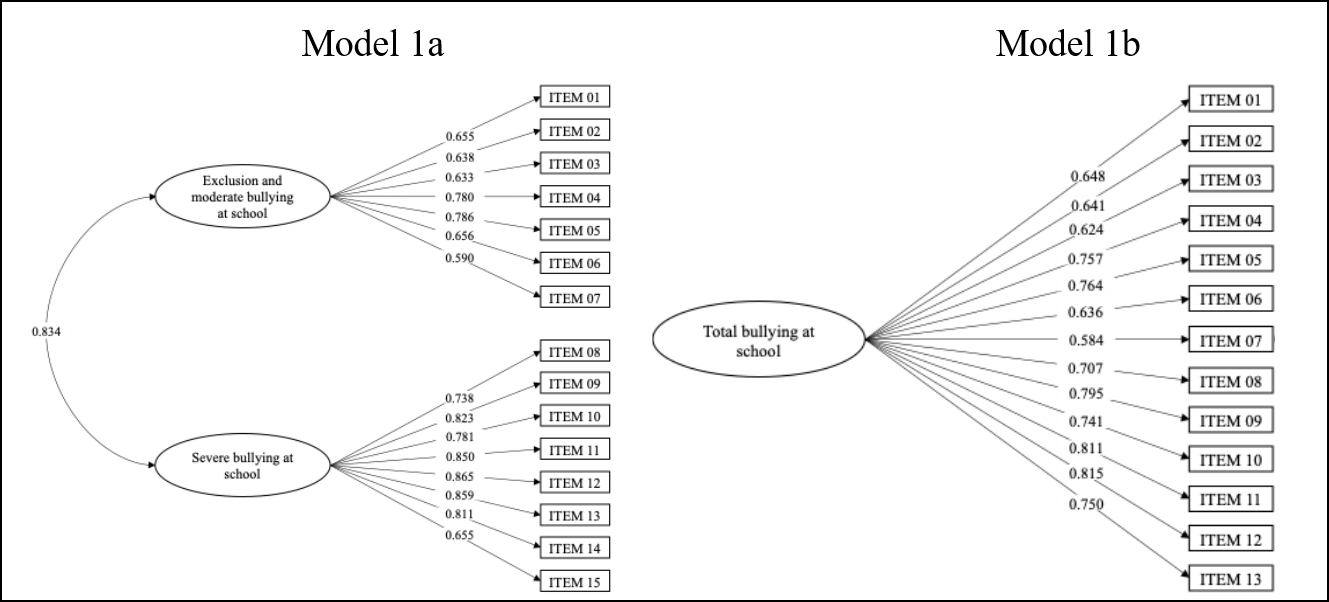
| Factor 1: Exclusion and Moderate Bullying at School | Factor 2: Severe Bullying at School | Factor 1: Total Bullying at School | |
| AVE | 0.463 | 0.641 | 0.514 |
| CR | 0.857 | 0.934 | 0.932 |
| R2F1-F2 | 0.696 | - | |
| DV (AVE-R2) | −0.214 | −0.036 | - |
| CEVEO at leisure | Model 2a (bifactorial) | Model 2b (unifactorial) | |
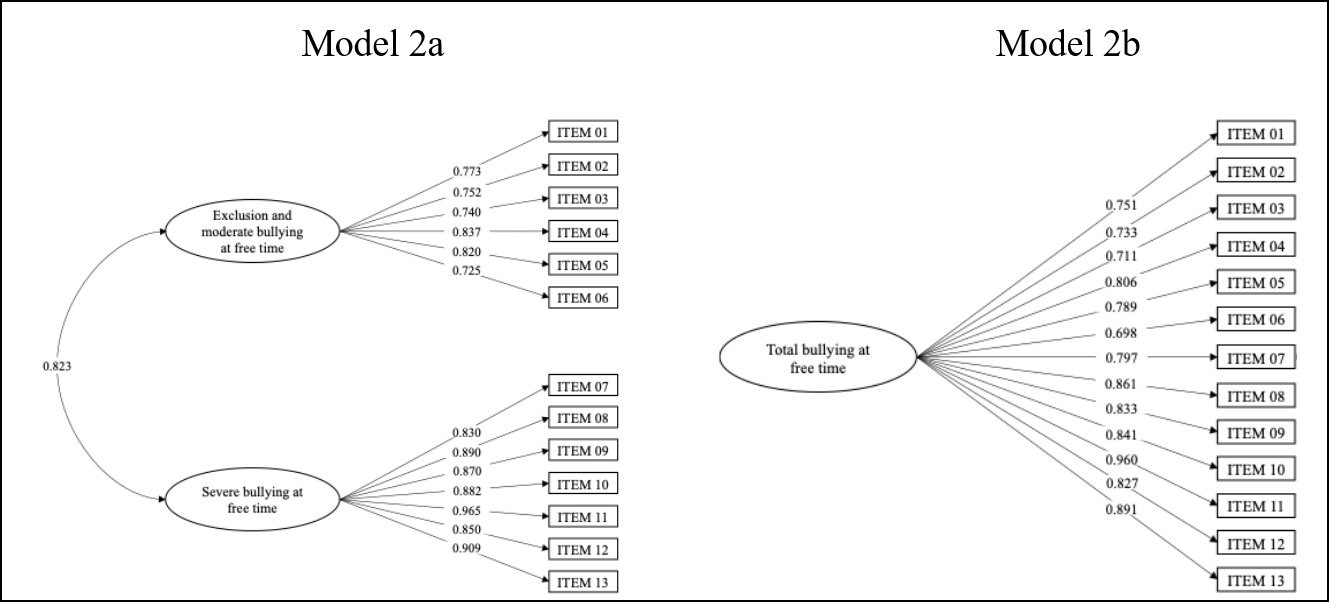
| Factor 1: Exclusion and moderate bullying at leisure | Factor 2: Severe bullying at leisure | Factor 1: Total bullying at leisure | |
| AVE | 0.602 | 0.785 | 0.657 |
| CR | 0.900 | 0.962 | 0.961 |
| R2 F1-F2 | 0.677 | - | |
| DV (AVE-R2) | −0.076 | 0.108 | - |
| Contexts of Aggression | School Aggression M (SD) | Leisure Aggression M (SD) | MD M (SD) | ||||
|---|---|---|---|---|---|---|---|
| Profiles | None n (%) | One n (%) | Both n (%) | ||||
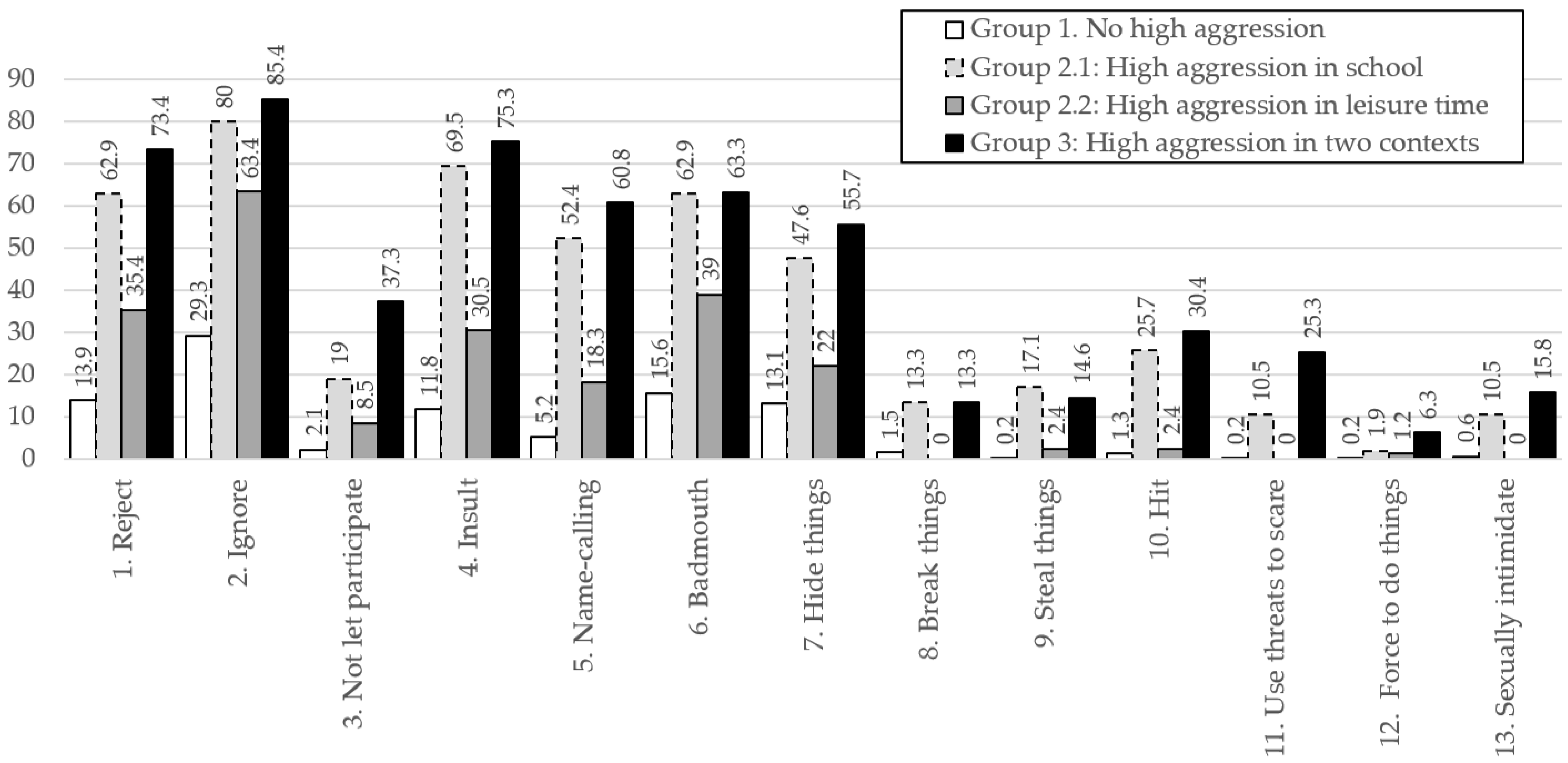
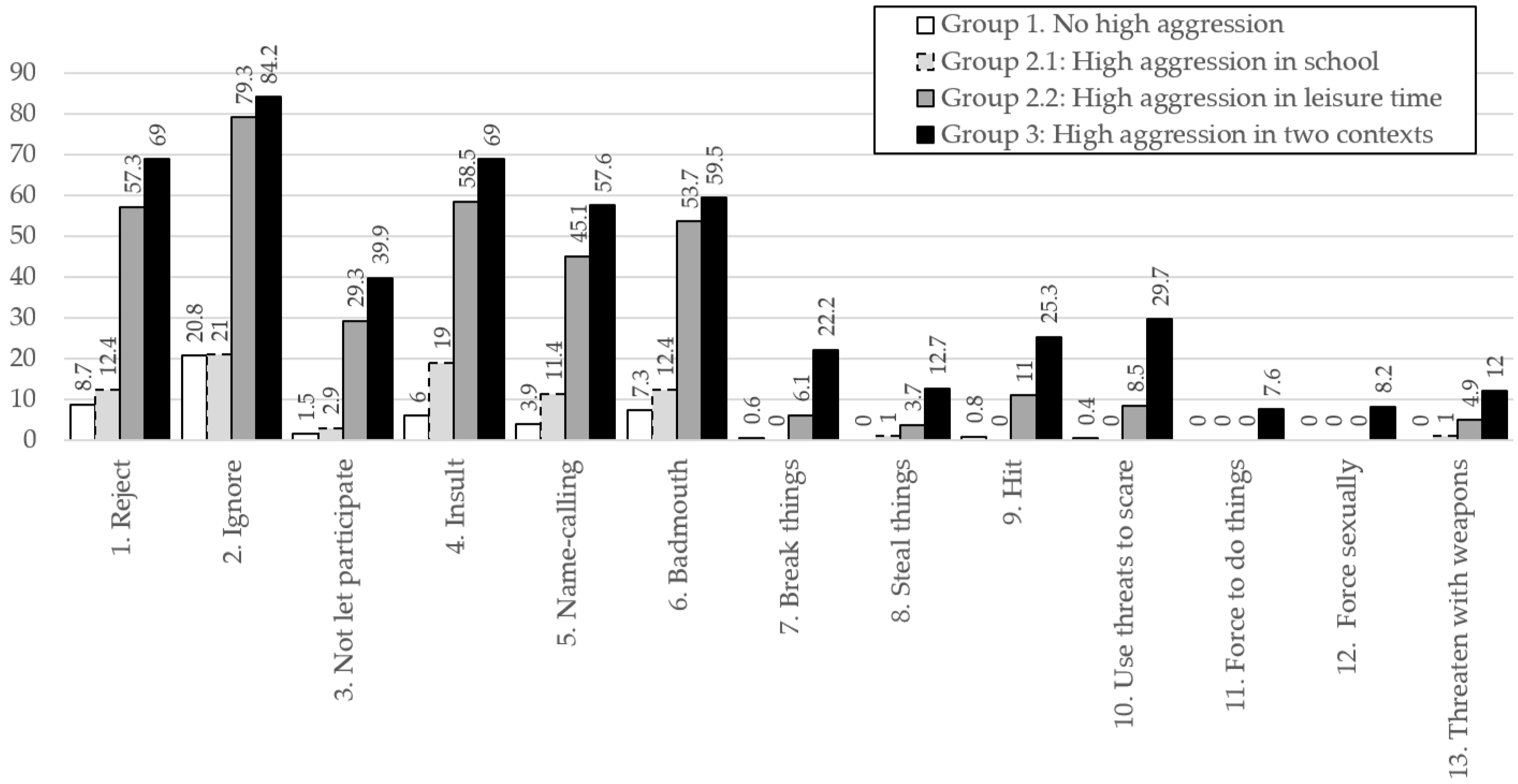
| 1. No high aggression (n = 519/60.1%) | 178 (34.3) | 180 (34.7) | 161 (31.0) | 13.98 (1.02) | 13.51 (0.72) | 16.65 (5.76) | |
| 2. High aggression in one context (n = 187/21.6%) | -- | 52 (27.8) | 135 (72.2) | 17.37 (2.95) | 15.31 (2.61) | 19.48 (5.74) | |
| 2.1 High aggression. School (n = 105/56.1%) | -- | 105 (100) | -- | 18.98 (2.99) | 13.81 (0.81) | 19.61 (5.53) | |
| 2.2 High aggression Leisure time (n = 82/43.9%) | -- | 82 (100) | -- | 15.32 (0.93) | 17.23 (2.87) | 19.31 (6.04) | |
| 3. High aggression in two contexts (n = 158/18.3%) | -- | -- | 158 (100) | 20.72 (4.48) | 20.04 (4.78) | 21.30 (6.86) | |
Disclaimer/Publisher’s Note: The statements, opinions and data contained in all publications are solely those of the individual author(s) and contributor(s) and not of MDPI and/or the editor(s). MDPI and/or the editor(s) disclaim responsibility for any injury to people or property resulting from any ideas, methods, instructions or products referred to in the content. |
© 2026 by the authors. Licensee MDPI, Basel, Switzerland. This article is an open access article distributed under the terms and conditions of the Creative Commons Attribution (CC BY) license.
Share and Cite
Oñate-Hormazábal, K.; Pérez, B.; Concha-Salgado, A. Psychometric Properties of the CEVEO Bullying Subscales for Aggressors in School and Leisure Contexts Among Chilean Adolescents: Profiles Based on Moral Disengagement, Aggression Frequency, and Context. Children 2026, 13, 134. https://doi.org/10.3390/children13010134
Oñate-Hormazábal K, Pérez B, Concha-Salgado A. Psychometric Properties of the CEVEO Bullying Subscales for Aggressors in School and Leisure Contexts Among Chilean Adolescents: Profiles Based on Moral Disengagement, Aggression Frequency, and Context. Children. 2026; 13(1):134. https://doi.org/10.3390/children13010134
Chicago/Turabian StyleOñate-Hormazábal, Karina, Beatriz Pérez, and Andrés Concha-Salgado. 2026. "Psychometric Properties of the CEVEO Bullying Subscales for Aggressors in School and Leisure Contexts Among Chilean Adolescents: Profiles Based on Moral Disengagement, Aggression Frequency, and Context" Children 13, no. 1: 134. https://doi.org/10.3390/children13010134
APA StyleOñate-Hormazábal, K., Pérez, B., & Concha-Salgado, A. (2026). Psychometric Properties of the CEVEO Bullying Subscales for Aggressors in School and Leisure Contexts Among Chilean Adolescents: Profiles Based on Moral Disengagement, Aggression Frequency, and Context. Children, 13(1), 134. https://doi.org/10.3390/children13010134