Examination of the Effects of a Play-Based Mindfulness Training Program on Resilience, Emotion Regulation Skills, and Executive Functions of Preschool Children

Abstract
1. Introduction
1.1. Mindfulness and Play in Early Childhood
1.2. Resilience in Early Childhood
1.3. Emotional Regulation in Early Childhood
1.4. Executive Functions in Early Childhood
- Does a play-based mindfulness intervention program improve resilience in preschool children?
- Does a play-based mindfulness intervention program improve emotion regulation skills in preschool children?
- Does a play-based mindfulness intervention program improve executive functions in preschool children?
2. Materials and Methods
2.1. Participants
2.2. Measures
2.2.1. Personal Information Form
2.2.2. Devereux Early Childhood Assessment for Preschoolers (DECA-P2)
2.2.3. Emotion Regulation Scale (ERS)
2.2.4. Childhood Executive Functioning Inventory(CHEXI)
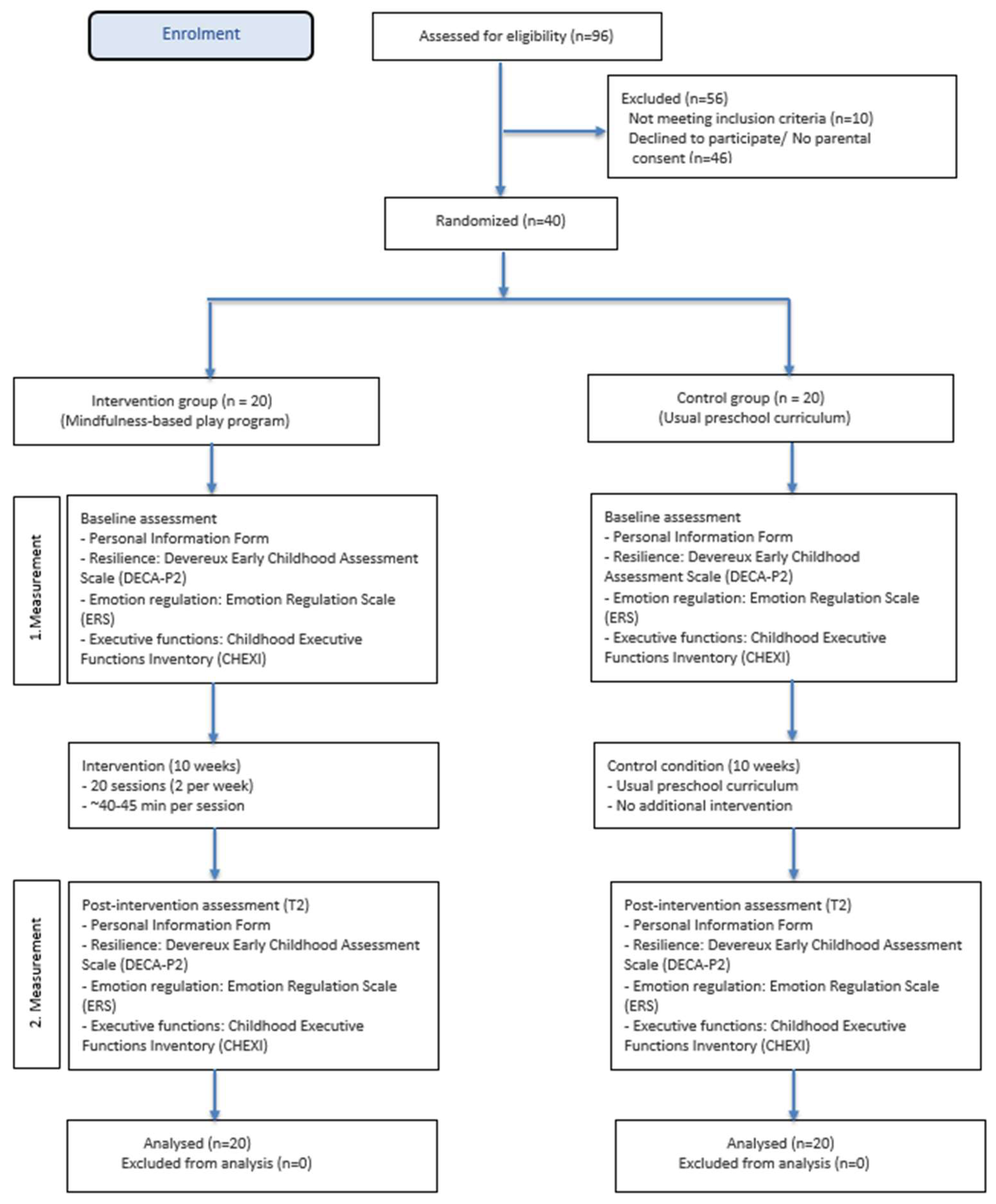
2.3. Procedure
2.4. Development and Implementation of the Play-Based Mindfulness Intervention Program
2.5. Data Analyses
3. Results
3.1. Descriptive Statistics and Pre-Intervention Comparison Results
3.2. The Effect of Intervention on Resilience
3.3. The Effect of Intervention on Emotion Regulation Skills
3.4. The Effect of Intervention on Executive Functions
4. Discussion
4.1. Resilience
4.2. Emotion Regulation Skills
4.3. Executive Functions
5. Limitations
6. Conclusions and Recommendations
Author Contributions
Funding
Institutional Review Board Statement
Informed Consent Statement
Data Availability Statement
Conflicts of Interest
References
- Oktay, A. Yaşamın Sihirli Yılları: Okul Öncesi Dönem; Epsilon: Kanpur, India, 2004. [Google Scholar]
- Alotaibi, M.S. Game-based learning in early childhood education: A systematic review and meta-analysis. Front. Psychol. 2024, 15, 1307881. [Google Scholar] [CrossRef] [PubMed]
- Ghosh, D. The impact of early childhood education on cognitive and social development. Int. J. Multidiscip. Res. 2024, 6, 201–209. [Google Scholar]
- Hammer, D.; Melhuish, E.; Howard, S.J. Do aspects of social, emotional and behavioural development in the pre-school period predict later cognitive and academic attainment? Aust. J. Educ. 2017, 61, 270–287. [Google Scholar] [CrossRef]
- Mondi, C.F.; Giovanelli, A.; Reynolds, A.J. Fostering socio-emotional learning through early childhood intervention. Int. J. Child Care Educ. Policy 2021, 15, 6. [Google Scholar] [CrossRef] [PubMed]
- Sawyer, A.; Chittleborough, C.; Mittinty, M.; Miller-Lewis, L.; Sawyer, M.; Sullivan, T.; Lynch, J. Are trajectories of self-regulation abilities from ages 2–3 to 6–7 associated with academic achievement in the early school years? Child Care Health Dev. 2015, 41, 744–754. [Google Scholar] [CrossRef]
- Downes, M.; Bathelt, J.; De Haan, M. Event-related potential measures of executive functioning from preschool to adolescence. Dev. Med. Child Neurol. 2017, 59, 581–590. [Google Scholar] [CrossRef]
- Zelazo, P.D.; Lyons, K.E. The potential benefits of mindfulness training in early childhood: A developmental social cognitive neuroscience perspective. Child Dev. Perspect. 2012, 6, 154–160. [Google Scholar] [CrossRef]
- Berti, S.; Cigala, A. Mindfulness for preschoolers: Effects on prosocial behavior, self-regulation and perspective taking. Early Educ. Dev. 2022, 33, 38–57. [Google Scholar] [CrossRef]
- Shlomov, I.; Levit-Binnun, N.; Horowitz-Kraus, T. Neurodevelopmental Effects of a Mindfulness and Kindness Curriculum on Executive Functions in Preschool Children—A Randomized, Active-Controlled Study. Mind Brain Educ. 2023, 17, 132–148. [Google Scholar] [CrossRef]
- Dunning, D.L.; Griffiths, K.; Kuyken, W.; Crane, C.; Foulkes, L.; Parker, J.; Dalgleish, T. Research Review: The effects of mindfulness-based interventions on cognition and mental health in children and adolescents—A meta-analysis of randomized controlled trials. J. Child Psychol. Psychiatry 2019, 60, 244–258. [Google Scholar] [CrossRef]
- Pérez-Peña, M.; Van der Gucht, K.; Philippot, P. The Impact of a School-Based Mindfulness-Based Intervention on Body Awareness, Emotion Regulation, and Symptoms of Depression, Anxiety, and Stress in Adolescents. Mindfulness 2025, 16, 2008–2028. [Google Scholar] [CrossRef]
- Xie, S.; Gong, C.; Lu, J.; Li, H.; Wu, D.; Chi, X.; Chang, C. Enhancing Chinese preschoolers’ executive function via mindfulness training: An fNIRS study. Front. Behav. Neurosci. 2022, 16, 961797. [Google Scholar] [CrossRef]
- Lee, R.L.T.; Lane, S.J.; Tang, A.C.Y.; Leung, C.; Kwok, S.W.H.; Louie, L.H.T.; Browne, G.; Chan, S.W.C. Effects of an unstructured free play and mindfulness intervention on wellbeing in kindergarten students. Int. J. Environ. Res. Public Health 2020, 17, 5382. [Google Scholar] [CrossRef]
- Dorra, J.; Jarraya, S. The effect of a short-term mindfulness program on motor skills and on psychological and social behavior in preschool children: A randomized controlled trial. Percept. Mot. Ski. 2024, 131, 1622–1646. [Google Scholar] [CrossRef] [PubMed]
- Flanagan, L.; McGourty, J.; O’Connor, C. Exploring the landscape of mindfulness practice in early childhood education in Ireland. Eur. Early Child. Educ. Res. J. 2025, 33, 919–934. [Google Scholar] [CrossRef]
- Gabdulchakov, V.F.; Shishova, E.O. Psychology of children’s play, imagination, creativity and playful pedagogies in early childhood education in Russia. In Play and STEM Education in the Early Years: International Policies and Practices; Springer: Berlin/Heidelberg, Germany, 2022; pp. 65–83. [Google Scholar]
- Zelazo, P.D.; Carlson, S.M. Hot and cool executive function in childhood and adolescence: Development and plasticity. Child Dev. Perspect. 2012, 6, 354–360. [Google Scholar] [CrossRef]
- Kabat-Zinn, J. Wherever You Go, There You Are: Mindfulness Meditation in Everyday Life; Hachette UK: London, UK, 2023. [Google Scholar]
- Brown, K.W.; Ryan, R.M. The benefits of being present: Mindfulness and its role in psychological well-being. J. Personal. Soc. Psychol. 2003, 84, 822. [Google Scholar] [CrossRef]
- Erwin, E.J.; Palombo, M.J.; Valentine, M.; Clark, L.A. “Mindfulness is noticing your feelings”: The power of mind-body awareness in the early years. J. Early Child. Res. 2025, 1476718X251363712. [Google Scholar] [CrossRef]
- Scafuto, F.; Quinto, R.M.; Ghiroldi, S.; Montecucco, N.F.; Presaghi, F.; Iani, L.; De Vincenzo, F. The mediation role of emotion regulation strategies on the relationship between mindfulness effects, psychological well-being and distress among youths: Findings from a randomized controlled trial. Curr. Psychol. 2024, 43, 24295–24307. [Google Scholar] [CrossRef]
- Vieira, I.; Faria, L. The role of mindfulness and emotional intelligence on adolescents’ well-being and secondary school achievement. Psychol. Rep. 2024, 00332941241301638, Online ahead of print. [Google Scholar]
- Bhandari, C.; Douglas, S.N. Embedding mindfulness into early childhood classroom routines: A practical strategy for teachers. Child. Educ. 2024, 100, 20–29. [Google Scholar] [CrossRef]
- Wood, L.; Roach, A.T.; Kearney, M.A.; Zabek, F. Enhancing executive function skills in preschoolers through a mindfulness-based intervention: A randomized, controlled pilot study. Psychol. Sch. 2018, 55, 644–660. [Google Scholar] [CrossRef]
- Thierry, K.L.; Bryant, H.L.; Nobles, S.S.; Norris, K.S. Two-year impact of a mindfulness-based program on preschoolers’ self-regulation and academic performance. Early Educ. Dev. 2016, 27, 805–821. [Google Scholar] [CrossRef]
- Lemberger-Truelove, M.E.; Carbonneau, K.J.; Atencio, D.J.; Zieher, A.K.; Palacios, A.F. Self-regulatory growth effects for young children participating in a combined social and emotional learning and mindfulness-based intervention. J. Couns. Dev. 2018, 96, 289–302. [Google Scholar] [CrossRef]
- Kim, E.; Jackman, M.M.; Jo, S.-H.; Oh, J.; Ko, S.-Y.; McPherson, C.L.; Hwang, Y.-S.; Singh, N.N. Effectiveness of the mindfulness-based OpenMind-Korea (OM-K) preschool program. Mindfulness 2020, 11, 1062–1072. [Google Scholar] [CrossRef]
- Bockmann, J.O.; Yu, S.Y. Using mindfulness-based interventions to support self-regulation in young children: A review of the literature. Early Child. Educ. J. 2023, 51, 693–703. [Google Scholar] [CrossRef] [PubMed]
- Pearce, Z.R.; Rajbhandari, B.; Stapp, A.C.; Wolff, K.E.; Miller, S.E. A Scoping Review of the Use of Mindfulness-Based Interventions to Improve Preschoolers’ Executive Function. Mindfulness 2025, 16, 797–822. [Google Scholar] [CrossRef]
- Veraksa, A.; Sukhikh, V.; Veresov, N.; Almazova, O. Which play is better? Different play types and development of executive functions in early childhood. Int. J. Early Years Educ. 2022, 30, 560–576. [Google Scholar] [CrossRef]
- Savina, E. Does play promote self-regulation in children? Early Child Dev. Care 2014, 184, 1692–1705. [Google Scholar] [CrossRef]
- ten Braak, D.; Størksen, I.; Idsoe, T.; McClelland, M. Bidirectionality in self-regulation and academic skills in play-based early childhood education. J. Appl. Dev. Psychol. 2019, 65, 101064. [Google Scholar] [CrossRef]
- Piaget, J. Play, Dreams and Imitation in Childhood; Routledge: London, UK, 2013. [Google Scholar]
- Vygotsky, L.S. Mind in Society: The Development of Higher Psychological Processes; Harvard University Press: Cambridge, MA, USA, 1978; Volume 86. [Google Scholar]
- Singer, D.; Golinkoff, R.M.; Hirsh-Pasek, K. Play = Learning: How Play Motivates and Enhances Children’s Cognitive and Social-Emotional Growth; Oxford University Press: Oxford, UK, 2006. [Google Scholar]
- Masten, A.S. Ordinary magic: Resilience processes in development. Am. Psychol. 2001, 56, 227. [Google Scholar] [CrossRef]
- Masten, A.S.; Barnes, A.J. Resilience in children: Developmental perspectives. Children 2018, 5, 98. [Google Scholar] [CrossRef] [PubMed]
- Mayr, T.; Ulich, M. Social-emotional well-being and resilience of children in early childhood settings–PERIK: An empirically based observation scale for practitioners. Early Years 2009, 29, 45–57. [Google Scholar] [CrossRef]
- Luthar, S.S.; Cicchetti, D. The construct of resilience: Implications for interventions and social policies. Dev. Psychopathol. 2000, 12, 857–885. [Google Scholar] [CrossRef] [PubMed]
- Karababa, P.; Şahin, M.K. The Role of Parents’ Gender Role Perceptions in Predicting Psychological Resilience in Preschool Children: Exploring the Moderating Effect of Empathy. Manisa Celal Bayar Üniversitesi Eğitim Fakültesi Derg. 2025, 13, 1–13. [Google Scholar] [CrossRef]
- Topuz, İ.; Aslan, O.; Bedel, A. Okul Öncesi Dönemde Psikolojik Sağlamlık ve Problem Davranışlar Arasındaki İlişkinin İncelenmesi. Dokuz Eylül Üniversitesi Buca Eğitim Fakültesi Derg. 2025, 65, 3345–3360. [Google Scholar] [CrossRef]
- Bazzano, A.N.; Sun, Y.; Zu, Y.; Fleckman, J.M.; Blackson, E.A.; Patel, T.; Shorty-Belisle, A.; Liederman, K.H.; Roi, C. Yoga and mindfulness for social-emotional development and resilience in 3–5 year-old children: Non-randomized, controlled intervention. Psychol. Res. Behav. Manag. 2023, ume 16, 109–118. [Google Scholar] [CrossRef]
- Greenberg, M.T.; Harris, A.R. Nurturing mindfulness in children and youth: Current state of research. Child Dev. Perspect. 2012, 6, 161–166. [Google Scholar] [CrossRef]
- Ogelman, H.G.; Önder, A. Emotional regulation strategies of 5–6-year-old children and their levels of resiliency. Early Child Dev. Care 2021, 191, 221–229. [Google Scholar] [CrossRef]
- Lucas-Molina, B.; Quintanilla, L.; Sarmento-Henrique, R.; Martín Babarro, J.; Giménez-Dasí, M. The relationship between emotion regulation and emotion knowledge in preschoolers: A longitudinal study. Int. J. Environ. Res. Public Health 2020, 17, 5726. [Google Scholar] [CrossRef]
- Sala, M.N.; Pons, F.; Molina, P. Emotion regulation strategies in preschool children. Br. J. Dev. Psychol. 2014, 32, 440–453. [Google Scholar] [CrossRef]
- Cole, P.M.; Martin, S.E.; Dennis, T.A. Emotion regulation as a scientific construct: Methodological challenges and directions for child development research. Child Dev. 2004, 75, 317–333. [Google Scholar] [CrossRef] [PubMed]
- Heselmans, I.; Van Gaever, M.; Hoogers, H.; Eggers, K. Examining Preschoolers’ Emotion Regulation Strategies: Psychometric Properties of the Translated Dutch Early Emotion Regulation Behavior Questionnaire (EERBQ-Dutch). Children 2025, 12, 494. [Google Scholar] [CrossRef] [PubMed]
- Ratcliff, K.A.; Vazquez, L.C.; Lunkenheimer, E.S.; Cole, P.M. Longitudinal changes in young children’s strategy use for emotion regulation. Dev. Psychol. 2021, 57, 1471. [Google Scholar] [CrossRef] [PubMed]
- Harrington, E.M.; Trevino, S.D.; Lopez, S.; Giuliani, N.R. Emotion regulation in early childhood: Implications for socioemotional and academic components of school readiness. Emotion 2020, 20, 48. [Google Scholar] [CrossRef]
- Eisenberg, N.; Spinrad, T.L.; Eggum, N.D. Emotion-related self-regulation and its relation to children’s maladjustment. Annu. Rev. Clin. Psychol. 2010, 6, 495–525. [Google Scholar] [CrossRef]
- Murray, A.L.; Russell, A.; Alfaro, F.A.C. Early emotion regulation developmental trajectories and ADHD, internalizing, and conduct problems symptoms in childhood. Dev. Psychopathol. 2025, 37, 1474–1481. [Google Scholar] [CrossRef]
- Fatahi, N.; Park, C.; Curby, T.W.; Zinsser, K.M.; Denham, S.A.; Moberg, S.; Gordon, R.A. Promoting preschoolers’ social and emotional competencies through emotion-focused teaching. Early Educ. Dev. 2023, 34, 1729–1748. [Google Scholar] [CrossRef]
- Broderick, P.C.; Metz, S. Learning to BREATHE: A pilot trial of a mindfulness curriculum for adolescents. Adv. Sch. Ment. Health Promot. 2009, 2, 35–46. [Google Scholar] [CrossRef]
- Anderson, P. Assessment and development of executive function (EF) during childhood. Child Neuropsychol. 2002, 8, 71–82. [Google Scholar] [CrossRef]
- Diamond, A. Executive functions. Annu. Rev. Psychol. 2013, 64, 135–168. [Google Scholar] [CrossRef]
- Stucke, N.J.; Doebel, S. Early childhood executive function predicts concurrent and later social and behavioral outcomes: A review and meta-analysis. Psychol. Bull. 2024, 150, 1178. [Google Scholar] [CrossRef]
- Benavides-Nieto, A.; Romero-López, M.; Quesada-Conde, A.B.; Corredor, G.A. Basic executive functions in early childhood education and their relationship with social competence. Procedia-Soc. Behav. Sci. 2017, 237, 471–478. [Google Scholar] [CrossRef]
- Cuartas, J.; Hanno, E.; Lesaux, N.K.; Jones, S.M. Executive function, self-regulation skills, behaviors, and socioeconomic status in early childhood. PLoS ONE 2022, 17, e0277013. [Google Scholar] [CrossRef] [PubMed]
- Likhitweerawong, N.; Khorana, J.; Boonchooduang, N.; Phinyo, P.; Patumanond, J.; Louthrenoo, O. Associated biological and environmental factors of impaired executive function in preschool-aged children: A population-based study. Infant Child Dev. 2023, 32, e2404. [Google Scholar] [CrossRef]
- Bezerra, T.; Cristi-Montero, C.; Bandeira, P.F.; Souza Filho, A.; Duncan, M.; Martins, C. Biological, behavioral, and social correlates of executive function in low-income preschoolers: Insights from the perspective of the networks. Appl. Neuropsychol. Child 2023, 12, 272–280. [Google Scholar] [CrossRef]
- Zenner, C.; Herrnleben-Kurz, S.; Walach, H. Mindfulness-based interventions in schools—A systematic review and meta-analysis. Front. Psychol. 2014, 5, 603. [Google Scholar] [CrossRef]
- Aydın, A.; Özbey, S. Bilinçli farkindalik (mindfulness) temelli eğitim programi’nin okul öncesi dönemdeki çocuklarin yönetici işlev düzeylerine etkisinin incelenmesi. Mehmet Akif Ersoy Üniversitesi Eğitim Fakültesi Derg. 2022, 64, 441–465. [Google Scholar] [CrossRef]
- Canol, B. Okul öncesi eğitim kurumlarına devam eden 60–72 aylık çocuklara yönelik hazırlanan öz düzenleme eğitim programının çocukların öz düzenleme ve sosyal becerileri üzerine etkisi. Gazi Üniversitesi Eğitim Bilim. Enstitüsü Ank 2021, 4, 56–71. [Google Scholar]
- Büyüköztürk, Ş. Sosyal Bilimler Için Veri Analizi el Kitabı; Pegem Atıf İndeksi 2018; Pegem Academy: Kızılay, Turkey, 2018; pp. 001–214. [Google Scholar]
- LeBuffe, P.A.; Naglieri, J.A. Devereux Early Childhood Assessment for Preschoolers Second Edition (DECA-P2); Kaplan Early Learning Company: Lewisville, NC, USA, 2013. [Google Scholar]
- Atabay Demir, S.; Sönmez, S. The Validity and Reliability of the Turkish Form of the Early Childhood Assessment Scale. Cukurova Univ. Fac. Educ. J./Çukurova Üniversitesi Eğitim Fakültesi Derg. 2020, 49, 769–793. [Google Scholar]
- Ernst, J.; Juckett, H.; Sobel, D. Comparing the impact of nature, blended, and traditional preschools on children’s resilience: Some nature may be better than none. Front. Psychol. 2021, 12, 724340. [Google Scholar] [CrossRef]
- Zhao, T.; Xuan, K.; Liu, H.; Chen, X.; Qu, G.; Wu, Y.; Zhang, J.; Sun, Y. The association between caregivers’ anxiety and sleep disturbances among preschool children in rural areas of China: The moderating effect of resilience. Child. Youth Serv. Rev. 2021, 131, 106292. [Google Scholar] [CrossRef]
- Shields, A.; Cicchetti, D. Emotion regulation among school-age children: The development and validation of a new criterion Q-sort scale. Dev. Psychol. 1997, 33, 906. [Google Scholar] [CrossRef] [PubMed]
- Batum, P.; Yağmurlu, B. Duygu düzenleme ölçeği: Geçerlik ve güvenirlik çalışması. Türk Psikol. Yazıları 2007, 10, 1–10. [Google Scholar]
- Thorell, L.B.; Nyberg, L. The Childhood Executive Functioning Inventory (CHEXI): A new rating instrument for parents and teachers. Dev. Neuropsychol. 2008, 33, 536–552. [Google Scholar] [CrossRef] [PubMed]
- Arslan-Çiftçi, H. Çocukluk Dönemi Yürütücü İşlevler Envanteri’nin 48–72 Aylık Çocuklar Için Geçerlik ve Güvenirlik Çalışması ve Okul Öncesi Yürütücü Işlevler Eğitim Programının Etkililiğinin Incelenmesi. Ph.D. Thesis, Marmara Üniversitesi, İstanbul, Turkey, 2020. [Google Scholar]
- Taba, H.; Spalding, W.B. Curriculum Development: Theory and Practice; Harcourt, Brace & World: New York, NY, USA, 1962; Volume 37. [Google Scholar]
- Fröbel, F. Hailmann, W.N., Translator; The Education of Man; Appleton and Company: New York, NY, USA, 1887; Volume 1. [Google Scholar]
- Kabat-Zinn, J. Mindfulness-based interventions in context: Past, present, and future. Clin. Psychol. Sci. Pr. 2003, 10, 144–156. [Google Scholar] [CrossRef]
- Akbıyık, S. Mindfulness (Fark’andalık) Temelli Psikoeğitim Programının Okul Öncesi Çocuklarda öz Düzenleme Becerilerine etkisi: Pilot Çalışma. Master’s Thesis, Bahçeşehir Üniversitesi, İstanbul, Turkey, 2022. [Google Scholar]
- Erten, C. Okul Öncesi Dönem Çocuklarinin Sosyal Davraniş Gelişimlerinde Farkindalik Uygulamalarinin Etkisi. Master’s Thesis, Mersin Üniversitesi, Mersin, Turkey, 2023. [Google Scholar]
- Aydın, A.; Özbey, S. Farkandalık (Mindfulness) Eğitim Programı’nın Okul Öncesi Dönem Çocukların Duygusal Zekâ Düzeylerine Etkisinin İncelenmesi. Int. Prim. Educ. Res. J. 2023, 7, 118–138. [Google Scholar]
- Yıldırım, M. Okul öncesi eğitime devam eden 48–66 aylık çocuklara yönelik bilinçli farkındalık (mindfulness) temelli akran ilişkisi programı önerisi. Master’s Thesis, Çanakkale Onsekiz Mart Üniversitesi, Çanakkale, Turkey, 2022. [Google Scholar]
- Çollak, N. Okul Öncesi Dönem Çocuklarına Yönelik 8 Haftalık Mindfulness (Bilinçli Farkındalık) Programı ve Programın Çocuklar Üzerindeki Etkileri. Master’s Thesis, Bahçeşehir Üniversitesi, Istanbul, Turkey, 2018. [Google Scholar]
- Parten, M.B. Social participation among pre-school children. J. Abnorm. Soc. Psychol. 1932, 27, 243. [Google Scholar] [CrossRef]
- Çokluk, Ö.; Şekercioğlu, G.; Büyüköztürk, Ş. Sosyal Bilimler Için Çok Değişkenli Istatistik: SPSS ve LISREL uygulamaları; Pegem akademi: Ankara, Turkey, 2012; Volume 2. [Google Scholar]
- Lakens, D. Calculating and reporting effect sizes to facilitate cumulative science: A practical primer for t-tests and ANOVAs. Front. Psychol. 2013, 4, 863. [Google Scholar] [CrossRef]
- Courbet, O.; Daviot, Q.; Kalamarides, V.; Habib, M.; Castillo, M.C.; Villemonteix, T. Promoting psychological well-being in preschool children: Study protocol for a randomized controlled trial of a mindfulness-and yoga-based socio-emotional learning intervention. Trials 2022, 23, 1050. [Google Scholar] [CrossRef]
- Fyffe, L.; Lewis, A. Does Play-Based Learning Support Children’s Everyday Resiliency? A Cross-Case Analysis of Parents’ and Kindergarten Teachers’ Perceptions of Play-Based Learning as a Precedent to Young Children’s Coping During the Pandemic-Affected 2020–2021 School Year. Children 2024, 11, 1378. [Google Scholar] [CrossRef]
- Treves, I.N.; Li, C.E.; Wang, K.L.; Ozernov-Palchik, O.; Olson, H.A.; Gabrieli, J.D. Mindfulness supports emotional resilience in children during the COVID-19 pandemic. PLoS ONE 2023, 18, e0278501. [Google Scholar] [CrossRef] [PubMed]
- Laundy, K.; Friberg, P.; Osika, W.; Chen, Y. Mindfulness-based intervention for children with mental health problems: A 2-year follow-up randomized controlled study. Mindfulness 2021, 12, 3073–3085. [Google Scholar] [CrossRef]
- Dreimane, L.F.; Vītola, E. Development of Emotion Regulation by Integrating Mindfulness Praxis in Early Childhood Education. Buck. J. Educ. 2024, 5, 7–22. [Google Scholar]
- Rowland, G.; Hindman, E.; Hassmén, P. Do group mindfulness-based interventions improve emotion regulation in children? A systematic review. J. Child Fam. Stud. 2023, 32, 1294–1303. [Google Scholar] [CrossRef]
- Hanceroglu, L. Investigating the Effects of Mindfulness on Children’s Executive Function, Emotional Regulation, Stress, and Academic Performance Compared to a Control Condition. Master’s Thesis, Wilfrid Laurier University, Waterloo, ON, Canada, 2017. [Google Scholar]
- Öztekin, G.G.; Turp, H.H.; Ata, S. Let’s Hear Children’s Emotions: The Play-Based Psychoeducation Program for the Socio-Emotional Development of Primary School Children. Erzincan Üniversitesi Eğitim Fakültesi Derg. 2024, 26, 38–46. [Google Scholar] [CrossRef]
- Khazaeili, Z.; Kashani, V.L.; Vakili, S.; Afrooz, G.A. Evaluating the Effectiveness of Mindfulness-Based Family-Centered Game Programs on Emotion Regulation and Instability/Negativity of Children with Behavioral Disorders. Middle East. J. Disabil. Stud. 2023, 13, 141. [Google Scholar]
- Diamond, A.; Lee, K. Interventions shown to aid executive function development in children 4 to 12 years old. Science 2011, 333, 959–964. [Google Scholar] [CrossRef]
- Newton, H. Supporting Executive Functioning in a Play-Based Environment. He Rourou 2022, 2, 1–23. [Google Scholar] [CrossRef]
- Gibb, R.; Coelho, L.; Van Rootselaar, N.A.; Halliwell, C.; MacKinnon, M.; Plomp, I.; Gonzalez, C.L. Promoting executive function skills in preschoolers using a play-based program. Front. Psychol. 2021, 12, 720225. [Google Scholar] [CrossRef]
- Yaffe, D.; Shtoots, L.; Kochav Isakow, O.; Daniel, Y.; Reuveni, O.; Keisari, S.; Golland, Y. Short playful interactions improve executive functions in children. Sci. Rep. 2025, 15, 23573. [Google Scholar] [CrossRef]
- Atalay, Z. Mindfulness: Şimdi ve Burada Bilinçli Farkındalık; Psikonet Yayınları: Istanbul, Turkey, 2018. [Google Scholar]
- Xie, S.; Lu, S.; Lu, J.; Gong, C.; Chang, C. Using mindfulness-based intervention to promote executive function in young children: A multivariable and multiscale sample entropy study. Cereb. Cortex 2024, 34, bhae330. [Google Scholar] [CrossRef]


| Characteristics | Groups | ||||||
|---|---|---|---|---|---|---|---|
| Control | Experimental | ||||||
| n | % | n | % | χ2 | p | ||
| Gender | Female | 10 | 50.0 | 9 | 45.0 | 0.100 | 0.752 |
| Male | 10 | 50.0 | 11 | 55.0 | |||
| Age | Five | 9 | 45.0 | 13 | 65.0 | 1.616 | 0.204 |
| Six | 11 | 55.0 | 7 | 35.0 | |||
| Number of children | 1 | 5 | 25.0 | 6 | 30.0 | 2.424 | 0.489 |
| 2 | 10 | 50.0 | 11 | 55.0 | |||
| 3 | 5 | 25.0 | 2 | 10.0 | |||
| 4 or more | 0 | 0.0 | 1 | 5.0 | |||
| Whether the mother is living | Yes | 20 | 100 | 20 | 100 | - | - |
| No | 0 | 0.0 | 0 | 0.0 | |||
| Whether the father is living | Yes | 20 | 100 | 20 | 100 | - | - |
| No | 0 | 0.0 | 0 | 0.0 | |||
| Whether the parents are living together | Yes | 20 | 100 | 20 | 100 | - | - |
| No | 0 | 0.0 | 0 | 0.0 | |||
| Educational level of the mother | High school | 1 | 5.0 | 1 | 5.0 | 0.543 | 0.762 |
| University | 13 | 65.0 | 15 | 75.0 | |||
| Postgraduate | 6 | 30.0 | 4 | 20.0 | |||
| Educational level of the father | High school | 0 | 0.0 | 2 | 10.0 | 2.286 | 0.319 |
| University | 12 | 60.0 | 12 | 60.0 | |||
| Postgraduate | 8 | 40.0 | 6 | 30.0 | |||
| Occupation of the mother | Housewife | 1 | 5.0 | 3 | 15.0 | 3.000 | 0.392 |
| Civil servant | 15 | 75.0 | 10 | 50.0 | |||
| Worker | 1 | 5.0 | 1 | 5.0 | |||
| Other | 3 | 15.0 | 6 | 30.0 | |||
| Occupation of the father | Civil servant | 14 | 70.0 | 10 | 50.0 | 3.333 | 0.189 |
| Worker | 1 | 5.0 | 0 | 0.0 | |||
| Other | 5 | 25.0 | 10 | 50.0 | |||
| Scales | Groups | Tests | Cronbach’s Alpha (α) | Skewness | Kurtosis |
|---|---|---|---|---|---|
| Working Memory | Experimental | Pre-test | 0.842 | 0.605 | 0.530 |
| Post-test | 0.864 | 0.672 | −0.496 | ||
| Continuance | 0.869 | 0.658 | −0.362 | ||
| Control | Pre-test | 0.805 | 0.371 | 0.077 | |
| Post-test | 0.867 | 0.445 | 0.448 | ||
| Inhibition | Experimental | Pre-test | 0.846 | 0.783 | −0.039 |
| Post-test | 0.821 | 0.277 | −0.443 | ||
| Continuance | 0.885 | 0.440 | −0.857 | ||
| Control | Pre-test | 0.857 | 0.430 | −0.685 | |
| Post-test | 0.848 | 0.506 | −0.643 | ||
| Self-regulation | Experimental | Pre-test | 0.788 | −0.978 | 0.165 |
| Post-test | 0.769 | −0.417 | −0.570 | ||
| Continuance | 0.751 | −0.784 | 0.155 | ||
| Control | Pre-test | 0.742 | 0.273 | −0.828 | |
| Post-test | 0.738 | 0.082 | −0.708 | ||
| Attachment/Relationship | Experimental | Pre-test | 0.801 | 0.712 | −0.200 |
| Post-test | 0.798 | 0.562 | 0.294 | ||
| Continuance | 0.776 | 1.247 | 1.067 | ||
| Control | Pre-test | 0.768 | 0.413 | 0.034 | |
| Post-test | 0.787 | 0.384 | −0.545 | ||
| Initiative | Experimental | Pre-test | 0.764 | −1.194 | 0.680 |
| Post-test | 0.791 | −1.252 | 0.849 | ||
| Continuance | 0.803 | −0.559 | 1.632 | ||
| Control | Pre-test | 0.754 | −1.247 | 1.429 | |
| Post-test | 0.784 | −1.483 | 1.617 | ||
| Negativity | Experimental | Pre-test | 0.807 | 1.760 | 1.134 |
| Post-test | 0.788 | 1.374 | 0.975 | ||
| Continuance | 0.704 | 1.012 | 1.878 | ||
| Control | Pre-test | 0.708 | 0.353 | −0.673 | |
| Post-test | 0.718 | 0.226 | −0.940 | ||
| Emotion Regulation | Experimental | Pre-test | 0.710 | −0.101 | −0.758 |
| Post-test | 0.724 | −0.096 | −0.716 | ||
| Continuance | 0.798 | −0.160 | −0.518 | ||
| Control | Pre-test | 0.762 | −0.219 | 0.104 | |
| Post-test | 0.732 | −0.680 | 0.776 |
| Scales | Subscales | Groups | n | X̄ | SE | sd | t | p |
|---|---|---|---|---|---|---|---|---|
| CHEXI | Working Memory | Experimental | 20 | 27.90 | 8.819 | 38 | 0.394 | 0.696 |
| Control | 20 | 26.80 | 8.859 | |||||
| Inhibition | Experimental | 20 | 32.40 | 6.557 | 38 | 0.585 | 0.562 | |
| Control | 20 | 31.05 | 7.970 | |||||
| Control | 20 | 30.55 | 4.298 | |||||
| DECA-P2 | Self-regulation | Experimental | 20 | 23.95 | 4.136 | 38 | 0.664 | 0.511 |
| Control | 20 | 24.80 | 3.955 | |||||
| Attachment/Relationship | Experimental | 20 | 26.30 | 1.689 | 38 | 1.259 | 0.216 | |
| Control | 20 | 25.45 | 2.502 | |||||
| Initiative | Experimental | 20 | 26.30 | 2.494 | 38 | 0.651 | 0.519 | |
| Control | 20 | 25.65 | 3.703 | |||||
| ERS | Negativity | Experimental | 20 | 27.55 | 5.987 | 38 | 0.816 | 0.420 |
| Control | 20 | 26.20 | 4.348 | |||||
| Emotion Regulation | Experimental | 20 | 20.60 | 2.836 | 38 | 0.835 | 0.409 | |
| Control | 20 | 21.20 | 1.508 |
| Experimental Group | Control Group | |||||||
|---|---|---|---|---|---|---|---|---|
| Pre-Test Mean ± SD | Post-Test Mean ± SD | Pre-Test Mean ± SD | Post-Test Mean ± SD | Groups | Time | Groupsxtime | ||
| Self-regulation | 23.95 ± 4.13 | 31.80 ± 3.59 | 24.80 ± 3.95 | 25.95 ± 3.92 | F-value | 4.27 | 316.99 | 175.67 |
| p | 0.04 | 0.00 | 0.00 | |||||
| η2 | 0.10 | 0.89 | 0.82 | |||||
| Attachment/Relationship | 26.3 ± 1.68 | 30.60 ± 1.46 | 25.45 ± 2.50 | 26.80 ± 2.41 | F-value | 14.58 | 139.83 | 38.12 |
| p | 0.00 | 0.00 | 0.00 | |||||
| η2 | 0.27 | 0.78 | 0.50 | |||||
| Initiative | 26.30 ± 2.49 | 29.20 ± 2.14 | 25.65 ± 3.70 | 25.80 ± 4.00 | F-value | 4.33 | 33.87 | 27.54 |
| p | 0.04 | 0.00 | 0.00 | |||||
| η2 | 0.10 | 0.47 | 0.42 | |||||
| Experimental Group | Control Group | |||||||
|---|---|---|---|---|---|---|---|---|
| Pre-Test Mean ± SD | Post-Test Mean ± SD | Pre-Test Mean ± SD | Post-Test Mean ± SD | Group | Time | Groupxtime | ||
| Subscales of the ERS | ||||||||
| Negativity | 27.55 ± 5.98 | 20.95 ± 4.60 | 26.20 ± 4.34 | 23.70 ± 3.58 | F-value | 0.23 | 173.09 | 35.13 |
| p | 0.63 | 0.00 | 0.00 | |||||
| η2 | 0.00 | 0.82 | 0.48 | |||||
| Emotion Regulation | 20.60 ± 2.83 | 24.35 ± 2.27 | 21.20 ± 1.50 | 22.65 ± 2.18 | F-value | 0.68 | 106.25 | 20.78 |
| p | 0.41 | 0.00 | 0.00 | |||||
| η2 | 0.01 | 0.73 | 0.35 | |||||
| Experimental Group | Control Group | |||||||
|---|---|---|---|---|---|---|---|---|
| Pre-Test Mean ± SD | Post-Test Mean ± SD | Pre-Test Mean ± SD | Post-Test Mean ± SD | Groups | Time | Groupsxtime | ||
| Subscales of the CHEXI | ||||||||
| Working Memory | 27.90 ± 8.81 | 41.85 ± 9.88 | 26.80 ± 8.85 | 28.35 ± 8.79 | F-value | 6.74 | 157.97 | 101.1 |
| p | 0.01 | 0.00 | 0.00 | |||||
| η2 | 0.15 | 0.80 | 0.72 | |||||
| Inhibition | 32.40 ± 6.55 | 42.25 ± 7.34 | 31.05 ± 7.97 | 32.75 ± 7.64 | F-value | 5.54 | 203.79 | 101.47 |
| p | 0.02 | 0.00 | 0.00 | |||||
| η2 | 0.12 | 0.84 | 0.72 | |||||
Disclaimer/Publisher’s Note: The statements, opinions and data contained in all publications are solely those of the individual author(s) and contributor(s) and not of MDPI and/or the editor(s). MDPI and/or the editor(s) disclaim responsibility for any injury to people or property resulting from any ideas, methods, instructions or products referred to in the content. |
© 2026 by the authors. Licensee MDPI, Basel, Switzerland. This article is an open access article distributed under the terms and conditions of the Creative Commons Attribution (CC BY) license.
Share and Cite
İçen, B.K.; Çelik, O.T. Examination of the Effects of a Play-Based Mindfulness Training Program on Resilience, Emotion Regulation Skills, and Executive Functions of Preschool Children. Children 2026, 13, 110. https://doi.org/10.3390/children13010110
İçen BK, Çelik OT. Examination of the Effects of a Play-Based Mindfulness Training Program on Resilience, Emotion Regulation Skills, and Executive Functions of Preschool Children. Children. 2026; 13(1):110. https://doi.org/10.3390/children13010110
Chicago/Turabian Styleİçen, Betül Kapkın, and Osman Tayyar Çelik. 2026. "Examination of the Effects of a Play-Based Mindfulness Training Program on Resilience, Emotion Regulation Skills, and Executive Functions of Preschool Children" Children 13, no. 1: 110. https://doi.org/10.3390/children13010110
APA Styleİçen, B. K., & Çelik, O. T. (2026). Examination of the Effects of a Play-Based Mindfulness Training Program on Resilience, Emotion Regulation Skills, and Executive Functions of Preschool Children. Children, 13(1), 110. https://doi.org/10.3390/children13010110