Article

Association Between Adolescent Violence Exposure and the Risk of Suicide: A 15-Year Study in Taiwan


1
Department of Medical Research, Tri-Service General Hospital, National Defense Medical Center, Taipei 11490, Taiwan
2
Department of Senior Citizen Care and Welfare, Deh Yu College of Nursing and Health, Keelung 203, Taiwan
3
School of Public Health, National Defense Medical Center, Taipei 11490, Taiwan
4
Taiwanese Injury Prevention and Safety Promotion Association, Taipei 11490, Taiwan
5
Department of Public Health, College of Medicine, Fu-Jen Catholic University, New Taipei City 24205, Taiwan
6
Big Data Research Center, College of Medicine, Fu-Jen Catholic University, New Taipei City 24205, Taiwan
7
Department of Microbiology & Immunology, National Defense Medical Center, Taipei 11490, Taiwan
8
Department of Family Medicine, Tri-Service General Hospital, National Defense Medical Center, Taipei 11490, Taiwan
9
Graduate Institute of Medical Sciences, National Defense Medical Center, Taipei 11490, Taiwan
10
Department of Nursing, Taipei City Hospital, Taipei 10684, Taiwan
*
Author to whom correspondence should be addressed.
Children 2025, 12(1), 10; https://doi.org/10.3390/children12010010

Submission received: 27 November 2024 / Revised: 16 December 2024 / Accepted: 23 December 2024 / Published: 24 December 2024
(This article belongs to the Section Global Pediatric Health)

Abstract

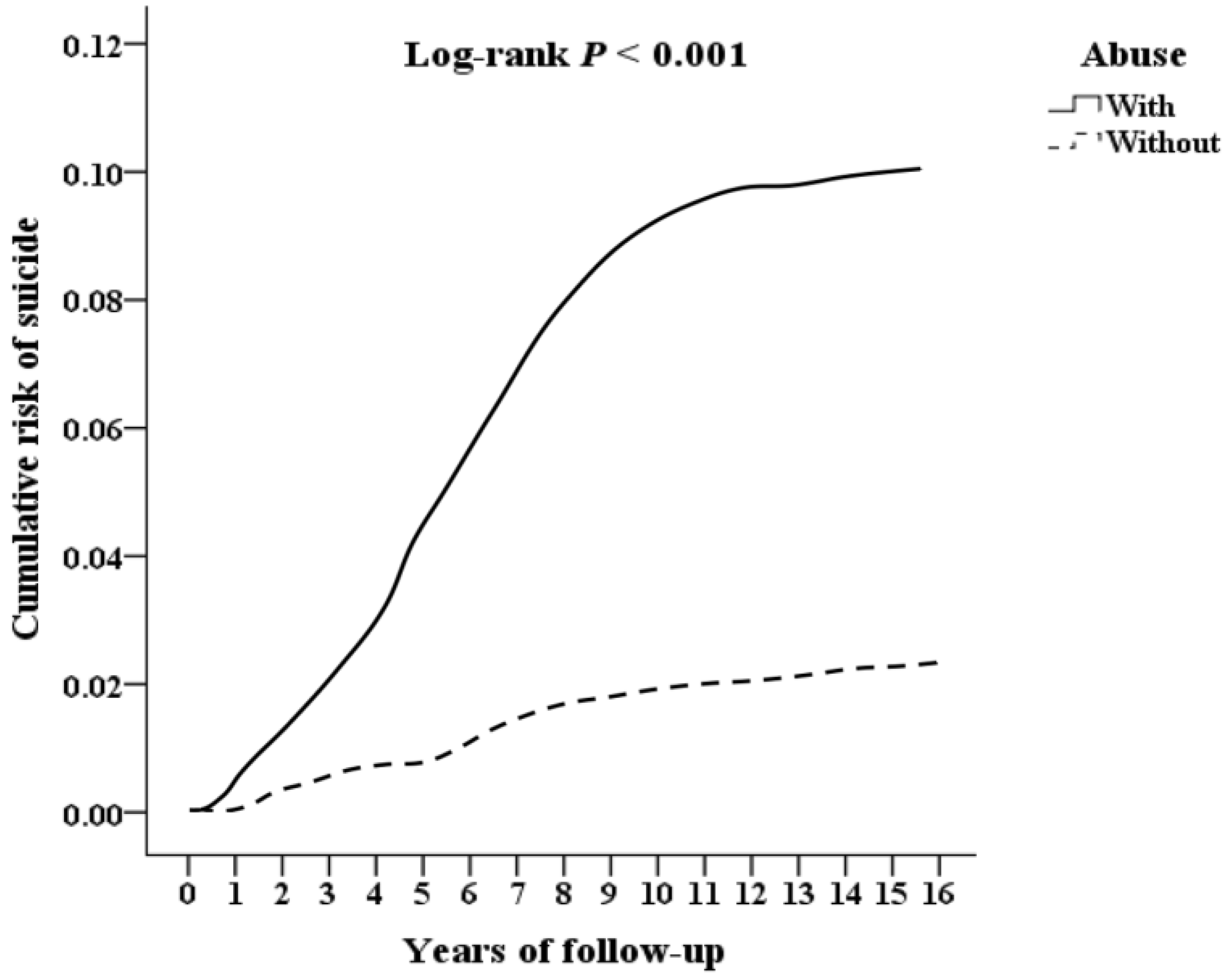
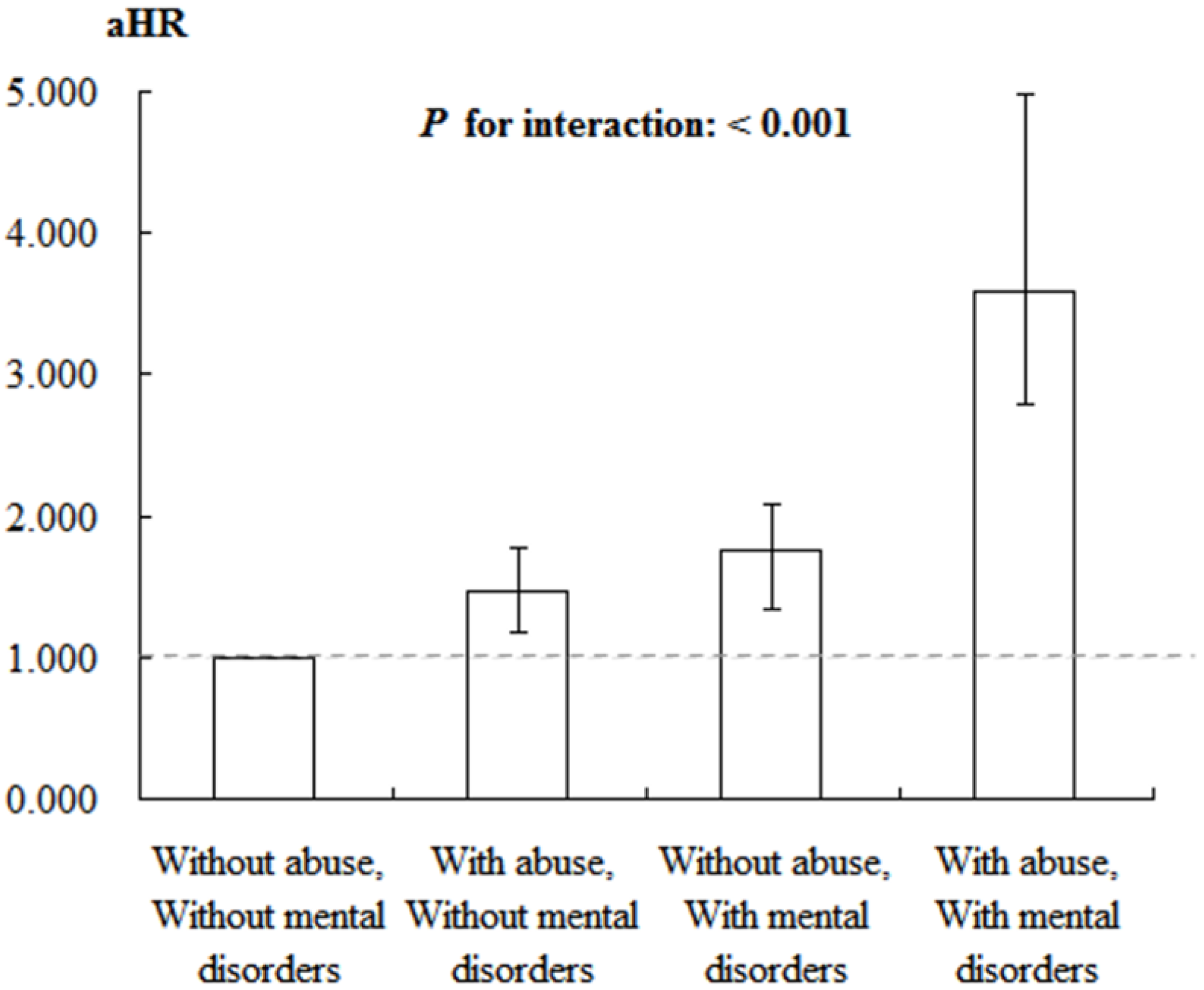
Background/Objectives: According to the 2023 Ministry of Health and Welfare statistics, the suicide rate among adolescents aged 15 to 24 has steadily increased since 2018, from 3.7 to 5.5 per 100,000 populations, reaching a recent high. Although previous studies have pointed out that the future risk of suicide of those who had suffered from abuse was higher than that of the general population, researchers seldom focused on adolescent groups. Therefore, the aim of this study was to explore the risk of suicide after youth violence and the impact of subsequent comorbid mental illness and suicide risk. Methods: This retrospective matched cohort study analyzed data from the NHIRD, covering the period from 2000 to 2015. A total of 976 cases aged 10–18 who had experienced violence were included in this study. Controlled grouping was conducted by 1:10 matching based on gender, age, and the time of medical treatment, and a control group who had not experienced violence was selected for comparison. We used the Cox proportional hazards model to analyze the risk of suicide among adolescents after exposure to violence. Results: The suicide rate among adolescents who have experienced violence was significantly higher than that of the control group after 15 years of follow-up (1.0% vs. 0.5%). The prevalence of mental illness or disorders in adolescents exposed to violence was significantly higher than in the control group (45.2% vs. 40.1%). Among adolescents who had experienced violence, the methods of suicide included poisoning (solid and liquid) (53.6% vs. 43.2%), hanging (1.2% vs. 0.6%), firearms (2.4% vs. 0%), and cutting instruments (27.4% vs. 22.8%), all of which were significantly higher than in the control group. After adjusting for gender, age, residential area, and mental health comorbidities, the risk of suicide in those who had experienced violence was 1.475 times that of the control group (95% CI = 1.125–1.933; p = 0.005). Conclusions: In this study, female, younger age, and comorbid mental disorders were identified as risk factors for suicide among the adolescent victims of violence. Exposure to youth violence was associated with an increased prevalence of emotional disorders, including depression and social isolation, which subsequently elevated the suicide risk. These findings underscore the urgent need for governmental attention to the mental health of adolescent victims of violence. Implementing targeted psychological support and intervention programs could play a crucial role in mitigating the risk of suicide among this vulnerable population.
Keywords: violence; adolescent suicide; suicide risk; National Health Insurance Research Database (NHIRD) violence; adolescent suicide; suicide risk; National Health Insurance Research Database (NHIRD)