Diet, Metabolism and Synaptic Function: Integrating Evidence Across Models in Neurodegeneration Research



Abstract
1. Introduction
1.1. Neuronal Metabolic Pathways
1.2. Linking Metabolism to Cognitive Decline
1.3. Synaptic Effects of High-Fat and High-Sugar Diets
2. Hypercalorific Diets
2.1. High-Sugar Diets
2.1.1. Fructose
2.1.2. Sucrose
2.2. High-Fat Diets
2.2.1. Neuronal Effects of Elevated Free Fatty Acids
2.2.2. Palmitate-Induced Synaptic Dysfunction
Dysregulation of Palmitoylation
Insulin Resistance
Alzheimer’s Disease Markers
Neuroinflammation
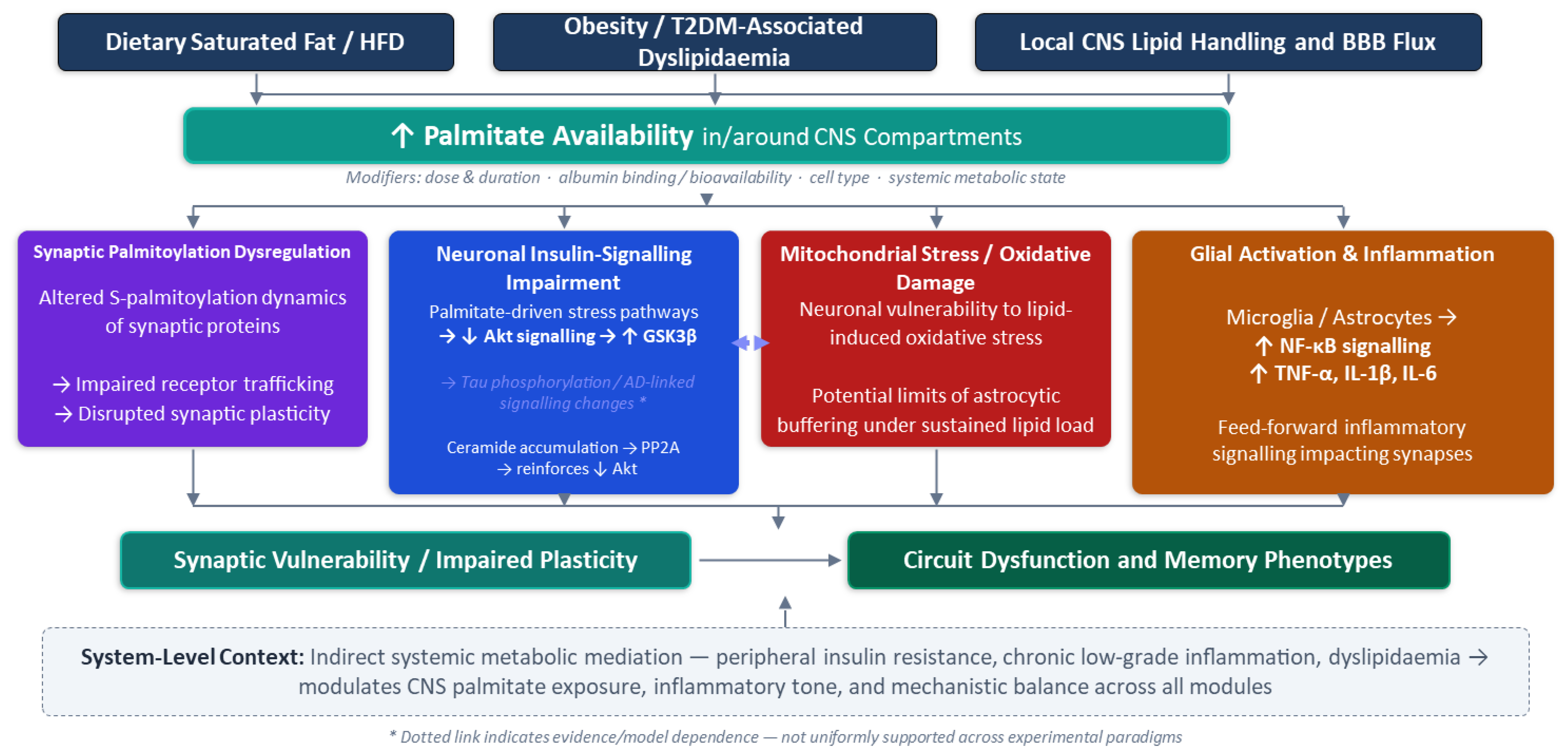
An Integrated Model of Palmitate-Driven Synaptic Vulnerability
2.2.3. Hippocampal Neurogenesis
Diet as a Regulatory Factor in AHN
Reflections on Translational Considerations
3. Caloric Restriction
4. Future Directions
5. Conclusions
Author Contributions
Funding
Institutional Review Board Statement
Informed Consent Statement
Data Availability Statement
Conflicts of Interest
References
- Wium-Andersen, I.K.; Rungby, J.; Jørgensen, M.B.; Sandbæk, A.; Osler, M.; Wium-Andersen, M.K. Risk of dementia and cognitive dysfunction in individuals with diabetes or elevated blood glucose. Epidemiol. Psychiatr. Sci. 2020, 29, e43. [Google Scholar] [CrossRef] [PubMed]
- Chatterjee, S.; Mudher, A. Alzheimer’s Disease and Type 2 Diabetes: A Critical Assessment of the Shared Pathological Traits. Front. Neurosci. 2018, 12, 383. [Google Scholar] [CrossRef]
- Gómez-Pinilla, F. Brain foods: The effects of nutrients on brain function. Nat. Rev. Neurosci. 2008, 9, 568–578. [Google Scholar] [CrossRef] [PubMed]
- Gutierrez, L.; Folch, A.; Rojas, M.; Cantero, J.L.; Atienza, M.; Folch, J.; Camins, A.; Ruiz, A.; Papandreou, C.; Bulló, M. Effects of Nutrition on Cognitive Function in Adults with or without Cognitive Impairment: A Systematic Review of Randomized Controlled Clinical Trials. Nutrients 2021, 13, 3728. [Google Scholar] [CrossRef]
- Roumes, H.; Pellerin, L.; Bouzier-Sore, A.-K. Astrocytes as metabolic suppliers to support neuronal activity and brain functions. Essays Biochem. 2023, 67, 27–37. [Google Scholar] [CrossRef] [PubMed]
- Jimenez-Blasco, D.; Agulla, J.; Lapresa, R.; Garcia-Macia, M.; Bobo-Jimenez, V.; Garcia-Rodriguez, D.; Manjarres-Raza, I.; Fernandez, E.; Jeanson, Y.; Khoury, S.; et al. Weak neuronal glycolysis sustains cognition and organismal fitness. Nat. Metab. 2024, 6, 1253–1267. [Google Scholar] [CrossRef]
- Rose, J.; Brian, C.; Pappa, A.; Panayiotidis, M.I.; Franco, R. Mitochondrial Metabolism in Astrocytes Regulates Brain Bioenergetics, Neurotransmission and Redox Balance. Front. Neurosci. 2020, 14, 536682. [Google Scholar] [CrossRef] [PubMed]
- Volk, M.; Millington, S.; Weinhouse, S. Oxidation of endogenous fatty acids of rat tissues in vitro. J. Biol. Chem. 1952, 195, 493–501. [Google Scholar] [CrossRef]
- Edmond, J.; Robbins, R.A.; Bergstrom, J.D.; Cole, R.A.; De Vellis, J. Capacity for substrate utilization in oxidative metabolism by neurons, astrocytes, and oligodendrocytes from developing brain in primary culture. J. Neurosci. Res. 1987, 18, 551–561. [Google Scholar] [CrossRef]
- Jernberg, J.N.; Bowman, C.E.; Wolfgang, M.J.; Scafidi, S. Developmental regulation and localization of carnitine palmitoyltransferases (CPTs) in rat brain. J. Neurochem. 2017, 142, 407–419. [Google Scholar] [CrossRef]
- Kumar, M.; Wu, Y.; Knapp, J.; Pontius, C.L.; Park, D.; Witte, R.E.; McAllister, R.; Gupta, K.; Rajagopalan, K.N.; De Camilli, P.; et al. Triglycerides are an important fuel reserve for synapse function in the brain. Nat. Metab. 2025, 7, 1392–1403. [Google Scholar] [CrossRef]
- Behera, P.; Mishra, M. Lipid Droplet in Lipodystrophy and Neurodegeneration. Biol. Cell 2025, 117, e70009. [Google Scholar] [CrossRef]
- Zhao, F.; Siu, J.J.; Huang, W.; Askwith, C.; Cao, L. Insulin Modulates Excitatory Synaptic Transmission and Synaptic Plasticity in the Mouse Hippocampus. Neuroscience 2019, 411, 237–254. [Google Scholar] [CrossRef]
- Grillo, C.A.; Piroli, G.G.; Lawrence, R.C.; Wrighten, S.A.; Green, A.J.; Wilson, S.P.; Sakai, R.R.; Kelly, S.J.; Wilson, M.A.; Mott, D.D.; et al. Hippocampal Insulin Resistance Impairs Spatial Learning and Synaptic Plasticity. Diabetes 2015, 64, 3927–3936. [Google Scholar] [CrossRef]
- Chavoshinezhad, S.; Zibaii, M.I.; Seyed Nazari, M.H.; Ronaghi, A.; Asgari Taei, A.; Ghorbani, A.; Pandamooz, S.; Salehi, M.S.; Valian, N.; Motamedi, F.; et al. Optogenetic stimulation of entorhinal cortex reveals the implication of insulin signaling in adult rat’s hippocampal neurogenesis. Prog. Neuro-Psychopharmacol. Biol. Psychiatry 2021, 111, 110344. [Google Scholar] [CrossRef]
- Mietelska-Porowska, A.; Domańska, J.; Want, A.; Więckowska-Gacek, A.; Chutorański, D.; Koperski, M.; Wojda, U. Induction of Brain Insulin Resistance and Alzheimer’s Molecular Changes by Western Diet. Int. J. Mol. Sci. 2022, 23, 4744. [Google Scholar] [CrossRef]
- Andrade, L.J.D.O.; Oliveira, L.M.D.; Bittencourt, A.M.V.; Lourenço, L.G.D.C.; Oliveira, G.C.M.D. Brain insulin resistance and Alzheimer’s disease: A systematic review. Dement. Neuropsychol. 2024, 18, e20230032. [Google Scholar] [CrossRef]
- Wu, M.; Huang, L.; Huang, Y.; Shen, J.; Chen, H.; Wang, B.; Zong, G.; Guasch-Ferre, M.; Rong, S.; Liu, X.; et al. Association between dietary fat intake and long-term risk of dementia: A prospective cohort study. Am. J. Clin. Nutr. 2025, 122, 1725–1734. [Google Scholar] [CrossRef]
- Zhang, S.; Xiao, Y.; Cheng, Y.; Ma, Y.; Liu, J.; Li, C.; Shang, H. Associations of sugar intake, high-sugar dietary pattern, and the risk of dementia: A prospective cohort study of 210,832 participants. BMC Med. 2024, 22, 298. [Google Scholar] [CrossRef]
- Li, H.; Li, S.; Yang, H.; Zhang, Y.; Zhang, S.; Ma, Y.; Hou, Y.; Zhang, X.; Niu, K.; Borné, Y.; et al. Association of Ultraprocessed Food Consumption with Risk of Dementia: A Prospective Cohort Study. Neurology 2022, 99, E1056–E1066. [Google Scholar] [CrossRef]
- Montonen, J.; Järvinen, R.; Knekt, P.; Heliövaara, M.; Reunanen, A. Consumption of Sweetened Beverages and Intakes of Fructose and Glucose Predict Type 2 Diabetes Occurrence. J. Nutr. 2007, 137, 1447–1454. [Google Scholar] [CrossRef]
- Hannou, S.A.; Haslam, D.E.; McKeown, N.M.; Herman, M.A. Fructose metabolism and metabolic disease. J. Clin. Investig. 2018, 128, 545–555. [Google Scholar] [CrossRef]
- Kelishadi, R.; Mansourian, M.; Heidari-Beni, M. Association of fructose consumption and components of metabolic syndrome in human studies: A systematic review and meta-analysis. Nutrition 2014, 30, 503–510. [Google Scholar] [CrossRef]
- Cisternas, P.; Salazar, P.; Serrano, F.G.; Montecinos-Oliva, C.; Arredondo, S.B.; Varela-Nallar, L.; Barja, S.; Vio, C.P.; Gomez-Pinilla, F.; Inestrosa, N.C. Fructose consumption reduces hippocampal synaptic plasticity underlying cognitive performance. Biochim. Biophys. Acta (BBA)—Mol. Basis Dis. 2015, 1852, 2379–2390. [Google Scholar] [CrossRef]
- Kovačević, S.; Pavković, Ž.; Brkljačić, J.; Elaković, I.; Vojnović Milutinović, D.; Djordjevic, A.; Pešić, V. High-Fructose Diet and Chronic Unpredictable Stress Modify Each Other’s Neurobehavioral Effects in Female Rats. Int. J. Mol. Sci. 2024, 25, 11721. [Google Scholar] [CrossRef]
- Mazzoli, A.; Spagnuolo, M.S.; Nazzaro, M.; Gatto, C.; Iossa, S.; Cigliano, L. Fructose Removal from the Diet Reverses Inflammation, Mitochondrial Dysfunction, and Oxidative Stress in Hippocampus. Antioxidants 2021, 10, 487. [Google Scholar] [CrossRef]
- D’Ambrosio, C.; Cigliano, L.; Mazzoli, A.; Matuozzo, M.; Nazzaro, M.; Scaloni, A.; Iossa, S.; Spagnuolo, M.S. Fructose Diet-Associated Molecular Alterations in Hypothalamus of Adolescent Rats: A Proteomic Approach. Nutrients 2023, 15, 475. [Google Scholar] [CrossRef] [PubMed]
- Jiménez-Maldonado, A.; Ying, Z.; Byun, H.R.; Gomez-Pinilla, F. Short-term fructose ingestion affects the brain independently from establishment of metabolic syndrome. Biochim. Biophys. Acta (BBA)—Mol. Basis Dis. 2018, 1864, 24–33. [Google Scholar] [CrossRef]
- Jaiswal, N.; Maurya, C.K.; Pandey, J.; Rai, A.K.; Tamrakar, A.K. Fructose-induced ROS generation impairs glucose utilization in L6 skeletal muscle cells. Free Radic. Res. 2015, 49, 1055–1068. [Google Scholar] [CrossRef]
- Wei, Y.; Wang, D.; Moran, G.; Estrada, A.; Pagliassotti, M.J. Fructose-induced stress signaling in the liver involves methylglyoxal. Nutr. Metab. 2013, 10, 32. [Google Scholar] [CrossRef]
- Kovačević, S.; Brkljačić, J.; Vojnović Milutinović, D.; Gligorovska, L.; Bursać, B.; Elaković, I.; Djordjevic, A. Fructose Induces Visceral Adipose Tissue Inflammation and Insulin Resistance Even Without Development of Obesity in Adult Female but Not in Male Rats. Front. Nutr. 2021, 8, 749328. [Google Scholar] [CrossRef]
- Spinelli, M.; Fusco, S.; Mainardi, M.; Scala, F.; Natale, F.; Lapenta, R.; Mattera, A.; Rinaudo, M.; Li Puma, D.D.; Ripoli, C.; et al. Brain insulin resistance impairs hippocampal synaptic plasticity and memory by increasing GluA1 palmitoylation through FoxO3a. Nat. Commun. 2017, 8, 2009. [Google Scholar] [CrossRef] [PubMed]
- Vratarić, M.; Šenk, V.; Bursać, B.; Gligorovska, L.; Ignjatović, D.; Kovačević, S.; Veličković, N.; Djordjevic, A. Fructose diet ameliorates effects of macrophage migration inhibitory factor deficiency on prefrontal cortex inflammation, neural plasticity, and behavior in male mice. BioFactors 2023, 49, 90–107. [Google Scholar] [CrossRef]
- Kruse, M.S.; Vadillo, M.J.; Miguelez Fernández, A.M.M.; Rey, M.; Zanutto, B.S.; Coirini, H. Sucrose exposure in juvenile rats produces long-term changes in fear memory and anxiety-like behavior. Psychoneuroendocrinology 2019, 104, 300–307. [Google Scholar] [CrossRef] [PubMed]
- Davis, J.A.; Paul, J.R.; McMeekin, L.J.; Nason, S.R.; Antipenko, J.P.; Yates, S.D.; Cowell, R.M.; Habegger, K.M.; Gamble, K.L. High-Fat and High-Sucrose Diets Impair Time-of-Day Differences in Spatial Working Memory of Male Mice. Obesity 2020, 28, 2347–2356. [Google Scholar] [CrossRef]
- Hernández-Ramírez, S.; Osorio-Gómez, D.; Escobar, M.L.; Rodríguez-Durán, L.; Velasco, M.; Bermúdez-Rattoni, F.; Hiriart, M.; Guzmán-Ramos, K.R. Catecholaminergic stimulation restores high-sucrose diet-induced hippocampal dysfunction. Psychoneuroendocrinology 2021, 127, 105178. [Google Scholar] [CrossRef]
- Coirini, H.; Rey, M.; Gonzalez Deniselle, M.C.; Kruse, M.S. Long-Term Memory Function Impairments following Sucrose Exposure in Juvenile versus Adult Rats. Biomedicines 2022, 10, 2723. [Google Scholar] [CrossRef] [PubMed]
- Korgan, A.C.; Oliveira-Abreu, K.; Wei, W.; Martin, S.L.A.; Bridges, Z.J.D.; Leal-Cardoso, J.H.; Kaczorowski, C.C.; O’Connell, K.M.S. High sucrose consumption decouples intrinsic and synaptic excitability of AgRP neurons without altering body weight. Int. J. Obes. 2023, 47, 224–235. [Google Scholar] [CrossRef]
- Miles, B.; Yang, W.; Dezsi, G.; Sokolenko, E.; Gomes, F.M.M.; Jupp, B.; Hill, R.; Hudson, M.; Jones, N.C. High sucrose diet does not impact spatial cognition in rats using advanced touchscreen technology. Behav. Brain Res. 2022, 418, 113665. [Google Scholar] [CrossRef]
- He, S.; Xu, Z.; Han, X. Lipidome disruption in Alzheimer’s disease brain: Detection, pathological mechanisms, and therapeutic implications. Mol. Neurodegener. 2025, 20, 11. [Google Scholar] [CrossRef]
- Qin, B.; Fu, Y.; Raulin, A.-C.; Kong, S.; Li, H.; Liu, J.; Liu, C.; Zhao, J. Lipid metabolism in health and disease: Mechanistic and therapeutic insights for Parkinson’s disease. Chin. Med. J. 2025, 138, 1411–1423. [Google Scholar] [CrossRef]
- De Paula, G.C.; Brunetta, H.S.; Engel, D.F.; Gaspar, J.M.; Velloso, L.A.; Engblom, D.; De Oliveira, J.; De Bem, A.F. Hippocampal Function Is Impaired by a Short-Term High-Fat Diet in Mice: Increased Blood–Brain Barrier Permeability and Neuroinflammation as Triggering Events. Front. Neurosci. 2021, 15, 734158. [Google Scholar] [CrossRef]
- González Olmo, B.M.; Bettes, M.N.; DeMarsh, J.W.; Zhao, F.; Askwith, C.; Barrientos, R.M. Short-term high-fat diet consumption impairs synaptic plasticity in the aged hippocampus via IL-1 signaling. npj Sci. Food 2023, 7, 35. [Google Scholar] [CrossRef]
- McLean, F.H.; Grant, C.; Morris, A.C.; Horgan, G.W.; Polanski, A.J.; Allan, K.; Campbell, F.M.; Langston, R.F.; Williams, L.M. Rapid and reversible impairment of episodic memory by a high-fat diet in mice. Sci. Rep. 2018, 8, 11976. [Google Scholar] [CrossRef]
- Spencer, S.J.; D’Angelo, H.; Soch, A.; Watkins, L.R.; Maier, S.F.; Barrientos, R.M. High-fat diet and aging interact to produce neuroinflammation and impair hippocampal- and amygdalar-dependent memory. Neurobiol. Aging 2017, 58, 88–101. [Google Scholar] [CrossRef] [PubMed]
- Chiazza, F.; Bondi, H.; Masante, I.; Ugazio, F.; Bortolotto, V.; Canonico, P.L.; Grilli, M. Short high fat diet triggers reversible and region specific effects in DCX+ hippocampal immature neurons of adolescent male mice. Sci. Rep. 2021, 11, 21499. [Google Scholar] [CrossRef] [PubMed]
- Wu, J.; Xu, H.; Wang, S.; Weng, H.; Luo, Z.; Ou, G.; Chen, Y.; Xu, L.; So, K.-F.; Deng, L.; et al. Regular exercise ameliorates high-fat diet-induced depressive-like behaviors by activating hippocampal neuronal autophagy and enhancing synaptic plasticity. Cell Death Dis. 2024, 15, 737. [Google Scholar] [CrossRef]
- Bakoyiannis, I.; Ducourneau, E.G.; N’diaye, M.; Fermigier, A.; Ducroix-Crepy, C.; Bosch-Bouju, C.; Coutureau, E.; Trifilieff, P.; Ferreira, G. Obesogenic diet induces circuit-specific memory deficits in mice. eLife 2024, 13, e80388. [Google Scholar] [CrossRef]
- Ruiz-Sobremazas, D.; Abreu, A.C.; Prados-Pardo, Á.; Martín-González, E.; Tristán, A.I.; Fernández, I.; Moreno, M.; Mora, S. From Nutritional Patterns to Behavior: High-Fat Diet Influences on Inhibitory Control, Brain Gene Expression, and Metabolomics in Rats. ACS Chem. Neurosci. 2024, 15, 4369–4382. [Google Scholar] [CrossRef] [PubMed]
- Wang, X.; Li, H. Chronic high-fat diet induces overeating and impairs synaptic transmission in feeding-related brain regions. Front. Mol. Neurosci. 2022, 15, 1019446. [Google Scholar] [CrossRef]
- Bracko, O.; Vinarcsik, L.K.; Cruz Hernández, J.C.; Ruiz-Uribe, N.E.; Haft-Javaherian, M.; Falkenhain, K.; Ramanauskaite, E.M.; Ali, M.; Mohapatra, A.; Swallow, M.A.; et al. High fat diet worsens Alzheimer’s disease-related behavioral abnormalities and neuropathology in APP/PS1 mice, but not by synergistically decreasing cerebral blood flow. Sci. Rep. 2020, 10, 9884. [Google Scholar] [CrossRef]
- Yang, S.; Miyazaki, H.; Wannakul, T.; Amo, E.; Saido, T.; Saito, T.; Sasaguri, H.; Maekawa, M.; Owada, Y. High-Fat Diet-Induced Excessive Accumulation of Cerebral Cholesterol Esters and Microglial Dysfunction Exacerbate Alzheimer’s Disease Pathology in APPNL−G−F mice. Mol. Neurobiol. 2025, 62, 12231–12251. [Google Scholar] [CrossRef]
- Ebert, D.; Haller, R.G.; Walton, M.E. Energy Contribution of Octanoate to Intact Rat Brain Metabolism Measured by 13C Nuclear Magnetic Resonance Spectroscopy. J. Neurosci. 2003, 23, 5928–5935. [Google Scholar] [CrossRef] [PubMed]
- Hamilton, J.A.; Brunaldi, K. A Model for Fatty Acid Transport into the Brain. J. Mol. Neurosci. 2007, 33, 12–17. [Google Scholar] [CrossRef]
- Mitchell, R.W.; On, N.H.; Del Bigio, M.R.; Miller, D.W.; Hatch, G.M. Fatty acid transport protein expression in human brain and potential role in fatty acid transport across human brain microvessel endothelial cells: Fatty acid transport protein expression in human brain. J. Neurochem. 2011, 17, 735–746. [Google Scholar] [CrossRef]
- Li, P.; Zhu, X.; Huang, C.; Tian, S.; Li, Y.; Qiao, Y.; Liu, M.; Su, J.; Tian, D. Effects of obesity on aging brain and cognitive decline: A cohort study from the UK Biobank. IBRO Neurosci. Rep. 2025, 18, 148–157. [Google Scholar] [CrossRef] [PubMed]
- Palomer, X.; Pizarro-Delgado, J.; Barroso, E.; Vázquez-Carrera, M. Palmitic and Oleic Acid: The Yin and Yang of Fatty Acids in Type 2 Diabetes Mellitus. Trends Endocrinol. Metab. 2018, 29, 178–190. [Google Scholar] [CrossRef] [PubMed]
- Sobczak, A.I.S.; Katundu, K.G.H.; Phoenix, F.A.; Khazaipoul, S.; Yu, R.; Lampiao, F.; Stefanowicz, F.; Blindauer, C.A.; Pitt, S.J.; Smith, T.K.; et al. Albumin-mediated alteration of plasma zinc speciation by fatty acids modulates blood clotting in type-2 diabetes. Chem. Sci. 2021, 12, 4079–4093. [Google Scholar] [CrossRef]
- Hu, T.; Zhang, W.; Han, F.; Zhao, R.; Liu, L.; An, Z. Plasma fingerprint of free fatty acids and their correlations with the traditional cardiac biomarkers in patients with type 2 diabetes complicated by coronary heart disease. Front. Cardiovasc. Med. 2022, 9, 903412. [Google Scholar] [CrossRef]
- Liu, X.; Gong, M.; Wu, N. Research progress on the relationship between free fatty acid profile and type 2 diabetes complicated by coronary heart disease. Front. Endocrinol. 2024, 15, 1503704. [Google Scholar] [CrossRef]
- Melo, H.M.; Seixas Da Silva, G.D.S.; Sant’Ana, M.R.; Teixeira, C.V.L.; Clarke, J.R.; Miya Coreixas, V.S.; De Melo, B.C.; Fortuna, J.T.S.; Forny-Germano, L.; Ledo, J.H.; et al. Palmitate Is Increased in the Cerebrospinal Fluid of Humans with Obesity and Induces Memory Impairment in Mice via Pro-inflammatory TNF-α. Cell Rep. 2020, 30, 2180–2194.e8. [Google Scholar] [CrossRef]
- Sánchez-Alegría, K.; Arias, C. Functional consequences of brain exposure to saturated fatty acids: From energy metabolism and insulin resistance to neuronal damage. Endocrinol. Diabetes Metab. 2023, 6, e386. [Google Scholar] [CrossRef] [PubMed]
- Saipuljumri, E.N.; Zeng, J.; Lo, C.H. Palmitic acid–induced autolysosomal dysfunction and lipotoxicity in neuroinflammation and neurodegeneration. Neural Regen. Res. 2025, 21, 2806–2811. [Google Scholar] [CrossRef]
- Main, A.; Fuller, W. Protein S-Palmitoylation: Advances and challenges in studying a therapeutically important lipid modification. FEBS J. 2022, 289, 861–882. [Google Scholar] [CrossRef] [PubMed]
- Sohn, H.; Park, M. Palmitoylation-mediated synaptic regulation of AMPA receptor trafficking and function. Arch. Pharm. Res. 2019, 42, 426–435. [Google Scholar] [CrossRef] [PubMed]
- Rojas, R.; Griñán-Ferré, C.; Castellanos, A.; Griego, E.; Martínez, M.; De Dios Navarro-López, J.; Jiménez-Díaz, L.; Rodríguez-Álvarez, J.; Soto Del Cerro, D.; Castillo, P.E.; et al. Beta-hydroxybutyrate counteracts the deleterious effects of a saturated high-fat diet on synaptic AMPAR receptors and cognitive performance. Mol. Metab. 2025, 99, 102207. [Google Scholar] [CrossRef]
- Pytyś, A.; Ijaz, R.; Buszka, A.; Miłek, J.; Figiel, I.; Wardaszka-Pianka, P.; Roszkowska, M.; Mierzwa, N.; Wojtas, A.; Kerstein, E.; et al. Temporal and protein-specific S-palmitoylation supports synaptic and neural network plasticity. Cell. Mol. Life Sci. 2025, 82, 355. [Google Scholar] [CrossRef]
- Amine, H.; Benomar, Y.; Taouis, M. Palmitic acid promotes resistin-induced insulin resistance and inflammation in SH-SY5Y human neuroblastoma. Sci. Rep. 2021, 11, 5427. [Google Scholar] [CrossRef]
- Sánchez-Alegría, K.; Bastián-Eugenio, C.E.; Vaca, L.; Arias, C. Palmitic acid induces insulin resistance by a mechanism associated with energy metabolism and calcium entry in neuronal cells. FASEB J. 2021, 35, 5427. [Google Scholar] [CrossRef]
- Mukhuty, A.; Fouzder, C.; Mukherjee, S.; Malick, C.; Mukhopadhyay, S.; Bhattacharya, S.; Kundu, R. Palmitate induced Fetuin-A secretion from pancreatic β-cells adversely affects its function and elicits inflammation. Biochem. Biophys. Res. Commun. 2017, 491, 1118–1124. [Google Scholar] [CrossRef]
- Cheng, A.M.; Handa, P.; Tateya, S.; Schwartz, J.; Tang, C.; Mitra, P.; Oram, J.F.; Chait, A.; Kim, F. Apolipoprotein A-I Attenuates Palmitate-Mediated NF-κB Activation by Reducing Toll-Like Receptor-4 Recruitment into Lipid Rafts. PLoS ONE 2012, 7, e33917. [Google Scholar] [CrossRef]
- Sergi, D.; Zauli, E.; Celeghini, C.; Previati, M.; Zauli, G. Ceramides as the molecular link between impaired lipid metabolism, saturated fatty acid intake and insulin resistance: Are all saturated fatty acids to be blamed for ceramide-mediated lipotoxicity? Nutr. Res. Rev. 2025, 38, 256–266. [Google Scholar] [CrossRef]
- Hammerschmidt, P.; Steculorum, S.M.; Bandet, C.L.; Del Río-Martín, A.; Steuernagel, L.; Kohlhaas, V.; Feldmann, M.; Varela, L.; Majcher, A.; Quatorze Correia, M.; et al. CerS6-dependent ceramide synthesis in hypothalamic neurons promotes ER/mitochondrial stress and impairs glucose homeostasis in obese mice. Nat. Commun. 2023, 14, 7824. [Google Scholar] [CrossRef]
- Carr, S.T.; Saito, E.R.; Walton, C.M.; Saito, J.Y.; Hanegan, C.M.; Warren, C.E.; Trumbull, A.M.; Bikman, B.T. Ceramides Mediate Insulin-Induced Impairments in Cerebral Mitochondrial Bioenergetics in ApoE4 Mice. Int. J. Mol. Sci. 2023, 24, 16635. [Google Scholar] [CrossRef]
- Dehghan, A.; Pinto, R.C.; Karaman, I.; Huang, J.; Durainayagam, B.R.; Ghanbari, M.; Nazeer, A.; Zhong, Q.; Liggi, S.; Whiley, L.; et al. Metabolome-wide association study on ABCA7 indicates a role of ceramide metabolism in Alzheimer’s disease. Proc. Natl. Acad. Sci. USA 2022, 119, e2206083119. [Google Scholar] [CrossRef] [PubMed]
- Reveglia, P.; Paolillo, C.; Angiolillo, A.; Ferretti, G.; Angelico, R.; Sirabella, R.; Corso, G.; Matrone, C.; Di Costanzo, A. A Targeted Mass Spectrometry Approach to Identify Peripheral Changes in Metabolic Pathways of Patients with Alzheimer’s Disease. Int. J. Mol. Sci. 2023, 24, 9736. [Google Scholar] [CrossRef] [PubMed]
- Patil, S.; Chan, C. Palmitic and stearic fatty acids induce Alzheimer-like hyperphosphorylation of tau in primary rat cortical neurons. Neurosci. Lett. 2005, 384, 288–293. [Google Scholar] [CrossRef]
- García-Cruz, V.M.; Arias, C. Palmitic Acid Induces Posttranslational Modifications of Tau Protein in Alzheimer’s Disease–Related Epitopes and Increases Intraneuronal Tau Levels. Mol. Neurobiol. 2024, 61, 5129–5141. [Google Scholar] [CrossRef]
- Patil, S.; Sheng, L.; Masserang, A.; Chan, C. Palmitic acid-treated astrocytes induce BACE1 upregulation and accumulation of C-terminal fragment of APP in primary cortical neurons. Neurosci. Lett. 2006, 406, 55–59. [Google Scholar] [CrossRef]
- Kim, J.Y.; Lee, H.J.; Lee, S.-J.; Jung, Y.H.; Yoo, D.Y.; Hwang, I.K.; Seong, J.K.; Ryu, J.M.; Han, H.J. Palmitic Acid-BSA enhances Amyloid-β production through GPR40-mediated dual pathways in neuronal cells: Involvement of the Akt/mTOR/HIF-1α and Akt/NF-κB pathways. Sci. Rep. 2017, 7, 4335. [Google Scholar] [CrossRef] [PubMed]
- Flores-León, M.; Pérez-Domínguez, M.; González-Barrios, R.; Arias, C. Palmitic Acid-Induced NAD+ Depletion is Associated with the Reduced Function of SIRT1 and Increased Expression of BACE1 in Hippocampal Neurons. Neurochem. Res. 2019, 44, 1745–1754. [Google Scholar] [CrossRef] [PubMed]
- Yang, C.; Sui, G.; Wang, L.; Chen, Z.; Wang, F. MiR-124 Prevents the Microglial Proinflammatory Response by Inhibiting the Activities of TLR4 and Downstream NLRP3 in Palmitic Acid-Treated BV2 Cells. J. Mol. Neurosci. 2022, 72, 496–506. [Google Scholar] [CrossRef] [PubMed]
- Chmielarz, M.; Sobieszczańska, B.; Teisseyre, A.; Wawrzyńska, M.; Bożemska, E.; Środa-Pomianek, K. Palmitic Acid Modulates Microglial Cell Response to Metabolic Endotoxemia in an In Vitro Study. Nutrients 2023, 15, 3463. [Google Scholar] [CrossRef] [PubMed]
- Zhou, H.; Chang, S.L. Meta-analysis of the effects of palmitic acid on microglia activation and neurodegeneration. NeuroImmune Pharmacol. Ther. 2023, 2, 281–291. [Google Scholar] [CrossRef]
- Gupta, S.; Knight, A.G.; Gupta, S.; Keller, J.N.; Bruce-Keller, A.J. Saturated long-chain fatty acids activate inflammatory signaling in astrocytes. J. Neurochem. 2012, 120, 1060–1071. [Google Scholar] [CrossRef]
- Butler, M.J.; Cole, R.M.; Deems, N.P.; Belury, M.A.; Barrientos, R.M. Fatty food, fatty acids, and microglial priming in the adult and aged hippocampus and amygdala. Brain Behav. Immun. 2020, 89, 145–158. [Google Scholar] [CrossRef]
- Campillo, B.W.; Galguera, D.; Cerdan, S.; López-Larrubia, P.; Lizarbe, B. Short-term high-fat diet alters the mouse brain magnetic resonance imaging parameters consistently with neuroinflammation on males and metabolic rearrangements on females. A pre-clinical study with an optimized selection of linear mixed-effects models. Front. Neurosci. 2022, 16, 1025108. [Google Scholar] [CrossRef]
- Evans, A.K.; Saw, N.L.; Woods, C.E.; Vidano, L.M.; Blumenfeld, S.E.; Lam, R.K.; Chu, E.K.; Reading, C.; Shamloo, M. Impact of high-fat diet on cognitive behavior and central and systemic inflammation with aging and sex differences in mice. Brain Behav. Immun. 2024, 118, 334–354. [Google Scholar] [CrossRef]
- Targett, I.L.; Pring, K.; Valiente, A.I.M.; Qualtrough, D.; Conway, M.E.; Crompton, L.A.; Craig, T.J. Chronic Fatty Acid Exposure Disrupts SH-SY5Y and Neuronal Differentiation and Is a Potential Link Between Type-2 Diabetes and Alzheimer’s Disease. Mol. Neurobiol. 2026, 63, 183. [Google Scholar] [CrossRef]
- Alonso-Moreno, M.; Gallardo-Caballero, M.; Prádanos-Senén, A.; Llorens-Martín, M. Human adult hippocampal neurogenesis in health and disease. Aging Brain 2025, 8, 100145. [Google Scholar] [CrossRef]
- Moreno-Jiménez, E.P.; Flor-García, M.; Terreros-Roncal, J.; Rábano, A.; Cafini, F.; Pallas-Bazarra, N.; Ávila, J.; Llorens-Martín, M. Adult hippocampal neurogenesis is abundant in neurologically healthy subjects and drops sharply in patients with Alzheimer’s disease. Nat. Med. 2019, 25, 554–560. [Google Scholar] [CrossRef]
- Zhang, X.; Wei, X.; Mei, Y.; Wang, D.; Wang, J.; Zhang, Y.; Li, X.; Gu, Y.; Peng, G.; Sun, B. Modulating adult neurogenesis affects synaptic plasticity and cognitive functions in mouse models of Alzheimer’s disease. Stem Cell Rep. 2021, 16, 3005–3019. [Google Scholar] [CrossRef]
- Mishra, R.; Phan, T.; Kumar, P.; Morrissey, Z.; Gupta, M.; Hollands, C.; Shetti, A.; Lopez, K.L.; Maienschein-Cline, M.; Suh, H.; et al. Augmenting neurogenesis rescues memory impairments in Alzheimer’s disease by restoring the memory-storing neurons. J. Exp. Med. 2022, 219, e20220391. [Google Scholar] [CrossRef]
- Li, Q.; Liu, H.; Li, L.; Guo, H.; Xie, Z.; Kong, X.; Xu, J.; Zhang, J.; Chen, Y.; Zhang, Z.; et al. Mettl1-mediated internal m7G methylation of Sptbn2 mRNA elicits neurogenesis and anti-alzheimer’s disease. Cell Biosci. 2023, 13, 183. [Google Scholar] [CrossRef] [PubMed]
- Bonds, J.A.; Shetti, A.; Stephen, T.K.L.; Bonini, M.G.; Minshall, R.D.; Lazarov, O. Deficits in hippocampal neurogenesis in obesity-dependent and -independent type-2 diabetes mellitus mouse models. Sci. Rep. 2020, 10, 16368. [Google Scholar] [CrossRef] [PubMed]
- Melgar-Locatelli, S.; De Ceglia, M.; Mañas-Padilla, M.C.; Rodriguez-Pérez, C.; Castilla-Ortega, E.; Castro-Zavala, A.; Rivera, P. Nutrition and adult neurogenesis in the hippocampus: Does what you eat help you remember? Front. Neurosci. 2023, 17, 1147269. [Google Scholar] [CrossRef]
- Robison, L.S.; Albert, N.M.; Camargo, L.A.; Anderson, B.M.; Salinero, A.E.; Riccio, D.A.; Abi-Ghanem, C.; Gannon, O.J.; Zuloaga, K.L. High-Fat Diet-Induced Obesity Causes Sex-Specific Deficits in Adult Hippocampal Neurogenesis in Mice. eNeuro 2020, 7, ENEURO.0391-19.2019. [Google Scholar] [CrossRef] [PubMed]
- Natale, F.; Spinelli, M.; Barbati, S.A.; Leone, L.; Fusco, S.; Grassi, C. High Fat Diet Multigenerationally Affects Hippocampal Neural Stem Cell Proliferation via Epigenetic Mechanisms. Cells 2022, 11, 2661. [Google Scholar] [CrossRef]
- Fierros-Campuzano, J.; Ballesteros-Zebadúa, P.; Manjarrez-Marmolejo, J.; Aguilera, P.; Méndez-Diaz, M.; Prospero-García, O.; Franco-Pérez, J. Irreversible hippocampal changes induced by high fructose diet in rats. Nutr. Neurosci. 2022, 25, 1325–1337. [Google Scholar] [CrossRef]
- Paulo, S.L.; Miranda-Lourenço, C.; Belo, R.F.; Rodrigues, R.S.; Fonseca-Gomes, J.; Tanqueiro, S.R.; Geraldes, V.; Rocha, I.; Sebastião, A.M.; Xapelli, S.; et al. High Caloric Diet Induces Memory Impairment and Disrupts Synaptic Plasticity in Aged Rats. Curr. Issues Mol. Biol. 2021, 43, 2305–2319. [Google Scholar] [CrossRef]
- Park, H.-R.; Kim, J.-Y.; Park, K.-Y.; Lee, J.-W. Lipotoxicity of Palmitic Acid on Neural Progenitor Cells and Hippocampal Neurogenesis. Toxicol. Res. 2011, 27, 103–110. [Google Scholar] [CrossRef] [PubMed]
- Wang, Z.; Liu, D.; Zhang, Q.; Wang, J.; Zhan, J.; Xian, X.; Du, Z.; Wang, X.; Hao, A. Palmitic acid affects proliferation and differentiation of neural stem cells in vitro. J. Neurosci. Res. 2014, 92, 574–586. [Google Scholar] [CrossRef]
- Rueda-Díaz, S.S.; Soto-Santarriaga, I.F.; Torres-Arciga, K.; García-Cruz, V.M.; González-Barrios, R.; Flores-León, M.; Arias, C. Palmitic Acid Induces Dynamic Time-Dependent Alterations in HDACs, Neuronal Chromatin Acetylation, and Gene Expression. Neurochem. Res. 2025, 50, 220. [Google Scholar] [CrossRef]
- Ardah, M.T.; Parween, S.; Varghese, D.S.; Emerald, B.S.; Ansari, S.A. Saturated fatty acid alters embryonic cortical neurogenesis through modulation of gene expression in neural stem cells. J. Nutr. Biochem. 2018, 62, 230–246. [Google Scholar] [CrossRef]
- López-Lluch, G.; Navas, P. Calorie restriction as an intervention in ageing. J. Physiol. 2016, 594, 2043–2060. [Google Scholar] [CrossRef]
- Baik, S.; Rajeev, V.; Fann, D.Y.; Jo, D.; Arumugam, T.V. Intermittent fasting increases adult hippocampal neurogenesis. Brain Behav. 2020, 10, e01444. [Google Scholar] [CrossRef] [PubMed]
- Dias, G.P.; Murphy, T.; Stangl, D.; Ahmet, S.; Morisse, B.; Nix, A.; Aimone, L.J.; Aimone, J.B.; Kuro-O, M.; Gage, F.H.; et al. Intermittent fasting enhances long-term memory consolidation, adult hippocampal neurogenesis, and expression of longevity gene Klotho. Mol. Psychiatry 2021, 26, 6365–6379. [Google Scholar] [CrossRef]
- Lee, J.; An, H.S.; Shin, H.J.; Jang, H.M.; Im, C.O.; Jeong, Y.; Eum, K.; Yoon, S.; Lee, S.J.; Jeong, E.A.; et al. Intermittent Fasting Reduces Neuroinflammation and Cognitive Impairment in High-Fat Diet-Fed Mice by Downregulating Lipocalin-2 and Galectin-3. Nutrients 2024, 16, 159. [Google Scholar] [CrossRef]
- Jantsch, J.; Da Silva Rodrigues, F.; Silva Dias, V.; De Farias Fraga, G.; Eller, S.; Giovenardi, M.; Guedes, R.P. Calorie Restriction Attenuates Memory Impairment and Reduces Neuroinflammation in Obese Aged Rats. Mol. Neurobiol. 2025, 62, 1788–1799. [Google Scholar] [CrossRef]
- Fontán-Lozano, Á.; Sáez-Cassanelli, J.L.; Inda, M.C.; De Los Santos-Arteaga, M.; Sierra-Domínguez, S.A.; López-Lluch, G.; Delgado-García, J.M.; Carrión, Á.M. Caloric Restriction Increases Learning Consolidation and Facilitates Synaptic Plasticity through Mechanisms Dependent on NR2B Subunits of the NMDA Receptor. J. Neurosci. 2007, 27, 10185–10195. [Google Scholar] [CrossRef] [PubMed]
- Colucci-D’Amato, L.; Speranza, L.; Volpicelli, F. Neurotrophic Factor BDNF, Physiological Functions and Therapeutic Potential in Depression, Neurodegeneration and Brain Cancer. Int. J. Mol. Sci. 2020, 21, 7777. [Google Scholar] [CrossRef]
- Wu, S.-Y.; Pan, B.-S.; Tsai, S.-F.; Chiang, Y.-T.; Huang, B.-M.; Mo, F.-E.; Kuo, Y.-M. BDNF reverses aging-related microglial activation. J. Neuroinflamm. 2020, 17, 210. [Google Scholar] [CrossRef] [PubMed]
- Wang, X.; Shi, J.; Li, Y.; Zhou, L.; Xu, L.; Wang, J.; Liu, C.; Liang, B. Different Fasting Methods Combined With Running Exercise Regulate Glucose Metabolism via AMPK/SIRT1/BDNF Pathway in Mice. Compr. Physiol. 2025, 15, e70031. [Google Scholar] [CrossRef] [PubMed]
- Hu, E.; Du, H.; Zhu, X.; Wang, L.; Shang, S.; Wu, X.; Lu, H.; Lu, X. Beta-hydroxybutyrate Promotes the Expression of BDNF in Hippocampal Neurons under Adequate Glucose Supply. Neuroscience 2018, 386, 315–325. [Google Scholar] [CrossRef]
- Di Lucente, J.; Persico, G.; Zhou, Z.; Jin, L.-W.; Ramsey, J.J.; Rutkowsky, J.M.; Montgomery, C.M.; Tomilov, A.; Kim, K.; Giorgio, M.; et al. Ketogenic diet and BHB rescue the fall of long-term potentiation in an Alzheimer’s mouse model and stimulates synaptic plasticity pathway enzymes. Commun. Biol. 2024, 7, 195. [Google Scholar] [CrossRef] [PubMed]


| Study | Effects of Palmitate | Evidence Tier | Conditions/Delivery | Mechanism Proposed |
|---|---|---|---|---|
| Melo et al. 2020 [61] | Correlation with cognitive decline + memory impairments | Human in vivo (observational) Animal in vivo (mouse) | Observational (human) Intracerebrovascular infusion of palmitate (mouse) | TNFα activation, hippocampal inflammation |
| Rojas et al. 2025 [66] | ↓ GluA1 surface expression, ↓ synaptic plasticity | Animal in vivo (mouse) | Dietary (7% calories from palmitate) | Postsynaptic, potentially changes in GluA1 palmitoylation |
| Spinelli et al. 2017 [32] | ↓ hippocampal synaptic plasticity ↓ memory | Animal in vivo (mouse) Animal ex vivo (isolated cells) | HFD (60% saturated fat) 200 µM (isolated cells) | ↑ palmitoylation of GluA1, insulin resistance |
| Amine et al. 2021 [68] | Insulin resistance + ↑ neuroinflammation | In vitro (undifferentiated SH-SY5Y cell line) | 200 µM direct treatment (4 h) | ↑ TLR4 expression, ↑TNFα |
| Sánchez-Alegría et al. 2021 [69] | Insulin resistance | In vitro (undifferentiated MSN cell line) | 200 µM, direct exposure | ↑ calcium entry via stimulation of ATP production and KATP channel closure |
| Yang et al. 2022 [82] | ↑ inflammatory markers | In vitro (BV2 cell line) | 20–160 µM | Increased TLR4/NF-kB signalling/p65 signalling |
| Chmielarz et al. 2023 [83] | ↑ inflammatory markers (IL-6 and MCP-1) | In vitro (HMC3 cell line) | 200 µM | Potentially JAK/STAT signalling, lipid peroxidation and oxidative stress |
| García-Cruz et al. 2024 [78] | ↑ tau phosphorylation | In vitro (differentiated MSN cell line) | 200 µM, 1–24 h | ↑ GSK3β and mTOR activity |
| Targett et al. 2026 [89] | Inhibition of neuronal differentiation | In vitro (differentiated SH-SY5Y cell line and hIPSC-derived forebrain neurones) | 20 µM, 10-day treatment | Insulin resistance, dysregulation of CREB, GSK3β and CDK5 activity |
| Zhou et al. 2023 [84] | ↑ palmitate ↑ inflammatory signalling (multiple cytokines) in microglia | In silico meta-analysis | N/A | Multiple pathways including TNFα, NF-kB, and TLR4 |
| Dietary Factors | Study | Observations |
|---|---|---|
| High-fructose diet | Cisternas et al. 2015 [24] | Reduction in LTP/LTD, reduced performance in MWM, reduction in neurogenesis, and insulin resistance. |
| Kovačević et al. 2024 [31] | ↑ CaMKII phosphorylation, altered synaptic protein expression, and increased stress behaviour. | |
| High-sucrose diet | Coirini et al. 2022 [37] | Memory defects, ↓ hippocampal BDNF, and metabolic dysfunction. Specific to juvenile exposure. |
| Hernández-Ramírez et al. 2022 [36] | Several different memory defects. Defective hippocampal LTP. | |
| Kruse et al. 2019 [34] | Increased anxiety and reduced exploring behaviour (when rats are exposed as juveniles). | |
| Davis et al. 2020 [35] | Circadian changes, impaired spatial working memory, and reduced hippocampal GluN2B expression. | |
| High-fat diet | McLean et al. 2018 [44] | Episodic memory impairment by short term HFD (reversible). |
| Spencer et al. 2017 [45] | Hippocampal and amygdalar memory deficits. Neuroinflammation. | |
| Chiazza et al. 2021 [46] | Reduced dendritic complexity in immature hippocampal neurones. Reduction in BDNF levels. Short-term HFD (reversible). | |
| Wu et al. 2024 [47] | Depressive-like behaviour and reduced Wnt5a signalling, reversible by exercise. | |
| Yang et al. 2025 [52], Bracko et al. 2020 [51] | Exacerbation of AD pathology in model mice (increased Aβ, neuroinflammation, amyloid plaques and memory deficits). | |
| Robison et al. 2020 [97] | Decreased AHN in female but not male mice. | |
| Natale et al. 2022 [98] | Multigenerational effect of maternal HFD on neurogenesis in offspring. |
Disclaimer/Publisher’s Note: The statements, opinions and data contained in all publications are solely those of the individual author(s) and contributor(s) and not of MDPI and/or the editor(s). MDPI and/or the editor(s) disclaim responsibility for any injury to people or property resulting from any ideas, methods, instructions or products referred to in the content. |
© 2026 by the authors. Licensee MDPI, Basel, Switzerland. This article is an open access article distributed under the terms and conditions of the Creative Commons Attribution (CC BY) license.
Share and Cite
Targett, I.L.; Hancock, J.T.; Craig, T.J. Diet, Metabolism and Synaptic Function: Integrating Evidence Across Models in Neurodegeneration Research. Biomedicines 2026, 14, 1089. https://doi.org/10.3390/biomedicines14051089
Targett IL, Hancock JT, Craig TJ. Diet, Metabolism and Synaptic Function: Integrating Evidence Across Models in Neurodegeneration Research. Biomedicines. 2026; 14(5):1089. https://doi.org/10.3390/biomedicines14051089
Chicago/Turabian StyleTargett, Imogen L., John T. Hancock, and Tim J. Craig. 2026. "Diet, Metabolism and Synaptic Function: Integrating Evidence Across Models in Neurodegeneration Research" Biomedicines 14, no. 5: 1089. https://doi.org/10.3390/biomedicines14051089
APA StyleTargett, I. L., Hancock, J. T., & Craig, T. J. (2026). Diet, Metabolism and Synaptic Function: Integrating Evidence Across Models in Neurodegeneration Research. Biomedicines, 14(5), 1089. https://doi.org/10.3390/biomedicines14051089