

Honey Evaluation Using Electronic Tongues: An Overview




Abstract
1. Introduction
- (i)
- (ii)
- (iii)
- (iv)
2. Electrochemical Sensor Devices for Honey Evaluation: Overview and Usual Chemometric Tools
3. Electrochemical Sensor Devices for Honey Assessment
3.1. Potentiometric Electronic Tongues
3.2. Voltammetric Electronic Tongues
4. Advantages, Limitations and Drawbacks of the Two Most Common Electronic Tongues Variants
5. Conclusions
Author Contributions
Funding
Conflicts of Interest
References
- Anthony, C.R.M.; Balasuriya, D.N. Electronic honey quality analyser. Eng. J. Inst. Eng. Sri Lanka 2016, 49, 41–47. [Google Scholar] [CrossRef] [Scilit]
- Prosser, S.W.J.; Hebert, P.D.N. Rapid identification of the botanical and entomological sources of honey using DNA metabarcoding. Food Chem. 2017, 214, 183–191. [Google Scholar] [CrossRef] [Scilit] [PubMed]
- Rao, P.V.; Krishnan, K.T.; Salleh, N.; Gan, S.H. Biological and therapeutic effects of honey produced by honey bees and stingless bees: A comparative review. Rev. Bras. Farmacogn. 2016, 26, 657–664. [Google Scholar] [CrossRef] [Scilit]
- Oryan, A.; Alemzadeh, E.; Moshiri, A. Biological properties and therapeutic activities of honey in wound healing: A narrative review and meta-analysis. J. Tissue Viability 2016, 25, 98–118. [Google Scholar] [CrossRef] [Scilit] [PubMed]
- Bulut, H.K.; Tüfekci, F.G. Honey prevents oral mocositis in children undergoing chemotherapy: A quasi-experimental study with a control group. Complement. Ther. Med. 2016, 29, 132–140. [Google Scholar] [CrossRef] [Scilit] [PubMed]
- Xu, J.-L.; Xia, R.; Sun, Z.-H.; Sun, L.; Min, X.; Liu, C.; Zhang, H.; Zhu, Y.-M. Effects of honey use on the management of radio/chemotherapy-induced mucositis: A meta-analysis of randomized controlled trials. Int. J. Oral Maxillofac. Surg. 2016, 45, 1618–1625. [Google Scholar] [CrossRef] [Scilit] [PubMed]
- Fogh, S.E.; Deshmukh, S.; Berk, L.B.; Dueck, A.C.; Roof, K.; Yacoub, S.; Gergel, T.; Stephans, K.; Rimner, A.; DeNittis, A.; et al. A Randomized Phase 2 Trial of Prophylactic Manuka Honey for the Reduction of Chemoradiation Therapy–Induced Esophagitis During the Treatment of Lung Cancer: Results of NRG Oncology RTOG 1012. Int. J. Radiat. Oncol. Biol. Phys. 2017, 97, 786–796. [Google Scholar] [CrossRef] [Scilit] [PubMed]
- Kateel, R.; Adhikari, P.; Augustine, A.J.; Ullal, S. Topical honey for the treatment of diabetic foot ulcer: A systematic review. Complement. Ther. Clin. Pract. 2016, 24, 130–133. [Google Scholar] [CrossRef] [Scilit] [PubMed]
- Tenci, M.; Rossi, S.; Bonferoni, M.C.; Sandri, G.; Boselli, C.; Di Lorenzo, A.; Daglia, M.; Cornaglia, A.I.; Gioglio, L.; Perotti, C.; et al. Particulate systems based on pectin/chitosan association for the delivery of manuka honey components and platelet lysate in chronic skin ulcers. Int. J. Pharm. 2016, 509, 59–70. [Google Scholar] [CrossRef] [Scilit] [PubMed]
- Peixoto, D.M.; Rizzo, J.A.; Schor, D.; Silva, A.R.; de Oliveira, D.C.; Solé, D.; Sarinho, E. Use of honey associated with Ananas comosus (Bromelin) in the treatment of acute irritative cough. Rev. Paul Pediatr. 2016, 34, 412–417. [Google Scholar] [CrossRef] [PubMed]
- Almasaudi, S.B.; Al-Nahari, A.A.M.; El-Ghany, E.S.M.A.; Barbour, E.; Al Muhayawi, S.M.; Al-Jaouni, S.; Azhar, E.; Qari, M.; Qari, Y.A.; Harakeh, S. Antimicrobial effect of different types of honey on Staphylococcus Aureus. Saudi J. Biol. Sci. 2017, 24, 1255–1261. [Google Scholar] [CrossRef] [Scilit] [PubMed]
- McLoone, P.; Warnock, M.; Fyfe, L. Honey: A realistic antimicrobial for disorders of the skin. J. Microbiol. Immunol. Infect. 2016, 49, 161–167. [Google Scholar] [CrossRef] [Scilit] [PubMed]
- Osés, S.M.; Pascual-Maté, A.; de la Fuente, D.; de Pablo, A.; Fernández-Muiño, M.A.; Sancho, M.T. Comparison of methods to determine antibacterial activity of honeys against Staphylococcus aureus. NJAS-Wagen. J. Life Sci. 2016, 78, 29–33. [Google Scholar] [CrossRef] [Scilit]
- Bueno-Costa, F.M.; Zambiazi, R.C.; Bohmer, B.W.; Chaves, F.C.; da Silva, W.P.; Zanusso, J.T.; Dutra, I. Antibacterial and antioxidant activity of honeys from the state of Rio Grande do Sul, Brazil. LWT Food Sci. Technol. 2016, 65, 333–340. [Google Scholar] [CrossRef] [Scilit]
- Alvarez-Suarez, J.M.; Giampieri, F.; Cordero, M.; Gasparrini, M.; Forbes-Hernández, T.Y.; Mazzoni, L.; Afrin, S.; Beltrán-Ayala, P.; González-Paramás, A.M.; Santos-Buelga, C.; et al. Activation of AMPK/Nrf2 signalling by Manuka honey protects human dermal fibroblasts against oxidative damage by improving antioxidant response and mitochondrial function promoting wound healing. J. Funct. Foods 2016, 25, 38–49. [Google Scholar] [CrossRef] [Scilit]
- Sarhan, W.A.; Azzazy, H.M.E.; El-Sherbiny, I.M. The effect of increasing honey concentration on the properties of the honey/polyvinyl alcohol/chitosan nanofibers. Mater. Sci. Eng. C 2016, 67, 276–284. [Google Scholar] [CrossRef] [Scilit] [PubMed]
- Aziz, Z.; Hassan, B.A.R. The effects of honey compared to silver sulfadiazine for the treatment of burns: A systematic review of randomized controlled trials. Burns 2017, 43, 50–57. [Google Scholar] [CrossRef] [Scilit] [PubMed]
- Moriano, M.E.; Alamprese, C. Honey, trehalose and erythritol as sucrose-alternative sweeteners for artisanal ice cream. A pilot study. LWT Food Sci. Technol. 2017, 75, 329–334. [Google Scholar] [CrossRef] [Scilit]
- Belay, A.; Haki, G.D.; Birringer, M.; Borck, H.; Addi, A.; Baye, K.; Melaku, S. Rheology and botanical origin of Ethiopian monofloral honey. LWT Food Sci. Technol. 2017, 75, 393–401. [Google Scholar] [CrossRef] [Scilit]
- Castro-Vázquez, L.; Díaz-Maroto, M.C.; de Torres, C.; Pérez-Coello, M.S. Effect of geographical origin on the chemical and sensory characteristics of chestnut honeys. Food Res. Int. 2010, 43, 2335–2340. [Google Scholar] [CrossRef] [Scilit]
- Corvucci, F.; Nobili, L.; Melucci, D.; Grillenzoni, F.-V. The discrimination of honey origin using melissopalynology and Raman spectroscopy techniques coupled with multivariate analysis. Food Chem. 2015, 169, 297–304. [Google Scholar] [CrossRef] [Scilit] [PubMed]
- Escriche, I.; Kadar, M.; Juan-Borrás, M.; Domenech, E. Suitability of antioxidant capacity, flavonoids and phenolic acids for floral authentication of honey. Impact of industrial thermal treatment. Food Chem. 2014, 142, 135–143. [Google Scholar] [CrossRef] [Scilit] [PubMed]
- Fechner, D.C.; Moresi, A.L.; Díaz, J.D.R.; Pellerano, R.G.; Vazquez, F.A. Multivariate classification of honeys from Corrientes (Argentina) according to geographical origin based on physicochemical properties. Food Biosci. 2016, 15, 49–54. [Google Scholar] [CrossRef] [Scilit]
- Guelpa, A.; Marini, F.; du Plessis, A.; Slabbert, R.; Manley, M. Verification of authenticity and fraud detection in South African honey using NIR spectroscopy. Food Control 2017, 73, 1388–1396. [Google Scholar] [CrossRef] [Scilit]
- Karabagias, I.K.; Louppis, A.P.; Karabournioti, S.; Kontakos, S.; Papastephanou, C.; Kontominas, M.G. Characterization and geographical discrimination of commercial Citrus spp. honeys produced in different Mediterranean countries based on minerals, volatile compounds and physicochemical parameters, using chemometrics. Food Chem. 2017, 217, 445–455. [Google Scholar] [CrossRef] [Scilit] [PubMed]
- Kato, Y.; Araki, Y.; Juri, M.; Ishisaka, A.; Nitta, Y.; Niwa, T.; Kitamoto, N.; Takimoto, Y. Competitive immunochromatographic assay for leptosperin as a plausible authentication marker of manuka honey. Food Chem. 2016, 194, 362–365. [Google Scholar] [CrossRef] [Scilit] [PubMed]
- Kortesniemi, M.; Slupsky, C.M.; Ollikka, T.; Kaukoe, L.; Spevacek, A.R.; Sjövall, O.; Yang, B.; Kallio, H. NMR profiling clarifies the characterization of Finnish honeys of different botanical origins. Food Res. Int. 2016, 86, 83–92. [Google Scholar] [CrossRef] [Scilit]
- Kuś, P.M.; Congiu, F.; Teper, D.; Sroka, Z.; Jerković, I.; Tuberoso, C.I.G. Antioxidant activity, color characteristics, total phenol content and general HPLC fingerprints of six Polish unifloral honey types. LWT Food Sci. Technol. 2014, 55, 124–130. [Google Scholar] [CrossRef] [Scilit]
- Scandurra, G.; Tripodi, G.; Verzera, A. Impedance spectroscopy for rapid determination of honey floral origin. J. Food Eng. 2013, 119, 738–743. [Google Scholar] [CrossRef] [Scilit]
- Siddiqui, A.J.; Musharraf, S.G.; Choudhary, M.I.; Rahman, A.-U. Application of analytical methods in authentication and adulteration of honey. Food Chem. 2017, 217, 687–698. [Google Scholar] [CrossRef] [Scilit] [PubMed]
- Silva, P.; Freitas, J.; Silva, C.L.; Perestrelo, R.; Nunes, F.M.; Câmara, J.S. Establishment of authenticity and typicality of sugarcane honey based on volatile profile and multivariate analysis. Food Control 2017, 73, 1176–1188. [Google Scholar] [CrossRef] [Scilit]
- Spiteri, M.; Rogers, K.M.; Jamin, E.; Thomas, F.; Guyader, S.; Lees, M.; Rutledge, D.N. Combination of 1H NMR and chemometrics to discriminate manuka honey from other floral honey types from Oceania. Food Chem. 2017, 217, 766–772. [Google Scholar] [CrossRef] [Scilit] [PubMed]
- Zhao, J.; Du, X.; Cheng, N.; Chen, L.; Xue, X.; Zhao, J.; Wu, L.; Cao, W. Identification of monofloral honeys using HPLC–ECD and chemometrics. Food Chem. 2016, 194, 167–174. [Google Scholar] [CrossRef] [Scilit] [PubMed]
- Al, M.L.; Daniel, D.; Moise, A.; Bobis, O.; Laslo, L.; Bogdanov, S. Physico-chemical and bioactive properties of different floral origin honeys from Romania. Food Chem. 2009, 112, 863–867. [Google Scholar] [CrossRef] [Scilit]
- Almeida-Muradian, L.B.; Stramm, K.M.; Horita, A.; Barth, O.M.; Freitas, A.S.; Estevinho, L.M. Comparative study of the physicochemical and palynological characteristics of honey from Melipona subnitida and Apis mellifera. Int. J. Food Sci. Technol. 2013, 48, 1698–1706. [Google Scholar] [CrossRef] [Scilit]
- Alvarez-Suarez, J.M.; Tulipani, S.; Díaz, D.; Estevez, Y.; Romandini, S.; Giampieri, F.; Damiani, E.; Astolfi, P.; Bompadre, S.; Battino, M. Antioxidant and antimicrobial capacity of several monofloral Cuban honeys and their correlation with color, polyphenol content and other chemical compounds. Food Chem. Toxicol. 2010, 48, 2490–2499. [Google Scholar] [CrossRef] [Scilit] [PubMed]
- Chaikham, P.; Kemsawasd, V.; Apichartsrangkoon, A. Effects of conventional and ultrasound treatments on physicochemical properties and antioxidant capacity of floral honeys from Northern Thailand. Food Biosci. 2016, 15, 19–26. [Google Scholar] [CrossRef] [Scilit]
- Del Campo, G.; Zuriarrain, J.; Zuriarrain, A.; Berregi, I. Quantitative determination of carboxylic acids, amino acids, carbohydrates, ethanol and hydroxymethylfurfural in honey by 1H NMR. Food Chem. 2016, 196, 1031–1039. [Google Scholar] [CrossRef] [Scilit] [PubMed]
- Escuredo, O.; Silva, L.R.; Valentão, P.; Seijo, M.C.; Andrade, P.B. Assessing Rubus honey value: Pollen and phenolic compounds content and antibacterial capacity. Food Chem. 2012, 130, 671–678. [Google Scholar] [CrossRef] [Scilit]
- Ferreira, I.C.F.R.; Aires, E.; Barreira, J.C.M.; Estevinho, L.M. Antioxidant activity of Portuguese honey samples: Different contributions of the entire honey and phenolic extract. Food Chem. 2009, 114, 1438–1443. [Google Scholar] [CrossRef] [Scilit]
- Gannabathula, S.; Krissansen, G.W.; Bisson-Rowe, L.; Skinner, M.; Steinhorn, G.; Schlothauer, R. Correlation of the immunostimulatory activities of honeys with their contents of identified bioactives. Food Chem. 2017, 221, 39–46. [Google Scholar] [CrossRef] [Scilit] [PubMed]
- Gomes, S.; Dias, L.G.; Moreira, L.L.; Rodrigues, P.; Estevinho, L. Physicochemical, microbiological and antimicrobial properties of commercial honeys from Portugal. Food Chem. Toxicol. 2010, 48, 544–548. [Google Scholar] [CrossRef] [Scilit] [PubMed]
- Isla, M.I.; Craig, A.; Ordoñez, R.; Zampini, C.; Sayago, J.; Bedascarrasbure, E.; Alvarez, A.; Salomón, V.; Maldonado, L. Physico chemical and bioactive properties of honeys from Northwestern Argentina. LWT Food Sci. Technol. 2011, 44, 1922–1930. [Google Scholar] [CrossRef] [Scilit]
- Jerković, I.; Kuś, P.M.; Tuberoso, C.I.G.; Šarolić, M. Phytochemical and physical–chemical analysis of Polish willow (Salix spp.) honey: Identification of the marker compounds. Food Chem. 2014, 145, 8–14. [Google Scholar] [CrossRef] [Scilit] [PubMed]
- Kaygusuz, H.; Tezcan, F.; Erim, F.B.; Yildiz, O.; Sahin, H.; Can, Z.; Kolayli, S. Characterization of Anatolian honeys based on minerals, bioactive components and principal component analysis. LWT Food Sci. Technol. 2016, 68, 273–279. [Google Scholar] [CrossRef] [Scilit]
- Lazarević, J.S.; Palić, R.M.; Radulović, N.S.; Ristić, N.R.; Stojanović, G.S. Chemical composition and screening of the antimicrobial and antioxidative activity of extracts of Stachys species. J. Serb. Chem. Soc. 2010, 75, 1347–1359. [Google Scholar] [CrossRef] [Scilit]
- Mattonai, M.; Parri, E.; Querci, D.; Degano, I.; Ribechini, E. Development and validation of an HPLC-DAD and HPLC/ESI-MS2 method for the determination of polyphenols in monofloral honeys from Tuscany (Italy). Microchem. J. 2016, 126, 220–229. [Google Scholar] [CrossRef] [Scilit]
- Mouhoubi-Tafinine, Z.; Ouchemoukh, S.; Tamendjari, A. Antioxydant activity of some Algerian honey and propolis. Ind. Crops Prod. 2016, 88, 85–90. [Google Scholar] [CrossRef] [Scilit]
- Moussa, A.; Noureddine, D.; Saad, A.; Abdelmalek, M.; Salima, B. The Influence of Botanical Origin and Physico-chemical Parameters on the Antifungal Activity of Algerian Honey. Plant Pathol. Microbiol. 2012, 3, 1000132J. [Google Scholar] [CrossRef]
- Özcan, M.M.; Ölmez, Ç. Some qualitative properties of different monofloral honeys. Food Chem. 2014, 163, 212–218. [Google Scholar] [CrossRef] [Scilit] [PubMed]
- Sousa, J.M.; de Souza, E.L.; Marques, G.; Meireles, B.; Cordeiro, Â.T.M.; Gullón, B.; Pintado, M.M.; Magnani, M. Polyphenolic profile and antioxidant and antibacterial activities of Monofloral honeys produced by Meliponini in the Brazilian semiarid region. Food Res. Int. 2016, 84, 61–68. [Google Scholar] [CrossRef] [Scilit]
- Veríssimo, M.I.; Gamelas, J.A.; Evtuguin, D.V.; Gomes, M.T. Determination of 5-hydroxymethylfurfural in honey, using head space solid-phase microextraction coupled with a polyoxometalate-coated piezoelectric quartz crystal. Food Chem. 2017, 220, 420–426. [Google Scholar] [CrossRef] [Scilit] [PubMed]
- Viuda-Martos, M.; Ruiz-Navajas, Y.; Zaldivar-Cruz, J.M.; Kuri, V.; Fernández-López, J.; Carbonell-Barrachina, Á.A.; Pérez-Álvarez, J.Á. Aroma profile and physico-chemical properties of artisanal honey from Tabasco, Mexico. Int. J. Food Sci. Technol. 2010, 45, 1111–1118. [Google Scholar] [CrossRef] [Scilit]
- Jin, Y.; Zhang, J.; Zhao, W.; Zhang, W.; Wang, L.; Zhou, J.; Li, Y. Development and validation of a multiclass method for the quantification of veterinary drug residues in honey and royal jelly by liquid chromatography–tandem mass spectrometry. Food Chem. 2017, 221, 1298–1307. [Google Scholar] [CrossRef] [Scilit] [PubMed]
- Juan-Borrás, M.; Domenech, E.; Escriche, I. Mixture-risk-assessment of pesticide residues in retail polyfloral honey. Food Control 2016, 67, 127–134. [Google Scholar] [CrossRef] [Scilit]
- Tette, P.A.S.; Oliveira, F.A.S.; Pereira, E.N.C.; Silva, G.; Glória, M.B.A.; Fernandes, C. Multiclass method for pesticides quantification in honey by means of modified QuEChERS and UHPLC–MS/MS. Food Chem. 2016, 211, 130–139. [Google Scholar] [CrossRef] [Scilit] [PubMed]
- Vichapong, J.; Burakham, R.; Santaladchaiyakit, Y.; Srijaranai, S. A preconcentration method for analysis of neonicotinoids in honey samples by ionic liquid-based cold-induced aggregation microextraction. Talanta 2016, 155, 216–221. [Google Scholar] [CrossRef] [Scilit] [PubMed]
- Bázár, G.; Romvári, R.; Szabó, A.; Somogyi, T.; Éles, V.; Tsenkova, R. NIR detection of honey adulteration reveals differences in water spectral pattern. Food Chem. 2016, 194, 873–880. [Google Scholar] [CrossRef] [Scilit] [PubMed]
- Li, S.; Zhang, X.; Shan, Y.; Su, D.; Ma, Q.; Wen, R.; Li, J. Qualitative and quantitative detection of honey adulterated with high-fructose corn syrup and maltose syrup by using near-infrared spectroscopy. Food Chem. 2017, 218, 231–236. [Google Scholar] [CrossRef] [Scilit] [PubMed]
- Shafiee, S.; Polder, G.; Minaei, S.; Moghadam-Charkari, N.; van Ruth, S.; Kuś, P.M. Detection of Honey Adulteration using Hyperspectral Imaging. IFAC-PapersOnLine 2016, 49, 311–314. [Google Scholar] [CrossRef] [Scilit]
- Shendy, A.H.; Al-Ghobashy, M.A.; Mohammed, M.N.; Alla, S.A.G.; Lotfy, H.M. Simultaneous determination of 200 pesticide residues in honey using gas chromatography–tandem mass spectrometry in conjunction with stream lined quantification approach. J. Chromatogr. A 2016, 1427, 142–160. [Google Scholar] [CrossRef] [Scilit] [PubMed]
- Shendy, A.H.; Al-Ghobashy, M.A.; Alla, S.A.G.; Lotfy, H.M. Development and validation of a modified QuEChERS protocol coupled to LC–MS/MS for simultaneous determination of multi-class antibiotic residues in honey. Food Chem. 2016, 190, 982–989. [Google Scholar] [CrossRef] [Scilit] [PubMed]
- Tette, P.A.S.; Guidi, L.R.; Glória, M.B.A.; Fernandes, C. Pesticides in honey: A review on chromatographic analytical methods. Talanta 2016, 149, 124–141. [Google Scholar] [CrossRef] [Scilit] [PubMed]
- Wu, L.; Du, B.; Heyden, Y.V.; Chen, L.; Zhao, L.; Wang, M.; Xue, X. Recent advancements in detecting sugar-based adulterants in honey—A challenge. Trends Anal. Chem. 2017, 86, 25–38. [Google Scholar] [CrossRef] [Scilit]
- Naila, A.; Flint, S.H.; Sulaiman, A.Z.; Ajit, A.; Weeds, Z. Classical and novel approaches to the analysis of honey and detection of adulterants. Food Control 2018, 90, 152–165. [Google Scholar] [CrossRef] [Scilit]
- Wilson, A.D.; Baietto, M. Advances in Electronic-Nose Technologies Developed for Biomedical Applications. Sensors 2011, 11, 1105–1176. [Google Scholar] [CrossRef] [Scilit] [PubMed]
- Vlasov, Y.; Legin, A.; Rudnitskaya, A.; Di Natale, C.; D’Amico, C. Nonspecific sensor arrays (“electronic tongue”) for chemical analysis of liquids: (IUPAC technical report). Pure Appl. Chem. 2005, 77, 1965–1983. [Google Scholar] [CrossRef] [Scilit]
- Gutiérrez, J.M.; Haddi, Z.; Amari, A.; Bouchikhi, B.; Mimendia, A.; Cetó, X.; del Valle, M. Hybrid electronic tongue based on multisensory data fusion for discrimination of beers. Sens. Actuator B Chem. 2013, 177, 989–996. [Google Scholar] [CrossRef] [Scilit]
- Cetó, X.; Gutiérrez-Capitán, M.; Calvo, D.; del Valle, M. Beer classification by means of a potentiometric electronic tongue. Food Chem. 2013, 141, 2533–2540. [Google Scholar] [CrossRef] [Scilit]
- Holmberg, M.; Eriksson, M.; Krantz-Rülcker, C.; Artursson, T.; Winquist, F.; Lloyd-Spetz, A.; Lundström, I. 2nd Workshop of the Second Network on Artificial Olfactory Sensing (NOSE II). Sens. Actuator B Chem. 2004, 101, 213–223. [Google Scholar] [CrossRef]
- Riul, A., Jr.; Dantas, C.A.R.; Miyazaki, C.M.; Oliveira, O.N., Jr. Recent advances in electronic tongues. Analyst 2010, 135, 2481–2495. [Google Scholar] [CrossRef] [Scilit] [PubMed]
- Mimendia, A.; Gutiérrez, J.M.; Leija, L.; Hernández, P.R.; Favari, L.; Muñoz, R.; del Valle, M. A review of the use of the potentiometric electronic tongue in the monitoring of environmental systems. Environ. Model. Softw. 2010, 25, 1023–1030. [Google Scholar] [CrossRef] [Scilit]
- Rodríguez-Méndez, M.L. Electronic Noses and Tongues in Food Science, 1st ed.; Academic Press: London, UK, 2016; 332p, ISBN 9780128002438. [Google Scholar]
- Rodríguez-Méndez, M.L.; De Saja, J.A.; González-Antón, R.; García-Hernández, C.; Medina-Plaza, C.; García-Cabezón, C.; Martín-Pedrosa, F. Electronic Noses and Tongues in Wine Industry. Front. Bioeng. Biotechnol. 2016, 4, 81. [Google Scholar] [CrossRef] [Scilit] [PubMed]
- Peris, M.; Escuder-Gilabert, L. Electronic noses and tongues to assess food authenticity and adulteration. Trends Food Sci. Technol. 2016, 58, 40–54. [Google Scholar] [CrossRef] [Scilit]
- Śliwińska, M.; Wiśniewska, P.; Dymerski, T.; Namieśnik, J.; Wardencki, W. Food Analysis Using Artificial Senses. J. Agric. Food Chem. 2014, 62, 1423–1448. [Google Scholar] [CrossRef] [Scilit] [PubMed]
- Toko, K. Biochemical Sensors: Mimicking Gustatory and Olfactory Senses; CRC Press: Boca Raton, FL, USA, 2013; 560p, ISBN 9789814267076. [Google Scholar]
- Valli, E.; Bendini, A.; Berardinelli, A.; Ragni, L.; Riccò, B.; Grossi, M.; Toschi, T.G. Rapid and innovative instrumental approaches for quality and authenticity of olive oils. Eur. J. Lipid Sci. Technol. 2016, 118, 1601–1619. [Google Scholar] [CrossRef] [Scilit]
- Dias, L.G.; Meirinho, S.; Veloso, A.C.A.; Rodrigues, L.R.; Peres, A.M. Chapter 13. Electronic Tongues and Aptasensors. In Bioinspired Materials for Medical Applications; Rodrigues, L.R., Mota, M., Eds.; Woodhead Publishing: Duxford, UK, 2017; pp. 371–402. ISBN 978-0-08-100746-4. [Google Scholar]
- Kirsanov, D.; Zadorozhnaya, O.; Krasheninnikov, A.; Komarova, N.; Popov, A.; Legin, A. Water toxicity evaluation in terms of bioassay with an Electronic Tongue. Sens. Actuator B Chem. 2013, 179, 282–286. [Google Scholar] [CrossRef] [Scilit]
- Peres, A.M.; Sousa, M.E.B.; Veloso, A.C.A.; Estevinho, L.; Dias, L.G. Chapter 6. Electrochemical Sensors for Assessing Antioxidant Capacity of Bee Products. In Applications of Honeybee Plant-Derived Products; Cardoso, S.M., Silva, A.M.S., Eds.; Bentham Science Publishers: Emirate of Sharjah, UAE, 2016; pp. 196–223. ISBN 978-1-68108-238-7. [Google Scholar]
- Ramamoorthy, H.V.; Mohamed, S.N.; Devi, D.S. E-Nose and E-Tongue: Applications and Advances in Sensor Technology. J. Nanosci. Nanotechnol. 2014, 2, 370–376. [Google Scholar]
- Zábrodská, B.; Vorlová, L. Adulteration of honey and available methods for detection—A review. Acta Vet. Brno 2014, 83, S85–S102. [Google Scholar] [CrossRef] [Scilit]
- Banerjee, R.; Tudu, B.; Bandyopadhyay, R.; Bhattacharyya, N. A review on combined odor and taste sensor systems. J. Food Eng. 2016, 190, 10–21. [Google Scholar] [CrossRef] [Scilit]
- Tahara, Y.; Toko, K. Electronic Tongues—A Review. IEEE Sens. J. 2013, 13, 3001–3011. [Google Scholar] [CrossRef] [Scilit]
- Zou, Y.; Wan, H.; Zhang, X.; Ha, D.; Wang, P. Chapter 2. Electronic Nose and Electronic Tongue. In Bioinspired Smell and Taste Sensors; Wang, P., Liu, Q., Wu, C., Hsia, K.J., Eds.; Science Press: Beijing, China; Springer Science + Business Media: Dordrecht, The Netherlands, 2015; pp. 19–44. ISBN 978-94-017-7332-4. [Google Scholar]
- Wei, X.; Wang, J. Discrimination of Honeys by Electronic Tongue and Different Analytical Techniques. In Proceedings of the 2009 2nd International Congress on Image and Signal Processing, Tianjin, China, 17–19 October 2009; p. 5, ISBN 978-1-4244-4129-7. [Google Scholar] [CrossRef] [Scilit]
- Wei, Z.; Wang, J.; Liao, W. Technique potential for classification of honey by electronic tongue. J. Food Eng. 2009, 94, 260–266. [Google Scholar] [CrossRef] [Scilit]
- Zakaria, A.; Md Shakaff, A.Y.; Masnan, M.J.; Ahmad, M.N.; Adom, A.H.; Jaafar, M.N.; Ghani, S.A.; Abdullah, A.H.; Aziz, A.H.A.; Kamarudin, L.M.; et al. A Biomimetic Sensor for the Classification of Honeys of Different Floral Origin and the Detection of Adulteration. Sensors 2011, 11, 7799–7822. [Google Scholar] [CrossRef] [Scilit] [PubMed]
- Masnan, M.J.; Mahat, N.I.; Zakaria, A.; Shakaff, A.Y.M.; Adom, A.H.; Sa’ad, F.S.A. Enhancing Classification Performance of Multisensory Data through Extraction and Selection of Features. Procedia Chem. 2012, 6, 132–140. [Google Scholar] [CrossRef] [Scilit]
- Wei, Z.; Wang, J. Tracing floral and geographical origins of honeys by potentiometric and voltammetric electronic tongue. Comput. Electron. Agric. 2014, 108, 112–122. [Google Scholar] [CrossRef] [Scilit]
- Major, N.; Marković, K.; Krpan, M.; Šarić, G.; Hruškar, M.; Vahčić, N. Rapid honey characterization and botanical classification by an electronic tongue. Talanta 2011, 85, 569–574. [Google Scholar] [CrossRef] [Scilit] [PubMed]
- Gan, Z.; Yang, Y.; Li, J.; Wen, X.; Zhu, M.; Jiang, Y.; Ni, Y. Using sensor and spectral analysis to classify botanical origin and determine adulteration of raw honey. J. Food Eng. 2016, 178, 151–158. [Google Scholar] [CrossRef] [Scilit]
- Di Rosa, A.R.; Leone, F.; Scattareggia, C.; Chiofalo, V. Botanical origin identification of Sicilian honeys based on artificial senses and multi-sensor data fusion. Eur. Food Res. Technol. 2018, 244, 117–125. [Google Scholar] [CrossRef] [Scilit]
- Dias, L.A.; Peres, A.M.; Vilas-Boas, M.; Rocha, M.A.; Estevinho, L.; Machado, A.A. An electronic tongue for honey classification. Microchim. Acta 2008, 163, 97–102. [Google Scholar] [CrossRef] [Scilit]
- Gil-Sánchez, L.; Garcia-Breijo, E.; Garrigues, J.; Alcañiz, M.; Escriche, I.; Kadar, M. Classification of Honeys of Different Floral Origins by Artificial Neural Networks. In Proceedings of the IEEE Sensors Proceedings, Limerick, Ireland, 28–31 October 2011; pp. 1780–1783. [Google Scholar] [CrossRef] [Scilit]
- Escriche, I.; Kadar, M.; Domenech, E.; Gil-Sánchez, L. A potentiometric electronic tongue for the discrimination of honey according to the botanical origin. Comparison with traditional methodologies: Physicochemical parameters and volatile profile. J. Food Eng. 2012, 109, 449–456. [Google Scholar] [CrossRef] [Scilit]
- Garcia-Breijo, E.; Garrigues, J.; Sanchez, L.G.; Laguarda-Miro, N. An Embedded Simplified Fuzzy ARTMAP Implemented on a Microcontroller for Food Classification. Sensors 2013, 13, 10418–10429. [Google Scholar] [CrossRef] [Scilit] [PubMed]
- Sousa, M.E.B.C.; Dias, L.G.; Veloso, A.C.A.; Estevinho, L.; Peres, A.M.; Machado, A.A.S.C. Practical procedure for discriminating monofloral honey with abroad pollen profile variability using an electronic tongue. Talanta 2014, 128, 284–292. [Google Scholar] [CrossRef] [Scilit] [PubMed]
- Dias, L.G.; Veloso, A.C.A.; Sousa, M.E.B.C.; Estevinho, L.; Machado, A.A.S.C.; Peres, A.M. A novel approach for honey pollen profile assessment using an electronic tongue and chemometric tools. Anal. Chim. Acta 2015, 900, 36–45. [Google Scholar] [CrossRef] [Scilit] [PubMed]
- Juan-Borrás, M.; Soto, J.; Gil-Sánchez, L.; Pascual-Maté, A.; Escriche, I. Antioxidant activity and physico-chemical parameters for the differentiation of honey using a potentiometric electronic tongue. J. Sci. Food Agric. 2017, 97, 2215–2222. [Google Scholar] [CrossRef] [Scilit] [PubMed]
- Khaydukova, M.; Medina-Plaza, C.; Rodriguez-Mendez, M.L.; Panchuk, V.; Kirsanov, D.; Andrey Legin, A. Multivariate calibration transfer between two different types of multisensor systems. Sens. Actuator B Chem. 2017, 246, 994–1000. [Google Scholar] [CrossRef] [Scilit]
- Bougrini, M.; Tahri, K.; Saidi, T.; El Hassani, N.E.; Bouchikhi, B.; El Bari, N. Classification of Honey According to Geographical and Botanical Origins and Detection of Its Adulteration Using Voltammetric Electronic Tongue. Food Anal. Method. 2016, 9, 2161–2173. [Google Scholar] [CrossRef] [Scilit]
- El Hassani, N.E.; Tahri, K.; Llobet, E.; Bouchikhib, B.; Errachid, A.; Zine, N.; El Bari, N. Emerging approach for analytical characterization and geographical classification of Moroccan and French honeys by means of a voltammetric electronic tongue. Food Chem. 2018, 243, 36–42. [Google Scholar] [CrossRef] [Scilit] [PubMed]
- Giordano, G.F.; Vicentini, M.B.R.; Murer, R.C.; Augusto, F.; Ferrão, M.F.; Helferd, G.A.; da Costa, A.B.; Gobbi, A.L.; Hantao, L.W.; Lima, R.S. Point-of-use electroanalytical platform based on homemade potentiostat and smartphone for multivariate data processing. Electrochim. Acta 2016, 219, 170–177. [Google Scholar] [CrossRef] [Scilit]
- Men, H.; Gao, H.; Li, J.; Liu, J.; Zhang, Y. Fuzzy ARTMAP for the Adulterated Honey Discrimination with Voltammetric Electronic Tongue. Sens. Transducers 2014, 178, 40–46. [Google Scholar]
- Tiwari, K.; Tudu, B.; Bandhopadhya, R.; Chatterjee, A. Discrimination of Monofloral Honey Using Cyclic Voltammetry. In Proceedings of the 3rd National Conference on Emerging Trends and Applications in Computer Science, Shillong, India, 30–31 March 2012; pp. 132–136. [Google Scholar] [CrossRef] [Scilit]
- Tiwari, K.; Tudu, B.; Bandyopadhyay, R.; Chatterjee, A. Identification of monofloral honey using voltammetric electronic tongue. J. Food Eng. 2013, 117, 205–210. [Google Scholar] [CrossRef] [Scilit]
- Tiwari, K.; Biswas, S.; Tudu, B.; Bandhopadhyay, R.; Chatterjee, A.; Pramanik, P. Voltammetric Technique for Honey Analysis Using NiO/Nps Modified Carbon Paste Electrode. In Proceedings of the 2014 International Conference on Control, Instrumentation, Energy & Communication (CIEC), Calcutta, India, 31 January–2 February 2014; pp. 152–155, ISBN 978-1-4799-2044-0/14. [Google Scholar]
- Tiwari, K.; Biswas, S.; Tudu, B.; Bandhopadhyay, R.; Pramanik, P. Development of metal oxide-modified carbon paste based sensor for honey analysis using electronic tongue. Mater. Today-Proc. 2017, 4, 9500–9504. [Google Scholar] [CrossRef] [Scilit]
- Tiwari, K.; Tudu, B.; Bandyopadhyay, R.; Chatterjee, A.; Pramanik, P. Voltammetric sensor for electrochemical determination of the floral origin of honey based on a zinc oxide nanoparticle modified carbon paste electrode. J. Sens. Sens. Syst. 2018, 7, 319–329. [Google Scholar] [CrossRef] [Scilit]
- Wei, Z.; Wang, J. Classification of monofloral honeys by voltammetric electronic tongue with chemometrics method. Electrochim. Acta 2011, 56, 4907–4915. [Google Scholar] [CrossRef] [Scilit]
- Sobrino-Gregorio, L.; Bataller, R.; Soto, J.; Escriche, I. Monitoring honey adulteration with sugar syrups using an automatic pulse voltammetric electronic tongue. Food Control 2018, 91, 254–260. [Google Scholar] [CrossRef] [Scilit]
- Cai, J.; Wu, X.; Yuan, L.; Han, E.; Zhou, L.; Zhou, A. Determination of Chinese Angelica honey adulterated with rice syrup by an electrochemical sensor and Chemometrics. Anal. Methods 2013, 5, 2324–2328. [Google Scholar] [CrossRef] [Scilit]
- Krepper, G.; Pierini, G.D.; Pistonesi, M.F.; Di Nezio, M.S. “In-situ” antimony film electrode for the determination of tetracyclines in Argentinean honey samples. Sens. Actuator B Chem. 2017, 241, 560–566. [Google Scholar] [CrossRef] [Scilit]
- Tonello, N.; Moressi, M.B.; Robledo, S.N.; D’Eramo, F.; Marioli, J.M. Square wave voltammetry with multivariate calibration tools for determination of eugenol, carvacrol and thymol in honey. Talanta 2016, 158, 306–314. [Google Scholar] [CrossRef] [Scilit] [PubMed]
- Zhao, X.; Zhang, Q.; Chen, H.; Liu, G.; Bai, W. Highly Sensitive Molecularly Imprinted Sensor Based on Platinum Thin-film Microelectrode for Detection of Chloramphenicol in Food Samples. Electroanalysis 2017, 29, 1918–1924. [Google Scholar] [CrossRef] [Scilit]
- Zhang, W.; Zhang, Z.; Li, Y.; Chen, J.; Li, X.; Zhang, Y.; Zhang, Y. Novel nanostructured MIL-101(Cr)/XC-72 modified electrode sensor: A highly sensitive and selective determination of chloramphenicol. Sens. Actuator B Chem. 2017, 247, 756–764. [Google Scholar] [CrossRef] [Scilit]
- Zhang, W.; Zong, L.; Geng, G.; Li, Y.; Zhang, Y. Enhancing determination of quercetin in honey samples through electrochemical sensors based on highly porous polypyrrole coupled with nanohybrid modified GCE. Sens. Actuator B Chem. 2018, 257, 1099–1109. [Google Scholar] [CrossRef] [Scilit]
- Sakthivel, R.; Kubendhiran, S.; Chen, S.-M.; Ranganathan, P.; Rwei, S.-P. Functionalized Carbon Black Nanospheres Hybrid with MoS2 Nanoclusters for the Effective Electrocatalytic Reduction of Chloramphenicol. Electroanalysis 2018, 30, 10. [Google Scholar] [CrossRef] [Scilit]
- Xiao, L.; Xu, R.; Yuan, Q.; Wang, F. Highly sensitive electrochemical sensor for chloramphenicol based on MOF derived exfoliated porous carbon. Talanta 2017, 167, 39–43. [Google Scholar] [CrossRef] [Scilit] [PubMed]
- Sun, Y.; Wei, T.; Jiang, M.; Xu, L.; Xu, Z. Voltammetric sensor for chloramphenicol determination based on a dual signal enhancement strategy with ordered mesoporous carbon@polydopamine and β-cyclodextrin. Sens. Actuator B Chem. 2018, 255, 2155–2162. [Google Scholar] [CrossRef] [Scilit]
- Wen, Y.; Liao, X.; Deng, C.; Liu, G.; Yan, Q.; Li, L.; Wang, X. Imprinted voltammetric streptomycin sensor based on a glassy carbon electrode modified with electropolymerized poly(pyrrole-3-carboxy acid) and electrochemically reduced graphene oxide. Microchim. Acta 2017, 184, 935–941. [Google Scholar] [CrossRef] [Scilit]
- Tajyani, S.; Babaei, A. A new sensing platform based on magnetic Fe3O4@NiO core/shell nanoparticles modified carbon paste electrode for simultaneous voltammetric determination of Quercetin and Tryptophan. J. Electroanal. Chem. 2018, 808, 50–58. [Google Scholar] [CrossRef] [Scilit]
- Oliveira, A.E.F.; Bettio, G.B.; Pereira, A.C. An Electrochemical Sensor Based on Electropolymerization of ß-Cyclodextrin and Reduced Graphene Oxide on a Glassy Carbon Electrode for Determination of Neonicotinoids. Electroanalysis 2018, 30, 10. [Google Scholar] [CrossRef] [Scilit]
- Panchuk, V.; Lvova, L.; Kirsanov, D.; Gonçalves, C.G.; Di Natale, C.; Paolesse, R.; Legin, A. Extending electronic tongue calibration lifetime through mathematical drift correction: Case study of microcystin toxicity analysis in waters. Sens. Actuator B Chem. 2016, 237, 962–968. [Google Scholar] [CrossRef] [Scilit]
- Sales, F.; Callao, M.P.; Rius, F.X. Multivariate standardization techniques on ion-selective sensor arrays. Analyst 1999, 124, 1045–1051. [Google Scholar] [CrossRef] [Scilit]
- Sales, F.; Callao, M.P.; Rius, F.X. Multivariate standardization for correcting the ionic strength variation on potentiometric sensor arrays. Analyst 2000, 125, 883–888. [Google Scholar] [CrossRef] [Scilit]
- Holmin, S.; Krantz-Rülcker, C.; Lundström, I.; Winquist, F. Drift correction of electronic tongue responses. Meas. Sci. Technol. 2001, 12, 1348–1354. [Google Scholar] [CrossRef] [Scilit]
- Rodrigues, N.; Dias, L.G.; Veloso, A.C.A.; Pereira, J.A.; Peres, A.M. Evaluation of extra-virgin olive oils shelf life using an electronic tongue—Chemometric approach. Eur. Food Res. Technol. 2017, 243, 597–607. [Google Scholar] [CrossRef] [Scilit]
- Rodrigues, N.; Dias, L.G.; Veloso, A.C.A.; Pereira, J.A.; Peres, A.M. Monitoring olive oils quality and oxidative resistance during storage using an electronic tongue. LWT Food Sci. Technol. 2016, 73, 683–692. [Google Scholar] [CrossRef] [Scilit]
- Kobayashi, Y.; Habara, M.; Ikezazki, H.; Chen, R.; Naito, Y.; Toko, K. Advanced taste sensors based on artificial lipids with global selectivity to basic taste qualities and high correlation to sensory scores. Sensors 2010, 10, 3411–3443. [Google Scholar] [CrossRef] [Scilit] [PubMed]
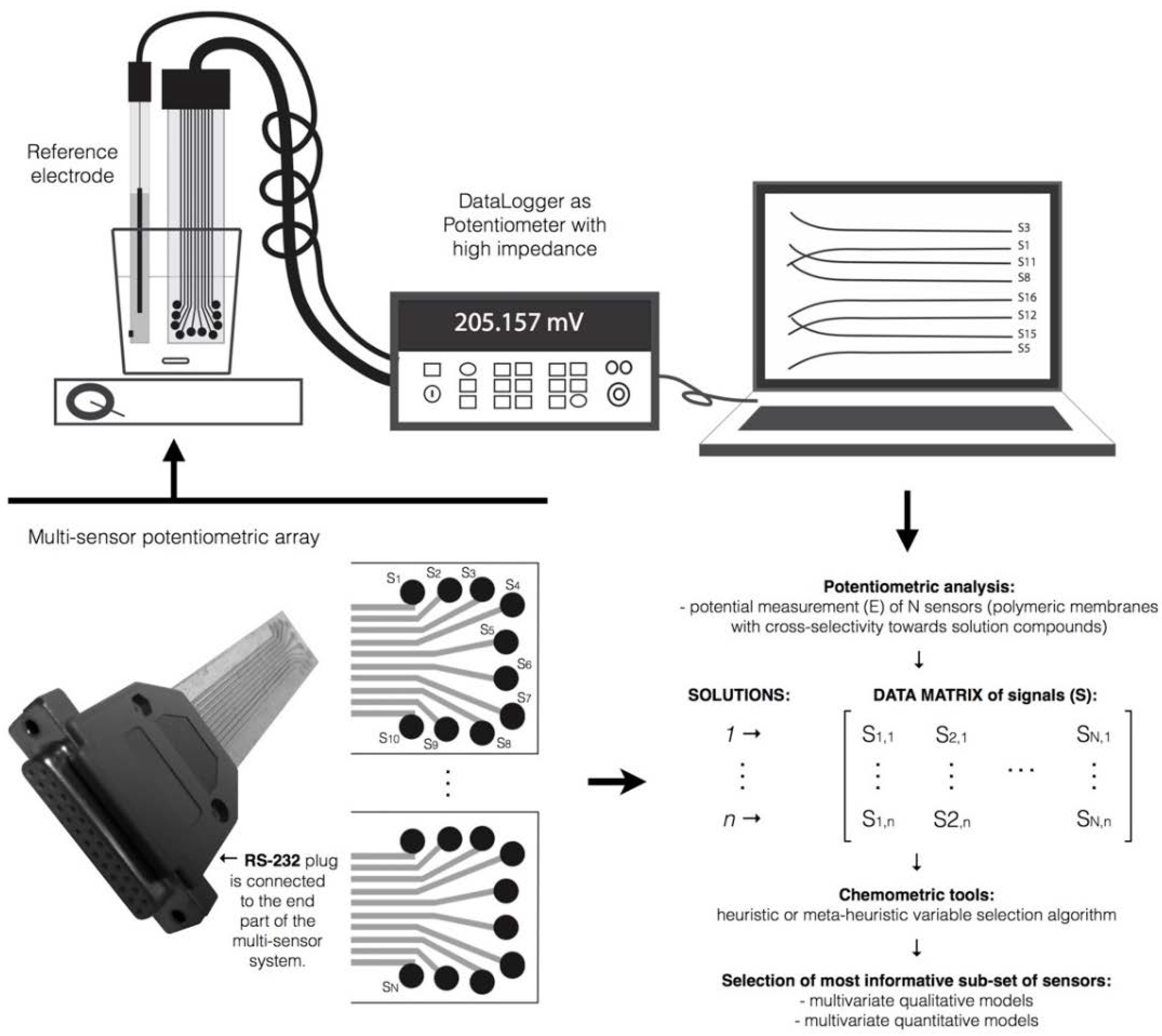
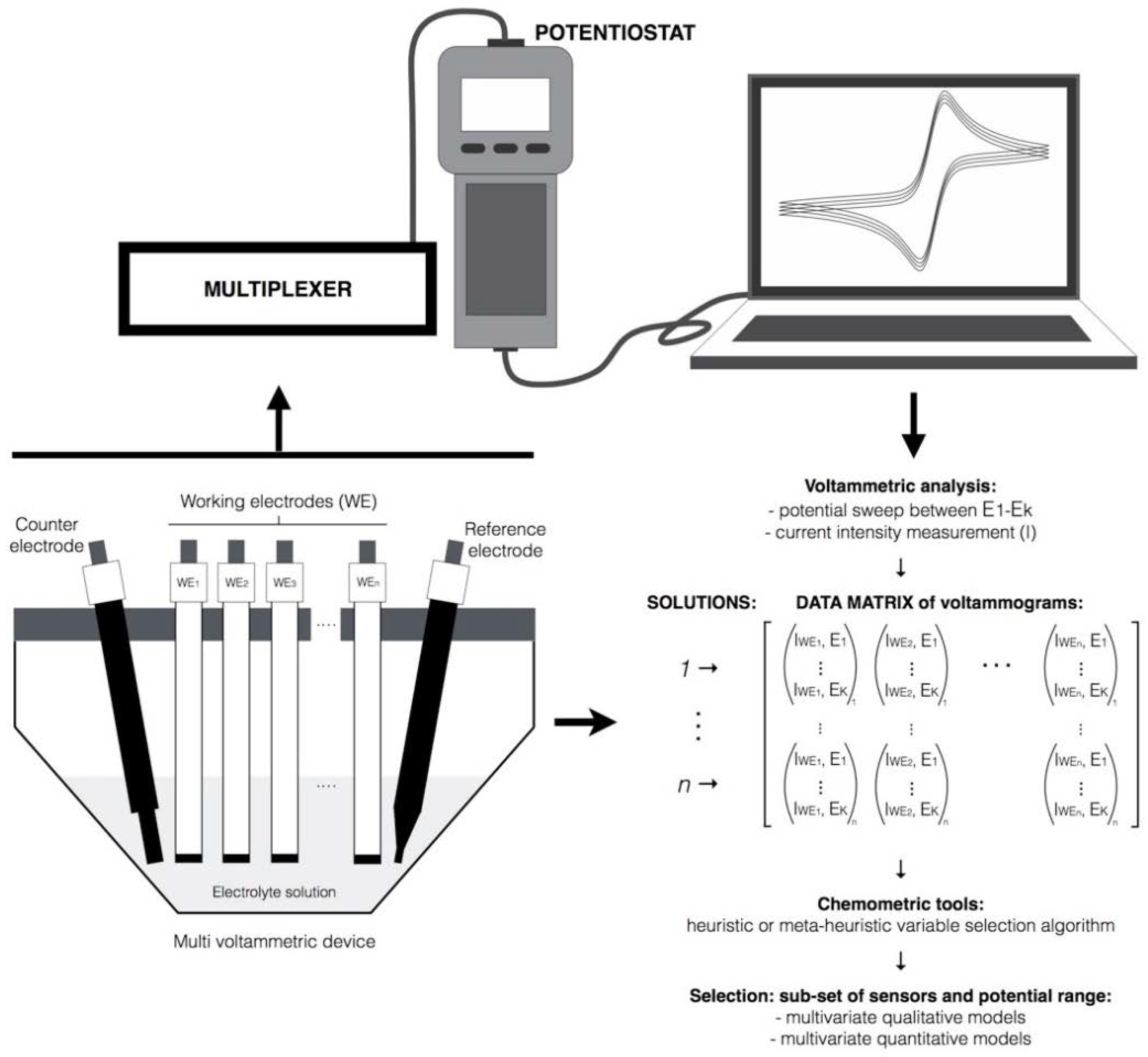
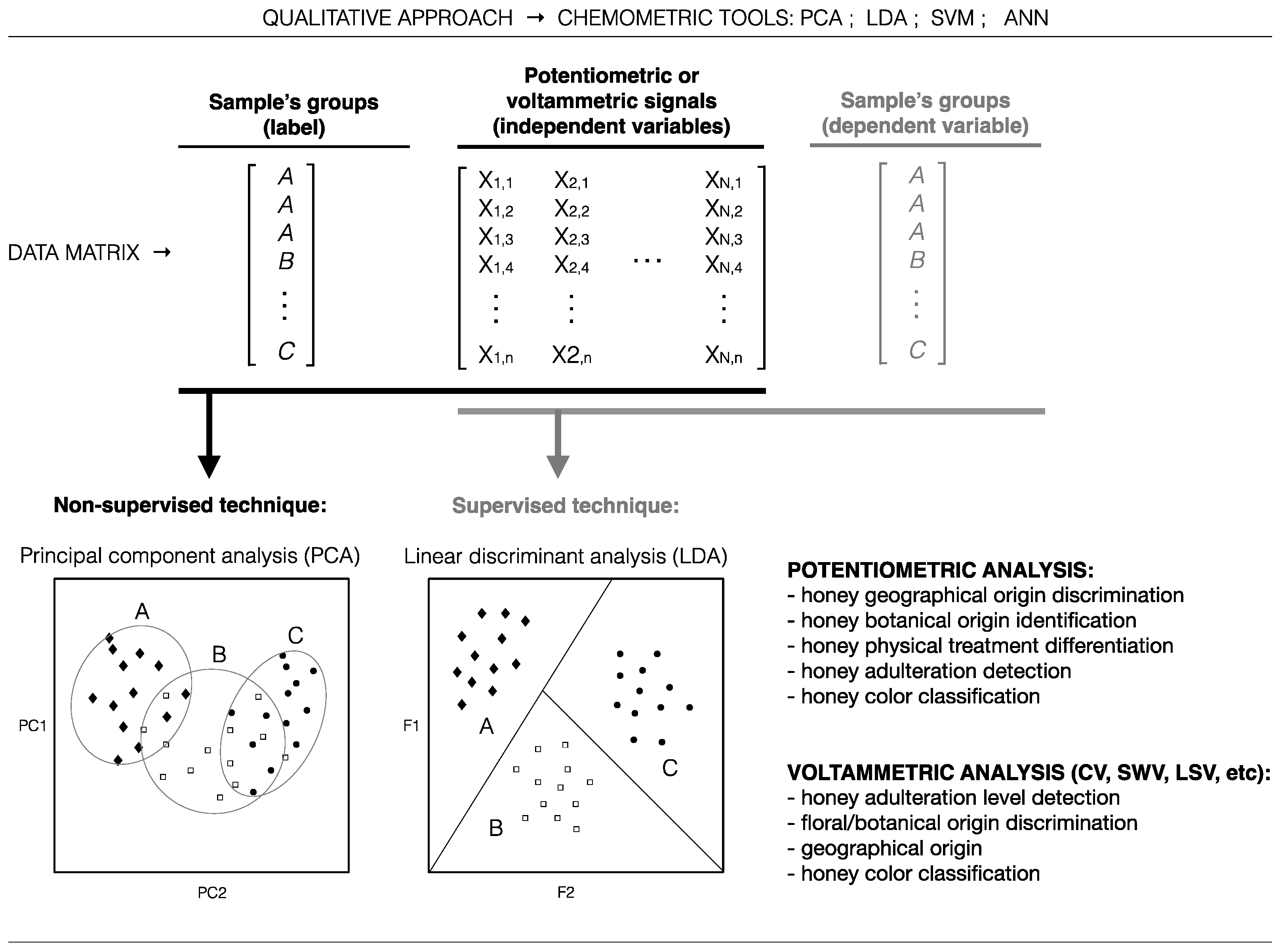
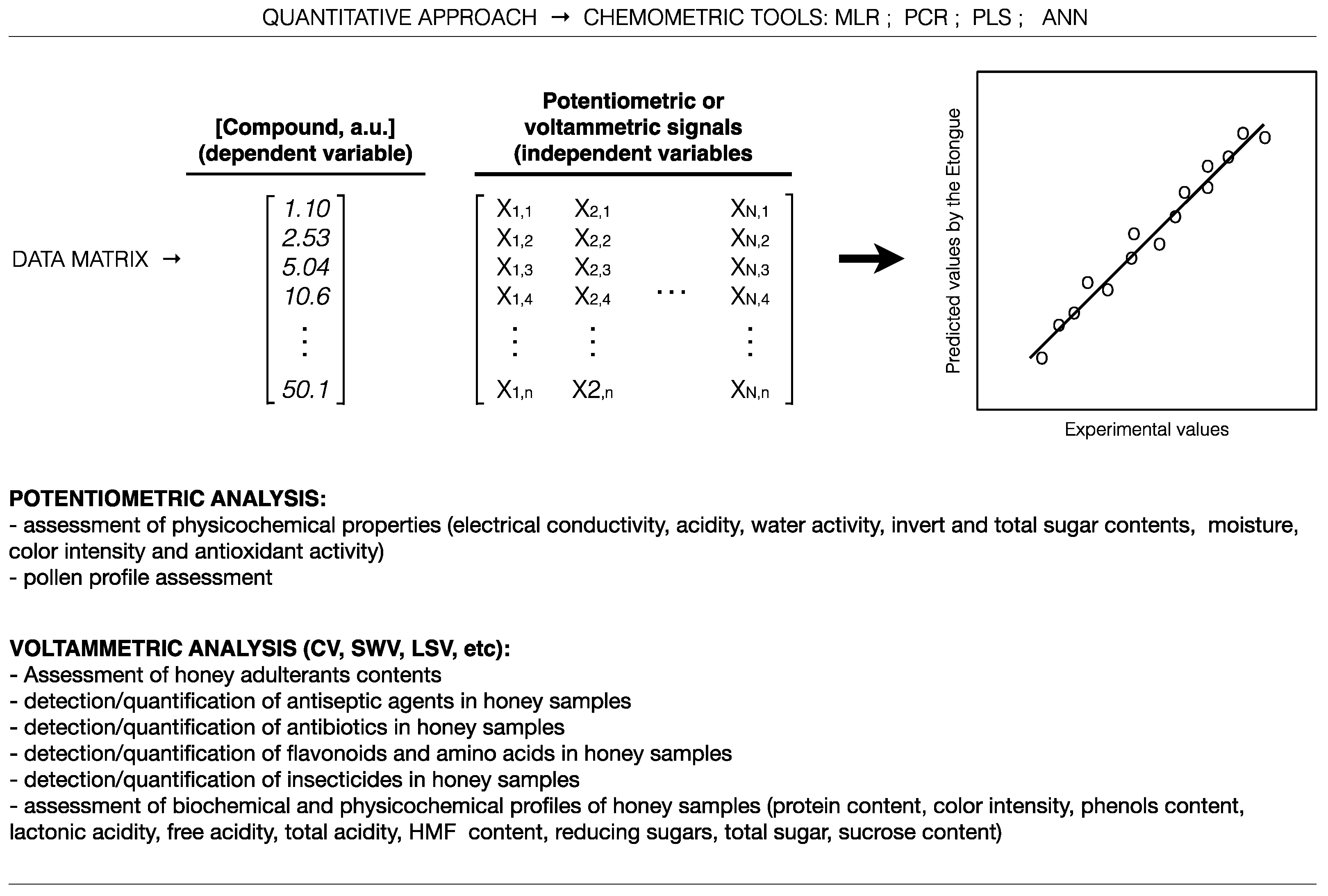

| E-Tongue Sensors | Type of Application | Chemometric Approach and Performance | Ref. |
|---|---|---|---|
| α-AstreeTM: ChemFET sensor technology with 7 cross-selective liquid sensors(sensitive to ionic, neutral and chemical compounds responsible for taste) coupled with an Ag/AgCl reference electrode | Honey classification according to floral origin (Acacia, Astragali, Data, Coptis, Vitex, Motherwort, Radix Changll and Buckwheat) | - PCA - DFA - BP-ANN (correct honey classification of 98.43% according to the floral origin) | [87] |
| α-AstreeTM: ChemFET sensor technology with 7 cross-selective liquid sensors(sensitive to ionic, neutral and chemical compounds responsible for taste) coupled with an Ag/AgCl reference electrode | Honey classification according to floral origin (Acacia, Astragali, Data, Coptis, Vitex, Motherwort, Radix Changll and Buckwheat) Honey classification according to geographical origin | - PCA - CA (correct honey classification: 90% according to the floral origin and 92% according to geographical origin) - ANN (correct honey classification: 93.75% according to the floral origin and 95% according to geographical origin, for test group) | [88] |
| Chalcogenide-based device: Ion-selective sensors (iron, cadmium, copper, mercury, titanium, sulfur and chromium ions) plus a Ag/AgCl reference electrode | Monofloral honey classification Identification of honey adulteration | - PCA - LDA (correct classification rate of 96.7%, for LOO-CV) - PNN (90.74% of corrected classifications for test group) | [89] |
| Chalcogenide-based device (commercial device): Ion-selective sensors (iron, cadmium, copper, mercury, titanium, sulfur and chromium ions) plus a Ag/AgCl reference electrode | Honeys classification (different floral origins, including leaf, durian, maluka, coconut, starfruit, wax apple and tualang; or, of tualang honey from different producers) | LDA with feature extraction or selection methods: LDA plus backward selection: 86.54% of correct classification using signals from 3 sensors LDA plus forward selection: 94.23% of correct classification using signals from 2 sensors LDA plus PCA: 57.70% of correct classification using data from 4 principal components | [90] |
| α-AstreeTM: ChemFET sensor technology with 7 potentiometric chemical sensors based on chemically modified field effect transistor technology, with sensors coated with materials sensitive to the basic tastes, coupled with an Ag/AgCl reference electrode | Classification of honey samples according to their botanical (Acacia, Data, Motherwort and Buckwheat) and geographic (4 regions) origins | Pattern recognition techniques with feature extraction (12 variable features), - PCA and DFA: honey samples correctly grouped in 2-D principal components according to the floral origin or geographical origin Quantitative analysis: - PCR, PLSR and LS-SVM models (floral and geographical origins were coded, varying from 1 to 4): prediction R2 equal to 0.7360, 0.9021 and 0.9447, respectively | [91] |
| α-AstreeTM: ChemFET sensor technology with 7 cross-selective liquid sensors(sensitive to ionic, neutral and chemical compounds responsible for taste) coupled with an Ag/AgCl reference electrode | Honey classification according to botanical origin (acacia, chestnut and honeydew) Honey analysis (physicochemical properties: electrical conductivity, acidity, water content, invert and total sugar contents) | Pattern recognition techniques: - PCA - CCA - ANN (downsizing of the model required to avoid overfitting: 100% of correct honey classification according to botanical origin, for the test group) Quantitative analysis: - ANN (models established for physicochemical parameters: 0.982 ≤ R-value ≤ 0.999, for the test group) | [92] |
| α-AstreeTM: ChemFET sensor technology with 7 cross-selective liquid sensors(sensitive to ionic, neutral and chemical compounds responsible for taste) coupled with an Ag/AgCl reference electrode | Honey botanical origin classification (acacia, jujube and vitex varieties from different geographical origins) Identification of raw honey adulteration (honey adulterated with different percentages of corn or rice syrups) | Sensor data pretreatment: SNV, autoscale, smoothing and derivatives PCA PLSDA classification models: - botanical origin: 91.53% of correct classification for test group - adulteration identification: 100% of correct classification for test group SVMDA classification models: - botanical origin: 100% of correct classification for test group | [93] |
| α-AstreeTM: ChemFET sensor technology with 7 cross-selective liquid sensors(sensitive to ionic, neutral and chemical compounds responsible for taste) coupled with an Ag/AgCl reference electrode | Classification of different Sicilian honey varieties: chestnut, eucalyptus, sulla and orange blossom from 7 different provenances | PCA: - effective discrimination of the different honeys according to their botanical origin using the potentiometric data DFA: - overall 70.8% of correct classifications for cross-validation | [94] |
| E-Tongue Sensors | Type of Application | Chemometric Approach and Performance | Ref. |
|---|---|---|---|
| All-solid-state sensors device: 20 polymeric membranes (additive + plasticizer + PVC) applied on solid conducting silver-epoxy supports plus a Ag/AgCl reference electrode | Honey classification according to floral origin (Erica, Echium and Lavandula) | - PCA - LDA coupled with heuristic variable selection algorithms (stepwise, backward and forward) allowed 72% of correct classifications, for LOO-CV procedure | [95] |
| Multi-electrode device (metallic electrodes): Pure metals (Au, Ag and Cu) and metal compound electrodes (Cu2O, Ag2O, AgCl, Ag2CO3 and Ag2SO4) plus a Ag/AgCl reference electrode. | Honey classification according to floral origin (citrus, rosemary, polyfloral and honeydew—forest origin) Honey physical treatment (raw, liquefied and pasteurized honeys) | - PCA - ANN (Fuzzy-ARTMAP network; correct honey classification: 83.3% according to the floral origin and 58.3% according to physical treatment) | [96] |
| Multi-electrode device: Pure metals (e.g., gold, silver and copper) and metallic compounds (e.g., AgO2, CuO2, AgCl and Ag2CO3) plus a Ag/AgCl reference electrode. | Honey botanical origin classification (citrus, rosemary, polyfloral and honeydew) Honey physical treatment (raw, liquefied and pasteurized honeys) | Pattern recognition techniques: - PCA - Fuzzy-ARTMAP neural networks (correct classification rates, for LOO-CV, of 94% and 42% for botanical origin and physical treatment, respectively) Quantitative analysis: - PLS (satisfactory performance for mmPfund color scale, color coordinate L* and diastase activity; R2 ≥ 0.926) | [97] |
| Multi-electrode device (metallic electrodes): Pure metals (e.g., gold, silver and copper) and metallic compounds (e.g., AgO2, CuO2, AgCl and Ag2CO3) plus a Ag/AgCl reference electrode. | Honey floral origin classification (citrus, rosemary, polyfloral and forest) Honey physical treatment (raw, liquefied and pasteurized honeys) | Fuzzy ARTMAP neural networks SFAM networks coupled or not to heuristic variable selection algorithms (stepwise, backward and forward) Better recognition performance for floral origin compared to physical treatment Maximum recognition rate of 75% for a test group | [98] |
| Multi-sensor arrays: 20 lipid membrane sensors and respective replicas (combinations of different lipid additives and plasticizers with PVC) | Honey classification according to color (white, amber and dark) Honey classification according to botanical origin (Castanea sp., Echium sp., Erica sp., Lavandula sp., Prunus sp. and Rubus sp.) | LDA coupled with feature selection (meta-heuristic SA variable selection algorithm): - color classification: 91% of corrected classified honey samples for LOO-CV - floral origin classification: 100% of correctly classified samples for LOO-CV after color split | [99] |
| Multi-sensor arrays: 20 lipid membrane sensors and respective replicas (combinations of different lipid additives and plasticizers with PVC) | Honey pollen profile assessment (i.e., quantification of pollen percentage in honey samples): monofloral honey of Castanea sp., Echium sp., Erica sp., Eucalyptus sp., Lavandula sp., Prunus sp., Rubus sp. and Trifolium sp.; and polyfloral honeys | MLR models coupled with feature selection (meta-heuristic SA variable selection algorithm): - pollen percentage quantification: MLR-SA models with mean R2 values (±SD) between 0.91 ± 0.15 and 0.996 ± 0.010, for repeated K-fold-CV, after color split (keeping more than 10% of data for prediction purposes) | [100] |
| Sensor array: Eight metallic electrodes including noble metals (gold, platinum, iridium and rhodium) and non-noble metals (copper, silver, nickel and cobalt) | Honey classification: orange blossom, rosemary, thyme, sunflower, winter savory and honeydew honey. Honey physicochemical evaluation: water activity, conductivity, moisture, color and antioxidant activity. | Pattern recognition techniques: - PCA - Fuzzy ARTMAP artificial neural networks: - 100% honey type classification success for the test group Quantitative MLR models: - Predicted R-value of 0.9666 and 0.8959 for antioxidant activity and electrical conductivity, respectively | [101] |
| E-Tongue Sensors | Technique | Type of Application | Chemometric Approach and Performance | Ref. |
|---|---|---|---|---|
| CHI660D electrochemical analyzer: - one WE (glassy carbon) - one RE (saturated calomel electrode, saturated with KCl solution) - one CE (platinum wire) | CV | Detection of honey adulteration with rice syrups | Pattern recognition techniques with feature extraction (12 variable features), - PCA: pure and adulterated honey samples were completely distinguished using the two first PCs - PCA-LDA and LDA: recognition rates of 100% for both calibration and prediction sets Quantitative analysis, - MLR model with 12 PCs: Rprediction = 0.898 - PCR model with 3 PCs Rprediction = 0.881 - PLS with 4 PCS: Rprediction = 0.898 | [114] |
| E-Tongue Sensors | Technique | Type of Application | Chemometric Approach and Performance | Ref. |
|---|---|---|---|---|
| - one WE: platinum electrode - one RE: Ag/AgCl saturated KCl - one CE: platinum electrode | CV | Discrimination of monofloral honeys: Eucalyptus, Til, Leechu and Khalisa | PCA used as a pattern recognition classifier: successful recognition of floral origin | [107] |
| - one WE: platinum electrode - one RE: Ag/AgCl saturated KCl - one CE: platinum electrode | CV | Identification of floral honey origin: Eucalyptus (Eucalyptus globulus) Til (Sesamum indicum) Leechu (Litchi chinensis) Khalisa (regional name) | - PCA (with relative scale2 method): Til and Eucalyptus honeys grouped into two distinct clusters while honey samples from Kholisa and Leechi overlapped - LDA (with autoscale method): 100% of corrected classified samples (original grouped samples) - BP-MLP neural network (with range scale method): 93.42% of correct classifications for a validation dataset - RBF neural network (with baseline subtraction method): 82.50% of correct classifications for a validation dataset | [108] |
| - one WE: NiO/Nps modified carbon paste electrode - one RE: Ag/AgCl saturated KCl - one CE: platinum wire | CV | Floral characterization of honey (Eucalyptus, Til, Lecchi, Pumpkin, Mustard and polyfloral) with the same geographical origin | PCA: honey samples correctly grouped according to the floral origin in 2-D dimensional planes, being polyfloral honey samples, a mixture of eucalyptus and mustard honeys, grouped closely to mustard and eucalyptus honey groups | [109] |
| - one WE: gold electrode - one RE: saturated calomel electrode - one CE: platinum electrode | DPV LSV CV SWV | Detection of honey adulteration with sugar syrups Quantification of adulteration percentage | Pattern recognition methods: - PCA: allows distinguishing honey samples according to the adulteration percentage (from 0% up to 70%) - RBF: 83.33% of honey samples correctly classified according to adulteration level (from 0% to 70%) - FKNN: 88.89% of honey samples correctly classified according to adulteration level (from 0% to 70%) - Fuzzy ARTMAP: 94.40% of honey samples correctly classified according to adulteration level (from 0% to 70%) Quantitative analysis: - PLS: honey adulteration percentage satisfactorily predicted (R-value = 0.8442) | [106] |
| Portable device with integrated chemometrics tools: - one WE: gold disk electrode - one RE: Ag/AgCl electrode - one CE: gold disk electrode | CV | Classification of honey samples according to their botanical (quince, orange, and coffee) and geographic 3 regions) origins | PCA (four-components model based on 408 variables, with decomposed signals): successfully applied to fingerprint honey samples according to their botanical and geographic origins. | [105] |
| - one WE: silver electrode - one RE: Ag/AgCl electrode - one CE: platinum electrode | CV | Differentiation of monofloral honeys according to botanical origin (Castanea sp., Echium sp., Rubus sp., Lavandula sp., Prunus sp., Erica sp., Trifolium sp.) Monofloral honey differentiation according to color scale | Qualitative approach: - honey samples from the same color group, anodic peak currents and anodic areas differ with floral origin of honeys - similar oxidation potentials and overall voltammetric profiles observed for Lavandula sp. honeys, regardless honey color - anodic peak current and anodic curve area of Lavandula sp. honeys increase with darkness increasing of Lavandula sp. honeys (mmPfund values versus anodic peak current intensity, R = 0.9680) | [81] |
| - one WE: glassy carbon electrode disk - one RE: KCl saturated calomel electrode - one CE: platinum foil | CV SWV | Determination of antiseptic agents (eugenol, carvacrol and thymol) in honey samples | Multivariate calibration tools developed based on SWV data, with baseline correction and signal alignment: - PLS: poor predictive capability (validation set: 0.19 ≤ R2 ≤ 0.76 with relative errors of prediction greater than 30%) - ANN (feed-forward network with Levenberg-Marquardt back propagation training): - validation set: 0.968 ≤ R2 ≤ 0.997 with relative errors of prediction of 5–7% and limits of detection between 0.010 and 0.240 mg L−1 | [116] |
| - one WE: modified platinum thin-film microelectrode with o-phenylenediamine - one RE: platinum electrode - one CE: platinum electrode | CV SWV | Determination of antibiotics in honey: chloramphenicol (CAP) | CAP dynamic range: from 0.9 to 10 nM (R = 0.992) CAP detection limit: 0.39 nM CAP recovery assays: from 89 to 107.3% | [117] |
| - one WE: modified glassy carbon electrode using an isoreticular carbon porous metal-organic framework - one RE: saturated calomel electrode - one CE: platinum wire | SWV | Determination of antibiotics in honey: chloramphenicol (CAP) | CAP dynamic range: from 10 nM to 1 μM (R2 ≥0.991) CAP detection limit: 2.9 nM CAP (0.1 to 1.5 μM) recovery assays: from 96 to 110% | [121] |
| - one WE: bare glassy carbon electrode or modified electrode (MIL-101(Cr)/XC-72/GCE sensor) - one RE: saturated calomel electrode - one CE: platinum wire | CV DPV | Determination of antibiotics in honey: chloramphenicol (CAP) | CAP dynamic range: from 10 nM to 20 μM (R = 0.985) CAP detection limit: 1.5 nM CAP (0.2 to 1.0 μM) recovery assays: from 95 to 101% | [118] |
| - one WE: functionalized carbon black nanospheres hybrid with MoS2 nanocluster - one RE: Ag/AgCl saturated KCl - one CE: platinum wire | CV DPV | Determination of antibiotics in honey: chloramphenicol (CAP) | CAP dynamic range: from 0.015 to 1370 μM (R2 = 0.989) CAP detection limit: 0.002 μM CAP (25 and 50 μM) recovery assays: from 93.0 to 96.2% CAP sensitivity: 3400 μAμM−1cm−2 | [120] |
| - one WE: glassy carbon electrode modified (or not) with ordered mesoporous carbon@polydopamine and β-cyclodextrin - one RE: saturated calomel electrode - one CE: platinum wire | CV SWV | Determination of antibiotics in honey: chloramphenicol (CAP) | CAP dynamic range: from 0.5 μM to 0.5 mM (R2 = 0.9992) CAP detection limit: 0.2 μM CAP recovery assays (5 to 50 μM): 80.0 to 93.0%. | [122] |
| - one WE: glassy carbon electrode modified with electro-polymerized poly(pyrrole-3-carboxy acid) and electrochemically reduced graphene oxide - one RE: saturated calomel electrode - one CE: platinum electrode | CV DPV | Determination of antibiotics in honey: streptomycin (STR) | STR dynamic range: 2 nM to 1 μM (R > 0.99) STR detection limit: 0.5 nM STR (25 nM to 1 μM) recovery assays: 96 to 104% | [123] |
| - one WE: antimony film coating a glassy carbon electrode - one RE: Ag/AgCl saturated NaCl - one CE: platinum wire | CV SWCSV | Determination of antibiotics (tetracyclines) in honey samples | Quantitative analysis using a LR model based on SWCSV: - linear range: 0.40–3.00 μM - sensitivity: 1.46 μA μM−1 - detection limit: 0.15 μM - recoveries: from 91.81% to 109.69% | [115] |
| - one WE: ZrO2NPs with modified carbon paste electrode and paraffin oil - one RE: Ag/AgCl saturated KCl - one CE: platinum wire | CV | Floral characterization of honey with different floral origins (Eucalyptus, Til, Pumpkin and Mustard) from different apiaries of the same geographical region | PCA (data preprocessed: scaled): honey samples correctly grouped according to the floral origin in 2-D dimensional planes | [110] |
| - one WE: carbon paste electrode modified with zinc oxide nanoparticles - one RE: Ag/AgCl saturated KCL - one CE: platinum wire | CV | Discrimination of the floral origin of honey: Eucalyptus globulus, Cucurbita maxima, Litchi chinensis, Brassica juncea, Sesamum indicum | Pattern recognition techniques: - PCA: allowed the discrimination among the different floral types - ANN (BP-MLP and RBF): classification model with more than 90% accuracy (86 to 97% of correct classification according to each honey floral type) | [111] |
| - one WE: carbon paste electrode modified with magnetic Fe3O4@NiO core/shell nanoparticles - one RE: Ag/AgCl electrode - one CE: platinum rod | CV DPV | Determination of Quercetin (Q, flavonoid) and Tryptophan (Trp, essential aminoacid) in honey samples | Q dynamic range: 0.08–60 μM (R2 = 0.9845) Trp dynamic range: 0.1–120 μM (R2 = 0.9893) Q detection limit: 2.18 nM Trp detection limit: 14.23 nM | [124] |
| - one WE: modified nanohybrid glassy carbon electrode with highly porous polypyrrole (MIP/MIL-101 (Cr)/MoS2/GCE sensor) - one RE: saturated calomel electrode - one CE: platinum foil | CV DPV | Determination of Quercetin (Q, flavonoid) in honey samples | Q dynamic range: 0.1 to 700 μM (R2 = 0.999) Q detection limit: 0.06 μM in phosphate buffer solution (PBS, pH = 3.5) Q recovery assays (1.1 to 1.5 μM): 97.3 to 101.3% | [119] |
| - one WE: glassy carbon electrode modified with ß-cyclodextrin and graphene oxide - one RE: Ag/AgCl electrode - one CE: platinum wire | CV SWV | Determination of neonicotinoids (insecticides): imidacloprid (IMP), clothianidin (CLT) and thiamethoxam (TMX) | IMP dynamic range: 0 to 165 μM CLT dynamic range: 7.5 to 80 μM TMX dynamic range: 10 to 70 μM IMP detection limit: 8.92 μM CLT detection limit: 4.72 μM TMX detection limit: 7.45 μM Recovery assays (added 20 μM): 108.75, 107.75 and 116% for IMP, CLT and TMX, respectively. | [125] |
| E-Tongue Sensors | Technique | Type of Application | Chemometric Approach and Performance | Ref. |
|---|---|---|---|---|
| - six WEs: gold, silver, platinum, palladium, tungsten, and titanium - one RE: Ag/AgCl saturated KCl - one CE: platinum electrode | MLAPV | Classification of honey samples, from the same geographical area, according to their botanical (Acacia, Astragali, Buckwheat, Coptis, Data, Motherwort and Vitex) | Pattern recognition techniques with feature extraction: - PCA, DFA and CA: the three methods based on the two databases have similar discrimination performances and the difference between the two databases has no effect to the separation ability | [112] |
| - six WEs: gold, silver, platinum, palladium, tungsten and titanium - one RE: Ag/AgCl saturated KCl - one CE: platinum electrode | MLAPV | Classification of honey samples according to their botanical (Acacia, Data, Motherwort and Buckwheat) and geographic (4 regions) origins | Pattern recognition techniques with feature extraction (12 variable features): - PCA and DFA: honey samples correctly grouped in 2-D principal components according to the floral origin or geographical origin Quantitative analysis: - PCR, PLSR and LS-SVM models (floral and geographical origins were coded, varying from 1 to 4): prediction R2 equal to 0.8924, 0.9887 and 0.9985, respectively | [91] |
| - seven WEs: noble metals (platinum, gold, palladium), non-noble metals (copper, glassy carbon, nickel) and reactive noble metal (silver) - one RE: Ag/AgCl electrode - one CE: platinum electrode | CV | Classification of honeys according to geographical (9 countries) and botanical (Lime green, Thyme, Rosemary, Natural blueberry, Saracen, Carob, Jujube, Mountain, Eucalyptus, Spurge, Orange and Polyfloral) origins Detection of honeys’ adulteration with sugar syrups | Pattern recognition techniques with feature extraction: - PCA: allowed to correctly discriminate honeys according to geographical or botanical origins, as well as to recognize all adulteration levels. - SVM: 100% success rate in the recognition of honeys of different geographical origins as well as of different botanical origins, for LOO-CV, as well as for the identification of adulterated honey - HCA: no errors or misclassifications of honey samples according to geographical or botanical origins as well as to distinguish between different classes of adulterated honey | [103] |
| - seven WEs: noble metals (platinum, gold, palladium), non-noble metals (copper, glassy carbon, nickel) and reactive noble metal (silver) - one RE: Ag/AgCl electrode - one CE: platinum electrode | CV | Classification of polyfloral honeys according to geographical origin (2 countries: Morocco and France) and type Quantitative prediction of biochemical and physicochemical profiles of honey samples (protein content, color intensity, phenols content, lactonic acidity, free acidity, total acidity, HMF (hydroxymethylfurfural) content, reducing sugars, total sugar, sucrose content) | Pattern recognition techniques with feature extraction (3 variable features): - PCA: successful discrimination of honeys according to geographical or botanical origins. - SVM: 100% success rate in the recognition of honeys of different geographical origins as well as of different botanical origins, for LOO-CV. - HCA: no errors or misclassifications of honey samples according to geographical or botanical origins. Quantitative analysis: - PLS: 0.821 ≤ R2 ≤ 0.998 0.015 ≤ NRMSE ≤ 0.184 2.306 ≤ RPD ≤ 7.658 | [104] |
| - four WEs: iridium, rhodium, platinum, gold - one RE: saturated calomel electrode - one CE: stainless steel circular piece | PV | Detection of honey adulteration with sugar syrups: monofloral honeys (heather, orange blossom and sunflower), syrup (rice, barley and corn), and adulterated honey (2.5, 5, 10, 20 and 40% of syrup) | Pattern recognition techniques: - PCA: voltammetric data allowed distinguishing pure honey, syrup, and different levels of adulterants Quantitative analysis: - PLS analysis: allowed to predict the level of the adulterants in each honey (sunflower honey adulterated with barley, corn or brown rice syrup: 0.949 ≤ R2 ≤ 0.997; orange blossom honey adulterated with barley, corn or brown rice syrup: 0.879 ≤ R2 ≤ 0.993; and, heather honey adulterated with barley, corn or brown rice syrup: 0.763 ≤ R2 ≤ 0.997) | [113] |
© 2018 by the authors. Licensee MDPI, Basel, Switzerland. This article is an open access article distributed under the terms and conditions of the Creative Commons Attribution (CC BY) license (http://creativecommons.org/licenses/by/4.0/).
Share and Cite
Veloso, A.C.A.; Sousa, M.E.B.C.; Estevinho, L.; Dias, L.G.; Peres, A.M. Honey Evaluation Using Electronic Tongues: An Overview. Chemosensors 2018, 6, 28. https://doi.org/10.3390/chemosensors6030028
Veloso ACA, Sousa MEBC, Estevinho L, Dias LG, Peres AM. Honey Evaluation Using Electronic Tongues: An Overview. Chemosensors. 2018; 6(3):28. https://doi.org/10.3390/chemosensors6030028
Chicago/Turabian StyleVeloso, Ana C. A., Mara E. B. C. Sousa, Leticia Estevinho, Luís G. Dias, and António M. Peres. 2018. "Honey Evaluation Using Electronic Tongues: An Overview" Chemosensors 6, no. 3: 28. https://doi.org/10.3390/chemosensors6030028
APA StyleVeloso, A. C. A., Sousa, M. E. B. C., Estevinho, L., Dias, L. G., & Peres, A. M. (2018). Honey Evaluation Using Electronic Tongues: An Overview. Chemosensors, 6(3), 28. https://doi.org/10.3390/chemosensors6030028


