Abstract
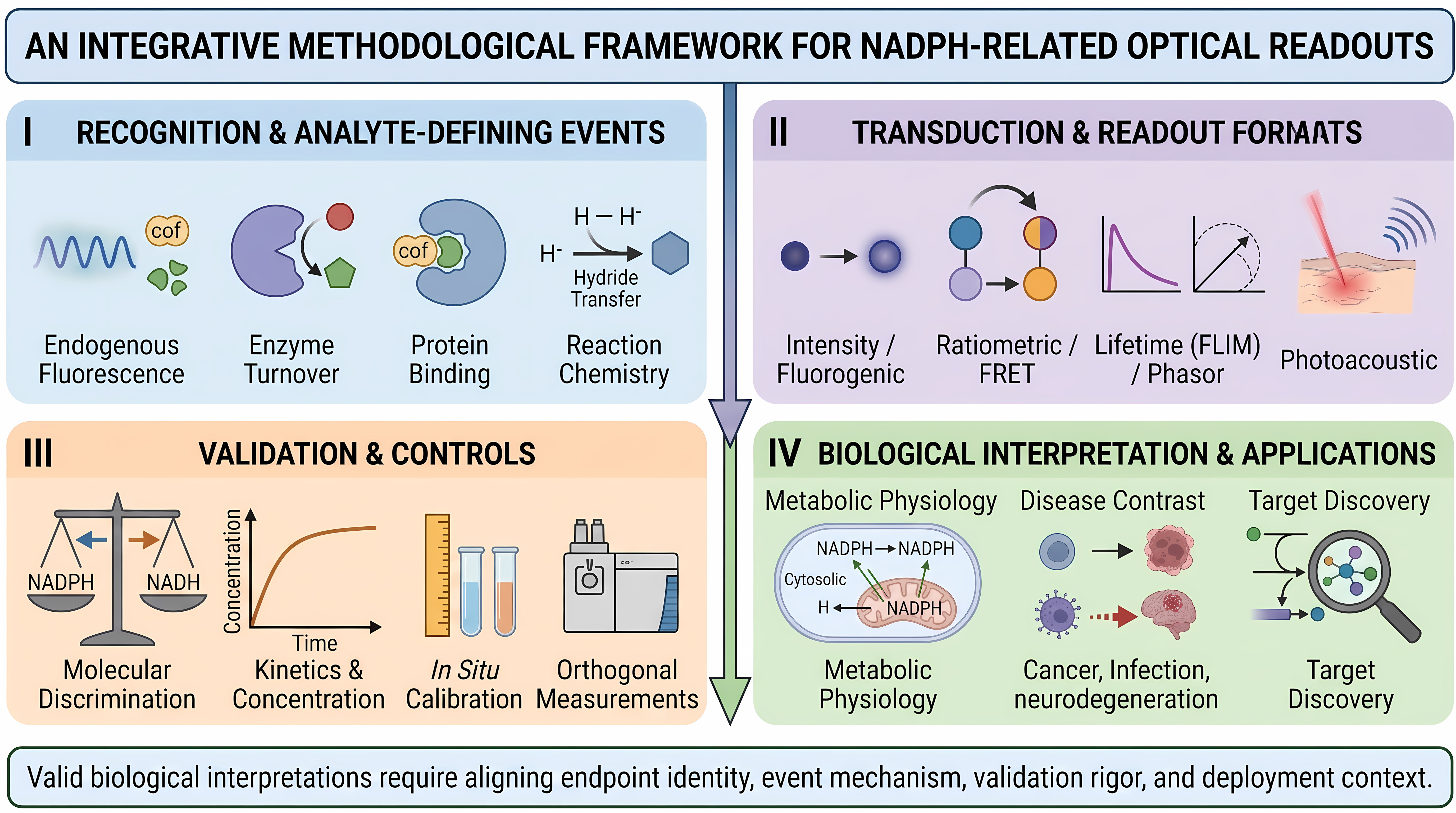
Reduced nicotinamide adenine dinucleotide phosphate (NADPH) sustains reductive biosynthesis, antioxidant defense, oxidase activity, and redox signaling; nevertheless, studies framed as “NADPH imaging” often interrogate biochemically non-equivalent variables and analytically distinct endpoints. To resolve that ambiguity, this review organizes current methods by analyte-defining event, optical transduction or readout, acquisition modality, and deployment context. Extraction and enzyme-coupled assays can define recovered NADPH, oxidized nicotinamide adenine dinucleotide phosphate (NADP+), total NADP(H), or a derived ratio, albeit at the cost of subcellular information. By contrast, protein-based, genetically encoded, and chemigenetic systems enable reversible, compartment-addressable measurements of sensor-accessible cofactor binding, ligand-dependent assembly, relay output, or NADPH/NADP+ balance; however, quantitative interpretation remains contingent on affinity, sensor abundance, pH, maturation, calibration, and sensor-induced buffering. Reaction-based probes offer the broadest spectral and imaging flexibility—including ratiometric, near-infrared, two-photon, and photoacoustic formats—yet most rely on hydride-transfer chemistry shared by reduced nicotinamide adenine dinucleotide (NADH) and NADPH. Absent matched kinetics and simultaneous mixed-cofactor experiments, NAD(P)H-responsive remains the most defensible designation for these platforms. Label-free autofluorescence, fluorescence lifetime imaging microscopy (FLIM), and phasor analysis preserve native spatial context; even so, they report composite intensity, binding-state, or metabolic contrast rather than a universal absolute NADPH concentration. Across modalities, rigorous interpretation requires physiologically relevant concentration ranges, product or binding-mechanism verification, matrix- and organelle-specific controls, time-resolved calibration, and orthogonal measurements of pool size or flux. By aligning each signal-generating event with the endpoint it can legitimately support, the review establishes a mechanistic basis for platform selection and for interpreting NADPH-related optical changes across purified systems, cells, tissues, and biofluids.