Article

Gold Nanoparticle-Based Composite Electrode for Sensitive Electrochemical Detection of Melamine


1
College of Science, Kaili University, Kaili 556011, China
2
Suzhou Key Laboratory of Advanced Semiconductor and Optical Detection Technology, Suzhou 215000, China
3
School of Optoelectronic Engineering, Xi’an Technological University, Xi’an 710021, China
4
College of Microelectronics and Artificial Intelligence, Kaili University, Kaili 556011, China
5
Engineering Research Center of Micro-Nano and Intelligent Manufacturing of Ministry of Education, Kaili University, Kaili 556011, China
*
Author to whom correspondence should be addressed.
Chemosensors 2026, 14(6), 133; https://doi.org/10.3390/chemosensors14060133 (registering DOI)
Submission received: 26 April 2026 / Revised: 7 June 2026 / Accepted: 8 June 2026 / Published: 10 June 2026
(This article belongs to the Special Issue Advancements of Chemosensors and Biosensors in China—3rd Edition)

Abstract

Melamine, characterized by its high nitrogen content, has been illegally added to food and feed to falsely increase apparent protein levels. However, melamine and its metabolites pose serious risks to human and animal health, including kidney stones, renal failure, and even death, as well as potential carcinogenic effects. Therefore, accurate detection of trace melamine is of great importance and urgency. Electrochemical sensors based on nanomaterials have been widely used for melamine detection due to their high sensitivity, good selectivity, rapid response, and simple operation. In this work, a composite nanosheet-structured electrode was fabricated, and a dense layer of gold nanoparticles was modified on its surface to enhance electrochemical performance. Cyclic voltammetry and electrochemical impedance spectroscopy measurements indicated that this electrode exhibited highly sensitive electrochemical properties. In addition, differential pulse voltammetry was employed for melamine detection, and the results showed a wide linear range of 20–500 nM with an LOD of 4.7 nM. The proposed electrode enabled the detection of melamine in milk samples, exhibiting good anti-interference ability and long-term stability.

1. Introduction

Melamine (C3H6N6) is a typical triazine-based nitrogen-rich organic compound. Owing to its stable triazine ring structure, it exhibits high thermal and chemical stability and is commonly referred to as cyanuramide or “protein essence”. Due to these physicochemical properties, melamine is widely used in industrial applications such as synthetic resins, plastics, coatings, flame-retardant materials, and adhesives, playing an important role in modern chemical production [1]. However, the high proportion of nitrogen in the melamine molecule makes it easily misidentified as a protein source in traditional protein detection methods (e.g., the Kjeldahl method) [2,3]. Therefore, melamine was once illegally added to dairy products and other foods to falsely elevate protein content [4]. The 2008 melamine incident starkly exposed this problem, causing many infants and young children to develop kidney stones and even renal impairment, and sparking widespread public concern and deep reflection on food safety [5]. From a toxicological perspective, melamine itself has relatively low acute toxicity, while its hazards mainly stem from its metabolic and interaction behaviors in vivo [6]. Studies have shown that melamine can form stable, insoluble complexes with structurally similar triazine compounds (such as cyanuric acid) through multiple hydrogen-bonding interactions. These complexes tend to accumulate in the kidneys and gradually form crystals, leading to renal tubular obstruction and inflammatory responses and ultimately resulting in kidney stones and renal dysfunction [7]. In addition, long-term low-dose exposure to melamine may also pose potential hazards to liver and kidney functions, and even induce chronic diseases [8]. In view of its potential hazards, international and national regulatory authorities have established strict limit standards for melamine residues in food. For example, the U.S. Food and Drug Administration (FDA) sets maximum melamine limits of 2.5 ppm (19.8 μM) for non-infant formula products and 1 ppm (7.9 μM) for infant dairy products [9]. These strict standards impose higher requirements on the sensitivity, accuracy, and reliability of analytical methods.
At present, the mainstream analytical methods for melamine detection mainly include chromatographic analysis, immunoassays, and spectroscopic techniques. Among them, high-performance liquid chromatography (HPLC) and liquid chromatography–mass spectrometry (LC–MS) are widely used for accurate laboratory-based quantitative analysis due to their high sensitivity and excellent quantification performance. For instance, Kamil et al. developed a novel amino-modified silica gel chromatographic column, which was applied to an HPLC system for the separation and quantitative detection of trace melamine in commercial infant formula and milk powder samples [10]. Gas Chromatography (GC) can also realize melamine detection under specific derivatization conditions. For example, S. Squadrone et al. validated a gas chromatography–mass spectrometry (GC–MS) method for melamine potentially present in animal feed in accordance with Regulation (EC) No. 882/2004, meeting the validation requirements for official feed control [11]. In addition, enzyme-linked immunosorbent assay (ELISA) relies on specific antigen–antibody recognition and exhibits high selectivity and high throughput. Sun et al. developed a sensitive ELISA method based on monoclonal antibodies for melamine detection in milk powder [12]. However, these methods are often expensive, complex, time-consuming, and require skilled operators, making them unsuitable for on-site rapid screening and point-of-care testing.
With the rapid development of nanomaterials science and sensing technology, electrochemical detection methods have attracted considerable attention in food safety analysis. Compared with conventional analytical techniques, electrochemical methods offer several advantages, including simple operation, low cost, rapid response, high sensitivity, and ease of miniaturization and portability [13]. Electrochemical sensors convert chemical information from target molecules into measurable electrical signals for quantitative analysis, making them particularly suitable for rapid detection of samples with complex matrices [14]. Furthermore, the introduction of nanomaterials can significantly increase the specific surface area, electron transfer rate and interfacial catalytic activity of the electrode, thereby further improving the detection performance [15]. Recent studies have further demonstrated that nanomaterial-integrated biosensing platforms exhibit excellent application potential in food residue analysis due to their high sensitivity, rapid response, and ease of miniaturization [16]. In particular, two-dimensional nanomaterials have attracted extensive attention in electrochemical sensing. Their unique electronic properties, large specific surface area, and tunable interfacial characteristics provide important design strategies for constructing high-performance electrochemical sensors [17]. Therefore, the construction of high-performance electrochemical sensing platforms has become an important development direction of current melamine detection research.
A series of advances have been made in the electrochemical detection of melamine in recent years. Xue et al. electropolymerized polycaffeic acid on a glassy carbon electrode and detected melamine via the potential shift from hydroquinone–melamine complexation. They achieved satisfactory detection results in both aqueous solution and milk powder samples, with an average recovery of (91 ± 7.9)% [18]. An et al. constructed an electrochemical sensor by modifying a screen-printed carbon electrode with ferrocene-glutathione (Fc-ECG) as the electron transfer mediator. They enhanced the electron transfer signal through the p-π conjugated double bonds of melamine and achieved sensitive detection of melamine in raw milk with a limit of detection (LOD) of 1 × 10⁻⁷ M [19]. Daizy et al. used ascorbic acid (AA) as the recognition element, combined with L-arginine and reduced graphene oxide–copper nanoflower composite to modify a glassy carbon electrode. Based on the decrease in AA oxidation peak current caused by the hydrogen bonding between AA and melamine, they fabricated a sensitive electrochemical sensor for non-electroactive melamine detection. The sensor achieved an ultra-low LOD of 5.0 nM for melamine and was successfully applied to the detection of infant milk powder samples with satisfactory recoveries [20]. These studies fully demonstrated that the detection performance for melamine could be significantly improved through rational design of electrode materials and interfacial structures.
However, the existing electrochemical sensing methods still have some urgent problems to be solved. In complex food matrices, various coexisting substances may interfere with the detection signal, thus impairing the accuracy and selectivity of detection [21]. In addition, some nanomaterials used for electrochemical sensor construction have drawbacks such as time-consuming preparation, high cost and poor biocompatibility [22]. Therefore, the development of electrochemical sensors with rational structural design, tunable interfacial properties, and balanced performance is of great significance for advancing rapid melamine detection technologies.
In this work, we fabricated a gold nanoparticle-coated composite film to construct a high-sensitivity electrochemical electrode for the sensitive detection of melamine. The multilayer MWCNTs/g-C3N4 structure enables rapid adsorption of melamine from solution. The densely distributed gold nanoparticles on the surface enhance the electrochemical response of the electrode, and the resulting MWCNTs/g-C3N4/Au composite structure significantly improves its sensing performance. The experimental results demonstrated a low LOD, a wide linear range, fast response, good selectivity, and high stability. This work provides a simple and effective strategy for the rapid detection of melamine in food safety applications.

2. Materials and Methods

2.1. Materials and Reagents

The main instruments and consumables used in this experiment are as follows: platinum sheet counter electrode (10 × 10 × 0.1 mm) and Ag/AgCl reference electrode (∅4 × 50 mm) (Sanshe Industrial Co., Ltd., Shanghai, China), graphite sheet electrode (10 × 10 × 3 mm) (Airuite Electromechanical Equipment Co., Ltd., Wuhu, China), phosphate-buffered saline (PBS, 10×, PH = 7.4), melamine (≥99.0%), graphitic carbon nitride (95%), multi-walled carbon nanotubes (>95%), sodium sulfate (Na2SO4, 99.5%) and sodium fluoride (NaF, ≥98.0%) (Sinopharm Chemical Reagent Co., Ltd., Shanghai, China).

2.2. Instrumentation

In this study, a Hitachi SU1510 scanning electron microscope (SEM, Tokyo, Japan) was employed to observe and characterize the microscopic surface morphology of the MWCNTs/g-C3N4/Au composite electrode. During the electrochemical experiments, the electrochemical behavior of melamine at the electrode interface was investigated using a CHI 660C electrochemical workstation, and a possible interaction mechanism was proposed based on the obtained electrochemical results.

2.3. Synthesis of MWCNTS/g-C3N4/Au Electrode

In this experiment, the deposition electrolyte for the fabrication of the MWCNTS/g-C3N4 composite was prepared with reference to previously reported work [23]. The specific components of the electrolyte system are as follows: 0.5 g/L graphitic carbon nitride, 1 g/L multi-walled carbon nanotubes, 1 mol/L sodium sulfate (Na2SO4), and sodium fluoride (NaF) with a mass fraction of 0.5%. A graphite sheet was used as the anode and a platinum sheet as the cathode, and electrodeposition was performed at a constant voltage of 10 V for 30 min to fabricate the MWCNTS/g-C3N4 functional film. On this basis, using a solution containing 0.005 M chloroauric acid as the reaction system, the MWCNTS/g-C3N4 film-coated electrode was employed as the cathode and a platinum electrode as the anode, electrodeposition was carried out at a working voltage of 1 V for 20 min, and the MWCNTS/g-C3N4/Au composite-modified electrode was prepared. The relevant experimental method also refers to the previously reported literature [24].

2.4. Parameters for Electrochemical Testing

Melamine standard was accurately weighed, and a series of melamine standard solutions with different concentrations (20–500 nM) were prepared via serial gradient dilution using PBS as the solvent for electrochemical tests; pure milk used for real sample detection was purchased from a local Heli Supermarket. Based on a previously reported method [25], the milk sample pretreatment procedure was appropriately optimized in this study. Briefly, 5 mL of milk sample was mixed with 5 mL of 0.5 M trichloroacetic acid and 40 mL of 5 M methanol–water solution, followed by ultrasonication for 15 min and thorough shaking. The mixture was then centrifuged at 10,000 rpm for 10 min. The supernatant was collected, filtered, and concentrated to 5 mL. Subsequently, 1 mL of the concentrated solution was diluted 10-fold with PBS, and a known amount of melamine standard was added and thoroughly mixed to prepare spiked samples for simulating real detection conditions. In this study, Differential Pulse Voltammetry (DPV) was adopted for electrochemical detection, with the test potential window set to 0–1 V, the pulse amplitude set to 50 mV and pulse width set to 0.05 s.

3. Results

3.1. Morphological Characterization of SEM

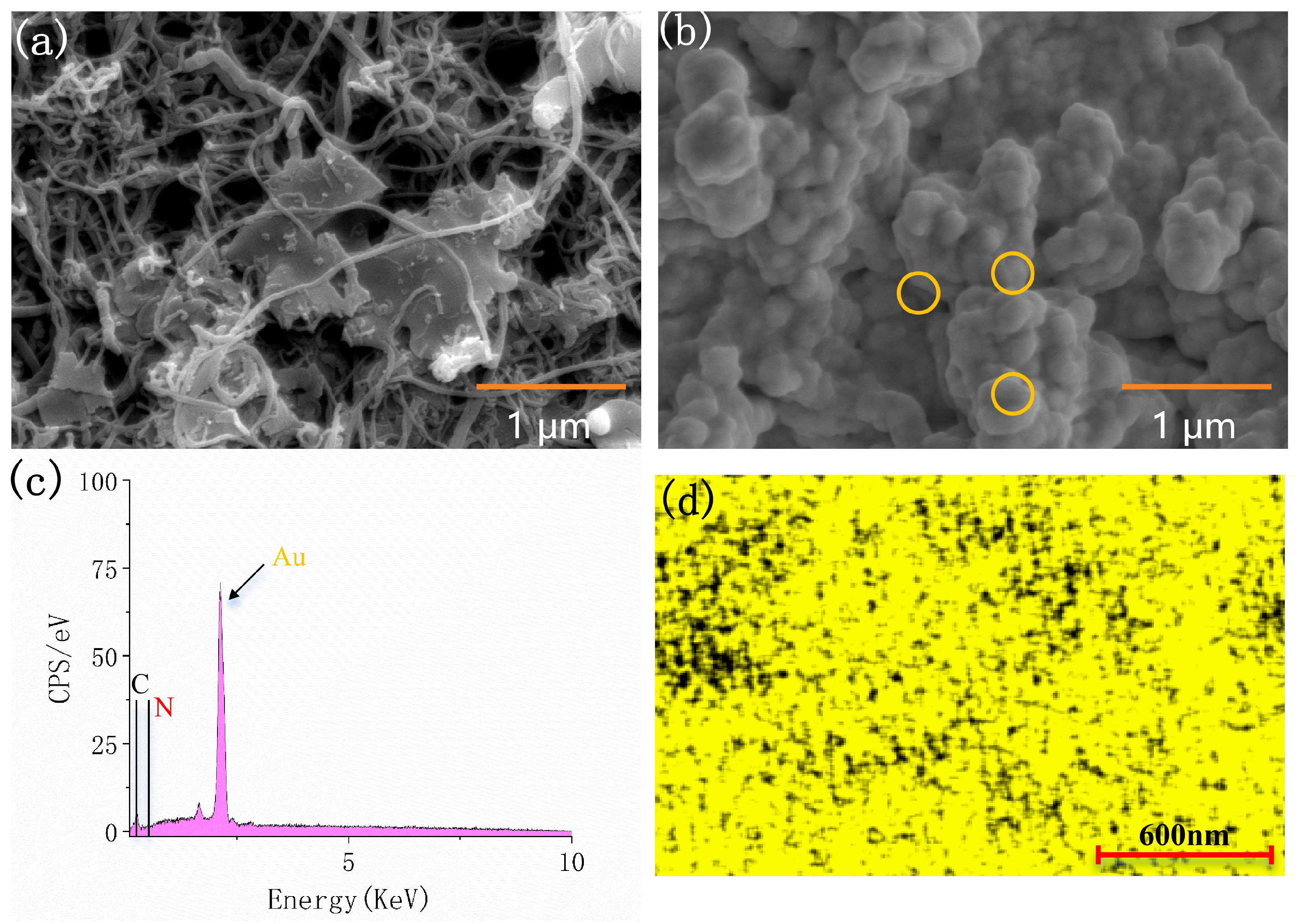
As shown in Figure 1a, the MWCNTS/g-C3N4 composite was constructed from tubular carbon nanotubes and lamellar carbon nitride. This multi-dimensional composite structure effectively increased the specific surface area of the electrode, enabling rapid adsorption of small-molecule substances in the solution. As could be seen from Figure 1b, a dense layer of Au nanoparticles was uniformly supported on the surface of the MWCNTS/g-C3N4 substrate. Au nanoparticles could significantly enhance the electrochemical activity of the composite structure surface, while possessing excellent chemical stability and strong oxidation resistance. Therefore, the MWCNTS/g-C3N4/Au composite structure prepared in this work not only endowed the electrode with good long-term storage stability, but also improved its sensing performance toward melamine. As shown in Figure 1c,d, the EDS results confirmed the presence of C, N, and Au elements on the electrode surface. In addition, the elemental mapping images further demonstrated the uniform distribution of Au nanoparticles on the MWCNTS/g-C3N4 composite structure, verifying the successful fabrication of the MWCNTS/g-C3N4/Au electrode.

3.2. Electrochemical Performance Testing of MWCNTS/g-C3N4/Au Electrode

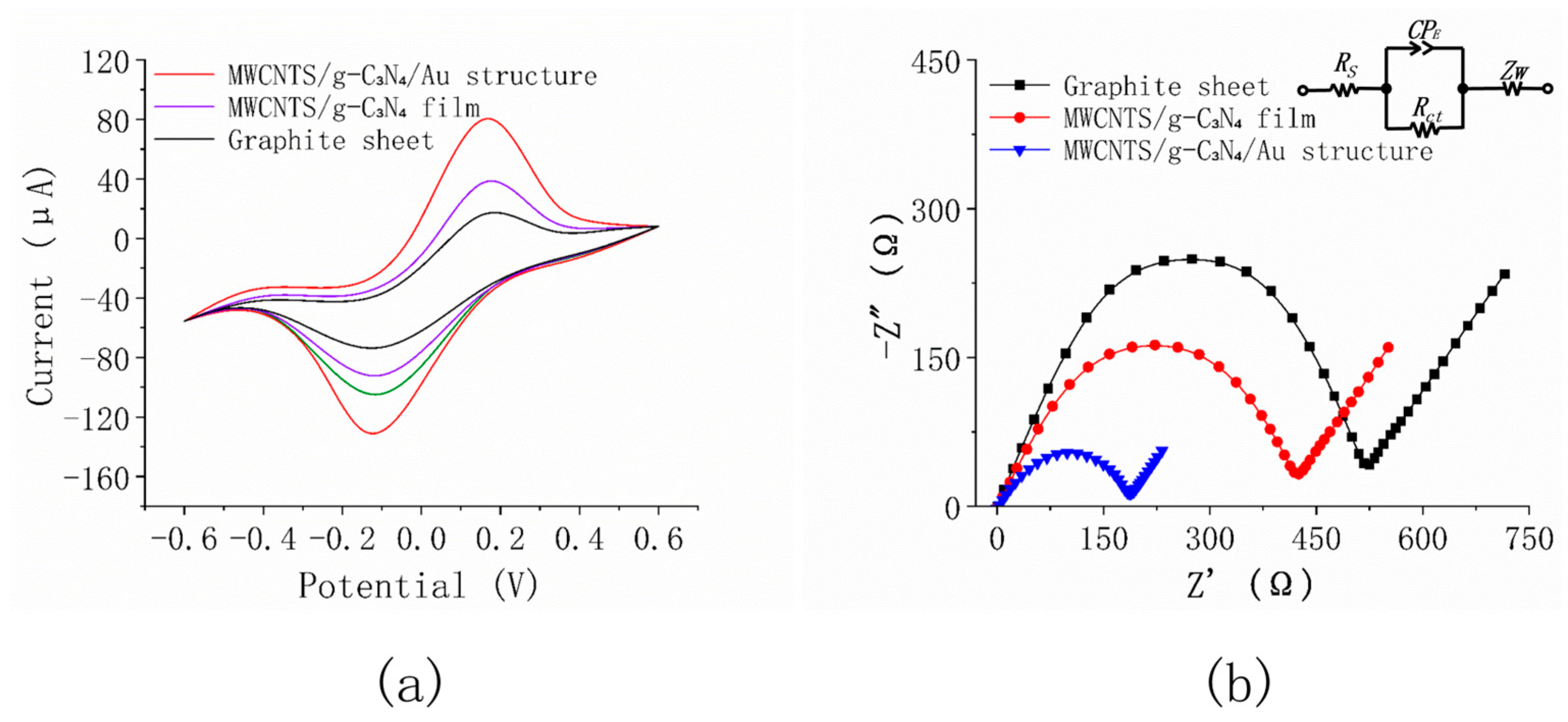
To intuitively demonstrate the fabrication process of the electrochemical sensor, Cyclic Voltammetry (CV) and Electrochemical Impedance Spectroscopy (EIS) were employed to investigate the electrochemical behavior of the sensor in an electrolyte solution containing 5.0 mM K3[Fe(CN)6]/K4[Fe(CN)6] and 0.1 M KCl. The current intensity of the redox peaks and the semicircle diameter in the EIS Nyquist plots can directly reflect the electron transfer capability of the electrode surface. As shown in Figure 2a, compared with the bare graphite sheet electrode, the MWCNTS/g-C3N4 structure exhibited a significantly increased peak current. This was attributed to the large specific surface area of the MWCNTS/g-C3N4 structure, which enlarged the contact area between the electrode and the electrolyte and provided more electroactive sites. In addition, the MWCNTS/g-C3N4/Au structure further improved the electrochemical sensitivity of the electrode owing to the modification of Au nanoparticles. The EIS results in Figure 2b showed that the charge transfer resistance (Rct) of the bare graphite sheet was 520 ± 26.0   Ω , while the Rct values of the MWCNTS/g-C3N4 structure and MWCNTS/g-C3N4/Au structure were 430 ± 21.5   Ω and 187 ± 9.4   Ω , respectively. We employed a simplified Randles equivalent circuit model, as shown in the inset of Figure 2b. The fitted circuit showed good consistency with the electrochemical impedance spectroscopy (EIS) results. It could be seen from the above results that the synergistic effect of the MWCNTS/g-C3N4/Au composite structure endowed the electrode with excellent potential for the sensitive detection of melamine.
The Randles–Sevick equation was used to calculate the electroactive surface area of the MWCNTs/g-C3N4/Au film: I p = 2.69 × 10 5 A n 3 / 2 D 1 / 2 C v 1 / 2 . Here, I p represents the peak current of the sensor, D denotes the diffusion coefficient of [Fe(CN)6]3−/4−, v is the scan rate, A is the electroactive surface area of the electrode, and C is the concentration of the [Fe(CN)6]3−/4− solution. The electroactive surface area of the MWCNTs/g-C3N4/Au film was calculated to be 0.4 cm2.
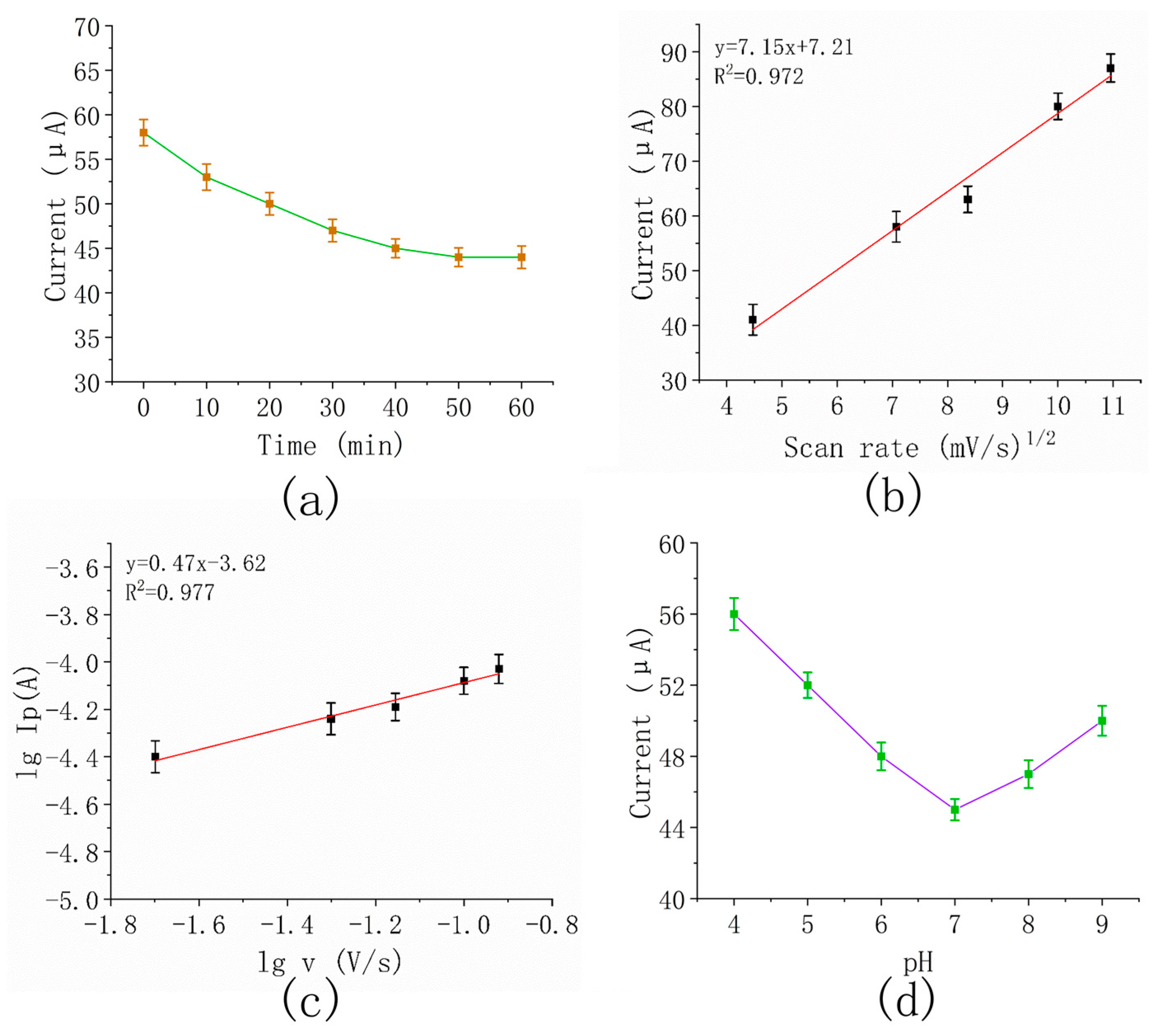
As shown in Figure 3a, the effect of accumulation time on the current response of the electrode toward 100 nM melamine was investigated over the range of 0 to 60 min. As the accumulation time increased from 0 to 50 min, the peak current gradually rose, which could be attributed to the increased amount of melamine molecules adsorbed onto the electrode surface. However, when the accumulation time exceeded 50 min, the amount of molecules adsorbed on the electrode surface gradually reached saturation due to the limited number of active sites on the electrode surface. Moreover, the electrochemical behavior of the electrode at different scan rates was investigated. As shown in Figure 3b, the oxidation peak current exhibited a good linear relationship with the square root of the scan rate ( v 1 / 2 ), which indicated that the electrochemical process was predominantly diffusion-controlled. As shown in Figure 3c, a double-logarithmic plot of the oxidation peak current versus scan rate was constructed, and lg(Ip) showed a linear relationship with lg(v). The results showed that the slope of the fitted line was 0.47. This value was close to the theoretical value of 0.5 for a diffusion-controlled process, which indicated that the electrochemical oxidation of melamine on the electrode surface was mainly governed by diffusion control.
To obtain a sensor with excellent electrochemical stability and high sensitivity, the pH of the test solution was further optimized. As shown in Figure 3d, the effect of pH on the current response of the electrode toward melamine was investigated in electrolytes with pH ranging from 4 to 9. The results showed that the electrode exhibited the most significant current response to melamine at pH 7. This mainly arose from the multiple nitrogen-containing functional groups in the melamine molecule, whose protonation state varied with the solution pH. Under acidic conditions, melamine tended to become protonated, which altered its electronic structure and weakened its interaction with the electrode surface, thereby reducing the electron transfer efficiency. In addition, excessively acidic or alkaline environments could adversely affect the active sites on the electrode surface, leading to suppressed current responses. At neutral pH (pH 7), melamine existed in a relatively stable molecular state, which was favorable for its adsorption on the electrode surface and the electron transfer process, resulting in the optimal electrochemical response. Therefore, an accumulation time of 50 min and a test solution pH of 7 were adopted for melamine detection using the MWCNTS/g-C3N4/Au electrode in this work.

3.3. Sensitivity of MWCNTS/g-C3N4/Au Electrodes in Detecting Melamine

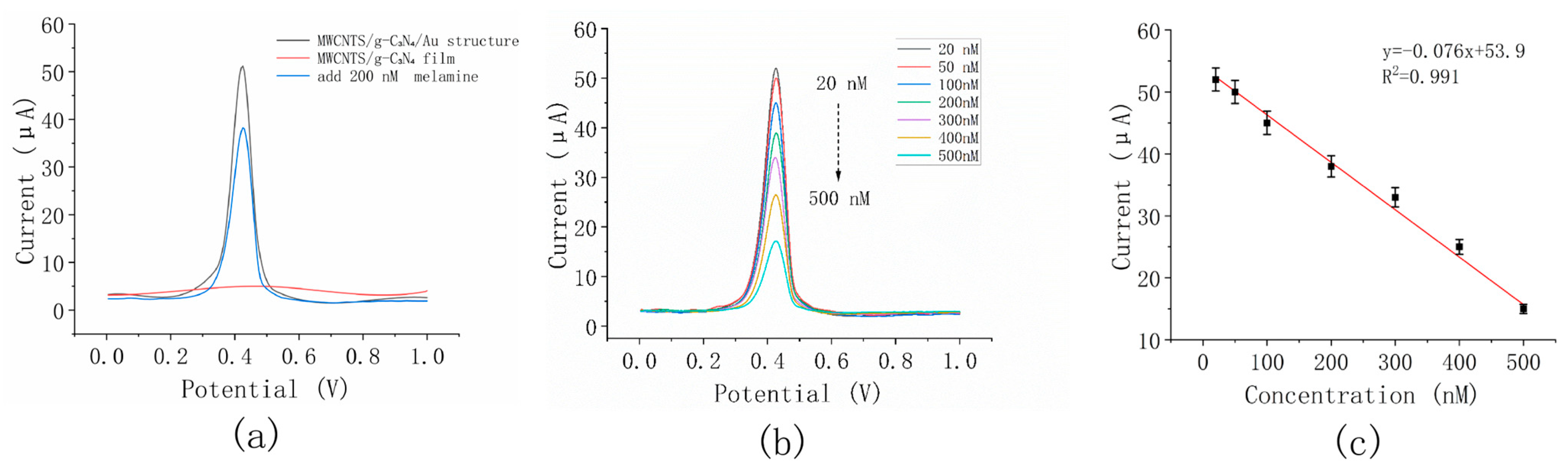
Under the optimized conditions (an accumulation time of 50 min and a test pH of 7), the sensitivity of the as-prepared MWCNTS/g-C3N4/Au electrode was evaluated via the DPV method, and the standard curve for melamine detection was plotted. As shown in Figure 4a, compared with the bare electrode, the modified electrodes exhibited a more pronounced current response, among which the MWCNTS/g-C3N4/Au electrode showed the strongest signal. This indicated that the incorporation of the MWCNTS/g-C3N4/Au composite structure and Au nanoparticles effectively enhanced the electron transfer capability and the number of active sites on the electrode surface, thereby improving the electrochemical response toward melamine. In addition, the large specific surface area and excellent electrical conductivity of Au nanoparticles facilitated the charge transfer process. The composite nanostructure further enhanced the interfacial reactivity of the electrode, ultimately resulting in an amplified DPV response signal.
In Figure 4b, the DPV curves exhibited an oxidation peak at approximately 0.45 V, which was mainly attributed to the electrochemical response of the Au nanoparticles on the electrode surface rather than melamine itself. With increasing melamine concentration, the peak current gradually decreased, which was ascribed to the adsorption of melamine molecules onto the Au nanoparticle surface. This led to partial blockage of active sites and hindered interfacial electron transfer [26].With the melamine concentration as the abscissa and the corresponding peak current response as the ordinate, the fitted straight line shown in Figure 4c was plotted. A good linear relationship between the two parameters was demonstrated over the sensor’s optimal response region (20–500 nM), where a stable and proportional electrochemical signal was observed. This concentration range was suitable for trace-level detection of melamine in food safety analysis. For samples with concentrations exceeding this range, appropriate dilution prior to measurement could be applied. The linear regression equation was y = −0.076x + 53.9 (R2 = 0.991) and the LOD was 4.7 nM. The LODs in this work were estimated using the following formula: LOD = 3σ/S. Here, σ was the standard deviation of the blank response and S was the slope of the calibration curve. These results confirmed that the proposed sensor possessed reliable detection performance.

3.4. Test of the Anti-Interference Capability of MWCNTS/g-C3N4/Au Electrodes for Detecting Melamine

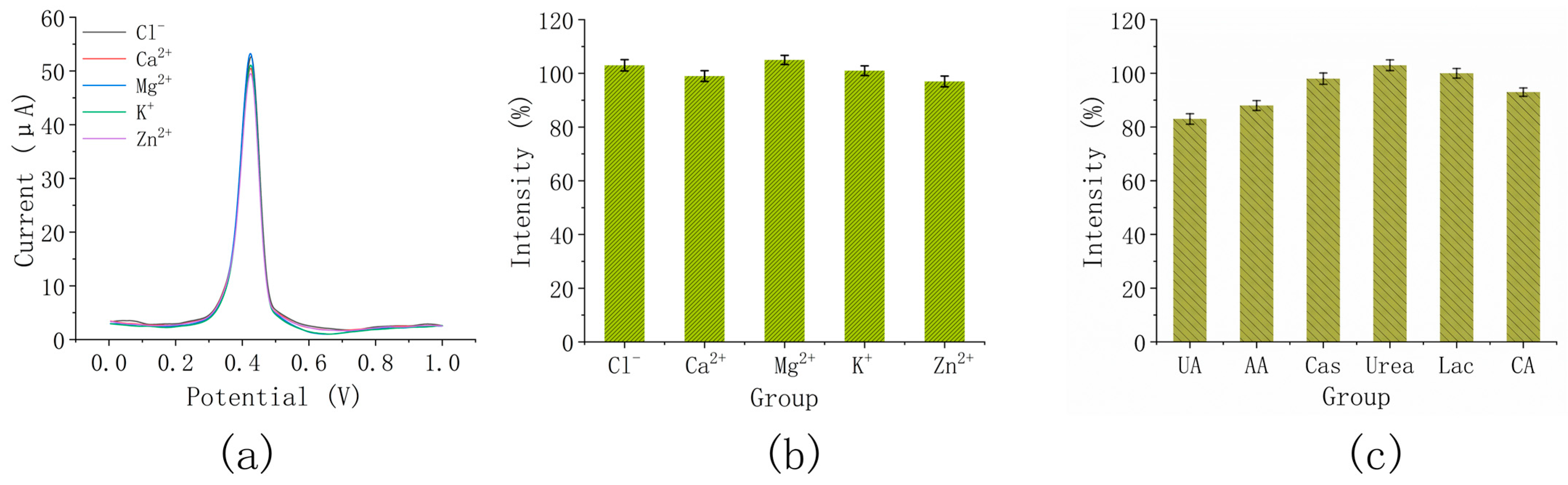
Selectivity is one of the fundamental indicators for evaluating sensor performance. The selectivity of the sensor was investigated by comparing its DPV responses to melamine and other interfering substances (Cl, Ca2+, Mg2+, K+, Zn2+). As shown in Figure 5a, the as-prepared sensor was immersed in a mixed solution containing 20 nM melamine and 100 nM of each interfering substance, and DPV tests were performed within the potential window of 0–1 V. The measured peak current intensity ranged from 50 ± 3 to 53 ± 3 μA, with a standard value of 52 ± 3 μA. Figure 5b compared the current intensity of the electrode for melamine detection in solutions containing interfering substances and the standard solution. The overall RSD was calculated to be 3.16%, indicating good anti-interference performance of the electrode. As shown in Figure 5c, the current response of the electrode toward melamine was compared in the presence of interfering substances (urea, cyanuric acid, and uric acid) at 10-fold higher concentrations relative to melamine, as well as in the standard solution. The results indicated that even in the presence of high concentrations of interfering species, no significant change in the current response toward melamine was observed, demonstrating that the constructed sensor exhibited excellent selectivity and anti-interference capability. In the presence of urea, uric acid, and cyanuric acid at a 10-fold higher concentration than melamine, the current response still exhibited a deviation that exceeded 5%. This result indicated that these organic interferents had a certain influence on the detection signal, while the deviation remained within an acceptable range and suggested controllable overall interference.

3.5. MWCNTS/g-C3N4/Au Electrode for Detecting Melamine in Milk

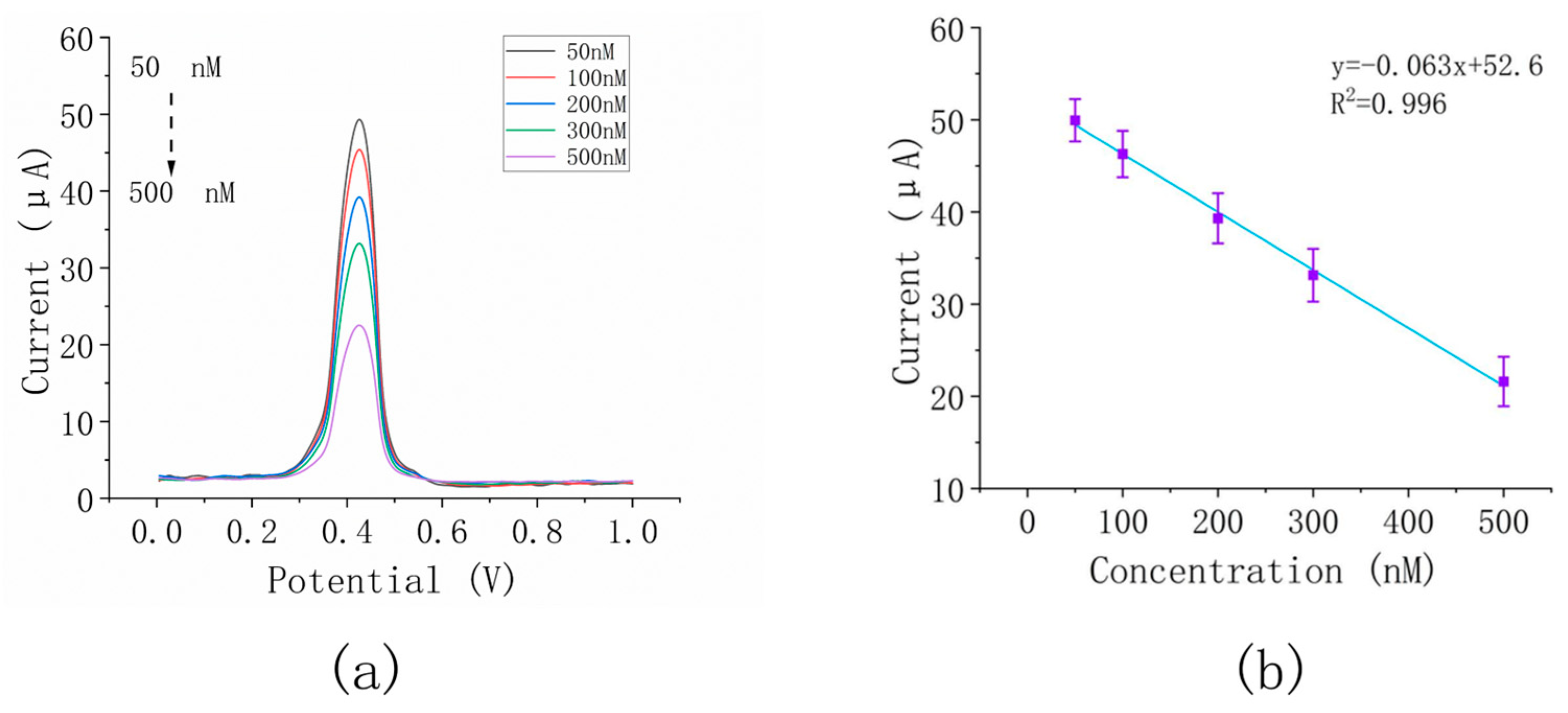
In this work, we pretreated milk samples and performed corresponding electrochemical tests. The accuracy of the as-prepared electrode for melamine concentration detection was verified via the spike-and-recovery method. As shown in Figure 6a, the electrode presented well-defined DPV responses during detection in milk samples. With the gradual increase in melamine concentration in the milk samples, the current response intensity on the electrode surface showed a continuous downward trend. The results in Figure 6b demonstrated a good linear relationship within the concentration range of 50–500 nM, with a linear regression equation of y = −0.063x + 52.6 (R2 = 0.996) and an LOD of 5.6 nM. These results confirmed the reliability of the proposed sensor for melamine detection in the milk matrix. Meanwhile, in milk samples, the linear range narrowed from 20–500 nM to 50–500 nM. This change was mainly attributed to the influence of the complex milk matrix, where proteins, fats, and other endogenous components might adsorb onto the electrode surface, partially blocking active sites and reducing the effective mass transfer of target molecules. Consequently, the electrochemical response at low concentrations was weakened, which led to an upward shift of the lower detection limit. The results in Table 1 indicated that the electrode yielded melamine recoveries ranging from 85% to 104%, with relative standard deviations (RSDs) between 2.3% and 2.9% in real samples, which effectively verified the reliable detection capability of the electrode toward melamine in milk samples. This deviation was mainly attributed to the complex matrix of milk samples, including the interference of proteins, fats, and other endogenous components. In addition, signal fluctuations at trace-level electrochemical detection and unavoidable losses during sample pretreatment might also have contributed to the observed variations. The MWCNTS/g-C3N4/Au composite structure exhibited favorable analytical performance with satisfactory reproducibility, which endowed the electrode with potential application for the rapid detection of melamine in food safety analysis.

3.6. Repetitiveness and Stability of MWCNTS/g-C3N4/Au Electrodes

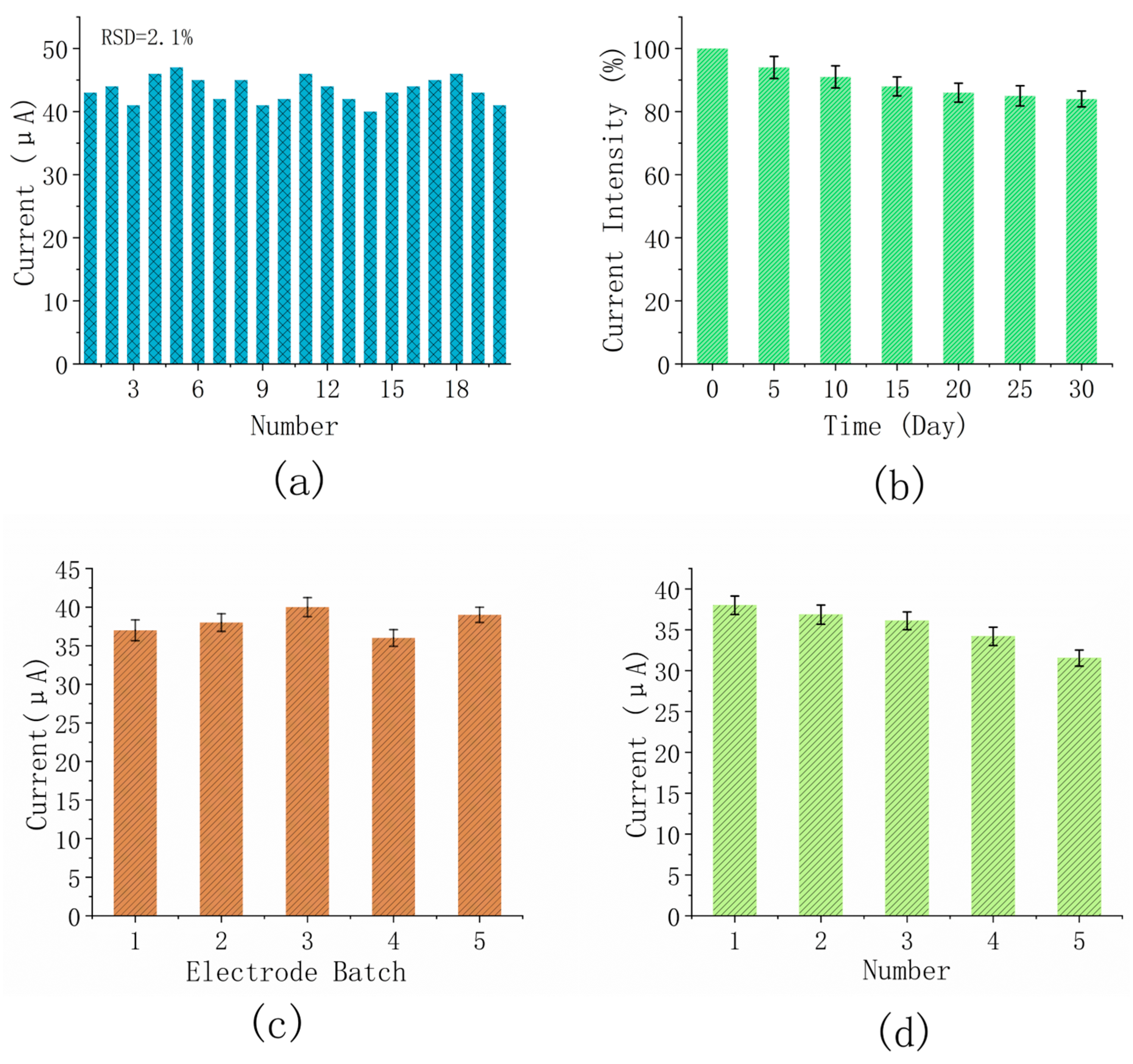
To evaluate the performance of the electrode, 20 MWCNTS/g-C3N4/Au electrodes were fabricated under identical conditions, and the reproducibility of the electrodes was investigated by detecting melamine at the same concentration in the electrolyte solution. The current responses toward 100 nM melamine obtained from different electrodes were presented in Figure 7a. It could be clearly observed that the variation in current intensity was negligible (RSD = 2.1), demonstrating the outstanding reproducibility of the fabricated electrodes. Furthermore, the results in Figure 7b indicated that after 30 days of storage under sealed conditions, the detection performance of the as-prepared electrochemical electrode could still retain 84% of its initial level. The result in Figure 7c showed that the current responses of electrodes from different batches exhibited good consistency. As shown in Figure 7d, the current response of the same electrode showed minimal fluctuation across repeated measurements. These results indicated that the fabricated electrodes possessed excellent fabrication reproducibility and measurement repeatability. The electrode maintained a stable response, exhibiting good long-term storage stability, which was attributed to the excellent chemical stability of the composite structure. The above results confirmed that the electrode possessed reliable service life and storability in practical applications and provided a feasible foundation for subsequent on-site detection and batch fabrication.
In this work, to assess the analytical performance of the MWCNTS/g-C3N4/Au electrode constructed in this work, the key parameters of different types of reported sensors for melamine detection were listed in Table 2 for horizontal comparison of their detection capabilities. The comparison results showed that the MWCNTS/g-C3N4/Au electrode exhibited a low LOD comparable to that of previously reported sensors. Although the sensor developed in this work was still inferior to some previously reported high-performance sensors in certain analytical parameters, it possessed several advantages, including simple fabrication, low cost, rapid response, and satisfactory applicability in real sample analysis. This excellent performance was attributed to the large specific surface area and superior electrochemical properties of the composite, which endowed the electrode with high sensitivity and reliable response toward low concentrations of melamine, indicating its potential for melamine detection.

4. Conclusions

For the detection of melamine residues in milk, we fabricated an electrochemical electrode by depositing dense and uniform gold nanoparticles on the surface of a multi-walled carbon nanotube/graphitic carbon nitride (MWCNTs/g-C3N4) structure. The high specific surface area of this composite provided abundant electroactive sites and enhanced the adsorption capacity toward melamine. Under optimized experimental conditions, the sensor enabled quantitative detection of melamine in aqueous solution with a limit of detection (LOD) of 4.7 nM. Furthermore, the electrode exhibited excellent electrochemical response toward melamine, maintaining stable current responses even in the presence of multiple coexisting interfering substances. When applied to the detection of melamine in milk samples, the sensor achieved recoveries ranging from 85% to 104%, demonstrating good accuracy and reliability in real sample analysis. Meanwhile, this study also further clarifies the limitations of the electrode in complex matrices, pointing out that surface fouling during long-term use may adversely affect its reusability and stability. In future work, the sensor can be further optimized to achieve a lower LOD and extended to the detection of other hazardous molecules and environmental pollutants. Overall, the MWCNTS/g-C3N4/Au electrochemical electrode developed in this work provides an efficient, economical, and practical approach for melamine detection in food matrices, and shows promising potential for practical applications.

Author Contributions

Writing—original draft preparation: L.C. Methodology: K.F. Experiments: J.M. and Y.L. Software: Y.W. Writing—review and editing: J.Y. Funding acquisition: L.C. and J.Y. All authors have read and agreed to the published version of the manuscript.

Funding

This research was funded by the school-level research project of Kaili University (2026YB003); The school-level research project of Kaili University (2026YB006); Open Fund Project from Engineering Research Center of Micro-Nano and Intelligent Manufacturing of Ministry of Education at Kaili University (WZG-202502).

Institutional Review Board Statement

Not applicable.

Informed Consent Statement

Not applicable.

Data Availability Statement

The original contributions presented in this study are included in the article. Further inquiries can be directed to the corresponding author.

Conflicts of Interest

The authors declare no conflicts of interest.

References

  1. Shalileh, F.; Sabahi, H.; Golbashy, M.; Dadmehr, M.; Hosseini, M. Recent Developments in DNA Nanostructure-Based Biosensors for the Detection of Melamine Adulteration in Milk. Microchem. J. 2023, 195, 109316. [Google Scholar] [CrossRef]
  2. Naeimi, R.; Safarpour, F.; Askari, H.; Ghasemi-Kasman, M. Current Insights into the Neurotoxicity of Melamine: A Comprehensive Review. Curr. Neuropharmacol. 2025, 23, 20–35. [Google Scholar] [CrossRef] [PubMed]
  3. Finete, V.D.L.M.; Gouvêa, M.M.; Marques, F.F.D.C.; Netto, A.D.P. Is It Possible to Screen for Milk or Whey Protein Adulteration with Melamine, Urea and Ammonium Sulphate, Combining Kjeldahl and Classical Spectrophotometric Methods? Food Chem. 2013, 141, 3649–3655. [Google Scholar] [CrossRef]
  4. Yang, H.; Wang, J.; Wu, Q.; Wang, Y.; Li, L.; Ding, B. Simple and Label-Free Fluorescent Detection of Melamine Based on Melamine–Thymine Recognition. Sensors 2018, 18, 2968. [Google Scholar] [CrossRef]
  5. Mauer, L.J.; Chernyshova, A.A.; Hiatt, A.; Deering, A.; Davis, R. Melamine Detection in Infant Formula Powder Using Near- and Mid-Infrared Spectroscopy. J. Agric. Food Chem. 2009, 57, 3974–3980. [Google Scholar] [CrossRef] [PubMed]
  6. Sun, J.; Zhang, X.; Cao, Y.; Zhao, Q.; Bao, E.; Lv, Y. Ovarian Toxicity in Female Rats after Oral Administration of Melamine or Melamine and Cyanuric Acid. PLoS ONE 2016, 11, e0149063. [Google Scholar] [CrossRef] [PubMed]
  7. Li, Y.; Xu, J.; Sun, C. Chemical Sensors and Biosensors for the Detection of Melamine. RSC Adv. 2015, 5, 1125–1147. [Google Scholar] [CrossRef]
  8. Hau, A.K.; Kwan, T.H.; Li, P.K. Melamine Toxicity and the Kidney. J. Am. Soc. Nephrol. 2009, 20, 245–250. [Google Scholar] [CrossRef]
  9. Gu, C.; Lan, T.; Shi, H.; Lu, Y. Portable Detection of Melamine in Milk Using a Personal Glucose Meter Based on an in Vitro Selected Structure-Switching Aptamer. Anal. Chem. 2015, 87, 7676–7682. [Google Scholar] [CrossRef]
  10. Kamil, G.; Uğur, Ş. Development of a Novel Amino-Silica Packed Column for HPLC Determination of Melamine in Infant Formula and Milk Powder Samples. J. Food Compos. Anal. 2025, 147, 108068. [Google Scholar] [CrossRef]
  11. Squadrone, S.; Ferro, G.L.; Marchis, D.; Mauro, C.; Palmegiano, P.; Amato, G.; Poma Genin, E.; Abete, M.C. Determination of Melamine in Feed: Validation of a Gas Chromatography–Mass Spectrometry Method According to 2004/882/CE Regulation. Food Control 2010, 21, 714–718. [Google Scholar] [CrossRef]
  12. Sun, F.; Liu, L.; Kuang, H.; Xu, C. Development of ELISA for Melamine Detection in Milk Powder. Food Agric. Immunol. 2013, 24, 79–86. [Google Scholar] [CrossRef]
  13. Wang, G.; Xu, J.; Chen, H. Progress in the Studies of Photoelectrochemical Sensors. Sci. China Ser. B-Chem. 2009, 52, 1789–1800. [Google Scholar] [CrossRef]
  14. Zhang, Y.; Niu, Q.; Gu, X.; Yang, N.; Zhao, G. Recent Progress on Carbon Nanomaterials for the Electrochemical Detection and Removal of Environmental Pollutants. Nanoscale 2019, 11, 11992–12014. [Google Scholar] [CrossRef]
  15. Tonelli, D.; Scavetta, E.; Gualandi, I. Electrochemical Deposition of Nanomaterials for Electrochemical Sensing. Sensors 2019, 19, 1186. [Google Scholar] [CrossRef]
  16. Zhang, F.; Liu, Y.; Wang, J.; Zhang, H.; Yu, W.; Sang, Y.; Liu, Y.; Yang, G.; Gao, F.; Wang, S.; et al. An Automated Microfluidic Biosensor with Bispecific Rabbit Monoclonal Antibody and Nanozyme-Bioenzyme Composite for Dual Antibiotic Detection. BMEMat 2026, 4, e70039. [Google Scholar] [CrossRef]
  17. Zhang, K.; Han, L.; Cai, H.-Q.; Xue, X.-Y.; Song, Y.-F.; Xin, W.-L.; Wang, Y.-Z.; Liu, P.; Liu, J. Toward Personalized Healthcare: Advances in Two-Dimensional Nanomaterial-Based Flexible Electrochemical Sensors for Physiological Monitoring. BMEMat 2025, e70047. [Google Scholar] [CrossRef]
  18. Xue, J.; Lee, P.T.; Compton, R.G. Electrochemical Detection of Melamine. Electroanalysis 2014, 26, 1454–1460. [Google Scholar] [CrossRef]
  19. An, Q.-Q.; Feng, X.-Z.; Zhou, Z.-F.; Zhan, T.; Lian, S.-F.; Zhu, J.; Han, G.-C.; Chen, Z.; Kraatz, H.-B. One Step Construction of an Electrochemical Sensor for Melamine Detection in Milk towards an Integrated Portable System. Food Chem. 2022, 383, 132403. [Google Scholar] [CrossRef] [PubMed]
  20. Daizy, M.; Tarafder, C.; Al-Mamun, M.R.; Liu, X.; Aly Saad Aly, M.; Khan, M.Z.H. Electrochemical Detection of Melamine by Using Reduced Graphene Oxide–Copper Nanoflowers Modified Glassy Carbon Electrode. ACS Omega 2019, 4, 20324–20329. [Google Scholar] [CrossRef] [PubMed]
  21. He, Y.; Liao, Y.; Zhang, B.; Xu, R.; Ma, Y.; Zhao, M.; Cui, H. Using the Photo-Enhanced Barrier Effect on Electrochemical Response for Highly Sensitive Detection of Melamine. Food Chem. 2024, 432, 137246. [Google Scholar] [CrossRef]
  22. Kalambate, R.P.; Kalambate, P.K.; Laiwattanapaisal, W. Revolutionizing Melamine Detection: Cutting-Edge Advances from Traditional Analyses to State-of-the-Art Electrochemical Sensors. Next Mater. 2024, 3, 100085. [Google Scholar] [CrossRef]
  23. Yu, C.; Hou, J.; Zhang, B.; Liu, S.; Pan, X.; Song, H.; Hou, X.; Yan, Q.; Zhou, C.; Liu, G.; et al. In-Situ Electrodeposition Synthesis of Z-Scheme rGO/g-C3N4/TNAs Photoelectrodes and Its Degradation Mechanism for Oxytetracycline in Dual-Chamber Photoelectrocatalytic System. J. Environ. Manag. 2022, 308, 114615. [Google Scholar] [CrossRef]
  24. Yao, S.; Lv, Y.; Wang, Q.; Yang, J.; Li, H.; Gao, N.; Zhong, F.; Fu, J.; Tang, J.; Wang, T.; et al. Facile Preparation of Highly Sensitive SERS Substrates Based on Gold Nanoparticles Modified Graphdiyne/Carbon Cloth. Appl. Surf. Sci. 2023, 609, 155098. [Google Scholar] [CrossRef]
  25. Waseem, R.; Nazli, Z.-H.; Huma, Z.E.; Naz, I.; Bano, N.; Sultan, M.; De Souza, P.M.; Jubeen, F. Zn-Sal/CuO Nanoflake-Based Electrochemical Sensor for High-Sensitivity Detection of Trace Melamine in Milk. J. Electrochem. Soc. 2025, 172, 057509. [Google Scholar] [CrossRef]
  26. Peng, J.; Feng, Y.; Han, X.-X.; Gao, Z.-N. Sensitive Electrochemical Detection of Melamine Based on Gold Nanoparticles Deposited on a Graphene Doped Carbon Paste Electrode. Anal. Methods 2016, 8, 2526–2532. [Google Scholar] [CrossRef]
  27. Tiwari, M.; Singh, A.; Dureja, S.; Basu, S.; Pattanayek, S.K. Au Nanoparticles Decorated ZnO/ZnFe2O4 Composite SERS-Active Substrate for Melamine Detection. Talanta 2022, 236, 122819. [Google Scholar] [CrossRef]
  28. J, G.; Manojkumar, P.A.; Koppole, K. Surfactant-Free Facile Synthesis of Ag/rGO Nanohybrid for SERS-Based Detection of Melamine. Plasmonics 2024, 19, 471–480. [Google Scholar] [CrossRef]
  29. Akbari-adergani, B.; Sadeghian, G.-H.; Alimohammadi, A.; Esfandiari, Z. Integrated Photografted Molecularly Imprinted Polymers with a Cellulose Acetate Membrane for the Extraction of Melamine from Dry Milk before HPLC Analysis. J. Sep. Sci. 2017, 40, 1361–1368. [Google Scholar] [CrossRef] [PubMed]
  30. Mohebbi, M.; Ghanbari, K.; Nejabati, F. Electrochemical Sensor Based on EDTA-Functionalized Polyorthophenylene Diamine g-C3N4 Nanocomposite for Determination of Melamine in Milk. J. Electroanal. Chem. 2023, 946, 117757. [Google Scholar] [CrossRef]
  31. El-Shahawi, M.S.; Khraibah, N.H. Development of a Highly Sensitive Voltametric Sensor for Trace Determination of Melamine Residues in Milk and Water Samples. Microchem. J. 2020, 157, 105087. [Google Scholar] [CrossRef]
  32. Khedr, A. Optimized Extraction Method for LC–MS Determination of Bisphenol a, Melamine and Di(2-Ethylhexyl) Phthalate in Selected Soft Drinks, Syringes, and Milk Powder. J. Chromatogr. B 2013, 930, 98–103. [Google Scholar] [CrossRef] [PubMed]
  33. Heydarian-Dehkordi, N.; Saei-Dehkordi, S.S.; Izadi, Z.; Ghasemi-Varnamkhasti, M. Development of an Ultrasensitive Molecularly Imprinted Poly-(Ortho-Phenylenediamine) Based Sensor for the Determination of Melamine Adulteration in Milk and Infant Formula. Food Sci. Nutr. 2022, 10, 3154–3164. [Google Scholar] [CrossRef] [PubMed]
Figure 1. (a) SEM image of the MWCNTS/g-C3N4 structure, (b) SEM image of the MWCNTS/g-C3N4/Au structure, (c) EDS spectra of the MWCNTS/g-C3N4 structure, (d) Elemental mapping of Au on film surface.
Chemosensors 14 00133 g001
Figure 2. (a) CV curves of different structures in Fe. (b) EIS curves of different structures and the corresponding simplified Randles equivalent circuit.
Chemosensors 14 00133 g002
Figure 3. (a) Current response of the MWCNTS/g-C3N4/Au composite structure in detecting melamine at different enrichment times. (b) Current response of the MWCNTS/g-C3N4/Au composite structure as a function of the square root of scan rate during melamine detection. (c) Linear relationship between lg (Ip) and lg(v) of the MWCNTs/g-C3N4/Au composite structure during melamine detection. (d) Current response of the MWCNTS/g-C3N4/Au composite structure in detecting melamine in electrolyte solutions with different pH values.
Chemosensors 14 00133 g003
Figure 4. (a) DPV responses of MWCNTS/g-C3N4 and MWCNTS/g-C3N4/Au electrodes in PBS solution, and MWCNTS/g-C3N4/Au electrode in PBS containing 200 nM melamine. (b) MWCNTS/g-C3N4/Au electrode detecting different concentrations of melamine. (c) The fitted straight line between melamine concentration and the current intensity on the electrode surface.
Chemosensors 14 00133 g004
Figure 5. (a) The current response of the MWCNTS/g-C3N4/Au electrode in detecting melamine in the presence of different interfering ions (Cl, Ca2+, Mg2+, K+, and Zn2+). (b) The current intensity error of the MWCNTS/g-C3N4/Au electrode for melamine detection in the presence of different interfering ions (Cl, Ca2+, Mg2+, K+, and Zn2+). (c) The current intensity error of the MWCNTS/g-C3N4/Au electrode for melamine detection in the presence of urea, cyanuric acid, and uric acid.
Chemosensors 14 00133 g005
Figure 6. (a) Current response of the MWCNTS/g-C3N4/Au electrode for melamine detection in milk within the concentration range of 20–500 nM. (b) The fitted straight line between melamine concentration and the current intensity on the electrode surface.
Chemosensors 14 00133 g006
Figure 7. (a) Current intensity of 100 nM melamine detected by 20 groups of MWCNTS/g-C3N4/Au electrodes. (b) Trend of current intensity of melamine detected by MWCNTS/g-C3N4/Au electrodes within 30 days. (c) Current response comparison of MWCNTS/g-C3N4/Au electrodes fabricated in different batches. (d) Current response of the MWCNTS/g-C3N4/Au electrode for five consecutive measurements of melamine.
Chemosensors 14 00133 g007
Table 1. Determination of melamine in milk using the MWCNTS/g-C3N4/Au electrode.
Add (nM)Detect (nM)Recovery (%)RSD (n = 5)
milk50521042.3
1001001002.4
200192962.7
300273912.9
500425852.6
Table 2. Key parameters of different types of electrodes currently used for detecting melamine molecules.
MethodsSensorLinear Range (M)LOD (mol/L)Reference
SERSAu- ZZF(ZnO/ZnFe2O)7.92 × 10−6–3.9 × 10−53.9 × 10−5[27]
SERSAg/rGO1 × 10−8–1 × 10−31 × 10−6[28]
ElectrochemicalMEL/Fc-ECG/SPCE2.0 × 10−6–2.0 × 10−51 × 10−7[19]
HPLC-1.59 × 10⁻⁷–9.37 × 10−55.56 × 10−8[29]
Electrochemicalg-C3N4/POPD/EDTA1 × 10−7–1 × 10−49 × 10−9[30]
ElectrochemicalP-Arg/rGO-CuNFs/GCE10 × 10−9–9.0 × 10−85 × 10−9[20]
Electrochemical preanodized glassy carbon electrode2.0 × 10−9–8.0 × 10−96.0 × 10−10[31]
LC-MS-9.5 × 10⁻⁸–7.9 × 10−69.5 × 10−11[32]
ElectrochemicalAuNPs/MIP/RGO/PGE10−17–10−82.64 × 10−16[33]
ElectrochemicalMWCNTS/g-C3N4/Au structure2 × 10−8–5 × 10−74.7 × 10−9This work
Disclaimer/Publisher’s Note: The statements, opinions and data contained in all publications are solely those of the individual author(s) and contributor(s) and not of MDPI and/or the editor(s). MDPI and/or the editor(s) disclaim responsibility for any injury to people or property resulting from any ideas, methods, instructions or products referred to in the content.