Conduction Mechanism in Lead Sulfide Quantum Dot Gas Sensors




Abstract
1. Introduction
2. Materials and Methods
2.1. Synthesis of PbS CQDs
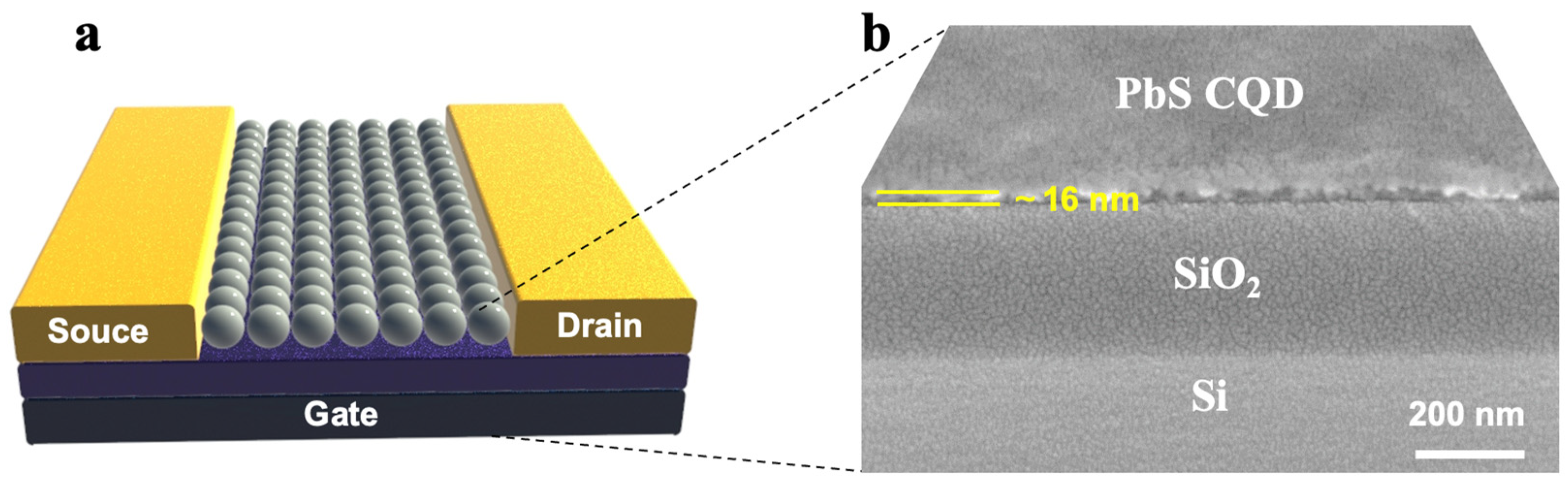
2.2. Fabrication of PbS CQDs TFT
2.3. Gas Sensing Performance and In Situ Electrical Characterization
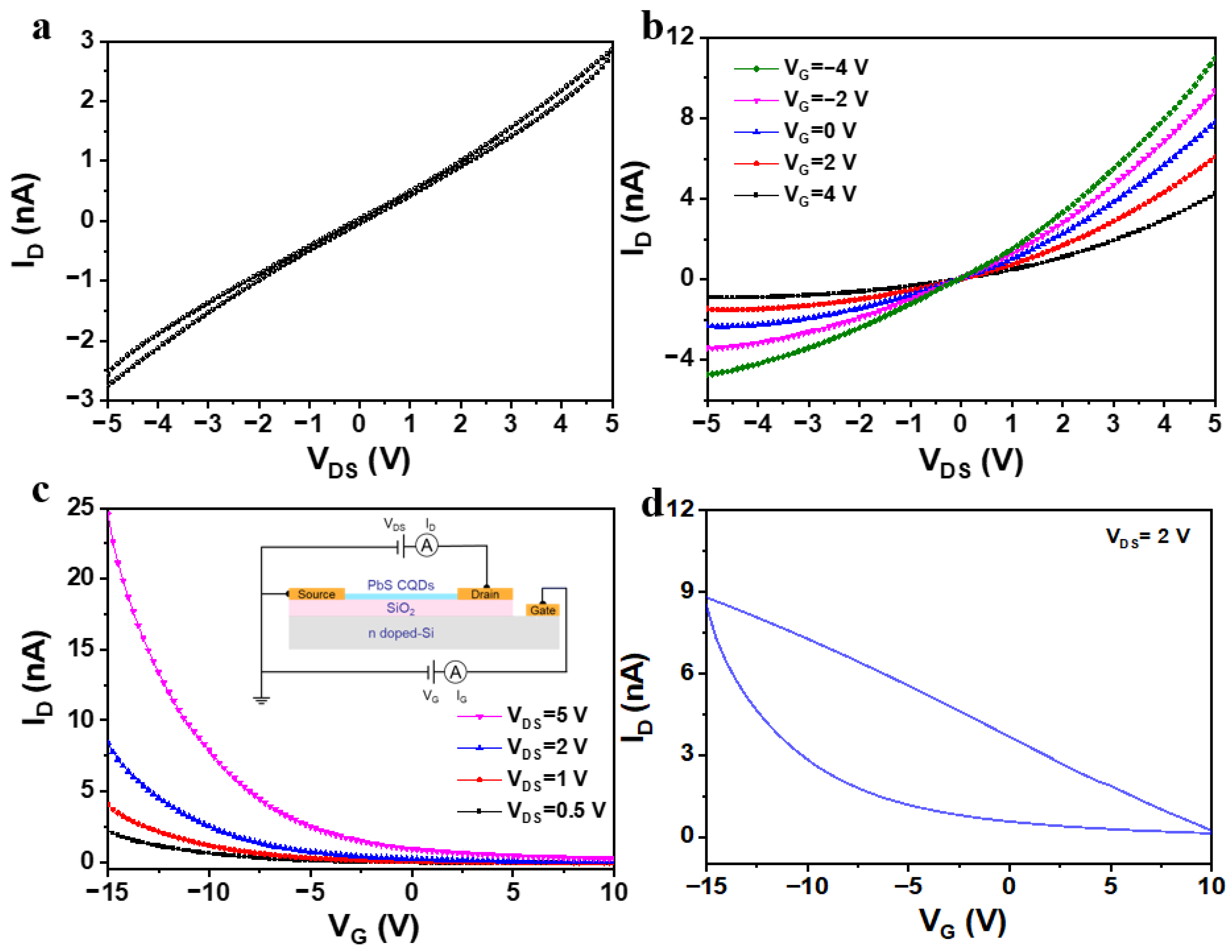
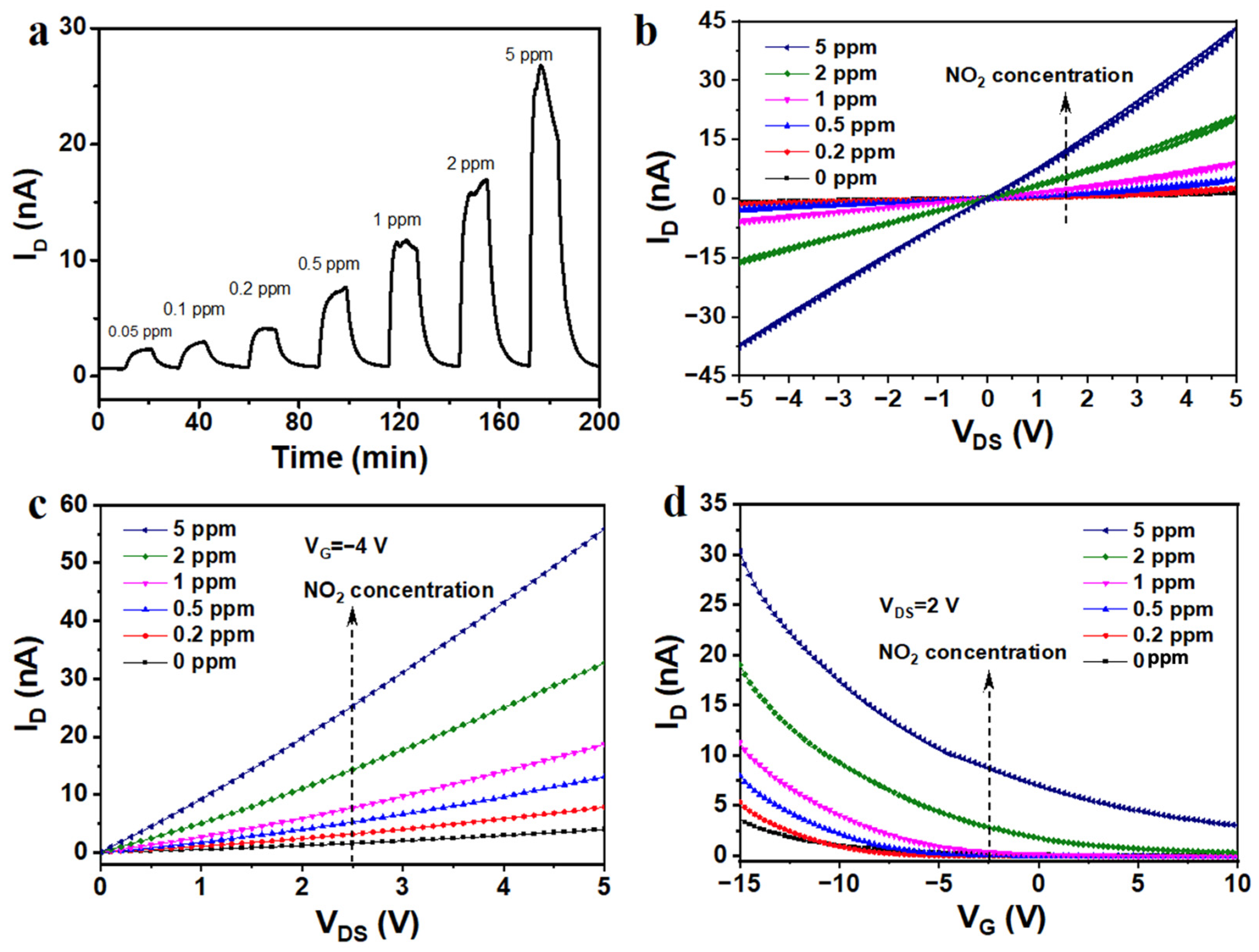
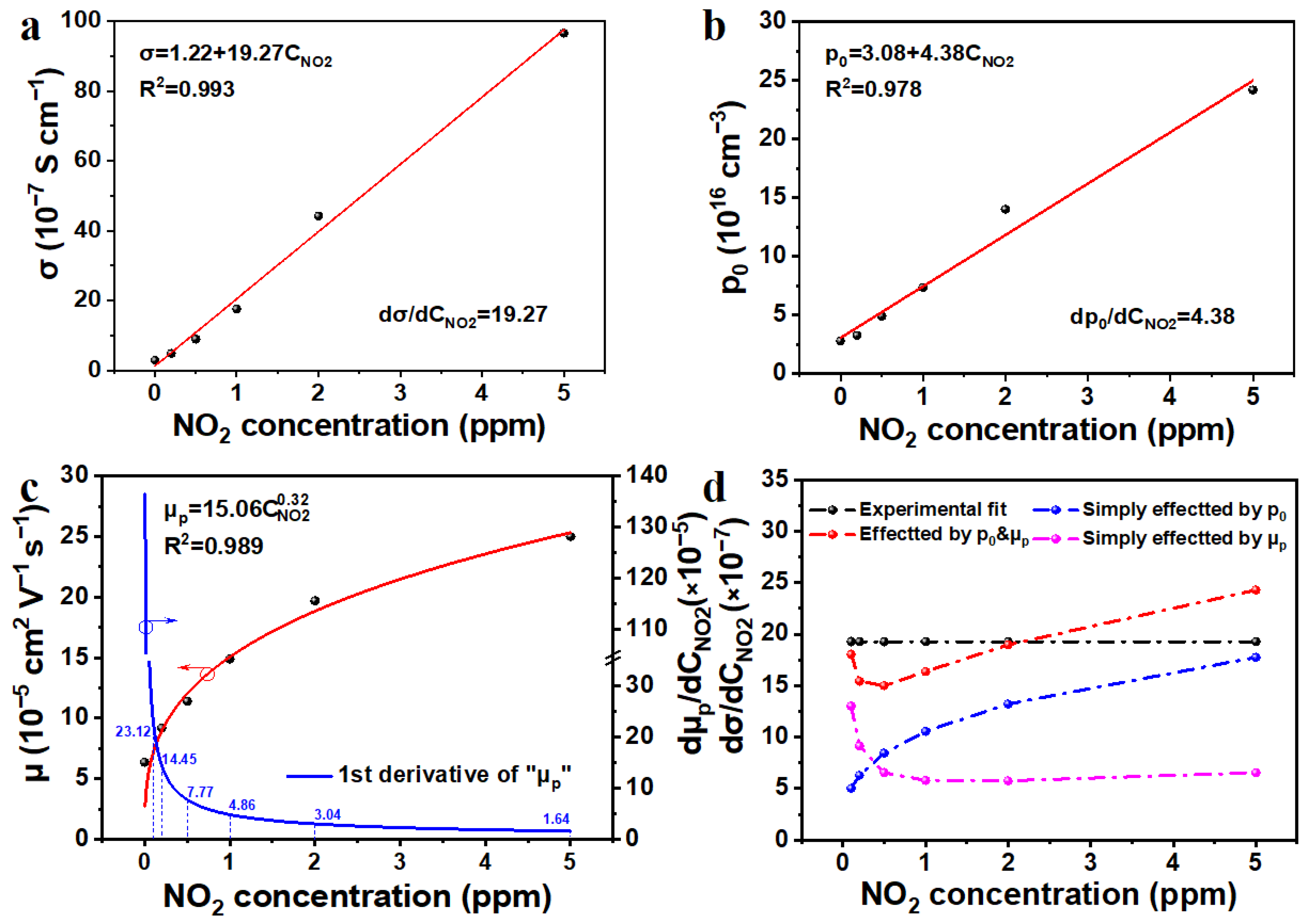
3. Results and Discussion
4. Conclusions
Author Contributions
Funding
Institutional Review Board Statement
Informed Consent Statement
Data Availability Statement
Conflicts of Interest
References
- Kaur, N. Nickel Oxide Nanostructures for Gas Sensing: Recent Advances, Challenges, and Future Perspectives. ACS Sens. 2025, 10, 1641–1674. [Google Scholar] [CrossRef]
- Kumar, A.; Mazumder, J.T.; Joyen, K.; Favier, F.; Mirzaei, A.; Kim, J.-Y.; Kwoka, M.; Bechelany, M.; Jha, R.K.; Kumar, M.; et al. Defect engineering approaches for metal oxide semiconductor-based chemiresistive gas sensing. Coord. Chem. Rev. 2025, 541, 216836. [Google Scholar] [CrossRef]
- Mandal, S.; Marsh, A.V.; Faber, H.; Ghoshal, T.; Goswami, D.K.; Tsetseris, L.; Heeney, M.; Anthopoulos, T.D. A robust organic hydrogen sensor for distributed monitoring applications. Nat. Electron. 2025, 8, 343–352. [Google Scholar] [CrossRef]
- Song, J.; Kim, D.-H.; Tiepelt, J.; Jo, Y.-M.; McGrath, G.; Song, M.; Chen, T.; Wang, J.; Coto, A.; Palani, S.; et al. Tunable and highly sensitive functionalized carbon-nanotube-based integrated systems for chemical gas sensing. Nat. Sens. 2026, 1, 252–260. [Google Scholar] [CrossRef]
- Yamazoe, N. New approaches for improving semiconductor gas sensors. Sens. Actuators B Chem. 1991, 5, 7–19. [Google Scholar] [CrossRef]
- Yamazoe, N. Toward innovations of gas sensor technology. Sens. Actuators B Chem. 2005, 108, 2–14. [Google Scholar] [CrossRef]
- Gillet, M.; Aguir, K.; Bendahan, M.; Mennini, P. Grain size effect in sputtered tungsten trioxide thin films on the sensitivity to ozone. Thin Solid Film. 2005, 484, 358–363. [Google Scholar] [CrossRef]
- Han, M.A.; Kim, H.-J.; Lee, H.C.; Park, J.-S.; Lee, H.-N. Effects of porosity and particle size on the gas sensing properties of SnO2 films. Appl. Surf. Sci. 2019, 481, 133–137. [Google Scholar] [CrossRef]
- Liu, H.; Li, M.; Voznyy, O.; Hu, L.; Fu, Q.; Zhou, D.; Xia, Z.; Sargent, E.H.; Tang, J. Physically flexible, rapid-response gas sensor based on colloidal quantum dot solids. Adv. Mater. 2014, 26, 2718–2724. [Google Scholar] [CrossRef]
- Farahmandpour, M.; Sadeghfar, F.; Asfaram, A.; Ghaedi, M.; Javadian, H. Improving the sensitivity and detection speed of methane gas at room temperature using a nanosensor based on lead sulfide (PbS) colloidal quantum dots. Results Chem. 2025, 18, 102760. [Google Scholar] [CrossRef]
- Kagan, C.R.; Lifshitz, E.; Sargent, E.H.; Talapin, D.V. Building devices from colloidal quantum dots. Science 2016, 353, aac5523. [Google Scholar] [CrossRef]
- Tang, Y.; Zhou, B.; Liu, J.; Chen, X.; Wang, H.; Hu, Z.; Mao, R.; Xing, Y.; Li, H.Y.; Li, D.; et al. Dual-Gate Modulation in a Quantum Dots/MoS2 Thin-Film Transistor Gas Sensor. ACS Sens. 2025, 10, 320–328. [Google Scholar] [CrossRef]
- Li, M.; Zhou, D.; Zhao, J.; Zheng, Z.; He, J.; Hu, L.; Xia, Z.; Tang, J.; Liu, H. Resistive gas sensors based on colloidal quantum dot (CQD) solids for hydrogen sulfide detection. Sens. Actuators B Chem. 2015, 217, 198–201. [Google Scholar] [CrossRef]
- Liu, Y.; Wang, H.; Yang, S.; Chen, K.; Yang, T.; Wei, J.; Tian, J.; Chen, W. ppb level ammonia detection of 3D PbS quantum dots/reduced graphene oxide nanococoons at room temperature and Schottky barrier modulated behavior. Sens. Actuators B Chem. 2018, 255, 2979–2987. [Google Scholar] [CrossRef]
- Roshan, H.; Mosahebfard, A.; Sheikhi, M.H. Effect of Gold Nanoparticles Incorporation on Electrical Conductivity and Methane Gas Sensing Characteristics of Lead Sulfide Colloidal Nanocrystals. IEEE Sens. J. 2018, 18, 1940–1945. [Google Scholar] [CrossRef]
- Kwon, J.; Ha, Y.; Choi, S.; Jung, D.G.; An, H.K.; Kong, S.H.; Jung, D. Solution-processed NO2 gas sensor based on poly(3-hexylthiophene)-doped PbS quantum dots operable at room temperature. Sci. Rep. 2024, 14, 20600. [Google Scholar] [CrossRef]
- Bai, J.; Shen, Y.; Li, A.; Wu, M.; Xiao, H.; Zhao, Q.; Zhao, S.; Liu, W.; Cui, B. Design of PbS quantum dots–PbMoO4–MoS2 ternary nanocomposites for highly selective NO2 sensing at room temperature. Int. J. Miner. Metall. Mater. 2025, 32, 1771–1782. [Google Scholar] [CrossRef]
- Barsan, N.; Weimar, U. Conduction Model of Metal Oxide Gas Sensors. J. Electroceram. 2001, 7, 143–167. [Google Scholar] [CrossRef]
- Shi, L.; Tang, P.; Hu, J.; Zhang, Y. A Strategy for Multigas Identification Using Multielectrical Parameters Extracted from a Single Carbon-Based Field-Effect Transistor Sensor. ACS Sens. 2024, 9, 3126–3136. [Google Scholar] [CrossRef] [PubMed]
- Torsi, L.; Dodabalapur, A.; Sabbatini, L.; Zambonin, P. Multi-parameter gas sensors based on organic thin-film-transistors. Sens. Actuators B Chem. 2000, 67, 312–316. [Google Scholar] [CrossRef]
- Hayasaka, T.; Lin, A.; Copa, V.C.; Lopez, L.P., Jr.; Loberternos, R.A.; Ballesteros, L.I.M.; Kubota, Y.; Liu, Y.; Salvador, A.A.; Lin, L. An electronic nose using a single graphene FET and machine learning for water, methanol, and ethanol. Microsyst. Nanoeng. 2020, 6, 50. [Google Scholar] [CrossRef]
- Gong, J.; Zhang, C.; Hu, W.; Zhou, J.-J. Free-carrier screening unlocks high electron mobility in ultrawide bandgap semiconductor CaSnO3. Appl. Phys. Lett. 2025, 127, 092110. [Google Scholar] [CrossRef]
- Rode, D.L.; Cetnar, J.S. Electron mobility of heavily doped semiconductors including multiple scattering by ionized impurities. J. Appl. Phys. 2023, 134, 075701. [Google Scholar] [CrossRef]
- Oh, S.J.; Berry, N.E.; Choi, J.H.; Gaulding, E.A.; Lin, H.; Paik, T.; Diroll, B.T.; Muramoto, S.; Murray, C.B.; Kagan, C.R. Designing high-performance PbS and PbSe nanocrystal electronic devices through stepwise, post-synthesis, colloidal atomic layer deposition. Nano Lett. 2014, 14, 1559–1566. [Google Scholar] [CrossRef]
- Ning, Z.; Voznyy, O.; Pan, J.; Hoogland, S.; Adinolfi, V.; Xu, J.; Li, M.; Kirmani, A.R.; Sun, J.P.; Minor, J.; et al. Air-stable n-type colloidal quantum dot solids. Nat. Mater. 2014, 13, 822–828. [Google Scholar] [CrossRef]
- Liu, J.; Lv, J.; Shi, J.; Wu, L.; Su, N.; Fu, C.; Zhang, Q. Size effects of tin oxide quantum dot gas sensors: From partial depletion to volume depletion. J. Mater. Res. Technol. 2020, 9, 16399–16409. [Google Scholar] [CrossRef]
- Tang, Y.; Zhou, B.; Liu, J.; Guo, L.; Ying, B.; Chen, X.; Zhang, W.; Liang, Y.; Li, L.; Duan, Q.; et al. Specific Odor Coding Using a Single Thin-Film Transistor. Nano Lett. 2025, 25, 7587–7594. [Google Scholar] [CrossRef] [PubMed]
- Kagan, C.R.; Murray, C.B. Charge transport in strongly coupled quantum dot solids. Nat. Nanotechnol. 2015, 10, 1013–1026. [Google Scholar] [CrossRef]
- Boles, M.A.; Ling, D.; Hyeon, T.; Talapin, D.V. The surface science of nanocrystals. Nat. Mater. 2016, 15, 364. [Google Scholar] [CrossRef]
- Garcia de Arquer, F.P.; Talapin, D.V.; Klimov, V.I.; Arakawa, Y.; Bayer, M.; Sargent, E.H. Semiconductor quantum dots: Technological progress and future challenges. Science 2021, 373, eaaz8541. [Google Scholar] [CrossRef]


Disclaimer/Publisher’s Note: The statements, opinions and data contained in all publications are solely those of the individual author(s) and contributor(s) and not of MDPI and/or the editor(s). MDPI and/or the editor(s) disclaim responsibility for any injury to people or property resulting from any ideas, methods, instructions or products referred to in the content. |
© 2026 by the authors. Licensee MDPI, Basel, Switzerland. This article is an open access article distributed under the terms and conditions of the Creative Commons Attribution (CC BY) license.
Share and Cite
Tang, Y.; Liu, J.; Zhou, B.; Guo, L.; Li, H.-Y.; Liu, H. Conduction Mechanism in Lead Sulfide Quantum Dot Gas Sensors. Chemosensors 2026, 14, 131. https://doi.org/10.3390/chemosensors14060131
Tang Y, Liu J, Zhou B, Guo L, Li H-Y, Liu H. Conduction Mechanism in Lead Sulfide Quantum Dot Gas Sensors. Chemosensors. 2026; 14(6):131. https://doi.org/10.3390/chemosensors14060131
Chicago/Turabian StyleTang, Yanting, Jingyao Liu, Bowen Zhou, Lanpeng Guo, Hua-Yao Li, and Huan Liu. 2026. "Conduction Mechanism in Lead Sulfide Quantum Dot Gas Sensors" Chemosensors 14, no. 6: 131. https://doi.org/10.3390/chemosensors14060131
APA StyleTang, Y., Liu, J., Zhou, B., Guo, L., Li, H.-Y., & Liu, H. (2026). Conduction Mechanism in Lead Sulfide Quantum Dot Gas Sensors. Chemosensors, 14(6), 131. https://doi.org/10.3390/chemosensors14060131