1. Introduction
Angiotensin-converting enzyme (ACE) inhibitors such as Lisinopril (LIS), Ramipril (RAM), and Enalapril (ENA) are among the most prescribed antihypertensive drugs worldwide. Their continuous consumption and partial metabolism lead to their release into aquatic environments through wastewater systems. Therefore, in order to quantify them at trace quantities, sensitive analytical procedures are necessary [
1,
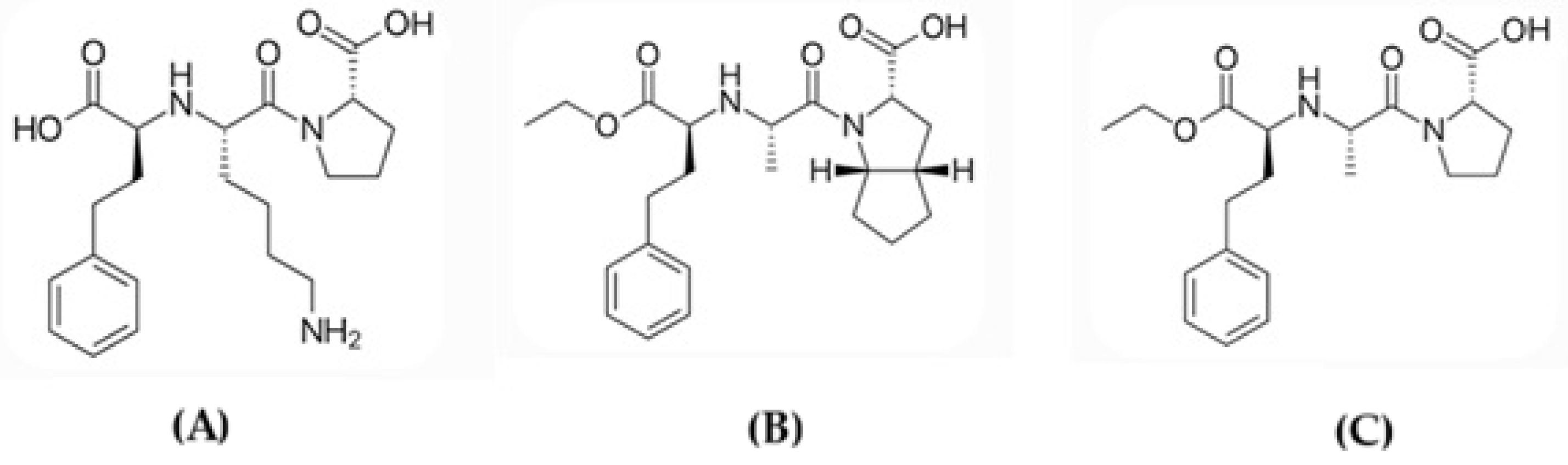
2]. The chemical structures of the studied ACE inhibitors are shown in
Figure 1.
ACE inhibitors are introduced into wastewater systems primarily through human excretion after therapeutic use, although improper disposal of unused medications may also contribute to environmental contamination. Following administration, these drugs undergo partial biotransformation in vivo, while a considerable fraction may be excreted as unchanged parent compounds or active metabolites through urine and feces. For example, LIS is minimally metabolized and is largely excreted unchanged in urine, whereas ENA and RAM are converted into their active metabolites before renal elimination [
3]. Consequently, wastewater treatment plants become important pathways for the release of ACE inhibitors into aquatic environments [
4].
One of the most important steps in the renin–angiotensin–aldosterone system (RAAS), the conversion of angiotensin I into the potent vasoconstrictor angiotensin II is blocked by ACE inhibitors, which in turn lower blood pressure. By reducing circulating angiotensin II levels, ACE inhibitors cause vasodilation, decrease aldosterone secretion, and enhance natriuresis, which collectively reduce systemic vascular resistance and blood volume. Additionally, these agents inhibit the breakdown of bradykinin, a vasodilatory peptide, further contributing to blood vessel relaxation and improved endothelial function. This dual effect underlies the therapeutic benefits of ACE inhibitors in hypertension and other cardiovascular diseases [
3].
The continuous release of ACE inhibitors and other pharmaceuticals into aquatic environments via wastewater effluents poses emerging environmental concerns because these compounds and their metabolites can persist at trace concentrations and are not fully removed by conventional treatment processes [
4,
5]. Although specific toxicity data for many ACE inhibitors are limited, pharmaceuticals in water are recognized as contaminants of emerging concern due to their potential to affect non-target aquatic organisms, disrupt physiological processes, and contribute to long-term ecological impacts even at low levels [
6,
7]. Chronic exposure to these biologically active compounds may lead to subtle but significant effects on growth, reproduction, and behavior in aquatic species, highlighting the need for improved monitoring and risk assessment frameworks for ACE inhibitors in the environment [
8,
9]. While comprehensive ecotoxicological information regarding ACE inhibitors remains scarce, long-term exposure to minute levels of these drugs is linked to behavioral and physiological changes in aquatic life, underscoring the need for ongoing environmental surveillance [
7,
9].
Recent environmental monitoring studies have demonstrated the widespread occurrence of ACE inhibitors in wastewater effluents and surface waters worldwide. Reported concentrations of compounds such as ENA and related cardiovascular pharmaceuticals generally range from low ng L
−1 to µg L
−1 levels depending on consumption rates, wastewater treatment efficiency, and local environmental conditions [
1]. These concentration levels highlight the need for highly sensitive analytical methodologies capable of reliable trace-level quantification in complex environmental matrices. Consequently, the development of sustainable and cost-effective analytical approaches for routine monitoring of ACE inhibitors remains an important environmental priority.
Several analytical techniques have been reported for the quantitative determination of ACE inhibitors in pharmaceutical formulations, biological fluids, and environmental samples [
10,
11,
12,
13,
14,
15,
16]. High-performance liquid chromatography (HPLC) coupled with UV detection is widely employed for pharmaceutical quality control and biological analysis, while liquid chromatography coupled with tandem mass spectrometry (LC-MS/MS) has become the preferred approach for trace-level determination in complex environmental matrices such as wastewater and surface water due to its excellent sensitivity and selectivity [
15,
16]. Nevertheless, LC-MS/MS is nowadays of routine application, but it requires skilled operation, and involves relatively high solvent consumption.
Voltammetric sensors have also attracted considerable attention as inexpensive, rapid, and low-solvent analytical tools for screening pharmaceutical contaminants in aqueous matrices. Their portability, operational simplicity, and reduced solvent consumption make them promising alternatives for environmental monitoring applications [
17,
18].
While capillary electrophoresis (CE) has proven to be a useful method for quantifying ACE inhibitors in pharmaceutical and biological samples, its application to environmental water analysis is often limited by the relatively low sensitivity of UV detection, particularly because these compounds are commonly present at trace concentrations ranging from ng L
−1 to low µg L
−1 levels in wastewater and surface waters [
15,
16]. In addition, the relatively high aqueous solubility and polar nature of several ACE inhibitors, particularly LIS, facilitate their persistence and transport in aquatic systems while making direct trace-level determination by conventional CE–UV methods more challenging. To overcome these limitations, researchers have developed online preconcentration techniques such as field-amplified sample stacking (FASS). In FASS, analytes are prepared in a low-conductivity sample matrix migrate rapidly under the applied electric field and become concentrated at the interface with the higher-conductivity background electrolyte, resulting in enhanced signal intensity and improved detection sensitivity [
19].
Additionally, for environmental matrices, one of the most effective sample preparation procedures is off-line solid-phase extraction (SPE), which allows for analyte enrichment, matrix purification, and improved method robustness. Combining SPE with FASS-enhanced CE creates a potent hybrid technique that greatly increases sensitivity while maintaining the features of CE [
20].
Although the combination of SPE with FASS in CE has been previously reported for trace-level environmental analysis, its application to angiotensin-converting enzyme inhibitors in complex wastewater matrices remains limited. The present study introduces several methodological and practical advancements compared to existing SPE–CE–FASS approaches. First, the method is specifically optimized for the simultaneous determination of structurally related ACE inhibitors under environmentally relevant conditions, achieving efficient separation and stable stacking behavior at near-neutral pH, which enhances robustness for real wastewater samples. Second, the integration of propranolol as an internal standard improves quantification accuracy by compensating for variations in extraction efficiency and electrophoretic injection. Third, the method demonstrates reliable performance in real wastewater matrices from Al Kharj Governorate, providing region-specific environmental data that are currently scarce in the literature. Finally, the proposed approach emphasizes analytical sustainability through reduced solvent consumption and simplified instrumentation, offering a practical and accessible alternative to mass spectrometry-based techniques for routine monitoring applications.
Compared with previously reported LC-MS/MS methods for ACE inhibitors in environmental waters, the proposed SPE–CE–FASS method provides comparable trace-level sensitivity while utilizing substantially simpler instrumentation and lower solvent consumption. Unlike LC-MS/MS methods that require continuous mobile-phase flow during chromatographic separation, the proposed method requires only a small volume of methanol for SPE elution together with microliter-scale electrolyte consumption during CE separation, thereby markedly reducing chemical waste generation and operational cost.
Using SPE and FASS-assisted CE, this study aims to develop and validate an analytical method that is sensitive and sustainable for determining LIS, RAM, and ENA simultaneously in pharmaceutical wastewater.
2. Materials and Methods
2.1. Chemicals, Reagents and Standard Solutions
The propranolol (PRO), LIS, RAM, and ENA reference standards were supplied by Cymit Quimica S.L. of Barcelona, Spain. All of these standards had a purity level of 99% or more. Due to its stability, suitable electrophoretic behavior, and compatibility with the optimized SPE–CE–FASS conditions, PRO was selected as the internal standard (IS). Preliminary analysis of the investigated wastewater samples did not reveal detectable endogenous interference at the migration time of PRO under the employed analytical conditions. Prolabo from France supplied the sodium dihydrogen phosphate, disodium hydrogen phosphate, hydrochloric acid, and sodium hydroxide. Sigma, Taufkirchen, Germany supplied the HPLC-grade methanol. The entire study relied on ultrapure water (18.2 MΩ·cm).
Phosphate buffer (25 mM, pH 7.4), prepared by combining certain proportions of sodium hydrogen phosphate and sodium dihydrogen phosphate, was the building block of the BGE. Next, either 0.1 M hydrochloric acid or 0.1 M sodium hydroxide was used to adjust the pH. The buffer was degassed and filtered via a 0.45 µm membrane filter before it was used.
A stock standard solution of LIS, RAM, ENA, and PRO were each prepared at a concentration of 10 mg L−1. Every day, standard solutions were made by serially diluting stock solutions with ultrapure water until they reached concentrations between 10 and 1000 ng L−1, which were necessary for capillary electrophoresis analysis. Prior to analysis, a final concentration of 100 ng L−1 of the IS solution was added to all samples, including standards, quality control, and real wastewater. Mixed standard solutions containing the three analytes at equal concentration levels together with the internal standard were prepared to enable simultaneous optimization and evaluation of the CE–FASS analytical conditions.
2.2. Instrumentation
An Agilent 7100 CE instrument (Agilent Technologies, Waldbronn, Germany) equipped with a diode array detector (DAD; G1315C/D) was used to conduct the experiments. The operation of the instrument was supervised using Agilent Chem-Station software (version C.01.08, Agilent Technologies, Waldbronn, Germany). For the purpose of separation, a fused silica capillary manufactured by Polymicro Technologies in Phoenix, AZ, USA, with an inner diameter of 50 µm and a total length of 58.5 cm (50 cm effective length) was employed. Additional relevant information, including peak areas and migration periods, were measured using the Agilent Chem-Station software. A pH-meter manufactured by Mettler-Toledo GmbH, Greifensee, Zurich, Switzerland was used for measuring the liquids’ pH levels.
2.3. Capillary Electrophoresis Conditions
An uncoated fused-silica capillary of 58.5 cm in total length and 50 cm in effective length was utilized to perform the separations. The inner diameter of the capillary was 50 µm. A 30 min flush with 1.0 M NaOH, 15 min of ultrapure water, and another 15 min of background electrolyte were used to prepare the capillary before initial usage. Starting with 0.1 M NaOH for 5 min, then water for 5 min, and finally the background electrolyte for an extra 5 min—this was the daily routine for cleaning the capillary. At two minute intervals between runs, the capillary was flushed with background electrolyte to ensure consistency of migration time.
A standard separation voltage of +25 kV and a constant capillary temperature of 25 °C were maintained. A diode array detector (DAD) was used at a wavelength of 214 nm. Hydro-dynamic injection was conducted at 50 mbar for a duration of 10 s for conventional CE, while for FASS experiments, the duration was extended to 60 s at the same pressure of 50 mbar.
2.4. Solid-Phase Extraction
Oasis HLB SPE cartridges (500 mg, 6 mL) obtained from Waters Corporation were used for solid-phase extraction of the pharmaceuticals that were tested from the wastewater samples. The cartridges were activated and impurities were removed before extraction by conditioning them with 5 mL of methanol and then 5 mL of ultrapure water in that order. The wastewater samples, which were 500 mL in volume, were filtered using 0.45 µm membrane filters to remove any suspended particles. If needed, pH was adjusted to 7.4 with 0.1 M sodium hydroxide. Additionally, 100 ng L−1 of PRO, an internal standard, was added. The samples were then added to the cartridges under vacuum conditions at a controlled flow rate (5 mL min−1). After loading the samples, 5 mL of ultrapure water was added to the cartridges to rinse them and remove any matrix components that were faintly retained. In order to accomplish full desorption, the remaining analytes were eluted with 5 mL of methanol at a low flow rate. The eluates were dried using a moderate nitrogen stream at 40 °C, and the residue was reconstituted in 1.0 mL of ultrapure water. Prior to analysis, the recovered extracts underwent vortex mixing for 30 s and were filtered using 0.22 µm polytetrafluoroethylene (PTFE) membrane filters.
2.5. Field-Amplified Sample Stacking Procedure
For FASS, samples and standards were prepared in a low-conductivity matrix composed of ultrapure water that included the internal standard. Following solid-phase extraction, the eluates were evaporated to near dryness and subsequently reconstituted in ultrapure water to achieve a conductivity substantially lower than that of the background electrolyte. A substantial hydrodynamic injection was executed (50 mbar, 60 s), succeeded by the prompt application of the separation voltage. The injection time for FASS was experimentally optimized. Shorter injection times resulted in lower detector responses, whereas longer injection times caused peak broadening and partial loss of resolution due to excessive sample loading. Therefore, 60 s at 50 mbar was selected as the optimal compromise between sensitivity enhancement and separation efficiency. Under these conditions, the injected sample plug corresponded to approximately 8–10% of the total capillary length.
When voltage was applied, analytes migrated swiftly in the low-conductivity sample zone and experienced a significant deceleration at the interface with the high-conductivity background electrolyte, leading to effective stacking. Enrichment factors resulting from FASS were determined by calculating the ratio of peak areas obtained through FASS injection (50 mbar, 60 s) to those acquired via conventional hydrodynamic injection (50 mbar, 10 s) under otherwise identical conditions.
2.6. Real Wastewater Samples’ Collection
Samples of pharmaceutical wastewater were collected from the final effluent discharge points in Al-Kharj Governorate while operating under usual conditions. Samples were collected in 500 mL cleaned amber glass bottles to reduce the risk of photodegradation. The bottles were washed three times with the sample water before collection. The samples were promptly transported to the lab in a temperature-controlled container and maintained at 4 °C following collection. As a precaution against degradation, all samples were analyzed no later than 48 h after collection. When the samples arrived, they were filtered to remove any suspended particles using cellulose acetate membrane filters with a pore size of 0.45 µm. Using 0.1 M sodium hydroxide, the pH of the filtered wastewater samples was then brought to 7.4 in accordance with the optimized solid-phase extraction (SPE) loading conditions.
2.7. Method Validation
The widely accepted analytical validation guidelines were followed in the validation of the SPE–CE–FASS technique [
21]. Included in the set of validation criteria were linearity, detection and quantification limits, accuracy, precision, recovery, matrix effects, and robustness. Throughout the validation process, PRO was used as an internal standard (IS).
2.7.1. Linearity
Calibration was designed to accurately reflect the analytical response of the cited CE–FASS method while accounting for the contribution of solid-phase extraction during real sample analysis. Two complementary calibration approaches were employed: solvent-based calibration using FASS and matrix-matched calibration using SPE combined with FASS.
Solvent-based calibration standards were prepared in ultrapure water at concentrations ranging from 10 to 1000 ng L−1, each containing PRO at a constant concentration (100 ng L−1) and analyzed using FASS under the optimized electrophoretic conditions. The use of FASS was essential to achieve detectable and quantifiable signals at ng L−1 levels, as conventional hydrodynamic injection without stacking did not provide sufficient sensitivity using CE–UV detection. These solvent-based calibration curves were used to evaluate the intrinsic linearity of the CE–FASS system and the UV detector response in the absence of matrix interferences.
Matrix-matched calibration curves were constructed by spiking blank wastewater samples (before SPE) at concentration levels of 10–1000 ng L−1, each containing PRO at a constant concentration (100 ng L−1). The spiked samples were subjected to the complete analytical workflow, including SPE (500 mL sample volume concentrated to 1.0 mL) followed by CE–FASS analysis. In this case, the solid-phase extraction step provided a volumetric enrichment factor of approximately 500, while FASS supplied additional on-line electrophoretic preconcentration during injection. Calibration was performed by plotting analyte-to-internal-standard peak area ratios against the original wastewater concentrations, not the enriched extract concentrations.
2.7.2. Limits of Detection and Quantification
With analyte-to-internal-standard peak-area ratios of 3 and 10, respectively, representing signal-to-noise (S/N) ratios, the limits of detection (LOD) and quantification (LOQ) were determined. Analyzing progressively diluted standard solutions prepared in ultrapure water under optimized CE-FASS conditions allowed for the evaluation of solvent-based LOD and LOQ values. Pharmaceutical wastewater samples that were progressively diluted, spiked before solid-phase extraction, and subjected to the full SPE–CE–FASS process were analyzed to derive matrix-based LOD and LOQ values.
2.7.3. Precision
The precision of the technique was evaluated using matrix-matched samples that were subjected to the complete SPE-CE-FASS procedure at three different concentration levels (50, 200, and 800 ng L−1) within the specified linear range. The examination of six replicate samples was carried out on a single day to evaluate intra-day precision, whereas the analysis was performed across three consecutive days to examine inter-day precision.
2.7.4. Accuracy and Recovery
The accuracy of the method was assessed through recovery experiments utilizing blank pharmaceutical wastewater samples that were spiked at three concentration levels (50, 200, and 800 ng L−1) before undergoing solid-phase extraction. Propranolol was incorporated prior to extraction to address potential analyte losses that may occur during the sample preparation and evaporation processes. Recoveries were determined by comparing the concentrations obtained from matrix-matched calibration curves with the respective nominal spiked concentrations.
2.7.5. Matrix Effect (ME) Assessment
The evaluation of matrix effects involved a comparison of the slopes derived from solvent-based calibration curves with those obtained from matrix-matched calibration, utilizing analyte-to-internal-standard peak-area ratios.
Smatrix and Ssolvent denote the slopes of the calibration curves derived from matrix-matched and solvent-based standards, respectively.
Values approaching 100% suggest minimal matrix effects, whereas values below 100% reflect signal suppression, and values exceeding 100% signify signal enhancement.
2.7.6. Robustness
By purposefully introducing small, controlled adjustments in particular experimental parameters and assessing their effect on analytical performance, the robustness of the suggested SPE–CE–FASS approach was evaluated. Buffer concentration (±2 mM), pH (±0.1), and separation voltage (±1 kV) were the parameters that were tested. Spiked pharmaceutical wastewater samples were used to examine each variation at a medium concentration level. Variations in migration time, analyte-to-internal-standard peak-area ratios, and separation resolution were evaluated to determine robustness.
3. Results and Discussion
3.1. Optimization of CE–FASS Conditions
The composition of the background electrolyte (BGE) was optimized through systematic evaluation of phosphate buffer concentration and pH to achieve efficient separation of LIS, RAM, ENA, and the IS. Buffer concentrations ranging from 10 to 40 mM and pH values between 6.5 and 8.0 were examined while monitoring analyte resolution, peak symmetry, migration time reproducibility, current stability, and stacking efficiency. Lower buffer concentrations resulted in unstable migration behavior and reduced resolution because of insufficient buffering capacity and less stable electroosmotic flow. In contrast, higher buffer concentrations increased current generation and Joule heating, which negatively affected peak efficiency and separation performance, despite the larger conductivity difference between the low-conductivity sample zone and the background electrolyte. A 25 mM phosphate buffer at pH 7.4 provided the optimal balance between separation performance, electroosmotic flow stability, current control, and stacking efficiency and was therefore selected for subsequent analyses. Efficient conductivity mismatch required for FASS was maintained by reconstituting SPE extracts in ultrapure water prior to CE injection.
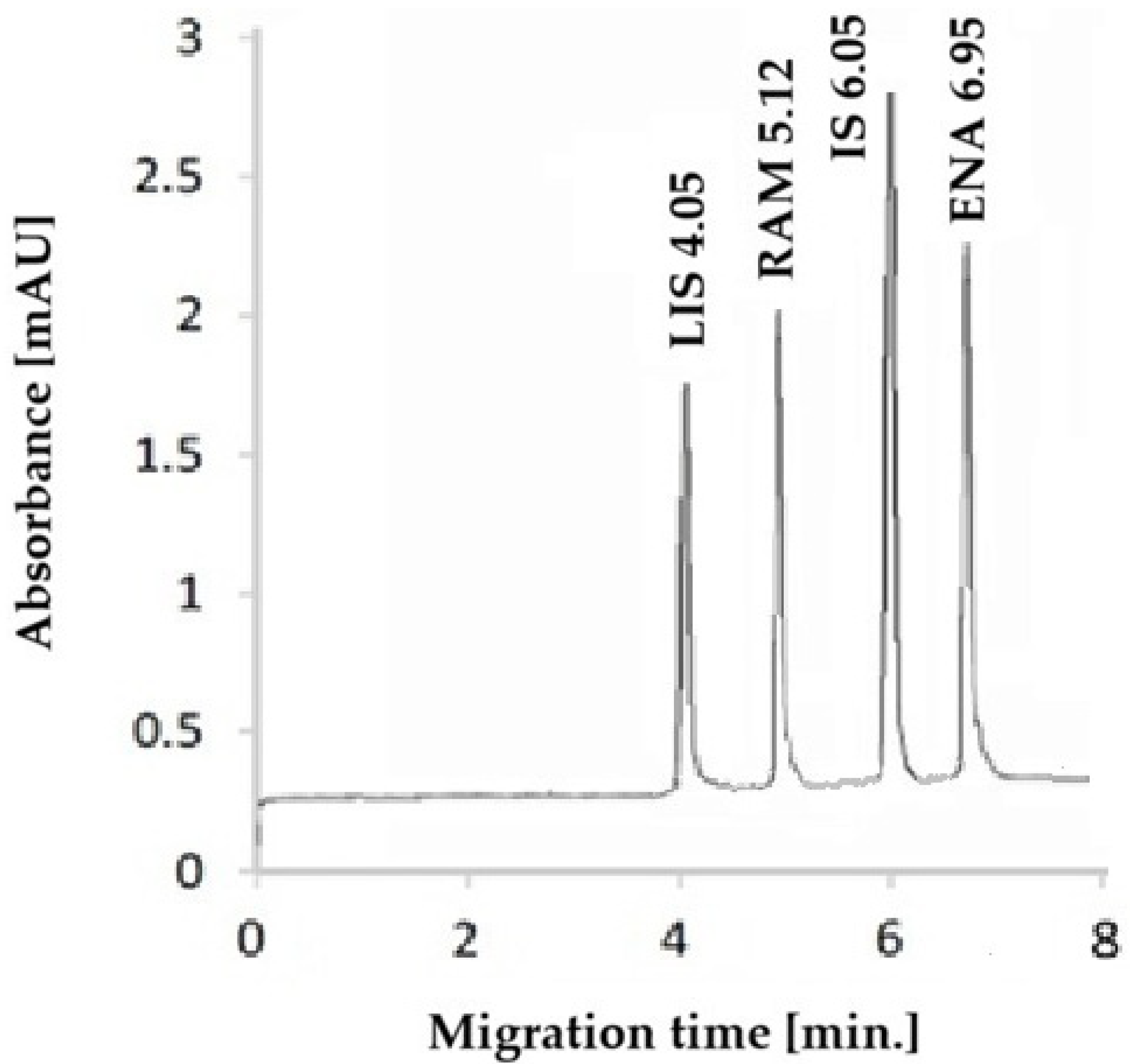
The separation of LIS, RAM, ENA, and the IS was achieved using 25 mM phosphate buffer adjusted to pH 7.4 provided optimal resolution, stable electroosmotic flow, and reproducible FASS performance. At this pH, the investigated ACE inhibitors predominantly exist in negatively charged forms due to deprotonation of their carboxylic acid groups. Nevertheless, the electroosmotic flow generated in the uncoated fused-silica capillary remained sufficiently strong to transport the analytes toward the detector under the applied positive voltage conditions. Preliminary experiments performed under lower-pH conditions aimed at co-EOF migration resulted in poorer selectivity and less stable stacking behavior. In contrast, the selected near-neutral pH conditions improved migration time reproducibility, analyte resolution, and FASS efficiency while minimizing analyte adsorption and enhancing capillary stability for wastewater analysis. Furthermore, the selected conditions ensured consistent migration of the IS and improved overall method robustness (
Figure 2).
Using a voltage of +25 kV allowed for successful separation with little Joule heating and within a tolerable analytical period. In order to ensure that all analytes were adequately detected, quantitative analysis was carried out at 214 nm using a diode array detector (DAD). LIS, RAM, ENA, and PRO were all adequately separated from one other under the optimal circumstances.
Although operation at +25 kV may contribute to moderate Joule heating, the optimized buffer concentration and separation conditions provided stable electrophoretic performance with highly reproducible migration times. Migration time repeatability was evaluated using replicate injections under optimized CE–FASS conditions, and relative standard deviation (RSD) values remained below 2% for all analytes (
Table S1), indicating satisfactory thermal and electrophoretic stability.
3.2. Field-Amplified Sample Stacking Performance
The application of FASS resulted in a substantial enhancement in detector response compared with conventional hydrodynamic injection, while maintaining satisfactory peak resolution. Enrichment factors, calculated from the ratio of peak areas obtained with FASS to those obtained without stacking, ranged from 335 to 469 depending on the analyte (
Table 1). Peak areas were determined in triplicate, and enrichment factors were calculated using mean values.
The variation in enrichment factors among analytes can be attributed to differences in electrophoretic mobility and stacking efficiency under the applied conditions.
3.3. Solid-Phase Extraction Performance
Pharmaceutical wastewater samples including LIS, RAM, and ENA were successfully retained and purified by the Oasis HLB cartridges. They were shown to be suitable for extracting and analyzing ACE inhibitors from complicated wastewater matrices, since the SPE approach showed high and repeatable recoveries (
Section 3.4.3) and negligible matrix effects (
Section 3.4.4).
Although both SPE and FASS contribute to sensitivity enhancement, their roles in the proposed method are fundamentally different. The SPE procedure provides off-line volumetric enrichment and matrix clean-up by concentrating 500 mL of wastewater into 1.0 mL prior to analysis, corresponding to an enrichment factor of approximately 500. In contrast, FASS provides on-line electrophoretic preconcentration during capillary injection through conductivity differences between the sample zone and the background electrolyte. Compared with conventional CE injection, FASS produced additional signal enhancement with enrichment factors ranging from 335 to 469 depending on the analyte. The combination of SPE and FASS therefore produces a synergistic improvement in sensitivity and selectivity, enabling reliable determination of ACE inhibitors at low ng L−1 levels in complex wastewater matrices.
3.4. Method Validation Results
3.4.1. Linearity
Linearity was assessed through the use of solvent-based and matrix-matched calibration curves across the concentration range of 10–1000 ng L
−1 for each analyte, employing peak area ratios (analyte/internal standard). Outstanding linearity was achieved in both media, with correlation coefficients surpassing 0.999 (
Table 2). The strong correlation between the slopes of solvent-based and matrix-matched calibration curves suggests that residual matrix effects after solid-phase extraction are minimal, and that the internal standard provides effective compensation.
The slight decrease in slopes observed in matrix-matched calibration (<10%) is consistent with minor signal suppression, which is effectively corrected through internal standardization.
3.4.2. Limits of Detection and Quantification
The limits of detection (LOD) and quantification (LOQ) obtained using CE–FASS were markedly improved compared to conventional CE injection, highlighting the significant enhancement in sensitivity provided by on-line stacking (
Table 3). As expected, matrix-based LODs and LOQs were slightly higher than solvent-based values due to residual matrix effects, even after SPE clean-up. The obtained low ng L
−1 detection limits demonstrate the suitability of the SPE–CE–FASS method for trace-level environmental monitoring of ACE inhibitors in wastewater.
Because they more accurately reflect analytical performance in real pharmaceutical wastewater samples, matrix-based LOD values were used for method comparison.
3.4.3. Precision, Accuracy, and Recovery
For each analyte, the technique showed good repeatability and precision. It was noted that the intra-day RSD was less than 5% and the inter-day RSD was less than 6% (
Table 4). The precision of the SPE process and propranolol’s acceptability as an internal standard for quantitative analysis were confirmed by recovery experiments, which showed good results across all concentration levels examined (recoveries ranging from 90 to 97%). Reduced recoveries at lower concentrations are likely caused by signal fluctuation close to the detection limit and the greater impact of matrix components.
3.4.4. Matrix Effect
By comparing the slopes of matrix-matched calibration curves with those based on solvent, reported as percentage ratios, matrix effects were quantitatively assessed (
Table 5). There was a modest signal suppression for every analyte that was examined. The consistency of the SPE-CE-FASS process is validated by the low standard deviation results (<3%), which show that the calibration slopes are excellently reproducible. The use of matrix-matched calibration in conjunction with propranolol as an internal standard allowed for accurate and reliable measurement in real pharmaceutical wastewater samples, and matrix-induced suppression is only minor.
Although PRO has been previously reported in municipal wastewater because of its widespread clinical use, no detectable endogenous PRO peak was observed in the analyzed pharmaceutical wastewater samples under the optimized experimental conditions. In the present study, PRO was selected primarily because it exhibited stable migration behavior, satisfactory extraction recovery, and effective compensation for variability associated with SPE recovery and CE injection. Nevertheless, PRO cannot be considered a universally exogenous internal standard for all environmental monitoring applications.
3.4.5. Robustness
Small, deliberate adjustments were made to important experimental parameters including buffer pH (±0.1), buffer concentration (±2 mM), and separation voltage (±1 kV) in order to test the robustness of the suggested SPE-CE-FASS approach.
According to
Table 6, the migration time, analyte-to-internal-standard peak-area ratios, and separation resolution were all unaffected by these alterations, and the relative standard deviation (RSD) values for all analytes remained below 5% throughout. According to these results, the robustness of the method is confirmed.
3.5. Application to Real Wastewater Samples
Real pharmaceutical wastewater samples were collected from Alkharj Governorate, and the validated SPE-CE-FASS technique was used to successfully determine RAM, LIS, and ENA. The target analytes were detected and assigned in the pharmaceutical wastewater samples by comparing their migration times and UV responses with those of corresponding reference standards analyzed under the optimized CE–FASS conditions, and were quantified at ng L−1 concentration levels.
To account for matrix-induced variability, the quantification was carried out using matrix-matched calibration using PRO as the IS.
Table 7 shows that ENA was found at the greatest quantities, followed by LIS and RAM.
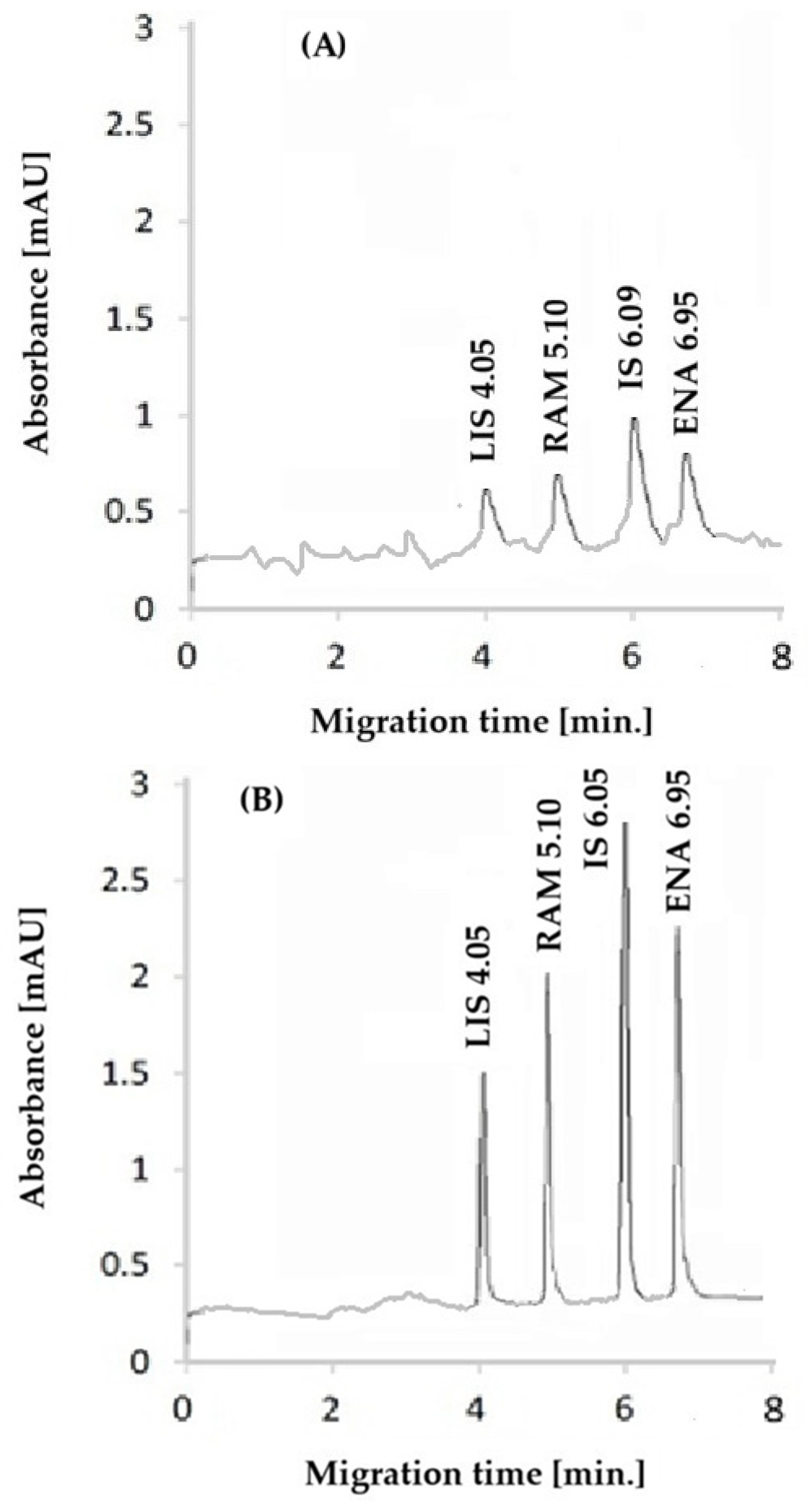
The target analytes were successfully separated and determined in a complex matrix, as shown in
Figure 3, which is an electropherogram indicative of a real wastewater sample. Compared with conventional CE injection (
Figure 3A), the CE–FASS electropherogram (
Figure 3B) exhibited markedly enhanced detector response and improved peak definition, confirming the effectiveness of the stacking procedure for trace-level wastewater analysis.
Regarding the electropherogram of the real wastewater sample (
Figure 3B), the notably stable baseline and absence of major unidentified peaks—which closely resembles the standard solution—can be attributed to the synergistic selectivity of the combined sample preparation and injection techniques. The off-line solid-phase extraction utilizing Oasis HLB cartridges effectively removed faintly retained and non-target matrix components during the washing step. Subsequently, the FASS procedure provided a highly selective on-line focusing mechanism. Because the sample was reconstituted in a low-conductivity matrix, the charged target analytes were selectively stacked at the interface of the high-conductivity background electrolyte, whereas bulk neutral matrix interferences were not focused and thus did not migrate efficiently into the detection window. Furthermore, diode array detection at 214 nm offered an additional layer of selectivity against matrix constituents lacking strong UV absorbance at this wavelength.
It is possible that LIS’s lower concentrations are due to its stronger polarity and enhanced elimination during wastewater treatment procedures, whereas ENA’s substantially larger concentrations are due to its intermediate environmental persistence and extensive clinical usage.
While this method was specifically optimized for LIS, RAM, and ENA, it is highly probable that other structurally related ACE inhibitors (e.g., benazepril, quinapril) and their active metabolites are present in these real wastewater matrices due to their clinical use. The presence of such pharmaceutical analogs likely contributes to the minor unidentified signals observed in the conventional CE electropherogram (
Figure 3A). Nevertheless, the enhanced selectivity of the optimized CE-FASS procedure effectively resolved the target analytes, ensuring that no significant co-migrating interferences affected their accurate quantification at trace levels.
3.6. Comparison with Published LC-MS/MS Methods
Compared with literature-reported LC-MS/MS methods for ACE inhibitors and related pharmaceuticals in environmental waters [
15,
16], which commonly achieve detection limits in the sub-ng L
−1 to low ng L
−1 range (
Table 8), the proposed SPE–CE–FASS method provided matrix-based LOD values of 3.2–4.1 ng L
−1 together with satisfactory recovery (90–97%) and precision (RSD < 6%). Although LC-MS/MS generally offers comparable sensitivity and structural confirmation capability, the proposed method provides important advantages related to simplified instrumentation, markedly lower solvent consumption, reduced operational cost, and improved analytical sustainability.
4. Conclusions
For the simultaneous measurement of LIS, RAM, and ENA in pharmaceutical wastewater, a sensitive and reliable SPE–CE–FASS approach has been devised. The sensitivity of CE-UV detection was greatly enhanced and robust analytical performance was ensured by combining solid-phase extraction with FASS. The method exhibited commendable linearity, precision, and recovery, alongside minimal matrix effects. The application of PRO as an IS facilitated dependable quantification by addressing variability throughout the extraction and analysis processes. The successful application to real wastewater samples confirmed the presence of the target ACE inhibitors at environmentally relevant concentrations, underscoring the method’s applicability to complex matrices.
The proposed approach presents a cost-efficient, low-solvent, and readily accessible alternative to mass spectrometry-based techniques. Compared with conventional LC-MS/MS methods, the developed SPE–CE–FASS procedure substantially reduces organic solvent consumption and chemical waste generation because CE separation requires only microliter-scale electrolyte volumes and avoids continuous mobile-phase usage. These characteristics enhance the analytical sustainability of the proposed method while maintaining suitable sensitivity for trace-level environmental monitoring.