Article

Enhanced Sensitivity of NO2 Gas Sensor Utilizing Fe2O3-Embedded ZnO Nanostructures


1
Department of Semiconductor System Engineering, Sejong University, 209 Neungdong-ro, Gwangjin-gu, Seoul 05006, Republic of Korea
2
Institute of Semiconductor and System IC, Sejong University, 209 Neungdong-ro, Gwangjin-gu, Seoul 05006, Republic of Korea
*
Author to whom correspondence should be addressed.
Chemosensors 2026, 14(1), 18; https://doi.org/10.3390/chemosensors14010018
Submission received: 6 November 2025 / Revised: 15 December 2025 / Accepted: 26 December 2025 / Published: 5 January 2026
(This article belongs to the Special Issue Innovative Gas Sensors: Development and Application)

Abstract

This paper introduces a streamlined three-step synthesis method for crafting porous Fe2O3/ZnO nanofibers (NFs). Initially, Fe2O3 nanoparticles (NPs) were synthesized using the hydrothermal method. Subsequently, PVP NFs laden with Fe2O3 NPs and zinc salt were synthesized via an electrospinning method. Finally, porous Fe2O3/ZnO NFs were fabricated through calcination, resulting in an average diameter of approximately 100 nm. Gas-sensing experiments illuminate that the porous Fe2O3/ZnO NFs exhibit outstanding sensitivity, selectivity, and robust long-term stability. Although the response magnitude decreased under high relative humidity (RH) due to competitive adsorption, the sensor maintained distinct detectable responses towards NO2 vapor at an optimum temperature of 225 °C. Particularly noteworthy is the substantial enhancement in NO2 sensing properties observed in the Fe2O3/ZnO composite compared to pure ZnO NFs. This enhancement can be ascribed to the distinctive microstructure and heterojunction formed between Fe2O3 and ZnO.

1. Introduction

The escalating issue of air pollution, driven by expanding industrialization, particularly highlights NO2 as a significant contributor emitted from industrial processes and vehicular combustion of fossil fuels. Recognized as an irritating red-brown oxidizing gas, NO2 poses adverse environmental consequences, including the initiation of acid rain and contributions to climate change [1,2,3]. Its presence in ambient air necessitates urgent monitoring due to its potential threat to the ecological balance. As public awareness of environmental pollution grows alongside rapid industrial development, NO2 emerges as a major threat. Therefore, there is imperative for us to develop NO2 gas sensors with characteristics such as high sensitivity, selectivity, and a low detection limit to mitigate its impact on the environment effectively [4,5]. The profound impact of NO2 on the environment and human health, stemming from burning procedures in vehicles and industrial activities, amplifies the urgency to develop cost-effective sensors for effective monitoring. Continuous exposure to NO2 raises serious health concerns, including respiratory infections and potentially permanent lung lesions [6,7]. Hence, it is critical to maintain NO2 concentrations below the defined permissible exposure level of 50 ppm set by U.S.EPA [8]. In response to these pressing challenges, researchers are compelled to prioritize the development of affordable and efficient NO2 sensors. These sensors must reflect the immediate need to safeguard both the environment and human well-being by enabling rapid NO2 detection to address associated health risks and ecological pollution.
Metal oxides, valued for their cost-effectiveness and ease of manufacturing, are widely used in diverse applications, including sensors for monitoring toxic substances and in photocatalytic wastewater degradation [9,10]. Among these, semiconducting metal oxides (SMOX) like ZnO stand out due to their n-type semiconductor characteristics, high electron mobility, and chemical stability, making them effective materials for NO2 gas sensors [11]. The gas-sensing properties of ZnO can be finely tuned through various methods such as diverse nanostructures, doping, and loading techniques [12,13,14,15,16]. In NO2 detection, electron transfer from the metal oxide leads to the formation of nitrite, consequently altering the resistance of n-type materials. Researchers explore a range of preparation methods including evaporation, deposition, solvent thermal, and chemical vapor deposition to optimize ZnO’s properties [17,18,19]. Acknowledging the profound impact of microstructure and surface state on gas sensor performance, studies focus on designing nanostructures, regulating exposed facets, and modulating surface defects. Nanostructured metal oxides, especially those with high specific surface areas and multi-channel structures, exhibit superior gas sensitivity.
The practical application of ZnO sensors currently faces challenges due to inherent limitations in sensitivity and response speed [20,21,22]. There is an urgent need to optimize their nanostructure and composition to significantly enhance their sensing capabilities. Notably, ZnO NFs and related one-dimensional (1D) materials have shown superior performance in gas sensing compared to bulk counterparts. This improvement is attributed to their larger specific surface area and the presence of more reactive sites, which enhance their gas detection efficiency. Additionally, doping emerges as a highly effective strategy for enhancing the gas sensing performance of ZnO sensors. By carefully modulating local structures and coordination environments through doping, researchers have achieved notable improvements in sensitivity and response speed. This multifaceted approach underscores ongoing efforts to overcome the limitations of ZnO sensors and further advance their practical utility in gas-sensing applications [23]. Hsu et al. reported that CuO-doped ZnO NFs were synthesized using sol-gel and electrospinning techniques. At a CuO-to-ZnO ratio of 0.15:1, the H2S response was enhanced by 25% compared to pure ZnO, reaching 83.98% at 1 ppm H2S and 200 °C, with reliable recovery and reproducibility. Fan et al. prepared a ZnO@CNF gas sensor, synthesized via electrospinning, preoxidation, and carbonization, which exhibits enhanced performance in detecting ammonia at room temperature. The integration of ZnO NPs onto carbon NFs significantly boosts sensitivity and selectivity while lowering the operational temperature [24]. Lee et al. augmented H2 sensing performance by synthesizing Co3O4-loaded ZnO NFs with varying Co3O4 concentrations. Among the compositions tested, the 0.95ZnO-0.05Co3O4 sensor exhibited the highest response of ~133 to 10 ppm H2 gas, showcasing superior selectivity. The heightened H2-sensing capability of the optimized sensor stemmed from the synergistic effects between ZnO surface/grain boundaries and Co3O4 [25]. Naderi et al. used ZnO/CdO NFs, synthesized via electrospinning and calcination, to form n-n type I heterojunctions with a straddling energy band gap, which exhibits high sensitivity and selectivity to NO gas, detecting concentrations as low as 1.2–33 ppm at an optimal temperature of 215 °C, with negligible influence from humidity. With excellent repeatability, long-term stability, and rapid response times, this sensor holds promise for monitoring toxic gases in industrial, urban, and potentially exhaled breath environments [26,27].
Certainly, increasing surface area, doping, and defect engineering have emerged as promising strategies to enhance the gas-sensing performance of ZnO sensors. However, the journey to construct optimized NO2 gas sensors and unravel their intrinsic sensing mechanisms remains an ongoing challenge. Deeper research in this area is essential, considering the current complexities, as it necessitates a thorough understanding of the intricate interplay between nanostructure, composition, and the dynamic processes involved in gas sensing. Despite the challenges, persistent exploration holds the key to unlocking innovative solutions and advancing the development of highly efficient and reliable NO2 gas sensors.
In this study, distinct from atomic-level doping, we fabricated a heterostructured composite by utilizing a cost-effective electrospinning method to successfully synthesize ZnO NFs with embedded Fe2O3 NPs. The results reveal significant changes in the morphology of the ZnO NFs and the creation of numerous surface OV defects upon the introduction of embedded Fe2O3 NPs. Our investigation extended to their sensing behavior towards NO2 gas, demonstrating that 4Fe-ZnO exhibits the most robust gas-sensing performance. This is characterized by a high response (78 for 5 ppm NO2), long-term stability, and superior selectivity compared to ZnO sensors without Fe2O3 NPs embedding. Importantly, our work experimentally establishes the correlation between the amount of embedded Fe2O3 and the concentration of oxygen vacancies. Additionally, our gas sensitivity experiments underscore the excellent gas-sensitive properties of the material, attributed to the synergistic effects of embedded Fe2O3 and oxygen vacancies. It is noteworthy that the adsorption energy for NO2 on ZnO is greatly enhanced after embedding Fe2O3 and introducing OV compared to pristine ZnO, indicating their crucial roles in optimizing the sensing performance of ZnO-based sensors.

2. Experiment

2.1. Preparation of Fe2O3 NPs

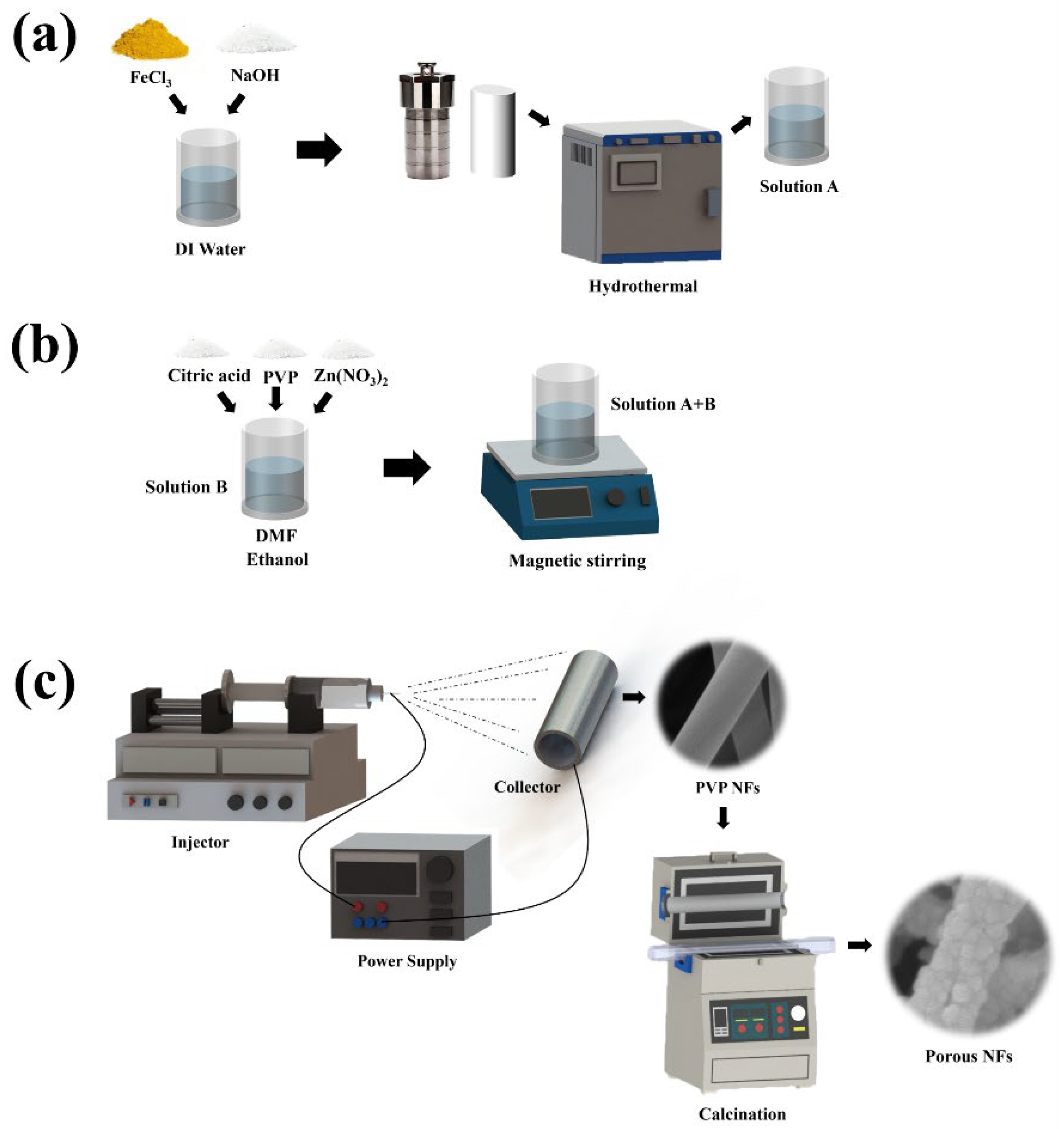
The Fe2O3 NPs were synthesized using the hydrothermal method, as illustrated in Figure 1a. Anhydrous ferric chloride powder (0.162 g, FeCl3, DUKSAN PURE CHEMICALS, Seoul, Republic of Korea) was added to 50 mL of deionized (DI) water and dissolved through magnetic stirring for 15 min. Sodium hydroxide beads (0.08 g, NaOH, DAEJUNG Chemicals, Gyeonggi-do, Republic of Korea) were introduced into this solution, followed by an additional 15 min of dissolution. The solution was then transferred to a Teflon-lined autoclave and placed in a convection oven at 150 °C for 5 h. After the reactor cooled to room temperature, the sample was transferred into a 50 mL conical tube and centrifuged at 3000 rpm for 5 min. To obtain pure nanoparticles, the supernatant was decanted and the precipitate was redispersed in 30 mL of a 1:1 (v/v) mixture of ethanol and deionized (DI) water. The mixture underwent ultrasonic dispersion for 10 min, followed by centrifugation under the same conditions. This washing procedure was repeated five times to effectively eliminate residual ions. The resulting Fe2O3 NP powder was collected in a 50 mL vial and dried in a convection oven at 50 °C for 24 h. The final yield of the dried powder was approximately 80 mg. Finally, the powder was redispersed in 20 mL of ethanol via ultrasonic agitation for 30 min and stored for further use.

2.2. Preparation of Fe2O3-Embedded Porous ZnO NFs

Fe2O3-NP-embedded porous ZnO NFs were fabricated via electrospinning, as depicted in Figure 1b. To prepare the electrospinning precursor solution B, 7 mL of ethanol and 3 mL of N,N-Dimethyl formamide (DMF, DUKSAN PURE CHEMICALS) were mixed to form a solvent. A mixture of 0.6 g zinc nitrate hexahydrate (Zn(NO3)2, 99%, Alfa Aesar, Ward Hill, MA, USA) and 0.3 g citric acid (C6H8O7, 99+%, Alfa Aesar) was then added with magnetic stirring for 1 h. To achieve the desired solution viscosity, 0.75 g polyvinylpyrrolidone (PVP, Mw = 1,300,000, Sigma-Aldrich, St. Louis, MI, USA) powder was added. A specific amount of solution A was added to solution B, with 0 mL, 0.2 mL, 0.4 mL, and 0.6 mL corresponding to sensor 0Fe-ZnO, 2Fe-ZnO, 4Fe-ZnO, and 6Fe-ZnO, respectively.
For electrospinning, the syringe needle was connected to a high-voltage power supply, and the collector was grounded. The distance between the needle and collector was set at 25 cm. Then, the solution in the syringe was injected at a velocity of 0.005 mL/min by applying a 15 kV positive bias to the needle. After 30 min, a white PVP fiber containing (hereafter referred to as PVP NFs) Fe2O3 NPs and Zn salt was deposited on the substrate. Finally, the collected white fibers were calcined at 500 °C at a moderate rate of 10 °C/min for 2 h in air to obtain pure ZnO and Fe2O3-NP-embedded ZnO NFs, as shown in Figure 1c.

2.3. Characterization

The morphologies of the following samples were characterized using field emission scanning electron microscopy (FE-SEM, Hitachi S8010, Tokyo, Japan). Their crystal structures were determined from the X-ray diffractograms obtained using a glancing angle (5°) high-resolution X-ray diffractometer (XRD, D/Max-2500, Rigaku, Tokyo, Japan) with Cu Kα radiation (λ = 1.5418 Å) within scattering angles of 20–80°. The detailed morphology of the NFs and their crystal structures was examined by field emission transmission electron microscopy (FE-TEM, Jeol 2100F) equipped with energy-dispersive X-ray spectroscopy (EDS) for qualitative chemical analysis of the corresponding nanotubes. X-ray photoelectron spectroscopy (XPS, Thermo Scientific, Waltham, MA, USA, Kα) was employed to measure the binding energies of the samples. The specific surface area and pore size distributions of the samples were calculated through N2 gas adsorption using the Brunauer–Emmett–Teller (BET, BELSORP-max, MicrotracBEL Corp., Osaka, Japan) and Barrett–Joyner–Halenda (BJH) surface analytical instruments (Osaka, Japan), respectively.

2.4. Fabrication and Measurement of Gas Sensor

The process began with patterning interdigital electrodes (IDE) onto a silicon wafer coated with a SiO2 layer, as depicted in Figure S1. Initially, a 10 nm titanium (Ti) layer was deposited onto the substrate, followed by a 100 nm gold (Au) layer to serve as an adhesion and conductive electrode. The gap between neighboring electrodes was maintained at 10 μm. In sample preparation, three milligrams of the synthesized material were dispersed in 3 mL of ethanol through ultrasonication for one minute. Subsequently, 0.5 mL of the resulting solution was applied onto the IDE chips using a spray gun. The IDE chip was then heated to 60 °C to facilitate solvent evaporation from the mist application.
A gas-sensing setup was established to evaluate the response of the NO2 sensor, as depicted in Figure S1. The IDE chip, coated with NFs, was connected to a source meter (B2901A, Keysight Technologies, Santa Rosa, CA, USA) via a gold wire within the sensing chamber. The sensor temperature was precisely regulated using a quartz tube furnace equipped with a PID controller, ensuring stability within ±1 °C via a thermocouple positioned near the sensor. The chamber was heated to the operational temperature, and the sensing chamber’s temperature was systematically adjusted from 150 °C to 250 °C in 50 °C increments to identify the optimal operating temperature for sensing performance. To assess sensitivity to NO2 gas, sensors were exposed to increasing concentrations of NO2 gas (ranging from 1 ppm to 5 ppm) for 200 s. Between exposures, the chamber was purged with synthetic air for 500 s to eliminate residual gases. For selective sensing analysis, gases including ethanol, acetone, toluene, methanol, TEA, NH3, and CO were introduced into the chamber. Various gases (99.99%) used for assessing sensing performance were acquired from Samjung Special Gas (Seoul, Republic of Korea). Specifically, standard calibration gas cylinders were utilized for all analytes to ensure precise concentration control. A 5 ppm NO2 cylinder (balanced in synthetic air) was used for the target gas sensing. For selectivity tests, 100 ppm standard gas cylinders (balanced in synthetic air) were employed for all interfering gases, including ethanol, acetone, toluene, methanol, TEA, NH3, and CO. These gases were diluted with additional synthetic air, and their flow rates were regulated using Mass Flow Controllers (MFCs). To clearly distinguish between gas types, the response of the sensors (R) was defined as Rg/Ra for the oxidizing gas (NO2) where resistance increases (Rg > Ra), and as Ra/Rg for reducing gases (ethanol, acetone, toluene, methanol, TEA, NH3, and CO) where resistance decreases. Response and recovery times were recorded until the resistance change in the sensing chip reached 90% of its saturation value. Before experimentation, the gas underwent a drying process to reduce its humidity level to 0.5%. This was achieved using a DRIERITE laboratory gas-drying unit from W.A. Hammond Drierite Co. LTD (Xenia, OH, USA). Subsequently, the gas flow was divided into two streams, each regulated by a Mass Flow Controller (MFC). One stream contained the humid air, while the other was previously dried. By blending these streams, humidity levels were adjusted from nominal 0% (experimentally maintained at <0.5% RH) to 80% (equivalent to 79.2% relative humidity). The RH levels were monitored using a commercial digital humidity sensor (SK-140TRH, SATO Japan, Tokyo, Japan) before conducting any sensing measurements. For a visual representation of this process, please refer to Figure S1.

3. Results

3.1. Characterization

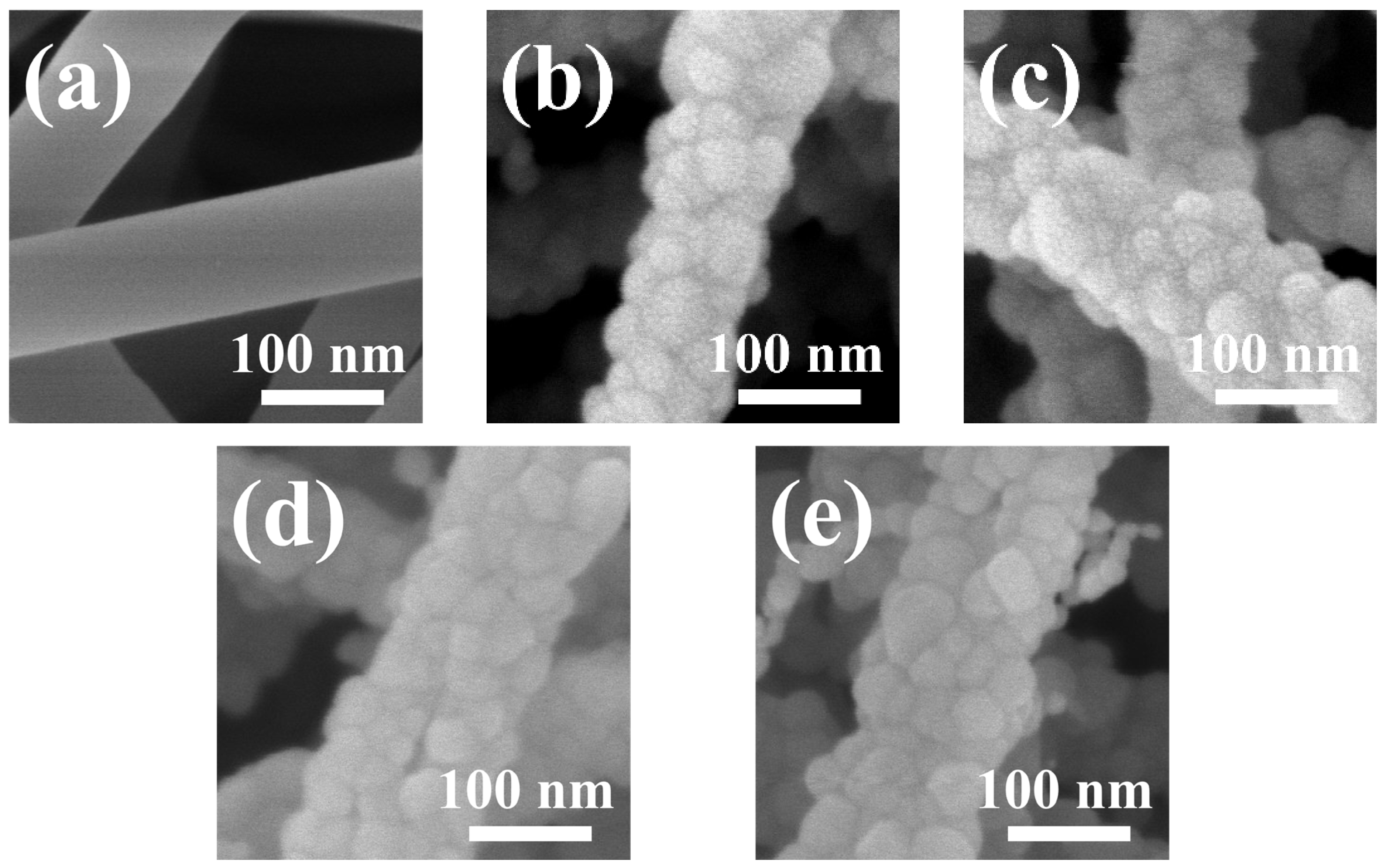
The low-magnification and magnified surface morphologies of the synthesized samples were analyzed using SEM, as depicted in Figure 2 and Figure S2. Figure S2 illustrates the uniform morphology of the PVP NFs before calcination and the samples after calcination. Figure 2a displays high-magnification SEM images of the PVP NFs before calcination, revealing a smooth surface with an average diameter of 100 nm. Subsequently, Figure 2b–e present corresponding SEM images of the calcined 0Fe-ZnO, 2Fe-ZnO, 4Fe-ZnO, and 6Fe-ZnO, respectively. Upon calcination, the diameter of 0Fe-ZnO decreased to approximately 100 nm. The calcined NFs exhibited depressed and rough surfaces with numerous nanograins, promoting increased gas sensitivity by enhancing gas adsorption and desorption through enlarged contact surfaces. Conversely, 2Fe-ZnO, 4Fe-ZnO, and 6Fe-ZnO displayed a rougher surface morphology with aggregated sub-grains compared to 0Fe-ZnO after calcination, featuring uniform diameters transformed into porous and bumpy structures comprised of numerous small sub-grains. Although these sub-grains consisted of ZnO and Fe2O3, discerning their compositions via SEM was challenging due to their similar morphologies.
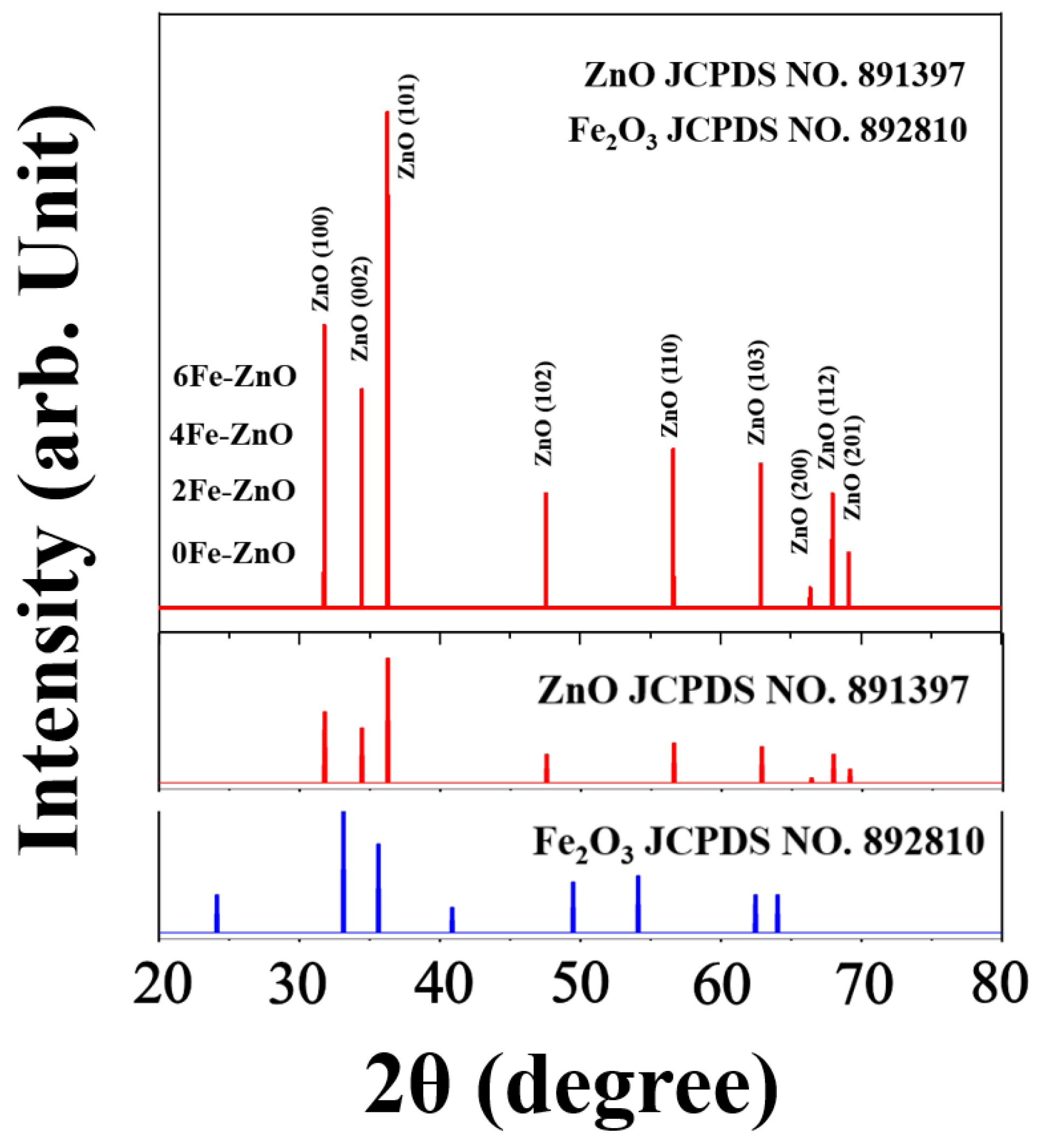
XRD was employed to determine the composition and crystal phase of the acquired samples. As depicted in Figure 3, the prominent diffraction peaks of XRD patterns for all samples are consistent with hexagonal Wortzite-phased ZnO (JCPDS 89-1397), indicating the clear presence of ZnO. However, in addition to the ZnO peaks, the peaks of Fe2O3 (JCPDS 89–2810) were not observed. As the content of Fe2O3 is relatively low, some peaks partially overlap with those of ZnO, resulting in weaker diffraction peaks. The diffraction peaks at 2-theta (2θ) of 31.73, 34.38, 36.21, 47.48, 56.54, 64.78, 66.30, 67.87, and 69.01° correspond to the (100), (002), (101), (102), (110), (103), (200), (112), and (201) crystal planes of hexagonal ZnO.
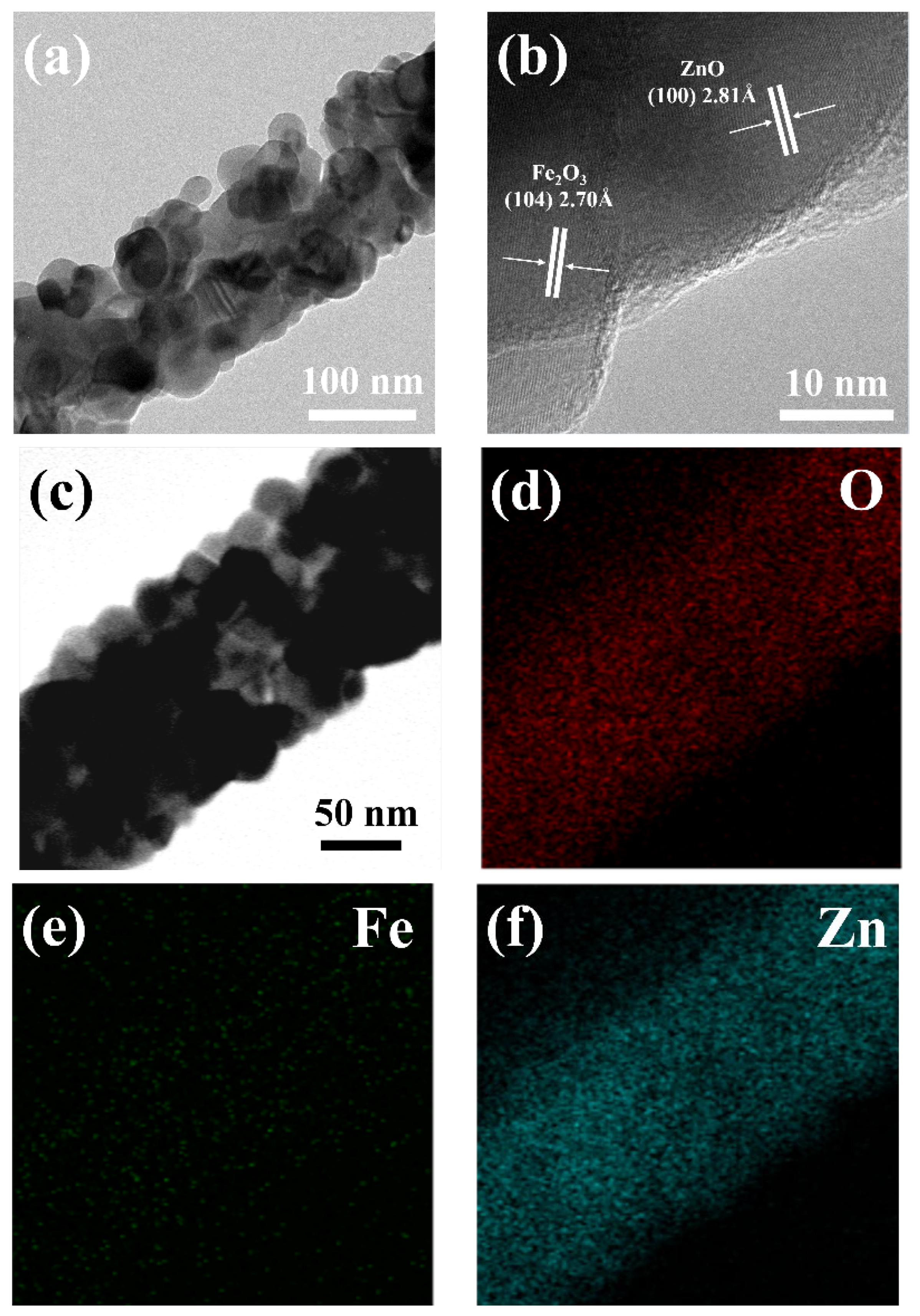
Figure 4 illustrates the TEM images of a single 4Fe-ZnO NF. Similar to the SEM images, the NF depicted in Figure 4a exhibits a porous and agglomerated structure consisting of numerous small nanograins. A high-resolution TEM image is presented in Figure 4b, where distinct fringe patterns representing the crystal structures of ZnO and Fe2O3 are observable within each grain. The inter-planar spacings of the neighboring fringes measure 0.281 nm, corresponding to the (100) lattice planes of ZnO, and 0.270 nm, corresponding to the (104) lattice planes of Fe2O3. Furthermore, the Selected Area Electron Diffraction (SAED) pattern (Figure S3) confirmed the polycrystalline nature of the NFs. The diffraction rings were indexed to the (100) plane of ZnO and the (104) plane of Fe2O3, which aligns perfectly with the inter-planar spacings measured in the HRTEM analysis. A scanning TEM (STEM) image of the 4Fe-ZnO NF is depicted in Figure 4c. Additionally, Figure 4d–f display the EDS elemental mapping profiles of O, Fe, and Zn, respectively. From these images, it can be concluded that the 4Fe-ZnO NFs are primarily composed of O, Zn, and Fe. Although the precise quantification of Zn:Fe ratios via EDS was limited by the geometric curvature of the nanofibers, the intensity of the Fe signal exhibited a clear increasing trend proportional to the nominal precursor loading, confirming the successful modulation of the Zn:Fe composition. The uniform distribution of Fe signals indicates that the Fe2O3 nanoparticles are well dispersed on the ZnO surface without significant agglomeration. No other elements were observed in the profile images.
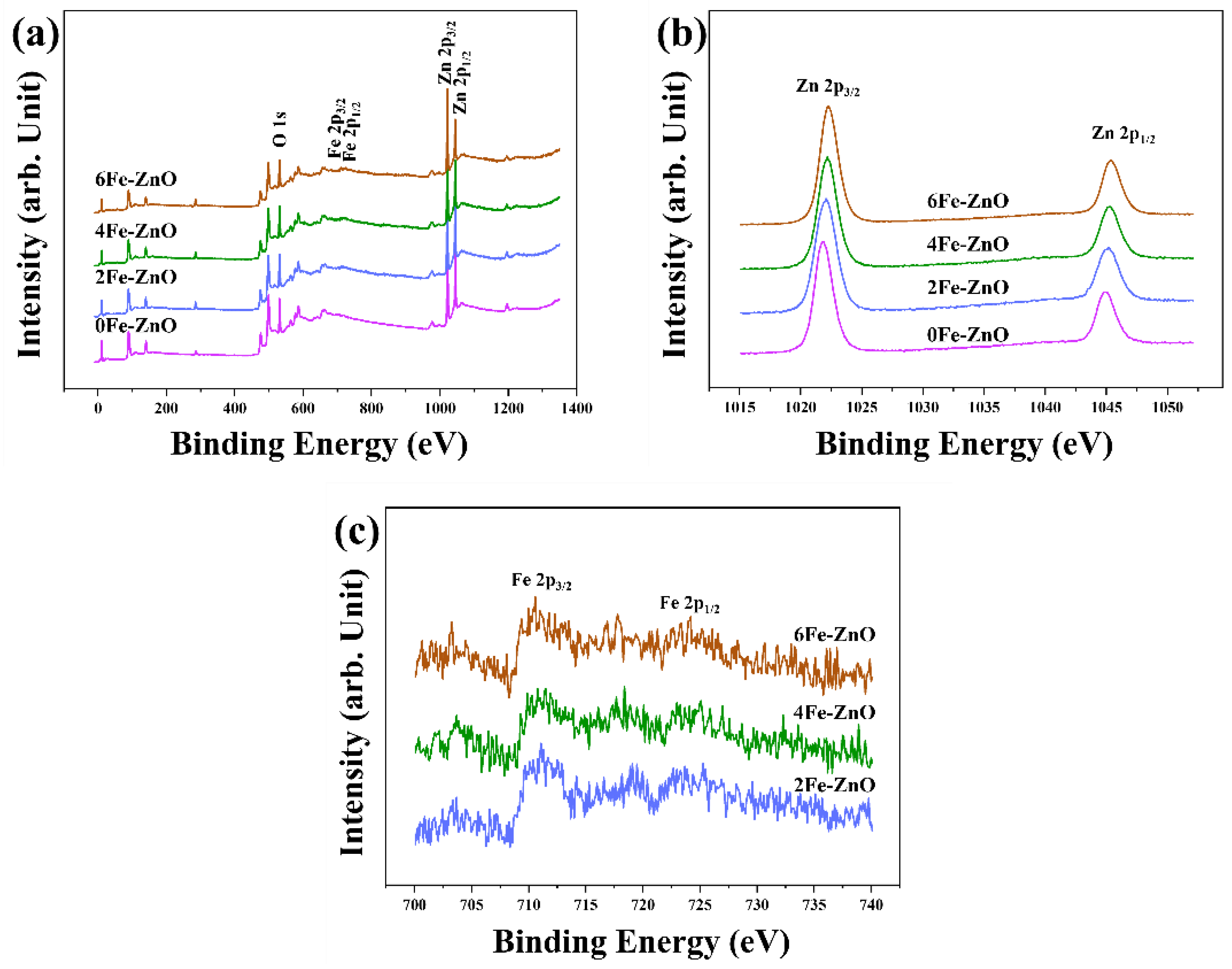
The XPS full survey spectra depicted in Figure 5a illustrate the elemental composition of the four samples. While 0Fe-ZnO exclusively exhibits Zn and O components, the presence of Fe in 2Fe-ZnO, 4Fe-ZnO, and 6Fe-ZnO indicates the successful embedding of Fe2O3 in NFs. Figure 5b reveals characteristic peaks at around 1044 and 1021 eV, corresponding to Zn 2p1/2 and Zn 2p3/2 of Zn2+, respectively [28]. A noteworthy observation is the slight positive shift in the binding energies of Zn 2p compared to those in 0Fe-ZnO. Furthermore, Figure 5c displays the Fe 2p XPS spectrum of the samples, showcasing distinct peaks at approximately 710 eV and 724 eV, attributed to Fe 2p3/2 and Fe 2p1/2, respectively, with the exception of 0Fe-ZnO [29]. This observation suggests an electrical interaction between Fe2O3 and ZnO, leading to electron transfer from ZnO to Fe2O3 and subsequent changes in binding energy [30,31].
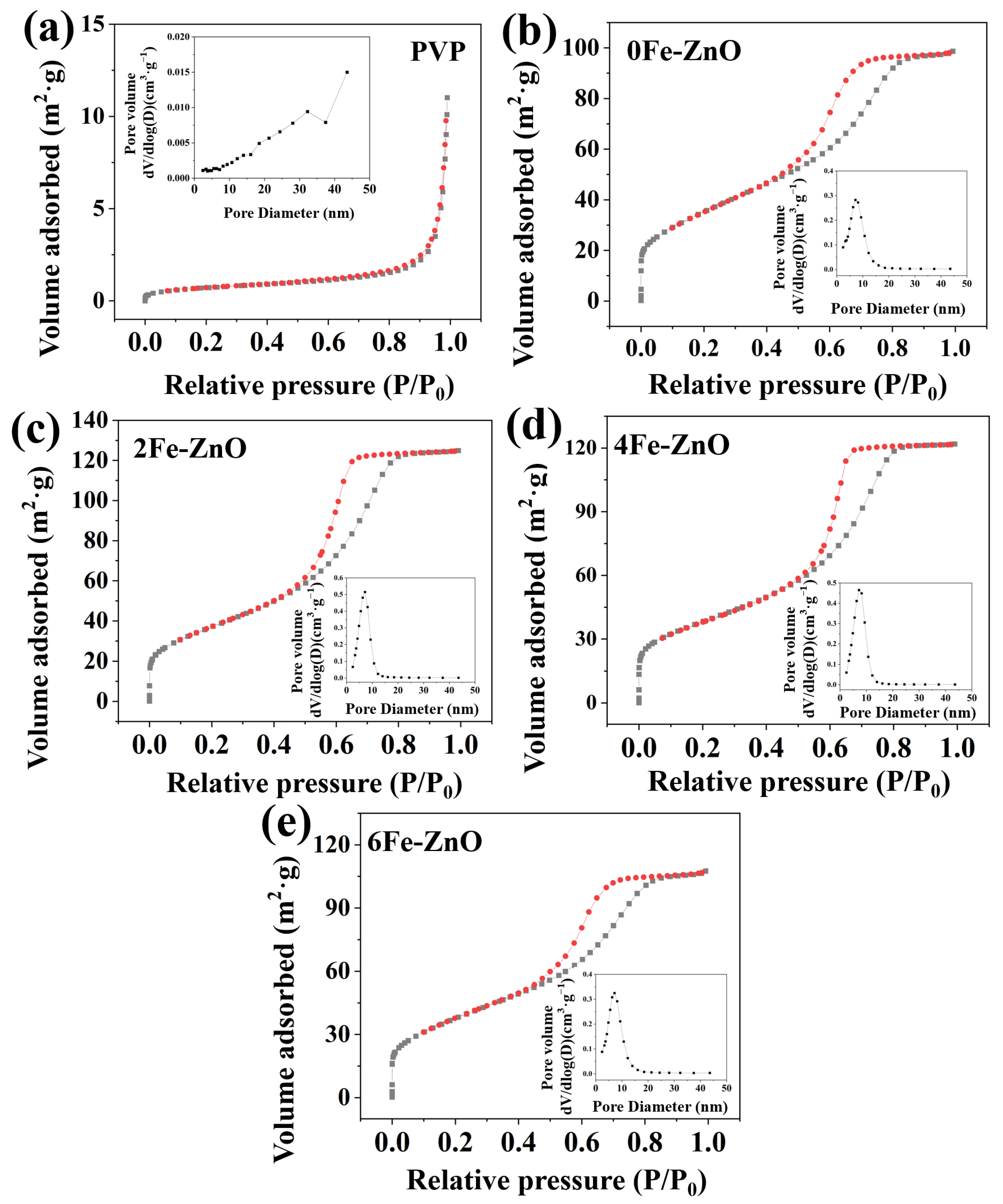
To assess the porous characteristics and specific surface area of the samples, nitrogen adsorption–desorption isotherms were conducted on both the PVP NFs and the four samples. Figure 6a–e illustrate the porous properties and corresponding pore size distribution of each sample. The specific surface area of the PVP NFs and the four samples varied with the Fe2O3 content and microstructure. Specifically, their specific surface areas were measured as 2.7 m2/g, 129.03 m2/g, 135.37 m2/g, 136.55 m2/g, and 137.49 m2/g, respectively. Correspondingly, the total cumulative pore volumes were determined to be approximately 0.37 cm3g−1 for the calcined samples, further confirming their porous nature. Notably, the specific surface area of the calcined NFs significantly exceeded that of the PVP NFs. Moreover, 2Fe-ZnO, 4Fe-ZnO, and 6Fe-ZnO demonstrated type-IV isotherms with H2 hysteresis loops, indicative of a mesoporous structure present in all obtained samples. This mesoporous structure, facilitated by the calcination process, enhances gas diffusion and the utilization rate of sensitive materials, which are crucial factors for gas-sensing applications. The inset shows corresponding BJH plots, confirming the presence of pore sizes in all samples except the PVP NFs. These BET results underscore the significance of pore size and volume in influencing sensing performance.

3.2. Gas-Sensing Properties

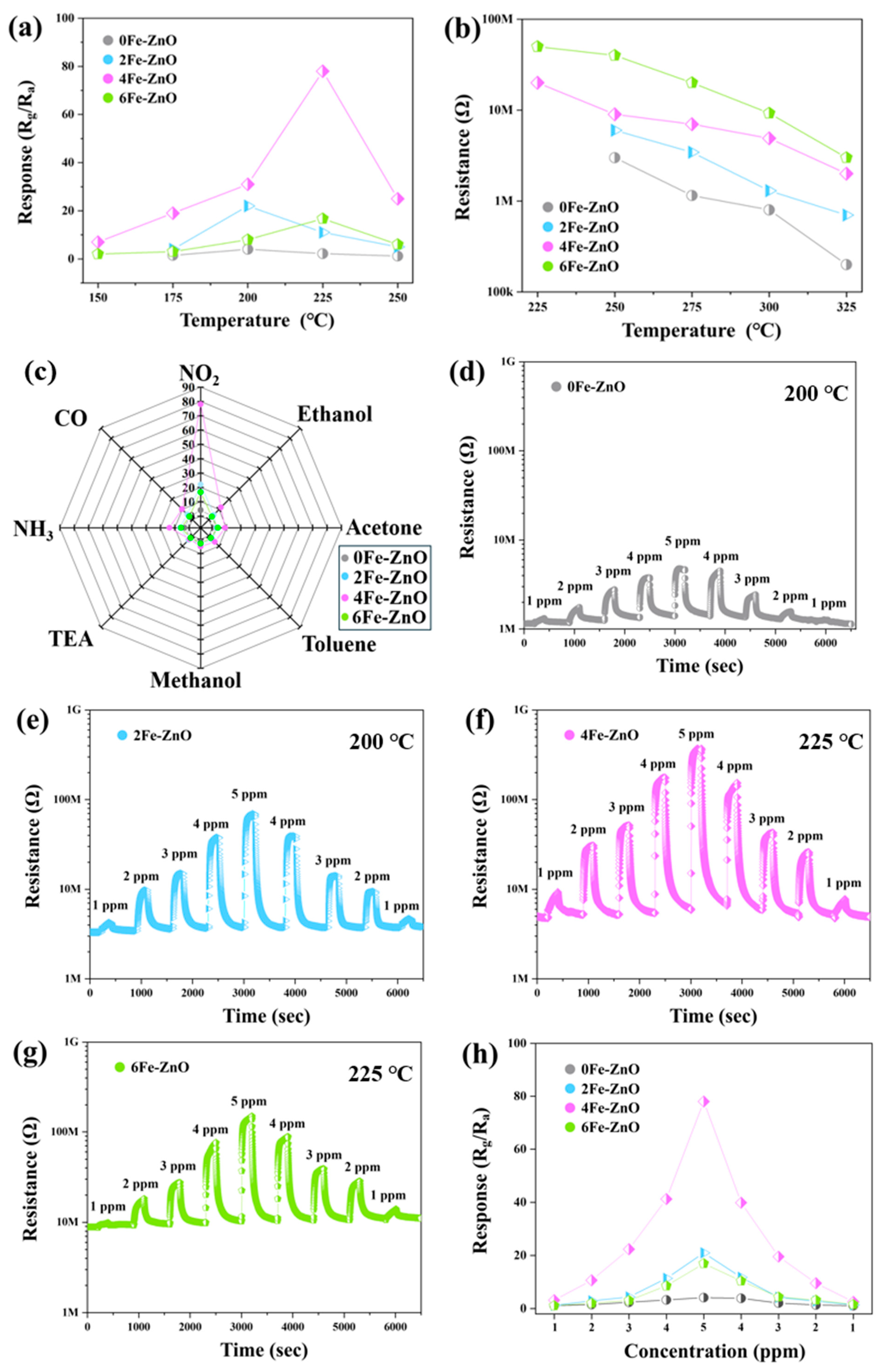
To determine the optimal operating temperature, we investigated the sensing performance of our fabricated sensors under dry air conditions (approx. 0% RH). Figure 7a illustrates the responses of the 0Fe-ZnO, 2Fe-ZnO, 4Fe-ZnO, and 6Fe-ZnO sensors to 5 ppm NO2 across temperatures ranging from 150 to 250 °C. Our findings reveal that sensor responses to 5 ppm NO2 are contingent upon operating temperature, exhibiting a characteristic pattern of initial increase followed by a decline against temperature. This pattern reflects the delicate balance between molecular activity and adsorption–desorption capacity. Specifically, both the 0Fe-ZnO and 2Fe-ZnO sensors demonstrate an initial increase in response towards 5 ppm NO2, peaking at 200 °C before declining at higher temperatures. The 4Fe-ZnO and 6Fe-ZnO sensors exhibit an optimal operating temperature around 225 °C, where they achieve maximum response values before experiencing a decline at higher temperatures. This shift to a higher optimal temperature compared to pure ZnO (200 °C) is attributed to the enhanced adsorption energy of NO2 on the Fe2O3/ZnO heterojunction. The stronger binding at the interface requires higher thermal energy to facilitate effective desorption and maintain rapid reaction kinetics. Beyond their optimal temperatures, sensors encounter challenges related to oxygen adsorption and gas diffusion as the operating temperature increased, thereby diminishing the rate of chemical reactions and subsequently reducing sensor response. To ensure a fair evaluation of each sensor’s intrinsic capability, we compared the sensing performances at their respective optimal operating temperatures (200 °C for 0Fe-ZnO and 2Fe-ZnO, 225 °C for 4Fe-ZnO and 6Fe-ZnO) rather than at a single fixed temperature. This approach allows for the assessment of the maximum potential of each sensing material. Notably, the 4Fe-ZnO sensor outperforms the 0Fe-ZnO sensor at higher temperatures, displaying an 18-fold increase in response at its optimal operating temperature. This improvement can be attributed to the formation of a heterojunction between Fe2O3 and ZnO. At this interface, charge carriers are efficiently separated, leading to enhanced gas-sensing properties such as increased sensitivity and selectivity. Moreover, the heterostructure facilitates improved adsorption and desorption kinetics of gas molecules, thereby augmenting the overall gas-sensing performance compared to pure ZnO.
Figure 7b illustrates the relationship between the baseline resistance (Ra) of the 0Fe-ZnO, 2Fe-ZnO, 4Fe-ZnO, and 6Fe-ZnO sensors and the operating temperature. It is important to highlight that the Ra sequence of the four sensors at identical temperatures follows the following order: 6Fe-ZnO > 4Fe-ZnO > 2Fe-ZnO > 0Fe-ZnO. Notably, the Ra value of the 0Fe-ZnO sensor is significantly lower than that of other three sensors. The Ra of all sensors exhibits typical semiconductor behavior with respect to operating temperature, where sensor resistance decrease is inversely proportional to temperature. Initially, at room temperature, the conduction of the sensing layers involves only a minimal number of free electrons. However, as the operating temperature increases, more free electrons participate in conduction, leading to a decrease in resistance. Across all sensors, Ra decreases as operating temperature rises, attributed to the increased transition of electrons into the conduction band at higher temperatures. This characteristic behavior of resistance–temperature curves is typical for surface-controlled gas sensors.
The 0Fe-ZnO, 2Fe-ZnO, 4Fe-ZnO, and 6Fe-ZnO sensors were also exposed to 100 ppm concentrations of various interfering gases, including ethanol, acetone, toluene, methanol, TEA, NH3, and CO, at their respective optimal operating temperatures. The results are illustrated in Figure 7c. As observed in the radar chart, the sensors exhibited negligible responses to both organic (VOCs) and inorganic gases (NH3, CO), despite the high concentration (100 ppm) of these interferents. Specifically, the response of the 4Fe-ZnO sensor to NO2 was distinctly higher compared to its response to other gases, demonstrating excellent selectivity against not only VOCs, but also common environmental pollutants like CO and NH3. Among these gases, the response of the 4Fe-ZnO sensor to NO2 was notably higher compared to its response to other interfering gases. This observation suggests the sensor’s potential for excellent selectivity towards NO2. Consequently, transient response measurements were conducted across different NO2 concentrations.
Figure 7d–g present the transient response curves of all sensors to NO2 concentrations ranging from 1 to 5 ppm, and, subsequently, from 5 ppm back to 1 ppm, conducted at their optimal operating temperatures. It is evident that all sensors exhibited a strong response to NO2, with response values increasing alongside NO2 concentration. Notably, the 4Fe-ZnO sensor demonstrated the highest response value, reaching 78, surpassing the other sensors. As the concentration decreased again, all sensors displayed a reduction in response to NO2. In Figure 7h, plots depict the relationships between NO2 vapor concentrations and the responses of the three sensors. These responses showed a gradual increase up to 5 ppm, attributed to NO2 surface saturation.
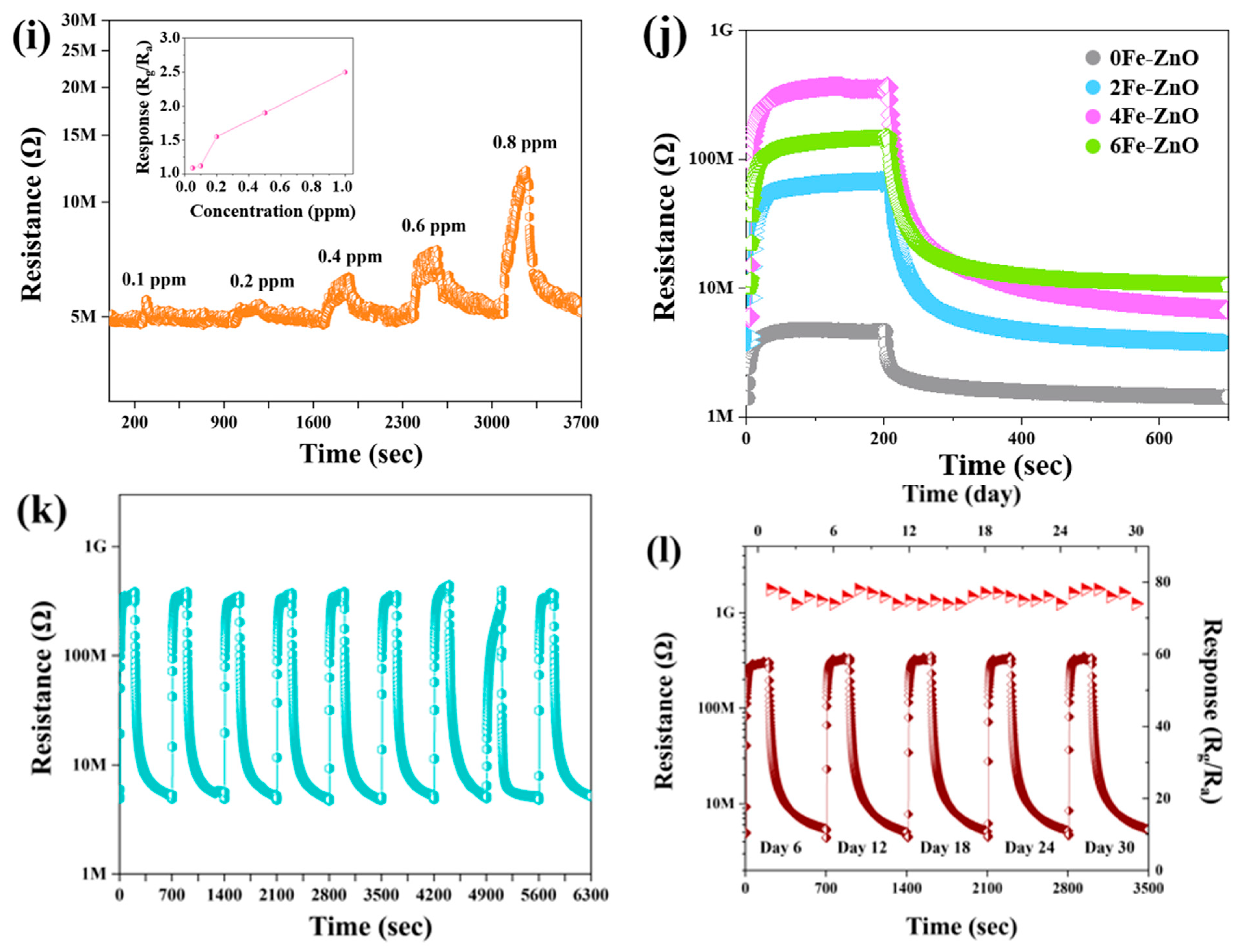
Figure 7i illustrates the sensing transient curve of the 4Fe-ZnO sensor with low NO2 gas concentrations ranging from 0.1 to 0.8 ppm. The corresponding responses curve as a function of low NO2 concentration, which is depicted alongside. Even under low concentration conditions, the 4Fe-ZnO sensor exhibited observable responses to NO2, particularly becoming apparent at 0.4 ppm. However, due to the presence of noise, responses below 0.4 ppm were relatively weaker. This suggests that the 4Fe-ZnO sensor holds significant potential as a NO2 gas sensor even at low concentrations. These findings highlight the promising applicability of the 4Fe-ZnO sensor in detecting low concentrations of NO2, indicating its suitability for various practical applications where precise detection of trace amounts of NO2 is crucial.
The response/recovery times of the 0Fe-ZnO, 2Fe-ZnO, 4Fe-ZnO, and 6Fe-ZnO sensors were found to be 22 s/198 s, 38 s/271 s, 56 s/310 s, and 96 s/399 s, respectively, as shown in Figure 7j. The 0Fe-ZnO sensor showed fast response/recovery time compared to its counterparts. This phenomenon can be attributed to several factors, including the presence of a heterojunction in the composite material. The heterojunction between Fe2O3 and ZnO introduces additional interfaces within the composite material. These interfaces can slow down the diffusion of gas molecules, leading to prolonged response and recovery times compared to pure ZnO, which lacks such interfaces. Secondly, the heterostructure may alter the surface chemistry and electronic properties of the sensing material. The presence of Fe2O3 in the heterostructured composite could introduce defects and trap sites on the surface of ZnO, which could affect the adsorption and desorption kinetics of target gas molecules. This alteration in surface properties could contribute to the longer response and recovery times observed in the heterostructured composite.
Figure 7k illustrates the repeatability transient curves of the 4Fe-ZnO sensor, obtained by subjecting it to repeated exposures to 5 ppm NO2. Notably, no significant changes in the response–recovery kinetics were observed even after nine continuous reversible cycles, indicating excellent repeatability and reproducibility. To further evaluate the long-term stability of the 4Fe-ZnO sensor, it was exposed to 5 ppm NO2 for 30 days, with sampling conducted every 6 days. As depicted in Figure 7l, the sensor exhibited negligible changes in both response and resistance after the 30-day sensing period, indicating robust long-term stability. This consistent electrical performance confirms that the sensing material retains its structural and chemical integrity without undergoing degradation or corrosion upon repeated exposure to NO2 gas.
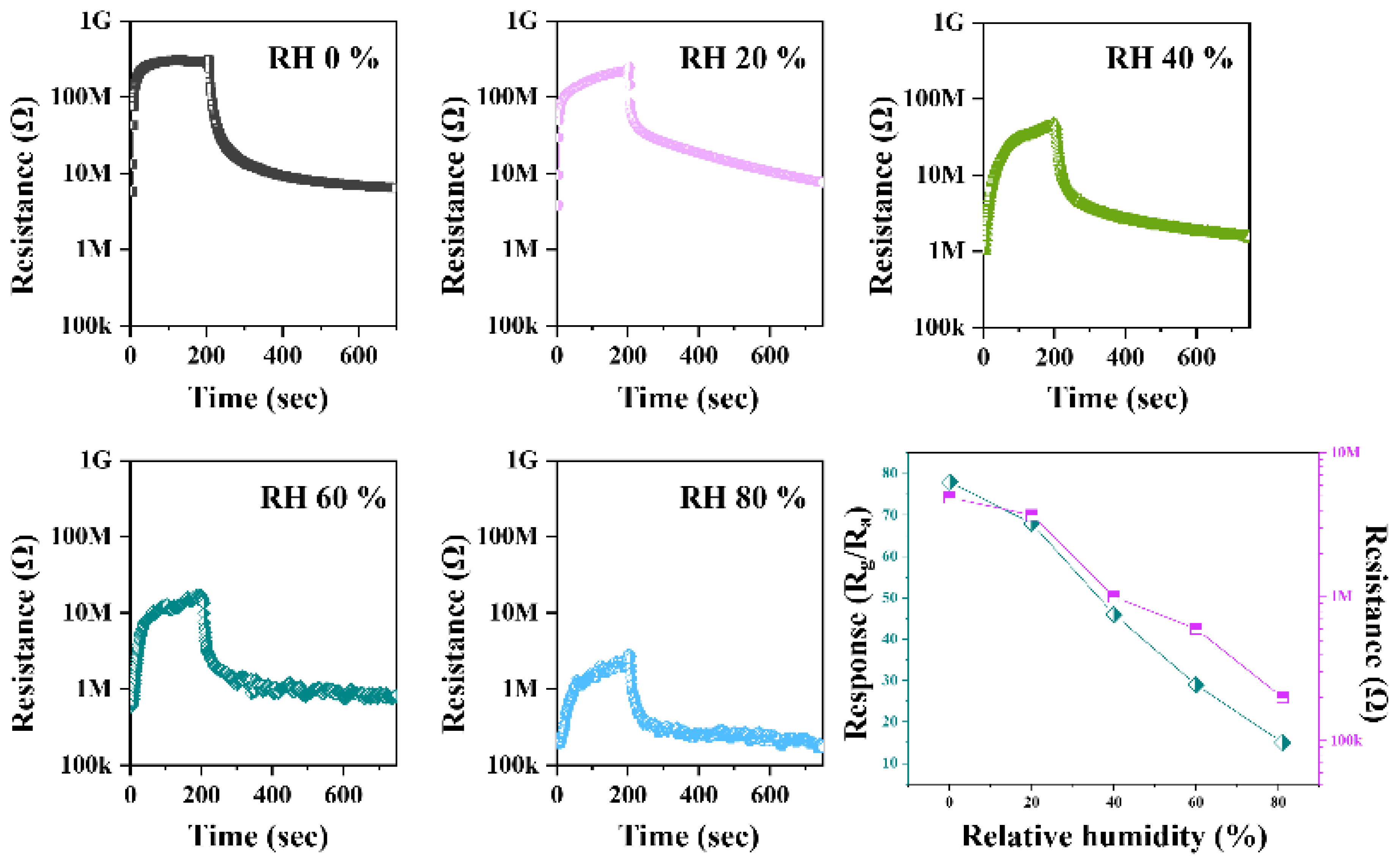
RH plays a crucial role in evaluating the sensing performance of semiconductor gas sensors in practical applications. To investigate the influence of RH on the 4Fe-ZnO sensor, the sensor response to 5 ppm NO2 at various RH levels was tested at 225 °C, as depicted in Figure 8. As RH increased from 0% to 80%, both resistance and response noticeably decreased. This decrease can be attributed to the increased adsorption of water molecules on the surface of the sensing materials. The presence of these water molecules could obstruct the absorption of oxygen molecules, thereby impacting the reaction between NO2 and oxygen ion species [32,33]. Despite the significant drop in response with increasing RH, even at 80% RH, the 4Fe-ZnO sensor still exhibited observable and distinct responses. However, it is worth noting that the influence of water molecules introduced more pronounced noise signals into the system. This observation indicates that, while water molecules interfere with the sensing reaction via competitive adsorption, the 4Fe-ZnO sensor retains its functionality up to 80% RH. Furthermore, the robust recovery and long-term stability shown in Figure 7k,l suggest that the humidity effect is reversible and does not induce permanent structural degradation of the sensing material.
The performance of the 4Fe-ZnO sensor was compared with other reported ZnO-based NO2 sensors, and the findings from the literature surveys are summarized in Table 1. Our study demonstrates that the 4Fe-ZnO sensor presented herein exhibits enhanced sensing performance, thereby positioning it competitively alongside other NO2 gas sensors reported in the literature.

3.3. Gas-Sensing Mechanism

When ZnO functions as a gas sensor, the redox reaction of the gas on its surface induces a shift in the carrier concentration, leading to a variation in the material’s space charge layer thickness and, consequently, a change in resistance [44]. As a prevalent n-type metal oxide semiconductor, ZnO interacts with oxygen molecules in the ambient air. These molecules become adsorbed on the surface, capturing electrons from the conduction band near the surface. This process occurs at different operating temperatures, giving rise to the formation of distinct ionic states, namely O 2 , O , and O 2 . In specific temperature ranges, O 2 dominates at temperatures below 100 °C, O between 100 and 300 °C, and O 2 at temperatures exceeding 300 °C. In the context of this study, with an operating temperature set at 225 °C, the prevalent surface-bound oxygen ion species are predominantly O [45].
O 2 ( gas )     O 2   ( ads )
O 2   ( ads ) + e   O 2   ( ads )   ( T < 100   °C )
O 2   ( ads ) + e   2 O   ( ads )   ( 100   °C < T < 300   °C )
O   ( ads ) + e     O 2   ( ads )   ( T > 300   °C )
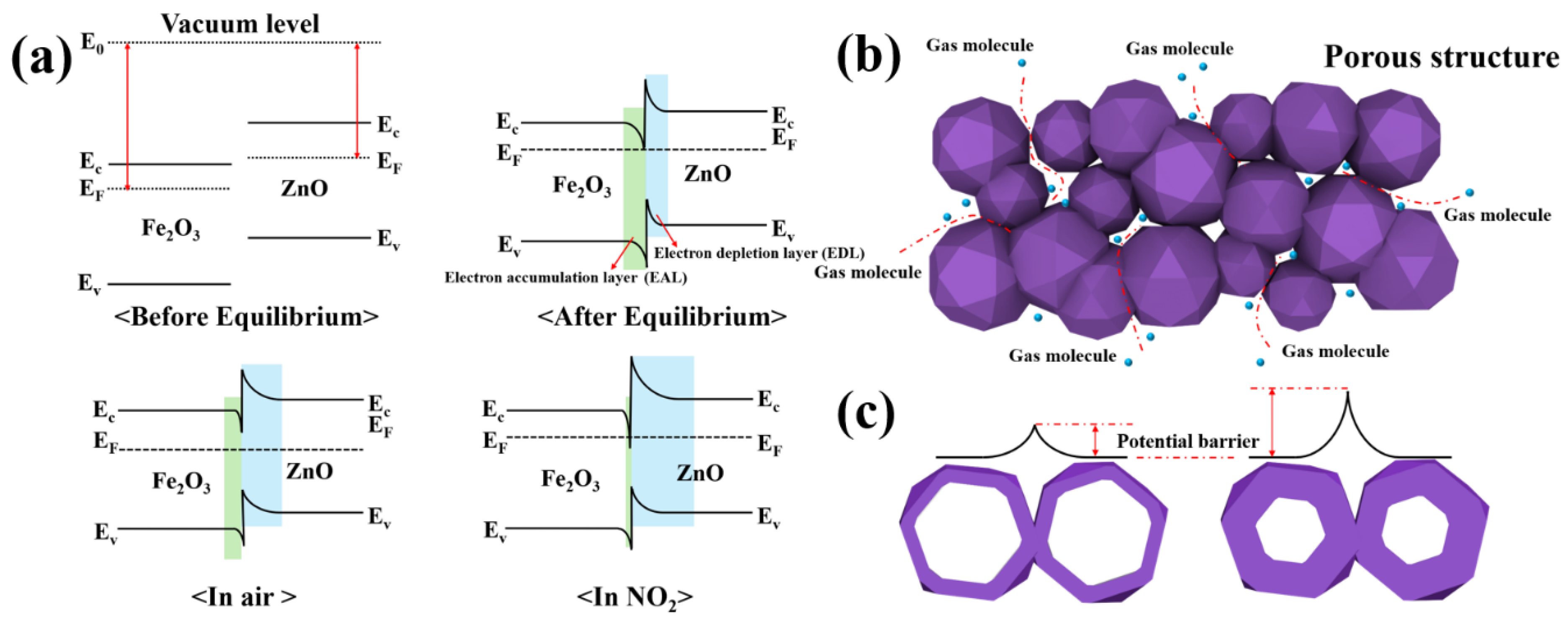
As depicted in Figure 9, O2 molecules adsorb onto the material surface at the optimal working temperature of 225 °C, trapping electrons to generate O (ads). This process results in the formation of an electron depletion layer, creating a potential barrier and subsequently increasing the resistance of ZnO materials. In the presence of NO2 gas, the NO2 molecule undergoes a reaction with the electrons in ZnO, leading to the formation of N O 2 (ads) [46], as expressed below.
N O 2   g a s   + e   N O 2   ( ads )
The observed response mechanism of ZnO/Fe2O3 to NO2 gas can be explained based on the work functions and semiconductor properties of ZnO and Fe2O3. A proposed energy band structure diagram of the ZnO/Fe2O3 heterojunction is elucidated schematically in Figure 9. The work function of Fe2O3 is greater than that of ZnO, both belonging to n-type semiconductors [47,48]. ZnO and Fe2O3 form an n-n heterojunction, where the Fermi level (EF) of ZnO is higher than that of Fe2O3. This energy level difference prompts electrons to transfer from ZnO to Fe2O3 upon contact, resulting in the establishment of a depletion layer on the ZnO side and an accumulation layer on the Fe2O3 side [49]. Furthermore, band bending and potential barriers are formed at the intergranular boundaries of Fe2O3/ZnO due to the electron transfer and lead to a higher resistance state of the Fe2O3/ZnO material. In the presence of air, O2 is absorbed on the surfaces of both Fe2O3 and ZnO, creating depletion layers in both materials. The depletion layer on the ZnO side consists of contributions from the n-n heterojunction and the adsorption of oxygen molecules [50]. Notably, the lower electron concentration in the ZnO side weakens its ability to absorb oxygen molecules from the air. Upon exposure to NO2, the potential barrier in ZnO intensifies, leading to an increase in the height of the barrier. This is attributed to the consumption of electrons from the ZnO surface, causing the depletion layer region to broaden. Consequently, the resistance of the ZnO material further increases. In summary, the response of ZnO/Fe2O3 to NO2 gas is intricately linked to the electron transfer, the formation of depletion layers, and the modulation of potential barriers, collectively influencing the electrical conductivity of the material in the presence of the target gas.
Additionally, the remarkable gas sensitivity exhibited by 4Fe-ZnO can be attributed to the synergistic effects of a significantly high specific surface area and a mesoporous structure. The sensing mechanism is visually represented in the schematic diagram in Figure 9. The porous Fe2O3/ZnO composite, with multiple exposed facets, facilitates a sensitive variation in the depletion region and provides abundant active sites. Consequently, NO2 molecules in the air can easily diffuse and rapidly adsorb on the surface due to the interconnected pore channels within the porous structure. This enhances electron capture, further widening the electron depletion layer. Therefore, the structure and connectivity of the pores play a crucial role in determining the gas sensitivity performance.
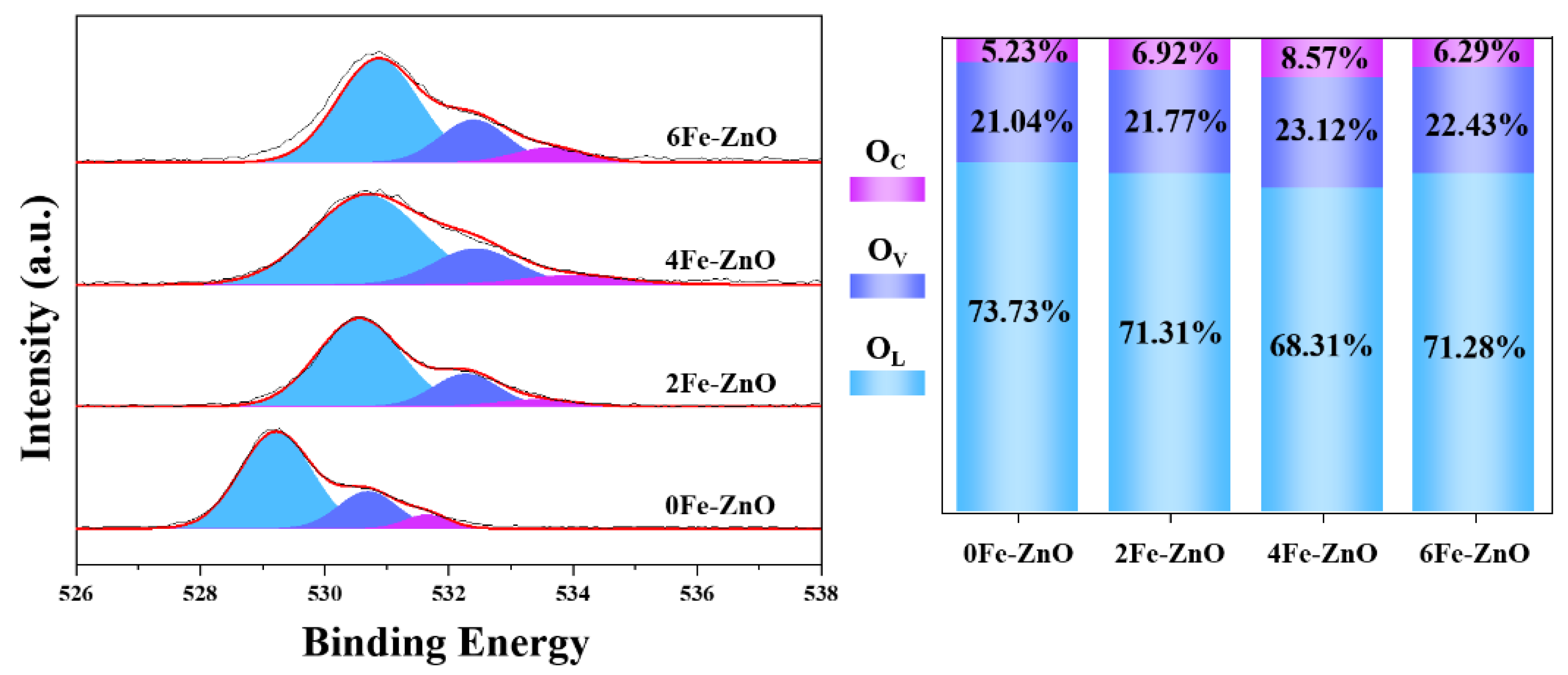
In this study, the 4Fe-ZnO composite, comprising numerous sub-grains synthesized via electrospinning and thermal calcination processes, serves as the host matrix for the proposed NO2 gas sensor. Fe2O3 NPs are incorporated onto the NFs to augment its sensing capabilities. Analysis of XPS spectra concerning the oxygen content reveals a pivotal mechanism for enhancing sensing performance attributed to the appended Fe2O3, as depicted in Figure 10. In the XPS spectra, the peaks corresponding to O 1s of the sensors are situated around 530 eV, further discernible into three distinct peaks representing lattice oxygen (OL), oxygen vacancy (OV), and adsorbed oxygen (OC) [51]. OL denotes oxygen ions within the material lattice with marginal influence on gas-sensing responses. OV signifies oxygen ions within oxygen-deficient regions, crucially affecting the material’s gas adsorption capacity. OC encompasses chemisorbed oxygen species, including dissociated oxygen species ( O 2 , O , and O 2 ) and O H . Quantitative analysis of O 1s XPS spectroscopy provides valuable insights into the relative proportions of oxygen species across all samples [52], as summarized in Figure 10. Recent studies regarding the rigor of XPS O 1s peak assignment [53,54] suggest that the component at ~531 eV, often labeled as oxygen vacancies (OV), may largely stem from surface hydroxyls or chemisorbed oxygen species associated with surface defects. While we acknowledge this debate, in the context of this study, this component is utilized as a comparative indicator to observe the relative trend of surface active states, which correlates consistently with the enhanced sensing performance. Remarkably, due to disparities in Fe2O3 cation content within NFs, the proportions of OV and OC exhibit variations among the samples. A higher total content of OV and OC implies increased involvement of surface-chemisorbed oxygen species in redox reactions, resulting in amplified resistance changes and enhanced gas sensor responses. Consequently, the OV rate in O 1s peaks for 0Fe-ZnO, 2Fe-ZnO, 4Fe-ZnO, and 6Fe-ZnO are assessed at 21.04%, 21.77%, 23.12%, and 22.43%, respectively. This variation in oxygen vacancy content is attributed to the trade-off between interface density and agglomeration. The introduction of Fe2O3 creates heterojunction interfaces with ZnO, where the lattice mismatch induces strain that promotes the formation of oxygen vacancies to lower the system’s energy. However, in the 6Fe-ZnO sample, excessive Fe loading leads to the agglomeration of nanoparticles, reducing the effective interfacial area available for defect formation. As a result, 4Fe-ZnO exhibits the optimized defect density, which significantly contributes to its improved sensing performance of 4Fe-ZnO.
Furthermore, it is acknowledged that both insufficient and excessive incorporation of Fe2O3 NPs within the NFs are speculated to adversely affect gas responsiveness. The porous NFs synthesized in this study comprise a plethora of sub-grains, as illustrated in Figure 9. The gas-sensitive properties of these NFs are contingent upon the polycrystalline nature of the sub-grains. The boundaries between these sub-grains act as potential barriers to the flow of charge carriers. Oxygen species adsorbed on the surface of sub-grains give rise to oxygen species according to reactions (3). A barrier to the flow of electrons emerges at the boundaries of adjacent sub-grains [55]. In this scenario, upon introduction of the target gas, the width of the barrier expands. As the height of the barrier varies, so does the resistance of the sample.

4. Conclusions

In summary, we successfully synthesized Fe2O3/ZnO composites using a combination of hydrothermal and electrospinning methods. These composites were then evaluated for their gas-sensing capabilities towards NO2. Impressively, the Fe2O3/ZnO composites exhibited exceptional sensitivity to NO2 vapors, particularly at 225 °C. Notably, the response to 5 ppm NO2 gas reached approximately 78. This heightened sensitivity can be attributed to the synergistic effects of Fe2O3 and ZnO, as well as the formation of an n-n heterojunction. These findings underscore the potential of the n-n Fe2O3/ZnO composite sensor as a promising candidate for high-performance gas-sensing applications.

Supplementary Materials

The following supporting information can be downloaded at: https://www.mdpi.com/article/10.3390/chemosensors14010018/s1, Figure S1: Schematic diagram of homemade gas sensing system; Figure S2: The low-magnification SEM images of (a) 0Fe-ZnO, (b) 2Fe-ZnO, (c) 4Fe-ZnO, (d) 6Fe-ZnO; and Figure S3: SAED pattern of the Fe2O3-embedded ZnO nanofibers (4Fe-ZnO). The diffraction rings correspond to the (100) plane of hexagonal wurtzite ZnO and the (104) plane of hematite Fe2O3, which is consistent with the lattice fringes observed in the HRTEM image (Figure 4b).

Author Contributions

Conceptualization: S.P.; methodology: S.P.; software: J.L.; validation: J.L.; formal analysis: J.L.; investigation: J.L.; resources: J.L.; data curation: J.L.; writing—original draft preparation: J.L. and S.P.; writing—review and editing; S.P.; supervision: S.P.; project administration: S.P.; funding acquisition: S.P. All authors have read and agreed to the published version of the manuscript.

Funding

Faculty fesearch fund of Sejong University in 2023.

Data Availability Statement

Dataset available on request from the authors.

Acknowledgments

This work was supported by the faculty research fund of Sejong University in 2023.

Conflicts of Interest

The authors declare no conflict of interest.

References

  1. Agrawal, A.; Kumar, N.; Kumar, M. Strategy and future prospects to develop room-temperature-recoverable NO2 gas sensor based on two-dimensional molybdenum disulfide. Nano-Micro Lett. 2021, 13, 38. [Google Scholar] [CrossRef]
  2. Li, Q.; Zeng, W.; Li, Y. Metal oxide gas sensors for detecting NO2 in industrial exhaust gas: Recent developments. Sens. Actuators B Chem. 2022, 359, 131579. [Google Scholar] [CrossRef]
  3. Bai, X.; Lv, H.; Liu, Z.; Chen, J.; Wang, J.; Sun, B.; Zhang, Y.; Wang, R.; Shi, K. Thin-layered MoS2 nanoflakes vertically grown on SnO2 nanotubes as highly effective room-temperature NO2 gas sensor. J. Hazard. Mater. 2021, 416, 125830. [Google Scholar] [CrossRef]
  4. Li, G.; Zhang, H.; Meng, L.; Sun, Z.; Chen, Z.; Huang, X.; Qin, Y. Adjustment of oxygen vacancy states in ZnO and its application in ppb-level NO2 gas sensor. Sci. Bull. 2020, 65, 1650–1658. [Google Scholar] [CrossRef] [PubMed]
  5. Zhang, C.; Luo, Y.; Xu, J.; Debliquy, M. Room temperature conductive type metal oxide semiconductor gas sensors for NO2 detection. Sens. Actuator A-Phys. 2019, 289, 118–133. [Google Scholar] [CrossRef]
  6. Zhang, B.; Bao, N.; Wang, T.; Xu, Y.; Dong, Y.; Ni, Y.; Yu, P.; Wei, Q.; Wang, J.; Guo, L.; et al. High-performance room temperature NO2 gas sensor based on visible light irradiated In2O3 nanowires. J. Alloys Compd. 2021, 867, 159076. [Google Scholar] [CrossRef]
  7. Kim, M.Y.; Park, C.O.; Choa, H.; To, D.T.H.; Mendoza, E.R.; Lee, S.Y.; Myung, N.V.; Lee, K.H. Gold nanoparticles-driven sensing performance enhancement of porous ZnO nanosheet toward NH3, acetone, and NO2. Chem. Eng. J. 2025, 521, 167090. [Google Scholar] [CrossRef]
  8. Pham, T.; Li, G.; Bekyarova, E.; Itkis, M.E.; Mulchandani, A. MoS2-based optoelectronic gas sensor with sub-parts-per-billion limit of NO2 gas detection. ACS Nano 2019, 13, 3196–3205. [Google Scholar] [CrossRef]
  9. Wang, N.; Tao, W.; Gong, X.; Zhao, L.; Wang, T.; Zhao, L.; Liu, F.; Liu, X.; Sun, P.; Lu, G. Highly sensitive and selective NO2 gas sensor fabricated from Cu2O-CuO microflowers. Sens. Actuator B-Chem. 2022, 362, 131803. [Google Scholar] [CrossRef]
  10. Ou, L.; Liu, M.; Zhu, L.; Zhang, D.; Lu, H. Recent progress on flexible room-temperature gas sensors based on metal oxide semiconductor. Nano-Micro Lett. 2022, 14, 206. [Google Scholar] [CrossRef] [PubMed]
  11. Meng, F.; Shi, X.; Yuan, Z.; Ji, H.; Qin, W.; Shen, Y.; Xing, C. Detection of four alcohol homologue gases by ZnO gas sensor in dynamic interval temperature modulation mode. Sens. Actuator B-Chem. 2022, 350, 130867. [Google Scholar] [CrossRef]
  12. Zhou, Q.; Zeng, W.; Chen, W.; Xu, L.; Kumar, R.; Umar, A. High sensitive and low-concentration sulfur dioxide (SO2) gas sensor application of heterostructure NiO-ZnO nanodisks. Sens. Actuator B-Chem. 2019, 298, 126870. [Google Scholar] [CrossRef]
  13. Qin, W.; Yuan, Z.; Gao, H.; Zhang, R.; Meng, F. Perovskite-structured LaCoO3 modified ZnO gas sensor and investigation on its gas sensing mechanism by first principle. Sens. Actuator B-Chem. 2021, 341, 130015. [Google Scholar] [CrossRef]
  14. Xuan, J.; Zhao, G.; Sun, M.; Jia, F.; Wang, X.; Zhou, T.; Yin, G.; Liu, B. Low-temperature operating ZnO-based NO2 sensors: A review. RSC Adv. 2020, 10, 39786–39807. [Google Scholar] [CrossRef]
  15. Hussain, S.; Wang, S.; Amu-Darko, J.N.; Begi, A.N.; Yusuf, K.; Ibrahim, T.K.; Manavalan, R.K.; Zhang, X.; Qiao, G. MOF-derived La-doped ZnO dodecahedron nanostructures for efficient detection of NO2 gas. Sens. Actuators B 2025, 425, 136954. [Google Scholar] [CrossRef]
  16. Xiao, R.; Pang, L.; Lai, X.; Fan, W.; Lu, Z.; Gao, J. Antimony Doping in SnO2 Nanoparticles for Sensitive NO2 Sensors. ACS Sens. 2025, 10, 3539–3550. [Google Scholar] [CrossRef] [PubMed]
  17. Kang, Y.; Yu, F.; Zhang, L.; Wang, W.; Chen, L.; Li, Y. Review of ZnO-based nanomaterials in gas sensors. Solid State Ion. 2021, 360, 115544. [Google Scholar] [CrossRef]
  18. Bhati, V.; Hojamberdiev, M.; Kumar, M. Enhanced sensing performance of ZnO nanostructures-based gas sensors: A review. Energy Rep. 2020, 6, 46–62. [Google Scholar] [CrossRef]
  19. Wang, C.; Li, Y.; Gong, F.; Zhang, Y.; Fang, S.; Zhang, H. Advances in doped ZnO nanostructures for gas sensor. Chem. Rec. 2020, 20, 1553–1567. [Google Scholar] [CrossRef]
  20. Kumar, S.; Pavelyev, V.; Mishra, P.; Tripathi, N.; Sharma, P.; Calle, F. A review on 2D transition metal di-chalcogenides and metal oxide nanostructures based NO2 gas sensors. Mater. Sci. Semicond. Process. 2020, 107, 104865. [Google Scholar] [CrossRef]
  21. Zheng, T.; Zhou, H.; Yang, K.; Li, Y.; Wang, Y.; Zhang, M.; Liu, Z.; Sui, C.; Liu, Y.; Liu, F.; et al. Enhanced surface basicity of spongy ZnO nanosheets by rare earth yttrium for room temperature NO2 detection. Sens. Actuators B 2025, 440, 137920. [Google Scholar] [CrossRef]
  22. Wu, M.-J.; Yan, T.-Z.; Hung, Y.-H.; Lin, C.-H.; Lee, H.-Y.; Lee, C.-T. Investigation of In2O3: Zn NO2 gas sensors with nanoimprinted nanorod array and gold-black nanoparticles. Appl. Surf. Sci. 2025, 29, 100833. [Google Scholar] [CrossRef]
  23. Sun, Y.-Y.; Cao, M.-Y.; Yang, M.; Lei, H.-N.; Li, Y.-N.; Xu, Y.-M.; Deng, Z.-P.; Huo, L.-H.; Gao, S. Pine needle-templated synthesis of graphitic carbon/ZnO tubules for highly enhanced response to NO2 gas at low temperature. Sens. Actuators B 2025, 428, 137230. [Google Scholar] [CrossRef]
  24. Hsu, K.; Fang, T.; Hsiao, Y.; Li, Z. Rapid detection of low concentrations of H2S using CuO-doped ZnO nanofibers. J. Alloys Compd. 2021, 852, 157014. [Google Scholar] [CrossRef]
  25. Fan, S.; Tang, W. Synthesis, characterization and mechanism of electrospun carbon nanofibers decorated with ZnO nanoparticles for flexible ammonia gas sensors at room temperature. Sens. Actuator B-Chem. 2022, 362, 131789. [Google Scholar] [CrossRef]
  26. Lee, J.; Kim, J.; Kim, J.; Mirzaei, A.; Kim, H.; Kim, S. Co3O4-loaded ZnO nanofibers for excellent hydrogen sensing. Int. J. Hydrogen Energy 2019, 44, 27499–27510. [Google Scholar] [CrossRef]
  27. Naderi, H.; Hajati, S.; Ghaedi, M.; Espinos, J. Highly selective few-ppm NO gas-sensing based on necklace-like nanofibers of ZnO/CdO n-n type I heterojunction. Sens. Actuator B-Chem. 2019, 297, 126774. [Google Scholar] [CrossRef]
  28. Zhang, Q.; Pang, Z.; Hu, W.; Li, J.; Liu, Y.; Liu, Y.; Yu, F.; Zhang, C.; Xu, M. Performance degradation mechanism of the light-activated room temperature NO2 gas sensor based on Ag-ZnO nanoparticles. Appl. Surf. Sci. 2021, 541, 148418. [Google Scholar] [CrossRef]
  29. Zhuang, Z.; Zhang, L.; Huang, C.; Wang, X.; Guo, H.; Thomas, T.; Qu, F.; Wang, P.; Yang, M. A dimethyl disulfide gas sensor based on nanosized Pt-loaded tetrakaidecahedral α-Fe2O3 nanocrystals. Nanotechnology 2022, 33, 405502. [Google Scholar] [CrossRef]
  30. Liu, L.; Wang, Y.; Guan, K.; Liu, Y.; Li, Y.; Sun, F.; Wang, X.; Zhang, C.; Feng, S.; Zhang, T. Influence of oxygen vacancies on the performance of SnO2 gas sensing by near-ambient pressure XPS studies. Sens. Actuator B-Chem. 2023, 393, 134252. [Google Scholar] [CrossRef]
  31. Das, S.; Roy, S.; Bhattacharya, T.; Sarkar, C. Efficient room temperature hydrogen gas sensor using ZnO nanoparticles-reduced graphene oxide nanohybrid. IEEE Sens. J. 2021, 21, 1264–1272. [Google Scholar] [CrossRef]
  32. Cai, Z.; Park, J.; Park, S. Synergistic effect of Pd and Fe2O3 nanoparticles embedded in porous NiO nanofibers on hydrogen gas detection: Fabrication, characterization, and sensing mechanism exploration. Sens. Actuator B-Chem. 2023, 388, 133836. [Google Scholar] [CrossRef]
  33. Sharma, B.; Sharma, A.; Myung, J.H. Selective ppb-level NO2 gas sensor based on SnO2-boron nitride nanotubes. Sens. Actuator B-Chem. 2021, 331, 129464. [Google Scholar] [CrossRef]
  34. Liu, W.; Gu, D.; Li, X. Ultrasensitive NO2 detection utilizing mesoporous ZnSe/ZnO heterojunction-based chemiresistive-type sensors. ACS Appl. Mater. Interfaces 2019, 11, 29029–29040. [Google Scholar] [CrossRef]
  35. Chen, X.; Shen, Y.; Zhong, X.; Li, T.; Zhao, S.; Zhou, P.; Han, C.; Wei, D.; Shen, Y. Synthesis of ZnO nanowires/Au nanoparticles hybrid by a facile one-pot method and their enhanced NO2 sensing properties. J. Alloys Compd. 2019, 783, 503–512. [Google Scholar] [CrossRef]
  36. Mane, S.; Nimbalkar, A.; Go, J.; Patil, N.; Dhasade, S.; Thombare, J.; Burungale, A.; Shin, J. NO2 sensing properties of 3D flower-like ZnO nanostructure decorated with thin porous petals synthesized using a simple sol–gel drop-casting method. Appl. Phys. A-Mater. Sci. Process. 2021, 127, 13. [Google Scholar] [CrossRef]
  37. Sinju, K.; Ramgir, N.; Pathak, A.; Debnath, A.; Muthe, K. Multiple sensor array based on ZnO nanowires for electronic nose applications towards toxic gases. AIP Conf. Proc. 2020, 2265, 030282. [Google Scholar] [CrossRef]
  38. Li, C.; Yu, L.; Fan, X.; Yin, M.; Nan, N.; Cui, L.; Ma, S.; Li, Y.; Zhang, B. Nucleation density and pore size tunable growth of ZnO nanowalls by a facile solution approach: Growth mechanism and NO2 gas sensing properties. RSC Adv. 2020, 10, 3319–3328. [Google Scholar] [CrossRef] [PubMed]
  39. Kim, J.; Porte, Y.; Ko, K.; Kim, H.; Myoung, J. Micropatternable double-faced ZnO nanoflowers for flexible gas sensor. ACS Appl. Mater. Interfaces 2017, 9, 32876–32886. [Google Scholar] [CrossRef]
  40. Gonzalez-Chavarri, J.; Parellada-Monreal, L.; Castro-Hurtado, I.; Castaño, E.; Mandayo, G. ZnO nanoneedles grown on chip for selective NO2 detection indoors. Sens. Actuator B-Chem. 2018, 255, 1244–1253. [Google Scholar] [CrossRef]
  41. Chen, X.; Shen, Y.; Zhang, W.; Zhang, J.; Wei, D.; Lu, R.; Zhu, L.; Li, H.; Shen, Y. In-situ growth of ZnO nanowire arrays on the sensing electrode via a facile hydrothermal route for high-performance NO2 sensor. Appl. Surf. Sci. 2018, 435, 1096–1104. [Google Scholar] [CrossRef]
  42. Chougule, M.; Sen, S.; Patil, V. Fabrication of nanostructured ZnO thin film sensor for NO2 monitoring. Ceram. Int. 2012, 38, 2685–2692. [Google Scholar] [CrossRef]
  43. Choi, M.; Kim, M.; Mirzaei, A.; Kim, H.; Kim, S.; Baek, S.; Chun, D.; Jin, C.; Lee, K. Selective, sensitive, and stable NO2 gas sensor based on porous ZnO nanosheets. Appl. Surf. Sci. 2021, 568, 150910. [Google Scholar] [CrossRef]
  44. Zhao, P.; Tang, Y.; Mao, J.; Chen, Y.; Song, H.; Wang, J.; Song, Y.; Liang, Y.; Zhang, X. One-Dimensional MoS2-Decorated TiO2 nanotube gas sensors for efficient alcohol sensing. J. Alloys Compd. 2016, 674, 252–258. [Google Scholar] [CrossRef]
  45. Kooti, M.; Keshtkar, S.; Askarieh, M.; Rashidi, A. Progress toward a novel methane gas sensor based on SnO2 nanorods-nanoporous graphene hybrid. Sens. Actuator B-Chem. 2019, 281, 96–106. [Google Scholar] [CrossRef]
  46. Liu, B.; Liu, X.; Yuan, Z.; Jiang, Y.; Su, Y.; Ma, J.; Tai, H. A flexible NO2 gas sensor based on polypyrrole/nitrogen-doped multiwall carbon nanotube operating at room temperature. Sens. Actuator B-Chem. 2019, 295, 86–92. [Google Scholar] [CrossRef]
  47. Tomić, M.; Claros, M.; Gràcia, I.; Figueras, E.; Cané, C.; Vallejos, S. ZnO structures with surface nanoscale interfaces formed by Au, Fe2O3, or Cu2O modifier nanoparticles: Characterization and gas sensing properties. Sensors 2021, 21, 4509. [Google Scholar] [CrossRef]
  48. Yang, J.; Yuan, K.; Zhu, L.; Hang, C.; Li, X.; Tao, J.; Ma, H.; Jiang, A.; Lu, H. Facile synthesis of α-Fe2O3/ZnO core-shell nanowires for enhanced H2S sensing. Sens. Actuator B-Chem. 2020, 307, 127617. [Google Scholar] [CrossRef]
  49. Touba, S.; Kimiagar, S. Enhancement of sensitivity and selectivity of α-Fe2O3 nanorod gas sensors by ZnO nanoparticles decoration. Mater. Sci. Semicond. Process. 2019, 102, 104603. [Google Scholar] [CrossRef]
  50. Liang, Y.; Hsu, Y. Enhanced sensing ability of brush-like Fe2O3-ZnO nanostructures towards NO2 gas via manipulating material synergistic effect. Int. J. Mol. Sci. 2021, 22, 6884. [Google Scholar] [CrossRef]
  51. Li, Z.; Guo, L.; Feng, Z.; Gao, S.; Zhang, H.; Yang, X.; Liu, H.; Shao, J.; Sun, C.; Cheng, Y.; et al. Metal-organic framework-derived ZnO decorated with CuO for ultra-high response and selectivity H2S gas sensor. Sens. Actuator B-Chem. 2022, 366, 131995. [Google Scholar] [CrossRef]
  52. Cai, Z.; Park, S. Improved SnO2 nanowire acetone sensor with uniform Co3O4 nanoparticle decoration. J. Environ. Chem. Eng. 2023, 11, 111504. [Google Scholar] [CrossRef]
  53. Frankcombe, T.J.; Liu, Y. Interpretation of Oxygen 1s X-ray Photoelectron Spectroscopy of ZnO. Chem. Mater. 2023, 35, 5468–5474. [Google Scholar] [CrossRef]
  54. Idriss, H. On the wrong assignment of the XPS O1s signal at 531–532 eV attributed to oxygen vacancies in photo- and electro-catalysts for water splitting and other materials applications. Surf. Sci. 2021, 712, 121894. [Google Scholar] [CrossRef]
  55. Cai, Z.; Park, S. Highly selective acetone sensor based on Co3O4-decorated porous TiO2 nanofibers. J. Alloys Compd. 2022, 919, 165875. [Google Scholar] [CrossRef]
Figure 1. Schematic illustration of the synthetic process for the Fe2O3-embedded porous ZnO NFs: (a) synthesis of Fe2O3 nanoparticles via hydrothermal method; (b) preparation of precursor solution containing Fe2O3 nanoparticles and Zn salt for electrospinning of PVP nanofibers; (c) synthesis of PVP nanofibers via electrospinning (dashed line: polymer fiber being ejected from the Taylor cone to the collector) and fabrication of Fe2O3 nanoparticle-embedded ZnO nanofibers through calcination.
Chemosensors 14 00018 g001
Figure 2. The magnified SEM images of (a) PVP nanofiber before calcination process (b) 0Fe-ZnO, (c) 2Fe-ZnO, (d) 4Fe-ZnO, and (e) 6Fe-ZnO.
Chemosensors 14 00018 g002
Figure 3. XRD patterns of 0Fe-ZnO, 2Fe-ZnO, 4Fe-ZnO, and 6Fe-ZnO.
Chemosensors 14 00018 g003
Figure 4. (a) TEM image of 4Fe-ZnO, (b) HRTEM images of 4Fe-ZnO, (c) STEM image, and (df) EDS elemental mapping images (O, Fe, and Zn) of 4Fe-ZnO.
Chemosensors 14 00018 g004
Figure 5. (a) XPS full survey spectra of 0Fe-ZnO, 2Fe-ZnO, 4Fe-ZnO, and 6Fe-ZnO. (b) Zn 2p spectra of 0Fe-ZnO, 2Fe-ZnO, 4Fe-ZnO, and 6Fe-ZnO. (c) Fe 2p spectra of 2Fe-ZnO, 4Fe-ZnO, and 6Fe-ZnO.
Chemosensors 14 00018 g005
Figure 6. N2 isothermal adsorption/desorption curve of (a) PVP, (b) 0Fe-ZnO, (c) 2Fe-ZnO, (d) 4Fe-ZnO, and (e) 6Fe-ZnO (gray: adsorption, red: desorption); the inset is the pore radius.
Chemosensors 14 00018 g006
Figure 7. (a) Responses of 0Fe-ZnO, 2Fe-ZnO, 4Fe-ZnO, and 6Fe-ZnO sensors to 5 ppm NO2 at different operating temperatures. (b) Baseline resistances in air of 0Fe-ZnO, 2Fe-ZnO, 4Fe-ZnO, and 6Fe-ZnO sensors at different operating temperatures. (c) Sensing responses of 0Fe-ZnO, 2Fe-ZnO, 4Fe-ZnO, and 6Fe-ZnO sensors to different interfering gases at 100 ppm at their respective optimal operating temperatures. (dg) The dynamic response curves of 0Fe-ZnO, 2Fe-ZnO, 4Fe-ZnO, and 6Fe-ZnO sensors to different NO2 concentrations at their optimal operating temperatures. (h) Responses of 0Fe-ZnO, 2Fe-ZnO, 4Fe-ZnO, and 6Fe-ZnO sensors as a function of NO2 concentration. (i) The dynamic response curves of the 4Fe-ZnO sensor to NO2 concentrations ranging from 0.1 to 0.8 ppm at 225 °C, including the corresponding responses. (j) Response–recovery times of 0Fe-ZnO, 2Fe-ZnO, 4Fe-ZnO, and 6Fe-ZnO sensors at 5 ppm NO2 concentration at their optimal operating temperatures. (k) Nine cycle stability curves of 4Fe-ZnO sensors to 5 ppm NO2 at 225 °C. (l) Stability tests of the sensors based on 4Fe-ZnO sensor for 30 days.
Chemosensors 14 00018 g007aChemosensors 14 00018 g007b
Figure 8. Dynamic response curves of 4Fe-ZnO to 5 ppm NO2 at the operating temperature of 225 °C under various relative humidities (0–80% RH). Corresponding response and resistance changes with the relative humidity.
Chemosensors 14 00018 g008
Figure 9. Schematic illustration of the sensing mechanism of the ZnO/Fe2O3 sensor: (a) band diagrams before and after particle contact, and upon exposure to air and NO2; (b) gas diffusion pathways through the polycrystalline and porous structure of the nanofibers; (c) changes in the depletion layer and potential energy barrier height at the interface before and after exposure to air and NO2 gas.
Chemosensors 14 00018 g009
Figure 10. XPS high-resolution spectra of O 1s and the percentage of different oxygen species for 0Fe-ZnO, 2Fe-ZnO, 4Fe-ZnO, and 6Fe-ZnO.
Chemosensors 14 00018 g010
Table 1. Comparison of NO2-sensing properties between our sensors and previous reports.
Sensing MaterialsCon. (ppm)Tem. (°C)Res. (Rg/Ra)Ref.
ZnO/ZnSe820010.42[34]
Au-ZnO115031.4[35]
ZnO10018023.3[36]
ZnO22001.29[37]
ZnO5022036.64[38]
ZnO5027029[39]
ZnO51951.04[40]
ZnO52503.3[41]
ZnO1020074.68[42]
ZnO10020037.2[43]
Fe2O3/ZnO522578This work
Disclaimer/Publisher’s Note: The statements, opinions and data contained in all publications are solely those of the individual author(s) and contributor(s) and not of MDPI and/or the editor(s). MDPI and/or the editor(s) disclaim responsibility for any injury to people or property resulting from any ideas, methods, instructions or products referred to in the content.