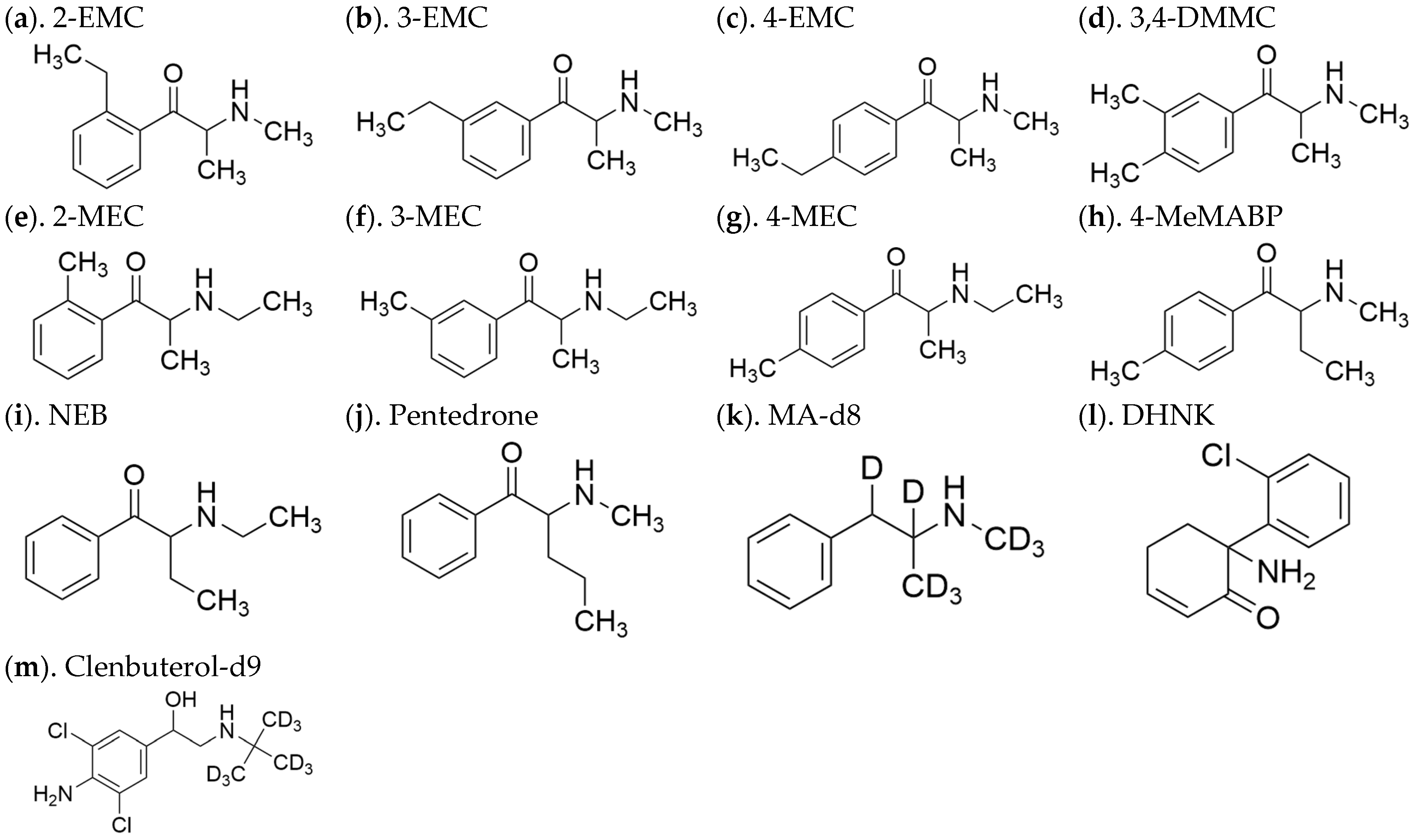
Analytical Challenges in the Separation and Identification of Ten Substituted Cathinone Isomers (C12H17NO) Using EI-GC-MS and ESI-LC-MS/MS


 , ,
, ,  and
and
Abstract
1. Introduction
2. Materials and Methods
2.1. Chemicals and Reagents
2.2. Preparation of Standard Solutions for GC-MS Analysis
2.3. GC-MS Conditions
- (1)
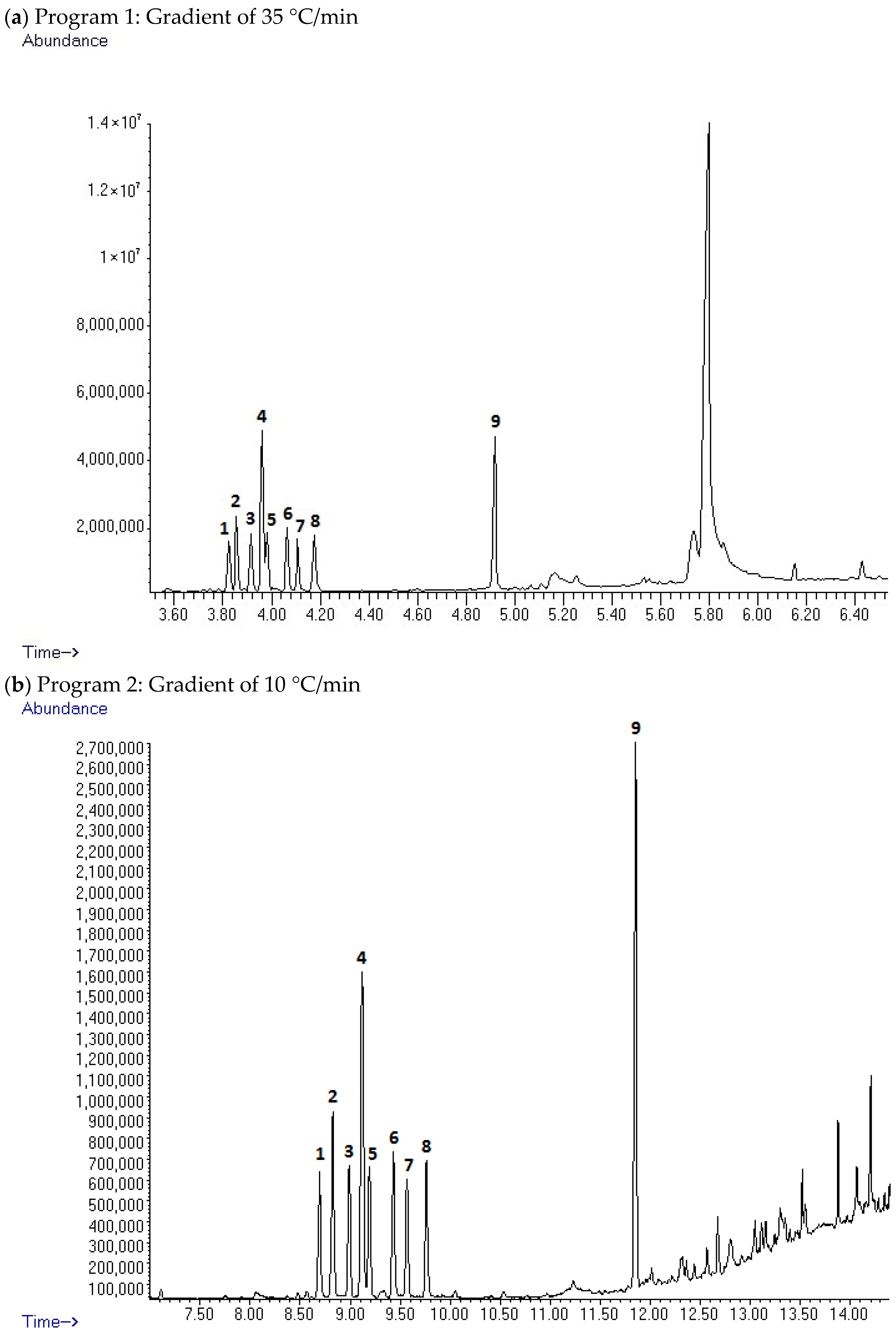
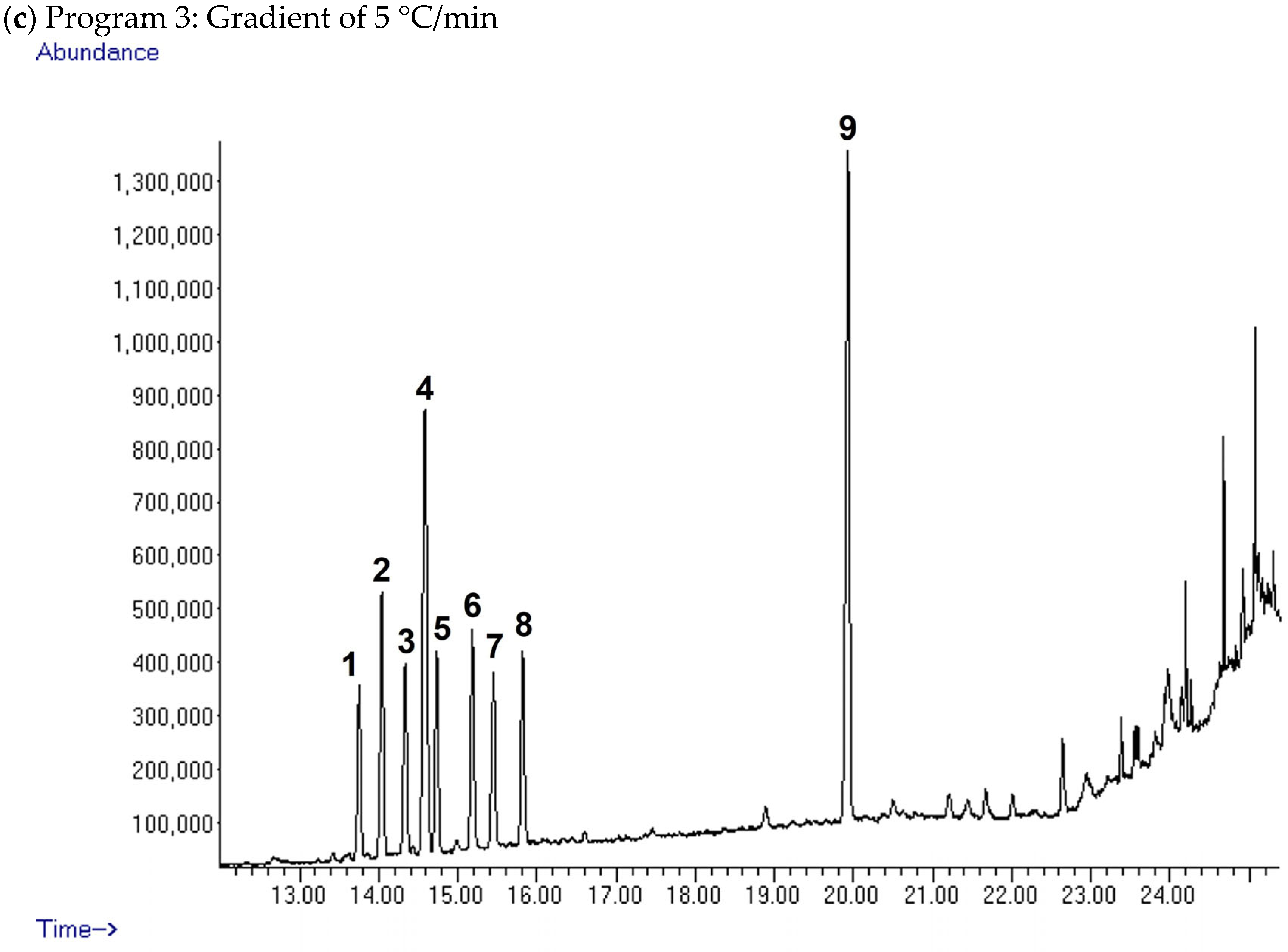
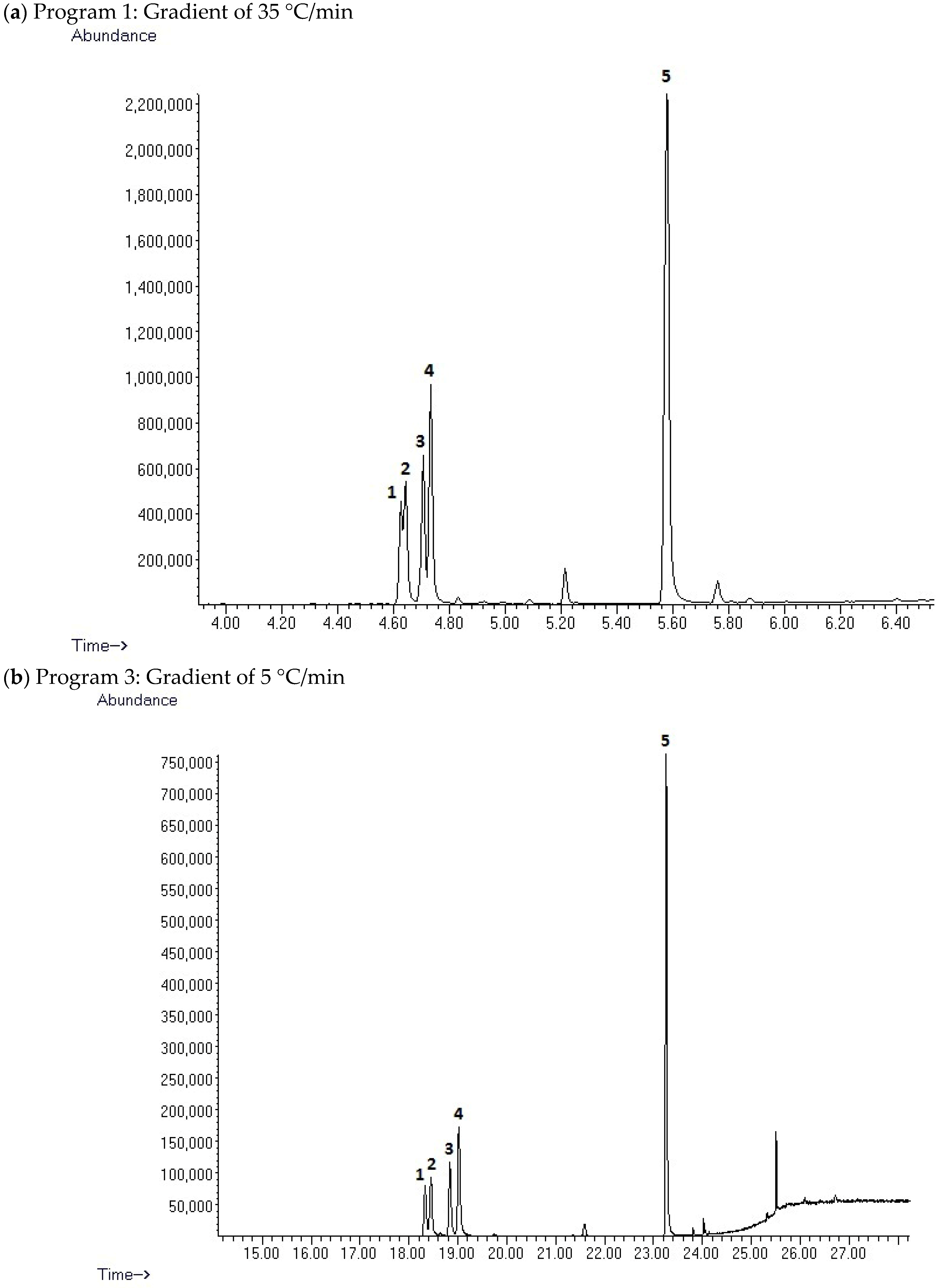
- Program 1: The oven was held at 80 °C for 0.3 min, followed by a ramp to 190 °C at 35 °C/min with a 0.1 min hold, and then increased to 280 °C at 30 °C/min. The total run time was 6.54 min.
- (2)
- Program 2: The oven was held at 80 °C for 0.3 min, followed by a ramp to 190 °C at 10 °C/min with a 0.1 min hold, and then increased to 280 °C at 30 °C/min. The total run time was 14.4 min.
- (3)
- Program 3: The oven was held at 80 °C for 0.3 min, followed by a ramp to 190 °C at 5 °C/min with a 0.1 min hold, and then increased to 280 °C at 30 °C/min and held for 2.86 min. The total run time was 28.26 min.
2.4. Optimization of LC-MS/MS Conditions
2.5. Calculations
3. Results
3.1. GC-MS Chromatogram and Mass Spectra of TFAA-Derivatized Isomers
3.2. GC-MS Chromatogram and Mass Spectra of AA-Derivatized Co-Eluting Isomers
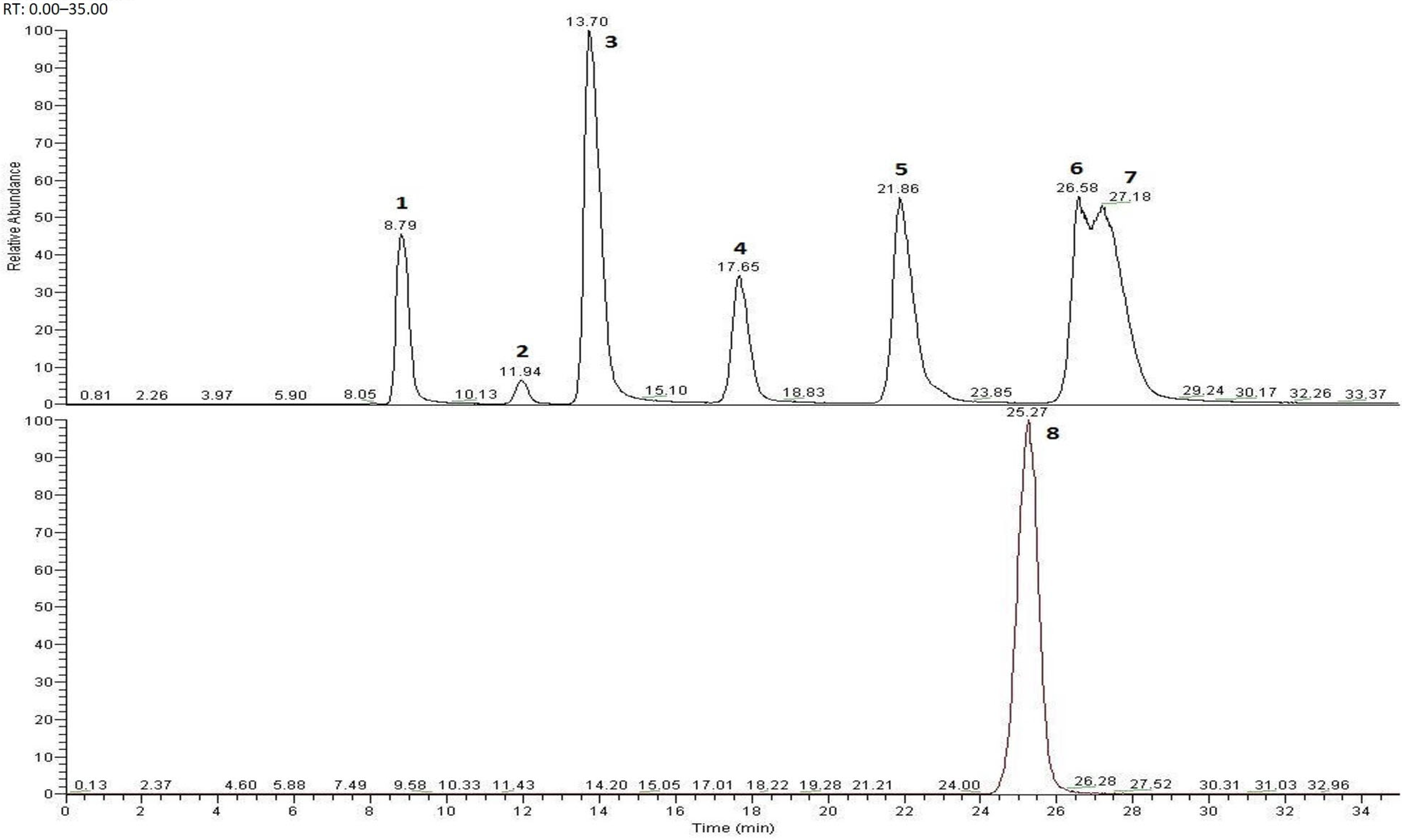
3.3. Identification of Ten Isomers by LC-MS/MS
4. Discussion
5. Limitations
6. Conclusions
Supplementary Materials
Author Contributions
Funding
Institutional Review Board Statement
Informed Consent Statement
Data Availability Statement
Acknowledgments
Conflicts of Interest
Abbreviations
| 2-, 3-, 4-EMC | 2-, 3-, 4-ethylmethcathinone |
| 2-, 3-, 4-MEC | 2-, 3-, 4-methylethcathinone |
| 2-, 3-, 4-MeMABP | 2-, 3-, 4-methylbuphedrone |
| 2,3-, 2,4-, 2,5-, 3,4-DMMC | 2,3-, 2,4-, 2,5-, 3,4-dimethylmethcathinone |
| AA | acetic anhydride |
| CE | collision energy |
| DHNK | dehydronorketamine |
| EA | ethyl acetate |
| EI-GC-MS | electron ionization gas chromatography mass spectrometry |
| ESI-LC-MS/MS | electrospray ionization liquid chromatography tandem mass spectrometry |
| FA | formic acid |
| GC | gas chromatography |
| HCl | hydrochloric acid |
| HPLC | high-performance liquid chromatography |
| IS | internal standard |
| LC | liquid chromatography |
| MA-d8 | methamphetamine-d8 |
| MRM | multiple reaction monitoring |
| MS | mass spectrometry |
| MW | molecular weight |
| NEB | N-ethylbuphedrone |
| NPS | new psychoactive substances |
| RRT | relative retention time |
| Rs | chromatographic resolution |
| RT | retention time |
| TFAA | trifluoroacetic anhydride |
| TFDA | Taiwan Food and Drug Administration |
References
- UNODC Early Warning Advisory on New Psychoactive Substances. What Are NPS? Available online: https://www.unodc.org/LSS/Page/NPS (accessed on 2 December 2025).
- UNODC Early Warning Advisory on New Psychoactive Substances. Data Visualization—Public. Available online: https://www.unodc.org/LSS/Page/NPS/DataVisualisations (accessed on 6 April 2026).
- Taiwan Food and Drug Administration. List of New Psychoactive Substances (NPS) Detected in Taiwan. Available online: https://www.fda.gov.tw/tc/site.aspx?sid=9958&r=97198537 (accessed on 6 April 2026).
- Taiwan High Prosecutors Office. Rapid Analysis of the Drug Situation in 2025. Available online: https://www.tph.moj.gov.tw/4421/4599/4603/749677/937043/post (accessed on 6 April 2026).
- Taiwan Food and Drug Administration. Statistics on Drug Abuse Cases and Testing. 2024. Available online: https://www.fda.gov.tw/tc/site.aspx?sid=1578&r=1521776557 (accessed on 2 December 2025).
- U.S. Department of Justice. Drug Enforcement Administration. Lists of Scheduling Actions, Controlled Substances, Regulated Chemicals. Available online: https://www.deadiversion.usdoj.gov/schedules/schedules.html (accessed on 4 October 2025).
- Laws and Regulations Database of the Republic of China (Taiwan). Narcotics Hazard Prevention Act. Available online: https://law.moj.gov.tw/LawClass/LawAll.aspx?pcode=C0000008 (accessed on 22 September 2025).
- Ministry of Public Security of the People’s Republic of China. Schedule of Non-Medical Narcotic Drugs and Psychotropic Substances. Available online: https://www.mps.gov.cn/n6557558/c10150600/content.html (accessed on 22 September 2025).
- Kojić, I.; Đurović, V.M.; Smyatskaya, Y.A.; Brkljača, N.; Skhvediani, A.E.; Vasin, A.V.; Stojanović, K.; Đurović, S.D. Methods for GC/MS Analysis of the Most Commonly Seized Drugs of Abuse and Their Metabolites in Biological Samples. Chemosensors 2025, 13, 286. [Google Scholar] [CrossRef]
- Wong, S.L.; Ng, L.T.; Tan, J.; Pan, J. Screening unknown novel psychoactive substances using GC–MS based machine learning. Forensic Chem. 2023, 34, 100499. [Google Scholar] [CrossRef]
- Archer, R.P.; Treble, R.; Williams, K. Reference materials for new psychoactive substances. Drug Test. Anal. 2011, 3, 505–514. [Google Scholar] [CrossRef]
- ANSI/ASB Standard 113; F.E. Standard for Identification Criteria in Forensic Toxicology. AAFS Standards Board: Colorado Springs, CO, USA, 2023.
- Harris, D.N.; Hokanson, S.; Miller, V.; Jackson, G.P. Fragmentation differences in the EI spectra of three synthetic cannabinoid positional isomers: JWH-250, JWH-302, and JWH-201. Int. J. Mass Spectrom. 2014, 368, 23–29. [Google Scholar] [CrossRef]
- Kranenburg, R.F.; Peroni, D.; Affourtit, S.; Westerhuis, J.A.; Smilde, A.K.; van Asten, A.C. Revealing hidden information in GC–MS spectra from isomeric drugs: Chemometrics based identification from 15 eV and 70 eV EI mass spectra. Forensic Chem. 2020, 18, 100225. [Google Scholar] [CrossRef]
- Tseng, L.-P.; Lan, Y.-S.; Lee, Y.-H.; Lee, Y.-C.; Chou, Y.-C.; Lee, H.-H.; Chang, M.-Y.; Liang, S.-S.; Lin, Y.-C. Optimizing analytical precision in the identification of synthetic cathinones and isomers: A comparative assessment of diverse GC–MS operating parameters. Anal. Sci. 2024, 40, 1397–1407. [Google Scholar] [CrossRef] [PubMed]
- Kupriyanova, O.V.; Shevyrin, V.A.; Shafran, Y.M. Potential of chromatography and mass spectrometry for the differentiation of three series of positional isomers of 2-(dimethoxyphenyl)-N-(2-halogenobenzyl) ethanamines. Drug Test. Anal. 2022, 14, 1102–1115. [Google Scholar] [CrossRef] [PubMed]
- Meyer, M.R.; Maurer, H.H. Review: LC coupled to low- and high-resolution mass spectrometry for new psychoactive substance screening in biological matrices—Where do we stand today? Anal. Chim. Acta 2016, 927, 13–20. [Google Scholar] [CrossRef]
- Maas, A.; Sydow, K.; Madea, B.; Hess, C. Separation of ortho, meta and para isomers of methylmethcathinone (MMC) and methylethcathinone (MEC) using LC-ESI-MS/MS: Application to forensic serum samples. J. Chromatogr. B 2017, 1051, 118–125. [Google Scholar] [CrossRef]
- Takeda, A.; Tagami, T.; Asada, A.; Doi, T.; Kawaguchi, M.; Satsuki, Y.; Sawabe, Y. Regioisomeric separation of ring-substituted cathinones by liquid chromatography–mass spectrometry with a naphthylethyl column. Forensic Toxicol. 2017, 35, 399–407. [Google Scholar] [CrossRef]
- Grumann, C.; Auwärter, V. Separation of positional isomers of nine 2-phenethylamine-derived designer drugs by liquid chromatography–tandem mass spectrometry. Drug Test. Anal. 2018, 10, 1184–1191. [Google Scholar] [CrossRef]
- Aldubayyan, A.A.; Castrignanò, E.; Elliott, S.; Abbate, V. Development and validation of a chiral LC-MS/MS method for the separation and quantification of four synthetic cathinones in human whole blood and its application in stability analysis. Talanta 2023, 253, 123986. [Google Scholar] [CrossRef]
- Peters, F.T.; Wissenbach, D.K.; Busardo, F.P.; Marchei, E.; Pichini, S. Method development in forensic toxicology. Curr. Pharm. Des. 2017, 23, 5455–5467. [Google Scholar] [CrossRef]
- Rivier, L. Criteria for the identification of compounds by liquid chromatography–mass spectrometry and liquid chromatography–multiple mass spectrometry in forensic toxicology and doping analysis. Anal. Chim. Acta 2003, 492, 69–82. [Google Scholar] [CrossRef]
- CLSI. C43-A2 Gas Chromatography/Mass Spectrometry Confirmation of Drugs. Approved Guideline—Second Edition (2010). Available online: https://clsi.org/shop/standards/c43/ (accessed on 21 September 2025).
- Daéid, N.N. FORENSIC SCIENCES|Systematic Drug Identification. In Encyclopedia of Analytical Science, 2nd ed.; Worsfold, P., Townshend, A., Poole, C., Eds.; Elsevier: Oxford, UK, 2005; pp. 471–480. [Google Scholar]
- WADA Science/IDCR Working Group. WADA Technical Document—TD2023IDCR (2023). Available online: https://www.wada-ama.org/en/resources/lab-documents/td2023idcr (accessed on 21 September 2025).
- Davidson, J.T.; Lum, B.J.; Nano, G.; Jackson, G.P. Comparison of measured and recommended acceptance criteria for the analysis of seized drugs using Gas Chromatography–Mass Spectrometry (GC–MS). Forensic Chem. 2018, 10, 15–26. [Google Scholar] [CrossRef]
- Taiwan Food and Drug Administration. Standards for the Establishment of Drug Testing Institutions and Guidelines for Accreditation Management. 11 April 2023. Available online: https://www.fda.gov.tw/tc/siteContent.aspx?sid=10878 (accessed on 24 September 2025).
- Power, J.D.; McGlynn, P.; Clarke, K.; McDermott, S.D.; Kavanagh, P.; O’Brien, J. The analysis of substituted cathinones. Part 1: Chemical analysis of 2-, 3- and 4-methylmethcathinone. Forensic Sci. Int. 2011, 212, 6–12. [Google Scholar] [CrossRef]
- Gathungu, R.M.; Kautz, R.; Kristal, B.S.; Bird, S.S.; Vouros, P. The integration of LC-MS and NMR for the analysis of low molecular weight trace analytes in complex matrices. Mass Spectrom. Rev. 2020, 39, 35–54. [Google Scholar] [CrossRef] [PubMed]
- Li, Z.; Shi, Y.; Li, Z.; Zhao, J.; Wang, X.; Wang, K.; Su, M.; Xiang, P. Separation and identification of the synthetic cathinone isomers dipentylone and N-ethylpentylone using chromatographic and mass spectral characteristics. Forensic Chem. 2024, 37, 100551. [Google Scholar] [CrossRef]
- Dimić, D. Emerging Novel Psychoactive Substances (2020–2025): GC-MS Approaches for Separation, Detection, and Characterization. Chemosensors 2025, 13, 426. [Google Scholar] [CrossRef]
- Kranenburg, R.F.; Verduin, J.; Stuyver, L.I.; de Ridder, R.; van Beek, A.; Colmsee, E.; van Asten, A.C. Benefits of derivatization in GC–MS-based identification of new psychoactive substances. Forensic Chem. 2020, 20, 100273. [Google Scholar] [CrossRef]
- Glicksberg, L.; Kerrigan, S. Derivatization. In Principles of Forensic Toxicology; Springer: Berlin/Heidelberg, Germany, 2020; pp. 163–175. [Google Scholar]
- Dobos, A.; Hidvégi, E.; Somogyi, G.P. Comparison of five derivatizing agents for the determination of amphetamine-type stimulants in Human urine by extractive acylation and gas chromatography–mass spectrometry. J. Anal. Toxicol. 2012, 36, 340–344. [Google Scholar] [CrossRef]
- Lin, T.C.; Lin, D.L.; Lua, A.C. Detection of p-chloroamphetamine in urine samples with mass spectrometry. J. Anal. Toxicol. 2011, 35, 205–210. [Google Scholar] [CrossRef] [PubMed][Green Version]
- Alsenedi, K.A.; Morrison, C. Comparison of six derivatizing agents for the determination of nine synthetic cathinones using gas chromatography-mass spectrometry. Anal. Methods 2017, 9, 2732–2743. [Google Scholar] [CrossRef]
- CLSI. CLSI C62:2022: Protocol for LC-MS Methods Development and Validation. Clinical and Laboratory Standards Institute. 2022. Available online: https://clsi.org/shop/standards/c62/ (accessed on 24 July 2025).
- Baker, G.B.; Coutts, R.T.; Holt, A. Derivatization with acetic anhydride: Applications to the analysis of biogenic amines and psychiatric drugs by gas chromatography and mass spectrometry. J. Pharmacol. Toxicol. Methods 1994, 31, 141–148. [Google Scholar] [CrossRef]
- Kerrigan, S.; Savage, M.; Cavazos, C.; Bella, P. Thermal Degradation of Synthetic Cathinones: Implications for Forensic Toxicology. J. Anal. Toxicol. 2016, 40, bkv099. [Google Scholar] [CrossRef][Green Version]
- Kataoka, H. Derivatization reactions for the determination of amines by gas chromatography and their applications in environmental analysis. J. Chromatogr. A 1996, 733, 19–34. [Google Scholar] [CrossRef] [PubMed]
- Stoll, D.R.; Mack, A.E. Mind the Diluent: Effects of Sample Diluent on Analyte Recovery in Reversed-Phase and HILIC Separations. LC-GC Eur. 2019, 37, 32. [Google Scholar]
- Dolan, J.W. How much retention time variation is normal? LCGC N. Am. 2014, 32, 418–423. [Google Scholar]
- Kebarle, P.; Tang, L. From ions in solution to ions in the gas phase-the mechanism of electrospray mass spectrometry. Anal. Chem. 1993, 65, 972A–986A. [Google Scholar] [CrossRef]
- Bonfiglio, R.; King, R.C.; Olah, T.V.; Merkle, K. The effects of sample preparation methods on the variability of the electrospray ionization response for model drug compounds. Rapid Commun. Mass Spectrom. 1999, 13, 1175–1185. [Google Scholar] [CrossRef]
- King, R.; Bonfiglio, R.; Fernandez-Metzler, C.; Miller-Stein, C.; Olah, T. Mechanistic investigation of ionization suppression in electrospray ionization. J. Am. Soc. Mass Spectrom. 2000, 11, 942–950. [Google Scholar] [CrossRef] [PubMed]
- Matuszewski, B.K.; Constanzer, M.; Chavez-Eng, C. Strategies for the assessment of matrix effect in quantitative bioanalytical methods based on HPLC− MS/MS. Anal. Chem. 2003, 75, 3019–3030. [Google Scholar] [CrossRef] [PubMed]
- Gosetti, F.; Mazzucco, E.; Zampieri, D.; Gennaro, M.C. Signal suppression/enhancement in high-performance liquid chromatography tandem mass spectrometry. J. Chromatogr. A 2010, 1217, 3929–3937. [Google Scholar] [CrossRef]
- Trufelli, H.; Palma, P.; Famiglini, G.; Cappiello, A. An overview of matrix effects in liquid chromatography–mass spectrometry. Mass Spectrom. Rev. 2011, 30, 491–509. [Google Scholar] [CrossRef] [PubMed]
- Furey, A.; Moriarty, M.; Bane, V.; Kinsella, B.; Lehane, M. Ion suppression; a critical review on causes, evaluation, prevention and applications. Talanta 2013, 115, 104–122. [Google Scholar] [CrossRef]
- Shamai-Yamin, T.; Shifrovich, A.; Madmon, M.; Belay, C.; Prihed, H.; Blanca, M.; Hindi, A.; Zafrani, Y.; Berliner, A.; Weissberg, A. Elucidation of synthetic N-benzyl cathinone structures using chemical derivatization and liquid chromatography–tandem mass spectrometry analysis. Forensic Chem. 2022, 29, 100422. [Google Scholar] [CrossRef]
- Aldubayyan, A.A.; Castrignanò, E.; Elliott, S.; Abbate, V. A quantitative LC–MS/MS method for the detection of 16 synthetic cathinones and 10 metabolites and its application to suspicious clinical and forensic urine samples. Pharmaceuticals 2022, 15, 510. [Google Scholar] [CrossRef]
- Yang, F.-S.; Lee, H.-H.; Tseng, L.-P.; Lee, Y.-H.; Lan, Y.-S.; Lee, Y.-C.; Chou, Y.-C.; Lin, Y.-C. Simultaneous Determination and Stability Analysis of Ten New Psychoactive Substances including Synthetic Cathinones, Phenethylamines, and Ketamine Substitutes in Urine Using Liquid Chromatography-Tandem Mass Spectrometry. Int. J. Anal. Chem. 2023, 2023, 9895595. [Google Scholar] [CrossRef]



| Fragment Ion m/z (CE) a | ||||
|---|---|---|---|---|
| Analyte b | Quantifier Ion | Ion 1 | Ion 2 | Ion 3 |
| 2-EMC | 174 (12) | 144 (32) | 145 (21) | 146 (17) |
| 3-EMC | 174 (12) | 144 (31) | 145 (20) | 146 (17) |
| 4-EMC | 174 (12) | 144 (31) | 145 (21) | 146 (17) |
| 3,4-DMMC | 174 (12) | 159 (20) | 158 (31) | 144 (30) |
| 2-MEC | 174 (12) | 144 (29) | 145 (19) | 146 (16) |
| 3-MEC | 174 (12) | 144 (29) | 145 (19) | 146 (17) |
| 4-MEC | 174 (12) | 144 (29) | 145 (20) | 146 (17) |
| 4-MeMABP | 174 (12) | 144 (31) | 145 (21) | 146 (17) |
| NEB | 174 (12) | 130 (29) | 146 (16) | 145 (19) |
| Pentedrone | 174 (12) | 132 (17) | 131 (24) | 91 (27) |
| Clenbuterol-d9 | 204 (17) | 268 (11) | 169 (30) | 133 (28) |
| Fragment Ion m/z (Ion Ratio %; Ion Ratio Tolerances) | |||||||
|---|---|---|---|---|---|---|---|
| * Analyte | RT, min | RRT a | RRT b | Base Peak | Ion 1 | Ion 2 | Ion 3 |
| NEB | 3.909 | 1.191 | 0.779 | 182 | 77 (16.0; 12.80–19.20) | 105 (27.4; 23.29–31.51) | 154 (11.0; 8.80–13.20) |
| Pentedrone | 3.940 | 1.200 | 0.785 | 182 | 77 (24.5; 20.83–28.18) | 105 (56.9; 51.21–62.59) | 140 (57.3; 51.57–63.03) |
| 2-EMC | 4.005 | 1.220 | 0.797 | 133 | 77 (6.6; 3.30–9.90) | 105 (10.9; 8.72–13.08) | 154 (14.0; 11.20–16.80) |
| 3-EMC | 4.055 | 1.233 | 0.807 | 133 | 77 (6.0; 3.00–9.00) | 105 (12.8; 10.24–15.36) | 154 (25.8; 21.93–29.67) |
| 4-EMC | 4.198 | 1.276 | 0.836 | 133 | 77 (5.4; 2.70–8.10) | 105 (8.2; 4.10–12.30) | 154 (15.9; 12.72–19.08) |
| 3,4-DMMC | 4.265 | 1.299 | 0.850 | 133 | 77 (5.7; 2.85–8.55) | 105 (14.9; 11.92–17.88) | 154 (10.0; 5.00–15.00) |
| 2-MEC | 4.049 | 1.232 | 0.806 | 119 | 91 (22.9; 19.47–26.34) | 140 (13.4; 10.72–16.08) | 168 (36.7; 31.20–42.21) |
| 3-MEC | 4.050 | 1.232 | 0.805 | 119 | 91 (24.8; 21.08–28.52) | 140 (22.5; 19.13–25.88) | 168 (72.0; 64.80–79.20) |
| 4-MeMABP | 4.066 | 1.239 | 0.811 | 119 | 91 (18.5; 14.80–22.20) | 140 (1.7; 0.85–2.55) | 168 (29.5; 25.08–33.93) |
| 4-MEC | 4.155 | 1.265 | 0.827 | 119 | 91 (19.0; 15.20–22.80) | 140 (14.8; 11.84–17.76) | 168 (40.0; 34.00–46.00) |
| Fragment Ion m/z (Ion Ratio %; Ion Ratio Tolerances) | ||||||
|---|---|---|---|---|---|---|
| * Analyte | RT, min | RRT a | Base Peak | Ion 1 | Ion 2 | Ion 3 |
| 2-MEC | 18.334 | 0.788 | 72 | 114 (63.6; 57.24–69.96) | 91 (13.4; 10.72–16.08) | 119 (6.7; 3.35–10.05) |
| 3-MEC | 18.469 | 0.793 | 72 | 114 (65.7; 59.13–72.27) | 91 (14.5; 11.60–17.40) | 119 (7.2; 3.60–10.80) |
| 3-EMC | 18.841 | 0.809 | 58 | 100 (78.6; 70.74–86.46) | 77 (6.8; 3.40–10.20) | 133 (6.2; 3.10–9.30) |
| 4-MeMABP | 19.027 | 0.817 | 72 | 114 (59.6; 53.64–65.56) | 91 (13.4; 10.72–16.08) | 119 (8.1; 4.05–12.15) |
| * Analyte | RT, min | RRT a | Product Ion and Corresponding Ion Ratios % Relative to the Quantifier Ion b (Ion Ratio Tolerances) | ||||||||
|---|---|---|---|---|---|---|---|---|---|---|---|
| 91 c | 130 | 131 | 132 | 144 | 145 | 146 | 158 | 159 | |||
| NEB | 8.86 | 0.350 | - | 47.6 (35.70–59.50) | - | - | - | 39.6 (29.70–49.50) | 42.4 (31.80–53.00) | - | - |
| 2-MEC | 11.96 | 0.472 | - | - | - | 44.6 (33.45–55.75) | 46.9 (35.18–58.63) | 41.1 (30.83–51.38) | - | - | |
| 4-MEC | 13.85 | 0.547 | - | - | - | 35.0 (26.25–43.75) | 39.7 (29.78–49.63) | 36.1 (27.08–45.13) | - | - | |
| 3-MEC | 13.89 | 0.548 | - | - | - | 44.4 (33.30–55.50) | 47.8 (35.85–59.75) | 41.8 (31.35–52.25) | - | - | |
| Pentedrone | 17.74 | 0.700 | 22.0 (16.50–27.50) | - | 27.0 (20.25–33.75) | 61.1 (48.88–73.32) | - | - | - | - | |
| 4-MeMABP | 22.07 | 0.871 | - | - | - | - | 41.1 (30.83–51.38) | 41.8 (31.35–52.25) | 23.4 (17.55–29.25) | - | |
| 2-EMC | 22.86 | 0.902 | - | - | - | 52.3 (41.84–62.76) | 49.0 (36.75–61.25) | 32.8 (24.60–41.00) | - | - | |
| 3,4-DMMC | 26.75 | 1.056 | - | - | - | 16.0 (11.20–20.80) | - | - | 37.2 (27.90–46.50) | 69.6 (55.68–83.52) | |
| 3-EMC | 27.33 | 1.078 | - | - | - | 54.9 (43.92–65.88) | 57.1 (45.68–68.52) | 34.1 (25.58–42.63) | - | - | |
| 4-EMC | 27.59 | 1.089 | - | - | - | 48.2 (36.15–60.25) | 52.9 (42.32–63.48) | 28.3 (21.23–35.38) | - | - | |
| Collision energy (eV) | 35 | 29 | 25 | 17 | 30 | 20 | 17 | 31 | 20 | ||
Disclaimer/Publisher’s Note: The statements, opinions and data contained in all publications are solely those of the individual author(s) and contributor(s) and not of MDPI and/or the editor(s). MDPI and/or the editor(s) disclaim responsibility for any injury to people or property resulting from any ideas, methods, instructions or products referred to in the content. |
© 2026 by the authors. Licensee MDPI, Basel, Switzerland. This article is an open access article distributed under the terms and conditions of the Creative Commons Attribution (CC BY) license.
Share and Cite
Lin, S.-R.; Mao, Y.-C.; Lua, A.C.; Huang, H.-W.; Liu, J.-J.; Shen, Y.-C. Analytical Challenges in the Separation and Identification of Ten Substituted Cathinone Isomers (C12H17NO) Using EI-GC-MS and ESI-LC-MS/MS. Chemosensors 2026, 14, 96. https://doi.org/10.3390/chemosensors14040096
Lin S-R, Mao Y-C, Lua AC, Huang H-W, Liu J-J, Shen Y-C. Analytical Challenges in the Separation and Identification of Ten Substituted Cathinone Isomers (C12H17NO) Using EI-GC-MS and ESI-LC-MS/MS. Chemosensors. 2026; 14(4):96. https://doi.org/10.3390/chemosensors14040096
Chicago/Turabian StyleLin, Shih-Rong, Yan-Chiao Mao, Ahai C. Lua, Hsuan-Wei Huang, Jun-Jen Liu, and Yu-Chih Shen. 2026. "Analytical Challenges in the Separation and Identification of Ten Substituted Cathinone Isomers (C12H17NO) Using EI-GC-MS and ESI-LC-MS/MS" Chemosensors 14, no. 4: 96. https://doi.org/10.3390/chemosensors14040096
APA StyleLin, S.-R., Mao, Y.-C., Lua, A. C., Huang, H.-W., Liu, J.-J., & Shen, Y.-C. (2026). Analytical Challenges in the Separation and Identification of Ten Substituted Cathinone Isomers (C12H17NO) Using EI-GC-MS and ESI-LC-MS/MS. Chemosensors, 14(4), 96. https://doi.org/10.3390/chemosensors14040096