Article

Analytical Challenges in the Separation and Identification of Ten Substituted Cathinone Isomers (C12H17NO) Using EI-GC-MS and ESI-LC-MS/MS

1
Institute of Medical Sciences, Tzu Chi University, 701, Sec. 3, Chung-Yang Rd., Hualien City 970374, Taiwan
2
Department of Medical Toxicology, Taichung Veterans General Hospital, 1650, Taiwan Boulevard Sec. 4, Taichung 407219, Taiwan
3
PhD Program in Medical Biotechnology, College of Medical Science and Technology, Taipei Medical University, No. 250, Wuxing St., Xinyi Dist., Taipei City 110301, Taiwan
4
College of Medicine, National Defense Medical University, 161, Sec. 6, Minquan E. Rd., Neihu Dist., Taipei 114201, Taiwan
5
Department of Post-Baccalaureate Medicine, College of Medicine, National Chung Hsing University, 145, Xingda Rd., South Dist., Taichung City 402202, Taiwan
6
Center for Drug Analysis, Tzu Chi University, 701, Sec. 3, Chung-Yang Rd., Hualien City 970374, Taiwan
7
Department of Laboratory Medicine and Biotechnology, Tzu Chi University, 701, Sec. 3, Chung-Yang Rd., Hualien City 970374, Taiwan
8
Department of Medical Laboratory Science and Biotechnology, Central Taiwan University of Science and Technology, No. 666, Buzih Road, Beitun Dist., Taichung City 406053, Taiwan
9
Department of Psychiatry, Hualien Tzu Chi Hospital, Buddhist Tzu Chi Medical Foundation, 707, Sec. 3, Chung-Yang Rd., Hualien City 970473, Taiwan
10
School of Medicine, Tzu Chi University, 701, Sec. 3, Chung-Yang Rd., Hualien City 970374, Taiwan
*
Author to whom correspondence should be addressed.
Chemosensors 2026, 14(4), 96; https://doi.org/10.3390/chemosensors14040096
Submission received: 15 February 2026 / Revised: 8 April 2026 / Accepted: 9 April 2026 / Published: 14 April 2026
(This article belongs to the Section Analytical Methods, Instrumentation and Miniaturization)

Abstract

Synthetic cathinones are among the most frequently encountered classes of new psychoactive substances, and many occur as structural isomers sharing identical molecular formulas and highly similar mass-spectral features. Among them, substituted cathinones with the molecular formula C12H17NO (MW 191 Da) present particular analytical challenges because of their similar chromatographic behavior and overlapping ionization patterns. This study evaluated a combined EI-GC-MS and ESI-LC-MS/MS workflow, incorporating derivatization with trifluoroacetic anhydride (TFAA) and acetic anhydride (AA), for the differentiation of ten MW 191 Da isomers. TFAA-derivatized GC-MS enabled preliminary classification of the isomers, although several EMC and MEC analogs remained only partially resolved. AA derivatization improved the separation of unresolved isomers under slower oven temperature conditions, demonstrating the value of alternative acylation for enhancing chromatographic discrimination. LC-MS/MS provided complementary confirmation for several analytes, but some isomers remained difficult to distinguish because of shared product ions and peak fusion in mixed-standard analysis. Overall, this study establishes a practical analytical workflow for distinguishing MW 191 Da substituted cathinone isomers and highlights both the strengths and limitations of combining derivatization-based GC-MS with LC-MS/MS confirmation in routine forensic or clinical laboratories.

1. Introduction

New psychoactive substances (NPS) are compounds designed to mimic the effects of controlled drugs while incorporating subtle structure modifications to evade legal regulation [1]. As of April 2026, 1448 NPS had been reported to the United Nations Office on Drugs and Crime Early Warning Advisory [2]. In Taiwan, 228 NPS had been identified in urine and non-urine samples by January 2026, comprising 69 synthetic cathinones, 48 synthetic cannabinoids, 35 phenethylamines, and other psychoactive categories [3]. Within the synthetic cathinone group, mephedrone (4-methylmethcathinone) was the most commonly reported compound [3]. Approximately 87 NPS-related deaths occurred annually in the recent 5 years [4], and over 75,000 urine samples test positive each year [5].
Among synthetic cathinones, several compounds are regulated differently across jurisdictions. In 2025, the United States Drug Enforcement Administration classified 4-methylethcathinone (4-MEC) and pentedrone as Schedule I substances [6]. In Taiwan, synthetic cathinones are controlled under Schedule II–IV, thirteen of which share the molecular formula C12H17NO (MW 191 Da). These include 4-MEC, pentedrone, three ethylmethcathinones (2-, 3-, and 4-EMC), four dimethylmethcathinones (2,3-; 2,4-; 2,5-; and 3,4-DMMC), three methylbuphedrones (2-, 3-, and 4-MeMABP), and N-ethylbuphedrone (NEB) [7]. China likewise regulates seven isomers with the same molecular formula (i.e., 3,4-DMMC, 4-MEC, 4-EMC, 4-MeMABP, NEB, pentedrone, and 4-methyldimethcathinone) [8]. These regulatory differences underscore the need for reliable analytical methods that can distinguish structurally similar cathinone isomers.
Electron-ionization gas chromatography–mass spectrometry (EI-GC-MS) is the primary platform for NPS screening and identification [9,10]. Although full-scan EI spectra allow rapid library-based comparison, definitive confirmation still requires analysis alongside authentic standards [11,12]. Structural isomers pose a particular challenge because they often exhibit nearly identical EI fragmentation patterns and similar chromatographic behavior [10,13,14,15,16]. Electrospray-ionization liquid chromatography–tandem mass spectrometry (ESI-LC-MS/MS) provides complementary selectivity [17,18], but many isomers share the same precursor ions and generate overlapping product ions, making chromatographic resolution essential for confident identification [16,19,20,21].
To ensure analytical reliability, international forensic guidelines require a minimum identification score of four points [12]. Chromatographic separation—via GC or LC—contributes one point and is essential for ensuring adequate isolation from matrix interferences [22]. The retention time (RT) or relative retention time (RRT) must not deviate by more than 1% from a reference standard analyzed in the same batch [23,24,25,26,27], and a chromatographic resolution (Rs) of ≥1.25 is recommended for adequate peak separation [24]. Mass-spectrometric confirmation provides the remaining points: ≥3 characteristic ions for GC-MS or ≥2 precursor-to-product ion transitions for LC-MS/MS [12,23,28]. When fewer than three diagnostic ions are available in GC-MS, chemical derivatization is recommended to improve specificity [24]. Ion ratio tolerances specified by the Taiwan Food and Drug Administration (TFDA) are as follows: (1) ±10%, ±15%, ±20%, and ±50% for ion with relative abundances of >50%, >20–50%, >10–20%, and ≤10%, respectively, in GC-MS; and (2) ±20%, ±25%, ±30%, and ±50% for the corresponding ion-ratio categories in LC-MS/MS [28].
Although nuclear magnetic resonance spectroscopy is highly effective for distinguishing regioisomers [29], its high instrument cost, operational complexity, and limited sensitivity make it impractical for routine use in hospital laboratories in Taiwan, particularly for trace-level analysis of biological or seized-drug samples [30]. Consequently, chromatographic separation combined with mass-spectrometric detection remains the cornerstone of NPS confirmation in these settings.
Despite the widespread application of GC-MS and LC-MS/MS for the identification of synthetic cathinones, the differentiation of structural isomers remains a significant analytical challenge [14,17,18,31,32]. This issue is particularly pronounced for substituted cathinones with a molecular weight of 191 Da (C12H17NO), because these compounds exhibit highly similar EI fragmentation patterns in GC-MS [14] and require chromatographic separation for reliable differentiation in LC-MS/MS [18,19,20,21]. Previous studies have explored chromatographic optimization or single-platform analytical approaches for cathinone isomers [18,19,20,21], and recent work has further shown that GC-MS operating parameters can substantially influence the analytical precision and resolution of synthetic cathinone isomers [15,32]. Derivatization has also been recognized as a useful strategy for improving GC-MS-based identification of new psychoactive substances [33,34]. However, systematic evaluation of dual derivatization reagents, such as trifluoroacetic anhydride (TFAA) and acetic anhydride (AA), together with integrated GC-MS and LC-MS/MS analysis for this specific group of MW 191 Da cathinone isomers, remains limited.
Tzu Chi University Hospital, an accredited laboratory authorized by the TFDA, routinely analyzes seized drug samples. Given the close structural similarity and differing legal classifications of these compounds, a robust analytical workflow is needed to reliably differentiate these isomers. Therefore, this study aimed to establish and evaluate a combined EI-GC-MS and ESI-LC-MS/MS workflow—using TFAA and AA as derivatizing agents [34,35]—for the identification of ten substituted cathinone isomers (C12H17NO, MW 191 Da): 2-, 3-, and 4-EMC; 3,4-DMMC; 2-, 3-, and 4-MEC; 4-MeMABP; NEB; and pentedrone. All analytes are secondary amines with highly similar structures, necessitating meticulous chromatographic and mass-spectrometric discrimination.

2. Materials and Methods

2.1. Chemicals and Reagents

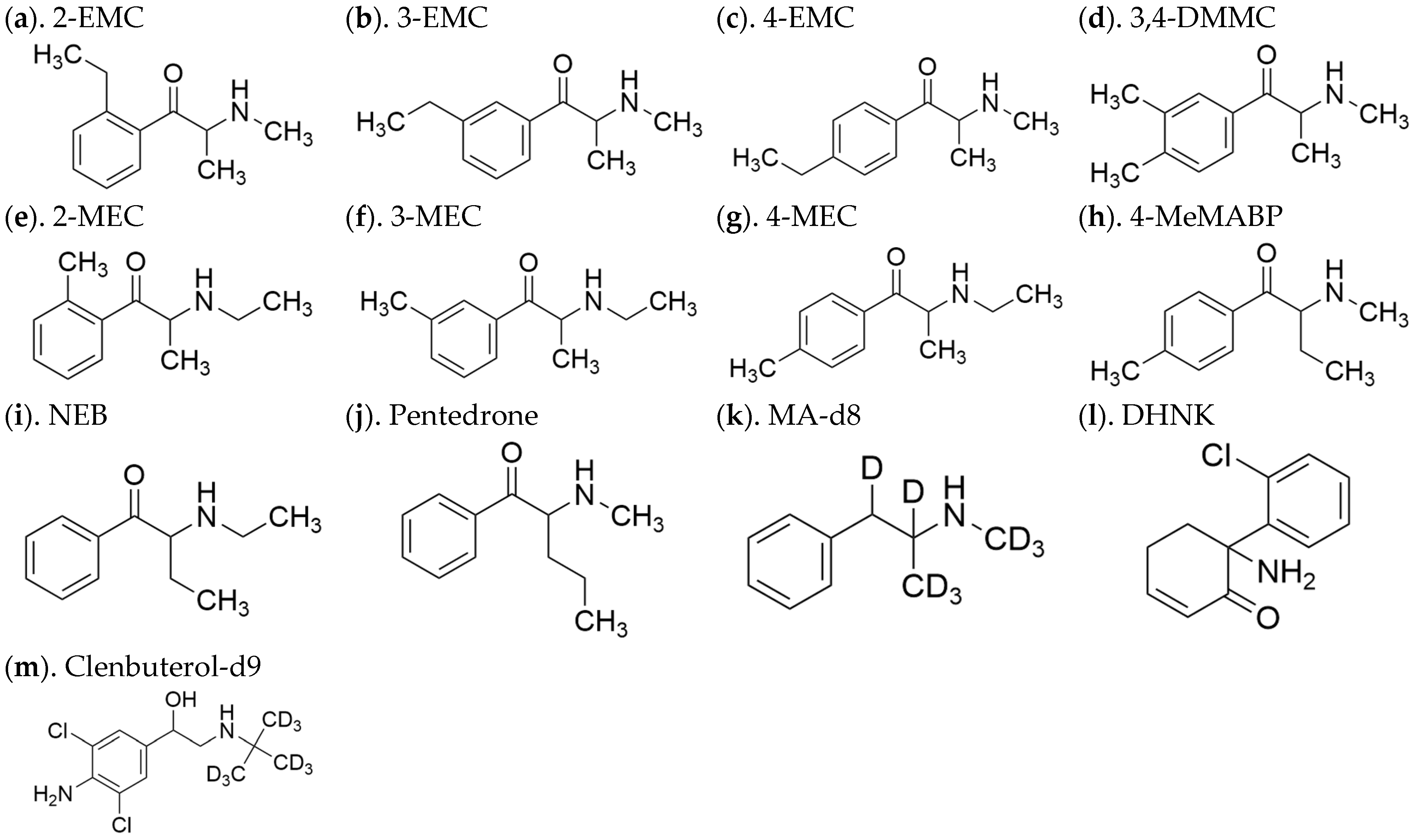
Analytical standards of 2-EMC (≥98% purity), 3-EMC (≥98% purity), 4-EMC (≥98% purity), 3,4-DMMC (≥98% purity), 2-MEC (≥98% purity), 3-MEC (≥98% purity), 4-MEC (≥98% purity), 4-MeMABP (≥98% purity), NEB (≥98% purity), and pentedrone (≥98% purity) were purchased from Cayman Chemical (Ann Arbor, MI, USA). Internal standards (IS) were obtained as follows: methamphetamine-d8 (MA-d8, 1 mg/mL) from Cerilliant Corporation (Round Rock, TX, USA); dehydronorketamine (DHNK, ≥99% purity) from Formosa Laboratories (Taipei, Taiwan); and clenbuterol-d9 (≥98% purity) from Toronto Research Chemicals Inc. (North York, ON, Canada). Chemical structures of all analytes and ISs are shown in Figure 1.
Methanol (HPLC grade, ≥99.9%) and ethyl acetate (EA; HPLC grade, ≥99.5%) were obtained from Mallinckrodt (Paris, KY, USA). Hydrochloric acid (HCl, ACS reagent grade, ≥37.0%) and formic acid (FA, ACS reagent grade, 98.0–100.0%) were purchased from Riedel-deHaën (Seelze, Germany). TFAA (GC derivatization grade, ≥99.0%, MW 210 Da) and AA (ACS reagent grade, ≥99.0%, MW 102 Da) were purchased from Sigma-Aldrich (St. Louis, MO, USA). Ultrapure water was produced using a Millipore Elix 10 system with a Milli-Q purification unit (Merck, Rahway, NJ, USA).

2.2. Preparation of Standard Solutions for GC-MS Analysis

Individual isomer standards, MA-d8, and DHNK were diluted in methanol to 10 μg/mL. A mixed standard solution containing all ten isomers (each at 10 μg/mL) was also prepared. Aliquots of 100 μL of the individual or mixed solutions were spiked with 100 μL of MA-d8 (10 μg/mL) or DHNK (10 μg/mL), acidified with 100 μL of methanol containing 0.1% HCl, and evaporated to dryness under a nitrogen stream at 60 °C. The residues were reconstituted in 50 μL of EA and derivatized with 50 μL TFAA or AA at 60 °C for 30 min. After derivatization, the samples were cooled to room temperature, evaporated to dryness under a nitrogen stream at 60 °C, and reconstituted in 100 μL of EA prior to GC-MS analysis, as described previously [36,37].
Individual-standard derivatives (TFAA or AA) were used to establish RTs, RRTs, mass-spectral profiles, and ion-ratio characteristics. Mixed-standard derivatives were used to generate chromatograms for evaluating chromatographic separation under simultaneous multi-analyte conditions.

2.3. GC-MS Conditions

GC-MS analyses were performed on an Agilent 7890A GC coupled to a 5975C quadrupole MS (Agilent Technologies, Palo Alto, CA, USA). Samples (1 μL) were injected in split mode (5:1) at an injector temperature of 250 °C. Chromatographic separation was achieved on an HP-5MS fused-silica column (12 m × 0.20 mm i.d., 0.33 µm film thickness; Agilent Technologies) with helium as the carrier gas at a constant flow rate of 0.6 mL/min. Three oven temperature programs were evaluated:
(1)
Program 1: The oven was held at 80 °C for 0.3 min, followed by a ramp to 190 °C at 35 °C/min with a 0.1 min hold, and then increased to 280 °C at 30 °C/min. The total run time was 6.54 min.
(2)
Program 2: The oven was held at 80 °C for 0.3 min, followed by a ramp to 190 °C at 10 °C/min with a 0.1 min hold, and then increased to 280 °C at 30 °C/min. The total run time was 14.4 min.
(3)
Program 3: The oven was held at 80 °C for 0.3 min, followed by a ramp to 190 °C at 5 °C/min with a 0.1 min hold, and then increased to 280 °C at 30 °C/min and held for 2.86 min. The total run time was 28.26 min.
The MS operated in EI full-scan mode (m/z 50–500).

2.4. Optimization of LC-MS/MS Conditions

Individual isomer standards and clenbuterol-d9 were first diluted to 1 μg/mL in methanol to optimize collision energies (CEs) and to identify the most abundant product ions. These experiments were used exclusively to establish the precursor-to-product ion transitions and CEs, which are summarized in Table 1.
After MS/MS parameters were established, a mixed-standard solution containing all ten isomers and clenbuterol-d9 (each at 1 μg/mL in methanol) was analyzed to evaluate chromatographic performance under multi-analyte conditions. A 10-μL injection was used to assess the actual chromatographic separation. LC separation was performed on an Agilent ZORBAX SB-C18 column (100 mm × 2.1 mm i.d., 1.8 μm particle size) at 0.32 mL/min using an isocratic mobile phase of 10% methanol in water with 0.1% FA (total analysis time: 35.0 min). Mass spectrometric detection was carried out on a Thermo Scientific TSQ Quantum triple-quadrupole MS (Fisher Scientific, Waltham, MA, USA) equipped with an ESI source operated in positive multiple-reaction monitoring (MRM) mode. Instrument settings were: collision gas, argon; collision cell pressure, 1.0 mTorr; capillary temperature, 270 °C; and spray voltage, 3500 V.

2.5. Calculations

Relative retention time (RRT) was calculated as follows [25]:
R R T = R T a n a l y t e R T I S
where RTanalyte and RTIS are the RTs of the analyte and IS, respectively.
In this study, the ten substituted isomers served as reference standards for one another. Chromatographic resolution (Rs) between adjacent peaks was calculated as [24,38]:
R s = T 2 T 1 ( W 2 + W 1 ) / 2
where T1 and T2 represent the RTs of the adjacent peaks, and W1 and W2 are their baseline widths.

3. Results

3.1. GC-MS Chromatogram and Mass Spectra of TFAA-Derivatized Isomers

RTs, RRTs (relative to MA-d8 and DHNK), base peaks, and major fragment ions with their ion-ratio tolerance limits are summarized in Table 2. Based on their mass-spectral features, the ten TFAA-derivatized isomers were grouped into three characteristic base-peak clusters: (1) m/z 182 (NEB and pentedrone); (2) m/z 133 (2-EMC, 3-EMC, 4-EMC, and 3,4-DMMC); (3) m/z 119 (2-MEC, 3-MEC, 4-MEC, and 4-MeMABP). Representative EI mass spectra are shown in Figure S1.
Within the m/z 182 group, NEB and pentedrone were readily differentiated by their characteristic fragment ions (m/z 154 vs. 140) and distinct ion-ratio patterns (m/z 77, 105). Among the m/z 133 group, RRT differences > 1% differentiated 2-EMC, 3-EMC, and 4-EMC, while the ion ratio at m/z 154 uniquely identified 3-EMC. In the m/z 119 group, 4-MEC displayed a distinct RRT, whereas 2-MEC, 3-MEC, and 4-MeMABP were distinguished by diagnostic ion-ratios at m/z 140 and 168; notably, the ion ratios at m/z 140 differentiated 2-MEC, 3-MEC, and 4-MeMABP from one another and the ion ratios at m/z 168 distinguished 3-MEC from 2-MEC and 4-MeMABP despite their similar RRTs (Table 2).
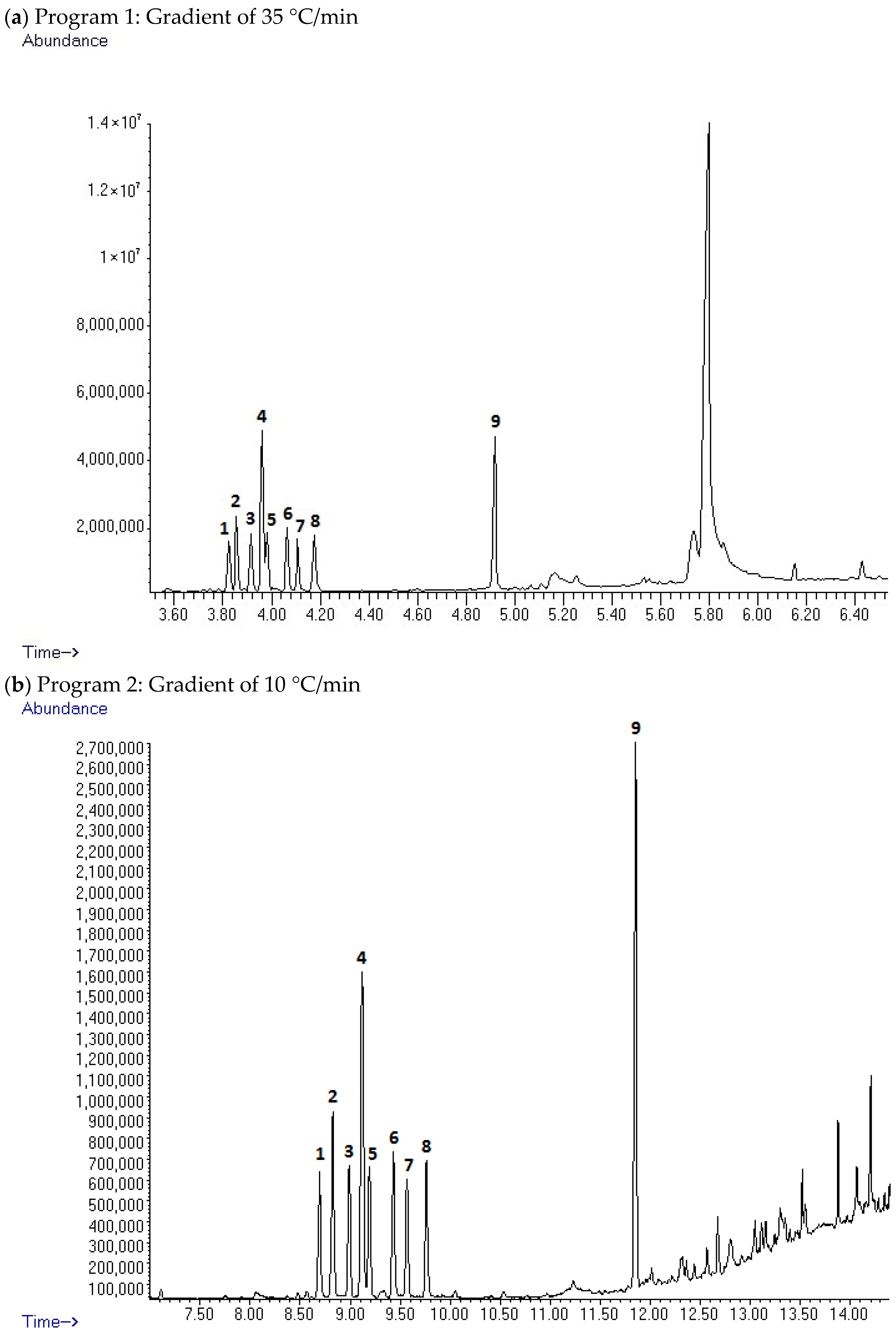
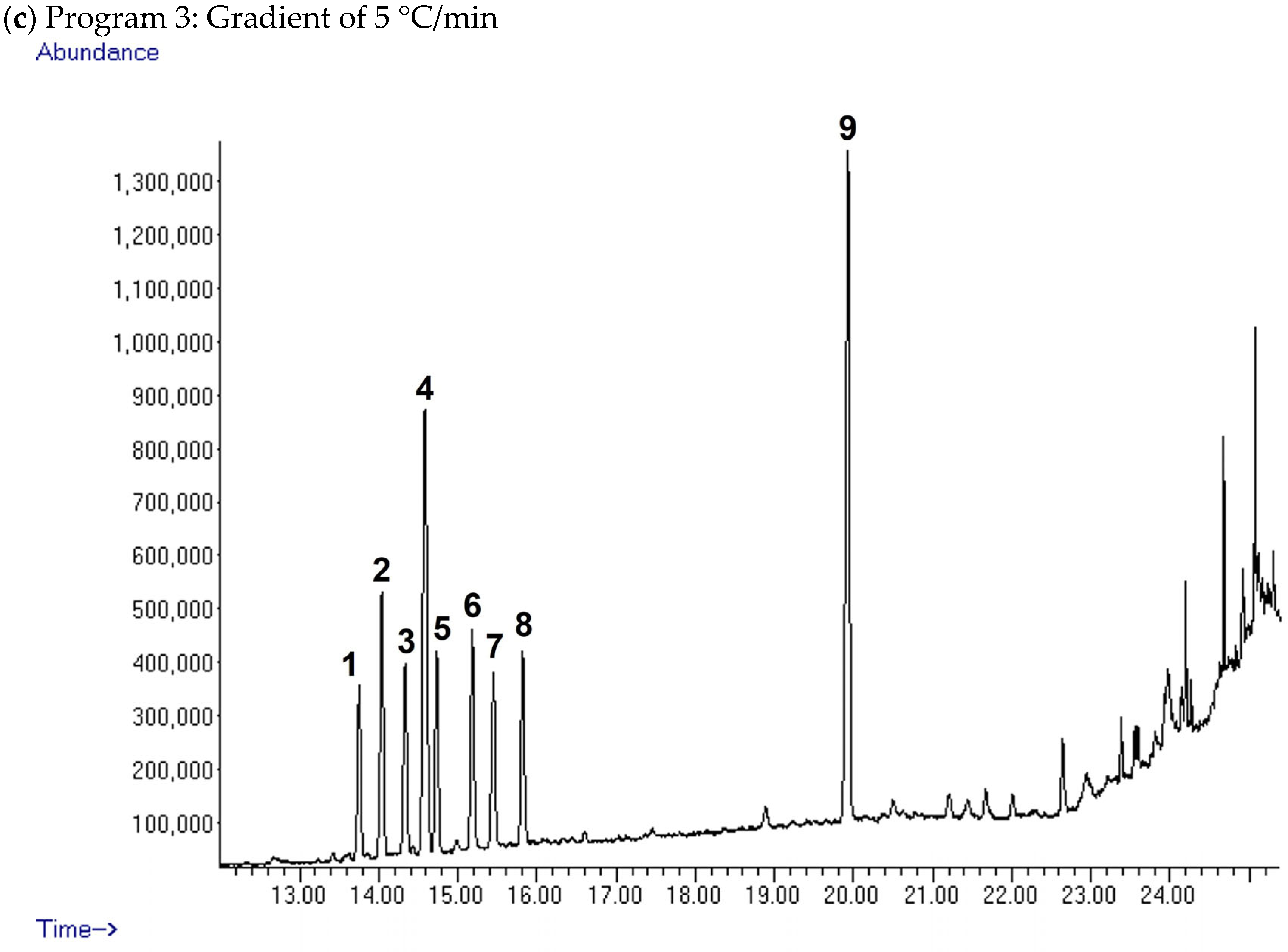
The elution order of the mixed-standard TFAA derivatives was: (1) NEB; (2) pentedrone; (3) 2-EMC; (4) 2-MEC, 3-MEC, and 3-EMC; (5) 4-MeMABP; (6) 4-MEC; (7) 4-EMC; (8) 3,4-DMMC; and (9) DHNK (IS). Peaks 1 and 2 were only partially resolved (Rs = 1.00). Peak 4 consisted of three co-eluting isomers that were not fully separated from peak 5 (Figure 2a). Reducing the oven ramp to 10 °C/min improved the resolution between peaks 1 and 2 (Rs = 1.67), but peaks 4 and 5 remained only partially separated (Rs = 1.08; Figure 2b). Further decreasing the ramp to 5 °C/min (Figure 2c) or using a longer column (30 m, same stationary phase and a 10 °C/min ramp) did not resolve the three co-eluting isomers of peaks 4.

3.2. GC-MS Chromatogram and Mass Spectra of AA-Derivatized Co-Eluting Isomers

The four isomers in peaks 4 and 5 (2-MEC, 3-MEC, 3-EMC, and 4-MeMABP) were derivatized with AA and analyzed using 35 °C/min and 5 °C/min oven programs. Their RTs, RRTs (relative to DHNK), base peaks, and major fragment ions were summarized in Table 3.
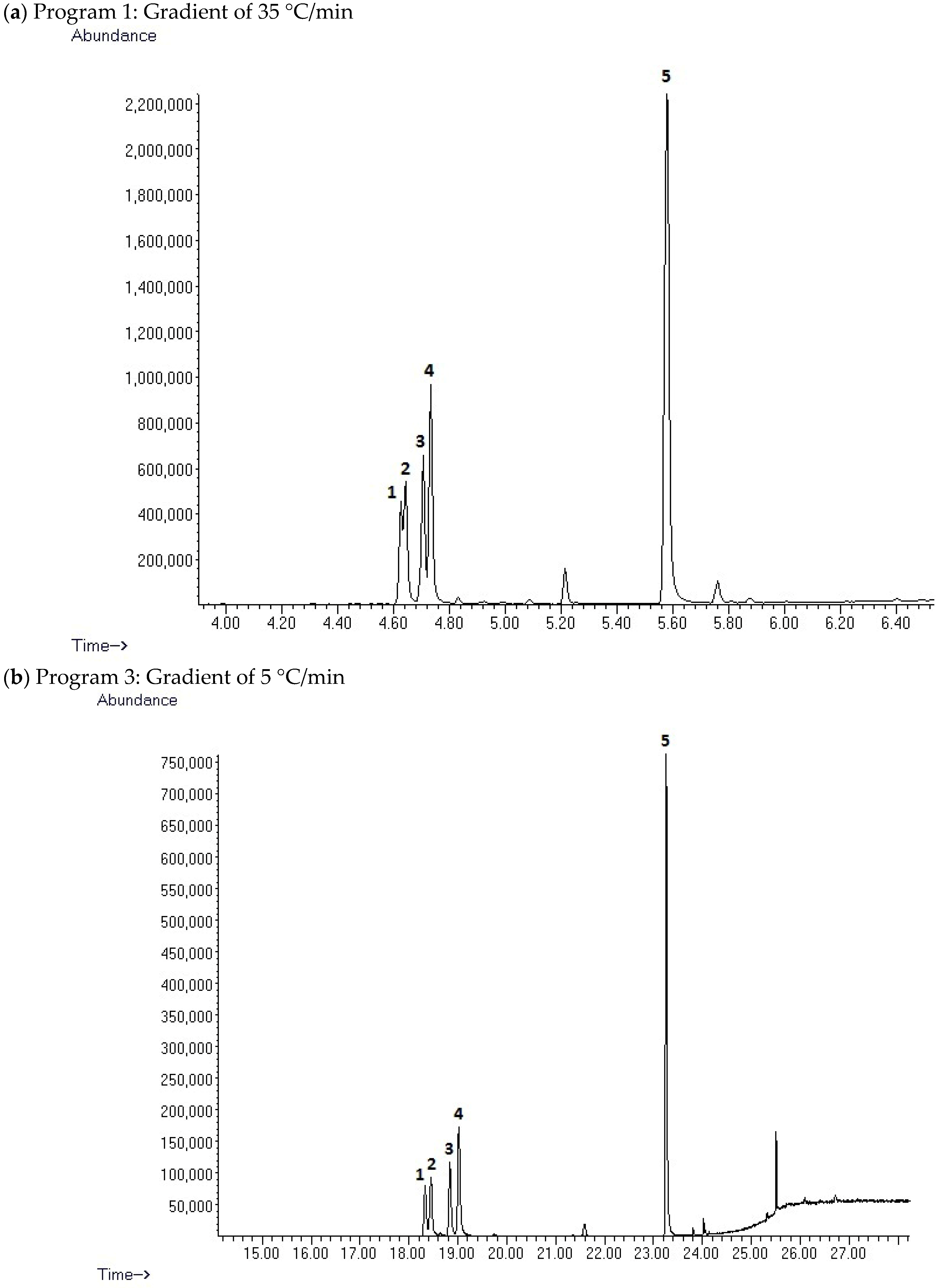
AA-derivatized 2-MEC, 3-MEC, and 4-MeMABP displayed similar fragmentation patterns dominated by m/z 72 and characteristic ions at m/z 114, 91, and 119, whereas 3-EMC yielded a distinct spectrum dominated by m/z 58 with prominent ions at m/z 100, 77, and 133 (Figure S2). At a ramp rate of 35 °C/min, the elution order of the AA-derivatized isomers was (1) 2-MEC, (2) 3-MEC, (3) 3-EMC, and (4) 4-MeMABP (RTs: 4.624, 4.643, 4.703, and 4.731 min, respectively), forming two partially resolved peaks (Figure 3a). At 5 °C/min, both isomer pairs achieved baseline separation (Rs = 1.41 and 1.77; Figure 3b).

3.3. Identification of Ten Isomers by LC-MS/MS

The LC-MS/MS RTs, RRTs, and major product-ion ratios for each isomer (Table 4) were obtained from individual-standard solutions. These measurements served as reference characteristics for evaluating chromatographic behavior under mixed-analyte conditions.
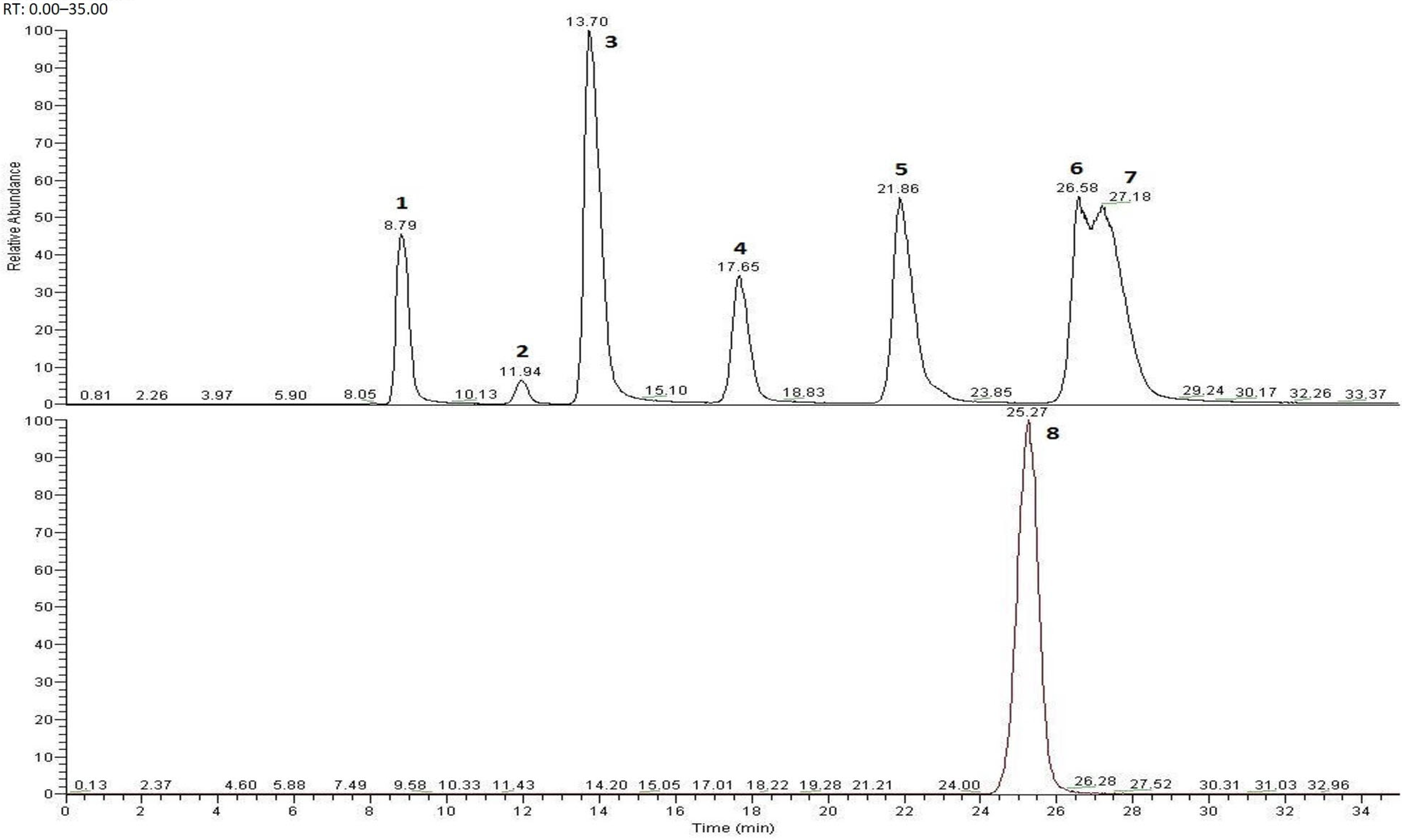
A mixed-standard solution containing all ten isomers and clenbuterol-d9 was then analyzed to assess the chromatographic separation achievable in a multi-analyte system. The resulting chromatogram (Figure 4) showed the following elution order: (1) NEB, (2) 2-MEC, (3) 4-MEC and 3-MEC, (4) pentedrone, (5) 4-MeMABP and 2-EMC, (6) 3,4-DMMC, (7) 3-EMC and 4-EMC, (8) clenbuterol-d9 (IS).
NEB, 2-MEC, pentedrone, and 3,4-DMMC exhibited RTs consistent with those obtained from the individual standards and were readily distinguished by their characteristic transition pairs (m/z 174 → 130 for NEB; m/z 174 → 91/131/132 for pentedrone; m/z 174 → 158/159 for 3,4-DMMC).
For the remaining isomers, individual-standard RRT values indicated that only two pairs—4-MeMABP vs. 2-EMC (3.43–3.56%) and 3-EMC vs. 4-EMC (1.01–1.02%)—met the ≥1% RRT difference criterion for chromatographic differentiation. However, these separations were not retained in the mixed-analyte chromatogram: 4-MeMABP and 2-EMC co-eluted as a single fused peak (peak 5), while 3-EMC and 4-EMC showed at least partial overlap. The 4-MEC/3-MEC pair, which exhibited <1% RRT difference (0.15–0.18%) in individual-standard measurement, also remained unresolved in the mixed-standard run. Overall, the isomer pairs 4-MeMABP/2-EMC, 3-EMC/4-EMC, and 4-MEC/3-MEC were not fully resolved in the LC-MS/MS mixed-standard analysis.
Because the unresolved isomers shared identical major product ions (m/z 144–146) and produced ion-ratio values within tolerance limits, chromatographic behavior in the mixed analysis served as the primary basis for assessing their resolvability under routine LC-MS/MS conditions.

4. Discussion

GC-MS analysis of the ten substituted cathinone isomers derivatized with TFAA produced distinct elution and fragmentation patterns that enabled partial differentiation among structural isomers. Three characteristic mass-spectral clusters were observed, grouping them into—m/z 182, 133, and 119—corresponding to NEB/pentedrone, the EMC series, and the MEC/MeMABP series, respectively. Fragment ions such as m/z 154 for NEB, m/z 140 for pentedrone, and m/z 154 for 3-EMC provided reliable markers for differentiation within each cluster. In the m/z 119 group, 4-MEC showed a distinct chromatographic shift, whereas 2-MEC, 3-MEC, and 4-MeMABP were distinguished mainly by diagnostic ion ratios at m/z 140 and 168. Despite these distinguishing features, partial co-elution persisted—most notably between peaks 1–2 and among the three isomers comprising peak 4—regardless of column length or reduced temperature ramp rates.
To improve the chromatographic resolution of these closely eluting compounds, AA derivatization was applied to the four isomers corresponding to the TFAA peaks 4 and 5 (2-MEC, 3-MEC, 3-EMC, and 4-MeMABP) [35,39]. Under a slower oven ramp (5 °C/min), both pairs of isomers (2-MEC/3-MEC and 3-EMC/4-MeMABP) achieved baseline resolution, an outcome not attainable under TFAA conditions. The AA-derivatized spectra were dominated by m/z 72, with additional ions at m/z 114 and 91, whereas 3-EMC produced a distinct fragmentation pattern. These findings demonstrate that AA provides greater chromatographic discrimination for certain structural isomers that remain unresolved following TFAA derivatization.
The enhanced resolution achieved with AA could be attributed to differences in derivatization chemistry. Although both TFAA and AA are acylating reagents suitable for secondary amines, they generate derivatives with different chromatographic behaviors [37,40]. TFAA forms trifluoroacetyl derivatives that are generally more volatile and elute more rapidly, which is advantageous for screening but may compress retention differences among closely related isomers [34,37]. In contrast, AA produces acetyl derivatives with slightly lower volatility and longer chromatographic retention [39,41]. Under slower oven temperature programs, this extended analyte–stationary phase interaction may allow subtle structural and positional differences among the isomers to be expressed more effectively as retention differences. Therefore, the improved separation observed with AA in this study is more likely attributable to altered chromatographic selectivity than to fundamentally different mass-spectral discrimination. Similar benefits of derivatization in enhancing chromatographic and analytical discrimination of new psychoactive substances have also been reported previously [15,33,36,37]. Silylation and alkylation were not used, as they better target hydroxyl- or carboxyl-containing compounds rather than the amine- and carbonyl-based cathinones examined here [34].
The oven temperature program further influenced chromatographic performance. Slower temperature ramps increased analyte–stationary phase interactions, improving resolution among compounds with similar physicochemical properties [15]. For instance, decreasing the ramp from 35 °C/min to 5 °C/min enabled baseline separation of the AA-derivatized isomers, an effect likely aided by the reduced thermal degradation during elution [40]. However, slower ramps were associated with reduced signal intensity, probably because volatilization and ionization became less efficient, consistent with previous findings [15]. Despite this limitation, optimizing the oven program remains critical for achieving reliable chromatographic resolution of synthetic cathinone isomers.
LC-MS/MS provided complementary confirmation but also revealed an intrinsic limitation for the differentiation of closely related cathinone isomers. Several analytes, including 4-/3-MEC, 4-MeMABP/2-EMC, and 3-/4-EMC, shared the same precursor ion and produced highly similar major product ions (m/z 144–146), indicating that collision-induced dissociation under triple-quadrupole MRM conditions generated only limited structural information for these compounds. Under such conditions, LC-MS/MS selectivity relies heavily on chromatographic separation rather than on transition uniqueness alone. This is particularly problematic for positional isomers, for which small structural differences may not translate into sufficiently distinct fragmentation pathways [18,19,20]. The present findings therefore suggest that, for MW 191 Da cathinones, LC-MS/MS should be regarded primarily as a complementary confirmatory tool rather than a standalone platform for definitive isomer differentiation. Importantly, the discrepancy between individual-standard and mixed-standard analyses further showed that apparent chromatographic distinguishability under simplified conditions may not be retained in multi-analyte systems, which more closely resemble real forensic samples.
An RT shift and peak fusion (from >22 min to 21.86 min) were observed for 2-EMC and 4-MeMABP in the mixed-standard LC-MS/MS chromatogram but not in individual-standard runs. Although the underlying causes were not fully investigated, they are less likely to be attributable to solvent effects [42,43], as both analyses were performed using identical solvent compositions and mobile-phase conditions. Such behavior may reflect competitive ionization, matrix-like interactions within the mixed standard, or co-elution-related suppression effects—phenomena previously noted in multi-component LC-MS/MS systems [44,45,46,47,48,49,50].
Although signals corresponding to all target analytes were observed under the applied conditions, the principal analytical difficulty was not detection itself, but the unambiguous differentiation of several closely related isomers because of insufficient chromatographic selectivity. Taken together, the combined GC-MS and LC-MS/MS workflow demonstrated here provides a useful strategy for qualitative identification of C12H17NO substituted cathinone isomers. This complementary workflow is particularly valuable in small-scale routine laboratories where access to advanced analytical instruments may be limited. Notwithstanding these analytical advantages, several limitations of the approach should be acknowledged.

5. Limitations

First, of the thirteen substituted cathinone isomers regulated in Taiwan, eight were investigated. Two additional non-regulated positional isomers of MEC (2-MEC and 3-MEC) were also analyzed because of their analytical similarity to 4-MEC, resulting in a total of ten analytes. The remaining five regulated isomers not examined in this study, namely 2,3-, 2,4-, and 2,5-DMMC and 2- and 3-MeMABP, are all classified as Schedule III controlled substances and have not yet been detected in Taiwan [3]. Further studies should include these compounds once authentic standards become readily accessible to provide a more comprehensive comparison among all C12H17NO isomers.
Second, derivatization was not applied in the LC-MS/MS analysis. As noted in the Discussion, the high proton affinity of secondary amines limits fragmentation efficiency in ESI, leading to relatively simple MS/MS spectra with insufficient structural information for reliable differentiation of isomers. Derivatization strategies such as carbamate formation using 2,2,2-trichloro-1,1-dimethylethyl chloroformate have been shown to enhance fragmentation by lowering proton affinity [51]; however, their applicability to position isomers of cathinones remains unclear. Future work should assess whether such derivatization approaches can improve isomeric differentiation while maintaining compatibility with routine LC-MS/MS workflows.
Third, the ISs used in this study—MA-d8 and DHNK for GC-MS and clenbuterol-d9 for LC-MS/MS—were selected based on availability and cost. Because the present study focused on qualitative identification rather than quantitative measurement, the use of a limited number of ISs was considered appropriate [52,53]. Nonetheless, incorporating multiple isotopically labeled analogs may further improve normalization across matrices in future validation studies.
Finally, the mixed-standard experiments revealed chromatographic interactions not observed in individual-standard runs, such as the RT shift and peak fusion of 2-EMC and 4-MeMABP in LC-MS/MS. These effects were not further investigated, but they highlight an additional limitation: the behavior of co-eluting isomers in mixed systems may differ from that predicted using individual standards. In addition, the AA derivatization experiment in this study was limited to the four unresolved isomers identified after TFAA derivatization and was not systematically evaluated against all other possible AA-derivatized MW 191 Da cathinone isomers. A direct side-by-side comparison with the non-derivatized cathinones was also not systematically included in the present study. Therefore, the advantages of derivatization were evaluated primarily through comparison between the TFAA- and AA-derivatized analytes rather than between derivatized and non-derivatized compounds. Further evaluation of concentration-dependent or solvent-induced interactions, as well as the selectivity of this targeted follow-up approach in more complex multi-analyte mixtures and unknown forensic samples, would strengthen the robustness of isomer identification protocols.

6. Conclusions

This study established an integrated EI-GC-MS and ESI-LC-MS/MS workflow for the qualitative identification of ten substituted cathinone isomers (C12H17NO, MW 191 Da). TFAA derivatization enabled initial differentiation based on characteristic chromatographic and mass-spectral features, whereas AA derivatization under slower oven-temperature programs further improved the separation of closely related isomers. LC-MS/MS provided complementary confirmation, particularly for NEB, 2-MEC, pentedrone, and 3,4-DMMC, although some positional isomers remained difficult to distinguish due to shared product ions.
By integrating chromatographic resolution, ion-ratio criteria, and RRT evaluation, the workflow demonstrated that reliable qualitative identification of highly similar MW 191 Da cathinones can be achieved using instrumentation commonly available in hospital laboratories. This approach enhances routine forensic capabilities for distinguishing controlled substances from their structural analogs. Continued expansion of this workflow to additional isomers and evaluation of advanced derivatization strategies may further improve isomeric discrimination in LC-MS/MS systems.

Supplementary Materials

The following supporting information can be downloaded at: https://www.mdpi.com/article/10.3390/chemosensors14040096/s1. Figure S1. GC-MS mass spectra of ten TFAA-derivatized substituted cathinone isomers obtained from TFAA-derivatized individual standards using oven temperature program 1 (35 °C/min). The proposed fragment ions, indicated by dashed lines, are shown in the upper right corner, and the molecular ion in Figure S1a is marked with an arrow. Figure S2. GC-MS mass spectra of four AA-derivatized substituted cathinone isomers (derived from AA-derivatized individual standards). The proposed fragment ions, indicated by dashed lines, are shown in the upper right corner, and the molecular ion in Figure S2a is marked with an arrow.

Author Contributions

Conceptualization, S.-R.L., Y.-C.M., A.C.L. and Y.-C.S.; methodology, S.-R.L., Y.-C.M., A.C.L. and Y.-C.S.; investigation, S.-R.L., Y.-C.M. and A.C.L.; data analysis, S.-R.L., Y.-C.M., H.-W.H., J.-J.L. and Y.-C.S.; writing—original draft preparation, S.-R.L.; writing—review and editing, Y.-C.M., H.-W.H., J.-J.L. and Y.-C.S. All authors have read and agreed to the published version of the manuscript.

Funding

This work was supported by grant TCIRP 98005-05Y3 from the Tzu Chi Foundation. The funder had no role in study design, data collection and analysis, decision to publish, or preparation of the manuscript.

Institutional Review Board Statement

Not applicable.

Informed Consent Statement

Not applicable.

Data Availability Statement

The datasets generated and/or analyzed during this study are not publicly available, as the data are not public, but are available from the corresponding author upon reasonable request.

Acknowledgments

The authors gratefully acknowledge Shu-Mei Chi, Hsiao-Chia Liao, Su-Chin Chen, Yu-Cheng Li, Szu-Yin Hsieh, and Sin-Tong Lan for their assistance with mass spectrometry analysis and data collection.

Conflicts of Interest

The authors declare no conflicts of interest.

Abbreviations

2-, 3-, 4-EMC2-, 3-, 4-ethylmethcathinone
2-, 3-, 4-MEC2-, 3-, 4-methylethcathinone
2-, 3-, 4-MeMABP2-, 3-, 4-methylbuphedrone
2,3-, 2,4-, 2,5-, 3,4-DMMC2,3-, 2,4-, 2,5-, 3,4-dimethylmethcathinone
AAacetic anhydride
CEcollision energy
DHNKdehydronorketamine
EAethyl acetate
EI-GC-MSelectron ionization gas chromatography mass spectrometry
ESI-LC-MS/MSelectrospray ionization liquid chromatography tandem mass spectrometry
FAformic acid
GCgas chromatography
HClhydrochloric acid
HPLChigh-performance liquid chromatography
ISinternal standard
LCliquid chromatography
MA-d8methamphetamine-d8
MRMmultiple reaction monitoring
MSmass spectrometry
MWmolecular weight
NEBN-ethylbuphedrone
NPSnew psychoactive substances
RRTrelative retention time
Rschromatographic resolution
RTretention time
TFAAtrifluoroacetic anhydride
TFDATaiwan Food and Drug Administration

References

  1. UNODC Early Warning Advisory on New Psychoactive Substances. What Are NPS? Available online: https://www.unodc.org/LSS/Page/NPS (accessed on 2 December 2025).
  2. UNODC Early Warning Advisory on New Psychoactive Substances. Data Visualization—Public. Available online: https://www.unodc.org/LSS/Page/NPS/DataVisualisations (accessed on 6 April 2026).
  3. Taiwan Food and Drug Administration. List of New Psychoactive Substances (NPS) Detected in Taiwan. Available online: https://www.fda.gov.tw/tc/site.aspx?sid=9958&r=97198537 (accessed on 6 April 2026).
  4. Taiwan High Prosecutors Office. Rapid Analysis of the Drug Situation in 2025. Available online: https://www.tph.moj.gov.tw/4421/4599/4603/749677/937043/post (accessed on 6 April 2026).
  5. Taiwan Food and Drug Administration. Statistics on Drug Abuse Cases and Testing. 2024. Available online: https://www.fda.gov.tw/tc/site.aspx?sid=1578&r=1521776557 (accessed on 2 December 2025).
  6. U.S. Department of Justice. Drug Enforcement Administration. Lists of Scheduling Actions, Controlled Substances, Regulated Chemicals. Available online: https://www.deadiversion.usdoj.gov/schedules/schedules.html (accessed on 4 October 2025).
  7. Laws and Regulations Database of the Republic of China (Taiwan). Narcotics Hazard Prevention Act. Available online: https://law.moj.gov.tw/LawClass/LawAll.aspx?pcode=C0000008 (accessed on 22 September 2025).
  8. Ministry of Public Security of the People’s Republic of China. Schedule of Non-Medical Narcotic Drugs and Psychotropic Substances. Available online: https://www.mps.gov.cn/n6557558/c10150600/content.html (accessed on 22 September 2025).
  9. Kojić, I.; Đurović, V.M.; Smyatskaya, Y.A.; Brkljača, N.; Skhvediani, A.E.; Vasin, A.V.; Stojanović, K.; Đurović, S.D. Methods for GC/MS Analysis of the Most Commonly Seized Drugs of Abuse and Their Metabolites in Biological Samples. Chemosensors 2025, 13, 286. [Google Scholar] [CrossRef]
  10. Wong, S.L.; Ng, L.T.; Tan, J.; Pan, J. Screening unknown novel psychoactive substances using GC–MS based machine learning. Forensic Chem. 2023, 34, 100499. [Google Scholar] [CrossRef]
  11. Archer, R.P.; Treble, R.; Williams, K. Reference materials for new psychoactive substances. Drug Test. Anal. 2011, 3, 505–514. [Google Scholar] [CrossRef]
  12. ANSI/ASB Standard 113; F.E. Standard for Identification Criteria in Forensic Toxicology. AAFS Standards Board: Colorado Springs, CO, USA, 2023.
  13. Harris, D.N.; Hokanson, S.; Miller, V.; Jackson, G.P. Fragmentation differences in the EI spectra of three synthetic cannabinoid positional isomers: JWH-250, JWH-302, and JWH-201. Int. J. Mass Spectrom. 2014, 368, 23–29. [Google Scholar] [CrossRef]
  14. Kranenburg, R.F.; Peroni, D.; Affourtit, S.; Westerhuis, J.A.; Smilde, A.K.; van Asten, A.C. Revealing hidden information in GC–MS spectra from isomeric drugs: Chemometrics based identification from 15 eV and 70 eV EI mass spectra. Forensic Chem. 2020, 18, 100225. [Google Scholar] [CrossRef]
  15. Tseng, L.-P.; Lan, Y.-S.; Lee, Y.-H.; Lee, Y.-C.; Chou, Y.-C.; Lee, H.-H.; Chang, M.-Y.; Liang, S.-S.; Lin, Y.-C. Optimizing analytical precision in the identification of synthetic cathinones and isomers: A comparative assessment of diverse GC–MS operating parameters. Anal. Sci. 2024, 40, 1397–1407. [Google Scholar] [CrossRef] [PubMed]
  16. Kupriyanova, O.V.; Shevyrin, V.A.; Shafran, Y.M. Potential of chromatography and mass spectrometry for the differentiation of three series of positional isomers of 2-(dimethoxyphenyl)-N-(2-halogenobenzyl) ethanamines. Drug Test. Anal. 2022, 14, 1102–1115. [Google Scholar] [CrossRef] [PubMed]
  17. Meyer, M.R.; Maurer, H.H. Review: LC coupled to low- and high-resolution mass spectrometry for new psychoactive substance screening in biological matrices—Where do we stand today? Anal. Chim. Acta 2016, 927, 13–20. [Google Scholar] [CrossRef]
  18. Maas, A.; Sydow, K.; Madea, B.; Hess, C. Separation of ortho, meta and para isomers of methylmethcathinone (MMC) and methylethcathinone (MEC) using LC-ESI-MS/MS: Application to forensic serum samples. J. Chromatogr. B 2017, 1051, 118–125. [Google Scholar] [CrossRef]
  19. Takeda, A.; Tagami, T.; Asada, A.; Doi, T.; Kawaguchi, M.; Satsuki, Y.; Sawabe, Y. Regioisomeric separation of ring-substituted cathinones by liquid chromatography–mass spectrometry with a naphthylethyl column. Forensic Toxicol. 2017, 35, 399–407. [Google Scholar] [CrossRef]
  20. Grumann, C.; Auwärter, V. Separation of positional isomers of nine 2-phenethylamine-derived designer drugs by liquid chromatography–tandem mass spectrometry. Drug Test. Anal. 2018, 10, 1184–1191. [Google Scholar] [CrossRef]
  21. Aldubayyan, A.A.; Castrignanò, E.; Elliott, S.; Abbate, V. Development and validation of a chiral LC-MS/MS method for the separation and quantification of four synthetic cathinones in human whole blood and its application in stability analysis. Talanta 2023, 253, 123986. [Google Scholar] [CrossRef]
  22. Peters, F.T.; Wissenbach, D.K.; Busardo, F.P.; Marchei, E.; Pichini, S. Method development in forensic toxicology. Curr. Pharm. Des. 2017, 23, 5455–5467. [Google Scholar] [CrossRef]
  23. Rivier, L. Criteria for the identification of compounds by liquid chromatography–mass spectrometry and liquid chromatography–multiple mass spectrometry in forensic toxicology and doping analysis. Anal. Chim. Acta 2003, 492, 69–82. [Google Scholar] [CrossRef]
  24. CLSI. C43-A2 Gas Chromatography/Mass Spectrometry Confirmation of Drugs. Approved Guideline—Second Edition (2010). Available online: https://clsi.org/shop/standards/c43/ (accessed on 21 September 2025).
  25. Daéid, N.N. FORENSIC SCIENCES|Systematic Drug Identification. In Encyclopedia of Analytical Science, 2nd ed.; Worsfold, P., Townshend, A., Poole, C., Eds.; Elsevier: Oxford, UK, 2005; pp. 471–480. [Google Scholar]
  26. WADA Science/IDCR Working Group. WADA Technical Document—TD2023IDCR (2023). Available online: https://www.wada-ama.org/en/resources/lab-documents/td2023idcr (accessed on 21 September 2025).
  27. Davidson, J.T.; Lum, B.J.; Nano, G.; Jackson, G.P. Comparison of measured and recommended acceptance criteria for the analysis of seized drugs using Gas Chromatography–Mass Spectrometry (GC–MS). Forensic Chem. 2018, 10, 15–26. [Google Scholar] [CrossRef]
  28. Taiwan Food and Drug Administration. Standards for the Establishment of Drug Testing Institutions and Guidelines for Accreditation Management. 11 April 2023. Available online: https://www.fda.gov.tw/tc/siteContent.aspx?sid=10878 (accessed on 24 September 2025).
  29. Power, J.D.; McGlynn, P.; Clarke, K.; McDermott, S.D.; Kavanagh, P.; O’Brien, J. The analysis of substituted cathinones. Part 1: Chemical analysis of 2-, 3- and 4-methylmethcathinone. Forensic Sci. Int. 2011, 212, 6–12. [Google Scholar] [CrossRef]
  30. Gathungu, R.M.; Kautz, R.; Kristal, B.S.; Bird, S.S.; Vouros, P. The integration of LC-MS and NMR for the analysis of low molecular weight trace analytes in complex matrices. Mass Spectrom. Rev. 2020, 39, 35–54. [Google Scholar] [CrossRef] [PubMed]
  31. Li, Z.; Shi, Y.; Li, Z.; Zhao, J.; Wang, X.; Wang, K.; Su, M.; Xiang, P. Separation and identification of the synthetic cathinone isomers dipentylone and N-ethylpentylone using chromatographic and mass spectral characteristics. Forensic Chem. 2024, 37, 100551. [Google Scholar] [CrossRef]
  32. Dimić, D. Emerging Novel Psychoactive Substances (2020–2025): GC-MS Approaches for Separation, Detection, and Characterization. Chemosensors 2025, 13, 426. [Google Scholar] [CrossRef]
  33. Kranenburg, R.F.; Verduin, J.; Stuyver, L.I.; de Ridder, R.; van Beek, A.; Colmsee, E.; van Asten, A.C. Benefits of derivatization in GC–MS-based identification of new psychoactive substances. Forensic Chem. 2020, 20, 100273. [Google Scholar] [CrossRef]
  34. Glicksberg, L.; Kerrigan, S. Derivatization. In Principles of Forensic Toxicology; Springer: Berlin/Heidelberg, Germany, 2020; pp. 163–175. [Google Scholar]
  35. Dobos, A.; Hidvégi, E.; Somogyi, G.P. Comparison of five derivatizing agents for the determination of amphetamine-type stimulants in Human urine by extractive acylation and gas chromatography–mass spectrometry. J. Anal. Toxicol. 2012, 36, 340–344. [Google Scholar] [CrossRef]
  36. Lin, T.C.; Lin, D.L.; Lua, A.C. Detection of p-chloroamphetamine in urine samples with mass spectrometry. J. Anal. Toxicol. 2011, 35, 205–210. [Google Scholar] [CrossRef] [PubMed][Green Version]
  37. Alsenedi, K.A.; Morrison, C. Comparison of six derivatizing agents for the determination of nine synthetic cathinones using gas chromatography-mass spectrometry. Anal. Methods 2017, 9, 2732–2743. [Google Scholar] [CrossRef]
  38. CLSI. CLSI C62:2022: Protocol for LC-MS Methods Development and Validation. Clinical and Laboratory Standards Institute. 2022. Available online: https://clsi.org/shop/standards/c62/ (accessed on 24 July 2025).
  39. Baker, G.B.; Coutts, R.T.; Holt, A. Derivatization with acetic anhydride: Applications to the analysis of biogenic amines and psychiatric drugs by gas chromatography and mass spectrometry. J. Pharmacol. Toxicol. Methods 1994, 31, 141–148. [Google Scholar] [CrossRef]
  40. Kerrigan, S.; Savage, M.; Cavazos, C.; Bella, P. Thermal Degradation of Synthetic Cathinones: Implications for Forensic Toxicology. J. Anal. Toxicol. 2016, 40, bkv099. [Google Scholar] [CrossRef][Green Version]
  41. Kataoka, H. Derivatization reactions for the determination of amines by gas chromatography and their applications in environmental analysis. J. Chromatogr. A 1996, 733, 19–34. [Google Scholar] [CrossRef] [PubMed]
  42. Stoll, D.R.; Mack, A.E. Mind the Diluent: Effects of Sample Diluent on Analyte Recovery in Reversed-Phase and HILIC Separations. LC-GC Eur. 2019, 37, 32. [Google Scholar]
  43. Dolan, J.W. How much retention time variation is normal? LCGC N. Am. 2014, 32, 418–423. [Google Scholar]
  44. Kebarle, P.; Tang, L. From ions in solution to ions in the gas phase-the mechanism of electrospray mass spectrometry. Anal. Chem. 1993, 65, 972A–986A. [Google Scholar] [CrossRef]
  45. Bonfiglio, R.; King, R.C.; Olah, T.V.; Merkle, K. The effects of sample preparation methods on the variability of the electrospray ionization response for model drug compounds. Rapid Commun. Mass Spectrom. 1999, 13, 1175–1185. [Google Scholar] [CrossRef]
  46. King, R.; Bonfiglio, R.; Fernandez-Metzler, C.; Miller-Stein, C.; Olah, T. Mechanistic investigation of ionization suppression in electrospray ionization. J. Am. Soc. Mass Spectrom. 2000, 11, 942–950. [Google Scholar] [CrossRef] [PubMed]
  47. Matuszewski, B.K.; Constanzer, M.; Chavez-Eng, C. Strategies for the assessment of matrix effect in quantitative bioanalytical methods based on HPLC− MS/MS. Anal. Chem. 2003, 75, 3019–3030. [Google Scholar] [CrossRef] [PubMed]
  48. Gosetti, F.; Mazzucco, E.; Zampieri, D.; Gennaro, M.C. Signal suppression/enhancement in high-performance liquid chromatography tandem mass spectrometry. J. Chromatogr. A 2010, 1217, 3929–3937. [Google Scholar] [CrossRef]
  49. Trufelli, H.; Palma, P.; Famiglini, G.; Cappiello, A. An overview of matrix effects in liquid chromatography–mass spectrometry. Mass Spectrom. Rev. 2011, 30, 491–509. [Google Scholar] [CrossRef] [PubMed]
  50. Furey, A.; Moriarty, M.; Bane, V.; Kinsella, B.; Lehane, M. Ion suppression; a critical review on causes, evaluation, prevention and applications. Talanta 2013, 115, 104–122. [Google Scholar] [CrossRef]
  51. Shamai-Yamin, T.; Shifrovich, A.; Madmon, M.; Belay, C.; Prihed, H.; Blanca, M.; Hindi, A.; Zafrani, Y.; Berliner, A.; Weissberg, A. Elucidation of synthetic N-benzyl cathinone structures using chemical derivatization and liquid chromatography–tandem mass spectrometry analysis. Forensic Chem. 2022, 29, 100422. [Google Scholar] [CrossRef]
  52. Aldubayyan, A.A.; Castrignanò, E.; Elliott, S.; Abbate, V. A quantitative LC–MS/MS method for the detection of 16 synthetic cathinones and 10 metabolites and its application to suspicious clinical and forensic urine samples. Pharmaceuticals 2022, 15, 510. [Google Scholar] [CrossRef]
  53. Yang, F.-S.; Lee, H.-H.; Tseng, L.-P.; Lee, Y.-H.; Lan, Y.-S.; Lee, Y.-C.; Chou, Y.-C.; Lin, Y.-C. Simultaneous Determination and Stability Analysis of Ten New Psychoactive Substances including Synthetic Cathinones, Phenethylamines, and Ketamine Substitutes in Urine Using Liquid Chromatography-Tandem Mass Spectrometry. Int. J. Anal. Chem. 2023, 2023, 9895595. [Google Scholar] [CrossRef]
Figure 1. Chemical structures of the ten substituted cathinone isomers and ISs.
Chemosensors 14 00096 g001
Figure 2. GC-MS total ion chromatogram of ten TFAA-derivatized substituted cathinone isomers and DHNK (IS). Peaks: (1) NEB; (2) pentedrone; (3) 2-EMC; (4) 2-MEC, 3-MEC, 3-EMC; (5) 4-MeMABP; (6) 4-MEC; (7) 4-EMC; (8) 3,4-DMMC; and (9) DHNK (IS). Only the numbered peaks correspond to the target analytes and DHNK (IS); unnumbered peaks represent non-target signals not assigned in this study. Oven temperature programs: (a) 35 °C/min; (b) 10 °C/min; (c) 5 °C/min.
Chemosensors 14 00096 g002aChemosensors 14 00096 g002b
Figure 3. GC-MS total ion chromatogram of four AA-derivatized substituted cathinone isomers. Peaks: (1) 2-MEC, (2) 3-MEC, (3) 3-EMC, (4) 4-MeMABP, and (5) DHNK (IS). Only the numbered peaks correspond to the target analytes and DHNK (IS); unnumbered peaks represent non-target signals not assigned in this study. Temperature programs: (a) 35 °C/min; (b) 5 °C/min.
Chemosensors 14 00096 g003
Figure 4. LC-MS/MS total ion chromatogram of ten substituted cathinone isomers and clenbuterol-d9 (IS). Peaks: (1) NEB, (2) 2-MEC, (3) 4-MEC and 3-MEC, (4) pentedrone, (5) 4-MeMABP, 2-EMC, (6) 3,4-DMMC, (7) 3-EMC, 4-EMC, and (8) clenbuterol-d9 (IS). Only the numbered peaks correspond to the target analytes and clenbuterol-d9 (IS).
Chemosensors 14 00096 g004
Table 1. LC-MS/MS parameters and the four most abundant product ions of the ten isomers and IS.
Fragment Ion m/z (CE) a
Analyte b Quantifier IonIon 1Ion 2Ion 3
2-EMC174 (12)144 (32)145 (21)146 (17)
3-EMC174 (12)144 (31)145 (20)146 (17)
4-EMC174 (12)144 (31)145 (21)146 (17)
3,4-DMMC174 (12)159 (20)158 (31)144 (30)
2-MEC174 (12)144 (29)145 (19)146 (16)
3-MEC174 (12)144 (29)145 (19)146 (17)
4-MEC174 (12)144 (29)145 (20)146 (17)
4-MeMABP174 (12)144 (31)145 (21)146 (17)
NEB174 (12)130 (29)146 (16)145 (19)
Pentedrone174 (12)132 (17)131 (24)91 (27)
Clenbuterol-d9204 (17)268 (11)169 (30)133 (28)
Note: (a) collision energy (eV); (b) precursor ion: m/z 192 for the ten isomers and m/z 286 for clenbuterol-d9 (IS).
Table 2. RT, RRT, and major ion ratios of ten TFAA-derivatized substituted cathinone isomers analyzed by GC-MS.
Fragment Ion m/z (Ion Ratio %; Ion Ratio Tolerances)
* AnalyteRT, minRRT aRRT bBase PeakIon 1Ion 2Ion 3
NEB3.9091.1910.77918277 (16.0; 12.80–19.20)105 (27.4; 23.29–31.51)154 (11.0; 8.80–13.20)
Pentedrone3.9401.2000.78518277 (24.5; 20.83–28.18)105 (56.9; 51.21–62.59)140 (57.3; 51.57–63.03)
2-EMC4.0051.2200.79713377 (6.6; 3.30–9.90)105 (10.9; 8.72–13.08)154 (14.0; 11.20–16.80)
3-EMC4.0551.2330.80713377 (6.0; 3.00–9.00)105 (12.8; 10.24–15.36)154 (25.8; 21.93–29.67)
4-EMC4.1981.2760.83613377 (5.4; 2.70–8.10)105 (8.2; 4.10–12.30)154 (15.9; 12.72–19.08)
3,4-DMMC4.2651.2990.85013377 (5.7; 2.85–8.55)105 (14.9; 11.92–17.88)154 (10.0; 5.00–15.00)
2-MEC4.0491.2320.80611991 (22.9; 19.47–26.34)140 (13.4; 10.72–16.08)168 (36.7; 31.20–42.21)
3-MEC4.0501.2320.80511991 (24.8; 21.08–28.52)140 (22.5; 19.13–25.88)168 (72.0; 64.80–79.20)
4-MeMABP4.0661.2390.81111991 (18.5; 14.80–22.20)140 (1.7; 0.85–2.55)168 (29.5; 25.08–33.93)
4-MEC4.1551.2650.82711991 (19.0; 15.20–22.80)140 (14.8; 11.84–17.76)168 (40.0; 34.00–46.00)
* Ranked by RRT and grouped by base peaks. (a) RRT to MA-d8 (IS); (b) RRT to DHNK (IS). Data were obtained from TFAA-derivatized individual standards at program 1 (35 °C/min).
Table 3. RT, RRT and major ion ratios of four AA-derivatized substituted cathinone isomers analyzed by GC-MS.
Fragment Ion m/z (Ion Ratio %; Ion Ratio Tolerances)
* AnalyteRT, minRRT aBase PeakIon 1Ion 2Ion 3
2-MEC18.3340.78872114 (63.6; 57.24–69.96)91 (13.4; 10.72–16.08)119 (6.7; 3.35–10.05)
3-MEC18.4690.79372114 (65.7; 59.13–72.27)91 (14.5; 11.60–17.40)119 (7.2; 3.60–10.80)
3-EMC18.8410.80958100 (78.6; 70.74–86.46)77 (6.8; 3.40–10.20)133 (6.2; 3.10–9.30)
4-MeMABP19.0270.81772114 (59.6; 53.64–65.56)91 (13.4; 10.72–16.08)119 (8.1; 4.05–12.15)
* Ranked by RT and grouped by base peaks. (a) RRT to DHNK (IS). Data were obtained from AA-derivatized individual standards analyzed at a ramp rate of 5 °C/min.
Table 4. RT, RRT, and major product-ion ratios of ten substituted cathinone isomers (data from individual-standard LC-MS/MS analyses).
* AnalyteRT, minRRT aProduct Ion and Corresponding Ion Ratios % Relative to the Quantifier Ion b (Ion Ratio Tolerances)
91 c130131132144145146158159
NEB8.860.350-47.6 (35.70–59.50)---39.6 (29.70–49.50)42.4 (31.80–53.00)--
2-MEC11.960.472-- -44.6 (33.45–55.75)46.9 (35.18–58.63)41.1 (30.83–51.38)--
4-MEC13.850.547-- -35.0 (26.25–43.75)39.7 (29.78–49.63)36.1 (27.08–45.13)--
3-MEC13.890.548-- -44.4 (33.30–55.50)47.8 (35.85–59.75)41.8 (31.35–52.25)--
Pentedrone17.740.70022.0 (16.50–27.50)-27.0 (20.25–33.75)61.1 (48.88–73.32) ----
4-MeMABP22.070.871----41.1 (30.83–51.38)41.8 (31.35–52.25)23.4 (17.55–29.25)-
2-EMC22.860.902-- -52.3 (41.84–62.76)49.0 (36.75–61.25)32.8 (24.60–41.00)--
3,4-DMMC26.751.056 ---16.0 (11.20–20.80)--37.2 (27.90–46.50)69.6 (55.68–83.52)
3-EMC27.331.078-- -54.9 (43.92–65.88)57.1 (45.68–68.52)34.1 (25.58–42.63)--
4-EMC27.591.089-- -48.2 (36.15–60.25)52.9 (42.32–63.48)28.3 (21.23–35.38)--
Collision energy (eV) 352925173020173120
* Ranked by RRT. (a) RRT to clenbuterol-d9 (IS; RT = 25.34 min); (b) quantifier ion (m/z 174); (c) product ion (m/z).
Disclaimer/Publisher’s Note: The statements, opinions and data contained in all publications are solely those of the individual author(s) and contributor(s) and not of MDPI and/or the editor(s). MDPI and/or the editor(s) disclaim responsibility for any injury to people or property resulting from any ideas, methods, instructions or products referred to in the content.