Nanostructure-Enhanced Optical Sensing Platforms for Pesticide Analysis in Food and Water Samples: A Review

 ,
, 
Abstract
1. General Aspects: Classification, Role and Mechanism of Action
2. Colorimetry
3. Fluorimetry
4. Chemiluminescence
5. Vibrational Spectroscopy
5.1. Near-Infrared Spectroscopy
5.2. Surface-Enhanced Raman Spectroscopy (SERS)
6. Surface Plasmon Resonance
7. Analytical Parameters Obtained in Relevant Applications
8. Critical Conclusions and Future Prospects
Author Contributions
Funding
Institutional Review Board Statement
Informed Consent Statement
Data Availability Statement
Conflicts of Interest
References
- Popp, J.; Pető, K.; Nagy, J. Pesticide productivity and food security. A review. Agron. Sustain. Dev. 2013, 33, 243–255. [Google Scholar] [CrossRef]
- Tudi, M.; Daniel Ruan, H.; Wang, L.; Lyu, J.; Sadler, R.; Connell, D.; Chu, C.; Phung, D.T. Agriculture Development, Pesticide Application and Its Impact on the Environment. Int. J. Environ. Res. Public Health 2021, 18, 1112. [Google Scholar] [CrossRef] [PubMed]
- Kitchen, L.W.; Lawrence, K.L.; Coleman, R.E. The role of the United States military in the development of vector control products, including insect repellents, insecticides, and bed nets. J. Vector Ecol. 2009, 34, 50–61. [Google Scholar] [CrossRef] [PubMed]
- Ahmad, M.F.; Ahmad, F.A.; Alsayegh, A.A.; Zeyaullah, M.; AlShahrani, A.M.; Muzammil, K.; Saati, A.A.; Wahab, S.; Elbendary, E.Y.; Kambal, N.; et al. Pesticides impacts on human health and the environment with their mechanisms of action and possible countermeasures. Heliyon 2024, 10, e29128. [Google Scholar] [CrossRef]
- Beketov, M.A.; Kefford, B.J.; Schäfer, R.B.; Liess, M. Pesticides reduce regional biodiversity of stream invertebrates. Proc. Natl. Acad. Sci. USA 2013, 110, 11039–11043. [Google Scholar] [CrossRef]
- Zhang, C.; Qiu, M.; Wang, J.; Liu, Y. Recent Advances in Nanoparticle-Based Optical Sensors for Detection of Pesticide Residues in Soil. Biosensors 2023, 13, 415. [Google Scholar] [CrossRef]
- Sharma, A.; Kumar, V.; Shahzad, B.; Tanveer, M.; Sidhu, G.P.S.; Handa, N.; Kohli, S.K.; Yadav, P.; Bali, A.S.; Parihar, R.D.; et al. Worldwide pesticide usage and its impacts on ecosystem. SN Appl. Sci. 2019, 1, 1446. [Google Scholar] [CrossRef]
- Pundir, C.S.; Chauhan, N. Acetylcholinesterase inhibition-based biosensors for pesticide determination: A review. Anal. Biochem. 2012, 429, 19–31. [Google Scholar] [CrossRef] [PubMed]
- Bird, S.B.; Sutherland, T.D.; Gresham, C.; Oakeshott, J.; Scott, C.; Eddleston, M. OpdA, a bacterial organophosphorus hydrolase, prevents lethality in rats after poisoning with highly toxic organophosphorus pesticides. Toxicology 2008, 247, 88–92. [Google Scholar] [CrossRef]
- Cech, R.; Zaller, J.G.; Lyssimachou, A.; Clausing, P.; Hertoge, K.; Linhart, C. Pesticide drift mitigation measures appear to reduce contamination of non-agricultural areas, but hazards to humans and the environment remain. Sci. Total Environ. 2023, 854, 158814. [Google Scholar] [CrossRef]
- Fang, L.; Liao, X.; Jia, B.; Shi, L.; Kang, L.; Zhou, L.; Kong, W. Recent progress in immunosensors for pesticides. Biosens. Bioelectron. 2020, 164, 112255. [Google Scholar] [CrossRef]
- Kaur, R.; Mavi, G.K.; Raghav, S. Pesticides Classification and Its Impact on Environment. Int. J. Curr. Microbiol. App. Sci. 2019, 8, 1889–1897. [Google Scholar] [CrossRef]
- Rani, L.; Thapa, K.; Kanojia, N.; Sharma, N.; Singh, S.; Grewal, A.S.; Srivastav, A.L.; Kaushal, J. An extensive review on the consequences of chemical pesticides on human health and environment. J. Clean. Prod. 2021, 283, 124657. [Google Scholar] [CrossRef]
- Singh, N.S.; Sharma, R.; Parween, T.; Patanjali, P.K. Pesticide Contamination and Human Health Risk Factor. In Modern Age Environmental Problems and their Remediation; Oves, M., Zain Khan, M., Ismail, I.M.I., Eds.; Springer International Publishing: Cham, Switzerland, 2018; pp. 49–68. [Google Scholar] [CrossRef]
- Frisoni, G.B.; Altomare, D.; Thal, D.R.; Ribaldi, F.; van der Kant, R.; Ossenkoppele, R.; Blennow, K.; Cummings, J.; van Duijn, C.; Nilsson, P.M.; et al. The probabilistic model of Alzheimer disease: The amyloid hypothesis revised. Nat. Rev. Neurosci. 2022, 23, 53–66. [Google Scholar] [CrossRef]
- Perrin, L.; Spinosi, J.; Chaperon, L.; Kab, S.; Moisan, F.; Ebaz, A. Pesticides expenditures by farming type and incidence of Parkinson disease in farmers: A French nationwide study. Environ. Res. 2021, 197, 111161. [Google Scholar] [CrossRef] [PubMed]
- Wang, C.; Yao, X.; Li, X.; Wang, Q.; Jiang, N.; Hu, X.; Lv, H.; Mu, B.; Wang, J. Fosthiazate, a soil-applied nematicide, induces oxidative stress, neurotoxicity and transcriptome aberrations in earthworm (Eisenia fetida). J. Hazard. Mater. 2024, 463, 132865. [Google Scholar] [CrossRef] [PubMed]
- Rafeeinia, A.; Asadikaram, G.; Moazed, V.; Darabi, M.K. Organochlorine pesticides may induce leukemia by methylation of CDKN2B and MGMT promoters and histone modifications. Gene 2023, 851, 146976. [Google Scholar] [CrossRef]
- Hernández-Mariano, J.Á.; Baltazar-Reyes, M.C.; Salazar-Martínez, E.; Cupul-Uicab, L.A. Exposure to the pesticide DDT and risk of diabetes and hypertension: Systematic review and meta-analysis of prospective studies. Int. J. Hyg. Environ. Health 2022, 239, 113865. [Google Scholar] [CrossRef]
- Bhardwaj, J.K.; Mittal, M.; Saraf, P.; Kumari, P. Pesticides induced oxidative stress and female infertility: A review. Toxin Rev. 2020, 39, 1–13. [Google Scholar] [CrossRef]
- Syafrudin, M.; Kristanti, R.A.; Yuniarto, A.; Hadibarata, T.; Rhee, J.; Al-onazi, W.A.; Algarni, T.S.; Almarri, A.H.; Al-Mohaimeed, A.M. Pesticides in Drinking Water—A Review. Int. J. Environ. Res. Public Health 2021, 18, 468. [Google Scholar] [CrossRef]
- Pathak, V.M.; Verma, V.K.; Rawat, B.S.; Kaur, B.; Babu, N.; Sharma, A.; Dewali, S.; Yadav, M.; Kumari, R.; Singh, S.; et al. Current status of pesticide effects on environment, human health and it’s eco-friendly management as bioremediation: A comprehensive review. Front. Microbiol. 2022, 13, 962619. [Google Scholar] [CrossRef]
- Yan, H.; Chen, Y.; Wang, H.; Jiao, L.; Chen, H.; Zhu, C. Bismuth atom-doped gold aerogels for the detection of acetylcholinesterase activity and organophosphorus inhibitor. Chem. Eng. J. 2023, 474, 145483. [Google Scholar] [CrossRef]
- Wahab, S.; Muzammil, K.; Nasir, N.; Khan, M.S.; Ahmad, M.F.; Khalid, M.; Ahmad, W.; Dawria, A.; Reddy, L.K.V.; Busayli, A.M. Advancement and New Trends in Analysis of Pesticide Residues in Food: A Comprehensive Review. Plants 2022, 11, 1106. [Google Scholar] [CrossRef] [PubMed]
- Fahimi-Kashani, N.; Hormozi-Nezhad, M.R. Gold-Nanoparticle-Based Colorimetric Sensor Array for Discrimination of Organophosphate Pesticides. Anal. Chem. 2016, 88, 8099–8106. [Google Scholar] [CrossRef]
- Araújo, M.F.; Castanheira, E.M.S.; Sousa, S.F. The Buzz on Insecticides: A Review of Uses, Molecular Structures, Targets, Adverse Effects, and Alternatives. Molecules 2023, 28, 3641. [Google Scholar] [CrossRef] [PubMed]
- Guerrero Ramírez, J.R.; Ibarra Muñoz, L.A.; Balagurusamy, N.; Frías Ramírez, J.E.; Alfaro Hernández, L.; Carrillo Campos, J. Microbiology and Biochemistry of Pesticides Biodegradation. Int. J. Mol. Sci. 2023, 24, 15969. [Google Scholar] [CrossRef] [PubMed]
- Hassaan, M.A.; El Nemr, A. Pesticides pollution: Classifications, human health impact, extraction and treatment techniques. Egypt. J. Aquat. Res. 2020, 46, 207–220. [Google Scholar] [CrossRef]
- Lazarević-Pašti, T.; Milanković, V.; Tasić, T.; Petrović, S.; Leskovac, A. With or Without You?—A Critical Review on Pesticides in Food. Foods 2025, 14, 1128. [Google Scholar] [CrossRef]
- Buszewski, B.; Bukowska, M.; Ligor, M.; Staneczko-Baranowska, I. A holistic study of neonicotinoids neuroactive insecticides—Properties, applications, occurrence, and analysis. Environ. Sci. Pollut. Res. 2019, 26, 34723–34740. [Google Scholar] [CrossRef]
- Thany, S.H. Molecular Mechanism of Action of Neonicotinoid Insecticides. Int. J. Mol. Sci. 2023, 24, 5484. [Google Scholar] [CrossRef]
- Ahmad, S.; Chandrasekaran, M.; Ahmad, H.W. Investigation of the Persistence, Toxicological Effects, and Ecological Issues of S-Triazine Herbicides and Their Biodegradation Using Emerging Technologies: A Review. Microorganisms 2023, 11, 2558. [Google Scholar] [CrossRef] [PubMed]
- Shukla, A.; Devine, M.D. Chapter 9—Basis of Crop Selectivity and Weed Resistance to Triazine Herbicides. In The Triazine Herbicides; LeBaron, H.M., McFarland, J.E., Burnside, O.C., Eds.; Elsevier: San Diego, CA, USA, 2008; pp. 111–118. [Google Scholar] [CrossRef]
- Leal, J.F.L.; Borella, J.; dos Santos Souza, A.; Langaro, A.C.; de Moura Carneiro, R.; de Souza da Silva, G.; de Oliveira Junior, F.F.; de Souza, F.R.; Machado, A.F.L.; de Pinho, C.F. Photosystem II- and photosystem I-inhibitor herbicides-driven changes in the dynamics of photosynthetic energy dissipation of Conyza spp. Acta Physiol. Plant. 2023, 45, 94. [Google Scholar] [CrossRef]
- Boros, B.-V.; Roman, D.-L.; Isvoran, A. Evaluation of the Aquatic Toxicity of Several Triazole Fungicides. Metabolites 2024, 14, 197. [Google Scholar] [CrossRef]
- Casida, J.E. Pest Toxicology: The Primary Mechanisms of Pesticide Action. Chem. Res. Toxicol. 2009, 22, 609–619. [Google Scholar] [CrossRef] [PubMed]
- Guo, Y.; Liu, R.; Liu, Y.; Xiang, D.; Liu, Y.; Gui, W.; Li, M.; Zhu, G. A non-competitive surface plasmon resonance immunosensor for rapid detection of triazophos residue in environmental and agricultural samples. Sci. Total Environ. 2018, 613–614, 783–791. [Google Scholar] [CrossRef]
- Korram, J.; Dewangan, L.; Karbhal, I.; Nagwanshi, R.; Vaishanav, S.K.; Ghosh, K.K.; Satnami, M.L. CdTe QD-based inhibition and reactivation assay of acetylcholinesterase for the detection of organophosphorus pesticides. RSC Adv. 2020, 10, 24190–24202. [Google Scholar] [CrossRef]
- Yao, T.; Liu, A.; Liu, Y.; Wei, M.; Wei, W.; Liu, S. Ratiometric fluorescence sensor for organophosphorus pesticide detection based on opposite responses of two fluorescence reagents to MnO2 nanosheets. Biosens. Bioelectron. 2019, 145, 111705. [Google Scholar] [CrossRef]
- Yue, Y.; Chen, J.; Zhang, M.; Yin, Y.; Dong, Y. Determination of Organophosphorus Pesticides in Vegetables and Fruit by an Indirect Competitive Enzyme-Linked Immunosorbent Assay (ic-ELISA) and a Lateral-Flow Immunochromatographic (LFIC) Strip Assay. Anal. Lett. 2022, 55, 1701–1718. [Google Scholar] [CrossRef]
- Tsagkaris, A.S.; Pulkrabova, J.; Hajslova, J. Optical Screening Methods for Pesticide Residue Detection in Food Matrices: Advances and Emerging Analytical Trends. Foods 2021, 10, 88. [Google Scholar] [CrossRef]
- Cui, X.; Jin, M.; Du, P.; Chen, G.; Zhang, C.; Zhang, Y.; Shao, Y.; Wang, J. Development of immunoassays for multi-residue detection of small molecule compounds. Food Agric. Immunol. 2018, 29, 638–652. [Google Scholar] [CrossRef]
- Wang, Y.; Abd El-Aty, A.M.; Wang, S.; Cui, X.; Zhao, J.; Lei, X.; Xu, L.; She, Y.; Jin, F.; Eun, J.-B.; et al. Competitive fluorescent immunosensor based on catalytic hairpin self-assembly for multiresidue detection of organophosphate pesticides in agricultural products. Food Chem. 2023, 413, 135607. [Google Scholar] [CrossRef]
- Patil, A.; Salunke-Gawali, S. Overview of the chemosensor ligands used for selective detection of anions and metal ions (Zn2+, Cu2+, Ni2+, Co2+, Fe2+, Hg2+). Inorganica Chim. Acta 2018, 482, 99–112. [Google Scholar] [CrossRef]
- Bravo-Yagüe, J.C.; Paniagua-González, G.; Garcinuño, R.M.; García-Mayor, A.; Fernández-Hernando, P. Colorimetric Molecularly Imprinted Polymer-Based Sensors for Rapid Detection of Organic Compounds: A Review. Chemosensors 2025, 13, 163. [Google Scholar] [CrossRef]
- Fauzi, N.I.M.; Fen, Y.W.; Omar, N.A.S.; Hashim, H.S. Recent Advances on Detection of Insecticides Using Optical Sensors. Sensors 2021, 21, 3856. [Google Scholar] [CrossRef]
- Samuel, V.R.; Rao, K.J. A review on label free biosensors. Biosens. Bioelectron. X 2022, 11, 100216. [Google Scholar] [CrossRef]
- Singh, A.K.; Mittal, S.; Das, M.; Saharia, A.; Tiwari, M. Optical biosensors: A decade in review. Alex. Eng. J. 2023, 67, 673–691. [Google Scholar] [CrossRef]
- Pisoschi, A.M.; Iordache, F.; Stanca, L.; Mitranescu, E.; Bader Stoica, L.; Geicu, O.I.; Bilteanu, L.; Serban, A.I. Biosensors for Food Mycotoxin Determination: A Comparative and Critical Review. Chemosensors 2024, 12, 92. [Google Scholar] [CrossRef]
- Yan, X.; Li, H.; Su, X. Review of optical sensors for pesticides. TrAC Trends Anal. Chem. 2018, 103, 1–20. [Google Scholar] [CrossRef]
- Li, J.; Chen, K.; Zhu, L.; Li, X.; Li, C.; Chang, Q.; Xu, W. Multiple Recognition-Based Sensor for Pesticide Residues. Front. Chem. 2022, 10, 856698. [Google Scholar] [CrossRef] [PubMed]
- Pisoschi, A.M.; Iordache, F.; Stanca, L.; Rosu, P.M.; Ciocirlie, N.; Geicu, O.I.; Bilteanu, L.; Serban, A.I. Electrochemical Nanosensors Applied to the Assay of Some Food Components—A Review. Chemosensors 2025, 13, 272. [Google Scholar] [CrossRef]
- Negrescu, A.M.; Killian, M.S.; Raghu, S.N.V.; Schmuki, P.; Mazare, A.; Cimpean, A. Metal Oxide Nanoparticles: Review of Synthesis, Characterization and Biological Effects. J. Funct. Biomater. 2022, 13, 274. [Google Scholar] [CrossRef]
- Mekuye, B.; Abera, B. Nanomaterials: An overview of synthesis, classification, characterization, and applications. Nano Sel. 2023, 4, 486–501. [Google Scholar] [CrossRef]
- Alsaiari, N.S.; Alzahrani, F.M.; Amari, A.; Osman, H.; Harharah, H.N.; Elboughdiri, N.; Tahoon, M.A. Plant and Microbial Approaches as Green Methods for the Synthesis of Nanomaterials: Synthesis, Applications, and Future Perspectives. Molecules 2023, 28, 463. [Google Scholar] [CrossRef] [PubMed]
- Yadav, P.K.; Chandra, S.; Kumar, V.; Kumar, D.; Hasan, S.H. Carbon Quantum Dots: Synthesis, Structure, Properties, and Catalytic Applications for Organic Synthesis. Catalysts 2023, 13, 422. [Google Scholar] [CrossRef]
- Kusuma, S.A.F.; Harmonis, J.A.; Pratiwi, R.; Hasanah, A.N. Gold Nanoparticle-Based Colorimetric Sensors: Properties and Application in Detection of Heavy Metals and Biological Molecules. Sensors 2023, 23, 8172. [Google Scholar] [CrossRef] [PubMed]
- Singh, H.; Bamrah, A.; Bhardwaj, S.K.; Deep, A.; Khatri, M.; Brown, R.J.C.; Bhardwaj, N.; Kim, K.-H. Recent advances in the application of noble metal nanoparticles in colorimetric sensors for lead ions. Environ. Sci. Nano 2021, 8, 863–889. [Google Scholar] [CrossRef]
- Tong, W.; Tao, G.; Wu, Y.; Chen, X.; Leng, Y.; Huang, X.; Xiong, Y. Aggregation of noble metal nanoparticles: A versatile sensing strategy for food safety monitoring. Trends Food Sci. Technol. 2023, 142, 104243. [Google Scholar] [CrossRef]
- Mehta, V.N.; Ghinaiya, N.; Rohit, J.V.; Singhal, R.K.; Basu, H.; Kailasa, S.K. Ligand chemistry of gold, silver and copper nanoparticles for visual read-out assay of pesticides: A review. TrAC Trends Anal. Chem. 2022, 153, 116607. [Google Scholar] [CrossRef]
- Xu, X.; Zhang, W.; Huang, J.; Xu, H. Colorimetric sensors for detection of organophosphorus pesticides in food: From sensing strategies to chemometrics driven discrimination. Trends Food Sci. Technol. 2024, 152, 104683. [Google Scholar] [CrossRef]
- Singh, R.; Thakur, P.; Thakur, A.; Kumar, H.; Chawla, P.; Rohit, J.V.; Kaushik, R.; Kumar, N. Colorimetric sensing approaches of surface-modified gold and silver nanoparticles for detection of residual pesticides: A review. Int. J. Environ. Anal. Chem. 2021, 101, 3006–3022. [Google Scholar] [CrossRef]
- Bordbar, M.M.; Nguyen, T.A.; Arduini, F.; Bagheri, H. A paper-based colorimetric sensor array for discrimination and simultaneous determination of organophosphate and carbamate pesticides in tap water, apple juice, and rice. Microchim. Acta 2020, 187, 621. [Google Scholar] [CrossRef] [PubMed]
- Papanastasiou, G.; Ziogas, I. Acid-base equilibria in ternary water/methanol/dioxane solvent systems: Determination of pK Values of Citric Acid at 25 °C. Anal. Chim. Acta 1989, 222, 189–200. [Google Scholar] [CrossRef]
- Xu, Q.; Du, S.; Jin, G.-d.; Li, H.; Hu, X.Y. Determination of acetamiprid by a colorimetric method based on the aggregation of gold nanoparticles. Microchim. Acta 2011, 173, 323–329. [Google Scholar] [CrossRef]
- Chen, N.; Liu, H.; Zhang, Y.; Zhou, Z.; Fan, W.; Yu, G.; Shen, Z.; Wu, A. A colorimetric sensor based on citrate-stabilized AuNPs for rapid pesticide residue detection of terbuthylazine and dimethoate. Sens. Actuators B Chem. 2018, 255, 3093–3101. [Google Scholar] [CrossRef]
- Sun, Z.; Cui, Z.; Li, H. p-Amino benzenesulfonic acid functionalized gold nanoparticles: Synthesis, colorimetric detection of carbaryl and mechanism study by zeta potential assays. Sens. Actuators B Chem. 2013, 183, 297–302. [Google Scholar] [CrossRef]
- Hoang, V.-T.; Dinh, N.X.; Nhat Trang, N.L.; Khi, N.T.; Quy, N.V.; Tuan, P.A.; Tri, D.Q.; Thang, L.H.; Huy, T.Q.; Le, A.-T. Functionalized silver nanoparticles-based efficient colorimetric platform: Effects of surface capping agents on the sensing response of thiram pesticide in environmental water samples. Mater. Res. Bull. 2021, 139, 111278. [Google Scholar] [CrossRef]
- Rasheed, T. Carbon dots as robust class of sustainable and environment friendlier nano/optical sensors for pesticide recognition from wastewater. TrAC Trends Anal. Chem. 2023, 160, 116957. [Google Scholar] [CrossRef]
- Zhang, Z.; Wang, H.; Chen, Z.; Wang, X.; Choo, J.; Chen, L. Plasmonic colorimetric sensors based on etching and growth of noble metal nanoparticles: Strategies and applications. Biosens. Bioelectron. 2018, 114, 52–65. [Google Scholar] [CrossRef]
- Zheng, M.; Wang, C.; Wang, Y.; Wei, W.; Ma, S.; Sun, X.; He, J. Green synthesis of carbon dots functionalized silver nanoparticles for the colorimetric detection of phoxim. Talanta 2018, 185, 309–315. [Google Scholar] [CrossRef] [PubMed]
- Liu, K.; Jin, Y.; Wu, Y.; Liang, J. Simple and rapid colorimetric visualization of tetramethylthiuram disulfide (thiram) sensing based on anti-aggregation of gold nanoparticles. Food Chem. 2022, 384, 132223. [Google Scholar] [CrossRef]
- Qian, S.; Lin, H. Colorimetric Sensor Array for Detection and Identification of Organophosphorus and Carbamate Pesticides. Anal. Chem. 2015, 87, 5395–5400. [Google Scholar] [CrossRef] [PubMed]
- Wen, X.; Chen, T.; Yu, J.; Shi, H.; Wang, L.; Xu, K.; Xu, Y. Nanozyme with tailored selectivity and highly catalytic activity for efficient sensing of endotoxin and sourcing gram-negative bacteria. Anal. Chim. Acta 2024, 1291, 342225. [Google Scholar] [CrossRef] [PubMed]
- Qu, Y.; Chen, T.; Xu, Y. Selective and smart dual-channel colorimetric sulfur ion sensing readout platform. Sens. Actuators B Chem. 2023, 392, 134060. [Google Scholar] [CrossRef]
- Chen, T.; Guo, H.; Wen, X.; Yu, J.; Shi, H.; Wang, L.; Xu, K.; Xu, Y. Phosphatase-like nanozymes with tailed selectivity and enhanced activity for endotoxin sensing. Talanta 2026, 298, 128860. [Google Scholar] [CrossRef]
- Song, D.; Tian, T.; Yang, X.; Wang, L.; Sun, Y.; Li, Y.; Huang, H. Smartphone-assisted sensor array constructed by copper-based laccase-like nanozymes for specific identification and discrimination of organophosphorus pesticides. Food Chem. 2023, 424, 136477. [Google Scholar] [CrossRef] [PubMed]
- Chang, Y.; Zhang, Z.; Hao, J.; Yang, W.; Tang, J. A simple label free colorimetric method for glyphosate detection based on the inhibition of peroxidase-like activity of Cu(II). Sens. Actuators B Chem. 2016, 228, 410–415. [Google Scholar] [CrossRef]
- Zhan, X.; Tang, Y.; Liu, Y.; Tao, H.; Wu, Y. A novel colorimetric strategy for rapid detection of dimethoate residue in vegetables based on enhancing oxidase-mimicking catalytic activity of cube-shape Ag2O particles. Sens. Actuators B Chem. 2022, 361, 131720. [Google Scholar] [CrossRef]
- Gai, P.; Pu, L.; Wang, C.; Zhu, D.; Li, F. CeO2@NC nanozyme with robust dephosphorylation ability of phosphotriester: A simple colorimetric assay for rapid and selective detection of paraoxon. Biosens. Bioelectron. 2023, 220, 114841. [Google Scholar] [CrossRef]
- Jiang, W.; Wu, Y.; Su, R.; Xu, W.; Yang, W.; Qiu, Y.; Cai, Y.; Wang, C.; Hu, L.; Gu, W.; et al. Grain-Boundary-Rich Ceria Metallene Nanozyme with Abundant Metal Site Pairs Boosts Phosphatase-like Activity. Nano Lett. 2024, 24, 9635–9642. [Google Scholar] [CrossRef]
- Ouyang, H.; Lu, Q.; Wang, W.; Song, Y.; Tu, X.; Zhu, C.; Smith, J.N.; Du, D.; Fu, Z.; Lin, Y. Dual-Readout Immunochromatographic Assay by Utilizing MnO2 Nanoflowers as the Unique Colorimetric/Chemiluminescent Probe. Anal. Chem. 2018, 90, 5147–5152. [Google Scholar] [CrossRef]
- Ouyang, H.; Tu, X.; Fu, Z.; Wang, W.; Fu, S.; Zhu, C.; Du, D.; Lin, Y. Colorimetric and chemiluminescent dual-readout immunochromatographic assay for detection of pesticide residues utilizing g-C3N4/BiFeO3 nanocomposites. Biosens. Bioelectron. 2018, 106, 43–49. [Google Scholar] [CrossRef]
- Zha, Y.; Lu, S.; Hu, P.; Ren, H.; Liu, Z.; Gao, W.; Zhao, C.; Li, Y.; Zhou, Y. Dual-Modal Immunosensor with Functionalized Gold Nanoparticles for Ultrasensitive Detection of Chloroacetamide Herbicides. ACS Appl. Mater. Interfaces 2021, 13, 6091–6098. [Google Scholar] [CrossRef]
- Pushparajah, S.; Shafiei, M.; Yu, A. Current Advances in Aptasensors for Pesticide Detection. Top. Curr. Chem. 2025, 383, 17. [Google Scholar] [CrossRef]
- Shi, H.; Zhao, G.; Liu, M.; Fan, L.; Cao, T. Aptamer-based colorimetric sensing of acetamiprid in soil samples: Sensitivity, selectivity and mechanism. J. Hazard. Mater. 2013, 260, 754–761. [Google Scholar] [CrossRef]
- Qi, Y.; Chen, Y.; Xiu, F.-R.; Hou, J. An aptamer-based colorimetric sensing of acetamiprid in environmental samples: Convenience, sensitivity and practicability. Sens. Actuators B Chem. 2020, 304, 127359. [Google Scholar] [CrossRef]
- Wang, S.; Su, L.; Wang, L.; Zhang, D.; Shen, G.; Ma, Y. Colorimetric determination of carbendazim based on the specific recognition of aptamer and the poly-diallyldimethylammonium chloride aggregation of gold nanoparticles. Spectrochim. Acta Part A Mol. Biomol. Spectrosc. 2020, 228, 117809. [Google Scholar] [CrossRef]
- Li, X.; Cui, H.; Zeng, Z. A Simple Colorimetric and Fluorescent Sensor to Detect Organophosphate Pesticides Based on Adenosine Triphosphate-Modified Gold Nanoparticles. Sensors 2018, 18, 4302. [Google Scholar] [CrossRef]
- Haupt, K.; Mosbach, K. Molecularly Imprinted Polymers and Their Use in Biomimetic Sensors. Chem. Rev. 2000, 100, 2495–2504. [Google Scholar] [CrossRef] [PubMed]
- Ye, T.; Yin, W.; Zhu, N.; Yuan, M.; Cao, H.; Yu, J.; Gou, Z.; Wang, X.; Zhu, H.; Reyihanguli, A.; et al. Colorimetric detection of pyrethroid metabolite by using surface molecularly imprinted polymer. Sens. Actuators B Chem. 2018, 254, 417–423. [Google Scholar] [CrossRef]
- Ren, H.; Tai, S.; Barimah, A.O.; Mao, M.; Peng, C.; Xu, J.; Wang, Z. Advancement of pesticides fluorescence detection: From sensing strategies to application prospect. Trends Food Sci. Technol. 2024, 152, 104682. [Google Scholar] [CrossRef]
- Saini, S.; Srinivas, G.; Bagchi, B. Distance and Orientation Dependence of Excitation Energy Transfer: From Molecular Systems to Metal Nanoparticles. J. Phys. Chem. B 2009, 113, 1817–1832. [Google Scholar] [CrossRef]
- Chen, J.; Chen, X.; Zhao, J.; Liu, S.; Chi, Z. Instrument-free and visual detection of organophosphorus pesticide using a smartphone by coupling aggregation-induced emission nanoparticle and two-dimension MnO2 nanoflake. Biosens. Bioelectron. 2020, 170, 112668. [Google Scholar] [CrossRef]
- Rather, S.R.; Scholes, G.D. From Fundamental Theories to Quantum Coherences in Electron Transfer. J. Am. Chem. Soc. 2019, 141, 708–722. [Google Scholar] [CrossRef]
- Kim, H.; Choi, H.S.; Eom, J.B.; Choi, Y. Mini-Platform for Off–On Near-Infrared Fluorescence Imaging Using Peptide-Targeting Ligands. Bioconjug. Chem. 2020, 31, 721–728. [Google Scholar] [CrossRef]
- Zhang, Z.; Feng, Q.; Yang, M.; Tang, Y. A ratiometric fluorescent biosensor based on conjugated polymers for sensitive detection of nitroreductase and hypoxia diagnosis in tumor cells. Sens. Actuators B Chem. 2020, 318, 128257. [Google Scholar] [CrossRef]
- Gao, S.; Yang, L.; Chen, Q.; Guo, K.; Han, J.-M. Fluorescent detection of HCl in halogenated solvents via photoinduced electron transfer: Towards efficient gamma radiation detection. New J. Chem. 2020, 44, 11256–11261. [Google Scholar] [CrossRef]
- Wei, W.; Fan, J.; Xia, Y.; Yin, X. Multi-mode fluorescence sensing detection based on one core-shell structure quantum dots via different types of mechanisms. Spectrochim. Acta Part A Mol. Biomol. Spectrosc. 2020, 241, 118630. [Google Scholar] [CrossRef] [PubMed]
- Yuvaraj, P.; Ajantha, J.; Easwaramoorthi, S.; Rao, J.R. Low-level detection of water in polar aprotic solvents using an unusually fluorescent spirocyclic rhodamine. New J. Chem. 2020, 44, 6566–6574. [Google Scholar] [CrossRef]
- Zhang, J.; Zhou, W.; Zhai, L.; Niu, X.; Hu, T. A stable dual-emitting dye@LMOF luminescence probe for the rapid and visible detection of organophosphorous pesticides in aqueous media. CrystEngComm 2020, 22, 1050–1056. [Google Scholar] [CrossRef]
- Liao, D.W.; Cheng, W.D.; Bigman, J.; Kami, Y.; Speiser, S.; Lin, S.H. On Theoretical Treatments of Electronic Excitation Energy Transfer. J. Chin. Chem. Soc. 1995, 42, 177–187. [Google Scholar] [CrossRef]
- Likhtenshtein, G.I. Role of orbital overlap and local dynamics in long-distance electron transfer in photosynthetic reaction centres and model systems. J. Photochem. Photobiol. A Chem. 1996, 96, 79–92. [Google Scholar] [CrossRef]
- Campanelli, A.R.; Domenicano, A. Structural variation, π-charge transfer, and transmission of electronic substituent effects through the carbon-carbon triple bond in β-substituted phenylacetylenes: A quantum chemical study, and a comparison with (E)-β-substituted styrenes. Struct. Chem. 2019, 30, 9–21. [Google Scholar] [CrossRef]
- Soler, M.; McCusker, J.K. Distinguishing between Dexter and Rapid Sequential Electron Transfer in Covalently Linked Donor−Acceptor Assemblies. J. Am. Chem. Soc. 2008, 130, 4708–4724. [Google Scholar] [CrossRef]
- Zheng, J.; Swager, T.M. Biotinylated poly(p-phenylene ethynylene): Unexpected energy transfer results in the detection of biological analytes. Chem. Commun. 2004, 24, 2798–2799. [Google Scholar] [CrossRef] [PubMed]
- Edgell, K.W.; Erb, E.J.; Wesselman, R.J.; Longbottom, J.E. Gas Chromatographic/Electron Capture Detection Method for Determination of Chlorinated Acids in Water: Collaborative Study. J. AOAC Int. 2020, 76, 1098–1112. [Google Scholar] [CrossRef]
- Zhang, J.; Zhou, R.; Tang, D.; Hou, X.; Wu, P. Optically-active nanocrystals for inner filter effect-based fluorescence sensing: Achieving better spectral overlap. TrAC Trends Anal. Chem. 2019, 110, 183–190. [Google Scholar] [CrossRef]
- Zhang, K.; Liu, J.; Zhang, Y.; Fan, J.; Wang, C.-K.; Lin, L. Theoretical Study of the Mechanism of Aggregation-Caused Quenching in Near-Infrared Thermally Activated Delayed Fluorescence Molecules: Hydrogen-Bond Effect. J. Phys. Chem. C 2019, 123, 24705–24713. [Google Scholar] [CrossRef]
- Thompson, R.B.; Scarlata, S.F. Fluorescence Made Easier: Fluorescence Techniques for the Novice Episode 3: Avoiding Those Pesky Artifacts: Sources of Error in Spectra and Steady State Measurements. In Reviews in Fluorescence 2017; Geddes, C.D., Ed.; Springer International Publishing: Cham, Switzerland, 2018; pp. 281–302. [Google Scholar] [CrossRef]
- Marks, P.; Radaram, B.; Levine, M.; Levitsky, I.A. Highly efficient detection of hydrogen peroxide in solution and in the vapor phase via fluorescence quenching. Chem. Commun. 2015, 51, 7061–7064. [Google Scholar] [CrossRef]
- Sharma, P.; Kumar, M.; Bhalla, V. “Metal-Free” Fluorescent Supramolecular Assemblies for Distinct Detection of Organophosphate/Organochlorine Pesticides. ACS Omega 2020, 5, 19654–19660. [Google Scholar] [CrossRef]
- Levine, M. Fluorescence-Based Sensing of Pesticides Using Supramolecular Chemistry. Front. Chem. 2021, 9, 616815. [Google Scholar] [CrossRef]
- Chen, S.; Yu, Y.-L.; Wang, J.-H. Inner filter effect-based fluorescent sensing systems: A review. Anal. Chim. Acta 2018, 999, 13–26. [Google Scholar] [CrossRef]
- Qiu, J.; Ahmad, F.; Ma, J.; Sun, Y.; Liu, Y.; Xiao, Y.; Xu, L.; Shu, T.; Zhang, X. From synthesis to applications of biomolecule-protected luminescent gold nanoclusters. Anal. Bioanal. Chem. 2024, 416, 3923–3944. [Google Scholar] [CrossRef]
- Gu, Y.; Tang, S.; Liu, X.; Liang, X.; Zhu, Q.; Wu, H.; Yang, X.; Jin, W.; Chen, H.; Liu, C.; et al. Stability prediction of gold nanoclusters with different ligands and doped metals: Deep learning and experimental tests. J. Mater. Chem. A 2024, 12, 4460–4472. [Google Scholar] [CrossRef]
- Abbaszadeh, Z.; Mousavi, M.-M.; Mahmoudpour, M. Surface functionalized gold nanoclusters based on optical biosensors for detecting pesticide residues in agricultural foods: A critical review. Microchem. J. 2024, 207, 111988. [Google Scholar] [CrossRef]
- Zhao, X.; Meng, X.; Ragauskas, A.J.; Lai, C.; Ling, Z.; Huang, C.; Yong, Q. Unlocking the secret of lignin-enzyme interactions: Recent advances in developing state-of-the-art analytical techniques. Biotechnol. Adv. 2022, 54, 107830. [Google Scholar] [CrossRef] [PubMed]
- Yuan, Y.; Jiang, J.; Liu, S.; Yang, J.; Zhang, H.; Yan, J.; Hu, X. Fluorescent carbon dots for glyphosate determination based on fluorescence resonance energy transfer and logic gate operation. Sens. Actuators B Chem. 2017, 242, 545–553. [Google Scholar] [CrossRef]
- Shekarbeygi, Z.; Farhadian, N.; Khani, S.; Moradi, S.; Shahlaei, M. The effects of rose pigments extracted by different methods on the optical properties of carbon quantum dots and its efficacy in the determination of Diazinon. Microchem. J. 2020, 158, 105232. [Google Scholar] [CrossRef]
- Sajwan, R.K.; Lakshmi, G.B.V.S.; Solanki, P.R. Fluorescence tuning behavior of carbon quantum dots with gold nanoparticles via novel intercalation effect of aldicarb. Food Chem. 2021, 340, 127835. [Google Scholar] [CrossRef]
- Babaee, E.; Barati, A.; Gholivand, M.B.; Taherpour, A.; Zolfaghar, N.; Shamsipur, M. Determination of Hg2+ and Cu2+ ions by dual-emissive Ag/Au nanocluster/carbon dots nanohybrids: Switching the selectivity by pH adjustment. J. Hazard. Mater. 2019, 367, 437–446. [Google Scholar] [CrossRef]
- Zu, F.; Yan, F.; Bai, Z.; Xu, J.; Wang, Y.; Huang, Y.; Zhou, X. The quenching of the fluorescence of carbon dots: A review on mechanisms and applications. Microchim. Acta 2017, 184, 1899–1914. [Google Scholar] [CrossRef]
- Yang, Y.; Xing, X.; Zou, T.; Wang, Z.; Zhao, R.; Hong, P.; Peng, S.; Zhang, X.; Wang, Y. A novel and sensitive ratiometric fluorescence assay for carbendazim based on N-doped carbon quantum dots and gold nanocluster nanohybrid. J. Hazard. Mater. 2020, 386, 121958. [Google Scholar] [CrossRef]
- Yang, Y.; Huo, D.; Wu, H.; Wang, X.; Yang, J.; Bian, M.; Ma, Y.; Hou, C. N, P-doped carbon quantum dots as a fluorescent sensing platform for carbendazim detection based on fluorescence resonance energy transfer. Sens. Actuators B Chem. 2018, 274, 296–303. [Google Scholar] [CrossRef]
- Li, M.; Zhao, S.; Kong, Z.; Li, L.; Yang, L.; Feng, B.; Cui, Y.; Lin, X.; Fan, B.; Simal-Gandara, J.; et al. Preservation of citrus fruit, and dissipation by diffusion and degradation of postharvest pesticides during storage. J. Food Compos. Anal. 2023, 122, 105456. [Google Scholar] [CrossRef]
- Liu, W.; Wang, X.; Wang, Y.; Li, J.; Shen, D.; Kang, Q.; Chen, L. Ratiometric fluorescence sensor based on dithiothreitol modified carbon dots-gold nanoclusters for the sensitive detection of mercury ions in water samples. Sens. Actuators B Chem. 2018, 262, 810–817. [Google Scholar] [CrossRef]
- Liang, B.; Han, L. Displaying of acetylcholinesterase mutants on surface of yeast for ultra-trace fluorescence detection of organophosphate pesticides with gold nanoclusters. Biosens. Bioelectron. 2020, 148, 111825. [Google Scholar] [CrossRef]
- Li, Q.; Wu, J.; Yang, Q.; Li, H.; Li, F. pH and Redox Dual-Response Disulfide Bond-Functionalized Red-Emitting Gold Nanoclusters for Monitoring the Contamination of Organophosphorus Pesticides in Foods. Anal. Chem. 2021, 93, 7362–7368. [Google Scholar] [CrossRef]
- Li, H.; Yan, X.; Lu, G.; Su, X. Carbon dot-based bioplatform for dual colorimetric and fluorometric sensing of organophosphate pesticides. Sens. Actuators B Chem. 2018, 260, 563–570. [Google Scholar] [CrossRef]
- Yan, X.; Kong, D.; Jin, R.; Zhao, X.; Li, H.; Liu, F.; Lin, Y.; Lu, G. Fluorometric and colorimetric analysis of carbamate pesticide via enzyme-triggered decomposition of Gold nanoclusters-anchored MnO2 nanocomposite. Sens. Actuators B Chem. 2019, 290, 640–647. [Google Scholar] [CrossRef]
- Hou, J.; Dong, J.; Zhu, H.; Teng, X.; Ai, S.; Mang, M. A simple and sensitive fluorescent sensor for methyl parathion based on l-tyrosine methyl ester functionalized carbon dots. Biosens. Bioelectron. 2015, 68, 20–26. [Google Scholar] [CrossRef] [PubMed]
- Dong, J.; Yang, H.; Li, Y.; Liu, A.; Wei, W.; Liu, S. Fluorescence sensor for organophosphorus pesticide detection based on the alkaline phosphatase-triggered reaction. Anal. Chim. Acta 2020, 1131, 102–108. [Google Scholar] [CrossRef]
- Sun, W.; Liu, L.; Memon, A.G.; Zhou, X.; Zhao, H. Waveguide-Based Fluorescent Immunosensor for the Simultaneous Detection of Carbofuran and 3-Hydroxy-Carbofuran. Biosensors 2020, 10, 191. [Google Scholar] [CrossRef]
- Cheng, Y.; Li, G.; Huang, X.; Qian, Z.; Peng, C. Label-Free Fluorescent Turn-On Glyphosate Sensing Based on DNA-Templated Silver Nanoclusters. Biosensors 2022, 12, 832. [Google Scholar] [CrossRef]
- Li, Z.; Pu, H.; Wei, Q. Ti3C2Tx MXene-Based Fluorescent Aptasensor for Detection of Dimethoate Pesticide. Biosensors 2024, 14, 69. [Google Scholar] [CrossRef]
- Wang, M.; Qiu, J.; Zhu, C.; Hua, Y.; Yu, J.; Jia, L.; Xu, J.; Li, J.; Li, Q. A Fluorescent Molecularly Imprinted Polymer-Coated Paper Sensor for On-Site and Rapid Detection of Glyphosate. Molecules 2023, 28, 2398. [Google Scholar] [CrossRef]
- Gámiz-Gracia, L.; García-Campaña, A.M.; Soto-Chinchilla, J.J.; Huertas-Pérez, J.F.; González-Casado, A. Analysis of pesticides by chemiluminescence detection in the liquid phase. TrAC Trends Anal. Chem. 2005, 24, 927–942. [Google Scholar] [CrossRef]
- Zhu, H.; Huang, X.; Deng, Y.; Chen, H.; Fan, M.; Gong, Z. Applications of nanomaterial-based chemiluminescence sensors in environmental analysis. TrAC Trends Anal. Chem. 2023, 158, 116879. [Google Scholar] [CrossRef]
- Saleh Ibrahim, Y.; Alexis Ramírez-Coronel, A.; Kumar Sain, D.; Haleem Al-qaim, Z.; Hassan Jawhar, Z.; Yaseen Mahmood Alabdali, A.; Hayif Jasim Ali, S.; Althomali, R.H.; Fakri Mustafa, Y.; Mireya Romero-Parra, R. Advances in nanomaterials-based chemiluminescence (bio)sensor for specific and sensitive determination of pathogenic bacteria. Microchem. J. 2023, 191, 108860. [Google Scholar] [CrossRef]
- Catalá-Icardo, M.; Meseguer-Lloret, S.; Torres-Cartas, S. Photoinduced chemiluminescence determination of carbamate pesticides. Photochem. Photobiol. Sci. 2016, 15, 626–634. [Google Scholar] [CrossRef] [PubMed]
- Li, L.; Lin, D.; Yang, F.; Xiao, Y.; Yang, L.; Yu, S.; Jiang, C. Gold Nanoparticle-Based Peroxyoxalate Chemiluminescence System for Highly Sensitive and Rapid Detection of Thiram Pesticides. ACS Appl. Nano Mater. 2021, 4, 3932–3939. [Google Scholar] [CrossRef]
- He, Y.; Xu, B.; Li, W.; Yu, H. Silver Nanoparticle-Based Chemiluminescent Sensor Array for Pesticide Discrimination. J. Agric. Food Chem. 2015, 63, 2930–2934. [Google Scholar] [CrossRef]
- Alhamami, M.A.M.; Algethami, J.S.; Rizk, M.A.; Abbas, A.M.; Khairy, G.M. A New Chemosensor Based on a Luminescent Complex for the Investigation of Some Organophosphorus Pesticides in Environmental Samples. Chemosensors 2022, 10, 391. [Google Scholar] [CrossRef]
- He, L.; Jiang, Z.W.; Li, W.; Li, C.M.; Huang, C.Z.; Li, Y.F. In Situ Synthesis of Gold Nanoparticles/Metal–Organic Gels Hybrids with Excellent Peroxidase-Like Activity for Sensitive Chemiluminescence Detection of Organophosphorus Pesticides. ACS Appl. Mater. Interfaces 2018, 10, 28868–28876. [Google Scholar] [CrossRef]
- Lu, Y.; Wei, M.; Wang, C.; Wei, W.; Liu, Y. Enhancing hydrogel-based long-lasting chemiluminescence by a platinum-metal organic framework and its application in array detection of pesticides and d-amino acids. Nanoscale 2020, 12, 4959–4967. [Google Scholar] [CrossRef] [PubMed]
- Zhu, Z.; Shi, Q.; Wu, J.; He, K.; Feng, J.; Dong, S. Determination of Acetamiprid Residues in Vegetables by Indirect Competitive Chemiluminescence Enzyme Immunoassay. Foods 2022, 11, 2507. [Google Scholar] [CrossRef] [PubMed]
- Shu, Q.; Wang, L.; Ouyang, H.; Wang, W.; Liu, F.; Fu, Z. Multiplexed immunochromatographic test strip for time-resolved chemiluminescent detection of pesticide residues using a bifunctional antibody. Biosens. Bioelectron. 2017, 87, 908–914. [Google Scholar] [CrossRef]
- Weng, R.-C.; Tsou, M.-C.; Lee, J.-L.; Tseng, C.-M.; Huang, Y.-F.; Xiao, Y.-L.; Lu, Y.-P.; Chou, W.-C.; Chang, R.-F.; Chuang, C.-Y. Development of a rapid aptamer-chemiluminescence sensor for detecting glyphosate pesticide residue in soybeans. Talanta 2024, 272, 125741. [Google Scholar] [CrossRef]
- Ma, Y.; Liu, X.; Zheng, J.; Huang, M.; Hou, J.; Luo, H.; Hou, C.; Huo, D. Detection of organophosphorus pesticides by a fluorescent sensing assay coupled with enzyme inhibition. J. Food Compos. Anal. 2024, 129, 106139. [Google Scholar] [CrossRef]
- Qi, Y.; Xiu, F.-R.; Zheng, M.; Li, B. A simple and rapid chemiluminescence aptasensor for acetamiprid in contaminated samples: Sensitivity, selectivity and mechanism. Biosens. Bioelectron. 2016, 83, 243–249. [Google Scholar] [CrossRef]
- Pan, Y.; Liu, X.; Liu, J.; Wang, J.; Liu, J.; Gao, Y.; Ma, N. Chemiluminescence sensors based on molecularly imprinted polymers for the determination of organophosphorus in milk. J. Dairy Sci. 2022, 105, 3019–3031. [Google Scholar] [CrossRef]
- Richter, M.M. Chapter 7—ELECTROCHEMILUMINESCENCE. In Optical Biosensors, 2nd ed.; Ligler, F.S., Taitt, C.R., Eds.; Elsevier: Amsterdam, The Netherlands, 2008; pp. 317–384. [Google Scholar] [CrossRef]
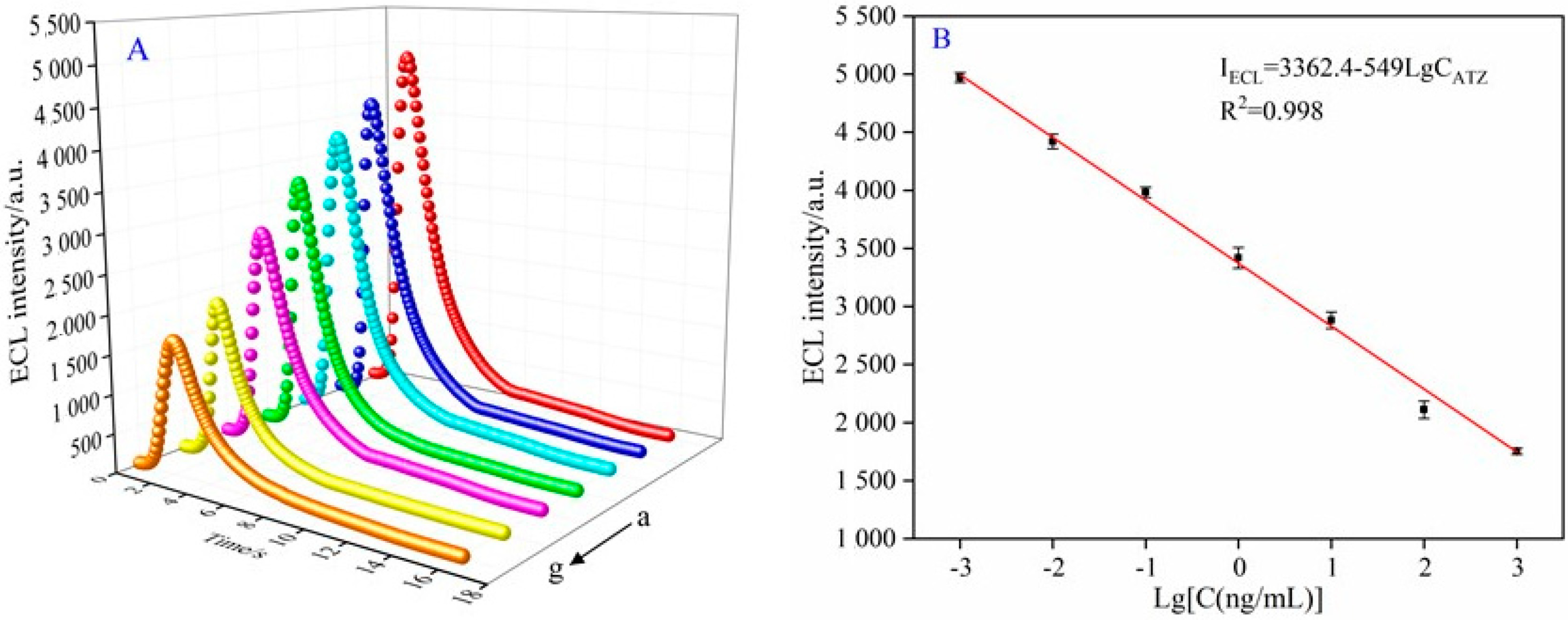
- Huang, X.; Li, H.; Hu, M.; Bai, M.; Guo, Y.; Sun, X. Effective Electrochemiluminescence Aptasensor for Detection of Atrazine Residue. Sensors 2022, 22, 3430. [Google Scholar] [CrossRef]
- Flanagan, A.R.; Glavin, F.G. A Systematic Review of Multi-Class and One-vs-Rest Classification Techniques for Near-Infrared Spectra of Crop Cultivars. In Proceedings of the 2023 31st Irish Conference on Artificial Intelligence and Cognitive Science (AICS), Letterkenny, Ireland, 7–8 December 2023; pp. 1–8. [Google Scholar]
- Yan, F.; Zhang, R.; Wang, S.; Zhang, N.; Zhang, X. A pesticide residue detection model for food based on NIR and SERS. PLoS ONE 2025, 20, e0320456. [Google Scholar] [CrossRef]
- Wanqing, Y.; Shuhui, Z.; Zhihui, G.; Bingming, G. The Organochlorine Pesticide Residues of Mesona Chinensis Benth by Near Infrared (NIR) Spectroscopy and Chemometrics. E3S Web Conf. 2021, 251, 02050. [Google Scholar] [CrossRef]
- Ferreira, I.J.S.; dos Santos Costa, D.; Rolim, L.A.; de Freitas, S.T.; de Souza, N.A.C.; Teruel, B. Monitoring pesticides with portable NIR spectroscopy in different intact fruits. J. Food Compos. Anal. 2025, 148, 108024. [Google Scholar] [CrossRef]
- Saranwong, I.; Kawano, S. Rapid Determination of Fungicide Contaminated on Tomato Surfaces Using the DESIR-NIR: A System for ppm-order Concentration. J. Near Infrared Spectrosc. 2005, 13, 169–175. [Google Scholar] [CrossRef]
- Acharya, U.; Subedi, P.; Walsh, K. Evaluation of a Dry Extract System Involving NIR Spectroscopy (DESIR) for Rapid Assessment of Pesticide Contamination of Fruit Surfaces. Am. J. Anal. Chem. 2012, 3, 524–533. [Google Scholar] [CrossRef]
- Ye, W.; Yan, T.; Zhang, C.; Duan, L.; Chen, W.; Song, H.; Zhang, Y.; Xu, W.; Gao, P. Detection of Pesticide Residue Level in Grape Using Hyperspectral Imaging with Machine Learning. Foods 2022, 11, 1609. [Google Scholar] [CrossRef] [PubMed]
- Wu, Z.; Hao, Z.; Chai, Y.; Li, A.; Wang, C.; Zhang, X.; Chen, H.; Lu, C. Near-infrared-excitable acetylcholinesterase-activated fluorescent probe for sensitive and anti-interference detection of pesticides in colored food. Biosens. Bioelectron. 2023, 233, 115341. [Google Scholar] [CrossRef] [PubMed]
- Sharma, B.; Frontiera, R.R.; Henry, A.-I.; Ringe, E.; Van Duyne, R.P. SERS: Materials, applications, and the future. Mater. Today 2012, 15, 16–25. [Google Scholar] [CrossRef]
- Pang, S.; Yang, T.; He, L. Review of surface enhanced Raman spectroscopic (SERS) detection of synthetic chemical pesticides. TrAC Trends Anal. Chem. 2016, 85, 73–82. [Google Scholar] [CrossRef]
- Johansson, P.; Xu, H.; Käll, M. Surface-enhanced Raman scattering and fluorescence near metal nanoparticles. Phys. Rev. B 2005, 72, 035427. [Google Scholar] [CrossRef]
- McFarland, A.D.; Young, M.A.; Dieringer, J.A.; Van Duyne, R.P. Wavelength-Scanned Surface-Enhanced Raman Excitation Spectroscopy. J. Phys. Chem. B 2005, 109, 11279–11285. [Google Scholar] [CrossRef]
- Tong, L.; Zhu, T.; Liu, Z. Approaching the electromagnetic mechanism of surface-enhanced Raman scattering: From self-assembled arrays to individual gold nanoparticles. Chem. Soc. Rev. 2011, 40, 1296–1304. [Google Scholar] [CrossRef] [PubMed]
- Lin, X.-M.; Cui, Y.; Xu, Y.-H.; Ren, B.; Tian, Z.-Q. Surface-enhanced Raman spectroscopy: Substrate-related issues. Anal. Bioanal. Chem. 2009, 394, 1729–1745. [Google Scholar] [CrossRef]
- Luo, S.-C.; Sivashanmugan, K.; Liao, J.-D.; Yao, C.-K.; Peng, H.-C. Nanofabricated SERS-active substrates for single-molecule to virus detection in vitro: A review. Biosens. Bioelectron. 2014, 61, 232–240. [Google Scholar] [CrossRef] [PubMed]
- Wei, W.; Bai, F.; Fan, H. Oriented Gold Nanorod Arrays: Self-Assembly and Optoelectronic Applications. Angew. Chem. Int. Ed. 2019, 58, 11956–11966. [Google Scholar] [CrossRef] [PubMed]
- Pu, H.; Huang, Z.; Xu, F.; Sun, D.-W. Two-dimensional self-assembled Au-Ag core-shell nanorods nanoarray for sensitive detection of thiram in apple using surface-enhanced Raman spectroscopy. Food Chem. 2021, 343, 128548. [Google Scholar] [CrossRef]
- Zhou, L.; Zhou, J.; Lai, W.; Yang, X.; Meng, J.; Su, L.; Gu, C.; Jiang, T.; Pun, E.Y.B.; Shao, L.; et al. Irreversible accumulated SERS behavior of the molecule-linked silver and silver-doped titanium dioxide hybrid system. Nat. Commun. 2020, 11, 1785. [Google Scholar] [CrossRef]
- Zhao, X.; Yang, T.; Wang, D.; Zhang, N.; Yang, H.; Jing, X.; Niu, R.; Yang, Z.; Xie, Y.; Meng, L. Gold Nanorods/Metal–Organic Framework Hybrids: Photo-Enhanced Peroxidase-Like Activity and SERS Performance for Organic Dyestuff Degradation and Detection. Anal. Chem. 2022, 94, 4484–4494. [Google Scholar] [CrossRef]
- Guselnikova, O.; Lim, H.; Kim, H.-J.; Kim, S.H.; Gorbunova, A.; Eguchi, M.; Postnikov, P.; Nakanishi, T.; Asahi, T.; Na, J.; et al. New Trends in Nanoarchitectured SERS Substrates: Nanospaces, 2D Materials, and Organic Heterostructures. Small 2022, 18, 2107182. [Google Scholar] [CrossRef]
- Tian, Z.-Q.; Ren, B.; Wu, D.-Y. Surface-Enhanced Raman Scattering: From Noble to Transition Metals and from Rough Surfaces to Ordered Nanostructures. J. Phys. Chem. B 2002, 106, 9463–9483. [Google Scholar] [CrossRef]
- Perumal, J.; Wang, Y.; Attia, A.B.E.; Dinish, U.S.; Olivo, M. Towards a point-of-care SERS sensor for biomedical and agri-food analysis applications: A review of recent advancements. Nanoscale 2021, 13, 553–580. [Google Scholar] [CrossRef]
- Tang, H.; Zhu, C.; Meng, G.; Wu, N. Review—Surface-Enhanced Raman Scattering Sensors for Food Safety and Environmental Monitoring. J. Electrochem. Soc. 2018, 165, B3098. [Google Scholar] [CrossRef]
- Qu, Q.; Zeng, C.; Peng, X.; Qi, W.; Wang, M. Sensitive SERS detection of pesticide residues in beverages based on an extraction integrated plasmonic platform. Sens. Actuators B Chem. 2023, 376, 133042. [Google Scholar] [CrossRef]
- Alsammarraie, F.K.; Lin, M. Using Standing Gold Nanorod Arrays as Surface-Enhanced Raman Spectroscopy (SERS) Substrates for Detection of Carbaryl Residues in Fruit Juice and Milk. J. Agric. Food Chem. 2017, 65, 666–674. [Google Scholar] [CrossRef] [PubMed]
- Xiong, Z.; Lin, M.; Lin, H.; Huang, M. Facile synthesis of cellulose nanofiber nanocomposite as a SERS substrate for detection of thiram in juice. Carbohydr. Polym. 2018, 189, 79–86. [Google Scholar] [CrossRef] [PubMed]
- Wang, X.; Zhu, C.; Hu, X.; Xu, Q.; Zhao, H.; Meng, G.; Lei, Y. Highly sensitive surface-enhanced Raman scattering detection of organic pesticides based on Ag-nanoplate decorated graphene-sheets. Appl. Surf. Sci. 2019, 486, 405–410. [Google Scholar] [CrossRef]
- Yi, X.; Yuan, Z.; Yu, X.; Zheng, L.; Wang, C. Novel Microneedle Patch-Based Surface-Enhanced Raman Spectroscopy Sensor for the Detection of Pesticide Residues. ACS Appl. Mater. Interfaces 2023, 15, 4873–4882. [Google Scholar] [CrossRef]
- Li, X.; Yang, T.; Song, Y.; Zhu, J.; Wang, D.; Li, W. Surface-enhanced Raman spectroscopy (SERS)-based immunochromatographic assay (ICA) for the simultaneous detection of two pyrethroid pesticides. Sens. Actuators B Chem. 2019, 283, 230–238. [Google Scholar] [CrossRef]
- Dong, S.; Shi, Q.; He, K.; Wu, J.; Zhu, Z.; Feng, J. A Simple Aptamer SERS Sensor Based on Mesoporous Silica for the Detection of Chlorpyrifos. Foods 2022, 11, 3331. [Google Scholar] [CrossRef]
- Feng, J.; Hu, Y.; Grant, E.; Lu, X. Determination of thiabendazole in orange juice using an MISPE-SERS chemosensor. Food Chem. 2018, 239, 816–822. [Google Scholar] [CrossRef]
- Wu, X.; Zhao, X.; Wang, J.; Zhao, X.; Wang, S.; Zhang, Y. Chemically and Electromagnetically dual-enhanced COFs-Au@AgNPs SERS sensor integrated with deep learning for ultrasensitive detection of neonicotinoid pesticides. Anal. Chim. Acta 2025, 1373, 344501. [Google Scholar] [CrossRef] [PubMed]
- Gieseking, R.L.M. Plasmons: Untangling the classical, experimental, and quantum mechanical definitions. Mater. Horiz. 2022, 9, 25–42. [Google Scholar] [CrossRef] [PubMed]
- Gupta, B.D.; Kant, R. [INVITED] Recent advances in surface plasmon resonance based fiber optic chemical and biosensors utilizing bulk and nanostructures. Opt. Laser Technol. 2018, 101, 144–161. [Google Scholar] [CrossRef]
- Homola, J.; Piliarik, M. Surface Plasmon Resonance (SPR) Sensors. In Surface Plasmon Resonance Based Sensors; Homola, J., Ed.; Springer: Berlin/Heidelberg, Germany, 2006; pp. 45–67. [Google Scholar] [CrossRef]
- Kant, R. Surface plasmon resonance based fiber–optic nanosensor for the pesticide fenitrothion utilizing Ta2O5 nanostructures sequestered onto a reduced graphene oxide matrix. Microchim. Acta 2019, 187, 8. [Google Scholar] [CrossRef]
- Moslemi, A.; Sansone, L.; Esposito, F.; Campopiano, S.; Giordano, M.; Iadicicco, A. Optical fiber probe based on LSPR for the detection of pesticide Thiram. Opt. Laser Technol. 2024, 175, 110882. [Google Scholar] [CrossRef]
- Rajan; Chand, S.; Gupta, B.D. Surface plasmon resonance based fiber-optic sensor for the detection of pesticide. Sens. Actuators B Chem. 2007, 123, 661–666. [Google Scholar] [CrossRef]
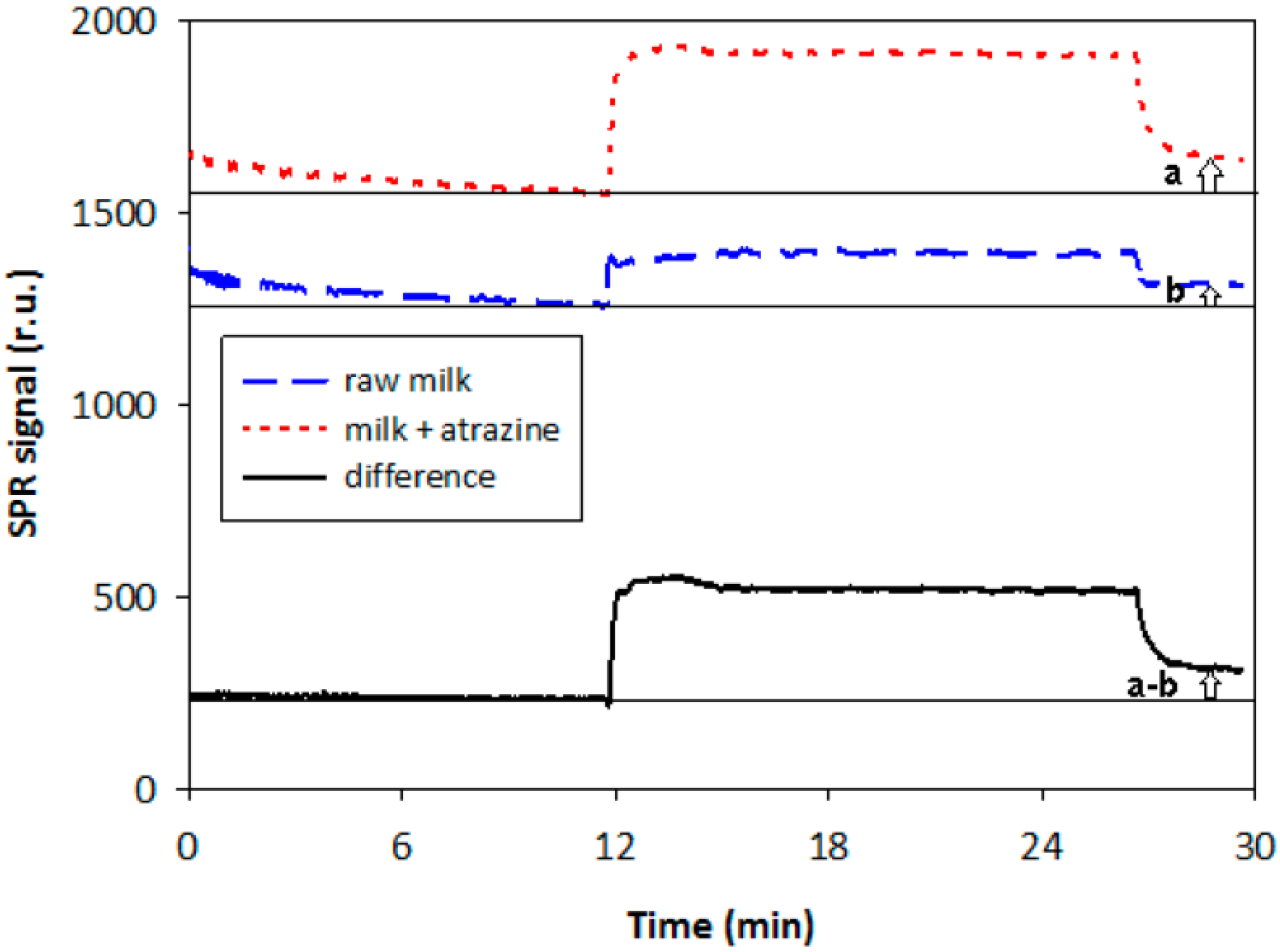
- Tomassetti, M.; Martini, E.; Campanella, L.; Favero, G.; Sanzó, G.; Mazzei, F. A New Surface Plasmon Resonance Immunosensor for Triazine Pesticide Determination in Bovine Milk: A Comparison with Conventional Amperometric and Screen-Printed Immunodevices. Sensors 2015, 15, 10255–10270. [Google Scholar] [CrossRef]
- Miyake, S.; Hirakawa, Y.; Yamasaki, T.; Watanabe, E.; Harada, A.; Iwasa, S.; Narita, H. Simultaneous Detection of Six Different Types of Pesticides by an Immunosensor Based on Surface Plasmon Resonance. Anal. Sci. 2020, 36, 335–340. [Google Scholar] [CrossRef]
- Oymen, B.; Jalilzadeh, M.; Yılmaz, F.; Aşır, S.; Türkmen, D.; Denizli, A. Simple and Fast Pesticide Nanosensors: Example of Surface Plasmon Resonance Coumaphos Nanosensor. Micromachines 2023, 14, 707. [Google Scholar] [CrossRef]
- Wang, Y.; Cui, Z.; Zhang, X.; Zhang, X.; Zhu, Y.; Chen, S.; Hu, H. Excitation of Surface Plasmon Resonance on Multiwalled Carbon Nanotube Metasurfaces for Pesticide Sensors. ACS Appl. Mater. Interfaces 2020, 12, 52082–52088. [Google Scholar] [CrossRef]
- Zhao, S.; Qian, S.; Zhang, S.; Jiang, S.; Zhang, J.; Wang, X.; Liu, S. Synergistic Electrochemical and SPR Fiber Sensor for Mechanistic Insights into Dimethoate Catalytic Degradation. ACS Sensors 2025, 10, 9044–9056. [Google Scholar] [CrossRef]
- Ramola, A.; Shakya, A.K.; Kumar, V.; Bergman, A. Recent Advances in Photonic Crystal Fiber-Based SPR Biosensors: Design Strategies, Plasmonic Materials, and Applications. Micromachines 2025, 16, 747. [Google Scholar] [CrossRef]
- Beniwal, S.; Babita, H.; Manju; Priyanka. Enhancing Sensitivity and Stability in Surface Plasmon Resonance Sensing through Integration with Photonic Crystal Fibers: A Comprehensive Review. Int. J. Enhanc. Res. Sci. Technol. Eng. 2024, 13, 141–148. [Google Scholar] [CrossRef]
- Angelopoulou, M.; Petrou, P.; Kakabakos, S. Advances in interferometric sensors for the detection of food contaminants. TrAC Trends Anal. Chem. 2024, 175, 117714. [Google Scholar] [CrossRef]
- Nikitin, P.I.; Kabashin, A.V.; Ksenevich, T.I.; Kalabina, N. Bio-optoelectronical “tongue” for detection of pesticide contamination of water. Sensors 1997, 1, 495–497. [Google Scholar] [CrossRef]
- Guo, L.; Li, Z.; Chen, H.; Wu, Y.; Chen, L.; Song, Z.; Lin, T. Colorimetric biosensor for the assay of paraoxon in environmental water samples based on the iodine-starch color reaction. Anal. Chim. Acta 2017, 967, 59–63. [Google Scholar] [CrossRef] [PubMed]
- Zhao, F.; Guo, D.; Tang, X.; Lan, J.; Chen, J. Ratiometrically electrochemical and colorimetric dual-mode detection of glyphosate based on 2D Cu-TCPP(Fe) NSs. Talanta 2024, 267, 125207. [Google Scholar] [CrossRef]
- Wu, C.; Li, W.; Wang, J.; Li, S. The Screening of Aptamers and the Development of a Colorimetric Detection Method for the Pesticide Deltamethrin. Sensors 2025, 25, 2060. [Google Scholar] [CrossRef]
- Zhao, H.; Cao, K.; Zhang, T.; Zhou, L.; Han, Z.; Wang, L.; Cui, Y.; Ji, X. A colorimetric and fluorescent dual-mode biosensor based on Aloe vera polysaccharide stabilized core-shell nanoflowers and red carbon dots for organophosphorus pesticide detection. Int. J. Biol. Macromol. 2025, 318, 145066. [Google Scholar] [CrossRef]
- He, Y.; Lv, C.; Li, F.; Li, Y.; Tian, X.; Chen, X.; Yang, Q.; Su, J.; Mu, D. Simultaneous detection of two pesticides by colorimetric and fluorescence dual-response sensor based on aptamer and gold nanoparticles. J. Food Compos. Anal. 2025, 145, 107762. [Google Scholar] [CrossRef]
- Jiang, C.; Li, H.; Jiang, W.; Liang, X.; Mei, S.; Feng, Y.; Yu, Z.; Xiao, Y.; Liu, Y. Bioenzyme-free dual-mode sensing: Fe-N/C single-atom nanozyme integrated smart hydrogel for visual detection of carbosulfan. Sens. Actuators B Chem. 2026, 446, 138677. [Google Scholar] [CrossRef]
- Luo, Q.J.; Li, Z.G.; Lai, J.H.; Li, F.Q.; Qiu, P.; Wang, X.L. An on–off–on gold nanocluster-based fluorescent probe for sensitive detection of organophosphorus pesticides. RSC Adv. 2017, 7, 55199–55205. [Google Scholar] [CrossRef]
- Hong, C.; Ye, S.; Dai, C.; Wu, C.; Chen, L.; Huang, Z. Sensitive and on-site detection of glyphosate based on papain-stabilized fluorescent gold nanoclusters. Anal. Bioanal. Chem. 2020, 412, 8177–8184. [Google Scholar] [CrossRef]
- Narayanan, N.; Mandal, A.; Kaushik, P.; Singh, S. Fluorescence turn off azastilbene sensor for detection of pesticides in vegetables: An experimental and computational investigation. Microchem. J. 2022, 175, 107205. [Google Scholar] [CrossRef]
- Yang, L.; Hu, W.; Pei, F.; Liu, Z.; Wang, J.; Tong, Z.; Mu, X.; Du, B.; Xia, M.; Wang, F.; et al. A ratiometric fluorescence imprinted sensor based on N-CDs and metal–organic frameworks for visual smart detection of malathion. Food Chem. 2024, 438, 138068. [Google Scholar] [CrossRef] [PubMed]
- Donà, E.; Lobnik, A. Chlorpyrifos Detection Based on 9-Fluorenone Oxime. Chemosensors 2025, 13, 170. [Google Scholar] [CrossRef]
- Huang, X.; Jiang, L.; Yuan, L.; Ma, W.; Cui, X.; Liu, J.; Ji, X.; Tu, Y. Orange ratiometric fluorescent probe for sensitive detection of phoxim. Spectrochim. Acta Part A Mol. Biomol. Spectrosc. 2026, 345, 126785. [Google Scholar] [CrossRef]
- Li, X.; Chen, M.; Li, Q.; Dai, J.; Yang, Y.; Li, H. Dual-mode fluorescence-chemiluminescence sensor for sensitive glyphosate detection based on Suc-Ce-OH BioMOF with phosphatase-like activity. Talanta 2026, 297, 128695. [Google Scholar] [CrossRef]
- López-Paz, J.L.; Catalá-Icardo, M.; Antón-Garrido, B. Determination of diquat by flow injection–chemiluminescence. Anal. Bioanal. Chem. 2009, 394, 1073–1079. [Google Scholar] [CrossRef]
- Xiu, F.; Lu, Y.; Qi, Y.; Wang, Y.; He, J. Ultrasensitive and practical chemiluminescence sensing pesticide residue acetamiprid in agricultural products and environment: Combination of synergistically coupled co-amplifying signal and smart interface engineering. Talanta 2021, 235, 122811. [Google Scholar] [CrossRef]
- Reshma, P.A.; Kumar, P.S.; Calay, R.K.; Goel, S. Chemiluminescence coupled microfluidic point of source testing device for onsite detection of harmful pesticides in fruits. Microchem. J. 2025, 215, 114381. [Google Scholar] [CrossRef]
- Huang, J.; Xiang, Y.; Li, J.; Kong, Q.; Zhai, H.; Xu, R.; Yang, F.; Sun, X.; Guo, Y. A novel electrochemiluminescence aptasensor based on copper-gold bimetallic nanoparticles and its applications. Biosens. Bioelectron. 2021, 194, 113601. [Google Scholar] [CrossRef]
- Liu, C.; Cai, L.; Wang, X.; Guo, Y.; Fang, G.; Wang, S. Construction of molecularly imprinted sensor based on covalent organic frameworks DAFB-DCTP-doped carbon nitride nanosheets with high electrochemiluminescence activity for sensitive detection of carbaryl. Microchem. J. 2022, 178, 107416. [Google Scholar] [CrossRef]
- Li, H.; Tian, L.; Yang, S.; Li, C.; Li, R.; Song, Y.; Guo, Y.; Li, X. Solid-state electrochemiluminescence sensor based on TiO2@CdSe and Ru(bpy)32+@Ag NPs for ultrasensitive detection of malathion. Food Chem. 2025, 470, 142726. [Google Scholar] [CrossRef]
- Wu, Y.; Ma, D.; Zhu, X.; Xia, F. A Novel Aggregation-Induced Emission-Based Electrochemiluminescence Aptamer Sensor Utilizing Red-Emissive Sulfur Quantum Dots for Rapid and Sensitive Malathion Detection. Biosensors 2025, 15, 64. [Google Scholar] [CrossRef] [PubMed]
- Basit, A.; Sanjaya, A.R.; Rahmawati, I.; Atriardi, S.R.; Rachmawati, A.; Gunlazuardi, J.; Wahyuni, W.T.; Irkham; Ivandini, T.A. Developing a carbamate insecticide isoprocarb mini sensor based on electrochemiluminescence of luminol on screen-printed carbon electrodes. Bull. Chem. Soc. Jpn. 2025, 98, uoaf058. [Google Scholar] [CrossRef]
- Yuan, W.; Wan, C.; Zhang, J.; Li, Q.; Zhang, P.; Zheng, K.; Zhang, Q.; Ding, C. Near-infrared ratiometric fluorescent strategy for butyrylcholinesterase activity and its application in the detection of pesticide residue in food samples and biological imaging. Spectrochim. Acta Part A Mol. Biomol. Spectrosc. 2023, 297, 122719. [Google Scholar] [CrossRef]
- Zhang, Z.; Li, J.; Yang, B.; Ma, M.; Ding, X.; Shi, H.; Ma, P.; Song, D.; Zhang, Z. Near-infrared fluorescent probe for ultrasensitive detection of organophosphorus pesticides and visualization of their interaction with butyrylcholinesterase in living cells. Talanta 2024, 279, 126587. [Google Scholar] [CrossRef]
- Chaudhary, S.; Senthilkumar, T.; Singh, C.B.; Manickavasagan, A. Determination of glyphosate residues in lentils using near-infrared hyperspectral imaging coupled with chemometric regression techniques. Infrared Phys. Technol. 2025, 150, 106034. [Google Scholar] [CrossRef]
- Liu, Y.-T.; Zhang, Q.-Q.; Yao, S.-Y.; Zhao, K.-Y.; Cui, H.-W.; Zhao, H.-Y.; Li, J.-Y.; Zou, Y.-L.; Zhao, L.-X. A near-infrared multifunctional fluorescent bio-probe with large stokes shift and high quantum yield for effective determination of heavy metal lead and pesticide glyphosate in vitro and vivo. J. Hazard. Mater. 2025, 486, 137017. [Google Scholar] [CrossRef]
- Wen, X.; He, Y.; Yuan, R.; Chen, S. Conjugated polymer-boosted near-infrared electrochemiluminescence of organic dye for detecting acetamiprid. Anal. Chim. Acta 2025, 1335, 343417. [Google Scholar] [CrossRef]
- Jiang, L.; Gu, K.; Liu, R.; Jin, S.; Wang, H.; Pan, C. Rapid detection of pesticide residues in fruits by surface-enhanced Raman scattering based on modified QuEChERS pretreatment method with portable Raman instrument. SN Appl. Sci. 2019, 1, 627. [Google Scholar] [CrossRef]
- Zhu, A.; Xu, Y.; Ali, S.; Ouyang, Q.; Chen, Q. Au@Ag nanoflowers based SERS coupled chemometric algorithms for determination of organochlorine pesticides in milk. LWT 2021, 150, 111978. [Google Scholar] [CrossRef]
- Freund, L.; Mossa, J.; Guo, H. Development of a portable SERS tool to evaluate the effectiveness of washing methods to remove pesticide residue from fruit surface. Anal. Chim. Acta 2025, 1336, 343476. [Google Scholar] [CrossRef] [PubMed]
- Shi, T.-f.; Pan, T.-t.; Lu, P. Rapid and simultaneous determination of mixed pesticide residues in apple using SERS coupled with multivariate analysis. Food Chem. X 2024, 24, 101954. [Google Scholar] [CrossRef] [PubMed]
- Thi Linh, D.; Mai, Q.-D.; Thi Hanh Trang, D.; Anh, N.T.; Vu, X.H.; Le, A.-T. Ultrasensitive detection of carbendazim pesticide in tea leaves using a green Ag/CuO(Cu2O) nanocomposite-based SERS sensor: Role of metal/semiconductor transition in sensing performance. RSC Adv. 2025, 15, 17635–17647. [Google Scholar] [CrossRef] [PubMed]
- Li, S.; Cao, T.; Xu, M.; He, M.; Cai, X.; Lu, Y.; Jin, Y.; Han, M.; Liu, H.; Wang, C. Biomimetic SERS platform with machine learning for sensitive detection of pesticides in complex food matrices. Opt. Laser Technol. 2025, 192, 113756. [Google Scholar] [CrossRef]
- Yan, F.; Deng, R.; Guo, S.; Li, X. Constructing hot-spots enriched Ag/MoS2 hybrid SERS platform for rapid detection of pesticide residue in juice. Spectrochim. Acta Part A Mol. Biomol. Spectrosc. 2026, 346, 126825. [Google Scholar] [CrossRef]
- Wu, Y.; Huang, J.; Shang, L.; Chen, Q.; Peng, F.; Liu, T.; Luo, Z.; Liu, M.; Zhao, J.; Huang, S. Exploring SERS methods for rapid determination of ofloxacin residues in egg white. Spectrochim. Acta Part A Mol. Biomol. Spectrosc. 2026, 345, 126810. [Google Scholar] [CrossRef]
- Çakır, O.; Baysal, Z. Pesticide analysis with molecularly imprinted nanofilms using surface plasmon resonance sensor and LC-MS/MS: Comparative study for environmental water samples. Sens. Actuators B Chem. 2019, 297, 126764. [Google Scholar] [CrossRef]
- Zhang, B.; Li, Y.-l.; Wang, L.; Cai, H. Magnetic Fe3O4@Au@PDA core-shell nanoparticle-enhanced SPR detection of tebuconazole. Microchem. J. 2025, 212, 113472. [Google Scholar] [CrossRef]
- He, Y.; Xiao, S.; Dong, T.; Nie, P. Gold Nanoparticles with Different Particle Sizes for the Quantitative Determination of Chlorpyrifos Residues in Soil by SERS. Int. J. Mol. Sci. 2019, 20, 2817. [Google Scholar] [CrossRef]
- Javaid, M.; Haleem, A.; Rab, S.; Pratap Singh, R.; Suman, R. Sensors for daily life: A review. Sens. Int. 2021, 2, 100121. [Google Scholar] [CrossRef]
- Röhr, A.; Lüddecke, K.; Drusch, S.; Müller, M.J.; Alvensleben, R.v. Food quality and safety––consumer perception and public health concern. Food Control 2005, 16, 649–655. [Google Scholar] [CrossRef]
- Sharma, A.; Shukla, A.; Attri, K.; Kumar, M.; Kumar, P.; Suttee, A.; Singh, G.; Barnwal, R.P.; Singla, N. Global trends in pesticides: A looming threat and viable alternatives. Ecotoxicol. Environ. Saf. 2020, 201, 110812. [Google Scholar] [CrossRef]
- Jampasa, S.; Khamcharoen, W.; Wirojsaengthong, S.; Suea-Ngam, A.; Traipop, S.; Ozer, T.; Unob, F.; Puthongkham, P.; Chailapakul, O. Recent advances and trends in the applications of nanomaterials in optical sensing platforms. TrAC Trends Anal. Chem. 2024, 180, 117914. [Google Scholar] [CrossRef]
- Regtien, P.; Dertien, E. Sensors for Mechatronics; Elsevier: Amsterdam, The Netherlands, 2018; p. 379. [Google Scholar] [CrossRef]
- Zhou, Y.; Zhang, Y.-n.; Yu, Q.; Ren, L.; Liu, Q.; Zhao, Y. Application of machine learning in optical fiber sensors. Measurement 2024, 228, 114391. [Google Scholar] [CrossRef]
- Chen, H.; Zhang, L.; Hu, Y.; Zhou, C.; Lan, W.; Fu, H.; She, Y. Nanomaterials as optical sensors for application in rapid detection of food contaminants, quality and authenticity. Sens. Actuators B Chem. 2021, 329, 129135. [Google Scholar] [CrossRef]
- Vanlalveni, C.; Lallianrawna, S.; Biswas, A.; Selvaraj, M.; Changmai, B.; Rokhum, S.L. Green synthesis of silver nanoparticles using plant extracts and their antimicrobial activities: A review of recent literature. RSC Adv. 2021, 11, 2804–2837. [Google Scholar] [CrossRef] [PubMed]
- Khan, M.; Shaik, M.R.; Adil, S.F.; Khan, S.T.; Al-Warthan, A.; Siddiqui, M.R.H.; Tahir, M.N.; Tremel, W. Plant extracts as green reductants for the synthesis of silver nanoparticles: Lessons from chemical synthesis. Dalton Trans. 2018, 47, 11988–12010. [Google Scholar] [CrossRef] [PubMed]
- Do Dat, T.; Cong, C.Q.; Le Hoai Nhi, T.; Khang, P.T.; Nam, N.T.H.; Thi Tinh, N.; Hue, D.T.; Hieu, N.H. Green synthesis of gold nanoparticles using Andrographis paniculata leave extract for lead ion detection, degradation of dyes, and bioactivities. Biochem. Eng. J. 2023, 200, 109103. [Google Scholar] [CrossRef]
- Beaton, A.D.; Wadham, J.L.; Hawkings, J.; Bagshaw, E.A.; Lamarche-Gagnon, G.; Mowlem, M.C.; Tranter, M. High-Resolution in Situ Measurement of Nitrate in Runoff from the Greenland Ice Sheet. Environ. Sci. Technol. 2017, 51, 12518–12527. [Google Scholar] [CrossRef] [PubMed]
- Nightingale, A.M.; Hassan, S.-u.; Warren, B.M.; Makris, K.; Evans, G.W.H.; Papadopoulou, E.; Coleman, S.; Niu, X. A Droplet Microfluidic-Based Sensor for Simultaneous in Situ Monitoring of Nitrate and Nitrite in Natural Waters. Environ. Sci. Technol. 2019, 53, 9677–9685. [Google Scholar] [CrossRef]
- Bluett, S.; O’Callaghan, P.; Paull, B.; Murray, E. Robust off-grid analyser for autonomous remote in-situ monitoring of nitrate and nitrite in water. Talanta Open 2023, 7, 100173. [Google Scholar] [CrossRef]
- Luna Juncal, M.J.; Skinner, T.; Bertone, E.; Stewart, R.A. Development of a Real-Time, Mobile Nitrate Monitoring Station for High-Frequency Data Collection. Sustainability 2020, 12, 5780. [Google Scholar] [CrossRef]
- Lal, K.; Jaywant, S.A.; Arif, K.M. Electrochemical and Optical Sensors for Real-Time Detection of Nitrate in Water. Sensors 2023, 23, 7099. [Google Scholar] [CrossRef]
- Kumari Shrestha, Y.K.; Shrestha, S.K. Fundamentals of Colorimetry. In Advances in Colorimetry; Samanta, A.K., Ed.; IntechOpen: London, UK, 2023. [Google Scholar] [CrossRef]
- Öztürk, B.; Ankan, A.; Özdemir, D. Chapter 50—Olive Oil Adulteration with Sunflower and Corn Oil Using Molecular Fluorescence Spectroscopy. In Olives and Olive Oil in Health and Disease Prevention; Preedy, V.R., Watson, R.R., Eds.; Academic Press: San Diego, CA, USA, 2010; pp. 451–461. [Google Scholar] [CrossRef]
- Villena Gonzales, W.; Mobashsher, A.T.; Abbosh, A. The Progress of Glucose Monitoring—A Review of Invasive to Minimally and Non-Invasive Techniques, Devices and Sensors. Sensors 2019, 19, 800. [Google Scholar] [CrossRef]
- Lai, S.; Sun, K.; Wu, Y.; Wu, X.; Yan, Y.; Liu, G.; Liu, X.; Ge, Y.; Zeng, L.; Guo, Z.; et al. Cu2+/Cu+ redox-cycling-driven dual-mode sensor for simultaneous monitoring of acetylcholinesterase activity and pesticide exposure. Front. Pharmacol. 2025, 16, 1640821. [Google Scholar] [CrossRef] [PubMed]
- Pebdeni, A.B.; Roshani, A.; Mirsadoughi, E.; Behzadifar, S.; Hosseini, M. Recent advances in optical biosensors for specific detection of E. coli bacteria in food and water. Food Control 2022, 135, 108822. [Google Scholar] [CrossRef]
- Wild, D. Chapter 1.2—Immunoassay for Beginners. In The Immunoassay Handbook, 4th ed.; Wild, D., Ed.; Elsevier: Oxford, UK, 2013; pp. 7–10. [Google Scholar] [CrossRef]
- Cinquanta, L.; Fontana, D.E.; Bizzaro, N. Chemiluminescent immunoassay technology: What does it change in autoantibody detection? Autoimmun. Highlights 2017, 8, 9. [Google Scholar] [CrossRef]
- Baeyens, W.R.G.; Schulman, S.G.; Calokerinos, A.C.; Zhao, Y.; García Campaña, A.M.; Nakashima, K.; De Keukeleire, D. Chemiluminescence-based detection: Principles and analytical applications in flowing streams and in immunoassays. J. Pharm. Biomed. Anal. 1998, 17, 941–953. [Google Scholar] [CrossRef] [PubMed]
- Fardell, P.; Guillaume, E. 11—Sampling and measurement of toxic fire effluent. In Fire Toxicity; Stec, A., Hull, R., Eds.; Woodhead Publishing: Sawston, UK, 2010; pp. 385–423. [Google Scholar] [CrossRef]
- Bunaciu, A.A.; Aboul-Enein, H.Y.; Fleschin, Ş. Vibrational Spectroscopy in Clinical Analysis. Appl. Spectrosc. Rev. 2015, 50, 176–191. [Google Scholar] [CrossRef]
- Pirutin, S.K.; Jia, S.; Yusipovich, A.I.; Shank, M.A.; Parshina, E.Y.; Rubin, A.B. Vibrational Spectroscopy as a Tool for Bioanalytical and Biomonitoring Studies. Int. J. Mol. Sci. 2023, 24, 6947. [Google Scholar] [CrossRef]
- Xie, J.; Li, X.-D.; Li, M.; Zhu, H.-Y.; Cao, Y.; Zhang, J.; Xu, A.J. Advances in surface plasmon resonance for analyzing active components in traditional Chinese medicine. J. Pharm. Anal. 2024, 14, 100983. [Google Scholar] [CrossRef] [PubMed]
- Park, J.-H.; Cho, Y.-W.; Kim, T.-H. Recent Advances in Surface Plasmon Resonance Sensors for Sensitive Optical Detection of Pathogens. Biosensors 2022, 12, 180. [Google Scholar] [CrossRef] [PubMed]
- Arshavsky-Graham, S.; Heuer, C.; Jiang, X.; Segal, E. Aptasensors versus immunosensors—Which will prevail? Eng. Life Sci. 2022, 22, 319–333. [Google Scholar] [CrossRef]
- Jayasena, S.D. Aptamers: An emerging class of molecules that rival antibodies in diagnostics. Clin. Chem. 1999, 45, 1628–1650. [Google Scholar] [CrossRef] [PubMed]
- Luzi, E.; Minunni, M.; Tombelli, S.; Mascini, M. New trends in affinity sensing: Aptamers for ligand binding. TrAC Trends Anal. Chem. 2003, 22, 810–818. [Google Scholar] [CrossRef]
- Toh, S.Y.; Citartan, M.; Gopinath, S.C.B.; Tang, T.-H. Aptamers as a replacement for antibodies in enzyme-linked immunosorbent assay. Biosens. Bioelectron. 2015, 64, 392–403. [Google Scholar] [CrossRef]
- Roberts, A.; Mahari, S.; Gandhi, S. Chapter 7—Biological/synthetic receptors (antibody, enzyme, and aptamer) used for biosensors development for virus detection. In Advanced Biosensors for Virus Detection; Khan, R., Parihar, A., Kaushik, A., Kumar, A., Eds.; Academic Press: Cambridge, MA, USA, 2022; pp. 113–131. [Google Scholar] [CrossRef]
- Vasilescu, A.; Hayat, A.; Gáspár, S.; Marty, J.-L. Advantages of Carbon Nanomaterials in Electrochemical Aptasensors for Food Analysis. Electroanalysis 2018, 30, 2–19. [Google Scholar] [CrossRef]
- Villalba-Rodríguez, A.M.; Martínez-Zamudio, L.Y.; Martínez, S.A.H.; Rodríguez-Hernández, J.A.; Melchor-Martínez, E.M.; Flores-Contreras, E.A.; González-González, R.B.; Parra-Saldívar, R. Nanomaterial Constructs for Catalytic Applications in Biomedicine: Nanobiocatalysts and Nanozymes. Top. Catal. 2023, 66, 707–722. [Google Scholar] [CrossRef]
- Sanabria Español, E.; Maldonado, M. Host–Guest Recognition of Pesticides by Calixarenes. Crit. Rev. Anal. Chem. 2019, 49, 383–394. [Google Scholar] [CrossRef]
- Wright, D.S.; Niu, H.C. 1.14—Supramolecular chemistry of p-block elements. In Comprehensive Inorganic Chemistry, 3rd ed.; Reedijk, J., Poeppelmeier, K.R., Eds.; Elsevier: Oxford, UK, 2023; pp. 652–664. [Google Scholar] [CrossRef]
- Shan, P.h.; Hu, J.h.; Liu, M.; Tao, Z.; Xiao, X.; Redshaw, C. Progress in host–guest macrocycle/pesticide research: Recognition, detection, release and application. Coord. Chem. Rev. 2022, 467, 214580. [Google Scholar] [CrossRef]
- Liu, Q.; Liu, Y.; Yang, H.; Su, Q.; Li, L.; Meng, X.; Li, M.; Jia, X.; Ma, P.; Fan, B.; et al. Advances in Optical Sensing Technologies for On-Site Detection of Harmful Residues in Food: Principles and Recent Applications. Foods 2025, 14, 4073. [Google Scholar] [CrossRef]
- Deshpande, K.; Kanungo, L. Chemiluminescence and fluorescence biosensors for food application: A review. Sens. Actuators Rep. 2023, 5, 100137. [Google Scholar] [CrossRef]
- Wu, W.; Yang, J.; Zhou, Y.; Zheng, Q.; Chen, Q.; Bai, Z.; Niu, J. Chemometrics-based signal processing methods for biosensors in health and environment: A review. Electroanalysis 2024, 36, e202300207. [Google Scholar] [CrossRef]
- Kumar, A.; Goel, S.; Chaudhary, A.; Dutt, S.; Mishra, V.K.; Kumar, R. Artificial Intelligence-Based Wearable Sensing Technologies for the Management of Cancer, Diabetes, and COVID-19. Biosensors 2025, 15, 756. [Google Scholar] [CrossRef]
- Xiao, X.; Yin, J.; Xu, J.; Tat, T.; Chen, J. Advances in Machine Learning for Wearable Sensors. ACS Nano 2024, 18, 22734–22751. [Google Scholar] [CrossRef]
- Vishvakarma, R.; Siddiqui, M.A.; Ansari, N.; Kumari, P.; Batool, F.; Parvez, Z.; Vimal, A. Nanosensors in Agricultural Applications: An Overview. In Handbook of Nanotechnology in Agriculture; Husen, A., Ed.; Springer Nature: Singapore, 2025; pp. 1–25. [Google Scholar] [CrossRef]
- Zhao, Y.; Jiao, W.; Li, Y.; Hu, D.; Song, S.; Wei, X.; Zhang, X.; Chen, X.; Yang, F. Portable Integrated Sensor Based on C60 Encapsulated into Cu-Based Porphyrin-Derived MOFs for the Photoelectrochemical Detection of Glyphosate. ACS Appl. Nano Mater. 2024, 7, 11214–11224. [Google Scholar] [CrossRef]
- Li, Z.; He, B.; Li, Y.; Liu, B.-F.; Zhang, G.; Liu, S.; Hu, T.Y.; Li, Y. Synergizing Nanosensor-Enhanced Wearable Devices with Machine Learning for Precision Health Management Benefiting Older Adult Populations. ACS Nano 2025, 19, 26273–26295. [Google Scholar] [CrossRef]
- Zhu, C.; Jiang, C.; Lee, H.K.; Zhang, Y.; Tang, S. All Nanozyme-Based Cascade Reactions for Biomedical Applications: From Self-Cascading Nanozyme to Immobilized Cascade Nanozyme. Adv. Sci. 2025, 13, e19656. [Google Scholar] [CrossRef]
- Tisch, U.; Haick, H. Nanomaterials for cross-reactive sensor arrays. MRS Bull. 2010, 35, 797–803. [Google Scholar] [CrossRef]
- Zhang, X.; Mikkelsen, Ø. Graphene Oxide/Silver Nanocomposites as Antifouling Coating on Sensor Housing Materials. J. Clust. Sci. 2022, 33, 627–635. [Google Scholar] [CrossRef]
- Thu, H.E.; Haider, M.; Khan, S.; Sohail, M.; Hussain, Z. Nanotoxicity induced by nanomaterials: A review of factors affecting nanotoxicity and possible adaptations. OpenNano 2023, 14, 100190. [Google Scholar] [CrossRef]
- Gimondi, S.; Ferreira, H.; Reis, R.L.; Neves, N.M. Microfluidic Devices: A Tool for Nanoparticle Synthesis and Performance Evaluation. ACS Nano 2023, 17, 14205–14228. [Google Scholar] [CrossRef] [PubMed]
- Fan, M.; Zhang, Z.; Hu, J.; Cheng, F.; Wang, C.; Tang, C.; Lin, J.; Brolo, A.G.; Zhan, H. Ag decorated sandpaper as flexible SERS substrate for direct swabbing sampling. Mater. Lett. 2014, 133, 57–59. [Google Scholar] [CrossRef]
- Gumber, K. Naked eye sensors for on-site pesticide detection: A review. J. Plant Prot. Res. 2023, 63, 173–184. [Google Scholar] [CrossRef]
- Singh, N.B.; Monjur, A.; Kumar, B.; Varshney, S.; Susan, M.A.B.H. Revolutionizing healthcare with nanosensor technology. RSC Adv. 2025, 15, 38774–38810. [Google Scholar] [CrossRef]
- Han, D.; Hosamo, H.; Ying, C.; Nie, R. A Comprehensive Review and Analysis of Nanosensors for Structural Health Monitoring in Bridge Maintenance: Innovations, Challenges, and Future Perspectives. Appl. Sci. 2023, 13, 11149. [Google Scholar] [CrossRef]
- Albu, C.; Chira, A.; Radu, G.-L.; Eremia, S.A.V. Advances in Cost-Effective Chemosensors for Sustainable Monitoring in Food Safety and Processing. Chemosensors 2025, 13, 113. [Google Scholar] [CrossRef]
- Market Glass Inc. (Global Industry Analysts Inc.). Optical Chemical Sensors—Global Strategic Business Report; Market Glass Inc.: San Jose, CA, USA, 2026; 227p, Available online: https://www.researchandmarkets.com/report/optical-chemical-sensors?srsltid=AfmBOoqPkm1dvuND21qZNXuppF5Rj-U7q9sSEyMiP0MuztOAV_LcQsDx#product--description (accessed on 17 January 2026).
- Darwish, M.A.; Abd-Elaziem, W.; Elsheikh, A.; Zayed, A.A. Advancements in nanomaterials for nanosensors: A comprehensive review. Nanoscale Adv. 2024, 6, 4015–4046. [Google Scholar] [CrossRef] [PubMed]
- Jafarzadeh, S.; Oladzadabbasabadi, N.; Dheyab, M.A.; Lalabadi, M.A.; Sheibani, S.; Ghasemlou, M.; Esmaeili, Y.; Barrow, C.J.; Naebe, M.; Timms, W. Emerging Trends in Smart and Sustainable Nano-Biosensing: The Role of Green Nanomaterials. Ind. Crops Prod. 2025, 223, 120108. [Google Scholar] [CrossRef]



| Method | Analyte | Matrix | RSD % | Linear Range | LOD | LOQ | Ref. |
|---|---|---|---|---|---|---|---|
| colorimetric biosensor | paraoxon | vegetables, irrigation water | 9.9–79.8 μg L−1 | 4.678 μg L−1 | [202] | ||
| colorimetry | dimethoate | pepper, green beans, cabbage | 1.9–5.4 | 20–160 μg⋅L−1 | 14 μg⋅L−1 | 46 μg⋅L−1 | [79] |
| colorimetry | glyphosate | soil, water and soybean samples | 0.169–16.9 μg⋅L−1 | 0.00319 μg⋅L−1 | [203] | ||
| colorimetry | deltamethrin | pears, apples | 0.13–6.12 | 0.1–1.2 mg·L−1 | 54.57 μg L−1 | [204] | |
| colorimetry, fluorescence | organophosphorus pesticides | extracts from pears, tomatoes, cucumbers | 0.003–100 mg L−1 | 0.37 μg⋅L−1 colorimetry 0.41 μg⋅L−1 fluorescence | [205] | ||
| colorimetry, fluorescence | acetamiprid, thiamethoxam | cabbage, potato | 1.97–2.13 (acetamiprid) 3.41–4.34 (thiamethoxam) | 4.454–44.54 μg⋅L−1 (acetamiprid) 2.917–43.75 μg⋅L−1 (thiamethoxam) | 0.251 μg⋅L−1 (acetamiprid) 0.507 μg⋅L−1 (thiamethoxam) | [206] | |
| colorimetry | carbosulfan | rice, soybeans, wheat | 50–20,000 μg L−1 | 25 μg L−1 | [207] | ||
| fluorescence | parathion-methyl | lake water, apple, and cucumber | 1.01–2.67 (lake water) 2.59–5.78 (apple) 1.20–7.72 (cucumber) | 0.33–6.67 μg L−1 | 0.14 μg L−1 | [208] | |
| fluorescence | glyphosate | tap water | 0.04–0.4 μg L−1 | 0.035 μg L−1 | [209] | ||
| fluorescent chemosensor | acetamiprid, imidacloprid, dimethoate, edifenphos, λ-cyhalothrin, quinalphos | cabbage | 0–33,405 μg L−1 0–38,349 μg L−1 0–34,389 μg L−1 0–46,555 μg L−1 0–67,477 μg L−1 0–44,745 μg L−1 | 445.4 μg L−1 511.32 μg L−1 458.52 μg L−1 620.74 μg L−1 899.7 μg L−1 596.6 μg L−1 | [210] | ||
| fluorescence | glyphosate | cabbage, potatoes | 2.51–4.85 | 200–1800 μg L−1 | 15 μg L−1 | [150] | |
| fluorescence | malathion | lettuce, tap water, soil samples | <3.1 | 330.36–3303.6 μg L−1 | 16.52 μg L−1 | [211] | |
| fluorescence | chlorpyrifos | water | 350–6980 μg mL−1 | 15.5 μg mL−1 | [212] | ||
| fluorescence | phoxim | red grapes, green grapes, tomatoes, pitayas | 1.4–3.80 | 7457.5–74,575 μg L−1 | 1.338 μg L−1 | [213] | |
| fluorescence, chemiluminescence | glyphosate | drip bag coffee, instant coffee, cold brew freeze-dried coffee, barley grass powder, green tea | 1.528–3.711 (fluorescence) 0.879–2.971 (chemiluminescence) | 81 μg L−1 (fluorescence) 38 μg L−1 (chemiluminescence) | [214] | ||
| chemiluminescence | diquat | river, tap, mineral and ground waters | 3.1 | 10–600 μg L−1 | 2 μg L−1 | [215] | |
| chemiluminescence | acetamiprid | waste water, cucumber, apple, soil | 2.9–4.6 | 0.00467–2.0 μg L−1 | 0.00198 μg L−1 | [216] | |
| chemiluminescence | thiram | fruits, vegetables, milk, environmental water | 0.084 μg L−1 | [142] | |||
| chemiluminescence | acetamiprid | Chinese cabbage, cucumber | 0.70-96.31 μg L−1 | 1.26 μg Kg−1 | [147] | ||
| chemiluminescence | glyphosate | soybean samples | 1.44–2.60 | 0.001–10 mg L−1 | 0.0009 μg L−1 | [149] | |
| chemiluminescence | malathion | apple, citrus, tomato | minimal 0.82 | 100–1000 μg L−1 | 16 μg L−1 | 50 μg L−1 | [217] |
| electrochemiluminescence | profenofos, isocarbophos, phorate, omethoate | spinach, rape, baby cabbage | 0.93–5.48 | 0.001–1000 μg L−1 0.001–1000 μg L−1 0.01–1000 μg L−1 0.1–1000 μg L−1 | 0.0003 μg L−1 0.0003 μg L−1 0.0033 μg L−1 0.034 μg L−1, respectively | [218] | |
| electrochemiluminescence | atrazine | tap water, soil, cabbage samples | 5.12 | 1 × 10⁻³–1 × 10³ μg L−1 | 3.3 × 10⁻⁴ μg L−1 | [154] | |
| electrochemiluminescence | carbaryl | milk powder, fruit wine | 1.9–4.2 | 0.02-100,600 μg L−1 | 0.0094 μg L−1 | [219] | |
| electrochemiluminescence | malathion | cucumber, cabbage, spinach | 1.4–4.2 | 1.321 × 10⁻⁵ μg L−1 −1.321 μg L−1 | 0.429 × 10⁻⁵ μg L−1 | [220] | |
| electrochemiluminescence | malathion | oranges, cabbages, eggplants | 3–6 | 3.3 × 10⁻⁵ −3.3 μg L−1 | 72.348 × 10⁻⁹ μg L−1 | [221] | |
| electrochemiluminescence | isoprocarb | 2–5 | 1.159–28.986 μg L−1 | 0.985 μg L−1 | 3.014 μg L−1 | [222] | |
| NIR | dichlorvos, carbofuran, chlorpyrifos methamidophos | beet, carrot, lettuce | <14.5 | 0.0186 μg L−1 2.20 μg L−1 12.3 μg L−1 13.6 μg L−1, respectively | [162] | ||
| NIR | dichlorvos | lettuce, tomato | 1.46–4.65 | [223] | |||
| NIR | paraoxon, chlorpyrifos, oxon, diazoxon | Chinese cabbage, oilseed rape, pakchoi (paraoxon) | 0.7–6.3 (paraoxon) | 1.0–10 μg L−1 (paraoxon) | [224] | ||
| NIR | glyphosate | lentil types | 5.12–6.66 | 0.008–19.80 μg g−1 (red lentils) 0.007–19.08 μg g−1 (large green lentils) 0–19.87 μg g−1 (black beluga) 0.019–19.34 μg g−1 (French green lentils) | [225] | ||
| NIR | azoxystrobin, chlorothalonil, chlorpyrifos, difenoconazole, lambda-cyhalothrin, tetraconazole | cherry tomatoes, strawberries | 1.61–3.80 as residual predicted deviation in cross-validation (RPDCV) | 0.0–0.8 mg g−1 (azoxystrobin) 0.01–0.7 mg g−1 (chlorothalonil) 0.0–025 mg g−1 (chlorpyrifos) 0.02–0.20 mg g−1 (difenoconazole) 0.0–0.30 mg g-1 (tetraconazole) | [158] | ||
| NIR | glyphosate | tap water, Songhua river water, licorice extract, soil extract and canned cola | 0.28–2.69 | 845.35–4226.75 μg L−1 | 6.171 μg L−1 | [226] | |
| NIR | acetamiprid | cabbage | 0.6 (intra-assay) 2.33 (inter-assay) | 0.0445–0.178 μg L−1 | [227] | ||
| SERS | phosmet | apple | 6.6–14 | 0.5–5 μg g−1 | 0.1 μg g−1 | [228] | |
| SERS | 2,4-D, imidacloprid | milk | 0.001–100 μg L−1 | 2.73 × 10⁻⁴ μg L−1 (2,4-D) 4.25 × 10⁻⁴ (imidacloprid) μg L−1 | 0.001 μg L−1 | [229] | |
| SERS | ferbam | peach layers (peach surface, inner skin, peach flesh) | 0.012 μg g−1 | [230] | |||
| SERS | pymetrozine, carbendazim | apple | 0.82–12.32 (pymetrozine) 3.92–7.20 (carbendazim) | [231] | |||
| SERS | carbendazim | tea leaves | <10 | 191.19–0.0191 μg L−1 | 0.0169 μg L−1 | [232] | |
| SERS | thiabendazole | tea samples | 5.92 | 0.1 μg L−1 | [233] | ||
| SERS | thiram | pear juice | 4.62–5.06 | 25–100 μg L−1 | 1.01 μg L−1 | [234] | |
| SERS | ofloxacin | egg white | 8.1720 (residual predictive deviation) | 0.5–45.0 mg L−1 | 0.5 mg L−1 | [235] | |
| SPR | triazophos | Chinese cabbage, cucumber, apple | 0.98–8.29 μg L−1 | 0.096 μg L−1 | [37] | ||
| SPR | dimethoate, carbofuran | water | 0.04–0.09 | 0.009–1 μg L−1 (dimethoate) 0.011–0.995 μg L−1 (carbofuran) | 8.37 ng L−1 (dimethoate) 7.11 ng L−1 (carbofuran) | [236] | |
| SPR | azoxystrobin boscalid, chlorfenapyr imazalil, isoxathion nitenpyram | potato | 3.5–19 μg L−1 (azoxystrobin) 4.5–50 μg L−1 (boscalid) 2.5–25 μg L−1 (chlorfenapyr) 5.5–50 μg L−1 (imazalil) 3.5–50 μg L−1 (isoxathion) 8.5–110 μg L−1 (nitenpyram) | [194] | |||
| SPR | coumaphos | honey | 0.1–250 μg L−1 | 0.001 μg L−1 | 0.004 μg L−1 | [195] | |
| SPR | topramezone | cucumber, corn | 2.4–7.3 | 1–200 μg L−1 | 0.61 μg L−1 | [237] |
| Sensor | Sensitivity | Selectivity (Interferences) | Stability (Life Time) | Pre-Analysis Time (Not Including Sample Pre-Treatment) | Response Time (Without Sample Pre-Treatment) | Sample Pre-Treatment Steps | Ref. |
|---|---|---|---|---|---|---|---|
| Colorimetric sensor for dimethoate based on Ag2O particles | 0.011 as the slope of the calibration, against μg L−1 as concentration units | The massive anions can markedly interfere with dimethoate detection due to inhibition on Ag2O catalytical activity; outstanding selectivity against other competitive pesticides | Reported remarkable stability | Ag2O mimicking oxidase-like activity, and dimethoate were added to a 1.5 mL centrifuge tube, mixed and incubated for 10 min at room temperature | Tetramethylbenzidine molecules in the catalytic solution could be oxidized to form blue products within 10 min, leading to the analytical absorption peak at 652 nm | The analyte was evenly sprayed on the surface of the vegetable samples, that were dried into the fume hood for 12 h. The samples were eluted with 5 mL acetate buffer, and then the eluate was filtered through a needle filter having a 0.22 µm pore size | [79] |
| Colorimetric biosensor for paraoxon based on iodine-starch | 4.7 ppb, reported lower than the maximum residue limits in the EU pesticide database (10 ppb) | Paraoxon was incubated with acetylcholine esterase at room temperature for 30 min; acetylcholine and choline oxidase were added, followed by further incubation for 30 min. After potassium iodide, horseradish peroxidase and starch addition, the absorbance was measured at 572 nm | High sensitivity for the assay of paraoxon residues with a reaction time of about 60 min | Vegetable irrigation water samples were twice filtered through a 0.22 µm membrane, and the filtrate was collected. The analyte was spiked, and then the colorimetric biosensor was applied to the detection of the spiked paraoxon concentration in the samples. | [202] | ||
| Colorimetric and fluorescent dual-mode biosensor for organophosphorus pesticide based on polysaccharide stabilized core-shell nanoflowers | 0.3/log c of dimethoate (mg L−1) in colorimetry; −374.5/log c dimethoate (mg L−1) in fluorimetry | Fenvalerate, tebuconazole, thiamethoxam, glucose, fructose, and metal ions including Na+, K+, Zn2+, Mg2+ and Ca2+ did not interfere, only dimethoate being significantly responsible for the biosensor’s signal | Stable for 7 days in the liquid state | 50 μL of glyphosate solution was mixed with 50 μL acetylcholinesterase at 150 U/L followed by 15 min incubation. 150 μL acetylcholine 1 mM was added, and the mixture was incubated for 30 min. The organophosphate-acetylcholine esterase-acetylcholine solution was combined with 200 μL bimetallic nanoflowers and 50 μL of an acetic acid/sodium acetate buffer solution. 1 mL of tetramethyl benzidine 0.6 mM pH = 4.0 was added to the mixture. The reaction was performed in a thermomixer at 40 °C for 10 min. | Bimetallic nanoflowers with oxidase-like activity reacted between 3 and 5 min The absorbance was read at 652 nm | Lettuce, cucumber and melon were crushed first, the supernatant was centrifuged and diluted 10 times with deionized water. Then, different amounts of glyphosate were added. The spiked samples were assayed. | [205] |
| Colorimetric and fluorescent dual-response aptamer sensor for thiamethoxam and acetamiprid based on gold nanoparticles | 0.006629/nM for thiamethoxam and 7.782/nM for acetamiprid as slopes of the calibration | The dual target sensor functioned without interference for the two target analytes | Within 55 min, for thiamethoxam, the corresponding aptamer was degraded by more than 95%; only less than 50% of the thiamethoxam aptamer/gold nanoparticles was degraded | 15 min as the best incubation time between aptamer and gold nanoparticles | Fluorescent signal stabilized after 3000 s | Cabbage, tomato and potato samples were homogenized with an appropriate amount of Tris-HCl buffer. The formed free-flowing puree was centrifuged at 5000 rpm for 30 min. Then, the precipitate was removed and the supernatant was filtered using a 0.22 μM membrane. The samples were then mixed with certain analyte amounts and analyzed | [206] |
| Colorimetric and fluorescent detection for carbosulfan based on Fe-N/C single-atom nanozyme integrated smart hydrogel | 8.28 as slope of the calibration, developed against concentration (μg mL−1) | Common cations and anions (Ca2+, Na+, Mg2+, Al3+, CO32−, SO42−, NO3−), biomolecules (L-Histidine, BSA, glucose, glycine, citric acid), and other common pesticides (dimethoate, glyphosate, carbaryl, thiamethoxam, metiram, acetamiprid, deltamethrin) had a minimal impact at 10 times higher concentration; glutathione, cysteine, and L-ascorbic acid, at concentrations higher than 1 mg mL−1 affected colorimetric and fluorescent signals | After 14 days of storage at 4 °C, the catalytic activity of the sodium alginate hydrogel probe preserved its stability, and the fluorescence intensity retained more than 89% of its initial value | The hydrogel beads adopted a stable light blue coloration after 40 min of incubation | The hydrogel probe has short detection time (15 min) | Known concentrations of carbosulfan were sprayed on brown rice, wheat, and soybean (10 g samples). The treated samples were left to stay 1 h at room temperature, followed by refrigeration overnight. Each sample was subject to extraction with ethyl acetate/acetone solution, via shaking for 10 min. Centrifugation at 8000 rpm for 5 min was followed by supernatant filtration through a 0.22 μm membrane. The filtrate was evaporated in a fume hood, and the residue was redispersed in 1 mL methanol | [207] |
| Fluorescent sensor for organophosphorus pesticides relying on gold nanoclusters | 0.38 as slope of the calibration, against concentration μmol L−1(μg L−1) | Na+, Mg2+, Hg2+, K+, Cr3+, Ca2+, Cd2+, SO42−, PO43−, CO32−, Cl− did not interfere at 1 μmol L−1 | Parathion methyl was added to the bovine serum protein-protected gold nanoclusters/acetylcholine esterase system. After incubation for 20 min, acetylthiocholine iodide was added to the mixture solution | The fluorescence signal of the solution was measured after 15 min | The water samples were spiked with different amounts of parathion methyl (1–5 μg L−1), then filtered, and centrifuged. Phosphoric acid and ferrous sulfate (0.1 mol L−1 solution) were added to remove any free chloride ions and oxidants. 1.0 mL copper sulfate solution, served to remove microorganisms. Finally, the water samples were distilled. The apples and cucumbers sprayed with analyte were chopped then crushed. The resulted homogenates (20 g) were dissolved in 20 mL methanol, the obtained dispersion was filtered with a membrane, and the juice was subject to further experiments. | [208] | |
| Fluorescence sensor for glyphosate based on papain-stabilized gold nanoclusters | Na+, Mg2+, D-glucose, D-fructose, soluble starch, glycine, L-tryptophan, L-glutamic acid, BSA (30 μg·L−1) did not give major interferences | Characterized by good photostability, preserving approximately 96% of the initial fluorescence intensity after continuous irradiation for one hour | Highest fluorescence intensity after 6 h incubation time for papain-gold nanoclusters system | Tap water samples with different concentrations of glyphosate and tyrosinase/dopamine were dropwise added onto the test strip and incubated for 15 min; the glyphosate concentration was assessed relying on the fluorescence color. | 40 μL of different glyphosate concentrations (0–10 μg·L−1) were mixed with 40 μL tyrosinase (250 U·mL−1), and the solution was shaken for 30 min at 4 C. After addition of 80 μL dopamine 10 mM, the solution was incubated for 1 h, and 60 μL of papain-gold nanoclusters were added. The solution was diluted to 400 μL with Tris-HCl buffer and shaken for 10 min. Tap water samples were initially filtered through a 0.22 μm membrane and then diluted 10 times using Tris-HCl buffer. Analyte solutions (0.1, 0.2, and 0.4 μg·L−1) were added. | [209] | |
| Fluorescence sensor for organophosphorus pesticides based on enzyme inhibition | 189.519 as slope of the calibration plotted against concentration mg L −1 | The system was not affected by interfering substances (Na+, K+, Cl−, Mg2+, Zn2+, Ca2+, Hg+, Fe3+, carbaryl, quintozene) when detecting organophosphates | After 40 days, it was noticed that the quantum dots’ fluorescence intensity still maintained 98% of the initial value, with outstanding stability | Under the optimal detection conditions, glyphosate was added to acetylcholinesterase (1 U/mL, 50 μL) and incubated for 5 min | The fluorescence intensity of the quantum dots was quenched with increasing acetylcholinesterase-acetylthiocholine iodide reaction time. At 60 min, the fluorescence intensity attained about 80% quenching level, considered for detection | The real samples of cabbage and potatoes were pretreated: 1 g was immersed into 0.01 M phosphate buffer solution and sonicated for 5 min to extract the analyte. After standing for 1 min, the supernatant was collected as the real sample for fluorescent assay. If the food was acidic or alkaline, the dosage could be tuned to hamper steep pH changes. Also, phosphate buffer solution can be employed to ensure the pH value at 7.50 | [150] |
| Fluorescence imprinted sensor for malathion based on N-doped carbon dots and metal organic frameworks | 0.1882 as the slope of the calibration plotted against concentration μM | K+, Ca2+, Na+, Cl−, Cu2+, SO42−, Pb2+, Mg2+, Zn2+, Mn2+, NO3−, Ni2+, and Co2+, malathion, thiamethoxam, imidacloprid, diazinon, phoxophos, glypho sate, dimethoate, and chlorpyrifos did not give major interferences | The stability of the sensor’s fluorescent response did not significantly alter during the first 20 days | The optimal imprinting time was 12 h | The fluorescence enhancement efficiency of the ratiometric sensor reached stability within only 1.0 min | Lettuce samples were washed with water and then spiked with malathion standard solutions (1 μM, 5 μM, and 10 μM). After drying at room temperature for 6 h, the spiked samples were cut into small pieces. 25 mL of methanol–water mixture (6:4, v/v) was added to the final solution, followed by sonication for 30 min and centrifugation at 10,000 rpm for 10 min. The obtained supernatant was filtered on a 0.22 μm membrane. The soil samples were filtered through qualitative 0.22 µm filter membranes followed by centrifugation for 15 min at 8000 rpm. The samples of lettuce, soil, and tap water, were spiked with malathion (1 μM, 5 μM, and 10 μM), then added to the ratiometric imprinted fluorescence sensor | [211] |
| Dual fluorescence-chemiluminescence sensor for glyphosate based on green biological metal organic framework | 111.31 per μg mL−1 as slope of the calibration in fluorescence and 5891 per μg mL−1 in chemiluminescence | Methionine, lysine, aspartic acid, glutamic acid, ions Na+, K+, Mg2+, Ca2+, Fe2+, Fe3+, glucose, caffeine, methyl cellulose, chlorpyrifos, dichlorvos, parathion at 10-fold higher concentration did not interfere | The green biological metal organic framework preserved over 90% of its initial activity after 30 days of storage showing its long-term stability and suitability for the detection platform | The incubation time of glyphosate with biological metal-organic frameworks was 20 min | 10 min was selected as the reaction time for detection | Drip bag coffee, instant coffee, cold brew freeze-dried coffee, green juice solid drink and green tea samples were analyzed. 2.00 g of the sample were transferred into a conical flask. Next, 50 mL of deionized water was added followed by ultrasonic extraction for 20 min. The resulting solution was filtered through a 0.22 μm aqueous membrane filter. A standard addition method was subsequently applied | [214] |
| Chemiluminescence sensor for thiram based on gold nanoparticles and peroxyoxalate chemiluminescence system | Anti-interference potential of the chemiluminescence-based sensing system against thyocyclam, methamidophos, atrazine, dimethoate, malathion, ammonium glyphosate, 2,4-D | Photostability of the chemiluminescent sensing system—120 h | Detection time of 40 s | [142] | |||
| Chemiluminescence sensor for acetamiprid based on indirect competitive immunoassay | IC50 10.24 μg L−1 | The cross-reactivity rates of four neonicotinoid analogues (nitenpyram, thiacloprid, thiamethoxam, and clothianidin) were all less than 10% | The pre-incubation time of anti-acetamiprid monoclonal antibody with the analyte solution was 30 min | Optimal reaction time of chemiluminescence 20 min | Homogenization, acetone addition to the juice, filtration, centrifugation at 6000 rpm for 5 min, and filtration through a 0.22 µm filter membrane | [147] | |
| Chemiluminescence sensor for glyphosate based on aggregation of gold nanoparticles and the chemiluminescent signal of the glyphosate-glyphosate binding aptamer | 1817.9 as the slope of the calibration built against analyte concentration (μg L−1) | In the specificity test of the glyphosate-binding aptamer, only glyphosate and profenofos were distinguished among the fifteen tested pesticides | Chemiluminescence intensity of glyphosate binding aptamer-glyphosate indicated a complete reaction within 15 min, which remained stable thereafter | Chemiluminescence signals of glyphosate were recorded versus concentrations at 15 min, under the optimal conditions | The organic and free-spraying soybeans (2 g) were introduced in a 15 mL polypropylene centrifuge tube with analyte solution (10 mg L−1) at 4 °C for 1 h, and dried in a hood for 2 h. The QuEChERS extraction was applied. Grinding, placing 2 g in a centrifuge tube, addition of 10 mL deionized water for 10 min, addition of 10 mL methanol solution containing 1% formic acid, homogenizing in a high-speed homogenizer, followed by 5 min of agitation, centrifugation for 10 min at 15 °C, and eventually filtration through 0.22 μm polyvinylidene difluoride membrane. | [149] | |
| Chemiluminescence FIA sensor for diquat based on oxidation with ferricyanide | 85.54 as the slope of the calibration built against concentration μg mL−1 | Ca2+, Mg2+, K+, NH4 +, Fe3+, Pb2+, Cu2+, Hg2+, Mn2+, Cl−, SO4 2−, NO3−, HPO4 2−, C2O4 2−, NO2−, urea, paraquat gave an error smaller than 5%. | Fastness given by a high sample throughput—144 samples per hour | Ground and river waters were filtered with polyamide membrane filters of 0.45 μm (for tap and mineral waters filtration was not necessary) and stored at 4 °C in the refrigerator. They were used within 1 week. In some cases, it was required to remove anionic interferences by prior passage of the spiked sample, through an anionic-exchange resin | [215] | ||
| Chemiluminescence sensor for acetamiprid based on graphene oxide/gold nanoparticles | 467.00 per acetamiprid concentration (10−10 mol L−1) 654.87 per concentration in nmol L−1) | Specificity in the presence of 2,4-D, chlorpyrifos, imidacloprid, bisphenol A, omethoate, dipterex, parathion methyl, isoprocarb | The storage stability of the gold based nanoparticles sensor was about half a month; graphene oxide/gold nanoparticles had good stability when stored for six months | The aptamer solution was incubated with the analyte for 15 min at room temperature yielding aptamer folded conformation; then, graphene oxide/gold nanoparticles (150 μL at 10 μg mL−1) were added to the acetamiprid-aptamer solution and interacted with the remaining unfolded single-stranded DNA aptamers for 5 min | The chemiluminescent signal was recorded immediately after injection of luminol–H2O2 solution; aptamer/acetamiprid/graphene oxide/gold nanoparticles nanocomposite yielded a maximum response at 150 s | The wastewater samples were filtered through a 0.22 μm membrane. The soil samples were dried to constant weight and ground, and then spiked with acetamiprid standards, followed by ultrasonication, extraction with dichloromethane, filtration, centrifugation, evaporation of the extracts in a rotary evaporator. The residue was dissolved in 10% ethanol–water. The cucumbers and apples were homogenized in a mortar, centrifuged and filtered through a 0.22 μm membrane. The filtrates were employed as solutions of agricultural samples. Standards were added to the sample solutions. | [216] |
| Portable microfluidic point-of-source-testing chemiluminometry for malathion | 80.139 as the slope of the calibration developed as signal intensity against concentration (ppm) | The technique was specific for malathion, with negligible interferences from other compounds, including inorganic and organic species | Microfluidic paper-based analytical devices were heated for one minute of incubation before all the experiments | Chemiluminometric reactions were instantaneous | 0.5 kg of apples, tomato or citrus fruits were cleaned with deionized water; 50 mL of rinsed water were collected in a centrifuge tube. 12 μL of the retrieved solutions were coated to the microfluidic paper-based analytical devices pre-treated with chemiluminometric reagents, followed by drying in the oven at 30 °C overnight. To assess the sample concentration, known concentrations were spiked over the microfluidic paper-based analytical devices. | [217] | |
| Electrochemiluminescence aptasensor for profenofos, isocarbophos, phorate, and omethoate based on copper-gold bimetallic nanoparticles | −732.48, −804.61 −813.55 −938.21 for profenofos isocarbophos phorate omethoate, as the slopes of the calibration graphs, developed versus log c (μg L−1) | The aptasensor had good specificity for four organophosphates | The electrochemiluminescence intensity of the electrodes after seven days was 97.95% of the electrodes’ signal before the seven days of assay (RSD = 3.33%); fourteen days later, the electrochemiluminescence intensity of the four electrodes decreased by only 7.32% (RSD = 6.95%) | The electrochemiluminescence intensity progressively diminished as the incubation time became longer, but the change began to become insignificant after 50 min; it took about 50 min for the organophosphorus pesticides to fully combine with the aptamer | 16 s detection time of the electrochemiluminescent aptasensor based on copper-gold bimetallic nanoparticles | The vegetables were cut into small pieces (1–2 mm). 2 g were weighed into a centrifuge tube, then certain analyte amounts were sprayed on the vegetables. The samples were left in a greenhouse for 24 h. 1 mL of acetone and 9 mL of 0.01 M phosphate buffer solution pH 8.0 were added, followed by sonication for 20 min, centrifugation at 12,000 rpm for 15 min, and collection of the supernatant. | [218] |
| Electrochemiluminescence sensor for atrazine using silver nanoparticles and hydrogen peroxide decomposition | −549 per lg C (μg L−1) | Six single interfering pesticides (imazine, bromoxynil, 2,4-D, propanil, paraquat, and malathion) could not effectively obstruct the luminescence intensity given by the analyte, under the same concentrations | Six electrodes were stored in a dark experiment room for detection, and three of them were tested every 5 days. After 5 days, the electrochemiluminescent intensity of the three electrodes was reduced by 2.70% (RSD = 4.99%). After 10 days, the electrochemiluminescent intensity of the remaining three electrodes was reduced by 3.71% (RSD = 3.90%). | Signal stabilized at 30 min incubation time | Maximum electrochemiluminescent signal obtained after 2–3 s for luminol, silver nanoparticles, aptamer, bovine serum albumin and atrazine, respectively | The cabbage was washed, dried, and ground, then 10 g of the cabbage homogenate were weighed. 28 mL of methanol and 12 mL of phosphate buffer solution (0.01 M, pH 9.0) were added and fully mixed under ultrasonication for 20 min. After passing on filter paper, the filtrate was centrifuged at 10,000 rpm for 5 min. Eventually, the extracted supernatant was employed as the sample solution. For the soil samples, the same treatment was applied, except for the washing, drying, and grinding steps. | [154] |
| Near-infrared-excitable acetylcholinesterase-activated fluorescent probe for dichlorvos, carbofuran, chlorpyrifos, methamidophos | IC50 values of the tested pesticides, showed by the slopes were 0.344, 11.5, 82.9 and 89.0 μg L−1, respectively showing the reported highly sensitive response in acetylcholine esterase inhibition | The anti-interference potential of the developed probe was certified only at chlorophyll concentration below 0.01 μg μL−1 | 10 μL of acetylcholine esterase was incubated with 250 μL sample at 37 °C for 10 min; 10 μL of acetylcholine esterase-activated NIR fluorescent probe was then added and the signal was measured after another 5 min of incubation | Lettuce, beet and carrot were chosen as matrix models, and dichlorvos as pesticide model. Matrix-matched calibration curves of dichlorvos in various matrices were assayed. Each unspiked sample was extracted with buffer solution, and the obtained extract was either diluted 20 times in volume or used directly to obtain two series of dichlorvos solutions. All these solutions were employed to develop the individual matrix-matched calibration. | [162] | ||
| SERS sensor based on gold nanoparticles for chlorpyrifos | 373.22 as the slope of the calibration, plotted against concentration mg mL−1 | The applied QuEChERS technique during pre-treatment served to remove carbohydrates, proteins, fats and other potential interfering compounds | The gold nanoparticles were reported for their outstanding chemical stability, reproducibility, ultrasensitivity, and the limit of detection was as low as 10 μg L−1 | Using a portable Raman spectrometer system combined with a 785-nm excitation wavelength diode-stabilized stimulator, the acquisition time was 10 s with three accumulations | 5 mL of ultra-pure water was added to a 10 g soil sample and vortexed for 30 s. After addition of 10 mL acetonitrile 1%, the mixture was vortexed at 400 rpm for 3 min, followed by 2 min ultrasonic oscillation; the sample was left for 15 min, and then 4 g sodium acetate and 3 g NaCl were added. The resulted solution was vortexed for 1 min at 400 rpm and centrifuged at 5000 rpm for 5 min. 1.5 mL supernatant, 50 mg N-propyl ethylenediamine, 10 mg graphite carbon black, 150 mg magnesium sulfate and 50 mg C18 were added, followed by centrifugation of the supernatant for 1 min to remove carbohydrates, proteins, fats and other compounds. Eventually, the solution was centrifuged for 5 min at 5000 rpm and then the supernatant was passed through a 0.22 μm organic film. | [238] | |
| Direct surface plasmon resonance biosensor for triazophos based on sensor chip with immobilized antibody | Sensitivity to the analyte given by an IC50 around 1 μg L−1 | Other eight tested pesticides gave negligible responses | The sensor chip could be regenerated for 160 cycles at least | Activation time of the carboxylic acid groups on the chip surface within 20 min, and the monoclonal antibodies were immobilized to reach the saturation plateau above 30,000 resonance units | Assay time of 7 min per cycle | Homogenized cabbage, cucumber or apple samples (10 g) were spiked with standard triazophos (10–100 ng g−1). After 2 h of incubation at room temperature, extraction and purification by QuEChERS was applied. Sample pretreatment gave efficiency in cleaning-up complex samples; dilution (10-fold for Chinese cabbage and cucumber, 20-fold for apple) was needed for the purified samples | [37] |
| SPR nanosensor for coumaphos based on molecular imprinting | 0.0314 as slope of the calibration graph between 50 and 300 ppb; 0.2839 as slope of the calibration graph between 0.1 and 25 ppb | High ratio of selectivity values versus diazinon, pirimiphos-methyl pyridaphenthion, phosalone, N-(2,4-dimethylphenyl)formamide, 2,4-dimethylaniline, dimethoate, phosmet, amitraz and parathion-ethyl | After two weeks, the activity of the coumaphos-imprinted sensor was 87% of the initial one | 500 s | 300–2000 s | Honey samples (1:5 ratio in water) were spiked with 100 ppb analyte and then passed through the sensor system | [195] |
| SPR sensor based on Fe3O4@Au@polydopamine core-shell magnetic nanoparticles for tebuconazole | 0.03 as the slope of the calibration graph, plotting the angular shifts against concentration (μg L−1) | RSD between parallel films of the sensor was 3%, indicating very good stability and controllability. When not carrying out experiments, the sensor was stored at 4 °C to lower molecular activity and retard decay | The bare gold film was immersed in 1 mg mL−1 dopamine Tris buffer, for self-polymerization for 30 min. It was kept in a dark environment, then removed, rinsed with deionized water, and dried with nitrogen. Then it was introduced in a HAuCl4 solution 0.01 for 30 min to reduce gold nanoparticles. After rinsing and drying, it was re-introduced to the flow tank. Monoclonal antibody 100 μg mL−1 was injected in the flow cell and kept for 3 h to achieve immobilization; incubation with BSA 10 mg mL−1 solution followed for 30 min, to hamper nonspecific binding. | Sensor response at various analyte concentrations stabilized after 6 min | Samples were homogenized into pulp, 10 g of this homogenate were mixed with 10 mL methanol, the mixture was shaken for 20 min, and then filtered. Subsequently, tebuconazole standard solution with concentrations ranging from 30 μg L−1 to 100 μg L−1 was added to cucumber and corn extracts | [237] |
Disclaimer/Publisher’s Note: The statements, opinions and data contained in all publications are solely those of the individual author(s) and contributor(s) and not of MDPI and/or the editor(s). MDPI and/or the editor(s) disclaim responsibility for any injury to people or property resulting from any ideas, methods, instructions or products referred to in the content. |
© 2026 by the authors. Licensee MDPI, Basel, Switzerland. This article is an open access article distributed under the terms and conditions of the Creative Commons Attribution (CC BY) license.
Share and Cite
Pisoschi, A.M.; Stanca, L.; Iordache, F.; Ionascu, I.; Gajaila, I.; Geicu, O.I.; Bilteanu, L.; Serban, A.I. Nanostructure-Enhanced Optical Sensing Platforms for Pesticide Analysis in Food and Water Samples: A Review. Chemosensors 2026, 14, 43. https://doi.org/10.3390/chemosensors14020043
Pisoschi AM, Stanca L, Iordache F, Ionascu I, Gajaila I, Geicu OI, Bilteanu L, Serban AI. Nanostructure-Enhanced Optical Sensing Platforms for Pesticide Analysis in Food and Water Samples: A Review. Chemosensors. 2026; 14(2):43. https://doi.org/10.3390/chemosensors14020043
Chicago/Turabian StylePisoschi, Aurelia Magdalena, Loredana Stanca, Florin Iordache, Iuliana Ionascu, Iuliana Gajaila, Ovidiu Ionut Geicu, Liviu Bilteanu, and Andreea Iren Serban. 2026. "Nanostructure-Enhanced Optical Sensing Platforms for Pesticide Analysis in Food and Water Samples: A Review" Chemosensors 14, no. 2: 43. https://doi.org/10.3390/chemosensors14020043
APA StylePisoschi, A. M., Stanca, L., Iordache, F., Ionascu, I., Gajaila, I., Geicu, O. I., Bilteanu, L., & Serban, A. I. (2026). Nanostructure-Enhanced Optical Sensing Platforms for Pesticide Analysis in Food and Water Samples: A Review. Chemosensors, 14(2), 43. https://doi.org/10.3390/chemosensors14020043