Skip to Content
ChemosensorsChemosensors
  • Article
  • Open Access

29 January 2026

Efficiently Monitoring Trace Nitrophenol Pollutants in Water Through the Dispersive Solid-Phase Extraction Based on Porous Organic Polymer-Modified Cellulose Nanofiber Membrane


,
,
,
and
1
Fujian Provincial Engineering Research Center of Rural Waste Recycling Technology, College of Environment & Safety Engineering, Fuzhou University, Fuzhou 350116, China
2
Fujian Provincial Key Laboratory of Green and Low-Carbon Building Technology, Fujian Academy of Buiding Research Co., Ltd., Fuzhou 350108, China
3
School of Future Membrane Technology, Fuzhou University, Fuzhou 350108, China
4
School of Metallurgy and Environment, Central South University, Changsha 410083, China

Abstract

Monitoring trace nitrophenol pollutants in water has garnered considerable attention. A porous organic polymer-modified cellulose nanofiber membrane (COP-99@DCA) was fabricated via in situ growth of a porous organic polymer on an electrospun cellulose nanofiber membrane. The resulting brown COP-99@DCA composite possessed abundant functional groups, including C-F, C-O, and hydroxyl groups, and exhibited excellent thermal and chemical stability. Furthermore, when employed as a sorbent in dispersive solid-phase microextraction (d-SPME), COP-99@DCA efficiently enriched trace nitrophenols in water. Under optimal enrichment and desorption conditions, the enrichment efficiencies for five nitrophenol congeners ranged from 97.24% to 102.46%. Mechanistic investigations revealed that the efficient enrichment of trace nitrophenols by COP-99@DCA was primarily governed by hydrogen bonding, π-π stacking, and hydrophobic interactions. Coupled with solid-phase extraction (SPE) pre-treatment, high-performance liquid chromatography (HPLC) enabled the sensitive detection of trace nitrophenols. The established calibration curves exhibited favorable linearity, with low limits of quantitation (LOQs) ranging from 0.5 to 1 μg/L and low limits of detection (LODs) between 0.08 and 0.1 μg/L. Moreover, practical applications in real water samples confirmed the outstanding enrichment performance of COP-99@DCA. At spiked concentrations of 5 and 10 μg/L, the recovery rates were 85.35–113.55% and 92.17–110.46%, respectively. These results demonstrate the great potential of COP-99@DCA for practical water sample analysis. Collectively, these findings provide a novel strategy for the design of pre-treatment materials for the analysis of trace organic pollutants.

1. Introduction

Detecting trace toxic and harmful pollutants in environmental media has become a global concern [1]. Endocrine disruptors are chemical substances that exogenously interfere with the endocrine system and include estrogenic substances, androgenic substances, progesterone-like substances, etc., which have been widely used in personal care products and industrial and agricultural production [2]. Nitrophenol, as one of the typical endocrine disruptors, has been detected in various environmental media [3]. Due to their strong hydrophobicity, the nitrophenols are found in water at trace levels (μg/L or ng/L) [4]. Despite their low concentrations, they can accumulate in organisms through the food chain and disrupt the endocrine system, posing potential health risks [5]. Therefore, detecting trace nitrophenols in water is important for assessing and ensuring water environment safety.
Given the rather low concentration level of nitrophenols, in addition to developing advanced detection equipment and more efficient methods, exploiting efficient adsorption materials to improve the sample pre-treatment efficiency is also an effective strategy. Generally, the extremely low concentration of pollutants meant the low driving force during the adsorption process, which required the adsorption materials to possess extremely strong adsorption capacity. So far, many nanomaterials with large specific surface areas and abundant functional groups exhibit efficient enrichment performance for trace organic pollutants in water, such as carbon nanomaterials [6] like carbon nanotubes and graphene, metal–organic frameworks (MOFs) [7], covalent organic frameworks (COFs) [8], conjugated microporous polymers (CMPs) [9], and porous polymer networks (PPNs) [10]. Among them, the porous organic materials like MOFs, COFs, CMPs, and PPNs demonstrate excellent enrichment performance for trace organic pollutants. For example, Chen et al. [11] developed a new modified metal–organic framework (Fe3O4@Fe-MIL) and used it as a micro solid-phase extraction adsorbent for the efficient enrichment of trace perfluorinated alkyl substances. By coupling with LC-MS/MS, the new method showed a recovery rate of 78.0% and a detection limit of 0.1 μg/L. Meanwhile, Xu et al. [12] found that imine-based covalent organic frameworks (COFs) showed excellent adsorption capacity for trace phenolic pollutants in water. Additionally, Sessler’s team at the University of Texas [13] discovered that large-ring porous organic polymers constructed based on cup pyrrole through conjugation could efficiently extract various trace organic pollutants through strong π-π stacking interactions. However, these nanomaterials are difficult to recover and may pose environmental risks. Therefore, determining how to recycle nanomaterials and avoid potential secondary pollution is a major issue in the development of pre-treatment adsorbents.
Preparing three-dimensional macroscopic materials with nanomaterials is an effective strategy to address the risk of nanomaterial loss. Recently, the widespread application of three-dimensional materials such as aerogels [14], hydrogels [15], and membranes [16] has attracted significant attention. Notably, combining nanomaterials with functionalized membranes has shown excellent performance and reusability in pollutant adsorption. Compared to aerogels and hydrogels, membrane materials offer greater controllability, stability, and application prospects. Nanofiber membranes produced through electrospinning technology comprise a large quantity of nanofibers, exhibiting a high specific surface area and excellent stability, which is considered an ideal template for constructing three-dimensional macroscopic materials with nanostructures. Recently, researchers have utilized electrospinning to prepare composite nanomaterials with diverse pore size distributions and surface morphologies, such as silver/titanium dioxide nanocomposites [17], nanotube arrays [18], and mesoporous silica [19]. For instance, Li et al. [20] successfully used electrospun membranes based on mesoporous covalent organic frameworks for the removal of plant pigments and the effective recovery of pesticides. The membrane can completely remove plant pigments in just 9 min with a simple immersion process. After treatment with methanol and ultrasound vibration, the adsorbed plant pigments can be completely desorbed within 3 min. The regenerated membrane can be reused at least 10 times. These findings demonstrate the feasibility of using electrospun membranes to construct three-dimensional macroscopic materials with nanostructures for efficient enrichment of trace organic pollutants. Additionally, some studies have also reported that in situ growth of nanomaterials on nanofibers can overcome the limitations associated with high nanomaterial loading in the preparation of nanofiber membranes. In our previous work [6], it was found that the COFs/PAN membranes achieved a significant enhancement in the enrichment capability of trace organic chlorinated pesticides through the strong hydrogen bonding interaction between the PAN membrane and COFs. Notably, for the porous polymer-modified electrospun nanofiber membrane, nanofiber membranes not only served as substrates but also synergistically enhanced the adsorption of organic compounds. For example, during the enrichment of plant pigments with COF-modified dopamine-modified nonwoven fiber membranes [21], the amino groups on the membrane surface effectively synergized with COF materials to enrich plant pigments through enhanced hydrogen bonding. Thus, the combination of organic porous materials and nanofiber membranes can generate synergistic effects, potentially achieving efficient enrichment of trace endocrine disruptors in water and avoiding environmental risks caused by the loss of nanomaterials. Based on our previous work [6,22], it was strongly confirmed that introducing the hydrophobic organic porous materials onto the electrospun nanofiber membrane was a feasible strategy to enhance the adsorption performance of the membrane on the organic pollutants. As reported in previous studies [23,24], the fluorine-functionalized materials exhibited extremely strong hydrophobicity, which was much stronger than most hydrophobic materials without fluorine. Thus, it was hypothesized that the fluorine-functionalized organic porous materials would significantly promote the hydrophobic effects between the hydrophobic organic pollutants and materials, resulting in excellent enrichment performance.
In this work, a Covalent Organic Polymer (COP)-modified cellulose nanofiber membrane (COP-99@DCA) was synthesized by in situ growth of a highly hydrophobic porous network polymer (COP-99, a material constructed from light elements with robust covalent bonds) on electrospun cellulose nanofibers, and its structure and properties were analyzed. Subsequently, COP-99@DCA was employed as the adsorption material in the dispersed solid-phase microextraction process. The enrichment performance of COP-99@DCA on five trace nitrophenols and the related mechanism were also explored. In addition, the analysis method was established based on the combination of dispersed solid-phase microextraction process and HPLC, and the application feasibility of the method in the actual water for the monitoring of trace nitrophenols was estimated.

2. Materials and Methods

2.1. Material

The standards of nitrophenol isomers (o-nitrophenol (2-NP), m-nitrophenol (3-NP), p-nitrophenol (4-NP), 4-Chloro-3-nitrophenol (4-Cl-3-NP), and 2,3-Dimethyl-4-nitrophenol (3-Me-4-NP)), along with cellulose acetate (CA), tetrafluorohydroquinone (TFHQ), and o-dichlorobenzene (DCB), were purchased from Aladdin-Reagent (Shanghai, China), and sodium hydroxide (NaOH), N,N-Dimethylformamide (DMF), potassium carbonate, methanol, and acetone (AC) were obtained from Sinopharm Chemical Reagent Co., Ltd. (Shanghai, China). Ultra-pure water was prepared using a Smart-S ultra-pure water machine (Shanghai, China). Seawater was collected from the sea area near the Fuqing Nuclear Power Plant (Fujian, China), and the river water came from the Minjiang River near the beach of Fujian Agriculture and Forestry University (Fuzhou, China).

2.2. Synthesis of DCA Nanofiber Membrane

First of all, a certain mass of cellulose acetate was poured into DMF, and after being fully mixed for 5 h at 25 °C, a cellulose acetate solution with a concentration of 14 wt% was obtained. An adequate amount of cellulose acetate spinning solution was aspirated using a 10 mL syringe. The original needle was removed and replaced with a metal needle with a diameter of 0.21 mm (21 G). Then, the assembled syringe was placed in Pusher A, the syringe was connected to the positive electrode, and the feed rate of Pusher A was set to 0.1 mm/min with a voltage of 15 kV. An appropriately sized aluminum foil was fixed on the surface of the collecting drum to receive the electrospun fibers.
The prepared cellulose acetate film was dried in a 60 °C oven for 6 h. After removal, it was cut into small pieces, and the cellulose acetate film was separated from the aluminum foil. Then, it was immersed in 200 mL of a 0.1 M NaOH solution that was previously prepared. After soaking for 48 h, the cellulose acetate film was completely deacetylated, resulting in a cellulose film (DCA).

2.3. Synthesis of COP-99@DCA

A total of 0.5 g of TFHQ and 0.03 g of DCA were dissolved in 15 mL of DMF solution in turn. Then, the mixture was transferred into a round-bottomed three-necked flask. Under a nitrogen (N2) atmosphere, the flask was purged for 5 min. Once the round-bottom flask was filled with N2, the temperature of the oil bath was raised to 80 °C, and the stirring speed was set to 250 rpm. After reacting for 1 h, the temperature was raised to 145 °C, and 0.5 g of anhydrous potassium carbonate was slowly added from one neck of the flask while the stirring speed was increased to 400 rpm. After 24 h of reaction, the oil bath was allowed to cool to room temperature. After cooling, 100 mL of ultra-pure water was added and stirred for 4 h. Then, the unreacted monomers and impurities were centrifuged and rinsed with ultra-pure water, acetone, and methanol (10,000 rpm), respectively. To further remove the residual solvent and monomer, the nanofiber membrane was treated by soxhlet extraction for 12 h. Finally, the COP-99@DCA nanofiber membrane was obtained after being oven-dried for 24 h in a vacuum.

2.4. Enrichment Experiment of NP Experiment in the Dispersed Solid-Phase Microextraction (DSPME)

2.4.1. Preparation

A total of 5 nitrophenol isomers (4-NP, 3-NP, 2-NP, 4-Cl-3-NP, and 2-ME-4-NP) were mixed to prepare a standard stock solution (1000 mg/L). The solution was transferred into 500 mL brown volumetric flasks, diluted with ultra-pure water to 10 mg/L and 5 mg/L, and stored in the dark at room temperature. When used, it was diluted with ultra-pure water to the required concentration.

2.4.2. Enrichment Experiment

The COP-99@DCA material was used as an adsorbent in the dispersed solid-phase extraction (DSPME) technique to investigate its adsorption performance towards NPs. A total of 10 mg of the COP-99 was evenly dispersed in 30 mL of NPs (4-NP, 3-NP, 2-NP, 2-ME-4-N, and 4-Cl-3-NP) solution (0.005 mg/L) in a 50 mL centrifuge tube. Then, the tubes were sealed and placed on an oscillator at 10,000 rpm and 25 °C. The COP-99@DCA material was separated from the solution via centrifugation, and the supernatant was subsequently discarded.
To validate the practical applicability and accuracy of the COP-99@DCA membranes, two environmental water samples—including river water (Minjiang River, Minhou County, Fuzhou) and seawater (Weitou Bay, Jinjiang, Quanzhou)—were collected and subjected to enrichment and detection experiments. As shown in Figure S1, two real samples contained massive dissolved organic substances.

2.4.3. Elution Experiment

To evaluate the elution performance, the collected membrane material from the previous step was immersed in 0.3 mL of organic solvent, and after several elution cycles, the target pollutants were eluted from the membrane material. Finally, 0.3 mL of eluent was filtered through a 0.22 μm filter membrane, and it was then transferred into the inner liner of the sample vial; the concentration of the pollutants was determined by HPLC-UV after enrichment.

2.5. Characterization and Analysis Methods

The morphology of the obtained membrane was characterized using field-emission scanning electron microscopy (FESEM, Thermo Fisher Scientific Verios G4, Waltham, MA, USA). Structural analysis was performed using a synchronous thermal analyzer (STA 449 F5-QMS 403 C, Netzsch, Bobingen, Germany), a Brunauer–Emmett–Teller (BET) analyzer (ASAP 2460, Micromeritics, Norcross, GA, USA), an ESCALAB QXi X-ray photoelectron spectrometer (XPS, Thermo Fisher Scientific, Waltham, MA, USA), and a Nicolet AVATAR 360 Fourier-transform infrared (FT-IR) spectrometer (Thermo Fisher Scientific, Waltham, MA, USA). The concentrations of NPs were detected with a high-performance liquid chromatograph (LC-20AT, Shimadzu Corporation, Kyoto, Japan) equipped with a C18 column (4.6 mm × 250 mm). Detailed information is provided in the Supporting Information file.

3. Results and Discussion

3.1. Characterization of the COP-99@DCA

3.1.1. Morphology Observation and Structure of COP-99@DCA

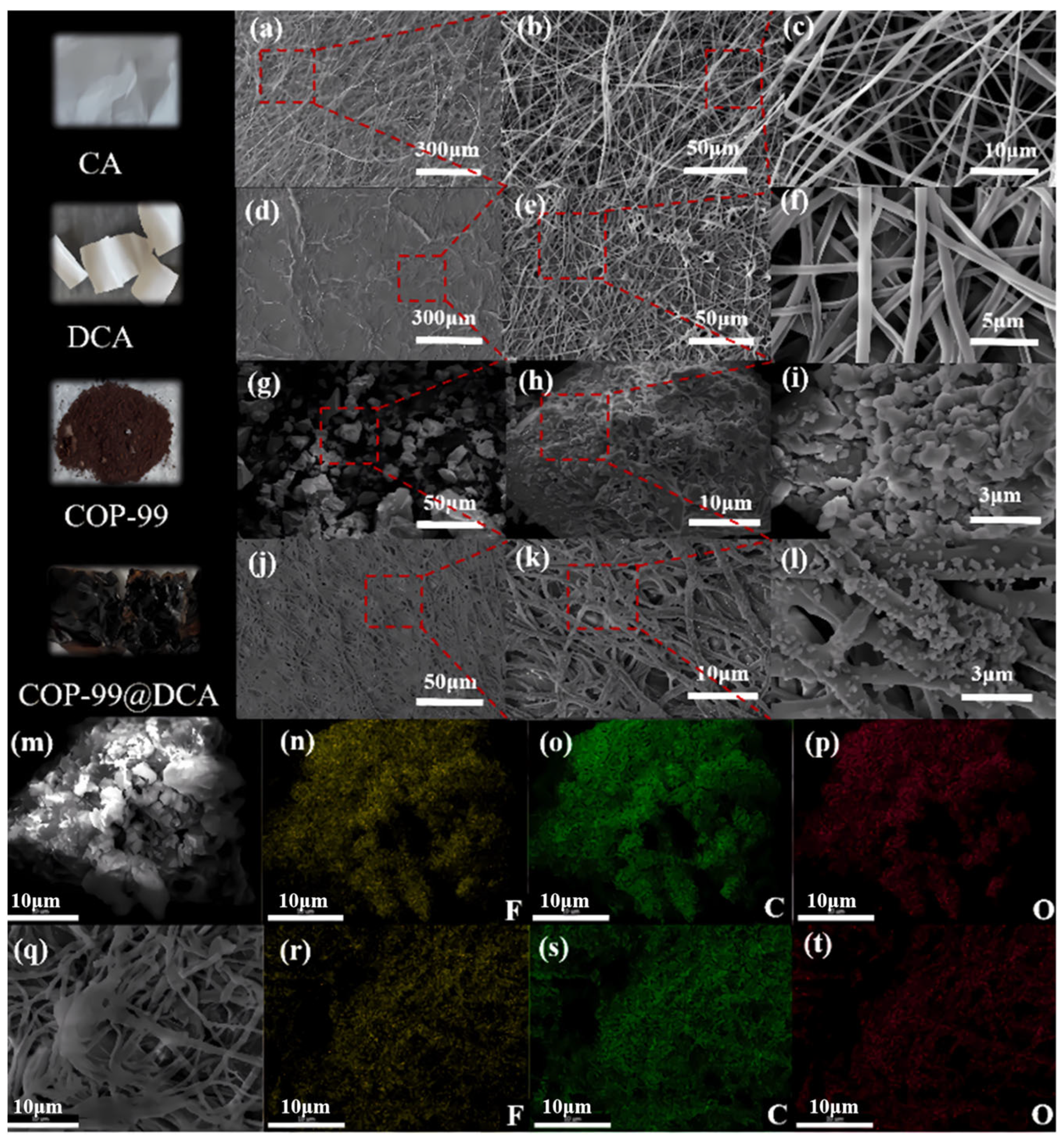
The morphologies of the CA membrane, DCA membrane, COP-99 powder, and COP-99@DCA composite were observed by scanning electron microscopy (SEM). As shown in Figure 1a–c, the white CA membrane consisted of many randomly distributed nanofibers [25]. After deacetylation (Figure 1d–f), the membrane surface was smoother, and both CA and DCA membranes were composed of irregular network fibers. As shown in Figure 1g–i, the COP-99 powder was a black-brown organic polymer with an irregular pore-like surface. After the in situ growth of COP-99 (Figure 1j–l), the color of the modified DCA membrane changed from white to black-brown, and numerous irregular particles were distributed along the nanofibers, suggesting the successful synthesis of COP-99@DCA. In addition, due to the presence of COP-99 on the CA membrane, the mean diameter of nanofibers on the COP-99@DCA membrane was 572 ± 114 nm, which was higher than that (462 ± 94 nm) on the CA membrane (Figure S2). Furthermore, as shown in the EDS mapping images (Figure 1m–p), the F, C, and O elements were uniformly distributed on the membrane, and their atomic percentages were 27, 50, and 23, respectively (Table S3). To well-analyze the pore structure of DCA membrane, COP-99 powder, and COP-99@DCA composite, the N2 adsorption–desorption measurements were performed to determine the BET specific surface area, pore volume, and pore size distribution. As depicted in Table S4 and Figure S3, the BET area and pore volume increased from 15.75 and 0.184 to 60.38 m2/g and 0.377 cm3/g, respectively, once the COP-99 grew on the DCA membrane. In addition, the average pore sizes of the DCA membrane and COP-99@DCA composite were similar, indicating that in situ COP-99 growth did not block membrane porosity. All the results confirmed the successful immobilization of COP-99 on the DCA substrate.
Figure 1. SEM images of CA nanofiber membrane (ac), DCA nanofiber membrane (df), COP-99 powder (gi), COP-99@DCA composite material (jl), EDS mapping images of COP-99 powder (mp), and EDS mapping images of COP-99@DCA membrane (qt).

3.1.2. Surface Composition Analysis and Stability Analysis of COP-99@DCA

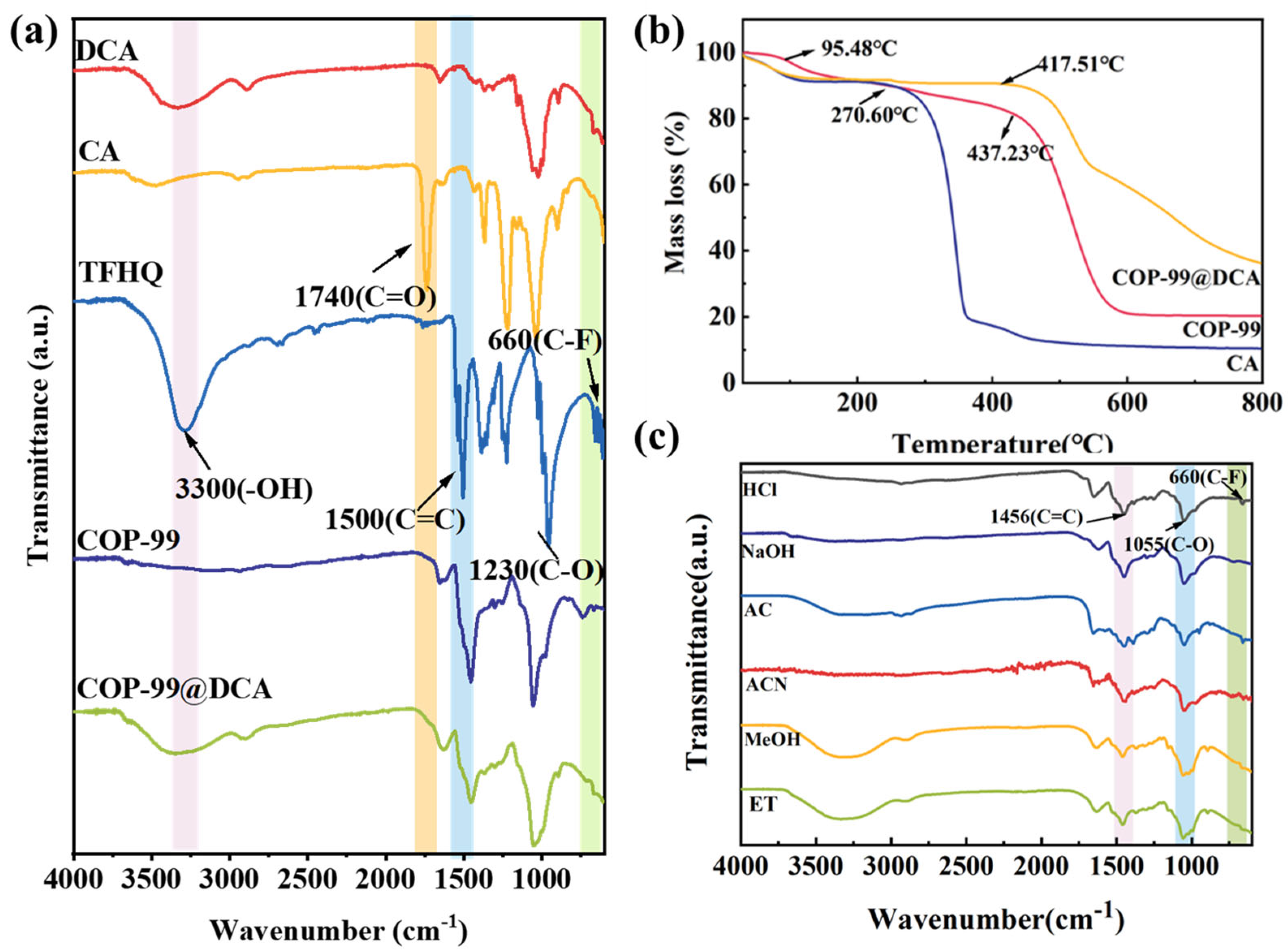
FT-IR was explored to analyze the changes in surface functional groups of the CA nanofiber membrane and COP-99@DCA membrane. Figure 2a showed that the main functional groups of samples were O-H (3450 cm−1) and C=O (1740 cm−1), which are characteristic peaks of polysaccharides like cellulose [26]. After deacetylation, the enhanced O-H group peak in the DCA membrane (3300 cm−1) and the weakened C=O stretching vibration peak (1740 cm−1) both indicated the successful deacetylation of the CA membrane [27].
Figure 2. FT-IR spectra of DCA, CA, COP-99@DCA, TFHQ, and COP-99 (a), thermogravimetric (TG) curves of DCA, COP-99, and COP-99@DCA (b), and FT-IR curves of COP-99@DCA immersed in different solvents for 24 h (c).
Figure 2a indicates that the main functional groups of COP-99@DCA are C-F (660 cm−1), C=C (1500 cm−1), -OH (3300 cm−1), and hydrogen bond (2920 cm−1). The disappeared and weakened -OH group peak in TFHQ (3300 cm−1), as well as the enhanced stretching vibration of the C-O-C at 1280 cm−1 and the stretching vibration of the C=C at 1500 cm−1, both demonstrate that TFHQ underwent a self-condensation reaction to form the COP-99 macromolecular polymer. In addition, the stretching vibration of the -OH at 3400 cm−1 and the hydrogen bond at 2920 cm−1 became stronger, suggesting that the substitution between DCA and COP-99 occurred [28]. COP-99@DCA retained the C=C group (1500 cm−1), C-O-C group (1280 cm−1), C-F group (750 cm−1), and C-O group (1055 cm−1) of COP-99, indicating successful synthesis of the COP-99@DCA membrane.
The thermal stability of COP-99@DCA was evaluated through thermogravimetric analysis (TGA). Figure 2b showed that the COP-99@DCA nanofiber membrane had a minimal mass loss at 95.48 °C, followed by the first and second mass losses at 270.60 °C and 437 °C, respectively. However, at 417.51 °C, COP-99@DCA only exhibited slight mass loss (less than 10%), revealing a marked improvement in the thermal stability of COP-99@DCA [29]. Therefore, the COP-99@DCA nanofiber membrane possessed satisfactory thermal stability [30].
In addition, the chemical stability of the COP-99@DCA nanofiber membrane in different solvents was also examined. As shown in Figure 2c, after immersion of the COP-99@DCA nanofiber membrane in six different solvents (HCl, NaOH, AC, ACN, MeOH, and ET), the absorption peaks around 660 cm−1 for the C-F group, around 1055 cm−1 for both C-F and C-O groups, and the characteristic peak at 1456 cm−1 for the C=C double bond remained essentially unchanged, which demonstrated that the membrane retained its structural and chemical integrity. The integrity of the F atoms in the benzene ring was maintained by the presence of the C-F group, and the C-O group suggested a stable interaction between the COP-99 polymer and the DCA membrane [31]. However, the characteristic peak of the C=C double bond (1456 cm−1) weakened when soaked in the AC solvent, indicating that AC can impair the enrichment capability of COP-99@DCA. Therefore, AC was excluded from use as a washing eluent for NPs in subsequent experiments. In conclusion, these findings demonstrate the excellent chemical stability of the COP-99@DCA nanofiber membrane [32].

3.2. Optimization of DSPME Parameters

3.2.1. The Effects of Enrichment Parameters

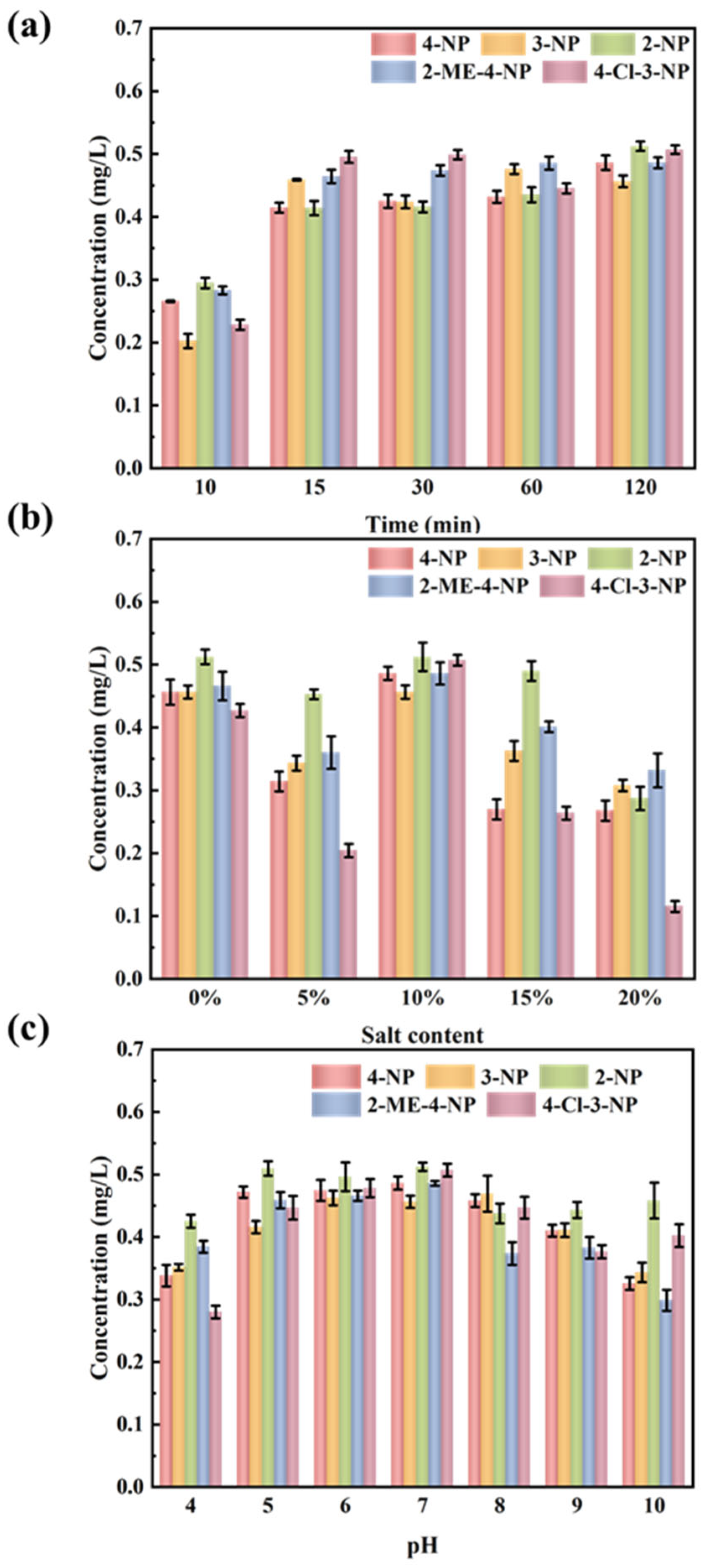
Figure 3a illustrates the variation in NP enrichment concentration over time. In this experiment, the eluent was methanol: acetonitrile (v/v, 1:1). The concentration of NPs in the eluent gradually increased as enrichment time increased, showing an overall upward trend. The growth rate of NP concentration was highest in the first 30 min. As enrichment time continued to increase, the growth rate slowed from 30 to 120 min, eventually reaching adsorption equilibrium [33]. Among them, the concentration of 2-NP reached its maximum at 120 min. In conclusion, the optimal enrichment time was 15 min.
Figure 3. Effect of time (a), salt content (b), and pH (c) on extraction efficiency of trace NPs in water.
Figure 3b displayed the influence of salt concentration on the enrichment of NPs. Increasing the ionic strength appropriately can enhance the enrichment efficiency of NPs, but excessive ionic strength can inhibit this process. Therefore, a NaCl concentration of 10 wt% was chosen for subsequent experiments.
Figure 3c illustrates the variation in NP enrichment efficiency with the pH of the elution solution. The pH of the enrichment solution exerted no significant effect on the elution efficiency of the target pollutants. Extraction performance was found to be optimal when the pH of the aqueous pollutant solution was not adjusted. The experimental results showed that when the pH was adjusted from 4 to 5, the concentration of NPs in the eluent increased. There was little change in concentration between pH 5 and 7. However, when the pH increased from 8 to 10, the concentration of NPs in the eluent decreased. This decline was attributed to the deprotonation of NPs (pH > pKa (~7.15 for 4-nitrophenol, ~8.36 for 3-nitrophenol, and ~7.78 for 4-Chloro-3-nitrophenol) into hydrophilic anions, which reduced their hydrophobic affinity for COP-99@DCA and introduced electrostatic repulsion from the negatively charged adsorbent surface (Figure S4). Consequently, no adjustments were made to the acidity or alkalinity of the aqueous contaminant solution in subsequent trials.

3.2.2. The Effects of Elution Parameters

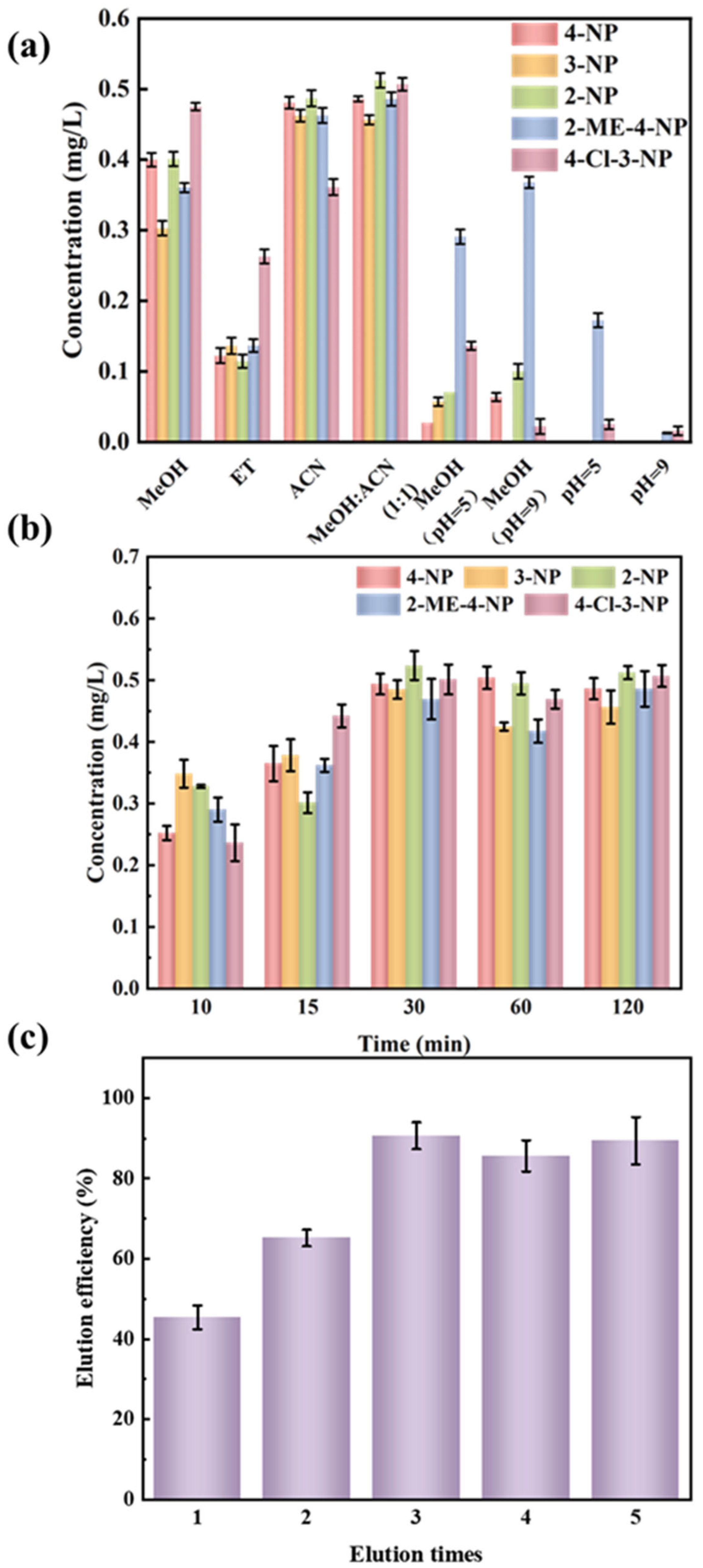
Figure 4a and Table 1 illustrates the effect of eluents on the elution efficiency of NPs. The experiment tested eight eluents, including MeOH, ET, ACN, MeOH:ACN (v/v, 1:1), MeOH (pH = 5), MeOH (pH = 9), pH = 5 aqueous solution, and pH = 9 aqueous solution. The results showed that MeOH:ACN (v/v, 1:1) yielded the highest elution efficiency, with an efficiency of 91.26–102.46%. Therefore, MeOH:ACN (v/v, 1:1) was selected as the optimal eluent.
Figure 4. Effect of eluent (a), elution time (b), and elution times (c) on extraction efficiency of trace NPs in water.
Table 1. Effect of eluent on extraction efficiency of trace NPs in water after 5 elution cycles.
Figure 4b represented the effect of elution time on NP enrichment. The concentration of NPs in the eluent increased rapidly and reached elution equilibrium within 0–30 min, whereas the increment rate slowed down in the 30–120 min period. Therefore, a 30 min elution time was selected for subsequent elution experiments with the COP-99@DCA nanofiber membrane.
The number of elutions is one of the key factors affecting elution efficiency. According to Figure 4c, with 4-Cl-3-NP as a representative, the elution efficiency increases continuously from the 1st to the 3rd elution, peaking at 89.40% after the third elution. Elution efficiency exhibits no significant variation from the 3rd to the 5th elution. Therefore, three consecutive elutions were selected as the optimal protocol for the experiment.

3.3. Evaluation of the DSPME-HPLC Method

The main parameters for evaluating the enrichment capability for contaminants usually include limits of detection (LODs, S/N = 3), limits of quantification (LOQs, S/N = 10), coefficient of determination (R2), linear equations, and enrichment factors (EFs). According to the results listed in Table S5, the calibration curves for 4-NP, 3-NP, 2-NP, 2-ME-4-NP, and 4-Cl-3-NP showed good linear relationships with R2 ranging from 0.9734 to 0.9964. The LOD and LOQ were calculated based on signal-to-noise ratios (S/N) of 3 and 10, respectively, with LOD values ranging from 0.08 to 0.1 μg/L and LOQ values ranging from 0.5 to 1 μg/L. Meanwhile, the relative standard deviation (RSD) was adopted to evaluate the reproducibility of intra-day and inter-day extraction, which were 2.54% to 8.77% and 1.65% to 6.81%, respectively, verifying the good reproducibility of the method based on COP-99@DCA fiber. Furthermore, the enrichment factors for the five NP isomers ranged from 92.80 to 100.60, suggesting that the COP-99@DCA composite material can effectively enrich trace nitrophenol endocrine disruptors in water, even at extremely low concentrations.
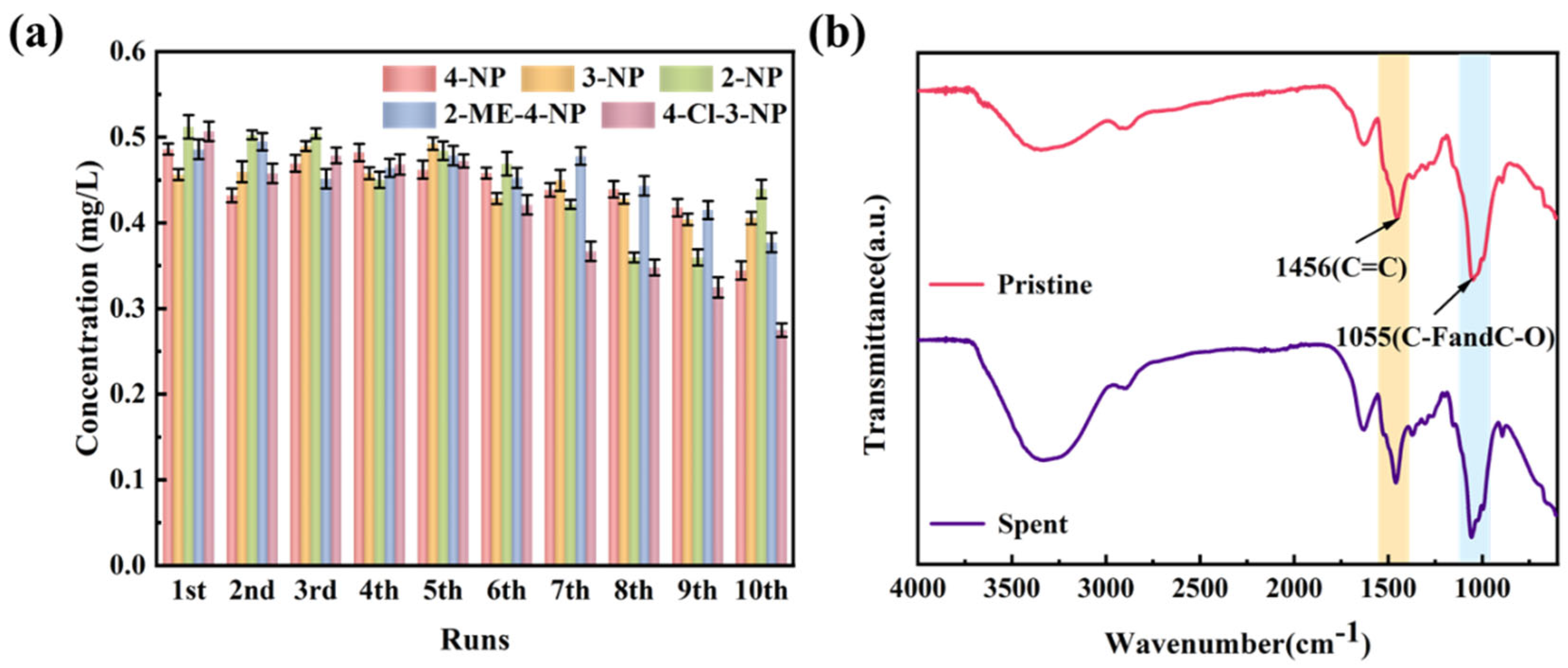
The cyclic capability and stability of COP-99@DCA were studied through continuous enrichment–desorption experiments. To remove residual analytes from previous cycles, the adsorbent was washed three times with 1 mL of methanol before reuse. Figure 5a showed that the enrichment concentration exhibited no significant decline for the first five cycles, and the enrichment efficiency began to decrease gradually from the sixth cycle. The desorption efficiency of NPs in the tenth cycle was 68.91%, 81.12%, 87.90%, 75.44%, and 54.98%, respectively, indicating favorable stability and reusability of the material [34]. In addition, as depicted in Figure 5b, no obvious changes were observed in the FT-IR spectra of the pristine and spent COP-99@DCA, suggesting the structural stability of the material [35]. To further estimate the stability of COP-99@DCA during the reutilization process, the FT-IR and FESEM were employed to observe the variation in the chemical groups and morphological structure. As shown in Figure S5, the same FT-IR spectra revealed good chemical stability. Instead, as shown in the FESEM images (Figure S6), the COP-99 particles evidently decreased after 10 runs, suggesting that the combination between the COP-99 and DCA membrane was not strong enough, which resulted in the evident decline in the enrichment after five runs. A detailed comparison of the reusability cycles and degradation mechanisms of COP-99@DCA with those of analogous adsorbent materials reported in the literature is presented in Table S6 [36,37,38,39]. Collectively, these results confirm that COP-99@DCA possesses excellent chemical stability and high adsorption efficiency for NPs in short-term applications. However, its long-term reusability is constrained primarily by insufficient mechanical adhesion between COP-99 nanoparticles and the DCA membrane, rather than by intrinsic chemical instability of the adsorbent itself [40].
Figure 5. Repeatability of COP-99@DCA for NPs under optimal conditions (a) and FT-IR spectra of pristine and spent COP-99@DCA (b).

3.4. Comparison with Other Materials

The enrichment performance of COP-99@DCA developed herein for NPs was compared with the published materials to illustrate the enrichment potential of NPs by COP-99@DCA composites. Table S7 showed that COP-99@DCA shows significant improvements over most existing materials, including lower practical detection limits (as low as 0.08 μg/L), the ability to enrich more analyte types (five NPs simultaneously), and a higher recovery rate (92.8–100.6%) [41,42,43,44,45]. Notably, despite the fact that APBDV/SCSE showed a lower detection limit than COP-99@DCA, the enrichment factors of COP-99@DCA were higher than those of APBDV/SCSE [44]. In general, the COP-99@DCA demonstrated strong competitiveness relative to other materials.

3.5. Application to Real Sample

To test the practicality of the method, the COP-99@DCA composite material was applied to real river and seawater samples. The concentrations of five trace nitrophenols were determined using high-performance liquid chromatography. The recovery rates and enrichment factors were evaluated by comparing the measured concentrations with the theoretical spiked concentrations. The results showed that the method successfully detected and enriched the NPs in both river and seawater samples, achieving satisfactory recovery rates and high enrichment factors.
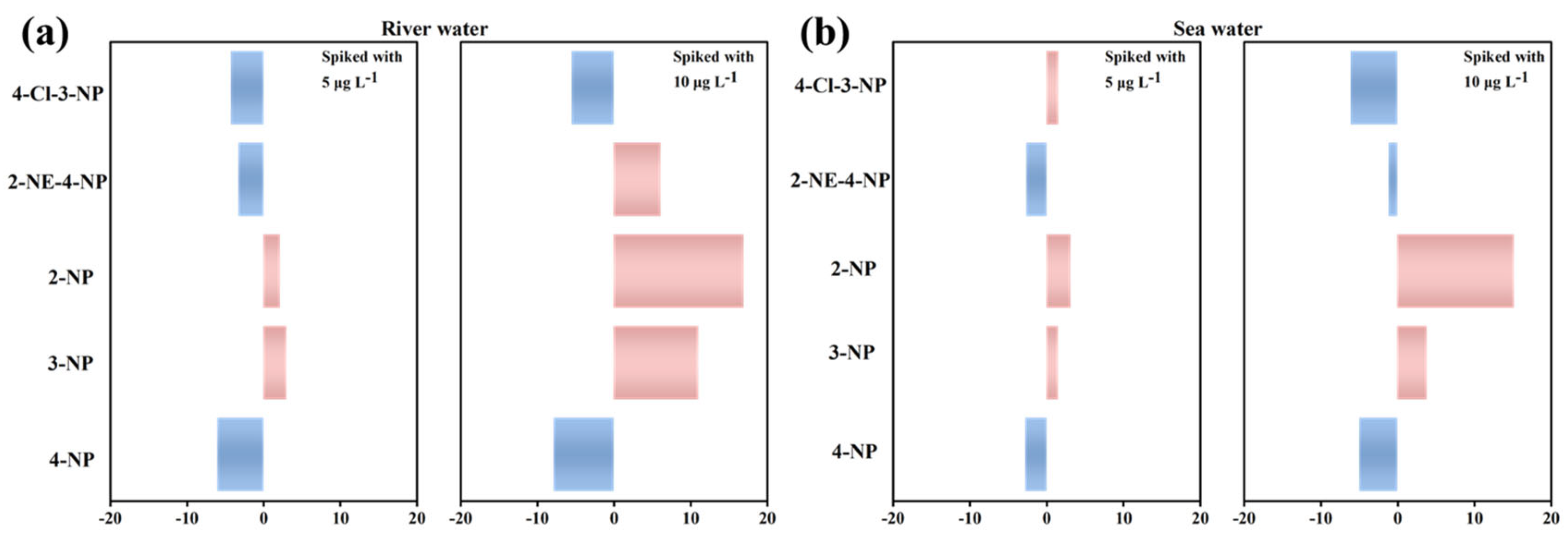
Due to the presence of various coexisting components, such as organic solutes, in both river water and seawater, their impact on the enrichment of NPs was unclear. Therefore, this study investigated the matrix effects during the trace enrichment of endocrine-disrupting compounds in river water and seawater. Matrix effects (ME) can be categorized into three classes: weak matrix effects (−20% to 20%), moderate matrix effects (20% to 50% and −20% to −50%), and strong matrix effects (>50% or <−50%) [46].
As shown in Figure 6a, in river water, at a spiking concentration of 5 μg/L, the matrix effects ranged from −6.00% to 2.99%. 3-NP and 2-NP showed weak matrix-enhancing effects (2.99% and 2.15%), whereas 4-NP, 2-ME-4-NP, and 4-Cl-3-NP exhibited weak matrix-inhibiting effects (−6% to −3.24%). At a spiking concentration of 10 μg/L, the matrix effects ranged from −7.84% to 16.99%. 4-NP and 4-Cl-3-NP demonstrated weak matrix-inhibiting effects (−7.84% to −5.42%), while 3-NP, 2-NP, and 2-ME-4-NP exhibited weak matrix-enhancing effects (6.13% to 11.07%).
Figure 6. Matrix effects on NP enrichment in actual water samples: (a) river water, (b) sea water.
In seawater (Figure 6b), at a spiking concentration of 5 μg/L, the matrix effects ranged from −2.74% to 3.10%. Specifically, the analytes 3-NP, 2-NP, and 2-ME-4-NP exhibited weak matrix-enhancing effects (1.48% to 3.10%), while 4-NP and 4-Cl-3-NP displayed weak matrix-inhibiting effects (−2.74% to −2.59%). At a spiking concentration of 10 μg/L, the matrix effects ranged from −6.04% to 15.24%. Only 3-NP and 2-NP showed weak matrix-inhibiting effects (−6.04% to −1.09%), while others exhibited weak matrix-enhancing effects. These results confirmed the feasibility of enriching NPs using COP-99@DCA nanofiber membrane materials in real water samples [22].
To further prove the feasibility of our method in analyzing NPs in real water, we also studied the enrichment and detection of NPs in the real water samples (river sample and sea sample) by adding the targets under different levels (5 μg/L and 10 μg/L). As shown in Table 2, the high recovery revealed the feasibility of enriching trace NPs in the real water. Furthermore, we also supplemented the quantification of NPs in the real water samples. As listed in Tables S8 and S9, the working curves of 4-NP, 3-NP, 2-NP, 2-ME-4-NP, and 4-Cl-3-NP showed a good linear relationship in two real water samples, and the coefficient of determination (R2) was between 0.9586 and 0.9903. In the river water sample, the limit of detection of all NPs was in the range of 0.10–0.50 μg/L, while the limit of quantification was in the range of 0.38–1.90 μg/L, respectively. In the seawater sample, the limit of detection of all NPs was in the range of 0.08–0.45 μg/L, while the limit of quantification was in the range of 0.30–1.50 μg/L, respectively. It indicated that COP-99@DCA could also enrich some kinds of NPs under extremely low concentrations. The intra-day precision and inter-day precision experiments were evaluated for accuracy and precision using mean recovery and relative standard deviation (RSD%) as indicators. The RSD during intra-day and inter-day of using COP-99@DCA to extract NPs were between 0.29 and 7.41% in river water and 3.54–8.79% in seawater. To further confirm the feasibility of our method in analyzing NPs in more complex matrices of water, the real wastewater samples near two printing and dyeing mills were employed for the test. Unfortunately, in these samples, we did not detect the NPs selected in our work, but we detected the 4-nitrobenzene sulfonic acid in the samples (Figure S7), which also revealed that COP-99@DCA was feasible to enrich the NPs and achieve the detection of NPs in real wastewater.
Table 2. The enrichment factors and recovery rate of NPs during the enrichment with COP-99@DCA in actual water bodies.

3.6. Enrichment Mechanism

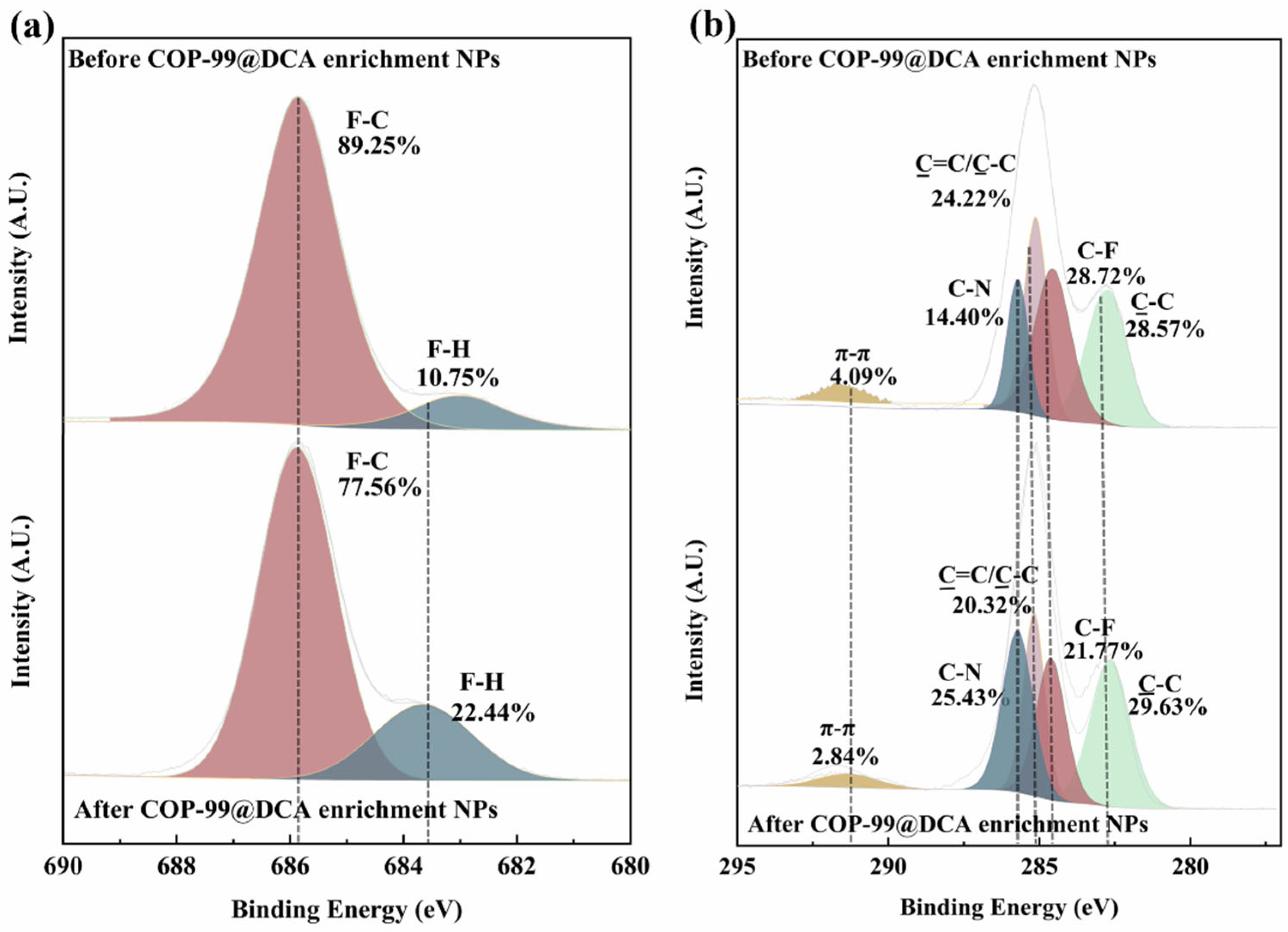
To further investigate the elemental composition and the types of interaction forces in the sample, including electrostatic interaction, acid–base interaction, hydrogen bond interaction, π-π stacking effect, and hydrophobic interaction, we performed XPS analysis. Given that NPs are organic molecules, electrostatic and acid–base interactions in aqueous environments are considered to be negligible. The F 1s spectrum primarily features peaks corresponding to F–C groups (685.9 eV) and F…H groups (683.6 eV). During the synthesis of the COP-99@DCA nanofiber membrane, F atoms form H…F hydrogen bonds with the hydroxyl groups on the DCA membrane. As shown in Figure 7, the content of F…H bonds increased from 10.75% before enrichment to 22.44% after enrichment, highlighting the crucial role of hydrogen bonding in the NP enrichment process [47]. The small atomic radius of F, along with the short bond length and high bond energy of the H…F interaction, endows the membrane with more stable binding ability and imparts strong affinity toward NP pollutants, thereby enhancing the overall enrichment efficiency.
Figure 7. F1s (a) and C1s (b) XPS spectra of COP-99@DCA nanofiber membrane before and after enrichment of NPs.
In aromatic ring-containing molecules, there are π-electron conjugated systems, and π-π stacking acts as a key intermolecular force, which is essentially the mutual attraction between electron clouds of different signs between aromatic rings [48]. π-π stacking can occur in multiple configurations, with the most prevalent stacking methods being face-to-face (F-type stacking) and face-to-edge (T-type stacking). Both NPs and COP-99@DCA possess abundant aromatic rings, indicating that π-π stacking takes place during the enrichment process. This experiment investigated the changes in functional group contents of the COP-99@DCA nanofiber membrane before and after NPs enrichment. From Figure 7, it can be observed that the main groups on the high-resolution map of C1s were the π-π group (291.7 eV), C-O (285.7 eV), C=C\C-C (285.1 eV), C-F (284.6 eV), and C-C (282.8 eV). The decrease in π-π group (291.7 eV) from 4.09% to 2.84% and C=C\C-C (285.1 eV) from 24.22% to 20.32% after NP enrichment suggests that π-π stacking interactions contribute significantly to the enrichment process of COP-99@DCA.
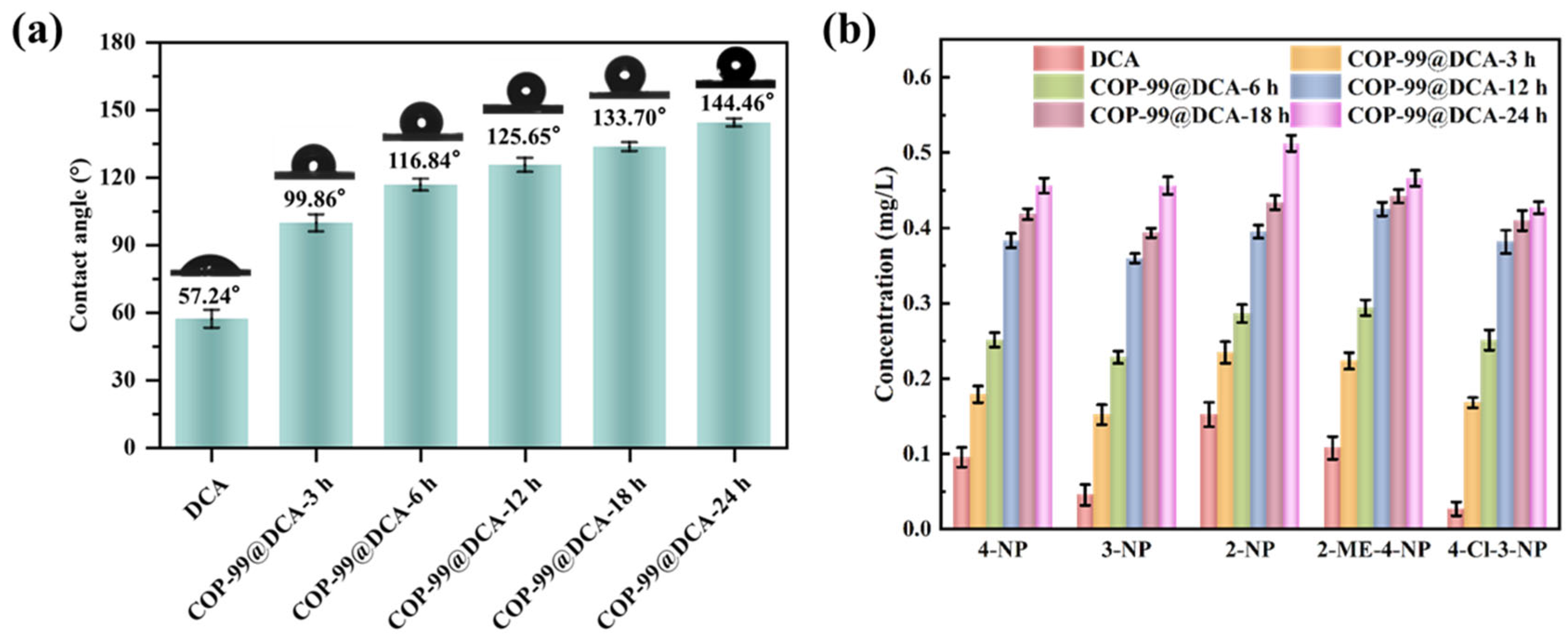
Hydrophobicity refers to the tendency of non-polar molecules to leave the aqueous phase and enter the non-polar phase, and the more non-polar regions (hydrophobic groups), the stronger the hydrophobicity [49]. As depicted in Figure 8a, the contact angle of the DCA nanofiber membrane was 57.24°, and its hydrophobicity was relatively weak owing to the abundance of hydrophilic hydroxyl groups on the membrane surface. Due to the presence of hydrophobic F atoms [50], the COP-99 usually displayed strong hydrophobicity. When COP-99 was grown on the DCA membrane, the contact angle of COP-99@DCA composites gradually rose along the reaction time and reached 144.46° after 24 h, revealing the strong hydrophobicity of the COP-99@DCA nanofiber membrane. This was attributed to the presence of hydrophobic phenyl ring molecules and F atoms on the surface of COP-99 in COP-99@DCA. Notably, the enrichment performance of nitrophenols was significantly positively correlated with hydrophobicity (Figure 8b), manifesting that the hydrophobic effect played a dominating role in enriching nitrophenols. During the enrichment process, NPs possess hydrophobic groups. The hydrophobic groups of COP-99@DCA can interact with the hydrophobic groups of large molecules on NPs, resulting in the promoted enrichment of NPs for COP-99@DCA composite [51].
Figure 8. Static contact angle (a) of DCA and COP-99@DCA under different reaction times, and concentration of NPs (b) in DCA and COP-99@DCA under different reaction times.

4. Conclusions

Exploiting highly efficient adsorption materials with high enrichment capacity to improve sample pre-treatment efficiency was also an effective strategy to achieve the analysis of trace toxic and harmful pollutants in water. In this work, a porous organic polymer-modified cellulose nanofiber membrane (COP-99@DCA) was prepared through in situ growth of porous organic polymer on the electrospun cellulose nanofiber membrane, and proved the feasibility of applying COP-99@DCA for the monitoring of trace nitrophenol pollutants in water when coupled with HPLC. The obtained COP-99@DCA composite owned rich functional groups, including C-F, C-O, and hydroxyl groups, which provide an efficient site to enrich nitrophenols through hydrogen bonding, π-π stacking, and hydrophobic effects. In addition, the COP-99@DCA composite also exhibited excellent thermal and chemical stability and reusability. Notably, based on COP-99@DCA and HPLC, the established method showed low LOQ (0.5–1 μg/L) and LOD (0.08–0.1 μg/L), high recovery rates (85.35% to 113.55%), fine precision (< 7% of relative standard deviations), and strong anti-interference capability (weak matrix effects) in actual water. All the findings will provide a new avenue for the development of efficient pre-treatment adsorbent materials and the detection of trace toxic endocrine-disrupting pollutants in water bodies.

Supplementary Materials

The following supporting information can be downloaded at https://www.mdpi.com/article/10.3390/chemosensors14020031/s1: Figure S1 Three-dimensional fluorescence spectra in three different actual water samples; Figure S2 FESEM diameter distribution histogram of CA membrane (a) and DCA membrane (b); Figure S3 Pore size distribution of COP-99@DCA-pristine (a), COP-99@DCA-spent (b), DCA membrane (c) and COP-99 powder (d); Figure S4 Zeta potentials of COP-99@DCA (pH = 3–10); Figure S5 FT-IR spectra of the fresh and used COP-99@DCA; Figure S6 FESEM of the COP-99@DCA fiber: (a) pristine, (b) after 5 runs, (c) after 10 runs; Figure S7 HPLC chromatograms of 4-nitrobenzene sulfonic acid in two real wastewater samples from printing and dyeing mills; Table S1 List of chemicals and reagents; Table S2 Summary of experimental instruments; Table S3 EDS atomic percentages (Atomic %) of key elements; Table S4 BET surface area, pore volume and average pore size of DCA, COP-99 powder, pristine and spent COP-99@DCA; Table S5 DSPE methodology parameter of COP-99@DCA; Table S6 Comparison of cycling performance for NPs enrichment; Table S7 Comparison of parameters with other extraction material enrich with nitraphenol; Table S8 DSPE methodology parameter of COP-99@DCA in river water bodies; Table S9 DSPE methodology parameter of COP-99@DCA in seawater bodies.

Author Contributions

Conceptualization, Y.L.; Methodology, X.H. Software, X.H.; Formal analysis, X.H. and W.L.; Investigation, X.H.; Resources, W.L. and C.T.; Writing—original draft, Y.L. and X.H.; Writing—review & editing, Y.L., X.L. and C.T.; Supervision, X.L. and C.T.; Funding acquisition, X.L. All authors have read and agreed to the published version of the manuscript.

Funding

This work was financed by the University-Industry Cooperation Project of Fujian (No. 2025Y4004).

Data Availability Statement

The original contributions presented in this study are included in the article/Supplementary Material. Further inquiries can be directed to the corresponding author(s).

Conflicts of Interest

Author Wangcheng Lan is employed by Fujian Academy of Buiding Research Co., Ltd. The remaining authors declare that the research was conducted in the absence of any commercial or financial relationships that could be construed as potential conflicts of interest.

References

  1. Onjia, A.; Huang, X.; González, J.M.T.; Egbueri, J.C. Editorial: Chemometric approach to distribution, source apportionment, ecological and health risk of trace pollutants. Front. Environ. Sci. 2022, 10, 1107465. [Google Scholar] [CrossRef]
  2. Zhang, M.J.; Cui, J.X.; Lu, T.; Tang, G.S.; Wu, S.T.; Ma, W.J.; Huang, C.B. Robust, functionalized reduced graphene-based nanofibrous membrane for contaminated water purification. Chem. Eng. J. 2021, 404, 126347. [Google Scholar] [CrossRef]
  3. Wang, J.; Yin, J.; Peng, D.; Zhang, X.; Shi, Z.; Li, W.; Shi, Y.; Sun, M.; Jiang, N.; Cheng, B.; et al. 4-Nitrophenol at environmentally relevant concentrations mediates reproductive toxicity in Caenorhabditis elegans via metabolic disorders-induced estrogen signaling pathway. J. Environ. Sci. 2025, 147, 244–258. [Google Scholar] [CrossRef] [PubMed]
  4. Lv, Y.; Ma, J.; Liu, K.; Jiang, Y.; Yang, G.; Liu, Y.; Lin, C.; Ye, X.; Shi, Y.; Liu, M.; et al. Rapid elimination of trace bisphenol pollutants with porous β-cyclodextrin modified cellulose nanofibrous membrane in water: Adsorption behavior and mechanism. J. Hazard. Mater. 2021, 403, 123666. [Google Scholar] [CrossRef]
  5. Liu, K.; Huang, Z.; Dai, J.; Jiang, Y.; Yang, G.; Liu, Y.; Lin, C.; Lv, Y.; Liu, M. Fabrication of amino-modified electrospun nanofibrous cellulose membrane and adsorption for typical organoarsenic contaminants: Behavior and mechanism. Chem. Eng. J. 2020, 382, 122775. [Google Scholar] [CrossRef]
  6. Ma, J.; Yu, Z.; Liu, S.; Chen, Y.; Lv, Y.; Liu, Y.; Lin, C.; Ye, X.; Shi, Y.; Liu, M.; et al. Efficient extraction of trace organochlorine pesticides from environmental samples by a polyacrylonitrile electrospun nanofiber membrane modified with covalent organic framework. J. Hazard. Mater. 2022, 424, 127455. [Google Scholar] [CrossRef]
  7. Rosado, A.; Borrás, A.; Suárez-García, F.; Vallcorba, O.; López-Periago, A.M.; Ayllón, J.A.; Domingo, C. Hydrophobic post-functionalization of a water instable bioMOF: Effect on CO2 and water adsorption. Appl. Mater. Today 2025, 42, 102573. [Google Scholar] [CrossRef]
  8. Luo, S.; Chen, R.; Zeng, R.Y.; Shi, D.; Tian, Y.Q.; Sun, J.M.; Song, Z.F.; Xiao, Y.H.; Yuan, J.S.; Shi, J.H.; et al. Electrostatic-modulated assembly of charged COF nanosheets into high-performance nanofiltration-based desalination membranes. Chem. Eng. J. 2025, 521, 166835. [Google Scholar] [CrossRef]
  9. Tang, D.L.; Yin, M.L.; Du, X.W.; Duan, Y.X.; Chen, J.; Qiu, T. Wettability tunable conjugated microporous poly(aniline)s for long-term, rapid and ppb level sequestration of Hg(II). Chem. Eng. J. 2023, 474, 145527. [Google Scholar] [CrossRef]
  10. El-Sheikh, A.H.; Sweileh, J.A.; Al-Degs, Y.S.; Insisi, A.A.; Al-Rabady, N. Critical evaluation and comparison of enrichment efficiency of multi-walled carbon nanotubes, C18 silica and activated carbon towards some pesticides from environmental waters. Talanta 2008, 74, 1675–1680. [Google Scholar] [CrossRef]
  11. Chen, M.; Zhao, Y.; Yang, Y.; Yang, Y.; Wang, H.; Luo, D.; Xie, S.; Chen, D. Development of a magnetic MOF-based MD-μSPE methodology combined with LC-MS/MS for the determination of fluorotelomer alcohols and its metabolites in animal derived foods. Food Chem. Adv. 2021, 363, 130205. [Google Scholar] [CrossRef]
  12. Xu, M.; Luo, X.; Zhang, G.; Zhao, B.; Li, S.; Xiao, Z.; Wu, Q.; Wang, Z.; Wang, C. Construction of imine-linked covalent organic framework as advanced adsorbent for the sensitive determination of chlorophenols. J. Chromatogr. A 2021, 1658, 462610. [Google Scholar] [CrossRef] [PubMed]
  13. He, Y.; Luo, D.; Lynch, V.M.; Ahmed, M.; Sessler, J.L.; Chi, X. Porous adaptive luminescent metallacage for the detection and removal of perfluoroalkyl carboxylic acids. Chem 2023, 9, 93–101. [Google Scholar] [CrossRef]
  14. Yi, S.Q.; Yuan, D.; Sun, L.; Chen, M.X.; Xu, S.Y.; Wan, S.G. Nonthermal plasma-assisted fabrication of pomelo peel-based aerogel with rich micropores and high hydrophobicity for the excellent adsorption of gaseous p-xylene. Chem. Eng. J. 2025, 511, 161951. [Google Scholar] [CrossRef]
  15. Zhu, H.Y.; Xu, Z.; Xiao, M.; Zhao, D.X.; Wang, Q.; Fu, Y.Q.; Zhu, J.Q.; Xiong, X.Q.; Jiang, R. Multifunctional and sustainable chitosan-based interfacial materials for effective water evaporation, desalination, and wastewater purification: A review. Int. J. Biol. Macromol. 2025, 321, 145973. [Google Scholar] [CrossRef]
  16. Zhang, X.F.; Qi, X.M.; Ma, Q.; Guo, X.; Wu, Y.Q. Spherical sponge-inspired design of chitosan/silver cluster-loaded cellulose nanofibrils/Cu-ZIF-8 gel beads for efficient removal of Cr(VI). Chem. Eng. J. 2024, 499, 155767. [Google Scholar] [CrossRef]
  17. He, Y.; Zhou, B.; Liang, H.; Wang, L.; Li, J.; Li, B. Silver nanoparticles on flower-like TiO2-coated polyacrylonitrile nanofibers: Catalytic and antibacterial applications. Colloids Surf. Physicochem. Eng. Aspects 2017, 529, 380–386. [Google Scholar] [CrossRef]
  18. Szilágyi, I.M.; Nagy, D. Review on one-dimensional nanostructures prepared by electrospinning and atomic layer deposition. J. Phys. Conf. Ser. 2014, 559, 012010. [Google Scholar] [CrossRef]
  19. He, H.Y.; Wang, J.; Li, X.; Zhang, X.W.; Weng, W.J.; Han, G.R. Silica nanofibers with controlled mesoporous structure via electrospinning: From random to orientated. Mater. Lett. 2013, 94, 100–103. [Google Scholar] [CrossRef]
  20. Li, W.; Jiang, H.X.; Geng, Y.; Wang, X.H.; Gao, R.Z.; Tang, A.N.; Kong, D.M. Facile Removal of Phytochromes and Efficient Recovery of Pesticides Using Heteropore Covalent Organic Framework-Based Magnetic Nanospheres and Electrospun Films. ACS Appl. Mater. Interfaces 2020, 12, 20922–20932. [Google Scholar] [CrossRef]
  21. Wang, X.H.; Li, W.; Jiang, H.X.; Chen, Y.; Gao, R.Z.; Tang, A.N.; Kong, D.M. Heteropore covalent organic framework-based composite membrane prepared by in situ growth on non-woven fabric for sample pretreatment of food non-targeted analysis. Microchim. Acta 2021, 188, 235. [Google Scholar] [CrossRef] [PubMed]
  22. Weng, X.; Liu, S.; Huang, J.; Lv, Y.; Liu, Y.; Li, X.; Lin, C.; Ye, X.; Yang, G.; Song, L.; et al. Efficient dispersive solid phase extraction of trace nitrophenol pollutants in water with triazine porous organic polymer modified nanofiber membrane. J. Chromatogr. A 2024, 1717, 464707. [Google Scholar] [CrossRef] [PubMed]
  23. Xia, X.Z.; Liu, J.L.; Xiao, Y.X.; Yu, Y.N.; Ren, Y.X.; Chen, J.J.; Xie, W.T.; Yang, B.; Zhang, J.Y.; Yang, Z.; et al. Superhydrophobic acid-resistant fluorinated Zif-8 prepared at normal temperature and pressure. Chem. Eng. J. 2025, 505, 159223. [Google Scholar] [CrossRef]
  24. Ma, J.Q.; Zhang, M.S.; Feng, R.; Dong, L.; Sun, W.; Jia, Y.Y. Superhydrophobic fluorinated metal-organic framework (MOF) devices for high-efficiency oil-water separation. Inorg. Chem. Front. 2024, 11, 5636–5647. [Google Scholar] [CrossRef]
  25. Moon, R.; Johnston, L.; Land-Hensdal, C.; Batchelor, W. Perspectives on cellulose nanofibril size measurement using scanning electron microscopy. Cellulose 2025, 32, 2793–2810. [Google Scholar] [CrossRef]
  26. Nan, Z.; Chen, L.; Li, G.; Li, H.; Li, Y.; Ma, J.; Ding, J.; Yang, J. A method for the quantitative analysis of Lycium barbarum polysaccharides (LBPs) using Fourier-transform infrared spectroscopy (FTIR): From theoretical computation to experimental application. Spectrochim. Acta Part A 2025, 326, 125204. [Google Scholar] [CrossRef]
  27. Tulos, N.; Harbottle, D.; Hebden, A.; Goswami, P.; Blackburn, R.S. Kinetic Analysis of Cellulose Acetate/Cellulose II Hybrid Fiber Formation by Alkaline Hydrolysis. ACS Omega 2019, 4, 4936–4942. [Google Scholar] [CrossRef]
  28. Bailey, A.V.; Honold, E.; Skau, E.L. Topochemical mechanisms involved in the preparation and deacetylation of partially acetylated cottons. Text. Res. J. 1958, 28, 861–873. [Google Scholar] [CrossRef]
  29. D’Acierno, F.; Michal, C.A.; MacLachlan, M.J. Thermal Stability of Cellulose Nanomaterials. Chem. Rev. 2023, 123, 7295–7325. [Google Scholar] [CrossRef]
  30. Kumalo, F.I.; Malimabe, M.A.; Mosoabisane, M.F.T.; Gumede, T.P. Development and Characterization of PBS/EA Cellulose and PCL/EA Cellulose Biocomposites: Structural, Morphological, and Thermal Insights for Sustainable Applications. Polymers 2025, 17, 971. [Google Scholar] [CrossRef]
  31. Yu, C.-H.; Betrehem, U.M.; Ali, N.; Khan, A.; Ali, F.; Nawaz, S.; Sajid, M.; Yang, Y.; Chen, T.; Bilal, M. Design strategies, surface functionalization, and environmental remediation potentialities of polymer-functionalized nanocomposites. Chemosphere 2022, 306, 135656. [Google Scholar] [CrossRef]
  32. Chen, Z.; Yu, C.; Zhong, W. Preparation of Mechanically Strong Aramid Nanofiber Gel Film with Surprising Entanglements and Orientation Structure Through Aprotic Donor Solvent Exchange. Materials 2025, 18, 1142. [Google Scholar] [CrossRef] [PubMed]
  33. Costa, M.; van der Geer, L.; Joaquim, M.; Hammarström, B.; Tanriverdi, S.; Joensson, H.N.; Wiklund, M.; Russom, A. EchoTilt: An Acoustofluidic Method for the Capture and Enrichment of Nanoplastics Directed Toward Drinking Water Monitoring. Micromachines 2024, 15, 1487. [Google Scholar] [CrossRef] [PubMed]
  34. Bayuo, J.; Rwiza, M.J.; Choi, J.W.; Mtei, K.M.; Hosseini-Bandegharaei, A.; Sillanpää, M. Adsorption and desorption processes of toxic heavy metals, regeneration and reusability of spent adsorbents: Economic and environmental sustainability approach. Adv. Colloid Interface Sci. 2024, 329, 103196. [Google Scholar] [CrossRef] [PubMed]
  35. Liu, Y.; Biswas, B.; Hassan, M.; Naidu, R. Green adsorbents for environmental remediation: Synthesis methods, ecotoxicity, and reusability prospects. Processes 2024, 12, 1195. [Google Scholar] [CrossRef]
  36. Sajab, M.S.; Wan Jusoh, W.N.L.; Mohan, D.; Kaco, H.; Baini, R. 3D Printed Functionalized Nanocellulose as an Adsorbent in Batch and Fixed-Bed Systems. Polymers 2023, 15, 969. [Google Scholar] [CrossRef]
  37. Narváez-Muñoz, C.; Ponce, S.; Durán, C.; Aguayo, C.; Portero, C.; Guamán, J.; Debut, A.; Granda, M.; Alexis, F.; Zamora-Ledezma, E.; et al. Polyacrylonitrile/Silver Nanoparticles Composite for Catalytic Dye Reduction and Real-Time Monitoring. Polymers 2025, 17, 1762. [Google Scholar] [CrossRef]
  38. Karakas, K.; Celebioglu, A.; Celebi, M.; Uyar, T.; Zahmakiran, M. Nickel nanoparticles decorated on electrospun polycaprolactone/chitosan nanofibers as flexible, highly active and reusable nanocatalyst in the reduction of nitrophenols under mild conditions. Appl. Catal. B 2017, 203, 549–562. [Google Scholar] [CrossRef]
  39. Wang, Y.-L.; Dai, Y.-M.; Tsai, M.-H. Highly efficient and recyclable Fe3C/Au@NG catalyst for 4-nitrophenol reduction. Catal. Commun. 2021, 149, 106251. [Google Scholar] [CrossRef]
  40. Dutta, R.; Baruah, K.; Doley, S.; Dolui, S.K.; Ray, B.C. Hydrophobic poly(ethylene-co-vinyl acetate) and nanoclay-based polymeric adsorbent for effective removal of oils and various organic solvents from contaminated wastewater. New J. Chem. 2024, 48, 16491–16499. [Google Scholar] [CrossRef]
  41. Wang, M.; Gao, M.; Deng, L.; Kang, X.; Yang, L.; Quan, T.; Xia, Z.; Gao, D. Composite Material Based on Carbon Dots and Molecularly Imprinted Polymers: A Facile Probe for Fluorescent Detection of 4-Nitrophenol. Nano 2020, 15, 2050105. [Google Scholar] [CrossRef]
  42. Dou, Y.; Guo, L.; Li, G.; Lv, X.; Xia, L.J.M.J. Amino group functionalized metal-organic framework as dispersive solid-phase extraction sorbent to determine nitrobenzene compounds in water samples. Microchem. J. 2019, 146, 366–373. [Google Scholar] [CrossRef]
  43. Salimi, M.; Behbahani, M.; Sobhi, H.R.; Ghambarian, M.; Esrafili, A. Dispersive solid-phase extraction of selected nitrophenols from environmental water samples using a zirconium-based amino-tagged metal–organic framework nanosorbent. J. Sep. Sci. 2018, 41, 4159–4166. [Google Scholar] [CrossRef] [PubMed]
  44. Zhang, Y.; Mei, M.; Huang, X.J.; Yuan, D.X. Extraction of trace nitrophenols in environmental water samples using boronate affinity sorbent. Anal. Chim. Acta 2015, 899, 75–84. [Google Scholar] [CrossRef] [PubMed]
  45. Farajzadeh, M.A.; Nemati, M.; Altunay, N.; Tuzen, M.; Kaya, S.; Kheradmand, F.; Mogaddam, M.R.A.J.M.J. Experimental and density functional theory studies during a new solid phase extraction of phenolic compounds from wastewater samples prior to GC–MS determination. Microchem. J. 2022, 177, 107291. [Google Scholar] [CrossRef]
  46. Raposo, F.; Barceló, D. Challenges and strategies of matrix effects using chromatography-mass spectrometry: An overview from research versus regulatory viewpoints. Trends Analyt. Chem. 2021, 134, 116068. [Google Scholar] [CrossRef]
  47. Zhang, X.; Lu, Q.; Chen, C.; Li, X.; Qing, G.; Sun, T.; Liang, X. Smart polymers driven by multiple and tunable hydrogen bonds for intact phosphoprotein enrichment. Sci. Technol. Adv. Mater. 2019, 20, 858–869. [Google Scholar] [CrossRef]
  48. Han, T.; Pan, X.; Wang, Y.; Du, Y.; Xue, J. Hydrogen-bond stabilized π-π stacking in the solvent-induced dimerization of 4-nitro-1-naphthol: A spectroscopic and computational investigation. J. Mol. Struct. 2024, 1312, 138505. [Google Scholar] [CrossRef]
  49. Gómez, S.; Rojas-Valencia, N.; Gómez, S.A.; Cappelli, C.; Merino, G.; Restrepo, A. A molecular twist on hydrophobicity. Chem. Sci. 2021, 12, 9233–9245. [Google Scholar] [CrossRef]
  50. Mattiuzzi, A.; Troian-Gautier, L.; Mertens, J.; Reniers, F.; Bergamini, J.-F.; Lenne, Q.; Lagrost, C.; Jabin, I. Robust hydrophobic gold, glass and polypropylene surfaces obtained through a nanometric covalently bound organic layer. RSC Adv. 2020, 10, 13553–13561. [Google Scholar] [CrossRef]
  51. Nishino, T.; Meguro, M.; Nakamae, K.; Matsushita, M.; Ueda, Y. The lowest surface free energy based on—CF3 alignment. Langmuir 1999, 15, 4321–4323. [Google Scholar] [CrossRef]
Disclaimer/Publisher’s Note: The statements, opinions and data contained in all publications are solely those of the individual author(s) and contributor(s) and not of MDPI and/or the editor(s). MDPI and/or the editor(s) disclaim responsibility for any injury to people or property resulting from any ideas, methods, instructions or products referred to in the content.

Article Metrics

Citations

Article Access Statistics

Multiple requests from the same IP address are counted as one view.