Article

An Ultrasensitive Ethanolamine Sensor Based on MoO3/BiOI Heterostructure at Room Temperature


1
School of Chemical Engineering and Material, Heilongjiang University, 74 Xuefu Road, Harbin 150080, China
2
Key Laboratory of Functional Inorganic Material Chemistry, School of Chemical Engineering and Material, Heilongjiang University, Ministry of Education, 74 Xuefu Road, Harbin 150080, China
*
Author to whom correspondence should be addressed.
Chemosensors 2026, 14(1), 28; https://doi.org/10.3390/chemosensors14010028

Submission received: 24 December 2025 / Revised: 14 January 2026 / Accepted: 16 January 2026 / Published: 18 January 2026
(This article belongs to the Special Issue Novel Materials for Gas Sensing)

Abstract

Ethanolamine (EA) is a widely used yet toxic volatile organic compound (VOC). However, existing gas sensors for EA detection face persistent challenges in achieving exceptional sensitivity and low detection limits at room temperature (RT). In this study, a novel and high-performance EA sensor based on the MoO3/BiOI composite was prefabricated using hydrothermal and cyclic impregnation methods. The response value toward 100 ppm EA reached 861.3, which was 3.5-times higher compared to that of pure MoO3. In addition, the MoO3/BiOI composite exhibited a low detection limit (0.13 ppm), excellent selectivity, short response/recovery times, exceptional repeatability and long-term stability. The outstanding gas sensing performance of the MoO3/BiOI is attributed to the formation of a p-n heterojunction, synergistic effects between the two materials, abundant adsorbed oxygen species and superior charge transfer efficiency. The sensor developed in this work effectively addresses the long-standing challenges, demonstrating unprecedented practical application potential for EA gas detection. Simultaneously, this study provides a novel strategy, a new approach and a promising material for the subsequent development of advanced amine sensors.

1. Introduction

Air pollution relevant to toxic volatile organic compounds (VOCs) with the advancement of technology has intensified significantly and has emerged as one of the threats to human health [1,2]. Ethanolamine (EA) is a typical VOC and is widely used in pharmaceuticals, textiles, cosmetics and other industries [3,4,5]. However, prolonged exposure to a low-concentration EA environment can damage the nervous system and cause significant irritation to the eyes, skin and respiratory systems [5,6]. According to the National Occupational Health Standard of China and the American Conference of Government Industrial Hygienists, the short-term exposure limit (STEL) for EA is regulated at 15 mg/m3 (5.9 ppm). Therefore, the development of a low-detection-limit and high-sensitivity EA sensor at room temperature (RT) is essential.
Metal oxide semiconductor (MOS) gas sensors have attracted extensive attention due to their structural simplicity, high sensitivity, low cost and robust stability in the gas sensing field [7,8]. Molybdenum trioxide (MoO3) is an n-type metal oxide semiconductor with a relatively wide band gap. The orthorhombic phase of MoO3 (α-MoO3) is popularly employed in electrochromic and photochromic devices, lithium-ion secondary batteries, selective catalytic reduction (SCR) systems and gas sensing applications due to its layered structure and superior thermodynamic stability [8,9]. Kwak et al. reported that α-MoO3 nanobelts acquired using the hydrothermal method exhibited a response value of 2.9 toward 10 ppm NH3 at 450 °C [8]. Huang et al. obtained MoO3 nanosheets via the hydrothermal method, demonstrating a sensitivity of 280 toward 50 ppm triethylamine at 235 °C [10]. Li et al. prepared MoO3 using a simple solvothermal approach with a response of 212 to 50 ppm n-pentylamine at 150 °C [11]. The high operating temperature and low sensitivity of the pure MoO3 sensor limit its application.
Bismuth oxyhalides (BiOX, X=F, Cl, Br, and I) have attracted considerable research interest in recent years owing to their distinctive layered structure and the internal static electric field perpendicular to each layer, which contribute to their remarkable catalytic activity [12]. Among them, BiOI is a class of ternary oxide semiconductors (V-VI-VII) with an orthorhombic structure and intrinsic p-type doping [3,13]. It typically consists of [I-Bi-O-Bi-I] slabs, and the superior optical and electronic characteristics of BiOI arise from the synergistic effect between intralayer covalent bonds and interlayer van der Waals interactions in its tetragonal matlockite structure [3,14]. Moreover, BiOI exhibits a distinctly narrower band gap and superior quantum efficiency compared to other bismuth compounds [15,16]. These character properties contribute to its promising potential for gas sensing applications [17]. It is well established that constructing p-n heterojunctions can enhance gas sensing performance. Meng et al. fabricated a 7%-NiMoO4/MoO3 p-n heterojunction with a response of 62.79 to 10 ppm triethylamine at 200 °C, about five-times that of the MoO3 [18]. The response of ZnO/BiOI with p-n heterojunction prepared by Li et al. to 1 ppm NO2 is 13.9, which is about 3.4-times higher than pure ZnO [19]. The MoO3/BiOI composite with p-n heterojunction constructed from the MoO3 and the BiOI demonstrates significant potential for enhancing gas sensing performance.
In this study, we synthesize MoO3/BiOI material via hydrothermal and cyclic impregnation methods. The sensing sensitivity of the MoO3/BiOI for EA gas is studied systematically at RT. The factors that boost the gas sensitivity performance of composites and the detailed mechanism of gas sensitivity response are also discussed.

2. Materials and Methods

2.1. Materials

Ammonium heptamolybdate tetrahydrate ((NH4)6Mo7O24·4H2O) and ethylene glycol (C2H6O2) were purchased from Shanghai McLean Biochemistry Co. Nitric acid (HNO3, 65–68%) was purchased from Liaoning Quanrui Reagent Co. Bismuth nitrate pentahydrate (Bi(NO3)3·5H2O), potassium iodide (KI), and ethanol were purchased from Tianjin Komiou Chemical Reagent Co., Ltd (Tianjin, China).

2.2. Preparation of MoO3 Nanoribbons and BiOI

First, 0.618 g (NH4)6Mo7O24·4H2O was added to 50 mL deionized water and stirred for 20 min to obtain a uniform solution. Subsequently, 2.5 mL HNO3 was added to the solution and stirred for 20 min. The mixed solution was transferred into a 50 mL autoclave and heated at 160 °C for 20 h. After the autoclave was reduced to RT, the product underwent multiple ethanol washes and dried at 70 °C for 10 h to acquire MoO3 nanoribbons. Then, 6.5 g Bi(NO3)3·5H2O was added to 5 mL of ethylene glycol and stirred for 30 min. This was followed by the addition of 2.23 g KI, and the mixture was stirred for an hour. The orange precipitate was collected via centrifugation and dried under vacuum at 70 °C to obtain BiOI.

2.3. Preparation of MoO3/BiOI Composite

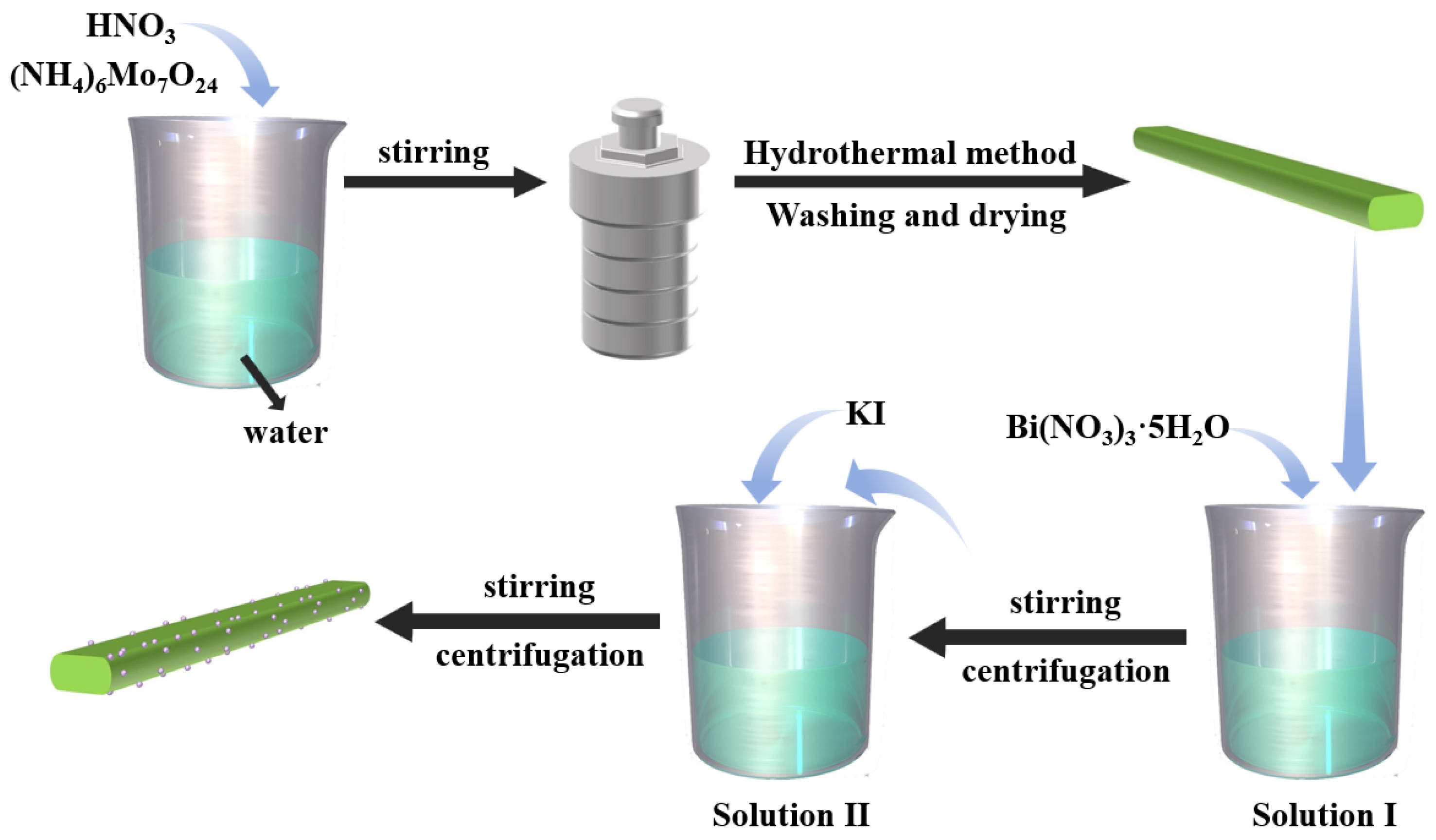
Following this, 0.0607 g of Bi(NO3)3·5H2O (Solution I) and 0.0208 g KI (Solution II) were sonicated in 50 mL ethylene glycol and anhydrous ethanol for 5 min, respectively. Then, 60 mg of MoO3 nanoribbons was dispersed in Solution I and stirred for 15 min, followed by centrifugation to collect the precipitate. The precipitate was dispersed in Solution II under magnetic stirring for 15 min, followed by centrifugation to harvest the product. The above procedure constitutes one complete impregnation, which is cycled 15 times in this way. Finally, the product underwent multiple ethanol washes followed by drying at 70 °C, yielding the MoO3/BiOI composite. The preparation process of MoO3/BiOI composite is shown Figure 1.

2.4. Sensor Fabrication and Measurement

A small amount of the synthesized sample was ground and dispersed in anhydrous ethanol to form a uniform slurry, followed by being coated onto gold interdigitated electrodes (size: 10 × 8 × 0.15 mm). Subsequently, the coated electrodes were placed in an oven and dried at 70 °C for 12 h to ensure complete evaporation of ethanol. Gas sensing tests were conducted using a WS-30B gas detection and analysis system (Zhengzhou Winsen Electronics Technology Co., Ltd., Zhengzhou, China), with the experimental setup illustrated in Figure S1. The sensor performance was evaluated at room temperature (22 °C) and 25% relative humidity (RH). As-prepared sensing elements were connected in series with a reference resistor and placed in an 18 L test chamber. All standard gases used during the measurement were purchased from Harbin Liming Gases Co., Ltd. For NO, H2S and CO, the desired test concentration is adjusted by using a micro syringe. The test environment is the air, and a part of NO may convert into NO2. Thus, the actual gas is nitrogen oxides (NOx). For ethanol, triethylamine, EA, ethylenediamine and ethylene glycol, the volume of liquid analyte calculated using Formula (1) [20] was injected onto the heating board fixed in the glass chamber via a micro syringe, evaporated immediately and mixed with air with the help of a fan. c (ppm) is the target gas concentration; φ, ρ (g/mL), V1 (μL), and M (g/mol) are expressed as the purity, density, volume, and molecular weight of the liquid (%); and V2 (L) is the volume of the chamber. The sensor response (R) is defined as R = Ra/Rg for reducing gases or R = Rg/Ra for oxidizing gases, where Ra and Rg represent the electrical resistance of the sensor in air and target gas, respectively. The response/recovery time is defined as the time required to reach 90% of the total resistance change.
c ( ppm ) = 22.4 × φ × ρ × V 1 × 1000 M × V 2

3. Results and Discussion

3.1. Structural and Morphological Characteristics

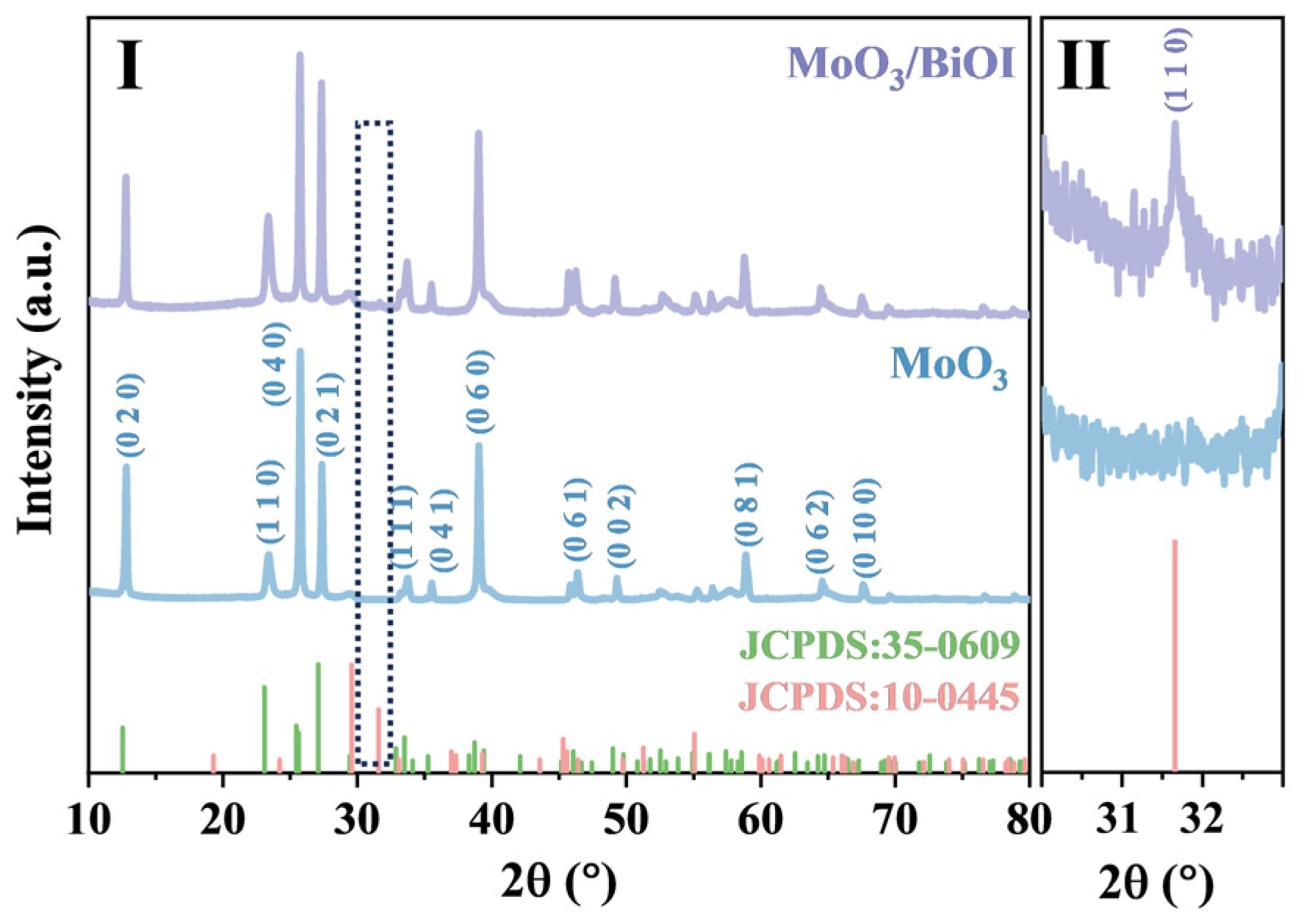
The crystal structures of MoO3 and MoO3/BiOI are characterized by X-ray diffraction (XRD), and the outcomes are shown in Figure 2. The diffraction peaks at 2θ values of 12.75°, 23.31°, 25.70°, 27.31°, 38.98° and 58.84° correspond to the (0 2 0), (1 1 0), (0 4 0), (0 2 1), (0 6 0) and (0 8 1) crystal planes of orthorhombic MoO3 (JCPDS NO. 35-0609), respectively. All characteristic peaks of pure MoO3 are observed in the XRD pattern of the composite. Additionally, a weak peak observed at 31.66° is well attributed to the (1 1 0) crystal plane of BiOI (JCPDS NO. 10-0445). A magnified view of the dashed-box region (in Figure 2I) is presented in Figure 2II for detailed observation. Figure S2 shows the XRD patterns of the samples with 17 cycles (MoO3/BiOI-17) and the MoO3/BiOI-15. As shown in Figure S2II, the peak intensity at 31.66° is significantly enhanced when the number of cycles increases (higher loading level). Moreover, a sharp little peak corresponding to the (1 1 4) plane of BiOI at 51.35° is found in the MoO3/BiOI-17 sample but absent in the MoO3/BiOI-15 sample (Figure S2III). The absence of distinct BiOI diffraction peaks in the MoO3/BiOI-15 can be attributed to the low BiOI content in the composite [21] or peak overlap with MoO3 reflections [22]. No detectable impurity peaks in the XRD pattern confirm the successful fabrication of the MoO3/BiOI composite. The elemental composition and content of the MoO3/BiOI composite are detected using energy dispersive spectroscopy (EDS), as shown in Figure S3. The EDS outcomes confirm that the composite consists of Mo, O, Bi and I elements with an atomic ratio of 10.78:88.04:0.61:0.57, and no impurity elements are detected. The successful synthesis of BiOI in the composite is evidenced by the Bi/I atomic ratio of approximately 1:1. These results demonstrate the high purity of the sample and the low BiOI content in the composite.
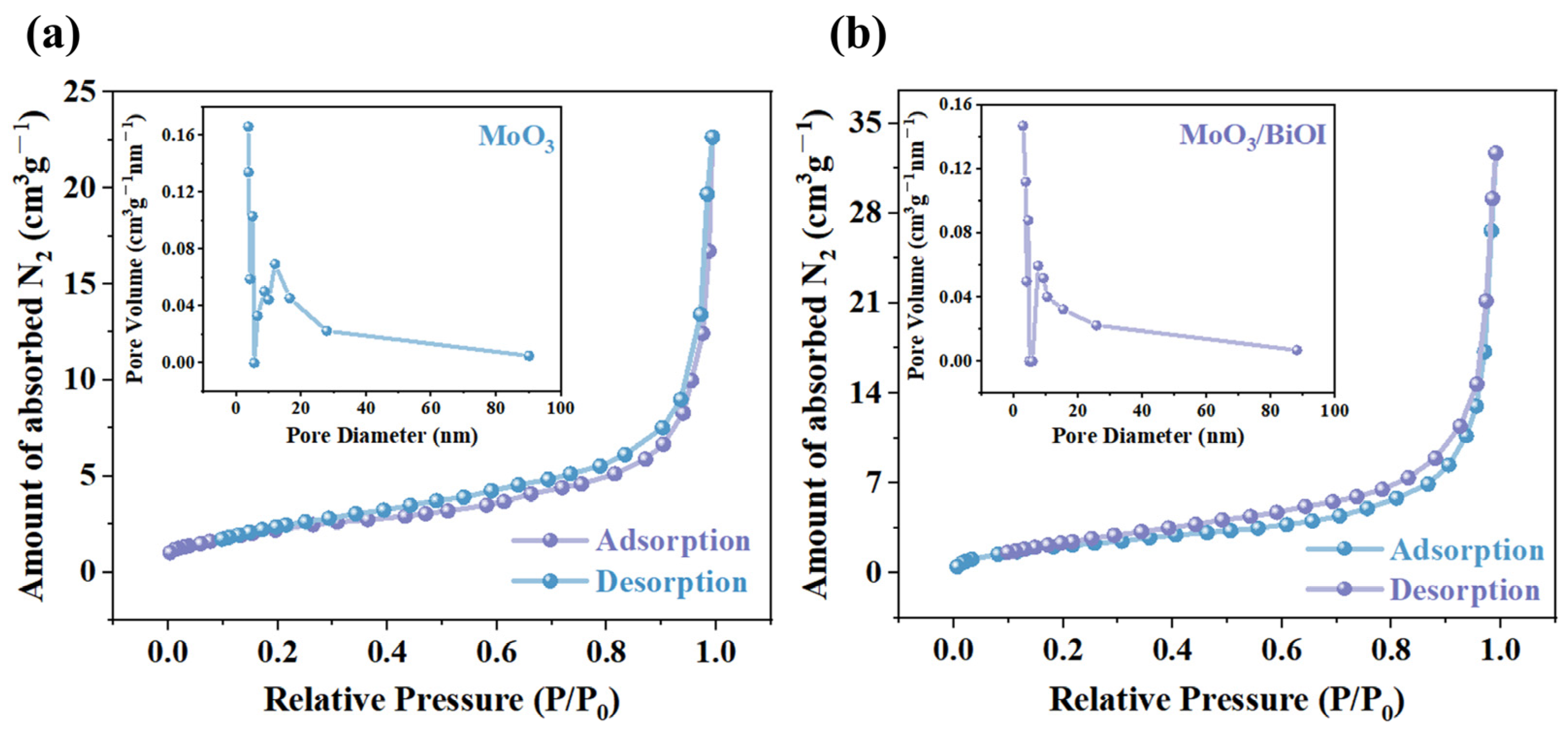
The N2 adsorption/desorption isotherms of MoO3 and MoO3/BiOI are shown in Figure 3. Both MoO3 and MoO3/BiOI exhibit Type IV isotherms with H3-type hysteresis loops, which confirm mesoporous materials [9]. According to the Brunauer–Emmett–Teller calculation method, the specific surface areas of MoO3 and MoO3/BiOI are 8.41 m2·g−1 and 9.43 m2·g−1, respectively. The pore size distribution curves of MoO3 and MoO3/BiOI are calculated via the Barrett–Joyner–Halenda method and displayed in the insets of Figure 3a,b, with average pore diameters determined as 3.43 nm for MoO3 and 3.12 nm for the composite. This further confirms that both synthesized MoO3 and MoO3/BiOI are mesoporous materials. The minimal loading level of BiOI does not result in significant alterations to the microscopic morphology and the specific surface areas. The two samples exhibit only slight differences in specific surface area and pore diameters, indicating that the incorporation of BiOI has minimal influence on the mesostructure of the material.
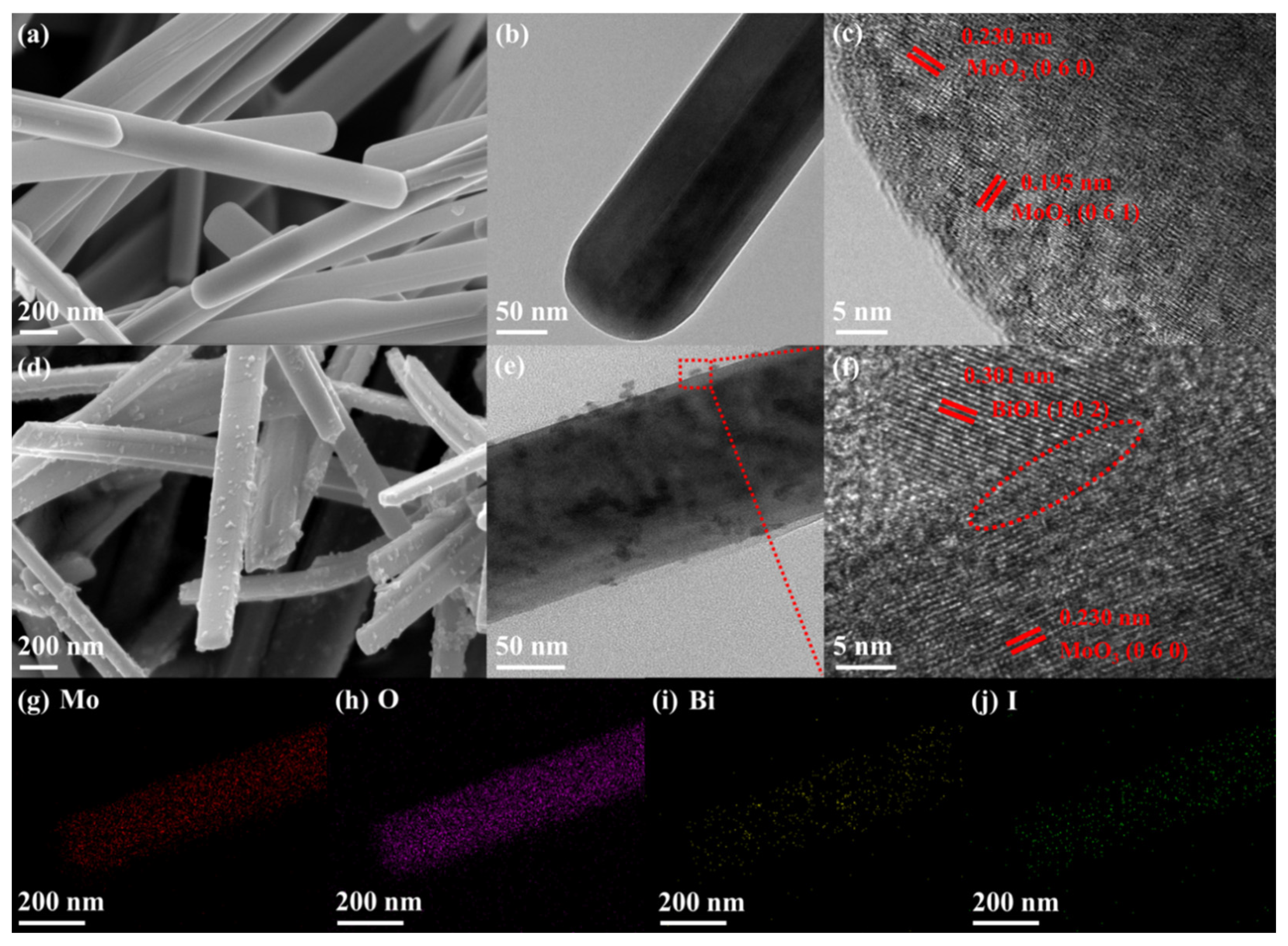
The morphology and microstructure of the samples are researched using scanning electron microscopy (SEM) and transmission electron microscopy (TEM). Figure 4a and Figure 4d show the SEM images of pure MoO3 and the MoO3/BiOI composite, respectively. It can be observed that pure MoO3 exhibits a nanoribbon structure with smooth surfaces and uniform thickness. The BiOI-modified MoO3 nanoribbons exhibit surface roughening while preserving the intrinsic morphology and dimensional integrity of pristine MoO3. The localized nanoribbon TEM images of MoO3 and the MoO3/BiOI are displayed in Figure 4b,e. It can be seen that the introduction of BiOI nanoparticles makes the surface of the composite rough without changing its structure, which is in agreement with SEM. The HRTEM image of pure MoO3 in Figure 4c reveals lattice spacings of 0.195 nm and 0.230 nm, corresponding to the (0 6 1) and (0 6 0) planes of MoO3, respectively. The lattice spacings of 0.230 nm and 0.301 nm are observed in the HRTEM image of the composite material in Figure 4f, which are assigned to the (0 6 0) plane of MoO3 and the (1 0 2) plane of BiOI, respectively. Meanwhile, a lattice contact is apparent at the interface between MoO3 and BiOI, indicating the formation of the MoO3/BiOI p-n heterojunction (red circle) [23]. To further confirm the successful construction of the heterojunction, Mott–Schottky (M-S) electrochemical analysis is conducted to investigate the conductive behavior of the material. The slopes in M-S plots serve as indicators to distinguish between n-type (positive slope) and p-type (negative slope) semiconductors [23]. The positive slope observed in the M-S plot of MoO3 (Figure S4) confirms its n-type semiconductor behavior. In contrast, the M-S plot of BiOI displays a negative slope, indicating a p-type semiconductor. The M-S plot of the composite displays a characteristic inverted “V” shape, signifying p-n heterojunction formation at the interface of MoO3 and BiOI [24]. This is consistent with the HRTEM observation results. The distribution of elements in the MoO3/BiOI is illustrated in Figure 4g-j. The uniform distribution of Mo, O, Bi and I elements in the composite further proves the successful preparation of MoO3/BiOI.
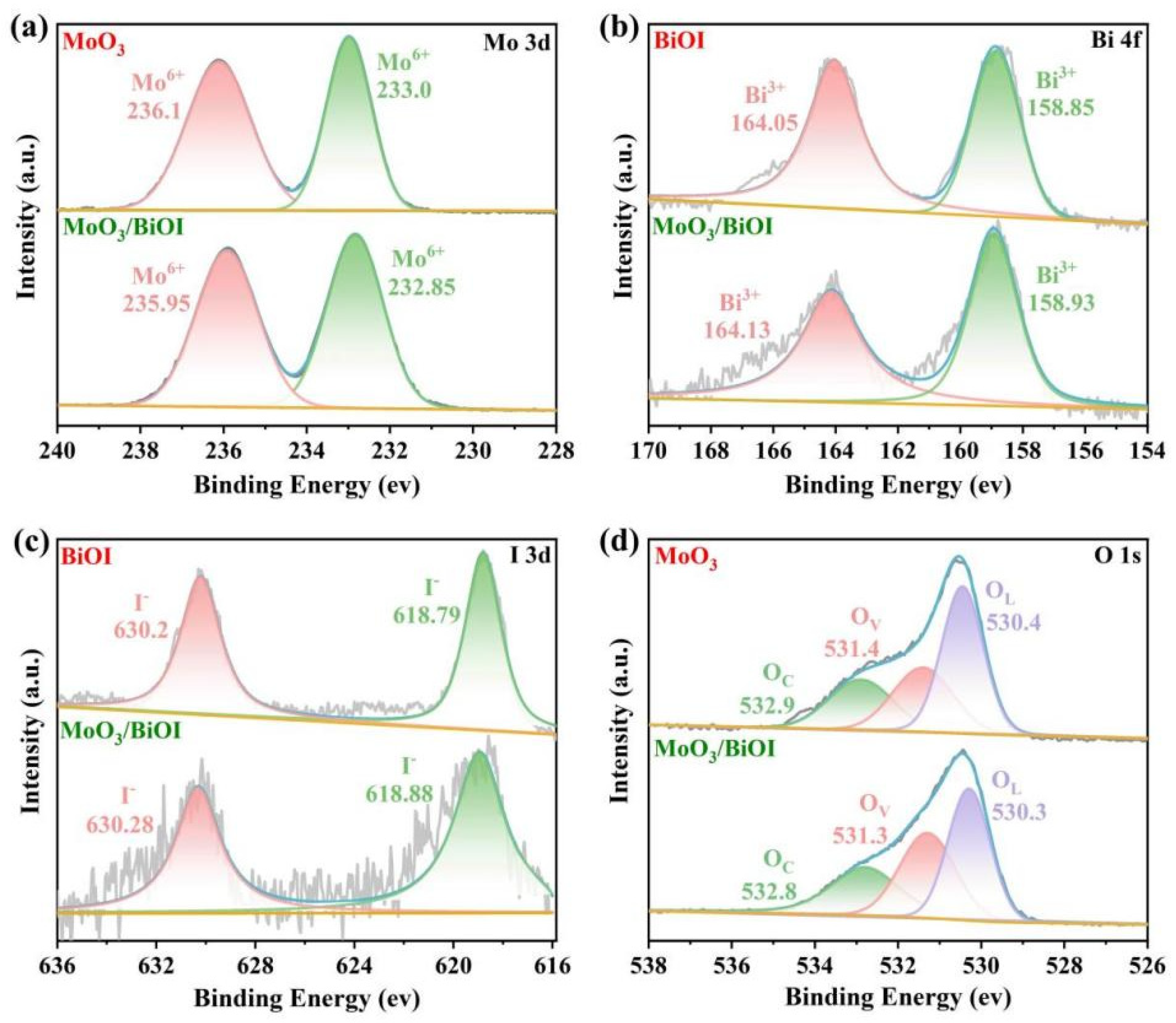
The elemental composition and chemical valence states of the materials can be investigated using X-ray photoelectron spectroscopy (XPS), and the outcomes are shown in Figure 5. The high-resolution Mo 3d spectra of MoO3 and MoO3/BiOI in Figure 5a exhibit peaks of binding energy located at ~236.1 eV and ~233.0 eV, corresponding to the Mo 3d3/2 and Mo 3d5/2 of Mo6+, respectively [25]. The peaks observed at ~164.05 eV and ~158.85 eV in the Bi 4f spectrum of Figure 5b belong to the Bi 4f5/2 and Bi 4f7/2, respectively. This indicates that the Bi element in both samples mainly exists as Bi3+ [26]. The binding energies of I 3d at ~630.2 eV and ~618.79 eV in Figure 5c are ascribed to I 3d3/2 and I 3d5/2, meaning that I exists in the form of I [27]. The peaks of Mo 3d in the composite shift toward lower binding energies compared to the pristine phase, while the peaks of Bi 4f and I 3d move in the opposite direction, demonstrating strong chemical interactions between MoO3 and BiOI [28]. The O 1s spectra of MoO3 and MoO3/BiOI in Figure 5d are further fitted into three peaks located at ~532.9, ~531.4 and ~530.4 eV, which correspond to chemisorbed oxygen (Oc), vacancy oxygen (Ov) and lattice oxygen (OL) [29]. The contents of various oxygen species in the two samples are summarized in Table 1. Notably, the MoO3/BiOI composite exhibits a marked enhancement in the relative concentrations of Oc and Ov compared to pure MoO3, suggesting its superior gas sensing performance [22,30]. Furthermore, electronic paramagnetic resonance (EPR) is performed to analyze the Oc of the sample, and the results are presented in Figure S5. The EPR symmetric signal peak at g = 2.000 [31] is attributed to the unpaired electrons in the oxygen vacancy, and the peak strength is related to the content of oxygen vacancy [32]. The peak intensity of the MoO3/BiOI complex is significantly higher compared to pure MoO3, indicating a higher content of Oc in the composite material. This agrees with the XPS results.

3.2. Gas Sensing Performance

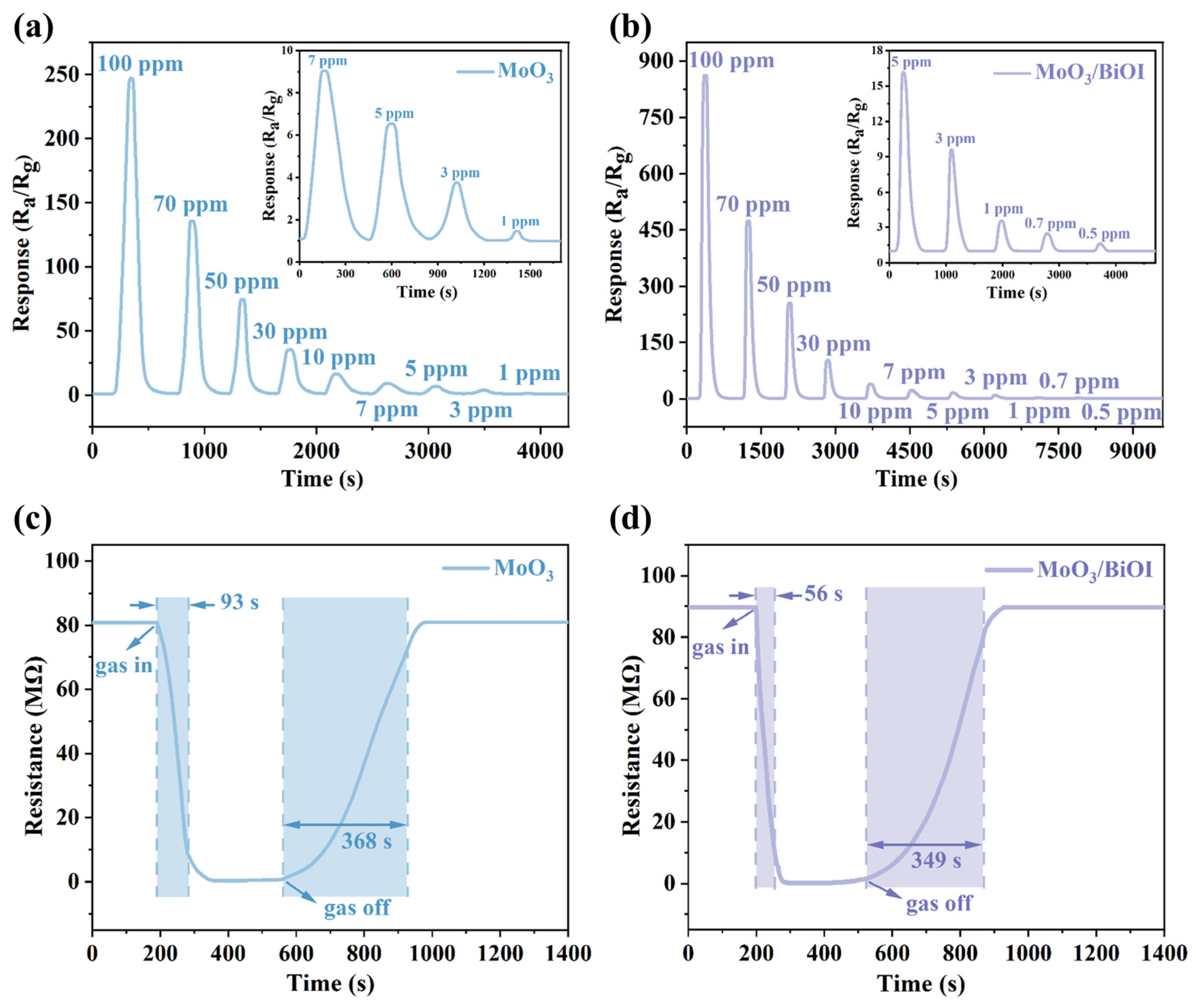
The gas sensing response of pure MoO3, pure BiOI and MoO3/BiOI composites (13-MoO3/BiOI, 15-MoO3/BiOI, and 17-MoO3/BiOI) with three different loading levels is illustrated in Figure S6, and the composite obtained via 15 cyclic impregnations demonstrates the superior response value among them. Consequently, this composite and pure MoO3 is selected for more detailed gas sensing investigations. Figure 6a,b depict the response/recovery plots of MoO3 and MoO3/BiOI toward various EA concentrations at RT. The response values of MoO3/BiOI are 861.3–1.6 in the concentration range of 100 to 0.5 ppm EA, while the response values of MoO3 toward 100-1 ppm EA are only 246.8–1.3. The response value of MoO3/BiOI toward 100 ppm EA is 3.5-times higher compared to pure MoO3. Furthermore, the response/recovery times of MoO3 and MoO3/BiOI toward 100 ppm EA are 93/368 s and 56/349 s in Figure 6c and Figure 6d, respectively. The results confirm that MoO3/BiOI exhibits higher sensitivity and faster response/recovery times than pure MoO3.
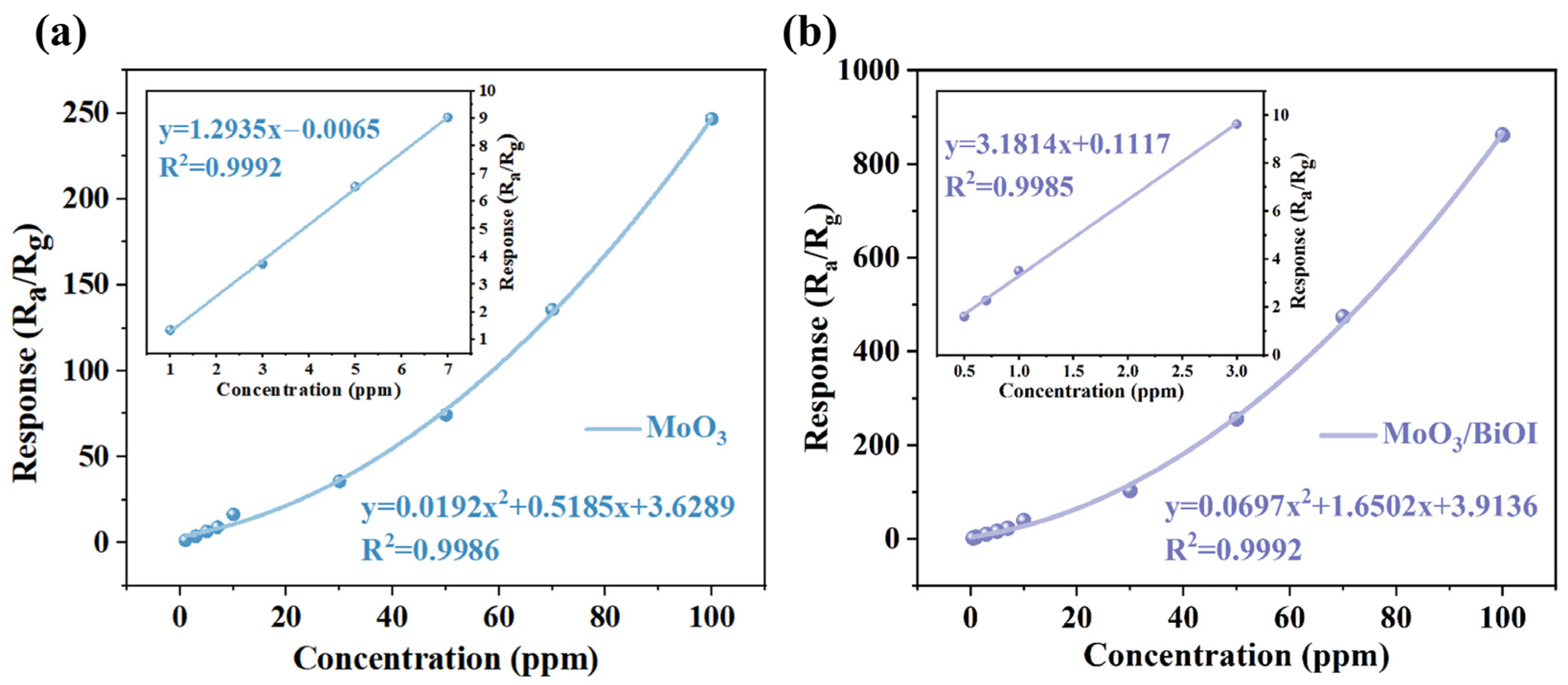
The functional relationships between the response values of the two sensors and the EA concentration are shown in Figure 7a,b. The fitting equations for MoO3 and MoO3/BiOI are y = 0.0192x2 + 0.5185x + 3.6289 (R2 = 0.9986) and y = 0.0697x2 + 1.6502x + 3.9136 (R2 = 0.9992), respectively. The high R2 values indicate an intense functional correlation between the response values and the EA concentration. To calculate the detection limit (DL) of the samples, the linear fitting relationships between the response values and the low EA concentration are shown in the insets of Figure 7a,b, and the raw baseline noise trace is shown in Figure S7. The theoretical detection limits of MoO3 and MoO3/BiOI for EA are 0.42 ppm and 0.13 ppm based on empirical Formulas (2) and (3), respectively. The fitting equations and calculation results demonstrate that the composite material is more suitable for trace EA gas detection than pure MoO3.
R M S n o i s e = ( y ¯ y i ) 2 n 1
D L = 3 R M S n o i s e k
In the two equations, k is the slope of the linear fit at low gas concentrations, RMS noise represents the root mean square noise, y ¯ denotes the average value of the baseline response, and y i corresponds to the baseline surveyed value.
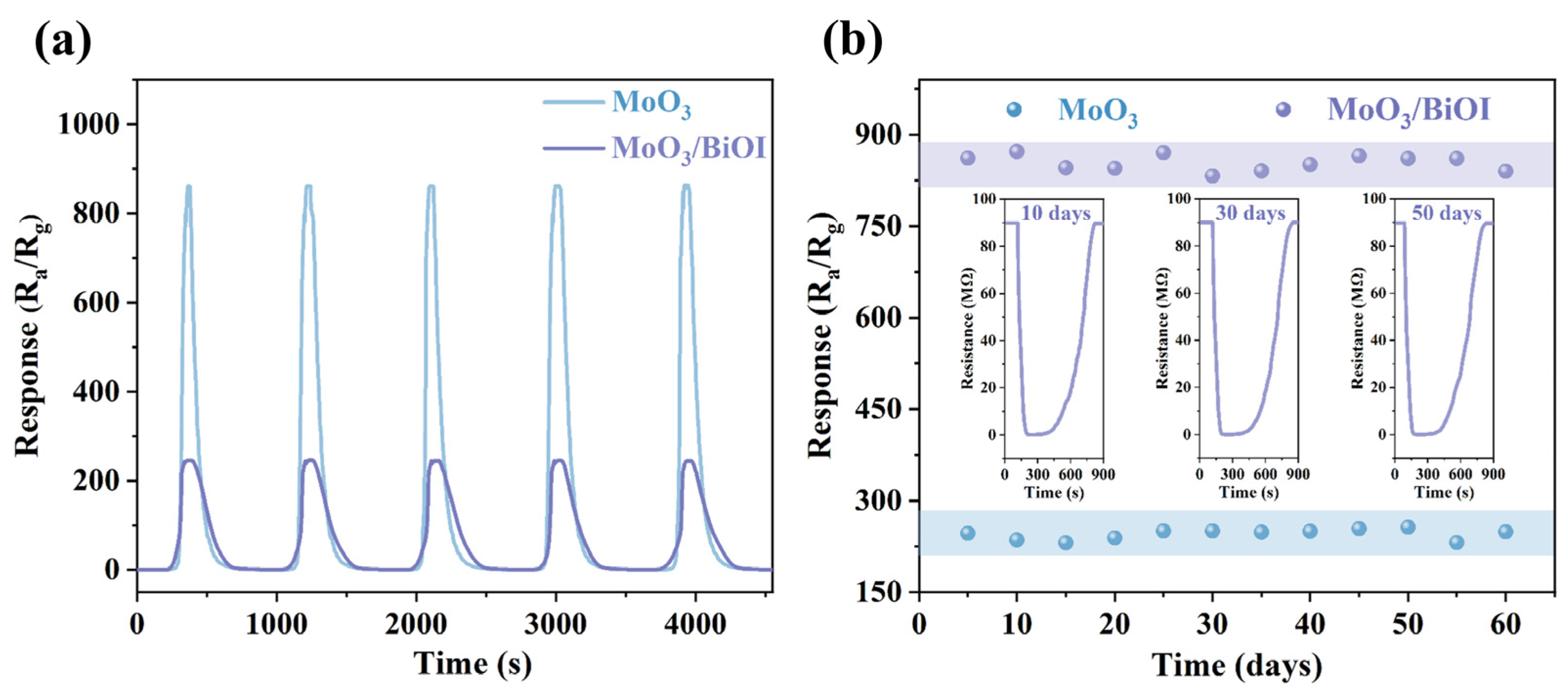
The repeatability and long-term stability serve as vital criteria for performance evaluation in practical applications. The five-cycle test curves of MoO3 and MoO3/BiOI composites toward 100 ppm EA are shown in Figure 8a. The resistance of samples declines when exposed to the EA atmosphere and recovers to their primal value when returned to air, confirming their typical n-type semiconductor behavior. The sensor response amplitudes vary slightly across five cycles, demonstrating remarkable repeatability in gas detection applications. Otherwise, the response values of sensors fluctuated within 5% during a 60-day testing period in Figure 8b, indicating excellent long-term reliability. The inset of Figure 8b presents the response curves of the MoO3/BiOI composites measured at intervals of 10, 30, and 50 days. The response/recovery times of MoO3/BiOI remain relatively stable throughout the testing period. Figure S8 displays the gas sensing responses of different batches of MoO3/BiOI samples toward 100 ppm EA under identical testing conditions. The standard error of the response values for the five groups is only 3%, demonstrating the excellent reproducibility of the MoO3/BiOI composite synthesized in this work.
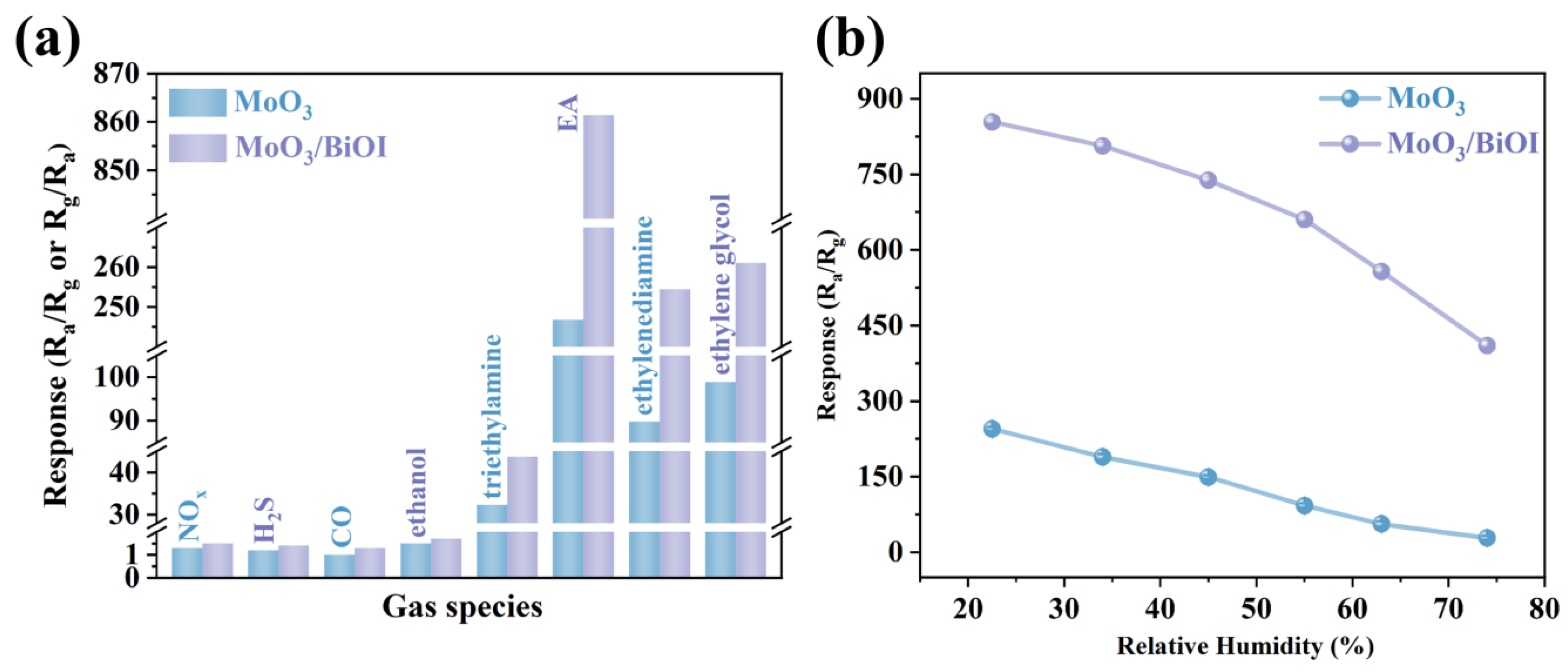
The selectivity is another significant factor in assessing the performance of sensors. To research the selectivity of MoO3 and MoO3/BiOI, their response values toward 100 ppm of various gases (NOx, H2S, CO, ethanol, triethylamine, EA, ethylenediamine and ethylene glycol) are measured and compared at RT, as shown in Figure 9a. The sensitivity of MoO3 and MoO3/BiOI to EA is significantly higher than those of other gases under identical testing conditions. The results indicate that MoO3 and MoO3/BiOI exhibit excellent selectivity toward EA. It is well known that selectivity is influenced by a multitude of factors. Firstly, there exists a strong acid/base attractive force between MoO3 and EA molecules [33]. As a relatively strong organic Lewis base, EA exhibits high reactivity with acidic MoO3 over other VOCs. Secondly, bond energy significantly influences the stability of compounds. The lower bond energy corresponds to the bond that is more easily broken [34]. The relevant bond energies (C-H: 411 kJ/mol, C-O: 361 kJ/mol, O-H: 458.8 kJ/mol, C-N: 307 kJ/mol) [35] reveal that the C-N bond of EA is the easiest to break. EA molecules have asymmetrical structures and stronger reducing chemical reactivity compared to other volatile gases [35,36]. Finally, the abundance of hydrogen bonds within the EA molecule promotes its adsorption on the surface of the MoO3/BiOI nanostructure, thereby enabling more efficient interaction with adsorbed oxygen species [5,37]. The influence of relative humidity (RH) on sensor performance is depicted in Figure 9b. The response values of both MoO3 and MoO3/BiOI composites to 100 ppm EA gradually decline as RH increases from 22% to 75%. Notably, the MoO3/BiOI composite consistently demonstrates superior response values compared to pure MoO3 across this humidity range. The MoO3/BiOI composite achieves a sensing response of 396 toward 100 ppm EA at 75% RH, which represents a 4.4-times improvement over pure MoO3. This pronounced performance shows the feasibility of the MoO3/BiOI composite as a sensing material for the detection of EA. The decrease in sensor response under high RH can be attributed to the following factors. Firstly, water molecules are adsorbed onto the surface of the sample, and the active sites become occupied, resulting in the chemisorption of oxygen species becoming more difficult [38]. Secondly, the adsorbed water molecules react with chemisorbed oxygen to generate surface hydroxyl groups (OH) [39]. A reduced concentration of adsorbed oxygen ions diminishes the thermodynamic driving force required for subsequent reactions. This decreased driving force further hinders both the adsorption and dissociation processes of EA molecules [40].
A comparison of the sensor developed in this study with other sensors reported in the literature is summarized in Table 2. It can be concluded that the MoO3/BiOI composite exhibits a high response to EA, operating conditions of RT and a low detection limit, which indicates that MoO3/BiOI holds significant potential for practical applications in EA gas detection.

3.3. Gas Sensing Mechanism

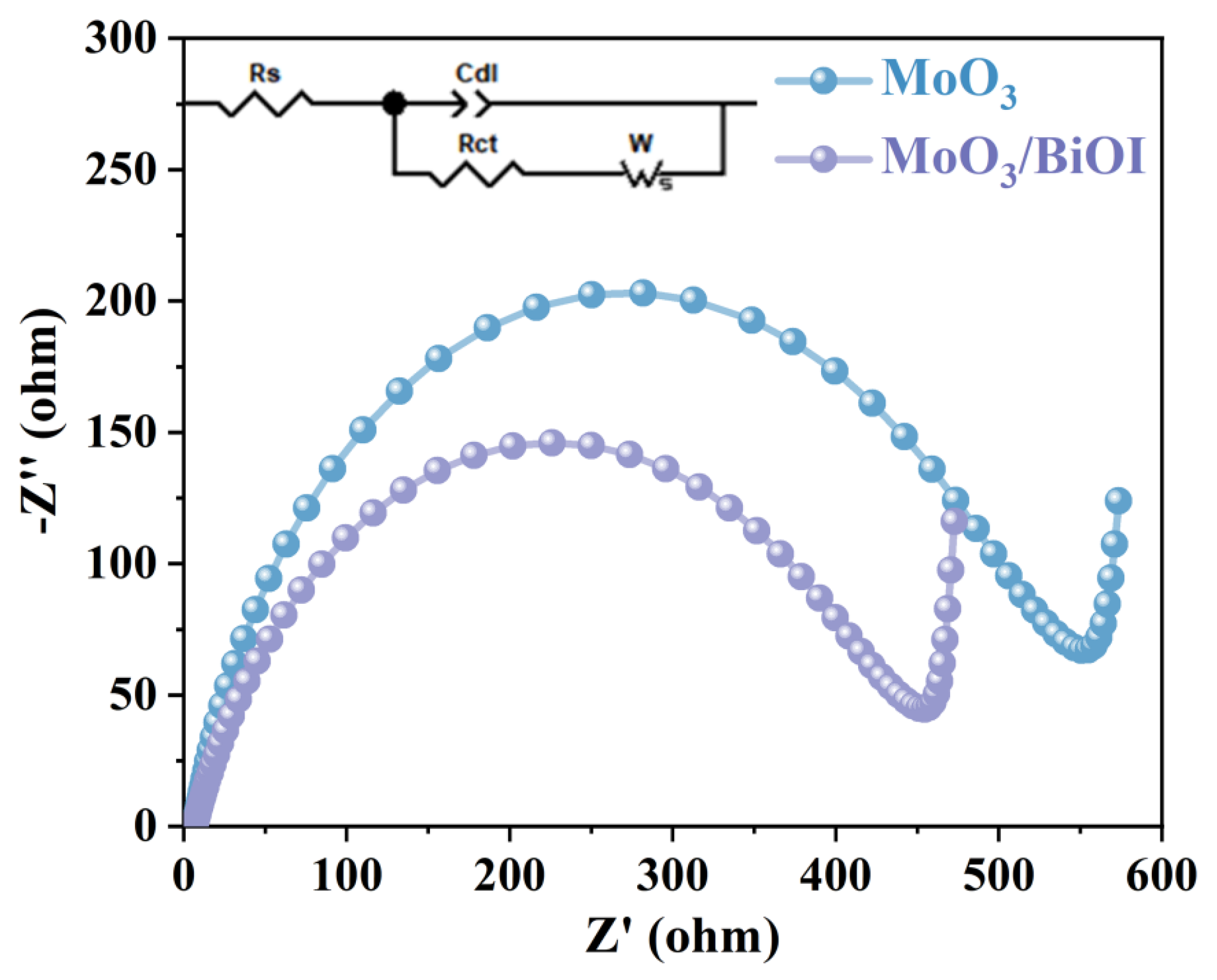
The markedly improved gas sensing performance of the MoO3/BiOI composite compared to pure MoO3 arises from the following synergistic mechanisms. Firstly, the MoO3/BiOI material has more Oc and Ov than pure MoO3, providing more active sites. These active sites further promote the redox reactions with EA molecules, thereby improving the gas sensing performance [23]. Secondly, the construction of the p-n heterojunctions in the MoO3/BiOI composite can significantly improve the sensing performance [46]. Lastly, the higher charge transfer efficiency can also enhance gas sensitivity [47]. Nyquist plots of the Electrochemical Impedance Spectroscopy (EIS) data for the pure MoO3 and MoO3/BiOI are shown in Figure 10. The corresponding equivalent circuit is shown in the inset of Figure 10. In this circuit, Rct denotes the interfacial charge transfer resistance, Rs represents solution resistance, W refers to Woberg impedance and Cdl is the electric double-layer capacitance, listed in Table S1. The composite material exhibits a smaller Rct than pure MoO3, which partially supports that MoO3/BiOI possesses a relatively higher charge transfer efficiency. This accelerates the interaction between target gas molecules and adsorbed oxygen species to some extent, which improves the gas sensing performance of the MoO3/BiOI [48].
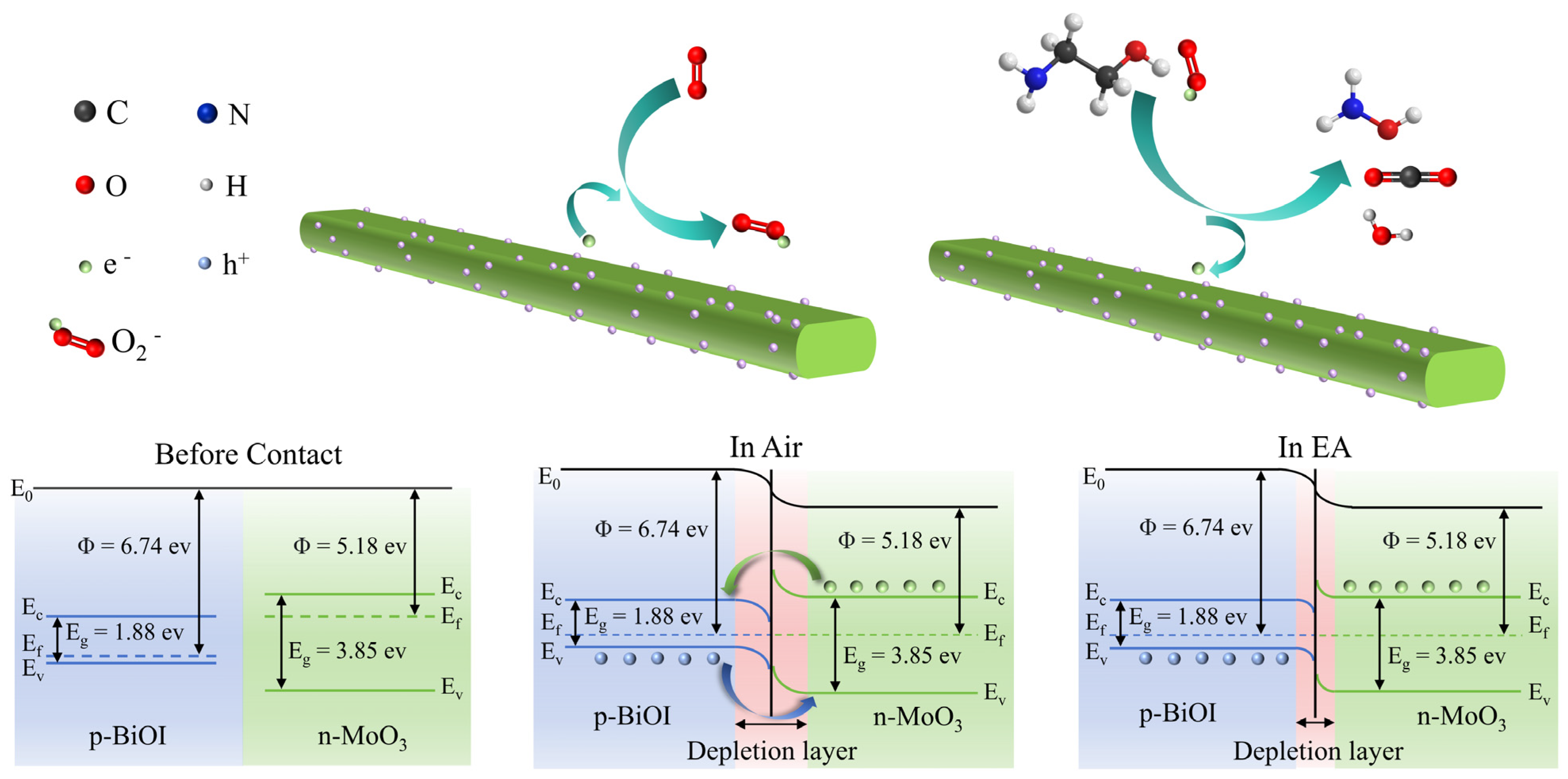
The sensing process of MOS originates from the chemical adsorption of oxygen molecules on the material surface and electron transfer between oxygen anions and the target gas, which alters the carrier concentration and ultimately results in resistance variations. Based on the band structure parameters of MoO3 and BiOI [49,50,51], Figure 11 illustrates the gas sensing mechanism and corresponding band structure of the MoO3/BiOI. The p-n heterojunction forms when contact occurs between n-type and p-type semiconductors due to the difference in work functions and Fermi-level alignment. The difference in work function between MoO3 (5.18 eV) and BiOI (6.74 eV) drives electron transfer from the higher Fermi level of MoO3 to the lower Fermi level of BiOI, while holes migrate in the opposite direction, resulting in an equilibrium of the Fermi level and band bending [52,53]. At the same time, a depletion layer is formed at the interface between MoO3 and BiOI [54]. When MoO3/BiOI is exposed to air, oxygen molecules (O2(gas)) in the atmosphere adsorb onto the material surface to convert to adsorbed oxygen molecules (O2(ads)). The adsorbed oxygen molecules capture free electrons from the conduction band of the sample to form oxygen anions (O2), as illustrated in Equations (4) and (5). This process reduces the carrier concentration and extends the depletion layer width, consequently causing a high primal resistance characteristic for the gas sensor in the air. A higher initial resistance can cause a higher response value when detecting reducing gases [55]. Upon exposure to EA gas, the adsorbed EA molecules (EA(gas)) undergo redox reactions with O2, releasing trapped electrons back into the conduction band. This process increases carrier concentration and reduces depletion layer thickness, as described by Equations (6) and (7) [42,56]. In the meantime, the resistance of the sensor decreases, and the response value increases rapidly. When the material is re-exposed to air, the adsorbed EA species are desorbed and the oxygen molecules are re-adsorbed on the surface of the material, which causes the depletion layer to be reconstructed and the resistance to return to its initial baseline value.
O2(gas) → O2(ads)
O2(ads) + e→ O2(ads)
C2H7NO(gas) → C2H7NO(ads)
C2H7NO(ads) + 3O2(ads) → NH2OH + 2CO2 + 2H2O + 3e

4. Conclusions

In summary, a high-performance EA sensor based on MoO3/BiOI composites was prefabricated for the first time using hydrothermal and cyclic impregnation methods at RT. The sensor exhibits exceptional sensitivity (861.3), rapid response/recovery time (56/349 s), a low detection limit (0.13 ppm) and outstanding repeatability and long-term stability toward EA. The composite possesses enhanced gas sensing performance compared to pure MoO3 due to the higher charge transfer efficiency, more Ov and Oc and the established p-n heterojunction. Moreover, the gas sensing mechanism is systematically explained using the oxygen adsorption model. The outcomes demonstrate that the synthesized MoO3/BiOI composite holds promise as a prospective gas sensor for EA detection and provides new insights for developing novel gas sensing materials.

Supplementary Materials

The following supporting information can be downloaded at: https://www.mdpi.com/article/10.3390/chemosensors14010028/s1, Figure S1: (a) Ws-30B gas detection and analysis instrument; (b) Weisheng 30 Road test board; (c) schematic diagram of resistance measurement circuit; (d) interfingered electrode; Figure S2: XRD of MoO3/BiOI-15 and MoO3/BiOI-17; Figure S3: EDS spectrum of MoO3/BiOI; Figure S4: Mott–Schottky plots of MoO3, BiOI and MoO3/BiOI; Figure S5: EPR spectra of MoO3 and MoO3/BiOI; Figure S6: Response values of MoO3, BiOI and three MoO3/BiOI to EA of 100 ppm and 50 ppm; Figure S7: The raw baseline noise trace of MoO3 and MoO3/BiOI; Figure S8: The reproducibility of the MoO3/BiOI sensor to EA; Table S1: Fitted impedance parameters of MoO3 and MoO3/BiOI.

Author Contributions

Conceptualization, X.Z. and Q.L.; methodology, G.Z.; formal analysis, X.Z. and Q.L.; investigation, X.Z.; writing—original draft preparation, X.Z.; writing—review and editing, visualization, and supervision, G.Z. and Q.P.; funding acquisition, G.Z. All authors have read and agreed to the published version of the manuscript.

Funding

The work was funded by the Opening Foundation of Key Laboratory of Functional Inorganic Material Chemistry (Heilongjiang University), Ministry of Education.

Institutional Review Board Statement

Not Applicable.

Informed Consent Statement

Not Applicable.

Data Availability Statement

The corresponding author can provide the relevant data supporting this study’s findings, subject to a reasonable request.

Conflicts of Interest

The authors report no conflicts of interest, financial or personal, that might be perceived as influencing this work.

References

  1. Cao, P.F.; Ma, S.Y.; Xu, X.L.; Yang, T.T.; Han, T.; Xu, X.H.; Wen, D.P.; Wang, L.; Alhadi, A. Synthesis of popcorn-shaped yeast@WO3 microspheres assisted by yeast cells and their potential application as an ethanolamine gas sensor. Sens. Actuators A Phys. 2021, 318, 112516. [Google Scholar] [CrossRef]
  2. Zhang, H.; Shi, W.; Gao, N.; Zhao, R.; Ahmed, M.M.; Zhang, T.; Li, J.; Du, J.; Asefa, T. Highly sensitive and selective gas-phase ethanolamine sensor by doping sulfur into nanostructured ZnO. Sens. Actuators B Chem. 2019, 296, 126917. [Google Scholar] [CrossRef]
  3. Xu, X.; Jiang, H.; Liu, W.; Wang, S.; Wang, X.; Wang, M.; Ma, W.; Ma, S.; Wei, J. Ag@SnO2/CsPbBr3 nanocomposite gas sensor for well-behaved low-concentration ethanolamine sensing at room temperature. J. Appl. Phys. 2024, 135, 084503. [Google Scholar] [CrossRef]
  4. Dai, H.; Ding, J.; Chen, H.; Fu, H. Improvement of ethanolamine sensing performance based on Au-modified ZnO rod-like nanoflowers. Mater. Lett. 2023, 340, 134183. [Google Scholar] [CrossRef]
  5. Xu, X.; Wang, S.; Chen, Y.; Liu, W.; Wang, X.; Jiang, H.; Ma, S.; Yun, P. CsPbBr3-Based Nanostructures for Room-Temperature Sensing of Volatile Organic Compounds. ACS Appl. Mater. Interfaces 2022, 14, 39524–39534. [Google Scholar] [CrossRef] [PubMed]
  6. Bi, W.; Zhu, J.; Zheng, B.; Liu, S.; Zhang, L. Synthesis of Pd-Doped SnO2 and Flower-like Hierarchical Structures for Efficient and Rapid Detection of Ethanolamine. Molecules 2024, 29, 3650. [Google Scholar] [CrossRef]
  7. Tan, X.; Wang, L.; Chen, X.; Zhang, H.; Guo, J.; Dong, Z.; Qian, L.; Chen, Z.; He, C. Ultrasensitive triethylamine gas sensors with ZnSe nanospheres/nest-like Cr-doped MoO3. J. Hazard. Mater. 2024, 474, 134709. [Google Scholar] [CrossRef]
  8. Kwak, D.; Wang, M.; Koski, K.J.; Zhang, L.; Sokol, H.; Maric, R.; Lei, Y. Molybdenum Trioxide (α-MoO3) Nanoribbons for Ultrasensitive Ammonia (NH3) Gas Detection: Integrated Experimental and Density Functional Theory Simulation Studies. ACS Appl. Mater. Interfaces 2019, 11, 10697–10706. [Google Scholar] [CrossRef]
  9. Liu, H.; Liu, J.; Liu, Q.; Li, Y.; Zhang, G.; He, C. Conductometric Gas Sensor Based on MoO3 Nanoribbon Modified with rGO Nanosheets for Ethylenediamine Detection at Room Temperature. Nanomaterials 2023, 13, 2220. [Google Scholar] [CrossRef]
  10. Huang, Y.-T.; Fan, L.-Y.; Liu, Y.-F.; Zheng, X.-H. High-performance MoO3 nanosheets gas sensors for triethylamine detection: A rapid approach for assessing fish freshness. Ceram. Int. 2025, 51, 9912–9922. [Google Scholar] [CrossRef]
  11. Li, R.; Tang, J.; Zheng, Q.; Zhang, X.; Dong, X.; Huo, L.; Xu, Y.; Cheng, X. Enhancement of n-pentylamine gas sensing performance through regulating the crystal facet orientation of MoO3. Microchim. Acta 2025, 192, 483. [Google Scholar] [CrossRef]
  12. Weng, B.; Xu, F.; Xu, J. Hierarchical structures constructed by BiOX (X = Cl, I) nanosheets on CNTs/carbon composite fibers for improved photocatalytic degradation of methyl orange. J. Nanoparticle Res. 2014, 16, 2766. [Google Scholar] [CrossRef]
  13. Lu, B.; Zeng, S.; Li, C.; Wang, Y.; Pan, X.; Zhang, L.; Mao, H.; Lu, Y.; Ye, Z. Nanoscale p-n heterojunctions of BiOI/nitrogen-doped reduced graphene oxide as a high performance photocatalyst. Carbon 2018, 132, 191–198. [Google Scholar] [CrossRef]
  14. Li, J.; Li, H.; Zhan, G.; Zhang, L. Solar Water Splitting and Nitrogen Fixation with Layered Bismuth Oxyhalides. Acc. Chem. Res. 2016, 50, 112–121. [Google Scholar] [CrossRef] [PubMed]
  15. Chang, H.; Fan, J.; Chen, R.; Qiu, H.; Liu, S.; Wang, L.; Ikram, M.; Wang, C.; Chen, X. UiO-66@BiOI core-shell structures with high concentration of defective oxygen for NO2 gas sensing at room temperature. J. Alloys Compd. 2025, 1010, 178327. [Google Scholar] [CrossRef]
  16. Wang, Y.; Long, Y.; Zhang, D. Facile in Situ Growth of High Strong BiOI Network Films on Metal Wire Meshes with Photocatalytic Activity. ACS Sustain. Chem. Eng. 2017, 5, 2454–2462. [Google Scholar] [CrossRef]
  17. Navale, S.T.; Huang, Q.; Cao, P.; Patil, V.B.; Stadler, F.J. Room temperature solid-state synthesis of mesoporous BiOI nanoflakes for the application of chemiresistive gas sensors. Mater. Chem. Phys. 2020, 241, 122293. [Google Scholar] [CrossRef]
  18. Meng, D.; He, C.; Zhang, Y.; San, X.; Zhang, L.; Jin, Q.; Qi, J. Heterostructures constructed by NiMoO4 functionalized 2D MoO3 nanosheets for ultrasensitive trimethylamine detection with ppb level detection. Sens. Actuators B Chem. 2024, 421, 136442. [Google Scholar] [CrossRef]
  19. Li, Y.; Liu, Y.; Lu, Y.; Liu, Z.; Sui, C.; Wang, Y.; Yang, L.; Liu, F.; Sun, P.; Liu, F.; et al. Preparation of BiOI-Functionalized ZnO Nanorods for Ppb-Level NO2 Detection at Room Temperature. ACS Sensors 2022, 7, 3915–3922. [Google Scholar] [CrossRef]
  20. Meng, D.; Zou, X.; San, X.; Ji, Y.; Zhang, Y.; Wang, G.; Qi, J.; Jin, Q. Construction of SnO2/SnS2 n-n heterojunction anchored on rGO for synergistically enhanced low temperature formaldehyde sensing performance. Sens. Actuators B Chem. 2024, 406, 135359. [Google Scholar] [CrossRef]
  21. Shi, Y.; Su, W.; Wei, X.; Bai, Y.; Song, X.; Lv, P.; Wang, J.; Yu, G. Carbon coated In2O3 hollow tubes embedded with ultra-low content ZnO quantum dots as catalysts for CO2 hydrogenation to methanol. J. Colloid Interface Sci. 2023, 636, 141–152. [Google Scholar] [CrossRef]
  22. Liu, J.; Liu, Y.; Liu, H.; Pan, Q.; Zhang, G. Construction of MOF-derived In2O3/g-C3N4/rGO nanostructures to enhance NOx gas-sensitive properties at room temperature. Sens. Actuators B Chem. 2023, 380, 133308. [Google Scholar] [CrossRef]
  23. Liu, Q.; Liu, J.; Liu, H.; Zheng, X.; Pan, Q.; Zhang, G. The novel NOx sensing material MOF-derived metal oxides In2O3/CoOOH heterojunction nanostructures performance enhancement. Appl. Surf. Sci. 2025, 687, 162304. [Google Scholar] [CrossRef]
  24. Fei, W.; Gao, J.; Li, N.; Chen, D.; Xu, Q.; Li, H.; He, J.; Lu, J. A visible-light active p-n heterojunction NiFe-LDH/Co3O4 supported on Ni foam as photoanode for photoelectrocatalytic removal of contaminants. J. Hazard. Mater. 2021, 402, 123515. [Google Scholar] [CrossRef] [PubMed]
  25. Wang, X.; Gao, Y.; Zhang, Q.; He, X.; Wang, X. Synthesis of MoO3 (1D) @SnO2 (2D) core-shell heterostructures for enhanced ethanol gas sensing performance. Sens. Actuators B Chem. 2023, 382, 133484. [Google Scholar] [CrossRef]
  26. Yang, J.; Su, H.; Wu, Y.; Li, D.; Zhang, D.; Sun, H.; Yin, S. Facile synthesis of kermesinus BiOI with oxygen vacancy for efficient hydrogen generation. Chem. Eng. J. 2021, 420, 127607. [Google Scholar] [CrossRef]
  27. Haile, C.T.; Ahmad, N.; Chiu, C.-W.; Jeffrey Kuo, C.-F. Highly photoactive novel NiS/BiOI nanocomposite photocatalyst towards efficient visible light organic pollutant degradation and carcinogenetic Cr (VI) reduction for environmental remediation. Chemosphere 2023, 323, 138108. [Google Scholar] [CrossRef]
  28. Wang, J.-C.; Ma, H.; Shi, W.; Li, W.; Zhang, W.; Li, R.; Qiao, X.; Hou, Y. Variable valence I3/I ionic bridge assisting CuI nanoparticle/BiOI nanosheet S-scheme photocatalyst with hydrophobic surface for boosting CO2 conversion with 100% CO selectivity. Renew. Energy 2024, 234, 121190. [Google Scholar] [CrossRef]
  29. Xu, H.; Zhong, H.; Hu, J.; Rong, X.; Zhang, W.; Wang, Y.; Li, S.; Li, G.; Wang, D. Facile engineering of metal–organic framework derived SnO2@NiO core–shell nanocomposites based gas sensor toward superior VOCs sensing performance. Chem. Eng. J. 2024, 501, 157692. [Google Scholar] [CrossRef]
  30. Zhou, T.; Zhang, T. Recent Progress of Nanostructured Sensing Materials from 0D to 3D: Overview of Structure–Property-Application Relationship for Gas Sensors. Small Methods 2021, 5, 2100515. [Google Scholar] [CrossRef]
  31. Huo, G.; Wang, X.-W.; Zhang, Z.-B.; Song, Z.; Kang, X.-M.; Chen, M.-X.; Wang, Q.; Fu, X.-Z.; Luo, J.-L. γ-MnO2 nanorod-assembled hierarchical micro-spheres with oxygen vacancies to enhance electrocatalytic performance toward the oxygen reduction reaction for aluminum-air batteries. J. Energy Chem. 2020, 51, 81–89. [Google Scholar] [CrossRef]
  32. Chen, K.; Xie, W.; Deng, Y.; Han, J.; Zhu, Y.; Sun, J.; Yuan, K.; Wu, L.; Deng, Y. Alkaloid Precipitant Reaction Inspired Controllable Synthesis of Mesoporous Tungsten Oxide Spheres for Biomarker Sensing. ACS Nano 2023, 17, 15763–15775. [Google Scholar] [CrossRef] [PubMed]
  33. He, S.; Li, W.; Feng, L.; Yang, W. Rational interaction between the aimed gas and oxide surfaces enabling high-performance sensor: The case of acidic α-MoO3 nanorods for selective detection of triethylamine. J. Alloys Compd. 2019, 783, 574–582. [Google Scholar] [CrossRef]
  34. Xu, X.; Wang, X.; Liu, W.; Wang, S.; Jiang, H.; Ma, S.; Yuan, F.; Ma, N. Ambient Stable CsPbBr3/ZnO Nanostructures for Ethanolamine Sensing. ACS Appl. Nano Mater. 2022, 5, 15030–15041. [Google Scholar] [CrossRef]
  35. Li, X.-B.; Gao, C.; Sun, S.; Huang, L.-L.; Zhou, H.; Wu, B.-X.; Zheng, L.-H.; Kang, X.-F.; Zhao, Y.-X.; Wang, F.-P.; et al. Ethanolamine gas sensors based on NdFeO3 modified hexagonal pyramid shaped ZnO nanocrystals. Ceram. Int. 2024, 50, 26311–26324. [Google Scholar] [CrossRef]
  36. Li, J.; Xie, K.; Wang, Y.; Zhao, R.; Shang, Y.; Du, J. Engineering Band Structure of SnO2 Nanoparticles via Coupling with g-C3N4 Nanosheet for the Detection of Ethanolamine. Chemosensors 2023, 11, 296. [Google Scholar] [CrossRef]
  37. Xu, X.; Jiang, H.; Liu, W.; Wang, S.; Wang, X.; Wang, M.; Ma, W.; Sun, G.; Liu, J. Design of Ti3C2Tx/SnO2-Selective Ethanolamine Sensor. ACS Appl. Nano Mater. 2024, 7, 4324–4335. [Google Scholar] [CrossRef]
  38. Bai, H.; Guo, H.; Wang, J.; Dong, Y.; Liu, B.; Xie, Z.; Guo, F.; Chen, D.; Zhang, R.; Zheng, Y. A room-temperature NO2 gas sensor based on CuO nanoflakes modified with rGO nanosheets. Sens. Actuators B Chem. 2021, 337, 129783. [Google Scholar] [CrossRef]
  39. Song, X.; Li, L.; Chen, X.; Xu, Q.; Song, B.; Pan, Z.; Liu, Y.; Juan, F.; Xu, F.; Cao, B. Enhanced triethylamine sensing performance of α-Fe2O3 nanoparticle/ZnO nanorod heterostructures. Sens. Actuators B Chem. 2019, 298, 126917. [Google Scholar] [CrossRef]
  40. Chi, W.; Dong, Y.; Liu, B.; Pan, C.; Zhang, J.; Zhao, H.; Zhu, Y.; Liu, Z. A photocatalytic redox cycle over a polyimide catalyst drives efficient solar-to-H2O2 conversion. Nat. Commun. 2024, 15, 5316. [Google Scholar] [CrossRef]
  41. Chao, J.; Yu, H.; Zhang, K.; Zhou, Y.; Meng, D.; Sun, Y. Integration of ZnO and Au/ZnO Nanostructures into Gas Sensor Devices for Sensitive Ethanolamine Detection. ACS Appl. Nano Mater. 2023, 6, 5994–6001. [Google Scholar] [CrossRef]
  42. Lin, X.; Chen, R.; Zhong, Q.; Yang, X.; Sun, B.; Hu, R.; Song, P. Synthesis of Ni-doped perovskite LaFeO3 nanofibers and their gas-sensing performance for ethanolamine. J. Environ. Chem. Eng. 2025, 13, 120425. [Google Scholar] [CrossRef]
  43. Ma, N.; Ma, S.; Fan, G.; Ni, P.; Guo, J.; Ma, W. Improving the sensing performance of SnWO4 nanostructure at room temperature based on CsPbBr3 composite. Ceram. Int. 2024, 50, 32098–32108. [Google Scholar] [CrossRef]
  44. Liu, B.; Ding, J.; Chen, H.; Fu, H. Konjac glucomannan template based synthesis of porous ZnO nanostructures for enhanced ethanolamine gas detection. Chem. Phys. 2025, 591, 112596. [Google Scholar] [CrossRef]
  45. Ding, J.; Wang, Y.; Qu, Y.; Chen, H.; Fu, H. Hydrothermal synthesis of ZnO/In2O3 nanocomposites derived from dual MOFs to enhance the gas sensing performance for ethanolamine. Sens. Actuators A Phys. 2026, 397, 117198. [Google Scholar] [CrossRef]
  46. Cao, J.; Zhang, N.; Wang, S.; Zhang, H. Electronic structure-dependent formaldehyde gas sensing performance of the In2O3/Co3O4 core/shell hierarchical heterostructure sensors. J. Colloid Interface Sci. 2020, 577, 19–28. [Google Scholar] [CrossRef]
  47. Liu, J.; Liu, Y.; Pan, Q.; Zhang, G. MOF-derived In2O3 nanotubes modified by r-GO for highly sensitive NOx detection at room temperature. Colloids Surf. A Physicochem. Eng. Asp. 2023, 670, 131609. [Google Scholar] [CrossRef]
  48. Shuai, Y.; Peng, R.; He, Y.; Liu, X.; Wang, X.; Guo, W. NiO/BiVO4 p-n heterojunction microspheres for conductometric triethylamine gas sensors. Sens. Actuators B Chem. 2023, 384, 133625. [Google Scholar] [CrossRef]
  49. Qin, P.; Fang, G.; Cheng, F.; Ke, W.; Lei, H.; Wang, H.; Zhao, X. Sulfur-Doped Molybdenum Oxide Anode Interface Layer for Organic Solar Cell Application. ACS Appl. Mater. Interfaces 2014, 6, 2963–2973. [Google Scholar] [CrossRef] [PubMed]
  50. Li, P.; Zhao, X.; Jia, C.-J.; Sun, H.; Sun, L.; Cheng, X.; Liu, L.; Fan, W. ZnWO4/BiOI heterostructures with highly efficient visible light photocatalytic activity: The case of interface lattice and energy level match. J. Mater. Chem. A 2013, 1, 3421. [Google Scholar] [CrossRef]
  51. Ganose, A.M.; Cuff, M.; Butler, K.T.; Walsh, A.; Scanlon, D.O. Interplay of Orbital and Relativistic Effects in Bismuth Oxyhalides: BiOF, BiOCl, BiOBr, and BiOI. Chem. Mater. 2016, 28, 1980–1984. [Google Scholar] [CrossRef]
  52. Zhao, H.; Sun, J.; Liu, J.; Zhang, H.; He, H.; Liu, X.; Liao, D.; Tong, Z.; Sun, L. UV-triggered carrier transport regulation of fibrous NiO/SnO2 heterostructures for triethylamine detection. Chem. Eng. J. 2023, 476, 146687. [Google Scholar] [CrossRef]
  53. Hou, J.; Lee, C.H.; Park, S.; Kim, H.; Hilal, M.; Cai, Z. Recent advances in engineering 2D transition metal dichalcogenides for high-performance gas sensing. Sens. Actuators A Phys. 2025, 396, 117195. [Google Scholar] [CrossRef]
  54. Liu, Y.; Xiao, D.; Wang, Y.; Sun, M.; Zhang, D.; Li, Z.; Sun, Y.; Sun, M. Green preparation of nanosheet-assembled CuO/ZnO hollow microspheres based on ammonia etching and ultrafast response to H2S. Chem. Eng. J. 2024, 500, 157306. [Google Scholar] [CrossRef]
  55. Tian, X.; Yao, L.; Cui, X.; Zhao, R.; Chen, T.; Xiao, X.; Wang, Y. A two-dimensional Ti3C2TX MXene@TiO2/MoS2 heterostructure with excellent selectivity for the room temperature detection of ammonia. J. Mater. Chem. A 2022, 10, 5505–5519. [Google Scholar] [CrossRef]
  56. Liu, M.; Wang, S.; Guo, M. CsPbBr3 modified polyacrylonitrile gas sensor for room temperature detection of ethanolamine. J. Alloys Compd. 2025, 1036, 181440. [Google Scholar] [CrossRef]
Figure 1. Diagrammatic drawing of the preparation step of MoO3/BiOI.
Chemosensors 14 00028 g001
Figure 2. (I) Complete and (II) locally magnified XRD of MoO3 and MoO3/BiOI.
Chemosensors 14 00028 g002
Figure 3. N2 adsorption–desorption isotherms and pore size distribution of (a) MoO3 and (b) MoO3/BiOI.
Chemosensors 14 00028 g003
Figure 4. SEM image of MoO3 (a) and MoO3/BiOI (d); TEM image of MoO3 (b) and MoO3/BiOI (e); HRTEM image of MoO3 (c) and MoO3/BiOI (f); elemental mapping of Mo, O, Bi and I in MoO3/BiOI (gj).
Chemosensors 14 00028 g004
Figure 5. XPS spectra of MoO3 and MoO3/BiOI (a) Mo 3d; (b) Bi 4f; (c) I 3d and (d) O 1s.
Chemosensors 14 00028 g005
Figure 6. Dynamic response recovery plots to EA of (a) MoO3 and (b) MoO3/BiOI; response/ recovery time to EA of (c) MoO3 and (d) MoO3/BiOI.
Chemosensors 14 00028 g006
Figure 7. Linear fitting of samples to various concentrations of EA and response values of (a) MoO3 and (b) MoO3/BiOI.
Chemosensors 14 00028 g007
Figure 8. (a) Cyclic curves of MoO3 and MoO3/BiOI; (b) long-term stability of MoO3 and MoO3/BiOI.
Chemosensors 14 00028 g008
Figure 9. (a) Response values of MoO3 and MoO3/BiOI to different gases; (b) response values of MoO3 and MoO3/BiOI to EA under different RH.
Chemosensors 14 00028 g009
Figure 10. The Nyquist plots of MoO3 and MoO3/BiOI.
Chemosensors 14 00028 g010
Figure 11. Schematic representation for simulated sensing mechanism and energy bands of the MoO3/BiOI composite before and after exposure to EA gas.
Chemosensors 14 00028 g011
Table 1. The contents of oxygen species of MoO3 and MoO3/BiOI.
MaterialsOc (%)Ov (%)OL (%)
MoO347.528.623.9
MoO3/BiOI37.136.726.2
Table 2. Comparison of the EA-sensing properties of the MoO3/BiOI in this work and the published literature.
MaterialsTarget GasOperating Temperature (°C)Gas Concentration (ppm)ResponseLod (ppm)Refs.
sulfur-doped ZnOEA240100830.089[2]
2%Au/ZnOEA24030097.6560.2[41]
Ni-LaFeO3EA2601008.32.25[42]
CsPbBr3-SnWO4EART20045.162[43]
g-C3N4/SnO2EA240100680.294[36]
KGM-ZnOEA300100313.491[44]
Pd-SnO2EA1501001061[6]
ZnO/In2O3EA24050237.7611[45]
MoO3/BiOIEART100861.30.13This work
Disclaimer/Publisher’s Note: The statements, opinions and data contained in all publications are solely those of the individual author(s) and contributor(s) and not of MDPI and/or the editor(s). MDPI and/or the editor(s) disclaim responsibility for any injury to people or property resulting from any ideas, methods, instructions or products referred to in the content.