Article

Does a “Cushion Effect” Really Exist? A Morphomic Analysis of Vulnerable Road Users with Serious Blunt Abdominal Injury
1
Division of Trauma and Emergency Surgery, Department of Surgery, Linkou Chang Gung Memorial Hospital, No. 5, Fuxing St., Guishan Dist., Taoyuan City 33302, Taiwan
2
College of Medicine, Chang Gung University, Taoyuan City 33302, Taiwan
3
Morphomic Analysis Group, University of Michigan, Ann Arbor, MI 48109, USA
4
Department of Internal Medicine, University of Michigan, Ann Arbor, MI 48109, USA
5
Department of Medicine, VA Ann Arbor Healthcare System, Ann Arbor, MI 48105, USA
6
Division of Acute Care Surgery, University of Michigan Medical School, Ann Arbor, MI 48109, USA
*
Author to whom correspondence should be addressed.
Chih-Yuan Fu and Shih-Ching Kang contributed equally to this article.
Healthcare 2021, 9(8), 1006; https://doi.org/10.3390/healthcare9081006

Submission received: 8 July 2021 / Revised: 27 July 2021 / Accepted: 2 August 2021 / Published: 6 August 2021
(This article belongs to the Special Issue Traffic Injuries and Prevention)

Abstract

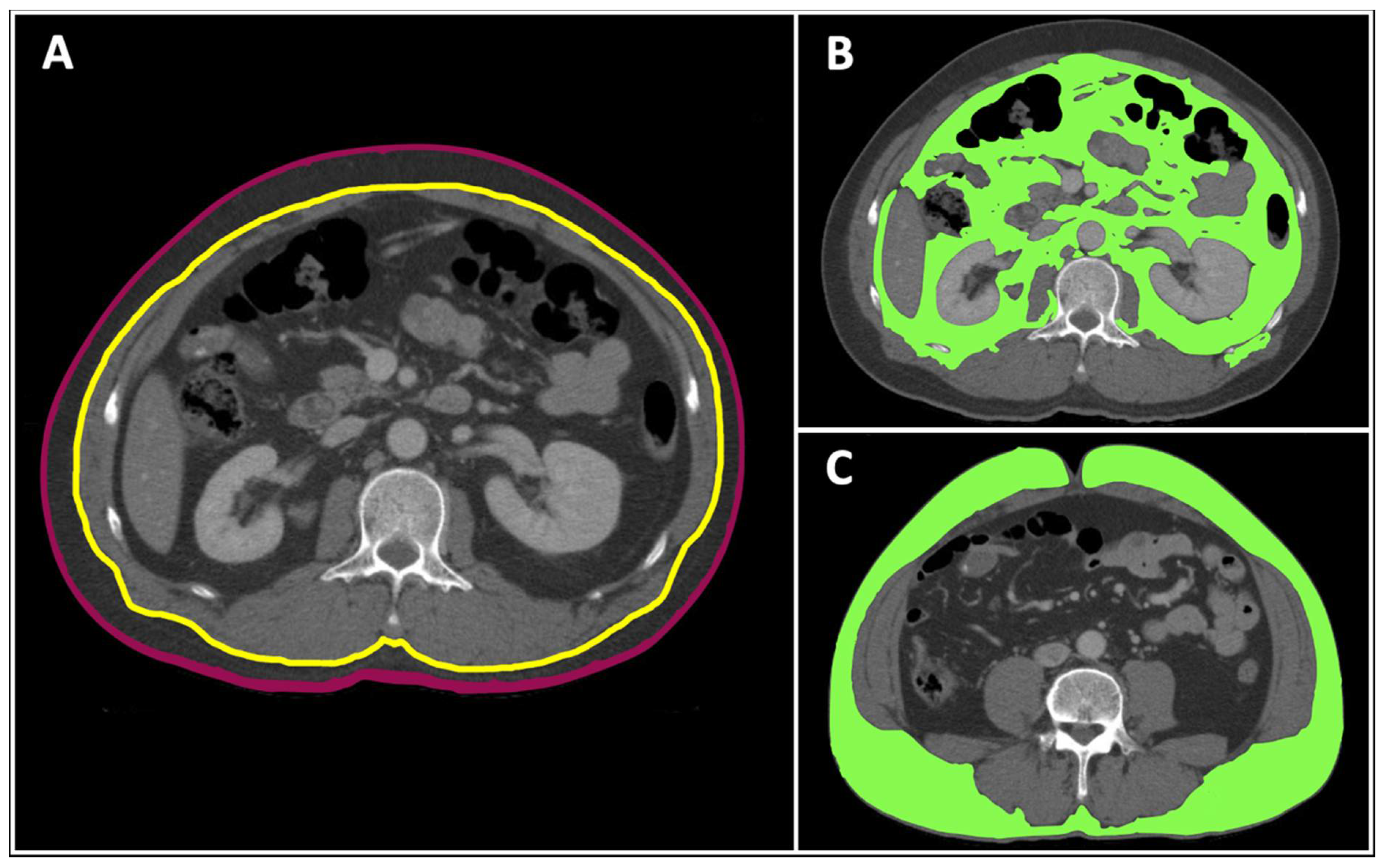
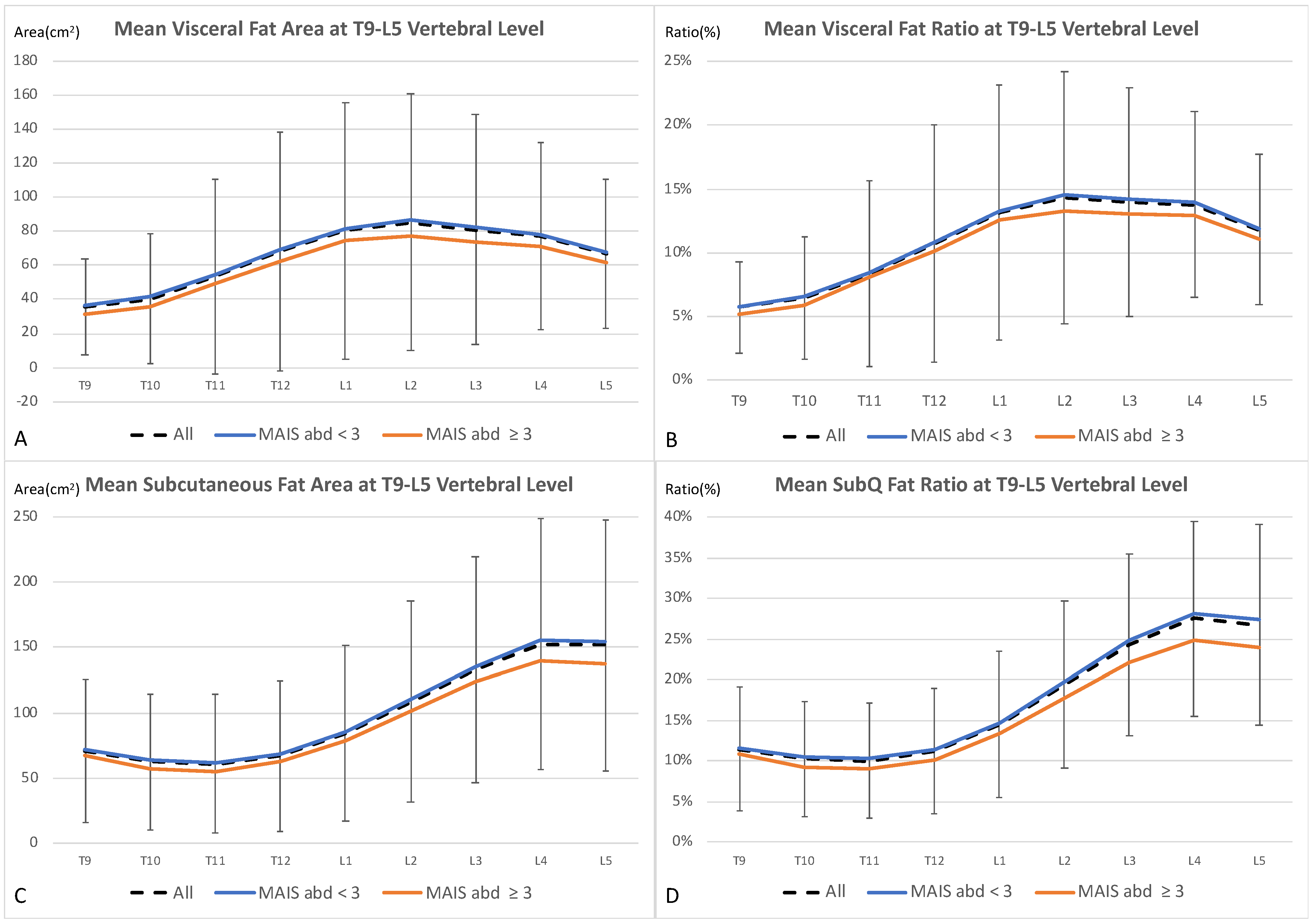
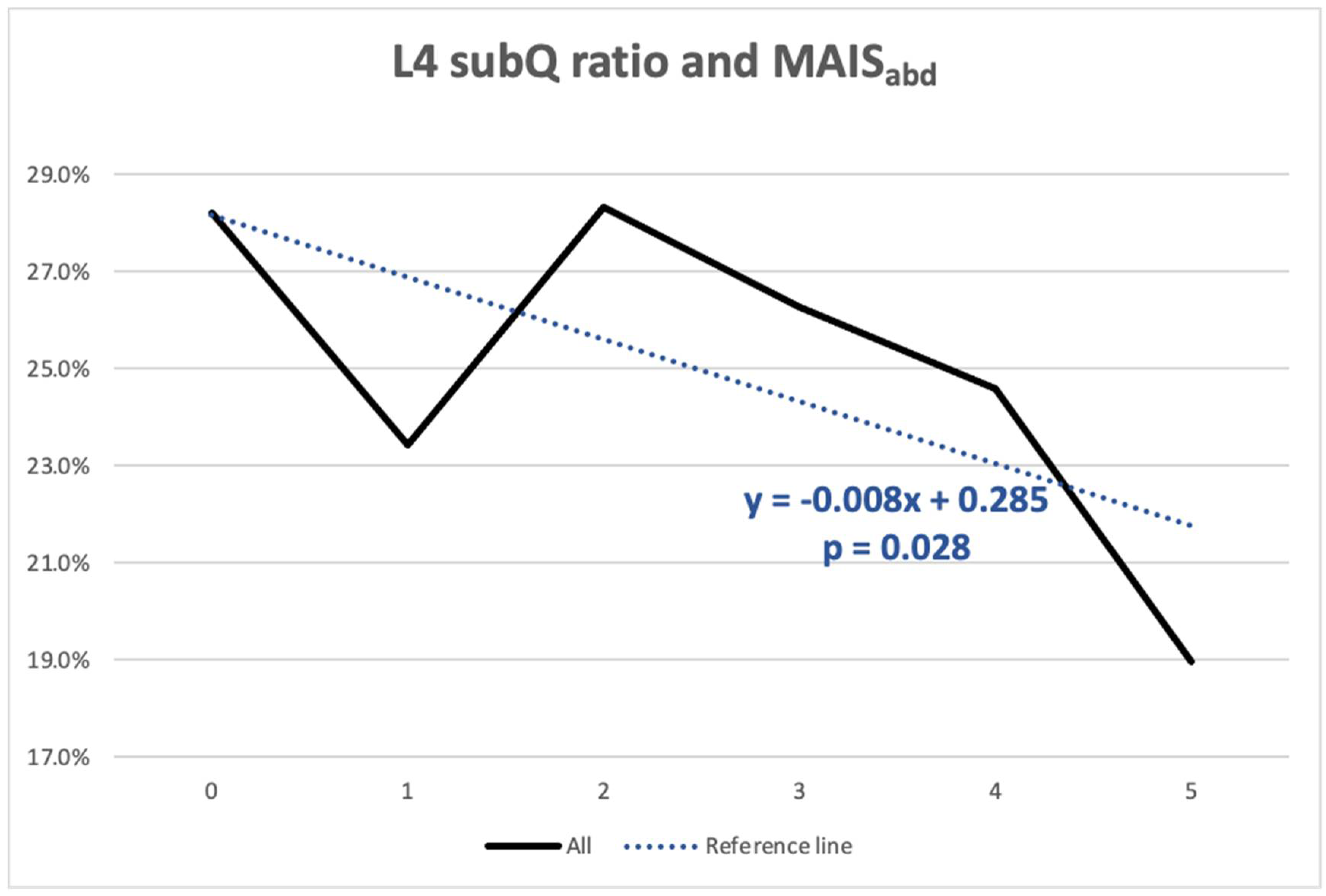
Introduction: The severity of injury from motor vehicle crashes (MVCs) depends on complex biomechanical factors, and the bodily features of the injured person account for some of these factors. By assuming that vulnerable road users (VRUs) have limited protection resulting from vehicles and safety equipment, the current study analyzed the characteristics of fat distribution measured by computed tomography (CT) imaging and investigated the existence of a “cushion effect” in VRUs. Materials and Methods: This retrospective study enrolled 592 VRUs involved in MVCs who underwent CT scans. Visceral fat area and subcutaneous fat cross-sectional area were measured and adjusted according to total body area (TBA) and are presented as the visceral fat ratio and the subQ fat ratio (subcutaneous fat ratio). Risk factors for serious abdominal injury (maximum abbreviated injury scale (MAISabd ≥ 3)) resulting from MVCs were determined by univariate and multivariate analysis. Results: MAISabd ≥ 3 was observed in 104 (17.6%) of the patients. The subQ fat ratio at the L4 vertebral level was significantly lower in the MAISabd ≥ 3 group than in the MAISabd < 3 group (24.9 ± 12.0 vs. 28.1 ± 11.9%; p = 0.015). A decreased L4 subQ fat ratio was associated with a higher risk for MAISabd ≥ 3 in multivariate analysis (odds ratio 0.063; 95% CI 0.008–0.509; p = 0.009). Conclusion: The current study supported the “cushion effect” theory, and protection was apparently provided by subcutaneous fat tissue. This concept may further improve vehicle and safety designation in the future.
Keywords: cushion effect; obesity; subcutaneous fat; vulnerable road user (VRU); abdominal injury cushion effect; obesity; subcutaneous fat; vulnerable road user (VRU); abdominal injury