Mapping Competence in Gastrointestinal Endoscopy Nursing Practice: An Item Response Theory Analysis of Perceived Skill Acquisition and Maintenance in Italy

 ,
,  , ,
, ,  , , ,
, , ,
Highlights
- This study quantifies perceived procedural repetition thresholds for both competence acquisition and maintenance across 30 endoscopic procedures. It demonstrates that complex or infrequently performed techniques require higher perceived thresholds and that more experienced nurses set stricter internal standards. The findings provide a validated, procedure-specific competence map for Italian endoscopy nursing.
- The results support the development of national competence standards, modular and adaptive training programs, and structured mentorship for gastrointestinal endoscopy nurses in Italy. Adoption of such a model could harmonize practice, enhance skill development, and improve patient outcomes.
Abstract
1. Introduction
2. Materials and Methods
2.1. Study Design
2.2. Setting
2.3. Participants
2.4. Study Variables
2.5. Sociodemographic and Professional Characteristics
2.6. Organizational and Educational Context
2.7. Acquisition and Maintenance of Specialized Skills
2.8. Statistical Analysis
2.9. Ethical Considerations
3. Results
3.1. Sociodemographics
3.2. Competence Acquisition
3.3. Competence Maintenance
3.4. Model Invariance and Differential Item Functioning
4. Discussion
4.1. Variability of Competence Thresholds Across Endoscopic Procedures
4.2. Acquisition Versus Maintenance of Competence: Educational Implications
4.3. Experience, Internal Standards, and Perceived Competence
4.4. Implications for Training Models and Competency Development
4.5. Interpretation and Applicability of Competence Thresholds
4.6. Study Limitations and Future Research Implications
5. Conclusions
Supplementary Materials
Author Contributions
Funding
Informed Consent Statement
Data Availability Statement
Acknowledgments
Conflicts of Interest
References
- Delamaire, M.-L.; Lafortune, G. Nurses in Advanced Roles: A Description and Evaluation of Experiences in 12 Developed Countries. OECD Health Working Papers. Available online: https://www.oecd.org/en/publications/nurses-in-advanced-roles_5kmbrcfms5g7-en.html (accessed on 12 November 2025).
- Jokiniemi, K.; Pietilä, A.M.; Kylmä, J.; Haatainen, K. Advanced nursing roles: A systematic review. Nurs. Health Sci. 2012, 14, 421–431. [Google Scholar] [CrossRef] [Scilit]
- Tucker, D.; Scrymgeour, G.; Marshall, B. Toward Developing a Nurse Endoscopist Role in New Zealand. Gastroenterol. Nurs. Off. J. Soc. Gastroenterol. Nurses Assoc. 2017, 40, 128–133. [Google Scholar] [CrossRef] [Scilit] [PubMed]
- Blythe, J.C.; Smith-Steinert, R.M.; Crouch, J.R.; Lehman, M.E. Improving Endoscopy Nursing Staff’s Patient Management Through the Implementation of an Education Initiative. Gastroenterol. Nurs. Off. J. Soc. Gastroenterol. Nurses Assoc. 2024, 47, 326–330. [Google Scholar] [CrossRef] [Scilit] [PubMed]
- Nabi, Z.; Reddy, D.N. Therapeutic endoscopy: Recent updates and future directions. Dig. Liver Dis. Off. J. Ital. Soc. Gastroenterol. Ital. Assoc. Study Liver 2024, 56, 1810–1818. [Google Scholar] [CrossRef] [Scilit] [PubMed]
- Conlon, C.; Campion, J.; Mehigan Farrelly, N.; Ring, E.; Dunne, T.; Gorman, D.; Murphy, S.; Kelleher, B.; Stewart, S.; Leyden, J.; et al. Endoscopy training through the COVID-19 pandemic: Maintaining procedural volumes and key performance standards. Frontline Gastroenterol. 2023, 14, 38–44. [Google Scholar] [CrossRef] [Scilit]
- Mahawongkajit, P.; Techagumpuch, A.; Auksornchat, K. Effects of basic endoscopic handling and care training on gastrointestinal endoscopy logistics. Endosc. Int. Open 2022, 10, E56–E61. [Google Scholar] [CrossRef] [Scilit]
- Ferrari, C.; Tadros, M. Enhancing the Quality of Upper Gastrointestinal Endoscopy: Current Indicators and Future Trends. Gastroenterol. Insights 2024, 15, 1–18. [Google Scholar] [CrossRef] [Scilit]
- Hamburg, M.A.; Collins, F.S. The path to personalized medicine. N. Engl. J. Med. 2010, 363, 301–304. [Google Scholar] [CrossRef] [Scilit]
- Fawaz, M. Role of nurses in precision health. Nurs. Outlook 2021, 69, 937–940. [Google Scholar] [CrossRef] [Scilit]
- National Academies of Sciences, Engineering, and Medicine; National Academy of Medicine; Committee on the Future of Nursing 2020–2030; Flaubert, J.L.; Le Menestrel, S.; Williams, D.R.; Wakefield, M.K. (Eds.) The Future of Nursing 2020–2030: Charting a Path to Achieve Health Equity; National Academies Press: Washington, DC, USA, 2021. Available online: https://www.ncbi.nlm.nih.gov/books/NBK573910/?report=printable (accessed on 10 November 2025).
- European Society of Gastroenterology and Endoscopy Nurses and Associate, ESGENA. ESGENA Core Curriculum for Endoscopy Nursing, 2008. Available online: https://esgena.org/publications/esgena-statements-and-curricula/ (accessed on 10 November 2025).
- European Society of Gastrointestinal Endoscopy, ESGE. Training in basic gastrointestinal endoscopic procedures: A European Society of Gastrointestinal Endoscopy (ESGE) and European Society of Gastroenterology and Endoscopy Nurses and Associates (ESGENA) Position Statement. Available online: https://www.esge.com/2023-a-2205-2613 (accessed on 12 November 2025).
- European Society of Gastroenterology and Endoscopy Nurses and Associates (E.S.G.E.N.A.). European Job Profile for Endoscopy Nurses: August 2004. Endoscopy 2004, 36, 1025–1030. [Google Scholar] [CrossRef] [Scilit]
- Napolitano, D.; Candela, M.L.; Gaggiotti, M.; Turchini, L.; Bertaglia, G.; Minenna, A.N.; Valdinoci, M.; Iannone, T.; Munno, N.; Iori, G.; et al. Definition of Skills and Roles of the Digestive Endoscopy Nurse: Italian Consensus of ANOTE-ANIGEA. Gastroenterol. Nurs. Off. J. Soc. Gastroenterol. Nurses Assoc. 2025, 48, 361–371. [Google Scholar] [CrossRef] [Scilit]
- Napolitano, D.; Scaldaferri, F.; Fiorino, G.; Spagnuolo, R.; Leonetti, A.; Lopetuso, L.R.; Cocchieri, A. Knowledge of Diagnostic and Therapeutic Aspects of IBD Among Nurses Working in Digestive Endoscopy: A Nationwide Italian Survey. Gastroenterol. Nurs. Off. J. Soc. Gastroenterol. Nurses Assoc. 2021, 44, E59–E66. [Google Scholar] [CrossRef] [Scilit] [PubMed]
- Napolitano, D.; Lo Cascio, A.; Bozzetti, M.; Povoli, A.; Grubissa, S.; Molino, L.; Marino, M.; Berretti, D.; Puca, P.; Lavigna, D.I.R.; et al. Patient Satisfaction with IBD Undergoing Colonoscopy: A Multicenter Cross-Sectional Study. J. Clin. Med. 2025, 14, 2562. [Google Scholar] [CrossRef] [Scilit] [PubMed]
- Ruiz Hernández, C.; Gómez-Urquiza, J.L.; Pradas-Hernández, L.; Vargas Roman, K.; Suleiman-Martos, N.; Albendín-García, L.; Cañadas-De la Fuente, G.A. Effectiveness of nursing interventions for preoperative anxiety in adults: A systematic review with meta-analysis. J. Adv. Nurs. 2021, 77, 3274–3285. [Google Scholar] [CrossRef] [Scilit] [PubMed]
- Liu, A.; Wang, H.; Lin, Y.; Fu, L.; Liu, Y.; Yan, S.; Chen, H. Gastrointestinal endoscopy nurse assistance during colonoscopy and polyp detection. Medicine 2020, 99, e21278. [Google Scholar] [CrossRef] [Scilit]
- Wang, W.; Xu, L.; Bao, Z.; Sun, L.; Hu, C.; Zhou, F.; Xu, L.; Shi, D. Differences with experienced nurse assistance during colonoscopy in detecting polyp and adenoma: A randomized clinical trial. Int. J. Colorectal Dis. 2018, 33, 561–566. [Google Scholar] [CrossRef] [Scilit]
- Dellon, E.S.; Lippmann, Q.K.; Sandler, R.S.; Shaheen, N.J. Gastrointestinal endoscopy nurse experience and polyp detection during screening colonoscopy. Clin. Gastroenterol. Hepatol. Off. Clin. Pract. J. Am. Gastroenterol. Assoc. 2008, 6, 1342–1347. [Google Scholar] [CrossRef] [Scilit]
- Kaminski, M.F.; Thomas-Gibson, S.; Bugajski, M.; Bretthauer, M.; Rees, C.J.; Dekker, E.; Hoff, G.; Jover, R.; Suchanek, S.; Ferlitsch, M.; et al. Performance measures for lower gastrointestinal endoscopy: A European Society of Gastrointestinal Endoscopy (ESGE) Quality Improvement Initiative. Endoscopy 2017, 49, 378–397. [Google Scholar] [CrossRef] [Scilit]
- Cheung, D.Y.; Jang, B.I.; Kim, S.W.; Kim, J.H.; Kim, H.K.; Shin, J.E.; Yoon, W.J.; Lee, Y.K.; Chung, K.H.; Cho, S.J.; et al. Multidisciplinary and Multisociety Practice Guideline on Reprocessing Flexible Gastrointestinal Endoscopes and Endoscopic Accessories. Clin. Endosc. 2020, 53, 276–285. [Google Scholar] [CrossRef] [Scilit]
- Salamanca-Balen, N.; Seymour, J.; Caswell, G.; Whynes, D.; Tod, A. The costs, resource use and cost-effectiveness of Clinical Nurse Specialist-led interventions for patients with palliative care needs: A systematic review of international evidence. Palliat. Med. 2018, 32, 447–465. [Google Scholar] [CrossRef] [Scilit]
- von Elm, E.; Altman, D.G.; Egger, M.; Pocock, S.J.; Gøtzsche, P.C.; Vandenbroucke, J.P.; STROBE Initiative. The Strengthening the Reporting of Observational Studies in Epidemiology (STROBE) statement: Guidelines for reporting observational studies. J. Clin. Epidemiol. 2008, 61, 344–349. [Google Scholar] [CrossRef] [Scilit] [PubMed]
- Andrich, D. Rasch Models for Measurement; Sage Publications, Inc.: Thousand Oaks, CA, USA, 1988. [Google Scholar]
- Masters, G.N. Partial Credit Model. In Handbook of Item Response Theory; Chapman and Hall/CRC: Boca Raton, FL, USA, 2016. [Google Scholar]
- Smith, A.B.; Rush, R.; Fallowfield, L.J.; Velikova, G.; Sharpe, M. Rasch fit statistics and sample size considerations for polytomous data. BMC Med. Res. Methodol. 2008, 8, 33. [Google Scholar] [CrossRef] [Scilit] [PubMed]
- Müller, M. Item fit statistics for Rasch analysis: Can we trust them? J. Stat. Distrib. Appl. 2020, 7, 5. [Google Scholar] [CrossRef] [Scilit]
- Christensen, K.B.; Makransky, G.; Horton, M. Critical Values for Yen’s Q3: Identification of Local Dependence in the Rasch Model Using Residual Correlations. Appl. Psychol. Meas. 2017, 41, 178–194. [Google Scholar] [CrossRef] [Scilit]
- Kopf, J.; Zeileis, A.; Strobl, C. Anchor Selection Strategies for DIF Analysis: Review, Assessment, and New Approaches. Educ. Psychol. Meas. 2015, 75, 22–56. [Google Scholar] [CrossRef] [Scilit]
- Robitzsch, A.; Kiefer, T.; Wu, M. TAM: Test Analysis Modules. 2024. Available online: https://github.com/alexanderrobitzsch/TAM (accessed on 1 November 2025).
- Mair, P.; Hatzinger, R. Extended Rasch Modeling: The eRm Package for the Application of IRT Models in R. J. Stat. Softw. 2007, 20, 1–20. [Google Scholar] [CrossRef] [Scilit]
- Yunoki, K.; Sakai, T. The role of simulation training in anesthesiology resident education. J. Anesth. 2018, 32, 425–433. [Google Scholar] [CrossRef] [Scilit]
- Bessmann, E.L.; Rasmussen, L.S.; Konge, L.; Kristensen, M.S.; Rewers, M.; Østergaard, D.; Airway Management Education Study Group. Maintaining competence in airway management. Acta Anaesthesiol. Scand. 2020, 64, 751–758. [Google Scholar] [CrossRef] [Scilit]
- Pann, K.J.; Buchner, V.K.; Eßl-Maurer, R.; Bacher, T.; Glarcher, M.; Ewers, A. International competencies of nurses with advanced practice in anesthesia nursing: An integrative review. Int. J. Nurs. Stud. Adv. 2025, 8, 100319. [Google Scholar] [CrossRef] [Scilit]
- Witt, C.M.; Balneaves, L.G.; Carlson, L.E.; Cohen, M.; Deng, G.; Fouladbakhsh, J.M.; Kinney, A.Y.; Mehta, A.; Mailman, J.; Pole, L.; et al. Education Competencies for Integrative Oncology-Results of a Systematic Review and an International and Interprofessional Consensus Procedure. J. Cancer Educ. Off. J. Am. Assoc. Cancer Educ. 2022, 37, 499–507. [Google Scholar] [CrossRef] [Scilit]
- Barr, J.; Fraser, G.L.; Puntillo, K.; Ely, E.W.; Gélinas, C.; Dasta, J.F.; Davidson, J.E.; Devlin, J.W.; Kress, J.P.; Joffe, A.M.; et al. Clinical practice guidelines for the management of pain, agitation, and delirium in adult patients in the intensive care unit. Crit. Care Med. 2013, 41, 263–306. [Google Scholar] [CrossRef] [Scilit]
- Rahmah, N.M.; Hariyati, R.T.S.; Sahar, J. Nurses’ efforts to maintain competence: A qualitative study. J. Public Health Res. 2021, 11, 2736. [Google Scholar] [CrossRef] [Scilit] [PubMed]
- Barleycorn, D.; Lee, G.A. How effective is trauma simulation as an educational process for healthcare providers within the trauma networks? A systematic review. Int. Emerg. Nurs. 2018, 40, 37–45. [Google Scholar] [CrossRef] [Scilit] [PubMed]
- Benner, P. From Novice to Expert: Excellence and Power in Clinical Nursing Practice. AJN Am. J. Nurs. 1984, 84, 1480. [Google Scholar] [CrossRef] [Scilit]
- Heydari, N.; Rakhshan, M.; Torabizadeh, C.; Salimi, G. Research article Individual innovation from the perspective of nursing students: A qualitative study. BMC Nurs. 2023, 22, 163. [Google Scholar] [CrossRef] [Scilit]
- Sguanci, M.; Mancin, S.; Carù, V.; Simonelli, N.; Cangelosi, G.; Morales Palomares, S.; Ferrara, G.; Lo Cascio, A. Exploring the Role of Advanced Practice Nurses in Cardiology: A Scoping Review. Int. Nurs. Rev. 2025, 72, e70054. [Google Scholar] [CrossRef] [Scilit]
- Assolari, F.; Mancin, S.; Lopane, D.; Dacomi, A.; Coldani, C.; Tomaiuolo, G.; Cattani, D.; Palomares, S.M.; Cangelosi, G.; Mazzoleni, B. Advanced practice nursing in surgery: A scoping review of roles, responsibilities, and educational programs. Int. Nurs. Rev. 2025, 72, e13045. [Google Scholar] [CrossRef] [Scilit]
- Kane, R.L.; Shamliyan, T.; Mueller, C.; Duval, S.; Wilt, T.J. Nurse staffing and quality of patient care. Evid. Rep./Technol. Assess. 2007, 1–115. [Google Scholar]
- Kang, S.J.; Tae, C.H.; Bang, C.S.; Shin, C.M.; Jeong, Y.H.; Choi, M.; Hwang, J.H.; Saito, Y.; Chiu, P.W.Y.; Rerknimitr, R.; et al. International Digestive Endoscopy Network consensus on the management of antithrombotic agents in patients undergoing gastrointestinal endoscopy. Clin. Endosc. 2024, 57, 141–157. [Google Scholar] [CrossRef] [Scilit]
- Elendu, C.; Amaechi, D.C.; Okatta, A.U.; Amaechi, E.C.; Elendu, T.C.; Ezeh, C.P.; Elendu, I.D. The impact of simulation-based training in medical education: A review. Medicine 2024, 103, e38813. [Google Scholar] [CrossRef] [Scilit]
- Gularte-Rinaldo, J.; Baumgardner, R.; Tilton, T.; Brailoff, V. Mentorship ReSPeCT Study: A Nurse Mentorship Program’s Impact on Transition to Practice and Decision to Remain in Nursing for Newly Graduated Nurses. Nurse Lead. 2023, 21, 262–267. [Google Scholar] [CrossRef] [Scilit]


| Variables | n (%) | |
|---|---|---|
| Age (years) M (SD) | 47.09 (9.57) | |
| Overall Experience (years) M (SD) | 23.64 (11.80) | |
| Endoscopy Experience (years) M (SD) | 10.08 (8.83) | |
| Coordination Experience (years) M (SD) | 1.56 (4.46) | |
| Gender | Female | 227 (68.4%) |
| Male | 105 (31.6%) | |
| Region | North | 93 (28.0%) |
| Center | 107 (32.2%) | |
| South & Islands | 132 (39.8%) | |
| Degree | Bachelor’s Degree | 264 (79.5%) |
| Master’s Degree | 26 (7.8%) | |
| Other | 42 (12.7%) | |
| Congress Attendance | Never | 36 (10.8%) |
| Rarely | 202 (60.8%) | |
| Always | 94 (28.3%) | |
| Formal Training | Yes | 176 (53.0%) |
| No | 73 (22.0%) | |
| No, but would like to | 82 (24.7%) | |
| Theoretical Training | Yes | 164 (49.4%) |
| No | 168 (50.6%) | |
| Checklist Use | Yes | 226 (68.1%) |
| No | 106 (31.9%) | |
| Organization Type | Public | 205 (61.7%) |
| University Public | 47 (14.2%) | |
| Private | 24 (7.2%) | |
| Mixed/Other (Research Institute, hybrid institutions) | 56 (16.9%) | |
| Procedure Intensity | High (e.g., ERCP, EUS, bariatric) | 220 (66.3%) |
| Medium (e.g., polypectomies, dilations) | 90 (27.1%) | |
| Low (e.g., screening, diagnostics) | 22 (6.6%) |
| Acquisition | Maintenance | |||||
|---|---|---|---|---|---|---|
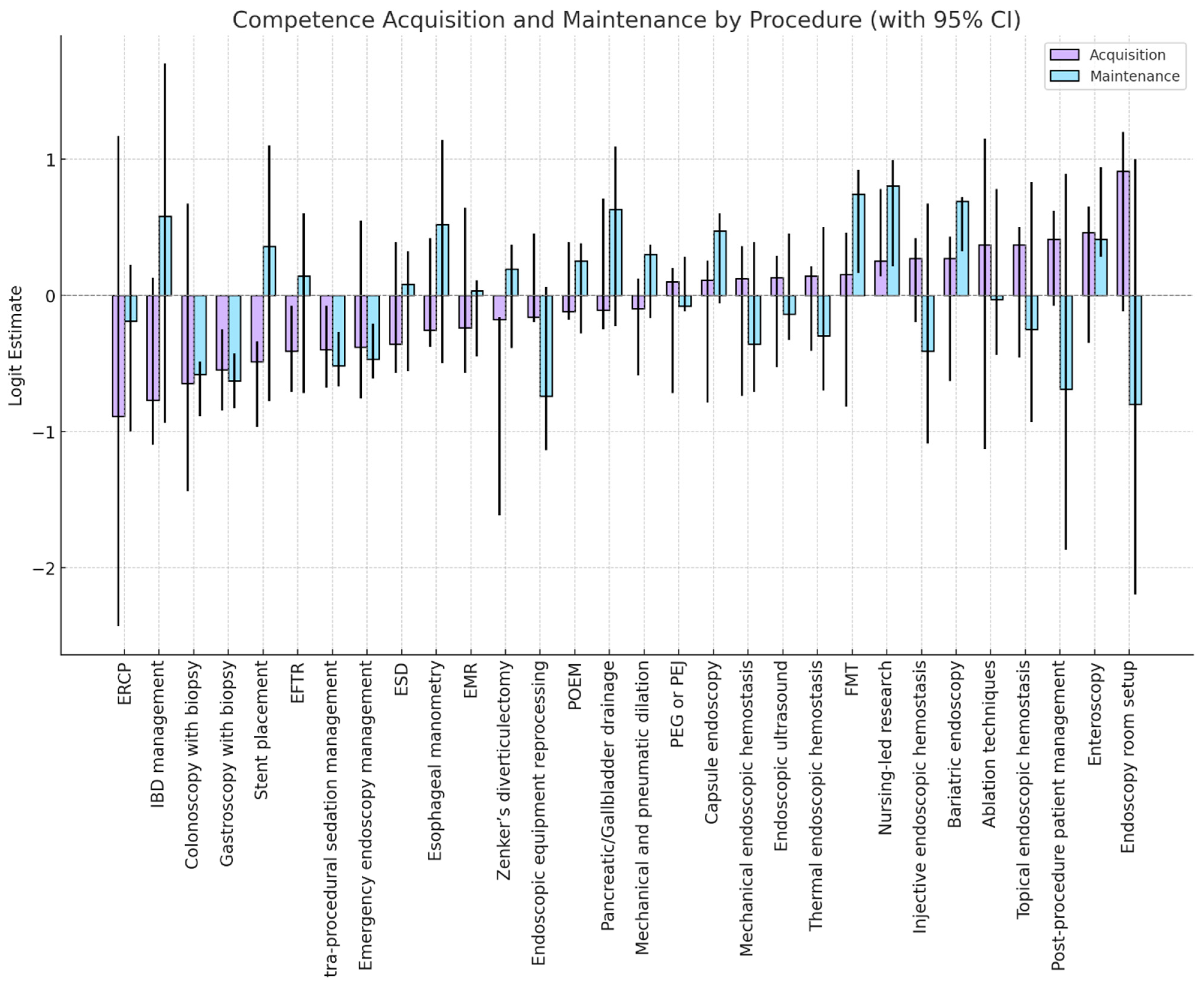
| Procedures | Procedures Needed | Logit Estimate [95% CI] | Outfit MSQ | Procedures Needed | Logit Estimate [95% CI] | Outfit MSQ |
| Endoscopy room setup | 11–30 | 0.91 [95% CI: 0.65, 1.17] | 1.53 | 11–30 | −0.8 [95% CI: −1.0, −0.6] | 0.78 |
| Endoscopic equipment reprocessing | 11–30 | −0.16 [95% CI: −0.44, 0.13] | 1.35 | 11–30 | −0.74 [95% CI: −0.94, −0.54] | 0.98 |
| Post-procedure patient management | 11–30 | 0.41 [95% CI: 0.14, 0.67] | 1.41 | 11–30 | −0.69 [95% CI: −0.89, −0.49] | 1.15 |
| Gastroscopy with biopsy | 11–30 | −0.55 [95% CI: −0.85, −0.25] | 1.16 | 11–30 | −0.63 [95% CI: −0.83, −0.43] | 1.20 |
| Colonoscopy with biopsy | 11–30 | −0.65 [95% CI: −0.97, −0.34] | 1.18 | 11–30 | −0.58 [95% CI: −0.78, −0.38] | 0.71 |
| Intra-procedural sedation management | 11–30 | −0.4 [95% CI: −0.71, −0.08] | 1.13 | 11–30 | −0.52 [95% CI: −0.72, −0.32] | 1.12 |
| Emergency endoscopy management | 31–50 | −0.38 [95% CI: −0.68, −0.08] | 0.99 | 11–30 | −0.47 [95% CI: −0.67, −0.27] | 1.04 |
| Injective endoscopic hemostasis | 31–50 | 0.27 [95% CI: 0, 0.55] | 0.82 | 11–30 | −0.41 [95% CI: −0.61, −0.21] | 1.21 |
| Mechanical endoscopic hemostasis | 31–50 | 0.12 [95% CI: −0.15, 0.39] | 0.91 | 11–30 | −0.36 [95% CI: −0.56, −0.16] | 1.27 |
| Thermal endoscopic hemostasis | 31–50 | 0.14 [95% CI: −0.14, 0.42] | 0.82 | 11–30 | −0.3 [95% CI: −0.5, −0.1] | 1.12 |
| Topical endoscopic hemostasis | 31–50 | 0.37 [95% CI: 0.09, 0.64] | 0.76 | 11–30 | −0.25 [95% CI: −0.45, −0.05] | 0.94 |
| ERCP: Stone removal, bile duct dilation, stent placement | 11–30 | −0.89 [95% CI: −1.62, −0.16] | 0.95 | 11–30 | −0.19 [95% CI: −0.39, 0.01] | 1.27 |
| Endoscopic ultrasound (with or without biopsy) | 31–50 | 0.13 [95% CI: −0.2, 0.45] | 0.93 | 11–30 | −0.14 [95% CI: −0.34, 0.06] | 1.18 |
| Percutaneous Endoscopic Gastrostomy (PEG or PEJ) | 31–50 | 0.1 [95% CI: −0.18, 0.39] | 0.79 | 11–30 | −0.08 [95% CI: −0.28, 0.12] | 1.04 |
| Ablation techniques (e.g., radiofrequency) | 31–50 | 0.37 [95% CI: 0.03, 0.71] | 1.08 | 11–30 | −0.03 [95% CI: −0.23, 0.17] | 1.42 |
| Endoscopic Mucosal Resection (EMR) | 31–50 | −0.24 [95% CI: −0.59, 0.12] | 0.65 | 31–50 | 0.03 [95% CI: −0.17, 0.23] | 0.86 |
| Endoscopic Submucosal Dissection (ESD) | 31–50 | −0.36 [95% CI: −0.72, 0] | 0.72 | 31–50 | 0.08 [95% CI: −0.12, 0.28] | 0.87 |
| Endoscopic Full-Thickness Resection (EFTR) | 31–50 | −0.41 [95% CI: −0.79, −0.03] | 0.86 | 31–50 | 0.14 [95% CI: −0.06, 0.34] | 0.98 |
| Zenker’s diverticulectomy | 11–30 | −0.18 [95% CI: −0.74, 0.36] | 0.74 | 31–50 | 0.19 [95% CI: −0.01, 0.39] | 1.43 |
| Peroral Endoscopic Myotomy (POEM) | 31–50 | −0.12 [95% CI: −0.53, 0.29] | 0.80 | 31–50 | 0.25 [95% CI: 0.05, 0.45] | 0.96 |
| Mechanical and pneumatic dilation | 31–50 | −0.1 [95% CI: −0.41, 0.21] | 0.79 | 31–50 | 0.3 [95% CI: 0.1, 0.5] | 0.74 |
| Stent placement for strictures | 31–50 | −0.49 [95% CI: −0.82, −0.16] | 0.68 | 31–50 | 0.36 [95% CI: 0.16, 0.56] | 1.31 |
| Enteroscopy | 31–50 | 0.46 [95% CI: 0.14, 0.78] | 0.75 | 31–50 | 0.41 [95% CI: 0.21, 0.61] | 1.11 |
| Capsule endoscopy | 11–30 | 0.11 [95% CI: −0.2, 0.42] | 0.96 | 31–50 | 0.47 [95% CI: 0.27, 0.67] | 0.77 |
| Esophageal manometry and pH monitoring | 11–30 | −0.26 [95% CI: −0.63, 0.11] | 1.35 | 31–50 | 0.52 [95% CI: 0.32, 0.72] | 1.30 |
| Endoscopic management of inflammatory bowel disease | 11–30 | −0.77 [95% CI: −1.13, −0.41] | 1.11 | 31–50 | 0.58 [95% CI: 0.38, 0.78] | 1.03 |
| Drainage of pancreatic or gallbladder collections | 31–50 | −0.11 [95% CI: −0.46, 0.24] | 0.93 | 31–50 | 0.63 [95% CI: 0.43, 0.83] | 1.48 |
| Bariatric endoscopy | 31–50 | 0.27 [95% CI: −0.08, 0.62] | 1.09 | 31–50 | 0.69 [95% CI: 0.49, 0.89] | 0.95 |
| Fecal microbiota transplantation (FMT) | 11–30 | 0.15 [95% CI: −0.35, 0.65] | 1.36 | 31–50 | 0.74 [95% CI: 0.54, 0.94] | 0.99 |
| Nursing-led endoscopy research | 31–50 | 0.25 [95% CI: −0.12, 0.62] | 1.50 | 31–50 | 0.8 [95% CI: 0.6, 1.0] | 0.73 |
Disclaimer/Publisher’s Note: The statements, opinions and data contained in all publications are solely those of the individual author(s) and contributor(s) and not of MDPI and/or the editor(s). MDPI and/or the editor(s) disclaim responsibility for any injury to people or property resulting from any ideas, methods, instructions or products referred to in the content. |
© 2026 by the authors. Licensee MDPI, Basel, Switzerland. This article is an open access article distributed under the terms and conditions of the Creative Commons Attribution (CC BY) license.
Share and Cite
Bozzetti, M.; Pascale, G.; Marcomini, I.; Lo Cascio, A.; Grilli, F.; Sclapari, C.; Multari, G.; Orgiana, N.; Gaggiotti, M.; Iori, G.; et al. Mapping Competence in Gastrointestinal Endoscopy Nursing Practice: An Item Response Theory Analysis of Perceived Skill Acquisition and Maintenance in Italy. Healthcare 2026, 14, 203. https://doi.org/10.3390/healthcare14020203
Bozzetti M, Pascale G, Marcomini I, Lo Cascio A, Grilli F, Sclapari C, Multari G, Orgiana N, Gaggiotti M, Iori G, et al. Mapping Competence in Gastrointestinal Endoscopy Nursing Practice: An Item Response Theory Analysis of Perceived Skill Acquisition and Maintenance in Italy. Healthcare. 2026; 14(2):203. https://doi.org/10.3390/healthcare14020203
Chicago/Turabian StyleBozzetti, Mattia, Gennaro Pascale, Ilaria Marcomini, Alessio Lo Cascio, Fabio Grilli, Caterina Sclapari, Grazia Multari, Nicoletta Orgiana, Mirko Gaggiotti, Giorgio Iori, and et al. 2026. "Mapping Competence in Gastrointestinal Endoscopy Nursing Practice: An Item Response Theory Analysis of Perceived Skill Acquisition and Maintenance in Italy" Healthcare 14, no. 2: 203. https://doi.org/10.3390/healthcare14020203
APA StyleBozzetti, M., Pascale, G., Marcomini, I., Lo Cascio, A., Grilli, F., Sclapari, C., Multari, G., Orgiana, N., Gaggiotti, M., Iori, G., Giordano, L. N., Mancin, S., Petrelli, F., Cangelosi, G., Lopetuso, L. R., & Napolitano, D. (2026). Mapping Competence in Gastrointestinal Endoscopy Nursing Practice: An Item Response Theory Analysis of Perceived Skill Acquisition and Maintenance in Italy. Healthcare, 14(2), 203. https://doi.org/10.3390/healthcare14020203